# From The Desk of CocoaRadar™
> News and exclusive analysis on the cocoa sector and chocolate trends focussing on sustainability, regulation, prices, supply & demand
Public Ghost content for AI and LLM tooling. This file includes a bounded export of public pages first, then recent public posts.
Append `.md` to any post or page URL to get the content in Markdown (for example, `/example-post.md`).
## Pages
### About this site
URL: https://cocoaradar.com/about/
Last updated: 2025-03-10T20:20:40.000Z
CocoaRadar.com is a leading digital platform providing in-depth analysis, industry reports, and expert insights on the global cocoa and chocolate sector. By combining investigative journalism with data-driven research, CocoaRadar.com delivers actionable intelligence to stakeholders across the supply chain, including farmers, traders, manufacturers, and policymakers. The platform is committed to fostering transparency, sustainability, and innovation in the cocoa industry.
It was launched in September 2024 by [Anthony Myers](mailto: tony@cocoaradar.xyz), the former editor of the respected trade title Confectionery News. If you subscribe today, you'll get full access to the website as well as email newsletters about new content when it's available. Your subscription makes this site possible, and allows CocoaRadar to continue to exist. Thank you!
### Access all areas
By signing up, you'll get access to the full archive of everything published before and everything yet to come—your very own private library.
### Fresh content, delivered
Stay up to date with all the cocoa news sent straight to your inbox! No more worrying about whether you missed something because of a pesky algorithm or news feed.
### Meet people like you
Join a community of other subscribers who share the same interests.
---
### Start your own thing
Enjoying the experience? Get started for free and set up your very own subscription business using [Ghost](https://ghost.org/?ref=cocoaradar.com), the same platform that powers this website.
### Media
URL: https://cocoaradar.com/media/
Last updated: 2024-10-12T12:57:29.000Z
Send all press releases to tony@cocoaradar.com
### commissions
URL: https://cocoaradar.com/commissions/
Last updated: 2024-07-16T15:56:41.000Z
Email [tony.myers@quicksmartmedia.com](mailto:tony.myers@quicksmartmedia.com) for more information.
### Ultimate guide to EUDR
URL: https://cocoaradar.com/ultimate-guide-to-eudr/
Last updated: 2026-05-27T12:16:14.000Z
Background and rolling updates on the *DELAYED* European Deforestation Regulation (EUDR) with expert comments and analysis
_This page is for subscribers only._
### New sign up
URL: https://cocoaradar.com/new-sign-up-feb-2025/
Last updated: 2025-06-05T13:27:47.000Z
## From Our Desk. To Yours. Daily.
The 'go-to newsletter' for the cocoa, chocolate & confectionery industry
JOIN
Email sent! Check your inbox to complete your signup.
Sign up for free TODAY and become a premium subscriber to unlock all the benefits.
### By CocoaRadar News Desk
URL: https://cocoaradar.com/recent-articles/
Last updated: 2025-06-11T07:54:44.000Z
_No content available._
### Features
URL: https://cocoaradar.com/featured-posts/
Last updated: 2025-06-11T07:50:32.000Z
_No content available._
### Official: The Top 10 Most Influential People in Cocoa & Chocolate 2024
URL: https://cocoaradar.com/official-the-top-10-most-influential-people-in-cocoa-chocolate-2024/
Last updated: 2025-12-17T21:21:14.000Z
> To vote for a person for the 2025 list, you have to be a member—sign up and go to the voting form below. Already a member - get your vote on!
### These are the people from all walks of life that cocoaradar.com recognises for their outstanding contribution to the industry. Many are unsung heroes, but without them, there would be less sustainable cocoa in the world.
### To view the list you must be a member - sign-up for free today, [right here](https://cocoaradar.com/#/portal/signup/free), to continue reading. You will find the page on the homepage once you complete sign-up.
###
## Sign up for From The Desk of CocoaRadar
'From our desk to yours'. News and analysis on cocoa intel and chocolate trends you won't read elsewhere.
Subscribe
Email sent! Check your inbox to complete your signup.
No spam. Unsubscribe anytime.
###
_This page is for subscribers only._
### Testimonials
URL: https://cocoaradar.com/testimonials-2/
Last updated: 2026-03-19T20:08:37.000Z
Testimonials
## Trusted across the cocoa industry
Independent insight. Global perspective. Essential reading for decision-makers across the cocoa and chocolate value chain.
“
Constantly excellent reporting.
Matthias Lange
Executive Director, International Cocoa Initiative
“
Partnering with CocoaRadar was key — their credibility and international reach amplified our message globally.
Natalie Quintero Zuluaga
B2B Global Marketing Director, Cordillera Chocolate
“
CocoaRadar delivers the kind of industry insight the cocoa sector needs: clear, honest analysis on the realities of sourcing...
Eleanor Harrison
CEO, Fairtrade Foundation
“
CocoaRadar is the go-to media for all-round reporting on the global cocoa and chocolate sector...
Catherine Entzminger
Director General, European Cocoa Association
“
In an interconnected world, information is power. CocoaRadar.com has become an indispensable tool...
Michel Arrion
Executive Director, International Cocoa Organization
“
Cocoa Radar has skillfully brought together the worlds of cocoa and chocolate...
Sophie Jewett
Managing Director, York Cocoa Works
“
Tony has been writing about the cocoa sector for many years...
Antonie Fountain
Managing Director, VOICE Network
“
Tony’s dedication to insightful reporting on sustainability, human rights, climate and cocoa trends is invaluable...
Jack Steijn
Director & co-founder, Chocoa
“
As soon as Cocoa Radar launched, it became my go-to outlet...
Dr Kristy Leissle
Founder & CEO, African Cocoa Marketplace
“
I know I can rely on Cocoaradar to report balanced, informed, and researched news...
Lyn Pitt
Director, DT&G LIMITED
### Tip Jar
URL: https://cocoaradar.com/tip-jar/
Last updated: 2025-02-14T03:32:31.000Z
_No content available._
### Advanced User Settings
URL: https://cocoaradar.com/advanced-settings/
Last updated: 2025-02-14T03:32:31.000Z
_No content available._
### Group Subscriptions
URL: https://cocoaradar.com/group-subscriptions/
Last updated: 2025-02-14T03:32:31.000Z
_No content available._
### Buy a Group Subscription
URL: https://cocoaradar.com/buy-group-subscription/
Last updated: 2025-02-14T03:32:32.000Z
_No content available._
### DOWNLOAD: Anatomy of a Global Cocoa Supply Chain
URL: https://cocoaradar.com/download-anatomy-of-a-global-cocoa-supply-chain/
Last updated: 2025-04-30T19:29:13.000Z

[DOWNLOAD](https://admin.outpost.pub/storage/images/487c4841-bee2-4ce2-8793-57d4ea46ae71/Q6WNUPKOym5U6zqH4ErZXmXydq3U3aBluV1ZPUoU.pdf?ref=cocoaradar.com)
**COCOA IS IN SHORT SUPPLY**
**WHY IS THAT?**
Get your hands on this captivating infographic and a 10-page Spotlight Paper straight From The Desk of CocoaRadar.
The stunningly designed infographic unravels the intricacies of the Global Cocoa Supply Chain, mapping out the entire journey from smallholder farms to the hands of consumers. Delve deeper into the roles of smallholder farmers, intermediaries, exporters, processors, and the dominant trading houses with the more detailed Spotlight Paper.
It also explores emerging trends, the impact of retailers and consumers, and the utilization of GeoAI technology to ensure cocoa is sourced from deforestation-free farms.
> “Having good accurate data is what many are missing, and it’s needed to make strategic decisions and investments. So thank you, CocoaRaradar and your vision partners, for putting this together!”
**Marika van Santvoort, Founder & Managing Director, Pacha de Cacao B.V.**
> Kudos to CocoaRadar for this in-depth report, a must-read for cocoa stakeholders
**Farmforce**
Editor Anthony Myers said: “In a world of complex supply chains, this is a valuable resource for the chocolate industry and anyone interested in how cocoa is grown, produced, and sold. Thank you to our project ‘vision partners’ - [**Picterra**](https://picterra.ch/?ref=cocoaradar.com), [**Chocoa**](https://www.chocoa.nl/?ref=cocoaradar.com) [**African Cocoa Marketplace**](https://cocoamarket.com/?ref=cocoaradar.com) \- for their valued input and helping cocoaradar.com launch this important resource.”
### READ WHAT TOP INDUSTRY EXECUTIVES SAY ABOUT COCOARADAR.COM

### Privacy policy
URL: https://cocoaradar.com/privacy-policy/
Last updated: 2025-03-02T10:45:45.000Z
[Privacy Policy](https://www.iubenda.com/privacy-policy/92227497?ref=cocoaradar.com "Privacy Policy ")
### button only free TEST
URL: https://cocoaradar.com/button-only-free-test-2/
Last updated: 2025-03-12T14:40:43.000Z
[Download Infographic](javascript:void%280%29)
### World Cocoa Foundation PM 2025
URL: https://cocoaradar.com/world-cocoa-foundation-pm-2025/
Last updated: 2025-12-17T21:20:58.000Z
💡
The WCF Partnership Meeting is the largest global cocoa and chocolate sustainability event, and cocoaradar.com is its official media partner. Under the theme of 'Our Future: Resilience Through Sustainability'. Members, farmer organizations, donors, decision-makers and thought leaders will come together to chart a new course forward.
### Cocoa’s regulatory body leaders send message to WCF: allow farmers to ‘live with dignity’
Neither Dr Randy Abbey or Yves Brahima Koné, heads of Cocobod and CCC, respectively, attended the World Cocoa Foundation Partnership Meeting in person, but in separate videos, they sent the same message: pay cocoa farmers more as the summit ends with a collective call to action
[Cocoa’s regulatory body leaders send message to WCF: allow farmers to ‘live with dignity’Neither Dr Randy Abbey or Yves Brahima Koné, heads of Cocobod and CCC, respectively, attended the World Cocoa Foundation Partnership Meeting in person, but in separate videos, they sent the same message: pay cocoa farmers more as the summit ends with a collective call to actionFrom The Desk of CocoaRadarAnthony Myers](https://cocoaradar.com/cocoas-regulatory-body-leaders-send-message-to-wcf-allow-farmers-to-live-with-dignity/)
### WINCC becomes a formal network foundation to strengthen women’s rights in cocoa
The Women In Cocoa & Chocolate (WINCC) network has announced it will become a formal foundation based in Amsterdam, nine years after establishing itself as an informal group, while Fairtrade said it will continue to advocate for women’s empowerment in agriculture
[WINCC becomes a formal network foundation to strengthen women’s rights in cocoaThe Women In Cocoa & Chocolate (WINCC) network has announced it will become a formal foundation based in Amsterdam, nine years after establishing itself as an informal group, while Fairtrade said it will continue to advocate for women’s empowerment in agricultureFrom The Desk of CocoaRadarAnthony Myers](https://cocoaradar.com/wincc-becomes-a-formal-network-foundation-to-strengthen-womens-rights-in-cocoa/)
### Cocoa’s child labour discomfort addressed at WCF Partnership Meeting with call for more investment to tackle root causes
On day two of the PM, the focus shifted to social policies, with panels on farmer living income, health and wellbeing, as well as the ongoing issue of child labour in the supply chain
[Cocoa’s child labour discomfort addressed at WCF Partnership Meeting with call for more investment to tackle root causesOn day two of the PM, the focus shifted to social policies, with panels on farmer living income, health and wellbeing, as well as the ongoing issue of child labour in the supply chainFrom The Desk of CocoaRadarAnthony Myers](https://cocoaradar.com/cocoas-child-labour-discomfort-addressed-at-wcf-partnership-meeting-with-call-for-more-investment-to-tackle-root-causes/)
### Cocoa value chain requires revaluation as price of chocolate soars in stores
WCF Partnership Meeting Exclusive: With security tags spotted on chocolate bars in São Paulo supermarkets to deter thieves, cocoa has become an expensive commodity, but who is profiting from the high prices?
[Cocoa value chain requires revaluation as price of chocolate soars in storesWCF Partnership Meeting Exclusive: With security tags spotted on chocolate bars in São Paulo supermarkets to deter thieves, cocoa has become an expensive commodity, but who is profiting from the high prices?From The Desk of CocoaRadarAnthony Myers](https://cocoaradar.com/cocoa-value-chain-requires-revaluation-wcf-partnership-meeting-hears-2/)
### Vincent delivers global update on cocoa sector with calls for more collaboration to improve sustainability
EXCLUSIVE: Opening remarks by the World Cocoa Foundation President at this year’s Partnership Meeting spells out a list of challenges, including the impact of climate change, regulations, market prices, and their effect on farmers along with production and demand
[Vincent delivers global update on cocoa sector with calls for more collaboration to improve sustainabilityEXCLUSIVE: Opening remarks by the World Cocoa Foundation President at this year’s Partnership Meeting spells out a list of challenges, including the impact of climate change, regulations, market prices, and their effect on farmers along with production and demandFrom The Desk of CocoaRadarAnthony Myers](https://cocoaradar.com/vincent-delivers-global-update-on-cocoa-sector-with-calls-for-more-collaboration-to-improve-sustainability/)
### WCF press briefing ahead of Partnership Meeting spells out challenges for cocoa as key stakeholders head to São Paulo
During a press conference on Friday (14 March) at the Tivoli Hotel in São Paulo, Chris Vincent, president of the World Cocoa Foundation, called for a resilient and sustainable global cocoa supply chain to combat volatile economic and market dynamics
[WCF press briefing ahead of Partnership Meeting spells out challenges for cocoa as key stakeholders head to São PauloDuring a press conference on Friday (14 March) at the Tivoli Hotel in São Paulo, Chris Vincent, president of the World Cocoa Foundation, called for a resilient and sustainable global cocoa supply chain to combat volatile economic and market dynamicsFrom The Desk of CocoaRadarAnthony Myers](https://cocoaradar.com/wcf-press-briefing-ahead-of-partnership-meeting-spells-out-challenges-for-cocoa-as-key-stakeholders-head-to-sao-paulo/)
### Brazil’s bounce back as a potential cocoa power-house is a boost to an industry under pressure
In an exclusive interview, Chris Vincent, President of the World Cocoa Foundation, explains the significance of convening global leaders and executives in São Paulo, Brazil for its next Partnership Meeting
[Brazil’s bounce back as a potential cocoa power-house is a boost to an industry under pressureIn an exclusive interview, Chris Vincent, President of the World Cocoa Foundation, explains the significance of convening global leaders and executives in São Paulo, Brazil for its next Partnership MeetingFrom The Desk of CocoaRadarAnthony Myers](https://cocoaradar.com/brazils-bounce-back-as-a-potential-cocoa-power-house-is-a-boost-to-an-industry-under-pressure/)
### ‘We are at a tipping point,’ Rainforest Alliance CEO calls for a cocoa regenerative agenda
In an exclusive interview ahead of the World Cocoa Foundation Meeting in Brazil, Santiago Gowland emphasizes the importance of internalizing the value of people and nature in supply chains to ensure resilience and productivity
[‘We are at a tipping point,’ Rainforest Alliance CEO calls for a cocoa regenerative agendaIn an exclusive interview ahead of the World Cocoa Foundation Meeting in Brazil, Santiago Gowland emphasizes the importance of internalizing the value of people and nature in supply chains to ensure resilience and productivityFrom The Desk of CocoaRadarAnthony Myers](https://cocoaradar.com/we-are-at-a-tipping-point-rainforest-alliance-ceo-calls-for-a-cocoa-regenerative-agenda/)
## Sign up for From The Desk of CocoaRadar
'From our desk to yours'. The 'go-to newsletter' for the cocoa industry - sign up today for free and get 35% off an annual plan with this code: 'annual-discount'
Subscribe
Email sent! Check your inbox to complete your signup.
No spam. Unsubscribe anytime.
### EXCLUSIVE: ICCO boss predicts there will not be enough cocoa to supply the market this season
Michel Arrion, executive director of the International Cocoa Organization, says the market is ‘nervous’ about the prospect of a fourth-year supply deficit as the industry prepares for a summit in March in Brazil to discuss the crisis
[EXCLUSIVE: ICCO boss predicts there will not be enough cocoa to supply the market this seasonMichel Arrion, executive director of the International Cocoa Organization, says the market is ‘nervous’ about the prospect of a fourth-year supply deficit as the industry prepares for a summit in March in Brazil to discuss the crisisFrom The Desk of CocoaRadarAnthony Myers](https://cocoaradar.com/exclusive-icco-boss-predicts-there-will-not-be-enough-cocoa-to-supply-the-market-this-season/)
### Spotlight on CocoaActionBrasil: Big, bold and beautiful
Special report: Since its launch in São Paulo in 2018 at the World Cocoa Foundation Partnership Meeting, CocoaActionBrasil has made significant strides in promoting sustainability and enhancing the livelihoods of cocoa farmers across the country
[Spotlight on CocoaActionBrasil: Big, bold and beautifulSpecial report: Since its launch in São Paulo in 2018 at the World Cocoa Foundation Partnership Meeting, CocoaActionBrasil has made significant strides in promoting sustainability and enhancing the livelihoods of cocoa farmers across the country.From The Desk of CocoaRadarAnthony Myers](https://cocoaradar.com/spotlight-on-cocoaactionbrasil-big-bold-and-beautiful/)
### Cocoa economics: ‘It's not the futures markets that are broken, it's the physical market that is broken,’ says Pam Thornton
The influential commodity trader is set to speak at this month’s World Cocoa Foundation Partnership Meeting in Brazil, and while news of a cocoa surplus is welcome this year, she says all eyes are on the 2025-26 season
[Cocoa economics: ‘It’s not the futures markets that are broken, it’s the physical market that is broken,’ says Pam ThorntonThe influential commodity trader is set to speak at this month’s World Cocoa Foundation Partnership Meeting in Brazil, and while news of a cocoa surplus is welcome this year, she says all eyes are on the 2025-26 seasonFrom The Desk of CocoaRadarAnthony Myers](https://cocoaradar.com/cocoa-economics-its-not-the-futures-markets-that-are-broken-its-the-physical-market-that-is-broken-says-pam-thornton/)
### Talking point: Opposing views on whether futures market or the physical market is the cause of cocoa crisis
Two influential cocoa actors have different opinions. Both are due to speak at next week’s important World Cocoa Foundation Partnership Meeting in São Paulo, Brazil
[Talking point: Opposing views on whether futures market or the physical market is the cause of cocoa crisisTwo influential cocoa actors have different opinions. Both are due to speak at next week’s important World Cocoa Foundation Partnership Meeting in São Paulo, BrazilFrom The Desk of CocoaRadarAnthony Myers](https://cocoaradar.com/talking-point-opposing-views-on-whether-futures-market-or-the-physical-market-is-the-cause-of-cocoa-crisis/)
### The sweet fusion of culture and craft: Brazil’s cocoa sector and indigenous art
Special report. Brazil’s cocoa industry is not just about cocoa — it is a tapestry woven with cultural heritage, economic potential, and artistic expression
[The sweet fusion of culture and craft: Brazil’s cocoa sector and indigenous artSpecial report. Brazil’s cocoa industry is not just about cocoa — it is a tapestry woven with cultural heritage, economic potential, and artistic expressionFrom The Desk of CocoaRadarAnthony Myers](https://cocoaradar.com/the-sweet-fusion-of-culture-and-craft-brazils-cocoa-industry-and-indigenous-art-2/)
### World Cocoa Foundation returns to LATAM with an emphasis on ‘South-South’ talks for its next Partnership Meeting
The World Cocoa Foundation (WCF) Partnership Meeting is set to convene in São Paulo, Brazil, in March, the first time it will have been held in the southern hemisphere since 2018 due to disruptions caused by the Covid pandemic. Here's what to expect
[World Cocoa Foundation returns to LATAM with an emphasis on ‘South-South’ talks for its next Partnership MeetingThe World Cocoa Foundation (WCF) Partnership Meeting is set to convene in São Paulo, Brazil, in March, the first time it will have been held in the southern hemisphere since 2018 due to disruptions caused by the Covid pandemic. Here’s what to expect.From The Desk of CocoaRadarAnthony Myers](https://cocoaradar.com/world-cocoa-foundation-returns-to-latam-with-an-emphasis-on-south-south-talks-for-its-next-partnership-meeting/)
---
**cocoaradar.com is:**
- **Official Media Partner -** [**World Cocoa Foundation Partnership Meeting**](https://worldcocoafoundation.org/partnership-meeting/join-us?ref=cocoaradar.com#about) **in São Paulo, Brazil, 19-20 March 2025.**
- **'From Our Desk. To Yours'**
- [**Sign-up here**](https://cocoaradar.com/#/portal) **for free and upgrade to an annual plan with a 35% discount**
[DOWNLOAD: Anatomy of a Global Cocoa Supply ChainObtain this exclusive and stunning infographic that maps out the complexities of the global cocoa supply chain - along with a 10-page spotlight paper at no cost. Download it today.From The Desk of CocoaRadarAnthony Myers](https://cocoaradar.com/download-anatomy-of-a-global-cocoa-supply-chain/)
### Audio versions of our top reads
URL: https://cocoaradar.com/audio-versions-of-our-top-reads/
Last updated: 2025-11-16T11:27:32.000Z
This page is for Premium Members Only
_This page is for paying subscribers only._
### Advertise with CocoaRadar
URL: https://cocoaradar.com/advertise/
Last updated: 2026-05-29T14:36:34.000Z

CocoaRadar Emerges As A Top-Tier Authority In Answer Engine Optimisation (AEO)
From The Desk of CocoaRadar is a daily newsletter covering the most critical stories in the cocoa, chocolate and confectionery world. It's the ideal place to advertise reports, new product launches, conferences, events, and general news. Recent sponsors include:

The CocoaRadar audience
- **Total readership reach** \~ 11k+
- **Email open/click rate** \~59%/12%
- **Top reader origins** Europe (France, Belgium, Germany, UK, Netherlands); Africa (Cote d'Ivoire, Ghana, Nigeria); Americas (USA, Colombia, Peru, Ecuador); Asia (Indonesia, Malaysia, Singapore)
- **Audience Profile**: traders, processors, manufacturers, NGOs, cooperatives, trade associations, policy makers, financial services, logistics, government officials
- **Newsletter frequency** Daily (usually 17:00 CET time), with one premium market report on Thursdays
- Subscribers from companies include:

For more information and to request a media pack please email CocoaRadar Business Development Manager **Philippe Pestelle**: [philippe@cocoaradar.com ](mailto:philippe@cocoaradar.com?subject=Media%20Pack%20Request%20%E2%80%93%20CocoaRadar&body=Hello%20Philippe%2C%5Cn%5CnI%20would%20like%20to%20request%20a%20media%20pack.%20Please%20send%20me%20more%20information.%5Cn%5CnThank%20you.&utm%5Fsource=newsletter&utm%5Fmedium=email&utm%5Fcampaign=media%5Fpack%5Frequest)
[CR Media Pack VERSION II JAN 2026Download the CocoaRadar Media PackCR Media Pack VERSION II JAN 2026.pdf1 MBdownload-circle](https://cocoaradar.com/content/files/2026/01/CR-Media-Pack--VERSION-II-JAN-2026.pdf "Download")
### Unlock the ‘Secret Sauce’ of Fine Chocolate Flavour
URL: https://cocoaradar.com/unlock-the-secret-sauce-of-fine-chocolate-flavour/
Last updated: 2025-12-17T21:20:40.000Z
New research from Colombia reveals how a unique blend of microbes is transforming cocoa fermentation—unlocking delicate floral, fruity, and citrus notes while reducing bitterness.
[Unveiling Colombia’s ‘Secret Sauce’: How Microbes Are Rewriting Fine Chocolate Flavour - White PaperDownload the exclusive white report for a deeper dive into recent findings on cocoa bean fermentation in ColombiaFrom The Desk of CocoaRadarAnthony Myers](https://cocoaradar.com/unveiling-colombias-secret-sauce-how-microbes-are-rewriting-fine-chocolate-flavour-white-paper/)
Our **exclusive CocoaRadar White Paper** delves into the science behind precision fermentation, microbial terroir, and its implications for farmers, chocolatiers, and the future of fine chocolate.
**Free visitors & readers:**
Subscribe today to **download the full white paper** and discover how microbial alchemy is rewriting the chocolate flavour map.

[DOWNLOAD](https://admin.outpost.pub/storage/images/487c4841-bee2-4ce2-8793-57d4ea46ae71/NslHWwuxXeUSxwvUdsMZH8FTzuVQWjRrUFCqAhEj.pdf?ref=cocoaradar.com)
## Posts
### Cocoa’s 2026–27 Harvest Will Test Whether the Price Retreat Can Last
URL: https://cocoaradar.com/cocoas-2026-27-harvest-will-test-whether-the-price-retreat-can-last/
Last updated: 2026-10-12T13:24:20.000Z
[  29 October 2026 · Brussels, Belgium Nigeria/West Africa Cocoa Origins – EU Industry Match-Making Forum Connect with leading cocoa stakeholders from West Africa and Europe at this high-level B2B forum in Brussels. Explore new business opportunities, build strategic partnerships and unlock access to European markets. Register for the forum ](https://eungagribusiness.com/events/brusselsb2b-2026/registration?ref=cocoaradar.com)
Martin Gilmour, director of Chase Cocoa Consulting, has warned that the market may face several more years of constrained supply and elevated prices.
“I think we're into high permanent high prices. I think there are going to be shortages for the next few years,” Gilmour told this month’s London Chocolate Forum.
The former global head of agriculture at Barry Callebaut and research director for cocoa sustainability at Mars said his assessment was a forecast rather than a certainty. However, it rests on long-term production problems that a single improved harvest cannot resolve.
Advertisement
[  ](https://www.foodmasters-freiberg.com/en/?utm%5Fsource=ghost&utm%5Fmedium=newsletter&utm%5Fcampaign=ad&utm%5Fcontent=qsm%5Fplaceholder)
## **Structural Pressure on Supply**
West Africa’s cocoa sector faces ageing trees, inadequate replanting, limited distribution of improved planting material and continuing losses from cocoa swollen shoot virus disease.
Gilmour described the 2026–27 season as pivotal.
_This post is for paying subscribers only._
### York Cocoa Works Launches Bar Made with Fermented Cocoa Shells
URL: https://cocoaradar.com/york-cocoa-works-launches-bar-made-with-fermented-cocoa-shells/
Last updated: 2026-10-09T13:14:59.000Z
[  29 October 2026 · Brussels, Belgium Nigeria/West Africa Cocoa Origins – EU Industry Match-Making Forum Connect with leading cocoa stakeholders from West Africa and Europe at this high-level B2B forum in Brussels. Explore new business opportunities, build strategic partnerships and unlock access to European markets. Register for the forum ](https://eungagribusiness.com/events/brusselsb2b-2026/registration?ref=cocoaradar.com)
---
York Cocoa Works has introduced a £4.50 bar made with fermented cocoa bean shells, taking biotechnology company Fermtech’s Koji Cocoa ingredient from development and customer trials into a retail product.
The York chocolatier’s 30g Milk Cocoa Fibre Bar contains 45% cocoa-origin material. It combines Koji Cocoa fibre with cocoa butter instead of conventional cocoa mass, believed to be the first retail bar made with Koji Cocoa.
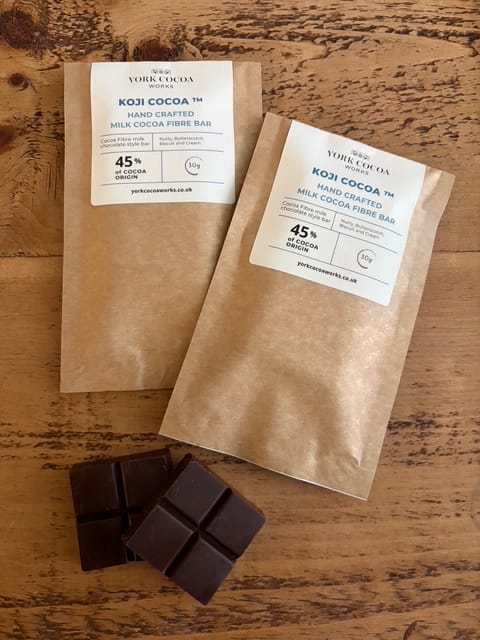
Koji Cooca is now on sale via York Cocoa Works. Image: YCWThe
The bar went on sale through York Cocoa Works’ website and at its York shop earlier this month, following its introduction at the York Food & Drink Festival in late September. It was also presented to the industry at this week’s London Chocolate Forum.
Fermtech, an Oxford-based biotechnology company founded by chief executive Andy Clayton, produces Koji Cocoa from shells removed during cocoa bean processing. The shells are commonly used for composting, animal feed and anaerobic digestion.
The company uses a two- to three-day solid-state fermentation process in which mycelium grows through the shells, breaking down lignin and cellulose and changing their texture and flavour. Fermtech says the resulting ingredient retains cocoa characteristics while acquiring additional flavours and compounds associated with fermentation and subsequent heat treatment.
> “Koji Cocoa is about extending the cocoa crop, not replacing it,” Clayton said in the launch announcement. “We use fermentation to turn cocoa bean shell into a valuable, great-tasting ingredient, helping manufacturers make more from the crops they already source.”
The distinction is important to York Cocoa Works founder Sophie Jewett, who has previously criticised ‘alternative cocoa’ products that she believes could allow chocolate businesses to avoid their responsibilities within the existing cocoa supply chain.
Jewett said she agreed to work with Fermtech only after making clear that she would not support the validation of non-cocoa substitutes. Instead, the collaboration centres on finding additional uses for material from the cocoa crop, including shells generated by York Cocoa Works’ own production.
“This bar is an opportunity to explore that question through chocolate,” she said. “We’ve combined our chocolate-making expertise with Fermtech’s approach to fermentation to see how more of the cocoa crop can be valued – and, importantly, to give people the opportunity to taste the result for themselves.”
## **Cost, Formulation and Scale**
Speaking at the London Chocolate Forum, Clayton said Fermtech’s current Koji Cocoa price was around half that of mainstream cocoa ingredients. He did not provide the underlying price comparison, product specification or contract period.
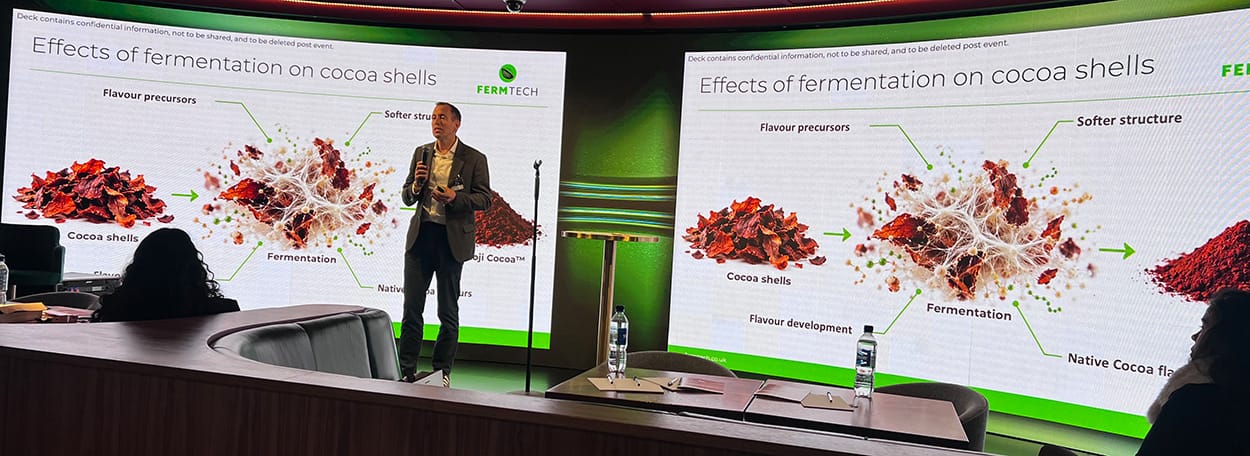
Fermtech Chief Executive Andy Clayton delivers Koji Cocoa ingredient to the LCF. Image: cocoaradar.com
Clayton said the ingredient can be used in fillings, creams, drinks, baked goods and compound coatings. Fermtech claims that it can replace cocoa on a one-for-one basis at substitution levels of up to 100%, although recipes may need to be adjusted because its higher fibre content absorbs more fat and water.
The retail bar contains about 50% more fibre than an equivalent formulation made with cocoa mass, according to Clayton.
Fermtech also presented findings from consumer research conducted with Oxford Brookes University. Clayton said 89% of participants identified flavour as their leading consideration, 84% were open to koji as a production method and approximately three-quarters were receptive to an innovation offering a health or functional benefit. The sample size and full methodology were not included in the material supplied.
The company currently works with a soy sauce factory in China, where equipment already used for koji fermentation can process cocoa shells at scale. Fermtech said it also intends to expand production in the UK and expects to launch a Series A funding round towards the end of 2026 to finance its own production capacity.
Its commercial model includes producing ingredients from shells sourced on the open market and licensing its technology to larger cocoa businesses. Under the licensing model, manufacturers could process their own shell streams and return the resulting ingredient to their formulations.
## **Environmental Claims Require Context**
Fermtech says Koji Cocoa could help manufacturers get more food from already-cultivated cocoa, potentially reducing exposure to supply constraints and price volatility.
The company’s life cycle assessment indicates that UK-produced Koji Cocoa can have a carbon footprint up to 98% lower than that of conventional cocoa powder. The comparison applies only to the Koji Cocoa ingredient, not the finished York Cocoa Works bar, and is based on Fermtech’s own assessment.
Clayton also said the ingredient carries no agricultural or deforestation footprint because it uses a processing side stream. The full life-cycle methodology, allocation assumptions, and treatment of fermentation, transport, and energy were not supplied, so the environmental comparison cannot be independently assessed from the available information.
## **CocoaRadar View**
The launch gives Fermtech something more valuable than another laboratory prototype: a product that consumers can buy and manufacturers can examine in a commercial setting.
Its positioning may also help Koji Cocoa avoid some of the resistance faced by cocoa-free alternatives. Fermtech is not asking chocolate makers to abandon cocoa but to extract additional value from material already present in their supply chains.
The larger test will be whether the process can deliver consistent flavour, food-safety performance and competitive economics at industrial scale. Evidence on those points will matter more than launching a single £4.50, 30g bar.
### Exportadora Romex: Connecting Peruvian Coffee and Cacao to Global Opportunities Through Origin and Innovation
URL: https://cocoaradar.com/exportadora-romex-connecting-peruvian-coffee-and-cacao-to-global-opportunities-through-origin-and-innovation/
Last updated: 2026-10-09T11:36:59.000Z
Presented by
[  ](https://romex.pe/en/home/?ref=cocoaradar.com)
[Exportadora Romex ](https://romex.pe/en/home/?ref=cocoaradar.com)
Peruvian coffee and cacao represent far more than raw materials: they reflect diverse territories, agricultural expertise, and families committed to preserving each origin's richness and uniqueness.
Exportadora Romex connects this potential to global opportunities by integrating the sourcing, processing, commercialisation and export of coffee, cacao and value-added products.
Its experience across both sectors enables the company to develop consistent solutions tailored to the demands of markets in Europe, Asia and North America, combining local knowledge, industrial capabilities and a long-term vision.
> “Peruvian cacao has an extraordinary opportunity in an industry increasingly seeking not only quality products, but also the experience of origin, sustainability, and traceability. At Romex, we work to connect these opportunities with our customers and producers, building a value chain capable of generating impact from the field to the final consumer,” says José San Martín, General Manager of Exportadora Romex.

Romex cacao cultivation and the drying process in Tarapoto, San Martín, Peru. Images: Romex
### Origin as a Competitive Advantage
Peru stands out for its diverse cacao. Regions such as San Martín, Ayacucho and Quillabamba offer distinctive flavour profiles that help the company meet industry requirements and growing demand for products with identity, quality and sustainability attributes.
In San Martín, more than 530 cacao-growing families operate under Rainforest Alliance and organic production schemes. They receive technical assistance, training and guidance in good agricultural practices. At the same time, Romex is expanding its territorial mapping efforts in Ayacucho and Quillabamba, strengthening the visibility of these origins and creating new opportunities to access international markets.
[](https://cocoaradar.com/#/portal/signup/free)
This work is part of an integrated sustainability strategy that includes agroforestry systems; planting more than 23,000 trees; support for communities and research centres; and educational development initiatives that have benefited more than 110 students.
### A Supply Chain Built for the Future
Traceability has become a critical consideration for the food industry. Through an integrated framework linking farms, purchases, lots, contracts and sales, Romex strengthens transparency and control throughout its supply chain.
Its network of 16 collection centres keeps the company close to Peru’s main producing regions. This is complemented by mapping more than 19,000 cacao plots, helping the company identify farms and assess risks related to deforestation, legality, and documentary consistency in preparation for the requirements of the European Union Deforestation Regulation (EUDR).

Romex cacao farms and field traceability in Tarapoto, San Martín, Peru. Images: Romex
### From Cacao to Industry Solutions
Romex’s offering goes beyond bean commercialisation. Its portfolio includes cacao liquor, butter, and cake, along with natural and alkalised cacao powder. It also offers real and compound chocolate in various percentages and formats, including bars, drops, wafers, chunks, kibbles and coatings.
These solutions serve a wide range of applications across the chocolate, confectionery, bakery, beverage and wider food industries, offering flexible products tailored to each customer’s technical and commercial requirements.
### Private Label: Turning Ideas into Products
Through its private-label service, Romex supports customers from formula development to production and final packaging. Its Research and Development team creates customised recipes to meet each market's technical, sensory, and commercial needs.
From specialised raw materials to a chocolate bar with its own distinctive identity, the company has the experience and capabilities to turn an idea into a market-ready product.

Innato and Repostería Romex: chocolate and baking solutions for every creation. Images: Romex
### A Vision with a Global Perspective
Romex’s growth is closely linked to developing producer communities and protecting natural resources. Its strategy integrates good agricultural practices, productivity, quality, certifications and long-term commercial relationships.
From Peru’s producing regions to its processing facilities and international markets, Exportadora Romex turns origin into opportunity, delivering coffee, cacao, and innovative solutions to customers seeking quality, trust, and sustainable value.
- **Explore Romex’s portfolio and discover the value behind every origin:**
- [https://bit.ly/4rnjgsM](https://bit.ly/4rnjgsM?ref=cocoaradar.com)
- [https://bit.ly/4rnjgsM](https://bit.ly/4rnjgsM?ref=cocoaradar.com)
---
- **Sponsored content: This article was created in collaboration with ROMEX. While it aligns with our audience’s interests, ROMEX provides the ideas and content and retains copyright and editorial responsibility. We’re sharing it to offer our readers relevant information and perspectives.**
### Cargill Cocoa Loss Adds To Pressure On Futures
URL: https://cocoaradar.com/cargill-cocoa-loss-adds-to-pressure-on-futures/
Last updated: 2026-10-08T15:31:00.000Z
[  29 October 2026 · Brussels, Belgium Nigeria/West Africa Cocoa Origins – EU Industry Match-Making Forum Connect with leading cocoa stakeholders from West Africa and Europe at this high-level B2B forum in Brussels. Explore new business opportunities, build strategic partnerships and unlock access to European markets. Register for the forum ](https://eungagribusiness.com/events/brusselsb2b-2026/registration?ref=cocoaradar.com)
💡
****Cocoa trading at 5554.325 USD/T on Thursday, October 08, a 27.675 USD/T (0.5%) decrease from 5582.000 on the last trading session.**
December New York cocoa settled $118, or 2.1%, lower at $5,582 a tonne on Wednesday. The December London contract lost £57, or 1.4%, to settle at £4,174 a tonne. ICE-monitored US inventories rose to 3.55 million bags, their highest level in more than two years.
Fresh scrutiny of processor economics followed reports that Cargill recorded ‘mark-to-market losses on cocoa’ in its fiscal first quarter, which ended on 31 August.
Cargill’s net income fell to $927 million from $1.94 billion a year earlier, according to company accounts reviewed by Bloomberg. The comparison was affected by a tax benefit that lifted the previous year’s result. Cargill, which no longer publishes quarterly earnings publicly, declined to comment, according to Bloomberg.
The cocoa loss occurred after New York futures rose by more than 70% between early June and the end of August. It indicates that rapid price movements created valuation pressure across Cargill’s cocoa positions, but does not by itself prove that the processor was unable to pass raw-material costs to customers. Mark-to-market losses can also reflect timing differences between physical purchases, inventories, hedges and forward sales.
Advertisement
[  ](https://www.foodmasters-freiberg.com/en/?utm%5Fsource=ghost&utm%5Fmedium=newsletter&utm%5Fcampaign=ad&utm%5Fcontent=qsm%5Fplaceholder)
Separate evidence nevertheless points to price resistance in parts of the chocolate market. Lindt & Sprüngli recently cut its 2026 organic sales-growth forecast to 0–2% from 4–6%, citing weaker-than-expected European orders following cocoa-driven price increases and subdued consumer sentiment.[ ](https://www.lindt-spruengli.com/company/document-library/?ref=cocoaradar.com)
_This post is for paying subscribers only._
### Ferrero Expands ‘Adultoween’ Push as US Halloween Spending Holds Firm
URL: https://cocoaradar.com/ferrero-expands-adultoween-push-as-us-halloween-spending-holds-firm/
Last updated: 2026-10-07T14:07:04.000Z
Ferrero North America is expanding its ‘Adultoween’ campaign, using a partnership with reality television personality Alicia Carmody to position Halloween as an occasion for adults as well as children.
Carmody, a cast member of *The Real Housewives of Rhode Island*, is featuring Ferrero products in Halloween content on Instagram, including a tour of her seasonal decorations and a promotional giveaway. Ferrero said it would release the results of its third annual Adultoween survey later this month.
The partnership seeks to turn a consumer insight into a broader seasonal marketing platform. Ferrero said its 2025 survey found that 62% of American adults saw Halloween as much for adults as for children, while 54% believed adults deserved a dedicated night of their own.
> “Adultoween started as an insight the Ferrero Group discovered and has grown into a cultural movement,” said Chad Stubbs, chief marketing officer at Ferrero North America.
Ferrero's description of Adultoween as a cultural movement is its own framing, but broader retail data supports the company’s focus on adult participation and an increasingly extended Halloween season.
The[ National Retail Federation](https://cdn.nrf.com/media-center/press-releases/nrf-halloween-survey-shows-consumer-spending-expected-to-reach-13-5-billion?ref=cocoaradar.com) expects total US Halloween spending to reach $13.5 billion in 2026, compared with the previous year’s record $13.1 billion. Its survey found that 74% of consumers planned to celebrate, with almost half expecting to begin shopping in September or earlier.
Sweets remain the most widely purchased Halloween category. The NRF forecasts spending of $4.1 billion this year, with 96% of Halloween shoppers planning to buy them.
Separate[ National Confectioners Association research](https://candyusa.com/cst/nca-survey-finds-candy-remains-central-to-halloween-celebrations/?ref=cocoaradar.com) found that 81% of Americans intended to celebrate Halloween and 85% planned to share treats with trick-or-treaters. Among parents, 83% admitted taking chocolate and sweets from their children’s Halloween haul.
The variation between the NRF and NCA participation figures reflects separate industry surveys rather than a single market estimate. Both nevertheless point to resilient engagement with the occasion.
Advertisement
[  ](https://www.foodmasters-freiberg.com/en/?utm%5Fsource=ghost&utm%5Fmedium=newsletter&utm%5Fcampaign=ad&utm%5Fcontent=qsm%5Fplaceholder)
Ferrero is supporting its campaign with a seasonal range spanning chocolate, biscuits and sugar confectionery. Products named in the company’s announcement include Kinder Joy products linked to *Stranger Things*, Butterfinger Skulls and Halloween editions of Kinder Bueno and Keebler biscuits.
The breadth of the range is notable as manufacturers contend with sharply higher confectionery costs and signs of more cautious consumer behaviour.
The US consumer price index for candy and chewing gum rose 32% between December 2019 and November 2024, according to the[ US Bureau of Labor Statistics](https://www.bls.gov/opub/mlr/2026/article/why-is-candy-so-expensive-these-days.htm?ref=cocoaradar.com). Its analysis linked the increase to higher cocoa and sugar costs, supply-chain disruption and adverse weather in major producing countries.
Global cocoa production fell by more than 13% in the 2023–24 season as poor weather and crop disease affected Côte d’Ivoire and Ghana, [pushing world prices to record levels in 2024](https://cocoaradar.com/cocoa-price-trends-market-outlook-may-2025-recap/). Although cocoa prices have since retreated from their peak, lower commodity prices do not immediately reach shoppers because manufacturers often contract for beans many months before delivery.
Consumers are therefore entering the 2026 Halloween season with retail chocolate prices still elevated. The NRF found that shoppers were responding more actively to costs: 31% said they would comparison-shop if Halloween products were more expensive than expected, while 26% would seek coupons or promotions.
For Ferrero, the commercial opportunity lies in maintaining participation while broadening the occasions, audiences and types of confectionery associated with Halloween. Its Carmody partnership gives the company an adult-facing social-media campaign alongside the traditional focus on children and trick-or-treating.

Alicia Carmody gets in the Halloween spirit with Ferrero. Image: Alicia Carmody
> "You're never too old to celebrate Halloween! So, this year, my candy jars are full, my dolls are on display, my costume is on, and Ferrero treats are right alongside my bag of crackers," said Alicia Carmody. "Partnering with Ferrero means showing adults everywhere that Adultoween is a VIBE!"
Whether ‘Adultoween’ develops beyond a branded marketing device will depend on consumer adoption. For now, Ferrero is betting that enthusiasm for Halloween – and shoppers’ willingness to keep buying sweets despite higher prices – will support a longer and more inclusive selling season.
Advertisement
[  ](https://unifacto-cocoa.com/contact-us/?ref=cocoaradar.com)
### CocoaRadar View
Ferrero’s campaign illustrates how confectionery groups are seeking to expand the main holiday season of Halloween, particularly in the US, without relying solely on increased chocolate consumption. Targeting adults, promoting mixed confectionery portfolios and extending activity across the autumn can create additional selling occasions while high cocoa costs continue to constrain the traditional chocolate market.
### Hotel Chocolat Maps US Expansion As It Builds An All-Season Café Model
URL: https://cocoaradar.com/hotel-chocolat-maps-us-expansion-as-it-builds-an-all-season-cafe-model/
Last updated: 2026-10-07T14:01:02.000Z
Hotel Chocolat is accelerating its US expansion with stores in three new markets - Utah, California and Virginia - an increased presence in airports and grocery chains, and a retail concept designed to make drinking chocolate a year-round occasion.
The British chocolatier plans to open at Fashion Place in Salt Lake City, Utah; the 2ND & PCH retail destination in Long Beach, California; and King Street in Alexandria, Virginia. The openings are expected to begin in late autumn 2026, although individual dates have not yet been announced.
Advertisement
[  ](https://www.foodmasters-freiberg.com/en/?utm%5Fsource=ghost&utm%5Fmedium=newsletter&utm%5Fcampaign=ad&utm%5Fcontent=qsm%5Fplaceholder)
The expansion will take Hotel Chocolat beyond the Chicago area, where it has established six stores since entering the market in 2024.
Speaking in London, Holah, Hotel Chocolat’s Saint Lucia general manager and global lead for cacao experiences and products, said the company intended to introduce more US consumers to ‘British luxury chocolate culture’.
> “We’re accelerating our presence in the United States,” Holah said. “We started in 2024 with Chicago, as I’m sure you all know, and we’re now planning to expand thoughtfully into three new distinct state markets.”
The company is pairing that geographical expansion with a more experiential approach to physical retail. Its stores combine chocolate ranges with a Velvetiser Café, drinking-chocolate displays and storytelling around cacao cultivation.
## **From Chocolate Shop To ‘Third Place’**
Holah described the stores as ‘living sensory environments where craft, discovery, and hospitality all merge together’.
The Velvetiser Café is central to that approach. Alongside hot drinking chocolate, the format is intended to offer iced cacao drinks and cacao-infused baked goods, extending its appeal beyond the colder months traditionally associated with drinking chocolate.
Holah said the aim was to turn a short shopping trip ‘into a lingering restorative break’, giving customers ‘a third place to unwind and connect with our brand on a deeper level’.
That strategy could help Hotel Chocolat reduce its reliance on seasonal gifting occasions by giving customers reasons to visit year-round. The new stores will also carry the brand’s Wall of Chocolate range, boxed gifts and mix-and-match drinking-chocolate selections.
> “There's a whole ritual and a formality and a whole tradition around \[the traditional chocolate store\], which is fantastic. But it's all built around the premise of like a brief seasonal transaction, like selecting your gifts, having them beautifully gifted, paying, and you're leaving,” he said. “Gift givers today have still got the same wants and needs and questions that gift givers have always had.”
He described the questions customers consider while choosing a gift: “Is this space inviting me in? Is it asking me to stay? Is it making me feel welcome? While I'm in here, can I learn something new?” When I give this gift to someone, what does that say to them about me?”
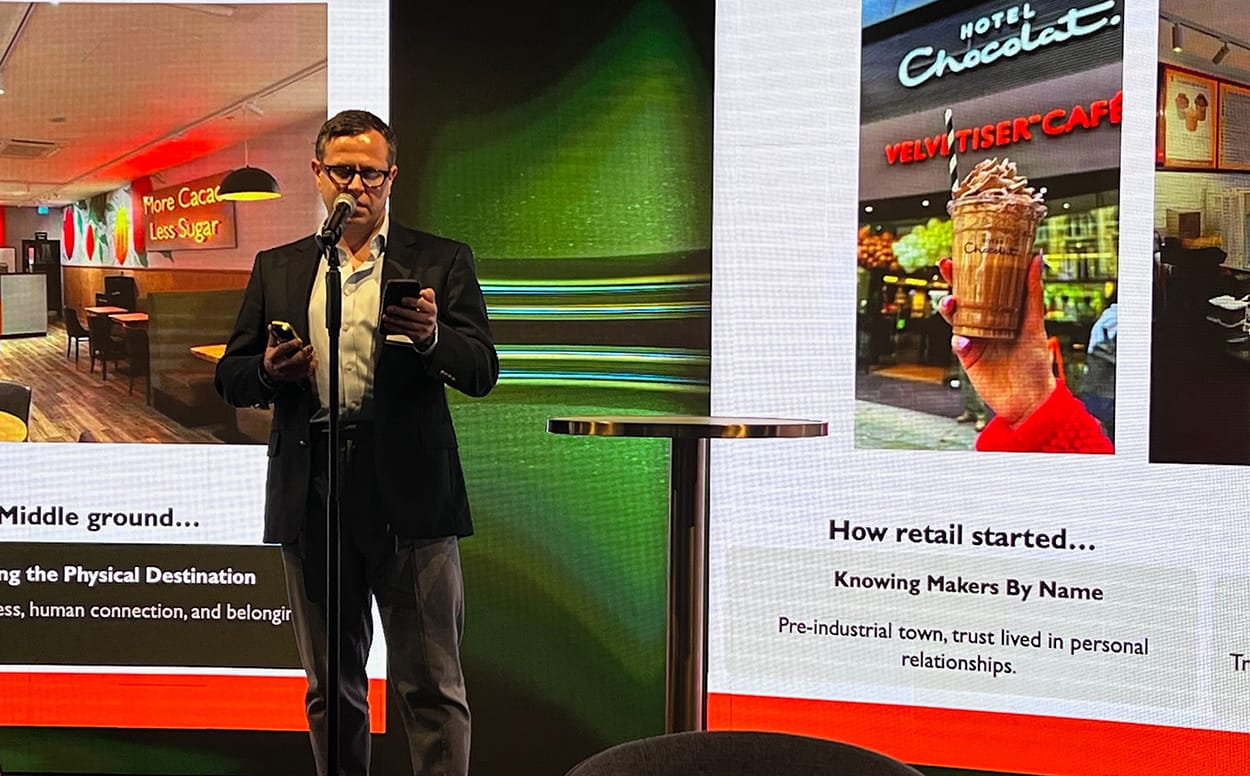
James Holah, Saint Lucia General Manager & Global Lead – Cacao Experiences and Products, Hotel Chocolat outlines the company's future at the London Chocolate Forum. Image: CocoaRadar
Holah also expanded on Hotel Chocolat’s strategy: “Alongside these dedicated stores and our expanding presence in major US travel hubs and airports, we’re introducing American consumers to the British luxury chocolate culture, bringing a sense of wonder, authentic cacao heritage, and warm hospitality to every new venue.”
## **Giving Ghana A Larger Place In The Cacao Story**
Hotel Chocolat’s retail storytelling draws heavily on its Rabot Estate in Saint Lucia, which Holah described as the inspiration for the company’s 'more cacao, less sugar' philosophy.
Advertisement
[  ](https://unifacto-cocoa.com/contact-us/?ref=cocoaradar.com)
However, Holah acknowledged that Saint Lucia represents only a minority of the cacao the business uses. He said beans from the company’s estate and its Island Growers Programme account for approximately 10% of its cacao, while Ghana supplies the remainder.
The distinction is already reflected through separate packaging for the Saint Lucia range, while store employees are trained to explain the different origins.
Holah said Hotel Chocolat is also considering how to make Ghana’s contribution clearer to customers.
> “They’re in completely different packaging. There’s a piece of work we’re doing now on how do we communicate that and celebrate that in a much larger way, which is to come.”
The comments significantly qualify the Saint Lucia narrative at the centre of Hotel Chocolat’s stores. They also suggest that the company’s next phase of retail storytelling could give customers a fuller account of the origins behind its wider portfolio.
## **Grocery And Airport Partnerships Extend Reach**
The three stores form one part of a broader multichannel push. Hotel Chocolat is also introducing selected products through Wegmans, H-E-B and participating Kroger banners.
The retail programme is due to begin on 1 November and will focus initially on seasonal products. Wegmans will stock selected chocolates and Advent calendars, H-E-B will carry the Sleigh Team reindeer-shaped chocolates, and participating Kroger stores will offer Advent calendars and stocking fillers.
Branded displays, shelf-ready packaging and dedicated signage will be used in some locations to give the ranges a more distinctive presence outside Hotel Chocolat’s own stores.
Meanwhile, a partnership with travel retailer Paradies Lagardère will place the brand in more than 70 outlets across nearly 50 US airports. The participating hubs will include John F Kennedy International Airport, Hartsfield-Jackson Atlanta International Airport, Los Angeles International Airport and Dallas Fort Worth International Airport.
Hotel Chocolat is also expanding its digital reach through its US direct-to-consumer website, Amazon and TikTok Shop.
Kelly Goering, general manager of Hotel Chocolat US, said the combination of stores, retail partners, travel locations and ecommerce represented the company’s “next phase of growth” in the country.
> “We are growing thoughtfully – selecting the right markets, locations and partners while preserving the creativity, quality and sense of wonder that define the Hotel Chocolat experience,” Goering said.
For Hotel Chocolat, the three openings will therefore be more than a test of demand for British premium chocolate in new states. They will test whether its combination of cafés, cacao storytelling and hospitality can turn the conventional chocolate shop into a destination in its own right.
### Peru’s Cocoa Powder Exports Near $60m As Bean Revenues Tumble
URL: https://cocoaradar.com/perus-cocoa-powder-exports-near-60m-as-bean-revenues-tumble/
Last updated: 2026-10-07T14:01:15.000Z
Premium Insights: Unsweetened cocoa powder shipments reached 7,861 tonnes in the first eight months of 2026. The trade demonstrates Peru’s processing capacity, but declining export earnings and heavy concentration among suppliers complicate the picture
_This post is for subscribers only._
### Machu Picchu Foods Develops Cadmium-Risk Map for Peru’s Cocoa Supply
URL: https://cocoaradar.com/machu-picchu-foods-develops-cadmium-risk-map-for-perus-cocoa-supply/
Last updated: 2026-10-02T12:53:48.000Z
[](https://eungagribusiness.com/events/brusselsb2b-2026/registration?ref=cocoaradar.com)
---
TARAPOTO, Peru — Machu Picchu Foods is developing a cadmium-risk map intended to guide cocoa sourcing, testing and farm-level interventions across Peru, the company’s head of sustainability told CocoaRadar.
The initiative is part of a broader sustainability strategy spanning traceability, community development, climate action and organic agriculture. It also reflects a challenge running through the cocoa supply chain: European cadmium limits apply at the finished-product stage, but their commercial effects can reach exporters and farmers long before cocoa becomes chocolate.
> “Cadmium is a big challenge for our market,” Jonathan Murga, head of sustainability and projects at Machu Picchu Foods, told CocoaRadar during an interview at the company’s offices in Tarapoto.
Advertisement
[  ](https://www.foodmasters-freiberg.com/en/?utm%5Fsource=ghost&utm%5Fmedium=newsletter&utm%5Fcampaign=ad&utm%5Fcontent=qsm%5Fplaceholder)
Murga’s presentation followed a CocoaRadar visit with the MPF team to one of its producers’ farms, providing a view of the conditions behind a problem often discussed principally in regulatory and laboratory terms.
Cadmium occurs naturally in the Earth’s crust, and cocoa trees can absorb it from the soil. Concentrations vary with factors including geology, soil characteristics, rainfall, genetics, and farm management, so elevated cadmium is not necessarily evidence of industrial pollution or poor agricultural practice.
EU rules set maximum cadmium concentrations for chocolate and consumer cocoa powder, rather than raw cocoa beans. The limits range from 0.10 milligrams per kilogram for milk chocolate containing less than 30% total cocoa solids to 0.80mg/kg for chocolate containing at least 50% cocoa solids.
A limit of 0.60mg/kg applies to cocoa powder sold to consumers or used in consumer drinking-chocolate products.[ The thresholds are set out in EU Regulation 2023/915](https://eur-lex.europa.eu/legal-content/EN/TXT/?uri=CELEX%3A32023R0915&ref=cocoaradar.com).
For suppliers, the absence of a single EU limit for raw beans means acceptable purchasing specifications may depend on the intended product, its cocoa content, processing effects and any other cocoa inputs used in the recipe.
MPF’s proposed response is to identify where higher cadmium concentrations may be more likely before cocoa enters its processing and export channels.
> “We can regulate or act in areas that we can measure with spatial precision,” Murga said, describing the principle behind the work.
The US does not set product-specific federal maximum cadmium concentrations for cocoa beans, chocolate or cocoa powder.
Instead, the Food and Drug Administration assesses whether cadmium levels make a food unsafe under federal food-safety law, using a toxicological reference range of 0.21–0.36 micrograms per kilogram of body weight per day in its health assessments. Some states, like California, apply a separate, exposure-based regime including a daily-exposure threshold rather than a concentration limit for chocolate.
According to Murga, MPF is combining its internal geographic information with an external cocoa-diversity map and applying a random forest modelling technique to data including topography, climate and soil characteristics.
The resulting map classifies areas as having low, moderate or high potential cadmium concentrations, Murga said. Still in its early stages, it already gives the company a clearer geographical picture to base future decisions on.
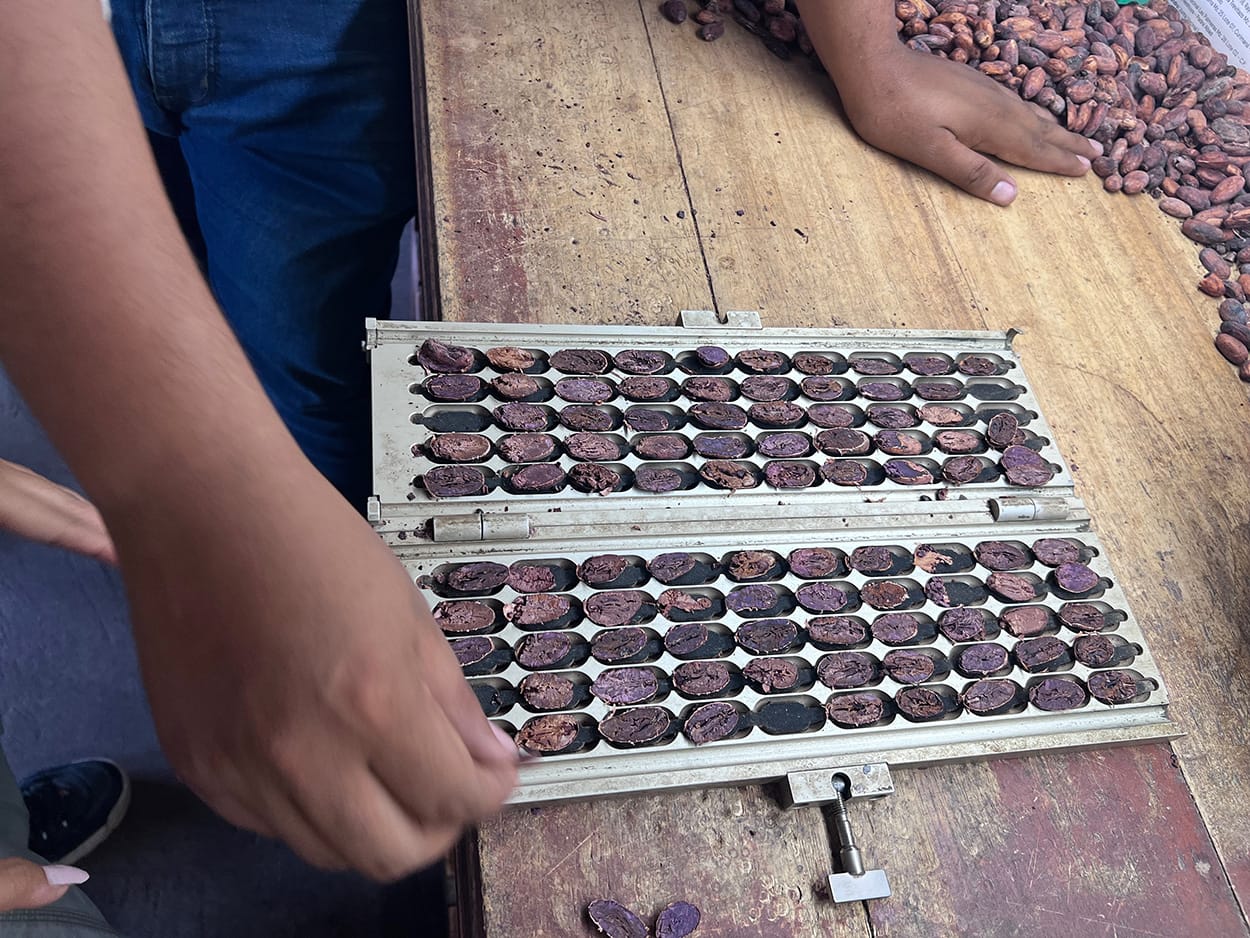
MPF conducts its own bean testing during cocoa processing. Image: CocoaRadar
If validated, such a tool could help MPF determine where additional soil or bean testing is needed and where to concentrate agricultural support. It could also help the company avoid treating cadmium as a uniform problem across Peru’s highly varied cocoa-growing regions.
> Independent national research supports the view that Peru’s cadmium challenge varies by region.
A 2023 study drawing on more than 2,000 soil and cocoa-bean samples used random forest models to predict cadmium concentrations across land suitable for cocoa cultivation. It found elevated risk concentrated mainly in northern Peru and Loreto, with localised pockets in Huánuco and San Martín.
The researchers estimated that fewer than 20% of cocoa-growing households nationwide might be affected by cadmium restrictions, although the proportion could reach 89% in Piura, the most exposed department in the model.
Soil cadmium was the strongest predictor of concentrations in cocoa beans, while geology, rainfall seasonality, soil pH and rainfall were also important at the national level.[ The study was published in *Science of the Total Environment* and summarised by the Alliance of Bioversity International and CIAT](https://alliancebioversityciat.org/publications-data/distribution-cadmium-soil-and-cacao-beans-peru?ref=cocoaradar.com).
The Alliance has also predicted soil and bean cadmium availability through its Cacao Diversity platform. MPF has developed a predictive model intended to be adapted to its own sourcing and operational processes. The model remains under development and is designed to help identify and classify potential risk within its cocoa supply chain.
MPF is also pursuing field measures intended to improve the conditions in which cocoa is grown. Murga referred to composting and environmental projects aimed at limiting soil erosion, improving soil health and protecting water resources.
He linked those measures to the company’s response to cadmium, although he did not present field-trial results or quantified reductions in soil or bean concentrations during the interview.
This is an important qualification. Cadmium uptake is shaped by interacting soil, environmental and genetic factors, and no single mitigation measure offers a universal solution. Interventions therefore need to be selected and tested under local conditions.
MPF places the programme within a sustainability framework organised around four pillars.
The first, integrity and transparency at source, centres on traceability. MPF says it uses geographic information systems to map farms, record cocoa purchases and trace certified cocoa through processing. The company’s website says all its certified cocoa is georeferenced.
The second pillar, community development, covers education, health and producer wellbeing. Murga presented these programmes as part of MPF’s relationship with cocoa-growing communities rather than as activities separate from sourcing.
Climate action, the third pillar, includes measuring emissions, reducing waste and restoring the environment. Organic agriculture (the fourth pillar) completes the framework and, for MPF, links to soil management and support for women farmers.
MPF’s public sustainability material identifies the same four areas and describes projects covering women’s economic participation, school infrastructure, regenerative agriculture, reforestation and irrigation.
[](https://cocoaradar.com/#/portal/signup/free)
### **The Test Will Be at Farm Level**
The approach illustrates how interdependent cocoa supply-chain challenges have become. Traceability establishes where cocoa originated. Spatial analysis may show where cadmium risk is greater. Testing can then assess particular farms or lots, while technical support can be directed towards producers facing the greatest exposure.
For farmers, however, the value of the exercise will depend on what follows the map: the reliability of its predictions, access to affordable testing, the effectiveness of recommended interventions and the availability of technical and financial support.
Cost distribution will also matter. A risk map could help companies use resources more precisely, but it could also disadvantage farms labelled as higher-risk if the classification is not supported by adequate sampling or accompanied by workable mitigation options.
Advertisement
[  ](https://unifacto-cocoa.com/contact-us/?ref=cocoaradar.com)
MPF’s initiative remains under development. Its attempt to connect spatial data with sourcing and farm support nevertheless shows how cocoa businesses are translating an end-market contaminant limit into decisions made much closer to the soil.
Cadmium compliance cannot be managed solely at the factory gate. Whether MPF’s map becomes a meaningful tool will depend on validation against field and bean data – and on evidence that the interventions following it reduce risk without placing an unreasonable burden on farmers.
### Demand Resistance Meets a Widening West African Farmgate Gap
URL: https://cocoaradar.com/demand-resistance-meets-a-widening-west-african-farmgate-gap/
Last updated: 2026-10-01T15:33:24.000Z
💡
****Cocoa trading at 5181.287 USD/T on Thursday, October 01, a 185.713 USD/T (3.46%) decrease from 5367.000 on the last trading session**
Lindt & Sprüngli’s latest sales warning suggests that even premium chocolate is reaching the limits of consumers’ willingness to absorb higher prices.
The Swiss chocolatier cut its 2026 organic sales-growth forecast to 0–2% from 4–6%, its second downgrade this year, according to MT Newswires. Lindt cited weaker seasonal orders, price-sensitive consumers and unusually hot European weather, with Germany, Switzerland and Austria particularly affected. Its shares fell nearly 9% in Zurich on 29 September.
For cocoa markets, the significant point is not the heatwave but the consumer response. Lindt’s warning provides fresh evidence that successive chocolate price increases are suppressing demand even at the premium end of the market.
Advertisement
[  ](https://www.foodmasters-freiberg.com/en/?utm%5Fsource=ghost&utm%5Fmedium=newsletter&utm%5Fcampaign=ad&utm%5Fcontent=qsm%5Fplaceholder)
Bloomberg reported that Lindt is reducing prices on Christmas products and plans wider cuts from January. Lower cocoa costs should create more room for promotions and marketing in 2027, when Lindt expects volumes to recover—but that rebound remains a forecast.
### Ghana Raises Cocoa Farmgate Price to $3,627 a Ton
Ghana will pay cocoa farmers 42,400 cedis ($3,627) per metric ton for beans in the 2026-27 season starting this month, Ghana Cocoa Board Chief Executive Officer Randy Abbey told reporters in Accra.
The new price is up 2.4% from 41,392 cedis ($3,541) for a 64-kilogram bag.
Ghana’s price is equivalent to about $3.63 a kilogram, based on the Bank of Ghana’s Sept. 29 exchange rate of 11.69 cedis per dollar.
Neighbouring Côte d’Ivoire, the world’s largest cocoa producer, set its guaranteed minimum price at 1,200 CFA francs a kilogram for the 2026-27 main crop, according to a[ Sept. 1 government announcement](https://www.gouv.ci/actualite/campagne-principale-2026-2027-le-prix-bord-champ-du-cacao-est-fixe-a-1200-fcfa-le-kg-le-prix-du-cafe-setablit-a-1300-fcfa-le-kg-8771?ref=cocoaradar.com).
That equals about $2.08 a kilogram, or $2,081 a ton.
Ghana’s dollar-equivalent price is therefore roughly 74% higher, keeping incentives for cross-border cocoa flows in focus, and, as one analyst told CocoaRadar, it will impact weekly estimated arrival numbers in Côte d’Ivoire negatively, which are usually more of a market driver than the graded and sealed numbers from Ghana, which are reported only irregularly.
### Conclusion
The combined message is uncomfortable for the industry. Chocolate companies face limits on what consumers will pay, while origin governments face pressure to offer farmers competitive prices and retain locally produced beans. Lower cocoa prices may eventually help revive demand, but a widening farmgate-price gap could make near-term West African supply data harder to read.
_This post is for paying subscribers only._
### Mars Raises Cocoa Bar, But Living Income Remains Missing Measure
URL: https://cocoaradar.com/mars-raises-cocoa-bar-but-living-income-remains-missing-measure/
Last updated: 2026-09-30T14:19:25.000Z
While independent comparisons place it among the stronger mass-market chocolate companies on sustainability, the industry still contends with farmer poverty, hazardous child labour, deforestation, and climate-driven supply shocks.
Achieving 98% is a milestone in its Responsibly Sourced Cocoa Programme in 2025, coming within two percentage points of its target to source all the cocoa used in its branded products
It is not, however, the same as proving that 98% of the cocoa physically contained in Mars products was sustainably produced. Nor does it show that the farmers supplying the company earn a living income.
That distinction runs through Mars’ latest [Cocoa for Generations progress report.](https://www.mars.com/sites/g/files/dfsbuz106/files/2026-09/Mars%20C4G%202025%20Report%5Fweb-final.pdf?ref=cocoaradar.com) The company presents one of the more developed sustainability programmes among the world’s largest confectionery businesses: extensive traceability, third-party verification, child-labour monitoring, agroforestry programmes, support for women and investment in agricultural science. Independent benchmarking broadly supports that assessment.
Advertisement
[  ](https://www.foodmasters-freiberg.com/en/?utm%5Fsource=ghost&utm%5Fmedium=newsletter&utm%5Fcampaign=ad&utm%5Fcontent=qsm%5Fplaceholder)
But the report is strongest when measuring systems and activities – farms mapped, households covered, trees distributed and people trained – and weaker when answering the question on which most other sustainability problems depend: are cocoa-growing families becoming durably better off?
### A Stronger Mainstream Programme
Mars says suppliers purchased a volume of cocoa through its Responsibly Sourced Cocoa programme equivalent to 98% of the cocoa used in its branded products during 2025\. It says the same volume was deforestation- and conversion-free after the relevant cut-off dates.
_This post is for subscribers only._
### Moving Cocoa: Good Together? Reflections on the CAA Conference in Singapore
URL: https://cocoaradar.com/moving-cocoa-good-together-reflections-on-the-caa-conference-in-singapore/
Last updated: 2026-09-29T13:50:39.000Z
The conference theme was: 'Good Together: Building an Agile Cocoa Future '.
With traders, grinders, chocolate companies, governments, NGOs and tech companies all in attendance, organisers promised a flexible, forward-looking and fair programme.
💡
Disclaimer: CocoaRadar was the conference’s official media partner. The views expressed here are my own, and this post was written independently.
All pumped up with adrenaline, from excitement about the days ahead, and from a lack of sleep due to jet lag, compensated with far too much coffee, I was ready to participate.
I love events like this. Seeing familiar faces of people you only ever meet at conferences, and people you have never met but who feel familiar because you follow their journey on social media.
The cocoa world is a people business, but I think we all feel we don't meet face to face enough. An event, if done well, is also an industry crash course, with all that knowledge at your fingertips.
International events make our industry feel so global, yet so small and familiar at the same time. Call me naïve, but I always start with a positive mindset: everything is still possible, even in gloomy times, if we're open to sharing authentically, willing to collaborate, and ready to invest in a better cocoa future.
So, did Singapore deliver on its promise of Good Together? Well, partly.
### The right participants
Most of us travel halfway around the world for the network, and CAA absolutely nailed it. CEOs, finance directors, heads of procurement and sourcing and sustainability leaders, all accessible and in one venue.
> Pulling together a participant list like this is quite something. The size was right too: large enough to meet new people, small enough to actually find the ones you were looking for. The quality of the participants made the trip worth it.
But with so many of them in one place, you need to build in enough moments for conversation, because most good conversations happen during the breaks. Or at the bar.
### Who gets to talk?
The programme is where I felt it could have delivered much more. What happens on stage decides what people talk about in the months to come. It shapes articles, policies and debates. It matters!
I understand how it works, though. Events like this are made possible by sponsors, a.k.a. large companies who have these kinds of budgets, so it makes sense that they get the good slots.
Sponsors send their representatives, fully briefed by the marketing team, to follow the communication guidelines strictly and avoid any 'hot topics'.
> And this is where an organising committee has a hugely important role: to be firm and bring the necessary counterweight on stage- independent thinkers, people from origin, voices with a different background or unique angle to challenge the speakers. They bring nuance and often the best new insights, simply because they are freer to say what needs to be said.
And with that come excitement, slightly unscripted moments and tension on stage. These 'free' speakers need to be part of the entire programme, not tucked away at the end or in breakout sessions.
### **Missing voices, missing topics**
On the first day, three hours passed without a single woman speaking, apart from the organiser. In fact, about 20% of the speakers on the main stage were women.
The market sessions on prices and grinding were all men. The panel with mostly women was about sustainability.
It is not only gender. Africa and the Americas together grow more than 90% of the world's cocoa. Still, Africa had just one speaker on stage, from Ghana's Cocoa Marketing Company, and no one came from Latin America.
With Ecuador now the world's third-largest producer and a huge supplier of cocoa to Asia, that's just a big gap. The panel on whether Asia is ready for the EUDR had no Asian representatives, and the panel on farmers had no single farmer.
[Chocolate Brands Strip Sustainability Logos as New EU Rules LoomSpecial Report: Lindt & Sprüngli is removing its cocoa programme logo as certifiers tighten claims ahead of new EU anti-greenwashing rules (EmpCo). Industry responses to Cocoaradar raise a bigger question: will consumers get clearer information – or will chocolate brands go quiet?From The Desk of CocoaRadar™Anthony Myers](https://cocoaradar.com/chocolate-brands-strip-sustainability-logos-as-new-eu-rules-loom/)
The same goes for the content. The EUDR got a lot of attention, understandably, but the new EU rules on green claims, which came into force this week (see link above), were no more than a footnote, although they will affect brands and chocolate consumption, and, with that, the cocoa trade.
> Climate change was on the agenda, but deserved much more room, even a key position in the programme. We are watching El Niño as the next big thing, but what will the climate look like in 10 years, and how will that affect farmers and our industry? How do we help farmers move towards agroforestry, and how do we share the risks and pay prices that make that shift possible?
And after all the billions that have gone into sustainability programmes, what I missed was a clear snapshot of where we truly stand today, on child labour, for example.
What role Singapore and Southeast Asia will play in that bigger picture, growing more cocoa instead of mainly processing it, was still an open question.
To be clear, this is not about ticking boxes to meet a quota. Speakers of different genders, backgrounds and professions, including more women and more farmers, bring nuance and new perspectives to the debates this industry really needs to have. We need to address the elephants in the room.
[From Dissonance to Cocoa Valley: Vietnam’s Vision for a Farmer-Centred Chocolate FutureCocoa Project founder Gricha Safarian used a musical metaphor to expose what he sees as the contradictions in today’s cocoa economy – and set out an alternative based on flavour, shared value, education and collaborationFrom The Desk of CocoaRadar™Anthony Myers](https://cocoaradar.com/from-dissonance-to-cocoa-valley-vietnams-vision-for-a-farmer-centred-chocolate-future/)
### Dissonance Strikes a Chord
Gricha Safarian, CEO of Puratos Grand-Place Indochina in Vietnam, called it dissonance. He has been pushing for years for ways to source cocoa built on value creation, and his model has been successful in Vietnam.
I heard the frustration in his voice when he spoke about the industry investing in technology, reformulation and cocoa-free chocolate when it should be focusing on paying higher prices and supporting farmers to grow higher quality and in a better way. The alternative is consonance: making better chocolate with better flavour, the way the wine industry does, rather than pushing on yield and competing on cost.
### To sum up
I felt some dissonance and disappointment too when I left Singapore. Great for networking, yes, but the programme lacked the clarity and answers I was hoping to find.
Good Together, the theme of this year's conference, does not mean we all have to agree. It means real, authentic conversations, where everyone in this sector feels represented and where plans become actionable and accountable.
A conference can facilitate that, and *that* is when it moves the sector forward.
**Read more from Moving Cocoa:**
[Moving Cocoa - From The Desk of CocoaRadar™News and exclusive analysis on the cocoa sector and chocolate trends focussing on sustainability, regulation, prices, supply & demandFrom The Desk of CocoaRadar™](https://cocoaradar.com/tag/moving-cocoa/)
|  **Marika van Santvoort** has been working in cocoa & chocolate since 2014, with a focus on responsible sourcing, innovation and farmer impact. In this monthly column she shares her own perspective on what is really moving in the sector; what is being said, what is not, why it matters and what it means for the industry. [LinkedIn](https://www.linkedin.com/in/marikavansantvoort/?ref=cocoaradar.com) · [movingcocoa.com](https://movingcocoa.com/?ref=cocoaradar.com) |
| ---------------------------------------------------------------------------------------------------------------------------------------------------------------------------------------------------------------------------------------------------------------------------------------------------------------------------------------------------------------------------------------------------------------------------------------------------------------------------------------------------------------------------------------------------------------------------------------------------------------------------------------------- |
### GLP-1 Users Still Eat Chocolate, but the Demand Picture Is More Complex
URL: https://cocoaradar.com/glp-1-users-still-eat-chocolate-but-the-demand-picture-is-more-complex/
Last updated: 2026-09-28T14:13:14.000Z
Chocolate remains on the menu for consumers taking GLP-1 medicines, but the confectionery industry’s reassuring consumption figures mask a more complicated commercial shift.
Research released by the US National Confectioners Association (NCA) in July found that 92% of GLP-1 users had consumed chocolate in the previous month, almost matching the proportion among non-users. Some 22% said they enjoyed confectionery daily, compared with 15% of people not taking the medicines.
Advertisement
[  ](https://www.foodmasters-freiberg.com/en/?utm%5Fsource=ghost&utm%5Fmedium=newsletter&utm%5Fcampaign=ad&utm%5Fcontent=qsm%5Fplaceholder)
The findings suggest that appetite suppression is changing how people treat themselves rather than driving them out of the category altogether. They do not, however, establish that consumers are buying the same quantities, spending the same amount or consuming as many calories as they did before treatment.
That distinction is becoming increasingly important for confectionery manufacturers, cocoa processors and investors.
### Consumption Is Not the Same as Purchasing
The NCA’s *Inside the GLP-1 Mindset* report combines consumer research conducted in December 2025 with Circana household-panel data and other industry analysis. Among users consuming less confectionery, 53% said they were eating less food generally rather than specifically avoiding chocolate or candy.
The association identified opportunities in smaller servings, premium products, lower-sugar recipes and products with clearer ingredient information. It also said financial pressures were six times more likely than GLP-1 use to cause consumers to reduce their confectionery purchases.
_This post is for subscribers only._
### London Chocolate Forum Sets Three-Part Agenda For 2026 Event
URL: https://cocoaradar.com/london-chocolate-forum-sets-three-part-agenda-for-2026-event/
Last updated: 2026-09-25T11:07:19.000Z
The London Chocolate Forum has announced the agenda for its 2026 conference, placing consumer change, cocoa-sector resilience and product innovation at the centre of the one-day programme.
The event will take place at the Hippodrome in central London on 5 October, with presentations and discussions organised around three themes: ‘The Changing Chocolate Consumer’, ‘The Cocoa Challenge’ and ‘Craft, Innovation & The Future of Chocolate’.
Advertisement
[  ](https://www.foodmasters-freiberg.com/en/?utm%5Fsource=ghost&utm%5Fmedium=newsletter&utm%5Fcampaign=ad&utm%5Fcontent=qsm%5Fplaceholder)
CocoaRadar will cover the forum, reporting on the issues raised by senior industry speakers and their implications for businesses across the cocoa and chocolate value chain.
### Changing Consumers
The opening sessions will examine how technology, health trends, and changing expectations are influencing how consumers encounter and purchase chocolate.
James Holah, Saint Lucia general manager and global lead for cacao experiences and products at Hotel Chocolat, will discuss the changing role of physical chocolate shops. His presentation will examine the company’s use of cafés, technology, storytelling, and immersive retail experiences.
Food futurist Tony Hunter will then consider the outlook for Generation Alpha, including how its relationship with artificial intelligence, health and food could affect chocolate brands.
Charlotte Radcliffe, director of The Nutrition Consultant, will address the potential effect of GLP-1 treatments on chocolate demand. Her session is expected to cover purchasing habits, treat occasions, formats, portion sizes, product development and marketing.
Together, the presentations place the changing consumer environment at the start of the programme, before attention turns to the production and sourcing challenges facing the sector.
### Cocoa Resilience And Responsibility
The second theme will focus on the cocoa supply chain, including how financial responsibility for sustainability and resilience is divided.
Jason Archie Acheampong, head of market-based solutions at the Fairtrade Foundation, will discuss the role of longer-term retailer commitments to cocoa producers. The session will consider whether partnerships and shared responsibility can move sustainability programmes beyond short-term interventions.
Nicko Debenham, managing director of Sustainability Solutions, will examine the practical implications of EUDR for cocoa businesses and the regulation’s effect on how cocoa is sourced and traded.
Dougal Freeman, vice-president of operations at the World Cocoa Foundation, will address the economics of resilience and the question of who should pay for sustainable cocoa.
The morning programme will conclude with Martin Gilmour, director of Chase Cocoa Consulting, considering the future of global cocoa production. The agenda includes planting material, agroforestry, agronomy, pests and diseases, soil fertility, flavour, quality and food safety.
### Craft Chocolate And New Uses For Cocoa
The afternoon programme will move to craft chocolate, fermentation, and efforts to extract more value from the cocoa fruit.
Isobel Carse, owner and chocolate maker at Dormouse Chocolates and chair of the Craft Chocolate Makers Association UK & Ireland, will lead a panel on the purpose and development of a craft chocolate association.
She will be joined by Joanna Brennan of Pump Street Chocolate, Spencer Hyman of Cocoa Runners and Tom Couch of Beancraft Chocolate. The discussion will examine the development of the UK and Irish craft sector, the reasons for establishing the new association and what greater industry collaboration could achieve.
Andy Clayton, chief executive of Fermtech, will explore how fermentation could enhance flavour, produce new ingredients and make greater use of cocoa side streams without moving away from the characteristics consumers expect from chocolate.
Advertisement
[  ](https://unifacto-cocoa.com/contact-us/?ref=cocoaradar.com)
The final listed presentation will come from David Greenwood-Haigh, founder of Coeur de Xocolat. His session will consider commercial applications for parts of the cocoa fruit that have traditionally been underused, including their potential to generate additional value for manufacturers and cocoa-growing communities.
- **The**[ **full 2026 agenda**](https://londonchocolateforum.com/2026-agenda/?ref=cocoaradar.com) **and**[ **speaker information**](https://londonchocolateforum.com/speakers-2026/?ref=cocoaradar.com) **are available on the London Chocolate Forum website.**
### **CocoaRadar View**
The programme's structure reflects the increasingly interconnected decisions facing the chocolate sector. Changes in demand, retail formats and health-related consumer behaviour cannot be separated from the cost and availability of cocoa or from questions about who finances greater resilience at origin.
The afternoon focus on craft, fermentation and whole-fruit utilisation also points to a search for value beyond conventional approaches to chocolate production. CocoaRadar’s event coverage will examine whether the ideas presented offer commercially workable responses to those pressures.
---
[  ](https://cocoaradar.com/advertise/)
Sponsored feature
### [CocoaRadar in Peru ](https://cocoaradar.com/advertise/)
During October 2026, CocoaRadar will publish a series of articles exploring the Peruvian cocoa economy.
**Commercial:** [philippe@cocoaradar.com](mailto:philippe@cocoaradar.com) · **Editorial:** [tony@cocoaradar.com](mailto:tony@cocoaradar.com)
### Global Cocoa Crop Nears Multi-Year High; Record Claim Unproven
URL: https://cocoaradar.com/global-cocoa-crop-nears-multi-year-high-record-claim-unproven/
Last updated: 2026-09-24T15:46:52.000Z
💡
****Cocoa trading at 5602.747 USD/T on Thursday, September 24, a 74.747 USD/T (1.35%) increase from 5528.000 on the last trading session.**
StoneX forecasts output of 5.136 million tonnes and a 422,000-tonne surplus, while Transgraph Consulting projects production of about 5.1 million tonnes and a 415,000-tonne surplus. Both estimates remain below the ICCO’s record of 5.244 million tonnes in 2020-21.
West African production has improved. Côte d’Ivoire forecasts a crop of 2 million–2.1 million tonnes in May, while subsequent port arrivals exceeded 2.1 million tonnes. However, arrivals may include carry-over stocks and are not directly comparable with current-season production.
Advertisement
[  ](https://www.foodmasters-freiberg.com/en/?utm%5Fsource=ghost&utm%5Fmedium=newsletter&utm%5Fcampaign=ad&utm%5Fcontent=qsm%5Fplaceholder)
In Ghana, provisional COCOBOD data put output at [about 771,000 tonnes](https://www.marketscreener.com/news/ghana-cocoa-output-hits-771-000-tons-exceeding-forecast-report-says-ce785ad9dc89f12d?ref=cocoaradar.com), 18.6% above its initial forecast and roughly 28% higher than the preceding fiscal period’s 603,840 tonnes.
The larger crop has not resolved Ghana’s liquidity problems. COCOBOD is seeking [GH¢16.3 billion, or approximately $1.4 billion, through a domestic Cocoa Note programme](https://www.myjoyonline.com/cocobod-pitches-1-4-billion-domestic-financing-plan/?ref=cocoaradar.com). An initial GH¢6.3 billion tranche is expected to combine commercial paper for seasonal purchases with a bond to refinance existing obligations.
The proposed safeguards include ring-fenced accounts, trustee oversight and export receivables covering at least 1.2 times debt service. However, the programme remains a financing proposal rather than confirmed purchasing liquidity. Ghana has yet to announce the new season’s opening date, while licensed buyers are seeking about GH¢4 billion in arrears.
Elsewhere, Brazil’s cocoa-bean receipts rose about 37% year on year to approximately 154,800 tonnes over the final quarter of 2025 and first half of 2026\. Ecuador, by contrast, exported [263,137 tonnes of cocoa and products between January and July, down 8.3%](https://www.primicias.ec/economia/exportaciones-cacao-ecuador-fenomeno-nino-riesgos-produccion-133094/?ref=cocoaradar.com), weakening manufacturers’ efforts to diversify supply beyond West Africa.
Demand also remains subdued. Nielsen data cited by Barry Callebaut showed chocolate-confectionery volumes across 26 countries falling 5.6% during the company’s first nine months.
The ICCO has yet to publish its 2025-26 production and grinding estimates while its methodology is under review. Until then, the emerging surplus case looks increasingly credible – but neither a record crop nor dependable 2026-27 availability has been established.
**Market Takeaway:** Supply is recovering, but Ghana’s unresolved financing needs and weaker Ecuadorian exports leave the outlook less comfortable than the headline surplus suggests.
Advertisement
[  ](https://unifacto-cocoa.com/contact-us/?ref=cocoaradar.com)
_This post is for paying subscribers only._
### Fairtrade Launches UK Fair Pay Campaign As Climate Threatens Food Supplies
URL: https://cocoaradar.com/fairtrade-launches-uk-fair-pay-campaign-as-climate-threatens-food-supplies/
Last updated: 2026-09-23T14:01:15.000Z
The Fairtrade Foundation has launched a UK campaign for better pay and stronger legal protections for overseas farmers, warning that poverty is limiting their ability to protect crops from increasingly severe weather.
The Fair Pay Campaign, launched during Fairtrade Fortnight, which runs from 21 September to 4 October, focuses on the farmers producing tea, coffee, cocoa and bananas for the UK market.
Fairtrade is calling on shoppers and businesses to support higher payments to producers. It also wants the UK Government to introduce Human Rights and Environmental Due Diligence legislation requiring companies to address harms linked to their supply chains.
Advertisement
[  ](https://www.foodmasters-freiberg.com/en/?utm%5Fsource=ghost&utm%5Fmedium=newsletter&utm%5Fcampaign=ad&utm%5Fcontent=qsm%5Fplaceholder)
The campaign follows research Kantar conducted for the charity, which found that 84% of British adults were concerned about the effect of climate change on the UK’s food supply. More than a quarter, 26%, said they were “much more concerned” following the summer’s heatwaves and droughts in the UK and Europe.
Among people aged 16 to 24, 69% said the summer had made them more worried about climate change's effects on food.
The Fairtrade-commissioned study also found that 56% of respondents were aware that climate change was contributing to higher prices for products such as coffee, tea and chocolate. A further 34% were not aware of the connection.
### Farmers Face Rising Adaptation Costs
Fairtrade said recent weather disruption had affected several of the supply chains on which British consumers depend. It cited flooding affecting coffee producers in Sumatra, strong winds damaging banana plantations in Colombia and hailstorms reducing tea yields by about a third for some smallholders in Kericho, Kenya.
The charity argues that farmers earning below a living income cannot invest adequately in irrigation, shade trees, soil restoration and crop diversification. Such measures can reduce producers’ exposure to rainfall disruption, extreme temperatures and other climate-related risks.
Martin Kinyua, a coffee farmer and manager at the Mutira Coffee Cooperative in Kenya, said unpredictable rainfall was making it increasingly difficult for farmers to plan their work.
“Climate change is one of the biggest challenges that we are facing as a cooperative and as smallholder farmers,” he said.
> “When you cannot predict the seasons, you cannot plan when to buy or apply inputs, and that affects the entire harvest. It is only thanks to the fairer price we receive by selling on Fairtrade terms that we have been able to take measures to adapt to the changing climate and continue growing coffee.”
Fairtrade said 74% of respondents supported increasing payments to tea, coffee, cocoa and banana farmers to help them respond to climate change. Among people who buy takeaway coffee, 65% said they would pay a few pence more if it helped farmers protect future supplies.
### Inflationary Pressures Bite
The findings nevertheless arrive at a difficult time for household finances.
UK inflation rose from 2.9% in July to 3.1% in August after higher energy costs fed through to fuel and travel prices, according to official figures reported by the Guardian. The newspaper reported that motor fuel prices rose by 23%, with petrol averaging 161.3p a litre and diesel 181.8p.
The renewed increase in inflation, alongside the prospect of higher borrowing costs, adds to the pressure on households already dealing with years of elevated food and energy prices.
Fairtrade’s research found that 78% of respondents were concerned about climate change affecting the prices of products they regularly buy.
That backdrop creates a central difficulty for the campaign: the cost of strengthening producers’ resilience ultimately has to be absorbed somewhere in the supply chain, while both farmers and British consumers face tight budgets.
The Arabica coffee bean commonly used by coffee shops is sensitive to rising temperatures. Image: Robert Bye/Unsplash
### **Coffee Supply Under Pressure**
Coffee illustrates the imbalance Fairtrade is seeking to address. The charity said many of the estimated 125 million people dependent on coffee farming live on £1 to £2 a day.
It also claimed that producers typically retain about 4p from a £3.70 cup of coffee sold in the UK, equivalent to roughly 1% of its retail price.
At the same time, Arabica coffee, the variety commonly used by coffee shops, is sensitive to rising temperatures. Fairtrade warned that suitable growing areas are shrinking, increasing the importance of investment in adaptation.
Coffee also appears difficult for many consumers to give up: 43% of those surveyed said they would find going without it for a week very difficult.
> Eleanor Harrison, chief executive of the Fairtrade Foundation, said fair pay was necessary to build more resilient food supply chains. “If we want resilient food supplies, we must invest in the people who produce our food,” she said. “Paying farmers fairly, both in the UK and around the world, is not just the right thing to do; it is essential to securing the crops and products we all rely on.”
The organisation is also pressing the UK Government to act on responsible business practices. Fairtrade said more than 107,000 people had signed its[ petition for a responsible business law](https://action.fairtrade.org.uk/page/186243/petition/1?ea.tracking.id=2026-do-it-fair-web-doitfair&ref=cocoaradar.com).
Advertisement
[  ](https://unifacto-cocoa.com/contact-us/?ref=cocoaradar.com)
Hundreds of events, including campaign coffee mornings, are scheduled across the UK during Fairtrade Fortnight.
### **CocoaRadar View**
The campaign connects two forms of financial vulnerability: low producer incomes in agricultural economies and strained household budgets in the UK.
Public willingness to pay more could help, but voluntary consumer choices alone are unlikely to determine how additional value is distributed. The commercial test will be whether retailers, brands and policymakers can improve producer incomes without placing a disproportionate burden on consumers already facing renewed inflation.
---
[  ](https://cocoaradar.com/advertise/)
Sponsored feature
### [CocoaRadar in Peru ](https://cocoaradar.com/advertise/)
During October 2026, CocoaRadar will publish a series of articles exploring the Peruvian cocoa economy.
**Commercial:** [philippe@cocoaradar.com](mailto:philippe@cocoaradar.com) · **Editorial:** [tony@cocoaradar.com](mailto:tony@cocoaradar.com)
### Sunbeth Publishes Inaugural Sustainability Report as Cocoa Supply Chains Face Higher Disclosure Expectations
URL: https://cocoaradar.com/sunbeth-publishes-inaugural-sustainability-report-as-cocoa-supply-chains-face-higher-disclosure-expectations/
Last updated: 2026-09-23T11:03:48.000Z
Presented by
[  ](https://www.sunbeth.net/?ref=cocoaradar.com)
[Sunbeth Global Concepts ](https://www.sunbeth.net/?ref=cocoaradar.com)
The expectations placed on cocoa supply chains are changing.
For manufacturers, traders and offtakers, responsible sourcing is increasingly about more than commitments. Buyers need to know where cocoa comes from, whether farms can be traced, how deforestation risk is being assessed and what systems suppliers have in place to address social risks within producing communities.
Against this backdrop, Sunbeth Global Concepts has published its inaugural 2025 Sustainability Report, providing a detailed account of how the business is approaching these issues across its cocoa supply chain.
The report is significant because of the standards it has chosen to adopt and the operational data behind its disclosures.
Sunbeth says it is the first Nigerian agricultural company, public or private, to voluntarily align its sustainability reporting with IFRS S1 and IFRS S2, the International Sustainability Standards Board frameworks covering sustainability-related financial information and climate-related disclosures.
The decision reflects a broader shift within the business: sustainability is increasingly being treated not as a standalone corporate responsibility initiative, but as part of governance, risk management, sourcing and long-term commercial resilience.
That distinction matters.
As regulatory and customer expectations rise, suppliers will increasingly be expected to demonstrate that responsible sourcing systems are embedded in their operations rather than introduced simply to meet individual customer requests.
### **Traceability Moving From Ambition To Infrastructure**
One of the clearest examples in the report is Sunbeth’s investment in farm-level traceability.
The company has polygon-mapped more than **140,000 hectares of cocoa farmland**, screening plots for deforestation risk using satellite data alongside ground verification. The company has also mapped more than 30,000 farmers within its supply chain.
The objective is to create a sourcing system in which origin, farm location and deforestation risk can be verified rather than assumed.
For cocoa buyers, this is becoming increasingly important. Sustainability claims are only as credible as the data supporting them, particularly as manufacturers face growing scrutiny over the environmental and social conditions within their upstream supply chains.
Sunbeth has therefore been building traceability and geolocation validation directly into its sourcing infrastructure, supported by independent deforestation-risk screening.
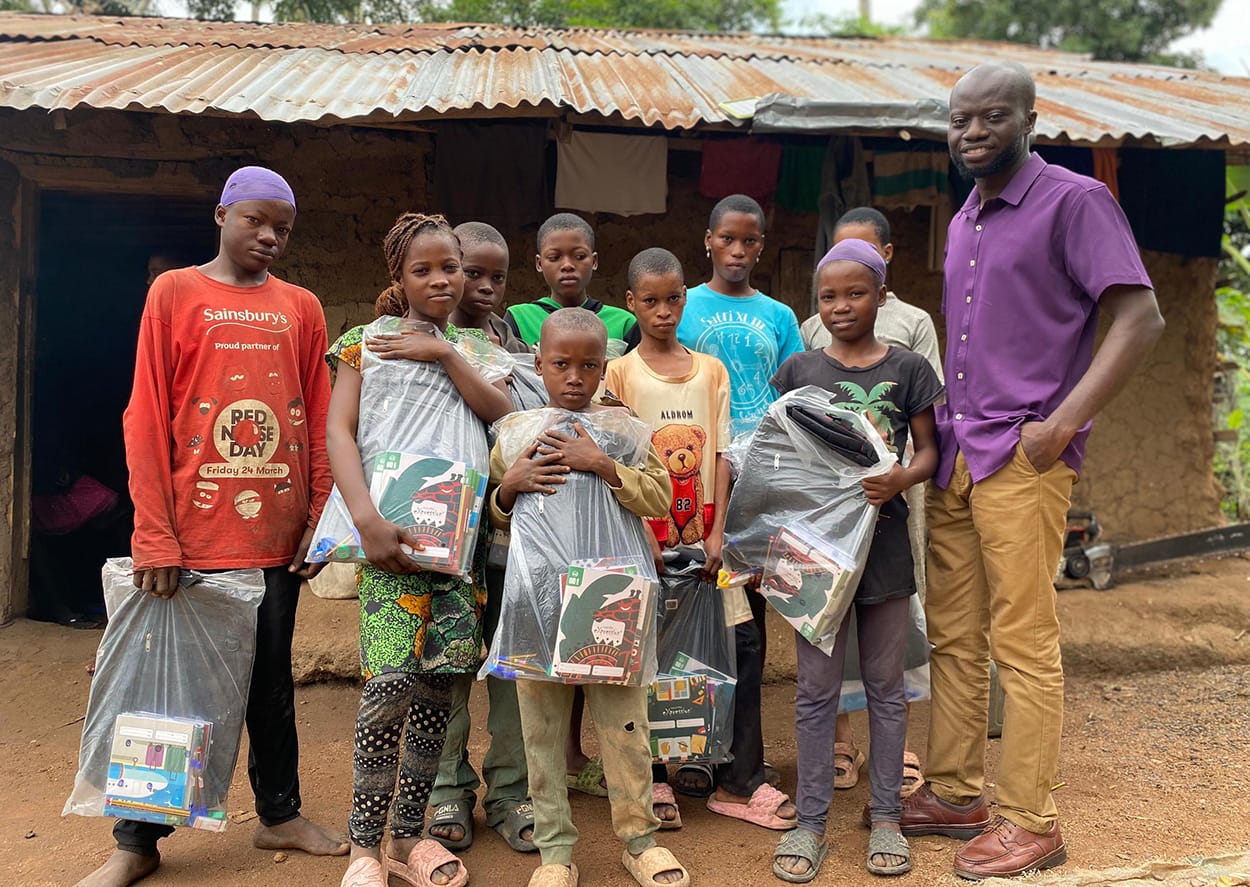
Sunbeth now operates a robust Child Labour Monitoring and Remediation System (CLMRS). Image: Sunbeth Global Concepts
### **Responsible Sourcing Also Has A Social Dimension**
Environmental traceability is only one part of the picture.
The report also details Sunbeth’s work through its Child Labour Monitoring and Remediation System (CLMRS). The programme surveyed more than 900 households across 120 communities. Eighty children identified as being at risk of child labour received remediation support.
Sunbeth has also become the first Nigerian company to join the International Cocoa Initiative, an organisation focused on addressing child labour and forced labour risks within cocoa-growing communities.
Beyond monitoring, the company reports investments in community infrastructure and farmer resilience, including clean-water facilities across 11 communities, income and skills programmes for women, and good agricultural practice training for more than 6,000 farmers.
These interventions point to an important reality for the sector: responsible cocoa supply chains depend not only on environmental compliance but also on the economic and social resilience of the communities producing the crop.
### **Building Certified Supply At Commercial Scale**
The report also shows how these sustainability systems are translating into commercial volumes.
Sunbeth sourced and sold approximately **4,600 metric tonnes of Rainforest Alliance-certified cocoa** at a premium and says it has developed more than **25,000 metric tonnes of certified capacity for the 2025-26 season**.
For manufacturers and offtakers, the relevance is straightforward.
As sustainability requirements become more demanding, buyers will need suppliers that can combine volume, traceability, certification, and credible sustainability data. The commercial value increasingly lies not simply in moving cocoa, but in demonstrating how that cocoa was sourced.
As Sunbeth Managing Director Olasunkanmi Owoyemi states in the report:
“Responsible sourcing is how we do business, how we manage risk, and how we create long-term value.”
### **From Individual Projects To A Longer-Term Framework**
The sustainability report also places these initiatives within Sunbeth’s broader [**Orange Cocoa Framework**](https://cocoaradar.com/from-farm-to-framework-how-sunbeth-global-concepts-is-redefining-sustainability-in-african-cocoa/), the company’s long-term approach to responsible cocoa sourcing.
The framework includes commitments to achieve 100% traceability of volumes to deforestation-free land by 2050, train 100,000 farmers by 2040, distribute 300,000 shade trees by 2040 and reach net-zero Scope 1 and Scope 2 emissions by 2050.
These are long-term targets, and their credibility will ultimately depend on continued measurement and disclosure of progress. Publishing the sustainability report creates a baseline against which that progress can now be assessed.
That may be one of the report’s most important contributions.
Sustainability commitments across the cocoa industry are becoming increasingly common. What buyers, regulators and other stakeholders increasingly need is evidence: measurable targets, traceable data, transparent reporting and a clear account of progress over time.
Sunbeth’s inaugural report begins to provide that record.
For a company operating across one of the world’s most scrutinised agricultural supply chains, transparency is no longer simply about reputation. It is becoming part of market access, customer confidence and the ability to compete in increasingly demanding global supply chains.
The **Sunbeth 2025 Sustainability Report** offers a closer look at how one African cocoa exporter is preparing for that environment, and the systems it is putting in place as responsible sourcing moves from aspiration to operating requirement.
**More from Sunbeth Global Concepts:**
- [**Read Sunbeth’s full 2025 Sustainability Report**](https://www.sunbeth.net/sustainability?ref=cocoaradar.com)
- [**Learn more about Sunbeth’s Orange Cocoa Framework**](https://cocoaradar.com/from-farm-to-framework-how-sunbeth-global-concepts-is-redefining-sustainability-in-african-cocoa/)
---
- **Sponsored content: This article was created in collaboration with Sunbeth Global Concepts. While it aligns with our audience’s interests, the ideas and content are provided by Sunbeth Global Concepts, which retains copyright and editorial responsibility. We’re sharing it to offer our readers relevant information and perspectives.**
### Chocolate Brands Strip Sustainability Logos as New EU Rules Loom
URL: https://cocoaradar.com/chocolate-brands-strip-sustainability-logos-as-new-eu-rules-loom/
Last updated: 2026-09-23T09:02:51.000Z
Days before sweeping new EU rules on sustainability marketing begin to apply, one of the world’s largest premium chocolate companies has confirmed a highly visible change to its packaging.
Lindt & Sprüngli is removing its company-owned Farming Program logo from packs and replacing it with the Rainforest Alliance seal on many products, the company told CocoaRadar.
Advertisement
[  ](https://www.foodmasters-freiberg.com/en/?utm%5Fsource=ghost&utm%5Fmedium=newsletter&utm%5Fcampaign=ad&utm%5Fcontent=qsm%5Fplaceholder)
> “As part of our efforts to comply with the Directive, we have reviewed and adapted our consumer-facing communication. On packaging, the Lindt & Sprüngli Farming Program logo is being removed and replaced with the Rainforest Alliance seal on many of our products,” a Lindt & Sprüngli spokesperson said.
The move offers an early indication of how the EU’s Empowering Consumers for the Green Transition Directive – widely known as EmpCo – will reshape sustainability communication and branding across the cocoa and chocolate sector.
From **27 September**, chocolate companies selling to EU consumers will face stricter restrictions on company-owned sustainability labels, generic environmental language and claims that make an entire product appear environmentally beneficial when the evidence concerns only one ingredient or part of the business.
> A spokesperson for industry watchdog The Voice Network said: "Credible sustainability claims are a basic requirement for building consumer trust and providing a foundation for strong sustainability initiatives. Many also described the directive as a welcome ‘clean-up’ of less professional initiatives and labels, which were often perceived as unreliable and as contributing to consumer confusion."
The directive is not designed to determine whether cocoa farmers earn a living income or whether child labour and deforestation have been eliminated. It regulates what companies can tell consumers about those issues – and what evidence, governance and independent scrutiny must sit behind their words and symbols.
That distinction is already pushing the industry towards three broad responses: removing proprietary logos, relying more heavily on established certification schemes, or attempting to transform private programmes into open, independently verified systems.
**Continue with Premium:**
Read the company-by-company findings, what Rainforest Alliance and Fairtrade say makes a sustainability label credible, why ‘responsibly sourced’ may no longer be enough, and whether the rules could push chocolate companies towards greenhushing.
[Continue with Premium → ](#/portal/signup)
_This post is for paying subscribers only._
### Russia Takes Control of Nestlé Operations, Raising Risks Across Global Confectionery
URL: https://cocoaradar.com/russia-takes-control-of-nestle-operations-raising-risks-across-global-confectionery/
Last updated: 2026-09-21T14:31:59.000Z
France has urged Russia to reverse its decision to place Nestlé and other European-owned businesses under external administration, adding diplomatic pressure over the Kremlin’s latest intervention in foreign corporate assets.
> “France condemns the placement of Russian subsidiaries of several French and European companies under provisional administration without justification,” the French foreign and economy ministries said in a joint statement reported by [AFP](https://www.afp.com/de/node/3841482?ref=cocoaradar.com).
The French government said it was in contact with the affected companies.
President Vladimir Putin’s decree transfers management of Nestlé’s Russian shareholdings to L.E.V. Management. Nestlé remains their legal owner, distinguishing the measure from formal nationalisation or confiscation, but has lost authority over operations and corporate governance.
Advertisement
[  ](https://www.foodmasters-freiberg.com/en/?utm%5Fsource=ghost&utm%5Fmedium=newsletter&utm%5Fcampaign=ad&utm%5Fcontent=qsm%5Fplaceholder)
The intervention also covers entities connected to French retailer Auchan, logistics groups FM Logistic and BATI Group, and Lemana Pro, the former Leroy Merlin business.
The Kremlin said the companies’ links to European countries it considers 'unfriendly', alongside Western support for Ukraine, influenced the decision. It stressed that no action beyond external management had yet been taken.
Nestlé said it was assessing its options, protecting its rights and seeking continuity for employees. It has not announced legal action, disclosed the book value at risk or said whether it will deconsolidate the business.
_This post is for paying subscribers only._
### From Dissonance to Cocoa Valley: Vietnam’s Vision for a Farmer-Centred Chocolate Future
URL: https://cocoaradar.com/from-dissonance-to-cocoa-valley-vietnams-vision-for-a-farmer-centred-chocolate-future/
Last updated: 2026-09-18T12:31:18.000Z
The cocoa sector has spent decades saying farmers need to earn more. When cocoa prices rose sharply, and some farmers finally did, the industry called it a crisis.
To Gricha Safarian, founder and general manager of The Cocoa Project and a shareholder and former general manager of Puratos Grand-Place Indochina, that contradiction sounds like two musical notes that do not belong together.
Opening a plenary session on farmers, women and young people at the recent CAA International Cocoa Conference in Singapore, Safarian returned to a question he had put to delegates two years earlier.
Advertisement
[  ](https://www.foodmasters-freiberg.com/en/?utm%5Fsource=ghost&utm%5Fmedium=newsletter&utm%5Fcampaign=ad&utm%5Fcontent=qsm%5Fplaceholder)
“Do we make sense? Do we, as an industry, as a cocoa and chocolate supply chain, do we make sense? Today I have the answers. We totally don't make sense. We are a very, very strange supply chain.”
Safarian described the resulting tension in musical terms.
“Dissonance is when you have two musical notes that don't fit together,” he said. “Dissonance is about tension, and we have serious dissonance in our supply chain.”
### A Crisis for Whom?
In Safarian’s analysis, the first discordant note is the sector’s response to higher cocoa prices.
For years, companies and sustainability programmes have highlighted low farmer incomes as one of the industry’s defining problems. But when prices rose in 2024, allowing farmers in Vietnam to receive more for their crop, the reaction elsewhere in the supply chain was alarm.
> “Our supply chain calls this the most terrible crisis we ever had in our life,” Safarian said. “The crisis was paying farmers for the right price.”
His argument was not that volatility creates no difficulties. Rapid price movements can pressure manufacturers, disrupt contracts, and force companies to reconsider products and pricing. His concern was that the language of crisis revealed whose interests the industry placed first.
He argued the same tension could be seen in the growth of cocoa alternatives. While companies speak about securing cocoa’s future, research and development budgets are increasingly being directed towards products designed to use less – or no – cocoa.
Safarian described this as “cocoa-free chocolate, which I decided to call farmer-free chocolate”.
He also criticised manufacturers’ response to higher input costs, claiming reformulation had reduced the cocoa content of chocolate products worldwide by approximately 10% (his estimate).
> “So I don't know where this is going, but not in the right direction,” he said.
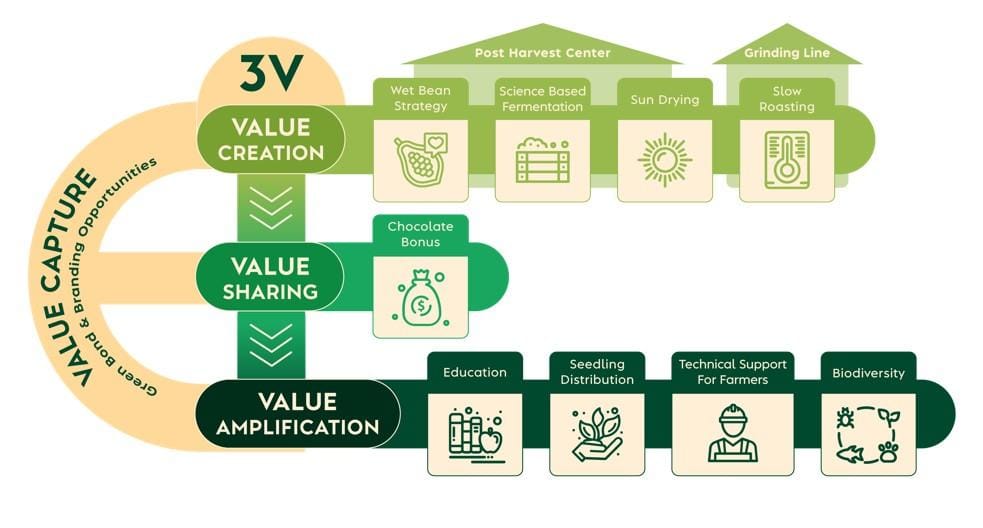
Image: The Cocoa Project
### Turning Value Into a Virtuous Circle
Safarian’s proposed answer is a three-part business model built around value creation, value sharing and value amplification – the ‘3V’ framework.
Value creation begins with the product itself. Instead of treating cocoa principally as a cost to be minimised, Safarian argued that companies should generate more value by producing better-tasting chocolate.
For Vietnam’s cocoa sector, that has meant focusing on science-based fermentation, slow roasting, and a tightly controlled process that turns fruit on the tree into finished chocolate within 60 days.
Safarian was not modest about the results.
“Vietnam, which is very low on the map of cocoa-producing countries, is actually where I believe – I don't want to offend any of my competitors here – but the best chocolate in the world today is made in Vietnam,” he said.
The broader comparison is with wine. Over generations, the wine sector has taught consumers to recognise differences in origin, varieties, processing and flavour. Those distinctions allow producers to move beyond a commodity proposition and capture more value.
Safarian argued that cocoa should follow a similar path: focusing innovation on flavour and provenance rather than simply finding ways to reduce or replace its defining ingredient.
Creating value, however, is only the first step. The 3V framework holds that some of the additional value must be shared with those responsible for producing the cocoa.
The approach underpins Puratos’s Cacao-Trace programme, which began in Vietnam and now operates in eight cocoa-producing countries. Puratos says the programme pays farmers a quality premium for suitable beans and collects a Chocolate Bonus for every kilogram of Cacao-Trace chocolate sold. It returns the money to farming communities either as direct payments or through community projects.
The third component, value amplification, is intended to extend the benefits beyond an individual product or transaction through education, research and wider collaboration.
Safarian pointed to Puratos’s €1bn sustainable financing transaction as evidence that a model combining commercial value with social and environmental goals could also attract large-scale capital. Puratos said the 20-year financing would support purchases of more Cacao-Trace-certified beans directly from farmers, as well as investment in post-harvest centres and grinding capacity.
### From Silicon Valley to Cocoa Valley
Safarian’s most ambitious proposal borrows its name from the technology sector: Cocoa Valley.
The analogy with Silicon Valley is deliberate. Instead of concentrating technology companies, venture capital, and software expertise in one place, Cocoa Valley aims to bring together researchers, farmers, companies, and educational institutions around the future of cocoa.

Vietnam's Cocoa Valley will be based in Dak Lak. Image: 190 Travel
Launched in Dak Lak, Vietnam's coffee capital, the initiative is a collaboration between Puratos Grand-Place Indochina, The Cocoa Project, Tay Nguyen University and the Western Highlands Agriculture and Forestry Science Institute.
Safarian describes it as a farmer-centred, pre-competitive platform. Its work includes fine-cocoa agronomy, intercropping strategies, clone selection, flavour, biodiversity and farmer incomes.
“Today, everybody understands the future of the cocoa supply chain has to go through a pre-competitive collaboration between all the stakeholders,” he told delegates.
Pre-competitive collaboration means companies working together on problems affecting the entire sector before competing in the marketplace. In this case, the ambition is to build shared knowledge on how to grow and process cocoa more successfully, rather than keeping that research within one company.
The plans include a two-year university curriculum for the next generation of cocoa farmers, as well as a research centre examining which combinations of cocoa and other crops can produce the best economic outcomes for growers.
For now, he said, his organisation was funding the initiative itself. But its research and programmes were not intended to remain proprietary.
“All this is open to all our competitors right now,” he said.
That openness is central to the Cocoa Valley proposition. Safarian argues that the most persistent problems in cocoa – from farmer poverty and biodiversity loss to inconsistent quality – cannot be solved by individual sustainability projects operating in isolation.
## **Women as an Existing Workforce**
Safarian also addressed the role of women, although in a notably different way from speakers who frame gender equality principally as a future objective.
“Women in Cocoa, I don't have much to say because in my company we have 65% women, and Vietnam is a country that is driven by women,” he said.
His remark presented women’s participation as an existing feature of his Vietnamese business rather than a new target. The talk did not identify which company the 65% figure referred to, but Safarian said women were already central to Vietnam's business and economic life.
Education received greater emphasis as the mechanism for bringing a new generation into cocoa. The proposed university curriculum would give young farmers access to scientific and business knowledge, while the intercropping research would seek to identify farming systems that can support more resilient incomes.
Advertisement
[  ](https://unifacto-cocoa.com/contact-us/?ref=cocoaradar.com)
Safarian also challenged the assumption that increasing yield should always be the sector’s primary objective. Greater production without sufficient demand or mechanisms for sharing value could place downward pressure on farm-gate prices, he argued.
For him, the future rests not on producing the greatest possible volume of undifferentiated cocoa, but on equipping farmers to produce higher-value cocoa on diversified, environmentally resilient farms.
## **Resolving the Dissonance**
Safarian’s presentation offered the industry two divergent paths.
One leads towards lower cocoa content, reformulation and alternatives that separate chocolate-like products from cocoa farmers. The other seeks to make cocoa more valuable by investing in flavour, scientific processing, farmer education and shared prosperity.
The second path does not reject commercial performance. The 3V proposition is that better products, stronger farmer incomes and viable businesses can reinforce one another.
That is the ‘consonance’ Safarian set against the tensions in the current supply chain: farmers receiving more because better cocoa creates more value; companies succeeding because they share enough of that value to sustain production; and research spreading beyond one company through a common platform.
Cocoa Valley is still in its early stages, and questions remain about its scale, governance, and ability to attract competitors. But its premise is clear. If the industry wants a secure cocoa future, Safarian believes it must stop treating the people who grow cocoa as a cost to be engineered out of the product.
The challenge is not simply to keep chocolate affordable. It is to build a chocolate economy in which the fruit, the farmer and the finished product are finally playing the same tune.
---
[  ](https://cocoaradar.com/advertise/)
Sponsored feature
### [CocoaRadar in Peru ](https://cocoaradar.com/advertise/)
During October 2026, CocoaRadar will publish a series of articles exploring the Peruvian cocoa economy.
**Commercial:** [philippe@cocoaradar.com](mailto:philippe@cocoaradar.com) · **Editorial:** [tony@cocoaradar.com](mailto:tony@cocoaradar.com)
### Funding And Farmer Strains Deepen Turmoil In Cocoa’s Two Biggest Origins
URL: https://cocoaradar.com/funding-and-farmer-strains-deepen-turmoil-in-cocoas-two-biggest-origins/
Last updated: 2026-09-17T15:20:12.000Z
Market report: Ghana’s buyers are demanding $349 million in unpaid reimbursements as Côte d’Ivoire’s producer groups challenge lower farmgate prices and unresolved bean stocks, raising fresh questions over supply-chain stability in the world’s two largest cocoa-producing countries
_This post is for subscribers only._
### Women of Cacao Summit Brings Sustainability, Innovation and Culture Into Focus
URL: https://cocoaradar.com/women-of-cacao-summit-brings-sustainability-innovation-and-culture-into-focus/
Last updated: 2026-09-16T10:46:41.000Z
Women working across the global cacao and chocolate sector will gather online from 17 to 20 September for the third annual Women of Cacao Global Summit, a four-day programme placing their leadership, knowledge and creativity at the centre of conversations about the industry’s future.
Hosted by the Women of Cacao network, the summit will bring together producers, chocolate makers, scientists, educators, entrepreneurs, researchers, authors and other industry professionals. Keynotes, panel discussions, workshops, tastings, wellness practices and practical training will be delivered in English and Spanish.
Advertisement
[  ](https://www.foodmasters-freiberg.com/en/?utm%5Fsource=ghost&utm%5Fmedium=newsletter&utm%5Fcampaign=ad&utm%5Fcontent=qsm%5Fplaceholder)
The organisers describe the event as an opportunity to connect the people driving innovation, preserving tradition and seeking lasting change across the cacao value chain. The[ 2026 summit](https://www.womenofcacao.com/?ref=cocoaradar.com) is free to attend online, although participants must reserve a pass.
Across its four themed days, the programme moves from personal relationships with cacao to some of the most consequential questions facing its production, trade and cultural identity.
### From Wellness to Stewardship
The summit opens on Wednesday 17 September with a focus on women’s wellness through cacao. Sessions will examine rituals, self-care and holistic practices alongside sensory experiences and conversations about cultural responsibility and cacao science.
The theme presents cacao as more than an agricultural commodity or an ingredient in confectionery. It considers the place cacao occupies in personal practice and community life while creating space for discussion about how traditions are interpreted and shared.
Attention turns to stewardship, sustainability and community on 18 September. The day’s programme covers sustainable farming, zero-waste practices, digital traceability and ethical supply chains, as well as certifications, co-operatives and fair trade.
Bringing those subjects together reflects the breadth of responsibility across the cacao value chain. Environmental practices at origin, the use of by-products, purchasing relationships and the systems used to verify provenance all form part of the same conversation about how cacao is grown, traded and valued.
Community storytelling is also woven into the programme, ensuring that discussions about sustainability include the experiences of the people involved in production rather than concentrating solely on technical systems and standards.
### Expanding the Meaning of Innovation
On 19 September, the summit will explore the future of chocolate through flavour, technology and education.
Sessions on mechanical innovation and bean-to-bar technology will sit alongside discussions of flavour development, professional training and chocolate festivals. This framing extends innovation beyond equipment or product development to include how knowledge is shared and how new generations of cacao professionals enter the sector.
The day also highlights the role women play as chocolate makers, educators and technical specialists. By connecting practical advances with training and international exchange, the programme aims to make expertise more accessible across a geographically dispersed industry.
Among the names featured in the organisers’ 2026 speaker line-up are **Zoi Papalexandratou**, **Andal Balu** of CocoaTown, **India Mayorga**, **Diana Marcano**, **Kristy Leissle** and **Rosário Cunha**. Women of Cacao founders **Dominique Zuniga** and **Mayari Castellanos** are also listed.
### Cacao as Culture and Creative Practice
The final day, 20 September, will celebrate cacao through art, culture and storytelling.
Culinary arts, children’s experiences and community celebrations will broaden the summit’s perspective beyond production and commerce. Storytelling sessions will consider how cacao’s histories and cultural meanings are preserved, communicated and carried into contemporary practice.
This closing theme also reinforces one of the summit’s central ideas: that the future of cacao cannot be separated from the people and communities that hold its knowledge. Women participate throughout that story as growers, makers, researchers, educators, entrepreneurs, artists and custodians of cultural traditions.
Rather than treating wellness, sustainability, technology and culture as isolated fields, the summit places them within one shared programme. Its structure shows how changes in one part of the cacao ecosystem can inform conversations elsewhere — from farming and sourcing to flavour, education and public understanding.
### Building a Global Network
The Women of Cacao network was created to connect and amplify women throughout the cacao and chocolate community. The summit extends that work by offering a meeting place for expertise that is often divided by profession, geography or position in the supply chain.
Advertisement
[  ](https://unifacto-cocoa.com/contact-us/?ref=cocoaradar.com)
Its emphasis on collaboration is particularly visible in the combination of technical panels, sensory activities, cultural programming and community discussions. Producers and researchers can enter the same conversation as artisans, wellness practitioners and educators, creating opportunities for knowledge exchange and future partnerships.
- **Free passes include four days of live online programming in English and Spanish. A paid All Access pass, currently advertised at $120, includes summit recordings, more than 20 pre-recorded workshops, networking opportunities, additional resources and one year of access to the Women of Cacao community.**
**Registration and further information are available through the**[ **Women of Cacao website**](https://www.womenofcacao.com/?ref=cocoaradar.com)**.**
---
[  ](https://cocoaradar.com/advertise/)
Sponsored feature
### [CocoaRadar in Peru ](https://cocoaradar.com/advertise/)
During October 2026, CocoaRadar will publish a series of articles exploring the Peruvian cocoa economy.
**Commercial:** [philippe@cocoaradar.com](mailto:philippe@cocoaradar.com) · **Editorial:** [tony@cocoaradar.com](mailto:tony@cocoaradar.com)
### Cocoa Crops Face Twin Rainfall Threat as Ivorian Farmers Warn of Dry Spell
URL: https://cocoaradar.com/cocoa-crops-face-twin-rainfall-threat-as-ivorian-farmers-warn-of-dry-spell/
Last updated: 2026-09-15T15:17:10.000Z
Farmers in most of the world’s largest cocoa-producing country told Reuters that persistent dry spells could prevent trees from reaching their full potential and cause the September-to-February main crop to finish earlier than last season.
Harvesting remains limited, with deliveries expected to accelerate in October. However, farmers reported that some small pods were already drying out in areas receiving little rain.
“It is worrying. It is still not raining properly. There is a high risk that yields will be low and that the main crop will end quickly,” Kouassi Kouame, a farmer near the western region of Soubre, told Reuters.
Advertisement
[  ](https://www.foodmasters-freiberg.com/en/?utm%5Fsource=ghost&utm%5Fmedium=newsletter&utm%5Fcampaign=ad&utm%5Fcontent=qsm%5Fplaceholder)
Only 0.5 millimetres of rain fell in Soubre during the week, 16.7mm below the five-year average. Farmers in the southern regions of Agboville and Divo reported similar concerns.
_This post is for subscribers only._
### NCA Opens Nominations for 2027 Confectionery Industry Awards
URL: https://cocoaradar.com/nca-opens-nominations-for-2027-confectionery-industry-awards/
Last updated: 2026-09-14T14:31:55.000Z
The National Confectioners Association (NCA) has opened nominations for its 2027 industry awards, with entries accepted until Friday 9 October 2026.
The awards recognise retail, wholesale, manufacturing and broker professionals, as well as women whose leadership and mentoring have helped advance the confectionery industry. Recipients will be honoured on Sunday 28 February at a ceremony opening the NCA’s 2027 State of the Industry Conference.
The conference will run from 28 February to 2 March at the JW Marriott Orlando Grande Lakes. NCA’s annual gathering brings together confectionery leaders and their retail partners for three days of discussion, education and networking. The programme is expected to include retailer-hosted roundtables, original research and the release of the association’s State of Treating report.
CocoaRadar attended the 2026 conference in Florida, where discussion focused on the pressures facing US confectionery companies, including tariffs, instability in cocoa-producing countries, energy costs, softer sales volumes and changing regulatory expectations.
[SOTIC - From The Desk of CocoaRadar™News and exclusive analysis on the cocoa sector and chocolate trends focussing on sustainability, regulation, prices, supply & demandFrom The Desk of CocoaRadar™](https://cocoaradar.com/tag/sotic/)
### Four Awards Open for Nominations
Two Confectionery Leadership Awards will recognise retail and wholesale professionals who introduce new ideas, deliver measurable category growth and build strong industry partnerships. Eligible candidates include buyers, category managers and retail executives, with nominations accepted from NCA broker and manufacturer members.
The Golden Candy Dish Award is the association’s highest honour for a broker or sales-agency professional. It recognises work to promote, grow and advocate for the confectionery industry, with nominations open to NCA broker and manufacturer members.
The Silver Candy Dish Award recognises a sales, marketing or management professional in confectionery manufacturing whose work with broker networks has contributed to category growth, business development and stronger industry relationships. NCA broker members may submit nominations.
The Woman of Influence Award, presented by NCA’s Women’s Leadership Group, honours a woman who has demonstrated leadership and mentorship while creating opportunities for other women in the industry. Any woman active in confectionery is eligible, and all industry professionals can nominate.
Further information and nomination forms are available on the[ NCA industry awards page](https://candyusa.com/industry-awards/nominations/?ref=cocoaradar.com). Details of the[ 2027 State of the Industry Conference](https://candyusa.com/state-of-the-industry-conference/?ref=cocoaradar.com) are also available online.
### **NCA Adds to Senior Team**
The awards announcement follows two senior staffing changes at the association.
Paul Kissin has been promoted to vice-president of marketing and technology after more than 10 years with NCA. Previously senior director of marketing and web technology, he has joined the association’s senior staff and will oversee marketing operations and its work on emerging technologies, data and artificial intelligence.
Alex Davidson joined NCA in July as senior director of public affairs and communications. He will lead strategic communications on legislative, regulatory, environmental and consumer issues affecting the confectionery industry. Davidson previously served as senior director of public affairs at the National Turkey Federation and has also held roles at the Beer Institute and on Capitol Hill.
---
[  ](https://cocoaradar.com/advertise/)
Sponsored feature
### [CocoaRadar in Peru ](https://cocoaradar.com/advertise/)
During October 2026, CocoaRadar will publish a series of articles exploring the Peruvian cocoa economy.
**Commercial:** [philippe@cocoaradar.com](mailto:philippe@cocoaradar.com) · **Editorial:** [tony@cocoaradar.com](mailto:tony@cocoaradar.com)
### Cocoa’s AI Revolution May Be Won With Better Data – Not Robots
URL: https://cocoaradar.com/cocoas-ai-revolution-may-be-won-with-better-data-not-robots/
Last updated: 2026-09-11T09:44:54.000Z
Artificial intelligence may transform the cocoa sector, but its most useful contribution is unlikely to arrive in the form of autonomous machines roaming farms.
At the recent The Cocoa Association of Asia (CAA) Conference in Singapore, moderator William Gaultier, partner at Enfactum, asked the ‘The Bittersweet Byte’ panel where AI is already creating value in cocoa – and where enthusiasm is running ahead of what the technology can reliably deliver.
Advertisement
[  ](https://www.foodmasters-freiberg.com/en/?utm%5Fsource=ghost&utm%5Fmedium=newsletter&utm%5Fcampaign=ad&utm%5Fcontent=qsm%5Fplaceholder)
The discussion pointed to a sector interested in AI but wary of exaggerated promises. Panellists identified the strongest near-term opportunities in relatively modest applications: analysing field data, forecasting demand, preserving institutional knowledge, reducing administrative work, supporting product development and delivering agricultural guidance through mobile devices.
The emerging picture was not one of technology replacing people, but of carefully designed systems helping them make faster, better-informed decisions.
### Better Intelligence Begins With Better Data
Hans Christian Fleischer, chief commercial officer at Farmforce, highlighted the potential to extract new insights from years of first-mile data. Over time, AI could also provide farmers with better information about agricultural practices and disease detection.
The value of such systems, however, will depend on the quality of the information underpinning them. AI cannot compensate for field data that is missing, unreliable or poorly collected.
Technology intended for remote cocoa-producing areas must also be robust and scalable. It needs to remain useful where internet connectivity is limited and digital infrastructure cannot be taken for granted.
That makes data collection and system design central to cocoa’s adoption of AI. Sophisticated models will offer little practical value if the information reaching them is incomplete or farmers cannot reliably access their output.
### Giving Small Businesses More Capacity
For smaller cocoa businesses, the immediate appeal of AI may lie in its ability to stretch limited resources.
Eduardo Burg, founder of COA&Co, described using the technology to undertake work that might otherwise require additional staff or capital. Applications have included brand development and the exploration of product and flavour trends.
He also identified potential uses in demand and supply forecasting. For smaller manufacturers, better forecasting could support decisions about stock and cash flow – areas in which mistakes can be particularly difficult to absorb.
His experience with AI-generated content and social media tools has been less convincing. This limitation points to a broader requirement for successful adoption: users must understand what a good result should look like before they can judge whether an AI system has produced one.
AI can expand a small company’s capacity, but it does not remove the need for subject knowledge. Without that expertise, greater speed and volume may simply make weak output harder to detect.
### The Smartphone as a Gateway
Mishari Muqbil, fractional chief technology officer at Mishari.net, suggested that the smartphone could become the principal interface between farmers and AI.
Farmers would not need to understand the underlying technology. They could instead ask questions in natural language and receive information through a device they already use.
That accessibility could make sophisticated tools available well beyond specialist technical teams. It also creates a serious verification problem.
Muqbil described an instance in which an AI system suggested a cover crop. Local agricultural specialists subsequently indicated that the plant was likely to become invasive and difficult to remove.
The system had generated a potentially useful line of enquiry, but local expertise prevented a recommendation from becoming a damaging intervention. The example demonstrated both the value and the limits of AI: it can rapidly propose possibilities, but it cannot be assumed to understand the full environmental and agricultural context in which its suggestions will be applied.
### Preserving Knowledge Before It Disappears
AI could also help cocoa organisations retain expertise that might otherwise be lost.
Muqbil described how one organisation recorded conversations with a senior engineer and processed the material into an AI-supported knowledge base. Junior colleagues could consult the system before approaching the expert directly, accelerating the transfer of specialised knowledge while preserving a point of human escalation.
A similar approach could be used to document the practical knowledge of experienced cocoa farmers. Insights developed over decades are often difficult to capture in formal manuals or databases. Recording that expertise could make it accessible to younger farmers and future generations.
The model is significant because it treats AI as a bridge to human knowledge rather than a substitute for it. The technology organises and retrieves expertise; people remain responsible for providing, interpreting and validating it.

William Gaultier (left) moderated a lively panel on the use of AI in cocoa. Image: cocoaradar.com
### A Prototype Is Only the Beginning
Natalia Poliakova, founder of Unscript IKIGAI, focused on the gap between creating an AI prototype and operating a dependable system.
An initial tool can now be built surprisingly quickly. Turning it into something suitable for routine business use is considerably more demanding.
Reliable implementation requires systems thinking, testing, appropriate data architecture, encryption and privacy controls. Businesses must also understand how commercially sensitive or highly personal information will be handled before placing it in a general-purpose AI system.
This distinction becomes particularly important as companies move from automation towards more autonomous systems. Automation can reduce repetitive work, but it should not be confused with independent judgement. Human emotion, accountability and the ability to understand context remain essential.
### Technology Cannot Fix Farming’s Economics
The panel was similarly cautious about suggestions that AI alone could attract a younger generation to cocoa farming.
Fleischer argued that the fundamental condition is economic viability. Young people must first be able to see a realistic living in agriculture. Once that foundation exists, technology could make farming more attractive by improving access to advice, helping producers document their production history, supporting access to financial services and reducing risk.
[When Cocoa Data Turns to DustEditor’s comment: The cocoa market has more information than ever. Without shared definitions and proper context, however, apparent precision can distort prices, investment and riskFrom The Desk of CocoaRadar™Anthony Myers](https://cocoaradar.com/when-cocoa-data-turns-to-dust/)
Connectivity and digital services may also help narrow the gap between rural and urban life. But technology cannot compensate for an occupation that does not provide a viable livelihood.
AI may enhance the proposition of cocoa farming; it cannot create that proposition by itself.
### Setting Boundaries for Agentic AI
Agentic AI – systems capable of carrying out multi-step tasks – could have substantial implications for cocoa businesses.
Instead of navigating multiple dashboards and repetitive processes, employees could use a single interface to assemble information, produce reports and complete administrative work. Tasks that once required teams to spend months compiling information could become considerably faster.
Yet greater capability increases the need for clear boundaries. Businesses must understand the processes they intend to automate, identify decisions that require human involvement and retain the expertise needed to evaluate the system’s output.
Advertisement
[  ](https://unifacto-cocoa.com/contact-us/?ref=cocoaradar.com)
Delegating a task to AI does not remove accountability for the result.
### A Revolution Built on Practical Gains
The panel’s message was one of restrained optimism.
AI’s most valuable early contribution to cocoa may be the removal of small, repetitive obstacles across the value chain, rather than a spectacular technological transformation. These practical gains could help farmers obtain advice, enable businesses to make better use of existing information and free employees from time-consuming administrative work.
Success will depend on reliable data, connectivity, privacy safeguards, local expertise and meaningful human oversight. The industry will also need a clear way to ensure that efficiency gains benefit farmers as well as companies.
AI can propose, organise and accelerate. People must still decide what is credible, appropriate and worth doing.
---
[  ](https://cocoaradar.com/advertise/)
Sponsored feature
### [CocoaRadar in Peru ](https://cocoaradar.com/advertise/)
During October 2026, CocoaRadar will publish a series of articles exploring the Peruvian cocoa economy.
**Commercial:** [philippe@cocoaradar.com](mailto:philippe@cocoaradar.com) · **Editorial:** [tony@cocoaradar.com](mailto:tony@cocoaradar.com)
### Ghana Cocoa Price Dispute Intensifies As a 6% Rise Tests Farmer Incentives
URL: https://cocoaradar.com/ghana-cocoa-price-dispute-intensifies-as-a-6-rise-tests-farmer-incentives/
Last updated: 2026-09-10T15:20:29.000Z
💡
****Cocoa trading at 5939.658 USD/T on Thursday, September 10, a 11.342 USD/T (0.19%) decrease from 5951.000 on the last trading session.**
### by Deodato exclusively for CocoaRadar Pro
Ghana’s cocoa-pricing dispute is about more than whether farmers receive another GH¢150 for a bag of beans. It raises a harder question: how should stronger export earnings be divided among growers, the regulator and the institutions financing the sector?
The immediate point of contention is a reported proposal to set the 2026-27 producer price at GH¢2,737, or about $239, for a 64-kilogram bag. That would be a 5.8% increase on the current GH¢2,587 and remains subject to approval by the finance minister, which could be confirmed by the end of this week - let’s wait and see.
_This post is for paying subscribers only._
### Global Witness Findings Deepen Questions Over Mondelēz Cocoa Strategy
URL: https://cocoaradar.com/global-witness-findings-deepen-questions-over-mondelez-cocoa-strategy/
Last updated: 2026-09-09T15:23:24.000Z
Global Witness has alleged that Mondelēz International pursued delays and changes to the European Union Deforestation Regulation (EUDR) that the NGO says would weaken the law. Mondelēz disputes that characterisation, saying it supports the regulation’s objectives and engages with policymakers to help make the rules workable.
The environmental watchdog’s[ investigation](https://globalwitness.org/en/campaigns/forests/toblerone-owner-mondelez-courts-trumps-man-in-brussels-to-weaken-eu-deforestation-law/?ref=cocoaradar.com) found that Mondelēz chairman abd chief executive Dirk Van de Put met Andrew Puzder, the US ambassador to the EU and an outspoken critic of the regulation, in Brussels in June. Global Witness said the meeting formed part of a broader campaign involving EU institutions and policymakers in France, Germany, Ireland and Luxembourg.
Advertisement
[  ](https://www.foodmasters-freiberg.com/en/?utm%5Fsource=ghost&utm%5Fmedium=newsletter&utm%5Fcampaign=ad&utm%5Fcontent=qsm%5Fplaceholder)
For the cocoa sector, the findings raise questions about the relationship between Mondelēz’s public sustainability commitments, its investment in Cocoa Life and its position on mandatory supply-chain regulation.
[Mondelēz Weighs Future Of Cocoa Life Amid Renewed Industry ScrutinyEXCLUSIVE: Two industry sources have told CocoaRadar that Mondelēz is considering reducing funding and possibly scaling back Cocoa Life, its flagship cocoa sustainability programme, raising questions over the future of one of the chocolate industry’s biggest corporate sustainability initiativesFrom The Desk of CocoaRadar™Anthony Myers](https://cocoaradar.com/mondelez-weighs-future-of-cocoa-life-amid-renewed-industry-scrutiny/)
The findings come amid separate uncertainty over Cocoa Life, Mondelēz’s principal cocoa-sustainability programme. CocoaRadar reported in August that two industry sources said the company was considering reducing the programme’s funding or scale.
CocoaRadar has not established that any proposal has been approved, and has found no evidence connecting a review of Cocoa Life with the company’s EUDR lobbying.
_This post is for subscribers only._
### THG and Merck Pilot Cocoa Traceability System Ahead of EUDR Deadline
URL: https://cocoaradar.com/thg-and-merck-pilot-cocoa-traceability-system-ahead-of-eudr-deadline/
Last updated: 2026-09-08T14:23:06.000Z
The Hashgraph Group and science and technology company Merck are piloting a cocoa traceability system designed to connect physically authenticated products with digital records of their origin, quality and compliance history.
PwC Germany is providing consulting and implementation support for the project, which combines The Hashgraph Group’s TrackTrace Digital Product Passport platform with Merck’s M-Trust authentication technology.
The partners said the system could help cocoa processors, manufacturers and brands improve supply-chain traceability and prepare for the EU Deforestation Regulation, or EUDR. It is also intended to support quality assurance, audits and more targeted responses to product recalls.
Advertisement
[  ](https://www.foodmasters-freiberg.com/en/?utm%5Fsource=ghost&utm%5Fmedium=newsletter&utm%5Fcampaign=ad&utm%5Fcontent=qsm%5Fplaceholder)
The pilot comes as the cocoa sector approaches the EUDR’s latest implementation deadline. The regulation is scheduled to apply to large and medium-sized operators from 30 December 2026\. Most micro and small operators have until 30 June 2027, according to the [European Commission](https://environment.ec.europa.eu/topics/forests/deforestation/regulation-deforestation-free-products%5Fen?ref=cocoaradar.com).
Under the regulation, operators placing cocoa and other covered commodities on the EU market must conduct due diligence and demonstrate that products are deforestation-free and legally produced.
## Pressure on Ivorian Readiness
Operational pressures are emerging in Cote d'Ivoire, the world’s largest cocoa-producing country, despite assurances from its Conseil du Café-Cacao (CCC) that the country is ready for the new rules.
Reuters recently reported that a delayed start to the country’s 2026-27 main crop could result in congestion at the ports of Abidjan and San Pedro as exporters rush to ship cocoa before the EUDR takes effect.
Citing two sources at the CCC and five exporters, Reuters said storage capacity could come under pressure in November and December. One source estimated that the main crop had been delayed by eight to 10 weeks because of difficult weather, insufficient farm maintenance and the strength of the preceding mid-crop.
> “With this looming delay, we will find ourselves having to export enormous quantities in a short period in December,” an executive at a European export company in Abidjan told Reuters.
Around 900,000 tonnes of cocoa are expected to reach Ivorian ports between October and December 2026, according to the report. The sources’ concerns centre on the prospect of arrivals being compressed into the latter part of that period as the regulatory deadline approaches.
[Ultimate guide to EUDRBackground and rolling updates on the \*DELAYED\* European Deforestation Regulation (EUDR) with expert comments and analysisFrom The Desk of CocoaRadar™Anthony Myers](https://cocoaradar.com/ultimate-guide-to-eudr/)
## Linking Physical Cocoa to Digital Records
The pilot creates a digital twin and passport for each cocoa batch or product unit. At designated handover and verification points, information can be added through scans, system integrations or operational records.
The passport can contain product identity and origin information, quality records, certificates, due-diligence documents and authentication events.
Merck’s M-Trust technology uses secure markers and scanning devices to authenticate the physical product or its packaging. TrackTrace structures the associated event data, while the Hedera distributed ledger provides timestamped records intended to support auditability.
Authorised supply-chain participants can access the resulting chain of records. Selected information could also be made available to consumers through QR codes or other scan-based services.
> “This solution shows how cocoa traceability can move beyond fragmented documentation and self-declared claims,” said Stefan Deiss, CEO and Co-Founder of The Hashgraph Group. “By integrating TrackTrace with Merck’s M-Trust™ technology and PwC’s process expertise, we can link any physical product, not limited to cocoa, to a trusted digital record. This integration provides enterprises with a more robust foundation for compliance, quality assurance, and consumer trust.”
Thomas Endress, Executive Director and Head of M-Trust at Merck, said: “M-Trust verifies that the product being scanned is genuine, while TrackTrace records that authentication event as part of the product’s digital history.”
Advertisement
[  ](https://unifacto-cocoa.com/contact-us/?ref=cocoaradar.com)
PwC Germany is supporting the project’s business-process design, governance, workflows, partner onboarding and training. The partners said those operational elements would be necessary to move the technology from a pilot into wider supply-chain use.
Although cocoa is the initial use case, the underlying architecture is intended for sectors including food, pharmaceuticals, luxury goods, electronics and industrial components.
---
[  ](https://cocoaradar.com/advertise/)
Sponsored feature
### [CocoaRadar in Peru ](https://cocoaradar.com/advertise/)
During October 2026, CocoaRadar will publish a series of articles exploring the Peruvian cocoa economy.
**Commercial:** [philippe@cocoaradar.com](mailto:philippe@cocoaradar.com) · **Editorial:** [tony@cocoaradar.com](mailto:tony@cocoaradar.com)
### El Niño Tests Cocoa’s Thin Supply Buffer as Industry Outlooks Diverge
URL: https://cocoaradar.com/el-nino-tests-cocoas-thin-supply-buffer-as-industry-outlooks-diverge/
Last updated: 2026-09-07T14:16:09.000Z
The new cocoa season has begun in Côte d’Ivoire under the shadow of a strengthening El Niño, but two sharply different industry assessments show why weather headlines alone cannot determine the outlook.
Recent [analysis by Barry Callebaut](https://www.barry-callebaut.com/en/about-us/media/news-stories/looking-beyond-headlines-understanding-climate-volatility-cocoa?utm%5Fsource=Barry%20Callebaut%20-%20News%20Contacts&utm%5Fmedium=email&utm%5Fcampaign=&utm%5Fsource=Barry+Callebaut+-+News+Contacts&utm%5Fcampaign=78c9c70d63-looking-beyond-headlines-understanding-climate-vol&utm%5Fmedium=email&utm%5Fterm=0%5Fbeb4acc7ec-78c9c70d63-126228696) said it did not expect a shortage of cocoa beans in the coming crop cycle. The world’s largest supplier of chocolate and cocoa argued that the market has a stronger buffer than it did during the 2023 and 2024 supply shock, supported by improved availability, inventories and customer coverage.
Still, Guan Chong chief executive Brandon Tay Hoe Lian offered a markedly more bearish view. He forecast a global deficit of 300,000–400,000 tonnes in 2026-27, compared with a surplus of approximately 100,000 tonnes a year earlier, as weather risks coincide with stabilising demand.
Advertisement
[  ](https://www.foodmasters-freiberg.com/en/?utm%5Fsource=ghost&utm%5Fmedium=newsletter&utm%5Fcampaign=ad&utm%5Fcontent=qsm%5Fplaceholder)
Tay spoke in an interview on the sidelines of the CAA International Cocoa Conference in Singapore, where CocoaRadar was a media partner. He said excessive rainfall had already waterlogged some West African farms, increased disease risk and weakened pod development. El Niño could then intensify the dry Harmattan winds and place trees under further stress.
The contrast is not merely a dispute over one forecast. It illustrates Barry Callebaut’s central point: El Niño is important, but it is only one part of a market shaped by crop health, inventories, demand, farmer behaviour and conditions that vary by origin.
_This post is for subscribers only._
### CAA Conference Day One: Resilience, Demand And Regulation Dominate Singapore Debate
URL: https://cocoaradar.com/caa-conference-day-one-resilience-demand-and-regulation-dominate-singapore-debate/
Last updated: 2026-09-04T01:22:29.000Z
The cocoa industry’s capacity to withstand further disruption – and the investment required to address its underlying vulnerabilities – dominated the opening day of the Cocoa Association of Asia’s fourth conference in Singapore.
Across four wide-ranging sessions, industry leaders examined constrained supply, volatile prices, changing consumption, climate and disease risks, cocoa-processing trends and the growing demands of European regulation.
Advertisement
[  ](https://www.foodmasters-freiberg.com/en/?utm%5Fsource=ghost&utm%5Fmedium=newsletter&utm%5Fcampaign=ad&utm%5Fcontent=qsm%5Fplaceholder)
The discussions revealed an industry that adapted rapidly to the historic price shock of 2024, but which continues to face pressure on demand, investment and consumer affordability.
## **Resilience Requires Sustainable Economics**
The conference opened with *In Conversation With Some Of Cocoa’s Most Prominent Leaders*, a discussion held under the Chatham House Rule. Comments from the session are therefore reported without identifying individual participants or their organisations.
A central message was that every part of the cocoa value chain – from farmers and traders to processors, manufacturers, retailers and consumers – needs a viable economic model.
Without adequate returns throughout the chain, participants argued, the sector will struggle to finance productivity improvements, sustainability programmes, scientific research and long-term resilience.
The panel distinguished between measures that helped companies navigate the immediate price shock and the structural changes required to strengthen cocoa supply over the next decade.
Short-term responses included securing alternative finance, sourcing different origins and qualities, operating with exceptionally low stocks, reformulating products and passing part of the cost increase to customers and consumers.
Those measures demonstrated the industry’s adaptability, but participants said the after-effects remained visible in weaker demand, lower volumes, pressure on earnings and reduced appetite for capital investment.
Volatility was described as particularly damaging for smaller and locally based businesses, which can face sudden increases in working-capital requirements without equally rapid support from their banks.
## **Productivity And Investment Cannot Wait**
Climate change, shifting weather patterns, ageing trees, crop disease and years of underinvestment were identified as structural threats rather than temporary disruptions.
Participants said the recent supply crisis should not be viewed as the consequence of a single El Niño event. Instead, the industry needs to assess resilience over a ten-year horizon.
Improving farm productivity was presented as a priority, especially in regions where expanding the area under cultivation is neither practical nor desirable.
Better planting material, disease-resistant varieties, scientific research, improved farming practices and more effective delivery of knowledge and support to farming communities were among the proposed responses. Diversifying production across additional origins could also reduce the industry’s exposure to concentrated supply risks.
However, cocoa trees take several years to become productive. Investment made now will determine what supply looks like towards the end of the decade.
Closer collaboration between companies, governments, industry associations, researchers and farming communities was repeatedly encouraged. One proposal was the formation of a pre-competitive alliance to accelerate work on science, productivity and supply-chain resilience, although no formal commitment was made.
Artificial intelligence was also discussed as a way to augment human decision-making rather than replace it. Potential applications included forecasting, crop development, productivity improvements and product reformulation. The challenge, participants said, is turning technological capability into practical solutions that farmers and other stakeholders can understand and use.
Some participants anticipated a tight or deficit cocoa market in 2026–27, although they emphasised that relatively small changes in consumer demand could materially alter the balance.
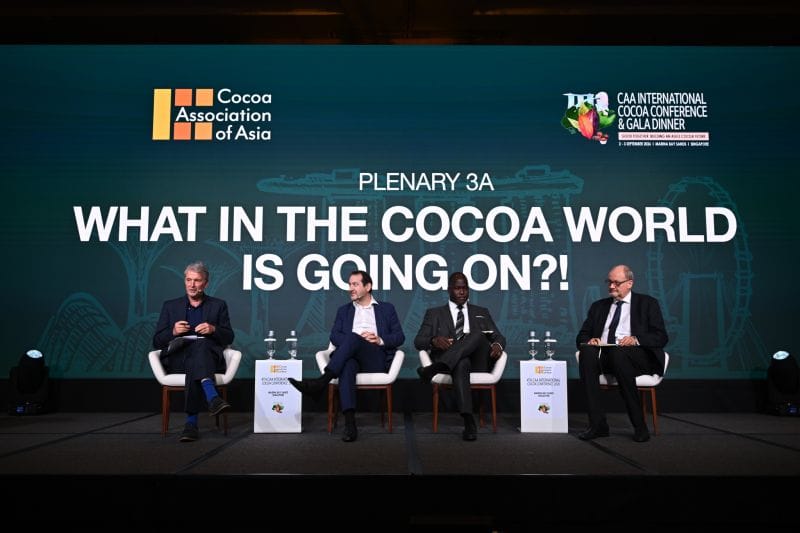
The first plenary session on Wednesday afternoon was: What In The Cocoa World Is Going On?! Moderated by Anthony Myers (far left) with Chris de Lavigne, Wisdom Kofi Dogbey and Michel Arrion. Image: cocoaradar.com
## **A Structural Shift In Cocoa**
After the lunch break, CocoaRadar founder and editor-in-chief Anthony Myers moderated three business-focused sessions examining the market, grindings and regulation.
In *What In The Cocoa World Is Going On?!*, Deloitte’s Chris de Lavigne argued that the sector was heading towards fundamental structural change.
The discussion took place in the same week that Côte d’Ivoire set its guaranteed farmgate price for the 2026–27 main crop at CFA1,200 ($2.12) per kilogram. The price maintained the level introduced for the preceding mid-crop and came in at the bottom of the CFA1,200–1,500 range anticipated by industry observers.
Michel Arrion, executive director of the International Cocoa Organization, told delegates that global grindings had fallen by almost half a million tonnes between 2023 and 2025.
He argued that the decline did not simply mean consumers had stopped eating chocolate. Instead, part of it reflected manufacturers reducing the amount of cocoa incorporated into their products.
Arrion cited findings from an ICCO-commissioned study indicating an 8–10% reduction in cocoa incorporation by major brands—a finding that surprised many delegates.
Wisdom Kofi Dogbey, managing director of Cocoa Marketing Company Ghana, reaffirmed Ghana’s importance to the global market. He said the country had completed the 2025–26 season with production of approximately 750,000 tonnes, compared with 597,000 tonnes in the previous season.
However, he stressed the need for more farm investment to replace ageing and diseased trees and improve productivity. Farm gate incentives, finance, agricultural inputs and new planting will all be essential if Ghana is to sustain its recovery. He also highlighted the country's new Cocoa Board Act that will offer more protection to farmers and boost sustainability initiatives.
## **Asia Defies The Grindings Slowdown**
Supply, demand and processing trends were explored further during *Will Cocoa Grind To A Halt?*
The panel brought together Eric Bergman of JSG Commodities, Paul Felix Tioputra of Cargill, Paul Arendsen of Barry Callebaut, Michael Clark of Mondelēz International and Max Goettler of JB Cocoa.
Against the legacy of record bean prices, persistent supply concerns, cost-of-living pressures and expanding regulatory requirements, the panel considered whether grindings and chocolate consumption could withstand further pressure.
Asia’s divergence from other major processing regions emerged as a central theme. The region was described as an increasingly important centre for cocoa processing, chocolate manufacturing, product innovation, consumer growth and supply-chain connectivity.
CAA figures showed that Asia’s second-quarter 2026 cocoa grind rose by just over 25% year on year to 224,646 tonnes. The increase indicated resilient processing activity despite elevated cocoa costs.
The possible return of El Niño remained in the background, alongside continuing supply pressure and the risk of demand destruction. These factors are expected to influence processing decisions in the coming quarters.
The panel also pointed to the resilience of premium chocolate and growing consumer interest in products with higher cocoa content. Potential health benefits associated with higher-cocoa chocolate could offer the industry an alternative growth narrative at a time when some manufacturers are reducing cocoa content or introducing substitutes.
## **Asia Prepares For Europe’s Regulatory Test**
The final session, *EU Crash Test*, examined whether Asia and the wider cocoa industry are ready for Europe’s changing regulatory landscape.
Michael Bucki, counsellor on environment and agriculture at the Delegation of the European Union to Thailand, drew on his experience with the rubber and palm oil sectors. He described how operators were using innovation to build sophisticated data and traceability platforms that could provide lessons for Asian cocoa supply chains preparing for the EU Deforestation Regulation.
Matthijs de Meer, director of EU affairs and sustainability at the European Cocoa Association, cautioned that implementation would still bring teething problems. Trust, transparency and the ability of industry systems to connect effectively with the EU’s infrastructure will be critical.
Large and medium-sized operators are due to begin applying the EUDR requirements from 30 December 2026, with a later deadline for most micro and small operators.
Questions also remain over who will absorb the cost of duplicated processes, legal liability and additional compliance requirements.
Sarah Dekkiche, director of policy and partnerships at the International Cocoa Initiative, urged companies to treat child labour, forced labour and human-rights due diligence as more than a reporting exercise.
The risk, she said, is that the industry could build increasingly sophisticated systems around the symptoms of its social problems while leaving farmer poverty fundamentally untouched. Poorly designed requirements could also push additional costs further down the supply chain.
Fuzz Kitto, co-director of Be Slavery Free and the Chocolate Scorecard, said the approach of regulation had already helped drive greater corporate engagement with traceability data.
Drawing on seven years of Chocolate Scorecard findings covering companies responsible for roughly nine out of every 10 cocoa beans traded globally, he said companies were no longer arguing that fuller traceability was impossible once regulation required it.
Kitto emphasised the need to address causes rather than symptoms. Living income, transparency and traceability were closely connected to deforestation, child and forced labour, agroforestry, chemical use, gender and farmer health, he said.
The panel broadly expected the EU, governments and larger industry operators to have their core systems ready by the end of 2026\. Whether those systems will operate seamlessly – and whether implementation will be consistent across the market – remains less certain.
## **An Integrated Challenge**
Day One underlined that cocoa resilience cannot be delivered through a single intervention.
Supply, productivity, farmer income, consumer affordability, traceability and human rights form an interconnected system. Shifting costs or risks from one participant to another may relieve immediate pressure, but it will not create a durable cocoa economy.
The industry has demonstrated that it can adapt under extreme conditions. Its next challenge is to turn that adaptability into sustained investment before the next disruption arrives.
---
**cocoaradar.com is:**
- **Official Media Partner -** [**CAA International Cocoa Conference**](https://www.caacocoaconference.org/programme?ref=cocoaradar.com)
- **'From Our Desk. To Yours. Daily'**
- [**Sign-up here**](https://cocoaradar.com/#/portal) **for free and choose your plan.**
### West African Cocoa Reforms Collide With Rising Supply Risks
URL: https://cocoaradar.com/west-african-cocoa-reforms-collide-with-rising-supply-risks/
Last updated: 2026-09-03T13:41:19.000Z
Fiscal discipline and cocoa-sector reform are moving to the centre of the market outlook in West Africa, just as expectations of a smaller 2026-27 harvest revive supply concerns.
Ghana Cocoa Board completed a GH¢2.31 billion ($205.18m) settlement linked to its 2026 restructuring commitments. The payment cleared obligations to bondholders affected by Ghana’s domestic debt exchange. Cocobod also paid GH¢162 million to cocoa-bill investors who opted out of the restructuring.
The settlement removes an immediate liability, but it does not resolve wider institutional concerns. The World Bank has warned that delayed reforms affecting Ghana’s cocoa, energy and gold institutions could weaken the country’s debt-sustainability trajectory.
Advertisement
[  ](https://www.foodmasters-freiberg.com/en/?utm%5Fsource=ghost&utm%5Fmedium=newsletter&utm%5Fcampaign=ad&utm%5Fcontent=qsm%5Fplaceholder)
Producer remuneration will be another test. Ghanaian cocoa farmers were promised 70% of the free-on-board price, according to the reporting provided, but it remains unclear whether that commitment will apply in the new season.
Côte d’Ivoire is pursuing a different form of restructuring by seeking to retain more value domestically. The government maintained the farmgate price at CFA1,200 per kilogram ($2.21) for the 2026-27 main crop while advancing plans to reduce the industry’s reliance on raw-bean exports.
Under its 2026–2030 National Development Plan, Côte d’Ivoire aims to process 50% of its cocoa domestically by 2030\. Cocoa accounts for roughly 17% of national output, according to the supplied report. The National Centre for Agronomic Research is also deploying measures against cocoa swollen shoot virus to protect plantations and yields.
Market pricing reflects growing concern about the next crop. New York cocoa futures have more than doubled since Côte d’Ivoire reduced farmers’ income by 57% in March, although the contract cited in the report was down 3.9% at $6,508 a tonne at 2:02 p.m. in London.
_This post is for paying subscribers only._
### Women and Youth Must Shape Cocoa’s Future, CAA Farmer Forum Hears
URL: https://cocoaradar.com/women-and-youth-must-shape-cocoas-future-caa-farmer-forum-hears/
Last updated: 2026-09-03T06:00:18.000Z
Women and younger people must be given greater influence over cocoa-sector decisions if farming communities and supply chains are to become more resilient, speakers told the CAA International Cocoa Conference in Singapore.
The ‘Invisible No More’ discussion followed a presentation on the second edition of the International Farmers Network Forum. It was moderated by Selene Scotton, Group Cocoa Sustainability Manager at Puratos.
Advertisement
[  ](https://www.foodmasters-freiberg.com/en/?utm%5Fsource=ghost&utm%5Fmedium=newsletter&utm%5Fcampaign=ad&utm%5Fcontent=qsm%5Fplaceholder)
Panellists were Fay Fay Choo, Asia director for cocoa sustainable sourcing at Mars; Cheok Mei-Ing, director of partnerships development for supply chains at Save the Children Federation; and Louise Mabulo, founder of The Cacao Project in the Philippines.
### **Representation Gaps**
Figures presented by Scotton highlighted significant demographic gaps across the cocoa supply chain in 10 countries.
Women made up only 10% of registered farmers, limiting their influence within the sector and affecting power dynamics and access to land ownership.
Around 40% of registered farmers were under 44\. In Asia, however, the proportion fell to between 18% and 20%, underlining the challenge of attracting and retaining a new generation of cocoa producers.
The forum was created to give women and younger farmers - groups often excluded from industry discussions - a platform to identify challenges and develop their own solutions.
Using design-thinking and mind-mapping exercises, participants explored knowledge-sharing, agricultural service networks and income opportunities beyond cocoa beans, including ecotourism and cocoa by-products.
Five business proposals emerged: Digital Crop Protection, focused on agricultural technology; Eakar Eco-Village, an ecotourism concept; Cocoa Life Academy, a six-month knowledge-sharing programme; Root Care, a regenerative soil initiative; and Farm Match, a platform connecting farmers with service providers.
The winning team will receive sponsorship to attend the Mars Cocoa Academy in Indonesia.
A mentorship scheme started at Chocoa in Amsterdam was also recognised for organising a programme through the Women in Cocoa & Chocolate Network.
### From Labour to Leadership
During the panel discussion, Choo said corporations needed to direct more attention towards women and younger people to improve the adoption of agricultural innovations and strengthen supply stability.
She said Asia had shifted from being a cocoa-bean producer to a net importer despite investment in agricultural technology. Women and youth could help reverse declining engagement with the crop by serving as village-based change agents, she added, pointing to younger people’s energy and concern about climate change.
Cheok identified structural barriers preventing both groups from taking on more influential roles. These included limited access to finance, assets and commercial networks, as well as social norms restricting women’s mobility.
Young people, she said, were also frequently treated as a source of manual labour rather than being included as strategic decision-makers.
### Measuring Regeneration and Resilience
The panel argued that conventional measures such as productivity and crop volumes were not sufficient on their own to assess whether cocoa supply chains were becoming more sustainable.
Future indicators should track whether younger people are moving into skilled and higher-value roles, including nursery management, service provision and entrepreneurship.
Cheok also called for greater attention to household resilience, including communities’ ability to recover from floods, earthquakes and other shocks.
Mabulo said traditional knowledge and modern science could be combined to create more accessible agricultural innovations. Farm-focused generative AI and geospatial technologies, for example, could provide farmers with practical guidance in local languages.
She added that women were often among the first to adopt new agricultural methods, making their participation central to the successful introduction of technology.
### Building Community-Owned Networks
The speakers favoured integrated, community-led approaches over standalone corporate or development programmes.
Cheok cited an example from Indonesia in which a community savings group successfully sought equipment to establish self-financed organic compost businesses using existing village facilities. The initiative demonstrated how partnerships between companies, non-governmental organisations and communities could become more sustainable when local leaders retained ownership.
Looking towards the next CAA Conference in two years, Choo proposed creating digital and offline networks through which farmers in countries and territories including Vietnam, Taiwan and the Philippines could exchange practical knowledge.
Such networks could support peer-to-peer learning on soil health, cover crops and other locally relevant farming practices, extending knowledge-sharing beyond a single conference.
The discussion linked the representation of women and younger people not only to equality, but also to the cocoa sector’s ability to regenerate its workforce, strengthen farming communities and maintain future supply.
More coverage from the CAA Conference:
[CAAICC2026 - From The Desk of CocoaRadar™News and exclusive analysis on the cocoa sector and chocolate trends focussing on sustainability, regulation, prices, supply & demandFrom The Desk of CocoaRadar™](https://cocoaradar.com/tag/caaicc2026/)
---
**cocoaradar.com is:**
- **Official Media Partner -** [**CAA International Cocoa Conference**](https://www.caacocoaconference.org/programme?ref=cocoaradar.com)
- **'From Our Desk. To Yours. Daily'**
- [**Sign-up here**](https://cocoaradar.com/#/portal) **for free and choose your plan.**
### The Crisis in Cocoa for Industry and Farmers
URL: https://cocoaradar.com/the-crisis-in-cocoa-for-industry-and-farmers/
Last updated: 2026-09-02T16:43:53.000Z
### **Help That Industry Needs and African Farmers Want**
### **Part 2: Yield and the Crisis**
The lack of any significant improvement in the yield of cocoa trees, especially in the most successful area of cocoa cultivation, West Africa, ties together the crises of the past three decades.
A comparison with wheat illustrates this. Chocolate first entered the middle-class diet of Great Britain in the 1850s. At that time, producing one bushel of wheat required three man-hours of labour. Today, 175 years later, producing one bushel requires around two *minutes* of labour.
Large increases in yields have been achieved in probably every staple food crop for humans and animals: corn, soy, oilseeds, barley, oats, beans, nuts, sugar, potatoes, rice, sorghum, vegetables, fruits, alfalfa, and others.
In contrast, probably more than 80% of the world’s cocoa beans are cultivated in Africa and elsewhere by methods that have not changed significantly in 175 years.
The entire chocolate confectionery industry, with its technologically advanced factories, computerised management systems, and sophisticated marketing departments, depends for its main feedstock on a workforce of mostly impoverished, often uneducated and illiterate, often recently immigrated, and often discriminated-against farmers working by hand.
The total yield of cocoa trees in Côte d’Ivoire and Ghana probably reached its peak in 2019-20 and has been declining by about 75 tmt each year since. The declines in each country have been for different reasons. The following charts reveal important reasons.
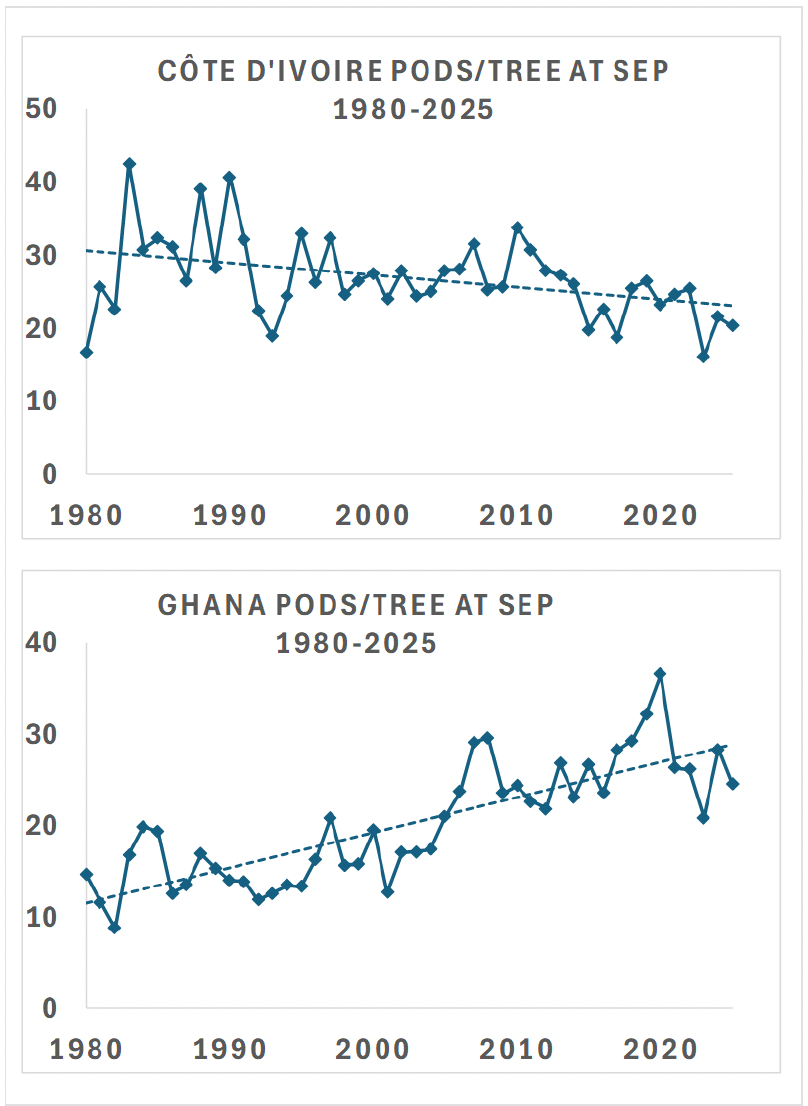
The charts above show the number of pods counted on each cocoa tree during September from 1980 to 2025 by teams working in Côte d’Ivoire and Ghana. They show the number of pods at the time the main-crop harvest was starting.
Although counted by different people and at gradually changing sites, the results should be comparable across years because the number of sites was always about 100, the number of trees 500–600, and the sites were distributed widely throughout each country.
A count during September is likely to be the most accurate of all counts made during a year because most pods are large enough to be seen. The total main-crop harvest will be close to the number of pods per tree found in September multiplied by the number of trees in the country.
The counts are therefore measures of the average main-crop yield per tree in each season.
The histories are very different.
- **Côte d’Ivoire:** Through the 1980s and early 1990s, the number of pods on trees in Côte d’Ivoire was stable at about 30\. Then the number began to decline. It has continued to decline through 2025, and the decline may have accelerated in the last 10 years. In recent years, the average slipped to about 25 pods per tree.
- **Ghana:** The pod load on Ghana’s trees was also about stable in the 1980s, but very low, at around 14\. It declined in the mid-1990s. Then it rose steadily and may have continued rising through 2024-25, despite the 2023-24 failure and weak 2024-25 season, when weather probably played a role. If the rise continues, it will reach the 30 pods per tree counted in Côte d’Ivoire 40 years ago.The long-term rise in Ghana has been about three times as rapid as the long-term decline in Côte d’Ivoire. For every one pod that disappeared in Côte d’Ivoire across seasons, three pods appeared in Ghana.
The difference almost certainly reflects structural differences between Côte d’Ivoire and Ghana.
- **Côte d’Ivoire:** Except for controlling prices and sales, Côte d’Ivoire never closely regulated its cocoa industry. Until a few years ago, it allowed farmers to migrate freely into native forests. The expansion of its crop depended on immigration from the Sahel of people without experience in cultivating cocoa.Côte d’Ivoire did not subsidise fertiliser or agrochemicals or make significant efforts to promote their use. It operated limited extension services for cocoa. There was some research and general agricultural support under organisations called SATMACI (cocoa and coffee) and, since the 1990s, ANADER (all agriculture).Trees aged; farmers aged. Swollen Shoot invaded from Ghana, if it was not already present, and recognition of its presence came only in about 2015.
- **Ghana:** Besides controlling prices and sales, Ghana has been continuously involved, through Cocobod, in every phase of cocoa cultivation. It has subsidised fertiliser and agrochemicals, sometimes 100%, and has almost always been involved in importing and distributing them.It has maintained a large extension division – CHED (Cocoa Health and Extension Division) – or predecessors with comparable responsibilities, distributed equipment for spraying, pruning, and weeding, and hired teams for these tasks.Cocobod’s CRIG, the Cocoa Research Institute of Ghana, dates from 1938\. Swollen Shoot was recognised in Ghana during the 1930s. Programmess to combat it started in the 1950s. These usually consisted of cutting out diseased trees, paying farmers for their losses, and replanting.Campaigns against Swollen Shoot have taken place every few years. Replanting often has been with new cultivars. These would have improved the tree stock and reduced its average age. Cocoa has been part of the culture and continues to be very important within it, for example through competitions for the best cocoa farmer.
Critics of Cocobod often complain about its inefficiency, mismanagement, and corruption. The complaints have merit. At every election, Cocobod can be a tool for winning the farm vote. Factories that Cocobod finances are perennial money losers.
Despite these real problems, the charts of yield per tree show that the existence of Cocobod and the cultural commitment to cocoa have accomplished something that Côte d’Ivoire has not.
Ghana’s crop has declined because farmers switched to other crops or sold their land for *galamsey* (gold prospecting). The total land area planted with cocoa declined.
In Côte d’Ivoire, the crop increased because farmers migrated to the forests. The area planted to cocoa expanded so fast that the decline in yields was hidden by the rising tonnes of arrivals at port.
- **Download:**
[Veriground Proposal to the Cocoa-using IndustryVeriground Proposal to the Cocoa-using Industry.pdf2 MBdownload-circle](https://cocoaradar.com/content/files/2026/08/Veriground-Proposal-to-the-Cocoa-using-Industry.pdf "Download")
**Read the first article in the series here:**
[The Crisis in Cocoa for Industry and Farmers – and the Help Industry Needs and African Farmers WantSteven Haws of Commodities Risk Analysis (CRA) summarizes the events that have led to the current crisis. He argues that industry representatives are calling for greater collaboration across the supply chain and for innovation that benefits both the industry and cocoa farmersFrom The Desk of CocoaRadar™Jasper Jemmett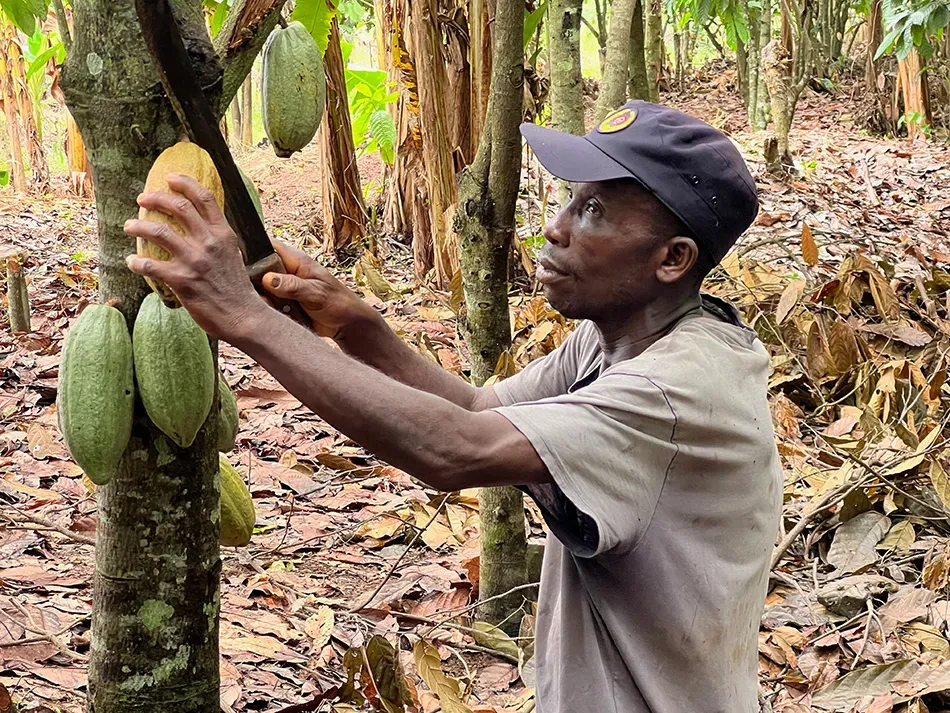](https://cocoaradar.com/the-crisis-in-cocoa-for-industry-and-farmers-and-the-help-industry-needs-and-african-farmers-want/)
---
**About CRA**
CRA offers a specific collaboration to support innovation at the beginning of the supply chain: the cocoa farmer in West Africa. [Veriground](https://www.veriground.io/?ref=cocoaradar.com) operates networks of weather stations in Côte d'Ivoire and Ghana that provide free local weather forecasts to farmers located near those stations, at a fraction of the cost compared with the potential return.
### CAA Becomes First Association to Back ASEAN Sustainability Programme
URL: https://cocoaradar.com/caa-becomes-first-association-to-back-asean-sustainability-programme/
Last updated: 2026-09-02T16:15:36.000Z
The Cocoa Association of Asia has become the first association to formally support the ASEAN One Billion Trees Growing Initiative, placing the regional cocoa sector behind a wider drive to promote reforestation and sustainable growth, CocoaRadar can reveal.
CAA Secretary-General Shirley Choo announced the commitment at the opening of the CAA International Cocoa Conference at Marina Bay Sands in Singapore on Wednesday, where a formal statement of support was signed. Choo said the initiative recognised the close relationship between cocoa production and healthy, biodiverse landscapes. Cocoa does not grow in isolation, she said, with surrounding trees providing shade, protecting soils and supporting the biodiversity on which productive farms depend.
Advertisement
[  ](https://www.foodmasters-freiberg.com/en/?utm%5Fsource=ghost&utm%5Fmedium=newsletter&utm%5Fcampaign=ad&utm%5Fcontent=qsm%5Fplaceholder)
The move also gives the cocoa industry a platform to contribute its practical knowledge of agroforestry, landscape regeneration and crop resilience to regional policymakers.
Choo described the CAA as a convening body operating at the intersection of industry, policy, sustainability and trade. Its role, she said, was to bring stakeholders together, share member expertise and help ensure cocoa remains part of Southeast Asian discussions about future trade and responsible growth.
That work is becoming more urgent as cocoa businesses respond to fast-changing requirements covering traceability, responsible farming and deforestation.
### Volatility Tests the Sector
Opening the two-day conference, CAA Chairman Brandon Tay said the global cocoa sector was confronting volatile prices, the effects of weather and climate change in producing regions, stronger consumer demands for transparency and the continuing need to protect farmer livelihoods.
He positioned Asia as an increasingly connected centre of cocoa production and consumption, and said the CAA’s environmental commitment reflected the need for industry, governments and regional organisations to work together.
> The conference, held under the theme ‘Good Together: Building an Agile Cocoa Future’, brings together farmers, producing countries, manufacturers, traders, governments, associations and specialists in sustainability, finance and technology. Tay said its purpose was to promote knowledge exchange and build relationships across those groups.
Enterprise Singapore managing director Cindy Khoo identified market volatility, rapid innovation and sustainability as three forces reshaping the industry.
Khoo noted that cocoa prices tripled in 2024 before falling sharply, exposing businesses to structural pressures including geopolitical tensions and supply-chain uncertainty. She highlighted Project Infinity, an AI-based decision-intelligence platform developed in Singapore by ofi (Olam Food Ingredients), as an example of how companies could reduce financial simulation cycles from weeks to seconds.
She also said changing consumer expectations demanded faster product development through connected agri-food ecosystems. Traceability would become increasingly important to market competitiveness as the European Union’s Deforestation Regulation (EUDR) approached implementation.
Khoo identified carbon markets as a potential source of upfront finance for smallholder farmers undertaking agroforestry and soil-restoration projects. Singapore, she said, was home to more than 160 carbon-services companies, while Ecom was establishing a global carbon desk as part of an expansion of its Asia-Pacific trading hub in the city-state.
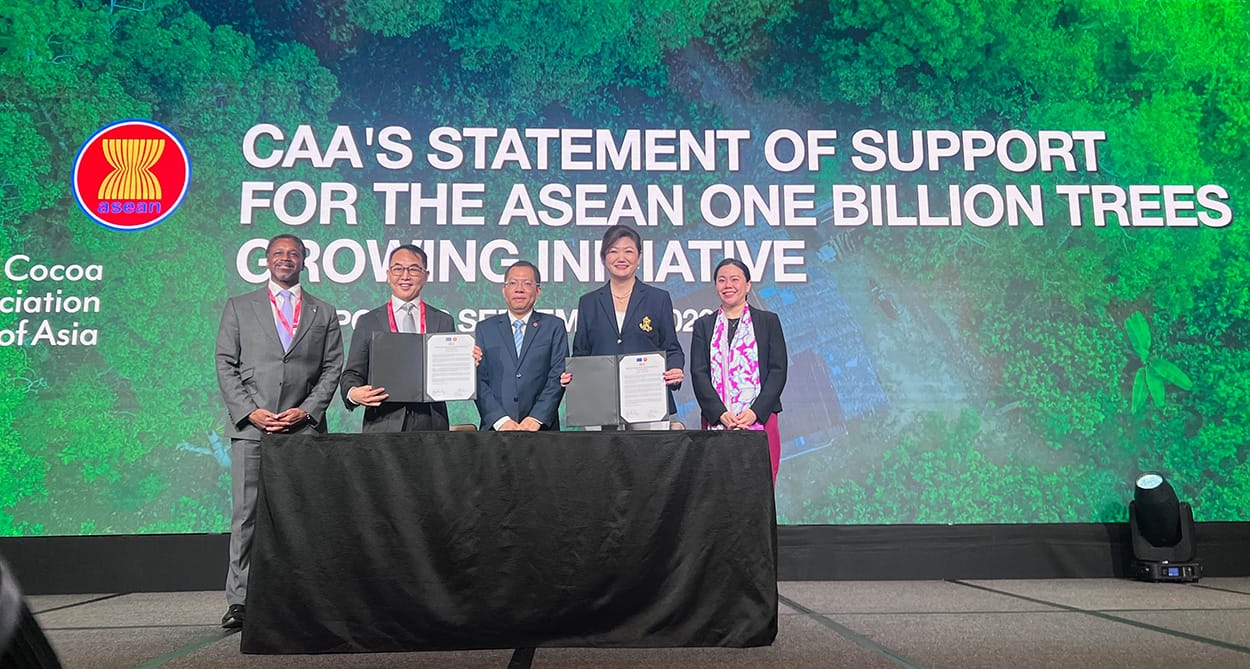
Shirley Choo (second from right) leads the signing of the formal statement of support with key stakeholders on behalf of the CAA, Image: cocoaradar.com
### EU Calls for Practical Support
Errol Levy, deputy head of mission at the European Union Delegation to Singapore, said cooperation across the cocoa value chain would be essential to balance environmental requirements, economic resilience and decent producer livelihoods.
He said farmers needed practical support to raise productivity, diversify and use land sustainably as climate change and market pressures intensified. The EU aimed to combine market requirements with investment through its Global Gateway initiative.
Levy said the EUDR would apply to large and medium-sized operators from 30 December 2026 and to most micro and small operators from 30 June 2027\. That timetable made improvements in farm geolocation, legality checks, traceability and producer support urgent.
He cited the EU-backed Sustainable Agriculture and Forest Ecosystems initiative in Indonesia, which supports agroforestry and traceability in Central Sulawesi, Lampung and West Kalimantan, as an example of regional cooperation.
The opening discussions set a clear direction for the conference: Asia’s cocoa sector is seeking to move beyond reacting to immediate market shocks and towards collective action on environmental resilience, responsible trade and farmer support.
**More on the CAA Conference:**
[CAAICC2026 - From The Desk of CocoaRadar™News and exclusive analysis on the cocoa sector and chocolate trends focussing on sustainability, regulation, prices, supply & demandFrom The Desk of CocoaRadar™](https://cocoaradar.com/tag/caaicc2026/)
---
**cocoaradar.com is:**
- **Official Media Partner -** [**CAA International Cocoa Conference**](https://www.caacocoaconference.org/programme?ref=cocoaradar.com)
- **'From Our Desk. To Yours. Daily'**
- [**Sign-up here**](https://cocoaradar.com/#/portal) **for free and choose your plan.**
### Publish Audit Findings, Cocoa Study Author Urges After False Sustainability Reporting Experiment
URL: https://cocoaradar.com/publish-audit-findings-cocoa-study-author-urges-after-false-sustainability-reporting-experiment/
Last updated: 2026-09-01T14:05:16.000Z
Cocoa sustainability programmes should publish internal audit results so outsiders can assess whether their monitoring systems deliver truthful reporting, the lead author of a new study has told CocoaRadar.
The call shifts attention from how much farm data companies collect to whether they can demonstrate that the information is credible – and that checks designed to protect its integrity actually work.
> “Most certification systems include audits, but without public information on their findings and effectiveness, it is difficult to determine whether these audits are sufficient to ensure truthful reporting,” Federico Cammelli said.
Advertisement
[  ](https://www.foodmasters-freiberg.com/en/?utm%5Fsource=ghost&utm%5Fmedium=newsletter&utm%5Fcampaign=ad&utm%5Fcontent=qsm%5Fplaceholder)
His research with Johan Six and Rachael Garrett, published in *Science*, examined a shade-tree planting programme involving 407 cocoa farms in Côte d’Ivoire. Manipulation appeared in 25% of field verification reports when data collectors knew the compliance threshold. Withholding that information reduced the figure to 11%, according to the[ study’s public data archive](https://datadryad.org/dataset/doi%3A10.5061/dryad.v9s4mw77q?ref=cocoaradar.com).
The result offers a relatively simple safeguard for sustainability monitoring. But Cammelli argues that wider progress requires transparency about conflicts of interest, evidence that verification works and greater engagement with the farmers expected to comply.
[When Cocoa Data Turns to DustEditor’s comment: The cocoa market has more information than ever. Without shared definitions and proper context, however, apparent precision can distort prices, investment and riskFrom The Desk of CocoaRadar™Anthony Myers](https://cocoaradar.com/when-cocoa-data-turns-to-dust/)
_This post is for subscribers only._
### Olam’s ofi Results Sharpen Focus on Indonesia’s Cocoa Supply Gap
URL: https://cocoaradar.com/olams-ofi-results-sharpen-focus-on-indonesias-cocoa-supply-gap/
Last updated: 2026-08-31T12:48:40.000Z
Two developments frame Asia’s cocoa agenda as the Cocoa Association of Asia (CAA) conference opens in Singapore this week: Olam’s food-ingredients business is emerging from extreme commodity-price volatility with greater financial flexibility, while Indonesia is trying to rebuild the domestic supply base its factories need.
[Beyond the Price Spike: Singapore Prepares for Cocoa’s Next Big ConversationAs the global cocoa sector confronts volatile markets, regulatory upheaval and questions over future supply, the Cocoa Association of Asia is bringing the industry together. CocoaRadar speaks exclusively with CAA Secretary General and COO Shirley Choo about why this year’s gathering mattersFrom The Desk of CocoaRadar™Anthony Myers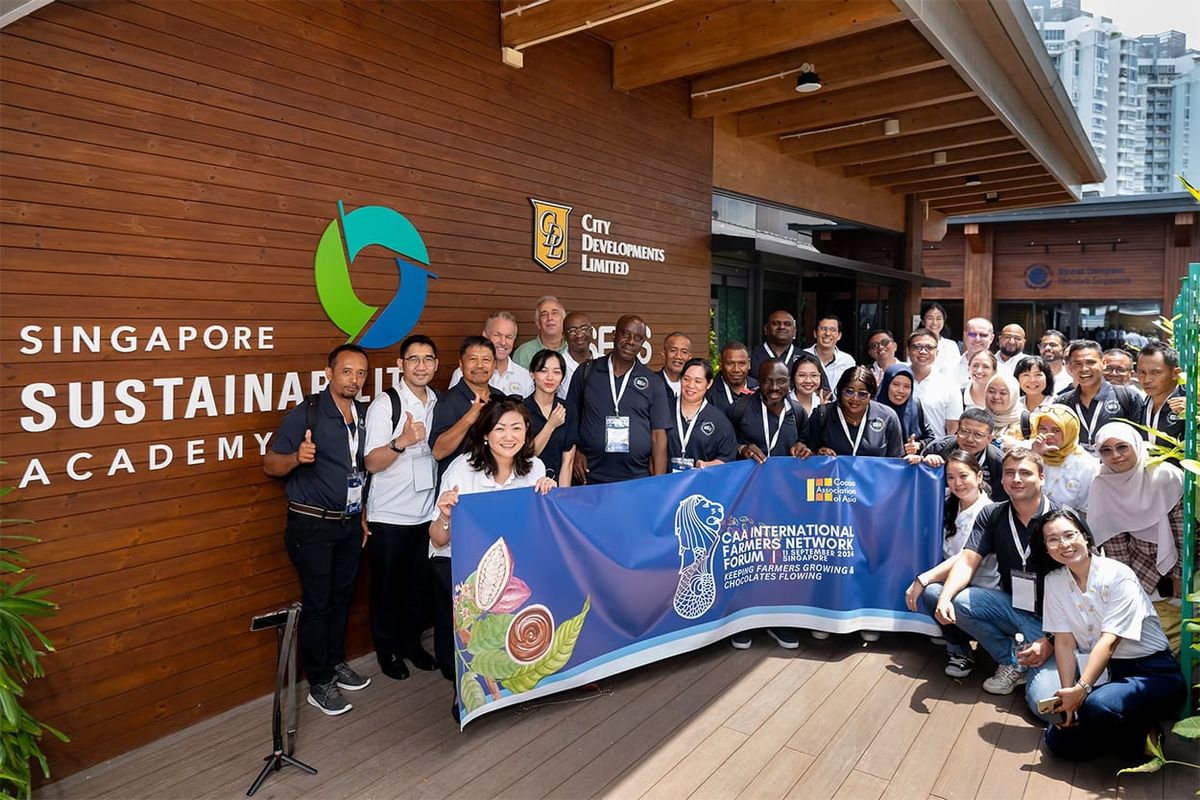](https://cocoaradar.com/beyond-the-price-spike-singapore-prepares-for-cocoas-next-big-conversation/)
Olam Group reported attributable profit of S$1.91 billion ($1.50bn) for the six months to 30 June, nearly six times the S$323.8 million recorded a year earlier. The headline result was driven mainly by S$1.75 billion in one-off gains from disposals and a revaluation linked to the group’s restructuring – not by a comparable surge in its underlying ingredients business.
Operational profit attributable from continuing operations fell 61.5% against the reported comparator to S$64.4 million, although Olam said the result improved after substantial prior-year foreign-exchange gains were excluded. According to Reuters, the group declared an interim dividend of one Singapore cent and a special dividend of six cents.
Advertisement
[  ](https://www.foodmasters-freiberg.com/en/?utm%5Fsource=ghost&utm%5Fmedium=newsletter&utm%5Fcampaign=ad&utm%5Fcontent=qsm%5Fplaceholder)
For cocoa markets, the more useful signal came from ofi. Revenue at Olam’s food-ingredients division fell 18.1% to S$12.02 billion as lower cocoa and coffee input prices were passed through to customers. EBIT declined by a much smaller 4.9% to S$509.7 million.
That divergence matters. Lower commodity values mechanically reduce reported revenue, but they can also release working capital tied up in inventories and hedging. Together with divestment proceeds, lower working-capital debt at ofi helped reduce Olam Group’s net gearing to 0.93 times from 2.09 times.
Management described ofi as delivering “stable earnings with significant reduction in capital deployment”. However, the division combines cocoa with coffee, dairy, nuts and spices, and Olam did not disclose cocoa-specific margins or volumes.
Its EBIT resilience is therefore informative, but not a clean measure of chocolate demand or cocoa-processing profitability.
### Indonesia Faces Processing Challenge
Indonesia presents the physical counterpart to that financial story. Its 11 cocoa processors have combined annual grinding capacity of more than 750,000 tonnes but are operating at only about 60%, according to the Industry Ministry. Over the past decade, domestic harvests have fallen by roughly 5% a year, while bean imports have increased by around 50%.
Indonesia has introduced a cocoa export levy intended to finance replanting, improved seedlings and productivity programmes. The priority is to increase yields on existing smallholder farms – particularly in Sulawesi – before expanding the planted area.
> “Today the biggest challenge for the processing industry is the shortage of raw materials,” Indonesian Cocoa Board chairman Soetanto Abdoellah told the Indonesian Cocoa Conference in July.
The economics demand patience. An estimated 200,000–300,000 hectares planted with ageing cocoa trees still require replanting. Newly planted trees typically take about two years to produce their first pods and considerably longer to reach peak yields.
### CocoaRadar View
ofi’s results and Indonesia’s revival plan expose the same strategic question from opposite ends of the supply chain: can lower financing pressure and stronger processing economics translate into sustained investment in cocoa farms?
The key indicator is Indonesia’s domestic production-to-grind ratio. A rising ratio would reduce import dependence, improve factory utilisation and support increased exports of higher-value butter, powder and chocolate. If the ratio continues to deteriorate, Indonesia may remain a successful processing hub while becoming less important as a cocoa origin.
For CAA delegates, the numbers to watch are levy disbursements, tree renewal, farmer incomes, imported bean volumes and processor utilisation – not export value alone.
---
**cocoaradar.com is:**
- **Official Media Partner -** [**CAA International Cocoa Conference**](https://www.caacocoaconference.org/programme?ref=cocoaradar.com)
- **'From Our Desk. To Yours. Daily'**
- [**Sign-up here**](https://cocoaradar.com/#/portal) **for free and choose your plan.**
### Beyond the Price Spike: Singapore Prepares for Cocoa’s Next Big Conversation
URL: https://cocoaradar.com/beyond-the-price-spike-singapore-prepares-for-cocoas-next-big-conversation/
Last updated: 2026-08-28T09:54:59.000Z
💡
The CAA International Cocoa Conference and Dinner takes place at Marina Bay Sands, Singapore, on 2–3 September 2026\. CocoaRadar is the event’s official media partner and will report live from the conference.
For much of the past two years, one story has towered over the global cocoa industry: price.
Record-breaking markets and concerns over future supply have forced businesses throughout the value chain to rethink long-held assumptions. At the same time, companies are confronting tougher sustainability requirements, new regulatory demands and changing consumer behaviour.
But as the industry prepares to gather in Singapore, the conversation is beginning to move beyond the price spike. The more fundamental question is whether cocoa has entered a new era – and, if it has, what kind of industry will emerge from it.
That question will run through the CAA International Cocoa Conference and Dinner, taking place on 2–3 September 2026 at Marina Bay Sands under the theme ‘Good Together: Building an Agile Cocoa Future’.
As the event’s official media partner, CocoaRadar will report live from Singapore as producers, traders, processors, chocolate manufacturers, policymakers, financiers, sustainability specialists and technology providers examine what comes next for the sector.
Advertisement
[  ](https://www.foodmasters-freiberg.com/en/?utm%5Fsource=ghost&utm%5Fmedium=newsletter&utm%5Fcampaign=ad&utm%5Fcontent=qsm%5Fplaceholder)
For Shirley Choo, Secretary General and Chief Operating Officer of the Cocoa Association of Asia (CAA), one word in this year’s theme is particularly significant: agility.
> “For me, agility is really the word for our industry now because things are moving so quickly,” Choo tells CocoaRadar. “In the last few years, we have had to deal with record prices, supply challenges, evolving regulations, sustainability expectations and changing consumer demands, often all at once.”
But agility, she stresses, should not be confused with simply responding faster to the next crisis.
“Agility is not just about reacting fast. It is about being practical, staying connected, and being ready to adjust together when the environment changes.”
### Beyond the Immediate Crisis
The cocoa sector has spent much of the past two years responding to extraordinary market conditions. Supply concerns and record prices have forced processors and chocolate manufacturers to confront costs few had built into their long-term models.
Yet price is only part of the story. Companies are also adapting to evolving European Union regulations and demands for greater traceability, transparency and accountability across agricultural supply chains.
For Choo, one ambition for Singapore is to shift the industry conversation from reaction towards strategy.
“Price volatility and supply uncertainty will of course remain part of the conversation, but I hope delegates leave looking beyond the immediate headlines,” she says.
“The bigger question is: how do we strengthen the sector for the long term? That means talking about innovation, productivity, sustainability, stronger partnerships and, very importantly, better support for farming communities.”
Her hope can be distilled into a simple shift in the question.
“I would love to see the conversation move from ‘what happened?’ to ‘what can we do together next?’”
### What in the Cocoa World Is Going On?
That challenge begins with one of the conference’s headline discussions, ‘What in the Cocoa World Is Going On?’
The session will bring together industry voices to consider record prices, supply uncertainty, changing regulations and evolving consumer expectations. It aims to separate short-term noise from long-term structural shifts and explore what may lie ahead.
Rather than offering another round of day-to-day market commentary, the discussion will examine where the cocoa sector may be heading over the next three to five years. Prices, supply, climate and regulation will all form part of that equation.
### Will Cocoa Grind to a Halt?
The macro debate sets the stage for another provocative session: ‘Will Cocoa Grind to a Halt?’
The question is not whether processing will literally stop, but what record cocoa prices, persistent supply concerns, cost-of-living pressures and increasing regulatory requirements mean for grindings, consumer demand and the future affordability of chocolate.
For Asia, the debate carries particular weight. The region is an increasingly important centre for cocoa processing, chocolate manufacturing, ingredient innovation, consumer-market growth and supply-chain connectivity.
Moderated by the CocoaRadar Editor, the panel will examine what demand and consumption could look like over the coming years. The aim is not to predict a single outcome, but to test whether the assumptions businesses have traditionally planned on still hold.

Shirley Choo (centre) talks 'EU Crash Test' with panellists ahead of this year's conference. Image: CAA
### The EU Regulatory ‘Crash Test’
Markets represent only one side of the transformation. Another discussion moderated by CocoaRadar will confront the EU’s shifting regulatory landscape.
The ‘EU Crash Test’ session will examine rising compliance expectations, traceability systems and commitments to sustainability. For companies operating in Asia, the effects will be felt wherever cocoa destined for European markets is produced, traded or processed.
The panel will ask whether the industry is ready and explore whether greater alignment and leadership are possible. Can regulation deliver meaningful change across global cocoa supply chains, or will it introduce additional cost and complexity? Can stronger traceability and transparency become sources of competitive advantage?
### The Challenges Are Too Connected
The breadth of the programme reflects a central reality facing cocoa in 2026: few of its biggest problems can be solved in isolation.
Supply resilience is connected to farm economics. Farm economics is connected to sustainability. Sustainability is increasingly connected to regulation and finance. Traceability is connected to technology. All of these factors ultimately influence what manufacturers can make, what consumers will buy and what farmers are paid.
That is why Choo believes bringing the value chain into the same room is essential.
> “The challenges we face are too connected for any one part of the value chain to solve alone,” she says.
“Each group sees the industry from a different angle, and that is exactly why it is so important to bring everyone into the same room. When producers, traders, manufacturers, regulators, financiers and technology providers are part of the same conversation, we get a more complete picture and, hopefully, more practical outcomes.”
Sometimes, she adds, progress begins by breaking established industry habits.
“I also find that some of the best conversations happen when people step outside their usual circles and start listening to each other.”
### Turning Disruption Into Opportunity
If volatility has exposed vulnerabilities in the cocoa system, it has also created pressure for faster innovation. Technology and traceability systems are developing, companies are examining supply chains in greater detail and sustainability programmes are evolving.
For Choo, the opportunity lies in turning that pressure into lasting improvement.
“Disruption is never easy, but it can also create momentum for change,” she says.
“We are seeing opportunities around traceability, technology adoption, sustainability initiatives and new ways to strengthen supply chains.”
EUDR provides a clear example of the tension. Implementation brings challenges across complex supply chains involving large numbers of smallholder farmers, but the direction towards greater transparency is unlikely to disappear.
> “Regulations such as EUDR are pushing companies to look more closely at transparency and accountability, and while that comes with real challenges, it can also help move the industry towards a stronger and more sustainable future,” Choo says.
“The organisations that are willing to collaborate, adapt and innovate will be better placed to navigate what comes next.”
### An Industry That Still Wants to Meet
Another signal is emerging ahead of Singapore: the industry is showing up. Registration is nearing capacity, while the gala dinner is fully subscribed and has a waiting list.
For Choo, that says something important about the mood within the sector.
“To me, it shows that people still believe in the value of coming together,” she says.
“Even with all the challenges around us, there is a real appetite to share knowledge, exchange ideas and build partnerships.”
She sees the participation as evidence that companies do not regard themselves simply as passengers in the transformation now taking place.
> “The industry does not want to sit on the sidelines. People want to be part of the conversation, and more importantly, part of shaping what comes next.”
### From Regional Gathering to Asian Industry Fixture
For Choo, CAAICC 2026 also represents something more personal. She has watched it develop from a regional meeting into an increasingly international gathering for cocoa and chocolate businesses with interests across Asia.
“CAAICC 2026 is shaping up to be a very special event, and I am truly encouraged by the strong interest from across the global cocoa and chocolate industry,” she tells CocoaRadar.
“What matters most to me is how far CAAICC has come – from a regional gathering to what I believe is now the leading cocoa and chocolate industry convention in Asia,” she says.
But scale alone is not how she measures its progress.
“More importantly, it shows the value of bringing different voices together to have honest conversations, share practical ideas and work through challenges as one industry.”
For Choo, the human element remains central.
> “On a personal level, hosting this event means a great deal to me. Cocoa is ultimately about people and relationships, and I want to sincerely thank the team and everyone working behind the scenes with me to bring this conference together.”
### What Happens After Singapore?
Any industry conference risks losing the energy generated in the room once delegates board their flights home. For Choo, avoiding that outcome will be the real test of success.
“Success would be if delegates leave with useful ideas, meaningful connections and practical takeaways they can bring back to their businesses and organisations,” she says.
“Success is creating a platform where people feel they can have open, constructive and honest conversations.”
But the larger ambition extends beyond two days in Singapore.
“For the wider industry, the real success is when those conversations do not end in the conference room, but continue as action, partnership and stronger collaboration long after everyone has gone home.”
That may be the most important measure of CAAICC 2026\. Cocoa does not lack challenges. What the industry needs are places where these connections can be confronted: between price and productivity, regulation and farmer livelihoods, traceability and technology, sustainability and commercial reality, supply resilience and consumer demand.
After two extraordinary years, delegates may arrive wanting to know where cocoa prices go next. They may leave confronting a larger question: what does a resilient cocoa industry need to become now?
For Choo, the answer begins with agility, collaboration and a willingness to continue the work after the lights at Marina Bay Sands have gone down.
“I look forward to welcoming everyone to Singapore and seeing what we can continue building together beyond the conference.”
- **Read more of our coverage on the CAAICC 2026:**
[Good Together: Why Asia’s Cocoa Moment Matters NowFrom 1–4 September 2026, the global cocoa and chocolate industry will converge at Singapore’s Marina Bay Sands Convention Centre for the Cocoa Association of Asia International Cocoa Conference, Exhibition & Gala Dinner (CAAICC2026). CocoaRadar announced as official Media PartnerFrom The Desk of CocoaRadar™Anthony Myers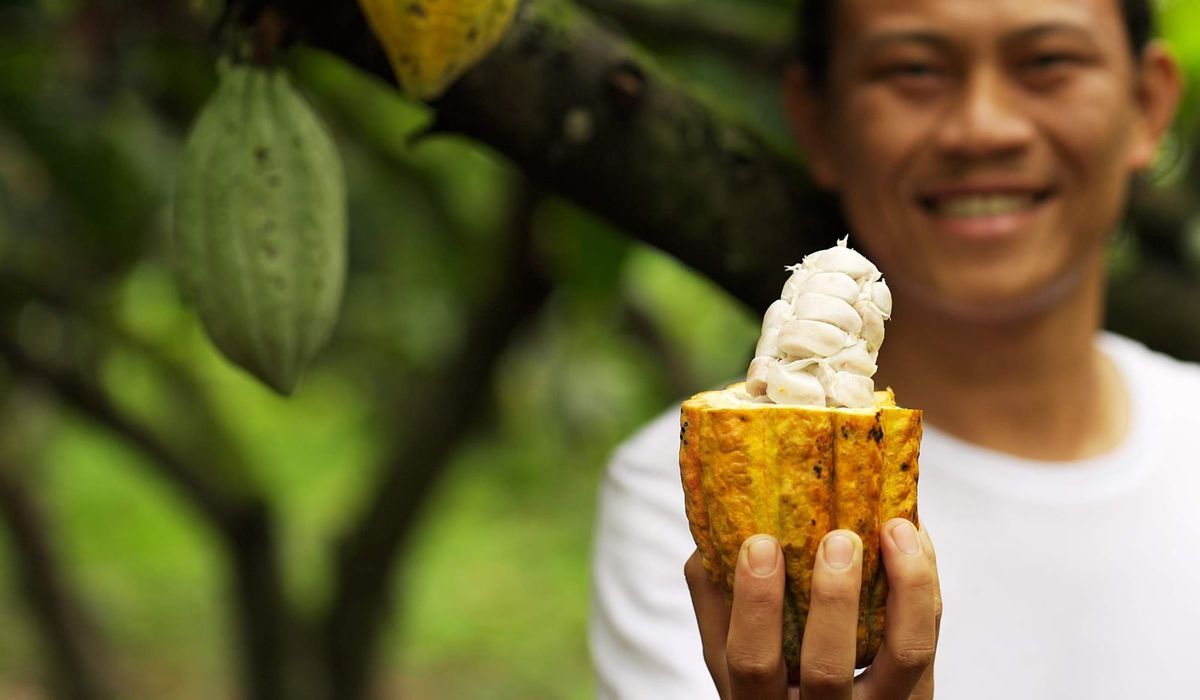](https://cocoaradar.com/good-together-why-asias-cocoa-moment-matters-now/)
---
**cocoaradar.com is:**
- **Official Media Partner -** [**CAA International Cocoa Conference**](https://www.caacocoaconference.org/programme?ref=cocoaradar.com)
- **'From Our Desk. To Yours. Daily'**
- [**Sign-up here**](https://cocoaradar.com/#/portal) **for free and choose your plan.**
### Barry Callebaut Restores COO Role With Mondelēz Veteran
URL: https://cocoaradar.com/barry-callebaut-restores-coo-role-with-mondelez-veteran/
Last updated: 2026-08-27T15:27:24.000Z
💡
****Cocoa trading at 6229.303 USD/T on Thursday, August 27, a 398.303 USD/T (6.83%) increase from 5831.000 on the last trading session.**
Barry Callebaut has appointed former Mondelēz International executive Thomas Gaengler as chief operating officer and Executive Committee member from 1 September 2026, restoring a standalone COO position after almost three years.
Gaengler brings more than 30 years of experience across supply chains, procurement and operations. Most recently, he led Mondelēz’s end-to-end supply chain across Asia Pacific, the Middle East and Africa, after spending four years as its global chief procurement officer.
Chief executive Hein Schumacher said Gaengler would help advance the company’s focus on ‘customer-centricity, operational excellence’ and its Focus for Growth priorities. The strategy is intended to stabilise core operations and concentrate resources on fewer growth priorities.
Advertisement
[  ](https://www.foodmasters-freiberg.com/en/?utm%5Fsource=ghost&utm%5Fmedium=newsletter&utm%5Fcampaign=ad&utm%5Fcontent=qsm%5Fplaceholder)
The appointment, framed as a renewed emphasis on supply-chain resilience and operational efficiency, reinstates a role removed in 2023, when operational responsibilities were placed under Chief Customer Supply and Development Officer Clemens Woehrle.[ ](https://www.confectionerynews.com/Article/2026/08/26/barry-callebaut-appoints-ex-mondelez-exec-thomas-gaengler-as-coo/?ref=cocoaradar.com)
First FMCG founder Vitali Dziadul offered a sharper interpretation on LinkedIn, arguing: “The leaner leadership model didn't survive contact with reality.”
Barry Callebaut has not characterised the appointment as a reversal of its earlier structure.
## **CocoaRadar View**
Recreating the COO position concentrates accountability as Barry Callebaut navigates demanding cocoa markets, customer-service pressures and more complex sourcing requirements. The key test will be whether Gaengler can deliver measurable improvements in supply reliability, manufacturing efficiency, and customer satisfaction.
_This post is for paying subscribers only._
### Farmgate Cocoa Price: Côte d'Ivoire Faces a Major Dilemma
URL: https://cocoaradar.com/farmgate-cocoa-price-cote-divoire-faces-a-major-dilemma/
Last updated: 2026-08-26T14:05:38.000Z
**By Ousmane Attai in Abidjan**
... How much should farmers be paid per kilogram of cocoa to reflect the lessons of the disastrous 2025–2026 season without further destabilising the sector’s financial balance?
This is far from a theoretical question. It follows an extremely turbulent season marked by difficulties in clearing cocoa stocks, a sharp decline in the guaranteed price during the mid-crop season and, above all, a strong rebound in international cocoa prices.
### A Difficult Financial Equation
For the CCC, setting the next farmgate price will not be a simple administrative decision. It will have to take several factors into account, including the prices at which Ivorian cocoa was sold on international markets.
Advertisement
[  ](https://www.foodmasters-freiberg.com/en/?utm%5Fsource=ghost&utm%5Fmedium=newsletter&utm%5Fcampaign=ad&utm%5Fcontent=qsm%5Fplaceholder)
According to several sources close to the matter, the CCC is believed to have sold a significant portion of the crop at relatively low prices before the latest surge in global cocoa prices.
This could now limit its ability to pass on the full increase in international prices to farmers.
In other words, the cocoa currently available on the market may not have fully benefited from the recent surge in global prices. Some sales were reportedly concluded earlier, leaving the regulator with less room to raise the farmgate price significantly.
_This post is for paying subscribers only._
### When Cocoa Data Turns to Dust
URL: https://cocoaradar.com/when-cocoa-data-turns-to-dust/
Last updated: 2026-08-28T08:30:39.000Z
💡
This article was amended on 28 August 2026.
### The High Cost of Misreading Cocoa’s Numbers
Cocoa does not lack data. It lacks agreement on what much of that data means.
At a preview of the 2025 European Cocoa Association Forum, Christian Vollers, managing director of Vollers Group, described cocoa data as either ‘gold or dust’. The phrase captures a market highly capable of collecting information, but far less adept at connecting it.
Futures, crop forecasts, certified stocks, grindings and producer prices generate a constant flow of figures. Companies also assemble farm registries, supply-chain maps and data on deforestation, livelihoods, child labour and carbon.
More information ought to reduce uncertainty. Poorly connected information can instead encourage confident decisions based on measures that describe only part of the market, affecting margins, working capital, investment and supply.
### **One Market, Many Prices**
No figure illustrates the problem better than ‘the cocoa price’. Futures are visible and influential, but they are neither the physical price of beans nor an automatic measure of what farmers receive. Origin differentials, quality, freight, finance, taxes, premiums, contract timing and national marketing systems all intervene.
A rise in futures may coexist with a smaller or delayed increase in farmgate income. Buyers can experience the same movement differently depending on hedging, inventories and contract dates. The useful question is not whether cocoa prices rose, but which price rose, for whom and over what period.
### **Numbers Need Context**
Exchange-certified stocks measure cocoa available within a particular delivery system, not every tonne held in commercial inventories. Falling stocks may signal tight deliverable supply, but may also reflect financing incentives, quality constraints or the use of non-certified storage. The figure can be accurate while the story attached to it is wrong.
Quarterly grindings show beans being processed into cocoa liquor, butter and powder. They indicate industrial activity, but are routinely treated as a synonym for consumer demand. Processors can grind more while building product stocks; grindings can fall while retail demand remains relatively resilient. Facing high bean prices, manufacturers may change recipes, reduce pack sizes or draw down inventories before consumers visibly buy less chocolate.
Grindings must therefore be read alongside trade flows, product stocks, processing margins and retail evidence. Distinguishing weaker processing economics from weaker consumption affects decisions about capacity, procurement and pricing.
### **Precision Without Certainty**
Supply estimates contain a different kind of uncertainty. The equation – production plus beginning stocks, less consumption, equals ending stocks – looks exact. Its inputs are not.
Crop forecasts depend on weather, disease, yields, quality, harvest timing and incomplete reporting. Cross-border trade can blur origin data. Demand is inferred from processing and downstream markets, while stock estimates may include modelled components.
Revisions show that new information has changed the market’s understanding; they are not necessarily admissions of failure. An intelligence system should preserve them rather than overwrite them, because beliefs held at the time shaped prices, purchasing and investment.
Disagreement is valuable, too. Different data or assumptions about disease, informal trade and the mid-crop can explain divergent crop estimates. The gap between credible estimates is itself a measure of uncertainty.
### **When Definitions Fail**
Sustainability data poses an even harder problem: common words with uncommon meanings.
‘Mapped’, ‘traceable’ and ‘verified’ can describe different levels of evidence. A sustainability percentage may cover total purchases, direct suppliers or only cocoa enrolled in a programme. “No deforestation detected” is bounded by a dataset, methodology, geography and cut-off date; it is not necessarily proof that no deforestation occurred.
A farmer ‘reached’ might have attended training, received an input, completed a survey or entered a monitoring programme. None automatically demonstrates higher income. Mapping establishes geographic information, but does not prove that beans remained physically traceable through every transaction.
This is how good data becomes dust. Futures become ‘the cocoa price’; certified inventories become ‘global stocks’; grindings become ‘demand’; mapping becomes ‘traceability’; and training becomes ‘impact’.. The figures become misleading when their boundaries disappear.
Misreading supply can distort hedging and working-capital decisions. Confusing activity with outcomes can favour reportable coverage over resilience. Weak traceability can threaten market access or raise compliance costs. Overestimating farm economics can lead to underinvestment in future supply.
### **From Data Feed to Intelligence**
This is the premise behind the CocoaRadar Intelligence Engine, due to launch in September. Its purpose is to record provenance, preserve revisions, distinguish observations from estimates and stakeholder claims, compare definitions, and connect evidence across market, regulatory and sustainability data.
A data feed reports that a number changed. Intelligence asks why, how much confidence to place in it, what evidence supports it and who bears the consequences.
Data can indeed be gold. But volume alone does not create value. Definitions must survive comparison, uncertainty must remain visible and separate signals must be connected. In cocoa, the most expensive mistake may be trusting a precise number before asking what, exactly, it measures.
A fuller essay examines CocoaRadar’s approach to data, evidence and uncertainty in more detail and is available to download here.
#### When Cocoa Data Is Gold - and When It Becomes Dust
An evidence-backed research paper for CocoaRadar Pro
[ DOWNLOAD ](https://outpost-eu-storage.ams3.cdn.digitaloceanspaces.com/images/487c4841-bee2-4ce2-8793-57d4ea46ae71/ma6hkP9RsHeDXp5qq9w2Q50OW23lBQlGBpdVB9W2.pdf?ref=cocoaradar.com)
---
Further reading:
[ClimateAi’s Collapse Raises a Bigger Question: Who Will Pay for Agricultural Intelligence?Analysis: The closure of ClimateAi, two years after Gro Intelligence failed, exposes a difficult contradiction at the heart of data-driven agriculture: companies need better intelligence than ever, but turning that need into a sustainable standalone business remains remarkably difficultFrom The Desk of CocoaRadar™Anthony Myers](https://cocoaradar.com/climateais-collapse-raises-a-bigger-question-who-will-pay-for-agricultural-intelligence/)
### Knoops Claims Record Start as Utah Store Launches US Expansion
URL: https://cocoaradar.com/knoops-claims-record-start-as-utah-store-launches-us-expansion/
Last updated: 2026-08-24T13:45:07.000Z
Knoops has described the opening of its first permanent US store as its strongest global launch by drinks volume per trading hour, giving the British company an encouraging first test of its store-led US expansion strategy.
The outlet opened last Friday in Salt Lake City’s 9th & 9th district. Chief executive William Gordon-Harris said the store had delivered “the highest number of drinks sold per trading hour of any Knoops global launch to date”.
Knoops did not disclose the number of drinks served, customer transactions or comparable figures from previous openings. The claim should also be viewed in the context of its launch promotion, reported by news website [Axios](https://www.axios.com/local/salt-lake-city/2026/08/06/knoops-chocolate-first-us-store-opening?ref=cocoaradar.com) ahead of the opening.
Advertisement
[  ](https://www.foodmasters-freiberg.com/en/?utm%5Fsource=ghost&utm%5Fmedium=newsletter&utm%5Fcampaign=ad&utm%5Fcontent=qsm%5Fplaceholder)
Even with those caveats, the turnout appears to have provided Knoops with an early indication of local interest. Gordon-Harris reported queues comprising families, students, children and older customers, while founder Jens Knoop said the opening had generated considerable discussion on social media.
> “Utah has given us such a warm welcome, and there’s a real sense of curiosity and excitement around what we’re doing,” Knoop told CocoaRadar. “This first store is the beginning of a very exciting chapter for Knoops in America.”
### Testing Demand Before Opening the Doors
The launch was preceded by a week of customer testing. Knoop said approximately 1,000 Utah residents were invited to try the drinks and provide feedback, allowing staff to practise under live trading conditions. The company then held a locally organised influencer event before opening to the public.
This phased approach gave Knoops an opportunity to train its team, refine service and generate local awareness before the opening weekend. It was particularly relevant for a concept built around a wide range of choices.
[Knoops: Crafting a Global Chocolate Drinks Phenomenon With a Slice of American PiePREMIUM ANALYSIS: Knoops, the British luxury chocolate drinks brand, is poised to make its first major US retail debut as its international expansion accelerates on the back of a stellar Christmas in the UK, but as rivals Hotel Chocolat discovered, chasing the American Dream can be costly adventureFrom The Desk of CocoaRadar™Anthony Myers](https://cocoaradar.com/knoops-crafting-a-global-chocolate-drinks-phenomenon-with-a-slice-of-american-pie/)
Knoops’ ‘Chocolate Library’ allows customers to select different cocoa percentages and order drinks hot, iced, frozen or as milkshakes, with additional flavours and a choice of milks.
The brand’s US strategy rests on stores doing more than generating sales. Knoops sees them as places to explain the category, introduce customers to different chocolates and build sufficient recognition for a wider retail business.
Knoops' Chief Executive William Gordon-Harris. Image: Knoops
Gordon-Harris said outlets remained central to efforts to ‘create the category’, build awareness and prepare the ground for Knoops At Home chocolate flakes, wholesale distribution and, eventually, ready-to-drink canned products. The company says it will introduce those products market by market when brand recognition can support national distribution at scale.
### Why Knoops Chose Utah
Salt Lake City represents a deliberate alternative to launching in a larger coastal market such as New York or Los Angeles.
Knoop told local media that the city had an aspirational food scene and a strong culture of personalised drinks. Utah’s established ‘dirty soda’ market — built around customised soft drinks — offered a useful local parallel for Knoops’ own choice-led model.
The company also believes chocolate drinks can occupy social occasions not served by coffee or alcohol. Knoop told Axios that this could give the brand broad appeal in a market where many members of the Church of Jesus Christ of Latter-day Saints abstain from both.
The early customer mix Gordon-Harris reported is consistent with the company’s argument that the proposition can reach across generations, although independent opening-weekend attendance data and customer research have not been released.
Knoops is taking a regional approach to expansion. A second Utah store is planned for Farmington (as early as the end of the year, according to some reports), while US expansion lead Mike Jensen told Axios that Park City was also under consideration. Jensen said the company intended to avoid saturating the market and position its stores as destinations.
### Stores Anchor a Wider Retail Strategy
Founded by Knoop in Rye, East Sussex, in 2013, Knoops has grown to more than 30 locations across the UK, UAE and US. The Utah opening gives the company a presence on three continents.
Alongside its US expansion, Knoops plans to increase UK distribution of its hand-flaked Knoops At Home range through delicatessens, farm shops and premium grocery retailers. The products are already sold through the company’s stores and website, as well as Amazon and retailers including Ocado, Harrods, Selfridges and Whole Foods.
The US expansion and UK distribution push follow the same model: use physical stores to demonstrate and explain the product, then pursue growth through several retail channels. The Salt Lake City opening offers a promising initial sign that this strategy can attract attention in a new market. Whether that enthusiasm converts into sustained, full-price demand will be the more important test.
### CocoaRadar View
Knoops treated its US debut as a market-entry exercise rather than a conventional store opening. Local sampling, employee training, influencer activity and complimentary drinks were used to reduce launch risk while teaching consumers how to navigate a comparatively complex product.
The opening-volume claim is encouraging but incomplete without absolute figures and a distinction between complimentary and paid drinks. Repeat visits and full-price trading after the launch promotion will provide a clearer measure of whether Utah can become a platform for wider US growth.
### Mars Bar Shrinkflation Puts Cocoa Use In Spotlight As Ghana And Côte d’Ivoire Warn Over Chocolate Reformulation
URL: https://cocoaradar.com/mars-bar-shrinkflation-puts-cocoa-use-in-spotlight-as-ghana-and-cote-divoire-warn-over-chocolate-reformulation/
Last updated: 2026-08-14T12:51:45.000Z
The discovery of a Mars bar in England dating from 1991 has reignited the debate over ‘shrinkflation’ in chocolate, with the old bar weighing 62.5g compared with 40g for the current version used in the widely reported comparison – a reduction of 22.5g, or 36%.
This has led to another argument: what happens if manufacturers increasingly reduce the cocoa inside chocolate products as well as their size?
Put another way, the vintage Mars bar was more than 56% heavier than the modern one.
Advertisement
[  ](https://www.foodmasters-freiberg.com/en/?utm%5Fsource=ghost&utm%5Fmedium=newsletter&utm%5Fcampaign=ad&utm%5Fcontent=qsm%5Fplaceholder)
The bar was discovered by cleaning business owner Victoria Gordon during a house clearance in Scunthorpe, England, and later compared side by side with a present-day Mars bar.
Images and video of the find spread rapidly online this week, turning an unusual household discovery into a highly visual example of how confectionery portion sizes have changed over several decades.
Newsite [People.com](https://people.com/woman-discovers-mars-bar-from-1991-while-cleaning-out-elderly-woman-s-apartment-goes-viral-12058343?utm%5Fsource=chatgpt.com) reported that Mars acknowledged that its bar sizes and pack formats have changed over the past 35 years, citing consumer demand alongside external pressures including manufacturing costs and the price of cocoa.
Additional media reports on the company's response said Mars maintained that the recipe itself had not changed.
The episode is primarily a story about *product size* rather than cocoa substitution. But its timing is significant.
Just days after the Mars story emerged, the Côte d’Ivoire-Ghana Cocoa Initiative (CIGCI) issued a warning about another potential change taking place inside chocolate products: the growing use of cocoa substitutes and reformulation that reduces cocoa content.
For the world's two biggest cocoa-producing countries, the concern is that after years of consumers watching chocolate bars become smaller, manufacturers faced with high cocoa and sustainability costs could increasingly make products less cocoa-intensive as well.
## **From Smaller Bars To Less Cocoa?**
In its statement this week, CIGCI expressed concern over the increasing use of substitutes and reformulation of products marketed as chocolate, warning that reducing cocoa-derived ingredients could ultimately weaken cocoa demand, producer incomes and sustainability investment.
The Initiative argues that the issue extends beyond the commercial decisions of individual chocolate companies.
Reduced cocoa intensity across confectionery products could weaken demand growth even if overall confectionery sales remain resilient, CIGCI claims. Image: Cocobod
Farmers in Ghana and Côte d’Ivoire are increasingly being required to meet demanding standards on traceability, deforestation, environmental protection, social compliance and cocoa quality. Meeting those requirements comes at a cost.
If manufacturers simultaneously respond to high cocoa costs by reducing the amount of cocoa required in finished products, producer countries fear that farmers could be left investing more to produce compliant cocoa for a market that ultimately needs less of it.
That creates a potential disconnect between sustainability requirements at the beginning of the supply chain and product formulation decisions at the consumer end.
## **Reformulation Raises A New Demand Question**
CIGCI warned that widespread reformulation risks undermining the coherence of the cocoa value chain and weakening its economic, social and environmental objectives.
The economic concern is relatively straightforward.
If a chocolate manufacturer makes a bar smaller, less product is sold in each unit. If it also reduces the cocoa intensity of the recipe, it may require even less cocoa per unit.
Replicated across millions of products and multiple confectionery categories, relatively small formulation changes could eventually become meaningful for aggregate cocoa demand.
This is why the debate over substitutes matters particularly to Ghana and Côte d’Ivoire, where cocoa remains an important source of export earnings and supports millions of rural livelihoods.
It also raises a longer-term question over whether farmers will receive sufficient returns on the investments required to produce increasingly traceable and sustainable cocoa.
## **Ghana And Côte D’ivoire Demand Transparency**
CIGCI is calling for clear and unambiguous communication whenever cocoa-derived ingredients are substantially reduced or substituted.
The Initiative argues that product names, composition and sustainability claims should accurately reflect the quantity and nature of cocoa actually contained in finished products.
For consumers, subtle recipe changes may be considerably harder to identify than shrinkflation.
As the Mars example shows, a 62.5g chocolate bar next to a 40g version provides an obvious visual comparison. Changes to cocoa butter, cocoa solids or other cocoa-derived ingredients inside a formulation can be much less apparent.
That is why CIGCI wants environmental, social and ethical claims to be proportionate to the actual cocoa contained in a product.
The position potentially broadens the sustainability debate. Much of the industry's scrutiny has historically focused on where cocoa comes from and how it is produced. Ghana and Côte d’Ivoire are effectively arguing that attention should also be paid to how much cocoa ultimately remains in products carrying cocoa-related sustainability credentials.
## **Farmer Economics Under Pressure**
The potential consequences for producers form one of the strongest themes in the CIGCI statement.
Farmers are being required to make investments associated with traceability, environmental compliance, disease management and sustainable production. Those investments ultimately depend on a market that can provide an adequate economic return.
Large-scale substitution could alter that equation.
Reduced cocoa intensity across confectionery products could weaken demand growth even if overall confectionery sales remain resilient.
For farmers, that creates the possibility of bearing the cost of increasingly stringent sustainability standards without receiving a corresponding benefit from demand for compliant cocoa.
Environmental investment could also be affected.
If cocoa demand or producer returns weaken, incentives to invest in climate resilience, forest protection, disease control and improved production could come under pressure.
## **Ghana And Côte D’ivoire Reinforce Producer Strategy**
Against this backdrop, Ghana and Côte d’Ivoire have reaffirmed their commitment to building a more sustainable cocoa economy based on improved producer remuneration and a fairer distribution of value across the supply chain.
Their agenda includes greater coordination of cocoa marketing policies, stronger research into diseases such as cocoa swollen shoot disease, development of climate-resilient planting material and deeper implementation of the ARS-1000 sustainable cocoa standard.
[Brussels Workshop Advances ARS-1000 as Côte d’Ivoire and Ghana Deepen Regional Cocoa StrategyCIGCI has taken another significant step in advancing African leadership on sustainable cocoa, bringing together governments, industry, civil society and development partners to accelerate implementation of the African Regional Standard for Sustainable and Traceable Cocoa (ARS-1000)From The Desk of CocoaRadar™Jasper Jemmett](https://cocoaradar.com/brussels-workshop-advances-ars-1000-as-cote-divoire-and-ghana-deepen-regional-cocoa-strategy/)
The countries also intend to accelerate local cocoa processing, allowing producing economies to capture a greater proportion of the value generated beyond the export of raw beans.
CIGCI is seeking to broaden cooperation to other producing countries, potentially strengthening coordination between cocoa origins as the economics of the global chocolate industry change.
## **Call For Permanent Industry Dialogue**
Rather than simply calling for restrictions on reformulation, CIGCI is seeking a structured consultation process involving governments, regulators, manufacturers, distributors, standardisation bodies, producer organisations, scientific partners and consumer representatives.
Such discussions would examine how substitution affects cocoa demand, producer incomes and sustainability investment, while considering whether requirements imposed on producers remain aligned with standards governing finished products.
The Initiative has called for a permanent consultation framework across the cocoa value chain and said it remains open to dialogue with industry and other stakeholders.
The broader message is one of shared responsibility: if farmers and producing countries are expected to bear the cost of making cocoa more sustainable, decisions further downstream should not undermine the economic value of those investments without transparency or consideration of their consequences.
## **Cocoaradar View: First the bars got smaller. What if cocoa is next?**
The timing of the Mars story makes the CIGCI intervention particularly interesting.
The 1991 Mars bar is a remarkably simple visual representation of how manufacturers can alter confectionery economics without abandoning an established brand. Consumers still recognise the wrapper and the product, but the quantity they receive has changed substantially over time.
To be clear, the Mars example should not be conflated with the substitution issue raised by Ghana and Côte d’Ivoire. Mars says its recipe remains unchanged, and the story concerns changes in bar and pack sizes rather than evidence that cocoa has been removed from the product.
But it provides useful context for a broader structural question facing cocoa.
The cocoa market's recent narrative has overwhelmingly been about supply: weather, disease, ageing farms, production deficits, sustainability requirements, prices and the investment required to rebuild output.
Reformulation introduces another variable — **structural demand destruction**.
There is an important difference between consumers temporarily buying less chocolate because prices rise and manufacturers permanently redesigning products so that each unit requires less cocoa.
The first can reverse when prices fall.
The second can become embedded in manufacturing.
That is what makes the producer-country intervention worth watching.
The Mars comparison shows just how significant incremental product changes can become over a long enough period. A bar associated with the same brand is today dramatically lighter than the version sold three-and-a-half decades ago.
Apply that principle not simply to the weight of a bar, but to the amount of cocoa used across an entire portfolio of chocolate and confectionery products, and the potential implications for the cocoa balance become much more significant.
Even modest reductions in cocoa intensity, multiplied across billions of individual products sold in major consuming markets, could eventually affect the amount of beans the global chocolate industry requires.
There is also a fundamental timing problem.
Farmers are being encouraged — and increasingly required — to invest in traceability, environmental compliance, productivity and climate resilience. Those investments assume sufficient future demand, and sufficient value within that demand, to reward compliant production.
If downstream companies simultaneously engineer cocoa out of products to control costs, the two sides of the sustainability equation begin moving in opposite directions.
For Ghana and Côte d’Ivoire, this is therefore more than a debate about ingredient labels. It is an early attempt to influence the rules governing future cocoa demand.
Their emphasis on local processing is equally significant. If producing countries expand grinding and processing capacity while manufacturers in consuming markets seek to reduce cocoa intensity, competition over where value is captured in the chain could intensify.
Shrinkflation has already taught consumers that familiar chocolate brands do not necessarily contain the same quantity of product they once did.
The question now being raised by cocoa-producing countries is whether the next evolution could concern the quantity of cocoa within those products.
For the global cocoa market, that creates a question arguably as important as the industry's continuing struggle to restore production: Not only how much cocoa can the world produce – but how much cocoa will the chocolate industry choose to use?
---
More from CIGCI:
[The Sustainability Paradox in ChocolateImporting markets have asked cocoa producers to meet the highest standards in the sector’s history. Some manufacturers are responding by quietly taking the cocoa out of chocolateFrom The Desk of CocoaRadar™Jasper Jemmett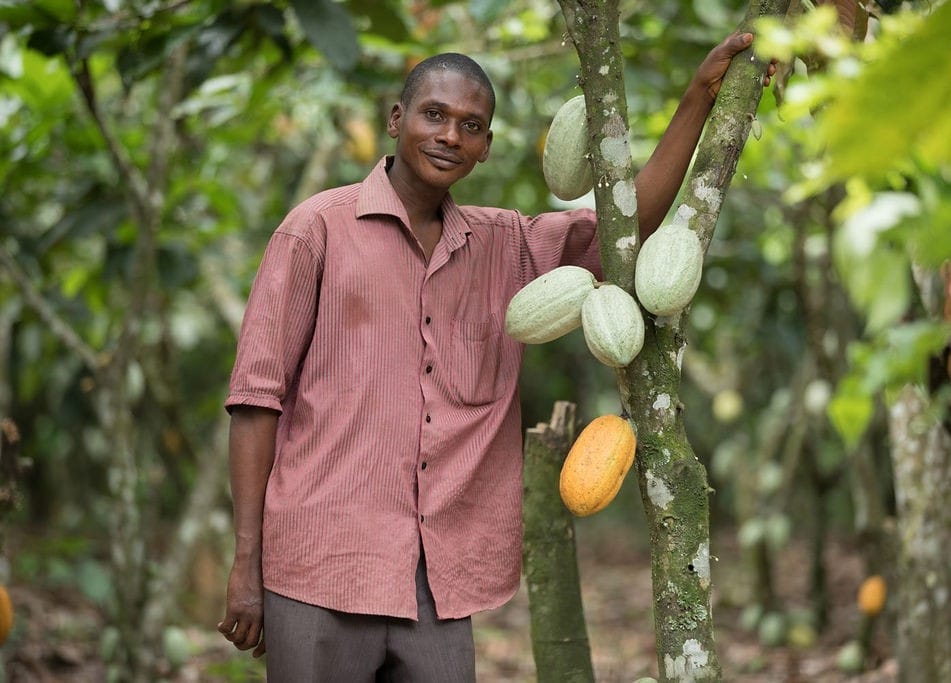](https://cocoaradar.com/the-sustainability-paradox-in-chocolate/)
### University Of Reading Makes First 100% British Chocolate Bar Since 1932
URL: https://cocoaradar.com/university-of-reading-makes-first-100-british-chocolate-bar-since-1932/
Last updated: 2026-08-13T15:40:25.000Z
💡
Scroll down for today's Weekly Global Market Report.
The Reading 100 Chocolate Bar, created to mark the university’s centenary, was made using cocoa grown at its International Cocoa Quarantine Centre in Berkshire, together with British-grown sugar and milk.
The university says it is the first 100% British chocolate bar since 1932, when Rowntree’s produced a bar from glasshouse-grown cocoa in York and presented it to the six-year-old Princess Elizabeth, later Queen Elizabeth II.
Food security master’s student Maha Khan harvested, fermented and processed the Reading-grown cocoa before turning it into chocolate with support from the university’s food science experts.
Advertisement
[  ](https://www.foodmasters-freiberg.com/en/?utm%5Fsource=ghost&utm%5Fmedium=newsletter&utm%5Fcampaign=ad&utm%5Fcontent=qsm%5Fplaceholder)
The project highlights the UK chocolate industry’s dependence on imported cocoa and the importance of protecting cocoa varieties as climate change puts growing regions under increasing pressure. The university’s quarantine centre holds more than 300 types of cocoa plant and handles 97% of the international movement of cocoa plants worldwide.
[Funding Crisis Threatens Decades of Research at International Cocoa Quarantine CentreDuring a session at last week’s London Chocolate Forum, Dr Fiona Lahive, Senior Research Fellow at the University of Reading, discussed the growing threat of climate change and its implications for the future of cocoa production, as the centre fights for its own survivalFrom The Desk of CocoaRadar™Anthony Myers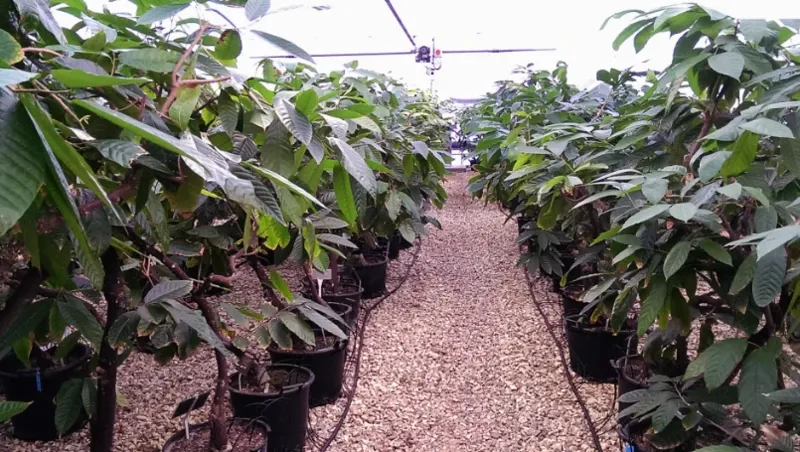](https://cocoaradar.com/funding-crisis-threatens-decades-of-research-at-international-cocoa-quarantine-centre/)
_This post is for paying subscribers only._
### Residual Cocoa Stocks, CCC Ends Evacuation Operations as Farmers Demand Accountability
URL: https://cocoaradar.com/residual-cocoa-stocks-ccc-ends-evacuation-operations-as-farmers-demand-accountability/
Last updated: 2026-08-12T14:07:08.000Z
**By Ousmane Attai in Abidjan**
In a statement issued on 5 August, Côte d'Ivoire's CCC announced that it had completed the evacuation of residual cocoa stocks, previously estimated at around 100,000 tons, as several producer organisations are calling for an audit of stock management and the publication of the list of cooperatives that benefited from the evacuation operations.
For the authorities, the decision is intended to allow the sector to prepare for the opening of the new season in a more peaceful environment.
But for farmers, several questions remain unanswered:
- How much cocoa is still in the hands of farmers, cooperatives and buyers?
- How much cocoa was actually evacuated?
- And, above all, what criteria were used to select the beneficiaries?
Advertisement
[  ](https://www.foodmasters-freiberg.com/en/?utm%5Fsource=ghost&utm%5Fmedium=newsletter&utm%5Fcampaign=ad&utm%5Fcontent=qsm%5Fplaceholder)
For several days, trade union organisations have been touring the main cocoa-producing areas to gather information on the stock situation. They are calling in particular for an independent audit of the operation and the publication of the list of cooperatives that benefited from the evacuation process.
_This post is for subscribers only._
### ClimateAi’s Collapse Raises a Bigger Question: Who Will Pay for Agricultural Intelligence?
URL: https://cocoaradar.com/climateais-collapse-raises-a-bigger-question-who-will-pay-for-agricultural-intelligence/
Last updated: 2026-08-25T14:14:19.000Z
Climate risk has rarely mattered more to global food companies.
Weather volatility is disrupting harvests, agricultural sourcing is becoming more complicated, supply chains are under pressure, and companies are being asked to make investment decisions about crops and sourcing regions years – sometimes decades – into the future.
Yet one of the companies built specifically to help them make those decisions has just disappeared.
San Francisco-based ClimateAi has ceased operations after eight years, announcing on 7 August that it would wind down the company and return remaining capital to investors.
According to [AGFunderNews](https://agfundernews.com/climate-resilience-platform-climateai-winds-down-operations?ref=cocoaradar.com), co-founder and CEO Himanshu Gupta attributed the decision to unspecified ‘geopolitical and climate headwinds’ that had made it difficult to continue the company’s mission.
ClimateAi had raised approximately **$38 million** from investors including Four Rivers Group, Radical Ventures and Robert Downey Jr’s FootPrint Coalition.
On its own, the demise of another climate-tech startup would be noteworthy. But in food and agriculture, there is an uncomfortable precedent.
In May 2024, **Gro Intelligence**, one of the most ambitious agricultural-data businesses of the previous decade, also closed after failing to secure sufficient additional funding. Gro had raised more than $125 million before its collapse. Its intellectual property was subsequently acquired by agricultural technology company Almanac.
The two companies were different. Their failures should not be conflated.
But together they raise a question that the agricultural sector – and particularly cocoa – should take seriously: If better data is becoming indispensable to managing agricultural risk, why is it proving so difficult to build durable independent businesses selling that intelligence?
## **Climateai Was Not Solving An Imaginary Problem**
There is little evidence that ClimateAi failed because climate risk suddenly became irrelevant.
Quite the reverse.
The company built its ClimateLens platform around a straightforward proposition: conventional weather forecasts become much less useful beyond relatively short horizons, while agricultural businesses increasingly need to make procurement, planting, investment and sourcing decisions months or years ahead.
ClimateAi combined information from satellites, weather stations, radar, ocean buoys and established meteorological models with machine learning, attempting to translate environmental signals into crop- and business-specific intelligence.
Its customer list included businesses such as Dole, Driscoll’s, AB InBev and Suntory, alongside seed companies, agricultural processors and financial institutions including Rabobank. ClimateAi said in late 2024 that it had worked with more than 56 food, beverage and agricultural partners across more than 40 crops and 60 countries.
Earlier growth had appeared strong.
When announcing its $22 million Series B in April 2023, ClimateAi said annual recurring revenue had increased fivefold over the preceding 18 months and its customer base had quadrupled. The company employed around 60 people at that stage.
It also claimed demonstrable commercial benefits. ClimateAi said seed company Advanta had captured additional sales after using forecasts to anticipate weather-driven changes in demand, while its case-study portfolio included supply-chain modelling, agricultural investment risk, crop-yield outlooks and commodity hedging.
This is what makes the shutdown significant.
ClimateAi was not simply selling carbon-accounting software into an evaporating ESG fashion. It was trying to address one of the most tangible problems facing agriculture: what happens next, where will it happen, and what should a company do about it?

****ClimateAi CEO Himanshu Gupta (left) and COO Will Kletter. Image: ClimateAi**
## **The Warning Signs Were Hidden In The Business Model**
ClimateAi itself had already articulated the commercial difficulty.
In an extensive December 2024 interview, its executives identified three barriers to adoption.
First, climate intelligence often *did not have an existing corporate budget line*.
Second, customers had to change established decision-making behaviour.
Third, ClimateAi had to persuade companies that its product was not simply a sustainability tool, but something capable of affecting procurement, risk and, ultimately, the bottom line.
That distinction is crucial.
A company may believe climate volatility represents a major strategic threat without having a procurement process capable of spending hundreds of thousands of dollars on an independent intelligence platform.
The person who needs the information may work in sustainability.
The person who can act on it may work in procurement.
The financial benefit may eventually appear in agricultural sourcing, inventory, insurance, trading or capital expenditure.
And the purchasing decision may belong somewhere else entirely.
ClimateAi was seeing signs that those silos were beginning to converge. In January this year, COO Will Kletter described procurement and sustainability teams increasingly coming together as companies treated climate as a core business variable.
But the company was still investing heavily.
Asked in January whether ClimateAi was profitable, Kletter said remaining competitive in AI was more important than immediate profitability, provided the company’s unit economics remained favourable.
Just over six months later, ClimateAi was gone.
## **And Only 20 Months Earlier, Profitability Was The Target**
The chronology makes the closure more striking.
In December 2024, Gupta said ClimateAi expected to become profitable around the third or fourth quarter of the following year and described the business as a scalable SaaS model with low marginal costs for additional customers.
The company hoped first to demonstrate value across roughly 200 partners and then potentially raise a Series C, according to AgFunderNews.
By January 2026, it was releasing an agentic-AI tool intended to turn Growing Degree Day calculations and agricultural forecasts into operational decisions.
Instead of simply providing graphs, the company’s ambition was to embed intelligence directly into customer workflows: predicting crop development, processing volumes, weather risks and potential agronomic responses.
That is a sophisticated evolution from selling data.
It is also revealing.
The competitive benchmark was no longer simply whether ClimateAi had better forecasts. The platform increasingly needed to integrate those forecasts into the customer’s everyday operations and tell users what to do next.
Information alone was becoming insufficient.
## **The Gro Intelligence Comparison**
There are obvious parallels with Gro Intelligence, but important differences.
Founded by former commodities trader Sara Menker, Gro attempted to create an enormous agricultural intelligence platform by bringing together government statistics, satellite imagery, trade data, weather information and other sources.
It attracted major investors and an $85 million Series B in 2021.
But its commercial model struggled.
According to former employees interviewed by AgFunderNews, the company generated a substantial portion of its revenue from a limited number of large customers, while some prospective projects became closer to bespoke consultancy than repeatable software revenue.
One former employee described a ‘fundamental mismatch between the product and the market’.
Gro also experienced serious operational and financial turmoil before closing, including layoffs and an inability to make payroll. These circumstances distinguish it materially from ClimateAi, which says it is returning remaining capital to investors.
Indeed, ClimateAi’s leadership had explicitly studied the Gro problem.
In 2024, Gupta argued that agricultural-data startups could become trapped by venture-capital pressure: chasing almost any available revenue, taking on increasingly bespoke customer requirements and gradually becoming low-margin consultancy businesses rather than scalable software companies.
ClimateAi, he said, intended to avoid that trap by concentrating on repeatable use cases.
Its subsequent closure does not prove that analysis was wrong.
It suggests that avoiding the consultancy trap may not, on its own, solve the underlying economics.
## **Cocoa Demonstrates Why The Problem Is Difficult**
ClimateAi’s cocoa work provides an unusually good illustration.
The company told AgFunderNews that traditional yield modelling was difficult in cocoa because historical datasets were insufficient.
Instead, ClimateAi developed a **cocoa risk outlook**, using indicators such as heat stress during pollination or drought during harvesting, then examining how such conditions had historically influenced markets.
That is an important acknowledgement.
Artificial intelligence cannot manufacture observations that do not exist.
Agricultural intelligence depends on the quality, continuity, granularity and comparability of the underlying information.
This matters particularly in cocoa, where production is concentrated among millions of smallholders and data can be fragmented across governments, traders, certification systems, cooperatives, companies, satellites, weather networks and research institutions.
ClimateAi was nevertheless pushing further into the sector.
In August 2025, it announced a collaboration with Japanese technology group NEC specifically examining climate adaptation for cocoa and rice in Africa.
The project sought to calculate the potential economic return from interventions including irrigation, changes in planting time and the adoption of climate-adapted varieties.
The ambition was not merely to predict climate change, but to answer the financially relevant question: **which adaptation intervention is worth paying for?**
That distinction may eventually determine whether agricultural intelligence becomes economically sustainable.
## **The Climate Adaptation Paradox**
There is a broader contradiction.
According to [UNEP’s 2025 Adaptation Gap Report](https://www.unep.org/resources/adaptation-gap-report-2025?ref=cocoaradar.com), developing countries could require around **$310–365 billion annually for adaptation by 2035**, while international public adaptation finance flows were just $26 billion in 2023\.
At the same time, businesses still struggle to obtain or interpret the very information needed to decide where adaptation capital should go.
The[ OECD reported ](https://www.oecd.org/en/publications/harnessing-the-private-sector-s-contribution-to-climate-adaptation%5F43d93534-en/full-report.html?ref=cocoaradar.com)this year that private companies face barriers including limited access to relevant weather data, insufficient technical capacity and difficulty quantifying the costs and benefits of adaptation.
In other words:
**The demand for better decisions is enormous. The need for data is enormous. The financial exposure is enormous.**
But the willingness – or organisational ability – to pay standalone intelligence providers enough to sustain expensive modelling, data science and AI teams may be considerably smaller.
That is the paradox exposed by ClimateAi.
## **Data Has Value. But Where Is That Value Captured?**
Gro’s technology did not vanish when Gro disappeared.
Almanac acquired its assets and incorporated Gro’s AI models into a broader agricultural technology platform already serving more than 100 million acres.
That may offer a clue.
Agricultural intelligence may ultimately be most valuable *inside another commercial activity*, rather than as an isolated product.
A trader can use intelligence to improve procurement.
An insurer can use it to price risk.
A bank can use it to assess lending.
A processor can use it to manage inventories.
A seed business can use it to determine where varieties should be developed or sold.
A farmer platform can use it to improve agronomic decisions.
The intelligence can create considerable economic value without the intelligence provider necessarily being able to capture that value through subscriptions alone.
That distinction matters.
The failure of an intelligence company does not necessarily mean its intelligence had no value.
It may instead mean that the value accrued elsewhere in the system.
## **The Lesson For Cocoa**
For cocoa, there is a temptation to believe that more data automatically produces more intelligence.
It does not.
The ClimateAi experience suggests several additional requirements.
Data needs context. Forecasting needs interpretation. Models need validation. Intelligence needs to reach the person able to act on it. And, crucially, the decision resulting from that intelligence needs to create enough measurable economic value to justify the cost of producing it.
This is particularly relevant as cocoa companies invest in farm mapping, traceability, satellite monitoring, climate modelling, deforestation assessment, crop forecasting and regulatory compliance.
Each creates another layer of information.
The danger is creating an increasingly sophisticated collection of disconnected data systems without a common mechanism for answering the question that ultimately matters:
What decision should change because we know this?
ClimateAi called this **‘** *decision accuracy* **’** rather than simply forecast accuracy.
A forecast did not have to predict rainfall perfectly, the company argued. If it gave a producer enough warning to alter a planting decision and prevent a significant loss, then the intelligence had delivered value.
That principle extends well beyond weather forecasting.
It applies to cocoa supply, disease, farmer economics, regulation, sustainability and markets.
## **From Data Platforms To Decision Infrastructure**
ClimateAi’s closure should therefore not be interpreted as an argument against agricultural AI.
Nor does the demise of Gro Intelligence mean the industry should abandon ambitious attempts to connect agricultural datasets.
The opposite conclusion may be more useful.
Both cases show how difficult – and expensive – it is to build an independent intelligence layer between fragmented agricultural data and commercial decision-making.
The next generation of platforms may consequently need to be narrower, more specialised and more deeply integrated with existing workflows.
Rather than attempting to become universal warehouses of agricultural knowledge, successful systems may concentrate on connecting selected high-value signals, explaining why they matter and making their implications immediately usable.
The commercial test is unlikely to be:
How much data does the platform possess?
It will be:
Does the platform help someone make a better decision?
And can that improvement be demonstrated strongly enough that somebody will consistently pay for it?
ClimateAi spent eight years trying to answer that question.
Its technology helped establish climate adaptation as a real business category. Its customers apparently found real applications for the intelligence. Its work reached directly into cocoa and the economics of climate adaptation.
And yet ClimateAi itself did not survive.
That should make the food and agriculture sector pay attention.
Because in an industry producing more information than ever before, the lesson from ClimateAi and Gro Intelligence may ultimately be uncomfortable but valuable:
**Data becomes gold only when somebody can connect it to a decision. Otherwise, however sophisticated the technology behind it, it risks becoming dust.**
### Rainforest Alliance To Consult Industry On Cocoa-Specific Certification Standard
URL: https://cocoaradar.com/rainforest-alliance-to-consult-industry-on-cocoa-specific-certification-standard/
Last updated: 2026-08-10T14:34:42.000Z
The consultation on the proposed Sustainable Agriculture Standard-Cocoa (SAS-Cocoa) will open on August 11 and run until October 13, 2026, with cocoa farmers, cooperatives, companies, traders, certification bodies, civil society organisations, governments and other stakeholders invited to comment.
A second consultation is planned for December 2026 to January 2027, with publication of the final standard and a summary of stakeholder feedback expected in the first half of 2027.
The Rainforest Alliance said the proposal follows changes made to its broader Sustainable Agriculture Standard in 2025, when requirements were streamlined with the aim of making certification more accessible and easier for farmers to implement.
Advertisement
[  ](https://www.foodmasters-freiberg.com/en/?utm%5Fsource=ghost&utm%5Fmedium=newsletter&utm%5Fcampaign=ad&utm%5Fcontent=qsm%5Fplaceholder)
The cocoa-specific version would consolidate requirements currently spread across a number of country-specific policies, including the organisation’s cocoa policy for West and Central Africa.
It would also place greater emphasis on issues particularly relevant to cocoa, including traceability and geodata, deforestation, child and forced labour risks, farmer livelihoods, soil health, integrated pest management and farmer support systems.
The proposed requirements are also intended to respond to an increasingly complex regulatory environment, including the EU Deforestation Regulation (EUDR), Corporate Sustainability Due Diligence Directive (CSDDD), EU Forced Labour Regulation and other European and African regulatory frameworks.
Ruth Newsome, Chief Product Officer at the Rainforest Alliance, told CocoaRadar: “In 2025, we streamlined our Sustainable Agriculture Standard to make it more accessible and easier for farmers to implement. The development of the Sustainable Agriculture Standard-Cocoa is the next step in this evolution: creating a cocoa-specific certification solution that responds to the evolving needs of cocoa farmers and supply chain actors.
> “Our commitment to robust requirements remains unchanged – this is about creating a more focused and nuanced standard that supports farmers, their communities, and supply chain actors in building more resilient, productive, and transparent cocoa supply chains.”
## **Cocoa Standard Has Not Yet Been Implemented**
The Rainforest Alliance stressed that the proposed cocoa standard remains at an early stage and has not yet been implemented.
Responding to questions from CocoaRadar about whether experience with its standards in coffee had provided a model for cocoa, the organisation said the cocoa initiative was still in development and was being opened to consultation as part of its standard-setting process.
The consultation is therefore intended to test and refine the proposed requirements before implementation, rather than assess the performance of an already operational cocoa-specific standard.
Rainforest Alliance says its standard-development process is designed to align with the ISEAL Code of Good Practice.
## **Coffee Provides Evidence For Rainforest Alliance’s Wider Approach**
There is, however, a relevant comparison with coffee in the Rainforest Alliance’s broader move towards more specialised certification.
In 2025, the organisation introduced a separate Regenerative Agriculture Standard, initially focused on coffee, which goes beyond conventional sustainability requirements with greater emphasis on areas including soil health, biodiversity and agricultural resilience.
La Cumplida, a 2,200-hectare coffee farm in Nicaragua’s northern highlands, became the first farm certified under the regenerative standard.
According to a recent interview with Rainforest Alliance CEO Santiago Gowland published by *The Independent*, the farm has reported the return of bees, spiders and bird species that naturally help control pests, alongside reduced soil erosion and more stable microclimates.
Gowland argued that combining environmental improvements with higher agricultural productivity is central to the organisation’s approach.
“Farmers stop deforesting, while also gaining productivity,” Gowland told *The Independent*. “This is not hypothetical: it exists in our projects around the world. Now we just need to scale.”
The comments provide useful context for the thinking behind the Rainforest Alliance’s evolving certification system. Rather than treating environmental standards purely as compliance measures, the organisation increasingly presents certification and regenerative farming as mechanisms for improving farm resilience and productivity as well as environmental performance.
Gowland told *The Independent* that the organisation’s research indicates increasing farm productivity is one of the most important ways of improving farmer incomes, arguing that nature-friendly and climate-resilient farming can contribute to that goal.
The article also highlights the commercial dimension of the strategy. The Rainforest Alliance argues that more resilient farms can ultimately translate into more stable agricultural supply chains – an increasingly significant consideration for cocoa and coffee buyers facing climate disruption.
> “What we are doing is a win-win for everyone,” Gowland told *The Independent*, pointing to benefits for nature, farmers, agricultural export economies and investors through greater supply-chain resilience.
That argument is particularly pertinent to cocoa, where climate pressures, deforestation requirements, human-rights due diligence and demands for greater traceability are increasingly converging.
However, the coffee regenerative programme should not be characterised as a direct pilot or proven model for SAS-Cocoa unless the Rainforest Alliance explicitly confirms that relationship.
The cocoa proposal is instead part of the organisation’s broader evolution towards more focused certification tools tailored to particular crops and sustainability challenges.
Alongside SAS-Cocoa, the forthcoming consultation will cover an optional Child Labour Monitoring and Remediation Systems (CLMRS) assurance module, intended to strengthen the credibility and transparency of companies’ efforts to identify and address child labour in cocoa supply chains.
The first consultation opens on 11 August, with in-person sessions also planned in key cocoa-producing countries during August and September.
- **More information on the consultation process** [**here**](https://www.rainforest-alliance.org/business/certification/the-rainforest-alliance-announces-public-consultation-on-proposed-certification-solution-for-cocoa/?ref=cocoaradar.com)**.**
---
**cocoaradar.com is:**
- **Official Media Partner -** [**CAA International Cocoa Conference**](https://www.caacocoaconference.org/programme?ref=cocoaradar.com)
- **'From Our Desk. To Yours. Daily'**
- [**Sign-up here**](https://cocoaradar.com/#/portal) **for free and choose your plan.**
### ISM Middle East 2026 Remains Firmly On The Calendar As Organisers Monitor Regional Situation
URL: https://cocoaradar.com/ism-middle-east-2026-remains-firmly-on-the-calendar-as-organisers-monitor-regional-situation/
Last updated: 2026-08-07T11:20:30.000Z
For the international confectionery and snacks industry, Dubai has become an increasingly important meeting point between manufacturers, brands, distributors and buyers across the Middle East, Africa and Asia.
This November, ISM Middle East is scheduled to bring that community together once again at Dubai World Trade Centre (DWTC).
The event remains officially scheduled for 3–5 November, with registration open and organisers Koelnmesse GmbH actively promoting the 2026 edition. ISM Middle East describes the show as a major sourcing platform connecting confectionery, snacks, bakery and impulse-product suppliers with buyers across the region.
There is good reason for confidence in the event itself. The 2025 edition delivered a record international participation rate of 86%, according to organisers, attracting buyers and businesses including Carrefour, IKEA, Emirates Airline, GMG, Noon and Tim Hortons. Organiser figures subsequently reported 95% exhibitor ROI, 90% visitor satisfaction and an 85% business impact, with 80% indicating plans to return.
Advertisement
[  ](https://www.foodmasters-freiberg.com/en/?utm%5Fsource=ghost&utm%5Fmedium=newsletter&utm%5Fcampaign=ad&utm%5Fcontent=qsm%5Fplaceholder)
Yet 2026 is clearly not a routine year for international business travel to the Gulf.
## **A Changing Regional Picture**
The US–Iran conflict that began in February has brought an unprecedented degree of uncertainty to parts of the region, including periods of disruption to commercial aviation.
The UAE itself has experienced the effects of the conflict. Reuters reported in May that UAE air defences had engaged Iranian missiles and drones, while a separate incident that month caused a fire at the Barakah nuclear power plant, with no injuries reported.
Aviation has been one of the most visible consequences for international businesses. Earlier in the conflict, airspace closures left thousands of passengers stranded and prompted repatriation flights, while airlines again cancelled and subsequently began restoring some Middle East services following renewed hostilities in July.
_This post is for subscribers only._
### Barry Callebaut’s €2bn Facility Shows Why Financing the Cocoa Cycle Has Become Strategic
URL: https://cocoaradar.com/barry-callebauts-eur2bn-facility-shows-why-financing-the-cocoa-cycle-has-become-strategic/
Last updated: 2026-08-06T15:21:37.000Z
💡
****Cocoa trading at 5791.560 USD/T on Thursday, August 06, a 90.44 USD/T (1.54%) decrease from 5882.000 on the last trading session.**
Barry Callebaut’s €2 billion ($2.31bn) borrowing-base facility therefore deserves to be viewed through a wider lens: **financing the cocoa cycle has become a strategic issue for the industry.**
A legal update published on 3 August confirmed that law firm Linklaters advised Barry Callebaut on its inaugural €2 billion sustainability-linked revolving borrowing-base facility, including a €250 million swingline. The facility is secured against inventory in Belgium, France, Germany, the US and Canada.
The financing itself was completed on 13 April . Barry Callebaut previously disclosed that it comprises €1.6 billion of committed funding and a further €400 million uncommitted tranche.
Advertisement
[  ](https://www.foodmasters-freiberg.com/en/?utm%5Fsource=ghost&utm%5Fmedium=newsletter&utm%5Fcampaign=ad&utm%5Fcontent=qsm%5Fplaceholder)
That timing is important. This is not a fresh €2 billion capital raise in August. The significance lies in how Barry Callebaut has redesigned part of its financing architecture following an extraordinary period of cocoa-price volatility.
## **Financing The Cocoa Cycle**
The mechanism is relatively straightforward.
When cocoa prices rise sharply, processors need considerably more cash to finance the same physical quantity of beans and cocoa products. Even where higher input costs are eventually passed through to customers, the processor must finance inventory while cocoa moves through procurement, processing and sales.
_This post is for paying subscribers only._
### Ghana’s Cocoa Bill Tries to Protect Supply — But Farmer Restrictions Could Create a New Production Risk
URL: https://cocoaradar.com/ghanas-cocoa-bill-tries-to-protect-supply-but-farmer-restrictions-could-create-a-new-production-risk/
Last updated: 2026-08-05T14:20:18.000Z
Parliament has passed a sweeping new Ghana Cocoa Board Bill ahead of the 2026-27 season, combining stronger protection of cocoa farmland with reforms to producer pricing, financing and sector governance. The legislation still requires presidential assent, according to Associated Press reporting.
One provision is proving particularly contentious. Cocoa farms would receive protected status, restricting conversion to other uses without authorisation. The legislation also provides severe penalties for certain violations, with AP reporting prison terms of up to 20 years for the most serious offences involving destruction of cocoa farms, including illegal mining.
Advertisement
[  ](https://www.foodmasters-freiberg.com/en/?utm%5Fsource=ghost&utm%5Fmedium=newsletter&utm%5Fcampaign=ad&utm%5Fcontent=qsm%5Fplaceholder)
Opposition MP Kennedy Osei Nyarko has described the restrictions as 'draconian', arguing that farmers who own or control their land should remain free to switch from cocoa into crops such as rubber or oil palm when economics favour doing so.
His warning is that restricting that option could discourage farmers from planting cocoa in the first place.
_This post is for subscribers only._
### Mondelēz Weighs Future Of Cocoa Life Amid Renewed Industry Scrutiny
URL: https://cocoaradar.com/mondelez-weighs-future-of-cocoa-life-amid-renewed-industry-scrutiny/
Last updated: 2026-08-20T10:07:20.000Z
💡
20/08/2026 Correction: In the original article we inadvertently claimed the ABC Four Corners investigation was a US Organisation. Four Corners is produced by Australia’s ABC.
CocoaRadar has not established that a decision has been taken, and neither source provided details of the scale, timing or structure of any potential changes. The sources spoke on condition of anonymity because they were not authorised to discuss the deliberations publicly.
Mondelēz International has neither confirmed nor denied the reports at the time of writing.
Asked directly by CocoaRadar whether the company was ‘either scaling back its Cocoa Life Program, or scrapping it altogether’, the Chicago-headquartered multinational instead issued a statement emphasising the programme’s achievements and the need for continued investment.
The uncertainty comes at a particularly sensitive moment. Cocoa Life now covers approximately 100% of the cocoa volume sourced for Mondelēz’s chocolate business, according to the company, and operates across a supply chain involving more than 257,000 registered farmers.
Advertisement
[  ](https://www.foodmasters-freiberg.com/en/?utm%5Fsource=ghost&utm%5Fmedium=newsletter&utm%5Fcampaign=ad&utm%5Fcontent=qsm%5Fplaceholder)
Meanwhile, in Australia, an [ABC Four Corners investigation](https://www.abc.net.au/news/2026-08-03/chocolate-industry-child-labour-in-ghana-despite-promises/106970782?ref=cocoaradar.com) reported hazardous child labour in a Ghanaian community identified as participating in Cocoa Life, while stating that it could not establish that the farm filmed supplied cocoa to Mondelēz.
[TogetherCocoa’s Biggest Risk Is an Own GoalEditor’s Comment: The cocoa industry’s latest collaborative venture starts with broad support. Its challenge is convincing the sector that it intends to play an open gameFrom The Desk of CocoaRadar™Anthony Myers](https://cocoaradar.com/togethercocoas-biggest-risk-is-an-own-goal/)
The questions surrounding Cocoa Life also coincide with the emergence of TogetherCocoa, a new foundation created by five major chocolate companies, including Mondelēz (Nestlé, Mars Incorporated, Lindt & Sprüngli, The Hershey Company).
That initiative could potentially reshape how some of the sector’s biggest buyers organise their sustainability spending – although its founders have so far released few details on exactly how it will operate.
_This post is for paying subscribers only._
### Brussels Workshop Advances ARS-1000 as Côte d'Ivoire and Ghana Deepen Regional Cocoa Strategy
URL: https://cocoaradar.com/brussels-workshop-advances-ars-1000-as-cote-divoire-and-ghana-deepen-regional-cocoa-strategy/
Last updated: 2026-08-03T14:02:29.000Z
Presented by
[  ](https://www.cighci.org/?ref=cocoaradar.com)
[cighci.org ](https://www.cighci.org/?ref=cocoaradar.com)
Held in June, the Stakeholder Engagement Workshop convened under the auspices of The Côte d'Ivoire–Ghana Cocoa Initiative (CIGCI) and supported by the EU Sustainable Cocoa Programme brought together representatives from Côte d'Ivoire's Le Conseil du Café-Cacao (CCC) and the Ghana Cocoa Board (COCOBOD) alongside stakeholders from across the cocoa value chain.
The workshop focused on how ARS-1000 can be implemented in ways that reflect the realities and priorities of producing countries while strengthening sustainability, traceability and transparency across cocoa supply chains. Participants also examined how the regional standard can help producers meet evolving international market requirements, including emerging regulatory expectations.
> The discussions come at a pivotal moment for the cocoa sector. Only days before the Brussels meeting, the presidents of Côte d'Ivoire and Ghana reaffirmed their commitment to deepen cooperation through CIGCI, strengthening the alliance that has become the leading voice for producer-country coordination in global cocoa markets.
### The Future of Cocoa Governance
Since its establishment in 2021, CIGCI has evolved beyond a bilateral initiative into a platform shaping the future of cocoa governance. Building on the 2018 Abidjan Declaration and the introduction of the Living Income Differential (LID), the partnership has championed coordinated farmgate pricing, joint action on cocoa diseases, greater market transparency and the development of ARS-1000 as Africa's regional sustainability and traceability framework.
The Brussels workshop represents another milestone in that strategy. Rather than importing sustainability requirements designed elsewhere, ARS-1000 aims to establish a producer-led framework that places farmers at the centre of sustainability while giving cocoa-producing countries a stronger role in setting international standards.

Representatives from the regulatory bodies, Le Conseil du Café-Cacao (CCC) and the Ghana Cocoa Board (COCOBOD), participated in the Stakeholder Engagement Workshop on the ARS-1000 held in Brussels earlier this year. Image: CIGCI
Participants agreed that stronger collaboration between governments, industry and development partners will be essential to building a more equitable, resilient and transparent cocoa economy that improves farmer livelihoods while responding to changing market demands.
### Sustainable Investment Facilitation Agreement (SIFA)
The timing is also significant given the European Union's growing engagement with Côte d'Ivoire on sustainable investment and resilient cocoa value chains. In July, the European Commission launched negotiations on a Sustainable Investment Facilitation Agreement (SIFA) with Côte d'Ivoire. Alongside the existing Economic Partnership Agreement, the proposed deal aims to encourage sustainable investment while strengthening cooperation on traceability, sustainability and resilient cocoa supply chains.
> For the EU, cocoa remains central to its economic partnership with Côte d'Ivoire, where agriculture accounts for a significant share of European investment. The new agreement is expected to reinforce cooperation on responsible investment and support long-term development across strategic sectors, including cocoa.
Against this backdrop, the Brussels workshop demonstrates how sustainability standards are increasingly becoming part of a wider strategy that links producer-country leadership, investment, market access and value creation. With Côte d'Ivoire and Ghana producing approximately 60% of the world's cocoa – and actively expanding CIGCI to include other African producers – the implementation of ARS-1000 is emerging as a key pillar of Africa's ambition to shape the future governance of the global cocoa sector.
As the joint platform of the Governments of Côte d'Ivoire and Ghana, CIGCI says it remains committed to advancing the vision of both heads of ztate by placing farmers at the centre of sustainability efforts and ensuring cocoa-producing countries play a leading role in defining the future of the industry.
---
- **This article was created in collaboration with CIGCI. While it aligns with our audience’s interests, some of the content was provided by CIGCI. We’re sharing it to offer our readers relevant information and perspectives.**
### Hershey's Earnings Beat Signals a New Phase for Chocolate Makers — But the Real Story Lies Beneath the Headlines
URL: https://cocoaradar.com/hersheys-earnings-beat-signals-a-new-phase-for-chocolate-makers-but-the-real-story-lies-beneath-the-headlines/
Last updated: 2026-07-31T11:31:46.000Z
After two years of unprecedented cocoa inflation, the Pennsylvanian company’s investors finally have evidence that profitability is beginning to recover.
Yet a closer examination of both Hershey's financial statements and broader industry trends suggests the story is more nuanced.
The company has successfully demonstrated pricing power, but questions remain about underlying consumer demand, inventory levels and how the benefits of lower cocoa costs will be deployed over the coming quarters.
Advertisement
[  ](https://www.foodmasters-freiberg.com/en/?utm%5Fsource=ghost&utm%5Fmedium=newsletter&utm%5Fcampaign=ad&utm%5Fcontent=qsm%5Fplaceholder)
For cocoa markets, this may mark the beginning of a transition – from surviving record commodity inflation to rebuilding margins in a lower-cost environment.
## **Pricing, Not Volume, Drove the Quarter**
The headline figures were undeniably strong.
Hershey reported second-quarter net sales of **$2.79 billion**, up **6.6%** year-on-year, while adjusted earnings reached **$1.90 per share**, comfortably ahead of analysts' expectations.
According to Reuters, the company increased prices by approximately **12%**, more than offsetting an **8% decline in shipment volumes**. That dynamic has become increasingly familiar across the global confectionery sector over the past two years as manufacturers passed soaring cocoa costs on to consumers while protecting profitability.
The key takeaway is straightforward: consumers bought fewer products but paid significantly more for them.
_This post is for paying subscribers only._
### Hershey, Mondelēz Results Reinforce Resilient Chocolate Demand Despite Cocoa Cost Pressure
URL: https://cocoaradar.com/hershey-mondelez-results-reinforce-resilient-chocolate-demand-despite-cocoa-cost-pressure/
Last updated: 2026-07-30T15:23:17.000Z
💡
****Cocoa trading at 5106.989 USD/T on Thursday, July 30, a 78.011 USD/T (1.5%) decrease from 5185.000 on the last trading session.**
The Hershey Company has delivered another strong signal that the global confectionery sector is proving resilient despite elevated cocoa prices, reporting robust second-quarter net sales, which grew 6.6% year-on-year to $2.78 billion. Organic, constant-currency net sales also rose by 3.6%.
The US confectionery company also posted a sharp recovery in earnings as investments in brands, innovation and productivity continue to pay off.
The results suggest leading chocolate manufacturers are successfully protecting margins through pricing, operational efficiencies and portfolio diversification while consumer demand remains intact.
Advertisement
[  ](https://www.foodmasters-freiberg.com/en/?utm%5Fsource=ghost&utm%5Fmedium=newsletter&utm%5Fcampaign=ad&utm%5Fcontent=qsm%5Fplaceholder)
With Hershey raising its full-year guidance and Mondelez also outperforming expectations, the latest earnings reinforce confidence that branded confectionery demand has remained resilient even as cocoa costs continue to reshape the industry's cost base.
**More on Hershey’s results to follow.**
Mondelez International also exceeded second-quarter expectations, further supporting the view that demand for chocolate and biscuits remains strong despite ongoing raw material inflation.
_This post is for paying subscribers only._
### The Crisis in Cocoa for Industry and Farmers – and the Help Industry Needs and African Farmers Want
URL: https://cocoaradar.com/the-crisis-in-cocoa-for-industry-and-farmers-and-the-help-industry-needs-and-african-farmers-want/
Last updated: 2026-07-31T10:45:25.000Z
Partner Content
This content was produced in partnership with Commodities Risk Analysis (CRA) and CocoaRadar Editorial Department
### Part 1: History of the Crisis
Every person working in any cocoa-using industry knows the events of 2023–2025\. Cocoa prices jumped from around £2,000 ($2,660) before these years to averages of £7,000, with daily prices sometimes approaching £11,000, then fell almost as quickly as they had risen.
The result has been steep increases in retail prices, shrinking package sizes, products disappearing from store shelves, firms disappearing or losing value, excitement followed by despair among cocoa farmers, anger at marketing boards, and questions about the actions of speculators.
Behind the story of these years, and relevant to it, is a longer story of worsening crises. Some of those crises occurred before the time of today's living market participants.
This is that history.
There were disputes in the 1930s between the UK confectionery industry and agents in Ghana who collected and exported cocoa beans. The conflict led to the creation of an organisation in Ghana that today is the Ghana Cocoa Marketing Board, Cocobod.
In the 1960s, one huge crop and low prices, followed a few years later by excessive taxation of cocoa farmers, led to a collapse in Ghana's crop.
In the 1970s, there was a crisis not entirely different from that of 2023–2025\. The declining crop in Ghana, strong consumption growth, weather-related losses, and the economic chaos of the 1970s brought about a bull market. That bull market reached its peak in 1977, then fell for four years to a bottom in mid-1981.
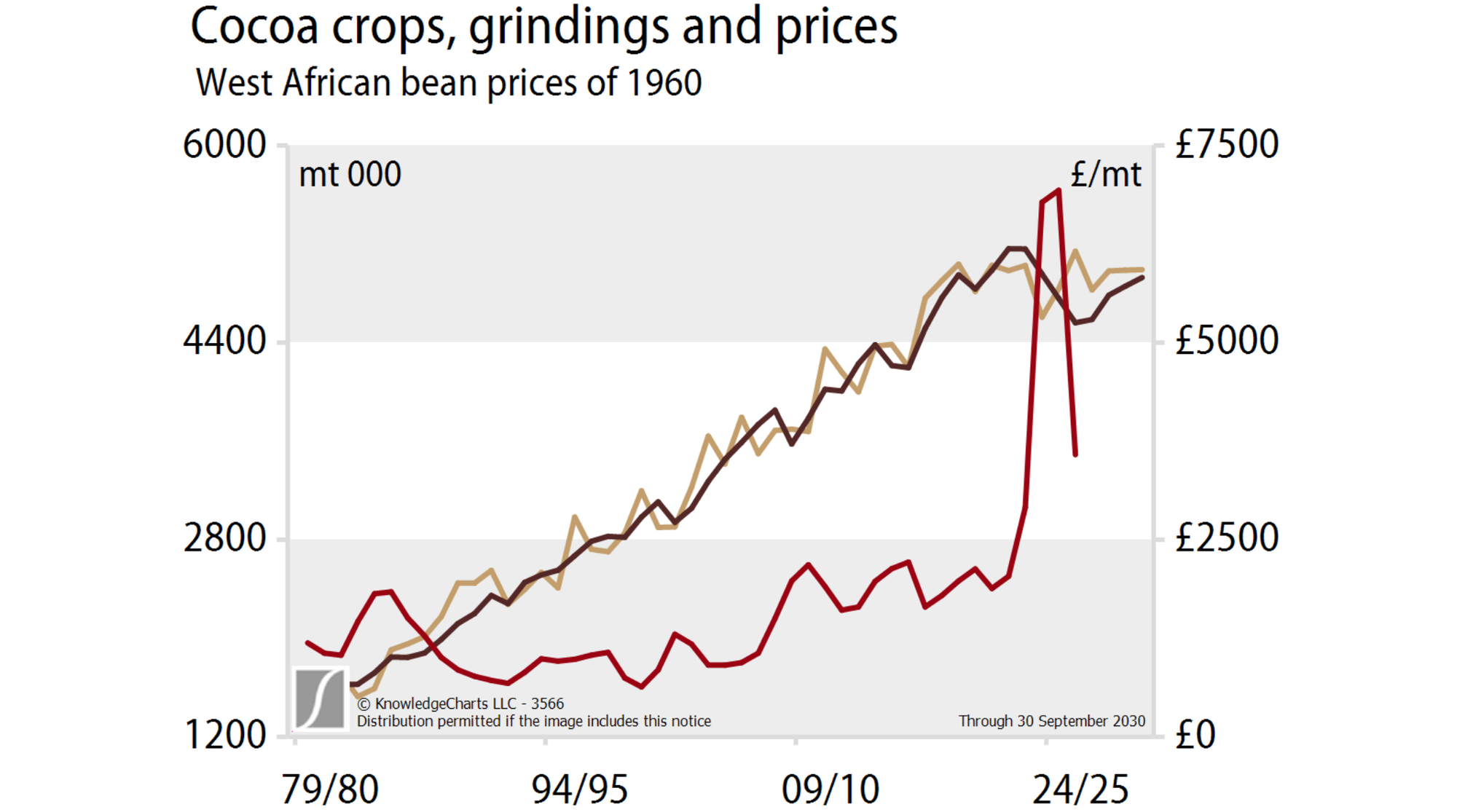
As prices fell, the governments of producing countries persuaded some consuming countries to join them in organizing the International Cocoa Organization (ICCO), with a provision for accumulating a buffer stock to support prices and farm incomes. Calls for improving the incomes of indigenous farmers, including cocoa farmers, also were beginning.
However, within a few years, the buffer stock was overwhelmed by general stocks that accumulated to levels never anticipated. By 1991, end-of-season worldwide stocks stood at 1,765 tmt, equivalent to 75% of a year's grindings.
In the late 1990s, the World Bank, IMF, and other institutions proposed a different solution to the problem of low farm incomes. They argued that Côte d'Ivoire and Ghana could improve farm incomes by closing their marketing boards and allowing free markets.
Côte d'Ivoire closed its *Caisse de Stabilisation* and allowed exporters to compete in buying from farmers. Ghana resisted and kept Cocobod in place, except that private firms were permitted to compete with Cocobod's Produce Buying Company (PBC) in collecting cocoa from farmers. Côte d'Ivoire reintroduced a marketing board in 2011, *Le Conseil du Café-Cacao*.
A sequence of public relations crises began in the early 2000s. Calls to increase cocoa farmer incomes reached the news media and public awareness. The first lawsuit regarding child labour was filed around 2005\. More lawsuits concerning child labour and slavery have followed from time to time. These have involved years of litigation and generated negative press coverage for the industry.
The first investigations into deforestation in cocoa-growing areas appeared around 2017\. As market participants know, these have expanded to become a common topic in the public media as well as in industry discussions, reports, and conferences.
Less visible, but today very important, stocks declined relative to demand after 1991\. Although total stock tonnage remained roughly stable from 1992 until 2022, stocks declined as a percentage of annual grindings from 75% in 1992 to 41% in 2018\. Consumption had been outpacing production for 30 years. After 2018, stock tonnage also fell while consumption continued to rise.
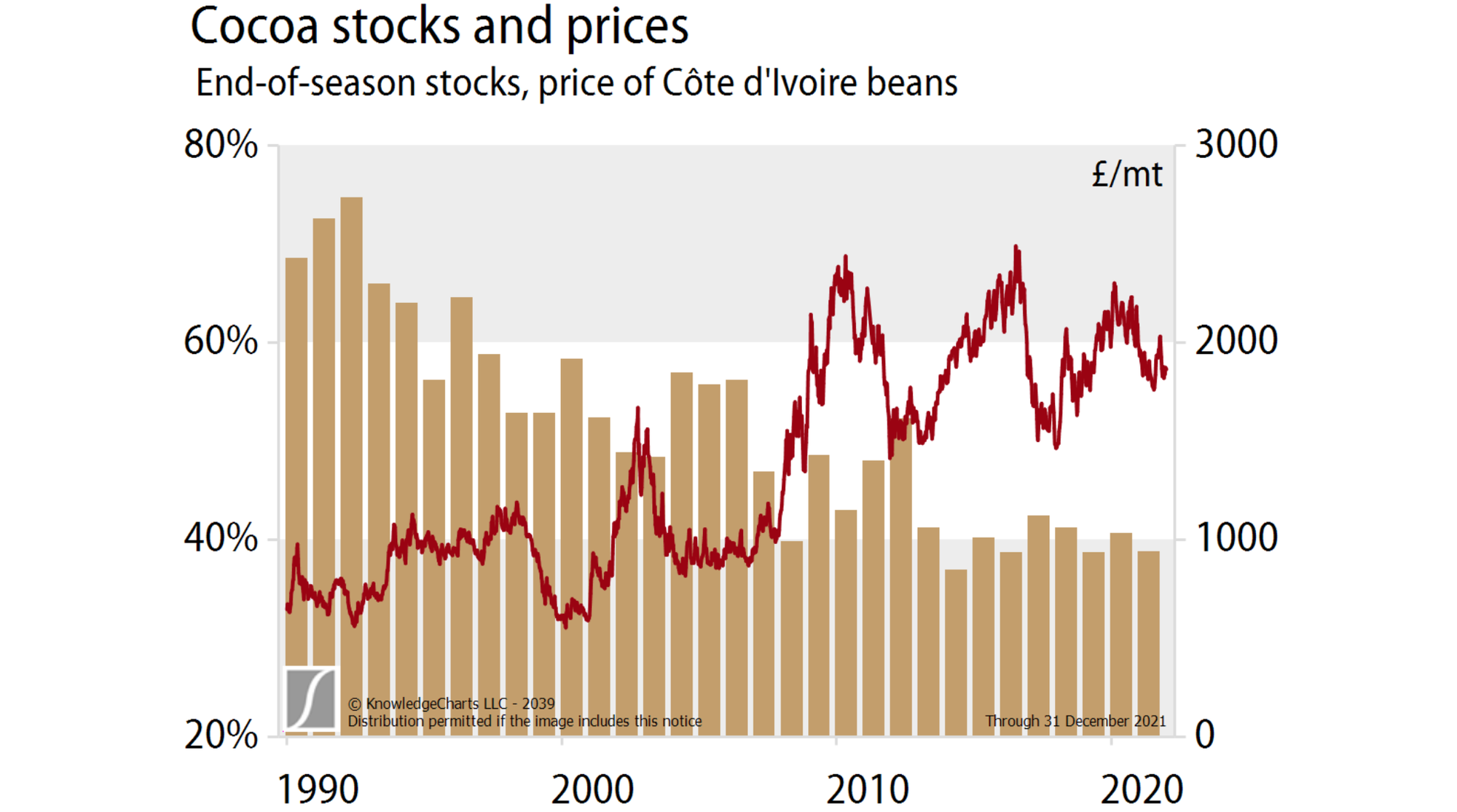
Four cycles of rising then falling prices happened between 2000 and 2022\. The cycles reached peaks of £1670 in October 2002 for Côte d’Ivoire beans CIF Europe six months forward, £2440 in April 2010, £2490 in February 2016, and £2305 during February 2020.
Stocks relative to grindings declined during this period from around 49% to 40%. Global weather, specifically a very strong El Niño in 2015-2016, was probably a contributing factor. (A very strong El Niño occurred during 2015–16\. It probably contributed to the third bull market cycle. The 2015/16 crops of Côte d'Ivoire, Ghana, and Ecuador were 425 tmt (14%) lower than surrounding years. Global weather probably was not a significant factor in the other years. NOAA reported neither La Niña nor El Niño before the 2002 peak, although crops declined by 13%. NOAA reported a weak La Niña during 2008–09 before the 2009 peak, when crops declined by 10%. NOAA reported a weak El Niño during 2018–19 before the 2020 peak. The 2018/19 crop rose by 9%, while the 2019/20 crop declined by 3% compared with surrounding years.)
The decline of prices during 2016/17 following the third bull market, together with the long history of marketing boards seeking higher prices for impoverished farmers, merged into the efforts of Côte d'Ivoire and Ghana to introduce the Living Income Differential (LID) on exports beginning with the 2020/21 season.
Conflict with the cocoa-using industry followed. The industry agreed publicly while resisting privately. The rise in prices in early 2020 to £2,304 occurred partly because the LID increased differentials in the world market. That rally ended as the COVID-19 pandemic began.
Although the LID continues in name, any meaningful effect on farm incomes ended soon after it came into force.
The fifth bull market began in late 2022, continued through 2023, and reached peaks in 2024 of just under £10,000 and $12,200 (second distant).
A major reason for the extreme price movement was that market participants concluded that the crops of Côte d'Ivoire and Ghana were in long-term decline. Those crops probably peaked in 2019/20.
Speculators – including those from the cocoa trade and cocoa processing industry – accelerated the rise.
The results of the fifth cycle over the past 20-plus years have included a 9% decline in worldwide cocoa consumption in all forms, a race to replace chocolate confectionery with sugar confectionery, and a race to find substitutes for cocoa beans and cocoa products.
Companies that once specialised in bringing chocolate to consumers are not only diversifying into other snack foods – for reasons beyond cocoa prices – but are also reducing their reliance on cocoa alone.
- **This is the first article in a four-part series: Part 2 summarises the history of cocoa yields in West Africa; Part 3 examines the history of sustainability programs and critiques of them; Part 4 sets out CRA's Veriground proposal.**
- **Download the PDF for more information on this topic:**
[CRA Cocoa Special Report 2026n28 (1135)CRA Cocoa Special Report 2026n28 (1135).pdf210 KBdownload-circle](https://cocoaradar.com/content/files/2026/07/CRA-Cocoa-Special-Report-2026n28--1135-.pdf "Download")
---
*Correction: An earlier version stated that the LID applied to crops starting with the 21/22 harvest. This was incorrect. It applied to crops starting 20/21\. Some numbers from the history of price cycles during 2000-2022 did not match the accompanying chart. These have been corrected without changing the substance of the discussion.*
**About CRA**
CRA offers a specific collaboration to support innovation at the beginning of the supply chain: the cocoa farmer in West Africa. Veriground operates networks of weather stations in Côte d'Ivoire and Ghana that provide free local weather forecasts to farmers located near those stations, at a fraction of the cost compared with the potential return.
### Moving Cocoa: Using NIRS Scanners in the Field to Reduce Costs and Losses
URL: https://cocoaradar.com/moving-cocoa-using-nirs-scanners-in-the-field-to-reduce-costs-and-losses/
Last updated: 2026-07-29T14:15:23.000Z
From our desk to yours. DailyDaily.
## Join our growing community of members and receive a free version of our daily newsletter on what really matters in cocoa.
No spam. Unsubscribe anytime.
[Subscribe → ](https://cocoaradar.com/#/portal/signup)
I love technology, especially when it helps to solve real problems. I am convinced technology will shape cocoa much more in the future than it has done in the past. There has probably never been a more interesting time for it either.
Advertisement
[  ](https://www.foodmasters-freiberg.com/en/?utm%5Fsource=ghost&utm%5Fmedium=newsletter&utm%5Fcampaign=ad&utm%5Fcontent=qsm%5Fplaceholder)
AI has opened doors to opportunities we could not even foresee a few years ago. A lot is already possible, but sometimes we need to look at other industries (like tomatoes, flowers, avocados) to see how technology has positively shaped them.
Thinking about technology in cocoa, alternative cocoa also comes to mind. And every time I read that another corporate has snapped up an alt-cocoa start-up, I feel... well... torn.
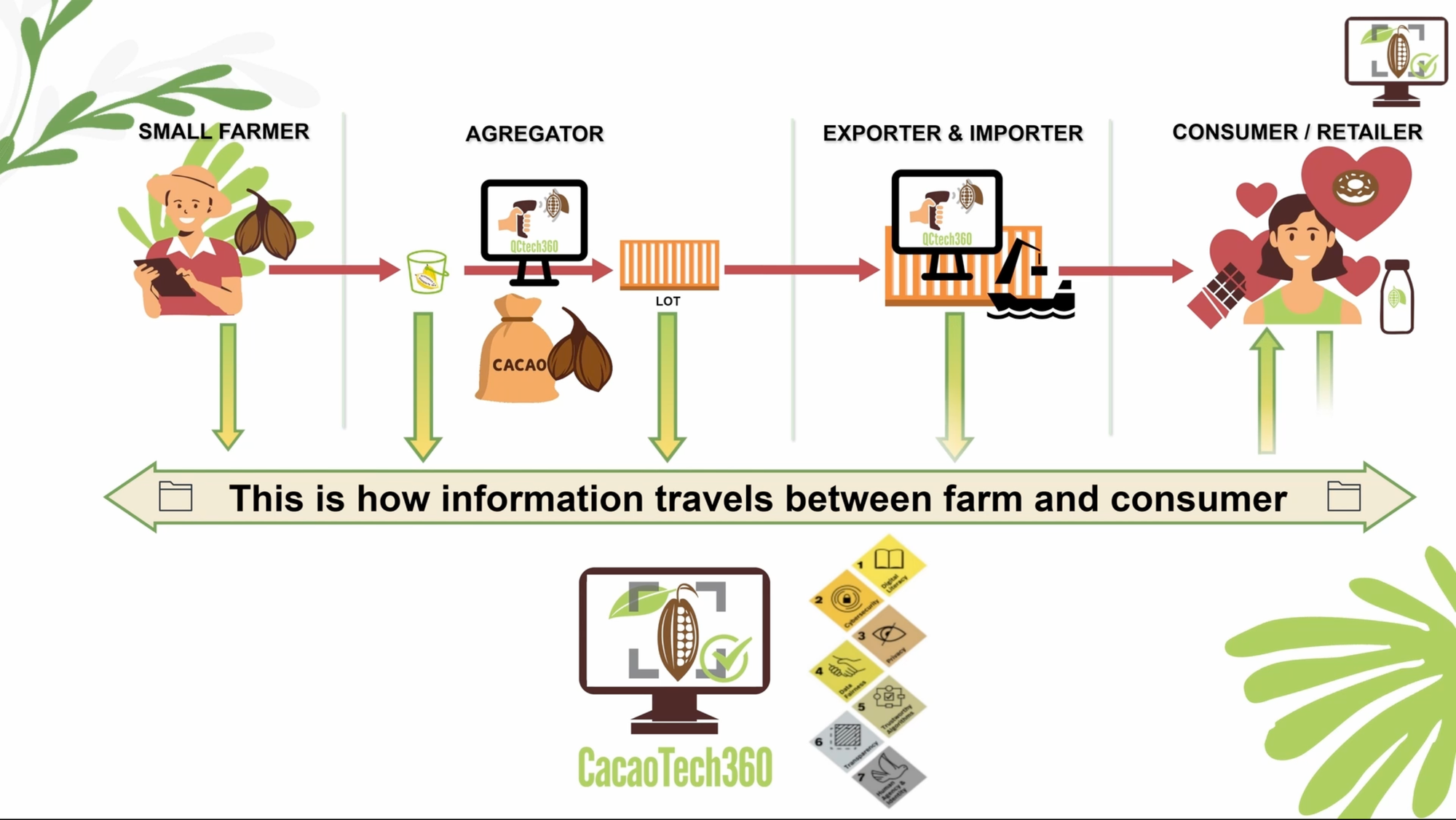
The innovator part of me is excited, and understands its appeal for companies. After the price rollercoaster of the past two years, I completely understand why securing cocoa has become a real and important problem for corporates to solve. If volumes can't be secured, at least the cocoa's flavour can be preserved.
But the other half of me, the side that truly loves cocoa, worries. If cocoa gets partly, or fully, swapped for something other than cocoa, what then happens to the millions of farmers who live from this crop?
What happens to the beautiful flavour of chocolate, to quality, to all the companies who depend on it?
> What happened to the vanilla bean market when vanillin (synthetic flavor) was created?
Personally, I would rather see technology used differently, for example to help reduce the issues we already have in the chain, issues that can be solved without anyone being cut out.
## Buying Blind
Anyone who has ever bought cocoa knows this issue: it is nerve-wracking to pay so much money for a batch of new cocoa when you don't yet know how it will turn out and taste.
In my first start-up, Gaia Cacao, my co-founder Mariana and I faced this too. You pick a batch from an origin based on a trust relationship and a sample that once tasted great.
You make the purchase, transfer (part of) the money, and the beans are shipped and sail for about six to eight weeks, still not fully dried. Basically, you find out what you actually paid for when the container gets to the warehouse and the doors open. Butt cheeks clenched, fingers crossed, praying to holy Mary that the beans would come out good.
> Wouldn't it be better to know before it even ships?
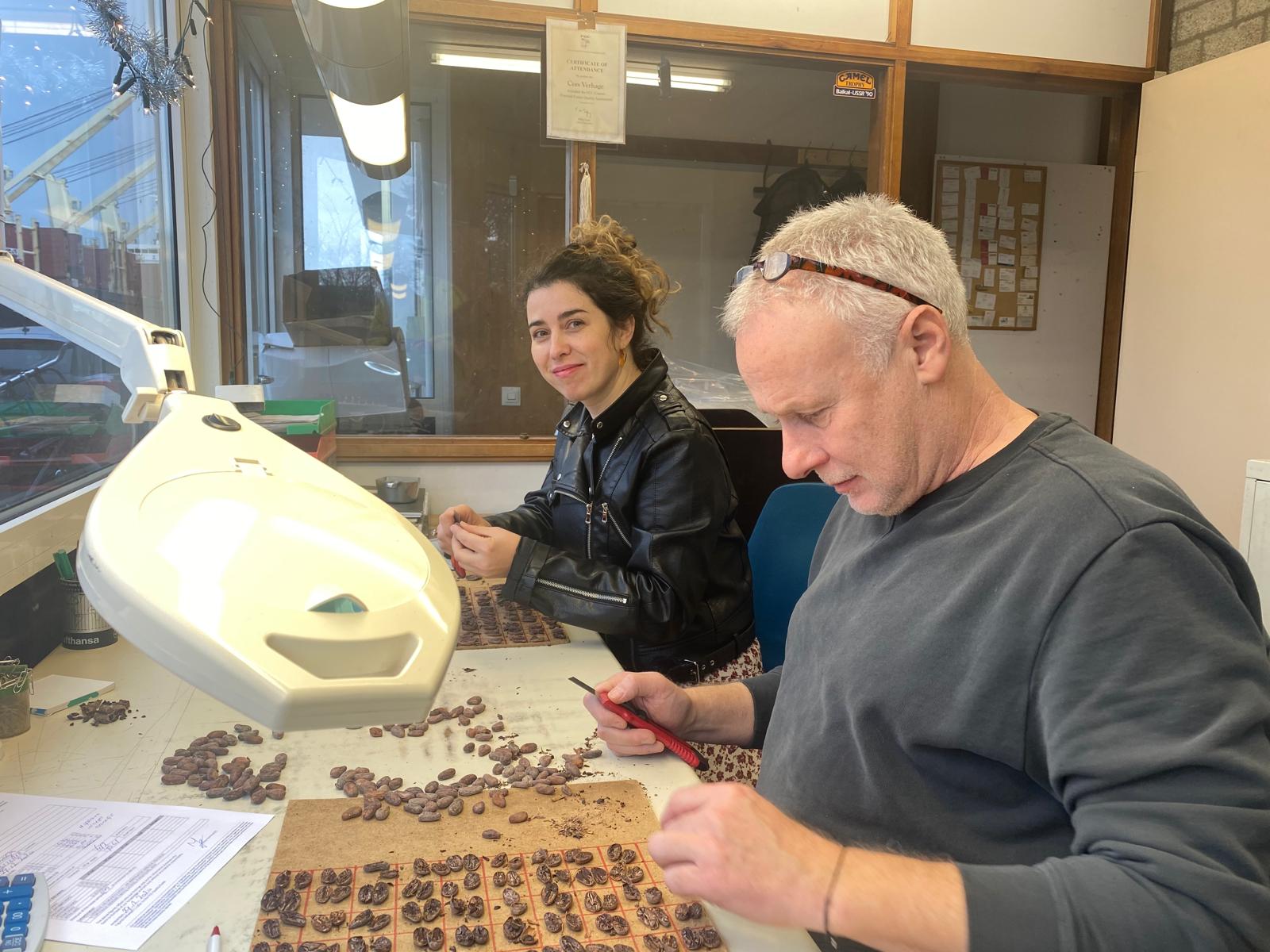
**Manually checking a batch of cocoa beans for defects such as moulds and insect damage at Cotterell cocoa warehouse in Amsterdam. Spending time in the warehouse has improved my understanding of quality issues.* Image: Marika van Santvoort
## **Cacao-Tech: Checking Quality At The Source Using NIRS Scanners**
Between 2023 and 2025, Moving Cocoa worked on a project called Cacao-Tech, together with Wageningen Research in the Netherlands, the Czech University of Life Sciences in Prague and a Dutch AI/software partner called Hyves Tech.
It ran under DRG4FOOD, an EU-funded programme on the use of new digital technologies in food systems. Our aim was to identify practical ways to use digital tools to improve quality, traceability, and reduce waste in the cocoa sector.
Eventually, we built a data platform from scratch that is EUDR-compliant and takes ethics seriously: who owns the data, who gets to share it, and how. In addition, we worked on a part where we used handheld NIRS scanners to read the quality of the beans, and even of the pulp inside a closed pod, from the outside.
Using NIRS itself is not new. It is a widely used tool in labs for measuring specific parameters. But using a handheld NIRS scanner on the farm or at the collection point to catch quality problems early, tie the result to traceability, and build an AI prediction algorithm with up to 95% accuracy - that is new for cocoa - and very exciting!
[Premium Briefing: Rise of the ‘Cacaobots’ – AI and the Future of Cocoa FarmingA special CocoaRadar Report: Smarter cocoa farming isn’t just the future – it’s happening now. With innovations in climate resilience, tech adoption, inclusive policies, and collaborative models, the industry is poised for a new eraFrom The Desk of CocoaRadar™Anthony Myers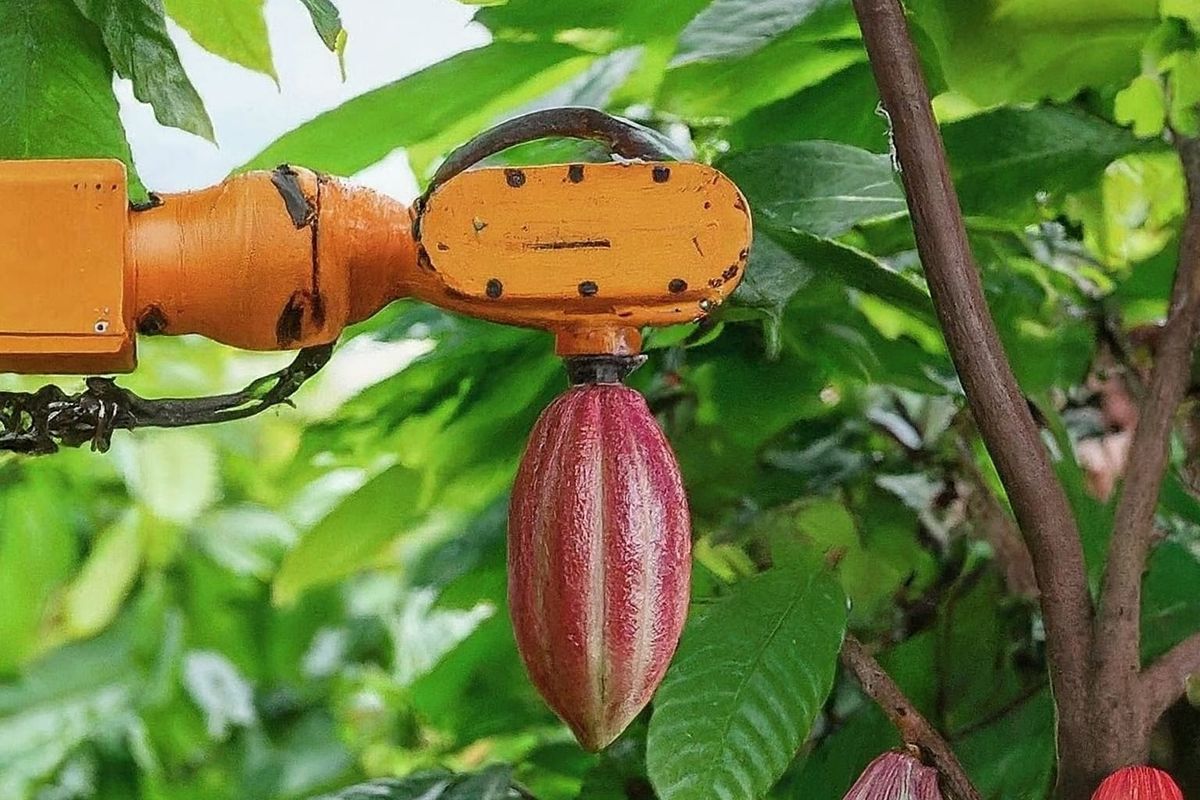](https://cocoaradar.com/premium-briefing-rise-of-the-cacaobots-ai-and-the-future-of-cocoa-farming/)
## How it Works
The scanner is a portable near-infrared spectrometer. It is small, easy to carry and (relatively) affordable. You press it against a pod or bean, and it reads the light that bounces back. The scans take a few seconds. That reading runs through a trained model that sorts it into classifications: well-fermented or not, and, with the finer model, violet, slaty, mouldy, white spots, and insect damage.
This is how you build a good, objective understanding of the batch's quality, by scanning the beans of a representative sample. It works completely offline and gives you an answer in half a minute instead of the days or weeks a lab takes. Every scan is time-stamped, tied to its batch, and can be synced with any traceability platform. It even flags a bad or tampered scan, so unreliable numbers never make it in.
We calibrated it against laboratory benchmarks and FCC quality protocols, and the same algorithm can be further trained for moisture and fat, and even for residues the EU now screens for at the border. Yes, even the PAHs and the mineral oils, MOSH and MOAH.
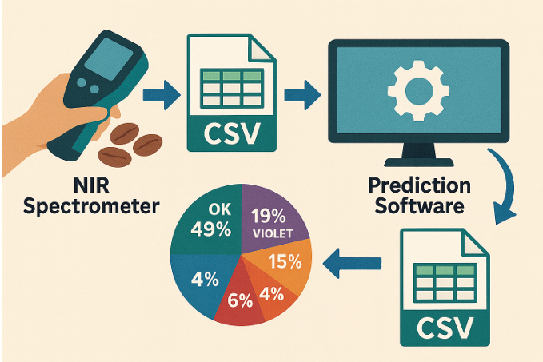
**From bean to result: scan with the handheld NIR device, and the software returns an objective quality read.* [**Read more.*](https://drg4foodtoolbox.eu/project/cacaotech/?ref=cocoaradar.com#why-matters)
### **What It Changes**
For farmers and cooperatives, this gives a clear answer right away. They can prove the quality of what they are selling and feel confident in a price negotiation with something so tangible and objective in hand. An issue such as poor post-harvest handling can be caught before the beans are sold. This can avoid potentially damaging the trust relationship with a buyer. We built it privacy-first and tested it with farmers and cooperatives in Ecuador. In our pilots, the data stays with the farmer, which was an important element of the project.
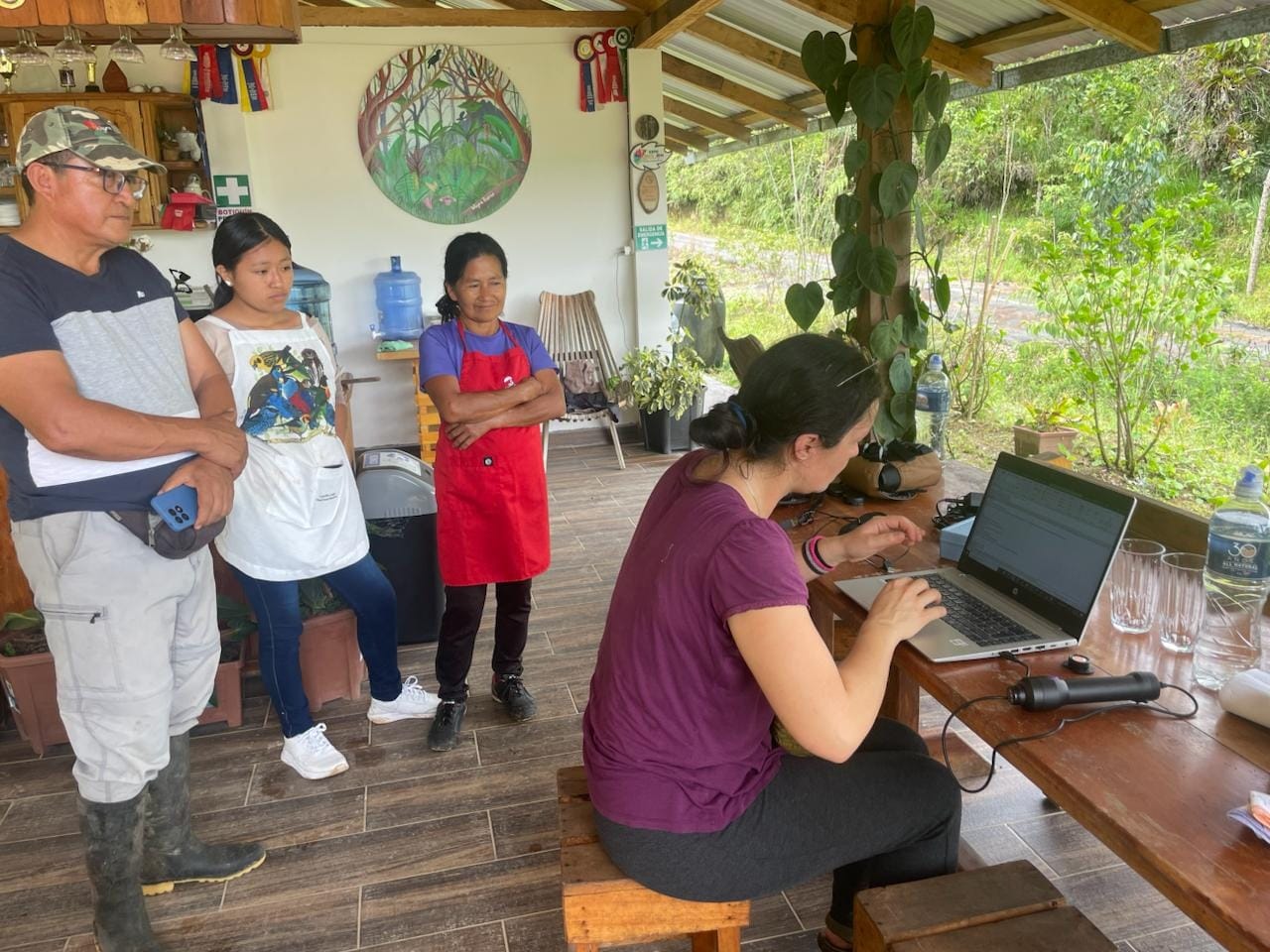
**Jana Kholova, plant scientist at CZU, setting up the NIRS scanner on a small cocoa farm near Tena and showing farmers how the cocoa bean quality scans look on a screen.* Image: Marika van Santvoort
For companies, quality translates into consistent, comparable data collected where the beans actually are, rather than where they arrive. This saves a lot of costs, for example on lab tests and cut tests. A shipment gets sampled about three times: at the cooperative, on arrival and often at the client, roughly 3kg a time.
Fine for a small batch and companies that sell premium cocoa, but imagine yours is a company that works on tight margins and imports 500,000 MT a year.
That is around 180 MT of beans and some 60,000 cut tests, close to 7 million euros in costs and losses, about 14 euros a tonne. Reading the quality at origin turns guesswork into one objective check, which helps companies make better decisions later in the chain, for example which recipe the beans should end up in, before the container arrives.
## Now, What's Next?
The research project and the pilots are finished, and the tools are ready to be commercialised under a licensing model. The group behind Cacao-Tech is now looking for the right partners to continue the work.
- **Further reading:** [**The Cacao Tech project** ](https://drg4foodtoolbox.eu/project/cacaotech/?ref=cocoaradar.com#why-matters)
- Interested in knowing more? Reach out to [marika@movingcocoa.com](mailto:marika@movingcocoa.com).
|  **Marika van Santvoort** has been working in cocoa & chocolate since 2014, with a focus on responsible sourcing, innovation and farmer impact. In this monthly column she shares her own perspective on what is really moving in the sector; what is being said, what is not, why it matters and what it means for the industry. [LinkedIn](https://www.linkedin.com/in/marikavansantvoort/?ref=cocoaradar.com) · [movingcocoa.com](https://movingcocoa.com/?ref=cocoaradar.com) |
| ---------------------------------------------------------------------------------------------------------------------------------------------------------------------------------------------------------------------------------------------------------------------------------------------------------------------------------------------------------------------------------------------------------------------------------------------------------------------------------------------------------------------------------------------------------------------------------------------------------------------------------------------- |
### Lindt's Premium Comes With a Reputation Premium
URL: https://cocoaradar.com/lindts-premium-comes-with-a-reputation-premium/
Last updated: 2026-07-28T14:33:42.000Z
Lindt & Sprüngli delivered the sort of results investors have come to expect. Higher sales. Rising profits. Expanding margins. Even as cocoa prices remain near historic highs, the Swiss chocolatier has once again demonstrated an enviable ability to pass on costs without denting demand. Few food companies enjoy that kind of pricing power.
Then came a reminder that premium brands are valued on more than financial performance.
A lawsuit filed in Washington, D.C. alleges that Lindt misled consumers by promoting commitments to responsible sourcing and children's rights while allegedly benefiting from child labour in its cocoa supply chain in Ghana and Côte d'Ivoire.
Advertisement
[  ](https://www.foodmasters-freiberg.com/en/?utm%5Fsource=ghost&utm%5Fmedium=newsletter&utm%5Fcampaign=ad&utm%5Fcontent=qsm%5Fplaceholder)
Lindt has strongly denied the allegations, saying it condemns all forms of child labour, operates supplier protocols and systematically investigates suspected cases, alongside broader programmes to improve traceability and conditions in cocoa-growing communities.
Legally, the case may prove manageable. The plaintiffs are seeking to halt allegedly misleading representations rather than financial damages. But the commercial implications deserve closer attention because they reach beyond the courtroom.
_This post is for paying subscribers only._
### The Sustainability Paradox in Chocolate
URL: https://cocoaradar.com/the-sustainability-paradox-in-chocolate/
Last updated: 2026-07-28T09:00:07.000Z
Presented by
[  ](https://www.cighci.org/?ref=cocoaradar.com)
[cighci.org ](https://www.cighci.org/?ref=cocoaradar.com)
💡
****By Alex Assanvo, Executive Secretary, Côte d'Ivoire–Ghana Cocoa Initiative (CIGCI)**
On supermarket shelves in some major markets, consumers can now buy a version of a chocolate snack in which every cocoa ingredient has been replaced. The substitute is made from oats and sunflower seeds. It is one product among many: since 2022, more than 150 million dollars has been invested in start-ups developing alternatives to cocoa butter, cocoa powder and chocolate itself — from fermented fava beans to cell cultures grown in bioreactors.
Behind them stand some of the largest names in the industry, as investors, partners and customers. The world's largest cocoa processor has made specialty ingredients, including cocoa substitutes, a pillar of its growth strategy.
**Innovation in food is not, in itself, a threat**. Producing countries have never feared science; we invest in it. But from where I sit, at the head of the Initiative that unites the two countries supplying nearly 60% of the world's cocoa, this trend raises a question the industry can no longer avoid: **what does it mean to demand sustainable cocoa while engineering cocoa out of the product?**
Consider what Côte d’Ivoire and Ghana have been asked to do in recent years. Under the European Union’s deforestation regulation, every bean sold into that market must be traceable to a geolocated farm plot. Our governments have mapped millions of farms, created national traceability systems, strengthened forest monitoring, and expanded due-diligence structures across the supply chain. This unprecedented compliance agenda was largely designed in importing markets, yet its cost and complexity have fallen mainly on producing countries.
> We accepted it, we are implementing it, and we did so on a clear, if implicit, understanding that the chocolate reaching consumers would contain the cocoa these standards are meant to protect and reward.
### Sustainability Costs
That understanding is now being tested. If premiums, traceability and sustainability requirements are justified in the name of cocoa and the farmers who grow it, then reformulation that strips out cocoa butter, powder or liquor weakens the entire compact. Producers carry rising sustainability costs; finished products carry less of the cocoa for which those standards were demanded. A chocolate bar can be marketed on the ethics of its supply chain even as the supply chain's share of the bar shrinks. That is not sustainability. It is arbitrage against it.
The farmers are the ones squeezed at both ends. They are being told that the cocoa must be deforestation-free, mapped, certified and documented, then absorb the demands of a compliance system. And at the same moment, laboratories in Europe, Israel and California are being financed — sometimes by the very companies that buy the beans — to make the crop replaceable.
No one has asked their opinion. Their income, and that of millions of households across West Africa and beyond where cocoa remains the backbone of rural economies, depends on the answer.
> Let me be clear about what we are asking, because it is not protectionism and it is not a rejection of research.
First, honesty toward consumers. When cocoa content has been reduced or replaced, consumers should be told plainly. And there are already some rules on these matters. People who choose chocolate because they believe their purchase supports sustainable farming deserve to know whether the product contains the cocoa they think they are supporting. Sustainability claims on packaging must remain credible — for the industry's sake as much as ours.
### The Regulatory Burden Rises at Origin
Second, coherence from regulators. Authorities in importing markets should ask whether substitution and reformulation practices align with the sustainability and traceability obligations they impose on producing countries. It is difficult to defend a framework in which the regulatory burden rises at origin while the incentive to source genuine cocoa falls downstream. Coherence across the value chain is not a favour to producers; it is the condition of the system's legitimacy.
Third, partnership rather than exit. The pressures pushing manufacturers toward substitutes — price volatility, supply uncertainty, climate stress on the cocoa belt — are real. But the answer to a fragile supply chain is to invest in its resilience, not to abandon it. Every dollar spent replicating cocoa in a bioreactor is a dollar that could strengthen disease-resistant varieties, climate adaptation, and the incomes that keep farmers in cocoa at all times.
Producing countries are also acting. On 16 June in Abidjan, H.E. Alassane Ouattara, President of the Republic of Côte d’Ivoire, and H.E. John Dramani Mahama, President of the Republic of Ghana, reaffirmed their commitment to a cocoa economy that puts farmers at the heart of governance and value sharing. Our two governments are aligning farmgate prices and crop calendars, expanding joint research on swollen shoot disease and climate-resilient varieties, implementing the African sustainability standard ARS-1000, and speeding up local processing so that more cocoa value remains on the continent that grows about 80% of the crop. The Initiative is also preparing to welcome other producing countries, because the sector’s challenges require a coordinated African response, not a fragmented one.
### Dialogue Requires a Shared Premise
We will continue to engage manufacturers, regulators and researchers in good faith, in the same spirit of dialogue that produced the Living Income Differential and the joint scientific cooperation now expanding across our region. But dialogue requires a shared premise. Ours is simple: a sustainable cocoa economy cannot be built on rising obligations for the people who grow cocoa and declining cocoa in the products those obligations are meant to make possible.
The industry must decide what chocolate is. If it is a product of cocoa — of the trees, the soil and the hands of farmers — then the standards now demanded of us make sense, and we will keep meeting them. If it is to become a flavour that can be assembled from oats, oils and fermentation tanks, then the sector should say so openly, and stop asking farmers to underwrite a promise it no longer intends to keep.
- **Alex Assanvo is Executive Secretary of the Côte d'Ivoire–Ghana Cocoa Initiative (CIGCI), the intergovernmental body headquartered in Accra, established by the Republics of Côte d'Ivoire and Ghana, which together produce nearly 60% of the world's cocoa.**
---
- **Sponsored content: This article was created in collaboration with CIGCI. While it aligns with our audience’s interests, the ideas and content are provided by CIGCI, which retains copyright and editorial responsibility. We’re sharing it to offer our readers relevant information and perspectives.**
### Trump's Forced-Labour Tariffs Largely Spare Cocoa, but Risks Remain for Origin Processing
URL: https://cocoaradar.com/trumps-forced-labour-tariffs-largely-spare-cocoa-but-risks-remain-for-origin-processing/
Last updated: 2026-07-27T14:28:12.000Z
From our desk to yours. DailyDaily.
## Join our growing community of members and receive a free version of our daily newsletter on what really matters in cocoa.
No spam. Unsubscribe anytime.
[Subscribe → ](https://cocoaradar.com/#/portal/signup)
The latest US tariff regime has raised concerns across global commodity markets, but its direct impact on cocoa-producing countries appears more limited than the headline tariff rates of 10% and 12.5% suggest.
The tariffs took effect on 24 July following a US Trade Representative (USTR) investigation into whether trading partners have adopted and effectively enforced prohibitions on imports produced with forced labour. The Trump administration says the measures are intended to encourage stronger action against goods linked to forced labour entering international supply chains.
However, the final USTR notice explicitly exempts several key cocoa products from the additional duties. These include cocoa beans, cocoa paste, cocoa butter, and unsweetened cocoa powder.
Advertisement
[  ](https://www.foodmasters-freiberg.com/en/?utm%5Fsource=ghost&utm%5Fmedium=newsletter&utm%5Fcampaign=ad&utm%5Fcontent=qsm%5Fplaceholder)
For the cocoa sector, the distinction between exempt intermediate products and potentially exposed finished products could prove significant.
## **Major Cocoa Products Exempted**
The exemptions cover Harmonized Tariff Schedule (HTS) headings **1801–1805**, including:
_This post is for subscribers only._
### When Story Becomes Strategy: Oumé’s Bid To Build Beyond Chocolate
URL: https://cocoaradar.com/when-story-becomes-strategy-oumes-bid-to-build-beyond-chocolate/
Last updated: 2026-07-24T11:23:35.000Z
This article is for members, which we are opening up to the public as a one-off. To read more exclusive insights subscribe belowDaily
## Join our growing community of members and receive a free version of our daily newsletter on what really matters in cocoa.
No spam. Unsubscribe anytime.
[Subscribe → ](https://cocoaradar.com/#/portal/signup)
There are countless premium chocolate launches each year, but relatively few begin with a conversation about childhood memories rather than cocoa percentages.
That distinction may prove to be one of Oumé’s greatest strengths.
Since its first public unveiling in London, the Côte d’Ivoire-inspired brand has deliberately resisted a conventional product-first approach. Instead of leading exclusively with flavour notes, recipes or technical specifications, Oumé introduced itself through identity, place and personal history.
Its ambitions also extend beyond the chocolate category. Oumé’s creators describe it as a lifestyle brand built around nostalgia, belonging and the meaning of home.
Advertisement
[  ](https://www.foodmasters-freiberg.com/en/?utm%5Fsource=ghost&utm%5Fmedium=newsletter&utm%5Fcampaign=ad&utm%5Fcontent=qsm%5Fplaceholder)
That strategy raises a larger question for the cocoa and confectionery industries: can a business with roots in Africa build a globally recognised premium brand rather than remaining associated primarily with the supply of raw cocoa?
For Ndubuisi Kejeh (ND), founding partner of the London-based venture studio Mustard, the answer begins with the story rather than the product.
“We’re a venture studio that believes story is king, and we’re trying to build brands that can prove that,” ND informs CocoaRadar during an interview at Mustard’s central London offices.
### A Story That Began Near Oumé
The idea that eventually became Oumé emerged during a lunch two years ago involving ND, former Chelsea and Côte d’Ivoire footballer Salomon Kalou, his wife Karina Ferreira and Baafour Totoe.
During the conversation, Kalou recalled growing up as one of 11 siblings in a farming family near the Ivorian town of Oumé. During cacao season, he would sometimes miss school to help with the harvest.
The memory remained with ND because it contained the foundations of a much broader story: family, labour, land, ambition and the emotional distance between where a life begins and where it eventually leads.
Kalou’s relationship with chocolate also carried an unexpected disconnection familiar across many cocoa-producing communities. According to ND, Kalou did not initially understand that the chocolate he later encountered was made from the cacao he had known during childhood.
“When he figured that out, it gave him deep nostalgia,” ND says. “We are always trying to build things, tell stories or do things that express nostalgia and express home.”
That idea became the organising principle behind Oumé.
Rather than treating narrative as a marketing campaign added once the product had been developed, Mustard’s approach is to use the founder’s lived experience as the basis for the company itself.

Ndubuisi Kejeh (right) at Oumés pre-launch in London in 2025 with founders Salomon Kalou, Karina Ferreira. Image: Oumé
### Authenticity Or Marketing?
As storytelling becomes increasingly central to brand building, the boundary between authentic narrative and carefully constructed marketing can be difficult to define.
ND acknowledges that Oumé will have to keep testing that boundary.
“It is an ongoing experimentation, and I think it will be an ongoing learning,” he says.
Traditional brand development often starts by identifying an attractive market segment and then shaping a proposition to appeal to it. Mustard attempts to reverse that process.
> “When you’re following a story, you’re not saying, ‘Who do I want to target?’” ND argues. “You’re actually saying, ‘Who gets me? Who gets my story?’”
He compares the approach to advising a child starting school. One option is to tell the child which group to pursue and encourage them to adapt their behaviour accordingly. The alternative is to tell them to be themselves and find the people who respond naturally.
For Oumé, the test is whether each new product, activation or message remains connected to the central ideas of home and nostalgia.
“As long as we’re doing that, then I think we’re on the right line,” ND believes.
### More Than An African Chocolate Brand
Oumé’s origins are inseparable from Côte d’Ivoire, the country where Kalou was raised and whose cocoa sector remains central to the global chocolate supply chain.
Yet ND is cautious about allowing the brand to be defined solely by geography.
Mustard initially spoke openly about its ambition to build a major global brand emerging from Africa. As Oumé developed, however, the team began to broaden that positioning.
> “Our biggest responsibility is the story,” ND says. “It’s not a continent. It’s not even a country.”
That shift became apparent during an early Oumé pop-up in London’s Soho district. Visitors from several countries responded to the concept of home without necessarily associating it exclusively with Côte d’Ivoire.
ND recalled an Italian visitor who interpreted Oumé’s message through memories of Italy.
“You’re talking about home, and I’m thinking about home in Italy,” the visitor told the team.
For ND, that reaction captured the brand's intended universality.
> “Salomon is a human being who has strong feelings of nostalgia,” he explains. “He’s a human being who loves his home. There are many human beings around the world who feel the same way.”
The approach carries both an opportunity and a risk.
Emphasising Oumé’s Ivorian origins gives the business a distinctive and meaningful foundation. But presenting it primarily as an ‘African brand’ could also cause some consumers to assume the product is intended for a particular demographic or region.
Oumé therefore wants its roots to remain visible without allowing them to become a boundary around the brand.
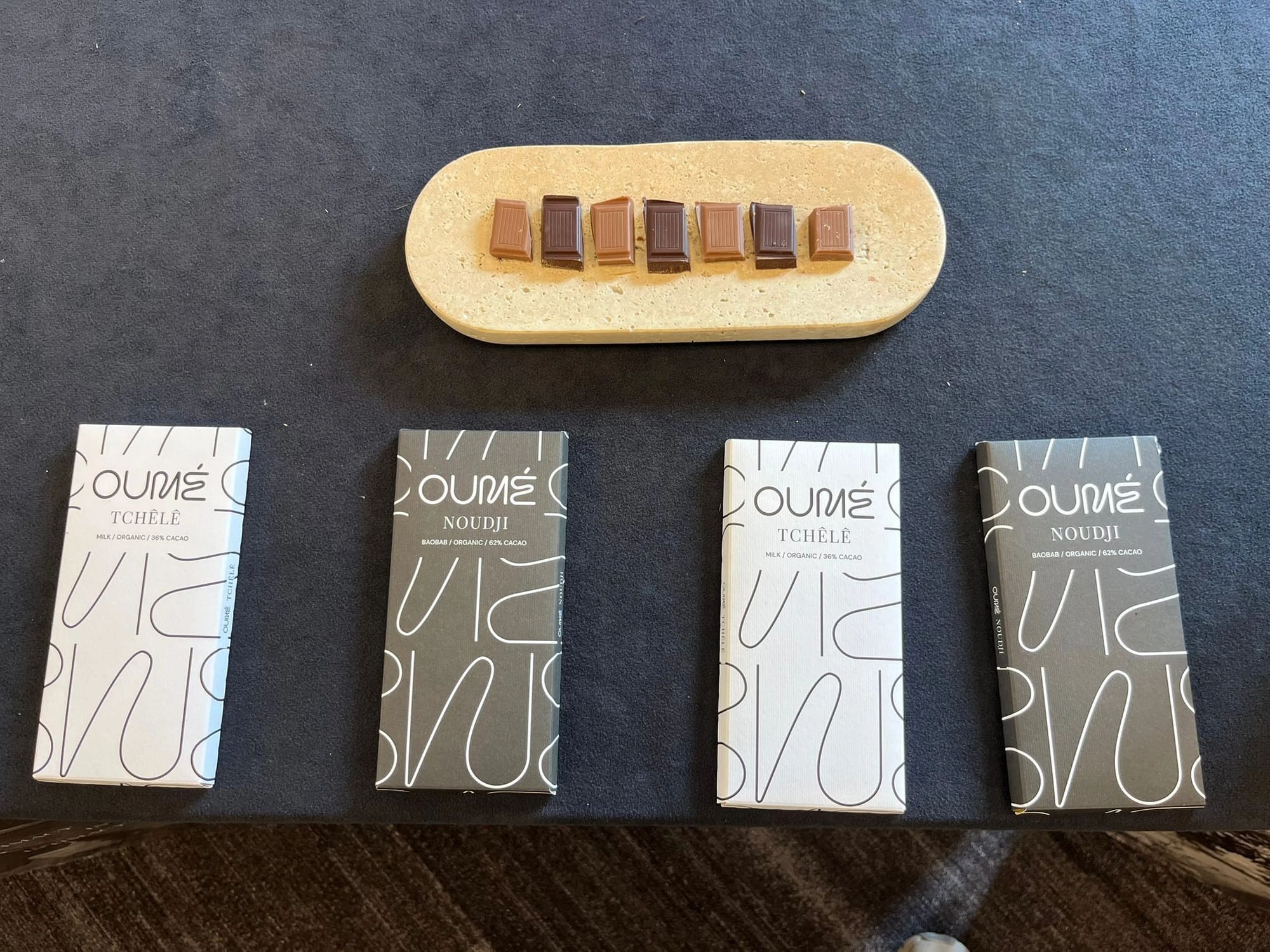
The Oumé premium chocolate collection has launched with milk and dark chocolate bars. Image: cocoaradar.com
### Manufactured In Switzerland, With Wider Ambitions
The initial Oumé chocolate range is manufactured in Switzerland using beans of mixed origin.
ND explains that the company is also working towards developing a chocolate made exclusively with cocoa from the Oumé area. A small-scale prototype has already been produced, but moving from an experimental bar to consistent commercial production presents considerable sourcing and quality challenges.
> “It’s extremely difficult to get really good quality from the origin, let alone talk about manufacture,” he argues.
The issue goes to the heart of a longstanding structural challenge within cocoa.
West Africa produces much of the raw material used by the global chocolate industry, yet much of the manufacturing, branding and higher-value commercial activity takes place elsewhere.
Oumé’s current production model does not overturn that structure. Its founders instead argue that building a larger and more profitable lifestyle company could eventually give the business the resources and audience needed to develop products more closely tied to the Oumé region.
“If we truly want to be able to make bars that are single origin from Oumé in the future, we have to be bigger,” ND says. “That means we need a bigger audience, but it also means we’re going to need bigger revenues and bigger profits.”
### Why Oumé Does Not Want To Remain Only A Chocolate Company
This month Oumé has opened its direct-to-consumer business in the UK and is also holding conversations with premium retailers.
However, ND believes the economics of the chocolate-bar category make it difficult to achieve the company’s wider ambitions through confectionery alone.
Chocolate bars operate within relatively established price and margin expectations. A business seeking to invest in origin-specific production, international expansion and wider cultural activations may therefore need products with different commercial characteristics.
> “We don’t think being just a chocolate brand is true to the story,” ND believes. “We also don’t think it is going to be long-term feasible based on what it is we want to do.”
He points to businesses such as Goop and luxury food and lifestyle companies as more relevant comparisons than conventional mass-market chocolate manufacturers.
The brand has already experimented with its own exclusive clothing collection, initially creating T-shirts using Paul Kodjo's 1970s Ivorian photography and intends to explore what ND describes as ‘sentimental objects’: products capable of carrying memories or associations with people and places.
Chocolate will remain an important part of the proposition, but not necessarily the only expression of it.
“We need to not stay in chocolate if we want to stand a chance to do something different in chocolate,” ND argues.
### Beyond The Celebrity Brand Model
Oumé also faces the familiar challenge attached to celebrity-founded businesses.
High-profile names can generate immediate attention, but that attention does not always develop into sustained consumer loyalty.
ND argues that Oumé differs from businesses built around celebrities with enormous and highly active online followings. Kalou retired from professional football several years ago and is not being used simply as a distribution channel to push products towards millions of current followers.
Instead, the business is being built around his history and experiences.
“We are building a brand that genuinely is about him – who he is as a retired athlete, his lived experience and the story arc that led him to where he is,” ND explains.
The long-term aim is for Oumé eventually to stand independently from its co-founder.
ND compares that process to a child gradually becoming less dependent on a parent.
> “They start off as an avatar of the founder,” he says. “But eventually they grow up and they’re independent of their parent. People know them for what they are.”
That ambition explains the significance of the Oumé name. It remains connected to Kalou’s origins, but it is not dependent upon consumers knowing his biography.
### Product Quality Is No Longer Enough
Oumé’s narrative may distinguish it, but storytelling alone will not secure a place in the premium market.
Consumers will ultimately judge the chocolate on taste, quality, packaging, availability and value.
Chief Chocolate Officer Marc Donaldson has overseen the development of the range, bringing decades of industry knowledge to the project. Visitors to the London Chocolate Forum were introduced to the products through guided tastings intended to connect flavour with the wider Oumé story.
ND believes the quality of the chocolate is strong, but he also argues that product excellence is no longer sufficient to guarantee commercial success.
“Products are really easy to make,” he said. “The thing that’s difficult is to get people to buy your product – and that’s attention.”
Artificial intelligence, faster manufacturing processes and easier access to product-development expertise have lowered some of the barriers facing new businesses. At the same time, the competition for public attention has become more intense.
> “I think the chocolate is an amazing product,” ND reiterates. “But I don’t think an amazing product is enough.”
Mustard’s answer is to begin with an audience’s emotional connection to a story, then create products that give that connection a physical form.
Whether that model can translate into repeat purchases and sustainable growth remains to be tested.
### A Brand Aiming To Become Stateless
Asked what success might look like five years from now, ND said he hopes Oumé will be substantially larger in revenue and valuation.
His more revealing ambition, however, concerns how consumers describe it.
“I would hope people will not be thinking of Oumé as an African brand,” he says. “I don’t think of Apple as an American brand.”
The comparison is not about scale but about perception. The world’s most powerful brands may have clear geographical origins, but consumers eventually experience them through their products, culture and accumulated meanings rather than through nationality alone.
“The best brands in the world, as they mature and capture the imagination, become truly global and stateless,” ND believes.
For Oumé, reaching that point would mean consumers no longer beginning with Côte d’Ivoire, Africa or even Salomon Kalou when explaining the company.
Instead, the name itself would provoke a recognisable feeling.
> “I would like people’s minds to have shifted purely to Oumé,” ND says. “When people hear Oumé, they have a feeling and a response. That is something that, right now, we haven’t yet created.”
It is an unusually candid admission from the founder of a young venture.
Oumé has established its story, introduced its first products and opened the door to consumers. It has not yet proven that its story-first approach can generate lasting commercial momentum or deliver its longer-term ambitions around Ivorian cocoa.
But it has identified the territory it wants to occupy.
The company is not simply asking whether consumers will buy another premium chocolate bar. It is asking whether taste, objects and experiences can carry memories of home – and whether a story that began on a farm near Oumé can eventually belong to people far beyond it.
- **Oumé is now taking pre-orders (UK deliveries only for the moment), and the online store is scheduled to open on 30 July.**
- [**https://oume.store/**](https://oume.store/?ref=cocoaradar.com)
---
Read more on Oumé here:
[Oume - From The Desk of CocoaRadar™News and analysis on the cocoa sector and chocolate trends focussing on sustainability and the EUDRFrom The Desk of CocoaRadar™](https://cocoaradar.com/tag/oume/)
### Nestlé Leads Sector with RIG-Driven Growth as Chocolate Holds Up Against Cocoa Inflation
URL: https://cocoaradar.com/nestle-leads-sector-with-rig-driven-growth-as-chocolate-holds-up-against-cocoa-inflation/
Last updated: 2026-07-23T16:08:08.000Z
💡
****Cocoa trading at 5236.113 USD/T on Thursday, July 23, a 91.887 USD/T (1.72%) decrease from 5328.000 on the last trading session.**
Nestlé delivered a solid first half of 2026, reporting **3.6% organic growth**, driven by **real internal growth (RIG) of 1.5%** and **2.1% pricing**, while free cash flow increased **46.3% to CHF 3.4 billion** ($4.17bn) despite foreign exchange headwinds reducing reported sales by 2.5% to **CHF 43.1 billion**. The company reaffirmed full-year guidance for **3-4% organic growth**, expecting RIG to accelerate further and margins to improve in the second half.
Chocolate and confectionery remained resilient despite elevated cocoa costs. Nestlé’s Food & Snacks division – the closest proxy for confectionery – generated **3.7% organic growth in H1** (RIG **1.9%**, pricing **1.8%**) on sales of **CHF 11.9 billion**, following **3.2% organic growth in Q2** (RIG **1.8%**, pricing **1.5%**).
**KitKat** continued to underpin category performance. In Asia, Oceania and Africa (AOA), confectionery led Food & Snacks growth, with double-digit organic growth in Q2 supported by continued KitKat momentum. In Europe, KitKat delivered positive growth despite broader weakness in Food & Snacks, while in the Americas confectionery growth moderated due to seasonal phasing.
Advertisement
[  ](https://www.foodmasters-freiberg.com/en/?utm%5Fsource=ghost&utm%5Fmedium=newsletter&utm%5Fcampaign=ad&utm%5Fcontent=qsm%5Fplaceholder)
Higher cocoa and coffee costs continued to pressure profitability, contributing to a 20-basis-point decline in gross margin to 46.4%. Nestlé said pricing, cost savings through its Fuel for Growth programme and stronger RIG helped offset inflationary pressures, while increased marketing investment continued to support flagship brands including KitKat.
_This post is for paying subscribers only._
### Newsflash: Barry Callebaut Ends 32-Year Distribution Partnership With Bidfood Malaysia
URL: https://cocoaradar.com/newsflash-barry-callebaut-ends-32-year-distribution-partnership-with-bidfood-malaysia/
Last updated: 2026-07-23T06:06:49.000Z
According to a source familiar with the negotiations, Bidfood Malaysia was given just one month’s notice that its 32-year partnership with Barry Callebaut would end, marking the latest shift in the company’s global route-to-market strategy.
A memorandum sent by Bidfood Malaysia to customers on **1 July**, seen by CocoaRadar, confirms that Barry Callebaut products will be removed from the distributor’s portfolio from **1 October 2026**.
The letter states that customers will be able to order Barry Callebaut products until **30 September**, subject to stock availability, and thanked customers for their support throughout what it described as a partnership spanning more than three decades.
_This post is for paying subscribers only._
### EU Backs AI-Driven Cocoa Cell Culture While Doubling Down on Traditional Cocoa Supply
URL: https://cocoaradar.com/eu-backs-ai-driven-cocoa-cell-culture-while-doubling-down-on-traditional-cocoa-supply/
Last updated: 2026-07-22T13:55:57.000Z
From our desk to yours. DailyDaily.
## Join our growing community of members and receive a free version of our daily newsletter on what really matters in cocoa.
No spam. Unsubscribe anytime.
[Subscribe → ](https://cocoaradar.com/#/portal/signup)
For more than a decade, European cocoa policy has centred on strengthening conventional cocoa production. The parallel strategies now suggest Brussels is preparing for a future in which biotechnology complements – rather than replaces – traditional cocoa production.
From the [European Union Deforestation Regulation (EUDR)](https://cocoaradar.com/ultimate-guide-to-eudr/) to climate resilience programmes, farmer support initiatives and sustainable supply chain investments, Brussels has consistently backed the future of cocoa farming in producing countries.
Advertisement
[  ](https://www.foodmasters-freiberg.com/en/?utm%5Fsource=ghost&utm%5Fmedium=newsletter&utm%5Fcampaign=ad&utm%5Fcontent=qsm%5Fplaceholder)
Now it is investing in a second future as well.
The European Union has awarded €5.5 million under its Horizon Europe programme to COCO-AI, a four-year research project investigating whether artificial intelligence and plant cell culture can be used to produce high-value cocoa compounds in bioreactors rather than relying solely on harvested cocoa beans.
The project, which runs from May 2026 until April 2030, first attracted wider industry attention through an [article in Green Queen](https://www.greenqueen.com.hk/plant-cell-culture-lab-grown-cocoa-horizon-europe-funding-coco-ai/?ref=cocoaradar.com). However, Horizon Europe and CORDIS documentation reveals ambitions that extend beyond the ‘lab-grown chocolate’ headlines that quickly followed.
Rather than attempting to manufacture cocoa beans in a laboratory, researchers will cultivate cocoa plant cells capable of producing flavour molecules and other valuable metabolites under tightly controlled conditions.
That distinction is important.
_This post is for subscribers only._
### New Cocoa Deforestation Framework Targets More Reliable Risk Assessments Ahead of EU Rules
URL: https://cocoaradar.com/new-cocoa-deforestation-framework-targets-more-reliable-risk-assessments-ahead-of-eu-rules/
Last updated: 2026-07-21T14:01:48.000Z
From our desk to yours. DailyDaily.
## Join our growing community of members and receive a free version of our daily newsletter on what really matters in cocoa.
No spam. Unsubscribe anytime.
[Subscribe → ](https://cocoaradar.com/#/portal/signup)
💡
Scroll down for an exclusive Q&A with Mike Matarasso, Impact Director and Head of North America at the WCF.
A new framework designed to improve how cocoa companies identify and verify deforestation risk has been launched as the industry prepares for stricter environmental due diligence requirements.
[Published earlier this month](https://worldcocoafoundation.org/storage/files/active-dra-cocoa-methodology.pdf?ref=cocoaradar.com) by the World Cocoa Foundation (WCF) and the Alliance of Bioversity International and the International Center for Tropical Agriculture (CIAT), the methodology provides a common approach for determining whether cocoa production is linked to deforestation.
Its developers say the framework will make risk assessments more transparent, consistent and evidence-based, while reducing the likelihood that farmers are wrongly classified because of inaccurate maps, poor geolocation data or the limitations of remote-sensing technology.
Advertisement
[  ](https://www.foodmasters-freiberg.com/en/?utm%5Fsource=ghost&utm%5Fmedium=newsletter&utm%5Fcampaign=ad&utm%5Fcontent=qsm%5Fplaceholder)
The publication comes as cocoa companies face growing scrutiny under measures including the European Union Deforestation Regulation (EUDR), which requires businesses placing cocoa and other specified commodities on the EU market to demonstrate that their products are not linked to deforestation after the regulation’s cut-off date.
Rather than relying on a single satellite dataset or an automated alert or mapping platform, the methodology sets out a structured process that combines multiple sources of evidence, local knowledge, legal checks, verification procedures, and documented decision-making.
_This post is for subscribers only._
### Chicago Wins Race to Become Permanent Home of the Candy Hall of Fame Experience
URL: https://cocoaradar.com/chicago-wins-race-to-become-permanent-home-of-the-candy-hall-of-fame-experience/
Last updated: 2026-07-20T13:28:31.000Z
From our desk to yours. DailyDaily.
## Join our growing community of members and receive a free version of our daily newsletter on what really matters in cocoa.
No spam. Unsubscribe anytime.
[Subscribe → ](https://cocoaradar.com/#/portal/signup)
Chicago has beaten New York and Orlando to become the permanent home of the new [Candy Hall of Fame Experience,](https://candyhalloffame.org/?ref=cocoaradar.com) a major immersive attraction designed to celebrate the people, brands and innovations that have shaped the North American confectionery industry.
The National Confectionery Sales Association (NCSA) has confirmed the 60,000-square-foot destination will open in summer 2027 at 830 North Michigan Avenue on Chicago’s Magnificent Mile, transforming three floors of a landmark building into what the project’s creators describe as the industry’s first permanent public home.
Advertisement
[  ](https://www.foodmasters-freiberg.com/en/?utm%5Fsource=ghost&utm%5Fmedium=newsletter&utm%5Fcampaign=ad&utm%5Fcontent=qsm%5Fplaceholder)
While the official announcement highlights Chicago’s historic role in American confectionery, CocoaRadar spoke exclusively with Janet T Planet, the project’s Chief Wondermaker and one of the creative forces behind the development, who explained why there was ultimately only one city capable of hosting the experience.
> “We looked at New York, and we looked at Orlando, but really landed on Chicago. It had to be Chicago,” she said. “So much of the innovation that shaped the North American candy landscape happened there between the late 1890s and the 1930s. It was essentially the Silicon Valley of confections.”
The decision reflects Chicago’s remarkable confectionery heritage. For more than a century, the city has been home to many of America’s best-known candy companies, including Ferrara, Mars, Brach’s, Tootsie Roll and Wrigley. Even Milton Hershey’s transition from caramel maker to chocolate pioneer traces back to Chicago’s famous 1893 World’s Fair, where he first encountered industrial chocolate-making equipment that would transform his business.
As Shelly Clarey, Chairman of the NCSA, noted: “For more than a century, Chicago has been home to some of the most iconic names in American candy. Establishing the Candy Hall of Fame Experience here reflects the city’s deep connection to the industry and creates a home to celebrate the people who helped build it.”
## **More Than a Museum**
The project is being developed through a partnership between the NCSA and confectionery retail entrepreneur Jeff Rubin, founder of IT’SUGAR and creator of concepts including Dylan’s Candy Bar and FAO Schweetz.
Rubin has assembled a creative team that includes Planet alongside Broadway designer David Korins, whose credits include *Hamilton* and *Beetlejuice*.
Planet believes the result will be unlike a traditional museum.
“It threads the needle,” she explained. “The second floor tells the story of candy, beginning with the 1893 World’s Fair before taking visitors through imaginative worlds inspired by the industry’s creators. Eventually you arrive at the Candy Hall of Fame itself.”
Instead of static displays, visitors will encounter immersive environments designed to celebrate both the brands consumers recognise and the innovators behind them.
> “People know the brands, and they love the brands, but they don’t necessarily know the stories behind them,” Planet told CocoaRadar. “We often say we’re showing people what’s behind the wrapper.”
That philosophy echoes her comments in the official announcement:
“Candy carries joy across generations. Our goal is to give that joy a place — one that celebrates imagination, invention and the shared delight people feel when they encounter something sweet.”
## **Three Floors Dedicated to Confectionery**
The experience has been designed around three distinct levels.
The ground floor will feature approximately 20,000 square feet of experiential retail, where leading confectionery brands will each have dedicated themed zones complete with interactive installations, character appearances and immersive storytelling.
The second floor will become the ticketed attraction, charting confectionery history from the Chicago World’s Fair through the development of iconic brands before culminating in the Candy Hall of Fame gallery itself.
Above that, the top floor will house a full-service restaurant and event venue capable of hosting more than 500 guests, offering panoramic views across Michigan Avenue and Lake Michigan.
Planet said the venue is intended to become a year-round destination rather than simply a tourist attraction.
“We’re hungry to become the epicentre of candy seasonal celebrations. We want to throw the best Halloween party every year.”
The event space is also expected to host industry receptions, brand launches, gala dinners and major celebrations when confectionery trade shows return to Chicago.
## **The UN of Candy Brands**
One of the project’s most ambitious goals is bringing competitors together under one roof.
Planet describes the attraction as: “Essentially the UN of all the candy brands.”
She said the response from manufacturers has been overwhelmingly positive.
> “It’s the first time everybody has been under one roof, and we’ve been so impressed by how everyone has simply said, ‘We have to be there.’”
Funding comes from a combination of private investment and contributions from confectionery companies, while discussions continue with civic organisations and tourism partners across Chicago.
Interest has already extended beyond the confectionery industry itself. According to Planet, organisations ranging from nearby hotels to the Mayor’s Office and even the Chicago Bulls have expressed interest in future collaborations.
## **Revitalising Michigan Avenue**
The attraction also arrives at an important moment for Chicago’s Magnificent Mile.
Planet noted that the northern end of Michigan Avenue suffered significant vacancies during the pandemic, but is now seeing renewed investment through experiential attractions and destination retail.
The Candy Hall of Fame Experience occupies a prominent building directly opposite Chicago’s historic Water Tower.
> “We’ve taken over this incredible building,” Planet said. “From the upper floor we have some of the best views on Michigan Avenue all the way down to the city and across to the lake. It’s a really special location.”
Jeff Rubin believes that location reinforces the project’s purpose.
“Chicago is the obvious home for the Candy Hall of Fame. It’s the candy capital, full stop. Generations of companies built this industry here, and the stories behind those creations deserve to live where they began. This isn’t just a location choice; it’s a homecoming.”
## **Celebrating The People Behind Confectionery**
Although the attraction is designed for the public, Planet emphasised that its wider mission remains recognising the people who built the industry.
“The celebration of the industry comes before anything else,” she said. “It’s about reconnecting people with the brands they love while reasserting Chicago’s place within confectionery history.”
That mission aligns closely with the work of the NCSA, which has administered the Candy Hall of Fame since its establishment in 1971, recognising outstanding lifetime contributions to the confectionery sector.
## **Candy Hall Of Fame Weekend Registration Opens**
As planning continues for the permanent Chicago attraction, the NCSA has also opened registration for the 55th Candy Hall of Fame Weekend, which will take place 22-24 October, at the Signia by Hilton Orlando Bonnet Creek.
The annual gathering remains the confectionery industry’s premier recognition event and will formally induct the Class of 2026, honouring 11 leaders whose careers have helped shape the industry. This year’s inductees are **Allison Miazga-Bedrick** (Mars Snacking), **Dale Buys** (The Walt Disney Company), **Michael Flynn** (Stribbons), **Juan Gallicchio** (posthumously, Thayer Distribution), **Tim Galloway** (Galloway Company), **Debra Harris** (Shankman & Associates), **R. “Taz” Murray** (Murray Asset Management), **Katherine Phegley** (Brown & Haley), **Kaye Marie Powell** (S. Abraham & Sons), **Michael Sitarz** (Elmer Chocolate) and **Alan Yarmaloff** (CVS Health).
The weekend will also recognise **Michael Rosenberg**, President & CEO of PIM Brands, with the NCSA Distinguished Service Award, alongside a programme of networking events, educational sessions and the annual induction ceremony.
For Planet and the Candy Hall of Fame Experience team, however, the annual celebration is also a glimpse of the future. Once the Chicago venue opens in late summer 2027, they expect it to become the permanent gathering place for confectionery history, industry celebrations and consumer experiences alike.
If their vision becomes reality, Chicago will once again be recognised not simply as the birthplace of many of America’s favourite candy brands, but as the city where their stories continue to be told.
---
- **From the Desk of CocoaRadar is the official media partner** [**ECA 9th European Cocoa Forum**](https://www.eurococoa.com/events/eca-forum-2025/?ref=cocoaradar.com)**.**
- **'From Our Desk. To Yours. Daily.'**
- [**Sign-up here**](https://cocoaradar.com/#/portal) **for free and upgrade to an annual plan.**
### Mayers Becomes Direct Competitor To Barry Callebaut In Australia After Abrupt End To Long-Standing Deal
URL: https://cocoaradar.com/mayers-becomes-direct-competitor-to-barry-callebaut-in-australia-after-abrupt-end-to-long-standing-deal/
Last updated: 2026-07-17T09:47:13.000Z
The split marks a significant shift in Australia's premium foodservice chocolate market and illustrates a broader trend among some multinational manufacturers seeking closer control of distribution and long-established local partners – in this case, a family-run company – that have spent decades building those markets.
Mayers Fine Foods confirmed that Barry Callebaut (the world's largest manufacturer of chocolate and cocoa products) informed the company earlier this year that it would end the long-standing exclusive distribution arrangement and move towards a more direct route to market in Australia.
In response, Mayers has launched Mayern, a Belgian couverture chocolate brand aimed at the same professional bakery, pastry and foodservice customers. The products went live on its [website](https://mayers.com.au/brands/mayern?ref=cocoaradar.com) this month.
Advertisement
[  ](https://www.foodmasters-freiberg.com/en/?utm%5Fsource=ghost&utm%5Fmedium=newsletter&utm%5Fcampaign=ad&utm%5Fcontent=qsm%5Fplaceholder)
Gary Willis, who manages Mayers' Chocolate and Patisserie division, described the decision as the most significant change in a relationship dating back to 1999.
"For probably the first 15 or 16 years, the relationship was pretty much faultless," Willis told CocoaRadar. "We had a fantastic relationship."
According to Willis, Mayers first learned of Barry Callebaut's decision during a meeting in January.
> "Out of the blue, they said they were going to take over direct distribution to our entire national distributor network," he said.
_This post is for paying subscribers only._
### Europe Grindings Weaken as Asia Rebounds; West Africa Pushes Value Addition; Weather risk overtakes inventory comfort
URL: https://cocoaradar.com/europe-grindings-weaken-as-asia-rebounds-west-africa-pushes-value-addition-weather-risk-overtakes-inventory-comfort/
Last updated: 2026-07-16T16:56:41.000Z
💡
****Cocoa trading at 5535.065 USD/T on Thursday, July 16, a 347.935 USD/T (5.91%) decrease from 5883.000 on the last trading session.**
European cocoa processing remained under pressure in the second quarter, while Asia delivered a surprisingly strong rebound, highlighting an increasingly divergent demand picture across the major consuming regions.
The European Cocoa Association (ECA) reported Q2 cocoa grindings of **316,366 metric tons**, down **4.6%** from **331,762 tons** a year earlier and the weakest second-quarter performance since 2020\. The figures reinforce evidence that high cocoa prices continue to weigh on chocolate demand across Europe's largest processing region.
By contrast, the **Cocoa Association of Asia (CAA)** reported **Q2 2026 grindings of 224,646 metric tons**, a **25.1% year-on-year increase** and **0.5% above Q1 2026**, signalling resilient processing activity despite elevated bean prices. First-half grindings reached **448,149 metric tons**, up **14.3%** from the same period last year.
Malaysia remained the standout performer. Data released jointly by the **Malaysian Cocoa Board** and the **Cocoa Manufacturers Group** showed Q2 grindings rising **29.4% year-on-year** to **90,849 metric tons**, underscoring Southeast Asia's growing importance as a global processing hub.
### US Data Awaited
The National Confectioners Association had not yet released its Q2 grindings figures at the time of writing, with the market awaiting the final major regional demand indicator later today.
The contrasting regional results suggest cocoa demand remains soft in mature Western markets while Asian processing continues to expand. For traders, attention is now shifting back to West African weather, where developing crop risks are increasingly competing with improving global supply fundamentals as the market's primary price driver.
Advertisement
[  ](https://www.foodmasters-freiberg.com/en/?utm%5Fsource=ghost&utm%5Fmedium=newsletter&utm%5Fcampaign=ad&utm%5Fcontent=qsm%5Fplaceholder)
### More news
- **COCOBOD improves liquidity:** The **Ghana Cocoa Board (COCOBOD)** has fully repaid **GH¢162 million** ($14.3m) owed to holders of Cocoa Bills outside Ghana's Domestic Debt Exchange Programme and has relaunched its free fertiliser and agro-input programme after releasing **GH¢2.6 billion** to Licensed Buying Companies to accelerate farmer payments. *Source: COCOBOD update.*
_This post is for paying subscribers only._
### Four-Nation Cocoa Alliance Could Reshape the Global Chocolate Industry — But It Is Not Yet an 'OPEC' for Cocoa
URL: https://cocoaradar.com/four-nation-cocoa-alliance-could-reshape-the-global-chocolate-industry-but-it-is-not-yet-an-opec-for-cocoa/
Last updated: 2026-07-16T19:36:54.000Z
From our desk to yours. DailyDaily.
## Join our growing community of members and receive a free version of our daily newsletter on what really matters in cocoa.
No spam. Unsubscribe anytime.
[Subscribe → ](https://cocoaradar.com/#/portal/signup)
Ghana, Côte d'Ivoire, Nigeria and Cameroon are moving toward what could become the most significant political realignment in the cocoa sector in generations. If successful, their proposed Cocoa Value Addition Alliance could shift the industry's centre of gravity away from simply exporting raw beans and toward processing, manufacturing and ultimately greater influence over the $100 billion-plus global chocolate value chain.
The development has already prompted comparisons with OPEC. Those comparisons may be premature – but they also highlight why the alliance matters.
### More Than A Price Story
The immediate headlines have focused on whether Africa's biggest cocoa producers are creating an ‘OPEC for cocoa’.
That description overstates what has been publicly confirmed so far.
Advertisement
[  ](https://www.foodmasters-freiberg.com/en/?utm%5Fsource=ghost&utm%5Fmedium=newsletter&utm%5Fcampaign=ad&utm%5Fcontent=qsm%5Fplaceholder)
Verified announcements show Ghana and Côte d'Ivoire have agreed to expand their existing bilateral cocoa cooperation, while Nigeria hosted a Cocoa Value Addition Summit in Abuja bringing together the four producing countries. Multiple reports indicate delegates signed an Abuja Declaration establishing a Cocoa Value Addition Alliance, although the full declaration had not been officially published at the time of writing.
_This post is for subscribers only._
### Commission Finalises EUDR Information System Rules as Questions Persist Over Delayed Rollout
URL: https://cocoaradar.com/commission-finalises-eudr-information-system-rules-as-questions-persist-over-delayed-rollout/
Last updated: 2026-07-14T19:24:56.000Z
From our desk to yours. DailyDaily.
## Join our growing community of members and receive a free version of our daily newsletter on what really matters in cocoa.
No spam. Unsubscribe anytime.
[Subscribe → ](https://cocoaradar.com/#/portal/signup)
The Implementing Act sets the technical rules for the digital platform through which operators will submit due diligence statements and simplified declarations. According to the Commission, the updated system includes operational simplifications requested by Member States and industry, including simplified declarations for micro and small primary operators and updated application programming interface (API) specifications to facilitate automated reporting.
The Commission says further system functionality will be added later this summer. The Information System reopened at the end of June following technical updates, with training sessions for companies due to begin at the end of July.
[Ultimate guide to EUDRBackground and rolling updates on the \*DELAYED\* European Deforestation Regulation (EUDR) with expert comments and analysisFrom The Desk of CocoaRadar™Anthony Myers](https://cocoaradar.com/ultimate-guide-to-eudr/)
The adoption comes after more than a year of scrutiny over the readiness of the digital infrastructure underpinning the EUDR.
> Arnaud Dupuis from Farmforce said: **“**The *system getting easier to file into doesn't mean there's more time. If anything, a working system removes the last excuse to wait on testing your own data flows before December.”*
Earlier this month, Dutch investigative journalism platform [*Follow the Money* (FTM) ](https://www.ftm.eu/?ref=cocoaradar.com)published an extensive investigation, based on internal correspondence and Commission documents, alleging that officials had been aware of significant weaknesses in the Information System for several years before the implementation was delayed.
Advertisement
[  ](https://www.foodmasters-freiberg.com/en/?utm%5Fsource=ghost&utm%5Fmedium=newsletter&utm%5Fcampaign=ad&utm%5Fcontent=qsm%5Fplaceholder)
According to FTM's reporting, companies, Members of the European Parliament and industry groups repeatedly warned the Commission that the system was not ready to support the regulation at scale.
FTM reports that internal documents suggest concerns about the capabilities of the underlying TRACES platform were raised as early as 2023, while questions remain about whether sufficient stress testing was ever conducted.
The investigation also examines whether political considerations – including pressure from trading partners and lobbying by several Member States – may have contributed to the repeated postponements.
The European Commission has consistently maintained that implementation decisions were taken to ensure effective and workable application of the legislation.
The Commission's latest announcement makes no reference to the previous delays but states that the new measures are intended to provide businesses, Member States and partner countries with "greater legal certainty and predictability" ahead of implementation.
## **Product Scope Updated**
Alongside the Information System rules, the Commission adopted a Delegated Act updating Annex I of the regulation, refining the list of products covered by the EUDR.
Several products have been removed from the scope, including cattle hides, skins, and leather; retreaded tyres; soybeans for sowing; articles of vulcanised rubber; conveyor and transmission belts; and aircraft and motor vehicle seats.
Meanwhile, soluble coffee, certain palm oil derivatives and frozen cattle tongues have been added. Newly added products will not become subject to the regulation until 30 December 2027, giving businesses an additional year to prepare.
The Delegated Act also clarifies that samples used for testing and analysis fall outside the regulation, while introducing targeted exemptions covering specific waste streams, used and second-hand products, certain packaging materials and products used in the manufacture of medicinal products.
The Commission emphasised that these amendments affect only the list of products derived from the seven regulated commodities – not the commodities themselves.
## **Completing The Simplification Package**
The two legal acts complete the Commission's simplification package announced in May 2026, alongside revised Guidance and Frequently Asked Questions that have now been adopted in all official EU languages.
Environment Commissioner Jessika Roswall said the package provides "the clarity and predictability that businesses, Member States and our international partners need" ahead of implementation.
Under the current timetable, the EUDR will apply from **30 December 2026** for large and medium-sized operators, as well as micro and small operators already covered by the EU Timber Regulation. Other micro and small operators will follow on **30 June 2027**.
## **Uncertainty Remains**
For companies across cocoa, coffee, palm oil, soy, rubber, timber and cattle supply chains, the Commission's latest measures remove several outstanding legal uncertainties around product scope and digital reporting requirements.
However, questions surrounding the Information System itself are unlikely to disappear quickly.
As highlighted by *Follow the Money*, businesses have already invested heavily in developing deforestation-free supply chains while navigating shifting implementation dates and evolving compliance requirements.
The publication's investigation argues that unresolved questions about the management of the Information System – and the reasons behind the repeated postponements – continue to affect confidence in one of the EU's flagship environmental regulations.
With less than six months before large operators are expected to begin submitting due diligence information, industry attention will now turn to whether the Commission can demonstrate that the Information System is capable of handling the scale and complexity required for full implementation.
---
- **From the Desk of CocoaRadar is the official media partner** [**ECA 9th European Cocoa Forum**](https://www.eurococoa.com/events/eca-forum-2025/?ref=cocoaradar.com)**.**
- **'From Our Desk. To Yours. Daily.'**
- [**Sign-up here**](https://cocoaradar.com/#/portal) **for free and upgrade to an annual plan.**
### Beyond Certification: Can Switzerland’s Cocoa and Coffee Platforms Deliver Real Change for Farmers?
URL: https://cocoaradar.com/beyond-certification-can-switzerlands-cocoa-and-coffee-platforms-deliver-real-change-for-farmers/
Last updated: 2026-07-13T14:06:17.000Z
From our desk to yours. DailyDaily.
## Join our growing community of members and receive a free version of our daily newsletter on what really matters in cocoa.
No spam. Unsubscribe anytime.
[Subscribe → ](https://cocoaradar.com/#/portal/signup)
Climate change, deforestation, human rights abuses and persistent farmer poverty increasingly cut across both sectors. At their joint annual meeting in Vevey at the beginning of this month, approximately 200 representatives from business, government, civil society and research gathered to discuss how a shared approach might deliver more sustainable supply chains.
Yet beneath the optimistic tone of the event lies a more difficult question: after years of sustainability initiatives, certification schemes and millions of Swiss francs invested in projects, are the platforms beginning to tackle the root causes of inequality in global cocoa and coffee production, or are they mainly improving how those challenges are measured and managed?
The answer, according to the platforms’ own reports, is nuanced.
Advertisement
[  ](https://www.foodmasters-freiberg.com/en/?utm%5Fsource=ghost&utm%5Fmedium=newsletter&utm%5Fcampaign=ad&utm%5Fcontent=qsm%5Fplaceholder)
### **A Common Agenda**
Hosted by Nestlé, a founding member of both organisations, the joint meeting marked a symbolic shift towards greater collaboration between sectors that have traditionally operated separately despite facing remarkably similar pressures.
_This post is for subscribers only._
### TogetherCocoa’s Biggest Risk Is an Own Goal
URL: https://cocoaradar.com/togethercocoas-biggest-risk-is-an-own-goal/
Last updated: 2026-07-10T11:11:11.000Z
When Johan Cruyff’s Netherlands captivated the football world in the 1970s, Total Football rested on a simple idea: every player shared responsibility. Movement, trust, and openness mattered more than rigid positions or territorial protection.
The TogetherCocoa Foundation has adopted much the same philosophy. Announcing his appointment as Chairman of the TogetherCocoa Foundation, Liberato Milo said that “some of the biggest challenges facing our industry cannot be solved by one company alone.”
Advertisement
[  ](https://www.foodmasters-freiberg.com/en/?utm%5Fsource=ghost&utm%5Fmedium=newsletter&utm%5Fcampaign=ad&utm%5Fcontent=qsm%5Fplaceholder)
The Geneva-based non-profit was launched earlier this year by Nestlé, Mars, Mondelēz International, Lindt & Sprüngli and The Hershey Company and argues that no single company can solve the structural problems facing cocoa farmers in Côte d’Ivoire and Ghana.
On that point, the founders deserve credit. Climate change, volatile prices, ageing farms and persistent rural poverty are systemic challenges. Systemic challenges demand collective responses.
_This post is for paying subscribers only._
### Premium Market Analysis: Cocoa’s Explosive Rally Signals A Market Repricing Future Risk – Not Today’s Supply
URL: https://cocoaradar.com/premium-market-analysis-cocoas-explosive-rally-signals-a-market-repricing-future-risk-not-todays-supply/
Last updated: 2026-07-09T16:16:04.000Z
💡
****Cocoa trading at 6337.372 USD/T on Thursday, July 09, a 285.372 USD/T (4.72%) increase from 6052.000 on the last trading session.**
Earlier this week, London cocoa futures surged 12.2%, while New York cocoa futures gained a remarkable 13.1%, in one of the strongest moves seen since the height of the 2024-25 cocoa crisis. Those advances were extraordinary even by cocoa’s standards, although they were narrowly eclipsed by an even larger rally in arabica coffee as investors piled back into the soft commodities complex.
The scale of the move suggests this is no longer simply a weather-driven market. Instead, cocoa is increasingly repricing around future supply risk, speculative positioning, and changing commercial buying behaviour.
Advertisement
[  ](https://www.foodmasters-freiberg.com/en/?utm%5Fsource=ghost&utm%5Fmedium=newsletter&utm%5Fcampaign=ad&utm%5Fcontent=qsm%5Fplaceholder)
## The Market Is Pricing Probability, Not Certainty
The immediate catalyst remains growing concern over the development of El Niño and what it could mean for the 2026-27 West African crop.
Attention is firmly focused on pod development and survival rates ahead of the main crop harvest, with traders assigning a higher probability to weather-related production losses than they were only a few weeks ago. Reuters reported that London cocoa reached multi-month highs as concerns over El Niño intensified, while Côte d’Ivoire temporarily paused forward sales for the new crop until production prospects become clearer, Reuters reported.
Whether those risks ultimately translate into lower production remains uncertain. But cocoa markets have rarely waited for confirmation before repricing supply risk.
_This post is for subscribers only._
### Barry Callebaut Suspends Cocoa Purchases After Brazil Deforestation Alert, Report Says
URL: https://cocoaradar.com/barry-callebaut-suspends-cocoa-purchases-after-brazil-deforestation-alert-report-says/
Last updated: 2026-07-08T14:30:27.000Z
From our desk to yours. DailyDaily.
## Join our growing community of members and receive a free version of our daily newsletter on what really matters in cocoa.
No spam. Unsubscribe anytime.
[Subscribe → ](https://cocoaradar.com/#/portal/signup)
The move by the Swiss-headquartered group highlights growing scrutiny of Brazil’s cocoa sector as companies prepare for stricter European Union sustainability rules (EUDR).
According to reporting by Repórter Brasil, cocoa trader Barry Callebaut suspended purchases from Fazenda Gameleira in Pará after receiving evidence from Dutch sustainability research organisation AidEnvironment.
The farm was identified in AidEnvironment’s latest Compliance Checker report (seen by CocoaRadar) as one of several Brazilian cocoa-linked properties associated with recent forest clearance and other environmental or social risk indicators.
Advertisement
[  ](https://www.foodmasters-freiberg.com/en/?utm%5Fsource=ghost&utm%5Fmedium=newsletter&utm%5Fcampaign=ad&utm%5Fcontent=qsm%5Fplaceholder)
The case underscores a broader conclusion from AidEnvironment’s research: while Brazil is increasingly promoted as a sustainable alternative source of cocoa amid supply shortages in West Africa, companies cannot assume Brazilian cocoa is automatically a low-risk origin.
Instead, the report argues that rigorous traceability, supplier monitoring and transparent due diligence will be essential if companies are to comply with the EUDR.
_This post is for subscribers only._
### Raising The Bar: Why Cocoa’s Future Depends On Moving From Compliance To Transformation
URL: https://cocoaradar.com/raising-the-bar-why-cocoas-future-depends-on-moving-from-compliance-to-transformation/
Last updated: 2026-07-10T12:04:26.000Z
Presented by
[  ](https://earthworm.org/?ref=cocoaradar.com)
[earthworm.org ](https://earthworm.org/?ref=cocoaradar.com)
Behind every chocolate bar lies a complex supply chain facing mounting pressure from climate change, ageing farms, volatile markets, deforestation and evolving regulations.
Against this backdrop, more than 80 representatives from across the cocoa and chocolate sector gathered for **Earthworm Foundation’s first ever cocoa-focused event**, united by a shared question: what will it take to build a resilient, sustainable and equitable cocoa sector?
The answer that emerged was clear. Incremental improvements are no longer enough. The cocoa sector is facing a systemic crisis.
The conversation repeatedly returned to the need to move beyond fragmented projects and compliance-driven approaches towards long-term, landscape-scale transformation centred on farmers.
## **Five Themes Shaping Cocoa’s Future**
### **1.Putting farmers at the centre**
One of the strongest messages from the one-day event, held last month in Switzerland, was that improving farmer livelihoods can no longer be viewed as a secondary outcome of sustainability programmes – it must become the starting point.
Declining productivity, climate impacts, crop disease and persistent poverty continue to reinforce one another. Participants agreed that without addressing the underlying economics of cocoa farming, efforts to improve sustainability will struggle to deliver lasting results.
The discussion highlighted the importance of longer-term investment horizons – potentially spanning 10 to 20 years – alongside wider adoption of agroforestry, diversified farming systems and coordinated rehabilitation of ageing cocoa farms.
### **2.Compliance Alone Will Not Stop Deforestation**
As cocoa production expands into frontier regions in countries including Liberia, Cameroon and Peru, delegates acknowledged that traceability systems and regulatory compliance remain essential – but are not enough on their own.
Deforestation in cocoa frontiers cannot be solved through compliance alone, was a recurring message throughout the day.
Instead, participants advocated for landscape-level approaches that balance conservation with rural development, involve local communities from the outset and create alternative livelihood opportunities that reduce pressure on forests. The consensus was that resilient landscapes depend on equally resilient communities.
### **3.Collaboration Is Essential**
No organisation can transform the cocoa sector in isolation.
Drawing on experiences from Côte d’Ivoire’s Cavally landscape, Earthworm Foundation highlighted how collaboration between companies, governments and local communities can deliver measurable progress. But participants also recognised that lasting change requires transparency, trust, shared governance and financing models that extend well beyond individual projects.
No single actor can drive impact at scale alone participants agreed.
### **4.Learn From Other Sectors**
Another recurring theme was that cocoa does not need to reinvent every solution.
Participants explored lessons from other agricultural commodities, including the value of shared frameworks, aligned commitments and embedding sustainability into core business and procurement strategies rather than treating it primarily as a reporting exercise.
The discussion reflected a growing desire to shift the conversation away from measuring compliance and towards building genuinely resilient production systems.
### **5.From Strategy To Action**
Perhaps the strongest call of the day was to close the gap between ambition and implementation.
Participants encouraged companies to adopt a 'test-and-learn' mindset, scale interventions that have already demonstrated success and support more farmer-led innovation rather than relying solely on top-down programmes.
As discussions concluded, one message resonated across the room: the sector must move from analysis and compliance toward action and transformation.

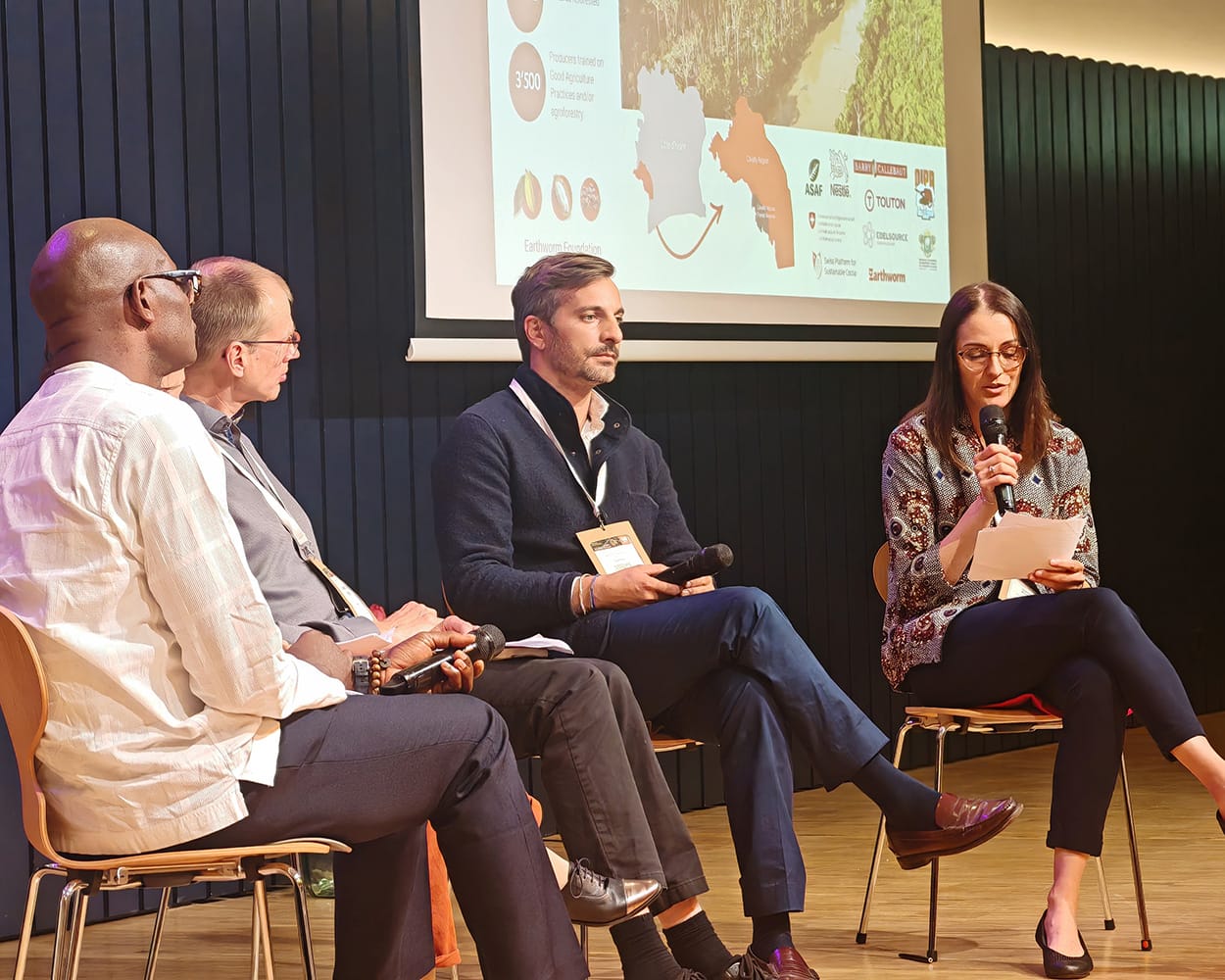


Delegates throughout the day were involved in key discussions on how to shift the dial forward and how best the industry can work together. Images. Earthworm Foundation
## **A Sector-Wide Transition**
The event highlighted a broader shift that many believe the cocoa sector must now embrace:
- From supply chains to landscapes
- From compliance to resilience
- From small pilots to scalable solutions
- From top-down programmes to farmer-led approaches
- From short-term projects to long-term transformation
As World Chocolate Day shines a spotlight on chocolate’s enduring popularity, marking the introduction of chocolate to Europe in 1550, when cacao was first brought from the Americas, it also offers an opportunity to reflect on the future of the ingredient at its heart.
If cocoa is to remain viable for generations to come, the conversations taking place across the sector will need to translate into meaningful collaboration and sustained action.
For those gathered at Raise the Bar, the challenge is no longer understanding what needs to change. The priority now is ensuring the industry works together to deliver that change at the pace and scale the future of cocoa demands.
- **More from the Earthworm Foundation:**
- Key Learnings - [Let's Raise the Bar](https://earthworm.org/news-stories/lets-raise-the-bar?ref=cocoaradar.com)
- [Our Cocoa program ](https://earthworm.org/our-work/products/cocoa?ref=cocoaradar.com)
- [Our Cavally project](https://earthworm.org/our-work/projects/cavally?ref=cocoaradar.com)
---
- **Sponsored content: This article was created in collaboration with Earthworm Foundation. While it aligns with our audience’s interests, the ideas and content are provided by Earthworm Foundation, which retains copyright and editorial responsibility. We’re sharing it to offer our readers relevant information and perspectives.**
### Sainsbury’s Signals a New Direction for Cocoa Sustainability – But Important Questions Remain
URL: https://cocoaradar.com/sainsburys-signals-a-new-direction-for-cocoa-sustainability-but-important-questions-remain/
Last updated: 2026-07-13T16:06:12.000Z
From our desk to yours. DailyDaily.
## Join our growing community of members and receive a free version of our daily newsletter on what really matters in cocoa.
No spam. Unsubscribe anytime.
[Subscribe → ](https://cocoaradar.com/#/portal/signup)
CocoaRadar understands that rather than focusing solely on certified cocoa, the premium supermarket has joined chocolate manufacturer Mondelēz International, cocoa supplier Barry Callebaut and implementation partner Proforest to support forest restoration, agroforestry and community resilience in one of Ghana’s key cocoa-growing regions.
The initiative reflects a broader shift taking place across the cocoa sector. For years, sustainability strategies were largely built around certification schemes and farm-level audits. Increasingly, however, companies acknowledge that challenges such as deforestation, climate resilience, farmer poverty and traceability cannot be solved on individual farms alone. Landscape-scale partnerships are emerging as a way of addressing environmental protection, governance and livelihoods together.
Advertisement
[  ](https://www.foodmasters-freiberg.com/en/?utm%5Fsource=ghost&utm%5Fmedium=newsletter&utm%5Fcampaign=ad&utm%5Fcontent=qsm%5Fplaceholder)
### Retailer Influence
For retailers, this represents a notable change in emphasis. Supermarkets do not grow cocoa or manufacture chocolate, but they occupy a powerful position within the supply chain through their purchasing decisions, own-brand products and relationships with manufacturers and traders. Their influence extends beyond certification requirements to the commercial incentives that shape how cocoa is sourced.
Sainsbury’s announcement is therefore significant because it demonstrates a willingness to invest alongside other parts of the supply chain rather than relying exclusively on supplier compliance. The programme also aligns closely with the implementation of the European Union Deforestation Regulation (EUDR), which is encouraging companies to strengthen traceability and reduce the risk of forest loss within commodity supply chains.
_This post is for subscribers only._
### Nestlé Revamps Kitkat Recipe As Global Ingredient Overhaul Gathers Pace
URL: https://cocoaradar.com/nestle-revamps-kitkat-recipe-as-global-ingredient-overhaul-gathers-pace/
Last updated: 2026-07-03T12:01:19.000Z
From our desk to yours. DailyDaily.
## Join our growing community of members and receive a free version of our daily newsletter on what really matters in cocoa.
No spam. Unsubscribe anytime.
[Subscribe → ](https://cocoaradar.com/#/portal/signup)
According to reports, the new KitKat recipe will feature a crisper wafer and what executives describe as a subtle 'hazelnut tone', while maintaining the existing cocoa content after a roll-out in European markets from September 2027
But the Swiss food giant insists the changes are designed to broaden the bar’s appeal rather than cut costs in response to volatile cocoa prices.
> “We won’t reduce the cocoa share but we will add a ‘third level’ to KitKat, that gives a more complex level of taste,” Rouven Lochmuller, Nestlé’s global brand manager for KitKat, said during the company’s annual media event in Vevey, Switzerland, Bloomberg reported.
Nestlé believes the revised recipe can appeal to consumers who typically favour darker, more complex chocolate flavours without alienating traditional milk chocolate fans. The company said UK consumers will not see any changes because the British recipe, with its characteristic “burned caramel” notes, already matches local taste preferences.
Advertisement
[  ](https://www.foodmasters-freiberg.com/en/?utm%5Fsource=ghost&utm%5Fmedium=newsletter&utm%5Fcampaign=ad&utm%5Fcontent=qsm%5Fplaceholder)
The European changes come just months after Hershey, which manufactures and markets KitKat in the United States under licence, announced plans to introduce a creamier-tasting version of the bar in 2027.
The recipe overhaul arrives after several years of unprecedented disruption in the global chocolate industry, with cocoa prices reaching record highs, forcing manufacturers to rethink pricing, pack sizes, and product formulations. Nestlé maintains, however, that cocoa inflation is easing and says the KitKat reformulation is not being driven by commodity costs.
The changes also follow a mixed track record for KitKat innovation. Nestlé’s plant-based KitKat V, launched after two years of development using a rice-based milk alternative, was discontinued in most markets after struggling to gain sufficient consumer traction.
[Special Report: Vegan chocolate after KitKat V: niche growth, mainstream frictionAs reported initially by CocoaRadar, in ‘Veganuary’ this year, Nestlé has confirmed that it has now entirely discontinued the vegan version of its popular KitKat chocolate barFrom The Desk of CocoaRadar™Anthony Myers](https://cocoaradar.com/special-report-vegan-chocolate-after-kitkat-v-niche-growth-mainstream-friction/)
Higher retail prices and limited demand ultimately undermined the product, as CocoaRadar previously reported.
### Elimination of Artificial Food Colourings
The KitKat announcement comes as Nestlé embarks on one of its most ambitious reformulation programmes to date.
Earlier this week, the company announced it will eliminate artificial food colourings from every product in its global portfolio by the end of 2026, becoming the first major multinational food manufacturer to commit to a worldwide phase-out.
In an interview with Reuters, Nestlé Chief Technology Officer Stefan Palzer said the initiative extends work already completed in the United States and reflects growing consumer demand for simpler ingredient lists and more natural formulations.
> “By the end of the year we will have the global Nestlé portfolio free of artificial colours,” Palzer said, adding that the transition required years of research to identify natural alternatives capable of matching the appearance, performance and shelf life of synthetic colourings.
“It was not a slam-dunk,” he said.
The move aligns Nestlé with a broader industry trend as food manufacturers respond to increasing consumer scrutiny of ingredients and evolving regulatory pressure, particularly in the United States, where the Food and Drug Administration has been encouraging the removal of petroleum-based synthetic food dyes.
Several major food companies have announced similar initiatives in the US, but Nestlé’s commitment is the first to cover its worldwide product portfolio.
### A Portfolio for Modern Times
Taken together, the KitKat recipe changes and the global colour-removal programme illustrate Nestlé’s wider strategy of modernising its portfolio through reformulation rather than simply launching new products. As consumer expectations shift toward cleaner labels and more sophisticated flavours, the company appears increasingly willing to revisit even some of its most established brands.
For KitKat, one of the world’s best-known chocolate bars, the challenge will be convincing loyal consumers that change is an improvement rather than a compromise.
---
**cocoaradar.com is:**
- **Official Media Partner -** [**CAA International Cocoa Conference**](https://www.caacocoaconference.org/programme?ref=cocoaradar.com)
- **'From Our Desk. To Yours. Daily'**
- [**Sign-up here**](https://cocoaradar.com/#/portal) **for free and choose your plan.**
### Lindt’s Pricing Power Under Pressure as Cocoa Shock Hits Demand and Weather Risks Return to the Forefront
URL: https://cocoaradar.com/lindts-pricing-power-under-pressure-as-cocoa-shock-hits-demand-and-weather-risks-return-to-the-forefront/
Last updated: 2026-07-02T15:41:25.000Z
💡
****Cocoa trading at 5022.583 USD/T on Thursday, July 02, a 69.416 USD/T (1.36%) decrease from 5092.000 on the last trading session.**
The Swiss chocolatier’s participation certificates are down approximately 15% since the end of March after sales volumes weakened following price increases of almost 20% implemented last year to offset soaring cocoa costs.
The pressure comes despite cocoa futures having fallen nearly 60% from their record highs in late 2024\. Because of Lindt’s long-term procurement strategy, however, lower bean prices are not expected to materially reduce its costs until 2027\. The company has nevertheless begun selectively cutting retail prices in Switzerland and Germany during 2026 to improve competitiveness.
Bloomberg has reported that investor sentiment has deteriorated since Lindt cut its 2026 organic sales growth guidance to 4-6% from 6-8% in March, citing weaker consumer confidence alongside higher transport and packaging costs linked to geopolitical tensions.
Analysts at Jefferies and Kepler Cheuvreux have warned that further price reductions may be needed to restore volumes, particularly in Europe where consumers have been most resistant to higher chocolate prices.
Advertisement
[  ](https://www.foodmasters-freiberg.com/en/?utm%5Fsource=ghost&utm%5Fmedium=newsletter&utm%5Fcampaign=ad&utm%5Fcontent=qsm%5Fplaceholder)
For cocoa markets, Lindt’s performance reinforces that while bean prices have eased sharply, demand recovery across premium chocolate remains delayed. Most manufacturers remain locked into higher-cost cocoa contracts, meaning lower futures prices are unlikely to translate into stronger consumer demand or improved margins until procurement cycles reset over the next 12-18 months.
_This post is for subscribers only._
### Analysis: Barry Callebaut’s Planned ISM Return Signals Ingredients Are Becoming The Industry’s New Innovation Battleground
URL: https://cocoaradar.com/analysis-barry-callebauts-planned-ism-return-signals-ingredients-are-becoming-the-industrys-new-innovation-battleground/
Last updated: 2026-07-01T14:15:50.000Z
From our desk to yours. DailyDaily.
## Join our growing community of members and receive a free version of our daily newsletter on what really matters in cocoa.
No spam. Unsubscribe anytime.
[Subscribe → ](https://cocoaradar.com/#/portal/signup)
If Barry Callebaut returns to Cologne in 2027 as expected, it will represent far more than the reappearance of one of the confectionery industry’s biggest names. It would underline a much larger shift taking place across the global sweets and snacks sector – one in which ingredients, functionality, and supply-chain innovation are becoming as important as finished consumer products.
According to organisers Koelnmesse, Barry Callebaut is among the companies planning to exhibit at **ISM Ingredients 2027**, the specialist ingredients exhibition that will once again run alongside ISM and ISM Manufacturing from 31 January to 3 February 2027.
[Barry Callebaut Bets on Premiumisation and Solutions-Led Growth as Cocoa Crisis Reshapes IndustryCocoa giant is pivoting from transformation to execution, unveiling a new ‘Focus for Growth’ strategy designed to restore volume growth, improve profitability and strengthen its position in higher-value chocolate solutions as the industry grapples with unprecedented cocoa market disruptionFrom The Desk of CocoaRadar™Anthony Myers](https://cocoaradar.com/barry-callebaut-bets-on-premiumisation-and-solutions-led-growth-as-cocoa-crisis-reshapes-industry/)
During a media briefing last month, CocoaRadar asked Barry Callebaut CEO Hein Schumacher whether the company intended to return to the ISM trade fair after several years away. Schumacher declined to comment on the company’s exhibition plans at that time.
Advertisement
[  ](https://www.foodmasters-freiberg.com/en/?utm%5Fsource=ghost&utm%5Fmedium=newsletter&utm%5Fcampaign=ad&utm%5Fcontent=qsm%5Fplaceholder)
While Barry Callebaut has yet to publish an official announcement confirming its participation, the organiser’s exhibitor information and reports across several international trade publications indicate that the world’s largest chocolate and cocoa ingredients manufacturer is planning a return to the Cologne exhibition halls in 2027.
For long-time ISM visitors, that would mark a notable homecoming.
_This post is for subscribers only._
### Rainforest Alliance Doubles Down on Regenerative Cocoa As Certification Grows – With Lindt Reaching 100% Certified Sourcing
URL: https://cocoaradar.com/rainforest-alliance-doubles-down-on-regenerative-cocoa-as-certification-grows-with-lindt-reaching-100-certified-sourcing/
Last updated: 2026-06-30T14:24:25.000Z
From our desk to yours. DailyDaily.
## Join our growing community of members and receive a free version of our daily newsletter on what really matters in cocoa.
No spam. Unsubscribe anytime.
[Subscribe → ](https://cocoaradar.com/#/portal/signup)
The Rainforest Alliance has unveiled its 2025 Annual Report, positioning regenerative agriculture as the next evolution of sustainable cocoa production while reporting significant gains in farmer livelihoods, climate resilience and forest restoration across key cocoa-growing regions.
Published under the theme Regeneration Takes Root, the report marks a major milestone with the launch of the Rainforest Alliance Regenerative Agriculture Standard – a science-based certification framework designed to move beyond conventional sustainability compliance towards farming systems that actively restore ecosystems while strengthening farmer incomes.
Advertisement
[  ](https://www.foodmasters-freiberg.com/en/?utm%5Fsource=ghost&utm%5Fmedium=newsletter&utm%5Fcampaign=ad&utm%5Fcontent=qsm%5Fplaceholder)
The organisation says the first products carrying the new regenerative certification seal are expected to reach consumers during 2026, reflecting growing demand from both brands and consumers for measurable environmental outcomes rather than simply reduced impacts.
### Cocoa Programme Continues To Expand
Alongside the annual report, the newly published 2025 Cocoa Certification Sector Report shows continued growth across the Rainforest Alliance cocoa programme.
Rainforest Alliance Certified farms produced approximately 2.7 million metric tonnes of cocoa in 2025, a 4% increase on the previous year, while certified cocoa sales rose 3% to 1.5 million metric tonnes, suggesting continued market demand despite ongoing supply chain pressures.
Certification participation also expanded, with around 1.56 million cocoa farms and 1.54 million farmers certified globally during 2025\. Africa remains the dominant production region, accounting for more than one million certified farms – around 81% of the global total – highlighting the organisation’s strong presence across the world’s largest cocoa-producing countries.
Overall, Rainforest Alliance says it now works with 10.8 million farmers and farmworkers, reaching an estimated 28 million people through programmes focused on regenerative agriculture, rural livelihoods and responsible supply chains.
### Ghana And Côte D’ivoire Deliver Encouraging Results
The report highlights progress in Ghana, where Rainforest Alliance-supported landscape programmes helped communities plant more than 1.3 million trees while implementing sustainable land management across 181,000 hectares. More than 1,100 community fire volunteers were also trained to improve resilience against climate-related wildfires and land degradation.
Meanwhile, early results from the Hershey Income Accelerator Program (HIAP) in Côte d’Ivoire suggest the approach could deliver meaningful productivity improvements. After three years, 89% of participating farmers completed their first-year Farm Enterprise Plan actions, while demonstration plots produced around 34% more cocoa pods per 20 trees than comparable farms outside the programme, indicating strong potential to improve both yields and household incomes.
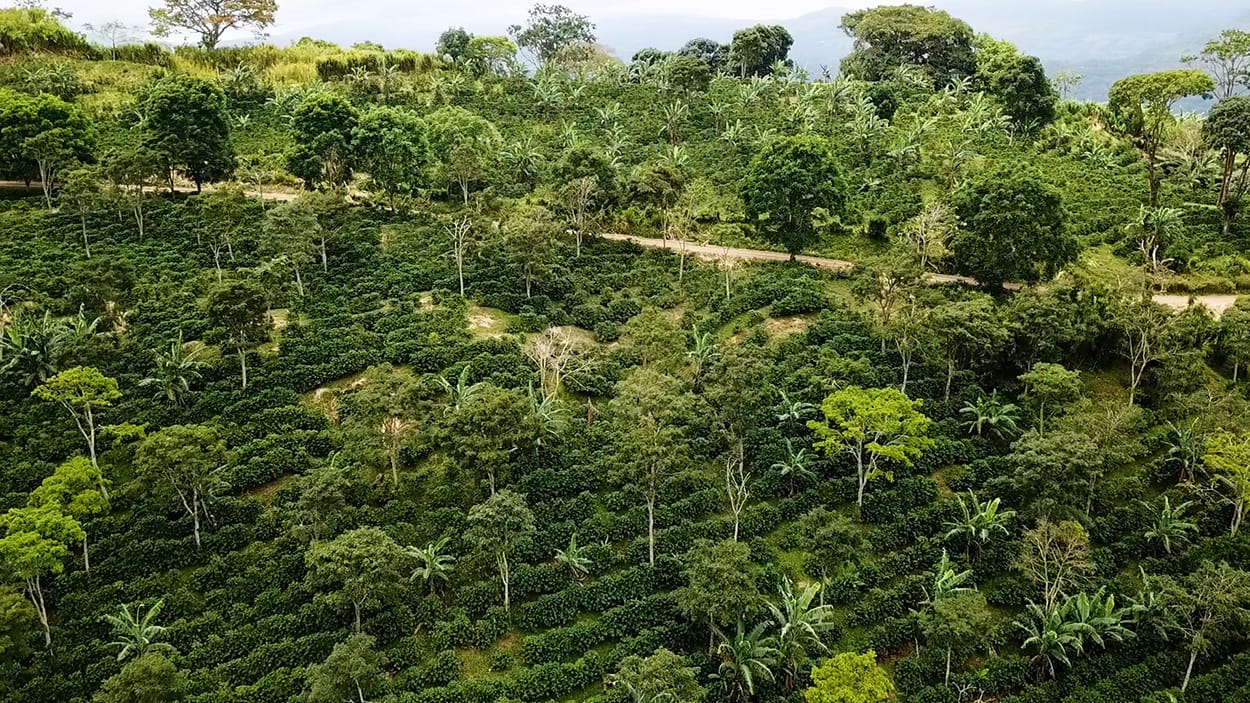
The Rainforest Alliance's new regenerative framework aims to restore soil fertility and improve biodiversity, with other environmental impacts. Image: Rainforest Alliance/Pedro J Chavarría
### Regeneration Moves From Concept To Commercial Reality
Rainforest Alliance argues that regenerative agriculture has become increasingly important as cocoa producers face mounting challenges from climate change, biodiversity loss and declining soil health.
Rather than simply minimising environmental harm, the new regenerative framework aims to restore soil fertility, improve biodiversity, strengthen water management and increase farm resilience while delivering measurable economic benefits for producers. The organisation says its certification programme is supported by a data-driven framework that allows companies and farmers to monitor environmental and social outcomes over time.
[Rainforest Alliance Bets on Human-Centred AI as Sustainability Enters a New EraExclusive insight: Artificial intelligence is transforming the way cocoa and coffee supply chains are monitored, but the Rainforest Alliance warns that trust – not technology – will determine whether AI becomes a force for sustainability or a new source of inequalityFrom The Desk of CocoaRadar™Anthony Myers](https://cocoaradar.com/rainforest-alliance-bets-on-human-centred-ai-as-sustainability-enters-a-new-era/)
Across all commodities, Rainforest Alliance reported 5.5 million tonnes of greenhouse gas emissions avoided or sequestered, 11.9 million hectares of ecosystems protected, restored or sustainably managed, and $2.22 billion in additional farm income generated through sustainability premiums and improved productivity.
Certified farms also achieved average yields around 28% higher than national averages, according to the organisation.
The report also confirms updates to the Sustainable Agriculture Standard through Version 1.4, simplifying certification requirements while strengthening data collection and incorporating compliance measures aligned with the European Union Deforestation Regulation (EUDR) for cocoa and coffee supply chains.
### Lindt Adopts 100% Rainforest Alliance Certified Cocoa
The growing commercial momentum behind Rainforest Alliance certification has also been reinforced by one of the confectionery industry’s biggest sustainability announcements.
Swiss premium chocolate manufacturer Lindt & Sprüngli has confirmed that 100% of its cocoa is now sourced as Rainforest Alliance Certified under the company’s long-running Farming Program, making certification the global baseline for all of its cocoa procurement from 2026 onwards.
The Rainforest Alliance seal will now be introduced progressively across eligible Lindt product packaging.
Importantly, Lindt says certification is the foundation, not the limit, of its sustainability strategy. The company will continue investing in programmes beyond certification, including agroforestry, forest protection and restoration, community development and its Living Income Pilot Programme aimed at narrowing the living income gap for cocoa farmers.
The move reflects a broader shift across the cocoa industry as manufacturers seek to strengthen supply chain resilience, improve traceability and prepare for stricter regulatory requirements such as the EUDR.
As certification increasingly becomes a baseline rather than a differentiator, companies are placing greater emphasis on demonstrating measurable impact through farmer support, landscape restoration, and income-improvement initiatives.
### Industry Collaboration Remains Essential
> In his foreword to the annual report, Rainforest Alliance CEO Santiago Gowland said agriculture must become “a force for regeneration rather than environmental decline.”
He argued that lasting change will require governments, companies, farmers and investors to work together to address the root causes of deforestation, biodiversity loss and rural poverty rather than relying on isolated sustainability initiatives.
With more than four million farmers and workers participating in its cocoa certification programme across 24 producing countries, Rainforest Alliance believes regenerative agriculture will play an increasingly central role in helping the global cocoa sector meet rising expectations around climate resilience, biodiversity protection and transparent supply chains.
- **Further reading: Rainforest Alliance** [**2025 Annual Report**](https://www.rainforest-alliance.org/annual%5Freport/2025?ref=cocoaradar.com) **and** [**impact data**](https://www.rainforest-alliance.org/impact?ref=cocoaradar.com)
- **Rainforest Alliance** [**2025 Cocoa Certification Sector Report**](https://www.rainforest-alliance.org/business/certification/cocoa-certification-data-report-2025/?ref=cocoaradar.com)
---
**cocoaradar.com is:**
- **Official Media Partner -** [**CAA International Cocoa Conference**](https://www.caacocoaconference.org/programme?ref=cocoaradar.com)
- **'From Our Desk. To Yours. Daily'**
- [**Sign-up here**](https://cocoaradar.com/#/portal) **for free and choose your plan.**
### ‘Rage Against the Dying of the Light’: Why Corporate Boards Are No Longer Looking Away
URL: https://cocoaradar.com/rage-against-the-dying-of-the-light-why-corporate-boards-are-no-longer-looking-away/
Last updated: 2026-06-29T16:59:32.000Z
From our desk to yours. DailyDaily.
## Join our growing community of members and receive a free version of our daily newsletter on what really matters in cocoa.
No spam. Unsubscribe anytime.
[Subscribe → ](https://cocoaradar.com/#/portal/signup)
> “Do not go gentle into that good night. Rage, rage against the dying of the light.” — Dylan Thomas.
For decades, corporate governance often operated on an uncomfortable bargain.
As long as chief executives delivered shareholder returns, boards were frequently willing to overlook behaviour that might otherwise have raised concerns. Personal conduct, conflicts of interest and executive influence were often treated as secondary to quarterly earnings.
That bargain appears to be changing.
Advertisement
[  ](https://www.foodmasters-freiberg.com/en/?utm%5Fsource=ghost&utm%5Fmedium=newsletter&utm%5Fcampaign=ad&utm%5Fcontent=qsm%5Fplaceholder)
Recent events at Nestlé and Hershey suggest that major corporations are becoming increasingly willing – not just to replace powerful leaders – but to actively limit their influence once they leave office. Whether driven by regulators, investors, ESG expectations or litigation risk, boards appear to be sending a clear message: governance now extends beyond performance.
_This post is for paying subscribers only._
### How Brexit’s Regulatory Freedom Helped Create A Cocoa-Free Chocolate Pioneer
URL: https://cocoaradar.com/how-brexits-regulatory-freedom-helped-create-a-cocoa-free-chocolate-pioneer/
Last updated: 2026-06-26T12:45:35.000Z
From our desk to yours. DailyDaily
## Now's the time to join our growing community of PRO members and benefit from a 10% discount on an annual licence as we celebrate our 2ND birthday!
No spam. Unsubscribe anytime.
[Claim your discount → ](https://cocoaradar.com/birthdaybeans)
Five years since the UK left Europe, few sectors illustrate that ambition more clearly than novel foods –and few companies embody it better than London-based Win-Win.
Founded in London in 2021, Win-Win has developed a cocoa-free alternative to chocolate at a time when the traditional cocoa supply chain is under unprecedented pressure from climate change, disease and price volatility. Using a proprietary rice-based fermentation process, the company has moved from laboratory concept to commercial production, supplying bakery, ice cream and dessert manufacturers in the UK and Europe with six product formats spanning milk, dark and white alternatives.
For chief executive Mark Golder, who joined the company in 2024 after a three-decade career in food, the mission is not to replace chocolate but to provide the industry with a resilient alternative.
Advertisement
[  ](https://www.foodmasters-freiberg.com/en/?utm%5Fsource=ghost&utm%5Fmedium=newsletter&utm%5Fcampaign=ad&utm%5Fcontent=qsm%5Fplaceholder)
“We’re here to provide a more sustainable alternative for the industry so consumers can continue to enjoy the chocolatey treats they’re accustomed to enjoying, but with fewer issues,” he says.
### **A Post-Brexit Opportunity**
The Brexit vote 10 years ago left Britain with the EU’s inherited novel foods framework, but with greater flexibility over how it is applied. The Food Standards Agency has increasingly sought to engage with emerging food technologies and, in 2025, launched what has been described as Europe’s first regulatory sandbox for cell-cultivated products.
That more innovation-friendly approach has helped create an ecosystem in which companies developing alternative ingredients – from cultured fats to fermentation-derived products – can scale more quickly.
Win-Win sits squarely within that movement.
> "For us at Win-Win, Brexit hasn't been a defining factor in our innovation journey. We've focused on developing delicious cocoa-free alternatives using established food processes that can be scaled commercially, and ultimately, demand for alternatives is being driven by structural challenges in cocoa rather than changes to the regulatory landscape," says Golder.
_This post is for subscribers only._
### Cocoa rallies to five-month high as El Niño fears outweigh strong Côte d’Ivoire arrivals
URL: https://cocoaradar.com/cocoa-rallies-to-five-month-high-as-el-nino-fears-outweigh-strong-cote-divoire-arrivals/
Last updated: 2026-06-25T15:21:38.000Z
From our desk to yours. DailyDaily
## Now's the time to join our growing community of PRO members and benefit from a 10% discount on an annual licence as we celebrate our 2ND birthday!
No spam. Unsubscribe anytime.
[Claim your discount → ](https://cocoaradar.com/birthdaybeans)
💡
****Cocoa trading at 5217.229 USD/T on Thursday, June 25, a 244.229 USD/T (4.91%) increase from 4973.000 on the last trading session.**
The rally follows Reuters reporting that Côte d’Ivoire has temporarily suspended sales of 2026-27 export contracts after selling around 1.15 million tonnes, with the Le Conseil du Café-Cacao (CCC) awaiting updated crop forecasts before resuming sales in early July. Officials cited uncertainty over El Niño’s impact and said the regulator is prioritising sales to multinational exporters amid heightened market volatility.
[Citi Raises Cocoa Price Outlook As ‘Super El Niño’ Threat Puts Latin American Producers On AlertAnalysis: Key cocoa suppliers tell CocoaRadar they are preparing for heightened risks from drought, excessive rainfall and disease pressure as market prepares to weather the stormFrom The Desk of CocoaRadar™Anthony Myers](https://cocoaradar.com/citi-raises-cocoa-price-outlook-as-super-el-nino-threat-puts-latin-american-producers-on-alert/)
Despite weather concerns, current supply indicators remain robust. Reuters estimates Côte d’Ivoire’s 2025-26 cocoa arrivals reached 1.883 million tonnes by 21 June, up 18% year-on-year, with weekly arrivals rising to 29,000 tonnes from 19,000 tonnes a year earlier.
Advertisement
[  ](https://www.foodmasters-freiberg.com/en/?utm%5Fsource=ghost&utm%5Fmedium=newsletter&utm%5Fcampaign=ad&utm%5Fcontent=qsm%5Fplaceholder)
Independent market analysts also highlighted the improving supply picture. X posts from @krusts (Economist) noted stronger port arrivals, above-normal rainfall across key cocoa regions and growing oversupply risks, arguing that ample stocks could ultimately pressure prices lower.
While @rebelty likewise maintained a bearish longer-term outlook, citing expectations of a 400,000-600,000-tonne global surplus in 2025-26, despite weather-driven volatility supporting prices in the near term.
Meanwhile, Reuters reported that heavy rainfall across Côte d’Ivoire has raised concerns about flooding, disease pressure, and bean quality during the final stages of the mid-crop, as farmers begin monitoring the development of the next main crop.
_This post is for paying subscribers only._
### UK Moves Closer to EUDR Alignment as New Deforestation Rules Put Cocoa Supply Chains Under the Spotlight
URL: https://cocoaradar.com/uk-moves-closer-to-eudr-alignment-as-new-deforestation-rules-put-cocoa-supply-chains-under-the-spotlight/
Last updated: 2026-06-24T14:00:16.000Z
From our desk to yours. DailyDaily.
## Join our growing community of members and receive a free version of our daily newsletter on what really matters in cocoa.
No spam. Unsubscribe anytime.
[Subscribe → ](https://cocoaradar.com/#/portal/signup)
After years of delays, the UK government has finally set out plans for mandatory anti-deforestation rules covering commodities including cocoa, coffee, palm oil, soy and rubber. While the proposal focuses initially on illegal deforestation, perhaps the most significant message for the cocoa sector is that Britain intends to align its future regime closely with the EU Deforestation Regulation (EUDR).
For cocoa traders, chocolate manufacturers and importers, the announcement suggests that preparations already underway for EUDR compliance may also provide the foundation for meeting future UK requirements.
## **Alignment With EUDR Becomes The Central Story**
Under proposals unveiled by DEFRA ([Department for Environment, Food & Rural Affairs](https://www.gov.uk/government/organisations/department-for-environment-food-rural-affairs?ref=cocoaradar.com)) during [London Climate Action Week](https://londonclimateactionweek.org/?ref=cocoaradar.com), businesses trading in forest-risk commodities will be required to conduct due diligence to ensure products are not linked to illegal deforestation.
Advertisement
[  ](https://www.foodmasters-freiberg.com/en/?utm%5Fsource=ghost&utm%5Fmedium=newsletter&utm%5Fcampaign=ad&utm%5Fcontent=qsm%5Fplaceholder)
More importantly, the government confirmed that consultations later this year will examine a Great Britain regime that uses the **same core commodities and underlying information requirements** as those already applying under EUDR in Northern Ireland from December 2026.
The aim is to prevent duplication across the UK internal market and ease trade with Europe.
That message was welcomed by retailers and environmental organisations alike. Andrew Opie, Director of Food and Sustainability at the British Retail Consortium, said retailers had long sought UK regulation and stressed the importance of alignment with EU rules to avoid unnecessary complexity.
Environmental campaigners view the move as evidence that the EU regulation is influencing international markets beyond Europe.
Fern described the announcement as proof that the EU’s 'theory of change' is working, noting that the UK is considering:
- The same commodity scope.
- Similar reporting requirements.
- Potential geolocation requirements.
- A turnover threshold around £1 million covering all but the smallest businesses.
## **What This Means For Cocoa Companies**
For cocoa supply chains, the announcement could reduce fears of maintaining two entirely different compliance systems.
The EUDR already requires companies to provide geolocation data and prove that products are both legal and deforestation-free. Britain’s current proposal remains narrower, focusing initially on illegality rather than all deforestation.
However, the UK government made clear that its longer-term ambition is to move toward a fully 'deforestation-free' standard, bringing it closer to the EU model.
For many companies investing in EUDR traceability systems, farm mapping and risk assessments, that trajectory is encouraging.
Britain’s own consultation document states that alignment is intended to help British exporters meet consistent data and traceability standards while protecting trade flows under the Windsor Framework.
[Ultimate guide to EUDRBackground and rolling updates on the \*DELAYED\* European Deforestation Regulation (EUDR) with expert comments and analysisFrom The Desk of CocoaRadar™Anthony Myers](https://cocoaradar.com/ultimate-guide-to-eudr/)
Readers can compare the requirements in CocoaRadar’s **Ultimate Guide to EUDR**, which details the EU regulation’s due diligence obligations and geolocation requirements.
## **Northern Ireland Effectively Becomes The Bridge**
Northern Ireland occupies a unique position because EUDR will begin applying there in phases from 30 December 2026.
As a result, businesses operating across the UK could otherwise face two parallel systems.
The government appears keen to avoid that scenario. According to DEFRA, consultations will explore how Great Britain can maintain similar information requirements and commodity coverage to Northern Ireland’s EUDR framework.
The Environmental Investigation Agency described this as an important signal that Britain intends to align key elements of its approach with the EU regulation.
## **NGOs Welcome Progress But Say The Proposals Do Not Go Far Enough**
The NGO Forest Coalition, which includes WWF, Global Witness, Friends of the Earth and Mighty Earth, welcomed the announcement but warned that years of delays have already come at a cost.
The coalition cited Global Witness estimates suggesting that since the Environment Act passed in 2021, a further 54,000 hectares of forest – an area roughly the size of Leeds – have been lost producing goods consumed in the UK.
Campaigners argue that the current approach leaves a significant loophole because it targets only deforestation deemed illegal under producer-country laws.
Friends of the Earth and other groups are pressing for regulations to cover all deforestation, regardless of legality, and to include stronger protections for human rights and Indigenous communities.
Fern similarly welcomed the UK’s intention to align with EUDR, arguing that harmonisation strengthens the global business case for deforestation-free supply chains.
## **Why Cocoa Remains Central**
Cocoa has long been identified as one of the commodities driving tropical forest loss. Parliamentary evidence previously highlighted cocoa among seven major forest-risk commodities whose UK consumption footprint is enormous, amounting to land use equivalent to 88% of the UK’s land mass annually.
According to DEFRA, UK consumption of forest-risk commodities in 2023 was associated with around 29,000 hectares of global deforestation and 9.4 million tonnes of related emissions.
With major chocolate manufacturers already heavily engaged in EUDR implementation, the UK’s decision to build compatibility into its own framework could significantly simplify compliance.
## **A Delayed Move, But One With International Implications**
The UK has lagged behind the EU in turning political commitments into binding regulations. Global Witness previously estimated that imports linked to tropical forest destruction equivalent to almost twice the size of Paris entered UK supply chains after the Environment Act was passed but before accompanying rules were implemented.
Now, with Northern Ireland entering the EUDR regime and Great Britain preparing its own consultation, the focus shifts from whether the UK will regulate deforestation to how closely it will follow Europe’s lead.
For the cocoa industry, that distinction may matter more than the announcement itself.
Because if Britain ultimately adopts the same data, traceability and geolocation requirements already embedded in EUDR, companies investing in compliance today may find they are preparing for both markets simultaneously.
---
### **Related reading**
- **CocoaRadar:** [**Ultimate Guide to EUDR**](https://cocoaradar.com/ultimate-guide-to-eudr/)
- DEFRA: [*Government steps up action to tackle illegal deforestation*](https://www.gov.uk/government/news/government-steps-up-action-to-tackle-illegal-deforestation?ref=cocoaradar.com)
- NGO Forest Coalition: [*NGOs welcome UK progress on urgently needed deforestation rules*](https://ngoforestcoalition.org/2026/06/23/ngos-welcome-uk-progress-on-urgently-needed-deforestation-rules/?ref=cocoaradar.com)
- Fern: [*UK ban on illegal deforestation in supply chains strengthens global deforestation case*](https://www.fern.org/publications-insight/article/uk-ban-on-illegal-deforestation-in-supply-chains-strengthens-global-deforestation-case/?ref=cocoaradar.com)
- Global Witness: [*UK imports linked to deforestation twice the size of Paris since passage of Environment Act*](https://globalwitness.org/en/press-releases/uk-imports-linked-to-deforestation-twice-the-size-of-paris-since-passage-of-environment-act/?ref=cocoaradar.com)
### Citi Raises Cocoa Price Outlook As ‘Super El Niño’ Threat Puts Latin American Producers On Alert
URL: https://cocoaradar.com/citi-raises-cocoa-price-outlook-as-super-el-nino-threat-puts-latin-american-producers-on-alert/
Last updated: 2026-06-23T13:54:55.000Z
From our desk to yours. DailyDaily.
## Join our growing community of members and receive a free version of our daily newsletter on what really matters in cocoa.
No spam. Unsubscribe anytime.
[Subscribe → ](https://cocoaradar.com/#/portal/signup)
Independent research from Citigroup has warned cocoa prices could climb to $5,000 a tonne over the next three months and reach $6,000 within a year as the return of El Niño raises fresh concerns over global supplies.
In its third-quarter commodities outlook, Citi said the weather pattern could have an outsized effect on a market that remains vulnerable following the historic supply crisis of 2024.
“In the fragile market that we are currently projecting, a weather cataclysm could have an amplified impact on prices,” the bank said.
Advertisement
[  ](https://www.foodmasters-freiberg.com/en/?utm%5Fsource=ghost&utm%5Fmedium=newsletter&utm%5Fcampaign=ad&utm%5Fcontent=qsm%5Fplaceholder)
New York cocoa futures settled at $4,237 per tonne last week. Citi forecasts a global cocoa deficit of 56,000 tonnes in the 2026-27 season, compared with a modest surplus of 111,000 tonnes in 2025-26, while warning that weak pod-setting in West Africa’s main crop could further tighten supplies.
The bank noted that the last moderate El Niño episode in 2023-24 brought strong Harmattan winds to West Africa, damaging older trees, while the previous strong El Niño in 2015-16 contributed to a sharp decline in Ecuadorian production.
The market warning comes as the US National Oceanic and Atmospheric Administration (NOAA) estimates a 63% probability that the current El Niño will intensify into a very strong event during the northern hemisphere winter of 2026-27\.
_This post is for subscribers only._
### Nestlé Says Collaboration Is ‘The Only Way Forward’ As Income Accelerator Reaches 45,000 Cocoa Households
URL: https://cocoaradar.com/nestle-says-collaboration-is-the-only-way-forward-as-income-accelerator-reaches-45-000-cocoa-households/
Last updated: 2026-06-22T14:34:19.000Z
Speaking during the webinar attended by nearly 1,000 participants, Liberato Milo, Head of Nestlé Confectionery and Snacking, said the pressures facing cocoa-producing communities are too large for any single actor to solve alone.
“Collaboration is not just the right approach. It is the only way forward for our sector,” Milo said.
“These are structural issues, not short-term disruptions that cannot be solved by any single company or organisation acting on its own.”
Advertisement
[  ](https://www.foodmasters-freiberg.com/en/?utm%5Fsource=ghost&utm%5Fmedium=newsletter&utm%5Fcampaign=ad&utm%5Fcontent=qsm%5Fplaceholder)
Milo said farmers, suppliers, governments, NGOs and implementing partners all have a role to play in strengthening the cocoa value chain.
> “If farmers are not resilient, neither is our business,” he said. “For us, resilience means very concrete things: households earning more stable incomes, farms that can cope better with climate stress, and a cocoa sector that can continue to meet demand in the years ahead with less volatile prices.”
The remarks accompanied the release of a new independent assessment by the KIT Institute, which found that Nestlé’s Income Accelerator programme continues to deliver measurable improvements in productivity, household income and women’s empowerment.
### Independent Study Shows Higher Yields And Incomes
The evaluation, based on nearly 2,000 participating households in Côte d’Ivoire between 2022 and 2025, found that farmers enrolled in the programme increased cocoa yields by 4%, while yields among comparable households declined by 16%.
During the difficult 2024-25 season, participating households harvested an average of 2,116 kilograms of cocoa – about 500 kilograms more than comparable farmers.
According to Nestlé, those additional volumes translated into more than $2,000 in additional annual earnings under current cocoa prices. Even using lower historical prices, participating households would still have earned about 31% more than non-participants.
The study also showed that cocoa income increased by 190%, while household savings rose significantly compared with control groups.
### Women’s Empowerment More Than Doubled
One of the strongest outcomes highlighted by the KIT Institute was progress in gender inclusion.
The proportion of women classified as empowered increased by 114% compared with 2022, while participation in Village Savings and Loans Associations rose substantially. Food insecurity declined, and households reported improved dietary diversity and greater ownership of productive assets.
Nestlé’s approach combines agricultural training with household support and conditional cash transfers delivered through mobile money accounts. Approximately 90,000 mobile accounts have now been established through the programme.
### Learning While Scaling
Milo acknowledged that the model has evolved since its launch in 2022 and emphasised that Nestlé chose to scale while continuously improving the design rather than waiting for a perfect system.
“This innovative programme is the living proof that we can accelerate change at scale,” he said.
“After four years, the results show that this approach can work – not perfectly, not everywhere in the same way – but well enough to confirm that combining farming improvements with household incentives can accelerate impact and make a difference at scale.”
The programme currently reaches around 45,000 households across Côte d’Ivoire and Ghana. More than 50,000 hectares have been pruned or re-pruned, approximately 600,000 forest and fruit trees have been distributed, and farmers have established about 13,000 compost piles.
Nestlé also simplified the programme by reducing incentives from four pillars to two and changing payment structures to improve household cash flow, with half of the incentive paid upfront and the remainder paid after activities are completed.
### Cocoa Sector Under Pressure
Milo warned that the industry faces unprecedented challenges.
“Cocoa is under real pressure,” he said. “Climate shocks are affecting production. Prices have been highly volatile.”
Despite those difficulties, he stressed Nestlé’s long-term commitment to cocoa-producing communities.
“Cocoa has been part of Nestlé’s business for more than 120 years,” he said. “Our ability to grow in chocolate has always depended on stable supply and on long-term relations with farming communities.”
[EXCLUSIVE: TogetherCocoa: Rescue Mission for Farmers — or a Cocoa ‘Super League’?Analysis: Five of the world’s biggest chocolate companies have quietly come together to form the TogetherCocoa Foundation, presenting it as a collaborative effort to make cocoa supply chains more ‘resilient’. But what are the real motives behind the formation of an ‘elite bloc’?From The Desk of CocoaRadar™Anthony Myers](https://cocoaradar.com/exclusive-togethercocoa-rescue-mission-for-farmers-or-a-cocoa-super-league/)
### Together Cocoa Foundation
While the KIT Institute report identified major gains in productivity and resilience, it also highlighted areas requiring further attention, particularly income diversification and long-term educational outcomes.
Over the next year, researchers will examine yield drivers, the adoption of regenerative agriculture, diversification, and school attendance to help shape the programme's next phase.
Nestlé also highlighted the launch of the Together Cocoa Foundation, created to promote broader industry collaboration.
“This foundation aims to accelerate industry-wide collaboration to help strengthen the resilience of the cocoa supply chain,” Milo said.
He concluded with a warning that the sector must move quickly.
> “There is no time to waste,” he said. “Securing the future of cocoa will require collective steps toward a more resilient cocoa sector.”
As climate pressures, disease outbreaks and market volatility continue to reshape global cocoa production, the experience of Nestlé’s Income Accelerator is increasingly being watched by companies and sustainability groups seeking models that can be scaled across the wider industry.
- **Read the full KIT report here**
[Sustained impact and the road ahead - KITThis report evaluates the impact of the Accelerator after 3.5 years of implementation among test-at-scale households in Côte d’Ivoire. To robustly estimate the Accelerator’s progress from 2022 to 2025, four waves of survey data from 1,970 households across 28 cooperatives (all Nestlé Cocoa Plan (NCP) and Rainforest Alliance (RA) certified) were used. To estimate the \[…\]KIT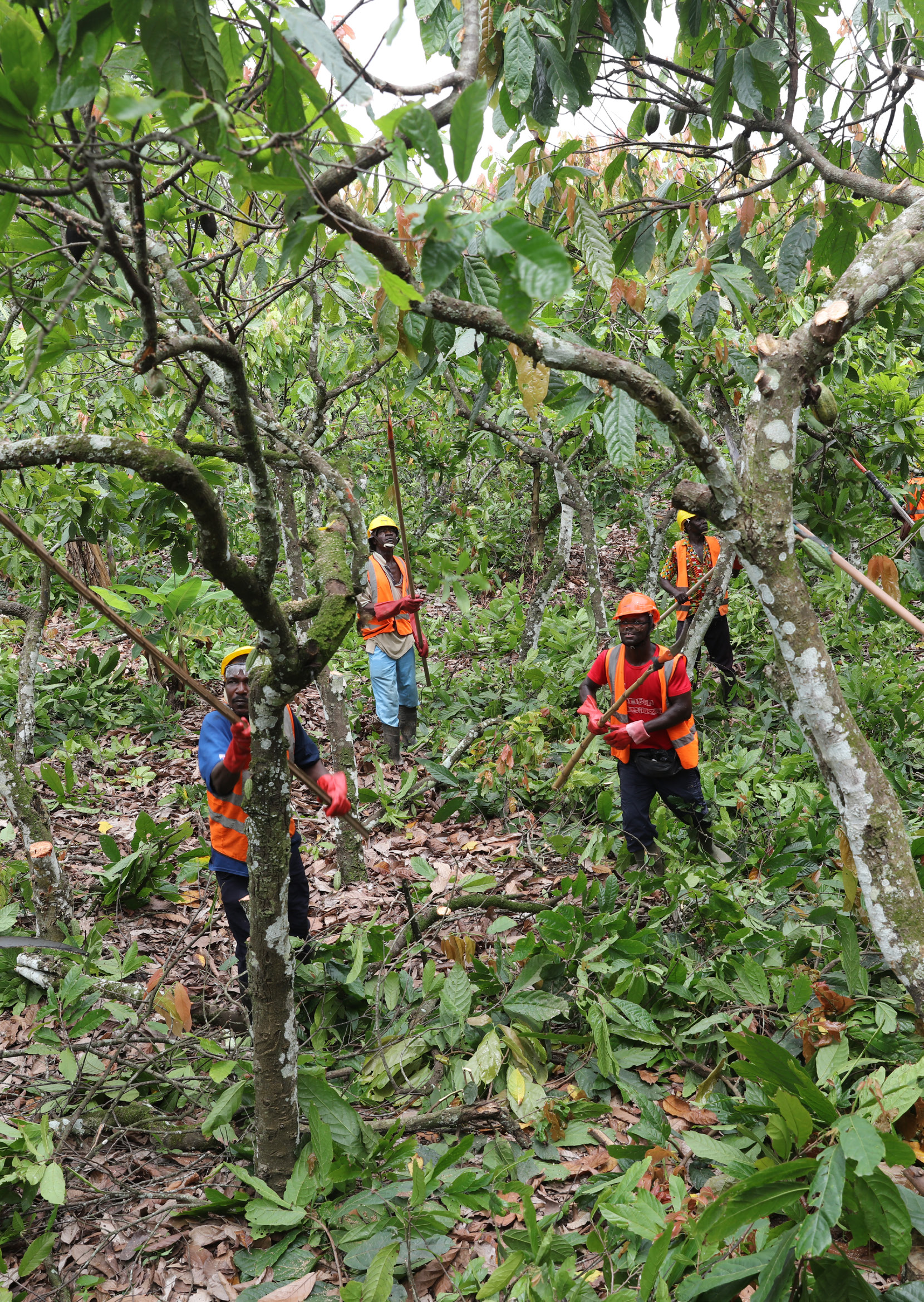](https://content.innovation-forum.co.uk/e/1041011/ned-impact-and-the-road-ahead-/39g42f/657194679/h/EkF0xa6Zi-V5Y2b2IintHtHgh-viYWj0E8353-TQD0E?ref=cocoaradar.com)
---
**cocoaradar.com is:**
- **Official Media Partner -** [**CAA International Cocoa Conference**](https://www.caacocoaconference.org/programme?ref=cocoaradar.com)
- **'From Our Desk. To Yours. Daily'**
- [**Sign-up here**](https://cocoaradar.com/#/portal) **for free and choose your plan.**
### Original Beans’ Philipp Kauffmann: ‘The Industry Needs to Look in the Mirror’
URL: https://cocoaradar.com/original-beans-philipp-kauffmann-the-industry-needs-to-look-in-the-mirror/
Last updated: 2026-06-27T08:40:06.000Z

email philippe@cocoaradar.com for more information
From our desk to yours. DailyDaily.
## Join our growing community of members and receive a free version of our daily newsletter on what really matters in cocoa.
No spam. Unsubscribe anytime.
[Subscribe → ](https://cocoaradar.com/#/portal/signup)
Philipp Kauffmann is not especially interested in sounding triumphant. Original Beans, the company he founded in 2010 and still chairs, has just been named recipient of the 2026 Good Egg Award, the highest distinction from the Chocolate Scorecard.
For many companies, that would be a moment for polished celebration. For Kauffmann, it is instead a prompt to ask why so much of the chocolate industry still struggles to look honestly at itself.
The award recognises Original Beans as one of the strongest performers in traceability, living income, deforestation prevention, agroforestry, climate action, pesticide control and biodiversity protection.
Advertisement
[  ](https://www.foodmasters-freiberg.com/en/?utm%5Fsource=ghost&utm%5Fmedium=newsletter&utm%5Fcampaign=ad&utm%5Fcontent=qsm%5Fplaceholder)
It confirms what the Amsterdam-headquartered company has long argued: that chocolate can be built around forests, farmers and flavour rather than volume alone. But Kauffmann’s larger point is less comfortable. The cocoa industry, he says, is now living through the consequences of warnings it has been hearing for years.
> “What has been predicted has actually occurred,” he says. Ageing farmer populations, depleted soils, income insecurity, climate stress, and fragile supply chains have converged with extreme price volatility.
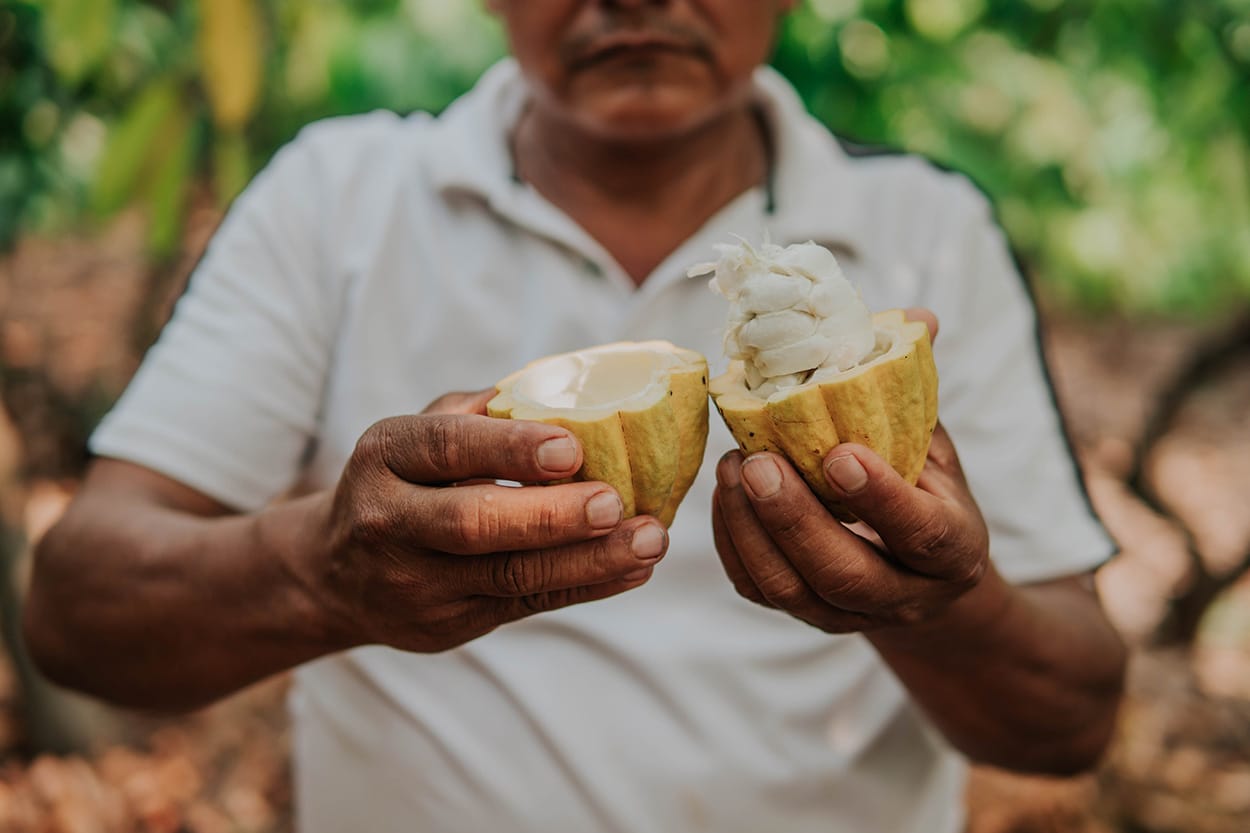
Original Beans' name reflects a commitment to origin, to rare cacao varieties, and to long-term relationships with grower communities. Image: Original Beans
### What Kind of Cocoa Economy Do We Want?
The first instinct of companies, he accepts, is to protect themselves. “Save your ass,” as he puts it. But he is struck by how little the deeper conversation has shifted. Businesses are busy being “in the business”, fighting fires, sourcing beans and defending margins. Too few, he argues, are working “on the business” — asking what kind of cocoa economy they want to create.
That distinction sits at the heart of Original Beans. The company was built against the logic of anonymous commodity cocoa. Its name reflects a commitment to origin, to rare cacao varieties, and to long-term relationships with grower communities.
Kauffmann began with sourcing in Virunga (Democratic Republic of the Congo), Beni (Bolivia) and Piura (Peru) – before expanding to Tanzania, Ecuador’s Pacific coast, northern Colombia and other Peruvian origins such as Chuncho.
The philosophy has remained strict: single varietal, single chocolate, no blending to smooth away differences.
> “We don’t blend,” Kauffmann reiterates. “The idea has always been to show that cacao is a very different thing than people assume.”
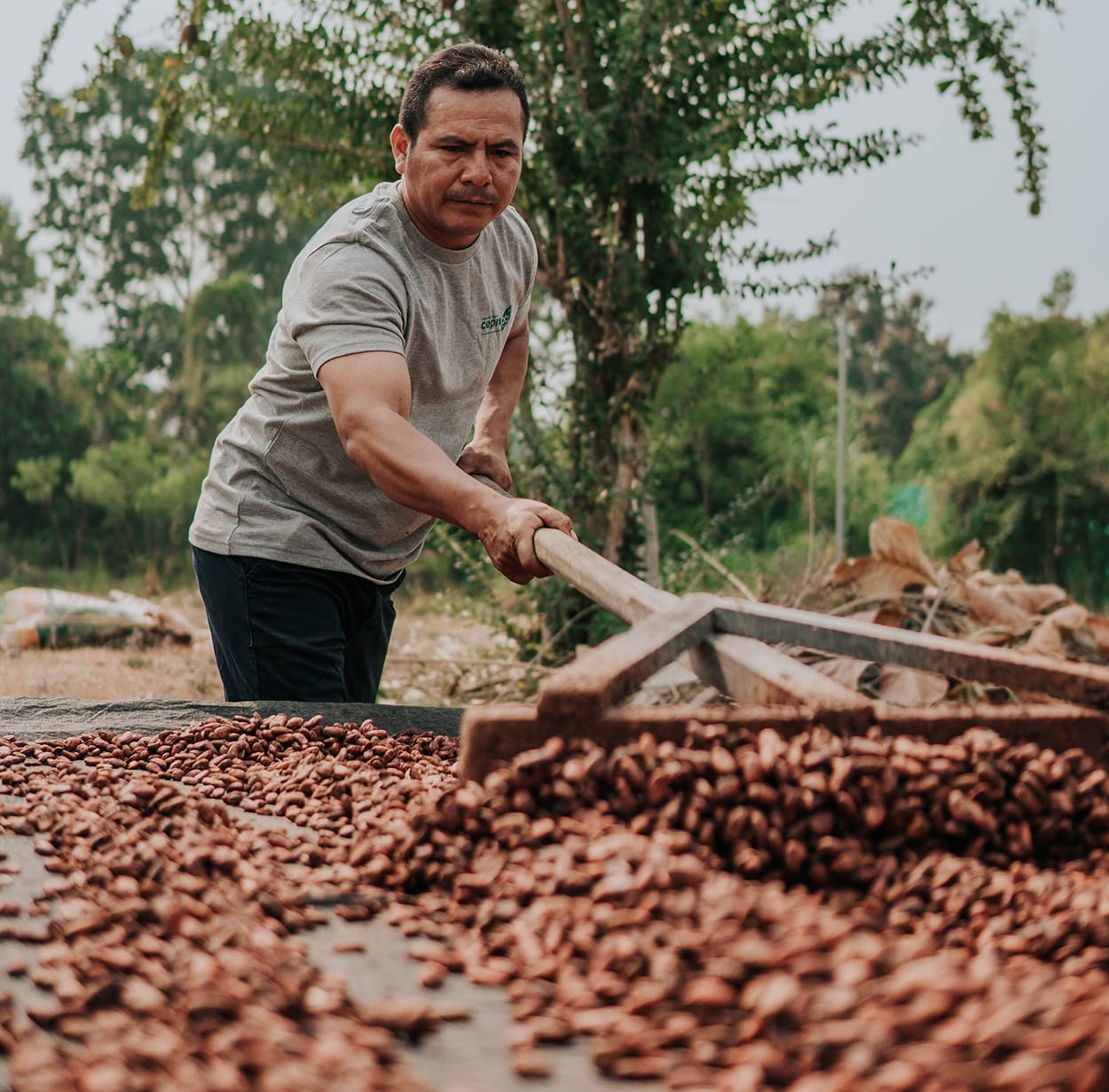
Latin America's long tradition of sustainable cocoa farming was a big attraction for Original Beans. Image: Original Beans
### Latin America’s Long Cacao Traditions
For Kauffmann, this is not simply about premium flavour. It is about restoring cocoa to the ecological systems in which it evolved. He speaks admiringly of Latin America’s long cacao traditions, stretching back thousands of years, and of fertile lands in southern Mexico where cacao, maize and other crops still grow in complex agroecological systems. These are not nostalgic curiosities, he argues, but working models of resilience: systems that feed families, protect soil, store carbon, preserve biodiversity and produce distinctive cocoa.
Original Beans calls this regenerative sourcing, though Kauffmann is wary of allowing the term to become another corporate slogan. In practical terms, it means growing cacao in rich ‘cacao forests’ rather than monocultures.
He contrasts the two sharply. A monoculture may be green, but it is biologically thin. A cacao forest contains canopy trees, companion crops, varied root systems, and rich soil microbial life. The point, he says, is not chaos but design: each tree has a purpose.
The striking part of his argument is that such systems need not sacrifice productivity. Kauffmann says studies comparing monoculture cocoa with traditional agroforestry systems show that dry bean yields can be similar, while biomass, carbon storage and ecological richness are vastly greater in diverse systems.
> “We are talking about a totally different way of thinking about cacao,” he says. In his view, the regenerative opportunity is not marginal. It is a route to better flavour, stronger communities and a more durable supply base.
This conviction has made Original Beans an outlier in a sector still dominated by bulk cocoa flows. The company sources less than 1,000 tonnes of cocoa annually – a fraction of the volumes handled by global processors – yet works directly with more than 3,000 smallholder farming families.
It employs around 30 people, including agronomists in Latin America and Africa. The company does not own farms, warehouses or factories in the conventional sense. Kauffmann describes the company instead as a “choreographer”: aligning farmers, co-operatives, logistics providers, processors, chocolatiers and customers around a common standard.
> “We don’t own plantations. We don’t own trade infrastructure. We work with people we know very well and who are mission-aligned.”
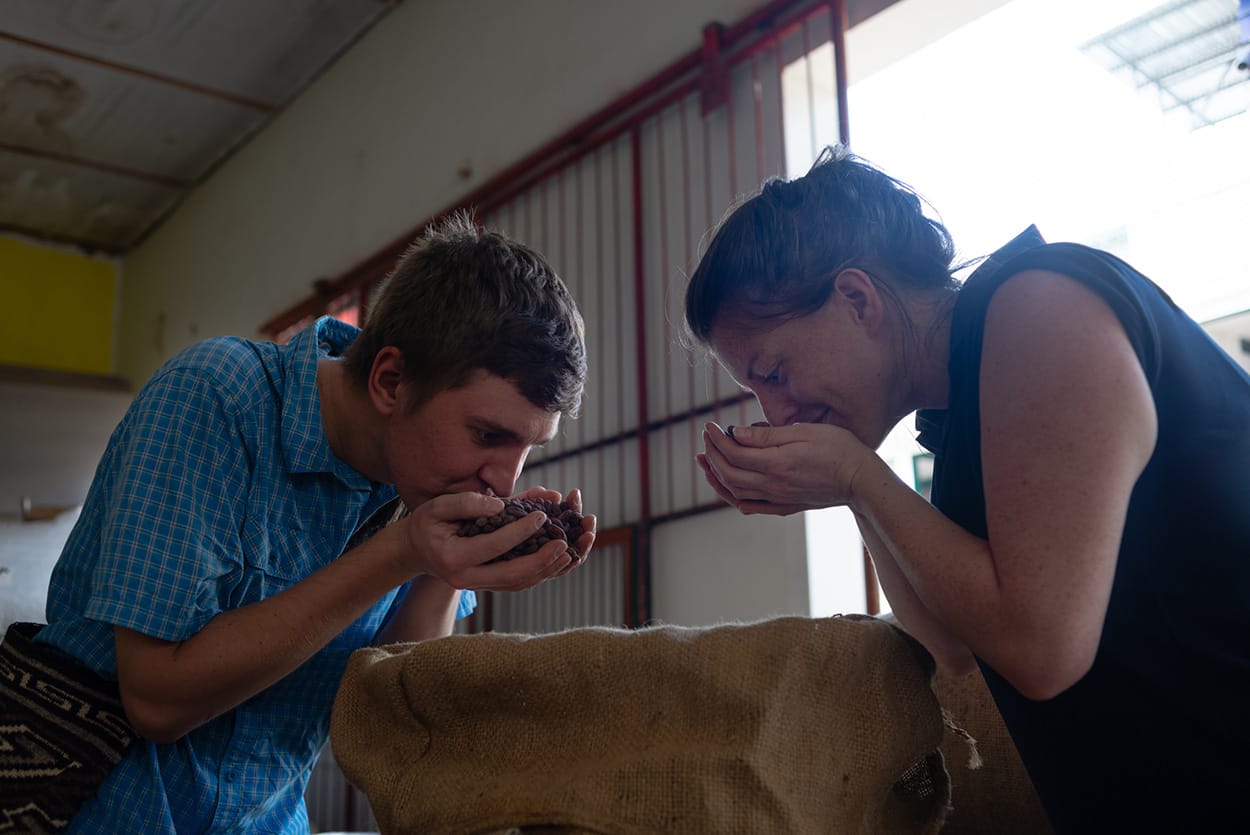
Original Beans receives its beans through established channels. Image: Original Beans
### A Complex Choreography
That choreography is complex. Beans are received through established trading infrastructure, including in the Netherlands, and processed in Switzerland by Felchlin under a co-processing arrangement that allows Original Beans to use its own beans and recipes. Retail bars are moulded by Bernardin Schokolade, a long-standing Swiss organic and Fairtrade specialist.
In Peru, Original Beans has gone a step further, investing alongside its long-term partner Norandino in a farmer-owned chocolate production facility in the north of the country. Through its Growers' Chocolate initiative, cacao is transformed into finished chocolate entirely at origin, allowing more value creation, expertise and economic benefits to remain in Peru rather than being exported abroad.
\- Kauffmann describes the result as a "world-class" couverture cooperatively made by cacao growers who live in villages without electricity – proof, he says, that exceptional chocolate begins with exceptional beans, not merely expensive machinery.
The company’s commercial base reflects that positioning. Much of its business is B2B, supplying chefs, bakers, ice-cream makers, chocolatiers and other premium food professionals. Its retail presence spans organic and fine-food stores in Germany, Austria, Denmark and, increasingly, the US. It has also acquired Scottish craft chocolate brand Ocelot, adding a more consumer-facing platform to a business that has traditionally been strongest among professionals.
Yet the past two years have tested even this carefully built model. The cocoa price spike rippled far beyond West Africa. Latin American origins, despite not causing the supply contraction, rose sharply with the market. For Original Beans, the first question was liquidity. If the same volume of cocoa costs several times more, can the company still pay?
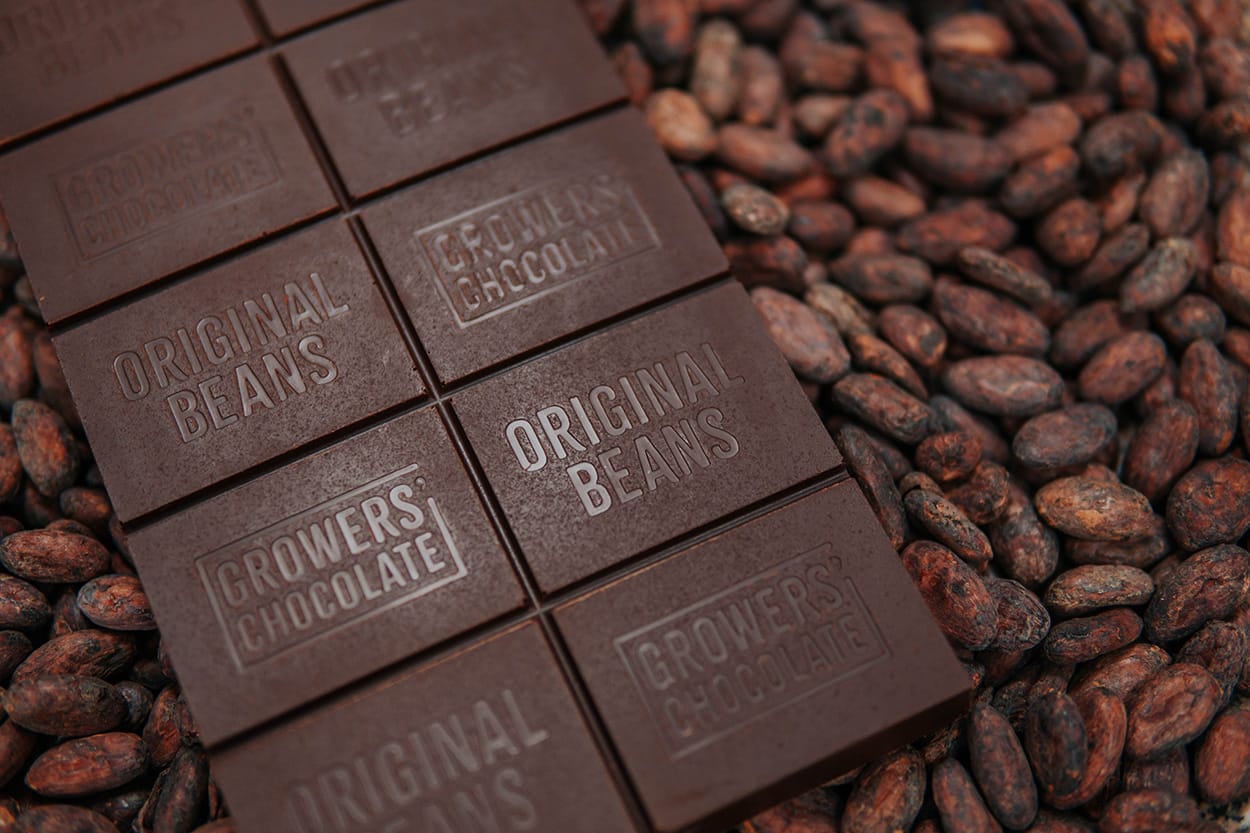
Retail bars are moulded by Bernardin Schokolade, a long-standing Swiss organic and Fairtrade specialist. Image: Original Beans
### Cash Challenge
Can it pay quickly enough when growers are being offered cash elsewhere? Can it continue to demand fermentation, quality and organic integrity when the market is paying high prices even for poorly handled beans?
> “We didn’t cause the problem, but we had to pay the price,” Kauffmann explains.
The challenge was cash. Buying the same quantity suddenly required multiples of the capital.
Then came another problem. Growers wanted faster payment.
> “If it’s a supplier’s market, they say, ‘I don’t only want to be paid that price, I want to be paid on time — and before harvest.’”
Original Beans maintained purchases, quality standards and organic sourcing throughout.
Kauffmann says the answer depends on alignment. Original Beans has a relatively simple shareholder structure, with himself and an aligned investment fund as principal owners. Its board, management and suppliers understand the long-term project.“We are cultivating long-termism. “Nature needs time, communities need time, investment needs time,” he says.
That made it possible to continue buying organic, maintain quality and protect relationships during the spike. Now that prices are falling, the test is reversed: whether the company will avoid squeezing growers when cheaper options return.
### Organic Market
The organic market is one of the most immediate strategic challenges. Original Beans has treated organic certification as a baseline for traceability and sustainability, particularly because it is a legal standard in the EU and offers batch-level accountability from field to shelf. But the price boom distorted incentives. Some grower groups allowed certifications to lapse because conventional markets were paying so well. Historical organic premiums of about $250 per tonne have, in some cases, become premiums of close to $2,000 per tonne. For buyers committed to organic, that is a tenfold increase in the premium alone.
At the same time, pesticide contamination has become harder to manage. Kauffmann says the real world is getting messier while European regulations, laboratories and paperwork are becoming ever more precise. Even committed organic growers can struggle to remain contamination-free in landscapes where pesticide use is widespread. For a company such as Original Beans, this is not a side issue. It goes to the heart of whether organic can remain a scalable foundation for regenerative chocolate.
[Chocolate Industry Faces Reckoning Over Poverty, Deforestation and Child LabourThe newly released 7th Edition of the Chocolate Scorecard reveals under half of cocoa farmers supplying the world’s biggest chocolate brands still earn below a living income, while deforestation and child labour remain entrenched across major supply chainsFrom The Desk of CocoaRadar™Anthony Myers](https://cocoaradar.com/chocolate-industry-faces-reckoning-over-poverty-deforestation-and-child-labour/)
### 'The Good Egg Award'
The [Good Egg Award](https://chocolatescorecard.com/?ref=cocoaradar.com), therefore, arrives at a revealing moment. The award, presented by the Chocolate Scorecard after assessing 49 of the world’s largest chocolate companies and retailers, recognised Original Beans as the industry's strongest performers across traceability, living income, deforestation, agroforestry, climate action and labour standards. (highest score of 90)
It validates the company’s approach, but it also highlights the weakness of the wider system. Kauffmann is not dismissive of big companies. He notes that some, including Nestlé and Mars, have serious people working on cocoa and have made meaningful commitments. He also recognises the logistical achievement of the commodity system: supplying chocolate confectionery daily to supermarkets around the world is, as he says, “unbelievable”. But admiration for efficiency does not remove the need to change direction.
Certifications such as Fairtrade, organic and Rainforest Alliance have added standards on top of commodity cocoa. Traceability requirements and incoming regulations have encouraged larger buyers to segregate supply and understand origins more closely.
Kauffmann sees value in that. But he argues the destination remains unclear. The industry has improved parts of the machine without agreeing on what the machine is ultimately for.
His preferred answer is decommoditisation: not abandoning scale, but embedding different values into the market. Cocoa should be priced not only as a bean, but as the product of a living system — one that can regenerate soil, hold carbon, sustain farmer families and preserve genetic diversity.

Much of Original Beans' business is B2B, supplying chefs, bakers, ice-cream makers, chocolatiers and other premium food professionals. Image: Original Beans
### Cacao Genetics
He is particularly forthright about cacao genetics. The old simplification of cacao into three types — Forastero, Criollo and Trinitario — is, he says, inadequate. Today, many more genetic clusters are recognised, and their preservation matters not only for flavour but for resilience.
Relying too heavily on one narrow branch increases vulnerability. “Keep all these branches open,” he says.
This is where Original Beans’ premium positioning becomes strategic rather than decorative. Its customers are not buying the cheapest cocoa solids. They are buying identity, provenance and trust. But Kauffmann is clear that even premium chocolate is not insulated from market shocks.
Original Beans competes with larger suppliers, including Barry Callebaut and Valrhona, and must explain to customers why consistency and regenerative sourcing come at a premium. That, he says, is part of the work: taking customers “by the hand” and showing how the chain's economics actually function.
The broader consumer question, in his view, is not whether people can afford better chocolate. In wealthy markets, he argues, there is money available. The challenge is cultural and commercial: how chocolate has been marketed, how price has been explained, and how far consumers have been trained to expect cheap chocolate rather than valuable cacao. In countries such as Ecuador and Colombia, he notes, consumers with far lower average incomes often pay more for chocolate because they are closer to cacao traditions.
### Next steps for Original Beans
Original Beans’ next phase will test whether this argument can grow without becoming diluted. The company has hired a new chief executive, Anne Schreuders, has a stable board and is looking five years ahead. It wants to expand while remaining disciplined: long-term pricing, direct relationships, rare varieties, organic where possible, regenerative systems and transparent impact reporting through its Chocolate Foodprint.
The ambition is not to become a miniature version of the commodity giants, but to show that another structure can be commercially resilient.
For the wider cocoa industry, Kauffmann believes the next four or five years will be decisive. West Africa cannot be abandoned, even as Ecuador and Latin America become increasingly attractive for buyers seeking stability, quality and more manageable supply chains. Farmer income remains unresolved. Regulations such as the EU Deforestation Regulation (EUDR) may improve accountability, though politics has already slowed and diluted implementation. Conferences, he suggests, still contain too much self-congratulation and too little reckoning.
> "One can go to all these conferences, and it's the same old story. How great we are."
The Good Egg Award places Original Beans on the right side of that debate. But Kauffmann’s mood is less of a victory lap than a warning. The industry knows the problems. It has predicted many of them itself. The question now is whether it can move beyond emergency responses and build for the long term.
In cocoa, as in forests, resilience is not created in a quarter. It has been cultivated for years. “Consistency,” Kauffmann says, is what builds trust. “That’s what builds your ecosystem.”
And ecosystems, unlike commodity markets, are designed to last.
Original Beans’ bet is that the market will eventually reward those who stayed consistent when volatility made short-termism tempting.
[](https://www.amsterdamcocoaweek.nl/?ref=cocoaradar.com)
### CocoaRadar Dutch Week: Former Cargill Trader Defends Role of Speculation in Cocoa Markets
URL: https://cocoaradar.com/cocoaradar-dutch-week-former-cargill-trader-defends-role-of-speculation-in-cocoa-markets/
Last updated: 2026-06-18T14:04:02.000Z

email philippe@cocoaradar.com for more information
From our desk to yours. DailyDaily.
## Join our growing community of members and receive a free version of our daily newsletter on what really matters in cocoa.
No spam. Unsubscribe anytime.
[Subscribe → ](https://cocoaradar.com/#/portal/signup)
As criticism of commodity speculation intensifies, Dutch-based former Cargill cocoa trader Martijn Bron argues that speculators are an essential part of keeping agricultural supply chains functioning rather than a source of instability.
In an interview with Netherlands investigative journalism platform **Follow The Money**, Bron, who spent more than 26 years at Cargill before leaving in 2023, said speculators provide the liquidity needed for producers, traders and manufacturers to hedge price risk.
Bron explained that companies throughout the food chain seek predictable prices, relying on futures markets to transfer risk to investors willing to take the opposite side. He argued that price movements themselves help balance supply and demand, encouraging production when prices rise and preventing structural shortages.
Advertisement
[  ](https://www.foodmasters-freiberg.com/en/?utm%5Fsource=ghost&utm%5Fmedium=newsletter&utm%5Fcampaign=ad&utm%5Fcontent=qsm%5Fplaceholder)
Drawing on his years leading cocoa trading at Cargill, Bron said physical traders with deep knowledge of harvest timing and crop conditions often have an advantage over trend-following hedge funds. Cargill’s market intelligence and sourcing network enabled traders to anticipate shifts in supply and position accordingly.
Bron said he supports regulation aimed at market abuse and manipulation but warned against price caps, arguing that excessive intervention could ultimately create shortages rather than stability.
His comments also underline the Netherlands’ importance as a global cocoa hub. As we have been reporting this week, Amsterdam remains home to major trading, risk management and logistics operations, while Dutch expertise continues to shape price discovery and supply chain management across the sector.
See more below on our special series of Dutch Cocoa Week articles
- **Source:** [***Follow The Money* interview with Martijn Bron**](https://www.ftm.eu/articles/former-cargill-trader-says-speculating-on-rising-commodity-prices-is-good?ref=cocoaradar.com)**, former Global Head of Cocoa Trading at Cargill.**
## Global Cocoa Market Report
11-18 June 2026
From The CocoaRadar Newsdesk
## **Ghana and Ivory Coast deepen cocoa alliance as market focus shifts from supply recovery to the 2026/27 season**
**Pro Intelligence Brief Executive Summary**
_This post is for paying subscribers only._
### Dutch Cocoa’s Convening Power: Can Collaboration Deliver Living Incomes?
URL: https://cocoaradar.com/dutch-cocoas-convening-power-can-collaboration-deliver-living-incomes/
Last updated: 2026-06-17T12:31:25.000Z

From our desk to yours. DailyDaily.
## Join our growing community of members and receive a free version of our daily newsletter on what really matters in cocoa.
No spam. Unsubscribe anytime.
[Subscribe → ](https://cocoaradar.com/#/portal/signup)
As we have been reporting this week, cocoa is not a distant commodity in the Netherlands. It is part of the country’s trading identity, its industrial base and its policy debate on sustainable development.
Around one-fifth of imported cocoa beans pass through the Netherlands, with Amsterdam and its surrounding logistics and processing infrastructure playing a central role in Europe’s chocolate supply chain. The sector supports thousands of jobs and gives the Dutch government a strategic stake in the future of cocoa.
But that position also brings responsibility.
As cocoa faces intensifying scrutiny over farmer poverty, child labour, deforestation, traceability and the uneven distribution of value, the Dutch approach is increasingly focused on collaboration. At the centre of that effort sits Utrecht-headquartered IDH, The Sustainable Trade Initiative, and its model of convening public and private actors around practical solutions.
Advertisement
[  ](https://www.foodmasters-freiberg.com/en/?utm%5Fsource=ghost&utm%5Fmedium=newsletter&utm%5Fcampaign=ad&utm%5Fcontent=qsm%5Fplaceholder)
For Renske Aarnoudse, Cocoa Programme Director at IDH, the challenge is not simply to secure more commitments. It is to turn those commitments into business practice, investment and measurable change for cocoa households.
“Convening is an art,” she said, describing IDH’s role in bringing companies, governments, civil society and producing-country actors into the same room. The aim, she explained, is to create the conditions in which stakeholders can agree not only on ambition, but also on who does what.
That question – who carries responsibility – now sits at the heart of the cocoa sustainability debate.
## **From Commitments To Living Income**
IDH’s Living Income Roadmap, launched three years ago at the Chocoa Conference in Amsterdam, was developed as a framework to help companies identify living income benchmarks, assess income gaps, verify calculations, design interventions and share learnings.
Although not limited to cocoa, the roadmap has become closely linked to the sector because living income is increasingly seen as a root issue behind many of cocoa’s most persistent problems.
Aarnoudse described living income as “the centrepiece” of the Dutch Initiative on Sustainable Cocoa, or DISCO. Without progress in farmers' incomes, she argued, efforts to address child labour, deforestation, gender inequality and exclusion will remain fragile.
But she was clear that a commitment alone is not enough.
> Reporting on the various European sustainable cocoa initiatives, including DISCO, is expected to play a growing role in demonstrating
That sequence matters because cocoa has spent years accumulating promises. The harder task now is implementation: changing how cocoa is bought, how risk is shared, how long-term relationships are built and how money actually reaches producers.
For IDH, that means connecting living income more directly to procurement. Aarnoudse pointed to long-term agreements, pricing, and cash-based interventions as areas where companies are beginning to test more serious approaches. Some interventions are tied to cocoa volumes, such as living income reference prices. Others, including conditional cash transfers, are not directly linked to volumes but may still help close income gaps.
The deeper question is whether these interventions are changing the economics of farming – or merely improving productivity within a system that still leaves many households below a decent standard of living.
Aarnoudse acknowledged that this remains a live issue. Reporting on the various European sustainable cocoa initiatives, including DISCO, is expected to play an increasingly important role in demonstrating whether strategies are producing measurable progress. She noted that many companies now have measurements and plans in place, but added that “a measurement and a plan doesn’t mean impact yet.”
That may be the clearest test for the next phase of the Dutch cocoa agenda.
The timing is significant. In 2025, the Netherlands overtook Germany to become the world’s largest exporter of cocoa products, exporting €12.4 billion worth of chocolate, cocoa mass, cocoa butter and cocoa powder, compared with Germany’s €11.4 billion. It is also the world’s largest importer of cocoa beans and the leading global trader in cocoa beans and cocoa products combined, according to Statistics Netherlands.
As Marika van Santvoort reported earlier this week in her column (see below), that rise has been dramatic. Dutch cocoa product exports almost tripled from €4.2 billion in 2020 to €12.4 billion in 2025, driven largely by soaring cocoa prices after poor West African harvests. Germany remains the largest destination for Dutch cocoa exports, followed by Belgium, France, the UK and the US. Unlike Germany and Belgium, whose exports are more heavily weighted toward finished chocolate, the Dutch trade is dominated by semi-finished cocoa products – reinforcing the Netherlands’ role as a processing and trading hub at the centre of the global cocoa economy.
### The Dutch ‘Diamond’ In Cocoa
For Pauline van der Aa, Coordinating Policy Officer for Trade for Development at the Dutch Ministry of Foreign Affairs, the Netherlands’ role in cocoa is both economic and developmental.
> “The cocoa sector is very important for the Netherlands,” she said, pointing to the country’s position in cocoa imports, processing and trade. But the government’s interest is not limited to commercial flows. Dutch policy also focuses on supporting local economies in producing countries, particularly Ghana and Côte d’Ivoire.
Van der Aa framed the Dutch approach through what she called the “Dutch diamond”: cooperation between government, industry, NGOs and knowledge institutions. That model, she argued, is one of the Netherlands’ strengths.
> “If we want to create a future-proof cocoa sector, we have to work together with all the stakeholders,” she said.
That cooperation is evident in Dutch support for IDH, DISCO and wider cocoa-sector initiatives, as well as in projects with organisations including Solidaridad, AgriTerra and the ILO. The ministry is also supporting work on agroforestry, income diversification, swollen shoot virus, local processing and farming systems that could make cocoa more attractive to younger generations.
Van der Aa also highlighted the role of Dutch embassies in Ghana and Côte d’Ivoire, particularly in convening stakeholders around politically sensitive issues such as cocoa pricing, sector reform and trust between governments and companies.
This is where the Dutch state and IDH’s convening model overlap. Both see cocoa sustainability as something that cannot be solved by a single actor.
The Netherlands' ambition to exercise influence is evident not only in trade and development policy but also in convening, where that ambition increasingly extends to Chocoa, Amsterdam’s annual cocoa and chocolate conference, which has grown into one of the industry’s most important gathering points (see article below).
Van der Aa said she was struck by both the scale and significance of the event when she attended for the first time this year. Alongside meetings organised by the World Cocoa Foundation, she sees Chocoa as an increasingly influential forum where companies, governments, civil society and producer-country representatives come together to shape the year’s agenda.
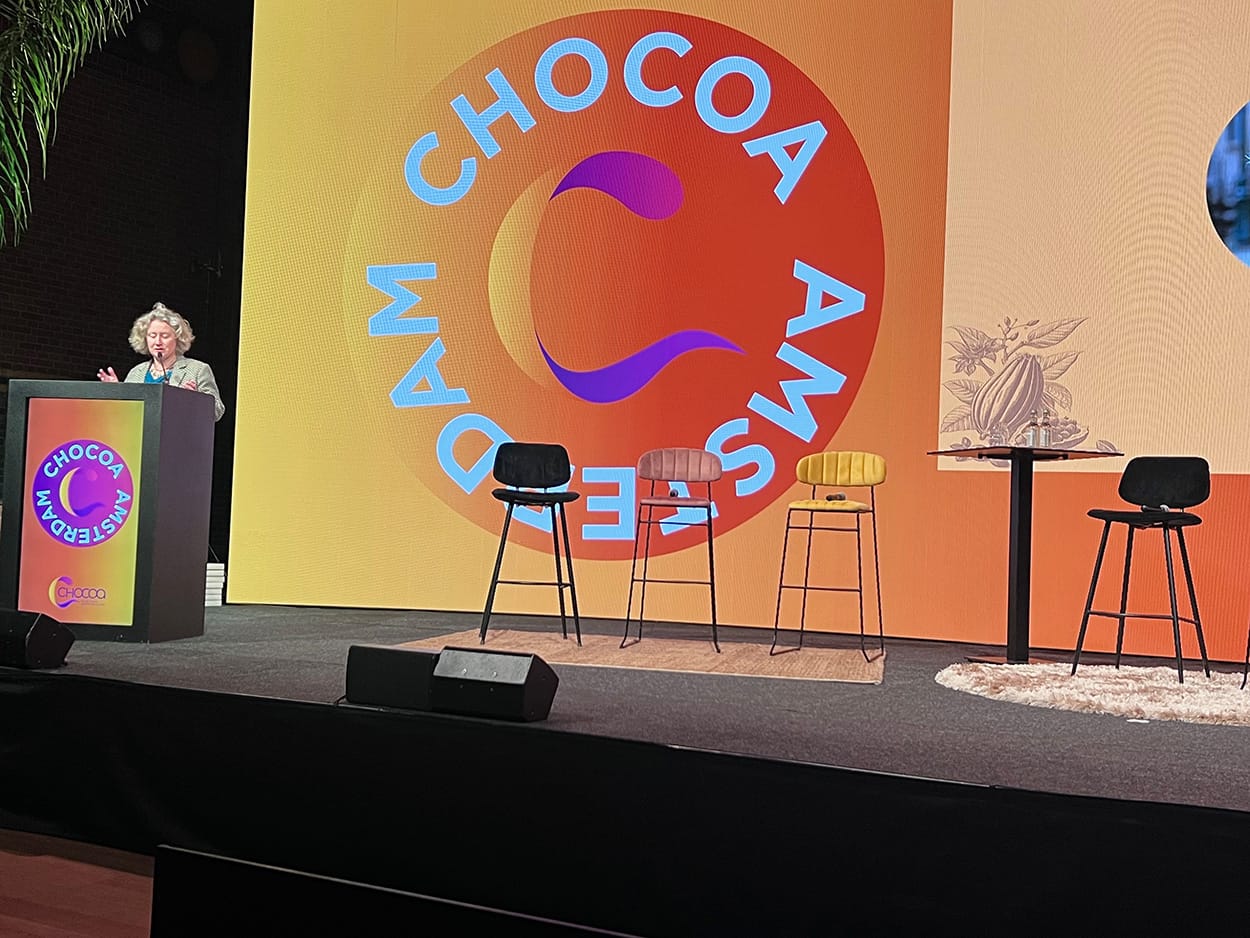
Judith Sargentini of DISCO reminds Chocoa 2026 of the Netherlands significant responsibility to the cocoa industry. Image: CocoaRadar.com
She acknowledged that the Dutch government had not always been sufficiently visible at the conference, but said that it was beginning to change. Working with Chocoa organisers and partners, including IDH, the Ministry of Foreign Affairs is looking at how to strengthen its presence and better communicate the Netherlands’ policy priorities.
For Van der Aa, a more active role at Chocoa reflects the wider Dutch approach to cocoa: using the country’s position as a global trading and processing hub to foster dialogue, promote collaboration and demonstrate what she described as the “Dutch diamond” model of cooperation between government, industry, NGOs and knowledge institutions.
As cocoa supply chains face mounting pressures from regulation, climate change and market volatility, Chocoa has become more than a trade conference. It is increasingly a place where debates around living income, traceability, due diligence and sustainability are tested and translated into action.
For the Dutch government, becoming more visible in that conversation is both a reflection of the Netherlands’ central position in the cocoa economy and a recognition that influence is exercised not only through policy but also through convening.
## **The Retailer Question**
One of the most revealing examples of shared responsibility, according to Aarnoudse, came through DISCO’s work with Dutch retailers.
Suppliers, she said, often hold the closest relationships with cooperatives and farmers. They gather data, understand field realities and know which interventions are practical. But suppliers also look to their clients. Their clients, in turn, look to retailers.
At one point, Dutch retailers asked a basic but important question: What exactly are we supposed to do?
Because DISCO provided a multi-stakeholder platform, IDH and its partners were able to create a working group to explore that question. Over time, major Dutch retailers strengthened their commitments to specific living income interventions.
For Aarnoudse, that example shows why convening matters. It allows different parts of the value chain to clarify their roles, identify barriers and connect commitments to financing.
> Civil society, she added, has played a crucial role in pushing ambition and keeping companies “on their toes.” Suppliers bring technical knowledge. Brands and retailers bring market power. Governments help create the enabling environment. NGOs challenge the sector to go further.
But the model still depends on transparency. Aarnoudse said the cocoa sector needs better clarity on how value is distributed through the chain and what it truly costs to produce sustainable cocoa.
## **EU Rules And The Business Case For Action**
The European regulatory environment has sharpened the debate. The EU Deforestation Regulation (EUDR), the Corporate Sustainability Due Diligence Directive, and the Forced Labour Regulation are all changing expectations for companies operating in the cocoa sector.
Aarnoudse said regulation has been essential in creating pressure for action, particularly because the business case for living income is not always immediate.
> “It would be cheaper, they would be making more money if they don’t invest in that,” she said of some companies. “Hence, they need that type of legislation coming in.”
The IDH Living Income Roadmap does not function as a compliance tool in a narrow legal sense. Rather, it helps companies build the data, strategy and partnerships needed to understand income gaps and act on them – elements that are increasingly relevant to due diligence and sustainability reporting.
Van der Aa welcomed the existence of EU regulation, while acknowledging questions around implementation. Her concern is practical: can regulations be applied in a way that does not leave smallholders behind?
Aarnoudse added that the Dutch competent authority has played an active role in helping businesses prepare for EUDR implementation, including through practical engagement with the cocoa sector. In her view, cocoa was relatively well prepared compared with some other commodities, partly because traceability and deforestation had already been prominent topics in the sector.
Still, the challenge remains: legislation can raise the floor, but it does not automatically deliver living incomes.
## **Who Can Reach A Living Income?**
Perhaps the most difficult question is what happens to farmers for whom cocoa alone may never provide a living income.
Aarnoudse said the answer depends partly on proportionality. If a household spends half its time on cocoa, should cocoa provide the entire household income or half of it? The answer has implications for prices, productivity, diversification, and buyers' responsibilities.
She argued that the focus should be on cocoa households, not just cocoa farmers. Few households rely solely on cocoa, and in many cases, cocoa must be part of a diversified livelihood system.
“A thriving cocoa sector needs to also sit in a diversified system,” she said.
Van der Aa made a similar distinction from a policy perspective. The Dutch government, she said, is focused on building a sustainable cocoa sector, which means working particularly with “stepping up” farmers with greater potential to invest in productivity and sustainability. More vulnerable “survivalist” farmers require attention too, but the pathway is different.
That distinction is uncomfortable but important. Cocoa sustainability policy often speaks in universal terms, but interventions may not affect all farmers equally. Some farmers may benefit from better prices and procurement models. Others may need diversification, social protection, land-use planning or alternative livelihood pathways.
The living income debate therefore cannot be separated from broader rural development.
## **What Success Would Look Like**
For IDH, success over the next five years would mean a stronger connection between demand for sustainable cocoa and the realities of producing it.
Aarnoudse said there is still too much distance between what companies and policymakers ask for, what farmers are expected to deliver, and what buyers are willing to pay.
The goal, she said, is to ensure that sustainability requirements are matched by investment, procurement practices and pricing models that enable farmers and communities to plan for the long term.
For the Dutch government, Van der Aa defined success in terms of a secure, sustainable cocoa supply and stronger farmer livelihoods. The Netherlands wants cocoa to continue flowing into Europe, but in a way that is traceable, responsible and economically viable.
She also pointed to progress in consumer awareness and traceability. More chocolate consumers now understand that cocoa has an origin, a farmer and a set of social and environmental conditions behind it. That awareness, she suggested, is part of the progress made over the past two decades.
The next five years will test whether that awareness can be converted into bigger change.
For IDH and the Dutch government, the answer lies in keeping the whole chain at the table – and ensuring the conversation moves beyond ambition.
The question for cocoa is no longer whether living income matters. It is whether the sector is willing to pay for the sustainability it says it wants.
- **The IDH Living Wage and Living Income Summit 2026 takes place in Rotterdam, The Netherlands, on 30 June. See** [**website**](https://idh.org/events/living-wage-living-income-summit-2026?ref=cocoaradar.com) **for more details.**
---
[](https://www.amsterdamcocoaweek.nl/?ref=cocoaradar.com)
### Chocoa 2026: A Year On, the Conversations Shaping Cocoa’s Future Continue
URL: https://cocoaradar.com/chocoa-2026-a-year-on-the-conversations-shaping-cocoas-future-continue/
Last updated: 2026-07-20T11:27:05.000Z

email philippe@cocoaradar.com for more information
From our desk to yours. DailyDaily.
## Join our growing community of members and receive a free version of our daily newsletter on what really matters in cocoa.
No spam. Unsubscribe anytime.
[Subscribe → ](https://cocoaradar.com/#/portal/signup)
As the official media partner of Chocoa 2026, CocoaRadar followed the discussions, debates, and insights that defined this important gathering. Six months on, many of the themes raised in Amsterdam have only grown in significance, shaping industry conversations around sustainability, compliance, finance, resilience, and the future of cocoa markets.
In an exclusive, open Signal Room discussion with CocoaRadar, Chocoa co-founders Caroline Lubbers and Mariana De La Rosa, and creative and programme director Anna Laven reflected on the lessons from Chocoa 2026 and offered early insights into the thinking behind Chocoa 2027.
Advertisement
[  ](https://www.foodmasters-freiberg.com/en/?utm%5Fsource=ghost&utm%5Fmedium=newsletter&utm%5Fcampaign=ad&utm%5Fcontent=qsm%5Fplaceholder)
💡
VIDEO: Check out our special Signal Room [video chat](https://www.youtube.com/live/gFEH-uUk%5Fv0?si=rX4kVLbXVUM4N3z5&ref=cocoaradar.com) for more on our discussion with The Company Behind Chocoa.
### **Looking Back: Chocoa 2026 and a Sector at a Turning Point**
If one message resonated throughout Chocoa 2026, it was that the cocoa sector is entering a new era.
For years, sustainability commitments were largely driven by voluntary initiatives and corporate pledges. Across the conference, speakers pointed to a future increasingly shaped by regulation, accountability, traceability, and measurable outcomes. Compliance is no longer viewed as an optional exercise; it is rapidly becoming a prerequisite for participation in global cocoa markets.
Against a backdrop of unprecedented price volatility, market uncertainty, and evolving regulatory frameworks, industry leaders in Amsterdam described the current period as a defining moment for the sector – a time when incremental change may no longer be enough.
The challenge ahead is clear: can the cocoa value chain transform urgency into practical action that delivers meaningful results for farmers, businesses, consumers, and producing countries alike?
### **From Volatility to Vision**
Rewind to February, and the opening sessions of Chocoa 2026 highlighted a stark reality: volatility is no longer an exception in cocoa markets – it has become a structural feature.
According to De La Rosa, one of the defining characteristics of the 2026 edition was the growing recognition of a changing global cocoa landscape. Latin America featured more prominently than ever, reflecting increasing diversification in supply origins, genetics, and quality. This was reinforced through the Chocoa auction, which highlighted rising appreciation for premium cocoa quality and origin diversity.
Participants explored how producing and consuming countries must work more closely together to address the interconnected challenges of climate change, farmer livelihoods, market instability, and sustainability requirements.
Price volatility dominated almost every discussion. While higher prices have created opportunities, delegates repeatedly questioned how much of the additional value is reaching producers and whether current market dynamics are translating into meaningful improvements in livelihoods.
Laven noted that the macroeconomic context had shifted dramatically compared with previous years. The crisis in West Africa, coupled with the absence of some key producing-country institutions that remained focused on domestic challenges, underscored how rapidly the industry landscape is evolving. At the same time, she emphasised that Chocoa seeks not only to address systemic challenges but also to highlight practical solutions and opportunities that can drive change.
Delegates also acknowledged a growing concern beyond supply: demand. Rising cocoa prices are already influencing consumer behaviour, reformulation strategies, and chocolate consumption patterns in some markets, raising important questions about how the sector balances sustainability goals with long-term market growth.
### **Building Stronger Foundations Through Finance and Productivity**
Access to finance emerged as one of the industry’s most persistent barriers – and one of its most urgent priorities.
De La Rosa described affordable financing as a challenge affecting every level of the value chain, from farmers and cooperatives to exporters and SMEs. Chocoa’s dedicated Financial Course, first introduced in 2025 and expanded in 2026, reflected the growing importance of this issue, with preparations already underway for a third edition in 2027.
Throughout the conference, speakers highlighted how land tenure challenges, documentation requirements, limited rural financial services, and investment uncertainty continue to restrict the flow of capital to cocoa-producing communities.
Farmers themselves repeatedly called for more practical knowledge and peer-to-peer learning. Reflecting on the inaugural Farmers Day, Laven noted strong demand for hands-on sessions, including discussions on financial literacy and even hedging. The appetite for practical solutions highlighted a broader shift toward producer-centred conversations and knowledge exchange.
Examples from Latin America demonstrated how improved agronomy, targeted investment, and agroforestry systems can significantly increase yields while supporting sustainability objectives. These examples reinforced an important message: productivity gains and environmental responsibility do not have to be competing priorities when supported by evidence-based approaches.
Looking ahead, finance is expected to become one of the central themes of Chocoa 2027\. Laven revealed that ‘**Financing the Future of Cocoa**’ is emerging as a guiding concept for next year’s programme, with organisers aiming to attract a broader range of investors and financial institutions to Amsterdam Cocoa Week.
### **Trade and Transport Enter a New Era**
The transformation of cocoa markets is also reshaping the systems that move cocoa around the world.
At Chocoa 2026, experts highlighted the growing importance of digital compliance infrastructure, including traceability systems, deforestation monitoring, and verification of lawful production. Increasingly, these tools are becoming embedded within everyday trading operations rather than existing as standalone sustainability projects.
Another important discussion centred on security and operational resilience. As supply chains face new risks, participants stressed the need to strengthen logistics networks, improve shipment integrity, and ensure that trade infrastructure remains robust in a rapidly changing environment.
The conference also explored practical pathways for reducing emissions across cocoa transport networks. Alongside discussions around alternative transport solutions, delegates called for stronger data collection on emissions, product quality, and logistics performance to ensure sustainability claims are supported by measurable evidence.
Looking ahead, the implementation of the European Union Deforestation Regulation (EUDR) is expected to remain a prominent topic in 2027\. Laven noted that while discussions during 2026 benefited from complementary sessions organised alongside the World Cocoa Foundation Partnership Meeting, regulatory developments will inevitably continue to shape future conversations throughout Amsterdam Cocoa Week.

The relaunch of WINCC (Women in Cocoa and Chocolate Network) at Chocoa 2026\. Image: WINCC
### **People at the Centre: Gender Equality and Labour Reform**
One of the most impactful themes of Chocoa 2026 was the recognition that resilience begins with people.
The introduction of Farmers Day marked a significant milestone. According to De La Rosa, the event was fully booked and demonstrated strong demand for farmer-led dialogue and exchange. Organisers also made a deliberate effort to ensure producer voices featured prominently throughout the conference programme.
Gender equality discussions moved beyond participation metrics and focused on agency, leadership, and decision-making power. Speakers highlighted the critical role women play throughout cocoa-growing communities while emphasising that much of their contribution remains under-recognised in formal systems and datasets.
Participants also explored growing evidence that empowering women through access to finance, training, savings mechanisms, and leadership opportunities can strengthen household resilience while supporting improved outcomes in education, nutrition, and child protection.
The relaunch of WINCC (Women in Cocoa and Chocolate Network) represented another important development. Lubbers confirmed that new mentoring initiatives are now being rolled out, designed to strengthen leadership pathways and encourage greater female representation throughout the industry.
Labour reform formed an equally important part of the conversation. As cocoa farming increasingly relies on hired labour, discussions focused on how professionalised labour systems, cooperative-supported workforce models, and practical interventions can improve productivity while reducing the risks of child labour.
A key takeaway was that while systemic change takes time, targeted and affordable solutions can deliver meaningful improvements today.
### **Connecting the Dots**
The closing discussions at Chocoa 2026 brought together many of the themes explored throughout the week.
Delegates examined the delicate balance between profitability and sustainability, the opportunities and challenges created by new regulatory frameworks, and the need for stronger evidence to guide decision-making across the value chain.
The event itself also illustrated the benefits of greater collaboration. Co-location with the World Cocoa Foundation Partnership Meeting brought together diverse audiences, creating opportunities for networking and reducing travel-related impacts. Although the schedule proved intense, organisers viewed the convergence of stakeholders in Amsterdam as a major advantage.
Perhaps most importantly, the conference highlighted a series of tensions the industry continues to navigate:
- Higher prices can improve farmer incomes but may also create new market distortions.
- Regulation can drive accountability but requires significant adaptation.
- Sustainability demands investment, even as markets remain volatile.
- Short-term interventions must support rather than undermine long-term resilience.
These discussions underscored that there are no simple solutions. Instead, progress will depend on connecting policy, finance, productivity, sustainability, and market realities into a coherent strategy for the future.
### **Looking Ahead to Chocoa 2027**
As [Amsterdam Cocoa Week returns from ](https://www.chocoa.nl/?ref=cocoaradar.com)22–28 February 2027., expectations are likely to be high.
Organisers are already positioning finance as one of the major themes for the next edition, with a stronger emphasis on investment and new stakeholder groups. Discussions are also underway with additional partners, and support from the Dutch Ministry of Foreign Affairs is expected to strengthen the week's international dimension.
For Lubbers, success will ultimately mean reinforcing Amsterdam Cocoa Week’s role as the place where the global cocoa sector comes together to launch initiatives, exchange ideas, and create new partnerships.
By the time Chocoa reconvenes, the industry will increasingly be judged not by its commitments but by its implementation. Stakeholders will be looking for evidence that compliance systems are operating effectively, that finance is reaching producers, that resilience programmes are delivering measurable outcomes, and that sustainability investments are generating lasting impact.
The conversations that began at Chocoa 2026 have not ended. If anything, they have become more urgent.
With the Chocoa 2027 agenda set to be announced in the coming months, the conference is expected once again to provide a vital platform for examining how the sector responds to some of its most pressing challenges and opportunities.
For businesses, producers, policymakers, researchers, and sustainability leaders across the cocoa and chocolate value chain, Amsterdam Cocoa Week offers a unique opportunity to connect, collaborate, and help shape the industry’s next chapter.
The questions raised in 2026 remain highly relevant today.
Chocoa 2027 may well reveal how many of those conversations have evolved into action.
- **Stay tuned to CocoaRadar for agenda announcements, speaker updates, exclusive interviews, and continuing coverage as the road to Chocoa 2027 begins.**
### The Future of Amsterdam Cocoa
URL: https://cocoaradar.com/the-future-of-amsterdam-cocoa/
Last updated: 2026-06-15T12:52:43.000Z

email philippe@cocoaradar.com for more information
Ask random people on the street in Amsterdam whether they believe their city has the largest cocoa port in the world, and nine out of 10 look at you like you're crazy. Most locals have no idea about the city's role in the cocoa and chocolate sector. I understand why: importing beans and pressing them into semi-finished cocoa is the least glamorous part of the chocolate story.
It is Dutch Week here at CocoaRadar, so a perfect moment to shine a light on exactly that unsexy middle part of the business.
To kick off, I revisited an article I wrote for the World Cocoa Foundation in 2018 about why this city became so important to cocoa historically and how it evolved.
In my WCF article, I mentioned how grinding in origin countries would grow and change Amsterdam Cocoa's role. But that was 2018, and now it is 2026\. Eight years, and it seems like a different world considering all the events that have hit the industry since: Covid lockdowns, a freight crisis, a war in Ukraine, climate disruptions that led to poor harvests and then to huge price spikes, EUDR and its delays. The list goes on. If each one on its own pushed up the price of a chocolate bar, imagine what they do combined!
Advertisement
[  ](https://www.foodmasters-freiberg.com/en/?utm%5Fsource=ghost&utm%5Fmedium=newsletter&utm%5Fcampaign=ad&utm%5Fcontent=qsm%5Fplaceholder)
With everything getting so complex and expensive, you would think it must finally make more sense to process the cocoa closer to where it grows. Right?
Well, one thing I have learned in cocoa is that nothing is as simple as it seems.
So instead of asking Claude (the AI) to analyse the data, I went one better and went to the source. I called two cocoa friends to meet me for coffee at a typical café on Amsterdam's east side to talk about how all this affects the city's cocoa sector now and in the future.
### **Cocoa Talk Over Coffee**
Bart Verzaal has traded cocoa for 41 years. He started at a broker's desk in Amsterdam, then went to the butter trade in Zaandam, and finally at Barry Callebaut in Switzerland for the last decade. He is retired now, but he still enthusiastically writes a daily cocoa newsletter for the cocoa industry. Bart speaks in trade jargon all the time, with statements like “they'll have to buy their shorts back,” integrated into his common language, though, truth be told, I am only now starting to decode his terminology.
Then there is Martijn Bron, a household name in the cocoa industry. Martijn traded at Cargill for 26 years, 16 of them in cocoa, running its global cocoa trading desk. He now explains how the trade actually works in sharp podcasts, articles, and posts that attract a steady stream of students and young people to the business. Add his adventurous stories from cocoa trips and the trade desk, a sauce of dry Dutch humour, and you understand the appeal to his 53k+ followers on LinkedIn.

From left to right: Martijn Bron, Bart Verzaal, Marika van Santvoort, and Tony Myers of CocoaRadar. Image: **Marika van Santvoort*
### **How Much Flows Through Amsterdam, And Why?**
The number you always read online in answer to this question is between 600,000 and 800,000 tonnes a year. The number seems static, as if it has not moved in years. The latest hard figure is more specific: approximately 774,000 tonnes of cocoa beans came into the Netherlands in 2025 (Eurostat).
A decade ago, it was around a million tonnes, with a peak near 1.16 million in 2018\. Over 10 years, the trend has drifted down but not collapsed. Interestingly and understandable, while the volume shrank, the value in euros tripled, which has everything to do with high cocoa prices.
The Netherlands is now both the world's largest importer of beans ánd the largest exporter of cocoa products. The port frames its own claim plainly: about 655,000 m² of storage, room for more than a million tonnes of cocoa, and the whole chain of storage, trade and processing clustered in one place (Port of Amsterdam). For the Dutch economy, it is no small thing either, roughly 17,000 jobs across 96 companies and 1.8 billion euros in added value (Erasmus, 2024).
When we say Amsterdam, it is a tad shorthand. The warehouses and trading offices are in the city, but the grinding, turning beans into mass, butter and powder, happens across the water in the Zaanstreek. Around it sits a close-knit cluster of companies: the big traders (Olam, Cargill, ECOM), speciality houses like Daarnhouwer and JS Cocoa, machine builders like Duyvis Wiener (recently taken over by Probat), and the warehouses, logistics firms and banks that keep it all running.
### A Brave New World
None of it appeared overnight or coincidentally. Amsterdam started as a small port and was successful largely due to its strategic position relative to other foreign ports. The first cocoa arrived in the 1600s, when ships brought the beans back from the New World. Once the canals were dug, precious cargo like coffee and tobacco (cocoa much later) was unloaded from the canals straight into the warehouses along the water.
That is how great fortunes were made, and the city grew bigger around the port. If you pay attention when you walk in Amsterdam’s old centre, you can still see it on the stone tablets above some of those old houses. The area was packed with windmills, and conveniently, their power was used to crush and grind the beans, which is part of why the processing settled there and never left.
Then, in 1828, a father and son named Van Houten built the cocoa press and worked out alkalisation, the treatment that softens the bitterness and darkens the colour, still called Dutching. It made cheap cocoa possible for the masses.
Bart remembers that when he started trading in 1985, the region still had around 200 cocoa companies. Most have been swallowed by a handful of giants since: Cargill, which took over Gerkens; Olam, which absorbed Cacao de Zaan; and Barry Callebaut, with its grinding just across the border in Belgium.
### **What About Local Processing in Origin Countries?**
Origin countries want more processing done locally, and this desire is amplified in every political campaign in every cocoa-growing country, especially around elections. It makes total sense: grind where the beans grow and keep more of the value, jobs, and margins. It is also better for the climate and for costs, because of fewer logistics.
And when a local company does it well, consistently, it is huge for a country. Ecuador is big in agricultural production but not relevant in manufacturing. Now it has Ecuakao, set up in 2018, which I visited in 2025\. They take in around 300 tonnes of beans a day, roughly 100,000 tonnes a year, close to a fifth of Ecuador's cocoa crop, pressing them into liquor, butter and powder and selling straight to large brands in the USA and Asia, without middlemen.
When a local company grinds at home, it is a different story from when a multinational like Cargill grinds in Côte d'Ivoire: the jobs may be local, but the profits still leave the country.
### **What The Data Says**
So is Amsterdam losing its place? It depends on whether you look at incoming euros or at volumes. In 2025 the Netherlands imported about 11.4 billion euro of cocoa and exported 13.3 billion, a record. But the volume tells another story: over the past decade, bean imports drifted down to 0.77 million tonnes in 2025, from around a million a decade ago and a 1.16-million peak in 2018\. Less cocoa, much higher prices. And most of that turnover is simply the imported bean passing through. The country itself earns about 3 billion euros from it (CBS, 2025), the value of the grinding and the trade, which is significant for the Dutch economy.
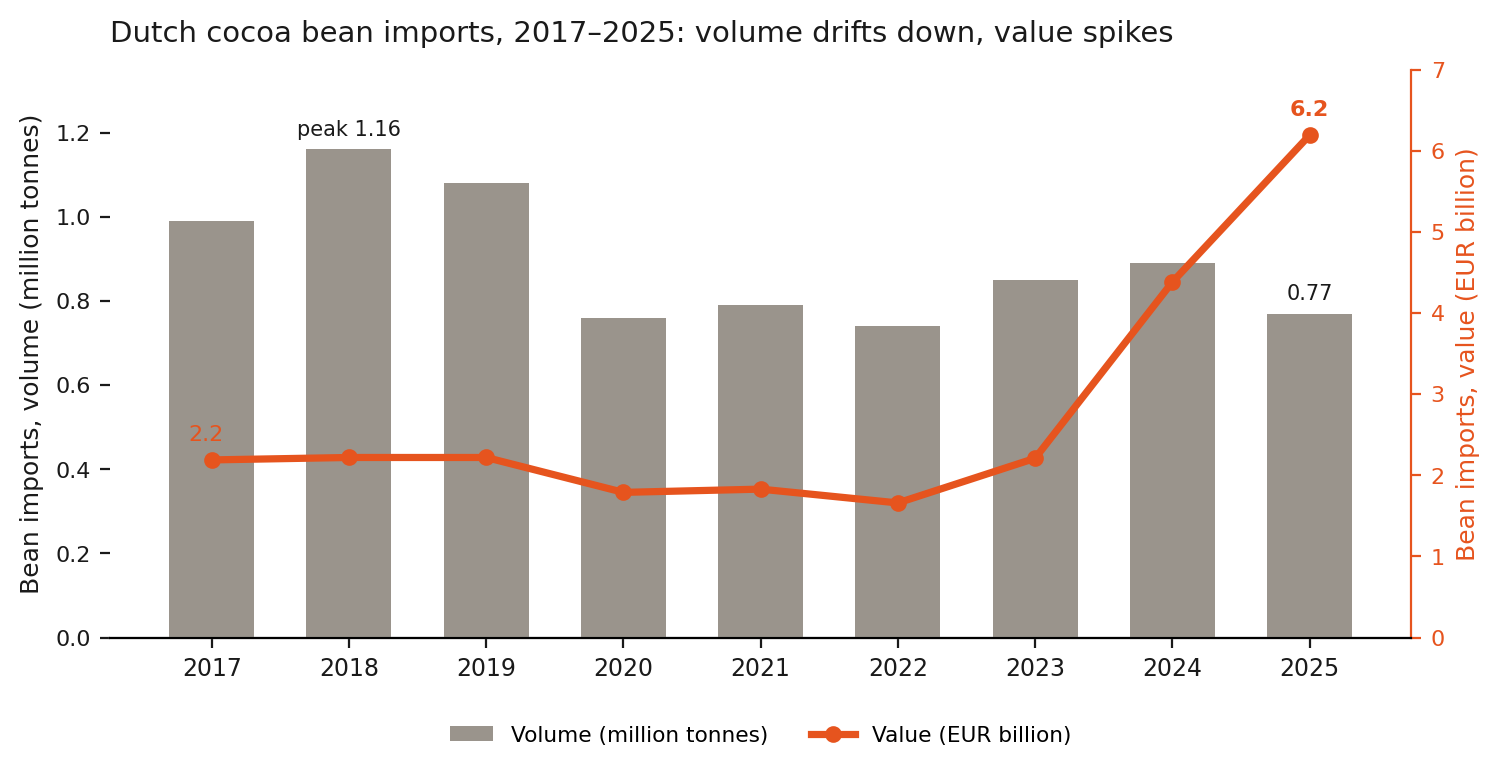
****Figure 1\.** Dutch cocoa bean imports, 2017-2025\. Volume drifted down from around a million tonnes to 0.77 million; value rose from 2.2 to 6.2 billion euros on high prices. Source: Eurostat Comext / CBS.
The Netherlands just surpassed Germany as the world's largest cocoa-products exporter, ahead of Côte d'Ivoire and Belgium. But it is a crown by value, riding the high price of butter and powder, not by volume. Germany still makes far more finished chocolate, with the brands and the margins. About three-quarters of what the Netherlands exports is semi-finished cocoa: mass, butter and powder. The Dutch grind and supply the ingredients; others make the chocolate.
Two other things can be seen. First, the port forwards fewer raw beans and grinds more of them itself: re-export of unprocessed beans is down about 45% since 2018, so Amsterdam is moving from a transit harbour toward a processing cluster, with Antwerp and Hamburg competing on the pure logistics. Second, the beans come from new places. In 2024, by value, Ghana, long a favourite, was down to 5% of Dutch bean imports, from about 12% in 2017, while Nigeria (18%), Cameroon (17%) and Ecuador (7%) filled the gap. Taken as a 10-year average those newer origins sit lower (around 14, 17 and 3%, per IDH/DISCO), so it is the recent years that show the move. A large part of Ecuador’s crop goes to Asian grinders rather than to Amsterdam.
Strip away the price spike, and the picture is clear. In euros, Amsterdam looks bigger than ever; in real cocoa, it is shrinking a bit, and origin is starting to grind its own. These shifts are real and have started already some time back.
### **Why Amsterdam Stays Top, For Now**
Still, the traders expect Amsterdam to stay on top for years. Four reasons.
- **Smooth operations.** A grinding production line must run around the clock to be profitable, which requires reliable power, skilled and experienced personnel, and substantial working capital. In many origin countries the power simply cuts out and the line stops. There is also the butter-and-powder balance every grinder has to get right, or you join what the trade calls the 'cocoa graveyard'.
- **Blending.** A chocolate is a blend of beans from different origins, usually mostly Côte d'Ivoire and Ghana, with a bit of Ecuador. But you cannot easily move beans between origin countries the way they flow into Amsterdam, so a grinder in Lagos cannot just bring in Ecuadorian beans to balance a recipe. In the Zaanstreek you can, and the blending ideally happens already in the warehouse.
- **Food safety and trust.** A buyer like Mondelēz International or Nestlé builds its brand on the promise of product consistency and safety. Besides the costs, a food-safety scandal is enormous reputational damage - as Ferrero and Barry Callebaut both learned. They will not move that risk to a new country lightly. And EUDR cuts both ways here too: it makes importing beans more expensive, but the strong EU's food-safety rules (PAH, microbiology) are exactly what origin often cannot meet, yet, as producing there is seen as riskier. And risk is exactly the word any brand wants to avoid, and traders want to control.
- **Cost.** Beans enter Europe duty-free from everywhere; the duty only bites on processed cocoa, and only for some origins. From the big African origins with an EU trade deal (Côte d'Ivoire, Ghana, Cameroon) even butter and powder come in at zero. But from a country without a deal it climbs at every step: for Nigeria 6.1% on mass, 4.2% on butter, 2.8% on powder; for Malaysia, Brazil or the US the full rate of 9.6, 7.7 and 8%, with chocolate higher again once the sugar duty is added. So the cheaper labour at origin can get eaten by the tariff, depending on where the beans are from. That escalation has protected European grinding for decades, and it still does.

Dutch favourite hagelslag (chocolate sprinkles)
Since it is Dutch Week here at CocoaRadar, and everyone in the Netherlands grows up with Hagelslag (chocolate sprinkles), let’s use it as a quick example. The recipe: roughly half sugar, a quarter lean cocoa powder, and the rest cocoa butter. To see what the duties do, I follow one 390-gram pack along three routes to the shelf: (a) beans shipped in and ground here (as it happens now); (b) semi-finished cocoa ground abroad and finished here; or (c) the pack made entirely at origin and imported finished. Here is how the cost stacks up in each case, with the shelf price at the end (green box).
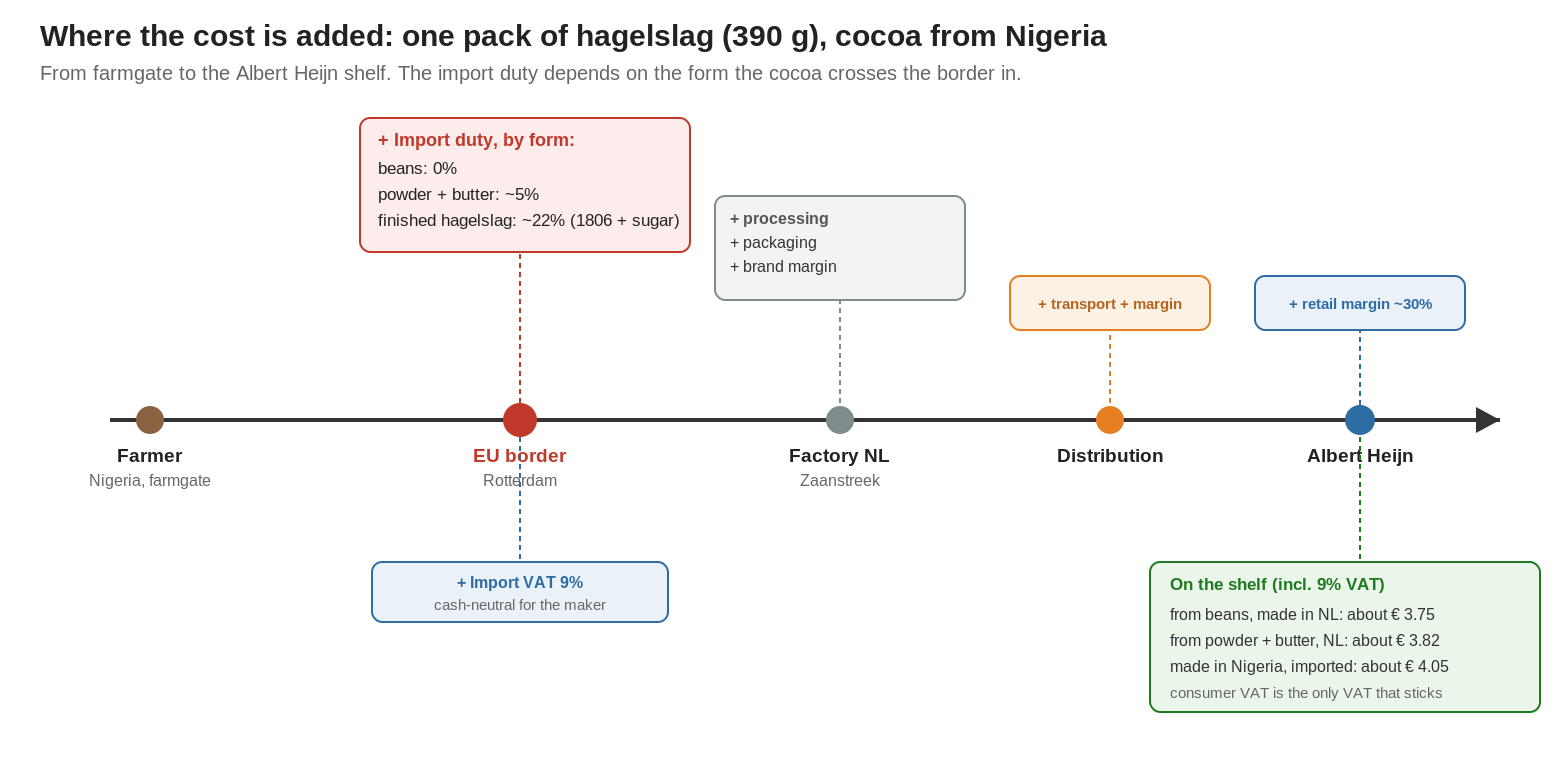
****Figure 2\.** How the cost stacks up on the way to the shelf, for a pack of Hagelslag, in three routes.
The duty climbs with every step, so the pack made abroad ends up the most expensive, even with cheaper labour. That is the point: where a product is made and where it goes determines the duty; the duty influences the shelf price; and price, for a large part, decides what sells and what does not, because most shoppers count their cents.
### The Future of Amsterdam Cocoa
Put together, the direction is much clearer now. Amsterdam remains the largest cocoa port, but the balance keeps tipping: more grinding and ingredients, less raw-bean transit. There is more grinding in origin, but it’s not a fast transformation. Before it really shifts, origin must first solve many difficult problems. It is also not an either-or matter, because cocoa production is growing, and so is demand in new consuming countries, especially in Asia.
So, Amsterdam Cocoa can rest assured. The ships keep arriving in the port, the warehouses keep being stacked, the presses run around the clock – and the wheels of the industry are just too strong to stop anytime soon.
Will it still be so in 20 years? Who knows. In cocoa, nothing is as simple as it seems. So ask me again after the next crisis.
---
*A big thank you to Bart and Martijn for sharing their knowledge, and to the Port of Amsterdam for sharing their figures.*
**Want to use (parts of) this article?** *Great. Please cite as: Marika van Santvoort, ‘Moving Cocoa: The Future of Amsterdam Cocoa’, CocoaRadar (2026).*
---
**Sources**
**1\.** Trade and origin figures: Eurostat Comext (DS-045409) and CBS, 2025; sector context from IDH and DISCO, June 2025.
**2\.** Duties: EU Access2Markets and the ECA cocoa tariff table.
**3\.** Grinding shift to origin: CocoaIntel and ADM; ISS and USDA FAS on Côte d'Ivoire.
*My 2018 WCF article and the full import and grinding dataset are available on request, just send me an email to marika@movingcocoa.com.*
|  **Marika van Santvoort** has been working in cocoa & chocolate since 2014, with a focus on responsible sourcing, innovation and farmer impact. In this monthly column she shares her own perspective on what is really moving in the sector; what is being said, what is not, why it matters and what it means for the industry. [LinkedIn](https://www.linkedin.com/in/marikavansantvoort/?ref=cocoaradar.com) · [movingcocoa.com](https://movingcocoa.com/?ref=cocoaradar.com) |
| ---------------------------------------------------------------------------------------------------------------------------------------------------------------------------------------------------------------------------------------------------------------------------------------------------------------------------------------------------------------------------------------------------------------------------------------------------------------------------------------------------------------------------------------------------------------------------------------------------------------------------------------------- |
### Child Labour in Cocoa Persists Despite Progress as Industry Shifts Toward Systemic Solutions
URL: https://cocoaradar.com/child-labour-in-cocoa-persists-despite-progress-as-industry-shifts-toward-systemic-solutions/
Last updated: 2026-06-12T12:36:16.000Z
From our desk to yours. DailyDaily.
## Join our growing community of members and receive a free version of our daily newsletter on what really matters in cocoa.
No spam. Unsubscribe anytime.
[Subscribe → ](https://cocoaradar.com/#/portal/signup)
While child labour remains widespread across West Africa, advocates increasingly argue that the issue cannot be solved through supply-chain audits alone. Instead, they say that lasting change requires stronger local institutions, higher incomes for farmers, and greater accountability.
The debate comes as new partnerships and emerging trade policies put renewed attention on labour practices in global supply chains.
Advertisement
[  ](https://www.foodmasters-freiberg.com/en/?utm%5Fsource=ghost&utm%5Fmedium=newsletter&utm%5Fcampaign=ad&utm%5Fcontent=qsm%5Fplaceholder)
### Beyond Audits: A Broader Child-Protection Challenge
An initiative announced by International Justice Mission (IJM) and the Government of the Netherlands seeks to strengthen efforts against child trafficking and exploitation in cocoa-growing communities. Rather than focusing solely on corporate compliance programmes, the partnership aims to reinforce local child-protection systems and criminal justice institutions.
Speakers involved in the initiative argued that trafficking and forced labour are often less visible than child labour itself. Children may be moved across communities or borders and exposed to hazardous agricultural work that is difficult to detect through traditional supply-chain monitoring.
The programme focuses on training police, prosecutors and social welfare officers, improving case identification and ensuring traffickers are held accountable. It also emphasises prevention through community awareness, education and support services for vulnerable families.
Participants stressed that governments, companies, civil society and communities all share responsibility. No single actor, they argued, can eliminate child exploitation alone.
### Poverty Remains A Central Driver
According to the International Labour Organization, an estimated 160 million children worldwide remain involved in child labour, with more than 54 million engaged in hazardous work. Sub-Saharan Africa accounts for nearly two-thirds of all cases.
Campaigners point to several underlying causes:
- Low farmer incomes and poverty.
- Limited access to education.
- Weak child-protection systems.
- Inadequate law enforcement and social services.
- Social norms that may normalise children’s participation in dangerous work.
The theme for World Day Against Child Labour 2026 — ‘Red card to child labour: Fair play for children, decent work for adults’ — reflects growing recognition that addressing poverty and creating decent employment for adults are essential to protecting children.
[](https://cocoaradar.com/chocci-leaks/)
### Tony’s Chocolonely Offers A Transparent Case Study
Few companies report on child labour as openly as Dutch chocolate maker Tony’s Chocolonely.
In its recent annual report, the company disclosed that the number of child labour cases identified through its Child Labour Monitoring and Remediation System rose to 3,448 during the latest reporting period. At first glance, the increase appears alarming. However, Tony’s attributes much of the rise to expanded monitoring as additional cooperatives joined its Open Chain programme.
Importantly, the company reports significantly different prevalence rates between long-term partner cooperatives and newer suppliers. Child labour prevalence averages around 4% among established partners, compared with roughly 13% in newer cooperatives. By comparison, studies have estimated the prevalence of child labour across the wider cocoa sector at approximately 46.7%.
Tony’s approach does not involve automatically excluding affected families from its supply chain. Instead, remediation focuses on school attendance, household support and long-term engagement, with most cases addressed within nine months.
The figures illustrate both progress and complexity. Greater transparency often results in more cases being identified, not fewer. Experts argue that finding cases should not necessarily be interpreted as failure, but as evidence that monitoring systems are functioning.
Questions remain, however. Investors and observers continue to ask how many identified cases are fully remediated and what barriers prevent prevalence from falling below the current 4% level among long-term partners.
> Belinda Borck, External Affairs & Reporting lead, at Tony's Open Chain, told CocoaRadar: “Bringing child labour prevalence below 4% is not just a matter of comprehensive monitoring of all households and remediation, we further support community child protection structures to ensure a holistic approach beyond our supply chain.
> “Driving the prevalence rate down also fundamentally requires addressing the structural conditions that make child labour persist in the first place. The biggest barrier remains farmer poverty, which requires sustained, sector-wide collaboration from governments, industry, and civil society to ensure living incomes, structural farming services, and shared accountability across the entire cocoa value chain are enabled.”
### Mondelēz releases Human Rights report
Mondelēz International is also observing World Day Against Child Labour by releasing its 2025 Human Rights Due Diligence and Modern Slavery Report, which outlines the company’s continued progress in helping prevent, identify, and address potential human rights and modern slavery risks across its operations and value chain.
> “We continue to believe that helping to drive positive change at scale across the communities our business touches is an integral part of value creation. Simply put, we believe that more sustainable business is, and always will be, good business,” said Darren O’Brien, Chief Corporate & Government Affairs Officer & Chief Cocoa Officer, Mondelēz International. “That’s why an enhanced human rights due diligence approach enables us to increase focus and scale, meeting our long-term goals and addressing systemic human rights issues in ingredient supply chains through meaningful partnerships.”
As part of its focus on prioritised ingredients, Mondelēz continued scaling its signature cocoa sustainability programme, Cocoa Life, in 2025 and claims to have reached its 2025 goal of \~100% Child Labour Monitoring & Remediation Systems (CLMRS) coverage of Cocoa Life communities in West Africa – representing approximately 2,300 communities.
### Trade Tensions Add Another Layer
Labour issues are also becoming increasingly intertwined with international trade policy.
The United States recently proposed new tariffs on imports from dozens of economies, arguing that countries have not done enough to prevent goods produced with forced labour from entering global supply chains. The move has prompted criticism from several trading partners, including the European Union, which maintains that it already operates some of the world’s strictest due diligence rules.
The debate highlights how labour standards are evolving from a corporate social responsibility issue into a geopolitical and regulatory concern.
### Progress Remains Uneven
Despite years of certification programmes and corporate commitments, child labour has not disappeared from cocoa production. Yet experts increasingly believe the solution lies not simply in auditing farms, but in strengthening the institutions that protect children and addressing the economic realities facing farming families.
The challenge is unlikely to be solved quickly. But the emerging consensus among governments, NGOs and companies is that lasting progress depends on combining transparency, law enforcement, education and higher incomes for farmers.
Finding more cases, advocates argue, may ultimately be a sign that systems are beginning to work – provided those cases lead to meaningful remediation and prevention.

email philippe@cocoaradar.com for more information
### Hidden Côte d'Ivoire Stocks Point to Much Larger 2025-26 Cocoa Crop
URL: https://cocoaradar.com/hidden-cote-divoire-stocks-point-to-much-larger-2025-26-cocoa-crop/
Last updated: 2026-06-11T15:31:46.000Z
💡
****Cocoa trading at 3743.576 USD/T on Thursday, June 11, a 13.424 USD/T (0.36%) decrease from 3757.000 on the last trading session.**
Fresh evidence suggests Côte d'Ivoire may be carrying substantially more cocoa than the market has priced in, with unaccounted inventories and a stronger-than-expected mid-crop potentially lifting 2025-26 production above 2 million tonnes and toward 2.2 million tonnes.
According to X posts by cocoa analyst **@Rebelty\_8**, Côte d'Ivoire port arrivals reached 1.69 million tonnes by 7 June, while citing an official Conseil du Café-Cacao (CCC) tally of 1.822 million tonnes. Weekly arrivals were estimated at 31,000 tonnes, up 64% from 18,855 tonnes a year earlier.
Advertisement
[  ](https://www.foodmasters-freiberg.com/en/?utm%5Fsource=ghost&utm%5Fmedium=newsletter&utm%5Fcampaign=ad&utm%5Fcontent=qsm%5Fplaceholder)
The key issue is the size of unsold stocks. Reuters reported in February that warehouses across Côte d'Ivoire were overflowing with unsold beans, prompting the CCC to launch a programme to buy back 100,000 tonnes of ageing inventories. Reuters later reported farmer protests over unpaid beans and noted that authorities were unable to quantify the extent of stocks held by cooperatives and producers.
CocoaRadar understands a government census identified roughly 350,000 tonnes of unsold cocoa, compared with a previous CCC estimate of 123,000 tonnes. Combined with expectations for another 160,000-200,000 tonnes from the remaining mid-crop, total 2025-26 output could reach 1.98-2.2 million tonnes, or 300,000-600,000 tonnes above trade expectations centred around 1.7-1.8 million tonnes.
_This post is for paying subscribers only._
### Italy Moves from Promise to Practice with New Cocoa Sustainability Initiative
URL: https://cocoaradar.com/italy-moves-from-promise-to-practice-with-new-cocoa-sustainability-initiative/
Last updated: 2026-06-10T14:05:24.000Z
From our desk to yours. DailyDaily.
## Join our growing community of members and receive a free version of our daily newsletter on what really matters in cocoa.
No spam. Unsubscribe anytime.
[Subscribe → ](https://cocoaradar.com/#/portal/signup)
What was, until recently, a strategic narrative is now evolving into operational reality. The recent emergence of a new consultancy role – Project Director for ‘The Italian Vision for a Sustainable Cocoa Value Chain’ comes after Italian Minister Plenipotentiary Stefano Gatti outlined a decisive shift in Italy’s approach to agricultural development – particularly in cocoa and coffee - at the Chocoa 2026 Conference in Amsterdam (first reported by cocoaradar.com)
[Chocoa 2026: From Volatility to Vision — A Sector Confronts Its Moment of TruthOpening the Conversation: Solidarity, Strategy and Shared Responsibility. The Company Behind Chocoa launched this year’s Sustainability Conference in Amsterdam, calling for global solidarity and systemic reform.From The Desk of CocoaRadar™Anthony Myers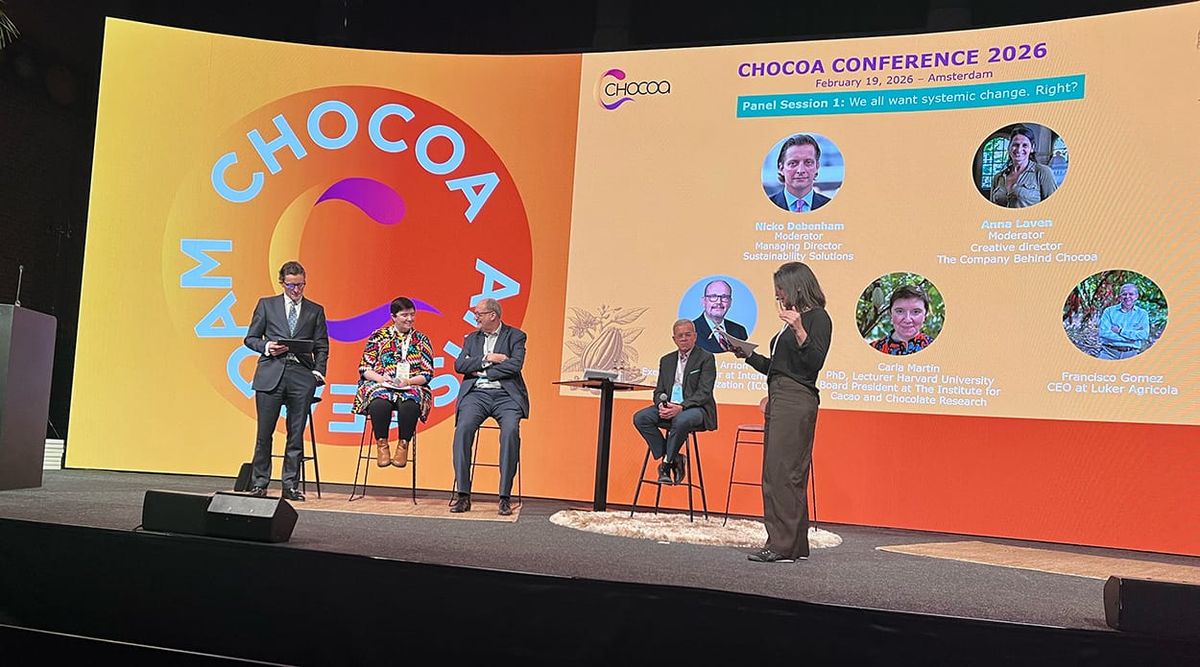](https://cocoaradar.com/chocoa-2026-from-volatility-to-vision-a-sector-confronts-its-moment-of-truth/)
With a domestic cocoa industry valued at €6.6 billion and annual imports of approximately 200,000 metric tonnes, Italy is repositioning itself not merely as a buyer, but as a long-term development partner.
Central to this strategy is a move away from traditional aid models toward co-investment and shared value creation. Backed by a €4.4 billion climate fund and an Africa-focused policy framework, Italy is investing in:
- Agricultural modernisation, education, and health across 23 African countries
- National resilience plans for coffee in Ethiopia and Uganda
- A forthcoming public–private coffee fund in coordination with the World Bank
The message was clear: future partnerships must deliver mutual economic growth and long-term resilience, not short-term development gains.
Advertisement
[  ](https://www.foodmasters-freiberg.com/en/?utm%5Fsource=ghost&utm%5Fmedium=newsletter&utm%5Fcampaign=ad&utm%5Fcontent=qsm%5Fplaceholder)
### **The Emergence of ‘Italy’s Cocoa Platform’**
That strategic direction is now materialising as a new initiative – informally referred to as Italy’s equivalent of a national sustainable cocoa platform (ISCO).
Led by the Alliance of Bioversity International and CIAT, and supported by key partners including Ferrero and Save the Children Italy, the programme aims to establish the Italian Sustainable Cocoa Platform (ISCP) as a long-term public–private partnership.
Promoted by the Italian Ministry of Foreign Affairs and International Cooperation under the Mattei Plan for Africa, the initiative is explicitly aligned with EU frameworks such as Global Gateway and broader international sustainability standards.
Its ambition is clear: to position cocoa as a driver of climate resilience, inclusive growth, and social equity in West and Central Africa – while reinforcing Italy’s leadership in sustainable sourcing.
### **A New Kind of Role for a New Kind of Strategy**
The Project Director position offers a revealing window into how seriously Italy is approaching implementation.
Far from a symbolic appointment, the role is designed to anchor the initiative at multiple levels – strategic, diplomatic, and operational. Responsibilities include:
- Providing overall strategic leadership aligned with Italian and EU policy frameworks
- Coordinating a complex ecosystem of governments, NGOs, corporates, and research institutions
- Leading the creation and positioning of the Italian Sustainable Cocoa Platform
- Overseeing programme delivery, funding alignment, and stakeholder engagement
- Representing the initiative in high-level international and diplomatic settings
The scope reflects a broader reality: this is not a traditional development programme, but a multi-stakeholder investment platform operating at the intersection of policy, finance, and supply chains.

email philippe@cocoaradar.com for more information
### **What This Signals for the Cocoa Sector**
Italy’s cocoa initiative should not be viewed in isolation. It is part of a wider geopolitical and economic repositioning – one that links European demand with African production through structured investment partnerships.
For industry players, several implications stand out:
**1\. Early-Stage Influence**
As a newly forming platform, the initiative offers companies a rare opportunity to help shape standards, governance models, and investment priorities.
**2\. Blended Finance Access**
With public capital deployed to de-risk private investment, corporates may gain improved access to frontier markets under more favourable conditions.
**3\. Deeper Supply Chain Integration**
The emphasis on local processing, resilience, and value addition suggests a shift toward upstream engagement, beyond traditional sourcing models.
**4\. Increased Coordination Complexity**
The multi-stakeholder model – spanning governments, NGOs, multilaterals, and private actors – will require stronger alignment and more sophisticated partnership management.
### From Aid to Investment Partnerships
At its core, Italy’s approach represents a structural shift:
- From **aid to investment partnerships**
- From **fragmented programmes to scalable value chain platforms**
- From **policy ambition to operational delivery**
The launch of this consultancy role is a small but significant milestone – evidence that Italy is beginning to operationalise its vision.
The real test now lies ahead: whether this model can deliver measurable impact across sustainability, resilience, and shared economic value in the cocoa sector.
---
**cocoaradar.com is:**
- **Official Media Partner -** [**CAA International Cocoa Conference**](https://www.caacocoaconference.org/programme?ref=cocoaradar.com)
- **'From Our Desk. To Yours. Daily'**
- [**Sign-up here**](https://cocoaradar.com/#/portal) **for free and choose your plan.**
### Nestlé Keeps Chocolate, but Tightens Its Focus
URL: https://cocoaradar.com/nestle-keeps-chocolate-but-tightens-its-focus/
Last updated: 2026-06-09T14:02:32.000Z
From our desk to yours. DailyDaily.
## Join our growing community of members and receive a free version of our daily newsletter on what really matters in cocoa.
No spam. Unsubscribe anytime.
[Subscribe → ](https://cocoaradar.com/#/portal/signup)
Speaking at the recent Deutsche Bank Global Consumer Conference, CEO Philipp Navratil outlined a streamlined strategy built around four growth platforms: coffee, pet care, nutrition and health, and food and snacks.
Chocolate remains inside that final category rather than standing as an independent pillar, suggesting Nestlé increasingly sees confectionery as part of a broader snacking portfolio rather than a separate engine of growth.
[The Italian Job: 12 Tonnes of KitKat Stolen in Europe – Inside a Growing Wave of Chocolate CrimeA truck carrying approximately 12 tonnes of KitKat chocolate bars– around 413,000 individual units – has vanished en route from central Italy to Poland, in what appears to be one of the most striking food cargo thefts in Europe in recent times, exclusive analysis from CocoaRadarFrom The Desk of CocoaRadar™Anthony Myers](https://cocoaradar.com/the-italian-job-12-tonnes-of-kitkat-stolen-in-europe-inside-a-growing-wave-of-chocolate-crime/)
## **KitKat Remains Strategic**
Despite the shift in language, Nestlé continues to support its largest chocolate assets. Navratil highlighted marketing and innovation as key priorities and pointed to campaigns including the KitKat 'stolen truck' activation. The company has allocated additional advertising spending while concentrating resources on fewer brands and fewer campaigns to improve returns.
Advertisement
[  ](https://www.foodmasters-freiberg.com/en/?utm%5Fsource=ghost&utm%5Fmedium=newsletter&utm%5Fcampaign=ad&utm%5Fcontent=qsm%5Fplaceholder)
“We have focused our media spend from roughly 400 brands to 100 brands,” Navratil told investors, emphasising that spreading resources too thin had failed to generate adequate returns.
For chocolate, that concentration favours scale brands such as KitKat, which remains one of Nestlé’s global billion-dollar brands.
_This post is for paying subscribers only._
### Rainforest Alliance Bets on Human-Centred AI as Sustainability Enters a New Era
URL: https://cocoaradar.com/rainforest-alliance-bets-on-human-centred-ai-as-sustainability-enters-a-new-era/
Last updated: 2026-06-08T14:02:33.000Z
From our desk to yours. DailyDaily.
## Join our growing community of members and receive a free version of our daily newsletter on what really matters in cocoa.
No spam. Unsubscribe anytime.
[Subscribe → ](https://cocoaradar.com/#/portal/signup)
For nearly four decades, the Rainforest Alliance says it has built its reputation on a simple promise: that independent verification can give consumers confidence that commodities such as cocoa and coffee are produced with respect for people and nature.
In a r[ecently published position statement on AI](https://www.rainforest-alliance.org/insights/trust-in-the-age-of-ai-the-rainforest-alliances-position/?ref=cocoaradar.com), the organisation argues that as artificial intelligence rapidly transforms industries worldwide, the same principles that underpin its certification system must guide its use.
The move comes at an inflection point for agricultural supply chains. AI technologies are becoming increasingly important in traceability, satellite monitoring and regulatory compliance. Yet concerns about data ownership, accountability and the concentration of power have raised questions about who benefits from these tools – and who bears the risks.
Advertisement
[  ](https://www.foodmasters-freiberg.com/en/?utm%5Fsource=ghost&utm%5Fmedium=newsletter&utm%5Fcampaign=ad&utm%5Fcontent=qsm%5Fplaceholder)
The new approach from Rainforest Alliance argues that AI represents both an unprecedented opportunity and a significant threat.
> “Credibility is our currency,” the organisation said. “Used well, we believe AI can lower the cost of verification, surface patterns invisible at human scale, and bring better evidence to more farmers and more supply chains. But we recognize that AI also introduces a new crisis of trust.”

The Rainforest Alliance is calling for collective action involving governments, businesses, civil society and farming communities to shape AI governance. Image: Rainforest Alliance
### AI Already Plays a Role
Artificial intelligence is not a future prospect for the organisation – it is already embedded in its work.
_This post is for subscribers only._
### Two Years On: What’s Next for CocoaRadar?
URL: https://cocoaradar.com/two-years-on-whats-next-for-cocoaradar/
Last updated: 2026-06-05T12:11:09.000Z
From our desk to yours. DailyDaily
## Now's the time to join our growing community of PRO members and benefit from a 10% discount on an annual licence as we celebrate our 2ND birthday!
No spam. Unsubscribe anytime.
[Claim your discount → ](https://cocoaradar.com/birthdaybeans)
Two years ago, I left my role as editor of ConfectioneryNews.
I believed there was a gap in the market.
A space between traditional trade publications and mainstream business media. A place for deeper analysis, sharper insight, and meaningful discussion around the issues shaping the cocoa sector: sustainability, regulation, cocoa prices, innovation, and market trends.
So, with one desk, one plan, and a lot of determination, *From The Desk of CocoaRadar* was born.
Today, with almost 500 published articles, that single desk has grown into a thriving community reaching over **11,000 industry professionals worldwide** every month.
And we’re just getting started.
### **What We’ve Built Together**
In only two years, CocoaRadar has[ become a trusted voice](https://cocoaradar.com/testimonials-2/) across the global cocoa and chocolate industry.
We’ve been proud to serve as the official media partner for:
• Chocoa Conference
• World Cocoa Foundation Partnership Meeting
• European Cocoa Association Forum
• [Cocoa Association of Asia Conference 2026](https://www.caacocoaconference.org/?ref=cocoaradar.com) (Singapore)
We’ve broken major stories, delivered exclusive investigations, launched our private [**Signal Room**](https://cocoaradar.com/the-signal-room/) events for premium members, and introduced [**CHOCCI-LEAKS**](https://cocoaradar.com/chocci-leaks/), providing a secure channel for industry insiders to report concerns and wrongdoing.
Most importantly, we’ve built a reputation for independent journalism and informed analysis that decision-makers rely on.
### **Looking Ahead**
Growth creates opportunity.
This year, we’re expanding the team with a dedicated Membership & Subscription Manager to better support our growing premium community.
We’re also investing in the future of CocoaRadar with:
- A refreshed design and user experience
- Enhanced premium member benefits
- The launch of our new **Data Intelligence Board** in Q3
- More exclusive reporting, analysis, and industry events
### **A Note on AI**
Many people ask whether I use AI.
The answer is yes.
AI helps me work faster, edit more effectively, maintain consistency in my writing, and deliver 5 newsletters every week. Right now, it acts like a virtual support team behind the scenes.
But the vision has never been about replacing people.
The vision is to build a dedicated team of talented professionals who can help CocoaRadar grow even further and continue delivering the independent journalism our industry deserves.
### **Thank You**
If you’ve been with us since the beginning, thank you for your trust and support -especially if you are a Pro member, we could not do what we do without your support.
If you’ve joined recently, welcome.
And if you’re not yet a member, now is the perfect time to discover why CocoaRadar has become the go-to source for cocoa intelligence, insight, and industry analysis.
> **Trusted across the cocoa industry. Independent insight. Global perspective. Essential reading for decision-makers across the cocoa and chocolate value chain.**
Join us as we enter our next chapter.
The best is yet to come.
- **As a one-off, we are opening our archive to non-premium members throughout June. Check out the link below.**
[From The Desk of CocoaRadar™ (Page 1)From The Desk of CocoaRadar™](https://cocoaradar.com/archive/)
### El Niño Concerns Make Global Cocoa Market Jittery
URL: https://cocoaradar.com/el-nino-concerns-make-global-cocoa-market-jittery/
Last updated: 2026-06-04T15:24:54.000Z
💡
****Cocoa trading at 3969.183 USD/T on Thursday, June 04, a 102.817 USD/T (2.52%) decrease from 4072.000 on the last trading session.**
Speaking on 2 June, Barry Callebaut CEO Hein Schumacher warned that developing El Niño conditions could add “a few thousand pounds per metric ton” to cocoa prices, citing unusually heavy rainfall in Ecuador and elevated temperatures in West Africa as emerging weather risks.
While Schumacher does not expect a repeat of the record-breaking 2024 rally, he noted that weather conditions remain a critical market focus, according to a report on Reuters.
Since those comments, forecasts have become increasingly supportive of an El Niño scenario. The World Meteorological Organization (WMO) now estimates an 80% probability that El Niño will develop during June–August 2026 and a 90% probability that it will persist through at least November.
Advertisement
[  ](https://www.foodmasters-freiberg.com/en/?utm%5Fsource=ghost&utm%5Fmedium=newsletter&utm%5Fcampaign=ad&utm%5Fcontent=qsm%5Fplaceholder)
Most climate models suggest the event could reach moderate-to-strong intensity, supported by significantly above-average subsurface temperatures in the tropical Pacific Ocean.
The weather outlook is already influencing market behaviour. Reports indicate that Côte d’Ivoire’s Conseil du Café-Cacao (CCC) has slowed some forward sales of the 2026-27 main crop and raised sales premiums amid concerns that El Niño-related drought could tighten future supplies.
El Niño forecasts are also closely monitored in Ecuador. Cocoa farmer Fernando Guzman Bertullo told CocoaRadar that in his country, El Niño usually arrives later in the year, but this time it is different.
“The rainy season has not stopped. And the very hot temperatures continue. We normally reach 27 °C by the end of May, but this month we have experienced temperatures between 33 and 35 °C. That is very hot for us, and the humidity is above 88%.
“I think we should take this information very seriously. I also think it will strike us hard. We do not know how hard, though. We pray to God that not too much.”
**Market Outlook:** The cocoa narrative is shifting from recovery after the 2024 supply crisis to renewed concern over weather-related production risks. With official forecasters signalling a high-probability El Niño event and Côte d’Ivoire adopting a more cautious marketing strategy, weather risk is once again emerging as a key bullish driver for cocoa prices heading into the second half of 2026.
_This post is for paying subscribers only._
### Luker Chocolate Wheys in at Sweets & Snacks Expo with Protein Chocolate
URL: https://cocoaradar.com/luker-chocolate-wheys-in-at-sweets-snacks-expo-with-protein-chocolate/
Last updated: 2026-06-03T14:30:09.000Z
From our desk to yours. DailyDaily.
## Join our growing community of members and receive a free version of our daily newsletter on what really matters in cocoa.
No spam. Unsubscribe anytime.
[Subscribe → ](https://cocoaradar.com/#/portal/signup)
The launch comes as consumer interest in protein-fortified snacks continues to rise across North America, creating opportunities for manufacturers seeking cleaner labels, better sourcing credentials and premium product experiences.
Presented at the company’s booth during the annual industry gathering in Las Vegas, Luker’s Functional Chocolate Couvertures range includes whey-protein chocolate formulations with cocoa content ranging from 44% to 65%, available in both regular-sugar and no-added-sugar options.
### Premium Chocolate
According to the company, the range has been developed to give product developers greater flexibility when creating protein-enhanced confectionery and snack products while maintaining the flavour and texture characteristics expected from premium chocolate.
Rachel Fish, Business Development Manager for North America at Luker Chocolate, told cocoaradar.com the company is seeing growing interest from brands looking for both functional ingredients and greater supply chain transparency.
“The demand is continually growing for transparency, ethical sourcing, and really understanding where things come from at a foundational level.”

Luker’s Functional Chocolate Couvertures range includes whey-protein chocolate formulations. Image: cocoaraddar.com
Fish said customers are increasingly approaching Luker not only for its sourcing credentials but also for its ability to develop tailored chocolate solutions.
### Excellent Research & Developoment
> “One of the other things that Luker offers is customisation. We have very excellent R&D developers who can take an idea and build it for us. We’re doing a lot of customisation, and that’s something that we always highlight and showcase because we can take an idea and bring it to life for our clients.”
The protein chocolate range reflects a broader trend toward functional confectionery, in which manufacturers seek to combine indulgence with added nutritional benefits.
Fish noted that Luker’s collaborative approach to product development is resonating with manufacturers and brands looking for more responsive ingredient partners.
“We work very collaboratively to support the client, grow the client, partner with them, because their success is our success.”
### A Growing Presence in North America
The Sweets & Snacks Expo marks the second consecutive year that Luker has exhibited in the event’s main exhibition area, reflecting the company’s growing presence in the US market.
“We’ve just started to find more of a home in the US and Canadian markets,” Fish said.
She added that awareness of the Luker brand continues to increase among manufacturers and consumer brands.
“I’m hearing it over and over again: ‘We’re hearing more, we’re seeing more of you. How are things going and what’s new?’”
Luker Chocolate, which traces its roots back more than 120 years, produces the majority of its chocolate in Colombia and has built its reputation on vertically integrated sourcing, sustainability programmes and direct relationships with cocoa-growing communities.
Manuel de la Peña, Vice President Global Sales, said the company continues to invest in long-term customer relationships as it expands internationally.
> “What we do with my team is to try to keep the relationships with the customers going, so that we can continue growing in a good way and continue helping them.”
He added that the company works closely with customers on product development and innovation projects.
“We continue giving service, product, and having conversations regarding new products and the way that we can help them continue growing.”
### Functional Foods
While functional foods have become one of the fastest-growing categories in snacking, manufacturers often face challenges balancing nutritional enhancement with consumer expectations around flavour and texture. Luker believes its whey protein chocolate platform can help bridge that gap, enabling brands to develop higher-protein products while maintaining a premium chocolate experience.
The launch also highlights the company’s strategy of leveraging its customisation capabilities and technical expertise to support emerging brands, co-manufacturers and established confectionery businesses alike.
As functional snacking continues to evolve, Luker’s latest innovation positions the company to serve a market increasingly seeking products that combine indulgence, nutrition, and transparent sourcing.

email philippe@cocoaradar.com for more information
### Barry Callebaut Bets on Premiumisation and Solutions-Led Growth as Cocoa Crisis Reshapes Industry
URL: https://cocoaradar.com/barry-callebaut-bets-on-premiumisation-and-solutions-led-growth-as-cocoa-crisis-reshapes-industry/
Last updated: 2026-06-02T13:43:21.000Z
From our desk to yours. DailyDaily.
## Join our growing community of members and receive a free version of our daily newsletter on what really matters in cocoa.
No spam. Unsubscribe anytime.
[Subscribe → ](https://cocoaradar.com/#/portal/signup)
After several challenging quarters marked by record cocoa prices, customer demand pressure, supply bottlenecks and operational disruptions, new CEO Hein Schumacher has outlined a more targeted growth agenda that concentrates resources on a handful of high-impact priorities rather than broad-based transformation initiatives.
The strategy signals a notable shift in how Barry Callebaut intends to compete. Rather than focusing primarily on scale and chocolate volumes, the company is increasingly positioning itself as a solutions provider serving premium, speciality, and adjacent food categories where growth rates and margins are typically higher.
In a media statement following an online investor presentation earlier today, Schumacher, commented: "Focus for Growth marks a shift toward sharper investment choice combined with driving operating discipline across the Group. Following a period of unprecedented industry disruption and transformation, we must first stabilize our fundamentals, restore customer service and prioritize customer-centricity.
Advertisement
[  ](https://www.foodmasters-freiberg.com/en/?utm%5Fsource=ghost&utm%5Fmedium=newsletter&utm%5Fcampaign=ad&utm%5Fcontent=qsm%5Fplaceholder)
> “At the same time, we are accelerating our focus on highervalue and differentiated solutions for everyday chocolatey occasions. By focusing on ten must-win markets, prioritizing Gourmet, scaling select Specialties and strengthening our premium offerings across the portfolio, we aim to drive above market volume and revenue growth with enhanced profit and returns. Further, we will continue to diversify our sourcing portfolio as the world's largest cocoa bean processor to safeguard future supply security and enhance operational resilience."
_This post is for subscribers only._
### ICCO Cuts 2024-25 Surplus Estimate as Global Cocoa Market Shifts into Recovery Mode
URL: https://cocoaradar.com/icco-cuts-2024-25-surplus-estimate-as-global-cocoa-market-shifts-into-recovery-mode/
Last updated: 2026-06-01T14:02:47.000Z
ICCO revised 2024-25 world cocoa production to **4.723 million tonnes**, up **8.3% year-on-year (+361,000 tonnes)**, reflecting a strong recovery in West African output. Global grindings were revised higher to **4.628 million tonnes**, but remain **3.8% below last season (-182,000 tonnes)**, highlighting continued demand weakness linked to historically high cocoa prices.
Advertisement
[  ](https://www.foodmasters-freiberg.com/en/?utm%5Fsource=ghost&utm%5Fmedium=newsletter&utm%5Fcampaign=ad&utm%5Fcontent=qsm%5Fplaceholder)
_This post is for paying subscribers only._
### Startup Street’s Sweet Spot for Snack Industry Disruptors
URL: https://cocoaradar.com/startup-streets-sweet-spot-for-snack-industry-disruptors/
Last updated: 2026-05-29T12:37:46.000Z
From our desk to yours. DailyDaily.
## Join our growing community of members and receive a free version of our daily newsletter on what really matters in cocoa.
No spam. Unsubscribe anytime.
[Subscribe → ](https://cocoaradar.com/#/portal/signup)
The 2026 Sweets & Snacks Expo arrived in Las Vegas at a pivotal moment for the confectionery and snack industries. Spanning more than 275,000 square feet across the West Hall of the Las Vegas Convention Center, the four-day gathering drew 17,500 attendees and 1,000 exhibitors, offering a snapshot of where consumer tastes — and industry investment — are heading next.
While established manufacturers unveiled their latest launches, some of the strongest interest on the show floor centred on a dedicated area designed for younger brands still finding their footing.
Advertisement
[  ](https://www.foodmasters-freiberg.com/en/?utm%5Fsource=ghost&utm%5Fmedium=newsletter&utm%5Fcampaign=ad&utm%5Fcontent=qsm%5Fplaceholder)
That area was Startup Street, a concept introduced by organisers the National Confectioners Association (NCA) in the wake of the pandemic to help emerging companies gain visibility in one of the world’s largest confectionery trade events.
### A Platform For First-time Exhibitors
Over the past four years, the section has evolved into one of the Expo’s most closely watched attractions, providing a platform for first-time exhibitors, experimental product concepts and founders hoping to break into an increasingly competitive market.
If the broader exhibition reveals where the industry is today, Startup Street often offers a glimpse of where it may be heading tomorrow.
Among this year’s standout exhibitors was Blue Unicorn, a Utah-based startup attempting to bridge the gap between indulgence and functionality. In a category crowded with protein bars, wellness snacks and low-sugar alternatives, the company has opted for a more confectionery-led approach.
Its flagship product combines a fluffy marshmallow centre with dark chocolate and a nutritional profile aimed at health-conscious consumers, delivering protein, fibre, and low sugar levels without sacrificing the chocolate bar experience.
The company’s origins are as distinctive as the product itself. According to Director of Operations Robert Bell, the business grew from the experiments of a founder with a doctorate in chemistry and a long-standing fascination with chocolate-making.
> “The founder is essentially Willy Wonka,” Bell said. “He has a PhD in chemistry and taught as a professor in Illinois for years. His focus is protein analysis, but he’s also been making bean-to-bar chocolates at home.”

Guittard Chocolates supplies Blue Unicorn with premium chocolate for its bars. Image: cocoaradar.com
That combination of scientific expertise and confectionery craftsmanship has shaped the brand’s development. Blue Unicorn’s bars contain only three grams of sugar and seven grams of fibre, while using a custom dairy-free dark chocolate blend produced with premium California chocolatier Guittard Chocolate Company.
What makes Blue Unicorn notable within Startup Street is not simply the product formulation but the broader market trend it reflects. Across the snack industry, manufacturers are increasingly responding to consumers who no longer view indulgence and wellness as opposing choices.
Protein-enriched products, digestive-health claims and reduced-sugar formulations have become mainstream expectations rather than niche differentiators. Yet many functional products continue to struggle with taste and texture.
### Start With a Confectionery Experience
Blue Unicorn’s strategy is to approach the challenge from the opposite direction: start with a confectionery experience and build nutritional functionality around it. “It’s really good for any age,” Bell said. “From the youngest kid — where it still feels like a treat — to adults looking for protein and fibre.”
For the young company, exhibiting at Sweets & Snacks was as much about relationship-building as immediate sales. The brand currently sells largely through direct-to-consumer channels and selected Utah retailers, but trade events provide exposure to distributors, buyers and potential partners beyond its home market. Bell said the company arrived with modest expectations.
> “When we first incorporated, everybody told us we needed to come,” he said. “The expectations were really just to start making connections and see what interest there was.”
Judging by the attention around Startup Street, that interest is growing.
As the 2026 Expo closes its doors, Startup Street once again underlines why it has become one of the event’s defining features. While global confectionery giants continue to dominate shelf space, many of tomorrow’s category leaders will emerge from smaller stands occupied by first-time exhibitors testing new ideas.
Whether Blue Unicorn ultimately becomes one of those breakout success stories remains to be seen. But its appearance in Las Vegas highlights a broader shift reshaping the industry: consumers increasingly want products that deliver both pleasure and purpose — and startups are moving fastest to meet that demand.
- **More information is available at Blue Unicorn’s official** [**website**](https://www.blueunicorn.com/?ref=cocoaradar.com)**.**
- **Check out more stories from Sweets & Snacks Expo 2026**
[Sweets & Snacks Expo - From The Desk of CocoaRadar™News and analysis on the cocoa sector and chocolate trends focussing on sustainability and the EUDRFrom The Desk of CocoaRadar™](https://cocoaradar.com/tag/sweets-snacks-expo/)

email philippe@cocoaradar.com for more information
### Touton Said to Exit Storage and Processing Operations After Hartree Deal; Mars invests in Slough; Weather Risks Reignite Cocoa Volatility
URL: https://cocoaradar.com/touton-said-to-exit-storage-and-processing-operations-after-hartree-deal-mars-invests-in-slough-weather-risks-reignite-cocoa-volatility/
Last updated: 2026-05-28T15:19:43.000Z
💡
****Cocoa trading at 4101.858 USD/T on Thursday, May 28, a 38.142 USD/T (0.92%) decrease from 4140.000 on the last trading session.**
Africa Intelligence reported that, following the deal, Touton sold warehouse assets to a local partner in Côte d’Ivoire and divested a cocoa grinding plant as part of a broader restructuring strategy.
While the operational changes have not yet been widely confirmed, the reported move would mark a significant strategic shift for one of the world’s largest cocoa merchants. Reuters previously reported that Hartree’s acquisition of Touton was part of a wider consolidation trend across the cocoa sector following the market’s historic price surge and heightened financing pressures.
If confirmed, the restructuring suggests a shift away from capital-intensive processing and storage activities toward a lighter, trading- and origination-focused model.
Advertisement
[  ](https://www.foodmasters-freiberg.com/en/?utm%5Fsource=ghost&utm%5Fmedium=newsletter&utm%5Fcampaign=ad&utm%5Fcontent=qsm%5Fplaceholder)
The timing is notable. Cocoa traders and processors have faced rising collateral requirements, tighter bank financing conditions, and volatile grinding margins since cocoa prices reached record highs in 2024\. Warehousing and inventory financing costs have also increased sharply across West Africa.
Africa Intelligence also reported that Touton has increased cocoa bean purchases despite reducing physical infrastructure exposure, potentially indicating a stronger focus on sourcing and merchanting operations.
Hartree and Touton have not publicly detailed any divestments linked to the transaction. Regulatory filings related to the acquisition previously indicated that Hartree was taking control of Touton’s cocoa-processing subsidiaries in Côte d’Ivoire and Ghana.
The reported changes may signal a broader shift in the cocoa trade, in which access to financing, logistics networks, and origination capacity is becoming increasingly important relative to fixed industrial assets.
Further details on the reported warehouse sales and processing asset disposals have not yet been disclosed.
### Mars Unveils Major Investment in Historic UK Factory
Mars is investing £190 million to modernise its historic chocolate factory in Slough, England, home to iconic brands including MARS, Galaxy and SNICKERS. The investment, which runs through 2028, will introduce advanced manufacturing technologies such as AI, robotics and digital twin systems to improve efficiency and sustainability.
The company said the project will also support workforce upskilling and reinforce the UK’s role as a key manufacturing hub for Mars’ European operations.
_This post is for paying subscribers only._
### Ghana’s Cocoa Gamble Meets Europe’s Green Demands
URL: https://cocoaradar.com/ghanas-cocoa-gamble-meets-europes-green-demands/
Last updated: 2026-05-27T14:37:19.000Z
From our desk to yours. DailyDaily.
## Join our growing community of members and receive a free version of our daily newsletter on what really matters in cocoa.
No spam. Unsubscribe anytime.
[Subscribe → ](https://cocoaradar.com/#/portal/signup)
When European Union Ambassador Rune Skinnebach returned to Ghana more than three decades after first arriving as a young European diplomat, he found a country facing a very different challenge.
Then, Ghana was emerging into a new democratic era. Today, it is attempting something more technically demanding: proving to Europe that one of the world’s most important cocoa industries can remain globally competitive in an age of climate accountability.
Advertisement
[  ](https://www.foodmasters-freiberg.com/en/?utm%5Fsource=ghost&utm%5Fmedium=newsletter&utm%5Fcampaign=ad&utm%5Fcontent=qsm%5Fplaceholder)
That challenge now sits at the centre of EU–Ghana relations. The European Union’s Deforestation Regulation (EUDR), due to begin applying from 30 December 2026 to large and medium-sized operators, will require companies importing commodities such as cocoa into Europe to demonstrate that their supply chains are not linked to deforestation or forest degradation.
### EU Market Access
For Ghana, where cocoa remains both a pillar of export earnings and a source of livelihoods for millions, the stakes are unusually high. Roughly 60% of Ghanaian cocoa exports go to Europe, making continued EU market access as much an economic imperative as an environmental one.

European Union Ambassador Rune Skinnebach. Image: Ghana News Agency (GNA)
Skinnebach has quickly framed Ghana not as a compliance risk, but as a strategic success story in the making.
Since presenting his credentials to President John Dramani Mahama in September 2025, the ambassador has repeatedly highlighted Ghana’s political stability, reform agenda and investment potential.
> More significantly, he has linked those themes directly to sustainability and trade readiness. The EU has already committed more than €1bn ($1.16bn) in Global Gateway investments to Ghana, reinforcing Brussels’ broader strategy of tying market access, environmental standards and infrastructure financing more closely together.
[Ultimate guide to EUDRBackground and rolling updates on the \*DELAYED\* European Deforestation Regulation (EUDR) with expert comments and analysisFrom The Desk of CocoaRadar™Anthony Myers](https://cocoaradar.com/ultimate-guide-to-eudr/)
_This post is for subscribers only._
### Does The Market For Cocoa By-Products Work?
URL: https://cocoaradar.com/does-the-market-for-cocoa-by-products-work/
Last updated: 2026-05-26T14:28:55.000Z
From our desk to yours. DailyDaily.
## Join our growing community of members and receive a free version of our daily newsletter on what really matters in cocoa.
No spam. Unsubscribe anytime.
[Subscribe → ](https://cocoaradar.com/#/portal/signup)
Cocoa could well be the most wasted fruit in the world, as only the seeds in the pods are used for chocolate, about 20-30% of the fruit. That adds up to about 20 million tonnes of side streams every year globally!\*
Pulp, the white fleshy fruit around beans, is tricky to work with. It’s volatile and ferments right away. The husks are scattered on farms and left to rot. Both pulp and husk could be put to far better use, and both could add real value in the chain.
I believe it’s one of the biggest opportunities for change, that could lead to stability of farmer income and reduce waste. But the code for a successful business model has not yet been cracked.
Advertisement
[  ](https://www.foodmasters-freiberg.com/en/?utm%5Fsource=ghost&utm%5Fmedium=newsletter&utm%5Fcampaign=ad&utm%5Fcontent=qsm%5Fplaceholder)
In early 2026, after more than six years of building, scaling and learning, I closed my startup [Pacha de Cacao](https://pachadecacao.com/?ref=cocoaradar.com). The reason was simple; we could not reach the scale we needed to make the numbers work.
I understand why.
> Do I still believe in cocoa by-products? Yes. But now that I have been working on this topic for so long, I have a different perspective from when I started.
Like Pacha, several small to mid-sized companies are taking the traditional approach of a start up producing and selling a product, but we’re all fighting huge uphill battles on two fronts at the same time and it’s exhausting.
So, what’s happening? Please hear me out for a sec.

Pacha de Cacao — a juice drink made from cacao fruit pulp.
### **Supply: closer than we think**
The supply side is the easy part. Don’t get me wrong, there is still plenty to wrestle with: local and international logistics, quality, collection, regulation, and production costs. It is easier to make this work in South America than in West Africa. There are larger farms in the mix, infrastructure is generally easier, and varieties like CCN-51 produce so much pulp that pre-drying is already standard practice on the farms anyway. This means there is already a lot of separated pulp on these farms.
> We have seen with Pacha that the majority of farmers are willing and able to adapt their practices when value flows back to them. Plenty of cooperatives are ready to partner on pulp as well, because it brings extra cash to farmers right away and it helps to build more loyalty to the coop.
Larger farms in particular collect massive volumes of pulp and this is a growing model in South America. Large companies, sometimes backed by international investment funds or retailers, buy large farmland to secure traceability, consistency and price stability of cocoa.
So the pulp is there. A lot of it.


Left to right: 1) Negotiating with a farmer in Ecuador, 2020\. The ask was new for him: pulp, not beans. 2) Testing pulp quality by hand in Ecuador. I was there for every collection. 3) Pacha in cocktails at one of our biggest US customers, a high-end Mexican restaurant chain.
### Market**: still a long way off**
The market side is much further behind. Cocoa as a fruit is a completely new concept for consumers in Europe and the US. How do you sell a product the consumer does not yet understand, let alone *need*? It’s really hard.
For startups, the reality is that there is no clear business case beyond break-even, and investor money and grants fill the gaps. There is a growing market, which consists of specialty chocolate shops, the premium chocolate segment and some retailers. But the mass market is not yet there. It takes time to reach the masses with something so new.
> I think this is where large cocoa and chocolate companies have more of a role to play, to drive volume and to fund the education this new category requires. But for this, a clear commercial case is needed, which is not yet proven.

#### CAA
The conference theme, "Good Together: Building an Agile Cocoa Future" reflects the collective resolve of the industry to respond to one of the most volatile and complex periods the sector has ever faced — together.
[Register Here](https://www.caacocoaconference.org/?utm%5Fsource=Cocoa+Association+of+Asia&utm%5Fcampaign=f03b0a338f-EMAIL%5FCAMPAIGN%5F2026%5F03%5F05%5F02%5F21%5FCOPY%5F01&utm%5Fmedium=email&utm%5Fterm=0%5F-c316032d2a-618222449&mc%5Fcid=f03b0a338f&mc%5Feid=c1da1b1569)
I was excited when Hershey joined the 20 million dollar Series B of Blue Stripes, a US startup turning the cocoa fruit into snacks and drinks, in 2024\. Unfortunately Hershey does not include cocoa fruit ingredients in their own products, which would have helped consumer awareness, and it is not part of their sustainability programme either, Cocoa For Good.
Hershey, until this day, never made serious efforts to include by-products as part of their own plan. That would have been a game changer for by-products, and would have positioned them as a frontrunner in the industry. A real missed opportunity. Still, Blue Stripes seems to be doing well, I think because they balance multiple revenue streams across products and channels.
The old logic of innovation goes a bit like this: startups test new ideas, and large companies step in once the concept proves itself in the market. But that logic does not work for by-products. A startup cannot prove the market alone, because the market does not exist yet at the scale a multinational needs to take it seriously. And multinationals are not building it themselves either, so the proof never makes it to the pudding. Classic chicken-and-egg.
That doesn’t mean there is no potential. It just means the market has to be built together, with several partners pulling in the same direction. A startup alone cannot do that.
### Building it together
I think the transformation can and WILL happen. It just needs different dynamics than what we’ve seen so far.
- Several partners in a whole chain need to move together. A large farm (scale) can work with smallholders (impact) in the area on collection, logistics and quality. A startup does early market introduction, technology and marketing. A multinational acts as offtaker, supports the startup with education, know-how, infrastructure and operational backing. They also bring in the retail distribution they already have in place. All stakeholders play to their strengths.
- By-products have to be carried as a real part of the operations and integrated into an authentic sustainability programme of the multinational, not as a side project. What I keep seeing in the field is large farms treating the by-product revenue as theirs to keep. That doesn’t fit the sustainability story. The extra value has to land with the smallholder farmer, measurable and verifiable, and at least 10% on top of their bean income.
- Pushing single-ingredient finished products (like a cacao pulp drink, as Pacha did) is the hardest way to enter a market. What I see as a realistic format going forward is by-products as ingredients and materials inside existing products, in food, but also in cosmetics and construction materials. Pulp can be a sugar alternative (though preferably not highly processed), or replace wood pulp in paper and fibre production. Husks can become materials and biocomposites. There are so many possibilities!
- Local markets in producing countries are such an obvious opportunity for more value creation. I know this is also not easy, but operational costs and risks are much lower, and people in origin regions already understand cocoa as a fruit. I was so excited to see a few cooperatives in Peru working on this during my last trip in 2025\.
So, Pacha de Cacao did not make it, and it’s clear why. It was fighting an upward battle, in a niche. Still, it has been the most challenging and most rewarding time of my life and I wouldn’t have wanted to miss it.
We have to build it - together.
That is how by-products can move from niche to norm, and how the sector transformation will be a success.
*PS — I'm writing a handbook with the honest lessons from my years in cocoa by-products: the book I would have wanted to read when I started! Follow me on LinkedIn to know when it's out.*
---
\*Back-calculation: ICCO world cocoa bean production for 2023/24 ≈ 4.5 million tonnes of dry beans. Standard pod composition: beans 20%, pulp 30%, husks 50% of fresh pod weight. This gives \~22.5 million tonnes of fresh pod; side streams (pulp + husks) ≈ 18 million tonnes per year, rising toward 20 million as production grows. Sources: ICCO Quarterly Bulletin of Cocoa Statistics, Vol L No 3 (2023/24); own field-data calculation.
---
|  **Marika van Santvoort** has been working in cocoa & chocolate since 2014, with a focus on responsible sourcing, innovation and farmer impact. In this monthly column she shares her own perspective on what is really moving in the sector; what is being said, what is not, why it matters and what it means for the industry. [LinkedIn](https://www.linkedin.com/in/marikavansantvoort/?ref=cocoaradar.com) · [movingcocoa.com](https://movingcocoa.com/?ref=cocoaradar.com) |
| ---------------------------------------------------------------------------------------------------------------------------------------------------------------------------------------------------------------------------------------------------------------------------------------------------------------------------------------------------------------------------------------------------------------------------------------------------------------------------------------------------------------------------------------------------------------------------------------------------------------------------------------------- |
### More from Marika here:
[Moving Cocoa - From The Desk of CocoaRadar™News and analysis on the cocoa sector and chocolate trends focussing on sustainability and the EUDRFrom The Desk of CocoaRadar™](https://cocoaradar.com/tag/moving-cocoa/)
### FIFA World Cup Fever Yet to Grip US Confectionery Sector Ahead of 2026 Tournament
URL: https://cocoaradar.com/fifa-world-cup-fever-yet-to-grip-us-confectionery-sector-ahead-of-2026-tournament/
Last updated: 2026-05-25T14:09:16.000Z
From our desk to yours. DailyDaily.
## Join our growing community of members and receive a free version of our daily newsletter on what really matters in cocoa.
No spam. Unsubscribe anytime.
[Subscribe → ](https://cocoaradar.com/#/portal/signup)
At last week’s Sweets & Snacks Expo in Las Vegas, World Cup branding and football-themed promotions were notably scarce. Aside from a handful of targeted campaigns, most major candy companies appeared reluctant to commit heavily to FIFA-linked marketing, with many instead reserving advertising spend for the upcoming celebrations surrounding America’s 250th anniversary of independence.
Notably, none of the leading US confectionery manufacturers have emerged as official FIFA World Cup 2026 sponsors.
Instead, companies including Ferrara and Hershey are pursuing ‘World Cup-timed’ or football-inspired campaigns without formal FIFA commercial affiliation – a distinction that matters in a tournament where FIFA tightly controls and licenses all official branding, marks and sponsorship language.
Advertisement
[  ](https://www.foodmasters-freiberg.com/en/?utm%5Fsource=ghost&utm%5Fmedium=newsletter&utm%5Fcampaign=ad&utm%5Fcontent=qsm%5Fplaceholder)
That licensing environment likely explains the subdued presence at the Las Vegas Convention Center, where the only prominent FIFA-linked signage came from PepsiCo-owned Lay’s.
FIFA recently confirmed Lay’s as an Official Sponsor of the FIFA World Cup 2026 and the FIFA Women’s World Cup 2027, with the partnership extending across PepsiCo’s broader snack portfolio through in-store activations, digital campaigns, fan zones and stadium branding.

The Lay's FIFA sponsorship deal was plastered in the foyer at the Sweets & Snacks Expo in Las Vegas. Image: cocoaradar.com
While technically snack-led rather than confectionery-focused, the Lay’s deal remains the clearest example of a major American food company publicly aligning itself with FIFA ahead of the tournament.
### **Snacking Brands Lead the Charge**
Despite limited official sponsorship activity, confectionery and snack manufacturers clearly recognise the commercial opportunity associated with football’s growing popularity in North America.
What marketing investment is being deployed is largely concentrated within snacking divisions, where brands see opportunities to tap into both hardcore football supporters and the tournament’s broader casual audience.
Among the most active is Mondelēz International, which recently unveiled a major ‘summer of soccer’ campaign featuring US football stars Christian Pulisic, Alex Morgan and Sophia Wilson alongside global music icon Pitbull.
According to Nick Rogers, director of portfolio marketing and sponsorship at Mondelēz, sporting occasions provide a natural platform for the company’s brands.
“Many of our brands across the whole portfolio have a rich history and heritage when it comes to sporting events as an occasion,” Rogers told Marketing Dive. “It’s about harnessing the halo effect of this summer of sport.”
The company expects select World Cup fixtures – particularly matches involving the United States, Mexico and Lionel Messi’s Argentina – to attract audiences exceeding 50 million viewers in the US alone.
Rogers described these fixtures as “mini Super Bowl moments” for advertisers and consumer brands.

Hershey celebrates the Christian Pulisic connection with a special bar. Image: Hershey Company
### **Hershey Backs ‘Captain America’**
Meanwhile, The Hershey Company is making perhaps the strongest football-focused statement within the confectionery category by celebrating Pennsylvania native and US national team captain Christian Pulisic ahead of the tournament.
The company recently launched a commercial campaign pairing one of America’s best-known chocolate brands with the AC Milan star, whom *Time* magazine famously dubbed ‘Captain America’.
To deepen the hometown connection, Hershey has introduced limited-edition 'PULISIC’S' Milk Chocolate Bars featuring custom wrappers bearing the player’s printed signature.
The initiative reflects a broader strategy among confectionery companies to leverage football culture and athlete partnerships without directly engaging in costly official FIFA sponsorship agreements.

Ferrara gets in on the game with some special promotions for the World Cup
### **Ferrara Targets US Soccer Fans**
Ferrara is also ramping up football-themed promotions following its newly announced multi-year partnership with the US Soccer Federation.
The company has introduced limited-edition offerings across several of its best-known brands, including a new SweeTARTS Ropes flavour, the return of Berry Punch NERDS Gummy Clusters and a soccer-themed Trolli Sour Brite Squad pack.
The move positions Ferrara to capitalise on rising interest in football among younger American consumers while strengthening ties with US Soccer ahead of the home-hosted World Cup.
### **Ferrero Goes ‘All In’**
Ferrero has likewise joined the growing wave of football-themed marketing activity through its ‘Go All In’ summer promotion.
The campaign spans brands including Nutella, Ferrero Rocher, Butterfinger and Blue Bunny, offering consumers the opportunity to win prizes – including a $1 million grand prize – through qualifying purchases.
To front the campaign, Ferrero partnered with seven-time Super Bowl champion Tom Brady, underscoring the crossover appeal brands hope to create between America’s traditional sports audience and football’s expanding fanbase.
“When Ferrero came to me, it was an easy yes,” Brady said in the campaign announcement. “They stand for quality, passion and excellence — the same values I’ve always believed in and live by.”
### **A Tournament Opportunity Still Emerging**
For now, however, the broader US confectionery industry appears cautious about fully embracing the FIFA World Cup commercially.
While football’s audience in North America continues to grow rapidly, many manufacturers appear more comfortable aligning with the tournament indirectly through occasion-based marketing, athlete endorsements and themed product launches rather than pursuing expensive official FIFA partnerships.
That could change once the tournament begins and audience figures materialise. For confectionery and snack brands alike, the World Cup represents not only a sporting spectacle, but potentially one of the largest shared consumer moments in modern North American marketing history.
---

email philippe@cocoaradar.com for more information
### Like Water For Chocolate And The Creation of ‘Affordable Luxury’
URL: https://cocoaradar.com/like-water-for-chocolate-and-the-creation-of-affordable-luxury/
Last updated: 2026-05-22T13:47:02.000Z
On a rainy weekday morning in London, an £8.60 hot chocolate arrives in a paper cup, complete with all the visual cues of everyday convenience: a takeaway lid, a branded sleeve, and a delivery app receipt. Yet the price increasingly places the drink in a very different psychological category.
For many consumers, it no longer competes with supermarket cocoa powder or a homemade treat. It competes with lunch, transport fares, or a portion of a household utility bill.
That distinction sits at the centre of a growing tension confronting premium drinking chocolate brands such as Knoops, Hotel Chocolat, Max Brenner, and Dandelion Chocolate.
Across Europe and North America, companies built around artisanal cacao, café rituals, and elevated indulgence are attempting to hold two positions simultaneously: that they are premium, carefully sourced, and experiential – but also broadly accessible.
Advertisement
[  ](https://www.foodmasters-freiberg.com/en/?utm%5Fsource=ghost&utm%5Fmedium=newsletter&utm%5Fcampaign=ad&utm%5Fcontent=qsm%5Fplaceholder)
During years of cheap capital and rising urban consumption, that balancing act was relatively easy to sustain. During a prolonged cost-of-living crisis, it has become considerably harder.
The debate now unfolding around premium chocolate mirrors the criticism increasingly directed at coffee chains such as Starbucks, where executives have leaned heavily on phrases such as ‘affordable luxury,’ ‘accessible premium’, and ‘elevated daily ritual’.
_This post is for paying subscribers only._
### Ghana to Host 2027 World Cocoa Foundation Partnership Meeting in Accra
URL: https://cocoaradar.com/ghana-to-host-2027-world-cocoa-foundation-partnership-meeting-in-accra/
Last updated: 2026-05-21T15:37:12.000Z
💡
****Cocoa trading at 3754.583 USD/T on Thursday, May 21, a 134.417 USD/T (3.46%) decrease from 3889.000 on the last trading session.**
The World Cocoa Foundation (WCF), in partnership with the Ghana Cocoa Board (Cocobod), has announced that the 2027 World Cocoa Foundation Partnership Meeting (PM27) will take place in Accra, Ghana, from 17–18 March 2027.
The announcement was made during an official ceremony held on 21 May 2026 at the Four Points by Sheraton Hotel in Accra, bringing together representatives from government, industry, civil society, development organisations and the international cocoa community.
### 'From Origin to Resilience'
Held under the theme 'From Origin to Resilience', PM27 will focus on how grounding sector dialogue in origin-country realities can help build a more sustainable, resilient and connected global cocoa value chain.
The annual Partnership Meeting is regarded as one of the cocoa sector’s leading global convenings, providing a platform for collaboration, dialogue and practical exchange across the cocoa and chocolate value chain. The event will bring together leaders from producing and consuming markets to discuss shared challenges, sustainability priorities and opportunities shaping the future of the cocoa sector.
Advertisement
[  ](https://www.foodmasters-freiberg.com/en/?utm%5Fsource=ghost&utm%5Fmedium=newsletter&utm%5Fcampaign=ad&utm%5Fcontent=qsm%5Fplaceholder)
According to WCF and Cocobod, the meeting will create space for stakeholders to connect with partners, exchange perspectives from both the origin and market contexts, and identify practical priorities to strengthen sustainability and resilience across cocoa-growing communities.
As one of the world’s leading cocoa-producing countries, Ghana continues to play a central role in advancing sustainability, resilience and long-term prosperity within the global cocoa economy. Hosting the 2027 Partnership Meeting reflects the country’s leadership and ongoing commitment to strengthening collaboration across the international cocoa community.
Alongside the Partnership Meeting, Cocobod will host a special commemorative event as part of its 80th anniversary celebrations, recognising eight decades of contribution to Ghana’s cocoa sector and the wider global cocoa economy.
Further details on the PM27 programme, themes, registration and participation opportunities are expected to be announced in the coming months through the WCF website and official PM27 communication channels.
_This post is for paying subscribers only._
### Premium Chocolate And Shifting Consumer Behaviour Dominate Discussions At Sweets & Snacks Expo
URL: https://cocoaradar.com/premium-chocolate-and-shifting-consumer-behaviour-dominate-discussions-at-sweets-snacks-expo/
Last updated: 2026-05-20T14:46:42.000Z
From our desk to yours. DailyDaily.
## Join our growing community of members and receive a free version of our daily newsletter on what really matters in cocoa.
No spam. Unsubscribe anytime.
[Subscribe → ](https://cocoaradar.com/#/portal/signup)
Feedback from the show floor revealed manufacturers, analysts, and retailers reinforcing a consistent message: confectionery demand remains resilient despite mounting economic pressures.
While the confectionery sector is currently navigating what industry publication Candy & Snack Today reported as an ‘affordability cycle’, speakers throughout the Expo repeatedly characterised the environment as a structural market reset rather than a long-term decline.
According to a recent report from CoBank’s Knowledge Exchange, consumer demand for chocolate has remained strong even as retail prices continue to rise. More significantly, consumers are increasingly trading up to premium chocolate products – a trend that featured prominently across presentations and exhibition booths throughout this year’s Expo.
Advertisement
[  ](https://www.foodmasters-freiberg.com/en/?utm%5Fsource=ghost&utm%5Fmedium=newsletter&utm%5Fcampaign=ad&utm%5Fcontent=qsm%5Fplaceholder)
The shift has particularly benefited companies such as Lindt & Sprüngli, which maintained one of the show’s largest and most visible presences while continuing to strengthen its premium chocolate business across North America.
> A spokesperson for the Swiss chocolatier said the North American market remains strategically important because it offers exposure to one of the world’s largest confectionery sectors, where brand recognition, merchandising and premium positioning heavily influence purchasing behaviour.
### Positive Growth in the US Market
Tony’s Chocolonely was another premium-focused brand attracting significant attention on the Expo floor. Its booth remained among the busiest during the opening day, with company representatives reporting continued positive growth in the US market.

Premium brand Tony's Chocolonely made a positive impression at this year's Sweets & Snacks Expo. Image: cocoaradar.com
The company also used the Expo to debut new product portfolios while highlighting growing interest among US manufacturers and retailers in its Tony’s Open Chain sustainability initiative.
### Intentional Consumption Experiences
> “The largest beneficiary of the drama surrounding cocoa prices, ironically, may be premium options, whose entire reputation is built on cocoa content,” said Billy Roberts, senior food and beverage economist at CoBank.
Roberts said increasing consumer interest in premium chocolate presents opportunities for the category to evolve beyond impulse purchasing and toward more intentional consumption experiences centred on flavour, indulgence and perceived health benefits associated with higher cocoa content.
Internal research from Lindt & Sprüngli also found that consumers using GLP-1 weight-loss medications continue to purchase chocolate, though many are increasingly favouring smaller, premium-format products.
Across multiple conference sessions, premiumisation emerged as one of the Expo’s defining trends, particularly as major manufacturers showcased investments in premium chocolate, merchandising strategies and North American expansion through some of the exhibition floor’s largest booths.
[Sweet and Savouring in Las VegasThe bright lights of Las Vegas have long promised excess, spectacle and sensory overload – and this week, the confectionery and snacks industry arrived in Nevada ready to embrace all threeFrom The Desk of CocoaRadar™Anthony Myers](https://cocoaradar.com/sweet-and-savouring-in-las-vegas/)
### Premium Products Position
Executives and analysts repeatedly stressed that future confectionery growth will increasingly depend on how manufacturers and retailers position premium products, respond to shifting consumer priorities and adapt to evolving shopping behaviours.
During a session focused on premiumisation, Chris Costagli, insights lead at NielsenIQ, said premium chocolate purchases occur less frequently than many retailers assume, with consumers becoming more selective and intentional in their buying habits.
Rather than serving as routine impulse purchases, premium chocolate and confectionery products are increasingly tied to specific occasions and elevated consumption experiences, he said.
Costagli advised manufacturers and retailers to build premium portfolios capable of sustaining repeat purchasing behaviour rather than relying solely on short-term, impulse-driven sales.

The panel for the Rethinking Candy Sets: Where BFY and Premium Fit On Shelf Today session, led by Michael Fisher. Image: cocoaradar.com
### Gen Z, Gen Alpha and Millennials
In another well-attended session hosted by Michael Fisher, founder and CEO of Rotten, panellists discussed how younger consumers — particularly Gen Z, Gen Alpha and Millennials — are reshaping expectations across the confectionery category.
The discussion focused heavily on growing demand for better-for-you (BFY) products, cleaner ingredient labels and more elevated flavours and textures.
“One of the panellists summarised the shift simply: more sugar means fewer sales, less sugar means more sales,” Fisher said during the session.
Panellists noted that premiumisation across both chocolate and non-chocolate confectionery categories has increased by as much as 13% in certain retail channels. However, speakers said retailers now face the challenge of determining how premium and BFY products should be integrated into existing store layouts.
Several speakers argued that premium and BFY confectionery products should no longer be relegated to the sidelines of mainstream candy aisles. Instead, they said, retailers should integrate them directly into core confectionery sets through dedicated merchandising strategies, including secondary placements, endcaps and premium-focused displays.
### The Rise Of ‘Chocolate Connoisseurs’
Another session, The Changing Cocoa Market: Supply, Trends, and What’s Next for Chocolate, explored how ongoing volatility in cocoa markets is reshaping portfolio development and brand positioning.
Laura Bergan, director of brand, portfolio and customer marketing at Barry Callebaut, said cocoa market uncertainty is increasingly influencing product development, portfolio strategy and brand storytelling.
She also highlighted the rise of ‘chocolate connoisseurs’ – consumers increasingly willing to pay more for flavour diversity, ingredient provenance, craftsmanship and origin stories.
> “Chocolate is the engine of taste for premium and growth,” Bergan said.
The discussions throughout the opening day closely mirrored the broader strategy being pursued by premium chocolate manufacturers such as Lindt & Sprüngli, which continues to expand its North American presence through premium positioning, gifting products, and higher-cocoa-content offerings.
Grounded in shopper and generational insights, Fisher and fellow panellists argued that premium and BFY confectionery products are attracting new consumer segments and that thoughtful shelf-space reallocation could help drive broader category growth.
Meanwhile, chocolate prices on US store shelves continued rising into early 2026, with Datasembly reporting a 14.4% year-on-year increase.
“Chocolate manufacturers are looking for ways to decrease the impact of supply challenges, quality fluctuations and volatile cocoa pricing,” Roberts said.
“But those efforts have not been without controversy, whether through reformulations that alter taste profiles or negative consumer reactions to shrinkflation.”
Despite those pressures, Roberts said the broader confectionery sector is increasingly being reshaped by premiumisation, innovation and more intentional consumer purchasing behaviour – trends that were highly visible across both the Expo floor and conference discussions in Las Vegas.
### Sweet and Savouring in Las Vegas
URL: https://cocoaradar.com/sweet-and-savouring-in-las-vegas/
Last updated: 2026-05-19T14:45:46.000Z
From our desk to yours. DailyDaily.
## Join our growing community of members and receive a free version of our daily newsletter on what really matters in cocoa.
No spam. Unsubscribe anytime.
[Subscribe → ](https://cocoaradar.com/#/portal/signup)
The 2026 Sweets & Snacks Expo opened on Monday at the Las Vegas Convention Center with the Most Innovative New Product Awards Ceremony & Reception, where 12 companies hit the jackpot in a celebration of creativity, flavour and category-defining innovation.
Before the official opening of the show floor on Tuesday, the Expo eased into action with The Supplier Showcase, where companies unveiled the latest advances in packaging, ingredients, equipment and business services. But even before the doors fully opened, there was already a sense that this year’s edition marked something bigger than a simple change of venue.
Advertisement
[  ](https://www.foodmasters-freiberg.com/en/?utm%5Fsource=ghost&utm%5Fmedium=newsletter&utm%5Fcampaign=ad&utm%5Fcontent=qsm%5Fplaceholder)
### A 'Game Changer' For The Industry
Billed by organisers as a ‘Game Changer’, the Expo’s move to Las Vegas has injected fresh energy into one of the confectionery industry’s premier global gatherings. Inside the cavernous West Hall of the Las Vegas Convention Center, exhibitors were putting the finishing touches to sprawling displays as anticipation built for three days of candy-coated networking, trendspotting and innovation hunting.
And in true Vegas fashion, simply getting there felt like part of the show.
Travelling from a hotel on The Strip to the Convention Center becomes its own immersive experience. The monorail ride begins at the Horseshoe Hotel and Casino, weaving through the faux Parisian streets, cafés, and boutiques of Paris Las Vegas. Then, beneath the city, visitors descend into the Convention Center Loop, where a fleet of Teslas ferries guests through winding underground tunnels to the West Hall – more theme park attraction than shuttle service. Only in Las Vegas could a trade show commute feel like an entertainment package.
For the National Confectioners Association (NCA), however, the move to Vegas represents more than spectacle – it is also a calculated gamble.


Sarah Atkinson hosts the awards show as exhibitors set up in the main hall for today's opening. The venue this year, in case you hadn't noticed, is Las Vegas. Images: cocoaradar.com
### Worth The Risk?
Previous editions in Indianapolis and Chicago allowed the Expo to dominate the host city. In Las Vegas, Sweets & Snacks must compete with countless conventions, headline entertainment acts and the city’s endless distractions. Yet the NCA appears confident the risk will pay off and runs a slick operation, already committing to return to Las Vegas in 2029 after scheduled editions in Indianapolis in 2027 and 2028.
> “Sweets & Snacks Expo is the premier showcase for the confectionery and snack categories, and last year’s record-setting attendance and exhibitor participation reaffirmed its unmatched value to the industry,” said John Downs, president and CEO of the NCA
> “With Sweets & Snacks heading to Las Vegas for the first time, manufacturers, retailers, brokers and suppliers are sure to hit the jackpot. With winning opportunities for networking and relationship building, trendspotting and discovering the latest innovations, we can’t wait to welcome them to the centre of the candy and snack universe.”
That optimism carried into the opening awards ceremony, hosted by Sarah Atkinson, who joined the NCA earlier this year as Vice President of Membership & Business Development. Framing the Expo as an industry-wide platform for “innovation, partnership and growth.” In a command performance worthy of any stage, Atkinson highlighted the scale of the event, which this year features more than 1,800 exhibitors from 136 countries.
> “The supplier showcase, featuring over 200 companies, is crucial for brand innovation,” she told delegates, while also announcing the return of the NCA’s Ruby Award for supplier innovation.
[Cargill and Voyage Foods Bring NextCoa Cocoa-Free Alternatives to North America Ahead of Sweets & Snacks ExpoAs the confectionery industry gathers in Las Vegas this week Cargill and Voyage Foods will unveil their award-winning solution offering manufacturers a new option designed to address cocoa supply volatility, sustainability goals and evolving consumer demandFrom The Desk of CocoaRadar™Anthony Myers](https://cocoaradar.com/cargill-and-voyage-foods-bring-nextcoa-cocoa-free-alternatives-to-north-america-ahead-of-sweets-snacks-expo/)
Among the suppliers attracting attention is Cargill, recognised for its cocoa-free confectionery alternative portfolio, NextCoa, designed to deliver a chocolate-style experience while addressing supply chain pressures facing the cocoa sector.
Sally Lyons Wyatt, Global Executive Vice President and Chief Advisor for Consumer Goods & Foodservice Insights at Circana, co-hosted the awards ceremony and noted that mounting pressure on core snack and candy categories is making innovation increasingly essential.
“With nearly 500 products entered this year – the largest field in programme history – the industry is clearly responding to changing consumer expectations,” she said, praising brands for driving consumer engagement through new formats, flavours and partnerships.
### The Trailblazer Award and the Powerhouse Award
This year’s awards also introduced two new top honours – the Trailblazer Award and the Powerhouse Award – replacing the former Best in Show and Small Business Innovator categories. The refreshed structure reflects an evolving marketplace while recognising both disruptive newcomers and high-impact launches from established brands.
The winners dealt the strongest hands of the evening:
- Powerhouse Candy: WARHEADS Loud Mouth Bites | CandyRific
- Powerhouse Snack: Dot’s Snack Mix | The Hershey Company
- Trailblazer Candy: Mochi Gummies – Dark Chocolate Covered Cherry | Issei
- Trailblazer Snack: Raspberry Rose (Beauty + Glow) Popcorn | Belle’s Gourmet Popcorn
- Chocolate: Alli & Rose Strawberry Moochies | CAL Marketing
- Gourmet/Premium Confections: Freeze Dried Milk + White Chocolate Strawberries | Tru Fru
- Gum & Mints: Bubblicious Gummy Gum – Strawberry Orange | Perfetti Van Melle
- Gummy Candy: Squashies Sours – Cherry & Apple | Smarties
- Non-Chocolate Candy: Sour Tiniez | Rotten
- Novelty/Licensed: Mashups Candy Salad Kit | 1UP Candy
- Seasonal: Brach’s Crunchy Chewy Jelly Beans | Ferrara
- Meat Snacks: Cinnabon Bakery Inspired Flavoured Bacon Jerky | Wicked Cutz
- Salty Snacks: Cholula Hot Sauce Flavoured Tortilla Chips | Xochitl, Inc.
- Savory Snacks: Everything Bagel Pretzels | Promise Confections / Edward Marc Brands
- Sweet Snacks: Nutella Ice Cream Cones | Ferrero North America
- Baked Goods: Strawberry Milkshake Cookie | The Graceful Cookie
If opening day was any indication, the confectionery industry’s first roll of the dice in Las Vegas may already be paying off.
---
- **CocoaRadar is one of the official accredited media companies covering the event, which runs until Thursday, 21 May, at the Las Vegas Convention Center.**
### Cargill and Voyage Foods Bring NextCoa Cocoa-Free Alternatives to North America Ahead of Sweets & Snacks Expo
URL: https://cocoaradar.com/cargill-and-voyage-foods-bring-nextcoa-cocoa-free-alternatives-to-north-america-ahead-of-sweets-snacks-expo/
Last updated: 2026-05-18T14:34:33.000Z
Developed through a partnership between the two companies, the NextCoa portfolio delivers a chocolate-like taste experience without cocoa, using plant-based ingredients such as upcycled grape seeds.
The products are formulated without major allergens, including dairy, soy, peanuts, and tree nuts, and are also vegan, Kosher pareve, and Halal suitable.
> “The NextCoa line is about expanding choice, not replacing chocolate but redefining what’s possible,” said Kojo Amoo-Gottfried, vice president and managing director of Cocoa and Chocolate for Cargill Food North America. “It unlocks a new way for manufacturers to create the flavours and indulgent experiences people love while building resilience into the food system.”
Advertisement
[  ](https://www.foodmasters-freiberg.com/en/?utm%5Fsource=ghost&utm%5Fmedium=newsletter&utm%5Fcampaign=ad&utm%5Fcontent=qsm%5Fplaceholder)
Available in Mild and Dark Mild varieties, the NextCoa line is designed for applications ranging from inclusions in bars, baked goods and ice cream to coatings for snacks and confectionery products such as truffles.
The companies said the innovation combines Voyage Foods’ patented technology with Cargill’s supply chain scale and commercial reach. Through the partnership, Cargill serves as Voyage Foods’ exclusive global business-to-business distributor and is working with regional ingredient partners to expand availability across the United States and Canada.
> “We built Voyage Foods to rethink how the world’s favourite foods are made,” said Adam Maxwell, CEO and founder of Voyage Foods. “With Cargill, we can scale that vision, making our approach to chocolatey-like foods accessible to even more manufacturers.”
### Innovation Takes Centre Stage At Sweets & Snacks Expo
The launch also comes as the National Confectioners Association highlighted innovation across the supplier community ahead of this week’s Sweets & Snacks Expo in Las Vegas.
NCA recognised Cargill as a finalist for the 2026 Ruby Award for Supplier Innovation for the NextCoa portfolio, citing its potential to help manufacturers navigate cocoa supply challenges, pricing volatility and sustainability pressures while maintaining familiar confectionery experiences.
> “The confectionery industry continues to evolve through investments in people, innovation and new technologies that strengthen manufacturing and support long-term growth,” said John Downs, president and CEO of the National Confectioners Association. “The Ruby Award recognises supplier partners that are delivering creative solutions to help confectionery companies operate more efficiently, innovate responsibly and meet changing consumer expectations.”
The Ruby Award for Supplier Innovation, created in 2018, recognises supplier-member companies that develop innovations improving the manufacturing, distribution, marketing or sale of chocolate and candy products.

#### CAA
The conference theme, "Good Together: Building an Agile Cocoa Future" reflects the collective resolve of the industry to respond to one of the most volatile and complex periods the sector has ever faced — together.
[Register Here](https://www.caacocoaconference.org/?utm%5Fsource=Cocoa+Association+of+Asia&utm%5Fcampaign=f03b0a338f-EMAIL%5FCAMPAIGN%5F2026%5F03%5F05%5F02%5F21%5FCOPY%5F01&utm%5Fmedium=email&utm%5Fterm=0%5F-c316032d2a-618222449&mc%5Fcid=f03b0a338f&mc%5Feid=c1da1b1569)
### Billie-Ann Plastics Packaging Corp wins Ruby Award
Ultimately, Billie-Ann Plastics Packaging Corp. was named the 2026 Ruby Award winner for its RPET Clear Cylinder with Optional Snap In/Snap On Top and Printing, a recyclable packaging solution made with a minimum of 25% post-consumer recycled PET content.
The packaging was recognised for offering confectionery companies a more sustainable alternative to virgin plastic packaging without requiring tooling changes or modifications to existing filling lines.
- **CocoaRadar will be on-site throughout next week’s Sweets & Snacks Expo as part of its ongoing industry coverage.**
---
**cocoaradar.com is:**
- **Official Media Partner -** [**CAA International Cocoa Conference**](https://www.caacocoaconference.org/programme?ref=cocoaradar.com)
- **'From Our Desk. To Yours. Daily'**
- [**Sign-up here**](https://cocoaradar.com/#/portal) **for free and choose your plan.**
### Nestlé’s York Crossroads: Cuts Shadow A Proud Chocolate Legacy
URL: https://cocoaradar.com/nestles-york-crossroads-cuts-shadow-a-proud-chocolate-legacy/
Last updated: 2026-05-15T13:01:55.000Z
From our desk to yours. DailyDaily.
## Join our growing community of members and receive a free version of our daily newsletter on what really matters in cocoa.
No spam. Unsubscribe anytime.
[Subscribe → ](https://cocoaradar.com/#/portal/signup)
The story of chocolate in York has always been one of continuity — of generations passing through factory gates, of recipes refined over decades, of brands that outlast economic cycles.
York was a large chocolate producer, with a combined workforce of around 18,000 people employed by the industry in its heyday.
Yet this spring, that narrative faces a sharp inflection point. Nestlé’s plan to cut 450 UK jobs, with unions warning that at least 120 roles could go in York, has cast a long shadow over the Haxby Road factory even as the city pauses to celebrate its confectionery past.
Advertisement
[  ](https://www.foodmasters-freiberg.com/en/?utm%5Fsource=ghost&utm%5Fmedium=newsletter&utm%5Fcampaign=ad&utm%5Fcontent=qsm%5Fplaceholder)
At the centre of this tension stands the sprawling York campus, where around 2,000 employees produce household names including KitKat, Aero and Yorkie. For many families, employment here is less a job than an inheritance.
“We’ve got people whose fathers, grandfathers, sons, daughters work at the site,” said GMB organiser Deanne Ferguson, underscoring the deep-rooted social fabric now at risk. The union argues the cuts will “rip the heart out of communities”, particularly in York and Gatwick (Nestlé’s UK main office), where the bulk of reductions are expected.
The restructuring is part of a far broader overhaul. Nestlé confirmed last year it would eliminate 16,000 roles globally, targeting £940mn in annual savings by 2027 as it leans into automation and trims layers of management.
> Chief executive Philipp Navratil has framed the move as essential to maintaining competitiveness: “The world is changing, and Nestlé needs to change faster.” The company, which employs roughly 277,000 people worldwide and more than 4,000 in the UK, is seeking to balance cost discipline with growth as input volatility — particularly in cocoa — begins to stabilise after a turbulent pricing cycle.

A special blue plaque marks Rowntree's historic legacy in York. Image: Nestlé
### The Historic Rowntree Factory
Yet in York, the corporate rationale sits uneasily alongside a renewed effort to commemorate the very workforce now facing uncertainty. On Haxby Road, a newly unveiled blue plaque marks the historic Rowntree’s factory, once dubbed the ‘garden factory’ for its progressive approach to worker welfare. The ceremony, led by York Civic Trust and attended by local leaders and former employees, paid tribute not only to industrial innovation but to the people who sustained it.
Even the plaque’s design nods to wartime resilience, echoing the distinctive blue wrapper used for KitKat during milk shortages in the Second World War.
That spirit of remembrance extends across the city. At York Castle Museum, a new exhibition — Sugar, Skill and Shiftwork: York’s Confectionery Workers — brings together personal testimonies, artefacts and archival material to chart the lived experience of factory life. From engineers and packers to designers and union organisers, it captures a century of labour that underpinned York’s global reputation for sweets. Timed to mark the centenary of Joseph Rowntree’s death, the exhibition offers a poignant reminder that the city’s chocolate story has always been as much about people as products.


York's chocolate history, as told by the factory workers' experiences, is part of an exhibition at York Castle Museum. Images: cocoaradar.com/York Press
The juxtaposition is striking: a heritage being honoured just as its future appears less certain. Since acquiring Rowntree Mackintosh in 1988, Nestlé has invested more than £ 500 million in York, maintaining the site as a cornerstone of its UK operations. Millions of KitKats still roll off production lines daily, a testament to enduring demand. But as automation reshapes manufacturing and global pressures mount, the question is whether the social contract that once defined Haxby Road can endure in its traditional form.
For now, York finds itself holding two narratives at once — one celebratory, one anxious. The blue plaque and museum exhibition anchor the city in its past, affirming a legacy of innovation and community. The proposed job cuts, by contrast, point to a leaner, more uncertain future.
How Nestlé reconciles these forces will not only determine the fate of its workforce but also the next chapter in one of Britain’s most storied industrial histories.
### Nestlé UK Workers Secure Surprise Pay Rise
In an update announced in the past week, Unite, the UK’s leading union, has secured an inflation-beating 3.9 per% pay rise for Nestlé workers in the UK.
The union represents over 1,200 members at Nestlé UK, including at its sites in Buxton, Carlisle, Halifax, Tutbury and York.
Unite general secretary Sharon Graham said: “This deal was achieved because Nestle workers are in a strong union and benefit from collective bargaining. Unite does what it says on the trade union tin – achieving better jobs, pay and conditions for our members.”
---
- **Sugar, Skill and Shiftwork: York’s Confectionery Workers at the York Castle Museum from 26 September 2025 – September 2026\. More information** [**here**](https://www.yorkcastlemuseum.org.uk/exhibition/sugar-skill-and-shiftwork-yorks-confectionery-workers/?ref=cocoaradar.com)**.**
### German Court Rules Against Mondelez International Over Milka ‘Shrinkflation’ Packaging
URL: https://cocoaradar.com/german-court-rules-against-mondelez-international-over-milka-shrinkflation-packaging/
Last updated: 2026-05-14T15:49:33.000Z
💡
****Cocoa trading at 4113.176 USD/T on Thursday, May 14, a 279.824 USD/T (6.37%) decrease from 4393.000 on the last trading session.**
A German court has ruled that Mondelez International misled consumers after reducing the size of its iconic Milka chocolate bars from 100g to 90g without making sufficiently clear changes to the packaging, in a closely watched case highlighting growing scrutiny over so-called “shrinkflation” in the food industry.
The ruling, reported by[ ](https://www.reuters.com/?utm%5Fsource=chatgpt.com)Reuters and further covered by The Guardian, backed a lawsuit brought by a consumer protection agency in Germany.
According to the court, the packaging continued to visually convey the expectation of the long-established 100g format despite the reduction in net weight introduced in early 2025\. Judges said consumers should have been given a ‘comprehensible and clearly visible notice’ on packs for at least four months following the quantity reduction in order to avoid confusion.
The decision is not yet final, with Mondelez having one month to appeal.
The case lands at a sensitive moment for the global chocolate industry, where manufacturers continue to face elevated cocoa prices, supply shortages and inflationary pressure across energy, logistics and raw materials.
Advertisement
[  ](https://www.foodmasters-freiberg.com/en/?utm%5Fsource=ghost&utm%5Fmedium=newsletter&utm%5Fcampaign=ad&utm%5Fcontent=qsm%5Fplaceholder)
For confectionery companies, the ruling may signal tougher regulatory and consumer scrutiny around pricing transparency and pack-size reductions as manufacturers seek to manage rising costs without imposing headline price increases.
### **European Cocoa Association Announces New Leadership Team**
The European Cocoa Association (ECA) has appointed Chris Beetge as its new President for a two-year term beginning 6 May 2026\. Beetge, currently Regional Head Europe and Global Head Cocoa Operations at ofi, will lead the association alongside newly appointed Vice-President Guus de Gruiter and Treasurer Olivier Werbrouck, forming the ECA’s new Executive Committee.
In his first remarks as President, Beetge emphasised the importance of industry unity amid ongoing market transformation, highlighting the ECA’s role as a stronger collective voice for the European cocoa sector. He also acknowledged outgoing Chairman Christian Vollers for his leadership, particularly around the successful European Cocoa Forum 2025.
The ECA Board additionally approved the appointments of Albert Rius and Alec Gunn as new Directors, bringing the Board to 11 members. The association represents the vast majority of Europe’s cocoa grinding and industrial chocolate production, maintaining a central role in regulatory, sustainability, and trade discussions across the cocoa value chain.
### **National Confectioners Association Appoints Carrie Abbott to Leadership Role**
The National Confectioners Association has named Carrie Abbott as Vice President of Membership & Business Development. In the newly expanded role, Abbott will oversee member engagement initiatives, industry partnerships, and business development opportunities across the U.S. confectionery sector.
NCA President and CEO John Downs said Abbott’s background as both a confectionery entrepreneur and industry advocate positions her well to support member growth and engagement during a pivotal period for the industry.
_This post is for paying subscribers only._
### Ghana’s Cocoa Crisis Deepens: Debt, Governance Failures, and the Collapse of Farmer Confidence
URL: https://cocoaradar.com/ghanas-cocoa-crisis-deepens-debt-governance-failures-and-the-collapse-of-farmer-confidence/
Last updated: 2026-05-13T14:30:42.000Z
Ghana’s cocoa industry – once considered one of the most organized agricultural commodity systems in the world — is now facing one of the deepest crises in its modern history. At the centre of the turmoil is the state-owned Producer Buying Company (PBC), whose mounting debt burden, operational paralysis, and inability to pay farmers have become symbolic of broader governance and structural failures across the cocoa value chain.
According to Reuters, PBC has accumulated approximately GH₵673 million (about $60 million) in debt and now faces potential asset seizures after a consortium of Ghanaian banks secured a court order authorising the sale of the company's assets.
The development is more than a corporate liquidity problem. It represents a critical stress point for Ghana’s cocoa economy, which supports hundreds of thousands of smallholder farmers and remains central to the country’s export revenues.
### **Farmers Left Unpaid as PBC Operations Stall**
PBC is legally mandated to serve as Ghana’s ‘buyer of last resort’, ensuring cocoa farmers always have a guaranteed market for their beans. Yet the company has reportedly been unable to fulfil even its most basic obligations.
Reuters reported that thousands of farmers have gone unpaid since November 2025, with PBC owing approximately GH₵24 million for more than 9,000 bags of cocoa already delivered.
A company source cited by Reuters said the situation has become so severe that PBC currently lacks the liquidity needed to continue purchasing cocoa from farmers at all.
The crisis has created immediate livelihood consequences across cocoa-growing communities. For many farmers, delayed payments mean unpaid school fees, rising household debt, reduced farm maintenance, and increasing vulnerability to alternative income sources – including illegal mining activities that continue to threaten Ghana’s cocoa-growing regions.

email philippe@cocoaradar.com for more information
### **The Financial Collapse Behind the Crisis**
PBC’s financial distress reflects years of deteriorating market position and mounting liabilities.
_This post is for paying subscribers only._
### Hidden Cocoa: Why 52% Of Côte d’Ivoire’s Cocoa Supply Chain Remains In The Dark
URL: https://cocoaradar.com/hidden-cocoa-why-52-of-cote-divoires-cocoa-supply-chain-remains-in-the-dark/
Last updated: 2026-05-13T07:29:30.000Z
Exclusive Member Analysis. Daily.Daily.
## Join our growing community of members and receive a free version of our daily newsletter on what really matters in cocoa.
No spam. Unsubscribe anytime.
[Subscribe → ](https://cocoaradar.com/#/portal/signup)
💡
****Exclusive analysis for CocoaRadar Members**
New [analysis from Trase](https://trase.earth/insights/cote-d-ivoire-cocoa-exports-and-deforestation-2026?utm%5Fsource=Trase&utm%5Fcampaign=b8f6697419-EMAIL%5FCAMPAIGN%5F2026%5F05%5F11%5F03%5F27&utm%5Fmedium=email&utm%5Fterm=0%5F-b8f6697419-746237754) reveals that only 48% of Ivorian cocoa exports in 2024 could be traced publicly to specific production departments through disclosures made by trading companies. The remaining 52% flowed through opaque channels – either sourced indirectly through intermediaries or undisclosed entirely by traders.
The findings expose a critical fault line in the global cocoa sustainability agenda at a time when the industry is under mounting pressure over deforestation, farmer poverty and child labour risks.
Advertisement
[  ](https://www.foodmasters-freiberg.com/en/?utm%5Fsource=ghost&utm%5Fmedium=newsletter&utm%5Fcampaign=ad&utm%5Fcontent=qsm%5Fplaceholder)
> “Cocoa supply chains in Côte d’Ivoire have driven shocking rates of forest loss, while low farmgate prices mean most farmers do not earn a living income,” said Mark Titley, researcher at Trase. “This data reinforces the outsized role of a small number of traders, whose visibility and leverage in the supply chain put them in a unique position to drive change.”
## **A Highly Concentrated Trade With Uneven Transparency**
The report underscores how concentrated Côte d’Ivoire’s cocoa economy has become. Just six trading companies accounted for 67% of all cocoa exports in 2024, giving a small group of multinationals enormous influence over environmental and social outcomes across the sector.
_This post is for subscribers only._
### Eyes down in Las Vegas as Sweets & Snacks Expo 2026 Goes ‘All In’ for Global Confectionery
URL: https://cocoaradar.com/eyes-down-in-las-vegas-as-sweets-snacks-expo-2026-goes-all-in-for-global-confectionery/
Last updated: 2026-05-12T15:13:29.000Z
From our desk to yours. DailyDaily.
## Join our growing community of members and receive a free version of our daily newsletter on what really matters in cocoa.
No spam. Unsubscribe anytime.
[Subscribe → ](https://cocoaradar.com/#/portal/signup)
With more than 16,000 attendees, 1,000 exhibitors and 275,000 square feet of exhibition space expected, the event marks far more than a simple venue change.
Industry leaders are positioning the move from Indianapolis to Las Vegas as a transformational moment for the sector – one that reflects a broader shift toward experiential trade events, accelerated innovation, AI-driven manufacturing, startup disruption and a rapidly evolving global consumer base.
At the same time, the world’s largest confectionery manufacturers are tightening their hold on a resilient market that continues to outperform despite inflationary pressures, supply-chain disruption and changing consumer preferences.
The result is an industry with a notably optimistic outlook for 2026.
Advertisement
[  ](https://www.foodmasters-freiberg.com/en/?utm%5Fsource=ghost&utm%5Fmedium=newsletter&utm%5Fcampaign=ad&utm%5Fcontent=qsm%5Fplaceholder)
### **Big Chocolate Tightens Its Grip**
Ahead of the Expo, the latest [Global Top 100 Candy Companies](https://www.globalgrowthinsights.com/blog/17-biggest-candy-companies-in-the-world-global-growth-insights-1097?ref=cocoaradar.com) ranking reinforced the dominance of a small group of multinational confectionery giants.
US-based Mondelēz International retained its position as the world’s largest candy producer by revenue, posting confectionery sales of approximately $38.5 billion.
Close behind was Mars Inc. with $36 billion, followed by Italy’s Ferrero Group at $22.2 billion.
The top five were completed by The Hershey Company and Nestlé, highlighting the continued influence of what many analysts refer to as ‘Big Chocolate.’
Together, these corporations command enormous manufacturing capacity, deeply entrenched global distribution networks and some of the world’s most recognisable consumer brands.
Beyond the top tier, companies including Meiji Co., Lindt & Sprüngli, Haribo, Perfetti Van Melle and Pladis rounded out the global top 10.
According to industry forecasts, the global candy market is now valued at approximately $78.8 billion and is projected to reach $99 billion by 2031, driven by premiumisation, expansion of digital commerce, emerging-market growth, and sustained consumer demand for indulgence.

The scene is set: Las Vegas Convention Center is ready to welcome Sweets & Snacks Expo.
### **Las Vegas Becomes the Industry’s New Global Stage**
The relocation of the Sweets & Snacks Expo to Las Vegas represents a deliberate repositioning effort by the National Confectioners Association (NCA), the event's organisers.
In comments published by trade title Confectionery Production, Carly Schildhaus, Senior Director of Public Affairs and Communications for the NCA, described the move as a pivotal moment for the exhibition and the broader industry.
> “We are going all in. We are in Las Vegas for the first time and it’s a really exciting chapter for us.”
> She added: “People know Las Vegas as an incredible trade show destination.”
> And perhaps most significantly: “The momentum is there. People are so excited about what this means for the confectionery and snack industries.”
The strategic logic is clear. Las Vegas offers stronger international connectivity, larger-scale event infrastructure and a globally recognised convention ecosystem capable of supporting the Expo’s increasing international ambitions.
For buyers and distributors across Asia-Pacific, Australia, Europe and Latin America, the city’s accessibility is expected to significantly improve attendance and commercial engagement.
The move also aligns with a broader trend reshaping global B2B events: the transition from transactional trade exhibitions to immersive, high-energy industry experiences.
In Las Vegas, organisers are seeking to combine sourcing, networking, entertainment, education and innovation into a single ecosystem.
### **An Industry Built on ‘Affordable Joy’**
Despite continued economic uncertainty, the confectionery sector remains remarkably resilient.
One of the central narratives emerging ahead of the Expo is the idea of confectionery as an affordable emotional indulgence – a small luxury consumers continue to prioritise even during financially challenging periods.
As Schildhaus noted in the Confectionery Production interview: “Consumers are leaving room in their budgets for confectionery products.”
She added: “That’s a little bit of sweetness and a little bit of joy to add to a challenging time.”
This positioning has become increasingly important for major brands navigating inflation, rising cocoa costs and shifting consumer purchasing habits.
Rather than abandoning indulgence altogether, many consumers are trading up to products that offer emotional comfort, nostalgia, and novelty at relatively accessible price points.
That dynamic is helping sustain strong category performance globally.

#### CAA
The conference theme, "Good Together: Building an Agile Cocoa Future" reflects the collective resolve of the industry to respond to one of the most volatile and complex periods the sector has ever faced — together.
[Register Here](https://www.caacocoaconference.org/?utm%5Fsource=Cocoa+Association+of+Asia&utm%5Fcampaign=f03b0a338f-EMAIL%5FCAMPAIGN%5F2026%5F03%5F05%5F02%5F21%5FCOPY%5F01&utm%5Fmedium=email&utm%5Fterm=0%5F-c316032d2a-618222449&mc%5Fcid=f03b0a338f&mc%5Feid=c1da1b1569)
### **‘Newstalgia’ and the Return of Familiar Flavours**
Among the dominant trends expected to shape the Expo floor is what organisers describe as ‘Newstalgia’ — the reinvention of classic confectionery products through modern flavours, formats and sensory experiences.
According to pre-show trend forecasts released by the NCA, iconic brands are increasingly blending nostalgia with innovation to reconnect with consumers seeking familiarity alongside novelty.
This includes:
- Retro-inspired flavours with contemporary twists
- Seasonal and limited-edition launches
- Reimagined packaging
- Hybrid textures and sensory contrasts
- Social-media-driven collectable products
Schildhaus described nostalgia as a continuing core consumer driver: “We’re seeing a continuation of this concept of nostalgia.”
At the same time, brands are intensifying experimentation with flavour and texture combinations.
Among the standout trends expected in Las Vegas:
- Sweet and spicy flavour pairings
- Chewy and crunchy texture combinations
- Layered sensory experiences
- Short-run and limited-time offerings designed to drive urgency and FOMO
As Schildhaus explained: “Sweet and spicy is really popular.”
And: “Chewy and crunchy is one that’s very cool together.”
The trend reflects how confectionery companies are increasingly competing not simply on taste, but on experience, social engagement and novelty cycles.
### **Startups Take Centre Stage**
While multinational corporations dominate revenue rankings, the Expo is also becoming an increasingly important launchpad for emerging brands.
A major feature of the 2026 show will again be the ‘5x5’ startup pitch competition, where confectionery and snack startups present directly to retailers in what organisers describe as a ‘Shark Tank-style’ environment.
> Schildhaus emphasised the Expo’s importance as a discovery platform: “There is no better place to showcase new products and new companies than at Sweets and Snacks.”
She added: “The next new hot products are in that room.”
The growing emphasis on startups reflects changing priorities among retailers.
Buyers are increasingly searching for:
- differentiated products,
- disruptive flavour concepts,
- functional ingredients,
- sustainability positioning,
- and digitally native brands capable of generating online engagement.
For emerging companies, the Expo offers rare direct access to large retail decision-makers and distribution networks.
### **AI Moves Into the Confectionery Mainstream**
One of the most notable developments shaping the 2026 industry conversation is the accelerating integration of artificial intelligence across manufacturing, packaging, marketing and supply-chain management.
According to a new report from PMMI, AI adoption is rapidly moving beyond pilot projects into broader operational deployment.
The report, *Building an AI Advantage in Packaging Equipment*, identifies several key drivers behind the acceleration:
- Falling implementation costs
- Greater accessibility for mid-sized manufacturers
- Increased worker familiarity
- Improved confidence in ROI
- Expanding functionality in predictive maintenance and machine vision
Jorge Izquierdo, vice president of market development at PMMI, said manufacturers are increasingly recognising AI’s ability to address labour shortages, operational efficiency and production consistency.
Among the fastest-growing applications are:
- machine vision systems,
- predictive maintenance,
- knowledge transfer,
- compliance automation,
- and data transparency systems.
The report also predicts a future in which AI orchestrates entire production environments dynamically across throughput, quality, energy use and cost management.
Importantly, AI is also becoming part of confectionery brand storytelling itself.
In comments referenced by Confectionery Production, Schildhaus highlighted how AI-powered campaign tools are beginning to enter mainstream industry marketing.
“It is AI-powered, which is just showing how we are integrating some new technology into the space.”
The message is significant.
The confectionery industry is increasingly positioning itself not as a legacy manufacturing category, but as a technologically adaptive sector embracing automation, analytics and digital engagement.

Hershey's is one of the big chocolate brands that maintains a large presence at the Sweets & Snacks Expo. Image: cocoaradar.com
### More Than a Trade **Show**
The 2026 Sweets & Snacks Expo is being framed as far more than a traditional confectionery exhibition.
The event now spans the full industry ecosystem, including:
- ingredient suppliers,
- packaging firms,
- processing technology providers,
- retailers,
- distributors,
- OEM manufacturers,
- startup incubators,
- and international trade pavilions.
The expanded Supplier Showcase on May 18–19 further reinforces the Expo’s growing importance as a supply-chain and infrastructure platform.
This broader positioning reflects how confectionery companies are increasingly operating within highly interconnected global systems influenced by:
- commodity volatility,
- logistics disruption,
- sustainability pressures,
- regulatory shifts,
- and digital commerce transformation.
The Expo’s educational programming is also expanding, with sessions focused on AI integration, category management, retail strategy, consumer behaviour, and innovation forecasting.
### **Winning** the **Aisle**
The official 2026 theme – *Game Changer: Win the Aisle* – captures the increasingly competitive nature of confectionery and snack retailing.
For brands, shelf space is no longer won solely through scale.
Success now depends on:
- speed to market,
- trend responsiveness,
- experiential branding,
- packaging impact,
- and the ability to create emotional connections with consumers.
That competitive intensity is likely to define the atmosphere in Las Vegas.
As the global confectionery market approaches the $100 billion mark, Sweets & Snacks Expo 2026 is shaping up as both a celebration of industry resilience and a preview of its next phase.
The world’s largest manufacturers may still dominate the revenue charts, but the future of confectionery will increasingly be shaped by innovation, technology, agility and the ability to turn small indulgences into powerful consumer experiences.
And for three days in May, the global industry’s attention will be fixed firmly on Las Vegas.
### **Need to Know**
- [**Sweets & Snacks Expo**](https://sweetsandsnacks.com/?ref=cocoaradar.com) **| Las Vegas Convention Center | May 19–21, 2026** **Supplier Showcase: May 18–19**[ ](https://sweetsandsnacks.com/?utm%5Fsource=chatgpt.com)
- **Heading to the Expo? Get in touch with the editor, Anthony Myers. Email: tony.myers@cocoaradar.com**

### Chocolate Industry Faces Reckoning Over Poverty, Deforestation and Child Labour
URL: https://cocoaradar.com/chocolate-industry-faces-reckoning-over-poverty-deforestation-and-child-labour/
Last updated: 2026-05-08T10:37:35.000Z
Produced by[ Be Slavery Free](https://beslaveryfree.com/?ref=cocoaradar.com), the annual assessment reviewed 49 of the world’s largest chocolate companies and retailers, representing roughly 90% of global cocoa production. The report argues the industry can no longer claim uncertainty about the human and environmental costs behind chocolate production.
> “For years the industry estimated. Now it measures,” said Fuzz Kitto. “The lights have come on, and the picture is stark.”
The report’s central finding is that 38% of cocoa farmers in major supply chains still do not earn a living income – enough to afford food, housing, healthcare and education. Approximately only one-third of farmers currently earn a living income, while the remainder remain unaccounted for.
Advertisement
[  ](https://www.foodmasters-freiberg.com/en/?utm%5Fsource=ghost&utm%5Fmedium=newsletter&utm%5Fcampaign=ad&utm%5Fcontent=qsm%5Fplaceholder)
The findings underscore a widening debate over how profits from the global chocolate trade are distributed. According to the Scorecard, a cocoa farmer in Ghana earns approximately 11 cents from an $8 block of milk chocolate. The organisation estimates that paying farmers a living income would add about 20 cents to the retail price of a chocolate bar.
> “Most companies have written living-income policies,” the report states. “Few have changed how they actually buy.”
### Deforestation Across West Africa
The report also warns that cocoa production continues to drive deforestation across West Africa, particularly in Ghana and Côte d’Ivoire, which together produce roughly two-thirds of the world’s cocoa.
New European regulations are expected to intensify scrutiny. Beginning 31 December 2026, the European Union’s Deforestation Regulation will require cocoa imported into Europe to be traceable to specific plots of land and verified as deforestation-free.
The Scorecard argues the industry now falls into three camps: companies prepared for compliance, companies claiming readiness, and companies hoping enforcement deadlines are delayed.
> “The chocolate that disappears from European shelves will be the chocolate the company couldn’t trace,” the report warns.
### Child Labour Hasn't Gone Away
Child labour remains another unresolved issue. The chocolate industry first pledged in 2001 to eliminate child labour from cocoa production, but the report says those commitments remain unmet 25 years later.
This year, 94% of large chocolate companies reported child labour cases within their supply chains, up sharply from 45% in 2023\. Retailer reporting also rose to 70%.
[](https://cocoaradar.com/chocci-leaks/)
The report credits companies for building sophisticated monitoring systems capable of identifying child labour, but says most firms have failed to address the underlying economic conditions driving families to rely on children’s labour.
> “We are counting, not preventing,” the report concludes.
The Scorecard identified several companies as industry leaders through its annual “Good Egg Awards,” recognising businesses that demonstrated stronger performance on farmer income, transparency and sustainability. Winners included [Halba](https://www.halba.ch/en.html?ref=cocoaradar.com),[ Coop Switzerland](https://www.coop.ch/en/?ref=cocoaradar.com) and[ Original Beans](https://originalbeans.com/?ref=cocoaradar.com).
Additional awards went to[ Tony’s Chocolonely](https://tonyschocolonely.com/?ref=cocoaradar.com) for gender equality initiatives and[ The Hershey Company](https://www.thehersheycompany.com/?ref=cocoaradar.com) for farmer health programmes.
Meanwhile, the report criticised companies that declined to participate, naming Mondelēz International — owner of brands including Cadbury and Toblerone — and[ Starbucks](https://www.starbucks.com/?utm%5Fsource=chatgpt.com) among its “Bad Egg” recipients.
> “Silence is a position,” said Carolyn Kitto. “The Good Eggs show this is solvable. They have done the work, opened the books, and stood the scrutiny. The Bad Eggs have made a different choice – to stay silent, to leave the row blank, to hope no one notices.”
The report encourages consumers to use the Chocolate Scorecard database to compare brands on labour rights, farmer income and environmental performance — information not typically disclosed on product packaging.
As regulators tighten supply-chain requirements and consumers increasingly demand ethical sourcing, the report suggests the chocolate industry is entering a new phase: one where transparency is no longer optional, and where measuring problems without solving them may no longer satisfy investors, governments or the public.
- **Visit** [**chocolatescorecard.com**](http://chocolatescorecard.com/?ref=cocoaradar.com) **to see how the chocolate in your trolley scores.**
---
**cocoaradar.com is:**
- **Official Media Partner -** [**CAA International Cocoa Conference**](https://www.caacocoaconference.org/programme?ref=cocoaradar.com)
- **'From Our Desk. To Yours. Daily'**
- [**Sign-up here**](https://cocoaradar.com/#/portal) **for free and choose your plan.**
### Cocoa’s Rally Above $4,000 Is Becoming a Positioning Event – Not Just a Supply Story. Should the market be ‘fearful’?
URL: https://cocoaradar.com/cocoas-rally-above-4-000-is-becoming-a-positioning-event-not-just-a-supply-story-should-the-market-be-fearful/
Last updated: 2026-05-07T15:28:34.000Z
💡
****Cocoa trading at 4405.832 USD/T on Thursday, May 07, a 270.832 USD/T (6.55%) increase from 4135.000 on the last trading session.**
What the market is experiencing now looks increasingly like a positioning-driven repricing in an environment of thin liquidity, weak conviction, and a heavily offside trade.
Predictions at the start of the year for an average mid-term reset of around $4-5,000 MT is what we are beginning to see. In February, the ICCO predicted a global supply surplus of 75,000 tonnes of cocoa, down from earlier estimates of up to 247,000 tonnes by some analysts.
The key surprise over the past week was not the weather narrative itself — traders have been discussing El Niño risk for months — but the realisation that speculative shorts were still building into a rising market.
Advertisement
[  ](https://www.foodmasters-freiberg.com/en/?utm%5Fsource=ghost&utm%5Fmedium=newsletter&utm%5Fcampaign=ad&utm%5Fcontent=qsm%5Fplaceholder)
An ongoing concern in West Africa is the estimated 70%+ regional prevalence of CSSV (Cacao swollen shoot virus), which is decimating farms and causing shortages of beans. A 2024 survey reported that about 31% of cocoa land in Ghana was affected by cacao swollen shoot disease nationally, up from 17% in 2017, supported by current surveillance data used by Cocobod, Ghana’s regulatory body.
Latest COT (Commitment of Traders) data showed managed money adding roughly 7–8K lots of fresh short exposure across London and New York, pushing the net speculative short back toward 58–60K lots overall. In New York alone, funds lifted their net short to nearly 20,000 lots, the largest bearish position in more than three years.
That positioning now matters far more because cocoa prices have already rebounded roughly 24% from recent lows. Once the market pushed through technical resistance, the trade became vulnerable to forced buying rather than discretionary buying.
_This post is for paying subscribers only._
### From Farm to Framework: How Sunbeth Global Concepts is Redefining Sustainability in African Cocoa
URL: https://cocoaradar.com/from-farm-to-framework-how-sunbeth-global-concepts-is-redefining-sustainability-in-african-cocoa/
Last updated: 2026-05-07T11:16:24.000Z
Presented by
[  ](https://www.sunbeth.net/?ref=cocoaradar.com)
[Sunbeth Global Concepts ](https://www.sunbeth.net/?ref=cocoaradar.com)
Buyers who once relied on third-party certifications now need documented due diligence and farm-level traceability they can stand behind when regulators come asking.
For West African exporters, this moment has arrived faster than anticipated. Some are scrambling. Others are waiting. Sunbeth Global Concepts, one of Nigeria's foremost cocoa exporters, made a different choice: to lead. Earlier this year, the company formalised that choice into Orange Cocoa, a structured sustainability framework designed not just to meet the demands of today's market, but to build the kind of supply chain that performs in tomorrow's.
### **A Framework Built for the Long Term**
Orange Cocoa is built around three interlinked pillars: Better Cocoa, Better Life, and Better Planet. Each carries specific, measurable commitments; not aspirational language, but targets attached to timelines and accountability.
Better Cocoa focuses on the productivity and quality of Sunbeth's smallholder supply chain, including a commitment to train 100,000 farmers and distribute 1 million improved hybrid seedlings by 2040\.
Better Life addresses the economic and social conditions of the farming communities the company sources from: 350 Village Savings and Loan Associations, a Child Labour Monitoring and Remediation System, and community-led development projects across 300 cocoa communities.
Better Planet sets environmental targets anchored in deforestation-free sourcing, with 100% of volumes traceable to verified land by 2050 and 300,000 shade trees planted on farms by 2040.
These three pillars are, by design, interdependent. A trained and supported farmer produces better cocoa. A farm managed regeneratively is more productive over time. A supply chain with strong social foundations is more resilient to shocks. Orange Cocoa gives each of those connections a structure, a set of indicators, and a clear owner.
### **The Architect Behind It**
Oyinkansola, Sunbeth's Sustainability Director and the architect of Orange Cocoa, describes the timing as deliberate.
> "What Orange Cocoa does is take the values we have always operated by and give them structure, measurable targets, and a clear accountability framework so that progress can actually be tracked and reported. The timing is not accidental; EUDR, climate variability, ageing farms, and inconsistent farmer income. All of those forces are converging at once. Orange Cocoa is our structured response."
Of the three pillars, Oyinkansola is most personally grounded in Better Life; and she is direct about why.
> "You can invest in the finest planting materials and build a technically sound traceability system, but if the farmer on the other end of that system cannot afford to keep his children in school, we have to be honest about what we are actually sustaining. Better Life is where the human reality of this work is most visible. It is also where the connection between social impact and supply chain security becomes clearest. Farmers who are economically stable and investing in their land are the ones who produce consistently and stay in the industry long term."
In practical terms, for a smallholder farmer, Orange Cocoa is tangible from day one: access to improved seedlings, agronomic training, financial tools through Village Savings and Loan Associations, and a child labour monitoring system that identifies vulnerability early.
As Oyinkansola puts it, the farmer who engages with Sunbeth under Orange Cocoa is entering a relationship invested in how their farm performs, how their family lives, and how their community develops over time.
For offtakers and procurement professionals reading this, Orange Cocoa translates into something concrete: a supply chain partner that has invested in the infrastructure to give you what you need before you have to ask. Traceability to farm level. Verified deforestation-free sourcing. EUDR-compliant supply that reduces the regulatory exposure you are managing in your own markets.
Oyinkansola is clear-eyed about the stakes on both sides of that relationship.
> "A supply chain that has not invested in farmer welfare or traceability is quietly accumulating risk. Farms not managed with climate adaptation in mind will become less productive. Supply chains without verified traceability will face growing barriers to premium markets. When you source from Sunbeth, you are not inheriting a compliance problem. You are inheriting a documented, traceable supply chain designed to hold up to scrutiny; in markets where the standards will only continue to rise."
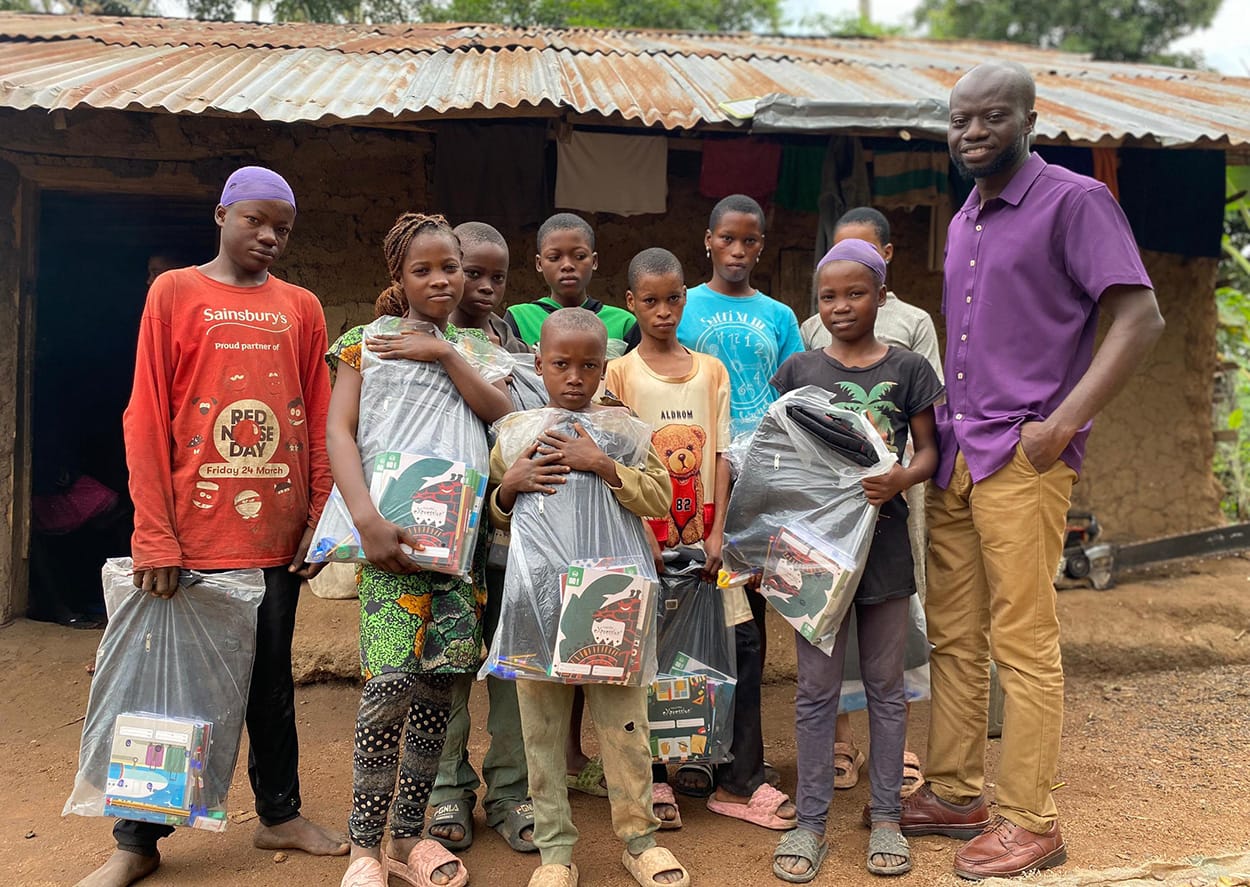
Sunbeth fully engages in a Child Labour Monitoring and Remediation System (CLMRS) program, where farmers are educated on child labour and school stationery was distributed to their children. Image: Sunbeth Global Concepts
### **A Signal From the Source**
Nigeria is the world's fourth-largest cocoa producer, yet origin-based exporters have historically occupied a narrow lane: produce, export, and leave the value creation and standards-setting to companies further up the chain. Orange Cocoa is a quiet but deliberate challenge to that arrangement.
On what sets this apart from the wave of sustainability commitments the industry has seen from multinationals, Oyinkansola does not shy away from the comparison.
> "The industry has a credibility problem when it comes to sustainability commitments, and farmers have grown understandably sceptical. What makes Orange Cocoa different is proximity and specificity. We are not designing this from a headquarters in London, working through intermediaries. We source directly from communities we operate in, with farmers we have real relationships with. And our targets are not aspirational statements; they are commitments that can be tracked and monitored by our partners, buyers, and the communities themselves. When an African exporter builds this kind of framework from within the origin, it carries a different kind of legitimacy."
### **Looking Ahead**
Five years from now, the measure of success for Orange Cocoa will not be a single headline metric. Asked what signal she would look for, Oyinkansola is precise.
> "If I can visit sourcing communities and find farmers earning more, farming on healthier land, and actively encouraging younger family members to stay in agriculture, that tells me we have moved beyond programme delivery into real behavioural and economic change. And if our buyers are renewing contracts specifically because of what Sunbeth represents in terms of traceability and supply reliability, it means sustainability has become a genuine market differentiator, not a compliance exercise."
That ambition, grounded in specifics and accountable to evidence, is what separates Orange Cocoa from a corporate communication exercise. Sunbeth is building something designed to last – and inviting buyers, partners, and financiers to be part of it.
- **Read the full Orange Cocoa commitment statement at** [**www.sunbeth.net**](http://www.sunbeth.net/?ref=cocoaradar.com)
---
- **Sponsored content: This article was created in collaboration with Sunbeth Global Concepts. While it aligns with our audience’s interests, the ideas and content are provided by Sunbeth Global Concepts, which retains copyright and editorial responsibility. We’re sharing it to offer our readers relevant information and perspectives.**
### If Cooperatives Are Central to Cocoa Sourcing, They Must Be Central to Cocoa Investment
URL: https://cocoaradar.com/if-cooperatives-are-central-to-cocoa-sourcing-they-must-be-central-to-cocoa-investment/
Last updated: 2026-05-06T14:06:52.000Z
From our desk to yours. DailyDaily.
## Join our growing community of members and receive a free version of our daily newsletter on what really matters in cocoa.
No spam. Unsubscribe anytime.
[Subscribe → ](https://cocoaradar.com/#/portal/signup)
**Cooperatives are central to the sector and to building its resilience**.
That may sound self-evident. After all, many of the world’s largest cocoa buyers already source significant volumes through cooperatives and farmer organisations. But the discussion pushed further. The real question is no longer whether cooperatives matter – it is whether the industry is investing in them at anything like the level required.
As moderator Anthony Myers noted at the outset, *“*strong cooperatives are not just a social model, they are a commercial asset.” That point was echoed by panellists from Fairtrade Africa, Ferrero, Ben & Jerry’s, and cooperatives Ecookim and Coopaza in Côte d’Ivoire.
Advertisement
[  ](https://www.foodmasters-freiberg.com/en/?utm%5Fsource=ghost&utm%5Fmedium=newsletter&utm%5Fcampaign=ad&utm%5Fcontent=qsm%5Fplaceholder)
In a volatile market, the cooperative model is being asked to do far more than aggregate beans – it is being asked to hold together the foundations of resilient cocoa supply chains.
### **Trust as Infrastructure**
The discussion was grounded in new [research from Fairtrade Foundation](https://www.fairtrade.net/content/dam/fairtrade/fairtrade-uk/resource-library/reports/Co-operatives%20Build%20a%20Better%20World%20for%20Cocoa%20Farmers.pdf?ref=cocoaradar.com) presented by Sonndia Ouattara, Cocoa Lead, Fairtrade Africa. The key findings were that cooperatives support farmer incomes in interconnected ways: securing better terms through aggregation, enabling access to markets and finance, distributing services and inputs, and – critically – building trust.
That trust emerged as one of the most important themes of the webinar. Ouattara described cooperatives as *“*trusted agents of change.”
It is a phrase worth examining.
Too often, the industry frames training, productivity, or compliance as purely technical interventions. But these efforts only succeed when farmers trust the people delivering them – and the systems behind them.
> As Cheryl Pinto of Ben & Jerry’s put it, “many things move at the speed of trust, including innovation.”
Programmes on areas like pruning, farm rehabilitation, or income diversification may look robust on paper, but their effectiveness ultimately depends on confidence – confidence from farmers, cooperative leadership and from the buyers supporting them.
This was reinforced by Pinto’s observation of a “virtuous cycle”: long-term partnerships build trust, which, in turn, drives higher adoption rates. In Ben & Jerry’s work with Coopaza, for example, trust has directly contributed to increased uptake of pruning within farm service programmes.
### **Procurement and Sustainability: No Longer Separate**
From a commercial perspective, Olivier Zwolsman of Ferrero offered a complementary insight. Reflecting a broader shift within the sector, he highlighted that procurement and sustainability functions are increasingly integrated – something both Ferrero and Ben & Jerry’s lead well on
> “A buyer in cocoa can’t look at procurement separately from sustainability,” he said.
Zwolsman also emphasised the importance of long-term partnerships alongside robust internal management systems within cooperatives. Strong cooperative data and standardised benchmarking, he argued, is essential to track impact effectively – to understand what is working, what is not, and where investment should be directed.
### **The Business Case for Strong Cooperatives**
The implications are significant. Strong cooperatives are not just vehicles for delivering sustainability projects – they are increasingly essential for securing traceability, managing farmer data, reducing side-selling, improving market access, and preparing for compliance with regulations such as the EU Deforestation Regulation.
They also provide critical infrastructure for addressing systemic risks, including child labour, gender inequality, and climate vulnerability.
In short, cooperatives are not just where sustainability happens – they are where supply chain resilience happens.
### **Investment as a Force Multiplier**
Aminata Bamba of the Ecookim union made the operational case clear. Most of the cocoa farmers she works with are smallholders cultivating around 3 hectares. At that scale, individual farmers have limited negotiating power and restricted access to services or finance.
The cooperative’s role, therefore, is deeply practical: to organise, buy, sell, train, support, and connect. It also serves as the conduit through which long-term partnerships translate into tangible benefits for farmers.
Bamba highlighted the transformative potential of cooperative-level investment. Well-funded cooperatives are better positioned to access premium markets – such as Fairtrade – where additional income can be reinvested into farmer livelihoods. This includes supporting income diversification, establishing Village Savings and Loan Associations (VSLAs), and delivering inputs, agricultural training and services to improve productivity.
### **Finance, Liquidity, and Risk**
Access to finance was another key thread throughout the discussion. Ouattara pointed to the importance of pre-finance, input loans, harvest loans, and diversification finance. She highlighted Fairtrade’s LEAP revolving finance facility, funded by Mars, as an example of how cash-flow constraints can be addressed more strategically.
Liquidity at the cooperative level is critical. Without it, cooperatives struggle to purchase crops when farmers need to sell, driving side-selling at lower prices and undermining farmers' income security. With it, they can stabilise supply, support access to inputs, and enable farmers to invest beyond cocoa.
[CocoaRadar LiveTurning Webinars into Global Broadcast Events for the cocoa & chocolate industryFrom The Desk of CocoaRadar™Anthony Myers](https://cocoaradar.com/cocoaradar-live/)
### **Trust, Accountability, and Results**
The webinar also featured insights from Djibo Breiman of the Coopaza cooperative, which has grown from 166 members in 2011 to more than 3,200 today.
He attributed this growth to a combination of direct and indirect benefits: training, premiums, access to inputs, local infrastructure, women’s empowerment, and sustained partnerships. But at the heart of it all lies trust.
> According to Breiman, trust is built through accountability, transparency, and consistent delivery. *“*The best publicity for what we do is results,” he said.
It is a grounding reminder in a sector that can sometimes lean too heavily on abstract language. Farmers join – and remain in – cooperatives not because of rhetoric, but because those cooperatives deliver tangible value.
### **From Sourcing to Investment**
Despite growing reliance on cooperatives, a critical gap remains between sourcing from them and investing in them.
That gap carries real consequences. Without sustained investment, cooperative capacity weakens, service delivery becomes fragile, productivity gains stall, and risk remains disproportionately concentrated at the farmer level.
Pinto captured this tension with a compelling phrase: beyond “linked prosperity,” the sector must also embrace “shared adversity.” If buyers expect resilient supply chains, risk cannot simply be pushed down during periods of volatility. Partnership must hold in difficult years as well as favourable ones.
### **A Strategic Turning Point**
The webinar’s conclusion was clear. Cocoa cooperatives are among the sector’s most important commercial and strategic partners to build a sustainable, resilient cocoa sector.
The question now is whether the industry is prepared to invest accordingly.
- **Download the latest Fairtrade Foundation Research:** [**CO-OPERATIVES BUILD A BETTER WORLD FOR COCOA FARMERS**](https://www.fairtrade.net/content/dam/fairtrade/fairtrade-uk/resource-library/reports/Co-operatives%20Build%20a%20Better%20World%20for%20Cocoa%20Farmers.pdf?ref=cocoaradar.com)
---
**cocoaradar.com is:**
- **Official Media Partner -** [**CAA International Cocoa Conference**](https://www.caacocoaconference.org/programme?ref=cocoaradar.com)
- **'From Our Desk. To Yours. Daily'**
- [**Sign-up here**](https://cocoaradar.com/#/portal) **for free and choose your plan.**
### Fairtrade Raises Cocoa Living Income Reference Prices After Industry-Wide Review
URL: https://cocoaradar.com/fairtrade-raises-cocoa-living-income-reference-prices-after-industry-wide-review/
Last updated: 2026-05-05T13:40:23.000Z
The move follows a year-long consultation process and comes amid renewed debate over whether reference pricing can meaningfully address persistent farmer poverty.
The revised voluntary benchmarks have increased for both countries, which together account for roughly two-thirds of global cocoa production. The new farmgate-equivalent LIRP is set at 1,758 CFA francs per kilogram (approximately $3.11) in Côte d’Ivoire and 45.40 cedi per kilogram (around $3.95) in Ghana.
According to Carla Veldhuyzen van Zanten, Senior Advisor of Sustainable Livelihoods at Fairtrade, price volatility remains a key barrier to long-term farm investment. She said the updated figures incorporate “the latest data and inputs from all sides of the cocoa industry” and are intended to shift the conversation “from talk about the importance of living incomes to concrete action.”
Advertisement
[  ](https://www.foodmasters-freiberg.com/en/?utm%5Fsource=ghost&utm%5Fmedium=newsletter&utm%5Fcampaign=ad&utm%5Fcontent=qsm%5Fplaceholder)
### **Consultation Follows Criticism Of Earlier Pricing Model**
The update comes after Fairtrade’s January 2025 revision triggered significant industry scrutiny. Stakeholders – including companies, producers, civil society groups, and researchers – questioned the assumptions underpinning the pricing model, particularly its ability to reflect real farm conditions.
[Fairtrade Living Income Reference Prices ‘don’t go far enough’ as Chocoa opens with discussions on the ongoing issue of farmer povertyFairtrade recently published its updated Living Income Reference Prices (LIRP) for cocoa from Cote d’Ivoire and Ghana, and while it is viewed as a valuable tool by the industry - according to some it does “not reflect the right of cocoa farmers to earn a Living Income”From The Desk of CocoaRadar™Anthony Myers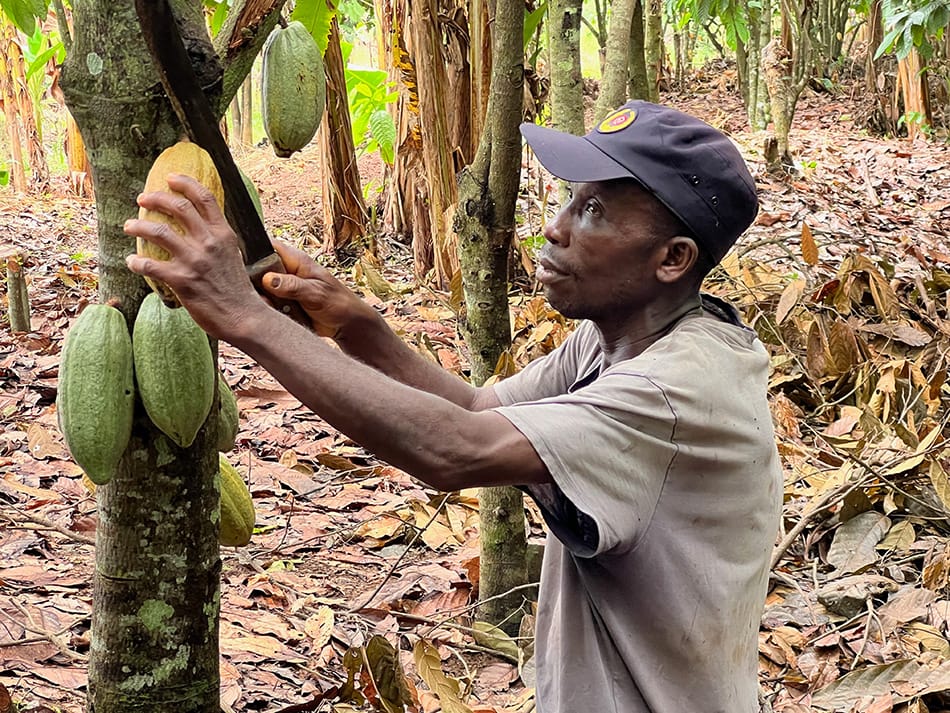](https://cocoaradar.com/fairtrade-living-income-reference-prices-dont-go-far-enough-as-chocoa-opens-with-discussions-on-the-ongoing-issue-of-farmer-poverty-2/)
That criticism has been part of an ongoing debate within the sector. Previous reporting by Cocoaradar highlighted concerns that LIRPs, while directionally positive, “do not go far enough” to close the income gap faced by smallholder farmers.
In response, Fairtrade undertook an extensive review process to align economic modelling with on-the-ground realities. The consultation coincided with a sharp correction in global cocoa prices – from peaks above $10,000 per tonne in late 2024 to roughly $3,400 per tonne by April 2026 – renewing concerns about farmer vulnerability.
### **Producers Emphasise Realism And Stability**
Industry participants involved in the consultation have largely welcomed the process, while stressing that price-setting must remain grounded in practical realities.
Yesson Moussa Yeo, Managing Director of the Yeyasso cooperative in Côte d’Ivoire, described the review as “robust” and participatory, noting that it helped build transparency and trust across the value chain.
> However, he cautioned that price benchmarks must account for variables such as farm size, family labour, climate pressures, and adoption of agricultural practices. Crucially, he underscored the importance of price stability: “A realistic price only has an impact if it is stable,” he said, pointing to the need for predictability to enable long-term planning and investment.
### **Gap Remains Between Reference And Market Prices**
The new LIRPs sit significantly above current regulated farmgate prices, particularly in Côte d’Ivoire. The updated Ivorian benchmark is 47% higher than the prevailing farmgate price of 1,200 CFA francs per kilogram. In Ghana, the increase is more modest, with the LIRP about 10 percent above the current 41.40 cedi per kilogram.
This gap underscores a persistent challenge: while LIRPs signal what farmers *should* earn to achieve a living income, they are voluntary and depend on uptake by companies and retailers.

#### CAA
The conference theme, "Good Together: Building an Agile Cocoa Future" reflects the collective resolve of the industry to respond to one of the most volatile and complex periods the sector has ever faced — together.
[Register Here](https://www.caacocoaconference.org/?utm%5Fsource=Cocoa+Association+of+Asia&utm%5Fcampaign=f03b0a338f-EMAIL%5FCAMPAIGN%5F2026%5F03%5F05%5F02%5F21%5FCOPY%5F01&utm%5Fmedium=email&utm%5Fterm=0%5F-c316032d2a-618222449&mc%5Fcid=f03b0a338f&mc%5Feid=c1da1b1569)
### **Industry Uptake Grows – But Questions Remain**
Fairtrade maintains that LIRPs are only one component of a broader “living income” strategy, which also includes productivity improvements, climate resilience, and income diversification. The organisation is developing a more flexible programme allowing companies to invest in these areas alongside paying higher prices.
Several European retailers – including Action, Marks & Spencer, Lidl, and Superunie – have already committed to integrating LIRPs into their sourcing strategies.
Adoption appears to be increasing. Volumes of Fairtrade cocoa sold at LIRP levels have tripled since 2019, reaching nearly 32,000 metric tonnes in the 2023/24 season. Commitments for 2026–2027 are set to approach 48,000 tonnes, a further 50% rise.
### **A Step Forward – Or Still Not Enough?**
Despite this momentum, the fundamental question remains unresolved: can voluntary reference pricing close the structural income gap in cocoa?
Critics argue that without wider industry alignment – or regulatory intervention – LIRPs risk remaining a niche mechanism rather than a systemic solution. Supporters, meanwhile, view them as a necessary step toward more equitable pricing frameworks.
Fairtrade plans to expand the model further, with a Living Income Reference Price for cocoa in Peru expected in early 2027.
For now, the updated benchmarks mark both progress and continued tension in the sector’s long-running effort to translate sustainability commitments into tangible income gains for farmers.
### Cocoaradar Analysis: EU Deforestation Regulation Simplification Package
URL: https://cocoaradar.com/cocoaradar-analysis-eu-deforestation-regulation-simplification-package/
Last updated: 2026-05-04T13:35:11.000Z
The report to the European Parliament and Council describes the simplification measures that have been implemented since the entry into force of the EUDR in June 2023, setting out a package designed to cut compliance costs, clarify obligations, and ease pressure on smaller operators before the law takes effect on 30 December 2026 for large and medium companies and 30 June 2027 for most micro and small enterprises.
### **What Changed**
The Commission’s package includes updated guidance, revised FAQs, a draft delegated act on product scope, improvements to the EUDR Information System and planned trade-facilitation tools. Brussels says the combined measures should reduce annual compliance costs by around **75%**, from an estimated **€8.1bn to €2.0bn**.
Advertisement
[  ](https://www.foodmasters-freiberg.com/en/?utm%5Fsource=ghost&utm%5Fmedium=newsletter&utm%5Fcampaign=ad&utm%5Fcontent=qsm%5Fplaceholder)
The most important simplification is the shift of responsibility for due diligence to the **first operator** placing covered products on the EU market or exporting them. Downstream operators and traders will mainly collect and retain reference information rather than submit their own due diligence statements.
For micro and small primary operators in low-risk countries, the package introduces a lighter regime: a **one-off simplified declaration** instead of repeated due diligence statements. The Information System will also be adjusted with simplified forms, API upgrades, contingency planning and voluntary grouping of due diligence reference numbers.
_This post is for paying subscribers only._
### Moving Cocoa: All Eyes on Cameroon
URL: https://cocoaradar.com/moving-cocoa-all-eyes-on-cameroon/
Last updated: 2026-05-01T12:01:18.000Z
From our desk to yours. DailyDaily.
## Join our growing community of members and receive a free version of our daily newsletter on what really matters in cocoa.
No spam. Unsubscribe anytime.
[Subscribe → ](https://cocoaradar.com/#/portal/signup)
It was January, 2008\. I was 22 years old, travelling alone, landing at Douala airport. No one came to pick me up. Taxi drivers pulled at my suitcases from three sides in the arrival hall, where I was the only white face.
The heat was damp and thick, slowing my thinking. It was sensory overload, and for a moment, I seriously reconsidered my choice to go to Cameroon in search of adventure and something meaningful in life.
I regrouped my thoughts, picked myself up and left the airport. What started as a six-month internship became three years of living and working in Central Africa.
_This post is for subscribers only._
### Mondelēz Beats Q1 Expectations as Cocoa Price Slump Eases Margin Pressure
URL: https://cocoaradar.com/mondelez-beats-q1-expectations-as-cocoa-price-slump-eases-margin-pressure/
Last updated: 2026-04-30T15:23:02.000Z
CocoaRadar Pro Intelligence Brief: Mondelēz International reported stronger-than-expected first-quarter results, supported by pricing power and easing input costs amid a retreat in cocoa prices, while Magnum Ice Cream Company Posts Resilient Q1 Growth
_This post is for subscribers only._
### Farmforce and Barry Callebaut Expand Traceability Push Across Global Cocoa Supply Chain
URL: https://cocoaradar.com/farmforce-and-barry-callebaut-expand-traceability-push-across-global-cocoa-supply-chain/
Last updated: 2026-04-29T13:54:47.000Z
From our desk to yours. DailyDaily
## Join our growing community of members and receive a free version of our daily newsletter on what really matters in cocoa.
No spam. Unsubscribe anytime.
[Subscribe → ](https://cocoaradar.com/#/portal/signup)
The collaboration, which began in 2024 following a competitive selection process, is already live across key origin markets. Since October 2025, Farmforce’s digital systems have been deployed in 50 cooperatives in Côte d’Ivoire, while a parallel rollout in Indonesia now covers all 10 targeted warehouses. The goal: build a fully traceable, data-driven supply chain from farm to first point of aggregation.
Advertisement
[  ](https://www.foodmasters-freiberg.com/en/?utm%5Fsource=ghost&utm%5Fmedium=newsletter&utm%5Fcampaign=ad&utm%5Fcontent=qsm%5Fplaceholder)
Rather than positioning the partnership as a breakthrough, the companies are framing it as an operational upgrade – one that leans heavily on digital infrastructure to improve oversight, efficiency, and compliance in complex sourcing environments.
> “We’re focused on delivering measurable transparency at scale,” said Hans Christian Fleischer, Chief Commercial Officer at Farmforce. “That means better data, clearer accountability, and tools that actually work in the field.”
### **Moving Beyond Traceability as a Buzzword**
At the centre of the rollout are two platforms: Farmforce Orbit and Farmforce Origin.
Orbit is designed for field-level execution. It equips teams with case management tools – used, for example, to flag and respond to risks such as child labour – alongside performance tracking, survey deployment, and geospatial mapping of farms. The emphasis is on standardising workflows across cooperatives while enabling faster, more targeted interventions.
Origin, meanwhile, handles the logistics layer. It tracks cocoa at the bag level, linking physical flows with digital records to support traceability claims. Features include automated quota controls, quality tracking, certification management, and integration with enterprise systems like SAP.
Together, the systems aim to close longstanding visibility gaps between smallholder production and global supply chains – a persistent challenge in the cocoa sector.
[The Cocoa Visibility Paradox: Compliance Is Scaling — Verification Is NotCocoaRadar Exclusive: As the cocoa sector prepares for the unveiling of Farmforce’s latest findings in its First Mile Traceability Barometer, at Chocoa, one message is unmistakable: the industry has mobilised around traceability — but the foundations remain fragileFrom The Desk of CocoaRadar™Anthony Myers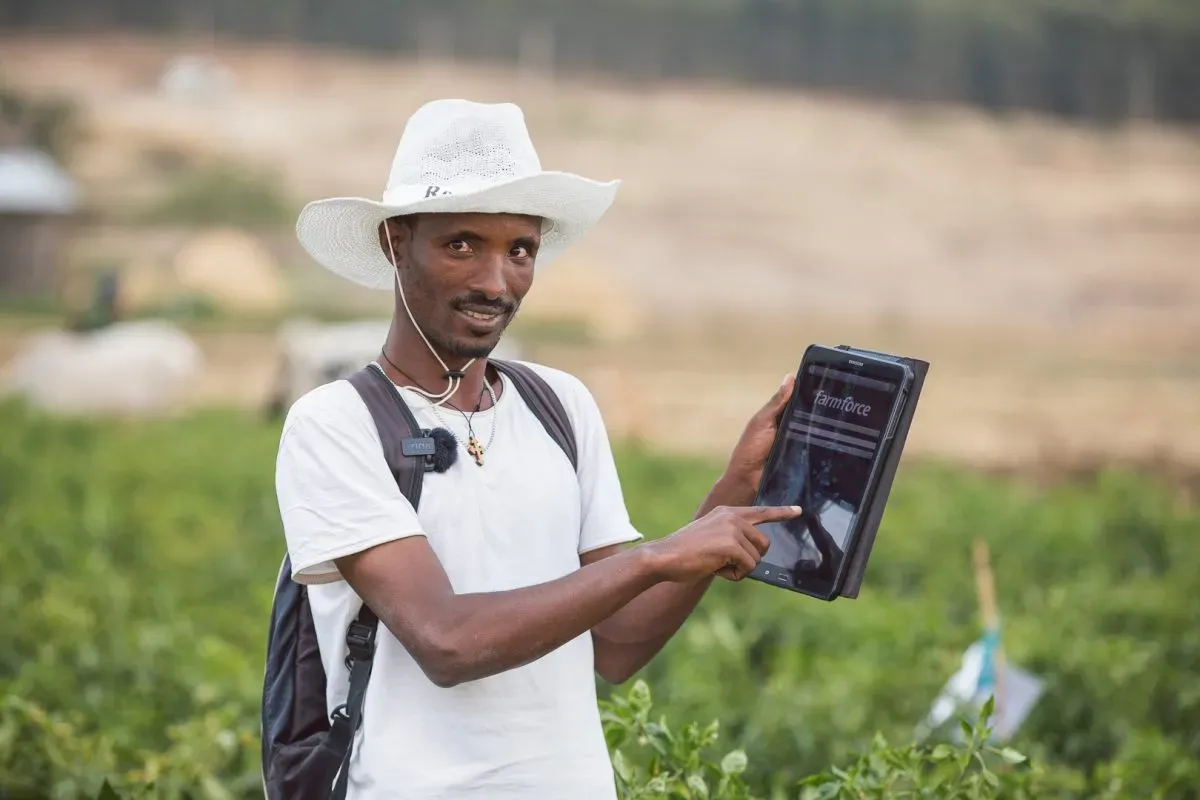](https://cocoaradar.com/the-cocoa-visibility-paradox-compliance-is-scaling-verification-is-not/)
### **Scaling Across Origins**
The next phase of the partnership will test its scalability. Expansion is scheduled to continue through 2026, with additional cooperatives coming online in Côte d’Ivoire and a first deployment planned in Nigeria. Ghana is expected to follow in 2027.
At full rollout, the programme is projected to reach around 600 cooperatives worldwide, positioning it among the largest first-mile traceability initiatives currently underway in cocoa.
### **A Sector Under Pressure**
The timing is notable. Cocoa supply chains are facing mounting pressure from incoming regulations – particularly in Europe – requiring stricter due diligence on deforestation, labour practices, and transparency in sourcing.
Against that backdrop, partnerships like this are less about innovation for its own sake and more about readiness: building systems capable of producing verifiable data at scale.
Whether these tools translate into meaningful impact on the ground remains the key question. But for now, the direction of travel is clear—digitisation is becoming a baseline requirement, not a differentiator.
---
**cocoaradar.com is:**
- **Official Media Partner -** [**CAA International Cocoa Conference**](https://www.caacocoaconference.org/programme?ref=cocoaradar.com)
- **'From Our Desk. To Yours. Daily'**
- [**Sign-up here**](https://cocoaradar.com/#/portal) **for free and choose your plan.**
### Ferrero Expands US Manufacturing with $75M Nutella Peanut Facility in Illinois
URL: https://cocoaradar.com/ferrero-expands-us-manufacturing-with-75m-nutella-peanut-facility-in-illinois/
Last updated: 2026-04-28T14:43:13.000Z
From our desk to yours. DailyDaily.
## Join our growing community of members and receive a free version of our daily newsletter on what really matters in cocoa.
No spam. Unsubscribe anytime.
[Subscribe → ](https://cocoaradar.com/#/portal/signup)
According to an official release from the company, the new facility marks a strategic milestone for Ferrero, enabling the first-ever US-based production of its flagship Nutella spread – and the debut of its first new flavour in more than six decades.
### A Strategic Investment in Growth
The Franklin Park expansion introduces a dedicated production line for Nutella Peanut, a hybrid spread combining the brand’s signature hazelnut cocoa base with roasted peanuts. The project is expected to create approximately 50 new jobs and reinforce Ferrero’s long-term commitment to scaling operations in the United States.
> “This new facility showcases our commitment to growth in North America and our ability to evolve iconic brands in meaningful ways,” said Michael Lindsey, President and Chief Business Officer of Ferrero North America.
The investment builds on Ferrero’s broader US expansion strategy, which has included billions of dollars in acquisitions and infrastructure development. Since acquiring Nestlé’s US confectionery business in 2018, Ferrero has accelerated its presence across manufacturing, research and development, and supply chain operations.
Advertisement
[  ](https://www.foodmasters-freiberg.com/en/?utm%5Fsource=ghost&utm%5Fmedium=newsletter&utm%5Fcampaign=ad&utm%5Fcontent=qsm%5Fplaceholder)
### Strengthening Domestic Supply Chains
The new Nutella Peanut product will be manufactured using domestically sourced ingredients, including hazelnuts from Oregon and peanuts from Georgia and other southeastern states. This localised sourcing strategy aligns with broader industry trends toward supply chain resilience and regional economic support.
Retail partners have welcomed the move. “When suppliers invest in US manufacturing, the impact is tangible – more jobs, stronger communities, and greater opportunity,” said Melody Richard, Senior Vice President at Walmart.
### Building on an Established Manufacturing Hub
The Franklin Park facility has long been a cornerstone of Ferrero’s US operations, producing legacy brands such as Butterfinger and Baby Ruth since the 1960s. The site became part of Ferrero’s portfolio following its acquisition of Nestlé’s US confectionery assets.
Illinois now serves as a critical hub for the company, housing not only the Franklin Park plant but also:
- A manufacturing campus in Bloomington producing brands such as Crunch, 100 Grand, and Raisinets
- Ferrero’s first North American Innovation Center and R&D labs in Chicago
- Additional production facilities supporting Keebler products
Beyond Illinois, Ferrero operates manufacturing sites across Georgia, Kentucky, Ohio, Arizona, Pennsylvania, and New Jersey, underscoring the scale of its US footprint.
### Innovation Meets Brand Legacy
The introduction of Nutella Peanut represents a notable shift for a brand that has largely maintained its original formulation since its launch in 1964\. The move signals a willingness to innovate within established product lines while responding to evolving consumer preferences.
> “Our fans have been asking for this for years,” said Noah Szporn, Senior Vice President of Spreads at Ferrero North America. “Nutella Peanut delivers the familiar experience consumers love, with a new flavour profile that broadens its appeal.”

#### CAA
The conference theme, "Good Together: Building an Agile Cocoa Future" reflects the collective resolve of the industry to respond to one of the most volatile and complex periods the sector has ever faced — together.
[Register Here](https://www.caacocoaconference.org/?utm%5Fsource=Cocoa+Association+of+Asia&utm%5Fcampaign=f03b0a338f-EMAIL%5FCAMPAIGN%5F2026%5F03%5F05%5F02%5F21%5FCOPY%5F01&utm%5Fmedium=email&utm%5Fterm=0%5F-c316032d2a-618222449&mc%5Fcid=f03b0a338f&mc%5Feid=c1da1b1569)
### Broader Business Context
Ferrero’s expansion comes amid continued global growth. The company reported annual revenues of €19.3 billion ($22.7 billion) in its most recent fiscal year. At the same time, it faces regulatory scrutiny in Europe, where it is cooperating with ongoing inspections by the European Commission.
Despite these challenges, Ferrero’s US investment strategy reflects confidence in the region as a key growth market. The Franklin Park expansion not only enhances production capabilities but also positions the company to better serve North American consumers with locally manufactured products.
### CocoaRadar Outlook
With the launch of Nutella Peanut and increased domestic production capacity, Ferrero is reinforcing its dual focus on innovation and localisation. The Illinois facility stands as a tangible example of how legacy food brands can evolve – balancing tradition with modern consumer demands while driving regional economic impact.
---
**cocoaradar.com is:**
- **Official Media Partner -** [**CAA International Cocoa Conference**](https://www.caacocoaconference.org/programme?ref=cocoaradar.com)
- **'From Our Desk. To Yours. Daily'**
- [**Sign-up here**](https://cocoaradar.com/#/portal) **for free and choose your plan.**
### Dubai Stakes Its Claim in Cocoa Trade With New DMCC Cacao Centre
URL: https://cocoaradar.com/dubai-stakes-its-claim-in-cocoa-trade-with-new-dmcc-cacao-centre/
Last updated: 2026-04-27T14:32:24.000Z
From our desk to yours. DailyDaily.
## Join our growing community of members and receive a free version of our daily newsletter on what really matters in cocoa.
No spam. Unsubscribe anytime.
[Subscribe → ](https://cocoaradar.com/#/portal/signup)
Dubai is positioning itself as a strategic node in the global cocoa supply chain – signalling a broader shift in how agricultural commodities are traded, financed, and processed.
### **Key development**
The Dubai Multi Commodities Centre (DMCC) has announced plans to launch a dedicated Cacao Centre to accelerate participation in the $26.2 billion global cocoa trade through Dubai. The initiative will offer integrated services across storage, processing, financing, and trading infrastructure.
The Centre will be developed in partnership with Kumbi Cocoa – focused on building direct, equitable relationships with farming cooperatives – and Ribezzi Group, which will lead development and execution. Together, the partners will assess the feasibility of establishing infrastructure in Dubai capable of storing, trading, and processing cacao beans into semi-finished products such as cocoa liquor, cocoa butter, and cocoa powder.
Advertisement
[  ](https://www.foodmasters-freiberg.com/en/?utm%5Fsource=ghost&utm%5Fmedium=newsletter&utm%5Fcampaign=ad&utm%5Fcontent=qsm%5Fplaceholder)
The goal: serve global markets while enhancing efficiency, transparency, and value creation across the cocoa supply chain.
The move builds on DMCC’s established commodities ecosystem and reflects a deliberate expansion beyond traditional strengths – such as gold and energy – into soft commodities with growing global relevance.
The centre is expected to create a consolidated marketplace for cocoa beans and semi-processed products, targeting producers, traders, and chocolate manufacturers seeking more efficient routes between origin countries – primarily in West Africa – and consumption hubs in Europe, the Middle East, and Asia.
### A Geographically Strategic Alternative
For cocoa markets, the development signals a gradual reconfiguration of trade flows. Historically concentrated in Europe – with cities like Amsterdam and London at the centre – cocoa trading may begin to diversify. Dubai offers a geographically strategic alternative, positioned between origin regions and fast-growing demand centres.
For chocolate manufacturers, particularly those expanding into Middle Eastern and Asian markets, sourcing, storing, and processing cocoa closer to end markets could reduce lead times and logistics costs. It also supports supply chain diversification amid heightened volatility in producing regions.
[Special Report: Dubai’s Cocoa Ambitions: Can the UAE Become the Next Global Trade Hub?As global cocoa supply chains face pressure from climate change, shifting demand, and realignments in trade routes, Dubai is positioning itself as a new hub for the international cocoa trade. But can the Emirate, long a powerhouse for gold, diamonds, and tea, add cocoa to its portfolio?From The Desk of CocoaRadar™Anthony Myers](https://cocoaradar.com/special-report-dubais-cocoa-ambitions-can-the-uae-become-the-next-global-trade-hub/)
For investors and commodity buyers, the initiative underscores the continued institutionalisation of cocoa as a globally traded asset class. By embedding financing, warehousing, and trading within a single hub, DMCC aims to reduce transactional friction – potentially increasing liquidity and improving price discovery beyond traditional exchanges.
> Ahmed Bin Sulayem, Executive Chairman and Chief Executive Officer of DMCC, told CocoaRadar: “Cocoa today is not only about production, but about how value is structured, financed, and distributed across the supply chain. With the DMCC Cacao Centre, we are building a platform around that reality. By bringing together producers, traders, manufacturers, and capital within a single ecosystem, we are creating the conditions for more value to be captured closer to origin while strengthening Dubai’s role as a global hub for agri-commodities trade.”
### **Market Response**
While the announcement has not yet triggered immediate price movements, it aligns with a broader trend: Gulf states are increasing investment in food security and agri-commodity infrastructure. The UAE, in particular, has steadily expanded its role in agricultural trade, leveraging its logistics capabilities and free zone model.
Industry signals point to growing interest from trading houses and processors in establishing a presence in Dubai – especially as companies reassess supply chain resilience following recent disruptions in cocoa-producing regions.
The initiative also complements rising regional grind capacity and re-export activity, suggesting Dubai is targeting not just trade flows but long-term value-added processing.
### **What to Watch**
Execution will be critical. Market participants will closely monitor whether the DMCC Cacao Centre can attract meaningful volumes away from established hubs and secure participation from major traders and processors.
Equally important is integration: how effectively the centre connects with existing supply chains in West Africa and whether it can offer competitive pricing, financing, and risk-management tools.
If successful, Dubai could emerge as a significant price-setting and distribution hub in cocoa – reshaping trade routes in a market already under structural strain.
---
**cocoaradar.com is:**
- **Official Media Partner -** [**CAA International Cocoa Conference**](https://www.caacocoaconference.org/programme?ref=cocoaradar.com)
- **'From Our Desk. To Yours. Daily'**
- [**Sign-up here**](https://cocoaradar.com/#/portal) **for free and choose your plan.**
### Global Organic Cocoa: Small Share, Strategic Leverage
URL: https://cocoaradar.com/global-organic-cocoa-small-share-strategic-leverage/
Last updated: 2026-04-28T08:37:45.000Z
From our desk to yours. DailyDaily.
## Join our growing community of members and receive a free version of our daily newsletter on what really matters in cocoa.
No spam. Unsubscribe anytime.
[Subscribe → ](https://cocoaradar.com/#/portal/signup)
Organic cocoa still accounts for less than 4% of global output – but its influence is rapidly expanding. Once viewed as a niche segment, it is now reshaping how the cocoa industry approaches traceability, deforestation compliance, and value-chain transparency. At the centre of this transformation sits Latin America, quietly redefining what high-integrity sourcing looks like in practice.
### A Market Growing in Value – And Redefining Itself
The global organic cocoa market is entering a more strategic phase. Valued at **$11.7 billion in 2026** and projected to reach **$17.4 billion by 2036**, the sector is expected to grow at a steady **4.1% CAGR**, driven by demand for clean-label, traceable, and ethically sourced chocolate.
Yet beneath these headline figures lies a more nuanced reality: organic cocoa remains a minority segment by volume, representing approximately **3.9% of global production**. Its importance, however, far exceeds its scale. For manufacturers and retailers, organic cocoa has evolved beyond certification – it is now a compliance mechanism, a branding asset, and a live test case for future-proof supply chains.
Advertisement
[  ](https://www.foodmasters-freiberg.com/en/?utm%5Fsource=ghost&utm%5Fmedium=newsletter&utm%5Fcampaign=ad&utm%5Fcontent=qsm%5Fplaceholder)
### Latin America: The Quiet Powerhouse
While West Africa continues to dominate global cocoa volumes, Latin America has emerged as the backbone of organic and traceable supply chains.
Countries such as Peru, Colombia and the Dominican Republic play an outsized role in certified organic flows, particularly into Europe – the world’s largest cocoa-consuming region. Recent EU import data reflects both reliance and volatility:
- Continued dependence on Latin American origins for high-integrity, segregated supply chains
- Sustained inflows of certified organic beans from the region
- A drop in EU organic cocoa imports from \~73,000 tonnes (2022) to \~56,000 tonnes (2023), underscoring market instability
This positioning is no coincidence. The region benefits from:
- Established **smallholder agroforestry systems**
- Strong alignment with **organic and biodiversity standards**
- A long-standing reputation for **fine-flavour cocoa**, essential for premium chocolate
As traceability and origin storytelling become market differentiators, these structural advantages are increasingly valuable.
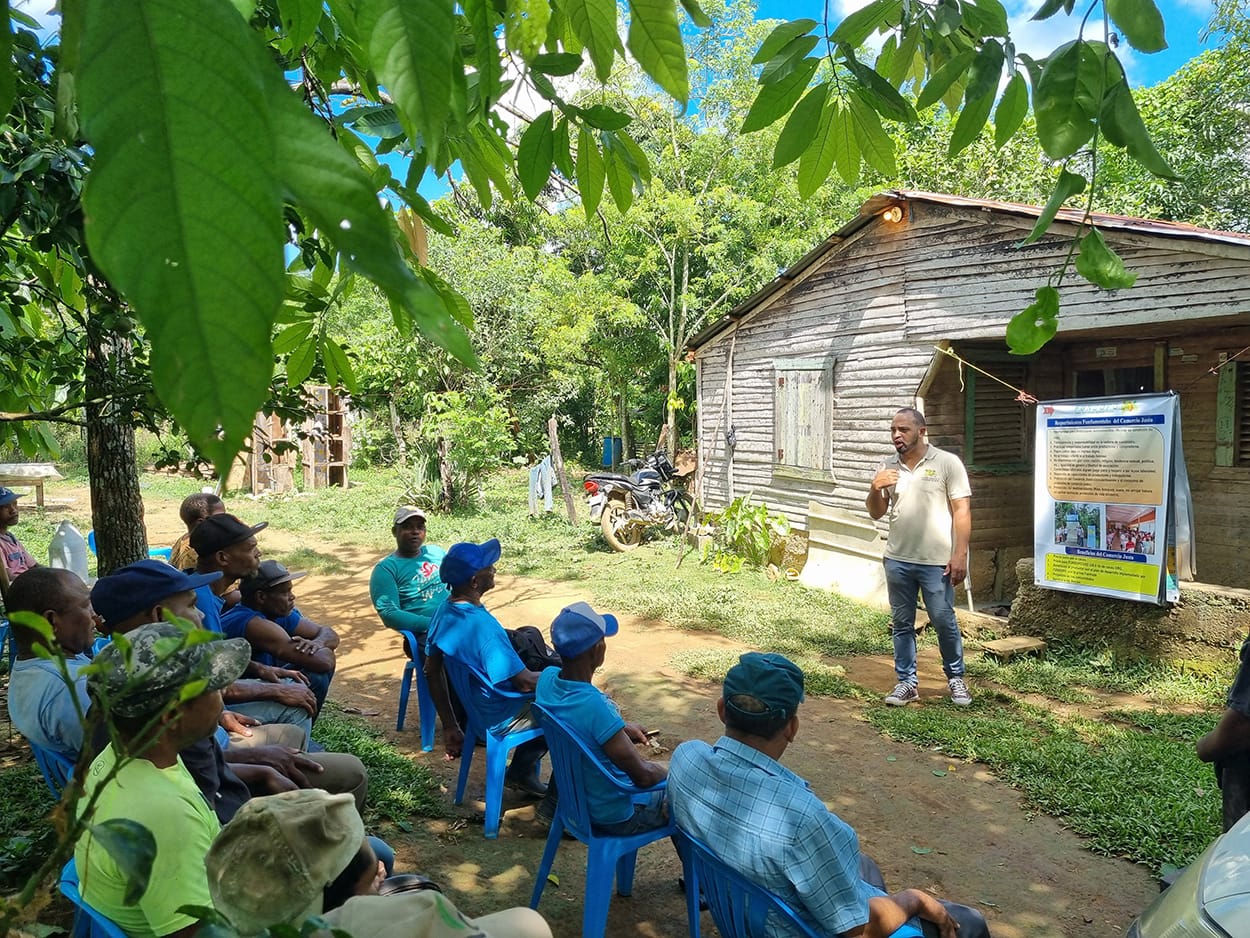
Farmers at the FUNDOPO cooperative in the Dominican Republic receive training to implement direct sourcing, farmer training, and reforestation initiatives. Image: Pronatec
### Demand Drivers: Health, Ethics, and Regulation
Three converging forces are reshaping demand for organic cocoa:
**1\. Functional Chocolate and Wellness**
Organic cocoa – particularly high-percentage dark chocolate – is increasingly positioned as a functional food, rich in flavanols, magnesium, and antioxidants. This is fueling growth across nutraceutical snacks, plant-based confectionery, and functional beverages.
**2\. Clean Label and Ethical Sourcing**
Consumers are shifting away from chemically treated inputs toward pesticide-free cocoa and transparent ‘bean-to-bar’ supply chains. Organic certification is now deeply intertwined with ethical sourcing narratives, reinforcing brand equity.
**3\. Regulatory Pressure—Especially in Europe**
The EU’s forthcoming deforestation regulation (EUDR) is accelerating investment in:
- Farm mapping and geolocation
- Deforestation risk screening
- Digitised supply chain documentation
Organic supply chains – already relatively well-documented – are often first to meet these requirements, increasing their strategic importance.

#### CAA
The conference theme, "Good Together: Building an Agile Cocoa Future" reflects the collective resolve of the industry to respond to one of the most volatile and complex periods the sector has ever faced — together.
[Register Here](https://www.caacocoaconference.org/?utm%5Fsource=Cocoa+Association+of+Asia&utm%5Fcampaign=f03b0a338f-EMAIL%5FCAMPAIGN%5F2026%5F03%5F05%5F02%5F21%5FCOPY%5F01&utm%5Fmedium=email&utm%5Fterm=0%5F-c316032d2a-618222449&mc%5Fcid=f03b0a338f&mc%5Feid=c1da1b1569)
### Industry Insight: Pronatec on Traceability and Compliance
David Yersin, CEO of PRONATEC AG, a Swiss-based organic cocoa grower and supplier to Europe, emphasises that traceability has long been embedded in the company’s sourcing model: “Pronatec’s priority has always been sourcing Fairtrade certified organic cocoa beans directly from smallholder farmers – making full traceability and traditionally established agroforestry systems the norm long before regulatory demands arose.”
Through its Dominican Republic subsidiary, YACAO, Pronatec works closely with cooperatives such as FUNDOPO to implement direct sourcing, farmer training, and reforestation initiatives.
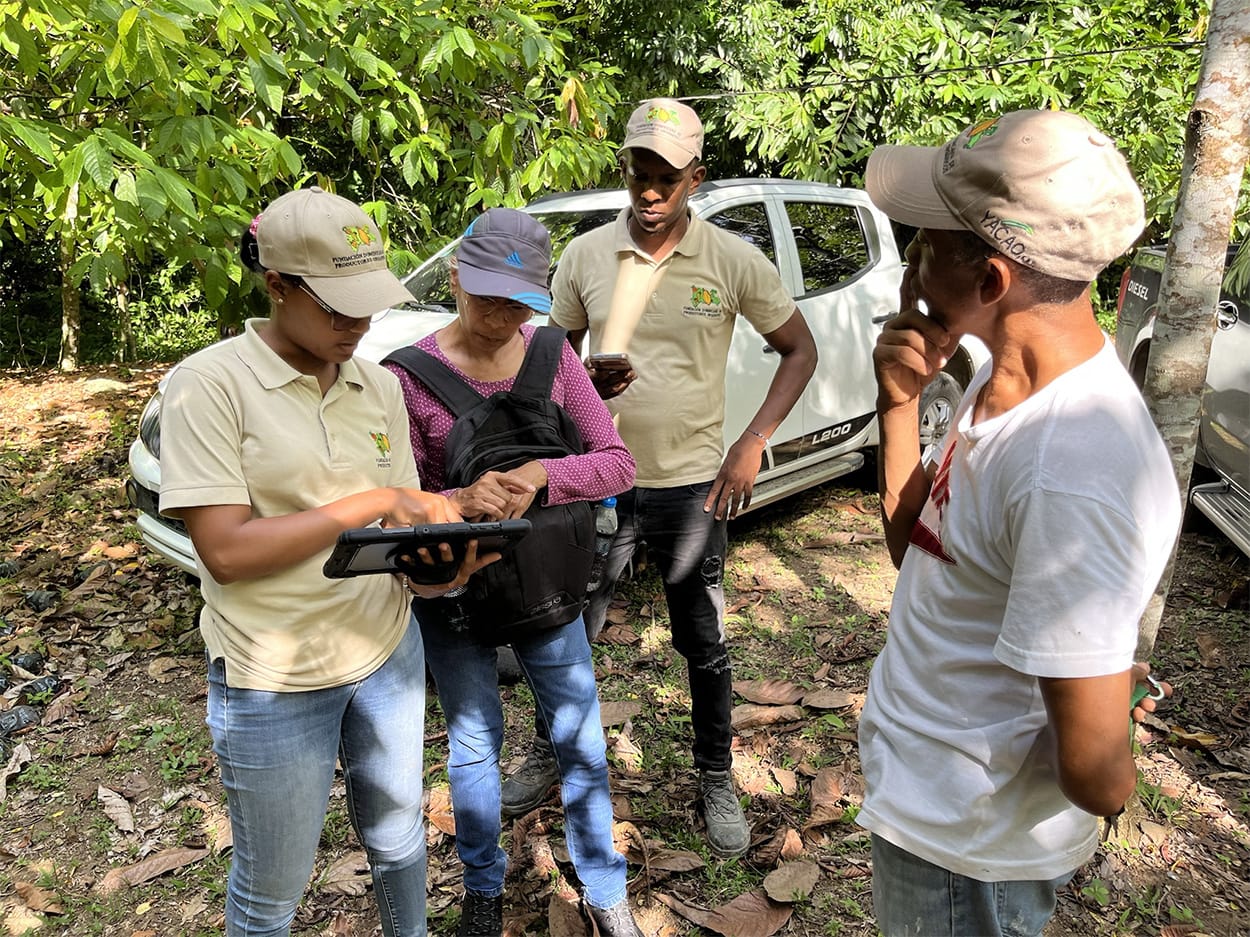
Managers from the coopertaive use latest mobile technology to map organic cocoa farms. Image: Pronatec
However, compliance is not without friction:
> “The operational reality is that obtaining, verifying and managing the required data – especially geolocations – is very time-consuming, while producers face increasingly complex regulatory requirements.”
Despite delays in EUDR implementation, Yersin sees an opportunity: “The revised timeline allows us to refine our approach and support a practical, structured, and as unbureaucratic an implementation as possible.”
### The Premium Paradox: Who Captures the Value?
Despite its premium positioning, organic cocoa continues to face a structural challenge: ensuring value reaches farmers.
The 2024–2025 cocoa price surge – rising from roughly €2,000–3,000 to as high as €10,000 per tonne – temporarily boosted farmgate incomes. Yet underlying issues persist:
- Certification and compliance costs can erode premiums
- Cooperative operating expenses reduce farmer payouts
- Additional requirements (traceability, audits, segregation) increase overhead
In some cases, elevated market prices delivered greater income gains than sustainability premiums themselves – raising critical questions about value distribution.
### Industry Insight: Pronatec on Farmer Economics
Pronatec’s model aims to address this imbalance through direct sourcing:
> “Because we source all our cocoa directly from smallholder cooperatives – never through intermediaries – we can be confident that higher market prices and premiums reach the farmers themselves.”
According to Yersin, these premiums are reinvested into:
- Reforestation
- Organic training
- Community development
“We see this as a fundamental responsibility: delivering high-quality raw materials while actively improving livelihoods at origin.”
### Supply Constraints: Agronomy Meets Compliance
Organic cocoa is not just demand-driven – it is inherently constrained by production realities:
- Lower yields without synthetic inputs
- Greater reliance on knowledge-intensive agroforestry systems
- Risk of contamination in mixed supply chains
- Strict EU limits on pesticide residues and heavy metals
At the same time, climate volatility and disease pressures – particularly in West Africa – are increasing the importance of resilient, diversified systems, where organic practices may offer long-term advantages.
### Industry Insight: Scaling Supply in a Volatile Market
Despite market fluctuations, Pronatec remains confident in scaling organic supply from the Dominican Republic:
> “Over the past 25 years, we’ve built a trusted presence through YACAO and our partnership with FUNDOPO. Farmers know they can rely on fair prices and consistent premiums.”
With approximately 4,000 cooperative members, digitalisation is becoming essential:
“Efficient digital systems are critical. Our software ensures accurate data management, geolocation, and internal control.”
> Yersin highlights a proactive approach: “In a volatile market, we stay close to the source – supporting producers through training, technical assistance, and quality assurance.”
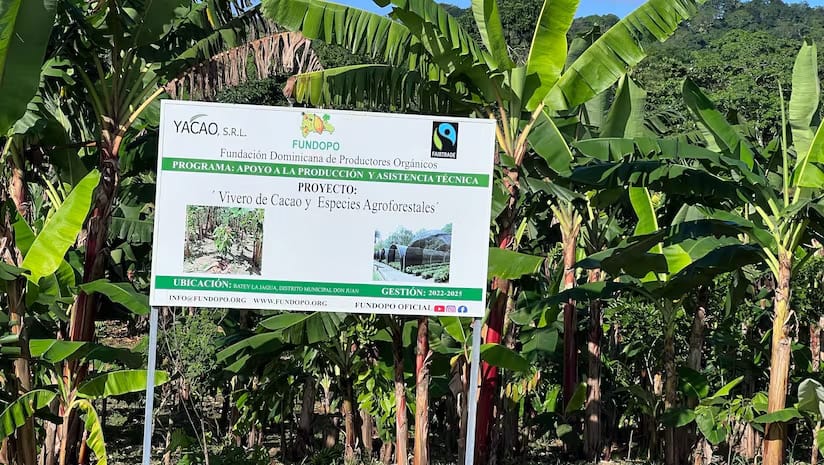
YACAO is fully certified by Fairtrade. Image: cocoaradar.com
### Beyond Certification: The Rise of Verifiable Supply Chains
The future of organic cocoa is shifting from certification alone to verifiable, data-driven supply chains.
Leading industry players are converging around:
- Full farm mapping and geolocation
- Satellite monitoring for deforestation
- Digital traceability systems
- Integrated sustainability programmes tied to income metrics
In this evolving landscape, organic cocoa is becoming a testing ground for next-generation sourcing models that intersect compliance, transparency, and storytelling.
### CocoaRadar’s Takeaway: Small Segment, System-Level Impact
Organic cocoa may remain a niche by volume, but its strategic importance is undeniable. It:
- Anchors high-integrity supply chains
- Aligns with emerging regulatory frameworks
- Enables premium product innovation
- Exposes unresolved tensions around farmer income and value distribution
For Latin America, the opportunity is clear: maintain leadership in traceable, high-quality organic supply while navigating rising regulatory and cost pressures.
For the industry, the challenge is sharper: prove that the premium for integrity delivers measurable impact at origin.
- **Additional source:** [**Organic Cocoa Market (2026 - 2036)**](https://www.factmr.com/report/organic-cocoa-market?ref=cocoaradar.com)
---
**cocoaradar.com is:**
- **Official Media Partner -** [**CAA International Cocoa Conference**](https://www.caacocoaconference.org/programme?ref=cocoaradar.com)
- **'From Our Desk. To Yours. Daily'**
- [**Sign-up here**](https://cocoaradar.com/#/portal) **for free and choose your plan.**
### Nestlé Signals Confectionery Recovery As Cocoa-Linked Pricing Cycle Begins To Stabilise
URL: https://cocoaradar.com/nestle-signals-confectionery-recovery-as-cocoa-linked-pricing-cycle-begins-to-stabilise/
Last updated: 2026-04-23T16:12:39.000Z
💡
****Cocoa trading at 3423.491 USD/T on Thursday, April 23, a 3.509 USD/T (0.1%) decrease from 3427.000 on the last trading session.**
Nestlé’s latest quarterly update suggests the global chocolate category may be entering a more nuanced phase – where pricing remains elevated, but volume trends are starting to improve.
### **Key development**
In its first-quarter 2026 results, Nestlé reported organic sales growth of 3.5%, supported by 1.2% real internal growth (RIG) and 2.3% pricing. Within this, the **Food & Snacks division – home to confectionery - delivered 4.2% growth**, with a more balanced contribution between pricing and volume.
Confectionery was a standout within the segment. Nestlé highlighted high single-digit growth in chocolate, driven by a “sequential improvement” in RIG, indicating that volumes are beginning to recover after a prolonged period of price-led growth.
Advertisement
[  ](https://www.foodmasters-freiberg.com/en/?utm%5Fsource=ghost&utm%5Fmedium=newsletter&utm%5Fcampaign=ad&utm%5Fcontent=qsm%5Fplaceholder)
Performance was consistent across regions. In the Asia, Oceania and Africa zone, confectionery growth was led by strong demand for KitKat, while in the Americas, improving volume trends in Brazil supported momentum. Europe also saw confectionery contribute positively, again led by KitKat, although overall Food & Snacks growth remained modest.
### **A Critical Market Shift**
For cocoa markets, Nestlé’s update points to a critical shift. After several quarters dominated by aggressive pricing to offset historically high cocoa costs, the return of positive volume growth in confectionery suggests **demand resilience is holding – even at elevated price levels**.
This is a key signal. If sustained, it indicates that the demand destruction many feared at peak cocoa prices may be less severe than expected, particularly for globally recognised brands.
For chocolate manufacturers, the message is more tactical. Nestlé’s results show that pricing power is still in play – but no longer the sole driver of growth. The improvement in RIG implies that companies are beginning to find a new equilibrium between price, pack size, and consumer acceptance.
_This post is for paying subscribers only._
### Mars And Ofi Deepen Partnership To Accelerate Net Zero Cocoa In Ecuador
URL: https://cocoaradar.com/mars-and-ofi-deepen-partnership-to-accelerate-net-zero-cocoa-in-ecuador/
Last updated: 2026-04-22T13:41:56.000Z
The recently announced partnership between Mars, Incorporated and Olam Food Ingredients (ofi) to advance Net Zero cocoa production in Ecuador reflects a broader shift in the cocoa sector toward climate-conscious sourcing and farmer-centred sustainability.
On paper, the initiative brings together many of the right elements: long-term collaboration, science-based targets, and a focus on regenerative agriculture.
Yet while the direction of travel is encouraging, the details reveal both meaningful strengths and important limitations that will determine whether this effort becomes a model for systemic change – or remains a well-executed but ultimately contained programme.
Advertisement
[  ](https://www.foodmasters-freiberg.com/en/?utm%5Fsource=ghost&utm%5Fmedium=newsletter&utm%5Fcampaign=ad&utm%5Fcontent=qsm%5Fplaceholder)
> “Building on our long-standing collaboration in cocoa sourcing, this effort demonstrates our belief that when companies share common goals, they can deepen cooperation and drive more meaningful impact at scale,” said Benjamin Guilbert, Global Vice President of Cocoa at Mars.
## **Where The Initiative Stands Out**
One of the clearest strengths of the partnership is its continuity and time horizon. Rather than launching a new, isolated pilot, the programme builds on more than a decade of work in Ecuador. This continuity matters in agriculture, where trust, behavioural change, and ecosystem restoration all require time.
The emphasis on climate-smart practices – including agroforestry and biochar – aligns with current scientific consensus. Moving away from full-sun monoculture toward diversified systems has the potential to deliver multiple co-benefits: improved soil health, greater biodiversity, and increased resilience to climate shocks. These are not marginal gains; they go to the core of long-term cocoa viability.
Equally important is the explicit focus on farmer livelihoods. By aiming to reduce input costs and create new income opportunities, the initiative acknowledges a critical truth: sustainability efforts in agriculture succeed only when they make economic sense for farmers.
Finally, the partnership reflects a wider industry evolution toward shared responsibility across the supply chain. Collaboration between a global brand and a major supplier signals a move beyond fragmented interventions toward more integrated approaches.
> Andrew Brooks, Head of Cocoa Sustainability at ofi, emphasised the practical impact on farmers: “By making regenerative practices more accessible, we aim to reduce implementation barriers and costly inputs while creating opportunities that strengthen farmer resilience and secure the future supply of cocoa.”
## **Where Questions Remain**
Despite these strengths, several aspects of the initiative remain underdefined, leaving open questions about its ultimate impact.
### **1\. Scale versus ambition**
The programme targets around 960 farmers across 9,000 hectares. While significant at a local level, this footprint appears relatively modest when set against the scale implied by ‘accelerating Net Zero cocoa’.
Without clarity on what proportion of total sourcing this represents, it is difficult to assess whether the initiative will materially reduce emissions – or primarily serve as a foundation for future expansion. The distinction is important: pilot programmes are essential, but they are not the same as systemic transformation.
### **The Reality of Farmer Adoption**
The initiative presents regenerative practices as increasingly accessible and beneficial. However, in practice, transitions to agroforestry systems can involve short-term trade-offs, including increased labour demands, delayed financial returns, and technical complexity.
The success of the partnership will depend heavily on whether these practices deliver tangible, near-term economic benefits for farmers – not just long-term environmental gains. If adoption relies heavily on external support, there is a risk that progress could stall once programme incentives are reduced.
### **Measuring Impact And Proving Outcomes**
The partnership commits to measurable reductions in greenhouse gas emissions and improved livelihoods, but offers limited detail on how these outcomes will be quantified and verified.
Key questions include:
- What baseline emissions are being used?
- How will carbon sequestration be measured and validated?
- What indicators will define “improved livelihoods”?
- How will external factors, such as market price fluctuations, be accounted for?
Without clear methodologies and transparent reporting, even well-intentioned programmes can struggle to demonstrate credible impact.
### **The Bigger Picture**
This initiative should be understood as part of a broader transition within the cocoa sector, where companies are increasingly aligning with science-based climate targets and responding to growing demand for sustainable sourcing.
In that context, the Mars–ofi collaboration is directionally strong. It combines technical innovation with on-the-ground engagement and reflects a willingness to invest in long-term solutions.
However, its ultimate significance will depend on three factors:
- **Scalability**: whether the model expands beyond its initial footprint
- **Farmer economics**: whether it delivers consistent, compelling value to participants
- **Credibility of impact**: whether outcomes are rigorously measured and transparently reported
### **A Cautious But Constructive Outlook**
The partnership represents a meaningful step forward, but not yet a definitive breakthrough.
If successfully implemented and scaled, it could provide a replicable model for low-carbon cocoa production. If not, it risks joining a long list of sustainability initiatives that show promise but fail to achieve systemic change.
For now, the initiative sits in an important middle ground: a credible foundation that still needs to prove its transformative potential.
---
**cocoaradar.com is:**
- **Official Media Partner -** [**CAA International Cocoa Conference**](https://www.caacocoaconference.org/programme?ref=cocoaradar.com)
- **'From Our Desk. To Yours. Daily'**
- [**Sign-up here**](https://cocoaradar.com/#/portal) **for free and choose your plan.**
### Hershey US President’s Sudden Exit Signals Deeper Corporate Strain - Premium Analysis
URL: https://cocoaradar.com/hershey-us-presidents-sudden-exit-signals-deeper-corporate-strain-premium-analysis/
Last updated: 2026-04-21T14:34:27.000Z
In a brief regulatory filing on 14 April, Hershey disclosed that Archambault would leave effective 1 May 2026, adding only that he is pursuing ‘another opportunity’. The company has launched a search for a replacement, considering both internal and external candidates.
No further explanation was provided – *an omission that stands out given the timing*.
### **A Departure That Raises Questions**
Archambault’s tenure was notably short. He joined Hershey in early 2025 and, by March 2026, had been elevated to oversee the company’s entire US portfolio under a newly consolidated ‘ONE Hershey’ operating model. Within weeks of that expanded mandate, he was set to exit.
Advertisement
[  ](https://www.foodmasters-freiberg.com/en/?utm%5Fsource=ghost&utm%5Fmedium=newsletter&utm%5Fcampaign=ad&utm%5Fcontent=qsm%5Fplaceholder)
Such a compressed timeline is atypical for a role with broad commercial responsibility, particularly one tied to a major organisational restructuring. Analysts often interpret these rapid transitions as signals of internal misalignment or performance concerns, though Hershey has not publicly confirmed any such issues.
_This post is for subscribers only._
### Swiss Mail Campaign Targets Lindt & Sprüngli Over Cocoa Practices
URL: https://cocoaradar.com/swiss-mail-campaign-targets-lindt-sprungli-over-cocoa-practices/
Last updated: 2026-07-28T11:42:06.000Z
Designed to resemble luxury chocolate packaging, the document replaces familiar branding cues with stark messaging, accusing the cocoa industry of profiting from what it describes as ‘highly toxic’ practices in West Africa.
While advocacy campaigns targeting chocolate companies are not new, the specificity of the allegations – and their direct focus on a named company – marks an escalation in tone and targeting.
Advertisement
[  ](https://www.foodmasters-freiberg.com/en/?utm%5Fsource=ghost&utm%5Fmedium=newsletter&utm%5Fcampaign=ad&utm%5Fcontent=qsm%5Fplaceholder)
At stake is not only the reputation of one of Switzerland’s most recognisable brands, but broader questions about how multinational companies monitor supply chains that extend into some of the world’s most vulnerable farming communities.
### **A Campaign Delivered by Post**
The leaflet (received by a CocoaRadar subscriber and sent to our editorial desk) appears to be part of a wider advocacy or fundraising campaign. It does not clearly identify its authors, but includes contact details linked to:
**Coalition for Corporate Responsibility** P.O. Box 3001 Monbijoustrasse 31 3001 Bern, Switzerland
A Swiss bank account number for donations is also listed, suggesting the mailing is tied to a fundraising effort focused on corporate accountability in cocoa supply chains.
The cover of the flyer targetting Lindt that was sent to households in areas of Switzerland.
The document’s presentation is deliberate: its cover, styled like a premium chocolate bar, reads ‘Pesticide Excellence’, reframing luxury into critique. Inside, it outlines several allegations:
- Hazardous pesticide use in Ghana
- Child labour exposure
- Environmental damage, including deforestation and pollinator decline
- Economic inequality between cocoa farmers and multinational companies
The organisation behind the leaflet could not be independently verified at the time of publication.
[](https://cocoaradar.com/chocci-leaks/)
### **What’s Verified – and What Isn’t**
Many of the leaflet’s claims draw on widely documented industry issues, though their direct connection to Lindt remains, in some cases, unverified.
**Pesticides:** The leaflet highlights chemicals such as imidacloprid and thiamethoxam – neonicotinoids restricted in the European Union due to environmental risks. Scientific literature confirms that such pesticides, along with fungicides like mancozeb, are used in parts of West African agriculture. However, there is no public evidence directly linking these substances to farms supplying Lindt.
**Child Labour:** Estimates of approximately 1.5 million children working in cocoa production in Ghana and Côte d’Ivoire are supported by major studies, including research from NORC at the University of Chicago. Hazardous child labour remains a documented, industry-wide issue – not limited to any single company.
**Pesticide Volumes:** The leaflet claims that 9,700 tonnes of pesticides were used in Ghana in 2023, representing a sevenfold increase since 2010\. While agricultural intensification trends support rising input use, this specific figure could not be independently confirmed.
**Farmer Poverty:** The contrast between multi-billion-franc revenues and low farmer incomes reflects a widely acknowledged disparity across the cocoa sector, supported by numerous studies on living income gaps.
**Deforestation:** Cocoa farming has been identified as a major driver of deforestation in West Africa, though companies and governments- including Lindt have made commitments to address the issue.
## ****Lindt Responds to the Allegations**
Lindt & Sprüngli provided detailed responses to Cocoa Radar addressing the specific claims outlined in the leaflet. The company’s answers are presented below in full.
### Oversight of Sustainability Programmes
**CocoaRadar: The document claims that Lindt & Sprüngli employs only one staff member in Ghana to oversee its entire sustainability program. Can you confirm how many staff are dedicated to sustainability and monitoring in Ghana?**
**Lindt:** In Ghana, the Lindt & Sprüngli Farming Programme is implemented with the help of our suppliers’ 360 field staff.
**CR: How is oversight structured on the ground?**
**Lindt:** The programme is strategically managed by our cocoa team at headquarters; on the ground, we have staff members responsible for local oversight, who maintain close contact with our suppliers, other service providers, and their staff. The field staff implements the programme on the ground, carrying out activities including farmer monitoring, training, or coaching. They are in direct contact with the farmers.
### Child Labour in Supply Chains
**CR: It is alleged that approximately 1.5 million children work in cocoa production in Ghana and Côte d’Ivoire, with exposure to hazardous pesticides. What measures does Lindt take to monitor, prevent, and remediate child labor within its supply chain?**
**Lindt:** We strongly condemn all forms of child labour. Lindt & Sprüngli employs a tailored strategy to mitigate risks in connection with child labour in our cocoa supply chain.
Our cocoa suppliers which implement the Farming Program (in countries of origin with a risk of child labour) are required to address child labour risks by implementing our Child Labour Monitoring and Remediation (CLRMS) guidance. A CLMRS aims to identify children in, or at risk of child labour, to provide appropriate remediation and follow-up measures and to ensure regular awareness-raising within the communities.
Starting in the 2025-26 cocoa season, we launched an update of our CLMRS in partnership with the International Cocoa Initiative (ICI). Our updated approach applies lessons learned from implementing our CLMRS over several years and aligns with the industry standard and best practices such as the ICI core criteria. We work with the ICI as a technical partner to guide and oversee the CLMRS implementation by our suppliers. For volumes sourced outside the Farming Program, we rely on the requirements of, and verification through, the Rainforest Alliance certification.
Since 2025, 100% of our cocoa volume from child labour risk countries were covered by a CLMRS or other due diligence system.
Additionally, we fund specific activities, aiming to address child labour at a more systemic level. For example, we have built or renovated around 100 school facilities in Ghana, Côte d’Ivoire and Madagascar. We also committed nearly 2 million Swiss Francs to collaborative initiatives in Ghana and Côte d’Ivoire which are investing in the education system more broadly.
In addition, with our 2030 Strategy, we have raised our ambitions. For cocoa alone, we plan to make additional investments of around CHF 300 million by 2030, with a large portion of the budget flowing into local community development. A central focus is on access to education, reintegration of children into schools, and promotion of educational quality in collaboration with NGOs. In agricultural value chains, especially in the cocoa sector in West African countries, child labor remains a persistent and complex challenge. Addressing it requires sustained, collaborative efforts from all stakeholders across the sector.
**CR: Can you share recent data or findings from your Child Labour Monitoring and Remediation Systems (CLMRS), if applicable?**
**Lindt:** In 2025, we reached our CLRMS target: 100% of our cocoa volume from child labour risk countries were covered by our CLMRS or other due diligence systems that are being rolled out or are already implemented. This also includes cocoa volumes sourced via the Mass Balance traceability system. Furthermore, in the cocoa reporting year 2024/25, suppliers reported that more than 2,000 children within the Farming Program received remediation support as part of the CLRMS process.
For further information and data, please see our latest [Sustainability Statement](https://www.lindt-spruengli.com/amfile/file/download/id/10512/file/Integrated-Annual-Report-2025.pdf?ref=cocoaradar.com) (starting at page 24, see specifically section Workers in the value chain).
### Use of Hazardous Pesticides
**CR: The document states that highly toxic pesticides (including substances banned in the EU) are used in cocoa farming linked to global supply chains. What is Lindt’s policy on pesticide use among its suppliers? How do you ensure compliance with international safety standards?**
**Lindt:** As of this year, 100% of our cocoa is sourced as Rainforest Alliance Certified. We believe this is an important measure to address grievances, partly thanks to additional controls. The Rainforest Alliance is one of the world’s most renowned non-profit organisations, committed to sustainable agriculture and improving the living conditions of small-scale farmers. Its standards regarding pesticide use are very detailed and cover integrated pest management, protection of pollinators (e.g., bees) and water bodies, as well as the provision of personal protective equipment and medical care. We thus reaffirm our commitment to cocoa farming and to the continuous improvement of the living and working conditions of cocoa farmers.
As part of the Farming Program, targeted training is provided to cocoa farmers, so that they understand the potential dangers of certain pesticides and how to use them properly, as well as emphasizing the importance of wearing appropriate protective clothing. The Lindt & Sprüngli Farming Program is implemented with the help of our suppliers’ field staff, aiming to address these concerns. In this spirit, we will continue to expand our engagement and plan to actively support local cocoa farmers, because in addition to imparting knowledge, it is essential to improve people’s living conditions so that they can earn a secure and healthy livelihood.
Despite our efforts, we are faced with the reality that the improper use of pesticides is a systemic and structural problem and is still widespread in certain countries. For many small farmers in the region the use of sometimes highly toxic pesticides seems to be the ‘easiest’ solution to protect their income. Crop failure means losing their most important source of income, so they often prioritize short-term yields over long-term sustainability.
### Farmer Income and Economic Conditions
**CR: The leaflet contrasts Lindt’s reported revenues with claims that many cocoa farmers in Ghana live in extreme poverty. What steps is Lindt taking to ensure farmers in your supply chain earn a living income?**
**Lindt:** The Lindt & Sprüngli Farming Program strives to contribute to building resilient livelihoods for farmers, their families, and farming communities. Our goal is to help improve the income situation of the farmers in our cocoa value chain. We aim to address this issue through a combination of measures, focused on increasing farm productivity and resilience, and supporting income diversification and community investment. Though this goal applies across our Farming Program origin countries, measures and projects are defined based on the context of each country. As such, there may be local and regional variations.
Building upon the experience we have gained since the introduction of the Farming Program in 2008, we are piloting a Living Income Program aimed at helping to close the income gap toward a living income for cocoa farming households. The basis of this is multi-year support of selected farmer groups. To foster farm investment in productivity and resilience, we finance the direct provision of cash transfers to cocoa farming households. The financial incentives as part of the Living Income Program are structured to enable Good Farming Practices such as pruning cocoa trees to improve yields and to foster children’s school attendance. The Pilot Program aims to cover 5’000 farmers by 2027.
The pilot phase will be guided by a learning agenda to evaluate the effectiveness of core initiatives through structured monitoring and impact assessments. We will also conduct micro-pilots to test innovative solutions to addressing emerging challenges. Based on the insights generated and stakeholder input, we will drive ongoing refinement and adaptation of the Living Income Program.
For further information on the Living Income Program, please see [Farming-Program-2026-2030](https://www.lindt-spruengli.com/amfile/file/download/id/10509/file/Farming-Program-2026-2030.pdf?ref=cocoaradar.com).
[EXCLUSIVE: TogetherCocoa: Rescue Mission for Farmers — or a Cocoa ‘Super League’?Analysis: Five of the world’s biggest chocolate companies have quietly come together to form the TogetherCocoa Foundation, presenting it as a collaborative effort to make cocoa supply chains more ‘resilient’. But what are the real motives behind the formation of an ‘elite bloc’?From The Desk of CocoaRadar™Anthony Myers](https://cocoaradar.com/exclusive-togethercocoa-rescue-mission-for-farmers-or-a-cocoa-super-league/)
Also, the recently incorporated TogetherCocoa foundation aims to help close the living income gap for cocoa farmers in Ghana and Côte d’Ivoire.
**CR: Could you provide data on improvements in farmers’ incomes linked to your programmes?**
**Lindt:** We are now in the process of collecting data related to farmers’ incomes as part of our Living Income Program.
### Pesticide Use Trends
**CR: The document claims that pesticide use in Ghana has increased significantly in recent years. Does Lindt track pesticide usage trends among its partner farmers? If so, what have you observed?**
**Lindt:** Pesticide use in countries of origin is difficult to measure because, particularly in West Africa, pesticides are not only applied by farmers but are also frequently used in mass sprayings carried out by the government. We regularly assess the application of Good Agricultural Practices and the use of agricultural inputs, such as pesticides and fertilizers, based on internal and independent third-party information. The targeted training provided to cocoa farmers as described under question 3 above helps to address potential trends in pesticide use on the ground. We also test for pesticide residues upon receipt of the beans and reject all shipments that exceed legal limits and do not meet our quality standards.
It is important to note that Lindt & Sprüngli strictly monitors its raw materials by conducting extensive laboratory tests on cocoa beans to detect any possible residues of pesticides. Lindt & Sprüngli’s quality and food safety requirements ensure that its entire product range complies with all applicable health and safety standards, making it safe to consume.
The Farming Program builds on the principle of continuous improvement. Our monitoring, evaluation, and verification approach is based on multiple complementary elements. These include certification, target setting, monitoring of outputs, a review of program quality, evaluation of program implementation by Lindt & Sprüngli, as well as periodic impact assessments. These elements are evaluated related to both the farms participating in the program and the implementation partners.
### Deforestation and Environmental Impact
**CR: There are also claims linking cocoa production to deforestation in West Africa. How does Lindt ensure its cocoa sourcing is deforestation-free?**
**Lindt:** We commit to working towards no deforestation in cocoa and our other primary deforestation linked supply chains: palm oil, soy, and pulp- and paper-based packaging.
As part of our approach in working towards no-deforestation, we employ a risk-based approach. This allows us to proactively identify and mitigate risks associated with deforestation, ensuring that our supply chain remains aligned with our sustainability objectives.
Our methodology is built on the following four core implementation options used to determine whether the deforestation risk is sufficiently low to deem a raw material sourced as deforestation-free:
- Satellite and field verification
- Certifications
- Traceable to low-risk origins
- Compliance with the EU Deforestation Regulation (EUDR)
Together, these four implementation options form a comprehensive framework that not only helps us assess deforestation risks but also strengthens our ability to mitigate them systematically.
These implementation options can be applied individually to specific raw materials or adapted in combination to meet the unique challenges of each supply chain: e.g. we perform satellite verification monitoring on cocoa volumes that is also certified with an acceptable certification scheme.
For more information on our commitments and requirements to address commodity-led deforestation in our supply chains, see our [No-Deforestation Policy.](https://www.lindt-spruengli.com/amfile/file/download/id/10192/file/No-Deforestation-Policy-2025.pdf?ref=cocoaradar.com) To learn more about the scope, the implementation approach, and governance to address commodity-led deforestation in our supply chains, see our [No-Deforestation Guidelines](https://www.lindt-spruengli.com/amfile/file/download/id/10195/file/No-Deforestation-Guidelines-2025.pdf?ref=cocoaradar.com).
In addition, 2026 is an important year for the cocoa sector as it prepares for the European Union Regulation on Deforestation-free Products (EUDR). The EUDR mandates traceability for sourcing and control measures to ensure relevant commodities are sourced deforestation-free and in compliance with local regulations. As part of this process, we have developed a robust system with respect to the current EUDR requirements including governance structures, a compliance policy, a risk assessment and mitigation framework, as well as an EUDR due diligence process. Our No-Deforestation Policy and our Responsible Sourcing Approach provide the basis for the requirements to be adopted under the EUDR.
We recognize that working towards no-deforestation in commodity supply chains cannot be achieved by Lindt & Sprüngli alone but requires ongoing collaboration within the sector with our suppliers as well as peers and other stakeholders to address systemic issues and develop common solutions.
**CR: Are you able to trace your cocoa supply to farm level?**
**Lindt:** 100% of Rainforest Alliance Certified cocoa is required to be traceable from farm to first point of purchase (first mile traceability).
We use different traceability levels depending on the cocoa product and market availability, and disclose the amount of volumes sourced under each model (see Metrics and targets in Resource use and circular economy, and Traceability levels in the Glossary of our Integrated Annual Report). For cocoa beans, Lindt & Sprüngli has a traceable supply chain which is considered as “Mixed Identity Preserved” or “Identity Preserved.” “Identity Preserved” means our cocoa beans are traceable from the first point of purchase to our factory doors, and must be supplied from registered Farming Program farmers. Our suppliers work with designated farmer groups that participate in the Lindt & Sprüngli Farming Program, and we aim to support these groups over multiple years.
---
### **CocoaRadar Comment**
This leaflet is not, in itself, proof of wrongdoing. But it reflects a growing strategy among advocacy groups: targeting consumers in wealthy countries with highly specific, data-driven claims about global supply chains.
Whether all its assertions hold up to scrutiny or not, the campaign underscores a broader reality: The cocoa industry remains under pressure to demonstrate that sustainability commitments translate into measurable, verifiable change on the ground.
For companies like Lindt & Sprüngli, the challenge is no longer just to act — but to prove, with transparency and credible data, that those actions are delivering real impact.
- ***Contact: insights@cocoaradar.com for tips or corrections***
---
**cocoaradar.com is:**
- **Official Media Partner -** [**CAA International Cocoa Conference**](https://www.caacocoaconference.org/programme?ref=cocoaradar.com)
- **'From Our Desk. To Yours. Daily'**
- [**Sign-up here**](https://cocoaradar.com/#/portal) **for free and choose your plan.**
### Barry Callebaut’s Reset: Schumacher’s First 100 Days at the Helm - Exclusive Analysis
URL: https://cocoaradar.com/barry-callebauts-reset-schumachers-first-100-days-at-the-helm-exclusive-analysis/
Last updated: 2026-04-17T11:41:15.000Z
When Hein Schumacher describes his first 100 days at Barry Callebaut, he returns repeatedly to one word: focus. It is less a slogan than a diagnosis. After years of expansion, transformation programmes and industry turbulence, the world’s largest chocolate supplier has become, in his telling, both overstretched and internally distracted – precisely as cocoa markets swing violently from shortage to surplus.
> “Service levels are below industry benchmarks – we have to get this right,” he told analysts and investors during yesterday’s call.
[Barry Callebaut Resets Strategy as Cocoa Price Collapse Forces Volume-First PivotCocoaRadar Pro Intelligence Brief: Cocoa’s Rebound Ran Into Hard Demand Data: Prices Bounced, But Europe’s Grind Slump And Barry Callebaut’s Weak Volumes Kept The Market Fundamentally HeavyFrom The Desk of CocoaRadar™Anthony Myers](https://cocoaradar.com/barry-callebaut-resets-strategy-as-cocoa-price-collapse-forces-volume-first-pivot/)
As reported by [cocoaradar.com](https://cocoaradar.com/), Barry Callebaut has cut its profit forecast and warned of the effect of falling cocoa prices. The FT reports that industry overcapacity and supply disruptions saw its shares down more than 15%.
Advertisement
[  ](https://www.foodmasters-freiberg.com/en/?utm%5Fsource=ghost&utm%5Fmedium=newsletter&utm%5Fcampaign=ad&utm%5Fcontent=qsm%5Fplaceholder)
“The Zurich-based group said it now expected earnings before interest and tax to fall by a ‘mid-teens’ percentage in its current financial year, reversing earlier guidance for growth.”
### Make no doubt of the the scale of the challenge facing Schumacher. The question is, can he pull it off?
Schumacher’s first 100 days show:
_This post is for subscribers only._
### Barry Callebaut Resets Strategy as Cocoa Price Collapse Forces Volume-First Pivot
URL: https://cocoaradar.com/barry-callebaut-resets-strategy-as-cocoa-price-collapse-forces-volume-first-pivot/
Last updated: 2026-04-16T12:47:18.000Z
Barry Callebaut has launched a strategic reset aimed at restoring volume growth after a sharp collapse in cocoa prices disrupted earnings and exposed operational constraints, the Swiss chocolate maker said alongside its FY2025-26 half-year results.
New CEO Hein Schumacher, appointed after leading Unilever, said his first 100 days revealed capacity bottlenecks, an incomplete digital transformation, and an overly complex operating model. In response, the company has introduced a 'Focus for Growth' programme and a 'growth accelerator coalition' to streamline execution and prioritise high-impact initiatives.
Advertisement
[  ](https://www.foodmasters-freiberg.com/en/?utm%5Fsource=ghost&utm%5Fmedium=newsletter&utm%5Fcampaign=ad&utm%5Fcontent=qsm%5Fplaceholder)
> “We need to restore fundamentals, step up service levels and empower our regional businesses,” Schumacher said, adding that the company is prioritising volume recovery as market conditions shift.
### **Cocoa price collapse reshapes strategy**
A rapid rise in cocoa prices is forcing a recalibration across the chocolate industry. Cocoa bean prices fell as much as 53% in eight weeks to around $2,057 per tonne in February, according to company disclosures, reversing a historic rally in 2024.
The broader market has been volatile. As The Wall Street Journal reported, cocoa futures surged to record highs last year amid supply shortages before sharply retreating, prompting manufacturers to raise prices and consumers to cut back. The subsequent correction is now expected to support a recovery in demand.
Barry Callebaut – supplier to major food groups including Mondelez International, Nestlé, and products linked to Magnum – said it is shifting focus from margins to volumes to capture that recovery.
_This post is for paying subscribers only._
### UPDATE: Ferrero confirms it is the company at the centre of EU Antitrust Raids
URL: https://cocoaradar.com/latest-eu-antitrust-raids-hit-chocolate-sector-nestle-and-mondelez-rule-themselves-out/
Last updated: 2026-04-15T21:18:23.000Z
Europe’s competition authorities have turned their attention back to the mechanics of pricing power in the chocolate aisle – launching unannounced antitrust inspections that have immediately triggered industry-wide positioning and denial
_This post is for paying subscribers only._
### Nestlé Goes Cocoa‑free In Germany With Choviva-Coated Choco Crossies
URL: https://cocoaradar.com/nestle-goes-cocoa-free-in-germany-with-choviva-coated-choco-crossies/
Last updated: 2026-04-14T14:09:38.000Z
The new ‘Snack Vibes’ range launches this month and targets Gen Z snackers with three flavours – Classic, Hazelnut, and Salted Popcorn Caramel Taste.
Nestlé’s German press release leans heavily into lifestyle messaging: the products come in ‘handy snack pouches’, are positioned for on-the-go sharing, and are marketed via TikTok and creator collaborations to meet younger consumers where they live online.
Advertisement
[  ](https://www.foodmasters-freiberg.com/en/?utm%5Fsource=ghost&utm%5Fmedium=newsletter&utm%5Fcampaign=ad&utm%5Fcontent=qsm%5Fplaceholder)
Marc Nussbaumer, Nestlé Germany’s confectionery boss, calls Gen Z a generation inundated with constant information, and frames Snack Vibes as a brief “chill‑out vibe”: “a snack that engages the senses and offers a brief, personal chill‑out vibe”.
**A ‘Big Food’ Signal Rather Than A Gimmick**
Planet A Foods, the Munich-based startup behind ChoViva, describes the Nestlé partnership as a ‘significant milestone’ and casts ChoViva as a toolkit for brands seeking trend-driven flavour experimentation without “altering the core identity” of flagship products.
Planet A CEO Dr Maximilian Marquart says the cooperation supports brands in building “lasting relevance with the consumers of tomorrow”.
## **Inside Choviva: Seeds, Fermentation, Conching – Without Cocoa**
Nestlé keeps its ingredient description relatively simple for consumers: ChoViva is “a cocoa-free chocolate alternative” made from ground sunflower seeds instead of cocoa beans.
Other industry reporting fills in more of the production picture with ChoViva described as a blend of sunflower seeds, sugar, plant-based fats and milk powder (with a vegan version that swaps the dairy)
According to reports, Planet A ferments and roasts sunflower seeds before conching the mixture – borrowing a key chocolate-making step.
_This post is for subscribers only._
### NCA Strengthens Leadership Bench with Strategic Promotions and New Education Initiative
URL: https://cocoaradar.com/nca-strengthens-leadership-bench-with-strategic-promotions-and-new-education-initiative/
Last updated: 2026-04-13T14:42:46.000Z
Announced by President and CEO John Downs, ahead of next month's tentpole Sweets & Snacks Expo in Las Vegas, these developments underscore the organisation’s commitment to strengthening its influence in Washington, DC, while delivering greater value to its members across a rapidly evolving industry landscape.
### **Leadership Promotions Signal Strategic Alignment**
At the forefront of this transition are the promotions of Brian McKeon and Christopher Gindlesperger to newly created Executive Vice President roles –positions designed to deepen the integration of policy, communications, and industry engagement.
Brian McKeon has been named Executive Vice President of Public Policy & Regulatory Affairs. Over the past five years, McKeon has led NCA’s advocacy efforts across federal, state, and regulatory arenas, building strong relationships with policymakers and executing targeted strategies that deliver measurable impact. In his expanded role, he will also oversee scientific and regulatory affairs, positioning NCA to navigate an increasingly complex legislative environment with greater cohesion and authority.
Christopher Gindlesperger now serves as Executive Vice President of Public Affairs & Communications. With more than a decade of experience shaping NCA’s communications strategy, Gindlesperger has played a key role in enhancing the industry’s reputation through media engagement, consumer education, and award-winning campaigns. His leadership of the 'Always A Treat' initiative has been instrumental in differentiating chocolate and candy within broader food conversations.
In his new role, he will further align communications with policy priorities and member engagement to amplify industry impact.
---
[  Cocoa Co-operatives: Free Webinar Join CocoaRadar and the Fairtrade Foundation for a high-level 75-minute insight on how farmer-led co-operatives are strengthening resilience, improving market access, and driving more sustainable cocoa supply chains across West Africa. Register Here! ](https://cocoaradar.com/cocoa-co-operatives-driving-change-for-farmers-in-west-africa-free-webinar/)
---
Additional leadership promotions reinforce this strategic evolution:
- Steve McCroddan has been elevated to Executive Vice President, Chief Financial Officer and Chief Administrative Officer.
- Sarah Atkinson has been named Chief of Staff and Senior Vice President of Industry Engagement.
- Susan Whiteside is now Senior Vice President of Marketing & Communications.
- Jennifer Gardner has been promoted to Vice President of State Government Affairs.
Together, this leadership team reflects a deliberate effort to align expertise across policy, advocacy, communications, and operations – ensuring NCA remains agile and influential in a dynamic business and regulatory environment.
As Downs noted, these promotions highlight both the strength of the organisation’s leadership and its forward-looking vision: a unified, collaborative approach that enhances advocacy, elevates the industry’s voice, and positions NCA for long-term success.
### **A New Era of Industry Education**
Complementing these leadership changes is the launch of a newly created Director of Education role – an initiative spearheaded by Sarah Atkinson in her expanded position.
This role represents a significant shift in how NCA approaches professional development and knowledge-sharing. Envisioned as the organisation’s 'education quarterback,' the Director of Education will design and lead a modern, member-centric learning ecosystem that spans all sectors of NCA membership.
Rather than relying solely on traditional, event-based programming, the new model will deliver continuous, year-round learning opportunities. It will integrate resources from across the organization – including industry affairs, scientific and regulatory guidance, public policy insights, communications, global business development, and member engagement – into a cohesive and accessible curriculum.
The goal is clear: to provide practical, flexible, and community-driven learning experiences that reflect how today’s professionals consume and apply information.
By unifying these efforts, NCA aims to strengthen its position as a trusted source of actionable industry intelligence. Members will benefit from enhanced access to research, regulatory updates, advocacy insights, and professional development tools – empowering them to navigate complexity, make informed decisions, and remain competitive in a fast-changing market.
### **Positioning for the Future**
These combined initiatives – leadership expansion and educational transformation– signal a broader strategic evolution within NCA. As the confectionery industry continues to face shifting regulatory pressures, changing consumer expectations, and increasing competition, the association is investing in the structures and talent needed to lead with clarity and impact.
With a strengthened leadership team and a reimagined approach to member education, NCA is not only responding to change – it is actively shaping the future of the industry it represents.
---
**cocoaradar.com is:**
- **Official Media Partner -** [**CAA International Cocoa Conference**](https://www.caacocoaconference.org/programme?ref=cocoaradar.com)
- **'From Our Desk. To Yours. Daily'**
- [**Sign-up here**](https://cocoaradar.com/#/portal) **for free and choose your plan.**
### Hotel Chocolat Bets On Reinvention In America As Premium Chocolate Holds Its Ground At Home
URL: https://cocoaradar.com/hotel-chocolat-bets-on-reinvention-in-america-as-premium-chocolate-holds-its-ground-at-home/
Last updated: 2026-04-10T12:42:42.000Z
From our desk to yours. DailyDaily.
## Join our growing community of members and receive a free version of our daily newsletter on what really matters in cocoa.
No spam. Unsubscribe anytime.
[Subscribe → ](https://cocoaradar.com/#/portal/signup)
For most consumer brands, this would be an awkward moment to start dismantling familiar bestsellers.
British households remain under pressure. Cocoa prices, though off their peaks, have delivered one of the most violent cost shocks the chocolate industry has seen in years. Easter gifting – the sector’s biggest seasonal seller – became entangled in what tabloids gleefully branded ‘eggflation’ in the run-up to last weekend’s holiday.
Yet Angus Thirlwell, Hotel Chocolat’s co-founder and chief executive, sounds less defensive than energised.
Advertisement
[  ](https://www.foodmasters-freiberg.com/en/?utm%5Fsource=ghost&utm%5Fmedium=newsletter&utm%5Fcampaign=ad&utm%5Fcontent=qsm%5Fplaceholder)
After more than 20 years of defining premium chocolate gifting in the UK, the company announced last month it is retiring some of its signature formats, including the Sleekster and H-Boxes, in favour of a new modular **‘**Boxed Selections’ range designed to stretch from entry-level gifting to more elaborate assortments.
At the same time, the group is pushing deeper into bricks-and-mortar retail in Britain while attempting, for the third time, to crack the US market – this time from Chicago, where Thirlwell has effectively moved in “above the shop”.
_This post is for subscribers only._
### Côte d’Ivoire Cocoa Recovery Gains Pace as Trading Consolidation Accelerates
URL: https://cocoaradar.com/cote-divoire-cocoa-recovery-gains-pace-as-trading-consolidation-accelerates/
Last updated: 2026-04-09T15:28:04.000Z
💡
****Cocoa trading at 3111.555 USD/T on Thursday, April 09, a 84.445 USD/T (2.64%) decrease from 3196.000 on the last trading session.**
Côte d’Ivoire's cocoa arrivals have caught up with last season, signaling a headline recovery in global supply – but underlying operational and market tensions continue to complicate the outlook.
According to latest reports, port arrivals reached 1.446 million tonnes by 5 April, narrowly exceeding last year by 0.24%. Weekly volumes surged to 22,000 tonnes from just 1,587 tonnes a year earlier, highlighting a sharp late-season acceleration. This rebound could add roughly 74,000 tonnes to near-term exports, reinforcing expectations of a global surplus in the 2025-26 season after two years of tight supply.
Advertisement
[  ](https://www.foodmasters-freiberg.com/en/?utm%5Fsource=ghost&utm%5Fmedium=newsletter&utm%5Fcampaign=ad&utm%5Fcontent=qsm%5Fplaceholder)
However, domestic pressures remain acute. Authorities are holding the farmgate price at 1,200 FCFA/kg despite declining international prices (around $3,154/tonne), while the sector contends with contract defaults, unsold stockpiles, and rigid pricing structures.
The shift from deficit to marginal surplus is a pivotal change for global cocoa markets and helps explain the more than 50% drop in prices from recent highs. While overall availability has improved, quality concerns – linked to uneven weather, disease, and drying challenges – are rising. As a result, the gap between headline supply and usable output may limit the market impact of higher volumes.
For buyers and investors, the picture remains nuanced. Futures markets reflect surplus conditions, but on-the-ground frictions – including logistics, quality issues, and policy intervention – continue to constrain effective supply and sustain pressure at the producer level.
_This post is for paying subscribers only._
### Cocoa Co-operatives: A Powerful Solution To A volatile Cocoa Market (Free Webinar)
URL: https://cocoaradar.com/cocoa-co-operatives-driving-change-for-farmers-in-west-africa-free-webinar-2/
Last updated: 2026-04-08T20:16:45.000Z
Free Webinar
## Secure Your Place
Join industry leaders and experts for this essential discussion on the future of cocoa.
Date **20 April 2026**
Time **16:00 CEST**
Duration **75 minutes**
Cost **Free**
[Register now ](https://forms.gle/THWt64PUyAT8agAd6?ref=cocoaradar.com)
Spaces are limited - early registration is recommended.
Following the release of the Fairtrade Foundation’s [substantive research](https://www.fairtrade.net/content/dam/fairtrade/fairtrade-uk/resource-library/reports/Co-operatives%20Build%20a%20Better%20World%20for%20Cocoa%20Farmers.pdf?ref=cocoaradar.com) on cocoa co-operatives, CocoaRadar is partnering with the organisation to host a timely and in-depth webinar: **Cocoa Co-operatives: A Powerful Solution To A volatile Cocoa Market.**
Taking place on **20 April 2026 at 4pm CEST**, this 75-minute session examines why co-operatives are increasingly central to resilient supply chains and how they are supporting stronger farmer livelihoods.
### **A Timely Webinar For Volatile Times**
Cocoa farmers across West Africa are navigating an increasingly complex landscape. Prices surged to historic highs of $12,000 per tonne in 2024, only to fall below $6,000 by the end of 2025\. At the same time, production has declined sharply due to climate pressures, ageing trees, and underinvestment.
Against this backdrop, co-operatives are emerging as a powerful solution.
The Fairtrade research highlights how co-operatives can improve farmer income through strengthening transparency and risk management and supporting social and environmental initiatives, for example.
With global demand for sustainable cocoa rising, the research also calls for deeper, long-term investment in these farmer-led organisations.
### **What to Expect**
The webinar will feature insights from **Sonndia Ouattara, Cocoa Lead at Fairtrade Africa**, who will present key findings from the research and outline how co-operatives are driving measurable impact.
A panel of industry experts, including cocoa companies and cooperative management, will then share real-world perspectives on both the opportunities and challenges of investing in co-operatives:
- **Djibo Breiman**, Board President, COOPAZA Cooperative (Côte d’Ivoire)
- **Representative** from ECOOKIM union
- **Olivier Zwolsman**, Responsible Sourcing Manager, Ferrero
- **Cheryl Pinto**, Head of Values-Led Sourcing, Ben & Jerry’s
The session will be moderated by **Anthony Myers**, Editor-in-Chief and Founder of CocoaRadar.
### **Who Should Attend?**
This webinar is essential for a wide range of stakeholders across the cocoa and chocolate value chain. It will be particularly valuable for sustainability and sourcing professionals within cocoa and chocolate companies, traders, and manufacturers seeking to build more resilient and responsible supply chains. Ultimately, anyone committed to improving farmer livelihoods, addressing systemic challenges in cocoa, and advancing a more sustainable and equitable industry will find this discussion both timely and actionable.
### **Collaboration Is Key**
Investing in cooperatives is an important and cost effective route to living income and major brands – including Mars, Ferrero, and Tony’s Open Chain – demonstrate how long-term collaboration can improve farmer incomes, strengthen supply chains, and tackle systemic issues such as gender inequality and environmental degradation.
Notably, programmes like Ben & Jerry’s Living Income Accelerator have shown how trust and sustained engagement with co-operatives can drive adoption of productivity-enhancing practices, such as cocoa tree pruning.
### **Looking Ahead**
Now, more than ever, the spotlight is firmly on co-operatives’ potential as an important and cost effective route to living income.
However, unlocking this potential requires continued commitment – from industry, governments, and development partners alike.
This webinar offers a unique opportunity to explore how that future can be built.
More information & sign-up
### Reserve your place
Learn more about the session and complete your registration on the event page.
[Reserve your place ](https://cocoaradar.com/cocoa-co-operatives-driving-change-for-farmers-in-west-africa-free-webinar/) More information and sign-up here
### Follow The Money: Why Cocoa Farmers Stay Poor as Chocolate Prices Surge
URL: https://cocoaradar.com/follow-the-money-why-cocoa-farmers-stay-poor-as-chocolate-prices-surge/
Last updated: 2026-04-07T14:25:31.000Z
Even during one of the biggest price spikes in decades, many farmers saw little to no financial gain, the report reveals. This paradox sits at the heart of a growing crisis in the global cocoa industry.
A recent investigation by Dutch media outlet [Follow the Money ](https://www.ftm.nl/artikelen/cacaoboer-lijdt-onder-prijsspeculatie-en-falend-overheidsbeleid?ref=cocoaradar.com)reveals that, while extreme weather, disease, and supply shortages drove cocoa prices to record highs in 2024, the farmers who produce the crop remained trapped in poverty. The reasons lie not just in nature – but in policy.
Advertisement
[  ](https://www.foodmasters-freiberg.com/en/?utm%5Fsource=ghost&utm%5Fmedium=newsletter&utm%5Fcampaign=ad&utm%5Fcontent=qsm%5Fplaceholder)
_This post is for subscribers only._
### Signal Room 4!
URL: https://cocoaradar.com/signal-room-4/
Last updated: 2026-04-07T11:59:51.000Z
Wednesday 15 April 2026 - are you in?
_This post is for paying subscribers only._
### Côte d’Ivoire Arrivals Surprise to the Upside as Geopolitical Shock Rewrites Cocoa’s Cost Curve
URL: https://cocoaradar.com/cote-divoire-arrivals-surprise-to-the-upside-as-geopolitical-shock-rewrites-cocoas-cost-curve/
Last updated: 2026-04-02T16:59:01.000Z
---
💡
****Cocoa trading at 3272.677 USD/T on Thursday, April 02, a 72.323 USD/T (2.16%) decrease from 3345.000 on the last trading session.**
### Key Development
Cocoa arrivals at Côte d'Ivoire ports surged to 31,000 tonnes for the week ending March 29, more than doubling last year’s 13,562 tonnes. Cumulative arrivals have now reached 1.424 million tonnes, narrowing the season’s deficit to just 1.17% year-on-year after earlier declines.
The data – circulating via niche market trackers and broadly aligned with recent Reuters trends – points to a stronger-than-expected tail to the 2025/26 crop. Market sources suggest the release of previously untapped rural stockpiles, potentially in the range of 60,000–100,000 tonnes.
At face value, this development challenges the prevailing narrative of persistent supply tightness.
Advertisement
[  ](https://www.foodmasters-freiberg.com/en/?utm%5Fsource=ghost&utm%5Fmedium=newsletter&utm%5Fcampaign=ad&utm%5Fcontent=qsm%5Fplaceholder)
However, the improvement in physical availability is unfolding alongside a significant exogenous shock: disruptions to energy, fertiliser, and shipping systems linked to tensions involving Iran and the Strait of Hormuz.
_This post is for paying subscribers only._
### Three Uncomfortable Questions for the UK Cocoa Coalition
URL: https://cocoaradar.com/three-uncomfortable-questions-for-the-uk-cocoa-coalition/
Last updated: 2026-04-01T14:17:09.000Z
The UK Cocoa Coalition was officially launched in Parliament on 24 March, as first reported by CocoaRadar, marking a rare moment of alignment between chocolate manufacturers, major retailers, NGOs, and policymakers.
Convened by the All-Party Parliamentary Group (APPG) on Global Deforestation and the NGO Forest Coalition, the event brought together industry and civil society voices calling for urgent implementation of the UK’s long-delayed Forest Risk Commodities (FRC) regulation.
At face value, the message was clear: business and environmental protection are no longer at odds.
Advertisement
[  ](https://www.foodmasters-freiberg.com/en/?utm%5Fsource=ghost&utm%5Fmedium=newsletter&utm%5Fcampaign=ad&utm%5Fcontent=qsm%5Fplaceholder)
Richard Laming, Head of Public Affairs at Ferrero UK & Ireland, framed the Coalition as evidence that “the needs of business and protecting the environment are not in competition but go hand in hand,” urging the government to bring forward legislation as “a vital first step in building a more resilient and sustainable cocoa supply chain.”
Retailers echoed that urgency. Jo Ennion of Sainsbury’s highlighted the commercial uncertainty created by regulatory delays: “Over four years after the passing of the Environment Act, uncertainty over forest risk commodity regulations challenges businesses’ ability to invest.”
[Cocoaradar Exclusive: UK Cocoa Coalition Launch Signals Industry Push for Urgent Deforestation RegulationA new cross-industry alliance, the UK Cocoa Coalition, has been launched in Parliament, bringing together leading manufacturers, retailers, traders, and NGOs to call for the urgent implementation of the UK’s long-delayed Forest Risk Commodities (FRC) regulationFrom The Desk of CocoaRadar™Anthony Myers](https://cocoaradar.com/cocoaradar-exclusive-uk-cocoa-coalition-launch-signals-industry-push-for-urgent-deforestation-regulation/)
From a policy perspective, the tone was equally supportive. Delivering the keynote address, UK Special Representative for Nature Ruth Davis emphasised a three-part strategy – governance, finance, and supply chains – as the foundation for sustainable transformation. APPG co-chair Alex Sobel MP reinforced the argument that regulation would provide clarity rather than burden: a long-awaited framework for businesses already preparing to act.
Yet beneath this broad consensus lies a more complex reality.
_This post is for subscribers only._
### Easter ‘Eggflation’ Persists Despite Cocoa Price Drop
URL: https://cocoaradar.com/easter-eggflation-persists-despite-cocoa-price-drop/
Last updated: 2026-03-31T14:11:52.000Z
British consumers are paying sharply more for Easter chocolate – even as global cocoa prices retreat from historic highs. New analysis from the Energy and Climate Intelligence Unit (ECIU) shows that the average price of popular UK Easter chocolates has risen by roughly two-thirds over the past three years, with some products more than doubling in cost.
At the product level, the increases are striking: Galaxy Easter eggs are up 105% per 100g since 2023, Cadbury Creme Eggs have risen 81%, and Lindt’s Gold Bunny now costs £8.42 – up 77% over the same period. Five packs of Creme Eggs have climbed 74%. Across the European Union, the trend is similarly acute: chocolate prices rose 18% in 2025 alone, far outpacing overall consumer price inflation of 2.5% (Euronews; ECIU).
Advertisement
[  ](https://www.foodmasters-freiberg.com/en/?utm%5Fsource=ghost&utm%5Fmedium=newsletter&utm%5Fcampaign=ad&utm%5Fcontent=qsm%5Fplaceholder)
### **The Lag Effect: Why Prices Aren’t Falling**
The disconnect between falling cocoa futures and rising retail prices comes down to timing. Confectionery manufacturers typically purchase cocoa months in advance and hedge their exposure to price volatility. Much of the chocolate currently on shelves – including seasonal Easter products – was produced when cocoa prices were near record highs.
_This post is for paying subscribers only._
### The Italian Job: 12 Tonnes of KitKat Stolen in Europe – Inside a Growing Wave of Chocolate Crime
URL: https://cocoaradar.com/the-italian-job-12-tonnes-of-kitkat-stolen-in-europe-inside-a-growing-wave-of-chocolate-crime/
Last updated: 2026-03-30T12:45:47.000Z
From our desk to yours. DailyDaily.
## Join our growing community of members and receive a free version of our daily newsletter on what really matters in cocoa.
No spam. Unsubscribe anytime.
[Subscribe → ](https://cocoaradar.com/#/portal/signup)
According to Nestlé, the shipment – part of a new KitKat product line – disappeared last week and remains missing at the time of writing. The company has stated that the stolen bars can be traced through batch codes and warned that they may surface through unofficial or grey-market sales channels. Both Reuters and the Associated Press independently confirmed these details.
Advertisement
[  ](https://www.foodmasters-freiberg.com/en/?utm%5Fsource=ghost&utm%5Fmedium=newsletter&utm%5Fcampaign=ad&utm%5Fcontent=qsm%5Fplaceholder)
### Nestlé Responds
> A spokesperson for Nestlé struck a light-hearted tone when addressing the incident, quipping: “We’ve always encouraged people to have a break with KitKat - but it seems thieves have taken the message too literally.”
Behind the humour, however, the company underscored a more serious concern. Nestlé warned that cargo theft is a growing, increasingly sophisticated threat, citing a recent joint report by the International Union of Marine Insurance (IUMI) and the Transported Asset Protection Association (TAPA). The report highlights an increase in freight fraud schemes, many of which are digitally enabled and use tactics such as fake carriers and stolen identities.

Consumers may also play a role in identifying diverted goods. Nestlé has confirmed that the stolen products can be tracked via batch codes, though no verified public list of those codes has been released. Anyone concerned about a purchased product may wish to check directly with the company for guidance.
### Why Chocolate?
At first glance, chocolate might seem like an unusual focus for organised theft. In reality, it fits a near-perfect criminal profile. It is compact, non-perishable, widely recognised, and easily resold without attracting the scrutiny associated with higher-risk goods like electronics or pharmaceuticals.
Recent industry warnings support this shift. The February 2026 IUMI–TAPA alert emphasised that cargo theft across Europe is becoming more organised and technologically sophisticated, reinforcing the idea that food products – once considered low-risk – are now part of a broader criminal strategy.
### A Modern Cargo Crime Playbook
While Nestlé has not disclosed how the KitKat shipment disappeared, the circumstances align with known tactics used in freight crime. Increasingly, thefts do not involve hijackings, but deception.
Criminals may pose as legitimate transport providers, exploit subcontracting chains, or manipulate logistics documentation to gain lawful access to cargo. Cross-border routes – such as the Italy-to-Poland corridor in this case – are particularly vulnerable due to the multiple handoffs and fragmented oversight they entail.
### Not an Isolated Case
The KitKat theft follows a pattern seen in several high-profile European confectionery heists over the past decade:
- **Austria (2019):** Around 20 tonnes of Milka chocolate were stolen after a fake driver used falsified credentials to collect a shipment routed through multiple subcontractors across Central Europe.
- **Germany (2017):** A trailer carrying 20 tonnes of Nutella, Kinder Surprise eggs, and other sweets was stolen in Neustadt, with authorities suspecting rapid redistribution through informal resale channels.
- **Italy (2014):** Approximately 175 tonnes of Lindt chocolate were stolen from a transport hub near Lodi. Prosecutors later linked the case to mafia-affiliated networks, highlighting how food cargo can intersect with organised crime logistics.
These cases reveal a consistent pattern: chocolate is not merely stolen for opportunistic resale – it is increasingly embedded within structured, sometimes transnational, criminal distribution systems.
[  CAA Conference - EARLY BIRD TICKETS ON SALE! Join us this September 2026 in Singapore for the region’s leading cocoa and chocolate conference. Our 2026 theme, invites the entire cocoa and chocolate supply chain to unite in shaping a future. ](https://www.caacocoaconference.org/tickets?ref=cocoaradar.com)
### The Retail Parallel
The trend extends beyond freight. In the United Kingdom, retailers have begun placing chocolate bars in anti-theft security boxes amid rising shoplifting rates. The British Retail Consortium reported 5.5 million shoplifting incidents last year, costing retailers nearly £400 million ($529m). Organised retail crime groups have specifically targeted high-demand, easily resold items – including confectionery.
While retail theft and cargo crime operate at different scales, both reflect the same underlying economics.
### The Price Factor
A key driver behind chocolate’s rising appeal is cost. Cocoa prices surged dramatically in 2024, nearly tripling due to supply constraints. Although futures have since declined, elevated input costs continue to influence retail prices into 2026.
Manufacturers have responded with price increases and product adjustments, effectively repositioning chocolate from a low-cost indulgence to a higher-value consumer good. For criminal networks, that shift translates into greater resale margins and stronger incentives.
### Perfect Timing For a Chocolate Heist
The timing of the KitKat theft is also notable. Occurring just ahead of Easter – a peak season for chocolate consumption – it maximizes the likelihood of rapid resale. Demand during this period is both predictable and high, reducing the risk of unsold inventory for illicit distributors.
### A Symptom of a Larger System
Taken together, the evidence suggests that the KitKat heist is less an anomaly and more a textbook example of modern European cargo crime. The convergence of rising prices, fragmented logistics networks, seasonal demand, and increasingly sophisticated fraud tactics has created ideal conditions for theft.
Chocolate, once considered a low-risk commodity, has quietly become a premium target.
One detail remains unclear: while Nestlé has confirmed that batch codes exist to trace the stolen products, no publicly verified list of those codes has been released.
For now, the missing shipment underscores a broader reality – today’s supply chains are not only global and efficient, but also increasingly vulnerable.
---
**cocoaradar.com is:**
- **Official Media Partner -** [**CAA International Cocoa Conference**](https://www.caacocoaconference.org/programme?ref=cocoaradar.com)
- **'From Our Desk. To Yours. Daily'**
- [**Sign-up here**](https://cocoaradar.com/#/portal) **for free and choose your plan.**
### EC moves to ease EUDR compliance burden with new DDS guidance on 'upstream' and 'downstream' actors
URL: https://cocoaradar.com/ec-moves-to-ease-eudr-compliance-burden-with-new-dds-guidance-on-upstream-and-downstream-actors/
Last updated: 2026-03-27T13:36:28.000Z
As part of the evolving implementation of the EU Regulation on Deforestation-free Products (EUDR), CocoaRadar understands the latest (third) edition of the [Commission’s supply chain guidance](https://op.europa.eu/en/publication-detail/-/publication/714f36d8-27fa-11f1-a7dd-01aa75ed71a1/language-en?ref=cocoaradar.com) – updated following targeted amendments adopted in late 2025 – signals a clear shift: compliance responsibilities are being streamlined toward those placing goods on the EU market for the first time, while duplication across the value chain is reduced.
### **A Shift in Responsibility Across The Supply Chain**
At the core of the update is a sharper distinction between 'upstream' and 'downstream' actors.
Upstream operators – importers, producers, and exporters placing commodities such as cocoa, soy, palm oil, and timber on the EU market – remain fully responsible for due diligence. This includes verifying that products are deforestation-free, legally produced, and covered by a valid DDS before market entry.
Advertisement
[  ](https://www.foodmasters-freiberg.com/en/?utm%5Fsource=ghost&utm%5Fmedium=newsletter&utm%5Fcampaign=ad&utm%5Fcontent=qsm%5Fplaceholder)
By contrast, downstream operators and traders are no longer required to submit DDS. Instead, their obligations focus on traceability: collecting, storing, and, where necessary, verifying DDS reference numbers generated upstream.
_This post is for subscribers only._
### Côte d’Ivoire Cocoa Buyback Crisis Deepens as Defaults and Surplus Pressures Build
URL: https://cocoaradar.com/cote-divoire-cocoa-buyback-crisis-deepens-as-defaults-and-surplus-pressures-build/
Last updated: 2026-03-26T16:24:54.000Z
💡
****Cocoa trading at 3113.069 USD/T on Thursday, March 26, a 19.931 USD/T (0.64%) decrease from 3133.000 on the last trading session.**
Latest reports out of the country add clarity to the scale of disruption behind the Ivorian cocoa buyback programme. As global prices fell sharply from their 2024 highs, local traders defaulted on at least 100,000 tonnes of main crop purchase contracts, reflecting a widening mismatch between the government’s fixed farmgate price and declining international market levels.
This breakdown in execution contributed to a build-up of unsold stocks – estimated at up to 200,000 tonnes by end-March when including remaining harvest volumes – prompting the government-backed intervention to absorb excess supply and restore liquidity to the system.
Advertisement
[  ](https://www.foodmasters-freiberg.com/en/?utm%5Fsource=ghost&utm%5Fmedium=newsletter&utm%5Fcampaign=ad&utm%5Fcontent=qsm%5Fplaceholder)
_This post is for subscribers only._
### Women for Chocolate: When Listening Comes First
URL: https://cocoaradar.com/women-for-chocolate-when-listening-comes-first/
Last updated: 2026-03-26T12:09:10.000Z
Presented by
[  ](https://chocolateassociates.com/?ref=cocoaradar.com)
[ ](https://chocolateassociates.com/?ref=cocoaradar.com)
Most cocoa sustainability projects begin with a predefined solution. A team somewhere – usually far from the farm – identifies a problem, designs an intervention, secures funding and arrives in a growing community ready to implement. Women for Chocolate was built on a different premise: start by asking farmers what they actually want and then commit to figuring it out together.
At its core, this is not just a different approach – it is a long-term commitment to the supply chain. It also makes commercial sense: the deeper a company understands its supply chain, the better it can sustain it.
### **Strengthening Long-Term Relationships Between Buyers and Farmers**
The cocoa sector has no shortage of sustainability programmes. And yet, the structural challenges facing cocoa farmers in West Africa have not meaningfully improved. Poverty persists. Women remain sidelined in decision-making despite undertaking significant cocoa labour. Climate pressures are intensifying.
Part of the problem is design. There is often a vast gap between the people designing sustainability programmes and the lived realities of farmers. Priorities that matter most to farmers get overlooked. Resources go to the wrong places.
Women for Chocolate takes a different approach – one that is farmer-led. The project started by listening to the farmers, which enabled targeted solutions to emerge.
### The Partners: Who’s Involved and Why it Matters
The public-private Women for Chocolate project brings together four distinct actors: the chocolate company, cocoa cooperatives, the NGO and the growing communities themselves – not as passive beneficiaries but as the people whose stated priorities fully shape everything else.
[Maeve Chocolate](https://maevechocolate.com/pages/people?ref=cocoaradar.com) (formerly Seattle Chocolate), a self-described woman-owned company, is the long-term funder and market partner. Its leadership was motivated by a desire to have a meaningful impact in West Africa and a commitment to understanding the supply chain at source.
Starting in 2020, [Three Mountains Cocoa](https://threemountainscocoa.com/?ref=cocoaradar.com) built the cocoa cooperative structures in eight communities in Ghana’s Ashanti Region. With staff members working consistently in those communities, Three Mountains has led the cooperatives in organic cultivation. The company’s close collaborations with farmers and local chiefs, within traditional leadership structures, ensured that Women for Chocolate project activities had a strong foundation of community trust.
Global NGO [Rikolto](https://www.rikolto.org/?ref=cocoaradar.com) is the implementing partner (supported by the Belgium Development Cooperation (DGD) and has begun work in West African cocoa in 2019\. Rikolto’s role is to facilitate community engagement and provide the kind of patient, adaptive support that commercial actors rarely have the bandwidth or incentive to offer.
The [Specialty Cocoa and Chocolate Associates](https://chocolateassociates.com/?ref=cocoaradar.com) (SCCA), led by Dr Kristy Leissle and Bill Guyton, provide the overall guidance and partnership relations for the projects. This combination of stakeholders creates added value for everyone involved, aligning commercial incentives with community priorities in a way that is rarely achieved.
### Saying Yes Without a Roadmap
What makes Women for Chocolate unique is that each partner committed before outcomes were guaranteed. There was no predetermined set of deliverables, no rigid theory of change – only a shared belief that genuinely listening to communities would lead somewhere useful, and a willingness to trust that process even when it was uncomfortable.
For Rikolto, this adaptive approach is second nature. But for a mid-sized chocolate company like Maeve, committing resources without a fixed output requires something less common: a leadership culture that values progress over certainty.
### Why a ‘Listening Tour’ Changed Everything
Before the project formally launched, Jean Thompson, CEO of Maeve Chocolate, and Ellie Thompson, Jean’s daughter and the company’s Marketing Director, travelled to Ghana to visit the communities – not for a polished supply chain visit but for a deliberate listening tour. They visited farmers, asked open-ended questions and made space for important issues to surface.
> Commenting on the experience, Jean noted: “The welcome we received was unlike anything I’ve ever experienced – so much gratitude, so much hospitality. It’s something that will stay with us for life. Every child from the school, every single person in the community came out to meet us. After that trip, we found a way to source beans directly from that very community, completing a full-circle partnership – a truly powerful win-win.”

The supported borehole project in Teshie Praso. Image: SCCA
One of the most striking insights was simple but profound: the benefits of enhanced access to clean water. This insight led to the installation of a new borehole and refurbishment of another in the Subinso community (this year, the project funded another new mechanical borehole in the Teshie Praso community). The impact of these boreholes has created a magnifying effect across the local area. In addition to saving time and labour, clean water access helped to power a bakery, as well as supporting a piggery project and seedling nursery.
According to Alhassan Issahaku, Rikolto's Programme Manager, Maeve’s physical presence built trust in a way that no formal partnership agreement could. *"It was an unusual occurrence," he noted. "And that made all the difference."*
### Centring Women Without Tokenism
The name ‘Women for Chocolate’ is intentional, but the project goes far beyond symbolic inclusion. Ensuring that women have equitable opportunities within the cocoa value chain depends on understanding structural barriers such as time constraints, access to finance, and social norms – and designing around them.
Women and young people hold leadership positions within farmer groups. Savings and loans programmes provide financial buffers during non-harvest months. And, critically, women’s voices directly shape project priorities.
### Learning Instead of Scaling Too Fast
In under two years, Women for Chocolate has formed 20 community savings groups, and established three livelihood diversification businesses. Despite this meaningful progress, the partners are deliberate about not treating early momentum as a signal to rush expansion.
In development programming, pressure to demonstrate impact often pushes projects toward reporting successes rather than interrogating assumptions. Women for Chocolate is different: monthly calls with all the partners create space for honest reflection and course correction. The logic here is simple but underappreciated – scaling a model before it's properly understood risks replicating its failures at greater cost.
At the same time, this structured yet flexible approach has allowed new ideas to emerge organically. Infrastructure investments and community engagement have enabled diversification into small businesses – a bakery, ginger farming and soap-making – creating additional income streams.
### What Chocolate Consumers Rarely See – and Why It Matters
There is a profound disconnect between the experience of consuming chocolate and the reality of producing it. Closing that gap requires companies to highlight the true costs and complexities of cocoa farming.
Companies like Maeve, who have visited the farms, seen the conditions and can speak to them with authority, can be ambassadors for a more honest public conversation about what cocoa farming actually involves. Through this proximity, these companies have the potential to reshape consumer understanding and, ultimately, support more sustainable pricing models.
### Looking Ahead: Hope, Risk and Staying the Course
Women for Chocolate is an evolving experiment grounded in trust, learning and long-term commitment.
The early signs are promising: 20 community savings groups, three small businesses, strong partnerships, and a growing ecosystem of community-led initiatives.
But the risks remain: climate change, currency and price volatility and structural inequities will continue to shape outcomes.
What sets this project apart is a refusal to pretend that sustainability is simple. Women for Chocolate is grounded in a determination to close the distance between leadership and on-the-ground realities. Most importantly, it shows that a listening-led approach isn’t just principled – it’s smart business.
---
- **Sponsored content: This article was created in collaboration with SCCA. While it aligns with our audience’s interests, the ideas and content are provided by SCCA, which retains copyright and editorial responsibility. We’re sharing it to offer our readers relevant information and perspectives.**
### Moving Cocoa: Recruit For The Future, Not The Past
URL: https://cocoaradar.com/moving-cocoa-recruit-for-the-future-not-the-past/
Last updated: 2026-03-26T11:39:53.000Z
Editor’s Note
After more than a decade building and scaling businesses across the cocoa and chocolate sector, Marika brings an unfiltered, practitioner’s perspective to the industry. In her first 'Moving Cocoa' column, she draws on firsthand experience in responsible sourcing, innovation and farmer impact to challenge conventional thinking, question entrenched systems and explore what it will take to create meaningful, lasting change.
After fifteen years of entrepreneurship, I recently made a deliberate choice to move into employment. Several reasons, but mostly these two things: I wanted a different life for myself, and I wanted to contribute to the cocoa and chocolate world in a different way, at a bigger scale, with a bigger team, with colleagues, inside an organisation working on something that genuinely matters. I am excited about that.
But the recruitment process that followed was, quite honestly, not what I expected.
I am not a junior. I have built and sold several companies, raised capital, set up new cocoa supply chains, led teams, created new products, launched multi-stakeholder projects, and closed large commercial contracts. And yet I kept running into the same quiet verdict: your profile is too risky. Not because of what I have done in my career, but how it looked on paper.
> It is a pattern, and it points to something worth saying out loud. The cocoa and chocolate industry, like many traditional sectors, still runs on a risk-avoiding hiring logic that treats corporate pedigree as the primary signal of competence.
Fifteen years at Cargill reads as credible and respectable, but fifteen years building your own business, running your own P&L, raising capital, closing deals and delivering results without a safety net, somehow still gets you filtered out.
Not because the results are not there, but because they were achieved outside the system and, therefore, are somehow less credible. It led me to believe that companies are not hiring the best person for the job; they are hiring the safest option.
### Affinity Bias
This is understandable. Research on affinity bias shows that we are naturally inclined to favour people who remind us of ourselves, in terms of background, experience, and way of thinking. To the hiring manager, it may not feel like bias; it feels like recognition, like finding someone who just gets it and will fit in perfectly. But what we are really doing, if we let this subconscious process lead the way, is recreating a room full of people we already have.
> Over time, that becomes a self-reinforcing system where the same type of people hire the same type of people, and anyone who breaks that pattern has to work twice as hard just to get through the door.
### AI Application Systems
AI is accelerating this. Application systems scan CVs for keywords derived from existing roles at familiar companies. If your experience does not match that exact language, your application likely lands in the rejection folder without any human having even seen it. Meanwhile, someone who has mastered the skill of using the right vocabulary could sail straight through, even if they lack the underlying depth.
The system optimises for recognition, but it should be looking at capability, ambition, skills, and job personality fit. Sure, I could play that game too. But I believe a genuine match between an employer and a candidate starts with honesty, not with learning how to game the system. And what does that system then build? A pipeline of people who act, look and think exactly like what already exists.
This problem is not new, but it is getting more consequential. Younger people do not expect to work patiently for 20+ years at the same company to climb the corporate ladder. They leave if there is no clear path forward or no real development. The result, across all levels and all generations, is the same: too many rooms filled with people who look and think alike.
> The uncomfortable truth is that decades of sustainability programmes have not fundamentally improved farmers' lives. And right now, the context is getting harder, not easier. Price volatility at levels the sector has never seen before.
Climate disruption is no longer something in the future, but a present one, with floods and droughts immediately impacting supply chains and people's lives. Logistics costs are going through the roof.
### Walking The Walk
The sector has no shortage of smart people who are good at building frameworks, models and convincing reports and presentations, but there is a fundamental difference between managing a problem and having implemented it yourself and seeing and hearing what works and what does not. The industry does lack people at the table who have actually walked the walk. When you consistently hire people trained to work within systems, you get solutions that are logical within the model but disconnected from reality outside it.
The cocoa sector is full of those. Well designed, well-intended, but also expensive and limited in impact.
And that starts with who you decide to hire.
> Every hiring decision made right now shapes the organisation you are building for the future. Strong solutions require diverse teams, and diverse teams need to be built through deliberate choices and offering the right support.
So next time you hire, take a good look at the room and ask yourself who is still missing. Are all voices represented in the right balance? And are those missing voices actually making it through your application filters? Test it. If you come across a candidate who does not tick every box but brings a fresh perspective, has the right mindset, and a willingness to learn and deliver, hire the outlier.
The future of this industry will not be built by people who tick all the boxes. It will be built by people who are brave enough to think outside of them. Always has been.
|  **Marika van Santvoort** has been working in cocoa & chocolate since 2014, with a focus on responsible sourcing, innovation and farmer impact. In this monthly column she shares her own perspective on what is really moving in the sector; what is being said, what is not, why it matters and what it means for the industry. [LinkedIn](https://www.linkedin.com/in/marikavansantvoort/?ref=cocoaradar.com) · [movingcocoa.com](https://movingcocoa.com/?ref=cocoaradar.com) |
| ----------------------------------------------------------------------------------------------------------------------------------------------------------------------------------------------------------------------------------------------------------------------------------------------------------------------------------------------------------------------------------------------------------------------------------------------------------------------------------------------------------------------------------------------------------------------------------------------- |
From our desk to yours. DailyDaily
## Join our growing community of members and receive a free version of our daily newsletter on what really matters in cocoa.
No spam. Unsubscribe anytime.
[Subscribe → ](https://cocoaradar.com/#/portal/signup)
### Cocoaradar Exclusive: UK Cocoa Coalition Launch Signals Industry Push for Urgent Deforestation Regulation
URL: https://cocoaradar.com/cocoaradar-exclusive-uk-cocoa-coalition-launch-signals-industry-push-for-urgent-deforestation-regulation/
Last updated: 2026-03-24T14:33:03.000Z
The announcement, timed to coincide with the **International Day of Forests 2026** (21 March), reflects growing industry pressure on the UK Government to provide regulatory clarity and accelerate action on deforestation-linked supply chains.
The Coalition includes major players such as Barry Callebaut, Ferrero, Tony’s Chocolonely, The Hershey Company, Sainsbury’s, Marks & Spencer, and Waitrose, alongside key NGOs including the Rainforest Alliance, Fairtrade Foundation, WWF, International Cocoa Initiative (ICI), IDH, and VOICE Network.
Advertisement
[  ](https://www.foodmasters-freiberg.com/en/?utm%5Fsource=ghost&utm%5Fmedium=newsletter&utm%5Fcampaign=ad&utm%5Fcontent=qsm%5Fplaceholder)
### Policy Urgency Intensifies Amid Climate Finance Concerns
The Coalition’s launch comes amid growing scrutiny of the UK’s environmental leadership, following recent cuts to climate aid (as reported by Cocoaradar). Stakeholders warn that delays in implementing the FRC regulation risk compounding pressures on cocoa-producing regions already grappling with climate instability, underinvestment, and deforestation.
[UK Climate Aid Cuts Raise Alarm for Cocoa-Producing NationsExclusive analysis: As donor countries scale back development aid, experts warn of cascading impacts on smallholder farmers, global supply chains, and food securityFrom The Desk of CocoaRadar™Anthony Myers](https://cocoaradar.com/uk-climate-aid-cuts-raise-alarm-for-cocoa-producing-nations/)
Although the Environment Act (2021) established the legal framework for regulating forest-risk commodities, secondary legislation has not yet been enacted. This regulatory gap has created uncertainty across industries reliant on global agricultural supply chains.
_This post is for paying subscribers only._
### UK Climate Aid Cuts Raise Alarm for Cocoa-Producing Nations
URL: https://cocoaradar.com/uk-climate-aid-cuts-raise-alarm-for-cocoa-producing-nations/
Last updated: 2026-03-23T15:02:41.000Z
Recent reductions in international climate finance – particularly from the United Kingdom – are intensifying concerns over the resilience of cocoa-growing regions already on the frontline of climate change.
### A Shrinking Lifeline
The UK government’s decision to reduce its international climate finance (ICF) to approximately £6 billion over three years – a drop of around 14% from previous levels – marks a significant shift in global aid priorities. The move is part of a broader reduction in overseas development assistance, now set to fall to 0.3% of gross national income by 2027.
Development organisations have responded with concern. The Fairtrade Foundation cautioned that the cuts risk “pushing the world’s poorest communities further into hardship,” particularly those already grappling with climate shocks, crop failures, and rising food insecurity.
Advertisement
[  ](https://www.foodmasters-freiberg.com/en/?utm%5Fsource=ghost&utm%5Fmedium=newsletter&utm%5Fcampaign=ad&utm%5Fcontent=qsm%5Fplaceholder)
Climate finance has historically played a critical role in supporting smallholder cocoa farmers – funding initiatives such as agroforestry, irrigation systems, and climate-resilient farming practices. With fewer resources available, these essential adaptation efforts face disruption.
_This post is for subscribers only._
### Hershey CEO Kirk Tanner: Fearless Innovation, Unified Operations and Industry Collaboration Will Shape Confectionery’s Future
URL: https://cocoaradar.com/hershey-ceo-kirk-tanner-fearless-innovation-unified-operations-and-industry-collaboration-will-shape-confectionerys-future/
Last updated: 2026-03-30T09:27:10.000Z
From our desk to yours. DailyDaily.
## Join our growing community of members and receive a free version of our daily newsletter on what really matters in cocoa.
No spam. Unsubscribe anytime.
[Subscribe → ](https://cocoaradar.com/#/portal/signup)
In a fireside conversation with moderator Mark Jeffries, Tanner outlined how Hershey is approaching innovation, consumer engagement, and policy advocacy at a time when both opportunities and challenges are reshaping the category.
“The growth is the most energising — the opportunity,” Tanner said. “When you work on an idea and see it come to life on a shelf or digitally, you’re really proud of that.”
Advertisement
[  ](https://www.foodmasters-freiberg.com/en/?utm%5Fsource=ghost&utm%5Fmedium=newsletter&utm%5Fcampaign=ad&utm%5Fcontent=qsm%5Fplaceholder)
### Building a Culture of Fearless Innovation
Central to Hershey’s strategy is cultivating a ‘fearless’ approach to innovation.
Rather than waiting for ‘perfect’ ideas, the company is encouraging faster experimentation and accepting that some innovations may not succeed immediately.
“If something doesn’t work now, maybe it was just ahead of the curve,” Tanner noted, emphasising the importance of revisiting ideas as consumer trends evolve.
Innovation is also expected to come from across the business — not just from R&D or marketing teams — with consumer obsession acting as the guiding principle.
Understanding emotional connections — from everyday treats to gifting and celebrations — remains key to developing relevant products.
[US Confectionery Sales Climb to $55 Billion in 2025, Bringing a Ray of Sunshine to Industry Execs Gathered in Florida for SOTICLast year was a strong one for US confectionery, as consumers responded to a cooling economy and job uncertainty by continuing to spend on chocolate, candy, gum, and mints – categories that remain firmly positioned as an ‘affordable treat’From The Desk of CocoaRadar™Anthony Myers](https://cocoaradar.com/us-confectionery-sales-climb-to-55-billion-in-2025-bringing-a-ray-of-sunshine-to-industry-execs-gathered-in-florida-for-sotic/)
### From Idea to Shelf: Demand, Commercialisation, Execution
Tanner described Hershey’s three-part approach to bringing innovation to market:
**Demand creation.**
Investing in brands, digital engagement, and R&D to generate consumer pull.
**Commercialisation.**
Working closely with retail partners to tailor innovations to specific shoppers and channels.
**Execution.**
Ensuring ideas come to life effectively in-store and across the digital shelf.
“A strategy is just on paper until it’s executed in front of the shopper,” Tanner said.
### Retail Collaboration and the Digital Opportunity
Retail partnerships remain critical to unlocking growth. Hershey is increasingly co-creating with retailers — from store walkthroughs to joint planning — to ensure innovations resonate with shoppers.
At the same time, Tanner highlighted the digital shelf as a major frontier, particularly in recreating impulse purchases in online environments.
### NEW: Hershey Unifies US Business Under ‘ONE Hershey’ Model
In a strategic update following SOTIC, Hershey announced a significant organisational shift designed to accelerate many of the priorities Tanner outlined on stage.
The company is unifying its US business under a new 'ONE Hershey' operating model to simplify its structure, increase agility, and improve execution across channels.
The move brings together previously distinct business units into a more integrated organisation, enabling:
- Faster decision-making and innovation cycles
- Stronger alignment across brands, categories, and customer teams
- Improved go-to-market execution, particularly in omnichannel environments
- Greater focus on consumer-centric growth opportunities
The reorganisation reflects a broader push to break down internal silos and better connect demand creation, commercialisation, and execution — the same framework Tanner emphasised during his SOTIC remarks.
By aligning teams more closely, Hershey aims to respond more quickly to evolving consumer behaviours, retailer needs, and digital commerce dynamics.
### Advocacy and a Unified Industry Voice
Tanner also underscored the importance of government relations and industry advocacy, particularly around SNAP (Supplemental Nutrition Assistance Program) policy.
“SNAP is an instrument that works for the most vulnerable population in our very affluent country,” he said.
He cautioned that restricting candy purchases under SNAP would add complexity without improving nutrition outcomes.
“Taking restrictions on SNAP for candy does not change nutrition.”
More broadly, Tanner called for stronger collaboration across the industry to address regulatory challenges and future disruptions.
“When we work together, we can do great things,” he said.
### A Category Built on Connection — and Now, Alignment
Despite ongoing challenges, Tanner expressed confidence in confectionery’s resilience, citing affordability, innovation, and emotional connection as enduring strengths.
The newly announced **‘**ONE Hershey’ model reinforces that confidence — aligning the company’s internal structure with its external ambitions.
Together, a culture of fearless innovation, deeper retail collaboration, unified operations, and coordinated industry advocacy position Hershey — and the broader confectionery category — for sustained growth in the years ahead.
---
**cocoaradar.com is:**
- **Official Media Partner -** [**CAA International Cocoa Conference**](https://www.caacocoaconference.org/programme?ref=cocoaradar.com)
- **'From Our Desk. To Yours. Daily'**
- [**Sign-up here**](https://cocoaradar.com/#/portal) **for free and choose your plan.**
### Tail-End Supply Is Improving Faster Than Expected — And That Is Starting To Change The Cocoa Market Narrative
URL: https://cocoaradar.com/tail-end-supply-is-improving-faster-than-expected-and-that-is-starting-to-change-the-cocoa-market-narrative/
Last updated: 2026-03-19T15:23:55.000Z
💡
****Cocoa trading at 3322.972 USD/T on Thursday, March 19, a 62.972 USD/T (1.93%) increase from 3260.000 on the last trading session.**
Côte d'Ivoire reported a strong 20,000-ton cocoa arrival on 17 March, 2026, up 46% from 13,716 tons a year earlier and above the five-year average of 19,000 tons. That matters because it suggests tail-end supply in the world’s largest producer is holding up better than the headline season-to-date figure implies.
Official arrivals for the season stand at 1.37 million tons, down 3% year on year. But when an estimated 100,000-130,000 tons of unreported rural stockpiles are considered, the underlying balance appears materially stronger, pointing to an effective 4-5% surplus rather than a deficit. With the main crop nearing its end and weaker year-ago benchmarks still ahead, the recent pace could support a firmer mid-crop start and reduce some of the tightness that drove the market higher over the past year, according to X trader @Rebelty\_8.
Advertisement
[  ](https://www.foodmasters-freiberg.com/en/?utm%5Fsource=ghost&utm%5Fmedium=newsletter&utm%5Fcampaign=ad&utm%5Fcontent=qsm%5Fplaceholder)
### Ecuador
Ecuador adds to that picture. February 2026 exports fell approximately 11% year on year to 40,520 tons, but the decline was less severe than January’s and appears to have been anticipated. More importantly, season-to-date exports are still up roughly 3%, supporting forecasts for 610,000-620,000 tons this season, with some discussion of further upward revisions. Industry expectations cited in the source material include a revised 615,000-ton national output estimate, up from 580,000 tons previously.
### Why it Matters
For cocoa markets, this combination suggests the supply recovery is broadening. Côte d'Ivoire’s late-season strength and Ecuador’s still-positive cumulative export pace both support the idea that global deficits may ease faster than feared.
For chocolate manufacturers, that could bring some relief after an extended period of supply stress and elevated input costs. It does not eliminate risk, but it may improve procurement visibility and reduce the urgency that has defined recent buying behaviour.
For investors, buyers, and customers, the strategic question is whether this becomes a temporary stabilisation or the start of a more durable surplus cycle. Current projections point to sizeable global surpluses in 2025-26, with some estimates ranging from 287,000 tons to 365,000 tons, and potentially similar conditions in 2026-27\. That helps explain why prices have fallen sharply from 2024 highs.
_This post is for paying subscribers only._
### EUDR: April Review Looms as Commission Holds the Line in Face of US Pushback
URL: https://cocoaradar.com/eudr-april-review-looms-as-commission-holds-the-line-in-face-of-us-pushback/
Last updated: 2026-03-18T15:55:02.000Z
The coming weeks will test whether this balancing act can satisfy mounting pressure from industry, international partners, and lawmakers.
### **A ‘No Reopening’ Strategy from the Commission**
The European Commission has now firmly signalled that it will not revise the core legal text of the EUDR, despite sustained lobbying. Instead, it will table a ‘simplification package’ by the end of April, focused on practical implementation.
According to recent reporting by *Euractiv*, this package will include:
- A **delegated act** amending the list of products covered
- Additional **technical guidance** on compliance
- Updates to the **IT system** to reflect simplified rules for smallholders
Crucially, the Commission reaffirmed in a closed-door meeting that the regulation’s **fundamental obligations—such as traceability and geolocation requirements—remain intact**.
The EUDR, now delayed until **30 December 2026**, requires companies placing key commodities (including coffee, cocoa, soy, palm oil, cattle, timber and rubber) on the EU market to demonstrate that they are deforestation-free.
Advertisement
[  ](https://www.foodmasters-freiberg.com/en/?utm%5Fsource=ghost&utm%5Fmedium=newsletter&utm%5Fcampaign=ad&utm%5Fcontent=qsm%5Fplaceholder)
_This post is for subscribers only._
### Chocolate Prices Soar Across Europe As Cocoa Crisis Reshapes Industry Strategy
URL: https://cocoaradar.com/chocolate-prices-soar-across-europe-as-cocoa-crisis-reshapes-industry-strategy/
Last updated: 2026-03-17T15:20:59.000Z
Retail chocolate prices across the European Union rose by 17.9% in 2025, the steepest increase among food categories tracked by Eurostat, according to Euronews. The surge far outpaced overall EU inflation of 2.5% and 3.3% for food and non-alcoholic beverages.
In the United Kingdom, chocolate prices climbed 16.2% year-on-year, according to Office for National Statistics data cited by Euronews.
The price surge reflects a turbulent period for cocoa markets, driven largely by production shocks in West Africa — the region that supplies roughly 70% of the world’s cocoa.
Advertisement
[  ](https://www.foodmasters-freiberg.com/en/?utm%5Fsource=ghost&utm%5Fmedium=newsletter&utm%5Fcampaign=ad&utm%5Fcontent=qsm%5Fplaceholder)
### Cocoa Prices More Than Doubled
Global cocoa prices experienced one of the sharpest spikes in commodity prices in recent years.
World Bank data cited by Euronews shows cocoa prices rising from $3.28 per kilogram in 2023 to $7.33 in 2024 and $7.80 in 2025 — an increase of more than 120% in a single year.
The surge was triggered by severe crop disruptions in the two largest cocoa producers, Côte d’Ivoire and Ghana.
Poor weather conditions, including prolonged dryness, combined with plant disease — particularly cocoa swollen shoot virus (CSSV) — significantly reduced harvests and tightened global supply. Reuters reported that Côte d’Ivoire’s cocoa production was expected to drop by about 20% in the 2023–24 season, while Ghana’s output was projected to be nearly 40% below target.
These disruptions pushed cocoa inventories to historically low levels and rapidly increased chocolate manufacturers' costs.
[  CAA Conference - EARLY BIRD TICKETS ON SALE! Join us this September 2026 in Singapore for the region’s leading cocoa and chocolate conference. Our 2026 theme, invites the entire cocoa and chocolate supply chain to unite in shaping a future. ](https://www.caacocoaconference.org/tickets?ref=cocoaradar.com)
### Uneven Price Increases Across Europe
The impact on consumers has varied widely across Europe.
According to Eurostat, inflation in chocolate prices across EU countries in 2025 ranged from 6.6% in Slovakia to 32.6% in Poland.
Other countries experiencing sharp increases included Estonia (31.5%), Lithuania (31.5%), Romania (26.1%), Latvia (25.9%), and Serbia (25.4%).
By contrast, countries with large chocolate manufacturing sectors — such as Germany, France, Italy, Belgium, the Netherlands and Switzerland — generally recorded smaller price increases.
Analysts attribute this to the structure of the chocolate industry. Large manufacturers in these countries often have stronger supply chains, longer-term contracts, and a greater ability to absorb short-term commodity shocks. Smaller markets that rely heavily on imported chocolate tend to experience stronger price pass-through.
Additional factors — including energy costs, labour costs, sugar and dairy prices, exchange rates, and retail competition — have also influenced how quickly cocoa price increases reach consumers.
### Mondelēz Expands Toblerone Production
While rising ingredient costs have squeezed margins across the confectionery sector, some manufacturers are responding by doubling down on premium chocolate brands.
Mondelēz International, one of the world’s largest snack companies, is expanding investment in its flagship Swiss brand Toblerone as part of a broader push toward higher-value products.
The company has invested 65 million Swiss francs (approximately $83 million) in its Toblerone facility in Bern, Switzerland, installing a new production line and positioning the site as a global ‘Center of Excellence’ for the brand.
The Bern plant already produces roughly 90% of Toblerone’s global output, exporting the triangular chocolate bars to more than 120 countries.
According to analysis from Simply Wall St, the investment reflects Mondelez’s strategy of strengthening premium chocolate brands that can maintain demand even as prices rise. Premium positioning allows companies to protect margins while differentiating products in an increasingly competitive market.
### Volatility Likely To Continue
Despite the steep price increases in 2025, cocoa markets have already shown signs of volatility.
After reaching record highs in 2024, cocoa prices fell sharply in early 2026 as supply conditions improved and market disruptions in Côte d’Ivoire altered global trade flows.
However, commodity price declines do not always translate immediately into lower retail prices. Manufacturers typically hedge cocoa purchases months in advance, meaning consumer prices can remain elevated even after raw-material costs fall.
### A Fragile Global Supply Chain
The recent price shock has highlighted how vulnerable the chocolate industry remains to disruptions in cocoa production.
With most global supply concentrated in just a few West African countries, climate extremes, disease outbreaks and agricultural challenges can quickly ripple through international markets.
Industry analysts say long-term solutions will likely involve investment in climate-resilient cocoa farming, improved disease management and diversification of supply.
In the meantime, consumers may continue to feel the effects of one of the most dramatic commodity swings in the modern chocolate industry — while manufacturers adapt through pricing changes, product reformulation and a stronger focus on premium brands.
---
**cocoaradar.com is:**
- **Official Media Partner -** [**CAA International Cocoa Conference**](https://www.caacocoaconference.org/programme?ref=cocoaradar.com)
- **'From Our Desk. To Yours. Daily'**
- [**Sign-up here**](https://cocoaradar.com/#/portal) **for free and choose your plan.**
### Ghana’s Cocoa Financing Strains Highlight Deeper Risks in Global Supply Chain as Fairtrade Calls for More Farmer Support
URL: https://cocoaradar.com/ghanas-cocoa-financing-strains-highlight-deeper-risks-in-global-supply-chain-as-fairtrade-calls-for-more-farmer-support/
Last updated: 2026-03-17T17:22:09.000Z
Recent reporting from Bloomberg and other media outlets indicates that Ghana’s cocoa regulator, the Ghana Cocoa Board (COCOBOD), owes more than $400 million to international traders that helped finance bean purchases after the country’s traditional funding model weakened. The unpaid debt stems from emergency financing arrangements that replaced Ghana’s long-standing syndicated cocoa loan as the country’s sovereign debt crisis reduced access to international credit.
The issue reflects a broader liquidity squeeze across Ghana’s cocoa sector. Licensed Buying Companies (LBCs), which purchase beans from farmers before delivering them to COCOBOD, are themselves heavily indebted, with bank obligations estimated at between $650 million and $750 million. Payment delays are increasingly reported within the supply chain, affecting both exporters and farmers.
Advertisement
[  ](https://www.foodmasters-freiberg.com/en/?utm%5Fsource=ghost&utm%5Fmedium=newsletter&utm%5Fcampaign=ad&utm%5Fcontent=qsm%5Fplaceholder)
Because the cocoa trade relies heavily on short-term credit, the situation raises the risk of a financing bottleneck in physical cocoa markets. Traders frequently advance funds to exporters and buying companies, allowing farmers to be paid and beans to move through the supply chain. If confidence in the system weakens and traders reduce financing, cocoa could struggle to move from farms to export markets even if harvest volumes remain stable.
The consequences could extend beyond logistics. Cocoa farming requires steady annual investment in fertilisers, pest control, and farm maintenance. When farmers face delayed payments or lower prices, these investments are often reduced, leading to lower yields over time. Diseases such as swollen shoot virus (CSSV) and black pod can spread more easily in poorly maintained farms, potentially affecting production over multiple harvest cycles.
### Farmer Behaviour
Economic pressures are also influencing farmer behaviour. In parts of Ghana, some farmers are shifting away from cocoa cultivation toward alternative sources of income, including small-scale gold mining. Because cocoa trees take several years to reach productive maturity, land converted away from cocoa may remain out of production for much of a decade.
_This post is for paying subscribers only._
### Innovation, Social Discovery and Shifting Consumer Expectations Shape Confectionery’s Next Phase
URL: https://cocoaradar.com/innovation-social-discovery-and-shifting-consumer-expectations-shape-confectionerys-next-phase/
Last updated: 2026-03-13T14:40:50.000Z
Across presentations and panel discussions, industry experts highlighted how social media, retail experimentation, regulatory shifts and emerging technologies are influencing everything from product development to merchandising strategies. Despite economic uncertainty, speakers agreed that confectionery remains a resilient category – one that continues to thrive by adapting quickly to changing consumer behaviour.
### **Innovation Drives Category Growth**
During the session **How Innovation Is Shaping the Future of Confectionery,** Sally Lyons Wyatt, global EVP and chief advisor for consumer goods and foodservice insights at Circana, outlined eight forces shaping the category’s future.
Innovation, she noted, has helped propel confectionery to become the No. 2 department in retail stores. Nearly half – about 49% – of category innovation comes from leading brands, while new brands, sub-brands and flavour extensions are also serving as major growth drivers.
Advertisement
[  ](https://www.foodmasters-freiberg.com/en/?utm%5Fsource=ghost&utm%5Fmedium=newsletter&utm%5Fcampaign=ad&utm%5Fcontent=qsm%5Fplaceholder)
At the same time, manufacturers are responding to shifting consumer expectations around value, convenience and experience. Companies are increasingly designing products and packaging that appeal both to everyday consumption and seasonal occasions, while also adapting to omnichannel shopping behaviours, she said.
Pricing strategies, pack sizes and product formats are also evolving as brands try to meet consumers where they are financially while still delivering excitement and novelty.

Sally Lyons Wyatt illustrates the power of TikTok to business leaders at SOTIC. Image: NCA
### **TikTok Emerges as a Discovery Engine**
One of the most significant forces accelerating innovation is the rise of social commerce – particularly TikTok.
Lyons Wyatt described TikTok as a “discovery platform, period,” emphasising its growing influence on how consumers learn about new products. TikTok Shop alone now represents roughly $6.5 billion in sales, and food and beverage products – including confectionery – have rapidly gained traction on the platform after being virtually nonexistent there less than two years ago.
Some emerging candy brands are even building early momentum on TikTok before securing national retail distribution, using viral trends and influencer content as a testing ground for new ideas.
> These viral moments can dramatically compress traditional innovation timelines. Products that gain traction online can move from social buzz to retail demand in a matter of weeks, creating new pressures – and opportunities – for manufacturers.
### **Texture, Playability and Pop Culture**
Products that perform well on social media often share several visual and experiential characteristics.
Lyons Wyatt pointed to the growing popularity of “playable candy” – products designed to be interactive, visually engaging or surprising. Items with peel-and-reveal elements, layered textures or unconventional formats translate particularly well into short-form video and ASMR-style content.
Recent viral trends, including freeze-dried candy and the so-called “Dubai chocolate” phenomenon, illustrate how unusual textures and novelty formats can capture consumer attention and spread quickly across digital platforms.
Pop culture collaborations are also gaining momentum. Partnerships tied to movies, entertainment franchises or nostalgic brands allow confectionery companies to tap into established fan communities and generate social conversation around limited-time offerings.
## Sign up for From The Desk of CocoaRadar™
'From our desk to yours'. Join our growing community of subscribers and receive our daily newsletter on what matters in cocoa.
Subscribe
Email sent! Check your inbox to complete your signup.
No spam. Unsubscribe anytime.
### **Digital Discovery Meets Retail Execution**
Despite the rising importance of social media, speakers emphasised that brick-and-mortar retail remains the backbone of confectionery sales.
E-commerce contributed about 14% of category growth in 2025, reflecting the increasing role of omnichannel shopping. However, in-store merchandising, seasonal displays and impulse-driven placements continue to drive trial and category momentum.
Lyons Wyatt encouraged manufacturers to strengthen both digital and physical retail strategies. Priorities include improving product descriptions with searchable attributes and seasonal keywords for AI-driven discovery, developing launch strategies that build in-store awareness before expanding online, and using TikTok Shop as a platform for testing new concepts.
Together, these strategies highlight how confectionery innovation increasingly sits at the intersection of social media, data analytics and retail execution.
### **Confectionery Remains a ‘Little Luxury’**
Retail leaders speaking during the conference’s **State of Retail** panel reinforced the category’s resilience even amid economic pressure.
Moderated by Lyons Wyatt, the discussion included executives from Target, CVS Health, Candy Funhouse, Gopuff and Casey’s. Panellists agreed that candy continues to perform well because consumers view it as an affordable indulgence.
Even as shoppers tighten discretionary spending, confectionery remains a dependable purchase – a small reward during periods of financial caution.
> Retailers are responding by leaning into trend-driven innovation, particularly products gaining visibility through social media. Viral moments increasingly influence demand before consumers ever reach store shelves.
At the same time, retailers stressed that core brands remain critical to category performance. Rather than allowing legacy brands to become static shelf items, companies are refreshing them through limited-time flavours, collaborations and stronger marketing activations.

Image: cocoaradar.com
### **Personalisation and Convenience Reshape Retail**
Digital commerce and convenience channels are also evolving rapidly.
Executives noted that personalisation, faster fulfilment, and on-demand purchasing are becoming central to the snacking experience. Rapid delivery platforms are responding by using data to tailor assortments and recommendations for individual shoppers.
> Convenience stores continue to serve as important testing grounds for new confectionery products. Because of their smaller footprints and fast-moving inventory, these retailers can experiment with new items more quickly than many larger formats can.
Across channels, retailers are increasingly adopting “test-and-learn” approaches. Pilot launches, limited releases, early sampling and closer collaboration with manufacturers allow retailers to evaluate performance before committing to broader rollouts.
Artificial intelligence and digital merchandising tools are also expected to play a growing role in helping retailers optimize assortments and improve product discovery.
### **Natural Ingredients Bring New Challenges**
While innovation and digital engagement are driving growth, manufacturers are also navigating increasing scrutiny around ingredients.
During the panel **Navigating Natural Ingredients: Regulation, Formulation, and Market Impact,** experts from the legal, supplier and manufacturing sectors discussed the complexity of shifting toward natural formulations.
Panellists noted that roughly 130 ingredient-related bills were introduced across US states in 2025, although only about a dozen ultimately became law. Companies were advised not to react to every proposal as if it will immediately become a regulation, but instead monitor which initiatives gain real traction.
> Speakers also raised concerns about the potential for a patchwork of state regulations, suggesting that federal standardisation could eventually provide greater consistency across the marketplace.
Replacing synthetic ingredients – particularly colours – poses technical challenges as well. Natural colours derived from botanical sources are often more sensitive to environmental and processing conditions, including heat, light exposure, pH levels and oxygen.
As a result, reformulation may require new manufacturing processes, different packaging formats or even refrigerated storage to maintain product stability.
Supply chains present another complication. Because many natural colourants depend on agricultural crops and specialised extraction processes, ingredient lead times can extend up to 18 months.
Cost also remains a major barrier. Panellists noted that natural colours can be 45% to 65% more expensive than synthetic alternatives, increasing the financial risk associated with reformulation.
At the same time, consumer perception does not always align with purchasing behaviour. While shoppers frequently express a preference for natural ingredients, brightly coloured products – often achieved with synthetic dyes – can still perform better in retail.
Given these realities, panellists encouraged companies to pursue gradual, strategic transitions supported by strong supplier partnerships and long-term planning.

Dona Sarkar spells out AI to business leaders at the NCA SOTIC. Image: cocoaradar.com
### **AI’s Role: Targeted Automation, Not Job Replacement**
Artificial intelligence is another emerging tool reshaping how companies operate, although speakers urged a measured approach.
Dona Sarkar of Microsoft’s AI, Copilot and Agents Extensibility Program emphasised that AI adoption is advancing gradually across industries. Rather than replacing entire professions, she said the technology is most effective when applied to specific tasks within existing roles.
Examples include coding assistants that help developers complete repetitive programming work or AI tools that support marketing teams in social media planning and trend analysis.
> Successful AI adoption depends on high-quality data, clearly defined use cases and carefully structured experimentation. Companies should track pilot programmes and measure outcomes to determine which applications deliver meaningful productivity gains.
Sarkar cautioned against deploying AI for highly regulated tasks such as legal, financial or compliance work without strong oversight.

Legendary football coach Nick Saban chats to John Downs. Image: cocoaradar.com
### **Leadership Lessons to Close the Conference**
The conference concluded with a leadership-focused conversation between legendary football coach Nick Saban and NCA President and CEO John Downs.
Drawing from his decades of coaching experience, Saban emphasised that high-performing organisations are built on strong culture, discipline and accountability.
Central to his philosophy is what he calls “the process” – a focus on daily habits, self-assessment and consistent execution rather than short-term results.
Saban also urged leaders to clearly communicate organisational principles from the moment employees join a company, ensuring every team member understands both expectations and purpose.
> For organisations aiming to build what he described as a “championship culture,” Saban highlighted three essential elements: teamwork, accountability and a positive mindset.
The discussion offered a fitting conclusion to the conference, linking lessons from elite sports leadership to the evolving challenges facing the confectionery industry.
As the sessions throughout the event made clear, the category’s continued success will depend on balancing innovation, digital engagement, regulatory awareness and strong retail partnerships – while maintaining the simple moments of enjoyment that keep consumers coming back to candy.
---
**cocoaradar.com is:**
- **Official Media Partner -** [**CAA International Cocoa Conference**](https://www.caacocoaconference.org/programme?ref=cocoaradar.com)
- **'From Our Desk. To Yours. Daily'**
- [**Sign-up here**](https://cocoaradar.com/#/portal) **for free and choose your plan.**
### Oil Shock, Middle East Tensions Add Fresh Volatility to Cocoa Markets
URL: https://cocoaradar.com/oil-shock-middle-east-tensions-add-fresh-volatility-to-cocoa-markets/
Last updated: 2026-03-12T15:33:09.000Z
💡
****Cocoa trading at 3244.976 USD/T on Thursday, March 12, a 184.024 USD/T (5.37%) decrease from 3429.000 on the last trading session**
Oil markets have been roiled by the unfolding Iran crisis in March 2026, which has disrupted shipping through the Strait of Hormuz and triggered a sharp rally in crude prices. Brent crude briefly crossed $100 per barrel before easing, while US West Texas Intermediate rose above $93 in recent trading. Energy agencies estimate the conflict has removed roughly 10 million barrels per day from global supply, marking the largest disruption on record.
The surge in energy prices could feed through to agricultural commodities, including cocoa. In commentary posted on X, market analyst @Rebelty\_8 speculated that war-driven concerns over shipping and fertilizer costs could push cocoa futures toward resistance levels between $3,600 and $4,000 per tonne. However, the analyst suggested $3,600 per tonne appears the more realistic ceiling in the near term, citing what was described as a ‘passive contract floor’ that may limit further upside.
Advertisement
[  ](https://www.foodmasters-freiberg.com/en/?utm%5Fsource=ghost&utm%5Fmedium=newsletter&utm%5Fcampaign=ad&utm%5Fcontent=qsm%5Fplaceholder)
The analysis builds on recent data from Cote d’Ivoire, the world’s largest cocoa producer. Cocoa arrivals have declined year-on-year to approximately 1.35 million tonnes, down from the five-year average of roughly 1.5 million tonnes, tightening global supply and potentially amplifying price volatility.
Still, the analyst argued that prolonged geopolitical conflict could ultimately weigh on cocoa demand more than it supports prices through higher input costs.
_This post is for paying subscribers only._
### US Candy Industry Celebrates America’s 250th with Growth, Renewed Focus on Joy and Support for WCF
URL: https://cocoaradar.com/us-candy-industry-celebrates-americas-250th-with-growth-renewed-focus-on-joy-and-support-for-wcf/
Last updated: 2026-03-11T13:26:29.000Z
At the National Confectioners Association’s State of the Industry address, titled '*Sweet Land of Liberty,'* NCA President and CEO John Downs drew a historical line between the country’s founding ideals and the chocolate and candy sector’s long tradition of innovation, entrepreneurship and consumer enjoyment.
Downs highlighted a lesser-known historical footnote: after the Boston Tea Party in 1773, many colonists shifted from drinking tea to chocolate – an early signal of how confectionery would become embedded in American life.
Advertisement
[  ](https://www.foodmasters-freiberg.com/en/?utm%5Fsource=ghost&utm%5Fmedium=newsletter&utm%5Fcampaign=ad&utm%5Fcontent=qsm%5Fplaceholder)
“Chocolate and candy have been part of the American story since the very beginning,” Downs said, describing the industry as one that reflects ideals of liberty, creativity and the pursuit of happiness.
In a press conference following the keynote, Downs reinforced the strength of the category, pointing to what he calls confectionery’s "Triple A’s”: acceptability, affordability and availability.
“Our category is solid,” Downs said. “If you look at those three A’s – acceptability, affordability and availability – they really drive the strength of confectionery.”
### Candy, Joy and Emotional Wellbeing
The industry’s emphasis on enjoyment is supported by emerging research into chocolate’s effects on mood.
According to reporting by USA Today, chocolate can trigger physiological responses linked to improved mood, including the release of endorphins and serotonin. It also contains compounds such as theobromine and phenylethylamine that stimulate the brain’s reward system and can produce feelings of comfort or pleasure.
Those mechanisms help explain why chocolate remains closely associated with celebrations and emotional moments – from Valentine’s Day and Halloween to birthdays and holidays.
Industry leaders emphasize that candy is intended as an occasional treat rather than a dietary staple, designed to enhance experiences and shared moments.
“It’s still the joy, the pleasure treat for consumers,” Downs said. “When budgets are tight and everything’s expensive, people can still reward themselves or say thank you with an affordable treat.”
### **A $55 Billion Industry Still Growing**
Despite inflation and shifting consumer habits, the US confectionery market remains one of the strongest categories in packaged foods.
Industry data presented at the conference showed confectionery sales reached about $55 billion last year. The market is projected to grow by roughly $7 billion, reaching around $62 billion over the next five years.
Downs attributed the sector’s resilience to its accessibility and emotional appeal. Candy maintains near-universal household penetration in the US, outperforming many everyday consumer goods.
“The industry continues to thrive because consumers see candy as affordable, accessible and enjoyable,” he said.
Confectionery also performs well in digital culture.
> “Our category is a social media darling,” Downs said. “We’re vibrant, energetic and tailor-made for the buzz around those platforms.”
Still, companies must adapt to changing consumer behaviour. Younger consumers increasingly interact with sweets through experiences, seasonal events and social media moments.
Downs encouraged companies to capitalise on cultural events such as the Super Bowl, the Olympics and Valentine’s Day – periods when confectionery sales typically surge.
## Sign up for From The Desk of CocoaRadar™
'From our desk to yours'. Join our growing community of subscribers and receive our daily newsletter on what matters in cocoa.
Subscribe
Email sent! Check your inbox to complete your signup.
No spam. Unsubscribe anytime.
### **Innovation Driving the Next Phase of Growth**
Innovation continues to be one of the sector’s defining strengths.
“Our category is the most innovative in the store,” Downs said. “We’re bringing new products to market at roughly four times the rate of other food and beverage categories.”
Chocolate has faced short-term pressure from rising cocoa costs and higher retail prices. Still, Downs said manufacturers are adapting.
“We’ve experienced some volume declines in chocolate driven by high commodity costs and pricing increases,” he said. “But I’m confident companies will double down in smart ways to address that.”
Meanwhile, non-chocolate categories – particularly gummies, chewy candy and freeze-dried formats – are expanding rapidly.
“Innovation in non-chocolate – flavours, textures, gummies, chewy and freeze-dried products—has been a fantastic success story,” Downs said.
### **Navigating a Complex Policy Landscape**
While consumer demand remains strong, the industry faces an increasingly complex regulatory environment.
The National Confectioners Association, founded in 1884 and widely regarded as the oldest trade association in the US food sector, has historically played a major role in shaping food policy. The organisation helped advocate for the country’s first federal food safety laws in 1906.
Today, Downs said the policy landscape is becoming more challenging.
Over the past year, the association tracked 137 state bills targeting ingredients or labeling requirements. Only three ultimately passed, a result industry leaders attribute to active engagement with lawmakers.
The NCA is advocating for nationally uniform food standards, arguing that a patchwork of state rules could disrupt manufacturing, labelling, and distribution.
“Federal standards ensure consistency and protect both consumers and manufacturers,” Downs said.
### **Industry Strategy: Advocacy, Litigation and Collaboration**
Following the keynote, Downs joined a policy panel with Brian McKeon, NCA senior vice president of public policy; Christopher Gindlesperger, senior vice president of public affairs and communications; and political consultant Kellyanne Conway.
The group outlined a multi-layered strategy to address emerging regulatory pressures.
One major issue is extended producer responsibility (EPR) legislation, which requires companies to help fund recycling systems. Several states have already passed such laws, potentially increasing packaging costs for manufacturers.
Industry leaders say their response combines state-level engagement, public communications campaigns and legal action where necessary.
Litigation is already underway against certain state regulations considered unconstitutional. According to McKeon, two state labelling laws have already been blocked by court injunctions.
The association is also advocating for federal preemption in some areas to avoid inconsistent state-by-state regulations.
Meanwhile, manufacturers are monitoring the implementation of the 2025 federal sugar program reforms aimed at improving supply reliability.
Tariffs on imported ingredients – including cocoa – have also been a major concern. Industry leaders say recent engagement with policymakers helped secure tariff relief on some inputs.
### America’s 250th: A Marketing Moment for Candy
Beyond policy debates, the industry sees the nation’s 250th anniversary as a significant commercial opportunity.
The NCA is encouraging brands to participate in its '*Sweet Land of Liberty'* campaign, linking confectionery to the country’s semiquincentennial celebrations.
Retailers are already planning promotional programs tied to the initiative during the summer selling season.
“We’re seeing retailers already excited to use the campaign for promotions in June, July and August,” Downs said.
Brands are also developing themed products and retail displays tied to the anniversary.
The campaign will coincide with events in Washington, DC, organised with national committees and federal partners responsible for the 250th anniversary commemorations.
The aim is to create consumer moments that celebrate both American history and candy’s role in bringing people together.
### Transparency and Consumer Trust
At the same time, the industry is responding to growing consumer interest in ingredients and sourcing.
Downs said manufacturers are investing in natural colours and flavours while increasing transparency around ingredients and production practices.
Efforts are supported by platforms such as [**AlwaysATreat.com**](https://alwaysatreat.com/?ref=cocoaradar.com), a consumer education initiative recently redesigned by the NCA. The site provides guidance on mindful enjoyment, portion awareness and balanced lifestyles.
Industry leaders say the goal is to reinforce the message that treats can fit responsibly within everyday diets.
### **Sustainability and the World Cocoa Foundation**
Looking beyond the US market, Downs stressed to CocoaRadar that sustainability in cocoa-producing regions remains a central industry priority.
“Sustainability is a must-win battle,” he said. “There’s no finish line – you just keep making progress year after year.”
Maintaining close collaboration with partners such as the World Cocoa Foundation will be critical, particularly as the WCF prepares to appoint new leadership.
Downs said establishing an early relationship with the incoming WCF president will help sustain momentum on joint initiatives. That includes welcoming the new leadership, scheduling introductory discussions and reaffirming existing collaboration frameworks.
Rather than relying on single breakthrough initiatives, progress in cocoa-growing communities often comes through incremental improvements.
“We focus on singles rather than home runs,” he said.
The NCA also highlighted the importance of grounding sustainability programmes in field-based projects. Recent examples include partnerships and visits in Brazil, Peru and Colombia, as well as engagement with governments exploring sustainable cocoa and coffee production as alternatives to illicit crops.
Downs also emphasised the value of connecting producing countries with global industry platforms – from trade shows to international conferences – to strengthen collaboration across the cocoa value chain.
---
**cocoaradar.com is:**
- **Official Media Partner -** [**CAA International Cocoa Conference**](https://www.caacocoaconference.org/programme?ref=cocoaradar.com)
- **'From Our Desk. To Yours. Daily'**
- [**Sign-up here**](https://cocoaradar.com/#/portal) **for free and choose your plan.**
### How to Get Ahead in Advertising - in an Economy Under Pressure from Geopolitics, Inflation and Technology
URL: https://cocoaradar.com/how-to-get-ahead-in-advertising-in-an-economy-under-pressure-from-geopolitics-inflation-and-technology/
Last updated: 2026-03-10T11:44:03.000Z
### Day Trading Attention: Why Confectionery Marketers Must Move Faster in a Volatile Economy
At the National Confectioners Association’s (NCA) State of the Industry Conference (SOTIC), two very different speakers delivered a shared message for brands navigating today’s market: the pace of change has accelerated — and companies that fail to adapt quickly risk being left behind.
Financial journalist Ron Insana opened with a sobering economic outlook, describing a global landscape shaped by geopolitical volatility, energy shocks and labour market disruption. Later, serial entrepreneur Gary Vaynerchuk took the stage with his trademark energy to argue that in a world where trends can ignite overnight, brands must learn to compete for consumer attention in real time.
Advertisement
[  ](https://www.foodmasters-freiberg.com/en/?utm%5Fsource=ghost&utm%5Fmedium=newsletter&utm%5Fcampaign=ad&utm%5Fcontent=qsm%5Fplaceholder)
Together, their perspectives framed the challenge facing confectionery and snack companies today: operating in an increasingly unpredictable economy while fighting for relevance in a rapidly evolving media environment.

“My forecast window has shrunk to about three months,” CNBC analyst Ron Insana told delegates at SOTIC. Image: cocoaradar.com
### **The Economic Backdrop: Volatility Everywhere**
Speaking in a session titled *Everything, Everywhere, All at Once: An Economic Outlook for a World in Motion*, Insana urged industry leaders to prepare for continued turbulence.
“You’ve got to keep your head on a swivel,” Insana told attendees, describing how developments in geopolitics, energy markets and technology now ripple through the global economy almost instantly.
Energy prices are one of the most immediate risks. Insana pointed to a dramatic surge in oil prices, which jumped roughly 30% to around $120 a barrel in just 12 hours — the largest single-day percentage increase on record. The spike followed escalating tensions between the United States, Israel and Iran, echoing the market disruptions seen during the 1970s oil crises.
The shock reverberated through financial markets, with the Dow dropping roughly 500 points and the S&P 500 falling about 5%. If sustained, Insana warned, higher energy costs could push inflation higher again and increase the risk of “mini-stagflation” — sluggish growth combined with persistent price pressures.
Meanwhile, the US labour market is showing signs of strain.
Although headline GDP figures do not yet indicate a classic recession, Insana noted that job creation has effectively stalled, with the US economy adding no net new jobs since April of last year. Around 92,000 jobs were lost last month, including about 31,000 linked to a nurses’ strike.
Even accounting for that disruption, hiring momentum has slowed markedly.
Insana described the current situation as a “labour market recession” — a rare scenario in which employment weakens while the national unemployment rate remains relatively low at around 4.4%. A shrinking labour force, partly driven by immigration and deportation dynamics, is masking the slowdown.
Looking ahead, he expects modest growth of roughly 1–2% with inflation hovering around or above 3%, still above the Federal Reserve’s target.
But with geopolitical tensions, energy markets, tariffs, immigration policy and artificial intelligence all shifting rapidly, forecasting has become increasingly difficult.
“My forecast window has shrunk to about three months,” Insana said.
---

SOTIC host Mark Jeffries, quizzes the VaynerMedia CEO at SOTIC. Image: cocoaradar.com
### Day Trading Attention - Rapid Growth of live Social Commerce
If Insana outlined the economic uncertainty brands must navigate, Vaynerchuk focused on the marketing reality within it.
Speaking in conversation with conference host Mark Jeffries, the VaynerMedia CEO argued that success in impulse-driven categories like confectionery will increasingly depend on speed, creativity and a deep understanding of where consumer attention lives.
“We’re all battling for attention,” he said.
In categories built around treating and discovery, that battle can be won or lost in seconds.
[  CAA Conference - EARLY BIRD TICKETS ON SALE! Join us this September 2026 in Singapore for the region’s leading cocoa and chocolate conference. Our 2026 theme, invites the entire cocoa and chocolate supply chain to unite in shaping a future. ](https://www.caacocoaconference.org/tickets?ref=cocoaradar.com)
### **The Rise of Live Social Shopping**
One of Vaynerchuk’s strongest predictions centred on the rapid growth of live social commerce.
“The thing that would probably catch this room off guard the most on what could actually affect their P&L in 2026 is live social shopping,” he said.
The model, he explained, functions as a kind of “QVC within social media”, where creators host livestreams and sell products directly to audiences in real time.
The format has already become massive in Asia. In China alone, live commerce is projected to generate around $800bn in gross merchandise value by 2026.
While adoption in the US is still developing, Vaynerchuk believes confectionery brands are particularly well positioned to benefit.
“It’s an incredible category for impulse,” he said. “This industry will be wildly affected by that medium.”
A single viral moment can quickly translate into product sales. Vaynerchuk pointed to one example where a TikTok clip drove a nationwide sell-out of a Walgreens gummy product.
“Attention is the only thing that’s happening here,” he said.
## Sign up for From The Desk of CocoaRadar™
'From our desk to yours'. Join our growing community of subscribers and receive our daily newsletter on what matters in cocoa.
Subscribe
Email sent! Check your inbox to complete your signup.
No spam. Unsubscribe anytime.
### Creators vs Corporations
A central theme of Vaynerchuk’s talk was the growing power of individual creators relative to traditional corporate marketing.
“The human being with a large audience has remarkable leverage compared to corporations — much bigger than people realise,” he said.
That shift means brands must rethink their marketing approach. Instead of relying on large, infrequent campaigns, companies need a constant stream of creative content that mirrors how creators communicate online.
“We as big companies need to start acting more like the creators — not the reverse.”
Many established brands, he argued, still underinvest in creative output while overspending on distribution.
“The creative is the variable of success,” he said. “You can waste unlimited money on social media if the creative isn’t right.”
### **Why Big Brands Move too Slowly**
For Vaynerchuk, the biggest challenge facing large companies is not budget — it is speed.
“Big brands do big brand things,” he said, describing how long decision cycles and complex approval processes slow marketing execution.
In contrast, smaller brands often outperform because they can experiment quickly and respond to emerging trends.
“Big brands that have 50 times more money than small brands are getting outspent in actualisation of relevance and attention consumption,” he said.
The solution, he argued, is to become “obnoxiously consumer-centric” — focusing relentlessly on where attention actually lives rather than relying on legacy marketing structures.
### AI as a creative accelerator
Artificial intelligence was another major theme of the discussion.
Rather than framing AI as a threat, Vaynerchuk described it as a powerful productivity tool that will dramatically accelerate marketing workflows.
“AI is electricity. AI is the internet,” he said.
The technology will allow brands to generate far more creative variations, test ideas rapidly and produce content at a scale that traditional production models cannot match.
“In the short term, it is not AI that’s taking anyone’s job,” he added. “It’s a human being who uses AI that’s going to take your job if you’re not using it.”
### Faster Marketing in an Uncertain World
Taken together, the two sessions highlighted the dual pressures facing consumer brands. The economic outlook may be increasingly unpredictable, but the pace of marketing and media is only accelerating.
For confectionery brands — built around impulse purchases, discovery and treating — that creates both risk and opportunity. The companies that win, Vaynerchuk suggested, will be those able to move at the speed of culture.
In today’s attention economy, the real-time market is not just financial — it is cultural. And brands, increasingly, must learn to trade in it every day.
---
**cocoaradar.com is:**
- **Official Media Partner -** [**CAA International Cocoa Conference**](https://www.caacocoaconference.org/programme?ref=cocoaradar.com)
- **'From Our Desk. To Yours. Daily'**
- [**Sign-up here**](https://cocoaradar.com/#/portal) **for free and choose your plan.**
### US Confectionery Sales Climb to $55 Billion in 2025, Bringing a Ray of Sunshine to Industry Execs Gathered in Florida for SOTIC
URL: https://cocoaradar.com/us-confectionery-sales-climb-to-55-billion-in-2025-bringing-a-ray-of-sunshine-to-industry-execs-gathered-in-florida-for-sotic/
Last updated: 2026-03-09T16:06:58.000Z
According to the **2026 State of Treating report**, released today by the National Confectioners Association (NCA) at its annual **State of the Industry Conference (SOTIC)** in Florida, these categories demonstrate strong staying power with US consumers. Sales are expected to climb another $7.3 billion over the next five years, reaching $62.2 billion across all outlets by 2030.
In his opening remarks, John Downs, NCA President & CEO, emphasised the importance of the confectionery industry in driving economic growth and its role within America’s free enterprise system.
Advertisement
[  ](https://www.foodmasters-freiberg.com/en/?utm%5Fsource=ghost&utm%5Fmedium=newsletter&utm%5Fcampaign=ad&utm%5Fcontent=qsm%5Fplaceholder)
SOTIC is also a moment to reflect on the sector’s broader impact. Downs noted that US confectionery sales reached $55 billion in 2025, with projections for roughly $7 billion in additional growth over the next five years, bringing the market to around $62 billion by 2030.
### Generational Shifts
However, he warned of a generational shift in consumer behaviour. Younger consumers in their 20s and 30s are developing a different relationship with chocolate and candy compared with older demographics.
Downs called for targeted marketing strategies to engage younger generations, particularly by leveraging key confectionery moments and cultural events such as the Super Bowl, the Olympics, and Valentine’s Day.
### 'Three-way squeeze'
This year’s State of Treating report findings also reinforced industry confidence. Many senior executives from leading confectionery companies gathered in Florida for the event, with several speaking off the record to Cocoaradar about concerns over a potential ‘three-way squeeze’. These include geopolitical tensions involving Iran that could reintroduce energy-driven cost inflation, uncertainty around US tariffs, and softening sales volumes.
Despite these concerns, the report highlighted the category’s remarkable reach: in 2025, 99.8% of US households purchased confectionery products at least once.
While consumers are weighing food purchases more carefully, their continued engagement with confectionery underscores the meaningful role chocolate and candy play in both everyday moments and special celebrations.
> Downs said: “Americans today are making their purchase decisions with greater intention, and chocolate and candy continue to earn their place in the basket. The confectionery industry consistently delivers products that consumers know and love while introducing new innovations that shape how people choose to enjoy and share treats. No matter the occasion, confectionery brings people together.”

Anne-Marie Roerink unpacks this year's State of Treating Report. Image: cocoaradar.com
### Key consumer trends
**Anne-Marie Roerink, President of 210 Analytics**, presented the full dataset to NCA members in a detailed 45-minute session.
She revealed that chocolate remains the largest segment, accounting for 41% of dollar sales, although unit sales have declined by 7% compared with 2021\. Non-chocolate candy has shown greater resilience, with rising dollar sales and stable unit volumes. While inflation has affected both segments, non-chocolate products have performed slightly better.
Roerink highlighted several key consumer trends, including fewer trips to the candy aisle and an increased focus on value.
“Gen Z and Millennials favour non-chocolate and novelty items. Innovation and seasonal promotions are crucial for growth, with e-commerce sales rising to 7% of total confectionery sales,” she said.
## Sign up for From The Desk of CocoaRadar™
'From our desk to yours'. Join our growing community of subscribers and receive our daily newsletter on what matters in cocoa.
Subscribe
Email sent! Check your inbox to complete your signup.
No spam. Unsubscribe anytime.
**Her key recommendations included:**
- **Integrate confectionery into AI-powered grocery tools:** Develop strategies to ensure AI shopping assistants and digital grocery lists include confectionery items, addressing potential “anti-candy bias” while highlighting the emotional benefits of treats.
- **Create a retail activation playbook:** Encourage secondary displays, seasonal front-of-store placements, and in-aisle reminders to increase trip frequency and impulse purchases.
- **Strengthen digital discovery strategies:** Expand e-commerce presence—particularly around gifting and seasonal promotions—and leverage platforms such as TikTok to drive product discovery.
The report also emphasised the importance of targeted promotions and brand loyalty in maintaining market share.
“The number of trips to the candy aisle is down year over year, which is unusual given the overall increase in food and beverage shopping trips,” Roerink noted. Consumers are increasingly adopting money-saving measures, making promotions and brand loyalty critical.
Despite these shifts, she concluded that the outlook for the confectionery industry remains positive, with continued growth expected despite broader market challenges.
The NCA’s 2026 State of Treating report provides insights to help manufacturers and retailers take the confectionery category to the next level.
**Key findings include:**
**Seasonal staple**
Engagement with seasonal treats has returned to pre-pandemic levels. The four major candy seasons – **Valentine’s Day, Easter, Halloween, and the winter holidays** – accounted for **63% of all confectionery sales in 2025**. Consumers are also increasingly gifting chocolate and candy for occasions such as **Mother’s Day, Father’s Day, and the Fourth of July**.
**Generational growth**
Across all outlets, chocolate represented **51.7% of confectionery sales**, but non-chocolate candy continues to gain ground, growing from **one-third of market share in 2015 to 40.9% in 2025**. Boomers tend to prefer traditional milk and dark chocolate, while Gen Z and Millennials over-index for gummy, chewy, and freeze-dried candies.
**Old is new**
One-third of consumers – particularly Gen Z and Millennials – are very interested in **exact re-releases of nostalgic or retro candy**. Younger consumers are also more likely to explore new confectionery innovations, including unexpected flavour combinations and texture experiences. **TikTok** has become a key discovery platform.
**Joy in treating**
Consumers widely agree that chocolate and candy bring joy and that physical health and emotional wellbeing are interconnected. More than **eight in 10 consumers** believe it is fine to occasionally enjoy chocolate or candy. On average, people in the US consume confectionery **two to three times per week**, averaging **around 40 calories and about one teaspoon of added sugar per day**.
### **Learn more**
The **2026 State of Treating report** explores confectionery shopping and treating trends and remains the definitive source for confectionery category performance data. For a **bite-sized overview**, visit [**CandyUSA.com/2026BiteSized**](https://candyusa.com/2026BiteSized?ref=cocoaradar.com).
---
**cocoaradar.com is:**
- **Official Media Partner -** [**CAA International Cocoa Conference**](https://www.caacocoaconference.org/programme?ref=cocoaradar.com)
- **'From Our Desk. To Yours. Daily'**
- [**Sign-up here**](https://cocoaradar.com/#/portal) **for free and choose your plan.**
### EXCLUSIVE: TogetherCocoa: Rescue Mission for Farmers — or a Cocoa ‘Super League’?
URL: https://cocoaradar.com/exclusive-togethercocoa-rescue-mission-for-farmers-or-a-cocoa-super-league/
Last updated: 2026-03-09T12:26:25.000Z
The sparse public disclosure around the project, the concentration of market power behind it, and the apparent exclusion of at least some non-founding peers invite a harder question: is this a genuine fix for a sector in distress, or an elite club reordering the cocoa agenda on its own terms?
Advertisement
[  ](https://www.foodmasters-freiberg.com/en/?utm%5Fsource=ghost&utm%5Fmedium=newsletter&utm%5Fcampaign=ad&utm%5Fcontent=qsm%5Fplaceholder)
The comparison with football’s aborted European Super League is provocative, but not frivolous. In April 2021, 12 of Europe’s richest clubs sought to create a breakaway competition governed by the founding members, with permanent advantages for insiders and limited access for outsiders. The plan promised more money, greater stability and benefits for the wider system. It collapsed within days under pressure from regulators, politicians, fans and rival institutions.
TogetherCocoa is not a direct copy of that model. There is no announced attempt to replace an existing cocoa institution, no formal closure of membership, and no public promise of a privileged commercial return for the founding companies. **Nestlé, Mars, Hershey, Mondelēz** and **Lindt** have said only that they are incorporating the foundation in Geneva, that it is in an 'early stage,' and that more details will come later.
_This post is for paying subscribers only._
### Cocoa Today, Cocoa Tomorrow? NCA conference to convene high-profile panel on cocoa’s wild ride
URL: https://cocoaradar.com/cocoa-today-cocoa-tomorrow-nca-conference-to-convene-high-profile-panel-on-cocoas-wild-ride/
Last updated: 2026-03-06T14:09:31.000Z
This high-profile panel brings together:
- **Anna Flaig, Senior Director Commercial – Cocoa & Chocolate North America, Cargill**
- **Hugo van der Goes, SVP Commercial, Blommer Chocolate Company**
- **Moderated by Anthony Myers, Editor-in-Chief & Founder, CocoaRadar.com**
At a moment when cocoa markets are recalibrating after historic volatility, the session promises an in-depth examination of crop conditions, commodity trading dynamics, consumer demand shifts, and short- and long-term price expectations. For manufacturers, traders, and brand leaders navigating uncertainty, the timing could not be more critical.
### A Market in Retreat — But Not at Rest
Recent industry research suggests 2026 has opened with a striking reversal: cocoa prices are down more than 48% year-to-date, pressured by a West African supply glut, weakening grind demand, and sustained speculative short positioning. ICE US stocks are building seasonally, while exports from Cote d’Ivoire and Ghana are lagging amid rising inventories.
Yet beneath the bearish headline numbers lies complexity:
- Medium-term price expectations remain in the $4,000–$5,000 range, with some analysts arguing current levels sit below fair value.
- Industry cover hovers around nine months — still below historic norms — suggesting further hedging activity may emerge as prices stabilize.
- Ecuador’s exports are up nearly 20% year-over-year, reflecting multi-year investment in production growth.
- Grindings are expected to remain soft in the first half of 2026, with potential improvement in the second half.
Speculative positioning remains cautious but steady. Technical indicators point to limited upside in the near term, though any short covering could trigger a sharp snap-back rally — a reminder that volatility remains embedded in the system.
Advertisement
[  ](https://www.foodmasters-freiberg.com/en/?utm%5Fsource=ghost&utm%5Fmedium=newsletter&utm%5Fcampaign=ad&utm%5Fcontent=qsm%5Fplaceholder)
### Supply, Demand — and Structural Questions
The 2024-25 global surplus followed three consecutive deficit years, underscoring how rapidly the market can shift. High prices stimulated production but dampened consumer demand. German retailers are already adjusting shelf prices downward, and snack-size chocolate formats are outperforming larger packs as consumers trade down.
Manufacturers are watching cocoa butter markets closely, with expectations for sub-$7,000/mt levels — the lowest in more than two years. Despite current headwinds, many in the industry project improved earnings by 2027 as demand normalises and pricing finds equilibrium.
These dynamics will frame the SOTIC discussion — but the conversation extends beyond price.
### From Amsterdam to Florida: The Flavour Debate
Last month’s Amsterdam Cocoa Week, as reported by CocoaRadar, surfaced deeper structural tensions shaping cocoa’s future.
Industry voices emphasised a growing paradox:
- Productivity & disease resistance (short-term necessity) vs. Flavour diversity & differentiation (long-term brand value)
- Incremental changes — higher-yield hybrids such as CCN-type varieties, shifts in roasting and refining, cocoa butter ratio adjustments — are helping manage costs and improve resilience. But experts warned these adaptations may gradually narrow chocolate’s flavour spectrum.
Several themes in Amsterdam emerged:
- ‘Flavour has value’ — echoing philosophy long championed by Ferrero.
- West Africa remains indispensable for foundational ‘deep chocolate’ profiles used globally.
- Quality must sit at the centre of pricing discussions; higher and more consistent quality is essential to justify better farmgate returns.
- Farmer living income ambitions are unattainable without reliability, consistency, and buyer trust.
Perhaps most striking was the consensus that extreme price volatility — from peaks near $12,000–$14,000 per metric ton (including premiums) to troughs near $3,000 — has damaged every layer of the value chain:
- High prices fuelled demand destruction and business closures.
- Low prices undermine farmer livelihoods.
- Violent swings erode confidence and long-term planning.
The call was clear: incremental change is no longer enough. Structural reform is needed to stabilise pricing mechanisms, support farmers, protect brands, and reduce exposure to future shocks.
### A Defining Moment for the Industry
SOTIC has long served as the global confectionery sector’s strategic pulse check. This year, with cocoa markets correcting sharply after historic highs, the stakes feel elevated.
‘Cocoa Today, Cocoa Tomorrow' will not simply dissect charts and forecasts. It will confront the deeper question facing chocolate: Can the industry balance productivity, profitability, quality, and farmer sustainability — without sacrificing the very flavour identity that built global demand?
Florida may offer the next chapter in that answer. Next week’s discussions will signal not only where cocoa prices are headed, but what kind of chocolate future the industry is choosing to build.
- **CocoaRadar will be reporting live from SOTIC,** [**SIGN UP HERE**](https://cocoaradar.com/#/portal/signup) **for the daily newsletter for all the news coming out of Florida.**
## ****State of the Industry Conference**
****(SOTIC 26)**
****CocoaRadar Highlight Panel**
More than **750 attendees** are expected for this year’s event, including executives from companies such as Hershey, Mars Wrigley, Mondelēz, Ferrero and major retailers like Walmart and Target along with mainly senior executives from:
- confectionery manufacturers
- cocoa and ingredient suppliers
- equipment companies
- brokers and distributors
- major retail buyers
### **Other Key Sessions Shaping the Future of Confectionery**
SOTIC 2026 brings together senior leaders from across the confectionery value chain to examine market trends, consumer behaviour, and the future of chocolate and candy. The programme combines commodity insights, retail intelligence and brand strategy discussions.
### State of Treating 2026 with Anne-Marie Roerink, President, 210 Analytics
The 7th annual State of Treating delivers a clear view of confectionery shopping and treating trends in 2025\. Combining a category performance review with the story behind the numbers, this year’s study highlights where confectionery is holding strong and where growth opportunities are emerging for 2026 and beyond.
### Retail & Consumer Trends
A major breakout session focuses on seasonal confectionery demand, which drives more than 60% of category sales, highlighting how shifting shopping habits, economic pressures and social commerce are reshaping retail strategies for chocolate and candy brands.
### **Industry Leadership & Strategy**
A general session features a fireside conversation with Hershey CEO Kirk Tanner, examining the long-term outlook for the confectionery category and the role of collaboration between manufacturers and retailers in sustaining growth.
### **Marketing & Consumer Attention**
Entrepreneur and marketing strategist Gary Vaynerchuk to deliver a high-energy discussion on how brands can capture consumer attention in a rapidly shifting digital landscape using AI, influencer culture and new storytelling platforms.
### **Networking & Leadership Development**
The conference also includes:
- Women’s Leadership mentoring roundtables
- Young Professionals networking sessions
- Supplier and retailer networking events

Sylvia Buxton, president and CEO of Perfetti Van Melle's Americas business unit. Image: PVM
### Other news: Perfetti Van Melle’s Sylvia Buxton Named NCA’s 2026 Advocate of the Year
The NCA has named Sylvia Buxton, president and CEO of Perfetti Van Melle's Americas business unit, its **2026 Advocate of the Year**.
The award recognises Buxton’s leadership in advancing the confectionery industry’s voice in policy discussions at the federal, state, and local levels. A veteran executive with more than 30 years of experience in fast-moving consumer goods, Buxton leads a business unit of more than 2,400 employees across the US, Canada, Mexico, and Latin America. She also serves on the National Confectioners Association’s Board of Trustees and Strategic Advisory Committee.
The **Advocate of the Year Award** honours individuals who make significant contributions to advancing and protecting the confectionery industry’s interests in public policy. Buxton will eceive the recognition during this year’s SOTIC.
- **Full SOTIC programme available** [**here**](https://candyusa.com/sotic-2026-schedule?ref=cocoaradar.com#tab-596272)**.**
---
**cocoaradar.com is:**
- **Official Media Partner -** [**CAA International Cocoa Conference**](https://www.caacocoaconference.org/programme?ref=cocoaradar.com)
- **'From Our Desk. To Yours. Daily'**
- [**Sign-up here**](https://cocoaradar.com/#/portal) **for free and choose your plan.**
### US confectionery faces ‘three-way squeeze’ as industry prepares to gather in Florida
URL: https://cocoaradar.com/us-confectionery-faces-three-way-squeeze-as-industry-prepares-to-gather-in-florida/
Last updated: 2026-03-05T15:35:31.000Z
💡
****Cocoa trading at 3003.912 USD/T on Thursday, March 05, a 56.089 USD/T (1.83%) decrease from 3060.000 on the last trading session.**
After two years dominated by record cocoa prices, the sector is now navigating what analysts describe as a three-way squeeze: tariff-driven uncertainty across supply chains, instability in cocoa-producing countries, and the risk of renewed energy inflation linked to the ongoing Iran conflict.
Speaking at the World Cocoa Foundation Partnership Meeting in Amsterdam last month, Brian McKeon, the NCA’s SVP Public Policy, said the environment confronting chocolate manufacturers has become increasingly complex.
> “Cocoa is a unique commodity where suppliers, farmers and brands come together in a competitive but collaborative space to confront shared market challenges,” McKeon noted, emphasizing the importance of industry cooperation at a time of structural disruption.
Advertisement
[  ](https://www.foodmasters-freiberg.com/en/?utm%5Fsource=ghost&utm%5Fmedium=newsletter&utm%5Fcampaign=ad&utm%5Fcontent=qsm%5Fplaceholder)
### Tariffs continue to ripple through supply chains
Trade policy remains a key pressure point for US confectionery manufacturers.
> “We’ve all tried to manage through this last year with tariffs. It’s been a significant challenge for us brands and US processors,” McKeon said. “Those are going to exist across the entire supply network. There are inputs that are not exempt that are providing problems for us.”
While some cocoa products have seen partial tariff relief, the broader challenge lies in intermediate ingredients, packaging components and equipment, which continue to face duties and trade friction. As companies work through older inventory and renegotiate contracts, analysts expect the full consumer price impact to become more visible through 2026.
### Energy shock risk returns
Another emerging variable is energy.
The escalation of conflict involving Iran has injected volatility into global oil and gas markets, raising concerns about potential disruption around the Strait of Hormuz — a chokepoint for roughly a fifth of global energy flows.
_This post is for paying subscribers only._
### Côte D’ivoire Cocoa Bottleneck Tests Pricing System As Arrivals Pick Up
URL: https://cocoaradar.com/cote-divoire-cocoa-bottleneck-tests-pricing-system-as-arrivals-pick-up/
Last updated: 2026-03-04T15:52:19.000Z
According to local reports and international news wires, authorities are attempting to restart the marketing chain through emergency stock purchases and a recalibration of the crop calendar designed to allow a lower regulated mid-crop price. At the same time, port data suggest beans are beginning to move again, even as season-to-date arrivals still trail last year.
### **Arrivals Accelerate But Remain Behind Last Season**
Port arrivals data show improving physical flows in recent weeks.
Season-to-date arrivals reached roughly **1.335 million tonnes as of 1 March**, about **3.7% below the same point last season**, according to trade data cited by Reuters.
Advertisement
[  ](https://www.foodmasters-freiberg.com/en/?utm%5Fsource=ghost&utm%5Fmedium=newsletter&utm%5Fcampaign=ad&utm%5Fcontent=qsm%5Fplaceholder)
However, the most recent weekly figures indicate stronger momentum. Arrivals for the week ending 1 March totalled roughly 28,000 tonnes — around 15,000 tonnes in Abidjan and 13,000 tonnes in San Pedro — compared with approximately 18,000 tonnes during the same week last year, according to figures circulated among traders and reported by Reuters.
The data present what traders describe as a “two-speed” market signal.
In the near term, stronger weekly arrivals suggest cocoa is beginning to move again, potentially as exporters and cooperatives rush shipments ahead of policy changes. But the cumulative deficit versus last season suggests the main crop is not dramatically larger than previously expected.
_This post is for paying subscribers only._
### Good Together: Why Asia’s Cocoa Moment Matters Now
URL: https://cocoaradar.com/good-together-why-asias-cocoa-moment-matters-now/
Last updated: 2026-03-03T15:11:31.000Z
Organised by the [Cocoa Association of Asia](https://www.cocoaasia.org/?ref=cocoaradar.com) (CAA), the conference arrives at a significant moment for the sector — one defined by historic price volatility, shifting supply dynamics, and renewed scrutiny on sustainability and farmer livelihoods.
The theme says it plainly:
## **‘GOOD TOGETHER: BUILDING AN AGILE COCOA FUTURE’**
A rallying call for alignment across the value chain — from farm to factory to financial markets — under the enduring mission:
**Keep Farmers Growing & Chocolates Flowing:**
As official media partner, **CocoaRadar** will be on the ground throughout the week, reporting on how Asia’s cocoa story is increasingly intertwined with global market forces and corporate performance.
**Asia’s Cocoa Footprint: Small in Volume, Strategic in Impact:**
Globally, cocoa production remains dominated by West Africa. Yet Asia plays a quietly strategic role in supply diversification.
Advertisement
[  ](https://www.foodmasters-freiberg.com/en/?utm%5Fsource=ghost&utm%5Fmedium=newsletter&utm%5Fcampaign=ad&utm%5Fcontent=qsm%5Fplaceholder)
### Indonesia: The Regional Anchor
Indonesia stands as the world’s third-largest cocoa producer, contributing roughly 6% of global output. While modest compared with Côte d’Ivoire or Ghana, its presence offers crucial diversification during periods of crop stress elsewhere.
Other Asian origins — Malaysia, the Philippines, Vietnam and India — contribute smaller volumes, but together reinforce regional supply resilience.
Vietnam, in particular, is gaining recognition for higher-flavour and speciality beans, supporting premium market segments and craft chocolate demand.
### **Demand Is Shifting East**
If Asia’s production footprint is relatively small, its consumption story is not.
Rapidly growing chocolate demand across Asia is reshaping trade flows and accelerating investment in local grinding and processing capacity. As regional middle classes expand and consumer tastes evolve, Asia is no longer just a sourcing region — it is a demand engine.
This demand growth directly influences global cocoa purchasing patterns and long-term investments in processing infrastructure.
### **The Price Whiplash: From Record Highs to Sharp Correction**
Few commodities have experienced a ride like cocoa over the past two years.
After historic peaks through 2023–24 — with futures climbing above US$10,000 per tonne — prices have since corrected sharply. Front-month ICE New York and London contracts have recently traded around the US$2,800–3,000 per tonne range, marking declines of roughly 50–70% from 2024 highs.
The drivers:
- Improved supply conditions and projected global surpluses
- Rising inventories
- Softer grindings and more cautious demand from chocolate manufacturers
Short-term rebounds have occurred, driven by technical factors and shipping cost pressures, but the broader narrative remains one of recalibration.
For producing nations, lower prices mean compressed export earnings and mounting pressure on farm-gate pricing systems. For processors and manufacturers, volatility complicates hedging strategies and margin management.
Asia — including Indonesia — is not insulated. Export competitiveness, hedging positions and procurement timing are all shaped by global circuit dynamics.
### **Corporate Signals: ofi and Olam Group Reflect the Cycle**
The financial results of major agribusiness players underscore how closely corporate performance tracks commodity swings.
Singapore-based Olam Group reported FY2025 PATMI of S$444.1 million (approximately US$320 million), up around 414% year-on-year, as operating performance strengthened amid elevated commodity prices. Group revenue rose roughly 19.3% to S$67.0 billion, with higher cocoa and coffee input prices largely passed through to customers.
Its food ingredients arm, ofi, posted steady EBIT of roughly S$1.1 billion in 2025 — nearly flat year-on-year despite intense volatility. Revenue climbed approximately 30.6% to S$28.5 billion, reflecting elevated cocoa and coffee prices more than pure volume growth.
As cocoa prices normalised from extreme highs, working capital pressures eased, improving cash flow and turning free cash flow to equity positive after a prior negative outturn.
The takeaway for investors and industry watchers: stable EBIT amid price turbulence signals operational resilience — but also highlights the delicate balance between cost pass-through, inventory valuation, and end-market demand.
[  CAA Conference - EARLY BIRD TICKETS ON SALE! Join us this September 2026 in Singapore for the region’s leading cocoa and chocolate conference. Our 2026 theme, invites the entire cocoa and chocolate supply chain to unite in shaping a future. ](https://www.caacocoaconference.org/tickets?ref=cocoaradar.com)
### Why This Context Matters for CAAICC2026
Against this backdrop, CAAICC2026 is more than an industry gathering. It is a strategic checkpoint.
The conference programme reflects the pressures facing the value chain.
**Pre-Conference — 1 September:**
The International Farmers Network Forum (Invite Only) ensures that farmer realities anchor the week’s discussions — not as a side event, but as a foundation.
**Day 1 — 2 September:**
Exhibitions open with Cocoa Village and *The Asia Cocoa Story* photo showcase. Plenary sessions confront urgent questions:
- *What in the cocoa world is going on?!*
- *Will cocoa grind to a halt?*
- *Invisible No More* — elevating farmer voices
A Networking Evening closes the day, where market participants will no doubt compare notes on prices, inventories and procurement strategies.
**Day 2 — 3 September**:
Masterclasses and plenaries dive deeper:
- **Reimagining Chocolate**, moderated by Racheal Toh of Barry Callebaut
- **Can Cocoa Truly Go Green?**
- **The Bittersweet Byte – Balancing AI’s promise with realities of the cocoa value chain**, moderated by William Gaultier
The Gala Dinner follows — a moment of celebration, but also reflection.
**Day 3 — 4 September**:
A Social Day with curated tours rounds out the programme.

Preparations are already under way for the CAA conference. Image: CAA
### The Real Conversation: Agility Under Pressure
Across panels and corridors, six themes are likely to dominate:
- Farmer-centric change and youth inclusion
- Macro forces reshaping supply and demand
- Affordability and demand resilience amid price swings
- Reinventing chocolate formats and health-forward positioning
- Sustainability beyond slogans — traceability, carbon markets, and cost allocation
- Practical AI adoption grounded in operational viability
In a market where futures can halve within months, agility is no longer optional.
### Asia’s Strategic Role in a Volatile Era
Asia’s cocoa sector may not rival West Africa in scale, but it plays three increasingly critical roles:
1. **Supply diversification** during crop risk cycles.
2. **Processing expansion** that supports global trade buffers.
3. **Demand growth** that reshapes long-term consumption trends.
Corporate results from ofi and Olam Group demonstrate how commodity volatility translates directly into revenue, margin management and investor confidence.
The message for CAAICC2026 delegates is clear: production geography, price cycles, processing economics and consumer demand are now inseparable conversations.
### Building the Agile Cocoa Future — Together
CAAICC2026 positions collaboration as the antidote to fragmentation.
Price booms and busts will continue. Climate variability will persist. Consumer expectations will evolve. Technology will disrupt.
But resilience — whether at farm level, processor balance sheet, or brand portfolio — depends on coordinated action.
In Singapore this September, the cocoa world will test whether it can truly live up to its theme.
- **Full programme details** [**here**](https://www.caacocoaconference.org/programme?ref=cocoaradar.com)**.**
---
**cocoaradar.com is:**
- **Official Media Partner -** [**CAA International Cocoa Conference**](https://www.caacocoaconference.org/programme?ref=cocoaradar.com)
- **'From Our Desk. To Yours. Daily'**
- [**Sign-up here**](https://cocoaradar.com/#/portal) **for free and choose your plan.**
### Brad Reese vs Hershey: This Time it’s Personal
URL: https://cocoaradar.com/brad-reese-vs-hershey-this-time-its-personal/
Last updated: 2026-03-02T15:06:54.000Z
At the centre is Brad Reese, grandson of inventor HB Reese, who created Reese’s Peanut Butter Cups in 1928\. In a recent, sharply worded open letter posted to LinkedIn, Reese accused The Hershey Company of “quietly” altering the ingredient architecture of certain Reese’s products — shifting from milk chocolate to compound-style coatings and from peanut butter to peanut-butter-style crème fillings.
His claim: the changes represent not innovation, but erosion.
Advertisement
[  ](https://www.foodmasters-freiberg.com/en/?utm%5Fsource=ghost&utm%5Fmedium=newsletter&utm%5Fcampaign=ad&utm%5Fcontent=qsm%5Fplaceholder)
Hershey, for its part, maintains that the core Reese’s Peanut Butter Cup recipe in the United States remains unchanged and says adjustments in other products reflect innovation, market needs and regulatory requirements across regions.
For a brand long defined by a simple formula — milk chocolate plus peanut butter — the debate raises broader questions about labelling standards, cocoa economics, and the balance between short-term cost pressures and long-term brand equity.
### **The Open Letter: ‘A Story Must Be Anchored in Truth’**
In his online letter addressed to Todd Scott, Hershey’s Manager of Corporate Brand & Editorial, Reese framed the issue as one of governance and narrative integrity.
_This post is for subscribers only._
### African Cocoa Marketplace: Where Trust Meets Trade
URL: https://cocoaradar.com/african-cocoa-marketplace-where-trust-meets-trade/
Last updated: 2026-03-02T12:26:36.000Z
Presented by
[  ](https://cocoamarket.com/?ref=cocoaradar.com)
[cocoamarket.com ](https://www.cooko.co/?ref=cocoaradar.com)
For more than two decades, Dr Kristy Leissle has dedicated her career to cocoa. As an academic, advisor and industry insider, she has been on the ground with farmers, buying sheds, warehouses and depots, while also partnering extensively with processors, traders and chocolate brands.
Now, the launch of the [African Cocoa Marketplace](https://cocoamarket.com/?ref=cocoaradar.com) (ACM) – a venture years in the making – brings these two worlds together. By placing sellers at the centre while reducing procurement risk for buyers, Leissle is uniting the realities of cocoa production with the need for reliable, trustworthy supply.
Leissle’s work has long centred on Ghana, the world’s most regulated cocoa market and one of its most storied producers. But her network extends across Liberia, Sierra Leone, Nigeria, Togo, Uganda and Cameroon, with a pipeline of sellers emerging from eight or nine countries across the continent.
At launch, ACM will feature around 20 sellers – a carefully curated mix of registered and verified businesses – with more than 100 additional sellers progressing through the onboarding process. What distinguishes ACM is not scale at speed but a careful, intentional approach, rooted in integrity.
### Deeper Relationships for Buyers and Sellers
Leissle describes ACM as the natural culmination of decades spent observing a persistent market gap. Time and again, she hears the same frustration from cocoa sellers: the “first prize” is securing a direct international buyer who understands and values their work. Yet many struggle to find those buyers – or to build transparent relationships that improve trade terms over time.
Buyers express similar frustrations. They want trustworthy supply and traceability data, insight into farmer membership and confidence that sourcing aligns with their expectations and regulatory obligations.
But cultural and technological barriers often stand in the way. With many African cocoa businesses operating face-to-face or via WhatsApp, and digital presence a rarity, finding the right partner – and assessing credibility from afar – can feel risky. ACM addresses that gap directly.
By centring sellers within a transparent, data-driven system, ACM aims to create more balanced trade relationships – where improved terms emerge from verified information rather than opaque negotiation.
### A Marketplace Centred on the Sellers
Despite being built on generations of knowledge, land stewardship and technical skill, many cocoa businesses in rural Africa are underrepresented in global markets.
> Without foreign backing, these tight-knit teams are without the administrative bandwidth to navigate complex international compliance regimes or to market themselves abroad. The stakes are high.
This is why, unlike many certification schemes or sourcing platforms, Leissle has ensured that ACM is free for sellers. It provides an internationally visible platform that showcases capacity, professionalism and production scale.
Leissle is also clear-eyed about current headwinds in African cocoa. While West Africa remains the world’s largest cocoa-producing region, liquidity challenges have intensified across the continent, tightening margins and straining payment cycles. Liquidity constraints do not negate operational capacity, but they do heighten buyer caution.
Conversations with buyers about African production often begin with scepticism – particularly when discussions turn to traceability, governance or sustainability. The result is friction on both sides: sellers struggle to secure better trade terms, while buyers struggle to de-risk procurement.
ACM operates squarely within that tension. By layering validation and verification before a buyer even initiates direct communication, the marketplace reduces uncertainty and lowers the psychological and financial barriers to trade.
### De-Risking Procurement Through Transparency
At its core, ACM de-risks procurement. But unlike traditional intermediaries, it is not an e-commerce platform and does not take ownership of cocoa at any stage. Rather than enabling buyers to purchase beans, ACM supports, verifies, introduces and facilitates – building the scaffolding for direct relationships grounded in transparency and evidence.
> Onboarding is rigorous by design. Phase one establishes sellers as registered participants, through online submission or, preferably, an in-person meeting. Sellers must provide commercially verifiable evidence of their ability to trade the cocoa they claim to offer.
Once registered, sellers appear on the marketplace, giving buyers immediate confidence that these are legitimate businesses with a real product and credible production scale.
But registration is only the beginning. Phase two is a comprehensive due diligence process. For each seller, ACM creates a detailed file comprising more than 300 data fields – each a structured inquiry into the business.
Questions range from operational capacity and asset ownership to logistics, staffing and quality control practices. Does the seller own motorbikes or pickup trucks? Do they use calibrated weighing scales? What is their farmer membership structure? How prepared are they for compliance with regulations such as the EU Deforestation Regulation (EUDR)? Responses are triangulated to build an accurate, evidence-based picture of each business.
### Verification Reports: Key Decision-Making Tools
Once a seller completes the due diligence process, ACM produces a verification report – a deep dive into the enterprise’s operations, strengths and potential risks.
For subscribed buyers, these reports become important decision-making tools. If a buyer identifies a seller who appears to meet their needs, they can request the verification report and, depending on their level of interest, commission additional services.
These services can include coordinated origin visits, quality assessments (including cut tests and bean counts), micro-batch production for flavour analysis, and sustainable pricing exercises to evaluate long-term viability.
### Careful Growth, Rooted in Credibility
ACM’s initial cohort reflects Leissle’s deliberate approach. Wary of overreach, she emphasises that each seller must represent quality, credibility and readiness. Over the coming months, the priority will be to move launch participants from registered to fully verified status, while selectively onboarding new enterprises.
The long-term vision, however, is expansive. Leissle ultimately wants every cocoa-producing country in Africa represented on the marketplace. Beyond raw beans, she envisions inclusion of cocoa butter, liquor, powder, husks and pod husks. Some sellers already offer multiple products. In time, derivative products could be integrated, creating a turnkey ecosystem for buyers seeking African cocoa and its value-added derivatives.
### Shifting the Narrative
As ACM progresses, its impact will be measured not only in contracts signed but in perceptions shifted.
Importantly, Leissle does not deny the exploitative history embedded in cocoa supply chains. But she insists that cocoa should not be defined solely by its past. This is also a story of aspiration and possibility – a sector that has sustained families, built businesses and created opportunity for more than a century.
By making African cocoa businesses more visible and verifiable, Leissle hopes that the industry will lose some of its hesitation. Buyers will see what she has witnessed for decades: skill, resilience, professionalism and generational expertise embedded in farming communities across the continent.
Through transparency, rigorous due diligence and an unwavering focus on sellers, ACM honours that story. By de-risking procurement for buyers and levelling the playing field for rural enterprises, it offers a practical pathway toward fairer trade – one verified seller at a time.
### Live Walkthrough Sessions
Buyers interested in exploring the African Cocoa Marketplace are invited to register for upcoming live executive walkthrough sessions with Dr Kristy Leissle on March 11 and March 12\. Early adopter subscription access is available through March 15.
**Register here:**
March 11 – 4pm GMT https://zoom.us/meeting/register/3X1EPXEJRdq\_CA9SEr-lVw
March 12 – 9am GMT https://zoom.us/meeting/register/VUqtrTBmTJqOQSl9yasGBQ
- **For more information on African Cocoa Marketplace, email Dr Kristy Leissle: kristy@cocoamarket.com**
---
- **Sponsored content: This article was created in collaboration with African Cocoa Marketplace. While it aligns with our audience’s interests, the ideas and content are provided by African Cocoa Marketplace, which retains copyright and editorial responsibility. We’re sharing it to offer our readers relevant information and perspectives.**
### Chocoa 26: Trade & Transport in Transition
URL: https://cocoaradar.com/chocoa-26-trade-transport-in-transition/
Last updated: 2026-03-03T10:32:35.000Z
Under the moderation of Jack Steijn of The Company Behind Chocoa, the session Trade & Transport in Transition, during day one of the Chocoa Sustainabilty Conference delivered a sobering yet forward-looking assessment of an industry grappling with unprecedented disruption.
### A Market in Turbulence
Cocoa markets are experiencing historic volatility. Prices have swung dramatically, driven by disease outbreaks, climate change, shifting production geographies, and demand fluctuations. At the same time, Latin America’s rising output is reshaping traditional supply dynamics long dominated by West Africa.
Advertisement
[  ](https://www.foodmasters-freiberg.com/en/?utm%5Fsource=ghost&utm%5Fmedium=newsletter&utm%5Fcampaign=ad&utm%5Fcontent=qsm%5Fplaceholder)
Overlay these structural shifts with escalating criminal activity in producing regions, logistical vulnerabilities, and tightening EU sustainability regulations, and it becomes clear why trade and transport are undergoing profound transformation.
For Northwest Europe – and Amsterdam in particular – the stakes are high. As one of the world’s most important cocoa hubs, changes at origin ripple directly through European ports, terminals, warehouses, and financial markets.

Clive de Ruig from ICE gives a 'high-tech' presentation with Post-It notes on how the Futures Market works. Image: cocoaradar.com
### Digital Compliance and Market Confidence
**Clive de Ruig** of Intercontinental Exchange (ICE) outlined how digital transformation is becoming essential to market stability. Over the past 25 years, ICE has transitioned analogue commodity processes into digital ecosystems. Cocoa is no exception.
Recent price volatility, he explained, reflects classic supply-and-demand mechanics – surplus production followed by demand destruction. Yet beyond pricing, regulatory change is now a defining force.
The EU Deforestation Regulation (EUDR) requires cocoa placed on the EU market to be deforestation-free and lawfully produced. ICE’s answer is ICE Cocoa Trace (ICE Cot) – a standardised compliance platform offering:
- Deforestation mapping
- Traceability verification
- Lawful production criteria
- Digital compliance “badges”
These badges can be written into sales contracts, reducing disputes and compliance costs while freeing resources for sustainability investments.
In a market built on physically delivered cocoa – where futures prices reflect actual European market realities – digital standardisation may prove essential to restoring confidence, he claimed.
[  CAA Conference - EARLY BIRD TICKETS ON SALE! Join us this September 2026 in Singapore for the region’s leading cocoa and chocolate conference. Our 2026 theme, invites the entire cocoa and chocolate supply chain to unite in shaping a future. ](https://www.caacocoaconference.org/tickets?ref=cocoaradar.com)
### Security Risks and the Criminal Shadow Economy
If regulation is reshaping trade from Brussels, geopolitics and criminal networks are reshaping it from the ground up.
**Cecilio A. Alvarez B**, CFO and CEO of Punta Trading, painted a stark picture of operating in Latin America. US efforts to curb Chinese influence in the region have intensified scrutiny of exporters. Meanwhile, the same shipping routes used for legitimate trade are exploited for illicit activities, particularly drug trafficking.
With cocoa prices surging from $2,400 to $12,000 per metric tonne at their peak, the commodity has become an attractive vehicle for criminal infiltration. Armed gangs demand payments. Ports are compromised. Insurance coverage for cash-in-transit and producer security risks remains scarce.
Punta Trading has responded with rigorous documentation protocols, including photographic and video evidence tied to payment milestones (25%, 50%, 75%, 100%). Contracts now include “conditions precedent” clauses requiring full shipment documentation before payment release.
Yet unpredictability remains. Alvarez's message was clear: compliance is no longer just environmental—it is operational and security-based.
### Moving Closer to Origin
For **Valentijn van der Weide** of C. Steinweg - Handelsveem, adaptation means proximity.
The cocoa map is shifting. While West Africa remains central, Latin American producers – particularly Ecuador and Brazil – are expanding, alongside growing demand for organic and specialty cocoa.
Steinweg’s strategy: integrate logistics, warehousing, and trade finance closer to origin. The company is expanding across the cocoa belt, with targeted growth in Côte d'Ivoire, Peru, Guinea, and Uganda. By embedding quality control, sampling, climate-controlled storage, and freight management at origin, Steinweg aims to safeguard both product integrity and financial flow.
Amsterdam, Antwerp, Hamburg, and Italy remain key hubs—but control increasingly begins at the source, he said.
### The Hidden Risk: Mineral Oil Contamination
Beyond geopolitics and logistics lies a quieter but technically critical challenge: contamination from mineral oil hydrocarbons (MOH), often linked to jute packaging.
**Michiel Kokken**, Chair of the Technical Working Group on MOH at the European Cocoa Association, highlighted the need for preventive industry-wide standards to avoid contamination risks. With food safety scrutiny intensifying, even packaging materials can no longer be taken for granted.
In a market already under pressure, technical compliance failures are risks few can afford.
### **Rethinking Transport for Climate Integrity**
For **Céline Jaffradou** of Belco and its sister company Nahu ('Nature and Human'), sustainability extends beyond certification – it shapes transport choices themselves.
Nahu prioritizes:
- Environmental preservation
- Decarbonization
- Price transparency
- Full origin-based quality control
Rather than relying on container ships – responsible for approximately 4% of global emissions – the company opts for barge transport where feasible. Though slightly more expensive per kilo, barges reduce CO₂ emissions by up to 90% on certain routes and offer more stable temperature and humidity conditions – critical for speciality cocoa and coffee.
Jaffradou called for a more robust voyage dataset for sail and barge transport, including temperature, humidity, emissions, and quality metrics. Data, once again, is the bridge between sustainability ambition and measurable impact.
### A System in Transition
Across panels and perspectives, one theme dominated: transition is no longer optional.
Trade is being reshaped by regulation.
Transport is being redefined by sustainability.
Security concerns are rewriting risk management.
Digital tools are becoming compliance infrastructure.
Origin countries are gaining operational centrality.
Amsterdam may remain a global cocoa hub – but the rules governing its trade flows are evolving rapidly.
The cocoa industry has always depended on global interconnection. Today, that interconnection is more complex—and more fragile—than ever.
What emerged from Day One of Chocoa’s special session during last week's conference was not simply a list of challenges, but a shared recognition: resilience in cocoa trade and transport will depend on integration – of data, sustainability, security, and trust – across every link in the chain.
---
**cocoaradar.com is:**
- **Official Media Partner - Amsterdam Sustainable Cocoa Conference,** [**Chocoa**](https://www.chocoa.nl/?ref=cocoaradar.com)**, 2026.**
- **'From Our Desk. To Yours. Daily'**
- [**Sign-up here**](https://cocoaradar.com/#/portal) **for free and choose your plan.**
### Cote d’Ivoire Drops Premiums; Ghana Buyers Owe $750m as Prices Slump; Big Five Choc companies announce split
URL: https://cocoaradar.com/cote-divoire-drops-premiums-ghana-buyers-owe-750m-as-prices-slump-big-five-choc-companies-announce-split/
Last updated: 2026-02-26T15:43:06.000Z
💡
****Cocoa trading at 3059.962 USD/T on Thursday, February 26, a 7.962 USD/T (0.26%) increase from 3052.000 on the last trading session.**
Ivory Coast has resumed forward cocoa sales after regulator Le Conseil du Café-Cacao (CCC) agreed to sell mid-crop beans at parity with global prices, dropping premiums that had stalled buying, Bloomberg reported. The premiums had lifted offers $250–$470/ton above futures, leaving hundreds of thousands of tons unsold, according to the report.
Advertisement
[  ](https://www.foodmasters-freiberg.com/en/?utm%5Fsource=ghost&utm%5Fmedium=newsletter&utm%5Fcampaign=ad&utm%5Fcontent=qsm%5Fplaceholder)
• The mid-crop (April start) is estimated at 400,000–450,000 tons, \~25% of annual output (Bloomberg).
• An X post cited forward sales of up to 200,000 tons at global prices, with activity restarting Wednesday (25 February) after premiums were removed. Rumours suggest efforts to offload the mid-crop to international buyers due to local grinders' reluctance, reflecting market dynamics where cocoa futures have fallen 31% in the past month to $3,057 per ton, down 66% year-to-date amid improved West African harvests, according to trader @Rebelty\_8.
• New York futures have slumped roughly 75% from a near-$13,000/ton peak in late 2024 to around $3,100/ton, London futures are near three-year lows (Bloomberg).
The policy shift highlights pressure on top producers amid demand destruction and improved West African harvests. Agriculture Minister Bruno Nabagné Koné said the $400/ton Living Income Differential would not be rolled back (Bloomberg). Ghana has cut its farmgate price and is revising its pricing mechanism.
Separately, Ghana’s licensed cocoa buyers owe banks 7–8 billion cedis ($650m–$750m) and 2.2–2.5 billion cedis to farmers, straining liquidity, the Licensed Cocoa Buyers Association told Reuters. Buyers have delivered 580,000 tons to Cocobod but are awaiting payment; 70,000 tons remain in the fields. Banks are restructuring debt, with no immediate systemic threat.
### ‘TogetherCocoa’
On ESG, Nestlé, Lindt, Mars, Mondelēz and Hershey announced the Geneva-based TogetherCocoa Foundation to coordinate living income efforts in Côte d’Ivoire and Ghana (company statements).
_This post is for paying subscribers only._
### EXCLUSIVE: WCF President Chris Vincent to step down from role at the end of the year
URL: https://cocoaradar.com/exclusive-wcf-president-chris-vincent-to-step-down-from-role-at-the-end-of-the-year/
Last updated: 2026-02-25T16:08:38.000Z
CocoaRadar understands that Vincent informed the WCF Board in the summer of 2025 of his intention to step down this summer. At the Board’s request, he has agreed to continue as President through to the end of 2026 to lead the full implementation of WCF’s refined strategy and ensure continuity during this critical delivery phase for the cocoa sector.
### WCF **Leadership Transition as Strategy Enters ‘Delivery Phase’**
The announcement comes as the global cocoa sector is entering one of its most volatile chapters in decades — and the organisation that represents more than 60% of it is preparing for a leadership transition.
Advertisement
[  ](https://www.foodmasters-freiberg.com/en/?utm%5Fsource=ghost&utm%5Fmedium=newsletter&utm%5Fcampaign=ad&utm%5Fcontent=qsm%5Fplaceholder)
After a week of high-level discussions in Amsterdam, which included the WCF Partnership Meeting, industry leaders privately describe the next 12 months as a ‘make-or-break’ period for cocoa: volatile prices and supply and demand, tightening European regulation, crop disease in West Africa, and growing scrutiny of sustainability claims are reshaping the supply chain.
### **A Managed Transition — Not a Crisis**
In a statement, WCF Chair Tricia Brannigan called the transition “normal, healthy governance and long-term planning,” adding that the Board has “full confidence” in Vincent’s leadership and is committed to an orderly succession process.
**In an exclusive interview with Cocoaradar, Vincent — speaking from his home in Abidjan — framed the timing as deliberate rather than reactive.**
“The key thing we’ve achieved is clarity,” he said. “Clarity on our purpose, clarity on strategy, and clarity on the Board’s role. In a sector with this many stakeholders, that matters enormously.”
Vincent joined WCF in 2020 to oversee programmes, then became interim president within months. He has now spent five years leading the organisation through what many insiders describe as a reset period following internal turbulence before his tenure.
### **Reputation Shield — or Systemic Convener?**
WCF has long faced criticism from some NGOs and other actors who argue that it functions primarily as a reputational shield for major chocolate manufacturers.
Vincent rejects that characterisation. “Our job is to convene members on the most difficult, pre-competitive systemic challenges facing the industry,” he said. “Farmer income, forest protection, regulation, disease — these are not branding exercises. These are structural challenges.”
He emphasised that WCF does not run company sustainability programmes — a point increasingly relevant as major firms advance their own branded initiatives and, according to multiple industry sources in Amsterdam last week, explore smaller group collaborations.
> “What we focus on is the enabling environment,” Vincent said. “Traceability systems, regulatory engagement, risk assessments — the conditions that allow programmes to function.”
### **Voluntary vs. Mandatory: A Structural Shift**
Over the past five years, the cocoa sector has moved from largely voluntary sustainability commitments to a more regulation-driven environment, particularly in Europe.
Vincent pointed to the EU’s deforestation regulation (EUDR) as an example of how voluntary and mandatory systems now overlap.
“Compliance is becoming the licence to operate,” he said. “That’s simply the reality of the world we’re operating in.”
Industry initiatives, national monitoring systems in producing countries, and company-level traceability efforts now coexist — sometimes cooperatively, sometimes competitively. WCF’s role, he argued, is to reduce duplication and align efforts.
### **Disease, Diversification and Balance**
At last week’s Partnership Meeting, cocoa swollen shoot virus (CSSV) resurfaced as a central concern, particularly in Ghana and Côte d’Ivoire. Some stakeholders questioned whether research mandates between industry bodies risk duplication.
[Cocoa Resilience at Risk: Confronting the Growing Threat of Cocoa DiseasesSpecial report: Cocoa – the foundation of a global chocolate industry worth billions - faces a mounting biological crisis and was a topic of a special plenary at this year’s WCF Partnership Meeting in AmsterdamFrom The Desk of CocoaRadar™Anthony Myers](https://cocoaradar.com/cocoa-resilience-at-risk-confronting-the-growing-threat-of-cocoa-diseases/)
Vincent said WCF’s approach is to “connect the work being done, identify gaps, and only step in directly if needed.”
The larger strategic question facing the next president may be geographic.
With around 60% of global cocoa production concentrated in Ghana and Côte d’Ivoire, companies are increasingly exploring diversification into Ecuador, Peru, Nigeria and Cameroon. Yet Vincent was clear that diversification must not mean disengagement.
> “It’s about balance,” he said. “Growth in other origins must be sustainable from the outset. But Ghana and Côte d’Ivoire will always remain central to the supply chain.”
[](https://cocoaradar.com/chocci-leaks/)
### **What Would Failure Look Like?**
Asked what failure would mean for the WCF a decade from now, Vincent paused.
“If we look back and say that in 2024, 2025, 2026, everyone recognised the systemic challenges, talked about collaboration — but didn’t deliver results,” he said. “That would be failure.”
For now, he plans to focus on completing WCF’s strategic delivery phase before returning to Europe and likely reentering the financial sector. He says he will miss West Africa “absolutely.”
The Board has not disclosed criteria for its successor. Industry observers note calls for leadership representation from the Global South and from women in senior roles, but WCF confirmed the selection process rests solely with its Board.
For an industry confronting climate risk, regulatory transformation and supply volatility, leadership continuity may be as significant as leadership change.
For the WCF, with rumours of the ‘Big Five’ companies: Hershey, Mars, Nestle, Mondelez and Lindt, swirling around Amsterdam last week of plans to move forward on their own-branded sustainability efforts, the main question for the next WCF president must be: what is the real role that WCF can play that would make a difference in this space?
Wouldn’t it be more efficient for the cocoa industry to concentrate its efforts through one funding vehicle?
Whether the next chapter of the WCF delivers measurable impact — or simply refined language — will be closely watched.
### Cordillera Chocolate Launches Colombian Cocoa Biodiversity Conservation Initiative
URL: https://cocoaradar.com/cordillera-chocolate-launches-colombian-cocoa-biodiversity-conservation-initiative/
Last updated: 2026-02-24T16:41:33.000Z
Announced following a specially convened session, Biodiversity in Cocoa Landscapes, at the World Cocoa Foundation Partnership Meeting in Amsterdam earlier this month, the initiative positions biodiversity not as a peripheral compliance issue -but as the strategic backbone of responsible sourcing.
### A Living Cocoa Landscape
Cordillera’s cocoa landscapes are far more than agricultural plots. They are complex agroforestry ecosystems where production coexists with nature.
A rigorous biodiversity baseline study – developed in partnership with Proforest and Universidad del Norte – identified:
- 60+ protected or threatened species (IUCN/CITES indexed)
- 34 migratory bird species
- 570+ species cohabiting cocoa agroforestry ecosystems
In total, more than 500 species of fauna and flora were documented across Cordillera’s cocoa landscapes – many cohabiting, others migrating through these productive systems.
Advertisement
[  ](https://www.foodmasters-freiberg.com/en/?utm%5Fsource=ghost&utm%5Fmedium=newsletter&utm%5Fcampaign=ad&utm%5Fcontent=qsm%5Fplaceholder)
The findings establish a first-in-its-class scientific baseline for Colombian cocoa agroforestry, enabling measurable conservation programmes and long-term environmental targets.
## Sign up for From The Desk of CocoaRadar™
'From our desk to yours'. Join our growing community of subscribers and receive our daily newsletter on what matters in cocoa.
Subscribe
Email sent! Check your inbox to complete your signup.
No spam. Unsubscribe anytime.

'Cocoa is not isolated from nature – it is part of a living ecosystem' Image: Cordillera Chocolate
### Biodiversity as a Strategic Backbone
Speaking at the Amsterdam session, Jorge León, B2B Sustainability Manager at Cordillera Chocolate, emphasised that the company has adopted a scientific baseline as the foundation for future action.
> “Biodiversity will be treated as core to responsible sourcing and farming – not just a reporting topic.”
With biodiversity-related compliance potentially on the horizon through legislation such as the EU’s Corporate Sustainability Due Diligence Directive (CSDDD) and Corporate Sustainability Reporting Directive (CSRD), industry experts at the panel underscored the urgency of scalable, credible, and practical nature-positive reporting mechanisms.
Cordillera’s response is clear: move from aspiration to measurable action.
## Exclusive Q&A with Jorge León
B2B Sustainability Manager, Cordillera Chocolate

Jorge León, B2B Sustainability Manager at Cordillera Chocolate. Image: Cordillera Chocolate
> “We don’t just process cocoa, we cultivate life.”
**Q: Cordillera often says it doesn’t just process cocoa, but ‘cultivates life’ How does this philosophy shape your sustainability approach today?**
**A:** Within Grupo Nutresa, our sustainability approach is grounded in a Responsible Sourcing framework that guides our continuous work with suppliers across the value chain. At Cordillera, this philosophy comes to life through our nearly 70-year relationship with cocoa farmers.
We now understand sustainability from a more holistic perspective. A prosperous farmer cannot exist without a healthy environment. ‘Cultivating life’ means recognising that cocoa production, biodiversity, and human well-being are deeply interconnected.
By balancing farmers’ realities with the ecosystems they depend on, we are not only protecting biodiversity—we are securing the long-term resilience of our supply chain and our business.”
**Q: Why place biodiversity – rather than a more conventional sustainability focus – at the centre of this initiative?**
**A:** The cocoa sector has traditionally been approached through social and economic perspectives, which remain essential. But that perspective is no longer sufficient on its own.
When we developed our Deforestation and Conversion Free (DCF) programme in 2024, it became clear that cocoa is not isolated from nature – it is part of a living ecosystem. If sustainability focuses only on productivity, income, or compliance without addressing ecosystem health, the commitment remains incomplete.
Biodiversity holds cocoa agroforestry systems together. Without it, there is no resilient farmer, no stable supply, and ultimately no sustainable business.
This placed biodiversity at the centre of our approach—not as an additional chapter, but as the foundation connecting environmental integrity, farmer livelihoods, and long-term business resilience.”
## Cocoa Farms as Biological Corridors
**Q: Your cocoa agroforestry systems are described as living ecosystems and biological corridors. What does this mean in practical terms?**
**A:** In practical terms, our cocoa agroforestry systems function as living ecosystems rather than monocultures. Cocoa grows alongside native and productive shade, timber, and fruit trees, creating structurally complex farms that support biodiversity and ecosystem health.
Because these systems are integrated into the broader landscape, they act as biological corridors—connecting forests and natural areas and helping maintain ecological balance.”
**Q: What did the biodiversity inventory reveal about the ecological role of cocoa farms?**
**A:** The inventory confirmed that cocoa agroforestry systems play a much broader ecological role than production alone. They function as biodiversity reservoirs and bridges across regions.
Critically endangered species like the Cotton-top tamarin rely on these landscapes as safe habitats. Migratory birds such as the Scarlet tanager, which travel from northeastern North America and Canada, also find refuge in Colombia’s cocoa systems during their winter journeys.”
## From Baseline to Action
**Q: Why is data and measurement so critical?**
**A:** Data turns sustainability from intention into impact. A scientific baseline allows us to understand the ecosystem’s starting point and measure real change over time.
Without measurement, sustainability remains an ideal. With it, every initiative becomes a result – one that strengthens ecosystems, farmer resilience, and long-term business sustainability.”
**Q: How will the baseline shape concrete conservation programmes?**
**A:** It allows us to move from diagnosis to action. We can now design targeted conservation programs, prioritise ecosystems and species under threat, and define measurable objectives together with farmers and partners.
> This is not a standalone effort. Meaningful, long-term impact requires collective action across the value chain.
## Farmers at the Centre
**Q: How are cocoa farmers involved?**
**A:** Farmers are at the centre of this initiative. For nearly 70 years, we have worked hand in hand with Colombia’s cocoa-growing communities.
No biodiversity initiative can succeed without farmer adoption. Real impact happens on the farm.
**Q: How does biodiversity contribute to climate resilience?**
**A:** Biodiversity enables cocoa systems to function as resilient ecosystems rather than fragile monocultures.
By strengthening biodiversity, we improve water regulation, soil health, pollination, and climate adaptation. It directly reinforces farmer resilience, supply stability, and long-term business viability.
**Q: How will Cordillera define success?**
“Success will be defined by our ability to mobilise collective action – building long-term partnerships grounded in solid scientific data.
Over time, we expect to see healthier cocoa ecosystems, continuous biodiversity monitoring, and the expansion of productive agroforestry practices that protect the ecosystem. Biodiversity conservation must become part of our value chain’s DNA.
**Q: If biodiversity became standard practice across the cocoa sector, how might the future change?**
**A:** It would fundamentally change cocoa and chocolate for the better. Agroforestry would become the backbone of the sector, while monoculture systems would increasingly prove unsustainable.
This shift would strengthen ecosystems, stabilise supply chains, and support more resilient farmer livelihoods—ensuring a secure future for businesses and for the entire industry.”
## A Call to the Industry
Cordillera is inviting partners, clients, and stakeholders to discover how cocoa can drive a sustainable future—transforming biodiversity into a strategic ingredient for responsible business growth.
As regulatory expectations rise and environmental pressures intensify, the message from Colombia is clear: sustainability is no longer an add-on. In cocoa, it is the main ingredient.
---
[](https://www.youtube.com/live/EawVzXtGqo0?si=4KU80XQ-qBTqViS5&ref=cocoaradar.com)
- **Watch the official launch** [**online**](https://www.youtube.com/live/EawVzXtGqo0?si=TE0ye8w86U%5FDpIJl&ref=cocoaradar.com)**:**
### A Pathway to Transition: Connecting the Dots for Cocoa’s Future
URL: https://cocoaradar.com/a-pathway-to-transition-connecting-the-dots-for-cocoas-future/
Last updated: 2026-02-23T12:03:02.000Z
Moderated by **Anna Laven** of The Company Behind Chocoa and **Michel Arrion**, Executive Director, ICCO (International Cocoa Organization), the final panel sought to ‘connect the dots’ — distilling insights from two days of debate into concrete action for cocoa’s future. What emerged was a frank, sometimes uncomfortable, but necessary conversation about systemic change in a sector facing unprecedented volatility.
At the heart of the discussion lay a defining shift: the transition from a voluntary sustainability model to a monetary, regulation-driven system. For many in the room, this signals not incremental reform, but the beginning of a new era.
Advertisement
[  ](https://www.foodmasters-freiberg.com/en/?utm%5Fsource=ghost&utm%5Fmedium=newsletter&utm%5Fcampaign=ad&utm%5Fcontent=qsm%5Fplaceholder)
### **From Voluntary Commitments to Monetary Reality**
Arrion was clear: the shift had been years in the making. “We know that this new approach was decided two or three years ago,” he said. “Now is the time to reshape the environment — to adapt, prepare and discuss. We are surely entering a new era.”
The private sector, long accustomed to voluntary sustainability pledges, now faces a regulated framework in which price, compliance, and accountability will increasingly drive behaviour. The change demands more than adaptation; it requires alignment around a shared vision of what meaningful transformation looks like.
## Sign up for From The Desk of CocoaRadar™
'From our desk to yours'. Join our growing community of subscribers and receive our daily newsletter on what matters in cocoa.
Subscribe
Email sent! Check your inbox to complete your signup.
No spam. Unsubscribe anytime.
Yet as speakers repeatedly underscored, alignment remains elusive.
### The Crisis No One Mentioned
In his characteristic forthright style, Voice Network’s **Antonie Fountain** cut through the conference’s polished rhetoric.
After four days of discussion (including the World Cocoa Foundation Partnership Meeting, held in the same hall two days earlier), he observed that the severe cocoa pricing crisis in Ghana and Côte d’Ivoire had barely been addressed. Farming sectors in both countries are facing acute instability, and — in his view — regulators and governments have failed to respond adequately.

Antonie Fountain from the Voice Network. Image: cocoaradar.com
“Business as usual is now one of crisis,” he warned.
The private sector, Fountain argued, cannot distance itself from the turmoil. Procurement strategies directly shape farmer livelihoods. Immediate action is not optional — it is urgent.
Beyond short-term price shocks, he pointed to looming disruptions from climate change and regulatory change, calling for resilient farming systems, stronger sustainability commitments, and the integration of human rights and environmental protection into core business practice.
His recommendation was practical: urgently convene stakeholders in Côte d’Ivoire and Ghana, document farmers’ immediate needs, and mobilise short-term support within months — not years.
### **Root Causes, Not Just Symptoms**
**Nupur Parikh**, Mars Global Sr. Director, Cocoa Sustainability, agreed on the need for systemic change, but introduced another tension: clarity.
Over the past two years, she said, the industry has become acutely aware of the symptoms — price spikes, volatility, farmer poverty, environmental degradation. What remains less cohesive is a shared articulation of root causes.
“There is a shared passion for doing the right thing,” she noted. “But we need a clear, cohesive vision — something that allows us to hold each other accountable and ensures efforts are not misdirected.”
As an economist, Parikh repeatedly returned to the topic of price. Cocoa farming, she argued, must be profitable — and must cover the cost of sustainable production, including investments in trees, labour, and resilience. Farmers must be able to withstand shocks and live with dignity.
“Price is very important from all dimensions,” she said. “It’s the only way the sector will thrive for everyone’s benefit.”
Yet she offered a caution. Living income reference prices may stabilise the ship in the short term, but over the long term, pricing mechanisms must also encourage productivity, efficiency, and innovation. Overcorrection could distort incentives, stimulate oversupply, and create new structural imbalances.
Systemic change, she suggested, requires systemic thinking.
### **Volatility and Demand Destruction**
Few embodied the market’s turbulence more starkly than **John Kehoe**, Guittard Chocolate’s Sustainability Manager.
Over the past decade, cocoa prices have swung wildly — at times exceeding $12,000 per tonne plus premiums, then falling back dramatically. The resulting volatility has not only squeezed margins but triggered what Kehoe described as “demand destruction.” Businesses have failed under the weight of soaring input costs. Some have exited the market entirely.
Extreme fluctuations, he stressed, are detrimental to the entire ecosystem.
He urged the sector to compile hard data: document business closures, quantify lost demand, and summarize the impacts. Without evidence, future crises cannot be averted.
### **Counting the Cost of Sustainability**
For **Jo Van Dierdonck** of Barry Callebaut, the path forward begins with numbers.
How much is truly being invested in sustainability? What are the measurable consequences of inaction — or insufficient action? Accurate cost estimation, he argued, is essential for informed decision-making, particularly in the retail environment where margins are tight and claims must be substantiated.
Data, not rhetoric, will determine whether strategies succeed.
### **The Retail Reality**
From the retail perspective, **Frenske Blom** of Superunie introduced a consumer lens.
Purchasing decisions vary widely — from self-consumption to gifting, from price sensitivity to ethical preference. Labelling and marketing can steer attention, but the market remains diverse. There is space, she suggested, for differentiated products serving distinct customer needs.
Blom also highlighted Superunie’s involvement in DISCO (the Dutch Initiative for Sustainable Cocoa), which aims to achieve a living income for cocoa farmers by 2030\. She expressed confidence in meeting that goal, crediting the retail group’s sustained commitment.
Her remarks underscored a core tension: sustainability ambitions must ultimately translate into consumer-facing propositions that succeed in competitive retail environments.
### **Diversification, Equality, and the Value of Ordinary Cocoa**
Arrion closed the session with a call for diversification and greater equality in the cocoa market, particularly in Ghana. Current government incentive structures, he suggested, have limitations that must be confronted.
Another recurring theme was the value of ordinary-quality cocoa. Despite rising attention on premium and speciality segments, global demand for large volumes of conventional cocoa remains high. Improving quality at scale — while ensuring fair compensation — remains both a challenge and an opportunity.
### A Conference Short of Consensus
The Chocoa Conference’s final session did not conclude with consensus. Instead, it crystallised the sector’s central paradox:
- Price is both solution and risk.
- Regulation promises accountability but demands adaptation.
- Sustainability requires investment, yet markets punish volatility.
- Short-term relief must not undermine long-term market fairness.
If there was a shared takeaway, it was this: incrementalism is no longer sufficient. The cocoa sector is entering a monetary, regulation-driven era in which systemic change cannot remain aspirational. It must become operational — measured in prices paid, data gathered, farmers supported, and markets stabilised.
The dots are now visible. The question is whether the industry can truly connect them.
### Gender Equality and Labour Reform Take Centre Stage at Chocoa 2026
URL: https://cocoaradar.com/gender-equality-and-labour-reform-take-centre-stage-at-chocoa-2026/
Last updated: 2026-02-20T15:16:35.000Z
Gender equality is no longer a side conversation in the cocoa sector — it is fast becoming a defining priority. At this year’s Chocoa Sustainability Conference in Amsterdam, the **Women in Cocoa & Chocolate Network (WINCC)** placed gender-transformative change firmly at the centre of sector dialogue, linking women’s empowerment directly to resilient families, productive farms, and sustainable businesses.
What emerged across multiple sessions was a clear message: strengthening the cocoa value chain requires structural change — beginning at household level and extending to cooperative governance, corporate leadership, and international policy.
Advertisement
[  ](https://www.foodmasters-freiberg.com/en/?utm%5Fsource=ghost&utm%5Fmedium=newsletter&utm%5Fcampaign=ad&utm%5Fcontent=qsm%5Fplaceholder)
### **Moving Beyond Participation to Power**
Moderated by independent consultant Cesar Maita, the WINCC-powered breakout session on the final day of the conference challenged the industry to move beyond counting women’s participation toward enabling genuine decision-making power.
While gender equality has been discussed for decades, progress remains uneven. Research suggests that, at current rates, achieving full global gender equality could take more than a century. At the same time, backlash against gender-focused initiatives is growing in some contexts.
“Gender equality is fundamental to resilient families and sustainable businesses,” Maita emphasised, introducing a framework centred on three pillars:
- Women’s agency
- Control over resources
- Decision-making authority
Participants agreed that representation alone is insufficient. The sector must generate stronger evidence about which interventions produce measurable, scalable change — and invest accordingly.
### **Making Women’s Labour Visible**
A recurring theme throughout the discussion was the “invisible workforce” of women in cocoa production. Across West Africa and beyond, women contribute significantly to farm labour and household income, yet their work often goes unrecognised in official statistics and programme design.
Representatives highlighted chronic underinvestment in training and agronomic resources for women farmers. Without equal access to capacity-building, productivity gains remain constrained, and economic empowerment stalls.
Speakers stressed that meaningful inclusion requires more than consultation meetings. Women must actively co-design and implement programmes that affect their livelihoods. When women influence decisions about land use, income allocation, and farm investment, households and communities become more resilient.
### **Gender Equality as a Lever for Child Protection**
The link between gender equality and child protection was underscored by Katie Bird of the **International Cocoa Initiative (ICI)**. Her message was unequivocal: empowering women is both a fundamental right and a strategic intervention against child and forced labour.
ICI’s recent cash transfer study revealed that directing payments to women — especially when combined with gender training and access to savings mechanisms — strengthens household decision-making and shifts power dynamics in positive ways.
When women control financial resources:
- Household spending prioritises nutrition and education
- Decision-making becomes more balanced
- Families demonstrate greater resilience to shocks
Women’s involvement in Child Labor Monitoring and Remediation Systems (CLMRS) further positions them as influential community change agents. Village savings and loans associations amplify this impact, reinforcing both economic agency and social cohesion.
The conclusion was clear: gender equality is not peripheral to sustainability — it is foundational.
### **WINCC’s New Chapter: Mentorship and Leadership**
The conference also marked a milestone moment for WINCC. Now operating as an independent organisation, the network celebrated its 10-year anniversary during Chocoa with the official launch of its Mentor Academy.
The programme aims to create structured pathways for women’s leadership across cocoa and chocolate value chains through:
- Formal mentorship pairings
- Leadership development modules
- Cross-company professional networks
- Safe spaces for peer exchange
Suzan Yemidi of **The Voice Network** noted that of the estimated 5–6 million smallholder women farmers globally, only around 30% are meaningfully included in decision-making structures.
Closing gender gaps in agriculture could increase productivity by 20–30% — a substantial opportunity for both poverty reduction and sector growth.
The Mentor Academy’s ambition is simple but transformative: bring “more women in the mix” wherever decisions are made. From cooperative boards to corporate strategy rooms, representation must translate into influence.
## Sign up for From The Desk of CocoaRadar™
'From our desk to yours'. Join our growing community of subscribers and receive our daily newsletter on what matters in cocoa.
Subscribe
Email sent! Check your inbox to complete your signup.
No spam. Unsubscribe anytime.
### **Strengthening the Household Unit**
Edem Agbe of Participatory Development Associates Ltd reinforced the importance of household-level engagement. His organisation’s community-based intervention model integrates:
- Child labour remediation
- Gender-transformative dialogue
- Nutrition education
- Self-help savings groups
By involving husbands, partners, and family members in structured dialogue sessions, programmes foster shared decision-making rather than isolated empowerment. When household relationships evolve, resilience deepens.
“Women’s empowerment strengthens family and community structures,” Agbe explained, highlighting the interconnected nature of social and economic progress.
## ****Labour Innovation: Professionalising the Cocoa Workforce**
While gender equality anchored the conference dialogue, labour reform emerged as a parallel priority during a final day session moderated by Anna Laven.
Across cocoa-growing regions, labour challenges are intensifying. Ageing farmer populations, low returns on investment, hazardous working conditions, and child labour risks continue to strain rural households.
Speakers from **Tony’s Open Chain**, **So-B-Green**, and **VisionSpring** presented initiatives designed to professionalise farm labour, increase productivity, and reduce household vulnerability.
### **The Rise of Hired Labour**
Data from Tony’s Open Chain’s five-year multi-dimensional poverty index study revealed a growing reliance on hired labour:
- 87% of Ghanaian farmers hired labour in the 2023/24 season
- 65% of Ivorian farmers did the same
Farmers who hire labour are significantly more likely to adopt good agricultural practices, particularly pruning and pest management — both of which are essential for higher yields.
Yet labour costs and cash-flow timing remain barriers. To address this, Tony’s Open Chain has introduced subsidised labour brigades supported by a shared productivity premium. Operating through cooperatives in Côte d’Ivoire and resource service centres in Ghana, the model provides five years of structured support.
Reported results are striking: a 90% reduction in child labour and measurable productivity gains within the first year.
The model also integrates farm coaches who offer diagnostics and long-term advisory support, helping farmers transition toward more professionalised systems.
### **Intensive Pruning and Structured Engagement**
Charles Tellier of So-B-Green highlighted the impact of intensive pruning programmes across West Africa, South America, and Southeast Asia.
Last year alone:
- 5,000 hectares were pruned
- 2,000 workers were employed
- The target for this year is 6,000 hectares
Beyond boosting yields and tree health, intensive pruning reduces reliance on costly chemical inputs and generates rural employment.
However, adoption requires structured engagement. Tellier called for:
- Transparent cash-payment mechanisms
- Voluntary participation frameworks
- Labour-cost volatility monitoring systems
Professional labour services, he argued, are not simply technical upgrades — they represent cultural and organisational shifts within farming communities.
### **Seeing Productivity Clearly**
Michael Cooke of VisionSpring introduced a deceptively simple yet powerful intervention: vision care.
Many cocoa farmers are over 40 and experience reduced near vision, which affects precision tasks such as hand pollination and reading product labels. VisionSpring’s research in Ghana shows that correcting near vision can increase productivity by up to 22% in comparable agricultural contexts.
Through community screening camps, farmers are tested and provided with reading glasses on the spot—a low-cost intervention with an immediate impact on productivity.
Cooke emphasised that systemic reform and practical solutions must go hand in hand. Structural transformation takes time; accessible health interventions deliver instant gains.
### **From Dialogue to Durable Change**
Across both sessions, a unifying insight emerged: resilience in the cocoa sector begins with people.
Empowering women strengthens household stability, improves child protection outcomes, and enhances productivity. Professionalising labour systems reduces physical strain, mitigates child labour risk, and unlocks higher yields.
Neither gender equality nor labour reform can be treated as isolated themes, the conference heard. They intersect at the household level — where decisions about income, labour allocation, education, and investment are made daily.
The momentum generated at Chocoa suggests the sector is beginning to embrace this interconnected reality. Through structured mentorship, inclusive governance, cooperative-led labour models, and practical productivity interventions, cocoa stakeholders are moving from conversation to action.
The challenge now is sustained commitment. Transformative change demands long-term investment, credible evidence, and shared accountability across the value chain.
But the direction is clear: a more equitable cocoa sector is not only possible — it is essential for building resilient families, thriving communities, and a sustainable global chocolate industry.
---
**cocoaradar.com is:**
- **Official Media Partner - Amsterdam Sustainable Cocoa Conference,** [**Chocoa**](https://www.chocoa.nl/?ref=cocoaradar.com)**, 2026.**
- **'From Our Desk. To Yours. Daily'**
- [**Sign-up here**](https://cocoaradar.com/#/portal) **for free and choose your plan.**
### Cocoa Resilience at Risk: Confronting the Growing Threat of Cocoa Diseases
URL: https://cocoaradar.com/cocoa-resilience-at-risk-confronting-the-growing-threat-of-cocoa-diseases/
Last updated: 2026-02-20T12:28:09.000Z
From West Africa to Brazil and Southeast Asia, emerging and persistent diseases are undermining farmer livelihoods, threatening supply chains, and testing the limits of scientific intervention.
At a plenary session on day one of the World Cocoa Foundation Partnership Meeting in Amsterdam, moderated by **Kristy Leissle**, Founder and CEO of **African Cocoa Marketplace**, leading voices from science, industry, and farming communities gathered to confront a sobering reality: despite decades of research and training, effective disease management remains elusive in many regions.
Advertisement
[  ](https://www.foodmasters-freiberg.com/en/?utm%5Fsource=ghost&utm%5Fmedium=newsletter&utm%5Fcampaign=ad&utm%5Fcontent=qsm%5Fplaceholder)
The message was clear—technical solutions alone are not enough. What’s needed is coordinated global action that integrates science, economics, governance, and farmer livelihoods.
### A Systemic Crisis, Not a Single Disease
**Cocoa Swollen Shoot Virus (CSSVD)**
Cocoa Swollen Shoot Virus Disease (CSSVD) remains one of West Africa’s most destructive threats. Spread by tiny insects called mealybugs, the virus affects roughly 30% of cocoa farms in some regions, devastating yields and incomes.
_This post is for paying subscribers only._
### Chocoa 2026: From Volatility to Vision
URL: https://cocoaradar.com/chocoa-2026-from-volatility-to-vision/
Last updated: 2026-02-20T12:17:30.000Z
The opening of Chocoa 2026 in Amsterdam did not trade in platitudes. Instead, it delivered a sober assessment of a sector under strain — and a call for structural transformation grounded in solidarity, strategy, and shared responsibility.
Anna Laven, representing The Company Behind Chocoa, set the tone early: cocoa’s future will not be secured through incremental improvements. It requires systemic reform built on genuine cooperation between producing and consuming nations.
Advertisement
[  ](https://www.foodmasters-freiberg.com/en/?utm%5Fsource=ghost&utm%5Fmedium=newsletter&utm%5Fcampaign=ad&utm%5Fcontent=qsm%5Fplaceholder)
Representatives from the Dutch Initiative on Sustainable Cocoa (DISCO) and the Italian Ministry of Foreign Affairs and International Cooperation reinforced that message, signalling a shift from isolated initiatives toward coordinated international action.
### Italy’s Strategic Turn Toward Partnership
Minister Stefano Gatti outlined Italy’s expanding role in sustainable commodity systems. With a €6.6 billion cocoa turnover and annual imports of approximately 200,000 metric tonnes, Italy is positioning itself not merely as a buyer, but as a long-term development partner.
Through its Africa-focused strategy and a €4.4 billion climate fund, Italy is investing in:
- Education, healthcare, and agricultural modernisation across 23 African countries
- National resilience plans for coffee in Ethiopia and Uganda
- A forthcoming public–private coffee fund coordinated with the World Bank
The emphasis was clear: partnerships must evolve beyond aid toward shared economic growth and durable resilience.
**DISCO: Ambition Meets Accountability**
Judith Sargentini of DISCO reminded participants that the Netherlands remains the world’s largest cocoa importer — and therefore bears considerable responsibility.
DISCO’s targets are ambitious:
- Living incomes for farmers by 2030
- Zero deforestation by 2025
- Elimination of child labour by 2025 through expanded CLMRS deployment
While progress has been made, volatility, fragmented procurement policies, and uneven regulatory enforcement continue to impede delivery. Alignment among buyers, brands, regulators, and producing countries remains essential.
## Sign up for From The Desk of CocoaRadar™
'From our desk to yours'. Join our growing community of subscribers and receive our daily newsletter on what matters in cocoa.
Subscribe
Email sent! Check your inbox to complete your signup.
No spam. Unsubscribe anytime.
### 'We All Want Systemic Change. Right?
The second session, moderated by Anna Laven and Nicko Debenham of Sustainability Solutions, posed a deliberately provocative question. The consensus: yes — but systemic change requires confronting uncomfortable structural realities.
**Market Whiplash: The Volatility Problem**
Michel Arrion, Executive Director of the International Cocoa Organization (ICCO), presented sobering data. Cocoa prices surged from around $3,000 per tonne in 2021 to nearly $12,000 in 2024 before retreating toward $4,000\. Global stocks now stand at approximately 1.3 million tonnes — roughly three months of production.
Key drivers include:
- Shrinking stock-to-consumption ratios
- Disease and ageing tree stock
- Climate change
- Illegal gold mining in West Africa
- Reduced output in Côte d’Ivoire and Ghana
- Ghana’s production decline in recent years
- Expansion in Ecuador
Yet even amid price spikes, per capita chocolate consumption in major European markets and the United States is declining. Reformulation, smaller product sizes, and compound substitutes are reshaping demand.
Arrion pledged that ICCO will conduct annual global stock assessments and publish stock-to-grindings ratios to improve transparency and market outlooks.
**Structural Barriers Beneath the Surface**
Debenham pressed the panel on deeper constraints, arguing that complaince must now function as a “license to operate.”
With regulations such as CSRD (Corporate Sustainability Reporting Directive), CSDDD, EUDR, and the Forced Labour Regulation reshaping compliance expectations, market access increasingly depends on demonstrable due diligence and transparency.
Persistent structural barriers include:
- Lack of formal land titles limiting farmers’ access to credit
- Restricted access to improved planting materials
- Limited financial services in rural areas
- Historically low investment due to price instability
Arrion pointed to Brazil’s land documentation systems as evidence that secure tenure can unlock financing. “The resources exist,” he noted. “Access is the challenge.”
He proposed three financing priorities:
1. Catalogue funding sources and assess eligibility and borrowing risks
2. Improve land titling and documentation
3. Develop strategies to promote premium cocoa consumption and counter the rise of compound substitutes
For Arrion, poverty reduction and market development are inseparable. Without rising incomes for both producers and consumers, quality and sustainability cannot flourish.
**Africa’s Intellectual and Industrial Reawakening**
Harvard scholar Carla Martin of The Institute for Cacao and Chocolate Research shifted the discussion from markets to power structures.
Drawing on her recent white paper, she highlighted Africa’s digital divide: limited connectivity and fibre-optic infrastructure constrain research capacity and knowledge exchange. Yet she also outlined a bold reimagining of the continent’s role in cocoa:
- Strengthening African-led research institutions
- Expanding local chocolate manufacturing
- Exploring nutraceutical and diversified cocoa applications
- Building neutral information-sharing networks
- Fostering Pan-African collaboration
Martin called for stronger engagement with the Côte d’Ivoire–Ghana initiative and greater inclusion of Gen Z voices in industry forums. Africa, she argued, must not only produce cocoa — it must shape cocoa’s intellectual and industrial future.
**Productivity and Precision in Latin America**
Francisco Gómez of Luker Agrícola offered a pragmatic counterpoint: systemic change also requires disciplined agronomy.
Cocoa production in Latin America has grown from 200,000 tonnes two decades ago to nearly 600,000 today, driven by improved planting materials and farm management.
Key insights included:
- 20% of trees account for 80% of production
- 13.3 million pods harvested across 683 hectares
- Average yields of 2.2 tonnes per hectare
- Agroforestry systems enhancing biodiversity and income diversification
Gómez emphasised context-specific agroforestry design — adapting wind control, shade, species mix, and planting density to local conditions — rather than importing generic models. Rigorous farm-level data collection, he argued, is essential for forecasting yields and identifying underperforming clones.
Productivity and sustainability, in this view, are mutually reinforcing when guided by evidence.
---
### Farmers Take the Floor: Bottom-Up Visions for a Just Transition
In a sector often shaped by distant debates, Chocoa’s farmer-led panel reversed the script.
Moderated by Anna Laven, the session brought together representatives from Latin America and West Africa to articulate their vision of resilience — one rooted in livelihoods, dignity, and long-term sustainability.
Suzan Yemidi of The Voice Network described the forum as a rare space for direct farmer engagement. One particularly resonant proposal was the creation of a global Indigenous market connecting Indigenous communities worldwide — strengthening market access while recognising cultural and ecological stewardship.
**Colombia: Quality and Peacebuilding**
Eduard Baquero of FedeCacao emphasised that Colombia’s reputation for high-quality cocoa serves as both a commercial asset and a development strategy. In several regions, cocoa cultivation has replaced illicit crops, contributing to soil restoration and rural stability — underscoring cocoa’s role in peacebuilding.
**Ecuador’s Amazon: Ancestral Systems Under Pressure**
Ivonne Chávez of the Wiñak Association highlighted the resilience of Indigenous and Afro-descendant communities in the Ecuadorian Amazon. The ancestral *chacra* system — a biodiverse agroforestry model — sustains livelihoods while preserving traditional knowledge.
Yet communities face mounting pressures: deforestation, illegal mining, climate change, and youth migration. Chávez called for regulatory frameworks that adapt to ancestral systems rather than forcing them into ill-fitting compliance models.
Women hold roughly 30% of land titles, signalling progress — but youth engagement remains critical.
**Côte d’Ivoire: Cooperative Scaling**
Bengaly Bourama of the Coobadi Cooperative described how collective organisation drives resilience. Founded in 2007 with 100 members, the cooperative has grown to more than 2,300 members — nearly half women — and achieved certification in 2014.
Key priorities include:
- Expanding good agricultural practices
- Strengthening child labour monitoring systems
- Investing in agroforestry and diversification
- Supporting schools and health clinics through partnerships
**Ecuador: Growth and Risk**
Cristian Noboa of Anecacao reported that Ecuador’s exports have doubled since 2021, surpassing 600,000 tonnes, while yields have risen significantly. The country currently meets 70% of EUDR requirements, with further improvements underway.
Yet rapid expansion carries risks. A price downturn could trigger farm abandonment, highlighting the need for diversification and stronger value chains.
Across regions, a unifying message emerged: resilience and equity are inseparable. Farmers must be co-creators of reform, not passive recipients.
---
### Forward-Thinking Farming Models Take Centre Stage
A final panel examined whether new farming models can scale while addressing poverty, insecure land tenure, and climate stress.
Philippe Bastide argued for a combined strategy integrating improved genetics, optimisedhours tree management, precision agriculture, and multi-service farm layouts. Regenerative agriculture and soil health, he stressed, are foundational.
Brazil’s Vitor Stella highlighted lessons from coffee, noting that yields could realistically double through better practices and mechanization. Michiel Kuit’s comparative data from Vietnam revealed how labour intensity, irrigation, and pruning drive yield gains — though replicability requires careful testing.
Juliette Cody of Barry Callebaut underscored the importance of coordinated financing structures and diversified investment vehicles to scale impact.
---
### **Beyond Rhetoric**
Across eight hours of debate, a pattern crystallised:
- Transparency is becoming mandatory.
- Finance exists — but access remains constrained.
- Productivity, equity, and market reform must advance together.
Volatility has exposed fragility in the cocoa system. But it has also clarified the stakes.
Systemic change is no longer aspirational rhetoric. It is rapidly becoming the condition for survival.
**cocoaradar.com is:**
- **Official Media Partner - Amsterdam Sustainable Cocoa Conference,** [**Chocoa**](https://www.chocoa.nl/?ref=cocoaradar.com)**, 2026.**
- **'From Our Desk. To Yours. Daily'**
- [**Sign-up here**](https://cocoaradar.com/#/portal) **for free and choose your plan.**
### Chocoa 2026: From Volatility to Vision — A Sector Confronts Its Moment of Truth
URL: https://cocoaradar.com/chocoa-2026-from-volatility-to-vision-a-sector-confronts-its-moment-of-truth/
Last updated: 2026-02-20T12:15:41.000Z
At today’s opening session, Anna Laven set the tone: cocoa’s future depends not on incremental change, but on structural transformation grounded in cooperation between producing and consuming nations.
Representatives from the Dutch Initiative on Sustainable Cocoa (DISCO) and the Italian Ministry of Foreign Affairs and International Cooperation reinforced that message.
Advertisement
[  ](https://www.foodmasters-freiberg.com/en/?utm%5Fsource=ghost&utm%5Fmedium=newsletter&utm%5Fcampaign=ad&utm%5Fcontent=qsm%5Fplaceholder)
### Italy’s Strategic Turn Toward Partnership
Min. Plen. Stefano Gatti outlined Italy’s expanding role in sustainable commodity systems. With a €6.6 billion cocoa turnover and annual imports of roughly 200,000 metric tonnes, Italy is positioning itself not merely as a buyer, but as a development partner, he said.
Through its Africa-focused strategy and a €4.4 billion climate fund, Italy is investing in:
- Education, health and agricultural modernization across 23 African countries
- National resilience plans for coffee in Ethiopia and Uganda
- A forthcoming public–private coffee fund coordinated with the World Bank
The emphasis was clear: partnerships must move beyond aid toward shared economic growth and long-term resilience.

Min. Plen. Stefano Gatti announces the Italian government's investment and plans to become a development partner. Image: cocoaradar.com
### DISCO: Ambition Meets Accountability
Judith Sargentini of DISCO( the Dutch Initiative on Sustainable Cocoa) reminded the audience that the Netherlands remains the world’s largest cocoa importer – and therefore carries significant responsibility.
DISCO’s targets include:
- Living incomes for farmers by 2030
- Ending deforestation by 2025
- Eliminating child labour by 2025 through expanded CLMRS deployment
Progress has been made, but volatility, fragmented procurement policies, and uneven regulatory enforcement continue to challenge delivery. Alignment – between buyers, brands, regulators and producing countries – remains essential.
## ****‘We All Want Systemic Change. Right?’**
Second Panel Session from Day One, Chocoa Conference
In the second session, moderated by Anna Laven and Nicko Debenham of Sustainability Solutions. The question was deliberately provocative.
The consensus: yes – but systemic change demands confronting uncomfortable structural realities.
### **Market Whiplash: The Volatility Problem**
Michel Arrion, Executive Director of the International Cocoa Organization (ICCO), provided sobering data.
Cocoa prices surged from around $3,000 per tonne in 2021 to nearly $12,000 in 2024, before retreating toward $4,000\. Global stocks stand at roughly 1.3 million tonnes—just three months of production.
Debenham highlighted key drivers including:
- Shrinking stock-to-consumption ratios
- Disease and ageing tree stock
- Climate change
- Illegal gold mining in West Africa
- Reduced output in Côte d’Ivoire and Ghana
- Ghana’s production halving in recent years
- Expansion in Ecuador
Yet even as prices spike, per capita chocolate consumption in major European markets and the United States is declining. Reformulation, smaller tablet sizes, and compound substitutes are reshaping demand.
Arrion pledged that ICCO will conduct an annual global cocoa stock assessment and publish stock-to-grindings ratios to improve transparency and market outlooks.
### **The Structural Barriers Beneath the Surface**
Debenham pressed the panel on deeper constraints. “Compliance,” he argued, “must now be understood as a license to do business.”
With regulations such as CSRD, CSDDD, EUDR and the Forced Labour Regulation (FLR) reshaping compliance expectations, companies face a new reality: participation in global markets increasingly depends on demonstrable due diligence and transparency.
Yet structural barriers persist:
- Smallholders lack titled land, limiting access to credit
- Restrictions on planting materials impede productivity gains
- Financial services rarely reach rural farmers
- Investment in cocoa remains historically low due to price instability
Arrion pointed to Brazil’s land documentation systems as an example of how secure tenure can unlock financing. “The resources exist,” he said. “Access is the challenge.”
He proposed three immediate financing priorities:
1. Catalogue funding sources (public, private, subsidized loans) and assess eligibility and borrowing risks
2. Improve land titling and documentation to unlock credit access
3. Develop a strategy to promote premium cocoa consumption and counter compound substitutes
For Arrion, poverty reduction and market development are inseparable: without rising incomes for both producers and consumers, quality and sustainability cannot thrive.
### **Africa’s Intellectual and Industrial Reawakening**
Harvard University scholar Carla Martin, representing The Institute for Cacao and Chocolate Research, shifted the lens from markets to power structures.
Drawing from her recent white paper on Africa’s cocoa industry, she highlighted the continent’s digital divide—low connectivity and limited fibre-optic infrastructure constrain knowledge exchange and research capacity.
But she also offered a bold reimagining:
- Strengthen African-led research institutions
- Promote local chocolate manufacturing
- Explore nutraceutical and diversified cocoa applications
- Build neutral information-sharing networks
- Foster Pan-African collaboration
Martin called for stronger engagement with the Côte d’Ivoire–Ghana initiative and urged conference organizers to bring more Gen-Z participants into industry forums.
The message: Africa must not only produce cocoa – it must shape cocoa’s intellectual and industrial future.
### **Productivity, Precision and Agroforestry in Latin America**
From South America, Francisco Gómez of Luker Agrícola offered a pragmatic counterpoint: systemic change also requires disciplined agronomy.
Cocoa production in the region has grown from 200,000 tonnes two decades ago to nearly 600,000 today, driven by improved planting materials, technical knowledge and farm management.
Key insights:
- 20% of trees account for 80% of production
- 13.3 million pods harvested across 683 hectares
- Average yields of 2.2 tonnes per hectare
- Agroforestry systems enhancing biodiversity and income diversification
Gómez emphasised tailoring agroforestry design to local conditions—wind control, shade, species mix and planting density—rather than importing generic models.
He also called for rigorous farm-level data collection to forecast yields and identify underperforming clones.
In short: productivity and sustainability are not opposing goals—they are mutually reinforcing when guided by evidence.
### **Beyond Rhetoric: Is There Political Will?**
The panel closed with the core question:
Is there genuine commitment – from governments, industry, civil society and farmer representatives – to do what systemic change requires?
Across sessions, three themes emerged:
1. **Transparency is becoming mandatory**, not optional.
2. **Finance exists—but structural access barriers persist.**
3. **Long-term resilience depends on aligning productivity, equity and market reform.**
The Chocoa opening panels made clear that volatility has exposed fragility in the cocoa system. But they also revealed a sector increasingly aware that incremental fixes will not suffice.
Systemic change is no longer aspirational rhetoric. It is fast becoming the condition for survival.
---
**cocoaradar.com is:**
- **Official Media Partner - Amsterdam Sustainable Cocoa Conference,** [**Chocoa**](https://www.chocoa.nl/?ref=cocoaradar.com)**, 2026.**
- **'From Our Desk. To Yours. Daily'**
- [**Sign-up here**](https://cocoaradar.com/#/portal) **for free and choose your plan.**
### World Cocoa Foundation PM Ends With A Call for Results, Resilience and Real Transformation
URL: https://cocoaradar.com/world-cocoa-foundation-pm-ends-with-a-call-for-results-resilience-and-real-transformation/
Last updated: 2026-02-19T07:48:10.000Z
In his final address, Chris Vincent, President of the World Cocoa Foundation, issued a challenge to the sector:
“Let us all resolve that when we get together in 12 months’ time, we are talking about results that have been delivered as a result of collective action and how we can do better – not simply agreeing again that we need to collaborate and the challenges are urgent. Words are great. The only thing that matters for the future of cocoa is results.”
Advertisement
[  ](https://www.foodmasters-freiberg.com/en/?utm%5Fsource=ghost&utm%5Fmedium=newsletter&utm%5Fcampaign=ad&utm%5Fcontent=qsm%5Fplaceholder)
His message set the tone for the wrap: urgency, accountability, and measurable progress must define the year ahead. Breaking with conference policy, Vincent declined to name the location for next year’s Partnership Meeting, but a source informed CocoaRadar that it could take place in West Africa, possibly Cameroon or Nigeria. An official announcement is expected in the coming weeks.
_This post is for paying subscribers only._
### The Cocoa Visibility Paradox: Compliance Is Scaling — Verification Is Not
URL: https://cocoaradar.com/the-cocoa-visibility-paradox-compliance-is-scaling-verification-is-not/
Last updated: 2026-02-18T14:50:08.000Z
What looks like rapid progress on paper may conceal a deeper structural vulnerability, the Barometer reveals.
### The Industry Has Moved — But Onto Unstable Ground
In just three years, cocoa has dramatically expanded farm-level traceability claims. Today, 77% of actors report high visibility, a sharp rise from 2023\. At face value, this suggests a sector accelerating toward EU Deforestation Regulation (EUDR) compliance.
Advertisement
[  ](https://www.foodmasters-freiberg.com/en/?utm%5Fsource=ghost&utm%5Fmedium=newsletter&utm%5Fcampaign=ad&utm%5Fcontent=qsm%5Fplaceholder)
But the Farmforce data tells a more complicated story.
- **28% of producers have zero geotagged farms**
- **24% have mapped less than 25% of their supply base**
The result is what the report terms the Traceability Paradox: the industry increasingly knows *who* its farmers are, but not precisely *where* their farms are located. In a regulatory environment that hinges on geospatial verification, this gap is not technical — it is existential.
## Sign up for From The Desk of CocoaRadar™
'From our desk to yours'. Join our growing community of subscribers and receive our daily newsletter on what matters in cocoa.
Subscribe
Email sent! Check your inbox to complete your signup.
No spam. Unsubscribe anytime.
## **Traders Are Compliance Engines. Producers Are Hitting a ‘Paper Ceiling’**
The EUDR has polarised the supply chain.
Traders and processors have emerged as the fastest-moving segment:
- **63% classify themselves as mostly or fully compliant**, up from zero in 2023.
- Significant investments in digital traceability and remote sensing are now standard.
**Producers**, however, face a different reality:
- **45% still rely on paper records or spreadsheets**
- **69% cite cost and resources as the primary barrier to digitalisation**
The bottleneck has shifted. In 2023, the challenge was technological capability. In 2026, it is financial capacity.
This ‘Paper Ceiling’ prevents satellite verification, slows audit readiness, and increases the risk of exclusion from EU markets. Compliance is no longer a matter of willingness — it is a question of capital.
## **The New Bottleneck: Data Quality, Not Data Collection**
According to the Barometer, The ‘human layer’ of traceability is largely in place:
- **59–60% of producers maintain unique digital farmer IDs**
But precision mapping and verification quality lag significantly.
Most requested support areas, according to the report:
- **Data verification methods (69% of producers)**
- **Mapping & polygon quality assurance (45%)**
- **Land rights documentation (36% of traders)**
This shows that the sector has mastered the art of collecting names. It has not yet professionalised spatial data. Furthermore, without robust polygon accuracy, quality controls, and documented tenure rights, traceability claims may collapse under a forensic audit.
## **EUDR: Stress Test and Strategic Inflection Point**
The EUDR has acted as a catalytic stress test.
- Traders are largely prepared.
- Manufacturers remain split between implementation and transition.
- Producers are still early-stage or mid-adaptation.
The greatest burden is administrative and legal — not technological. Training, documentation systems, and verification standards now determine market access.
Cooperatives face a stark choice: achieve full compliance or risk exclusion from EU trade flows.
## **Beyond Deforestation: The Rise of Regenerative Agriculture**
If Phase 1 was about identifying farmers and Phase 2 about mapping farms, Phase 3 is emerging rapidly: value creation through regenerative agriculture**.**
- 76% of producers plan to implement regenerative projects
- The industry is pivoting from’no deforestatio’ to ‘pro-regeneration’
But regenerative agriculture requires far more than traceability. It demands advanced farm management systems capable of tracking:
- Soil health metrics
- Sustainability indicators
- Premium payments
- Verified impact data
The infrastructure built for EUDR could become the backbone of long-term resilience — if it is upgraded beyond minimum compliance.
## **A New Risk on the Horizon**
While the industry scrambles to meet EUDR requirements, another regulatory wave is forming.
**36% of traders remain unaware of the EU Digital Product Passport (DPP).**
Without proactive education and alignment, the sector risks repeating reactive compliance cycles — shifting from one regulatory shock to the next without structural consolidation.
“The data suggests we’re sleepwalking into the next issue. The industry is so consumed by the administrative burden of EUDR that 36% of traders - typically the most prepared group - haven't yet heard of the Digital Product Passport. If the leaders are blind to this, another reactive shock seems inevitable,” said Arnaud Dupuis, Head of Marketing at Farmforce.
### CocoaRadar’s Takeaway
The cocoa sector has successfully mobilised around traceability. It has not yet mobilised around verification quality. 2026 marks a decisive strategic inflection point:
- **Phase 1 (Completed): Identify farmers**
- **Phase 2 (Under Pressure): Precisely map farms**
- **Phase 3 (Emerging): Transform compliance infrastructure into regenerative value creation**
As Farmforce highlights, the winners will not be those who merely comply with EUDR. They will be those who convert compliance systems into a long-term digital, operational, and sustainability advantage.
Cocoa’s visibility problem is no longer about transparency. It is about precision. And precision now determines market access.
- **Farmfore We will be unveiling the results of its 2026 First Mile Traceability Barometer in full on Thursday, 19 February, 9:00 am in the Keurzaal as part of the Chocoa Sustainability Conference.**
**Speakers:**
- **Alejandro Gil Aguirre (Procurement and Agricultural Development Director, Compañía Nacional de Chocolates S.A.S)**
- **Raphaël Felenbok (Independent Advisor, Cocoa & Chocolate)**
- **Rodney Muriuki (Global Sales Director, Farmforce)**
- **Thomas Vaassen Vaasen (CEO, Meridia)**
- **For more details on its First Mile Traceability Barometer, visit this** [**link**](https://farmforce.com/articles/announcing-the-2026-farmforce-traceability-barometer-report/?ref=cocoaradar.com)**.**
---
**cocoaradar.com is:**
- **Official Media Partner - Amsterdam Sustainable Cocoa Conference,** [**Chocoa**](https://www.chocoa.nl/?ref=cocoaradar.com)**, 2026.**
- **'From Our Desk. To Yours. Daily'**
- [**Sign-up here**](https://cocoaradar.com/#/portal) **for free and choose your plan.**
- [**Farmforce**](https://farmforce.com/?ref=cocoaradar.com) **is an official sponsor of the Chocoa Conference**
### Cocoa at the Crossroads: Leaders Call for Urgent Collaboration Amid Market Turbulence
URL: https://cocoaradar.com/cocoa-at-the-crossroads-leaders-call-for-urgent-collaboration-amid-market-turbulence/
Last updated: 2026-02-18T11:21:21.000Z
The opening high-level plenary session on the second day of the World Cocoa Foundation Meeting in Amsterdam, '*Cocoa at the Crossroads: The Future of Origin-Country Leadership in a Changing World',* was expected to feature senior officials from West Africa’s cocoa powerhouses. However, last-minute withdrawals by Yves Brahima Koné of the Conseil du Café-Cacao and Francis Baah of Cocobod — both attending to unfolding pricing crises in their respective countries — shifted the conversation’s focus.
Advertisement
[  ](https://www.foodmasters-freiberg.com/en/?utm%5Fsource=ghost&utm%5Fmedium=newsletter&utm%5Fcampaign=ad&utm%5Fcontent=qsm%5Fplaceholder)
In their absence, Michel Arrion, Executive Director of the International Cocoa Organization (ICCO), and Lawrence Attipoe, Africa Regional Coordinator at the International Trade Centre (ITC), took centre stage to address the sector’s most pressing challenges.
### **Demand Decline Masks Deeper Structural** Issues
At the heart of the discussion was a ‘burning issue’: decreasing demand.
_This post is for paying subscribers only._
### Collective Action, Compliance and Climate Urgency
URL: https://cocoaradar.com/collective-action-compliance-and-climate-urgency/
Last updated: 2026-02-17T16:45:07.000Z
Amsterdam set the stage for an important reset in the global cocoa conversation as leaders from industry, government, civil society and technology gathered for the first day of the World Cocoa Foundation (WCF) Partnership Meeting.
Across plenary sessions and breakouts, one message was unmistakable: the cocoa sector has entered a decisive phase.
Advertisement
[  ](https://www.foodmasters-freiberg.com/en/?utm%5Fsource=ghost&utm%5Fmedium=newsletter&utm%5Fcampaign=ad&utm%5Fcontent=qsm%5Fplaceholder)
From regulatory transformation and forest protection to child labour monitoring and digital innovation, stakeholders signalled a strategic shift away from fragmented initiatives toward coordinated, system-level solutions.
The tone was pragmatic, urgent and, at times, candid. With 2030 climate and sustainability targets looming – and supply chains under unprecedented pressure – incremental progress is no longer sufficient.
_This post is for paying subscribers only._
### World Cocoa Foundation Partnership Meeting Opens Amid Global Price Volatility
URL: https://cocoaradar.com/world-cocoa-foundation-partnership-meeting-opens-amid-global-price-volatility/
Last updated: 2026-02-17T08:55:42.000Z
Senior figures from Côte d’Ivoire and Ghana cancelled plans to attend the meeting in order to address the growing price crisis in their home countries.
More than 500 delegates gathered at the Beurs van Berlage in Amsterdam for the annual event, hosted by the Government of the Netherlands.
Advertisement
[  ](https://www.foodmasters-freiberg.com/en/?utm%5Fsource=ghost&utm%5Fmedium=newsletter&utm%5Fcampaign=ad&utm%5Fcontent=qsm%5Fplaceholder)
In his opening remarks, **Chris Vincent**, President of the World Cocoa Foundation, underscored the scale of recent market turbulence.
“We are confronting unprecedented volatility in cocoa prices,” he said. “Prices tripled in just three months, fluctuating around $8,000 per tonne.”
Vincent stressed the need for collective action to strengthen supply chain resilience and sustainability, particularly in the face of disease, climate pressures and evolving regulatory requirements.
_This post is for paying subscribers only._
### Code Red for Cocoa? West Africa’s Pricing Crisis Overshadows World Cocoa Foundation Summit
URL: https://cocoaradar.com/industry-gathers-for-world-cocoa-foundation-summit-as-real-time-situation-in-west-africa-sets-off-alarm-bells/
Last updated: 2026-02-16T15:01:42.000Z
With cocoa futures settling at $3,699 per tonne on Friday, 13 February — down $25 on the previous session — the global market has cooled sharply from last year’s record highs. As reported by cocoaradar.com in its intelligence briefing, cocoa prices are trading near long-term support in the mid-$3,800s per tonne. A break below this zone could expose further downside momentum, while a rebound at support would offer the first sign of stabilisation.
Advertisement
[  ](https://www.foodmasters-freiberg.com/en/?utm%5Fsource=ghost&utm%5Fmedium=newsletter&utm%5Fcampaign=ad&utm%5Fcontent=qsm%5Fplaceholder)
Yet farmgate pricing decisions taken during the recent boom are now reverberating through West Africa’s marketing systems. Across Ghana and Côte d’Ivoire, where price volatility, liquidity strains and regulatory credibility are under intense pressure, farmers and producers remain anxious about their financial future.
_This post is for paying subscribers only._
### Chocoa 2026 Special Preview: Deep Dives into Cocoa’s Toughest Questions with COOKO’S exclusive workshops
URL: https://cocoaradar.com/chocoa-2026-special-preview-deep-dives-into-cocoas-toughest-questions-with-cookos-exclusive-workshops/
Last updated: 2026-02-16T10:27:25.000Z
Presented by
[  ](https://www.cooko.co/?ref=cocoaradar.com)
[cooko.co ](https://www.cooko.co/?ref=cocoaradar.com)
From value loss in West African supply chains to the interplay of origin and technology — and the urgent problem of contaminants — these COOKO sessions unpack topics that go far beyond traditional cocoa conversations.
### **1\. Reality Cheque: Redesigning the West African Cocoa Value Chain**
**When:** Tuesday, 17 Feb | 10:00–12:00 — Beurs van Berlage, Amsterdam
**Focus:** Uncovering hidden value loss across the cocoa value chain.
Despite cocoa’s central role in West African economies, an **estimated €2,800–€6,000 per tonne** of value is lost before beans ever leave the region — more than the commodity is worth at current prices. Structural inefficiencies like fragmented production, weak post-harvest quality management, opaque intermediaries, extractive pricing, and limited value addition all contribute to systemic underperformance.
In this workshop, three voices with different expertise — from economic analysis to on-the-ground operational reform — will challenge conventional assumptions and ask: **Where is the lost value going, and how can we redesign systems to keep more of it where it’s produced?**
This session isn’t about abstractions: it’s designed to stimulate debate with actionable insights into what investors, traders, cocoa buyers and sustainability officers might do differently.
- **See link below for tickets and info.**
[  COOKO WORKSHOP: Reality Cheque: Redesigning the West African Cocoa Value Chain Who is cashing the sustainability cheque? The high cost of traceability has made it clear: we are paying for process, not progress. GET YOUR TICKET HEREI ](https://bit.ly/Reality%5FCheque?ref=cocoaradar.com)
### **2\. Tech vs Terroir? Rethinking Origin Premiums in a Data-Driven Cocoa World**
**When:** Wednesday, 18 Feb | 10:30–12:30 — Beurs van Berlage, Amsterdam
**Focus:** Does traditional origin still matter when technology reshapes quality signals?
For decades, origin and terroir have been cornerstones of cocoa value — from single-origin branding to price premiums for fine-flavour beans. Yet as controlled fermentation, digital traceability, and data analysis reshape how we understand flavour and quality, the industry faces a challenging question: Is provenance still the best proxy for value — or is it masking variability that technology can clarify or even override?
This workshop brings together experts to debate whether modern supply chains can preserve distinct origin identities while using technology to manage risk and enhance quality outcomes. It touches on fundamental questions about what buyers are really paying for today: ambience of place, biological terroir, or codified process performance.
Expect a rich discussion on how **process design can both reveal and preserve terroir** — and whether origin premiums still make sense in a world where precise data can tell a more consistent story about bean quality.
**See link below for tickets and info.**
[  COOKO WORKSHOP: TECH VS TERRIOR Join COOKO Founder Ferdinand van Heerden for a debate on precision fermentation and data-driven post-harvesting. ](https://www.eventbrite.de/e/tickets-tech-vs-terroir-1979958871283?aff=oddtdtcreator&ref=cocoaradar.com)
### **3\. Managing Cocoa Contaminants: Know-How, Monitoring and Mitigation**
**When:** Thursday, 19 Feb | 10:00–12:00 — Amsterdam cocoa week venue
**Focus:** Technical strategies for contamination control and regulatory compliance.
The chocolate stories hitting headlines across Europe aren’t just about flavour or supply — they’re about safety. As heavy-metal concerns and regulatory scrutiny intensify, industry professionals can no longer treat contamination as a peripheral issue. Instead, they must confront where risks enter the supply chain and how to manage them before products hit shelves.
This workshop cuts straight into the science and practical knowledge behind contamination pathways — from soil uptake of cadmium to post-harvest exposure to lead, hydrocarbons and other chemical hazards. It goes beyond testing to explore **where interventions can realistically make cocoa and chocolate compliant and safer**, with hands-on insights into monitoring and mitigation at early stages of processing.
As regulators tighten limits and analytical tools become more sensitive, success will depend less on documents and more on **controllability at the first mile of processing** — a theme this session will explore in depth.
- **See link below for tickets and info**
[  COOKO WORKSHOP: Managing Cocoa Contaminants A technical exploration of how COOKO's digitised processing contributes to safer, EUDR-aligned cacao. ](https://www.eventbrite.de/e/managing-cocoa-contaminants-know-how-monitoring-and-mitigation-tickets-1979963027715?ref=cocoaradar.com)
## **WhyYou Should Attend These Workshops**
If you are heading to [Amsterdam Cocoa Week](https://www.amsterdamcocoaweek.nl/?ref=cocoaradar.com), together, these sessions form a powerful lens on the future of cocoa — one that balances economic reality, flavour science, technological innovation and safety.
They are not your typical cocoa talks; instead, they challenge assumptions and invite attendees to rethink how value and quality are created, quantified, and protected across global supply chains.
Whether you’re a cocoa buyer, sustainability professional, quality scientist or brand leader, COOKO’S Chocoa 2026’s workshop series offers tangible insights into the shifts shaping the chocolate industry’s next decade.
---
- **Sponsored content: This article was created in collaboration with COOKO. While it aligns with our audience’s interests, the ideas and content are provided by COOKO, which retains copyright and editorial responsibility. We’re sharing it to offer our readers relevant information and perspectives.**
[](https://www.eventbrite.com/e/1979958514215?aff=oddtdtcreator&ref=cocoaradar.com)
**cocoaradar.com is:**
- **Official Media Partner - Amsterdam Sustainable Cocoa Conference,** [**Chocoa**](https://www.chocoa.nl/?ref=cocoaradar.com)**, 2026.**
- **'From Our Desk. To Yours. Daily'**
- [**Sign-up here**](https://cocoaradar.com/#/portal) **for free and choose your plan.**
### Forced Labour Regulation: A Turning Point for the Cocoa Sector Ahead of Amsterdam Cocoa Week
URL: https://cocoaradar.com/forced-labour-regulation-a-turning-point-for-the-cocoa-sector-ahead-of-amsterdam-cocoa-week/
Last updated: 2026-02-13T13:28:02.000Z
In an exclusive interview, Sarah Dekkiche, Director of Policy and Partnerships at International Cocoa Initiative (ICI), tells Cocoaradar of another regulation that may ultimately shape the sector profoundly has advanced almost quietly: the EU Forced Labour Regulation (FLR).
Advertisement
[  ](https://www.foodmasters-freiberg.com/en/?utm%5Fsource=ghost&utm%5Fmedium=newsletter&utm%5Fcampaign=ad&utm%5Fcontent=qsm%5Fplaceholder)
“The Forced Labour Regulation came a bit out of the blue. It did not receive the same level of political scrutiny as CSDDD or EUDR. And yet, it may prove to be one of the most consequential,” Dekkiche explains. “Everyone’s eyes were on something else. Now it’s here — and we need to be ready for it.”
### Obligation of Means vs. Obligation of Results
At the heart of the issue lies a structural regulatory tension.
Under the Corporate Sustainability Due Diligence Directive (CSDDD), companies are subject to an *obligation of means*. They must establish and implement a robust human rights due diligence (HRDD) process and are assessed on the quality and credibility of that process.
The Forced Labour Regulation, by contrast — EU Forced Labour Regulation — establishes an obligation of results. If a product is found to be linked to forced labour, it can be banned from the EU market.
> As Dekkiche clarifies: “In contrast to the CSDDD, which places an obligation of means on companies, the Forced Labour Regulation defines an obligation of results, linked to a potential product ban. That creates a fundamental tension.”
## Sign up for From The Desk of CocoaRadar™
'From our desk to yours'. Join our growing community of subscribers and receive our daily newsletter on what matters in cocoa.
Subscribe
Email sent! Check your inbox to complete your signup.
No spam. Unsubscribe anytime.
This misalignment is amplified by three critical differences:
- **Scope**: The Forced Labour Regulation applies to *all companies*, regardless of size or sector. CSDDD directly concerns only very large companies.
- **Definition of due diligence**: CSDDD outlines relatively specific HRDD expectations. The Forced Labour Regulation frames due diligence more broadly — leaving significant room for interpretation.
- **Focus**: CSDDD evaluates the company’s overall HRDD process. The Forced Labour Regulation links due diligence expectations to a specific product outcome.
“The due diligence requirements under the Forced Labour Regulation are framed more generally, yet tied to a potential product harm. That is, in itself, a contradiction,” Dekkiche notes.
Without alignment, companies may find themselves compliant in process — yet vulnerable in product.
### Cocoa’s Specific Realities
Available data indicate that forced labour in cocoa exists but is significantly less prevalent than child labour. Reported risks include:
- Withholding of wages
- Hazardous working conditions
- Absence of formalised employment agreements
- Trafficking in specific contexts
An important nuance, Dekkiche emphasises, is that forced labour is defined by two core elements (in line with the ILO definition):
- **Absence of free and informed consent**
- **Presence of coercion or threat**
In cocoa-growing communities, many cases are linked to structural vulnerabilities — including informal labour arrangements.
> “Formalising employer–employee relations is fundamental. Written agreements matter. Awareness-raising matters. Many people may not even recognise when they are in a forced labour situation.”
### **What Works: Prevention, Mediation, and Collaboration**
ICI’s externally verified pilot grievance mechanisms in Ghana offer practical insight into what works.
Dekkiche outlines a four-pillar approach:
1. **Prevention**
- Awareness raising
- Training
- Formalizing worker relations (including written or documented agreements)
1. **Mediation**
- Many situations can be resolved through structured mediation before escalation.
1. **Identification & Remediation**
- Grievance mechanisms operating throughout supply chains and/or at the community level
- Individual case resolution and referral where needed
“A lot of forced labour issues can be addressed through prevention and mediation. Our pilot has led to very positive results.”
1. **Collaborative Approaches**
- Cross-industry grievance mechanisms
- Landscape-level interventions
- Pre-competitive pooled funding
Collective action becomes particularly relevant when structural risk factors, rather than isolated actors, drive vulnerability.
[  COOKO WORKSHOP: Reality Cheque: Redesigning the West African Cocoa Value Chain Who is cashing the sustainability cheque? The high cost of traceability has made it clear: we are paying for process, not progress. GET YOUR TICKET HEREI ](https://bit.ly/Reality%5FCheque?ref=cocoaradar.com)
### **The Traceability Challenge**
A further complexity lies in the feasibility of enforcement.
Cocoa supply chains frequently rely on mass balance systems, meaning beans are mixed along the chain. Linking a specific forced labour case to a specific end product may be technically unrealistic — even when companies have implemented preventive systems.
This raises difficult enforcement questions under a product-ban model.
### **The Decisive Role of EU Guidelines**
The European Commission is expected to issue guidelines by mid-year, seen as a pivotal moment for NGOs like the ICI, which has long campaigned for ending child labour in the cocoa supply chain.
Dekkiche tells CocoaRadar that the ICI is currently working with partners to develop recommendations to ensure the guidance:
- Clearly defines what due diligence means in forced labour contexts
- Recognises sector and geographic realities
- Clarifies the relationship between company-level HRDD and product-level enforcement
- Enables lawful collaboration (including clarity on competition concerns)
- Ideally includes sector-specific supporting materials
> “Guidelines that are practical and clear in defining what it means to do due diligence in relation to forced labour will be key — ideally, sector-specific,” she says.
### **A Sector Under Pressure**
Amsterdam Cocoa Week offers more than networking and panel discussions. It presents a strategic inflection point.
“We are at a turning point. There are areas that cannot be addressed without stronger public–private alignment. The question is how — and who provides the resources to make that alignment effective,” says Dekkiche.
Whether it becomes a compliance shock or a catalyst for smarter alignment between regulatory and sustainability systems will depend on clarity, coordination, and collective leadership in the months ahead.
For a sector already navigating the implementation of CSDDD and EUDR, the message is clear: forced labour is no longer a peripheral issue.
It is the next defining test.
- **Matthias Lange, Executive Director, ICI, is part of a panel discussion: Connected for Change: Public & Private Synergy to End Child Labour at the World Cocoa Foundation Partnership Meeting in Amsterdam on 17 February 2026\. 11:45\.**
**See** [**agenda**](https://worldcocoafoundation.org/partnership-meeting/securing-cocoa-s-future-in-a-changing-world?ref=cocoaradar.com#programme) **for more details.**
---
**cocoaradar.com is:**
- **Official Media Partner - Amsterdam Sustainable Cocoa Conference,** [**Chocoa**](https://www.chocoa.nl/?ref=cocoaradar.com)**, 2026.**
- **'From Our Desk. To Yours. Daily'**
- [**Sign-up here**](https://cocoaradar.com/#/portal) **for free and choose your plan.**
### Cocoa’s Great Reset: Price Capitulation, Hershey Profits Drop, Touton Takeover Approved
URL: https://cocoaradar.com/cocoas-great-reset-price-capitulation-hershey-profits-drop-touton-takeover-approved/
Last updated: 2026-02-12T16:14:55.000Z
💡
****Cocoa trading at 3756.000 USD/T on Thursday, February 12, a 100 USD/T (2.593%) decrease from 3856.000 on the last trading session.**
**Cocoa futures are testing multi-year lows as technical selling meets shifting fundamentals, even as chocolate manufacturers absorb the aftershocks of last year’s price spike and major traders reposition through consolidation. Together, these developments signal a market moving decisively from crisis-driven volatility toward a new competitive and structural equilibrium.**
Cocoa prices have plunged sharply this week as technical momentum and fundamental pressures converge on the softs market. Benchmark ICE cocoa futures in New York and London both slid around 6–7%, driving U.S. contracts to their lowest levels in over two years. The sell-off accelerated on Tuesday, with NY cocoa down more than 7%, amid reports of rising exports (notably from Nigeria) and ample global inventory levels.
Advertisement
[  ](https://www.foodmasters-freiberg.com/en/?utm%5Fsource=ghost&utm%5Fmedium=newsletter&utm%5Fcampaign=ad&utm%5Fcontent=qsm%5Fplaceholder)
This recent swing has followed a broader downtrend that has seen cocoa prices retreat roughly 50–65% from 2024’s record highs, as the market digests excess supply expectations and weaker demand dynamics.
_This post is for paying subscribers only._
### Reality Cheque: The €4,400-Per-Tonne Question Nobody at Chocoa Wants to Answer
URL: https://cocoaradar.com/reality-cheque-the-eu4-400-per-tonne-question-nobody-at-chocoa-wants-to-answer/
Last updated: 2026-02-12T10:44:08.000Z
Presented by
[  ](https://www.cooko.co/?ref=cocoaradar.com)
[cooko.co ](https://www.cooko.co/?ref=cocoaradar.com)

Here is an uncomfortable number for your Tuesday morning: for every tonne of cocoa that leaves West Africa, an estimated €4,400 in value is destroyed, extracted, or left on the table by a supply chain that has barely changed in decades. That is more than the bean itself is worth at current FOB prices.
Not all of that is recoverable. But a significant portion of it, perhaps half, is being lost to failures that are structural, not inevitable. Poor fermentation. Opaque intermediaries. Seasonal operations that leave factories idle and pods rotting on trees for months at a time. A traceability gap that the EUDR is about to make obvious.
These are not new complaints. What is new is that we are not accepting it as inevitable and built an operational model that demonstrates what the value chain looks like when you actually fix the plumbing.
---
[  COOKO WORKSHOP: Reality Cheque: Redesigning the West African Cocoa Value Chain Who is cashing the sustainability cheque? The high cost of traceability has made it clear: we are paying for process, not progress. GET YOUR TICKET HEREI ](https://bit.ly/Reality%5FCheque?ref=cocoaradar.com)
**Beurs van Berlage, Amsterdam, NH**
**Tuesday, Feb 17 from 10 am to 12 pm CET**
---
### The Six Leaks
Analysis prepared for the workshop identifies six interconnected structural inefficiencies, each quantified in cost per tonne:
**Production fragmentation and the yield gap (€425–€808/tonne).** West African farmers average 400–500 kg per hectare, roughly half the achievable yield, under improved practices. The per-tonne cost of production is effectively doubled by this gap. Ageing tree stock, near-zero access to credit, and absent extension services lock farmers into a low-input, low-output cycle.
**Opaque market intermediation (€170–€383/tonne).** Between the farmgate and the export warehouse, cocoa passes through pisteurs, coxeurs, and licensed buying companies. Each layer takes a margin, introduces information asymmetry, and fragments quality signals. The farmer rarely sees a quality premium, even when one exists downstream.
**Post-harvest quality and physical losses (€425–€935/tonne).** This is the big one. Rudimentary heap fermentation, weather-dependent drying, inadequate storage; studies estimate 20–30% of potential value is lost before beans reach the port. The flavour potential of West African origins is systematically squandered by processes that have not changed despite great intentions.
**Extractive pricing mechanisms (€170–€425/tonne).** The Living Income Differential was meant to transfer $400 per tonne to farmers. Evidence suggests it has been partially offset by reductions in country differentials and origin premiums. Meanwhile, informal deductions at the point of purchase, delayed payments, and asymmetric hedging capacity continue to suppress the farmer's effective share.
**Regulatory and institutional overhead (€128–€340/tonne).** Marketing board bureaucracy, opaque fiscal management, and the incoming EUDR compliance burden, which will disproportionately hit origin-country actors who lack digital traceability infrastructure. For non-prepared supply chains, compliance costs alone could add €50–150 per tonne.
**Value addition deficit (€1,275–€2,550/tonne).** West Africa still exports 65–75% of its cocoa as raw beans. The highest-value transformation happens in Europe. This is the largest single category of stranded value — and arguably the hardest to unlock at scale.
### The ‘Reality Cheque’ Proposition
Next Tuesday morning (17 Feb) at the Beurs van Berlage, three speakers with very different perspectives will stress-test these numbers before an audience of chocolate makers, traders, and sustainability officers.
[**Dr Kristy Leissle**](https://www.linkedin.com/in/kristy-leissle/?ref=cocoaradar.com), founder of the African Cocoa Marketplace and one of the sharpest academic voices on West African cocoa economics, will bring the macro lens. Her work on market access, trade dynamics, and the structural barriers to origin-country value capture puts the per-tonne numbers into political and historical context.
[**Sylvestre Awono**](https://www.linkedin.com/in/sylvestre-awono-4b85912b/?ref=cocoaradar.com) brings the perspective of Puratos' Cacao-Trace programme — one of the most scaled sustainable sourcing operations in the industry, with deep experience in post-harvest centre implementation and community-level investment. He knows what works at volume, and what falls apart.
[**Ferdi van Heerden**](https://www.linkedin.com/in/ferdiv/?ref=cocoaradar.com), CEO of COOKO, will present the operational counter-model. COOKO's fermentation facility in Cameroon runs twelve months a year — not six — with controlled anaerobic and aerobic fermentation, greenhouse drying, and end-to-end digital traceability from GPS-mapped farm plots through to the buyer's receipt. The SOP eliminates the intermediary chain entirely: farmers are paid via mobile money within days, at a transparent weekly price, with digital receipts for every transaction.
The claim is provocative: that this model recovers roughly €1,200–€3,100 per tonne of the system's structural losses. The year-round operation alone unlocks an estimated €130–€340 per tonne in value that the conventional seasonal model simply leaves on the tree.
### Why This Matters Right Now
The timing is not accidental. The cocoa market has spent two years in crisis — prices that touched €11,000, demand destruction across Europe and Asia, and a supply chain that proved far more fragile than anyone on the buying side had assumed. Prices have since retreated to around €3,400, but JP Morgan's structural forecast of approximately €5,100 per tonne suggests the era of cheap West African cocoa is over.
Meanwhile, EUDR compliance deadlines are approaching. Large operators face a December 2026 deadline to demonstrate farm-level traceability and deforestation-free sourcing for every shipment entering the EU. The industry's current approach — retrospective auditing, third-party certification, post-hoc verification — is expensive and, as the workshop organisers argue, structurally backwards. You cannot audit quality and traceability into a supply chain that was not designed to produce either.
The workshop's central provocation is that the industry has been writing cheques to consultants and certifiers when it should have been investing in first-mile infrastructure. The session title — ‘Reality Cheque’ — is a deliberate double meaning: a reality check on where sustainability budgets actually go, and a question about who is cashing the cheque.
### The Format
This is not a panel of polite agreement. The two-hour session opens with three 10-minute provocations — the "hard truths" — followed by audience breakouts debating whether the current industry strategy for West Africa is fundamentally flawed, and closes with a call to action. Space is strictly limited to keep the discussion substantive.
[GRAB YOUR TICKET HERE](https://bit.ly/Reality%5FCheque?ref=cocoaradar.com)
If you are a chocolate maker, trader, or sustainability officer who suspects the current model is not delivering, this is the room to be in.
[cocoa\_cost\_model\_eur.xlsx - Cost Per Tonne SummarySpecial Download - see the datacocoa\_cost\_model\_eur.xlsx - Cost Per Tonne Summary.pdf42 KBdownload-circle](https://cocoaradar.com/content/files/2026/02/cocoa%5Fcost%5Fmodel%5Feur.xlsx---Cost-Per-Tonne-Summary.pdf "Download")
*INDICATIVE REFERENCES*
1. *ICCO. Cocoa Market Review and Fine Flavour Cocoa Reports.*
2. *Sukha, D.A., Umaharan, P., & Butler, D.R. (2017). Evidence for applying the concept of terroir in cocoa flavour and quality attributes. International Symposium on Cocoa Research, Lima, Peru.*
3. *Afoakwa, E.O. et al. (2014). Flavor formation and character in cocoa and chocolate. Food Chemistry.*
4. *Kongor, J.E. et al. (2016). Factors influencing quality variation in cocoa fermentation. Journal of Agricultural and Food Chemistry.*
---
- **Sponsored content: This article was created in collaboration with COOKO. While it aligns with our audience’s interests, the ideas and content are provided by COOKO, which retains copyright and editorial responsibility. We’re sharing it to offer our readers relevant information and perspectives.**
---
- **Attending Chocoa 2026? Check out more workshops from COOKO:**
[  COOKO WORKSHOP: Managing Cocoa Contaminants A technical exploration of how COOKO's digitised processing contributes to safer, EUDR-aligned cacao. ](https://www.eventbrite.de/e/managing-cocoa-contaminants-know-how-monitoring-and-mitigation-tickets-1979963027715?ref=cocoaradar.com) [  COOKO WORKSHOP: TECH VS TERRIOR Join COOKO Founder Ferdinand van Heerden for a debate on precision fermentation and data-driven post-harvesting. ](https://www.eventbrite.de/e/tickets-tech-vs-terroir-1979958871283?aff=oddtdtcreator&ref=cocoaradar.com)
[](https://www.eventbrite.com/e/1979958514215?aff=oddtdtcreator&ref=cocoaradar.com)
### A Confident First Chapter: Barry Callebaut Sets the Tone Under New CEO Hein Schumacher
URL: https://cocoaradar.com/a-confident-first-chapter-barry-callebaut-sets-the-tone-under-new-ceo-hein-schumacher/
Last updated: 2026-02-11T15:38:45.000Z
The appointment of Hein Schumacher as chief executive marks a fresh start for the group. Taking the helm after a period of transformation during which sales volumes declined year-on-year, Schumacher inherits a business recalibrating for resilience and long-term growth. Early signals suggest a pragmatic yet forward-looking approach – anchored in innovation, operational discipline, and renewed commitment to core manufacturing hubs.
Advertisement
[  ](https://www.foodmasters-freiberg.com/en/?utm%5Fsource=ghost&utm%5Fmedium=newsletter&utm%5Fcampaign=ad&utm%5Fcontent=qsm%5Fplaceholder)
### **Innovation as a Growth Engine: Singapore Takes Centre Stage**
One of the clearest statements of intent comes from Asia. Barry Callebaut has opened a new Global Innovation Center in Singapore, positioning the city-state as a strategic hub for R&D, customer collaboration, and product development tailored to fast-growing Asian markets.
The facility is designed to accelerate co-creation with food manufacturers, artisans, and foodservice players – bringing together chefs, scientists, and technologists under one roof. From reduced-sugar formulations to plant-based and functional chocolate applications, the centre underscores how innovation will play a central role in the group’s next phase.
For Schumacher, the Singapore investment aligns with a broader pivot: focusing on proximity to customers and end markets, while sharpening Barry Callebaut’s ability to anticipate changing consumer tastes.

Barry Callebaut's main chocolate factory in Weize, Belgium, will undergo a modernisation programme. Image: Barry Callebaut
### **Reinforcing the Core: Long-Term Commitment to Wieze**
While Asia represents future-facing growth, Europe remains foundational. Barry Callebaut has detailed a significant, multi-year investment plan for its Wieze site in Belgium, one of the group’s most important production and innovation locations.
The programme focuses on modernising infrastructure, improving energy efficiency, and strengthening industrial resilience – signalling that cost discipline does not come at the expense of long-term manufacturing capability. It also reflects continuity: reinforcing trusted assets even as the company adapts to market headwinds.

Hein Schumacher's tenure as CEO of Barry Callebaut has began with major investment announcements for infrastucture and R&D. Image: Barry Callebaut
### **A Measured Reset, Not a Retreat**
Schumacher’s arrival comes at a time when Barry Callebaut is openly acknowledging pressures – from cocoa price volatility to cautious customer ordering patterns. Yet the narrative emerging is not one of retrenchment, but recalibration.
[  COOKO WORKSHOP: Managing Cocoa Contaminants A technical exploration of how COOKO's digitised processing contributes to safer, EUDR-aligned cacao. ](https://www.eventbrite.de/e/managing-cocoa-contaminants-know-how-monitoring-and-mitigation-tickets-1979963027715?ref=cocoaradar.com)
By pairing investment in advanced innovation capabilities with targeted reinforcement of industrial sites, the company is laying the groundwork for a more agile, regionally responsive organisation. The early weeks of Schumacher’s tenure suggest a leadership style focused on execution, clarity, and selective boldness rather than sweeping reinvention.
### **Looking Ahead**
For stakeholders watching closely, these moves form a coherent opening chapter. Innovation in Singapore. Stability and commitment in Wieze. And a CEO stepping in with a mandate to steer Barry Callebaut through short-term turbulence while positioning it for sustainable growth.
If this is the tone of Hein Schumacher’s start, it is one that blends realism with confidence – an approach likely to resonate as the group enters its next phase.
---
**cocoaradar.com is:**
- **Official Media Partner - Amsterdam Sustainable Cocoa Conference,** [**Chocoa**](https://www.chocoa.nl/?ref=cocoaradar.com)**, 2026.**
- **'From Our Desk. To Yours. Daily'**
- [**Sign-up here**](https://cocoaradar.com/#/portal) **for free and choose your plan.**
### West Africa’s Cocoa Crisis Deepens As Ghana’s Cocobod Goes Into Financial Meltdown
URL: https://cocoaradar.com/west-africas-cocoa-crisis-deepens-as-ghanas-cocobod-goes-into-financial-meltdown/
Last updated: 2026-02-10T16:30:43.000Z
**The Core Issue: Ghana Cocoa Board’s Funding Model Has Stalled**
Reporting from News Ghana and Reuters confirms that Cocobod (the country’s cocoa regulatory body) entered the 2024-25 season without a fully functioning syndicated loan, after legacy arrears from prior seasons weakened lender appetite.
Instead, cocoa purchases relied more heavily on buyer-linked financing and ad-hoc arrangements, reducing liquidity precisely when prices and FX volatility demanded more working capital, not less.
Advertisement
[  ](https://www.foodmasters-freiberg.com/en/?utm%5Fsource=ghost&utm%5Fmedium=newsletter&utm%5Fcampaign=ad&utm%5Fcontent=qsm%5Fplaceholder)
This has produced a structural mismatch:
- **Domestic producer prices were fixed at elevated levels** when global prices and the cedi were stronger.
- **Global prices subsequently retreated** into the USD 5,400–6,000/t range in early 2026.
- Ghanaian beans became uncompetitive at export parity, even as Cocobod remained obligated to pay farmers at the higher fixed price.
_This post is for paying subscribers only._
### DCF meets GHG accounting: Harmonising methods and data for actionable insights
URL: https://cocoaradar.com/dcf-meets-ghg-accounting-harmonising-methods-and-data-for-actionable-insights/
Last updated: 2026-02-12T09:58:15.000Z
Presented by
[  ](https://www.meridia.land/?ref=cocoaradar.com) [  ](https://www.adastra.eco/?ref=cocoaradar.com)
[meridia.land ](https://www.meridia.land/?ref=cocoaradar.com) • [adastra.eco ](https://www.adastra.eco/?ref=cocoaradar.com)
In this panel, sector-leading practitioners will move beyond the basics of DCF and emission reduction targets to debate how these goals can merge into a single strategy. Panelists will share their perspectives on navigating changing standards, and working across different methods and data sources to make decisions that support real progress on the ground.
[REGISTER](https://share-eu1.hsforms.com/13P03DKliQe6Ko1k4hxdiIg2dy7yj?utm%5Fcontent=534891718&utm%5Fmedium=social&utm%5Fsource=linkedin&hss%5Fchannel=lcp-9290685)
**Discussion points will include:**
- How can we unify geospatial polygon boundaries and historical satellite imagery, among other datasets, to ensure a supply chain that is both deforestation-free and low-emission, rather than treating them as separate targets?
- How can we manage the risk of false detections in land use change accounting, and at what point does waiting for perfect data become an unnecessary obstacle to progress?
- How do we navigate the methodological frictions between rigid compliance frameworks and continuous carbon accounting without stalling decisions?
This session is designed for sustainability, procurement, and finance teams looking to break the silos between compliance and climate action, building a strategy that stands up as a lever for decarbonisation.
**Schedule:**
**16 February 2026**
**16:00–16:45:** Panel discussion
**16:45–17:00:** Audience Q&A
**17:00–17:30:** Coffee/tea & mingling
**Location:** Room 4, Beurs van Berlage, Amsterdam
**Speakers**
- [Pedro Amaral](https://www.linkedin.com/in/pedro-amaral-45520110/?utm%5Fsource=share&utm%5Fcampaign=share%5Fvia&utm%5Fcontent=profile&utm%5Fmedium=ios%5Fapp), Associate Director, Head of Cocoa Climate Sustainability, Mars
- [Claudia Parra Paitan](https://www.linkedin.com/in/claudiaparrapaitan/?utm%5Fsource=share&utm%5Fcampaign=share%5Fvia&utm%5Fcontent=profile&utm%5Fmedium=ios%5Fapp), Ecosystems & Biodiversity Manager, ofi
- [Sebastiaan van der Hoek](https://www.linkedin.com/in/svanderhoek/?utm%5Fsource=share&utm%5Fcampaign=share%5Fvia&utm%5Fcontent=profile&utm%5Fmedium=ios%5Fapp), Advisor, Sustainability - Climate, Cargill
- [Thierry Hohmann](https://www.linkedin.com/in/thierryhohmann/?ref=cocoaradar.com), Senior Consultant, AdAstra Sustainability
**Moderator**
- [Vivian Ribeiro,](https://www.linkedin.com/in/vivirbr/?ref=cocoaradar.com) VP Methodology & R&D, Meridia
[REGISTER](https://share-eu1.hsforms.com/13P03DKliQe6Ko1k4hxdiIg2dy7yj?utm%5Fcontent=534891718&utm%5Fmedium=social&utm%5Fsource=linkedin&hss%5Fchannel=lcp-9290685)
**Co-hosted by Meridia and AdAstra Sustainability**
*Meridia and AdAstra partner to transform complex, incomplete and messy supply chain data into actionable insights that help teams identify high-risk suppliers, prioritise land use change hotspots, and implement targeted mitigation strategies.*
---
- **Sponsored content: This article was created in collaboration with MERIDA and AdAstra. While it aligns with our audience’s interests, the ideas and content are provided by MERIDA and AdAstra, which retains copyright and editorial responsibility. We’re sharing it to offer our readers relevant information and perspectives.**
### Global Cocoa Leaders Convene in Amsterdam as WCF Launches Refined Strategy
URL: https://cocoaradar.com/global-cocoa-leaders-convene-in-amsterdam-as-wcf-launches-refined-strategy/
Last updated: 2026-02-09T15:50:12.000Z
Over two days, decision-makers from European institutions, the United Nations, national governments, chocolate manufacturers, sustainability experts, farmers’ organisations and NGOs will convene with one shared objective: to shape a more resilient, responsible and future-ready cocoa sector.
Advertisement
[  ](https://www.foodmasters-freiberg.com/en/?utm%5Fsource=ghost&utm%5Fmedium=newsletter&utm%5Fcampaign=ad&utm%5Fcontent=qsm%5Fplaceholder)
The meeting comes at a critical moment for the industry, as climate pressure, evolving sustainability expectations and tightening regulatory frameworks converge. This year’s [Partnership Meeting](https://worldcocoafoundation.org/partnership-meeting/securing-cocoa-s-future-in-a-changing-world?ref=cocoaradar.com#about) will also mark the launch of WCF’s newly refined strategy, signalling a more focused, action-oriented approach to climate resilience, cocoa disease management, traceability and regulatory readiness.
## **Leadership from Across the Cocoa Value Chain**
Senior public- and private-sector leaders from key producing and consuming countries will take part, underscoring the growing urgency for alignment across the cocoa value chain. The programme features high-level participation from West Africa, Latin America and Europe, alongside senior officials from the European Commission and the Government of the Netherlands.
Discussions will be moderated by Henry Bonsu, UK journalist and international broadcaster, whose experience includes moderating high-level policy and sustainability forums for the United Nations. Fluent in French and German, Bonsu brings deep expertise in facilitating complex, multi-stakeholder dialogue.
## Sign up for From The Desk of CocoaRadar™
'From our desk to yours'. Join our growing community of subscribers and receive our daily newsletter on what matters in cocoa.
Subscribe
Email sent! Check your inbox to complete your signup.
No spam. Unsubscribe anytime.
Alongside the main programme, WCF will host a special reception, **Women at the Heart of Sustainable Cocoa: Celebrating the International Year of Women Farmers**, sponsored by Hershey. Declared by the United Nations, the International Year of Women Farmers recognises the essential role women play in sustainable food systems, climate resilience and rural livelihoods.
## **Spotlight Panel: The Next Frontier — Biodiversity in Cocoa Landscapes**
One of the most closely watched breakout sessions will be '**The Next Frontier: Biodiversity in Cocoa Landscapes',** reflecting the sector’s growing focus on nature-positive outcomes beyond carbon and deforestation.
With biodiversity-related compliance potentially on the horizon through legislation such as the Corporate Sustainability Due Diligence Directive (CSDDD) and Corporate Sustainability Reporting Directive (CSRD), the session will explore how companies can move from intention to implementation. Experts in policy, science, markets and on-the-ground delivery will examine scalable, credible and practical approaches to measuring, reporting and embedding biodiversity into corporate and regulatory frameworks.
### **Exclusive: Cordillera Chocolate's Jorge León on Biodiversity as the Next Sustainability Imperative**
Speaking exclusively to cocoaradar.com, **Jorge León**, B2B Sustainability Manager at Cordillera Chocolate, underlined why biodiversity is rapidly becoming central to cocoa sustainability strategies.
“Biodiversity right now is becoming more relevant not only in Colombia, not only for Nacional de Chocolates or Cordillera, but for the entire industry,” he says.
León says biodiversity is the next major evolution in sustainability thinking—one that must involve corporations, farmers and the wider supply chain.
“Biodiversity is the next big thing in terms of sustainability strategies and sustainability responsibility - from the corporate point of view, from the farmers’ point of view, and from the industry’s point of view.”
Crucially, León stresses that the panel will focus on initiatives already underway, rather than abstract concepts. “My aim is to share things that already happened – materialised initiatives – not only ideas, but something that is already in motion. It’s absolutely relevant to take biodiversity to WCF and speak about this, because not every company understands how to go from intention to action.”
His message to the cocoa and chocolate industry is unequivocal - and says true sustainability extends beyond compliance or declarations. “It’s not only taking care of the trees or the forest; it’s taking care of the entire life embedded in the plantation - the plants, the animals, everything. It’s not only about declaration. It’s about action.”
His message to other organisations and companies is that sustainability should be one of the main ingredients of your business - not only chocolate as an ingredient, but sustainability as an ingredient.
“When we talk about sustainable cocoa, everybody needs to act towards the ecosystem - cultivating and harvesting cocoa in a responsible way. This is a call to action for every actor in the supply chain.”
## **Brazil in Focus: CocoaAction Brasil Session**
In addition to the main WCF programme, **CocoaAction Brasil** will host a dedicated **Brazil Session** on **Thursday, 19 February 2026**, from **08:30 to 11:30**, at the **Beurs van Berlage, Administratiezaal**, in central Amsterdam. Register [here](https://forms.office.com/pages/responsepage.aspx?id=CGVWPtG6vUy73IKuM7W0qQrz0b86X4RElbp1OtRVjNNURTZESThNSTZWS0JJNjhROThZVkRFU0NWMC4u&route=shorturl&ref=cocoaradar.com).
The session will showcase ongoing projects and perspectives from across the Brazilian cocoa chain, highlighting success stories that are already delivering positive change and sustainable impact. International guests will gain insight into Brazil’s evolving cocoa landscape, its ambitions toward 2030, and emerging opportunities for collaboration, investment and partnership.
Designed as a networking and knowledge-sharing forum, the Brazil Session aims to connect Brazilian and global stakeholders, exchange ideas and strengthen Brazil’s role in driving innovation and sustainability within the global cocoa sector.
## **CocoaRadar's Bottom Line**
With its refined strategy, strong government participation and a clear emphasis on action over rhetoric, the WCF Partnership Meeting 2026 signals a decisive moment for the cocoa sector. From biodiversity and climate resilience to gender inclusion and regional leadership, Amsterdam will host conversations that are set to shape cocoa’s future - well beyond the conference rooms.
[WCFPM: REGISTRATION](https://worldcocoafoundation.org/partnership-meeting/securing-cocoa-s-future-in-a-changing-world?ref=cocoaradar.com#about)
- **cocoaradar.com is an accredited media outlet for the WCFPM**
### EXCLUSIVE: Judge Allows Child Labour Lawsuit Against Chocolate Giants to Move Forward
URL: https://cocoaradar.com/exclusive-judge-allows-child-labour-lawsuit-against-chocolate-giants-to-move-forward/
Last updated: 2026-02-07T09:24:00.000Z
The decision, handed down by Judge Ebony M Scott, clears the way for a consumer protection suit brought by the nonprofit International Rights Advocates (IRA) under the District of Columbia’s Consumer Protection Procedures Act (CPPA). The case alleges that the chocolate companies use deceptive marketing to portray their supply chains as ethical, despite evidence of hazardous child labour on West African cocoa farms that supply their products.
Advertisement
[  ](https://www.foodmasters-freiberg.com/en/?utm%5Fsource=ghost&utm%5Fmedium=newsletter&utm%5Fcampaign=ad&utm%5Fcontent=qsm%5Fplaceholder)
> “The Court finds that Plaintiffs have sufficiently alleged that Defendants’ representations – framed as commitments or accomplishments – could mislead consumers,” Judge Scott wrote in the opinion.
## Sign up for From The Desk of CocoaRadar™
'From our desk to yours'. Join our growing community of subscribers and receive our daily newsletter on what matters in cocoa.
Subscribe
Email sent! Check your inbox to complete your signup.
No spam. Unsubscribe anytime.
### **Key Rulings in the Decision:**
- **Lawsuit Proceeds Against Mars and Cargill**: The judge found sufficient factual allegations that both companies made false or misleading public claims about child labour oversight in their supply chains. Examples include Mars’ ‘Responsible Cocoa’ campaign and Cargill’s claims of traceability and child labour monitoring.
- **Partial Dismissal for Mondelēz**: Claims against Mondelēz related to Cadbury products were dismissed because they are produced under license by Hershey in the U.S. Additionally, a 2019 YouTube video was excluded due to the statute of limitations.
- **Jurisdiction Established**: Despite being headquartered outside the District, all three corporations were found to be subject to D.C. jurisdiction because they sell products there and allegedly misled D.C. consumers.
- **Free Speech Defence Rejected**: The court firmly denied the companies’ argument that their statements were protected by the First Amendment, stating that commercial speech – including misleading sustainability claims – can be regulated under consumer protection law.
[](https://cocoaradar.com/chocci-leaks/)
### **Wider Implications:**
This ruling sets a powerful precedent for holding multinational corporations accountable for human rights abuses hidden within global supply chains. It affirms that **“**aspirational” language used in marketing – such as promises to eliminate child labour or commitments to sustainability – may be legally actionable if they mislead consumers.
It also reinforces the ability of public interest organisations like IRA to bring enforcement actions, even without individual consumer plaintiffs.
Fernando Morales-de la Cruz, a journalist, human rights activist and founder and editor-in-chief of Lewis Hine Org, has followed the case for many years. He told CocoaRadar: “This legal case against Mars, Cargill, and Mondelēz, brought under US consumer protection laws, is extremely important because the cruel and exploitative business models of the chocolate industry have long relied on deceitful marketing and false advertising to mask exploitation, including child labour, often supported by NGOs and misleading certifications such as Fairtrade and Rainforest Alliance.”
A **remote status hearing is scheduled for 13 March, 2026**, which could pave the way for discovery that could shed light on longstanding concerns about child labour in the cocoa industry.
- ***Mars, Cargill, and Mondelēz have not responded to requests for comment.***
**Background information:**
**Reuters** (July 23, 2025) – **Hershey, Nestlé, other cocoa companies defeat appeal of child slavery lawsuit.** *Reuters* covered a **U.S. appeals court** decision that rejected a lawsuit by former child workers from Mali against several chocolate makers. The D.C. Circuit found the plaintiffs couldn’t *“plausibly”* link their forced labor to specific farms supplying the companies . The report notes **Mars, Cargill** and **Mondelēz** were among the defendants in this case (along with Nestlé, Hershey, Olam and Barry Callebaut). The plaintiffs’ lawyer, IRA’s Terry Collingsworth, criticized the ruling for effectively rewarding the companies for obscuring their supply chains . *(Link:*[ Reuters](https://www.reuters.com/sustainability/boards-policy-regulation/hershey-nestle-other-cocoa-companies-defeat-appeal-child-slavery-lawsuit-2025-07-22/?ref=cocoaradar.com)\*)
**Case file: SUPERIOR COURT OF THE DISTRICT OF COLUMBIA CIVIL DIVISION. Case No. 2023-CAB-7264**
---
**For further information contact:** International Rights Advocates (IRA) iradvocates.org
### Barry Callebaut leadership fallout, Mondelēz outlook, and volatile cocoa markets
URL: https://cocoaradar.com/barry-callebaut-leadership-fallout-mondelez-outlook-and-volatile-cocoa-markets/
Last updated: 2026-02-05T15:48:33.000Z
💡
****Cocoa trading at 4176.219 USD/T on Thursday, February 05, a 90.219 USD/T (2.21%) increase from 4086.000 on the last trading session.**
### **Feld’s fate at Barry Callebaut sealed by keeping board in the dark over cocoa unit split**
As fallout from former [Barry Callebaut CEO Peter Feld’s abrupt departure ](https://cocoaradar.com/barry-callebaut-names-hein-schumacher-ceo-marking-post-transformation-pivot-as-group-sales-volume-declines-by-9-9-year-on-year/)continues, cocoaradar.com understands that other senior executives have also exited the group, including Kai Hummel, its former Global Head of Corporate Communication.
Hummel, appointed in September 2023 and regarded as a Feld ally, was notable for his limited presence at Barry Callebaut’s Zurich headquarters – he continued to live in Germany – and for his handling of media relations. Sources say he left the group on 21 January, the same day as Feld.
A spokesperson for Barry Callebaut said Hummel "resigned in December to take on a new role in Germany. This was his personal decision as he wanted to be closer to home, which we fully respect".
Advertisement
[  ](https://www.foodmasters-freiberg.com/en/?utm%5Fsource=ghost&utm%5Fmedium=newsletter&utm%5Fcampaign=ad&utm%5Fcontent=qsm%5Fplaceholder)
Barry Callebaut is now searching for a new Global Head of Corporate Communications, with Karolien Cloots serving as interim head for Europe.
Hein Schumacher, former Unilever CEO, took over from Feld on 21 January and is assembling a new executive team, including a Head of External Affairs.
According to the Financial Times, Schumacher was ousted from Unilever in February 2025 after the board lost patience with the pace of his turnaround, replacing him with CFO Fernando Fernandez.
_This post is for paying subscribers only._
### Does Terroir Still Matter? Why Technology Is Forcing Cocoa to Rethink Origin Premiums
URL: https://cocoaradar.com/does-terroir-still-matter-why-technology-is-forcing-cocoa-to-rethink-origin-premiums/
Last updated: 2026-02-05T10:45:22.000Z
Presented by
[  ](https://www.cooko.co/?ref=cocoaradar.com)
[cooko.co ](https://www.cooko.co/?ref=cocoaradar.com)
This is reflected in price. According to ICCO market reviews and buyer disclosures, bulk West African cocoa has historically traded at a significant discount to speciality origins, while fine-flavour cocoa from origins such as Madagascar, Ecuador, Venezuela, and Trinidad has commanded premiums ranging from 30% to well over 100%, depending on quality, certification, and buyer segmentation.
Origin, in other words, has functioned as a proxy for expected flavour and differentiation.
---
[](https://www.eventbrite.de/e/tickets-tech-vs-terroir-1979958871283?aff=oddtdtcreator&ref=cocoaradar.com)
**CHOCOA WORKSHOP: TECH VS TERRIOR**
**Join COOKO Founder Ferdinand van Heerden for a debate on precision fermentation and data-driven post-harvesting.**
**Beurs van Berlage, Amsterdam, NH**
**Wednesday, feb. 18, 10:30 a.m - 12:30 p.m. CET**
[**TICKETS AND INFO HERE**](https://www.eventbrite.de/e/tickets-tech-vs-terroir-1979958871283?aff=oddtdtcreator&ref=cocoaradar.com)
---
Market data reinforces this tension. Recent origin differentials show fine-flavour cocoa from origins such as Ecuador commanding material premiums over bulk West African supply, often several hundred dollars per tonne, while also displaying notable volatility within the same origin. Origin continues to carry price weight, but it does so unevenly and increasingly imperfectly as a proxy for quality.
Yet a quiet question is now circulating through sourcing teams, R&D departments, and quality labs: does country of origin still tell us what we think it does?
As cocoa supply chains become increasingly mediated by technology, through controlled fermentation, digital traceability, and data-driven post-harvest handling, the traditional relationship between origin, flavour, and value is under pressure. At the same time, significant investment is flowing into synthetic and cell-culture-based cocoa alternatives, often positioned as responses to climate and sustainability challenges. While these technologies promise functional substitutes, they also sharpen an uncomfortable contrast: removing cocoa from place removes not only risk, but identity.
### Origin, Variety And The Biology Of Terroir
The concept of cocoa terroir draws from wine and coffee, where climate, soil, genetics, and local practice shape sensory outcomes. In cocoa, terroir is not only geographic but biological. Different cocoa varieties grown in different regions produce pulp with distinct sugar, acid, and aromatic profiles.
Fermentation takes place within this pulp. As a result, varietal differences directly influence microbial activity and the flavour compounds that are absorbed into the cocoa bean. This means that flavour development begins before fermentation starts, and that the potential for terroir expression is embedded in the variety itself.
Scientific evidence supports this view. Research presented at the 2017 International Symposium on Cocoa Research demonstrated that cocoa terroir is both chemically and sensorially meaningful when varietal differences, post-harvest practices, and microbial dynamics are considered together (Sukha et al., 2017). The study also highlighted the role of local microbial populations in shaping flavour outcomes, reinforcing the idea that terroir includes biological ecosystems, not just place.
### Process Can Reveal — Or Destroy — Terroir
At the same time, a growing body of literature shows that post-harvest processing, particularly fermentation, often exerts a stronger influence on final flavour than geography alone. Variables such as fermentation duration, temperature, oxygen availability, and microbial succession can either amplify varietal and origin-linked characteristics or overwhelm them.
> Importantly, technology itself is neutral. Controlled fermentation and monitoring do not inherently diminish character. However, poorly designed or poorly executed fermentation – whether traditional or technical – can spoil any cocoa, regardless of origin or variety.
Origin may set the parameters, but fermentation determines how clearly those parameters are expressed.
### The Origin Premium Under Scrutiny
Despite the persistence of origin-based pricing, manufacturers frequently observe substantial variability within the same origin. Beans from a single country, region, or harvest can deliver inconsistent sensory and quality outcomes depending on post-harvest handling.
This raises an uncomfortable question: are origin premiums rewarding terroir – or compensating for uncertainty? As regulatory scrutiny, quality expectations, and sustainability pressures rise, predictability is becoming as valuable as provenance. In this context, origin narratives unsupported by process data are increasingly difficult to defend.
### Source Fermentation And The Preservation Of Identity
Source-based fermentation models are emerging as one response to this challenge. By applying controlled, monitored fermentation at origin, these approaches aim to preserve the link between place, variety, and flavour while reducing variability and risk.
COOKO’s work in Cameroon illustrates how source fermentation can function as an enabling layer rather than a replacement. By anchoring process control at the first mile, characteristic flavour profiles can be expressed more consistently, while the agricultural and cultural identity of origin remains intact.
### The Questions The Industry Can No Longer Avoid
**These questions sit at the centre of the** [**‘Tech vs Terroir?’ workshop**](https://www.eventbrite.de/e/tickets-tech-vs-terroir-1979958871283?aff=oddtdtcreator&ref=cocoaradar.com)**, part of COOKO’s workshop series at Chocoa 2026:**
- If the country of origin commands a premium, what exactly are buyers paying for today?
- Does process control diminish cocoa’s character, or make terroir more legible?
- In a world investing heavily in synthetic cocoa, what defines authenticity and identity in chocolate?
Bringing together perspectives from Dr Silke Elwers, Dr Christina Rohsius, Karin Chatelain, and Muffadal Saylawala, the session examines how origin, variety, process design, and technology interact in shaping flavour, value, and identity.
As with contamination and food safety, the challenge facing the chocolate industry is no longer whether technology belongs in cocoa, but how it is used - to replace origin, or to make it intelligible.
*Indicative References*
1. *ICCO. Cocoa Market Review and Fine Flavour Cocoa Reports.*
2. *Sukha, D.A., Umaharan, P., & Butler, D.R. (2017). Evidence for applying the concept of terroir in cocoa flavour and quality attributes. International Symposium on Cocoa Research, Lima, Peru.*
3. *Afoakwa, E.O. et al. (2014). Flavor formation and character in cocoa and chocolate. Food Chemistry.*
4. *Kongor, J.E. et al. (2016). Factors influencing quality variation in cocoa fermentation. Journal of Agricultural and Food Chemistry.*
---
- **Sponsored content: This article was created in collaboration with COOKO. While it aligns with our audience’s interests, the ideas and content are provided by COOKO, which retains copyright and editorial responsibility. We’re sharing it to offer our readers relevant information and perspectives.**
---
- **Attending Chocoa 2026? Check out more workshops from COOKO:**
[  COOKO WORKSHOP: Managing Cocoa Contaminants A technical exploration of how COOKO's digitised processing contributes to safer, EUDR-aligned cacao. ](https://www.eventbrite.de/e/managing-cocoa-contaminants-know-how-monitoring-and-mitigation-tickets-1979963027715?ref=cocoaradar.com)
[](https://www.eventbrite.com/e/1979958514215?aff=oddtdtcreator&ref=cocoaradar.com)
### Tony’s Chocolonely Grows Fast — and Puts Ethical Cocoa Under the Microscope
URL: https://cocoaradar.com/tonys-chocolonely-grows-fast-and-puts-ethical-cocoa-under-the-microscope/
Last updated: 2026-02-04T15:30:13.000Z
Tony’s Chocolonely is having a standout year by conventional business metrics. The Dutch-based mission-led chocolate company reported 20% year-on-year revenue growth to €240 million, became the fastest-growing premium chocolate bar brand in the United States, and scaled its ethical sourcing programme, Tony’s Open Chain, by more than 50%.
Advertisement
[  ](https://www.foodmasters-freiberg.com/en/?utm%5Fsource=ghost&utm%5Fmedium=newsletter&utm%5Fcampaign=ad&utm%5Fcontent=qsm%5Fplaceholder)
But beneath the upbeat headlines, the company’s newly published Annual FAIR Report and accompanying press release reveal a more complex picture — one that mixes genuine progress on farmer livelihoods and deforestation with stubborn, industry-wide human rights challenges that Tony’s itself says are far from solved.
_This post is for subscribers only._
### Destination Amsterdam: Cocoa Trade, Transport and Latin America’s Rising Role
URL: https://cocoaradar.com/destination-amsterdam-cocoa-trade-transport-and-latin-americas-rising-role/
Last updated: 2026-02-03T15:23:51.000Z
On Thursday 19 February 2026, industry leaders will gather in the Dutch capital for the [Chocoa Sustainability Conference](https://www.chocoa.nl/?ref=cocoaradar.com) session examining how cocoa trade and transport are being reshaped – and what that means for Europe and Latin America alike.
Advertisement
[  ](https://www.foodmasters-freiberg.com/en/?utm%5Fsource=ghost&utm%5Fmedium=newsletter&utm%5Fcampaign=ad&utm%5Fcontent=qsm%5Fplaceholder)
Held at the historic Beurs van Berlage, the session, Trade and Transport in Transition 2026, takes place during Amsterdam Cocoa Week and positions the city as a lens through which the cocoa sector’s global transformation can be understood.
💡
****Cocoaradar.com is the official media partner for the session, underscoring its focus on transparency, traceability, and systemic change. For more information on the session click** [****here**](https://www.chocoa.nl/event/trade-transport?ref=cocoaradar.com)****.**
### **Shocks, Losses, Volatility And The Rise of Latin America**
The cocoa industry is navigating a convergence of shocks: unprecedented price volatility, production losses linked to disease and climate change, rising insecurity in producing regions, and major regulatory shifts in Europe. At the same time, Latin America is increasing its share of global cocoa production and exports, challenging long-established West African supply dominance.
Amsterdam – home to one of the largest cocoa ports and grinding clusters in the world – sits at the heart of this transition. What happens to trade flows, logistics models, and sustainability standards here will ripple across producing regions, traders, manufacturers, and consumers worldwide.
According to the conference programme, the session is explicitly designed to explore how these pressures are transforming both origin countries and European trade hubs, with Amsterdam as a central case study.
### **A City Built on the Cocoa Trade**
For decades, Amsterdam has functioned as a strategic gateway between cocoa-producing countries and European chocolate makers. Its ports, warehouses, futures markets, and service providers form an ecosystem that extends far beyond the Netherlands.
But that ecosystem is under strain. Rising volumes from Latin America, tighter European regulations, and new sustainability expectations are forcing traders and logistics providers to rethink how cocoa moves - from farm to port, warehouse to factory.
The Trade and Transport in Transition session is only the second of its kind in the history of Amsterdam Cocoa Week, reflecting the urgency of these changes and the city’s desire to remain a relevant, responsible trade hub.
[  COOKO WORKSHOP: Managing Cocoa Contaminants A technical exploration of how COOKO's digitised processing contributes to safer, EUDR-aligned cacao. ](https://www.eventbrite.de/e/managing-cocoa-contaminants-know-how-monitoring-and-mitigation-tickets-1979963027715?ref=cocoaradar.com)
### **Spotlight on Latin America**
One of the session’s core themes is what makes cocoa trade with Latin America distinct. In a keynote address, Cecilio A Alvarez B of Punta Trading is set to examine how geopolitical shifts, security concerns, and logistical realities are reshaping trade relationships with countries such as Ecuador, Peru, Colombia, and Brazil.
Latin America’s cocoa sector is often associated with fine-flavour cocoa and closer links between producers and buyers. Yet the region also faces growing challenges, including organised crime affecting transport routes and ports, and the need to comply with increasingly strict European sustainability and food safety regulations.
As Latin American volumes rise, European hubs like Amsterdam must adapt their infrastructure, risk management, and compliance systems to accommodate different trade patterns and origin-specific realities.
## Sign up for From The Desk of CocoaRadar™
'From our desk to yours'. Join our growing community of subscribers and receive our daily newsletter on what matters in cocoa.
Subscribe
Email sent! Check your inbox to complete your signup.
No spam. Unsubscribe anytime.
### **Regulation, Logistics, and the Future of Trade**
Other keynote sessions highlight how deeply interconnected trade, transport, and regulation have become.
Clive de Ruig, from the Intercontinental Exchange ICE Benchmark Administration, will outline how futures markets are adapting to regulatory change, traceability demands, and periods of cocoa scarcity. Warehousing and logistics providers, including Amsterdam-based operators, will discuss how shifts in production and consumption are redefining their role in the supply chain.
Food safety regulation is another focal point. New European rules on mineral oil hydrocarbons – linked in part to contamination from traditional jute bags - pose a significant risk of disruption if not carefully managed. Industry groups are increasingly called upon to coordinate solutions that protect consumers without cutting producers out of the market.

Cocoa suppliers are increasingly adapting modern sailing vessels to transport cargo across the globe. Image Cargill
Finally, the session will explore low- and zero-carbon transport models, including the use of sailing vessels for cocoa shipments. These initiatives, while still niche, raise critical questions about scalability, cost, and their potential to decarbonise long-distance trade between Latin America and Europe.
### **Amsterdam’s Strategic Choice**
What emerges from the agenda is a clear message: Amsterdam’s future as a cocoa hub will depend on its ability to evolve. Maintaining volume alone is no longer enough. The city’s competitive advantage increasingly lies in its capacity to offer compliant, transparent, and sustainable trade services – aligned with both European regulation and producer realities.
For Latin American exporters, Amsterdam remains a key entry point into European markets. But the relationship is changing from one based primarily on throughput to one defined by data, standards, and shared responsibility across the supply chain.
As the cocoa world enters what many describe as a structural transition rather than a temporary crisis, the conversations taking place in Amsterdam will help determine whether trade hubs can be part of the solution - or risk becoming bottlenecks in a rapidly changing system.
### **CocoaRadar’s analysis**
The *Trade and Transport in Transition 2026* session concludes with a wrap-up discussion and industry networking, but its implications extend well beyond Amsterdam Cocoa Week. For traders, producers, policymakers, and logistics providers, the questions raised – about resilience, equity, and sustainability – will shape decisions for years to come.
As Latin America’s role expands and Europe tightens its rules, the cocoa supply chain is being rewritten. Amsterdam, once again, finds itself at the centre of that story.
---
**Chocolate Makers Forum - special panel: Technology and Innovation in Chocolate: Redefining the Future of Flavour // Friday 20 February 2026 (16:15 – 17:30)**
**Executive Summary:** The chocolate industry faces increasing challenges related to cacao supply, price volatility, sustainability, and regulation. This academic survey explores industry perspectives on cacao alternatives used or considered for chocolate and chocolate-like products, amid a growing push to explore alternatives in response to these perceived challenges. Conducted as part of a Boston University (BU) research project, the survey assesses the relevance and potential of these alternatives among stakeholders. The survey takes about 10 minutes to complete. Responses will be confidential and aggregated, with findings published open access by the Institute for Cacao and Chocolate Research (ICCR) and in a presentation in the above session by **José López Ganem**, Executive Director Institute for Cacao and Chocolate Research.
**Take the survey:** [https://bostonu.qualtrics.com/jfe/form/SV\_0eK1IuB3uUBMDhc](https://bostonu.qualtrics.com/jfe/form/SV%5F0eK1IuB3uUBMDhc?ref=cocoaradar.com)
---
**cocoaradar.com is:**
- **Official Media Partner - Amsterdam Sustainable Cocoa Conference,** [**Chocoa**](https://www.chocoa.nl/?ref=cocoaradar.com)**, 2026.**
- **'From Our Desk. To Yours. Daily'**
- [**Sign-up here**](https://cocoaradar.com/#/portal) **for free and choose your plan.**
### Cocoa Beyond Borders 2026: From Compliance to Sovereignty in a Shifting Global Cocoa Economy
URL: https://cocoaradar.com/cocoa-beyond-borders-2026-from-compliance-to-sovereignty-in-a-shifting-global-cocoa-economy/
Last updated: 2026-02-02T15:56:18.000Z
The two-day conference was convened by International Cocoa Diplomacy (ICD) in collaboration with NielsenSmith, and brought together stakeholders from across the cocoa value chain, including policymakers, producers, financiers, and sustainability experts
Cocoaradar editor Anthony Myers, joined discussions spanning sustainability regulation, trade sovereignty, finance, and technology-driven transformation framed by a central question: how can cocoa-producing countries move from adapting to global rules toward shaping them?
Advertisement
[  ](https://www.foodmasters-freiberg.com/en/?utm%5Fsource=ghost&utm%5Fmedium=newsletter&utm%5Fcampaign=ad&utm%5Fcontent=qsm%5Fplaceholder)
Across panels and keynote addresses, speakers emphasised that sustainability regulations – while necessary – risk reinforcing structural inequities if implemented without producer-country leadership.
New frameworks such as the EU Deforestation Regulation (EUDR), the Corporate Sustainability Due Diligence Directive (CSDDD), and the Carbon Border Adjustment Mechanism (CBAM) were repeatedly cited as reshaping market access and cost structures.
Participants warned that compliance costs, particularly for traceability and carbon accounting, could serve as de facto trade barriers for smallholder-dominated supply chains in West Africa and beyond. The prevailing sentiment, however, was not resistance – but repositioning.
“The issue is not whether producers comply,” one panellist noted. “It is whether they are empowered to design systems that work for farmers, ecosystems, and markets simultaneously.”
_This post is for subscribers only._
### WINCC Launches Mentor Academy to Strengthen Female Leadership and Human Capital in the Cocoa Sector
URL: https://cocoaradar.com/wincc-launches-mentor-academy-to-strengthen-female-leadership-and-human-capital-in-the-cocoa-sector/
Last updated: 2026-01-30T14:19:36.000Z
The Women in Cocoa & Chocolate Network (WINCC) has announced the launch of the WINCC Mentor Academy, a new mentorship and leadership development programme designed to support, retain, and advance women across the global cocoa and chocolate value chains.
The launch comes at a pivotal moment for the cocoa sector. While the industry grapples with unprecedented market volatility, climate impacts, and the implementation of new due diligence regulations, a critical factor often receives less attention — human capital.
Advertisement
[  ](https://www.foodmasters-freiberg.com/en/?utm%5Fsource=ghost&utm%5Fmedium=newsletter&utm%5Fcampaign=ad&utm%5Fcontent=qsm%5Fplaceholder)
According to WINCC, resilient and profitable cocoa supply chains depend not only on policy and technology, but on experienced leadership capable of navigating complexity and driving innovation.
Women play vital roles across producing and consuming countries, yet remain significantly under-represented in decision-making positions and certain functional areas, such as sourcing. Many also encounter mid-career barriers including limited sponsorship, unclear progression pathways, and health-related attrition. When experienced women leave the sector, the result is not only a loss of talent, but a measurable erosion of institutional knowledge, professional relationships, and execution capacity.
[](https://cocoaradar.com/official-the-top-10-most-influential-people-in-cocoa-chocolate-2025/)
Colombian cocoa farmer **Idaly Gallego** named CocoaRadar's top cocoa influencer in 2025.
Research shows these challenges emerge precisely when women’s expertise is most valuable — a stage associated with systems thinking, innovation, and resilience. Studies further indicate that around 80% of women over 40 experience work-impacting health symptoms, contributing to an estimated 10% workforce attrition.
At the same time, persistent gender pay gaps and limited transparency continue to undermine retention — issues that the EU Pay Transparency Directive, effective June 2026, seeks to address through mandatory disclosure and corrective action.
> “Gender inequality in leadership is not just unfair, it is inefficient,” says **Beatrice Moulianitaki**, Founder and Chair of WINCC. “At a time when the cocoa sector is under pressure from all sides, we cannot afford to lose talented and experienced professionals because systems fail to support them.”
[  COOKO WORKSHOP: Managing Cocoa Contaminants A technical exploration of how COOKO's digitised processing contributes to safer, EUDR-aligned cacao. ](https://www.eventbrite.de/e/managing-cocoa-contaminants-know-how-monitoring-and-mitigation-tickets-1979963027715?ref=cocoaradar.com)
### A Structured Response to a Sector-Wide Challenge
The WINCC Mentor Academy is designed as a practical response to these challenges. The programme offers structured mentorship, leadership development, sponsorship opportunities, and cross-company networks to strengthen retention and advancement — both within companies and along the wider supply chain.
> “I didn’t always have the right support in my career and learned a lot the hard way,” says **Marika van Santvoort**, Lead a.i. of the Mentor Academy. “In a complex sector like cocoa, having a mentor who understands the system and can offer perspective when you’re stuck can be the difference between giving up or pushing on.”
WINCC is inviting participation from:
- **Mentees** — women seeking growth, visibility, and leadership development
- **Mentors** — experienced professionals committed to sponsoring emerging talent
- **Sponsors and Partners** — organisations investing in talent, ESG goals, and long-term sector resilience
### **Launch Event During Chocoa 2026**
The Mentor Academy will officially launch on **17 February 2026 in Amsterdam**, during [**Chocoa 2026**](https://www.chocoa.nl/?ref=cocoaradar.com), coinciding with WINCC’s 10-year anniversary. The evening will bring together female and male allies committed to advancing women in the cocoa sector, while fostering dialogue on leadership and human capital needs.
Speaker guests include, singer/songwriter **Kris Berry**, **Jenny Davis-Pecoud** / Partner Sustainability at Bain & Company, **Merlyn Casanova Loor** / CEO at Anecacao, **Antonie Fountain** at Voice Network.
**Event details**
**Date:** 17 February 2026, Amsterdam (open to female and male allies)
**Time:** 19:00–21:00 (ticket includes access to the WCF Reception from 17:30–19:00)
**Tickets:** €35 via chocoa.nl
**Programme info:** [Events | WINCC](https://www.wincc.info/events?ref=cocoaradar.com)
### Cocoaradar's takeaway
With the Mentor Academy, WINCC positions women’s leadership not as a diversity add-on, but as a strategic imperative — essential to building a more resilient, innovative, and sustainable cocoa sector.
---
**cocoaradar.com is:**
- **Official Media Partner - Amsterdam Sustainable Cocoa Conference,** [**Chocoa**](https://www.chocoa.nl/?ref=cocoaradar.com)**, 2026.**
- **'From Our Desk. To Yours. Daily'**
- [**Sign-up here**](https://cocoaradar.com/#/portal) **for free and choose your plan.**
### Côte d’Ivoire Cocoa Crisis Deepens as Port Arrivals Lag and Producer–CCC Tensions Escalate
URL: https://cocoaradar.com/cote-divoire-cocoa-crisis-deepens-as-port-arrivals-lag-and-producer-ccc-tensions-escalate/
Last updated: 2026-01-29T16:30:15.000Z
💡
****Cocoa trading at 4209.665 USD/T on Thursday, January 29, a 59.665 USD/T (1.44%) increase from 4150.000 on the last trading session.**
Cocoa market strains in Côte d’Ivoire intensified this week after judicial authorities summoned sector figures Kanga Koffi and Koné Moussa on Tuesday, highlighting mounting internal frictions as deliveries weaken and prices slide (Infocentrale.net, 26 Jan).
The country’s new Minister of Agriculture, Bruno Koné, has moved to take charge of the cocoa sales crisis, reiterating the government’s commitment to buy back all unsold stocks held by producers. These inventories are estimated at roughly 123,000 tonnes, with a total cost to the state exceeding 280 billion CFA francs.
Advertisement
[  ](https://www.foodmasters-freiberg.com/en/?utm%5Fsource=ghost&utm%5Fmedium=newsletter&utm%5Fcampaign=ad&utm%5Fcontent=qsm%5Fplaceholder)
_This post is for paying subscribers only._
### Have You Seen the Headlines?
URL: https://cocoaradar.com/have-you-seen-the-headlines/
Last updated: 2026-01-30T12:20:05.000Z
Presented by
[  ](https://www.cooko.co/?ref=cocoaradar.com)
[cooko.co ](https://www.cooko.co/?ref=cocoaradar.com)
### *Have you found yourself pausing over recent headlines about chocolate?*
In late 2025, a wave of sensational media coverage swept through France and Belgium following investigative reporting by the French consumer group **UFC-Que Choisir**. Headlines warning of ‘poisoned pleasures’, heavy metals in chocolate, and potential risks to children circulated widely, raising uncomfortable questions about the safety of one of Europe’s most cherished foods.
Particularly unsettling was the so-called **‘toxic bio’ paradox**: organic and Fairtrade dark chocolates — often perceived as safer and more ethical — were reported in some cases to contain higher levels of cadmium than conventional products. Other stories focused on child exposure, highlighting that a single portion of certain dark chocolates could account for a substantial share of a child’s tolerable daily intake.
While chocolate became the visible focus of the debate, the underlying issue was far broader. Food safety issues resulting from opaque supply chains have plagued everything from baby formula to olive oil.
Chocolate has long been perceived as a low-risk food category. Quality discussions have historically focused on flavour, texture, and shelf life rather than chemical contamination.
That perception is now under strain.
Across Europe, regulators, laboratories, and manufacturers are confronting a growing reality: a rising proportion of cocoa and chocolate products are failing or narrowly passing contamination thresholds that were once considered peripheral risks. What appears on paper as incremental regulatory tightening is, in practice, exposing deeper structural weaknesses in how cocoa is processed and moved through the value chain.
The question increasingly being asked, quietly, is whether traditional cocoa logistics can continue to deliver chocolate that is legally compliant in the European Union without fundamental change.
### Contamination is Not a Flavour Problem
One of the most challenging aspects of contamination in chocolate is that many of the most problematic substances are sensorially invisible. A chocolate bar can taste excellent and still exceed legal limits for contaminants.
Many of the most consequential contaminants — including heavy metals, mineral oil hydrocarbons, and certain aromatic hydrocarbons — are chemically active but sensorially silent. They do not affect taste, aroma, or processing characteristics, meaning products can appear high-quality while still failing legal food-safety thresholds.
According to the European Food Safety Authority (EFSA), cocoa and chocolate products are among the largest contributors to dietary cadmium exposure, particularly for children and high consumers (EFSA CONTAM Panel, 2023). At the same time, regulatory attention has intensified around lead, mineral oil hydrocarbons (MOSH/MOAH), pesticide residues, and mycotoxins.
These contaminants differ in origin and risk profile, but they share a common characteristic: once they enter the cocoa system, they are difficult, or impossible, to remove downstream.
### The Proportionality Of Risk: Where Contaminants Enter
Understanding contamination requires distinguishing between different substances and the stages at which risk is most pronounced.
Among the group of heavy metals, cadmium primarily originates from soil uptake, depending on local geochemistry, whereas lead contamination is more closely associated with post-harvest exposure. Studies cited by EFSA and academic research show that lead levels often increase during fermentation, drying and transport due to environmental dust, and contact with contaminated surfaces.
Mineral oil hydrocarbons (MOSH/MOAH) are rarely linked to agricultural practices. Instead, they are strongly associated with post-harvest logistics. The use of jute sacks treated with batching oils, recycled packaging materials, and lubricants in transport and storage environments has been identified as a major migration pathway, particularly given cocoa’s high fat content.
Free fatty acids (FFAs), while not a contaminant by definition, are associated with mould activity, particularly during uncontrolled fermentation and drying, or due to insect infestation resulting from poor storage, which also increases the risk of mycotoxins such as Ochratoxin A (OTA).
### Pesticides And The Limits Of Retrospective Traceability
Pesticide residues remain a compliance concern, particularly as detection limits improve. However, the challenge is not simply whether residues exist, but whether they can be accurately attributed.
In fragmented supply chains where beans from multiple farmers are fermented, dried, and stored together, retrospective traceability becomes unreliable. When a residue is detected at export or import, it is often impossible to determine when, where, or by whom a substance was applied.
### Why Testing Alone Is No Longer Sufficient
The industry's response to contamination has largely focused on end-product testing. While testing remains essential, it is inherently reactive. It identifies non-compliance after the risk has already materialised.
As regulatory thresholds tighten and analytical sensitivity increases, reliance on testing alone leads to rising costs, higher rejection rates, and increased pressure to blend or downgrade material. None of these measures addresses the underlying causes of contamination.
### From Traceability To Controllability At The First Mile
What is increasingly clear is that compliance depends less on retrospective documentation and more on identifying which risks can realistically be controlled.
It is important to distinguish between what can be fully controlled and what can only be managed. Certain risks, such as soil-borne cadmium or inappropriate pesticide use, cannot be eliminated through process design alone. However, first-mile data, batch integrity, and early segregation make these risks visible sooner, allowing informed sourcing, blending, or exclusion decisions before compliance is compromised.
The first mile — fermentation, drying, and early transport — is where most contamination pathways either open or can be closed. At this stage, process design decisions have a disproportionate influence on downstream risk.
Emerging first-mile traceability and process-monitoring approaches focus on capturing data at the moment risk is introduced. This includes monitoring fermentation and drying performance, handling environments, and material contact points in real time.
### The Role Of Source-Based Process Design
Source-based processing models, including centralised or controlled fermentation approaches being explored in producing countries such as Cameroon, are increasingly discussed to reduce cumulative contamination risk.
By limiting open-air exposure, reducing batch mixing, and standardising post-harvest conditions, these systems can materially lower the probability of exceeding limit values for contaminants and residues. At the same time, any remaining impurities can be traced and minimised at their source.
### The Technical Conversation The Industry Can No Longer Avoid
These issues will be examined in depth at ‘[**Managing Cocoa Contaminants: Know-How, Monitoring and Mitigation**](https://www.eventbrite.de/e/managing-cocoa-contaminants-know-how-monitoring-and-mitigation-tickets-1979963027715?ref=cocoaradar.com)’, a technical workshop taking place during [**Chocoa 2026**](https://www.chocoa.nl/?ref=cocoaradar.com)in Amsterdam.
The session will be led by Dr Frank Heckel, **Head of LCI Cologne**, together with Dr Silke Elwers, **VP of Product Integrity at COOKO**. The workshop will focus on the current legal situation and the latest news regarding residues and contaminants in cocoa and chocolate in Europe. It also explains how contamination enters cocoa systems, which risks are controllable, and where current approaches fall short.
---
[](https://www.eventbrite.de/e/managing-cocoa-contaminants-know-how-monitoring-and-mitigation-tickets-1979963027715?ref=cocoaradar.com)
A technical exploration of how COOKO's digitised processing contributes to safer, EUDR-aligned cacao - book your ticket today.
### WORKSHOP
**Managing Cocoa Contaminants: Know-How, Monitoring and Mitigation**
**Thursday, 19 February 2026**
**10:00–12:00**
**Chocoa 2026**
**Amsterdam**
**TICKETS & INFO** [**HERE**](https://www.eventbrite.de/e/managing-cocoa-contaminants-know-how-monitoring-and-mitigation-tickets-1979963027715?ref=cocoaradar.com)
---
As regulatory scrutiny intensifies, the question facing the chocolate industry is no longer whether contamination matters, but whether existing systems are capable of meeting the standards now being applied.
**Key Cocoa Contaminants and Points of Risk in the Value Chain**
| Contaminant | Primary Risk Entry Point | Why Risk Is Introduced | First-Mile Control Leverage |
| --------------------------------------- | ------------------------------------------------ | ------------------------------------------------------------------------------------------------------------------------------------------ | --------------------------------------------------------------------------------------------------- |
| Cadmium (Cd) | Systemic uptake from the soil during cultivation | Naturally occurring in certain soils; absorbed by cocoa trees depending on geochemistry | Limited; requires origin selection, blending strategies, and process segregation |
| Lead (Pb) | Post-harvest processing | Environmental dust and exhaust fumes adhere to wet beans dried in open-air environments | High; controlled drying environments and reduced open-air exposure |
| MOSH/MOAH | Transport & storage | Migration from jute bags, lubricants, recycled packaging, truck beds into fat-rich beans | Medium; application of certified jute bags and closed, sealed handling during early stages |
| Pesticide residues | Cultivation & post-harvest handling | Wrong dosage and application time of wrong pesticides on cocoa farms, Contamination from surfaces during processing, storage and transport | High, applying appropriate farmer training, but depending on full traceability right from the farms |
| Free Fatty Acids (FFAs) | Mould development | Uncontrolled microbial activity and enzymatic breakdown of cocoa butter | High; by adequate, controlled fermentation, drying, storage and transport |
| Ochratoxin A (OTA) and other Mycotoxins | Mould development | Mould growth under slow or humid drying conditions | High; rapid, hygienic drying and moisture monitoring |
| PAH (Polyaromatic Hydrocarbons) | Drying | Smoke exposure during drying over open fires | High; controlled drying without combustion or smoke exposure |
| Bisphenol A (BPA) | Moulding and downstream processing | Migration from polycarbonate food-contact materials | Low; material substitution, not addressable at origin |
---
- **Sponsored content: This article was created in collaboration with COOKO. While it aligns with our audience’s interests, the ideas and content are provided by COOKO, which retains copyright and editorial responsibility. We’re sharing it to offer our readers relevant information and perspectives.**
---
[](https://www.eventbrite.com/e/1979958514215?aff=oddtdtcreator&ref=cocoaradar.com)
### Blommer Chocolate Sustainability Leader Rachel Quiring Selected for NCA Future Leadership Programme
URL: https://cocoaradar.com/blommer-chocolate-sustainability-leader-rachel-quiring-selected-for-nca-future-leadership-programme/
Last updated: 2026-01-28T14:46:42.000Z
From her very first birthday – marked by a triple-layer chocolate mousse cake at the Hotel Hershey – Rachel Quiring’s connection to chocolate has been both personal and enduring.
Fast forward a few years and that lifelong passion has evolved into industry leadership, as the Sustainability Manager at Blommer Chocolate Company Quiring’s has been named to the National Confectioners Association (NCA) 2026 Future Leadership Programme.
Advertisement
[  ](https://www.foodmasters-freiberg.com/en/?utm%5Fsource=ghost&utm%5Fmedium=newsletter&utm%5Fcampaign=ad&utm%5Fcontent=qsm%5Fplaceholder)
_This post is for subscribers only._
### Knoops: Crafting a Global Chocolate Drinks Phenomenon With a Slice of American Pie
URL: https://cocoaradar.com/knoops-crafting-a-global-chocolate-drinks-phenomenon-with-a-slice-of-american-pie/
Last updated: 2026-01-27T15:00:00.000Z
The London-based company has announced it will open its inaugural US store in Utah in April 2026 — the first step in a wider plan to establish over 160 stores across the United States over the next six years.
### **The ‘Knoopology’ effect**
Founded in 2013 by German chocolatier Jens Knoop, Knoops began as a boutique concept in Rye, East Sussex, centred around premium handcrafted chocolate drinks and a bespoke tasting experience.
Advertisement
[  ](https://www.foodmasters-freiberg.com/en/?utm%5Fsource=ghost&utm%5Fmedium=newsletter&utm%5Fcampaign=ad&utm%5Fcontent=qsm%5Fplaceholder)
The company’s signature ‘Knoopology’ approach allows customers to tailor their drink by selecting from a curated menu of chocolate percentages, milk options and natural flavour infusions — a concept that has built a devoted following across the UK and beyond.
Today, Knoops is a recognised luxury chocolate café and retail brand with almost 30 stores across the UK and several outlets in the Middle East. Its products — including gourmet chocolate flakes and at-home drinking chocolate — are also sold through premium retailers and online.
_This post is for paying subscribers only._
### From Talk to Tools: Cocoa TechXchange Takes Centre Stage at WCPM in Amsterdam
URL: https://cocoaradar.com/from-talk-to-tools-cocoa-techxchange-takes-centre-stage-at-wcpm-in-amsterdam/
Last updated: 2026-01-26T14:52:43.000Z
When more than 400 leaders converge in Amsterdam next month, one new initiative in particular will test whether the industry is ready to move from ambition to execution: *Cocoa TechXchange*.
The two-day meeting, convened by the World Cocoa Foundation (WCF) on 17–18 February in Amsterdam, comes at what its president, Chris Vincent, has described as a 'critical inflection point' for cocoa. Climate volatility, regulatory pressure, farmer poverty and supply uncertainty are no longer future risks – they are present realities. And increasingly, the question facing the sector is not *what* must change, but *how* change is delivered at scale.
Advertisement
[  ](https://www.foodmasters-freiberg.com/en/?utm%5Fsource=ghost&utm%5Fmedium=newsletter&utm%5Fcampaign=ad&utm%5Fcontent=qsm%5Fplaceholder)
### **A Convening Platform**
The Partnership Meeting has long served as the cocoa sector’s main convening platform, bringing together governments, companies, farmer organisations, civil society and financiers. But the 2026 edition reflects a subtle yet significant shift in tone.
_This post is for subscribers only._
### Carbon Compliance or Climate Colonialism? The EUDR–Carbon Nexus in Cocoa Landscapes
URL: https://cocoaradar.com/carbon-compliance-or-climate-colonialism-the-eudr-carbon-nexus-in-cocoa-landscapes/
Last updated: 2026-01-23T13:44:55.000Z
Built to curb deforestation and embed sustainability into supply chains, the EUDR’s compliance mechanisms now intersect with carbon sequestration efforts – and critics warn the result may create new forms of *climate inequality* rather than deliver climate justice.
💡
Ahead of a major conference in London next week to discuss this topic in a panel moderated by cocoaradar editor Anthony Myers, this exclusive report probes a core tension: **Does EUDR advance climate goals by recognising cocoa agroforestry as carbon sinks - or does it deepen structural imbalances that leave smallholder farmers with the costs while Western markets reap the environmental credits?*
Drawing on academic research, civil-society critiques, and real-world implementation data, we unpack the ambitions and blind spots of this landmark policy at the crossroads of climate, trade and global power.
Advertisement
[  ](https://www.foodmasters-freiberg.com/en/?utm%5Fsource=ghost&utm%5Fmedium=newsletter&utm%5Fcampaign=ad&utm%5Fcontent=qsm%5Fplaceholder)
### **A Regulation with Global Reach and Local Stakes**
The EUDR – formally the EU Regulation on Deforestation-Free Products – mandates that certain commodities sold in the EU, including cocoa, must be free of deforestation and forest degradation after 31 December 2020\. Companies must prove supply chain due diligence, including geo-tagging and traceability of origin plots.
Originally celebrated as a breakthrough for forest and climate protection, the law’s implementation has been delayed and weakened amid political pushback and industry pressure. Critics argue that changes dilute enforcement and introduce uncertainty for businesses and producer countries alike.
[Ultimate guide to EUDRBackground and rolling updates on the \*DELAYED\* European Deforestation Regulation (EUDR) with expert comments and analysisFrom The Desk of CocoaRadar™Anthony Myers](https://cocoaradar.com/ultimate-guide-to-eudr/)
For cocoa producers – particularly in Côte d’Ivoire and Ghana, which together supply the majority of the world’s beans – EUDR compliance isn’t abstract policy. It shapes market access, impacts trade flows, and channels financial and technical support into traceability systems and forest-related requirements.
### **Agroforestry and Carbon: Lost in Translation?**
Agroforestry – growing cocoa beneath a canopy of shade trees – holds significant *untapped carbon sequestration potential*, according to emerging academic research. A 2024 study finds that West African cocoa landscapes, if managed with tree cover in mind, could offset a substantial share of the sector’s carbon footprint without reducing yields.
Yet the EUDR’s framing centres primarily on *deforestation avoidance* rather than *climate contribution through carbon storage*. Under the regulation, what matters is whether land was cleared after 2020, not the ongoing carbon sequestration performance of existing cocoa systems. This gap risks leaving agroforestry practices – many of which enhance carbon stocks and biodiversity – insufficiently recognised in compliance frameworks.
As one practitioner’s guide explains, detecting “agroforestry or shade-grown cocoa” within regulatory systems remains technically challenging, creating blind spots that exclude carbon-rich systems from formal credit or premium pricing mechanisms.
### **Climate Colonialism? Unequal Costs and Claims**
Some scholars frame EUDR’s global enforcement as a form of *green or climate colonialism*. Research applying a ‘Green Colonialism–Development Theory’ lens suggests that compliance costs disproportionately burden smallholders and national economies while European actors shape rules without fully integrating producers’ priorities or benefits.
Under EUDR, smallholder farmers face expensive traceability requirements; in Côte d’Ivoire, for example, cooperatives report costs as high as $100 per ton of cocoa to meet compliance metrics—with little consistent financial support.
Meanwhile, carbon markets and voluntary climate initiatives like REDD+ have historically struggled with *integrity and equity*. Forestry-based carbon credits often suffer from issues like ‘phantom credits’ permanence uncertainties and benefit distribution gaps, raising concerns about whose climate contributions are recognised—and rewarded.
Critics argue that if cocoa landscapes’ carbon sequestration is not formally recognised or monetised, the climate benefits accrue invisibly to major consuming markets while producers shoulder compliance costs.
### **The Promise and Limits of EUDR’s Climate Logic**
Proponents of the EUDR maintain the law can reduce global deforestation and embedded carbon emissions tied to EU consumption - cocoa included. By making deforestation-free supply chains a legal requirement, the EU aims to reduce its contribution to forest loss and biodiversity collapse.
But *deforestation avoidance* and *climate mitigation via carbon storage* are not the same. To fully harness the climate potential of cocoa landscapes, policies must evolve to value *carbon sinks* – particularly shade-grown systems that combine production with robust ecosystem services like biodiversity and soil health.
Emerging work on policy principles for sustainable land systems stresses the need for integrated approaches that balance *livelihood security, equity, climate mitigation and biodiversity outcomes* rather than single-issue compliance.
### **What’s Next? Toward Equitable Recognition**
For cocoa-producing countries, the challenge is twofold: meeting current regulatory demands while advocating for frameworks that recognise *agroforestry’s climate value* and distribute benefits equitably. Civil society and producer networks argue that compliance must be paired with *capacity building, financial support, and co-created metrics* that recognise carbon sequestration and social justice alongside deforestation avoidance.
Whether the EUDR becomes a template for *inclusive global climate governance* or deepens divides between consuming and producing regions will depend on how emerging issues like carbon accounting, agroforestry valuation, and equitable benefit sharing are addressed in the next phase of policy design and market mechanisms.
### CocoaRadar's Takeaway
In summary, the EUDR represents a significant step in linking trade and environmental protection – but stopping deforestation alone won’t unlock cocoa landscapes’ climate potential. Without explicit recognition of carbon sequestration and the fair distribution of compliance costs and climate benefits, the law risks reinforcing patterns in which the planet’s richest carbon sinks are preserved at the economic expense of those who steward them.
---
*Further reporting draws on a University of Oxford expert comment on cocoa market volatility and climate risks.* https://www.ox.ac.uk/news/2025-12-15-expert-comment-why-has-price-chocolate-become-so-volatile
- **Panel Discussion: Carbon Compliance or Climate Colonialism? The EUDR–Carbon Nexus in Cocoa Landscapes, the Cocoa beyond Borders: Sustainability, Compliance, and the Future of Global Markets Conference, 27 – 28 January 2026, London, UK.**
- **More details here:** [**https://nielsonsmith.com/events/cocoa-beyond-borders-sustainability-compliance-and-the-future-of-global-markets-11-12-june-2025-london-uk/**](https://nielsonsmith.com/events/cocoa-beyond-borders-sustainability-compliance-and-the-future-of-global-markets-11-12-june-2025-london-uk/?ref=cocoaradar.com)
### Weak Grindings, Surplus Signals and Macro Pressures Maintain a Bearish Outlook in Cocoa Price Narrative
URL: https://cocoaradar.com/weak-grindings-surplus-signals-and-macro-pressures-maintain-a-bearish-outlook-in-cocoa-price-narrative/
Last updated: 2026-01-22T17:57:30.000Z
💡
****Cocoa trading at 4471.396 USD/T on Thursday, January 22, a 23.396 USD/T (0.53%) increase from 4448.000 on the last trading session.**
Global cocoa markets continue to signal demand softness and a likely surplus in the 2025/26 season, driven by weak grindings and improving supply fundamentals.
### Grindings Data Disappoint
Recent regional grindings — a key demand indicator — have been softer than expected. European Q4 cocoa grindings fell **8.3% year-on-year to \~304,470 MT**, the lowest for a Q4 in over a decade, while Asian grindings dropped **4.8% to \~197,022 MT**. North American grindings showed only marginal growth of **+0.3% to \~103,117 MT**. These figures point to subdued chocolate processing activity amid elevated prices and softer consumer demand, dampening near-term demand prospects.
Advertisement
[  ](https://www.foodmasters-freiberg.com/en/?utm%5Fsource=ghost&utm%5Fmedium=newsletter&utm%5Fcampaign=ad&utm%5Fcontent=qsm%5Fplaceholder)
### Price Action Reflects Bearish Demand and Surplus Expectations
Cocoa prices have sold off sharply, with both New York and London contracts reaching multiyear lows as markets price in weaker demand and surplus risk. Analysts note that weak grinding figures have contributed to this downward pressure. On the markets, cocoa prices plunged with NY cocoa posting a 2-year nearest-futures low and London cocoa posting a 2.25-year nearest-futures low this week.
💡
Sign up [here](https://cocoaradar.com/#/portal/signup) for CocoaRadarPro to access this week's full intelligence briefing.
_This post is for paying subscribers only._
### Barry Callebaut Names Hein Schumacher CEO, Marking Post-Transformation Pivot as Group Sales Volume Declines by -9.9% Year-on-Year
URL: https://cocoaradar.com/barry-callebaut-names-hein-schumacher-ceo-marking-post-transformation-pivot-as-group-sales-volume-declines-by-9-9-year-on-year/
Last updated: 2026-01-21T09:22:59.000Z
💡
****Barry Callebaut AG** announced today that its Board of Directors has appointed ****Hein Schumacher** as Chief Executive Officer, effective January 26, 2026\. Schumacher will succeed ****Peter Feld**, who will leave the company after nearly three years at the helm to pursue other career opportunities.
The decision comes as Barry Callebaut nears completion of its sweeping **BC Next Level** transformation program - an initiative that has reshaped the group’s cost base, operating discipline and balance sheet during one of the most volatile periods the chocolate industry has ever faced.
Advertisement
[  ](https://www.foodmasters-freiberg.com/en/?utm%5Fsource=ghost&utm%5Fmedium=newsletter&utm%5Fcampaign=ad&utm%5Fcontent=qsm%5Fplaceholder)
### **A Board-Led Transition at a Turning Point**
In a statement accompanying the announcement, Chairman **Patrick De Maeseneire** said the Board conducted an extensive global search before selecting Schumacher, citing his “unique blend of expertise in food, B2C/B2B and ingredients” and a track record of shareholder value creation.
_This post is for paying subscribers only._
### Ecobank–Corus Deal Lands as Ivorian Cocoa Politics Put Women Farmers at Risk
URL: https://cocoaradar.com/ecobank-corus-deal-lands-as-ivorian-cocoa-politics-put-women-farmers-at-risk/
Last updated: 2026-01-20T15:22:20.000Z
As CocoaRadar’s recent intelligence briefing suggests, the initiative’s real test will be whether it can shield women cocoa farmers from intensifying price, policy, and market shocks — not just improve access to credit on paper.
[Côte d’Ivoire Cocoa Flows, Market Power, and the Battle for Price Control amid calls for Koné’s SackingAnalysis: Cocoa crisis in the world’s largest cocoa-producing company, with calls of ‘economic blackmail’ by farmer unionsFrom The Desk of CocoaRadar™Anthony Myers](https://cocoaradar.com/cote-divoire-cocoa-flows-market-power-and-the-battle-for-price-control-amid-calls-for-kones-sacking/)
### **A Partnership Focused on Finance, Resilience, and Inclusion**
According to the recent joint announcement, Corus International and Ecobank Côte d’Ivoire have signed a collaboration agreement aimed at strengthening financial access, agribusiness resilience, and inclusive growth across agricultural value chains, including cocoa. The partnership emphasises tailored financial products, capacity-building, and support for smallholder-linked enterprises — with women and youth identified as priority beneficiaries.
This aligns with a long-standing structural gap in Ivorian cocoa: women perform an estimated 60–70% of on-farm labour, yet control a far smaller share of land titles, cooperative leadership roles, and formal credit access. Most remain excluded from bank financing, relying instead on informal lenders or household income smoothing.
Advertisement
[  ](https://www.foodmasters-freiberg.com/en/?utm%5Fsource=ghost&utm%5Fmedium=newsletter&utm%5Fcampaign=ad&utm%5Fcontent=qsm%5Fplaceholder)
### **CocoaRadar Context: Finance Meets a Volatile Market**
What the press release does not address — but CocoaRadar intelligence highlights — is that this initiative launches amid a **deepening conflict over cocoa pricing and market control in Côte d’Ivoire**, which supplies more than 40% of the world’s cocoa.
Cocoa arrivals are recovering, with weekly inflows exceeding 50,000 tonnes and the seasonal deficit narrowing toward historical norms. Under normal circumstances, that would calm markets. Instead, prices remain elevated and volatile due to political risk, disputes with multinational buyers, and growing pressure on the state-led stabilisation system run by the **Conseil du Café Cacao (CCC)**.
At the centre of the standoff is the guaranteed producer price of **2,800 FCFA/kg** and the Living Income Differential — both fiercely defended by regulators but contested by some international buyers. For women farmers, this conflict is not abstract. It determines whether they can repay loans, pay labourers, or keep children in school.
### **Why Women Farmers Face Disproportionate Exposure**
CocoaRadar analysis shows that women cocoa farmers are structurally more vulnerable to the current market tension for three reasons:
1. **Lower financial buffers:** Women-led farms typically operate on thinner margins and smaller plots, leaving little room to absorb price shocks or payment delays caused by export bottlenecks.
2. **Limited bargaining power:** In many cooperatives, women deliver cocoa but do not negotiate sales terms. When domestic prices fluctuate — as they have recently, falling from 4,000 to 3,200 FCFA/kg amid rumours of unsold cocoa — women often feel the impact first.
3. **Credit without protection is a risk:** Access to finance can empower farmers, but in a politicised market, poorly structured credit can also increase vulnerability if repayment schedules do not account for delayed offtake or regulatory disruption.
[](https://cocoaradar.com/chocci-leaks/)
### **Where the Corus–Ecobank Model Kicks In**
This is where the partnership’s design becomes critical. If Ecobank products are paired with Corus-led training on cash-flow management, cooperative governance, and women’s leadership — as suggested in the announcement — the initiative could help women farmers navigate volatility rather than amplify it.
CocoaRadar notes that credit tied to guaranteed farmgate pricing, flexible repayment terms aligned with cocoa campaigns, and direct engagement with women’s producer groups would materially reduce risk. Conversely, standardised loan products disconnected from cocoa’s political reality could leave women carrying disproportionate debt exposure.
> Mahmoud Bah, Chief Operating Officer of Corus International, told CocoaRadar, “Agricultural cooperatives are the economic backbone of many communities in West Africa. By joining forces with Ecobank, we can amplify our action, provide greater financial stability to farmer organisations, and help them access tools that strengthen their autonomy. This partnership creates a vital bridge between community-level development and the financial solutions needed to transform agricultural value chains.”
### **The Bigger Picture: Finance in a Politicised Cocoa Economy**
The timing of this initiative underscores a broader truth emerging from CocoaRadar’s monitoring: cocoa markets are no longer driven by weather and yields alone. They are shaped by institutional credibility, buyer behaviour, and sovereign assertiveness.
As the CCC resists pressure to lower producer prices and defends the Living Income Differential, Côte d’Ivoire is signalling that farmer income — including that of women — is now a political red line. Any financial inclusion effort that ignores this context risks irrelevance.
> Paul-Harry Aithnard, Managing Director of Ecobank Côte d’Ivoire and Regional Executive for the West African Economic and Monetary Union \[UEMOA\] Zone, said: “This collaboration establishes a structured framework to help agricultural cooperatives strengthen their professionalism, stability and access to opportunities. By combining the field expertise of Corus International with the operational capacity of Ecobank’s Agribusiness Desk, we aim to build solutions adapted to farmers’ realities, at the heart of the value chains that sustain our territories. Our shared ambition is to reinforce these essential actors and accelerate sustainable local value creation.”
### **What Success Would Look Like**
For women cocoa farmers, success will not be measured by the number of accounts opened or loans disbursed. It will be measured by whether they can:
- Maintain stable incomes despite market volatility
- Avoid distress sales or informal debt
- Gain a stronger voice in cooperatives and value-chain decisions
If the Corus–Ecobank collaboration delivers on that promise, it could become a model for aligning finance with farmer protection in one of the world’s most politically sensitive commodity markets.
If not, it risks becoming another well-intentioned initiative overtaken by the hard realities of cocoa power, price, and politics.
---
*Contact: insights@cocoaradar.com for tips, corrections, or confidential information*
---
**cocoaradar.com is:**
- **Official Media Partner - Amsterdam Sustainable Cocoa Conference,** [**Chocoa**](https://www.chocoa.nl/?ref=cocoaradar.com)**, 2026.**
- **'From Our Desk. To Yours. Daily'**
- [**Sign-up here**](https://cocoaradar.com/#/portal) **for free and choose your plan.**
### ISM 2026: Expansion, Innovation and Eventisation Set the Pace for the Global Sweets and Snacks Industry
URL: https://cocoaradar.com/ism-2026-expansion-innovation-and-eventisation-set-the-pace-for-the-global-sweets-and-snacks-industry/
Last updated: 2026-01-19T15:45:25.000Z
[The Cocoa Sector in 2026 - Key Conferences, Trade Shows and CoursesAs the cocoa industry navigates significant challenges in 2026, several important conferences and events will provide platforms for stakeholders to collaborate, share insights, and drive progressFrom The Desk of CocoaRadar™Anthony Myers](https://cocoaradar.com/the-cocoa-sector-in-2026-key-conferences-trade-shows-and-courses/)
With strong exhibitor growth, new independent formats and a significantly expanded event programme, **ISM** and **ProSweets Cologne** are sending a clear signal: the future of the industry is collaborative, content-driven and innovation-focused.
### **Strong Growth and a Fully Integrated Value Chain**
Weeks before opening its doors, ISM 2026 is already exceeding expectations. Approximately 1,600 exhibitors from 74 countries have registered, with booked exhibition space surpassing the final figures of the previous event. Together with ProSweets Cologne and the newly launched **ISM Ingredients**, the trade fair alliance now spans the entire value chain – from raw materials and ingredients to processing, packaging and finished products.
Advertisement
[  ](https://www.foodmasters-freiberg.com/en/?utm%5Fsource=ghost&utm%5Fmedium=newsletter&utm%5Fcampaign=ad&utm%5Fcontent=qsm%5Fplaceholder)
The debut of ISM Ingredients as an independent, fully booked format underlines the growing need for transparency and dialogue in the upstream supply chain. Closely linked in both content and location with ISM and ProSweets Cologne, the new platform creates direct interfaces between ingredient suppliers, machine and packaging manufacturers, brands and trade.
### **Eventisation as a Strategic Driver**
ISM is placing a strong emphasis on experience and exchange. “New formats, a sharper focus on future themes and a top-class event programme are turning ISM into a central orientation platform for the entire market,” explains ISM Director Sabine Schommer. The result is a trade fair concept that goes far beyond classic product presentation.
A new highlight is the **ISM Opening Night** on 1 February 2026 at the Confex conference centre on the Cologne fairgrounds. As a festive prelude to the show week, it brings together participants from ISM, ISM Ingredients and ProSweets Cologne for relaxed networking. The evening also provides the stage for the prestigious ISM Award, which honours an outstanding personality from the international sweets and snacks industry.
Networking continues throughout the week with established and new formats, including the ProSweets Cologne Party, the Lab5 Party presented by LIMITD and numerous informal meeting points across the halls.
### **Content Hubs, Insights and Interaction**
At the heart of the fair lies the Expert Stage on the Central Boulevard in Hall 10.1\. Acting as the knowledge hub for both ISM and ProSweets Cologne, it brings together market analyses, trends and best practices. Supported by knowledge partners such as Innova Market Insights, Euromonitor International and the DLG, the programme tackles key challenges facing the industry – from sustainability and digitalisation to artificial intelligence, volatile raw material markets and the shortage of skilled labour.
Complementing this, the Talks & Tasting Stage in Hall 10.1 expands its interactive concept in 2026\. Tastings, creator formats and lectures create a dynamic platform particularly tailored to marketing and innovation professionals.
## Sign up for From The Desk of CocoaRadar™
'From our desk to yours'. Join our growing community of subscribers and receive our daily newsletter on what matters in cocoa.
Subscribe
Email sent! Check your inbox to complete your signup.
No spam. Unsubscribe anytime.
### **Spotlight on Start-ups and Innovation**
A major new programme highlight is the **ISM Start-up Pitches Award**, which will be presented for the first time on 2 February 2026\. Selected start-ups will pitch their business models and product ideas live on stage to a high-profile jury. Hosted by food entrepreneur and investor Robert Kronekker, the format puts entrepreneurial innovation centre stage, with prize money and industry visibility awaiting the winning team.
Innovation is also showcased in the New Product Showcase, the ISM Consumer Award and the New Product Showcase Award, all celebrating the creative strength of exhibitors across the global sweets and snacks market.
### **Lab5, Functional Sweets and Future Ingredients**
The alliance of ISM, ISM Ingredients and ProSweets Cologne becomes a tangible experience in Hall 10.1\. Here, visitors can trace every step of the process – from sourcing raw materials to final packaging solutions. Integrated into this area is Lab5 by ISM, home to more than 30 start-ups and scale-ups, trend snack providers and handcrafted speciality producers from around the world.
New thematic accents include ‘ISM Functional Sweets’, reflecting the growing demand for products with added health benefits, and the Special Show ‘Ingredients – Functional and Climate-Conscious’, curated together with the future agency Haute Innovation. The focus: vegan alternatives, sustainable ingredients, functional foods and food-tech approaches shaping tomorrow’s portfolios.

Packaging innovation takes centre stage at ProSweets Cologne 2026\. Image: Koelnmesse
### **Practical Orientation at ProSweets Cologne**
ProSweets Cologne 2026 further sharpens its profile as a future-oriented supplier platform. In addition to shared content formats with ISM, the programme features practical Packaging Workshops with Pacoon, addressing topics such as AI in packaging and the new EU Packaging and Packaging Waste Regulation (PPWR). Guided Tours offer structured insights into key themes, from ingredients of the future to the complete value chain.
“With this programme, we want to provide concrete guidance and create real starting points for corporate decisions,” says Guido Hentschke, Director of ProSweets Cologne and ISM Ingredients.
### **A Trade Fair Alliance with Global Relevance**
With its expanded exhibitor base, new independent formats and a clearly upgraded event and content strategy, ISM 2026 positions itself more than ever as the global meeting point for the sweets and snacks industry. The close interlinking of ISM, ISM Ingredients and ProSweets Cologne transforms Cologne into a unique platform for business, innovation and dialogue – and sets a strong benchmark for the future of international trade fairs in the sector.
---
**cocoaradar.com is:**
- **Official Media Partner - Amsterdam Sustainable Cocoa Conference,** [**Chocoa**](https://www.chocoa.nl/?ref=cocoaradar.com)**, 2026.**
- **'From Our Desk. To Yours. Daily'**
- [**Sign-up here**](https://cocoaradar.com/#/portal) **for free and choose your plan.**
### Côte d’Ivoire Cocoa Flows, Market Power, and the Battle for Price Control amid calls for Koné’s Sacking
URL: https://cocoaradar.com/cote-divoire-cocoa-flows-market-power-and-the-battle-for-price-control-amid-calls-for-kones-sacking/
Last updated: 2026-01-16T12:30:57.000Z
Analysis: Cocoa crisis in the world's largest cocoa-producing company, with calls of 'economic blackmail' by farmer unions
_This post is for paying subscribers only._
### Q4 2025 Grindings Shock Signals Demand Destruction
URL: https://cocoaradar.com/q4-2025-grindings-shock-signals-demand-destruction/
Last updated: 2026-01-15T16:06:28.000Z
💡
****Cocoa trading at 5035.265 USD/T on Thursday, January 15, a 54.735 USD/T (1.08%) decrease from 5090.000 on the last trading session**
### **Premium Preview — Pro Subscribers Only**
Q4 2025 cocoa grindings delivered a decisive shock: this is no longer a supply-led market. A deep miss in Europe, compounded by weakness across Brazil and Asia, confirms that elevated prices are actively destroying demand—faster and more broadly than consensus expected. At the same time, futures are rolling over, specs are being flushed out, and the narrative is shifting from scarcity to surplus risk.
Advertisement
[  ](https://www.foodmasters-freiberg.com/en/?utm%5Fsource=ghost&utm%5Fmedium=newsletter&utm%5Fcampaign=ad&utm%5Fcontent=qsm%5Fplaceholder)
In this Pro analysis briefing, we go beyond the headlines to connect the dots across grindings data, positioning flows, corporate pricing power, and West African supply politics. We quantify the scale of global demand erosion, assess what falling prices really signal, and explain why structurally elevated volatility persists despite improving arrivals in Côte d’Ivoire.
**Upgrade to Pro** to access the full breakdown, regional forecasts, and forward implications for cocoa prices, margins, and strategy into 2026\. **Premium members, read on**.
_This post is for paying subscribers only._
### Mondelēz Pledges to Scale Up Forest Protection in Ghana Amid Renewed Criticism Over Sustainability Record
URL: https://cocoaradar.com/mondelez-pledges-to-scale-up-forest-protection-in-ghana-amid-renewed-criticism-over-sustainability-record/
Last updated: 2026-01-14T15:01:22.000Z
CocoaRadar can reveal that the initiative comes as environmental groups intensify scrutiny of the company’s broader sustainability practices and supply-chain transparency.
The landscape-level effort, part of Proforest Africa’s Production Landscape Programme, involves Mondelēz International working with fellow cocoa sector players Barry Callebaut and Sainsbury’s, alongside existing donors such as the Walmart Foundation. The partners aim to bolster governance, restore degraded forest reserves, increase tree cover on cocoa farms, and support farmer understanding of compliance with the EU Deforestation Regulation (EUDR) over the next three years.
Advertisement
[  ](https://www.foodmasters-freiberg.com/en/?utm%5Fsource=ghost&utm%5Fmedium=newsletter&utm%5Fcampaign=ad&utm%5Fcontent=qsm%5Fplaceholder)
“This funding marks a significant step toward achieving a deforestation-free and climate-resilient cocoa landscape in Asunafo-Asutifi,” said Augustus Asamoah, Principal Project Manager at Proforest Africa.
_This post is for subscribers only._
### Amsterdam Cocoa Week 2026 Set for February as Organisers Double Down on ‘Resilience’ and ‘Transition’
URL: https://cocoaradar.com/amsterdam-cocoa-week-2026-set-for-february-as-organisers-double-down-on-resilience-and-transition/
Last updated: 2026-01-13T14:45:01.000Z
The dates, direction, and operational framework were outlined during a recent [exclusive stakeholder webinar](https://www.youtube.com/live/RR8-yvPWuzc?si=CP8C7VUCWrmHSFsi&ref=cocoaradar.com) with CocoaRadar (the event’s official media partner), offering an early look at how the **Chocoa 2026** sustainable conference and its surrounding events are taking shape — and where important questions still remain.
Advertisement
[  ](https://www.foodmasters-freiberg.com/en/?utm%5Fsource=ghost&utm%5Fmedium=newsletter&utm%5Fcampaign=ad&utm%5Fcontent=qsm%5Fplaceholder)
### **A Week-Long Cocoa Ecosystem, Not a Single Event**
Organisers were clear that Amsterdam Cocoa Week is designed not as a standalone conference or trade fair, but as a carefully interlinked ‘week ecosystem.**’** The structure will again span business, policy, and consumer-facing moments, including:
- Chocoa Conference
- WCF Partnership Meeting
- Cocoa of Excellence
- Trade fair
- Consumer chocolate festival
- A growing number of partner-led side events
💡
Tickets and more information here: [https://www.chocoa.nl/tickets](https://www.chocoa.nl/tickets?ref=cocoaradar.com)
“From the start, every year we have added new elements to the programme — with the philosophy that every new element should contribute to the success of the other programme elements,” said Jack Steijn, Chocoa co-founder and finance director. “To make sure that it’s a synergy, especially for the visitors.”
That ecosystem approach is also reflected in the scale of collaboration. “We have 20-plus other organisations who make use of the event to organise their own side event in the same week and also in the same building,” said Anna Laven, Programme Director of Amsterdam Cocoa Week.
[The Cocoa Sector in 2026 - Key Conferences, Trade Shows and CoursesAs the cocoa industry navigates significant challenges in 2026, several important conferences and events will provide platforms for stakeholders to collaborate, share insights, and drive progressFrom The Desk of CocoaRadar™Anthony Myers](https://cocoaradar.com/the-cocoa-sector-in-2026-key-conferences-trade-shows-and-courses/)
### **Chocoa 2026: Resilience and Transition at the Core**
The thematic focus for the 2026 Chocoa Conference has been set as **‘Resilience’ and ‘Transition.’** Organisers say the aim is to move beyond surface-level sustainability narratives and instead confront:
- Root causes of fragility in cocoa supply chains
- Farmer-centred realities and perspectives
- Forward-looking farming and business models
“We need to transition into a sector that is more sustainable and more fair for producers and for all who contribute to the cocoa sector,” Laven said, explaining why the theme matters now.
The programme is being shaped to reflect a sector under pressure — from regulation and climate stress to disease and shifting market expectations — while creating space for more nuanced, sometimes difficult conversations. “We don’t start necessarily by thinking we know all the answers,” Laven added, “but we do want to bring everybody together to discuss in a nuanced way.”
---
### **CocoaRadar Confirmed as Official Media Partner**
**CocoaRadar has been confirmed as the official media partner for Chocoa 2026**, committing to on-the-ground reporting throughout the week. Coverage will include interviews, daily reporting, and premium editorial content capturing both headline developments and behind-the-scenes dynamics.
---
### **Operational Model and Attendee Experience**
From an operational standpoint, several key elements were reconfirmed:
- The official event app will again serve as the primary networking and matchmaking tool
- Registered attendees will receive app access approximately three weeks before the event
- Organisers are prioritising clearer agenda formats, venue screens, and guidance on “what’s on when”
Exhibitor onboarding is already well advanced and the show is almost sold out, manuals, timelines, and stand setup support are underway.
Behind the scenes, scale remains a constant challenge. “With a four-person team we have managed to do something that is virtually impossible,” Steijn said. “The only way we could have pulled it off is that we didn’t know this at the beginning.”
### **What’s New for 2026**
Several notable developments were highlighted during the webinar:
- The **Grand Chocolat Dinner** will move to a new venue, **De Koepel**, replacing the Hilton
- The **Cocoa of Excellence ceremony** will introduce a **first-ever cocoa auction**, featuring special batches auctioned in lots of approximately 200–500kg
- Logistics are being finalised for the new **Trade & Transport in Transition** event
### **Looking Ahead**
With the programme now described as finalised, a communications push is imminent as Amsterdam Cocoa Week 2026 positions itself as a pivotal moment for a sector in transition.
“As we are not related to any interest in the cocoa supply chain, we’re a neutral platform,” Steijn said. “That allows us to get those discussions on stage at a very early level.”
For now, stakeholders are being encouraged to grab their tickets and prepare for a week in February in Amsterdam that aims to reflect not just where cocoa is today, but where it may be heading next.
---
**cocoaradar.com is:**
- **Official Media Partner - Amsterdam Sustainable Cocoa Conference,** [**Chocoa**](https://www.chocoa.nl/?ref=cocoaradar.com)**, 2026.**
- **'From Our Desk. To Yours. Daily'**
- [**Sign-up here**](https://cocoaradar.com/#/portal) **for free and choose your plan.**
---
### Why CocoaRadar is the intelligent platform for the sector
**CocoaRadar.com** is independent journalism for the cocoa sector — built for decision-makers, not reassurance. We explain what matters, what breaks next, and who is exposed. *“The rest is the noise.”*
[Get 30-day access → then €15.50/month ](https://cocoaradar.com/#/portal/signup/6786abd04f3e110001d52662/monthly)
### EU Sustainability Rules Reset: What the Latest CSDDD and EUDR Developments Mean for Cocoa
URL: https://cocoaradar.com/eu-sustainability-rules-reset-what-the-latest-csddd-and-eudr-developments-mean-for-cocoa/
Last updated: 2026-01-12T15:36:18.000Z
While both are firmly on track, political negotiations and implementation realities have reshaped their timelines, scope, and interaction. For cocoa-sector stakeholders, the message is clear: **deforestation compliance is imminent, and broader corporate due diligence obligations are narrowing — but not disappearing**.
Advertisement
[  ](https://www.foodmasters-freiberg.com/en/?utm%5Fsource=ghost&utm%5Fmedium=newsletter&utm%5Fcampaign=ad&utm%5Fcontent=qsm%5Fplaceholder)
_This post is for paying subscribers only._
### Sweet Victory: How Candy & Chocolate Crushed It With Super Bowl Ads Since 2000
URL: https://cocoaradar.com/sweet-victory-how-candy-chocolate-crushed-it-with-super-bowl-ads-since-2000/
Last updated: 2026-01-09T12:54:31.000Z
From Betty White biting back at hunger to Skittles staging Broadway-level theatrics, the confectionery world has turned 30-second spots into cultural moments. In this exclusive member report, we unwrap how these sweet makers turned commercials into touchdowns.
Advertisement
[  ](https://www.foodmasters-freiberg.com/en/?utm%5Fsource=ghost&utm%5Fmedium=newsletter&utm%5Fcampaign=ad&utm%5Fcontent=qsm%5Fplaceholder)
_This post is for subscribers only._
### BCOM Rebalancing Inflows Seen Manageable as Ghana Reforms and Surplus Outlook Reinforce Bearish Cocoa Narrative
URL: https://cocoaradar.com/bcom-rebalancing-inflows-seen-manageable-as-ghana-reforms-and-surplus-outlook-reinforce-bearish-cocoa-narrative/
Last updated: 2026-01-08T15:50:28.000Z
💡
****Cocoa trading at 6231.902 USD/T on Thursday, January 08, a 316.902 USD/T (5.36%) increase from 5915.000 on the last trading session**
Cocoa markets are bracing for up to $2bn in index-linked inflows from the Bloomberg Commodity Index rebalancing, but traders see the buying as easily absorbed amid liquid futures markets and persistently bearish fundamentals. Expectations of a 2025-26 surplus, weak grinding demand, and rebuilding stocks are being reinforced by signs of improving production prospects in West Africa, including a reform-driven reset of Ghana’s cocoa sector under new COCOBOD leadership, even as short-term price volatility lingers.
Advertisement
[  ](https://www.foodmasters-freiberg.com/en/?utm%5Fsource=ghost&utm%5Fmedium=newsletter&utm%5Fcampaign=ad&utm%5Fcontent=qsm%5Fplaceholder)
**Pro subscribers see the probabilities, not the headlines. Unlock the full CocoaRadarPro Intelligence Brief**
_This post is for paying subscribers only._
### Members' Briefing: The Cocoa Sector's Key Conferences and Shows in 2026
URL: https://cocoaradar.com/members-briefing-the-cocoa-sectors-key-conferences-and-shows-in-2026/
Last updated: 2026-01-07T15:12:13.000Z
We’ve compiled a **members-only intelligence page** that maps the **key conferences, trade shows, and strategic forums** shaping the cocoa sector in 2026.
Advertisement
[  ](https://www.foodmasters-freiberg.com/en/?utm%5Fsource=ghost&utm%5Fmedium=newsletter&utm%5Fcampaign=ad&utm%5Fcontent=qsm%5Fplaceholder)
This members-only briefing maps **where the cocoa sector will align, debate, and set direction in 2026**. Access is limited to subscribers.
_This post is for subscribers only._
### Sucden and Mars Announce Collaboration for Climate-Resilient Cocoa Production in Dominican Republic and Ecuador
URL: https://cocoaradar.com/sucden-and-mars-announce-collaboration-for-climate-resilient-cocoa-production-in-dominican-republic-and-ecuador/
Last updated: 2026-01-06T16:00:05.000Z
Soft commodity trading house Sucden (General Cocoa) and Mars, Incorporated have announced the launch of a five-year collaboration (2025-2029) aimed at advancing low-carbon, climate-resilient cocoa production in participating farms in the Dominican Republic and Ecuador.
In a joint statement released before the Christmas break, the partners said the project aims to bring together innovation, science-based reductions and farmer-centred approaches to drive meaningful greenhouse gas (GHG) reductions across the participating farms in the cocoa supply chain.
Advertisement
[  ](https://www.foodmasters-freiberg.com/en/?utm%5Fsource=ghost&utm%5Fmedium=newsletter&utm%5Fcampaign=ad&utm%5Fcontent=qsm%5Fplaceholder)
The emphasis will be on collaboration and will build on a shared commitment between the companies to help minimise the environmental footprint of cocoa production while helping farmers improve their yields.
The programme activities will encourage participating farmers to adopt climate-smart agricultural practices such as use of improved planting materials, low carbon fertilizers, aerobic composting and other agroforestry practices which are aimed at helping enhance productivity and soil health, reduce GHG emissions and increase yields for cocoa farmers.
Sucden’s technical partners will support the project’s design and monitoring through advanced modelling tools and field-based assessments to quantify emission reductions and measure long-term environmental impact.
> *“Addressing the climate challenges facing cocoa today demands coordinated action and specialized capabilities. Sucden brings deep on-the-ground experience in cocoa production systems, farmer engagement and sustainability program delivery – capabilities that are essential to implementing complex, multi-year climate initiatives,”* said **Charlotte Demuijnck, Sucden Global Cocoa Program Manager**. *“Through our strategic partnership with Mars, we aim to deliver robust, science-based interventions that support farmers, reduce emissions and strengthen the long-term resilience of the cocoa supply chain in Ecuador and the Dominican Republic.”*
Over the next five years, the programme aims to help hundreds of farmers across priority regions in the Dominican Republic and Ecuador produce cocoa on 5,250 of hectares using improved agroforestry practices that align with Mars’ GHG reduction targets and Sucden’s commitment to regenerative supply chains.
Raw ingredients account for 65% of the total GHG emissions from Mars’ snacking portfolio. The collaboration on this project aims to drive measurable reductions in GHG emissions in the participating farms in the cocoa supply chain.
[](https://cocoaradar.com/official-the-top-10-most-influential-people-in-cocoa-chocolate-2025/)
Who are the 2025 Top 10 Influencers in cocoa & chocolate?
If the agroforestry techniques on this project prove to be effective and scalable across the wider cocoa supply chain, they may play a meaningful role in helping Mars achieve its larger sustainability targets, outlined in the [Mars Net Zero Roadmap](https://www.mars.com/sustainability-plan/healthy-planet/net-zero-2050?ref=cocoaradar.com), to cut GHG emissions by 50% and to achieve net zero GHG emissions across the company’s full value chain by 2050 (as measured in each case against a 2015 baseline).
> *“The world we want tomorrow starts with how we do business today, and we can only achieve our sustainability ambitions by working with like-minded value-chain partners. That’s why Mars is working with suppliers to help build a deforestation and conversion-free cocoa supply chain. This collaboration with Sucden aims to encourage farmers to implement practices in Latin America that can help increase their yields while reducing our supply chain emissions—helping deliver mutual benefits for farmers, suppliers and Mars,”* said **Pedro Amaral, Associate Director, Head of Cocoa Climate Sustainability**. *“Taking action to embed sustainability efforts through collaborations with suppliers like this one aligns with our vision to help create a more modern, inclusive and sustainable cocoa ecosystem.”*
---
**cocoaradar.com is:**
- **Official Media Partner - Amsterdam Sustainable Cocoa Conference,** [**Chocoa**](https://www.chocoa.nl/?ref=cocoaradar.com)**, 2026.**
- **'From Our Desk. To Yours. Daily'**
- [**Sign-up here**](https://cocoaradar.com/#/portal) **for free and choose your plan.**
### Cloud Dancer: How Pantone’s 2026 Colour Signals a Softer Future for Confectionery
URL: https://cocoaradar.com/cloud-dancer-how-pantones-2026-colour-signals-a-softer-future-for-confectionery/
Last updated: 2026-01-05T15:03:19.000Z
---
The Pantone Color Institute has named [**PANTONE 11-4201 ‘Cloud Dancer’** ](https://www.pantone.com/color-of-the-year/2026?ref=cocoaradar.com)its defining shade: a soft, airy off-white intended to evoke calm, clarity, and reflective pause. In a statement on its website, Pantone says it “signifies our desire for a fresh start” and that by “peeling away layers of outmoded thinking, we open the door to new approaches.”
Advertisement
[  ](https://www.foodmasters-freiberg.com/en/?utm%5Fsource=ghost&utm%5Fmedium=newsletter&utm%5Fcampaign=ad&utm%5Fcontent=qsm%5Fplaceholder)
For the confectionery, chocolate, baking, and patisserie industries, the choice is more than aesthetic. It signals a broader cultural shift — away from spectacle and toward restraint, craftsmanship, and emotional resonance — that could reshape everything from product design to packaging and brand storytelling.
_This post is for subscribers only._
### Introducing CocoaRadar Pro, the CIDB, and Our New Signal Room
URL: https://cocoaradar.com/introducing-cocoaradar-pro-the-cidb-and-our-new-signal-room/
Last updated: 2026-01-05T08:56:10.000Z
Premium Members only
_This post is for paying subscribers only._
### The CocoaRadar Lens on 2025
URL: https://cocoaradar.com/the-cocoaradar-lens-on-2025/
Last updated: 2025-12-29T13:35:37.000Z
How we covered a year of Cocoa and Chocolate
_This post is for subscribers only._
### And the CocoaRadar Most Influential Person of the Year is . . .
URL: https://cocoaradar.com/and-the-cocoaradar-most-influential-person-of-the-year-is/
Last updated: 2025-12-19T09:30:56.000Z
### We are **not revealing names publicly yet**.
But members now have complete access.
**Why does the industry take notice of this list?**
Advertisement
[  ](https://www.foodmasters-freiberg.com/en/?utm%5Fsource=ghost&utm%5Fmedium=newsletter&utm%5Fcampaign=ad&utm%5Fcontent=qsm%5Fplaceholder)
This is **not** about titles, visibility or social media reach.
The 2025 list recognises individuals who:
- Shaped outcomes during historic cocoa price volatility
- Influenced regulation, sustainability frameworks and market behaviour
- Shifted power dynamics — from farm level to boardroom
- Took real decisions when the sector was under pressure
### **Not a member?**
This is exactly why CocoaRadar exists.
Our members don’t just read the news — they **help shape the narrative** before it goes public.
**Subscribe** [**here**](https://cocoaradar.com/#/portal/signup) **to unlock the full list**
Join decision-makers, traders, sustainability leaders, NGOs and farmer organisations who rely on CocoaRadar for independent, credible insight
The question isn’t *who’s on the list*.
It’s **why they matter — and who didn’t make it.**
_This post is for subscribers only._
### Cocoa Volatility Persists as Surplus Forecasts Shrink, Stocks Draw Down and Regulation Delays Ease Pressure
URL: https://cocoaradar.com/cocoa-volatility-persists-as-surplus-forecasts-shrink-stocks-draw-down-and-regulation-delays-ease-pressure/
Last updated: 2025-12-18T15:30:32.000Z
💡
****Cocoa trading at 5899.680 USD/T on Thursday, December 18, a 78.32 USD/T (1.31%) decrease from 5978.000 on the last trading session.**
SUMMARY:
Global **cocoa prices** remain volatile as surplus forecasts for the **2025–26 cocoa season** continue to be revised lower. While cocoa supply conditions have improved in parts of **West Africa**, production shortfalls in other origins and falling exchange-monitored stocks are keeping the **global cocoa market** highly sensitive to disruption.
Advertisement
[  ](https://www.foodmasters-freiberg.com/en/?utm%5Fsource=ghost&utm%5Fmedium=newsletter&utm%5Fcampaign=ad&utm%5Fcontent=qsm%5Fplaceholder)
Cocoa futures rebounded in early December after weakness in November, highlighting how quickly **cocoa price volatility** can return. Strong arrivals from **Côte d’Ivoire and Ecuador** have eased immediate supply concerns, but recent drawdowns in cocoa inventories and ongoing **weather risks in Ghana and Côte d’Ivoire** remain key upside risks.
On the demand side, **chocolate consumption** is proving resilient but increasingly price-sensitive. Manufacturers continue to manage high cocoa costs through price increases and shrinkflation. Meanwhile, regulatory pressure has eased after the EU confirmed a delay to the **EU Deforestation Regulation (EUDR)**, offering short-term relief for cocoa and chocolate companies.
Overall, the **cocoa market outlook** remains finely balanced. Improving crop flows are offset by weather uncertainty, inventory tightness, and structural volatility across the cocoa supply chain.
💡
****To read the full CocoaRadar Market Outlook and access in-depth cocoa price analysis, upgrade to a** [****Premium Subscription**](https://cocoaradar.com/#/portal/signup)****.**
_This post is for paying subscribers only._
### Barry Callebaut Weighs Undoing a Decade-Old Integration as Cocoa Split Looms
URL: https://cocoaradar.com/barry-callebaut-weighs-undoing-a-decade-old-integration-as-cocoa-split-looms/
Last updated: 2025-12-17T14:41:54.000Z
💡
****Market Reaction: Barry Callebaut Group shares jumped sharply on Tuesday's news, reflecting investor optimism about potentially unlocking value.**
According to a Reuters report and CocoaRadar’s own sources, the Swiss-headquartered group is in the early stages of examining options that include spinning off the cocoa division, selling a minority stake, forming a joint venture or merger, or even divesting the business entirely, Reuters reported on Tuesday, citing three people familiar with the matter.
The aim is to reduce exposure to volatile cocoa prices and improve the group’s financial profile. There is no certainty that a separation will go ahead.
Advertisement
[  ](https://www.foodmasters-freiberg.com/en/?utm%5Fsource=ghost&utm%5Fmedium=newsletter&utm%5Fcampaign=ad&utm%5Fcontent=qsm%5Fplaceholder)
### **Why Pivot Now?**
If pursued, a split would mark one of the most consequential strategic shifts in Barry Callebaut’s modern history, with implications for cocoa farmers, grinders, multinational food companies and financial markets. It would also represent a rethink of the company’s long-held belief that full vertical integration – from cocoa bean sourcing to finished chocolate — offered the strongest competitive advantage.
💡
To go deeper and read our full analysis, become a member and subscribe to our newsletter.
_This post is for subscribers only._
### Fairtrade Price Reset and Tony’s Open Chain Signal New Momentum on Cocoa Farmer Incomes
URL: https://cocoaradar.com/fairtrade-price-reset-and-tonys-open-chain-signal-new-momentum-on-cocoa-farmer-incomes/
Last updated: 2025-12-16T14:24:51.000Z
As cocoa markets reel from extreme volatility, Fairtrade cocoa farmers and cooperatives are set to benefit from significantly increased premiums and a strengthened price safety net in 2026, following an announcement by Fairtrade International aimed at helping producers withstand what it calls a 'perfect storm' of climate change, volatile global markets, crop disease, and sharply rising production costs.
Advertisement
[  ](https://www.foodmasters-freiberg.com/en/?utm%5Fsource=ghost&utm%5Fmedium=newsletter&utm%5Fcampaign=ad&utm%5Fcontent=qsm%5Fplaceholder)
At the heart of the package is a 45% increase in the Fairtrade Minimum Price, alongside higher Fairtrade Premiums and a substantially improved organic differential. The new pricing measures will take effect across most cocoa-producing countries in the next 12 months, with special arrangements for Côte d’Ivoire and Ghana, where farmgate prices are government-regulated.
### **A Stronger Floor in an Unstable Market**
The changes come against a backdrop of extreme price swings. Cocoa prices peaked at around **US$12,000 per tonne in 2024** before falling to below **US$6,000 per tonne** at the end of this year. Even during periods of high prices, farmers often fail to benefit as gains are eroded by inflation, extreme weather, and declining yields.
Fairtrade’s new framework aims to counter that volatility:
- The **Fairtrade Minimum Price for conventional cocoa** will rise by 45% to **US$3,500 per tonne in Ghana** and **€3,200 per tonne in Côte d’Ivoire** from 1 October 2026, aligning these origins with global benchmarks.
- The **Fairtrade Premium** will increase by 15% to **US$275 per tonne** globally, and by 13% to **€250 per tonne** in Côte d’Ivoire.
- The **Fairtrade Organic Differential** will rise by 50% to **US$450 per tonne**, or **€410 per tonne** in Côte d’Ivoire, recognising higher compliance and production costs under forthcoming EU organic regulations.
In Ghana and Côte d’Ivoire, from October 2026, **40% of the Fairtrade Premium must be paid directly in cash to cooperative members**, with minimum allocations also set for cooperative strengthening, farm services, and community projects.
> “There has never been more uncertainty for Fairtrade cocoa farmers, despite relatively high global prices,” says **Johanna Schmidt, Cocoa Manager at Fairtrade International**. “Fairtrade can’t do this alone. We need the entire cocoa industry to reduce volatility and commit to a long-term, sustainable future for farmers who have been exploited for far too long.”

Members of Albert Heijn, PLUS and Superunie receive the Living Income Award from Solidaridad. Image: Solidaridad.
### **Retailers Move Beyond Certification**
While Fairtrade is reinforcing its price and premium mechanisms, retailers and brands are increasingly acknowledging that certification alone does not guarantee a living income.
This shift was underscored this month when **Albert Heijn and PLUS**, alongside purchasing cooperative **Superunie**, received the **Living Income Award from Solidaridad** for concrete steps to improve cocoa farmer incomes across their private-label chocolate ranges. Supermarket chain **Jumbo** has now joined this group of frontrunners.
> “It is the first time supermarkets are working purposefully towards a living income for cocoa farmers,” said **Babasola Olajide**, cocoa expert at Solidaridad, during the awards ceremony. “Those who continue to sell chocolate produced by farmers living in desperate poverty risk losing all credibility.”

Tony's Open Chain model is making an impact on pushing retailers to source chocolate more ethically. Image: Tony's Chocolonely
### **Tony’s Open Chain as a Practical Bridge**
A key differentiator in this emerging retail strategy is the adoption of [Tony’s Open Chain](https://www.tonysopenchain.com/?ref=cocoaradar.com), the sourcing model developed by Dutch ethical brand Tony’s Chocolonely to operationalise living income principles through long-term contracts, traceability, and income benchmarks.
Albert Heijn has worked closely with Tony’s Open Chain since 2018, initially through its Delicata private label, and in October 2024 committed to sourcing all cocoa for its private-label chocolate through the Open Chain before 2028 — placing it well ahead of most European retailers.
[](https://cocoaradar.com/chocci-leaks/)
Superunie, which committed in August 2025, is now collaborating with Fairtrade Netherlands to go beyond standard certification. On its website, Superunie acknowledges that “current Rainforest Alliance or Fairtrade certifications are not sufficient” to guarantee living incomes and that additional, income-focused interventions are required. Its goal is to make living incomes possible for all private-label products containing at least 5% cocoa by 2030.
For farmers, the convergence of Fairtrade’s higher price floor and Tony’s Open Chain’s living income benchmarks could be critical. Fairtrade strengthens the minimum safety net, while Open Chain models seek to close the remaining income gap through longer-term purchasing commitments and transparent cost and income calculations.
### **Pressure from Consumers and Civil Society**
Civil society pressure has played a decisive role in accelerating retailer action. Solidaridad, alongside organisations such as Oxfam Novib, launched a high-profile consumer campaign in September 2024 after research showed that 93% of chocolate sold in Dutch supermarkets did not enable farmers to earn a living income.
More than 22,500 consumers signed a petition calling for fair chocolate on supermarket shelves. Campaigns around chocolate letters, Easter eggs, and everyday products — from croissants to Christmas wreaths — helped push living income from a policy discussion into a commercial priority.
> “People want chocolate on the shelves that also puts bread on the table for farmers,” said campaign leader **Charlotte van den Arend**.
[2025 Barometer casts cocoa’s troubles as a ‘polycrisis’ with more shocks to comeEXCLUSIVE: It’s been three years since the VOICE Network published the last Cocoa Barometer. CocoaRadar.com received an advance copy before today’s publication and its insights team has been pouring over the data for a special report that all industry figures should readFrom The Desk of CocoaRadar™Anthony Myers](https://cocoaradar.com/2025-barometer-casts-cocoas-troubles-as-a-polycrisis-with-more-shocks-to-come/)
### **Poverty Remains the Root Problem**
The **Cocoa Barometer 2025** describes the past few years as the most turbulent of the century for the sector. Climate-related crop failures have driven global price spikes of up to 400%, while rising labour and fertiliser costs continue to squeeze farm incomes in Côte d’Ivoire and Ghana.
Poverty, the report concludes, is the underlying driver of many systemic issues in cocoa — including child labour, deforestation, and low productivity. Addressing farmer income directly is therefore not just a social imperative, but a structural necessity.
### **Who is still lagging?**
As Albert Heijn, Superunie-affiliated retailers, PLUS and Jumbo move towards income-based sourcing models, pressure is mounting on discount chains such as **Lidl and Aldi**, which have yet to make comparable commitments across their private-label chocolate ranges.
The question for the sector is no longer whether living income is achievable, but how quickly the remaining players are willing to follow.
### CocoaRadar’s Takeaway
For cocoa farmers navigating an era of climate shocks and market instability, the alignment of Fairtrade’s reinforced price mechanisms with Tony’s Open Chain’s income-focused sourcing may signal the most credible pathway yet toward stable, dignified livelihoods.
---
**cocoaradar.com is:**
- **Official Media Partner - Amsterdam Sustainable Cocoa Conference,** [**Chocoa**](https://www.chocoa.nl/?ref=cocoaradar.com)**, 2026.**
- **'From Our Desk. To Yours. Daily'**
- [**Sign-up here**](https://cocoaradar.com/#/portal) **for free and choose your plan.**
### Why We All Should Eat More (Dark) Chocolate at Christmas
URL: https://cocoaradar.com/why-we-all-should-eat-more-dark-chocolate-at-christmas/
Last updated: 2025-12-15T14:04:20.000Z
Yes, an unexpected ally might be hiding in our stocking this year: **chocolate**. Not just as a comfort treat, but potentially as a small boost to wellbeing backed by emerging science.
### **Theobromine: Chocolate’s ‘Age-Defying’ Secret?**
A new [study led by researchers at **King’s College London**](https://www.kcl.ac.uk/news/key-chemical-in-dark-chocolate-may-slow-down-ageing?ref=cocoaradar.com) has found that a natural compound in dark chocolate known as theobromine — the bitter alkaloid that gives cocoa its characteristic taste — may be linked to slower biological ageing. In blood tests from over 1,600 participants, higher levels of theobromine were associated with biological markers that appear 'younger' than chronological age.
Advertisement
[  ](https://www.foodmasters-freiberg.com/en/?utm%5Fsource=ghost&utm%5Fmedium=newsletter&utm%5Fcampaign=ad&utm%5Fcontent=qsm%5Fplaceholder)
Biological age is measured by changes in DNA methylation patterns and other molecular indicators — essentially, how *well* the body is functioning, not just how *long* it has existed. While the researchers stress this doesn’t prove eating chocolate *causes* slower ageing, it highlights how compounds in everyday foods might help unravel pathways to healthier lifespans.
The findings dovetail with growing interest in the role plant compounds — including flavonoids and polyphenols found in cocoa — play in inflammation, vascular health, and cellular function. Scientists emphasise that chocolate’s sugar and fat content means moderation is key, even if theobromine shows promise in the lab.
### **A Festive Stress Fighter**
Dark chocolate isn’t just about ageing research; health experts routinely point to cocoa’s potential in *stress reduction*, especially during the holiday season. Studies have shown that eating small amounts of dark chocolate can lower levels of cortisol, the body’s primary stress hormone, helping people *feel calmer and more centred* amid festive chaos.
## Sign up for From The Desk of CocoaRadar™
'From our desk to yours'. Join our growing community of subscribers and receive our daily newsletter on what matters in cocoa.
Subscribe
Email sent! Check your inbox to complete your signup.
No spam. Unsubscribe anytime.
Research also suggests that cocoa’s antioxidants may improve blood vessel function, relaxing circulation and possibly easing physical stress responses. A small bite of high-cocoa dark chocolate — ideally 70% cocoa or higher — may deliver these stress-busting benefits while offering a gentle energy lift thanks to natural caffeine and flavonoids.
### **More Than Just a Mood Boost**
It’s not just stress: cocoa compounds have been linked with:
- **Improved circulation and antioxidant protection**, which can help maintain healthy blood pressure and vascular flexibility.
- **Better endurance and energy levels**, potentially useful during long holiday shopping days or winter walks.
- **Mood regulation**, as cocoa can influence serotonin and other brain chemistry to support emotional wellbeing.
This constellation of effects — energy support, mood lift, stress moderation — may explain why chocolate feels especially satisfying in winter, when daylight shrinks and social demands grow.
### **But Not All Chocolate Is Created Equal**
Experts emphasise that **dark chocolate with a high cocoa content** tends to offer more of these potential benefits than milk or white chocolate. That’s because higher cocoa concentration means more beneficial compounds like theobromine and flavonoids, and usually less added sugar.
Too much sugar and saturated fat, on the other hand, can undercut any nutritional upside, and highly processed chocolate may lack the concentrations of plant nutrients linked to health effects. All in all, sensible portion sizes and mindful choices matter as much as the sweet treat itself.
### **A Seasonal Sweet Spot**
So should you *eat more chocolate at Christmas*? While scientists aren’t saying chocolate is a magic health bullet, the growing evidence suggests:
- A small amount of **dark chocolate** can be a **delicious way to ease stress** and support mood during a busy season.
- Components like theobromine may be **connected with healthier biological ageing patterns**, offering scientists clues to how diet influences longevity.
- Choosing quality over quantity — high-cocoa, lower-sugar options — helps balance enjoyment with wellbeing.
## ****Chocolate, But Make It Clever (and Christmassy)**
****How to eat chocolate this Christmas without feeling guilty**

Be warned: scoffing a whole selection box won’t slow ageing overnight. Image: serghei-savchiuc/ unsplash
### Good news: the festive season doesn’t mean chocolate is off-limits — in fact, it might deserve a starring role. The trick is knowing *how* to indulge.
##
> *“Dark chocolate can be good for you… but don’t eat it with too much sugar.”* says *Master Chocolatier Jacques Torres on mindful chocolate enjoyment.*
- **Go dark or go home**
Reach for **70–85% dark chocolate**. It’s richer, less sugary, and packed with cocoa compounds that scientists actually get excited about. Milk and white chocolate? Delicious, yes — but mostly here for fun, not function.
- **Two squares, not the whole bar**
Experts suggest about **20–30 grams a day** — roughly two squares. Enough to feel indulgent, not enough to spark a post-Christmas regret spiral.
- **Timing is everything**
Dark chocolate contains gentle stimulants, so it’s best enjoyed as a **mid-afternoon mood-lift**, not a midnight nibble that keeps you wide awake wondering about life.
- **Pair it like a pro**
Chocolate loves company. Nuts, berries or a meal beforehand can help keep energy levels steady and cravings in check.
- **Festive reality check**
Chocolate isn’t a superfood miracle — and scoffing a whole selection box won’t slow ageing overnight. Ultra-sugary treats cancel out the good stuff pretty fast.
- **The sweet spot:**
A little high-quality dark chocolate can be a **joyful, stress-soothing Christmas ritual** — one that feels indulgent *and* slightly virtuous.
- **Comment:**
That’s a holiday win, in our book.
---
**cocoaradar.com is:**
- **Official Media Partner - Amsterdam Sustainable Cocoa Conference,** [**Chocoa**](https://www.chocoa.nl/?ref=cocoaradar.com)**, 2026.**
- **'From Our Desk. To Yours. Daily'**
- [**Sign-up here**](https://cocoaradar.com/#/portal) **for free and choose your plan.**
### Special Report: Dubai’s Cocoa Ambitions: Can the UAE Become the Next Global Trade Hub?
URL: https://cocoaradar.com/special-report-dubais-cocoa-ambitions-can-the-uae-become-the-next-global-trade-hub/
Last updated: 2025-12-12T12:50:38.000Z
With strategic plans laid out by the [Dubai Multi Commodities Centre (DMCC](https://dmcc.ae/?ref=cocoaradar.com)) and the success of regional trade events like [ISM Middle East](https://www.ism-me.com/?ref=cocoaradar.com), the vision is bold. The execution, however, remains in progress.
### Cocoa’s Global Reset
A combination of supply shocks, evolving consumer tastes, and sustainability concerns is pushing the $120 billion cocoa industry into a state of flux. West African producers — who account for over 70% of the world’s cocoa — face climate-related yield threats and pressure to process beans locally. Meanwhile, Asia’s chocolate consumption is rising, and markets in the MENA region are seeking more direct sourcing.
Advertisement
[  ](https://www.foodmasters-freiberg.com/en/?utm%5Fsource=ghost&utm%5Fmedium=newsletter&utm%5Fcampaign=ad&utm%5Fcontent=qsm%5Fplaceholder)
Dubai, situated at the nexus of Africa, Asia, and the Middle East, believes it can bridge these worlds. DMCC’s recent **‘Future of Trade: Special Cocoa Edition’** report outlines a 5- to 10-year plan to create a full-fledged cocoa ecosystem, including warehousing, blending, grinding, branding, and trade finance.
💡
To read the full report and listen to the audio version become a member of CocoaRadar.
_This post is for subscribers only._
### A Market on Edge: Cocoa’s 6,050 Rebound, West African Supply Turmoil, and New Industry Consolidation Drive the Next Big Move
URL: https://cocoaradar.com/a-market-on-edge-cocoas-6-050-rebound-west-african-supply-turmoil-and-new-industry-consolidation-drive-the-next-big-move/
Last updated: 2025-12-11T15:26:15.000Z
💡
****Cocoa trading at 6188.085 USD/T on Thursday, December 11, a 20.085 USD/T (0.33%) increase from 6168.000 on the last trading session.**
Recent analysis highlights cocoa futures’ **bullish retest of the 6,050 USD/MT support**, that has repeatedly identified as pivotal throughout 2025’s extreme volatility. The recent price action shows **strong buyer commitment** after a clean breakout, reinforcing the idea that the 6,050 zone has transitioned from resistance to support.
Market data validates this technical narrative:
- On **10** **December 2025**, cocoa prices **surged 4.5% to 6,091 USD/MT**, matching the described rebound from 6,050 and demonstrating renewed upside momentum amid **ongoing supply shortages in West Africa**.
- If bulls successfully push through the **6,290 resistance**, analysts project a potential continuation toward **6,640**, aligning with broader sentiment around tightening supply and sustained buying pressure.
Advertisement
[  ](https://www.foodmasters-freiberg.com/en/?utm%5Fsource=ghost&utm%5Fmedium=newsletter&utm%5Fcampaign=ad&utm%5Fcontent=qsm%5Fplaceholder)
Still, this price behaviour must also be understood within the **larger 2025 cocoa environment**, where severe crop losses, climate disruptions, and structural deficits have driven prices to **double year-to-date**.
The recent retest of 6,050 therefore isn’t just a technical event—it reflects the ongoing sensitivity of cocoa markets to scarcity, weather risk, and trader positioning in the face of historic supply stress.
### Cote d'Ivoire Port Glut
Bloomberg has reported that Cote d’Ivoire is facing a temporary glut of cocoa at its ports as farmers rush to find buyers due to falling international prices and a cash crunch affecting local exporters.
“Ports at Abidjan, the commercial hub, and San Pedro have been clogged with truckloads of cocoa for the last three weeks as middlemen arrive with beans looking for buyers, according to people familiar with the matter. The surge has lifted weekly cocoa bean arrivals above 100,000 tons recently, higher than usual this time of year.”
This is important because the move risks distorting market estimates for the size of this season’s crop and further pushing down cocoa prices.
### Kellanova-Mars Takeover
News from The European Commission Press Office states that it has approved unconditionally, under the EU Merger Regulation, the proposed acquisition of Kellanova by Mars, Incorporated (‘Mars'). The Commission has concluded that the proposed transaction would not raise competition concerns in the European Economic Area (‘EEA').
- **Read the full release** [**here**](https://ec.europa.eu/commission/presscorner/detail/es/ip%5F25%5F2938?ref=cocoaradar.com)
💡
To read the full Global Market Report, upgrade or sign up to Premium.
_This post is for paying subscribers only._
### ofi Hits Climate Milestone as Women and Children Move to the Centre of Cocoa Sustainability
URL: https://cocoaradar.com/ofi-hits-climate-milestone-as-women-and-children-move-to-the-centre-of-cocoa-sustainability/
Last updated: 2025-12-10T17:53:34.000Z
In its 2024 Cocoa Compass Impact Report, ofi confirms a **12% reduction in greenhouse gas (GHG) natural capital costs per ton of cocoa** compared with its 2018 baseline, surpassing its 2024 climate target.
But this year’s report also makes something else clear: sustainability in cocoa is no longer only about emissions or yields. It is about women farmers gaining power, children being protected from labour risks, and regenerative agriculture reshaping how cocoa is grown across Africa, Latin America, and Asia.
Advertisement
[  ](https://www.foodmasters-freiberg.com/en/?utm%5Fsource=ghost&utm%5Fmedium=newsletter&utm%5Fcampaign=ad&utm%5Fcontent=qsm%5Fplaceholder)
> ofi’s Global Head of Cocoa Sustainability, Andrew Brooks, captured the urgency: “As we continue towards 2030, our focus will be on maintaining progress and enabling more sustainable outcomes for cocoa production against the unpredictability of fluctuating markets and climate changes.”
## **Climate Pressure Mounts — But Regenerative Agriculture Offers a Path Forward**
The 12% GHG reduction reflects two major shifts: a cut in land-use emissions and carbon gains from agroforestry — specifically, nearly **9.8 million trees distributed** to farmers since 2018, the report highlights. Regenerative agriculture is now the backbone of ofi’s climate strategy, emphasising practices such as crop residue management, biochar use, pruning, soil restoration, and mixed-species planting.
ofi and partners — including Nestlé and GIZ — aim to eventually bring **1.4 million hectares** of cocoa farmland under regenerative management. Their five-year collaboration with Nestlé alone is expected to trim **1.5 million tons of CO₂** over 30 years while supporting 25,000 farmers in Nigeria, Côte d’Ivoire, and Brazil.
But climate stabilisation does not mean production stability. West Africa — source of two-thirds of the world’s cocoa — continues to face prolonged droughts, swollen-shoot disease, and the largest recorded annual supply deficit.
Brooks emphasised the need for industry-wide action:
> “We need collective solutions that are good for cocoa farmers, good for manufacturers, and good for consumers,” said Brooks.
## Sign up for From The Desk of CocoaRadar™
'From our desk to yours'. Join our growing community of subscribers and receive our daily newsletter on what matters in cocoa.
Subscribe
Email sent! Check your inbox to complete your signup.
No spam. Unsubscribe anytime.
## **A Milestone in Farmer Livelihoods — But Inequality Remains Stark**
In one of the report’s biggest achievements, 155,000 cocoa farmers — 45% of those in ofi programmes—now earn a living income, surpassing the company’s 2030 target six years ahead of schedule.
This improvement, however, is heavily tied to the recent surge in global cocoa prices. If prices fall — as they historically do — farmer incomes will drop accordingly. For this reason, ofi views living income data less as a triumph and more as a diagnostic tool for targeting support.
That support includes:
- **320,000 farmers receiving livelihood aid**
- **257,000 trained in Good Agricultural Practices**
- **tailored resilience programs that help smallholders withstand climate and market volatility**
Yet regional disparities remain sharp. In 2024:
- **Brazil and Cameroon:** 95% of farmers reached living income
- **Ecuador:** 81%
- **Indonesia:** 70%
- **Ghana, Côte d’Ivoire, Nigeria, PNG, Uganda:** majority still below living income thresholds
The gulf reflects differing production costs, farm sizes, and climate conditions — and underscores why sustained structural support remains critical.

Across cocoa origins, women are increasingly visible as farmers. Image: ofi
## **Women Rising: Gender Equality Becomes a Core Supply Chain Strategy**
A standout section of the report spotlights women as essential drivers of cocoa resilience. Across cocoa origins, women are increasingly visible as farmers, entrepreneurs, trainers, and leaders — challenging decades of structural exclusion.
### **Key gender-impact highlights:**
- **50,000 women farmers** trained in good agricultural practices
- **23,000 women** in Village Savings and Loans Associations gaining access to business capital
- **120,000 community members** reached through gender-sensitization programmes
- **Over 70% of recipients (in the RESTORE partnership, in Côte d’Ivoire and Ghana)** of landscape-governance support are women
One programme — the **Brazilian CACAU DELAS initiative**—is particularly transformative. In partnership with Mondelēz International’s Cocoa Life sustainability initiative, it aims to train 200 women by 2025 in nursery management, grafting, pruning, entrepreneurship, and leadership, complete with childcare, transport, and meals to make participation possible.
ofi also became the first company to join the FAO’s ‘Commit to Grow Equality’ initiative, signalling a shift toward gender equity as a strategic—not peripheral—priority.
## **Child Labour: Rising Detection, Expanding Support Systems**
Child labour remains one of the most critical and scrutinised issues in cocoa. In 2024, ofi reported:
- **13,700 cases of child labour identified** in its direct supply chain (up 27% due to expanded monitoring)
- **60% of affected children now in remediation**
- **40,000 children** receiving education support — school kits, tuition help, and vocational training
The rise in identified cases is attributed to broader deployment of ofi’s Child Labor Monitoring and Remediation System (CLMRS), now covering 252,000 households.
ofi insists detection is progress, not failure. More visibility means more opportunities to intervene — and more families receiving support designed to end reliance on child labour, including income diversification, women’s economic empowerment, and regenerative agriculture training that boosts long-term farm productivity.

Six ofi landscape partnerships are active across major cocoa regions, advancing the goal of becoming forest-positive by 2030\. Image: ofi
## **Protecting the Landscape: Toward Forest-Positive Cocoa**
The push toward forest protection is intensifying, especially with the EU Deforestation Regulation (EUDR) looming. The report has been published before the proposed recent delay to the end of 2026, but to comply — and to secure long-term land health — ofi said it is accelerating:
- satellite deforestation monitoring
- community-led forest governance
- risk-assessment mapping
- training for farmers to increase yields without clearing new land
Six landscape partnerships are active across major cocoa regions, advancing the goal of becoming forest-positive by 2030.
## **CocoaRadar’s Takeaway**
The ofi 2024 sustainability report lands at the midpoint between ofi’s 2018 baseline commitments and its 2030 targets — a moment of reflection amid unprecedented strain on the cocoa sector.
The highlights are promising: steep emission reductions, rapid progress in women’s empowerment, improved farmer incomes, and expanded child protection systems.
Yet the threats — deforestation, volatile markets, climate extremes, illegal mining, crop disease — continue to escalate.
As cocoa faces its most challenging decade yet, ofi’s data shows both the fragility of the system and the growing momentum to protect it through climate action, inclusion, and regenerative transformation.
If cocoa is to survive — and thrive — the path forward must elevate farmers, protect children, empower women, and rebuild ecosystems, all at once, and ofi just might have created a new blueprint to achieve those goals.
- **Read the full ofi 2025 Compass Report** [**here**](https://www.ofi.com/en-us/cocoa/sustainability-in-cocoa?ref=cocoaradar.com)
---
**cocoaradar.com is:**
- **Official Media Partner - Amsterdam Sustainable Cocoa Conference,** [**Chocoa**](https://www.chocoa.nl/?ref=cocoaradar.com)**, 2026.**
- **'From Our Desk. To Yours. Daily'**
- [**Sign-up here**](https://cocoaradar.com/#/portal) **for free and choose your plan.**
### London Set to Host Key Cocoa Diplomacy Summit as ICD Pushes for Fairer Global Trade
URL: https://cocoaradar.com/london-set-to-host-key-cocoa-diplomacy-summit-as-icd-pushes-for-fairer-global-trade/
Last updated: 2025-12-11T10:41:18.000Z
The event, rescheduled from earlier this year, kicks off the 2026 cocoa conference calendar and marks the organisation’s most ambitious diplomatic effort yet, positioning the UK as a convening hub for sustainability, compliance and value-addition dialogue in the cocoa sector.
Advertisement
[  ](https://www.foodmasters-freiberg.com/en/?utm%5Fsource=ghost&utm%5Fmedium=newsletter&utm%5Fcampaign=ad&utm%5Fcontent=qsm%5Fplaceholder)
Created to address “resource gaps and sustainability challenges faced by cocoa-producing communities,” the ICD works to amplify the voices of cocoa-growing nations — particularly smallholder farmers — whose contributions underpin a global chocolate market worth an estimated $140 billion. Through a “bottom-up diplomacy” model, the organisation links growers, governments, industry players and civil-society groups to shift the narrative from aid dependency toward self-determination.
### **A London Forum for a Sector in Flux**
**Cocoa Beyond Borders: Sustainability, Compliance and the Future of Global Markets** brings together senior figures from cocoa production, supply-chain governance, ESG finance and international trade regulation. The forum is capped at 80 delegates by invitiation to encourage candid, solutions-driven discussion.
Headline speakers include:
- **HRM Oba Dokun Thompson**, ICD founder
- **Prince Bimbo Olashore**, President, Nigerian-British Chamber of Commerce
- **Chantal Coady OBE**, chocolate entrepreneur and sustainability advocate
- **Ato Boateng** and **Prof. Tilo Huhn**
- **Senator Abubakar Kyari** has confirmed attendance and will deliver a Keynote Address on 'Reclaiming Value, Shaping Rules: Nigeria's Vision for Cocoa Sovereignity in a Fragmented Trade Order'
The two-day programme features keynote addresses, expert panels and closed-door strategy sessions. Day 1 focuses on EUDR compliance, carbon accounting and the tension between environmental regulation and market protectionism. Day 2 examines trade sovereignty, cocoa futures markets and new South-South alliances reshaping production and processing strategies.
## Sign up for From The Desk of CocoaRadar™
'From our desk to yours'. Join our growing community of subscribers and receive our daily newsletter on what matters in cocoa.
Subscribe
Email sent! Check your inbox to complete your signup.
No spam. Unsubscribe anytime.
With participation from policymakers, multinational buyers, development finance institutions and craft-chocolate makers, the gathering aims to clarify regulatory expectations while enabling producing countries to negotiate from a position of greater strength.
### **ICD’s Mission: From Raw Beans to Real Influence**
The London conference builds on a series of ICD-led initiatives advocating for value addition at the origin. West Africa produces roughly 70% of the world’s cocoa but retains less than 2% of the final chocolate market’s value. ICD argues that increasing domestic grinding and chocolate manufacturing is essential for job creation, industrial diversification and resilience against commodity price volatility.
This approach was central to the Nigerian edition of the International Cocoa and Chocolate Forum (ICCF) in January 2024, held with the Cocoa Research Institute of Nigeria and the Nigerian Export and Import Bank.
### **Sustainability, Rights and Compliance**
Alongside trade diplomacy, ICD champions sustainable farming, traceability and farmer-centred pricing. The organisation works with research institutes and development partners to improve disease management, address climate vulnerabilities and support remediation systems related to child labour. Its advocacy complements efforts by institutions such as the International Cocoa Initiative while pushing for reforms that ensure farmers meet environmental standards without bearing disproportionate costs.
### **A Turning Point for Global Cocoa Governance**
As cocoa-producing countries navigate shifting regulations — particularly the EU’s anti-deforestation rules — and volatile global prices, ICD positions **Cocoa Beyond Borders** as a pivotal moment for rebalancing power across the supply chain. By convening decision-makers in London, the organisation aims to create a diplomatic space where producer nations can shape the policies that govern the industry.
Registration for the conference is now open, with tiered pricing: **£999** standard admission, **£499** for government and non-profit participants, and **£350** for small chocolatiers. Admission includes all sessions, documentation, networking lunches, refreshments and an evening reception.
- **Visit the** [**website**](https://nielsonsmith.com/events/cocoa-beyond-borders-sustainability-compliance-and-the-future-of-global-markets-11-12-june-2025-london-uk/?ref=cocoaradar.com) **for more information and to register.**
For ICD, the goal is clear: elevate cocoa diplomacy, strengthen producer-region agency and help ensure that the countries growing the world’s cocoa capture a fairer share of the value.
---
**cocoaradar.com is:**
- **Official Media Partner - Amsterdam Sustainable Cocoa Conference,** [**Chocoa**](https://www.chocoa.nl/?ref=cocoaradar.com)**, 2026.**
- **'From Our Desk. To Yours. Daily'**
- [**Sign-up here**](https://cocoaradar.com/#/portal) **for free and choose your plan.**
### Dominican cocoa at 25: how YACAO helped turn a smallholder crop into a global organic powerhouse
URL: https://cocoaradar.com/dominican-cocoa-at-25-how-yacao-helped-turn-a-smallholder-crop-into-a-global-organic-powerhouse/
Last updated: 2025-12-11T11:44:22.000Z
💡
PREMIUM ANALYSIS: As the company marks its 25th anniversary in Santo Domingo, farmers, officials and buyers reflect on how deep partnerships, agroforestry and fair pricing have reshaped both rural livelihoods and the country’s reputation in the chocolate trade.
Under the shade of mango and avocado trees in the Dominican Republic countryside, cocoa farmer families are celebrating a quiet revolution. Twenty-five years ago, most sold unfermented beans to middlemen at prices that barely covered costs. Today, many of those same families are at the heart of one of the world’s most successful organic cocoa stories – and this winter, that story had a party.
In December 2025, YACAO, the Dominican Republic subsidiary of Swiss organic cocoa specialist PRONATEC, marked its 25th anniversary with a celebration in Santo Domingo. Employees from across the country, members of the smallholder organisation FUNDOPO, international buyers and officials gathered not just to toast a company milestone, but to acknowledge how far the Dominican cocoa sector has come in a quarter of a century.
Advertisement
[  ](https://www.foodmasters-freiberg.com/en/?utm%5Fsource=ghost&utm%5Fmedium=newsletter&utm%5Fcampaign=ad&utm%5Fcontent=qsm%5Fplaceholder)
“Without the high-quality organic cocoa from the Dominican Republic, Swiss chocolate would not be what it is today,” Swiss ambassador Rita Hämmerli told guests. “Behind this quality stand generations of dedicated people whose knowledge and hard work form the foundation of this success.”
_This post is for subscribers only._
### CocoaRadar Launches CHOCCI-LEAKS: A Confidential Tipline for the Cocoa Sector
URL: https://cocoaradar.com/cocoaradar-launches-chocci-leaks-a-confidential-tipline-for-the-cocoa-sector/
Last updated: 2025-12-05T13:34:08.000Z
**CHOCCI-LEAKS** is CocoaRadar’s new confidential tipline, built to give insiders across the value chain a safe, secure way to share information about wrongdoing, malpractice or sensitive issues that deserve scrutiny.
The system is designed with one goal:
**Expose the truth. Protect the future of cocoa.**
### **Why CHOCCI-LEAKS matters**
From sustainability claims and procurement decisions to labour practices and financial governance, not everyone working inside this industry feels able to speak up. Several of CocoaRadar’s most impactful stories this year began with anonymous tips — and revealed issues that would not otherwise have come to light.
Advertisement
[  ](https://www.foodmasters-freiberg.com/en/?utm%5Fsource=ghost&utm%5Fmedium=newsletter&utm%5Fcampaign=ad&utm%5Fcontent=qsm%5Fplaceholder)
As Editor & Founder Tony Myers notes:
> “Transparency is discussed widely in supply chains, yet corporate policies can remain opaque — and not everyone feels able to speak up for fear of reprisals. This is a first for the cocoa and chocolate industry: a safe way for people to share evidence of bad behaviour or sensitive material with us, regardless of who they work for.”
CHOCCI-LEAKS creates that safe space — with strict editorial controls and source protection at its core.
## Sign up for From The Desk of CocoaRadar™
'From our desk to yours'. Join our growing community of subscribers and receive our daily newsletter on what matters in cocoa.
Subscribe
Email sent! Check your inbox to complete your signup.
No spam. Unsubscribe anytime.
## **What You Can Report**
CHOCCI-LEAKS welcomes confidential information on:
- Corruption or fraud
- Unethical sourcing
- Greenwashing or false sustainability claims
- Labour or human rights violations
- Market manipulation or misuse of funds
- Corporate malpractice across procurement, sustainability, compliance, finance, and more
Every submission is handled solely within CocoaRadar’s editorial chain, assessed for public-interest value, and — where appropriate — investigated for publication.
## **How to Share Information**
📩 **Email:** **CHOCCI-LEAKS@cocoaradar.com**
📮 **Secure digital dropbox:** [cocoaradar.com/chocci-leaks](https://cocoaradar.com/chocci-leaks/)
If you are sharing sensitive material, consider using a personal device and network. CocoaRadar will **never** disclose a source’s identity without explicit permission, unless legally required.
## **A Sector Built on Trust Deserves Transparency**
CocoaRadar remains committed to reporting that strengthens accountability and protects the communities, farmers, workers and professionals who depend on this industry.
If you have information that deserves attention — you’re not alone, and you now have a safe place to share it.
**Be part of the change. Report with confidence.**
*CocoaRadar Newsroom*
- **email the editor for more information or for feedback on this initiative: tony@cocoaradar.com**
### ICCO Predicts Cocoa Surplus for 2024-25 as Demand Softens and Prices Stabilise
URL: https://cocoaradar.com/icco-predicts-cocoa-surplus-for-2024-25-as-demand-softens-and-prices-stabalize/
Last updated: 2025-12-04T15:45:35.000Z
💡
****Cocoa trading at 5336.123 USD/T on Thursday, December 04, a 116.877 USD/T (2.143%) decrease from 5453.000 on the last trading session.**
The International Cocoa Organization (ICCO) has released its revised estimates for the **2023-24** and **2024-25** cocoa years, covering world production, grindings, and stocks based on data available as of early November 2025.
The Bulletin highlights that the **2023-24 season concluded with a significant global cocoa deficit of 489,000 tonnes**, in sharp contrast to the **projected surplus of 49,000 tonnes for 2024-25**. Elevated cocoa prices in recent years have encouraged many farmers to reinvest in their operations, adopt improved cultivation practices, and expand production capacity — all of which support expectations of supply recovery.
Advertisement
[  ](https://www.quicksmartmedia.com/?utm%5Fsource=ghost&utm%5Fmedium=newsletter&utm%5Fcampaign=ad&utm%5Fcontent=qsm%5Fplaceholder)
Global cocoa **grindings** — a measure of processing and demand — are estimated at **4.81 million tonnes in 2023/24** and **4.60 million tonnes in 2024/25**, reflecting a year-on-year decline. High input costs continue to compress processor margins, limiting grindings growth and contributing to demand softness.
_This post is for paying subscribers only._
### CocoaRadarLive! Amsterdam Cocoa Week 2026 Special Edition
URL: https://cocoaradar.com/cocoaradarlive-amsterdam-cocoa-week-2026-special-edition/
Last updated: 2025-12-04T10:16:47.000Z
Welcome to a milestone moment for CocoaRadar — and for the global cocoa sector
_This post is for subscribers only._
### Building Resilience, Not Just Compliance: Inside Fairtrade’s Evidence on the Future of Cocoa Co-operatives
URL: https://cocoaradar.com/building-resilience-not-just-compliance-inside-fairtrades-evidence-on-the-future-of-cocoa-co-operatives/
Last updated: 2025-12-04T08:01:32.000Z
Prices may have soared to historic highs, but for most smallholders in Côte d’Ivoire and Ghana, daily life has grown more precarious. Rising input costs, climate shocks, and mounting compliance demands have widened, not narrowed, the gap between global market headlines and household realities.
Against this backdrop, Fairtrade has released one of its most consequential analyses in recent years: [Building a Better World for Cocoa Farmers ](https://www.fairtrade.net/content/dam/fairtrade/fairtrade-uk/resource-library/reports/Co-operatives%20Build%20a%20Better%20World%20for%20Cocoa%20Farmers.pdf?ref=cocoaradar.com) report draws on fresh evidence from programme evaluations, independent studies, and on-the-ground research across West Africa.
Advertisement
[  ](https://www.quicksmartmedia.com/?utm%5Fsource=ghost&utm%5Fmedium=newsletter&utm%5Fcampaign=ad&utm%5Fcontent=qsm%5Fplaceholder)
Its findings offer both a warning and a roadmap, highlightingthe transformative impact of strong co-operatives: organisations that help farmers build resilience, secure financial benefits, and access essential services that improve livelihoods and strengthen communities. These co-operatives not only boost farmer incomes and lift families out of poverty, but also play a vital role in advancing the UN Sustainable Development Goals.
In our exclusive interview (below), the Report’s author, Rachel Wadham, Head of Evidence and Insights at the Fairtrade Foundation, said co-operatives are absolutely central to the future of sustainable cocoa. “By definition, they are built to represent member interests — economic, social, and community needs. They provide resilience as much as they reduce risk.
> “Buyers, donors, and programmes may come and go, but the co-operative is the constant in a farmer’s life. They are the actors best placed to understand barriers to living income and to support farmers through climate shocks, market volatility, and external pressures.”
The Fairtrade report outlines how well-governed co-operatives can help farmers move closer to a living income, unlock access to new markets, strengthen climate resilience, and deliver essential community services. But this potential is far from guaranteed — and often undermined by short-term purchasing practices, inconsistent investment, and widening regulatory burdens.
## Sign up for From The Desk of CocoaRadar™
'From our desk to yours'. Join 11,000 + subscribers and receive our daily newsletter on what matters in cocoa.
Subscribe
Email sent! Check your inbox to complete your signup.
No spam. Unsubscribe anytime.
### ‘International Year of Co-operatives’
This year is also the ‘International Year of Co-operatives’, and the cocoa industry is facing a decisive inflection point, Fairtrade argues that co-operatives must move from being treated as implementation partners to being recognised as strategic actors in global supply chains.
The case is compelling, but it raises tough questions: Are companies stepping up with the long-term commitments they claim to make? Can co-operatives realistically meet intensifying due diligence requirements? And do the success stories represent genuine sector-wide change, or pockets of progress against a backdrop of persistent systemic challenges?
To unpack the evidence behind the headlines — and to probe how the sector must evolve if co-operatives are to thrive rather than merely survive — CocoaRadar sat down with Wadham, to dig into the data, the blind spots, and the uncomfortable truths behind the co-operative model, asking what it would take to rebalance the cocoa economy in favour of the people who grow it.
[](https://cocoaradar.com/chocci-leaks/)
Waldham explained how Fairtrade co-operatives, for example, have helped thousands of farmers move closer to earning a living income while investing millions in education, healthcare, and community infrastructure. In Côte d’Ivoire, the proportion of Fairtrade cocoa farmers projected to earn above a living income has more than tripled in two years—from 7% to 24%—with another 50% earning close to a living income.
The report also showcases co-operatives providing aggregation services and market access to support members’ income-generating activities beyond cocoa.
Examples of organisations moving up the cocoa value chain — for instance, Ecookim exporting and negotiating directly with Mars and Ferrero, and nine unions in Ghana joining forces to establish their own Licensed Buying Company.
The ECOOKIM union — representing more than 42,000 producers — has built schools, water towers, and solar canteens, and distributed more than 2.5 million seedlings to combat deforestation and improve soil fertility.
> Aminata Bamba, Sustainability Manager at ECOOKIM in Côte d’Ivoire, said: “A well-organised and structured co-operative with good governance is more credible and has more commercial clout than an individual producer. By joining forces, our members improve their bargaining power, obtain better prices and premiums, and invest in their communities. Alone, we are vulnerable, but together, we are stronger.”
## Q&A: Rachel Wadham
Head of Evidence and Insights at the Fairtrade Foundation

Rachel Wadham. Image: Fairtrade Foundation
### Q: Evidence vs Reality: Are co-operatives actually receiving the long-term backing that companies claim to provide?
**Rachel Wadham:** The research for this report didn’t specifically analyse contractual commitments between companies and co-operatives, but from our wider experience, we do see an increasing appetite for more direct, long-term engagement. Traceability demands are pushing brands, suppliers, and retailers to work more closely with specific co-operatives.
Some companies have been leading this for years. Ben & Jerry’s, for example, has long worked in Côte d’Ivoire under their ‘linked prosperity’ model and Living Income Accelerator Programme. Mars also publicly discloses the co-operatives they source from.
> Fairtrade’s position is that long-term, stable commitments should be the norm across the industry. The evidence shows that when that commitment is there, it works — and the sector should move decisively in that direction.
### Q: Living Income: Why aren’t record cocoa prices translating into farmer prosperity?
**Rachel Wadham:** Living income is complex. Price is absolutely part of the picture — and high prices *can* move households closer to a living income. In our study, once we adjusted for 2024-25 prices, the proportion of Fairtrade farmers projected to earn above a living income rose from 7% to 24%.
But the problem is that high prices have coincided with falling production. Côte d’Ivoire saw a 23% drop, and Ghana 19%, driven by multiple factors: years of underinvestment, climate change, swollen shoot disease, and rising input costs. Even with high prices, declining yields and rising costs hold households back.
> This is where co-operatives matter. They provide stability and resilience — bulk input purchasing that lowers production costs, nurseries and seedlings after climate shocks, approved treatments, and continuous technical support. Co-operatives help farmers navigate the volatility that makes living income progress so difficult.
They are, in many ways, the ‘constant’ when the market is anything but.
### Q: EUDR & data burden: Are co-operatives being set up to fail?
**Rachel Wadham:** I can’t comment on the specifics of the EUDR delay — that sits with other colleagues. But more broadly, Fairtrade’s research shows a growing strain placed on co-operatives from escalating data and compliance demands.
One major challenge is duplication: many actors request the same data, yet co-operatives don’t always have access to the data they provide. There’s also currently insufficient investment in helping co-operatives generate, manage, and benefit from this data.
> Our position is clear: co-operatives need the resources and systems not just to comply, but to *own* their data. When they have access to their own GPS mapping, polygon data, and farm-level information, it empowers them — it helps with business planning, land tenure security, and responding to external threats.
So the expectation must come with investment. Otherwise, yes — the burden becomes unsustainable.

Farmers like Kindo Yacouba from Fairtrade's COOPAPIG co-operative in Côte d'Ivoire rely on crop diversification to generate more income. Image: Fairtrade Foundation
### Q: Income diversification: Can it realistically scale across West Africa?
**Rachel Wadham:** Diversification is absolutely possible at scale — but only when programmes are designed with a clear route to market. That’s where we’ve seen too many initiatives fail in the past.
Our evidence shows that diversification succeeds when it is ‘market-backed’, not just training-based. That means demand exists, buyers are engaged, and co-operatives can broker connections and aggregate products.
One example is our LEAP programme, which uses a market systems approach to diversify into palm, honey, and rubber. The recent evaluation showed strong results because the programme embedded itself in market demand and built the infrastructure around it.
> Co-operatives are central to making diversification viable — they are the bridge between farmers and markets.
### Q: Illegal gold mining and land loss in Ghana: How serious is the threat for cocoa?
**Rachel Wadham:** It’s an issue we’re aware of through sector-wide research, but it isn’t my specific area of expertise. The only point I would make is that strong data systems — GPS, polygon maps, land documentation — are critical tools for protecting farmers’ land rights.
This links back to the need for data ownership: co-operatives having accurate land-use information strengthens their ability to respond to external threats, including land pressure from illegal mining.
### CocoaRadar's Takeaway
The key message of the report and from our discussion with Wadham is this: **co-operatives are not just implementers — they are business partners.** With long-term commitments, investment, and professionalisation, they can drive sustainability, resilience, and real progress toward living incomes. Strengthening co-operatives benefits everyone in the supply chain.
Co-operatives are the backbone of Fairtrade cocoa certification and it sees them as not just economic entities but as powerful agents of change and ecological trailblazers, helping smallholder farmers become frontline defenders of forests and champions of regenerative agriculture.
- **Download the full report here:** [**https://www.fairtrade.net/content/dam/fairtrade/fairtrade-uk/resource-library/reports/Co-operatives%20Build%20a%20Better%20World%20for%20Cocoa%20Farmers.pdf**](https://www.fairtrade.net/content/dam/fairtrade/fairtrade-uk/resource-library/reports/Co-operatives%20Build%20a%20Better%20World%20for%20Cocoa%20Farmers.pdf?ref=cocoaradar.com)
---

- **CocoaRadarLive - Amsterdam Cocoa Week Special Preview: Join the CocoaRadar editor and The Team Behind Chocoa for a peer meeting to discuss the programme for this crucial gathering and exchange insights that will shape the industry for the next 12 months.**
- **LIVE DISCUSSION: Thu, Dec 4, 2025, 2:30 PM CET**
- **JOIN US** [**HERE**](https://www.linkedin.com/events/amsterdamcocoaweekq-a7396904315744919552/theater/?ref=cocoaradar.com)
### Premium Insights: New Science Hires Step Into a Regulatory ‘Perfect Storm’ for US Candy
URL: https://cocoaradar.com/premium-insights-new-science-hires-step-into-a-regulatory-perfect-storm-for-us-candy/
Last updated: 2025-12-03T16:06:41.000Z
Recruiting **Julie Moss** as NCA Vice President of Food Safety & Scientific Affairs and **Sarah Brandmeier** as NCA Director of Nutrition Policy & Scientific Affairs is less about LinkedIn updates and more about survival strategy for a $54 billion US confectionery sector entering the most complex regulatory era in its history.
Advertisement
[  ](https://www.quicksmartmedia.com/?utm%5Fsource=ghost&utm%5Fmedium=newsletter&utm%5Fcampaign=ad&utm%5Fcontent=qsm%5Fplaceholder)
Behind every bag of Halloween candy and Valentine’s chocolate, a fight is unfolding over food dyes, heavy metals, sugar policy, tariffs and even the future of cocoa itself. Moss and Brandmeier are now the point people for an industry squeezed from three sides at once: Washington regulators, state lawmakers and international trading partners.
Announcing the new hires, John Downs, NCA president and CEO, said: “Now more than ever, it is essential that decisions affecting food and nutrition regulations are rooted in science and sound policy to protect the integrity of the US food supply.
_This post is for subscribers only._
### Amsterdam Cocoa Week 2026 – Your First Look
URL: https://cocoaradar.com/amsterdam-cocoa-week-2026-your-first-look/
Last updated: 2025-12-02T15:42:22.000Z
💡
****We’re proud to announce: CocoaRadar is the Official Media Partner of the Chocoa Conference 2026**
Amsterdam is preparing for one of the most important cocoa gatherings of the decade. From **16–22 February 2026**, over **3,000 professionals**, **190+ exhibitors**, and **130+ speakers** will converge for [**Amsterdam Cocoa Week**](https://www.amsterdamcocoaweek.nl/?ref=cocoaradar.com) — a global hub for collaboration, innovation and sector transformation.
Advertisement
[  ](https://www.quicksmartmedia.com/?utm%5Fsource=ghost&utm%5Fmedium=newsletter&utm%5Fcampaign=ad&utm%5Fcontent=qsm%5Fplaceholder)
And this year, we’re can confirm that once again: **CocoaRadar will serve as the official media partner for the Chocoa Conference.**
Expect exclusive interviews, on-the-ground reporting, and Premium analysis straight from the main stage.
---

- **CocoaRadarLive - Amsterdam Cocoa Week Special Preview: Join the CocoaRadar editor and The Team Behind Chocoa for a peer meeting to discuss the programme for this crucial gathering and exchange insights that will shape the industry for the next 12 months.**
- **Amsterdam Cocoa Week: Thu, Dec 4, 2025, 2:30 PM CET**
- **Pre register here:** [**https://chocoawebinar.grwebsite.nl/**](https://chocoawebinar.grwebsite.nl/?ref=cocoaradar.com)
---
### What’s Inside Chocoa 2026?
**A Week Shaping Cocoa’s Future**
The Chocoa Conference brings one of the sharpest, most solutions-driven agendas in the sector. Key themes include:
- systemic change and governance
- farmer resilience and living income
- climate-smart farming models
- data, AI & traceability risks
- scaling successful sustainability pilots
- gender equality and labour challenges
### Standout Sessions
- **Systemic Change: Why it Keeps Stalling** – featuring ICCO, Harvard/ICCR and others
- **Farmer Perspectives on Resilience** – farmer-led framing from Côte d’Ivoire, Ecuador & more
- **Forward-Thinking Farming Models** – agroforestry, irrigation, mechanisation
- **Risk Mitigation, Digitalisation, and Labour Professionalisation** – three deep-dive breakouts
- **Living Income & Climate Change** (IDH), **Gender & WellBeing** (WINCC), and **Scaling Pilots** (KIT)
- **Closing Panel: 'Connecting the Dots.** – defining what real transition requires
> As media partner, we’ll be covering every major session, pulling out insights, tensions, and commitments as they emerge - **keep scrolling for our interview with Anna Laven.**
## Sign up for From The Desk of CocoaRadar™
'From our desk to yours'. Join 11,000 + subscribers and receive our daily newsletter on what matters in cocoa.
Subscribe
Email sent! Check your inbox to complete your signup.
No spam. Unsubscribe anytime.
### Amsterdam Cocoa Week: A Global Meeting Point
Beyond Chocoa, the full Amsterdam Cocoa Week brings:
- **World Cocoa Foundation Partnership Meeting** (Tue–Wed)
- **Cacao of Excellence Awards Ceremony** (Fri)
- **Auction of award-winning lots** (Finale)
- **Amsterdam Chocolate Festival** – the largest, most premium edition yet
**The scale:**
- 3,500+ B2B attendees
- 8,000+ festival visitors
- 20+ partner meetings
Expect a high-powered mix of policy, trade, sustainability, innovation, sensory excellence, and consumer connection.
[](https://cocoaradar.com/chocci-leaks/)
### What CocoaRadar Will Be Watching
As the official media partner, our editorial team will be tracking:
- Whether systemic change commitments move beyond talk
- The rise of data & AI governance in cocoa
- Farmer-led priorities vs programme realities
- Climate-resilient farming models gaining traction
- The integration of award-winning beans into traceable consumer products
- Whether Amsterdam Cocoa Week establishes an annual 'impact benchmark'
Premium members will receive exclusive reporting, session breakdowns, interviews and behind-the-scenes analysis throughout the week.
### **Stay Tuned: Our Coverage Begins Soon**
CocoaRadar will publish:
- daily conference briefings
- expert interviews from the Chocoa floor
- live insights from partner meetings
- highlights from the Awards and Auction
- a final 'State of Cocoa 2026' wrap-up exclusive for Premium subscribers
## ****Q&A: Anna Laven**
****Chocoa Programme Director**

Anna Laven, Creative Director, The Company Behind Chocoa & Amsterdam Cocoa Week. Image: cocoaradar.com
### **Q: What stands out as the defining theme of Chocoa 2026, and how does this year’s programme reflect the most significant shifts in the cocoa sector since the last edition in February 2025?**
**Anna Laven**: It is good to explain that the overall Chocoa 2026 programme exists of several events that have different aims and that target various audiences: The Trade Fair (where cocoa producers, traders, chocolate makers, and service providers do business), the Chocoa Conference (for multi-stakeholder audience working on sustainability in mainstream cocoa and chocolate), The Chocolate Makers' Forum (for craft chocolate makers' that aim to grow and have more impact) - see the programme for full details.
Next to Chocoa events, the Amsterdam Cocoa Week will host the [Partnership Meeting of the World Cocoa Foundation](https://worldcocoafoundation.org/partnership-meeting/securing-cocoa-s-future-in-a-changing-world?ref=cocoaradar.com#about), Cacao of Excellence Award Ceremonies and many other side-events organized by key players in the sector.
This ambitious programme makes it difficult to identify a single defining theme. But, if we look at the Chocoa Conference, which is one of the key-events for industry, two words reflect the core of the 2026 programme: Resilience and Transition.
**Resilience** to cope with price fluctuations, intensified disease pressure, climate change, health and supply risks, and the need to address some of the most fundamental persistent challenges that block **transition**, such as the ongoing fragmentation of land, lack of documentation, restrictions on planting materials and access to services and finance.
Like the last edition, we will have a strong presence of farmers and their organisations on stage and we will bring in a variety of stakeholders that bring in nuance, evidence, innovation, fresh perspectives and inspiration.
### **Q: Many stakeholders have said the sector is entering a ‘make-or-break’ period. From your perspective, what are the most urgent industry challenges that Chocoa 2026 is trying to confront head-on?**
**Anna Laven**: We will kick-off the Chocoa Conference with an open, more macro-level, discussion on the fundamental challenges (mentioned above) that the cocoa sector faces, and understand how deeply these are rooted and whether or not there is commitment from all stakeholders to address these.
These challenges are not necessarily new, but they remain underaddressed, poorly understood, or even neglected. We include the perspective of farmer organizations from different countries of origin to share their views on what is needed to move towards resilience, and we will learn from and critically reflect on, forward-looking farming models that respond to tough challenges.
In six break-out sessions, we create space for sharing and discussing potential impactful and scalable solutions that help the sector to mitigate risks, address inequalities, improve farmers' income, improve working conditions and contribute to more resilient livelihoods. In a final panel, we will reflect on what a realistic future outlook of the global cocoa sector looks like, building on the insights from all contributors. Chocoa offers a neutral platform for all stakeholders to discuss potential solutions, as we are not driven by member interests - be they industry, NGOs or governmental.
### **Q: The EUDR delays have created uncertainty and frustration across producing countries and the supply chain. How is Chocoa addressing this shifting regulatory landscape, and what conversations do you expect to dominate the hallways?**
**Anna Laven**: Chocoa is addressing the regulatory landscape in three events, the European Market Academy (EMA), the Farmers' Day and in break-out sessions of the conference. The focus in EMA and Farmers' Day is quite practical, helping SMEs, farmer organisations and farmers to be ready for compliance with regulation, putting their realities at the centre.
EUDR and other regulatory instruments have been on the Chocoa agenda for years. We know from the reactions of our participants that the uncertainty and frustrations are shared by many stakeholders, and that, on the other hand, relief is felt as well, as many farmers and their organisations and event their countries were not ready yet to meet the requirements.
Those farmers would have been blocked from the European market, their main export destination and source of income. We will continue to use the events that are organised during the Amsterdam Cocoa Week to support those farmers/organisations/countries to prepare themselves for future implementation of the requirements.
### **Q: Looking 12–18 months ahead, what do you see as the most realistic outlook for the global cocoa sector — commercially, socially and environmentally?**
**Anna Laven**: This is the million-dollar question that we will reflect on during the closing panel of the Chocoa Conference. The Chocoa events will offer a platform for discussion, and thoughts will come together at the end of the programme. We encourage everyone to join in and contribute to a clear outlook for the global cocoa sector.
### **Q: Chocoa is known for its multi-stakeholder format — farmer voices, governments, industry, NGOs, researchers. Why is this model more important than ever, and why should the industry prioritise Chocoa?**
**Anna Laven**: Chocoa is an independent entity, set up by a small team of passionate cocoa and chocolate experts. With the Chocoa events that we organise ourselves and the events of partners that we host during the Amsterdam Cocoa Week, we aim to bring positive change to the cocoa sector as a whole and at every step at the value chain. The only way to do this is to involve multiple stakeholders and maintain an open attitude to new perspectives and narratives. Collaboration and co-creation are critical features of Chocoa and the Amsterdam Cocoa Week. Industry is one of the leading players, so they should make sure to be present and contribute. Of course, you can sit back, relax and listen to what others say, but the format of the events in designed to get as much participation as possible. We do it because we care.
### **Q: And finally — why Amsterdam? What makes the city, and the Netherlands more broadly, such a strategic and symbolic place to host a global conversation on the future of cocoa?**
**Anna Laven**: It goes without saying that if cocoa had a home in any region outside of the cocoa production belt, it surely is Amsterdam. The Port of Amsterdam is the largest port in the world for import and storage of cocoa, and the Amsterdam region (including Zaanstreek) hosts the largest network of cocoa processing, trade and dedicated services. In addition, Amsterdam hosts many research institutes, NGOs, and cocoa sustainability service providers, which foster innovation and multi-stakeholder collaboration. This makes Amsterdam the logical place to host a global conversation on the future of cocoa, making Amsterdam the centre for networking, knowledge exchange and doing business. We do this annually during Amsterdam Cocoa Week, bringing together 3,000+ professionals from different countries of origin at the former trade house, the iconic Beurs van Berlage in the centre of Amsterdam.
---
**cocoaradar.com is:**
- **Official Media Partner - Amsterdam Sustainable Cocoa Conference,** [**Chocoa**](https://www.chocoa.nl/?ref=cocoaradar.com)**, 2026.**
- **'From Our Desk. To Yours. Daily'**
- [**Sign-up here**](https://cocoaradar.com/#/portal) **for free and choose your plan.**
### News Briefing: EUDR Delay Negotiations – What the Cocoa Sector Needs to Know
URL: https://cocoaradar.com/news-briefing-eudr-delay-negotiations-what-the-cocoa-sector-needs-to-know/
Last updated: 2025-12-01T15:13:07.000Z
The revised text also reduces some administrative steps. Only the first importer into the EU will need to submit a due diligence statement and share the reference number with their buyer. Companies further down the chain must still know their suppliers and keep basic contact details, but will not need to pass reference numbers forward.
‘It is too early to fully foresee the implications of the changes for the cocoa sector,’ the World Cocoa Foundation (WCF) says.
Advertisement
[  ](https://www.quicksmartmedia.com/?utm%5Fsource=ghost&utm%5Fmedium=newsletter&utm%5Fcampaign=ad&utm%5Fcontent=qsm%5Fplaceholder)
Preferred by Nature’s [analysis](https://www.preferredbynature.org/news/european-parliament-adopts-its-negotiating-position-eudr-revision-moves-trilogue-our-analysis?ref=cocoaradar.com) notes that the Parliament’s negotiating position was adopted on **26 Nov 2025** and that the legislative process must conclude before mid‑December 2025; otherwise, the existing EUDR timeline (Dec 2025 for large operators; Jun 2026 for small operators) will remain.
_This post is for subscribers only._
### COP30: What the Climate Summit’s Fractured Deal Means for Cocoa
URL: https://cocoaradar.com/cop30-what-the-climate-summits-fractured-deal-means-for-cocoa/
Last updated: 2025-11-28T14:06:17.000Z
Against this backdrop, the cocoa sector arrived in Belém, Brazil, with a growing sense of urgency: climate impacts are accelerating, trade rules are tightening, and new reporting frameworks are reshaping market access.
Chris Vincent, President of the World Cocoa Foundation, put it bluntly in a LinkedIn post during the summit:
> “COP30 matters for cocoa because climate, trade and regulation are converging, and the sector needs to be part of the conversation, not just subject to its outcomes. …We’re no longer at the stage of explaining *why* cocoa should be included. Now it’s about how we shape the systems that will define carbon accounting, land use and market access.”
He pointed to the GHG accounting methodology launched at New York Climate Week — now already being used — as an example of how the sector is preparing for rapidly evolving carbon-market and disclosure frameworks.
_This post is for subscribers only._
### Supply Rebounds, Demand Retreats: Cocoa’s New Reality Hits the Market
URL: https://cocoaradar.com/supply-rebounds-demand-retreats-cocoas-new-reality-hits-the-market/
Last updated: 2025-11-27T17:19:25.000Z
💡
****Cocoa trading at 5068.470 USD/T on Thursday, November 27, a 75.47 USD/T (1.512%) increase from 4993.000 on the last trading session.**
**A decisive shift takes hold as West African supply steadies, global grindings weaken, and cocoa futures slide to multi-month lows — signalling a fragile but unmistakable market reset.**
The ICCO’s findings in its latest Market Report (October 2025) strengthen the narrative that supply conditions are improving, even if port arrivals look weak.
Stock-building behaviour in Côte d’Ivoire and improvements in quality management support a more resilient supply picture for early 2026.
### Price Trend & Market Sentiment
The ICCO report confirms a **clear downward trend** in cocoa prices at the start of the 2025-26 season.
- In October 2025, **DEC-25 futures** traded between **US$5,478–6,320**/t in London and **US$5,809–6,686**/t in New York. Prices then **fell \~8%** by month end.
- This contrasts sharply with **October 2024**, when tight supply pushed prices **11% higher** in London and **4% higher** in New York.
This reinforces the current market’s **bearish shift**, consistent with the declines seen in the past seven days.
### Supply Conditions: Weak Arrivals but Possible Stock-Building
- Côte d’Ivoire port arrivals reached **411,000 tonnes by 10 Nov 2025**, down **9.7% YoY**.
- However, ICCO notes this may **not** reflect a bad harvest — rather processors appear to be **stockpiling high-quality beans** after a poor mid-crop with high rejection rates.
**This suggests supply may be *firmer than port data indicates*, aligning with recent global sentiment that has eased supply fears.**
### **Demand Conditions: Weakening Grindings Across Regions**
The report’s grindings chart shows a **clear downturn in global demand**:
- **Asia**: –17.1% YoY to **183,413 tonnes**, the **lowest Q3 grind in nine years**.
- **Europe**: –4.8% YoY to **337,353 tonnes**.
- **North America**: +3.2% YoY to **112,784 tonnes**, though this increase stems from **two additional reporting plants**, not real demand growth.
This confirms the broader trend from the past 7-day market analysis: **Demand is weak, capping any upward price momentum.**
### **Risks Ahead (Seasonal, Regulatory, Weather)**
The ICCO warns that despite the current bearish tone, the outlook could change quickly due to:
- **EUDR regulatory shifts**
- **Seasonal uncertainties**
- **Potential weather disruptions (e.g., Harmattan winds)** All of these could squeeze supply once again.
In its latest report, [barchart.com](http://barchart.com/?ref=cocoaradar.com), reports cocoa prices settled lower on Wednesday 26 November, but remained above last Wednesday's 1.75-year nearest-future lows after the European Parliament approved a 1-year delay to the EUDR, keeping cocoa supplies ample.
💡
To read the full Global Market Report, upgrade or sign-up to Premium
## Global Cocoa Market Report
20-27 November 2025
From The CocoaRadar Newsdesk
_This post is for paying subscribers only._
### Nestlé and Research Partners Map Cocoa Diversity to Safeguard Chocolate’s Future
URL: https://cocoaradar.com/nestle-and-research-partners-map-cocoa-diversity-to-safeguard-chocolates-future/
Last updated: 2025-11-26T16:08:56.000Z
### **A Strategic Move in the Face of Increasing Pressures**
With climate change, pests and diseases threatening cocoa yields and the livelihoods of millions of smallholder farmers, the new genetic road map provides what scientists describe as a ‘Noah’s Ark’ of cocoa diversity — making it easier to identify plants with traits such as climate resilience, disease tolerance, higher yield and fine flavour.
> “We assembled the world’s genetic diversity of cocoa into a well-curated collection,” said Jeroen Dijkman, Head of the Nestlé Institute of Agricultural Sciences. “It makes sense from a conservation point of view — and it allows us to uncover key traits that can be used in traditional breeding programmes to safeguard the future of cocoa.”
### The Science Behind the Collection
The project involved researchers from The Pennsylvania State University (Penn State), the Tropical Agricultural Research and Higher Education Center (CATIE) in Costa Rica, Fox Consultancy and Nestlé Research.
The team analysed more than 300 cocoa varieties using deep genome sequencing, bioinformatics and high-resolution data analysis to map genetic similarities and differences. The result was the identification of 96 varieties that capture nearly the entire genetic landscape of the cocoa species.
The genomic data have been made publicly available through the National Center for Biotechnology Information (NCBI), with additional genetic trees hosted by Penn State, CATIE and other institutions — giving scientists, breeders, and policymakers open access to the findings.
[Funding Crisis Threatens Decades of Research at International Cocoa Quarantine CentreDuring a session at last week’s London Chocolate Forum, Dr Fiona Lahive, Senior Research Fellow at the University of Reading, discussed the growing threat of climate change and its implications for the future of cocoa production, as the centre fights for its own survivalFrom The Desk of CocoaRadar™Anthony Myers](https://cocoaradar.com/funding-crisis-threatens-decades-of-research-at-international-cocoa-quarantine-centre/)
### **Why Broader Cocoa Stakeholders Say it Matters**
Currently, only a narrow fraction of cocoa’s total genetic diversity is used in commercial production. This limited diversity leaves supply chains extremely vulnerable to fungal pathogens like *Fusarium*, rising temperatures and increasingly erratic rainfall patterns.
Independent experts told CocoaRadar that a project of this scale has been long overdue.
> **“**Cocoa breeding has historically lagged behind major crops like maize or rice**,”** said Dr Emmanuelle Boivin, an agricultural geneticist unaffiliated with the project. **“**Creating a standardised, representative core collection knocks down one of the biggest barriers — fragmented, inaccessible genetic data**.”**
Climate-risk specialists in West Africa, where about 70 % of the world’s cocoa is grown, echo that view.
> “If we want farmers to stay in cocoa, they need access to varieties that can withstand tomorrow’s climate, not yesterday’s,” notes Kwame Owusu, a Ghana-based agronomist. “This type of global genetic work is essential—but it must translate into real planting materials reaching farms.**”**
### **Market and Industry Implications**
Chocolate-sector analysts say the initiative could help stabilise supply chains that have faced extreme volatility, including historically high cocoa prices driven by crop losses and ageing tree stock.
> “Genetic resilience directly affects price stability,” says Maria Lentz, commodity analyst at AgroCon Markets. “If breeding programmes can accelerate the development of hardier cocoa strains, industry players from farmers to major chocolate companies benefit.”
Still, analysts caution that genetic breakthroughs must be paired with investment in distribution, farmer training and long-term sustainability programs.
### **Nestlé’s Broader Sustainability Agenda**
The project aligns with the Nestlé Cocoa Plan, which aims to promote responsible sourcing and support farmer livelihoods. Nestlé is also exploring post-harvest innovations — such as a patented technique that uses under-utilised components of the cocoa pod to create cocoa flakes — unlocking added value and reducing waste.
### **What Comes Next?**
With the core collection established, breeding programmes worldwide can more efficiently identify climate-resilient, disease-tolerant and high-quality cocoa varieties. Whether these advances reach farmers at scale — and how quickly they help stabilise global cocoa supply — will be pivotal to watch.
For the chocolate industry, this marks a significant scientific milestone. For cocoa-producing communities, the real test will be turning genetic potential into tangible resilience on the ground.
---

- **CocoaRadarLive - Amsterdam Cocoa Week Special Preview: Join the CocoaRadar editor and The Team Behind Chocoa for a peer meeting to discuss the programme for this crucial gathering and exchange insights that will shape the industry for the next 12 months.**
- **Amsterdam Cocoa Week: Thu, Dec 4, 2025, 2:30 PM CET**
- **Pre register here:** [**https://chocoawebinar.grwebsite.nl/**](https://chocoawebinar.grwebsite.nl/?ref=cocoaradar.com)
### Breaking News: EUDR Delayed by One Year Following European Parliament Vote
URL: https://cocoaradar.com/breaking-news-eudr-delayed-by-one-year-following-european-parliament-vote/
Last updated: 2025-11-26T12:47:24.000Z
**What’s happening:**
- The European Parliament has voted in favour of delaying the enforcement of the EUDR by **one additional year**. ([Reuters](https://www.reuters.com/world/european-parliament-supports-year-long-deforestation-law-delay-2025-11-26/?utm%5Fsource=chatgpt.com))
- Under the newly endorsed timeline:
- Large operators/traders must now comply by **30 December 2026**. ([Reuters](https://www.reuters.com/world/european-parliament-supports-year-long-deforestation-law-delay-2025-11-26/?utm%5Fsource=chatgpt.com))
- Micro and small enterprises will have until **30 June 2027**. ([Reuters](https://www.reuters.com/world/european-parliament-supports-year-long-deforestation-law-delay-2025-11-26/?utm%5Fsource=chatgpt.com))
**Why this matters for the cocoa sector:**
- Cocoa is among the key commodities covered by the EUDR (alongside palm oil, coffee, soy, rubber, timber) — the regulation requires traceability back to the individual plot where the commodity was grown and proof that production did not contribute to deforestation after 2020\. ([ESG Today](https://www.esgtoday.com/eu-countries-vote-to-delay-supply-chain-deforestation-law-for-another-year/?utm%5Fsource=chatgpt.com))
- The extra time may give cocoa supply-chain actors (farmers, cooperatives, traders, manufacturers) more time to prepare systems, data, and traceability mechanisms.
- However — the delay may also create **uncertainty**: companies that have already invested in compliance frameworks may feel disadvantaged, and environmental stakeholders warn that the shift could weaken the regulation’s impact. ([Impakter](https://impakter.com/esg-news-eu-deforestation-law-delay/?utm%5Fsource=chatgpt.com))
**Key implications / what to watch:**
- **Readiness and investment:** Cocoa leads and origin-country stakeholders should assess whether delays in traceability, IT-systems, and verification will be used to scale back compliance ambition.
- **Competitive risk:** Firms that acted early may have higher sunk costs; those delaying might seek to lower compliance overhead.
- **Regulatory trajectory:** The decision also includes a clause for the European Commission to review the regulation’s administrative burden by April 2026 — meaning further changes (simplifications or roll-backs) are possible.
- **Messaging to origin partners:** Cocoa supply-chain actors in producing countries should be briefed on the changed timeline, but also reassured that the final rules are still expected to apply and thus preparation should not be deferred indefinitely.
### **CocoaRadar's take:**
- **Alert your stakeholders**: email or newsletter brief to supply-chain partners (in origin and Europe) explaining the new timeline and what it means for cocoa.
- **Assess your readiness status**: map out where you stand on traceability systems, data collection, and compliance frameworks — adjust timelines but not commitment.
- **Monitor next steps**: keep a close eye on the trilogue negotiations (Parliament-Council-Commission) for the final text, and the Commission’s review due April 2026.
- **Highlight both risk and opportunity**: The delay gives time — but it also increases regulatory uncertainty. Companies that maintain momentum may gain a competitive advantage.
*More to follow*
Sources:
- [Reuters](https://www.reuters.com/world/european-parliament-supports-year-long-deforestation-law-delay-2025-11-26/?utm%5Fsource=chatgpt.com)
- [Bloomberg](https://www.bloomberg.com/news/articles/2025-11-26/eu-parliament-backs-one-year-delay-of-deforestation-regulation?utm%5Fsource=chatgpt.com)
- [Responsible Investor](https://www.responsible-investor.com/european-parliament-poised-to-back-year-long-delay-to-eudr/?utm%5Fsource=chatgpt.com)
### Fairtrade Overhauls Its Standards as Pressure Mounts on Cocoa Farmers and Ethical Labels
URL: https://cocoaradar.com/fairtrade-overhauls-its-standards-as-pressure-mounts-on-cocoa-farmers-and-ethical-labels/
Last updated: 2025-11-25T15:30:21.000Z
As the world’s most recognised ethical certification system embarks on a multi-year reform, cocoaradar.com can reveal long-standing challenges — from low farmgate prices in West Africa to concerns over certification complexity — continue to test its relevance.
The organisation announced a sweeping evolution of all its generic and product standards, including those governing cocoa, one of its largest and most scrutinised commodities. Fairtrade argues the overhaul will make its system ‘more effective’ and ‘fit for purpose’ amid climate shocks, widening inequalities and rapidly tightening human-rights regulations.
> “We know the world is shifting, we see the pressure farmers and companies are under, and we will be there supporting them with evolved standards that meet their practical needs as well as the requirements for a trade system that is fair and just,” said Marike Runneboom de Peña, Interim CEO of Fairtrade International.
### Spotlight on West Africa
Cocoa farmers in Ghana and Côte d’Ivoire — who together grow more than 60% of the world’s cocoa — continue to struggle with historically low farmgate prices, high input costs and climate-driven yield volatility. Certification, once seen as a pathway to higher incomes and stronger protections, is now under pressure to prove it still delivers meaningful change.
_This post is for subscribers only._
### From AI to Deforestation: How Brussels Keeps Botching Its ‘World-First’ Laws
URL: https://cocoaradar.com/from-ai-to-deforestation-how-brussels-keeps-botching-its-world-first-laws/
Last updated: 2025-11-24T15:02:16.000Z
The EU’s flagship AI Act and the equally high-profile EU Deforestation Regulation (EUDR) are now converging into a different narrative — one of sprawling bureaucracy, political back-pedalling and a Commission that over-promises, under-delivers and then blames 'technical problems' when the politics go bad.
For cocoa, coffee and palm oil exporters who have spent years preparing for EUDR, and for AI developers trying to build products under a moving regulatory target, the pattern is starting to look worryingly familiar.
### **Brussels’ AI Act: From Showcase to Cautionary Tale**
The Financial Times’ Big Read, [How the EU botched its attempt to regulate A](https://www.ft.com/content/6585fb32-8a86-4ffb-a940-06b17e06345a?emailId=8a879903-2bf3-4b37-a406-1a783bdc5722&segmentId=9264b0f7-e7ac-8f9b-044f-c10729049333&ref=cocoaradar.com)I, charts how a flagship attempt to define ‘trustworthy AI’ descended into a tangle of rushed amendments, unclear obligations and now, fresh delays.
According to the FT’s account and subsequent reporting, the AI Act started as a relatively contained, risk-based framework in 2021\. Then three things happened:
_This post is for subscribers only._
### From Bean to Basket: How Cocoa Price Shocks Become Chocolate Inflation
URL: https://cocoaradar.com/from-bean-to-basket-how-cocoa-price-shocks-become-chocolate-inflation/
Last updated: 2025-11-24T12:38:10.000Z
---
When cocoa prices spike—whether due to weather disruptions, geopolitical risks, or market speculation—the ripple effects extend far beyond the farm.
This exclusive CocoaRadar timeline infographic illustrates how a sudden spike in cocoa bean prices, such as the sharp surge in cocoa futures in April 2024 — when, for example, the May-2024 contract on the London market touched \~US$12,567 per tonne — affects all stakeholders.
See how the impact moved through the chocolate value chain into 2025\. From early trader panic and processor contract resets to supermarket shrinkflation and shifting consumer behaviour, this map breaks down the typical 12+ month journey from a futures-market jolt to visible inflation in the chocolate aisle.
Understand the timing gaps, pressure points, and tipping moments that transform a commodity shock into a full consumer story.
**🌟 Premium Member Benefit:**
**Premium members can download the full, richly detailed infographic that visualises exactly how a cocoa bean price shock—whether in futures or spot markets—transmits through the chocolate and confectionery value chain and ultimately results in higher retail prices.**
[Infographic Download](https://admin.outpost.pub/storage/images/487c4841-bee2-4ce2-8793-57d4ea46ae71/F7ZDQgEmFBRrjbUc0SMUjLNmzANMDFVedft1rzEP.pdf?ref=cocoaradar.com)
### Cocoa futures drop over EUDR talk of another delay, Trump exempts cocoa from tariffs
URL: https://cocoaradar.com/cocoa-futures-drop-over-eudr-talk-of-another-delay-trump-exempts-cocoa-from-tariffs/
Last updated: 2025-11-20T16:01:35.000Z
💡
****Cocoa trading at 5197.588 USD/T on Thursday, November 20, a 254.588 USD/T (5.15%) increase from 4943.000 on the last trading session.**
### Cocoa Futures drop as EU Council starts talks with Parliament on a targeted revision and delay of EUDR
New York cocoa futures dropped sharply this week, falling roughly 6% following news of a potential delay in the EU Deforestation Regulation (EUDR). Intraday lows touched around **$5,070 per ton**, reflecting heightened bearish sentiment as regulatory pressure appeared to ease alongside an improving global supply outlook. While the exact settlement price varied across sources, the move marked one of the weakest levels this year and likely brought prices close to lows not seen since early 2024\. Overall, the decline underscores a market increasingly driven by policy developments and shifting expectations on supply resilience.
### **Trump Administration Exempts Cocoa, Coffee & Other Food Inputs from Reciprocal Tariffs — Industry Reacts**
The White House issued an Executive Order on 14 November exempting cocoa, coffee, and several other agricultural inputs from reciprocal tariffs, citing limited US domestic production and the need to support supply-chain resilience. The move removes a significant cost burden for US chocolate and coffee manufacturers: Hershey had faced up to $180 million in annual cocoa-related tariff exposure, while industry groups such as the National Confectioners Association and National Coffee Association praised the exemption as essential to maintaining competitiveness and easing consumer cost pressures.
💡
To read the rest of the market report, sign up or upgrade to Premium.
_This post is for paying subscribers only._
### EU Council Sets Mandate to Streamline and Delay Deforestation Regulation
URL: https://cocoaradar.com/eu-council-sets-mandate-to-streamline-and-delay-deforestation-regulation/
Last updated: 2025-11-19T17:41:09.000Z
Cocoaradar Premium – Newsflash: New application date of 30 December 2026 for medium and large operators
_This post is for paying subscribers only._
### Deep Dive: AI Innovation in Chocolate Hits New Heights
URL: https://cocoaradar.com/deep-dive-ai-innovation-in-chocolate-hits-new-heights/
Last updated: 2026-06-25T12:43:47.000Z
### **A Meeting of Tradition and Technology**
Barry Callebaut, known for its premium chocolate and cocoa solutions, is teaming up with NotCo AI, the first foundational AI platform tailored for the consumer goods industry. Together, they will explore how AI can accelerate recipe development across taste and texture, sustainability, and nutrition.
In this partnership:
- Barry Callebaut contributes its extensive knowledge of chocolate formulations, manufacturing scale, supply-chain infrastructure, and its global reach.
- NotCo AI brings its AI platform—trained on over a decade of high-fidelity data spanning ingredient chemistry, formulation, sensory profiles, manufacturing parameters and consumer feedback.
- Together, they aim to build a new framework for chocolate innovation, making the process smarter, faster, more scalable, and more sustainable.
### **What This Means for the Chocolate Industry**
According to Barry Callebaut’s CEO Peter Feld, the collaboration reflects the group’s commitment to delivering a best-in-class customer experience by boosting innovation and speed to market. The AI-driven approach, he says, will allow breakthrough formulations—health-forward recipes, new functional ingredients, even Nutri-Score-friendly variants—to be developed more rapidly.
"With the pace of change across the industry and the cocoa market, our customers’ needs are evolving rapidly. This collaboration enables us to test how AI can enhance process efficiency and scale our innovation efforts to meet future demands."
💡
This is a special report for Premium Members only - sign-up or updgrade for full access.
_This post is for subscribers only._
### 30th Anniversary Success for the 2025 Salon du Chocolat et de la Pâtisserie
URL: https://cocoaradar.com/30th-anniversary-success-for-the-2025-salon-du-chocolat-et-de-la-patisserie/
Last updated: 2025-11-18T15:39:51.000Z
This anniversary year brought a strong sense of renewal and industry unity to the Porte de Versailles Paris Expo Centre, with the Salon doing what it does best: bringing together chefs, artisans, chocolatiers, and producers while inviting the general public to join the celebration.
The Salon also expanded its B2B footprint, with the Village B2B welcoming 3,000+ professionals, hosting 30+ exhibitors across 600 m² and offering a full programme of high-level conferences.
A spokesperson for organisers Comexposium told CocoaRadar: “Attendance was good and more international than ever. Although the majority of visitors were French, nearly 8% of total visitors came from other countries … mainly Japan, Belgium and the United States.
0:00
/2:22
1×
Janice Wong, chocolatier talks chocolate.
“We are delighted because the public turned out in large numbers, despite reduced purchasing power and a general increase in food prices, which also affected cocoa, chocolate and pastries. We wanted to re-enchant the visitor experience, and we rose to the challenge.”
The Salon du Chocolat Paris welcomed 12% more exhibitors than last year, bringing the total to 250+, making it the event’s strongest year since 2019\. Organisers confirmed that 45% were new exhibitors, “which highlights the appeal of the event.”
As the world’s largest event dedicated to cocoa, chocolate, and pastry, the Salon emphasises its educational and informative mission. “We would like to welcome more producing countries and promote the upstream part of the industry, thus covering the entire sector—a subject consumers are unfamiliar with but curious about, especially professionals!” said the spokesperson.

The Salon du Chocolat attracts makers from across the cocoa-growing belt. Image: Louis Brunet
**This Year's Key Figures**
- **96,000+** visitors over 5 days
- **300+** events and **200 hours** of programming
- **17,000 m²** of exhibition space
- **250 exhibitors** (**45% new**)
- **30** countries represented
- **500** speakers
- **11** chocolate costumes created for the anniversary musical
- **43** pastry chefs offering **3,000** tasting portions
- **19** chefs in the new *Village des Chefs by Gault & Millau*
- **35** awards distributed across competitions
- **3** monumental chocolate sculptures
- **3,000+** professional visitors in the *Village B2B*
- **240,000** social-media followers

Brazil made a massive impact at this year's Salon du Chocolat. Image: Louis Brunet
This year’s Salon was notably shaped by the Brazilian Pavilion, a joint initiative by the Bahia and Pará regional governments representing the country’s main cocoa-producing regions. Brazil is aiming to position itself as a global cocoa leader, and a spokesperson for the trade mission noted the importance of attending the Salon to attract new markets.
Beyond South America, there was also a strong contingent of Asian exhibitors. Janice Wong—Singaporean artist, chocolatier, chef, and entrepreneur—returned once again, emphasising that the European market is essential for her brand and that the Salon is an ideal showcase for bean-to-bar makers (see above video).
“To attract the public, we have to reinvent ourselves every year. This year, we had to find the right balance between shopping and festivities,” the spokesperson added. “Plans are already underway for the 2026 Salon.”
Building on the success of this anniversary edition, organisers are inviting gourmets, professionals, and all enthusiasts of cocoa and pastry to join the next chapter of this renowned celebration of chocolate and creativity.
---
**cocoaradar.com is a content partner for Salon du chocolat**
- **'From Our Desk. To Yours. Daily.'**
- [**Sign-up here**](https://cocoaradar.com/#/portal) **for free and choose your plan**
### Exclusive Interview: Chris Vincent on Securing Cocoa’s Future
URL: https://cocoaradar.com/exclusive-interview-chris-vincent-on-securing-cocoas-future/
Last updated: 2025-11-17T15:30:25.000Z
With the agenda for Amsterdam finalised— with scope for minor updates depending on any last-minute amendments from Brussels or unforeseen market volatility—the [2026 WCF Partnership Meeting,](https://worldcocoafoundation.org/partnership-meeting/securing-cocoa-s-future-in-a-changing-world?ref=cocoaradar.com#about) 17 & 18 February 2026, will be held under the theme: Securing Cocoa’s Future in a Changing World.
Delegates can expect two days of high-level dialogue, practical sessions, and cross-sector exchange during the centrepiece of **Amsterdam Cocoa Week** (16–22 February). The meeting will mark the culmination of a ‘strategy refresh’ led by Vincent himself, following WCF’s last global gathering in São Paulo in March 2025.
### **A Strategy for a Changing World**
Vincent explains that the strategy refresh reflects a broader shift in the cocoa sector’s landscape.
“We’re pivoting to reflect changing market conditions—particularly tighter regulation and the evolution of companies’ programmatic skills. Our focus is now on enabling environments and harmonised standards,” says Vincent.
> He continues: “We last refreshed our strategy when I took over about three years ago. The world has changed materially since then, so it’s only right that any organisation adapts to new realities.”
Vincent outlines two main drivers of the change: the advancement of regulation—especially under the EU Deforestation Regulation (EUDR)—and the evolving programmatic maturity of WCF’s members.
“As companies build out bigger teams with huge programmatic expertise, WCF’s role is evolving to complement these efforts by enabling the environments that help programmes deliver maximum impact rather than delivering those programmes,” he says.
“We also want to focus on the regulatory and standards piece: How can we harmonise reporting? How can we ensure compliance across regulatory, voluntary, and mandatory frameworks? And how do we communicate the sector’s measurable sustainability impact?”
## Sign up for From The Desk of CocoaRadar™
'From our desk to yours'. Join 11,000 + subscribers and receive our daily newsletter on what matters in cocoa.
Subscribe
Email sent! Check your inbox to complete your signup.
No spam. Unsubscribe anytime.
### **Clearing the Air on a ‘Cocoa Standard’**
When rumours circulated that WCF was preparing to launch its own cocoa standard, Vincent was quick to dismiss them.
“Let’s be clear: we are not launching a new cocoa standard,” he insists. “We aim to harmonise reporting with the existing standards—ARS, EUDR, and corporate requirements—to reduce costs and create consistency."
Vincent points to the African Regional Standard (ARS), now being implemented, as an example of the alignment WCF supports. He also cites lessons from the Rainforest Alliance’s new coffee standard, where methodology simplification has become critical.
“There are already multiple methodologies under various topics being reported. When a single word changes in a definition, it can mean retraining 50 field workers. That’s what we’re trying to avoid,” he says.
[Cocoa Industry Unveils First-Ever Climate Reporting Standard at NYC Climate WeekAs Climate Week NYC returns alongside the UN General Assembly, the global cocoa sector faces growing pressure to adapt - or risk severe disruptionsFrom The Desk of CocoaRadar™Anthony Myers](https://cocoaradar.com/cocoa-industry-unveils-first-ever-climate-reporting-standard-at-nyc-climate-week/)
By integrating methodologies such as those under EUDR, ARS, and WCF’s own GHG accounting protocol, the foundation hopes to reduce duplication and drive efficiency across the sector.
### **The WCF’s Evolving Role**
“We are an industry association, but our value lies in being a convener—bringing governments, civil society, and farmers together to find shared solutions,” Vincent explains.
While funded by its members, he emphasises WCF’s neutrality. “Our membership recognises that our strength lies in convening global stakeholders—producing and consuming country governments, civil society, farmers, and cooperatives—to find solutions that benefit all. Over the last few years, we’ve seen real areas of mutual interest, and we aim to remain as neutral a convener as possible, even as we represent the industry.”
### **Shaping Better Regulation**
Vincent stresses that WCF supports regulation—but insists it must be effective.
> “We’re not against stronger regulation; we want better regulation that works for the cocoa supply chain. The goal is to contribute constructively to its design and implementation and be involved earlier in the process,” he says.
WCF is currently collaborating with partners to build externally validated, sector-wide tools that help members, supply chains, and farmers comply with new rules.
“A good example is the deforestation risk assessment methodology developed with our members, the European Forestry Institute, and the Joint Research Council, feeding into the ECA compliance protocol for EUDR,” Vincent notes.
### **Transparency and Trust**
Asked how WCF maintains credibility when commitments are delayed or progress varies, Vincent is candid.
“Our communications must be honest and transparent. We need credible, reliable data on sustainability outcomes that are externally validated,” he says.
“Not every member is on the same page or moving at the same pace, and that’s normal. Our role is to find common ground. But the key is ensuring regulation is real, credible, and effective—and adapted to the realities of cocoa production.”
### **Defining Success by 2030**
Before the conversation returns to the upcoming meeting in Amsterdam, Vincent reflects on what success will look like for WCF and the cocoa sector by 2030.
“Success means adoption of common tools and standards, a secure supply of sustainable cocoa, and farmers earning enough to continue growing cocoa, despite the challenges of disease and climate change”, he says.
He envisions an industry where collaboration deepens and WCF’s convening power unites all actors around shared sustainability goals.
“We’ll measure success through adoption of tools, greater programme impact, and a stronger enabling environment. Crucially, farmers must be earning sustainable incomes that allow them to keep producing cocoa.”
[Funding Crisis Threatens Decades of Research at International Cocoa Quarantine CentreDuring a session at last week’s London Chocolate Forum, Dr Fiona Lahive, Senior Research Fellow at the University of Reading, discussed the growing threat of climate change and its implications for the future of cocoa production, as the centre fights for its own survivalFrom The Desk of CocoaRadar™Anthony Myers](https://cocoaradar.com/funding-crisis-threatens-decades-of-research-at-international-cocoa-quarantine-centre/)
### **Supporting Science and Research**
The interview took place on the eve of COP30 in Brazil, and the discussion turned to the funding crisis at the **International Cocoa Quarantine Centre**. Is WCF stepping in?
“We’re absolutely aware of the issues,” he says. “As with several other areas of research beyond the mainstream, we’re bringing our members together, highlighting the problem, and seeking solutions.”
### **Looking Ahead to Amsterdam 2026**
The **2026 Amsterdam Partnership Meeting** will be a milestone moment for the industry—a platform to anchor WCF’s new global strategy focused on measurable impact, regulatory readiness, carbon accounting, and disease management.
Vincent’s message is clear: WCF’s next chapter is about enabling systemic impact, not delivering programmes. And as the world’s cocoa stakeholders gather in Amsterdam, WCF aims to demonstrate that a harmonised, transparent, and inclusive cocoa sector is not just possible—but already taking shape.
- **WCF 2026 Partnership Meeting, Securing Cocoa’s Future in a Changing World, Amsterdam 17 – 18 February 2026\.** [**Early Bird Tickets on sale now**](https://worldcocoafoundation.org/partnership-meeting/securing-cocoa-s-future-in-a-changing-world?ref=cocoaradar.com#about)**.**
---
### Webinars On Demand:
[Traceability Beyond Compliance – The Future of Cocoa Sustainability ](https://youtube.com/live/x%5Fb2q1szpYI?ref=cocoaradar.com)
### Barry Callebaut Puts a Price Tag on Cocoa Sustainability
URL: https://cocoaradar.com/barry-callebaut-puts-a-price-tag-on-cocoa-sustainability/
Last updated: 2025-11-14T14:35:47.000Z
Nicolas Mounard, Vice President of ESG, Sustainability & Traceability at Barry Callebaut, described the company’s upcoming **‘**Price Tag**’** study as a “cornerstone” for the future of sustainable cocoa.
> “The ‘Price Tag’ study addresses a critical and often overlooked question: What does it actually cost to transform a cocoa farming system?” said Mounard. “Preliminary insights point to a substantial gap between current investment levels and what’s truly needed to drive lasting change.”
Set to be completed in early 2026, the study aims to provide an empirical foundation for scaling investment and policy reform across cocoa-producing nations. “By establishing a ‘price tag,’ we can foster informed and constructive dialogue across the sector,” Mounard added. “This is about moving from sustainability as a programme to sustainability as transformation.”
#### **The Economics of Transformation**
Barry Callebaut’s sustainability drive is anchored in its long-term Forever Chocolate strategy, which seeks to make sustainable chocolate “the norm”. The company’s country-specific so-called ‘North Star’ frameworks serve as blueprints for modernising cocoa production through three core levers: yield, climate, and price.
In Côte d’Ivoire — the world’s largest cocoa producer — these frameworks are being applied to boost on-farm investment, protect forests, and ensure more equitable value distribution to farmers. Mounard said the approach “recognises that sustainability programmes alone are not enough,” emphasising the need for “the right interventions, the right enabling environment, and the right level of investment.”
---

***Celebrating the people shaping the future of cocoa, chocolate, and sustainability***
🎖️ *The Top 10 Most Influential People in Cocoa & Chocolate 2025*
🌍 *Who will make this year’s list?*
🗓️ *Nominations now open — until 12 December 2025*
👉 *Nominate your candidate at*
---
#### **Key Results: Traceability, Livelihoods, and Emissions**
According to the 2024-25 Impact Report, Barry Callebaut has:
- **Mapped 1.5 million cocoa farms**, meeting European Union Deforestation Regulation (EUDR) traceability requirements ahead of the expected 2026 deadline.
- **Lifted 557,739 farmers** above the poverty line — surpassing its 10-year target.
- **Implemented agroforestry systems** across 24,301 hectares and launched a 1,200-hectare assisted natural regeneration programme.
- **Remediated 51,420 cases of child labour**, a 24.8% increase over the previous year.
- **Reduced emissions by 20%** and committed to a 30% further reduction by 2030 en route to **Net Zero by 2050**.
The company’s ‘Forever Chocolate’ pillars — *Prospering Farmers, Human Rights, Thriving Nature,* and *Sustainable Ingredients* — remain central to its transformation agenda. Each aligns with the evolving global regulatory landscape, including compliance with the EU Deforestation Regulation (EUDR), Corporate Sustainability Reporting Directive (CSRD), and Corporate Sustainability Due Diligence Directive (CSDDD).
#### **From Programmes to Policy**
Industry analysts see Barry Callebaut’s *Price Tag* initiative as part of a broader push for financial realism in sustainability planning. By quantifying transformation costs, the company aims to mobilise both private and public capital into a sector facing acute climate and supply pressures.
In December 2024, cocoa prices reached an all-time high of over $12,000 per metric ton, driven by erratic weather and disease outbreaks. As ageing trees and yield losses continue to challenge producers, the economic sustainability of cocoa farming is increasingly tied to climate adaptation and income diversification.
Barry Callebaut’s North Star approach — combining yield enhancement, climate resilience, and fair pricing — is designed to address those structural risks head-on.
#### **Looking Ahead**
Mounard said the *Price Tag* study is intended to catalyse “sector-wide action, not just corporate compliance.”
“To truly transform cocoa, we must align ambition with the financial reality of what transformation costs,” he said. “That’s what the ‘Price Tag’ is about — transparency, accountability, and investment at scale.”
### CocoaRadar’s view
With global regulatory scrutiny tightening and market expectations rising, Barry Callebaut’s next move may redefine how sustainability is valued — not just as a moral imperative, but as a measurable economic proposition.
- **Download the full report** [**here**](https://www.barry-callebaut.com/system/files/2025-11/Annual%20Social%20and%20Environmental%20Impact%20Report%202024%5F25%5F1.pdf?ref=cocoaradar.com)**.**
### Inflation eases in the UK, but chocolate still under pressure, fresh signs of softening of demand for cocoa beans
URL: https://cocoaradar.com/inflation-eases-in-the-uk-but-chocolate-still-under-pressure-fresh-signs-of-softening-of-demand-for-cocoa-beans/
Last updated: 2025-11-13T16:57:53.000Z
💡
****Cocoa trading at 5542.826 USD/T on Thursday, November 13, a 82.174 USD/T (1.46%) decrease from 5625.000 on the last trading session.**
New data from Worldpanel by Numerator (formerly known as Kantar) show UK grocery price inflation slowed to **4.7 % in the four weeks to 2 November 2025**—down from 5.2 % a month earlier—as supermarkets ramp up pre‑Christmas promotions.
Retailers are launching simpler price cuts rather than multibuy deals to show value for money and ease pressure on shoppers ahead of the government’s budget on 26.
**Chocolate confectionery leads price rises:** Worldpanel notes that prices are still rising fastest in chocolate confectionery, with fresh meat and coffee also seeing notable increases. By contrast, household paper, sugar confectionery and dog food prices are falling.
**Promotions set to dominate Christmas shopping:** Promotional shopping is growing quickly—spending on discounted items rose **9.4 % year‑on‑year**, and nearly **30 % of October grocery spending** was on promotions. Analysts expect this figure to climb further as Christmas approaches, suggesting retailers will continue to lean heavily on deals to attract bargain‑hunting consumers.
**Bottom line:** The UK confectionery market enters the 2025 festive season with grocery inflation easing and cocoa costs retreating from record highs. Yet chocolate confectionery remains the fastest‑rising grocery category, and retailers are expected to flood the market with promotions to support volumes. Despite economic headwinds, consumers continue to crave small indulgences, keeping chocolate demand surprisingly resilient.
💡
To read the full weekly market report, upgrade or subscribe to CocoaRadar premium
_This post is for paying subscribers only._
### The Top 10 Most Influential People in Cocoa & Chocolate 2025 — Nominations Now Open!
URL: https://cocoaradar.com/the-top-10-most-influential-people-in-cocoa-chocolate-2025-nominations-now-open/
Last updated: 2025-11-12T15:15:23.000Z
Nominate someone who truly made an impact in 2025 — a farmer, innovator, policymaker, entrepreneur, or advocate who has moved the industry forward.
💡
Nominations close ****12 December 2025**.
****Submit your nomination** [****here**](https://cocoaradar.com/official-the-top-10-most-influential-people-in-cocoa-chocolate-2024/)****.**
Last year’s inaugural list —[ **The Top 10 Most Influential People in Cocoa & Chocolate 2024**](https://cocoaradar.com/official-the-top-10-most-influential-people-in-cocoa-chocolate-2024/) — sparked widespread debate and captured the imagination of the industry. From cocoa farmers to CEOs, sustainability leaders, chocolatiers and journalists, the rankings celebrated those whose influence shaped real change across the value chain.
> Editor **Tony Myers** recalls: “Last year, John Adamanor, a cocoa farmer from Ghana, took the top spot as a representative of cocoa farmers everywhere — because without the farmers, there would be no cocoa. But the list also included CEOs, sustainability officers, independent chocolatiers, and journalists. What we look for is influence that creates real impact. The first list attracted huge attention — I believe it was the first of its kind in the industry. It sparked debate, but ultimately, it’s about recognising those who strive to do good in a sector that often gets its share of bad press.”

Cocoa farmer John Adamanor, was our most influential person in 2024 - who will it be in 2025? Image: cocoaradar.com
### Why it **matters:**
The CocoaRadar Top 10 recognises **influence that drives sustainability, innovation, and integrity** — often spotlighting unsung heroes whose quiet leadership sustains the global cocoa and chocolate world.
**Nominate now and have your say in shaping the 2025 list!**
[Official: The Top 10 Most Influential People in Cocoa & Chocolate 2024It’s the list the industry has been waiting for. Check out who’s on it or, more importantly, who has not made the cut this year. Have we missed anyone? Subscribe to see the results and give your opinion and feedbackFrom The Desk of CocoaRadar™Anthony Myers](https://cocoaradar.com/official-the-top-10-most-influential-people-in-cocoa-chocolate-2024/)
### Cocoa Farmers in Côte d’Ivoire See Income Uplift as Fairtrade Support Strengthens Cooperatives
URL: https://cocoaradar.com/cocoa-farmers-in-cote-divoire-see-income-uplift-as-fairtrade-support-strengthens-cooperatives/
Last updated: 2025-11-11T15:27:17.000Z
Between April 2023 and April 2025, farmgate cocoa prices more than doubled for many farmers—and as a result, the proportion of farmers projected to earn above a living income rose from around 7% to 24%. Meanwhile, those estimated to live in extreme poverty dropped from 26% to 7%.
Researchers surveyed over 700 households in 2024 across 31 producer organisations. They built models based on current yields, costs and pricing to project incomes.
Compared to earlier rounds (2017, 2020) in 14 organisations, the share of farmers earning above the poverty line increased to 51% from 43% in 2020; those in extreme poverty fell from 36% to 17% over the same period.
## Sign up for From The Desk of CocoaRadar™
'From our desk to yours'. Join 11,000 + subscribers and receive our daily newsletter on what matters in cocoa.
Subscribe
Email sent! Check your inbox to complete your signup.
No spam. Unsubscribe anytime.
Farmers attribute income stability to the Fairtrade Premium (a communal fund on top of selling price) and to trainings in farm maintenance, harvesting, processing and storage. These have enabled improved investments and resilience against climate change, pests and labour shortages.
Still, the situation remains complex. While yields rose slightly (from 625 to 650 kg/ha), farm size and total production per household fell—by 29 % between 2020 and 2024—as did cocoa-growing area and growing costs increased by 16 %.
The study highlights that farm size, yields, costs and prices all interact—and paying a living-income-aligned price is necessary but not sufficient.
> “It’s good confirmation that higher farmgate prices are indeed making a significant difference for farmers,” said Jon Walker, Senior Advisor, Cocoa, Fairtrade International. “However, we have to continue to measure and explore how farmers are improving yields in the face of climate change pressures, as well as understand the dynamics of farm size and household size which this study shows are highly influential in the difference between earning a living income or not.”
### Fairtrade’s West Africa Cocoa Programme (WACP
At the same time, Fairtrade’s West Africa Cocoa Programme (WACP) is playing a vital role in enabling cooperatives across Côte d’Ivoire, Ghana and Sierra Leone to adapt to a shifting cocoa landscape. Launched in 2016 by producer network Fairtrade Africa, the programme supports over 270 co-operatives and 51,000 farmers with training, technical support and capacity building.
An evaluation by the consultancy Syspons GmbH found that WACP-supported co-operatives have improved management systems, better financial oversight, heightened awareness of regulatory requirements (such as the EU Deforestation Regulation), and stronger human rights and labour risk monitoring.
Farmers participating in WACP also took concrete actions: boosting productivity and quality, increasing youth and women’s participation in governance, investing the Fairtrade Premium more democratically (72 % of Ivorian and 92 % of Ghanaian respondents reported being involved in decisions), and diversifying incomes into beekeeping, cassava and poultry.
Still, the evaluation highlights that translating improved capacity into expanded market access remains a significant barrier. Many co-operatives cite the need for better marketing, buyer outreach, negotiation skills and business planning.
### **Why This Matters for the Cocoa Sector**
- The combined effect of higher prices and capacity-building shows promise for improving farmer livelihoods in West Africa’s cocoa belt.
- But structural issues remain—yields, farm size, cost of production, diversification, regulatory pressures and market access all exert influence.
- For chocolate brands, exporters and buyers, the findings reinforce that paying fairer farmgate prices must go hand-in-hand with longer-term sourcing commitments and supporting producer organisations.
- For policymakers and certification bodies, the study underscores the need for a multi-layered approach: farmer income, productivity, farm sustainability, cooperative governance and supply-chain transparency all matter.
### CocoaRadar’s view
The income study will feed into Fairtrade’s review of its Living Income Reference Price model for cocoa. Meanwhile, the WACP evaluation suggests refining its focus, clarifying core mandates, scaling up a training-of-trainers model and exploring co-financing to enable more sustainable support.
For consumers and cocoa-industry stakeholders, the message is clear: meaningful change is underway—but it remains an incremental journey, not a quick fix.
---
### Webinar's On Demand
[Traceability Beyond Compliance – The Future of Cocoa Sustainability ](https://youtube.com/live/x%5Fb2q1szpYI?ref=cocoaradar.com)
### Time to Deliver: Industry-Voices Urge Swift Implementation of the EUDR - EXCLUSIVE
URL: https://cocoaradar.com/time-to-deliver-industry-voices-urge-swift-implementation-of-the-eudr-exclusive/
Last updated: 2025-11-10T15:04:03.000Z
The round-table debate, attended by CocoaRadar, convened last week in the European Parliament, titled 'Time to Deliver: Business Needs Effective EUDR Implementation Now', to assess the latest proposal from the European Commission to amend the Regulation (EU) 2023/1115 on deforestation‑free products (EUDR).
It was an opportunity for the business community to express what it expects in terms of implementation and regulatory certainty. Industry and civil-society actors are now navigating a complex mix of readiness, regulatory ambition and delay risk, policy makers were informed.
As noted by Euractiv, the regulation is under intense pressure: a new one-year delay is gaining ground amid opposing views from EU institutions.
💡
To read our full report from this crucial meeting, upgrade or sign up for a Premium account
_This post is for paying subscribers only._
### Banks Made $26bn From Companies Linked to Deforestation Since Paris Deal, Report says — as COP30 spotlights Forest Finance
URL: https://cocoaradar.com/banks-made-26bn-from-companies-linked-to-deforestation-since-paris-deal-report-says-as-cop30-spotlights-forest-finance/
Last updated: 2025-11-07T14:41:44.000Z
Listen to the audio version of this article.
0:00
/575.4
1×
**The analysis by the campaigning organisation, shared with CocoaRadar, covers credit- and investment-related income largely between 2016–2024 (with bond and equity positions assessed to May 2025).**
Global Witness approached all financial institutions named for comment; key responses are summarised below.
### The Headline Numbers
Global Witness reports that since the Paris Agreement, global finance has continued to reward forest-risk business models:
- **$26bn**: income earned by nearly 4,000 financial institutions from investments, loans and underwriting tied to 50 companies linked to deforestation.
- **By financial centre**: US institutions earned **$5.4bn**; EU institutions **$3.5bn**; UK institutions **$1.2bn**; all other countries **$15.9bn**.
- **Top country earners**: US (**$5.4bn**) and Indonesia (**$4.9bn**), followed by the Netherlands, France and the UK (each **\~$1.2bn**).
- **By sector**: pulp & paper (**48% of income**) and palm oil (**41%**) dominate, with soy (**4%**), beef (**3%**), rubber (**3%**) and timber (**1%**) trailing.
- **Segment-adjusted**: figures reflect the share of each company’s business exposed to forest-risk commodities in tropical regions. Counting *all* activities lifts total earnings to **$104.7bn**.
> “Trying to increase nature-positive finance…without addressing the negative is fighting a losing battle,” Professor Nicola Ranger of the London School of Economics told Global Witness.
### A System Profiting From Forest Loss
The report argues that despite high-profile pledges to end deforestation by **2030**, destruction has escalated, with **2024** marking a record spike. It links this to the ease with which commodities, including cocoa, produced on cleared land are traded — and financed.
The top five individual bank earners are reported to be from **Indonesia** and **Brazil**, led by **Bank Central Asia** (about **$1.1bn**), largely via palm oil and pulp & paper. In total, more than **2,000 US-based institutions** earned the most overall, driven predominantly by asset managers **Vanguard**, **BlackRock** and **Capital Group** holding shares in forest-risk firms.
Among EU players, **BNP Paribas** is cited as the largest earner (**$810m**, \~90% tied to pulp & paper), followed by **Rabobank** (**$750m**). In the UK, **HSBC**, **abrdn (Aberdeen)** and **Schroders** lead.
Brazil’s public lender **BNDES** reportedly ranks second globally (**$868m**) despite a sustainability mandate; it is a major shareholder in **JBS**, long criticized for sourcing risks in Brazil’s Amazon and Cerrado.
On **China**, the analysis finds cumulative income in the global top ten, driven mostly by **credit** rather than equity investments, with lenders including **CITIC**, **ICBC** and **Bank of China** among significant creditors to forest-risk conglomerates.
### **Income, Hectares Cleared — But Incentives Matter**
Global Witness cautions that bank income is not a direct proxy for on-the-ground forest loss. High earnings in **pulp & paper** and **palm oil** reflect capital-intensive business models that rely heavily on loans and bond issuance, not necessarily larger areas cleared than **beef** or **soy**, which research has shown to be major deforestation drivers.
Locality also shapes flows: Indonesian and Brazilian firms often rely on domestic lenders for cost and relationship reasons; development banks (e.g., **BNDES**) have explicit national mandates, concentrating financing — and incomes — at home.
### **Case Studies and Sector Snapshots**
- **Palm oil** generated an estimated **$10.6bn** in financier income. **Wilmar** — which has a 2013 “No Deforestation, No Peat, No Exploitation” policy — is named among major firms; its top financers include **DBS**, **OCBC** and **HSBC**. Wilmar rejects claims it continues to drive deforestation, citing suspension and remedial measures and ongoing monitoring.
- **Beef**: For cattle, the top 10 financers were all **US** or **Brazil-based**; over **21%** of income accrued to **Capital Group**, **BlackRock** and **Vanguard**, reflecting the outsized role of asset managers. **JBS**, the world’s largest meat company, is linked in the report to sourcing from risk areas in the **Cerrado** and **Apyterewa Indigenous territory**. JBS says it enforces responsible sourcing, supply-chain monitoring and sectoral engagement, and that purchases complied with policies at the time.
- **Soy**: Over **one-third (33.5%)** of soy-derived income is linked to **US** institutions; **Japan** is second (about **9%**). **Cargill** is cited for historical links to deforestation in Brazil and Bolivia; it declined comment for this report.
### **What Banks and Companies Say**
- **BNP Paribas** says it is “strongly committed” to fighting deforestation, disputes aspects of the methodology, and points to a policy requiring clients to achieve **zero deforestation** in supply chains by **2025**, with compliance checks from **2026**.
- **BNDES** disputes a clear link between its financing and deforestation, citing blocks on funding for landowners involved in illegal clearing and other safeguards.
- **HSBC** refers to its Net Zero Transition Plan’s nature section and does not comment on specific clients.
- **JBS** rejects Global Witness’s characterization and outlines a five-pillar sustainability approach.
- **Wilmar** refutes ongoing deforestation links and details monitoring, a “suspend first” policy, and conditions for re-joining the High Carbon Stock Approach.
- Multiple institutions — including **BlackRock**, **Capital Group**, **JPMorgan Chase**, **Bradesco**, and others — declined to comment or did not respond.

### **COP30 and the Tropical Forests Forever Facility**
The findings land as delegates arrive for **COP30** in Belém, where Brazil plans to launch the **Tropical Forests Forever Facility (TFFF)** — a proposed **$125bn** fund investing in global markets and channelling returns to tropical forest nations, with at least **20%** for **Indigenous Peoples and local communities**.
Global Witness frames a central contradiction: the same financial system poised to help protect forests has been **profiting from deforestation**. For the TFFF to work, the group argues, it must be paired with **binding financial-sector rules** that prohibit financing deforesting companies, **robust accountability**, and **greater direct support** to frontline communities.
> “The financial system must support those who protect, not those who devastate,” says **Kawowe Parakanã**, an Indigenous leader from Apyterewa. “Stop investing in death; support those who protect the forest.”
### Policy Landscape: Promises, Delays and Loopholes
Global Witness says voluntary initiatives — such as GFANZ and sector roadmaps — have not stemmed deforestation-linked finance. It highlights:
- **EU**: The **EU Deforestation Regulation (EUDR)** could save more than **8 million ha** in its first decade, according to the group, but faces dilution and delay. Complementary measures, including the **Corporate Sustainability Due Diligence Directive**, remain contested.
- **UK**: A 2021 law enabling due diligence on “illegal” deforestation remains **unenacted**, pending secondary regulations and a promised Treasury review of the financial sector’s role.
- **US**: Climate-risk disclosure rules are on hold and the **FOREST Act** has stalled.
- **China**: The world’s largest soy importer lacks binding deforestation-free supply-chain rules; green-finance guidance exists, but major lenders remain significant financiers of forest-risk sectors.
- **Indonesia**: Reporting requirements have improved, but no law currently **prohibits** financing of natural-ecosystem conversion, and state-backed projects still risk large-scale clearing.
### **How the Analysis Was Undertaken**
Global Witness says it first identified **50 companies** with credible, publicly reported links to deforestation or land conversion across **six commodity chains** (cattle, soy, palm oil, rubber, timber, pulp & paper). Profundo then analyzed **343,903** financial deals drawn from Forests & Finance (sources include Bloomberg, Refinitiv, IJGlobal, filings and media archives).
Income includes fees and interest from **corporate loans**, **revolving credit**, and **bond/share underwriting** (2016–2024), dividends on **listed equities** (2016–May 2025), and coupon income from **corporate bonds** (to May 2025). A **segment-adjustment** factor attributes only the proportion of income linked to forest-risk segments of each business.
### CocoaRadar’s takeaway
A decade on from Paris, Global Witness contends that banks and asset managers have **widened** the forest-finance gap: limited climate-positive funding is being outpaced by **profitable** flows to forest-risk companies. With COP30 set in the Amazon, the group argues that **rules to defund deforestation** — not just new funds — are essential to meet 2030 goals.
- **Download the full Global Witness report:** [**https://gw.hacdn.io/media/documents/Banks\_make\_26\_billion\_in\_a\_decade\_of\_financing\_deforesting\_companies\_Oct\_2025.pdf**](https://gw.hacdn.io/media/documents/Banks%5Fmake%5F26%5Fbillion%5Fin%5Fa%5Fdecade%5Fof%5Ffinancing%5Fdeforesting%5Fcompanies%5FOct%5F2025.pdf?ref=cocoaradar.com)
- **COP30 takes place in Belém, Brazil, from 6-21 November 2025\. More details** [**here**](https://unfccc.int/cop30?ref=cocoaradar.com).
**\[Used with permission under the Global Witness public interest journalism policy\]**
### What Hershey’s Figures and a Weaker Halloween Mean for the Industry, While Volatility in the Markets Remain
URL: https://cocoaradar.com/what-hersheys-figures-and-a-weaker-halloween-mean-for-the-industry-while-volatility-in-the-markets-remain/
Last updated: 2025-11-06T15:31:42.000Z
💡
****Cocoa trading at 6141.933 USD/T on Thursday, November 06, a 254.067 USD/T (3.97%) decrease from 6396.000 on the last trading session.**
While Hershey acknowledges disappointing Halloween sales so far in the US, the company still upped its annual outlook thanks to price hikes, with overall outlook remaining cautiously optimistic, supported by strong pricing and broader snacking demand.
Complete data for the season is still to trickle in, but indicators are that the US Halloween/candy market looks robust in spending terms - however, beneath the surface lies a more complex story of inflation, consumer value focus, and structural shifts in candy format preference.
_This post is for paying subscribers only._
### Quebec Shutdown Shadows Barry Callebaut's year - and its Road Back
URL: https://cocoaradar.com/quebec-shutdown-shadows-barry-callebauts-year-and-its-road-back/
Last updated: 2025-11-05T17:01:04.000Z
💡
Updated with reports the issue was metal contamination at the Québec site. Official comment from Barry Callebaut on the situation: 'As Peter Feld explained today, it was a purely technical malfunction of the roasting equipment and we took precautionary measures according to our strict quality and safety standards. There was no danger for customers at any time. The site is back up and running, and we are doing everything possible to deliver our customers’ orders as soon as possible.'
In a call to analysts this morning after publication of Barry Callebaut Group – Full-Year Results, Fiscal Year 2024/25 it was noted that while the group eked out recurring EBIT growth and accelerated deleveraging in the second half, the North American supply hiccup—and the board’s green-light to rebuild the regional network—frame the near-term playbook as much as the headline numbers.
Barry Callebaut confirmed volumes fell as customers recalibrated amid record-high bean prices, but revenue surged on cocoa-linked pass-throughs. The group kept cash discipline in focus, proposed a CHF 29.00 dividend, and unveiled a long-term partnership with Planet A Foods to expand cocoa-free ‘ChoViva' offerings—moves aimed at decoupling earnings from bean-price whiplash over time.
### **What Happened in Québec—and Why it Matters**
On the analyst call, CEO Peter Feld said a roasting-equipment issue (unconfirmed reports claim it was a metal contamination problem) forced a proactive shutdown at Saint-Hyacinthe for roughly three weeks, with a “trickle-on effect” across North American customers and some volume loss. He added that the board has approved significant upgrades across North America and a new US facility to bring reliability to the expected standard. The company did not disclose precise dates, affected lines, or customer names. (Statements per management remarks shared with this publication.)
💡
This is exclusive analysis for Premium Members only - upgrade or sign up to access the full report
_This post is for paying subscribers only._
### Made Uncommon’s Sweet Move: What Love Cocoa’s Acquisition Signals for Ethical Chocolate
URL: https://cocoaradar.com/made-uncommons-sweet-move-what-love-cocoas-acquisition-signals-for-ethical-chocolate/
Last updated: 2025-11-04T15:23:48.000Z
Announced on 4 November 2025, the acquisition brings Love Cocoa into Made Uncommon’s growing portfolio of purpose-led confectionery brands, including Seed & Bean. While financial details remain undisclosed, the move underscores an accelerating trend: established boutique chocolate labels with strong sustainability credentials are increasingly being absorbed into larger groups seeking operational efficiencies and brand diversity.
For the ethical chocolate movement — built on traceability, fair pay, and sustainable sourcing — this consolidation wave may redefine what 'ethical scale' really looks like. Beyond a simple business transaction, the deal raises larger questions about how small, mission-driven brands can scale without losing their ethical edge in a market squeezed by cocoa inflation and consolidation pressures.
Cadbury is also the owner of the popular vegan brand H!P Chocolate, which CocoaRadar also believes is part of the deal. Speaking to this author in January 2024, he expressed caution about selling his brands, particularly H!P Chocolate, despite larger chocolate companies showing interest in the vegan trend. He acknowledged that at some point, external investment could prompt discussions about a sale.
💡
This is a member only post, for more analysis and comment on cocoa sign-up for our 'go-to' newsletter for the industry.
_This post is for subscribers only._
### From Promise to Proof: Verifying Regenerative Agriculture’s Real Impact
URL: https://cocoaradar.com/from-promise-to-proof-verifying-regenerative-agricultures-real-impact/
Last updated: 2025-11-03T15:59:44.000Z
They’ll dig into the most challenging question in regen ag right now: **how to prove outcomes at scale**—from soil health and biodiversity to farmer resilience and business performance.[ ](https://www.linkedin.com/events/7389309939724410881/?ref=cocoaradar.com)
💡
****Event details**
****Title:** From promise to proof: verifying regenerative agriculture’s real impact
****When:** ****6 November**, 16:00 CET (live)
****Hosts:** Picterra × From the Desk of CocoaRadar
****Speakers:** Tony Myers (CocoaRadar); Luke Hopkins (Picterra); ****Carlotta Costa** (Director of ESG, Dimitra Technology)
****RSVP:**[ LinkedIn event page](https://www.linkedin.com/events/7389309939724410881/?ref=cocoaradar.com)
Regenerative agriculture is increasingly treated as a core sourcing strategy across commodities such as cocoa and coffee. The bottleneck is no longer intent—it’s **verification**: demonstrating that practices deliver measurable, independently verifiable results without creating new burdens for farmers. Tools like Geospatial AI (GeoAI) and remote sensing are moving centre stage to help companies verify land-use outcomes, deforestation risk, and compliance across vast supply bases.
“Farm-first verification” will be a major theme. Costa, who leads Dimitra’s ESG Compass, focuses on AI-enabled, field-level support—using mobile tools for agronomy insights, yield prediction, pest and disease diagnostics from leaf images, and pathways to carbon credits. Her role and remit underscore a broader shift to outcome data that’s usable by producers and finance teams alike.
### **Why Verification Matters in 2025**
If, as widely expected, The **EU Deforestation Regulation (EUDR)** comes into force at the end of the year, it will require assurances that imports like cocoa and coffee are deforestation-free. Meanwhile, the **Corporate Sustainability Reporting Directive (CSRD)** expands disclosures on environmental impacts, and the **Corporate Sustainability Due Diligence Directive (CSDDD)** formalizes value-chain due diligence. Together, these files push companies from “claims” to auditable evidence.
This compliance shift is landing amid a broader market pivot from “do less harm” sustainability toward supply-chain resilience—protecting yields and de-risking procurement as climate shocks intensify. That shift was widely discussed at the **Regenerative Agriculture & Food Systems Summit Europe 2025** in Amsterdam (8–10 September), where sessions emphasised breaking the pilot cycle, financing multi-year transitions, and scaling outcome-based MRV/DMRV.
### **The Debate: Who Benefits from MRV?**
Post-summit commentary highlighted tensions: if measurement, monitoring, reporting and verification (MRV/DMRV) is designed mainly for corporate compliance, it risks becoming a cost centre for farmers; if co-designed, it can unlock finance, reward outcomes, and accelerate adoption. Civil-society groups in Amsterdam also challenged what they view as the ‘co-option' of regeneration by large sponsors—an optics risk brands will need to manage.
### **Background Reading**
- [**GeoAI for deforestation-free sourcing**](https://www.linkedin.com/pulse/verify-sustainability-claims-from-deforestation-free-sourcing-e60cf/?trackingId=H34BpdgFSRG39BKQnKQQzA%3D%3D&ref=cocoaradar.com)**:** Picterra on using satellite data and automation to verify land-use outcomes at scale.
---
- **Bonus for live attendees:** A one-pager on verifying regenerative agriculture with GeoAI, plus details on how to redeem a **complimentary verification consultation** with a Picterra expert.
- [Attend on LinkedIn →](https://www.linkedin.com/events/7389309939724410881/?ref=cocoaradar.com)
### Webinar Catch-Up: Traceability Beyond Compliance – The Future of Cocoa Sustainability Now Available Online
URL: https://cocoaradar.com/webinar-catch-up-traceability-beyond-compliance-the-future-of-cocoa-sustainability-now-available-online/
Last updated: 2025-10-31T14:18:03.000Z
The discussion came at a critical time, with the implementation of the **EU Deforestation Regulation (EUDR)** still in flux after EU ambassadors urged the European Commission to “stop the clock” and delay enforcement of the new anti-deforestation laws—not just for small enterprises, but for all stakeholders. If this request succeeds, the regulation would no longer take effect on **30 December 2025**, as initially planned.
## Sign up for From The Desk of CocoaRadar™
'From our desk to yours'. Join 11,000 + subscribers and receive our daily newsletter on what matters in cocoa.
Subscribe
Email sent! Check your inbox to complete your signup.
No spam. Unsubscribe anytime.
As the title suggests, the webinar’s focus was on **traceability that goes beyond compliance**. While the EUDR remains a pivotal framework for ensuring transparent, deforestation-free supply chains, speakers agreed that—even if implementation is delayed—the cocoa sector is already demonstrating a strong capacity to “go it alone” toward sustainability and accountability.
> “In the chocolate industry, supply chain management is based on three types of trust: local, institutional, and distributed,” said **Tony Myers**, CocoaRadar Editor and Founder. “They are also the fundamentals of good business practice, and in Colombia, we see a sophisticated, highly efficient, and functional cocoa sector.”
💡
If you missed the live broadcast, you can watch the [HERE](https://www.youtube.com/live/x%5Fb2q1szpYI?si=kRZxGGTTzH%5FXIUpZ&ref=cocoaradar.com) replay on [****CocoaRadar’s YouTube channel**](https://www.youtube.com/live/x%5Fb2q1szpYI?si=kRZxGGTTzH%5FXIUpZ&ref=cocoaradar.com).
---
### **Guest speakers**
- **Alejandro Gil** – Procurement & Agricultural Development Director, Cordillera Chocolate
- **Juan Lezaca** – EUDR Expert, Team Leader for Traceability of Export Products & Sustainability in Colombia (EU)
- **Catalina Gonzalez** – Sustainability Manager, Albrecht & Dill
- **Rodney Muriuki** – Global Sales Director, Farmforce
- **Daniel Arancibia** – LATAM Director, Proforest
---
### Key Decisions
- **Treat traceability as a value driver, not a checkbox.**Consensus among panelists: leverage EUDR pressure to stand out on origin transparency, product quality, and farmer outcomes—not merely to avoid penalties.
- **Run an interoperability pilot.**Stakeholders agreed to a near-term proof-of-concept linking origin systems (e.g., Colombia case) with buyer compliance systems, testing data handoffs from **farm polygons → lots → shipments**.
- **Publish a shared “minimum data set.”**Participants will circulate a lean, common schema—including farm geolocation and legal status, supplier IDs, lot/trace chain data, risk flags, and remediation notes—that multiple platforms can read and write.
- **Align plans to the updated EUDR rollout.**Participants will prepare for large-operator compliance by **30 December 2025**, while staging SME support through 2026 in line with emerging EU guidance.
- **Make “farmer benefit” a gating metric.**Traceability workstreams will include KPIs on farmer onboarding, data ownership, and income-linked incentives—not only audit outcomes
---
### Next Steps and Task Owners
- **Cordillera Chocolate (Origin Case Owner):**Document and share the Colombia end-to-end traceability blueprint—from farm mapping to buyer delivery—as a reference model for the pilot. Draft pack due for pilot partners.
- **Farmforce / Tech Partners (Interoperability Lead):**Establish sandbox connections (API/CSV bridges) for data exchange based on the shared minimum data set. Deliver pilot environment and quick-start guide.
- **Buyer Panel Representatives (Requirements Owner):**Develop and publish a buyer-side checklist mapping EUDR duties to supporting data evidence (e.g., farm geo proof, legality documents, segregation controls, Chain of Custody). Deliver version 1 for suppliers.
- **Policy & Regulatory Experts (Compliance Owner):**Track EU’s targeted updates and translate them into a living operational FAQ covering scope, evidence requirements, and timeline adjustments.
- **Moderator / CocoaRadar (Communications Owner):**Host a follow-up clinic to review pilot outcomes, gather feedback, and publish templates for risk screening, supplier attestation, and incident logging.
---
### Open Questions
- How minimal can the shared “data set” be while still satisfying EUDR audits across different markets (EU vs. non-EU)?
- What constitutes acceptable proof of “legal production” when documentation varies by jurisdiction—and who validates it?
- Can SMEs afford the physical or digital segregation required to separate compliant and non-compliant lots at scale?
- How can premiums, services, or credit be linked to clean data submissions—and how are consent and data reuse governed?
- What contingency plans are in place if EU guidance shifts again mid-implementation?
---
- **If you or your organisation** **would like to partner with CocoaRadar to host a high-impact webinar reaching a broad, engaged global audience, please contact events@cocoaradar.com for more information.**
### Cadbury-maker Mondelēz cuts full-year profit forecast as demand softens, high prices pushing artisans to ‘breaking point’
URL: https://cocoaradar.com/cadbury-maker-mondelez-cuts-full-year-profit-forecast-as-demand-softens-high-prices-pushing-artisans-to-breaking-point/
Last updated: 2025-10-30T15:31:27.000Z
💡
****Cocoa trading at 6037.856 USD/T on Thursday, October 30, a 6.144 USD/T (0.1%) decrease from 6044.000 on the last trading session.**
In June Wells Fargo analysts raised its rating from ‘Equal Weight’ to ‘Overweight’ and increased its price target to US $78 (from US $68) on the basis that: “While the company is confronting historical inflation in 2025, pricing execution has been strong, inflation looks likely to temper in 2026, and we see a recovery of earnings ahead.”
### **Key points from the latest Mondelēz International results**
- Mondelēz now expects its 2025 adjusted earnings per share (EPS) to fall approximately **15%**, up from a prior expectation of a 10% decline, Reuters has reported.
- The company has also lowered its organic net revenue growth expectation to just above **4%**, down from roughly 5% forecast earlier this year.
### The trigger:
- Weaker demand for higher-priced snacks and chocolates in both North America and Europe amid consumer price sensitivity.
- Elevated input cost pressures, notably cocoa (though cocoa prices may be stabilising).
- Volume declines: For example, in Europe volumes dropped about 7.5 percentage points, and in North America around 1.8 percentage points. ([Reuters](https://www.reuters.com/business/mondelez-international-forecasts-bigger-decline-annual-profit-2025-10-28/?utm%5Fsource=chatgpt.com))
- The company reported Q3 net sales of approximately. US $9.74 billion, slightly ahead of estimates. Adjusted EPS also beat by about 2 cents.
### **Implications for the cocoa/chocolate market**
The weaker-than-expected performance from a major global chocolate/snack maker suggests that consumers are economising on premium confectionery, which may reduce demand pressure for cocoa in some markets.
💡
To access the full report subscribe/upgrade to Premium
_This post is for paying subscribers only._
### Official: Oumé Launches at London Chocolate Forum
URL: https://cocoaradar.com/official-oume-launches-at-london-chocolate-forum/
Last updated: 2025-10-29T15:45:14.000Z
There remains an air of mystery around the brand—likely by design, courtesy of creative agency Mustard, which manages the account. Key details such as the cocoa’s origin and the chocolate’s production location remain undisclosed, prompting some to question whether Oumé is a chocolate brand at all.
Up to this point, the marketing strategy has centred around the brand itself, founded by former professional footballer Salomon Kalou and his wife, ex-catwalk model Karina Ferreira.
## Sign up for From The Desk of CocoaRadar™
'From our desk to yours'. Join 11,000 + subscribers and receive our daily newsletter on what matters in cocoa.
Subscribe
Email sent! Check your inbox to complete your signup.
No spam. Unsubscribe anytime.
It’s been an effective approach—but at LCF, the product finally took centre stage, and it did not disappoint.
Two sample bars—**Oumé TCHÊLÊ**, an organic milk chocolate with 36% cacao, and **Oumé NOUDJI**, an organic dark chocolate with 62% cacao—garnered strong reactions from attendees. The chocolate is the creation of Marc Donaldson, Oumé’s Chief Chocolate Officer, a specialist in launching premium products to market.
Before sampling, visitors were invited to undergo a brief sensory workshop—an immersive exercise in appreciating chocolate as a delicacy meant to engage all the senses.
0:00
/1:52
1×
Oumé's chocolate tasting session at LCF.
From taste to presentation, Oumé is clearly positioned as a high-end brand. Named after a town in Côte d’Ivoire—also meaning “home”—Oumé draws on Kalou’s roots. Born into a cocoa-farming family, his journey has taken him from Côte d’Ivoire to Chelsea FC, where he earned a loyal following. It was fitting, then, for him to return to London to unveil his vision for a new kind of chocolate.
“I want to make people in the Ivory Coast proud of this product,” said Kalou. “As you can see, we’ve had to think outside the box. I hope it resonates with people—just like Chelsea fans resonate with Chelsea.”
Mustard’s creative director, Ndubuisi Kejeh (ND), explained that the brand was originally conceived as a chocolate line, but evolved after a striking image from the Côte d’Ivoire National Archives inspired a broader vision.
### 'Abundance and Innocence'
“The brand evokes nostalgia and a sense of home, weaving together art, memory, and community,” said Kejeh. “Our first product is chocolate—symbolising abundance and innocence—but we aim to expand into new products and experiences that honour Ivorian heritage and create lasting emotional connections.”
Ferreira echoed that sentiment. “We always knew our brand would walk hand in hand with art. That’s why we’ve collaborated with photographers and artists to express the values so central to who we are. Cacao is really at the core of this brand—so yes, there’ll be a lot of cacao,” she added.
To further build anticipation, Oumé launched a pop-up store in Soho, where consumers could sample the chocolate and immerse themselves in the brand’s ethos—“a chocolate for everyone’s home.”
While final pricing is still to be announced, Oumé will clearly occupy the premium segment, with a focus on high cacao content and natural ingredients—an approach that should be celebrated and encouraged in the current market.
### **London Chocolate Forum 2025: A Global Gathering**
Oumé’s debut at the LCF was perfectly timed, coinciding with an event widely regarded as the premier meeting point for the global cocoa and chocolate value chain.

'It’s great to see such a thriving craft chocolate market in the UK,” commented Chris Vincent, president of the WCF. Image: Kennedys
Hosted by *Kennedy’s Confection*, the London Chocolate Forum 2025 brought together delegates from more than 50 companies—from cocoa farmers and sustainability experts to boutique chocolatiers, NGOs, and multinational brands.
“It’s always nice to share knowledge and learn from one another,” said Andrea Camacho, Sustainability Director at Luker Chocolate, who spoke about Colombia’s cocoa sector. “These events are essential. We need collaboration to truly transform the cocoa industry.”
Kiran Grewal, Editor of *Kennedy’s Confection*, reflected on the event’s impact: “The London Chocolate Forum 2025 was a true celebration of connection. Having so many stakeholders from across the cocoa and chocolate value chain in one room—talking, listening, and learning—was powerful. The sense of shared purpose and optimism was palpable. It’s what drives this industry forward, and why we’re proud to host this community every year.”
### Cote d’Ivoire Election Outcome Seen as ‘Stability Vote’ for Cocoa Sector — Premium Insight & Analysis
URL: https://cocoaradar.com/cote-divoire-election-outcome-seen-as-stability-vote-for-cocoa-sector-premium-insight-analysis/
Last updated: 2025-10-28T15:40:56.000Z
### Country significance
The sector — deeply intertwined with rural livelihoods, export revenues and global chocolate supply chains — appears to favour continuity amid turbulence. No major labour actions or disruptions have emerged so far.
### Global significance
For cocoa‑focused investors, processors and growers, the election result signals a choice for predictability over upheaval. According to internal sources at Côte d'Ivoire's regulatory body, the Conseil du Café-Cacao (anonymised for this article), and confirmed by an analyst’s remarks to CocoaRadar, the absence of immediate sectoral disruption gives the industry breathing space.
Still, the more profound questions remain: will Ouattara’s win translate into meaningful policy changes for farmers, or merely reaffirm the status quo of raw bean dependency amid price volatility and climate risk?
_This post is for paying subscribers only._
### Traceability Tech Takes Centre Stage as 2025‑26 Cocoa Season Unfolds — Webinar to Dive Deeper
URL: https://cocoaradar.com/traceability-tech-takes-centre-stage-as-2025-26-cocoa-season-unfolds-webinar-to-dive-deeper/
Last updated: 2025-10-27T15:02:26.000Z
The company, created in 2012 as a non-profit initiative by the Syngenta Foundation, has been confirmed as a featured guest in the upcoming industry webinar: [**Beyond Compliance: Traceability as the Future of Cocoa Sustainability**](https://cocoaradar.com/beyond-compliance-traceability-as-the-future-of-cocoa-sustainability/)(hosted by Cordillera Chocolate and published by CocoaRadar) — underlining just how central traceability has become to cocoa’s coming season.
Farmforce’s mission is to digitalise smallholder supply chains. In 2017, it became a private entity, maintaining its focus on building technology for agricultural transparency and efficiency, by ‘empowering agri-businesses with first-mile traceability technology that brings sustainability, compliance, and operational efficiency, from the producers to the first collection point.’
In its recent report [**2025‑2026 Cocoa Season Outlook: Challenges and Sustainability in Focus**](https://farmforce.com/articles/2025-2026-cocoa-season-outlook-challenges-and-sustainability-in-focus/?ref=cocoaradar.com), Farmforce outlines a series of converging pressures: tighter regulation, evolving sustainability demands, shifting supply‑chain dynamics and heightened risk in origin countries.
## Sign up for From The Desk of CocoaRadar™
'From our desk to yours'. Join 11,000 + subscribers and receive our daily newsletter on what matters in cocoa.
Subscribe
Email sent! Check your inbox to complete your signup.
No spam. Unsubscribe anytime.
For industry players, the message is increasingly clear: tracking where cocoa comes from — and what has happened on the ground — is no longer a nice‑to‑have. It is increasingly non‑negotiable.
### Regulatory Compliance
Our upcoming webinar provides a platform to transition from broad strategy to practical action. Farmforce’s inclusion signals that the conversation will encompass not only regulatory compliance (EUDR) but also the technologies and methodologies necessary to meet those obligations.
As a primer for the high-level webinar, we delved into the report, and several themes stand out:
- **Regulatory pressure tightens:** Many cocoa companies are grappling with how they will meet the traceability, deforestation‑risk and sustainability‑reporting requirements that are now being pushed harder by retailers and governments.
- **Traceability as driver, not just compliance:** Farmforce argues that traceability systems are evolving from a back‑office task into a strategic asset: ‘Farm mapping, GPS, farm‑level data sets, deforestation monitoring’ are mentioned as core.
- **Supply risk remains elevated:** Weather volatility, ageing trees, disease pressure, and input cost inflation are all flagged as variables that may disrupt yields — making the case for ‘early awareness’ in the chain stronger than ever.
- **Sustainability metrics expanding:** It’s no longer enough to trace beans and avoid deforestation: Farmforce flags that future metrics may cover living income, biodiversity, carbon, and human rights — and traceability systems will need to feed into all of those.
Together, these signals suggest that 2025‑26 is set to be a transition year: from regulatory wait‑and‑see into operational readiness. And for many cocoa‑supply‑chain actors, that means asking:
> “How do we know what we know, when did we know it, and can we prove it?”
---
[ Cordillera Traceability Webinar Webinar: Wednesday, 29 October 2025 Title: Traceability Beyond Compliance: The Future of Cocoa Sustainability Topic: Focusing on traceability as a cornerstone of sustainability, compliance, and value creation in the cocoa supply chain. SIGN UP TODAY!  ](https://cocoaradar.com/beyond-compliance-traceability-as-the-future-of-cocoa-sustainability/)
---
### **About the Webinar**
The ‘Beyond Compliance’ webinar will feature Cordillera Chocolate and Farmforce, among others, and is positioned to help industry professionals translate the big picture into actionable steps. Key agenda items will include:
- How traceability systems (farmlevel, GPS / polygon mapping, satellite overlays) are evolving in response to regulation and market demands
- Practical insight from Farmforce on how these systems are being implemented in producing countries — and the lessons learned so far
- Q&A on how traceability intersects with broader sustainability metrics (biodiversity, carbon, human rights) — going beyond deforestation to full‑chain responsibility
- A chance for participants to benchmark their own traceability readiness ahead of upcoming regulatory deadlines
For cocoa brands, processors, traders and sourcing teams, this may be one of the most timely webinars of the year. With supply‑chain risk elevated and regulatory deadlines looming, understanding how to build traceability into daily operations is less optional than ever.
### **Industry Outlook & What to Watch**
As the Farmforce document and broader market reporting hint, several variables will shape the cocoa season ahead:
- **Regulation implementation timing** – Delays or clarifications in the EUDR and related rules may affect when and how companies must report traceability and deforestation‑risk data.
- **Origin performance** – If major origins such as Ghana or Côte d’Ivoire deliver weaker harvests than hoped, traceability pressures may compound with supply risk.
- **Data integrity and infrastructure** – It’s one thing to map farms on paper. It’s another to build, digitise, verify and maintain the systems reliably at scale. Farmforce emphasises this challenge.
- **Cost implications** – Traceability doesn’t come for free. The cost burden — for farm mapping, data capture, verification, audits — will increasingly factor into sourcing strategies and pricing.
- **Strategic shift in traceability mindset** – As Farmforce suggests, the ideal state is predictive (anticipating risk) rather than reactive. That requires more advanced data and analytics, and industry actors who invest earlier may gain a strategic advantage.
### **What You Should Do Now**
If you’re in cocoa sourcing, sustainability, brand compliance or supply‑chain management, here are three immediate actions:
1. **Register for the webinar**: Don’t wait until the season is fully underway. This webinar is a timely opportunity to see how others are doing it and to ask your own questions.
2. **Audit your traceability readiness**: Do you currently map farms to GPS or polygons? Do you receive satellite or verified deforestation‑risk data? Are you capturing farm‑level volumes linked to origin?
3. **Think beyond seeds & beans**: Traceability systems will increasingly underpin broader sustainability metrics. Begin thinking now: Are you set up to monitor, report or act on living‑income, biodiversity, human rights — not just deforestation?
- ***Register for the webinar*** [***here***](https://cocoaradar.com/eudr-forces-cocoas-traceability-leap-but-questions-remain/)
### Why Halloween 2025 May Taste Bittersweet in the US: Chocolate Prices Soar Amid Global Cocoa Crisis
URL: https://cocoaradar.com/why-halloween-2025-may-taste-bittersweet-in-the-us-chocolate-prices-soar-amid-global-cocoa-crisis/
Last updated: 2025-10-24T13:41:34.000Z
This season’s chocolate sticker shock points to deeper pressures: a sharp drop in global cocoa supply, inflation-driven increases in packaging and transportation costs, and the knock-on effects of trade tariffs. While manufacturers and trade groups emphasise that demand remains strong, the high cost of cocoa means the premiums are likely to be passed on to consumers.
Meanwhile, the National Confectioners Association (NCA) is already looking ahead to 2030, forecasting growth despite current headwinds, suggesting the structural dynamics of the candy business may shift.
### **What’s driving prices up?**
Even though cocoa futures prices have come down since the beginning of the month, according to a recent report by Wells Fargo Agri‑Food Institute, cocoa costs in the US chocolate supply chain have *more than doubled* since early 2024\.
Analysts report that North American chocolate candy sales have been dropping by over 21% in recent quarters.
The root cause lies in the major cocoa-growing regions of West Africa — namely Cote d’Ivoire and Ghana, which together account for over 60% of global cocoa output.
Heavy rains in late 2023 and subsequent El Niño-induced droughts in 2024 triggered both black pod disease and increased incidence of cocoa swollen shoot virus disease, leading to a 12.9 % drop in global production to 4.37 million metric tons in the last crop year, creating a supply deficit of nearly 494,000 metric tons — the largest in over 60 years.
---
[ Cordillera Traceability Webinar Webinar: Wednesday, 29 October 2025 Title: Traceability Beyond Compliance: The Future of Cocoa Sustainability Topic: Focusing on traceability as a cornerstone of sustainability, compliance, and value creation in the cocoa supply chain. SIGN UP TODAY!  ](https://cocoaradar.com/beyond-compliance-traceability-as-the-future-of-cocoa-sustainability/)
---
### ‘Reciprocal’ tariffs
In addition to crop losses, the US has imposed ‘reciprocal’ tariffs of 15-25% on major cocoa suppliers, including Ecuador, Côte d’Ivoire, the Dominican Republic and Ghana — adding further cost pressure on US importers and chocolate manufacturers.
### **Impact on consumers**
Retail consumers are already registering the uptick. According to a CBS News report, an average box of 48 full-size chocolate bars has jumped from about US$40 to over US$50\.
Still, surveys suggest Americans celebrating Halloween this year expect to spend more: one source cites an average of US$192 per person, up from US$172 in 2024\.
The cost of candy alone, for those handing out treats, is estimated at approximately US$70\.
According to the consumer price index for candy and gum, price growth of roughly 8% is being recorded, attributable primarily to the cocoa surge.
### Impact on manufacturers and retailers
Many US chocolate makers are responding with strategies such as ‘shrinkflation’ — smaller package sizes at the same or slightly higher prices — and by reducing the variety of seasonal lines.
While some firms, such as Hershey, have publicly stated they will hold prices steady on Halloween-packaged items, analysts caution that this may reflect short-term positioning rather than a fundamental shift in cost pressures.
Wells Fargo analysts advise consumers to look for treats with lower cocoa content, generic brands, and to compare unit pricing across retailers if they are looking to stretch their candy budget.
### **Looking beyond Halloween**
The high price of chocolate has implications for both consumers and industry:
- **Consumer behaviour shifts**: With elevated prices, some families may buy fewer treats, shift to non-chocolate candy or generic alternatives, or delay purchases. According to a report by Axios, 57% of respondents said higher prices were changing how much they spend on Halloween candy.
- **Industry cost-push inflation**: Chocolate supply is vulnerable — cocoa grows only in tropical zones — limiting the ability to offset local inflation or shift production. Supply disruptions thus have an outsized impact.
- **Seasonal sales mix**: Halloween is one of the “big four” confectionery seasons (alongside Valentine’s Day, Easter, and winter holidays) in the US. The fact that chocolate costs are running high at the moment may affect seasonal promotions, profit margins, and inventory decisions for retailers and manufacturers.
### On the bright side
As a counterpoint to this year’s cost pressures, the NCA released forecasts earlier this month projecting the broader US candy market to reach US$27.8 billion by 2030 — driven primarily by growth in non-chocolate candy segments, younger consumers, and innovation in flavours and formats.
The NCA also notes that chocolate and candy are still viewed as “treats” — consumed 2-3 times per week on average by Americans — which supports the durability of demand despite current price headwinds.
### Key pinch points - what to watch for:
- **Crop outlook & weather**: The next cocoa crop year has already commenced, but any further weather-related disruption to the main crop in West Africa could tighten supply further.
- **Tariff/policy developments**: Any changes to US import tariffs or trade deals affecting cocoa or cocoa-derived products could alter cost pressure.
- **Retail behaviour**: Will chocolate treat manufacturers keep raising list prices, shrink pack sizes further, or shift more aggressively to non-chocolate alternatives?
- **Consumer substitution**: If prices remain elevated, there could be a meaningful shift toward non-chocolate candies in the Halloween mix, especially among cost-conscious households.
- **Long-term demand vs. cost**: While the NCA sees growth ahead, if supply constraints persist, the ‘sweet indulgence’ may become less affordable for many.
### CocoaRadar’s takeaway
For Halloween 2025, the deceptively simple act of buying chocolate for trick-or-treaters has turned into a more complex calculus. Behind the candy aisle lies a global supply shock, weather extremes, crop disease, tariff pressures and inflation.
While manufacturers and trade groups are holding firm that demand remains strong, the cost burden is real, and US consumers may find themselves paying more for their sweets this season.
At the same time, the confectionery industry is looking beyond the immediate crunch, betting that innovation, changing consumer tastes and generational shifts will propel growth through 2030\.
For now, however, the message is clear: this Halloween, the treat might cost a bit more than usual—a scary thought.
---
- **'From Our Desk. To Yours. Daily.'**
- **Insights. Intelligence. Impact.**
- [**Sign-up here**](https://cocoaradar.com/#/portal) **for free and upgrade to an annual plan and support independent journalism.**
### EUDR Update, Election Watch in Côte d’Ivoire, cocoa prices remain stable - for now
URL: https://cocoaradar.com/eudr-update-election-watch-in-cote-divoire-cocoa-prices-remain-stable-for-now/
Last updated: 2025-10-23T15:25:27.000Z
💡
****Cocoa trading at 6387.634 USD/T on Thursday, October 23, a 89.634 USD/T (1.42%) increase from 6298.000 on the last trading session.**
The European Commission’s announcement this week of ‘targeted updates to ensure a smoother rollout of the EU Deforestation Regulation (EUDR)’ aims to preserve the much-troubled law, simplify compliance for small operators, and stabilise IT infrastructure.
It means large companies stay on track for the **30 December 2025** implementation, while small ones get an extra year, subject to approval by the **European Parliament and European Council**, which is expected by **the end of the month**.
Industry action was swift and, in general, met with palliative relief that the legislation would not be delayed by another 12 months, or worse, scrapped completely.
> Caroline Busse, Satellite Monitoring & EUDR Compliance expert, said on LinkedIn: “The timing and communication of the new updates were chaotic, to say the least. But the proposed amendments would meaningfully reduce unnecessary DDS exchanges along the supply chain and lower the burden for smaller companies, while keeping core EUDR goals intact.”
The Rainforest Alliance welcomed the Commission’s clarification, applauding the decision to maintain the 2025 deadline for large companies. However, it expressed concern that the simplifications favour EU farmers rather than smallholders in tropical regions.
In a statement, it has called for fairness and urgency—especially for smallholders supplying the global cocoa and coffee market.
“The fight to protect the world’s forests remains at the heart of our mission,” It said.
- **Read the European Commission’s statement on its proposals** [**here**](https://environment.ec.europa.eu/document/15e6d00c-28bc-48db-9b32-b485742d372b%5Fen?ref=cocoaradar.com)
### Election watch: Côte d’Ivoire goes to the polls
The outcome of Côte d’Ivoire’s presidential election on 25 October could significantly impact its cocoa production, given the country's position as the world's top cocoa producer, supplying approximately 40% of global output.
Given the incumbent President, Alassane Ouattara's strong position, his victory is the most probable outcome. This ensures short-term stability for cocoa production - provided any civil protests following the vote are contained.
It would mean Côte d’Ivoire maintains its output at current levels annually and continues its economic policies, which have driven consistent cocoa production growth since 2011\. An opposition upset, while unlikely, would introduce uncertainty but could benefit farmers if promised reforms materialise.
Global cocoa markets will watch closely, with price volatility hinging on post-election stability.
💡
To access the weekly Global Cocoa Market Report subscribe/upgrade to Premium.
_This post is for paying subscribers only._
### EUDR Forces Cocoa’s Traceability Leap — But Questions Remain
URL: https://cocoaradar.com/eudr-forces-cocoas-traceability-leap-but-questions-remain/
Last updated: 2025-10-22T14:23:34.000Z
💡
EUDR update: The European Commission has announced new 'targeted updates to ensure a smoother rollout' of the EU Deforestation Regulation (EUDR) on 30 December 2025\. These include:
Application date for micro/small operators postponed to 30 Dec 2026
Penalties for non-compliance postponed by 6 months (30 June 2026)
At the time of writing the EUDR will come into force at the end of the year as planned - however the new proposal now moves to the European Parliament and Council for approval.
Read the EC's official statement [here](https://ec.europa.eu/commission/presscorner/detail/da/ip%5F25%5F2464?ref=cocoaradar.com).
This month’s London Chocolate Forum laid bare a truth the cocoa industry can no longer ignore: the EUDR may still be in flux, but traceability is now the heartbeat of cocoa’s sustainability future.
Chris Vincent, president of the World Cocoa Foundation, delivered a candid assessment of where the sector stands. “We’ve been working on traceability for over 10 years,” he reminded the audience. “But there’s no doubt EUDR gave this a massive push.”
With the EUDR mandating that detailed, verifiable data be collected back from every container of cocoa imported into the EU — down to the GPS coordinates of the farm — the cost and complexity of compliance are enormous. “Each container needs a gigabit of data,” Vincent noted.
> “It’s a massive cost, and the EU system isn’t even capable of processing all the information it’s demanding.”

WCF president Chris Vincent gives a talk on traceability at this year's London Chocolate Forum. Image: LCF
Yet despite regulatory delays and implementation gaps, Vincent struck a hopeful tone: “The industry has made enormous efforts. Traceability is in much better shape than it was three or four years ago.” From satellite-linked maps to externally validated deforestation risk models, the infrastructure for verifying cocoa origins is taking shape.
### EU Green Deal Agenda
Still, the path forward is uncertain. National authorities across the EU are interpreting the law differently, and many companies are left “guessing what that interpretation is going to be,” Vincent warned. Meanwhile, cocoa remains just “2% of the economic value of the EUDR,” a minor actor swept into a much larger EU Green Deal agenda.
---
[ Cordillera Traceability Webinar Webinar: Wednesday, 29 October 2025 Title: Traceability Beyond Compliance: The Future of Cocoa Sustainability Topic: Focusing on traceability as a cornerstone of sustainability, compliance, and value creation in the cocoa supply chain. SIGN UP TODAY!  ](https://cocoaradar.com/beyond-compliance-traceability-as-the-future-of-cocoa-sustainability/)
---
That complexity is precisely why CocoaRadar is hosting a timely webinar on 29 October: ‘Beyond Compliance: Traceability as the Future of Cocoa Sustainability’, presented by Colombian sustainability brand Cordillera Chocolate. The session aims to help industry players pivot from reactive compliance to proactive sustainability — by putting traceability at the centre of operations.
Cordillera, which has invested heavily in digitising its supply chain, sees traceability as more than a regulatory checkbox. “It’s about trust,” the brand said in a preview of the event.
> “If we don’t know where our cocoa comes from, how can we guarantee sustainability — whether it's living income, biodiversity, or carbon metrics?”
Vincent’s remarks echo that long-term vision: “Traceability will be national, data-driven, AI-enhanced, independently verified. It will eventually cover everything from child labour to biodiversity.”
He added that the EUDR may be the beginning — not the end — of cocoa’s accountability journey.
In a landscape of shifting regulations and rising consumer scrutiny, the message is clear: real sustainability starts with knowing the ground your cocoa grows on.
---
- **Webinar: Traceability Beyond Compliance: The Future of Cocoa Sustainability. A Live Webinar Presented by Cordillera Chocolate • Hosted by CocoaRadar. Register** [**here**](https://cocoaradar.com/beyond-compliance-traceability-as-the-future-of-cocoa-sustainability/)**.**
## Sign up for From The Desk of CocoaRadar™
'From our desk to yours'. Join 11,000 + subscribers and receive our daily newsletter on what matters in cocoa.
Subscribe
Email sent! Check your inbox to complete your signup.
No spam. Unsubscribe anytime.
### Salon du Chocolat 2025:The world’s most iconic chocolate fair is turning 30 — and it’s doing so in style
URL: https://cocoaradar.com/salon-du-chocolat-2025-the-worlds-most-iconic-chocolate-fair-is-turning-30-and-its-doing-so-in-style/
Last updated: 2025-10-21T14:38:38.000Z
With over 240 exhibitors from 30 countries, and a brand-new structure built around five immersive discovery tours, this year’s Salon is leaning hard into its most valuable currency — authenticity, with a focus on craftsmanship, credibility, and cultural connection in the age of soaring cocoa prices and shifting consumer expectations.
*CocoaRadar is the event’s content partner. Here is what to expect in the booths.*
### Premium by Nature, Not by Marketing
At CocoaRadar, we’ve long tracked the rise — and dilution — of the word 'premium.' As we noted in our recent blog post for Salon du Chocolat.
The pressure is mounting. Inflation and historic cocoa prices are pushing consumers toward value — but not always volume. There’s a clear appetite, especially among high-income European households, for chocolate that tells a story: of origin, of process, of people.
## Sign up for From The Desk of CocoaRadar™
'From our desk to yours'. Join 11,000 + subscribers and receive our daily newsletter on what matters in cocoa.
Subscribe
Email sent! Check your inbox to complete your signup.
No spam. Unsubscribe anytime.
Salon du Chocolat 2025 understands this tension — and is curating its 30th anniversary edition accordingly.
### **This Year’s Big Shift: From Exhibition to Exploration**
For the first time, the Salon is structured around five thematic journeys, each tailored to a specific consumer mindset — and each rich with implications for premium chocolate makers:
### **1\. Pépites Tour**
**For Curious Flavour Hunters**
Think new brands, wild creativity, and one-of-a-kind products. This is the place for discovery — from **Fleurs de Chocolat’s floral confections** to **Fuzco’s botanical cocoa infusions** (created by Vincent Cluizel of the famed Cluizel family).
### 2\. Origins & Bean to Bar Tour
**For the Purists**
Here’s where storytelling meets traceability. Brands like **Bon Fiction**, **Fu Wan**, and **Paysac** are showcasing chocolate that’s truly *premium by nature*, controlling the journey from tree to bar — and proving that ethical sourcing isn’t a marketing strategy, but a structural commitment.
### 3\. Che**fs’ Secrets Tour**
**For the Haute Pâtisserie Obsessed**
From **Pierre Hermé** and **Cédric Grolet** to **Claire Santos Lopes** and **Thierry Marx**, this space is pure indulgence — with more than 50 live demos and the debut of **Gault&Millau’s “Village des Chefs”**, expanding into the savoury world.
### 4\. Treasures of the World Tour
**For Global Gourmets**
**Brazil takes centre stage** as this year’s guest country, but don’t miss Côte d’Ivoire, Ghana, Morocco, and Madagascar either — all part of a deep dive into origin, terroir, and the cultural dimension of chocolate.
### 5\. Musical Chocolate Show
**For Families and First-Timers**
An immersive experience blending live performance, chocolate dresses, and storytelling — perfect for new audiences and future superfans.

Premium chocolate creations from master chefs will be highlighted at this year's Salon du Chocolat. Image: Bruno Monié
### **Premium Brands: Your Moment to Connect, Not Compete**
As Marie-Lorraine Michot, Head of Marketing, Prestat Group & Rococo Chocolates, told CocoaRadar, “In an environment where large marketing investments are difficult to justify — especially for smaller artisans — authentic communication is far more valuable than paid advertising.”
With global players increasingly “premiumising” through packaging or positioning — rather than product integrity — she said there’s a real opportunity to reclaim the word ‘premium’ with substance.
### **CocoaRadar’s takeaway**
Salon du Chocolat 2025 isn’t just a birthday party**.** It’s a litmus test for the premium chocolate sector in a post-pandemic, price-shocked world.
Can craft scale without losing credibility? Can luxury coexist with transparency? Can value be rebuilt — bar by bar — in the eyes of consumers?
We’ll be on the ground in Paris asking exactly those questions — and highlighting the brands that are answering them best.
- **For more information and tickets, see** [**website**](https://www.salon-du-chocolat.com/fr-FR/paris?ref=cocoaradar.com)
[Salon du Chocolat hits 30 with passion and styleThe Salon du Chocolat et de la Pâtisserie in Paris celebrates its 30th anniversary with a revamped programme and new immersive experiencesFrom The Desk of CocoaRadar™Anthony Myers](https://cocoaradar.com/salon-du-chocolat-hits-30-with-passion-and-style/)
### When is a chocolate bar not a chocolate bar?
URL: https://cocoaradar.com/when-is-a-chocolate-bar-not-a-chocolate-bar/
Last updated: 2025-10-21T11:26:30.000Z
---
It has been common knowledge for some time that major chocolate brands are altering recipes, shifting away from traditional cocoa-rich formulations and replacing them with coatings or blends that no longer meet the legal definition of 'chocolate' in the UK and EU.
This matters for consumers, for cocoa farmers, and for overall transparency. Of course, the price of cocoa has more than doubled in some instances over the past two years, pushing manufacturers to adjust to keep consumer prices relatively stable.
But is this a convenient factor for brands to reduce costs and maintain profits by misleading consumers in this underhanded way?
### **The Backstory**
In summer 2025, industry observers noted a seismic shift: due to surging cocoa prices and poor harvests in West Africa, companies such as Nestlé and Pladis (owner of the iconic UK brands, McVitie's, Penguin and Club) were **removing the word 'chocolate'** from some products because their cocoa-butter or cocoa‐solid content fell below the legally-mandated minimum.
Specifically, we can report that:
- Penguin and Club bars now use what the manufacturer calls a “chocolate flavour coating with cocoa mass” in place of a true chocolate coating. The firm says taste tests show the new coating “delivers the same great taste,” though the formulation now includes more palm oil and shea oil than cocoa solids.
- White-chocolate versions of products such as the white version of KitKat and white-chocolate digestives from Pladis no longer contain enough cocoa butter to qualify as “white chocolate.” In the UK, the minimum cocoa butter content is 20%.
In other words, what appears to the consumer as 'chocolate' may no longer legally be so. And even when it is still labelled 'chocolate', the composition may have changed significantly.
### **How the Legal Definition Works (and Why It Matters)**
Under UK & EU law, the term 'chocolate' is not purely marketing fluff—it’s regulated. For example, 'white chocolate' must contain at least 20% cocoa butter. Regular milk chocolate must contain a certain minimum of cocoa solids and cocoa butter, too. When a product falls below those thresholds, legally it cannot be labelled simply 'chocolate' but must instead use modifiers like “chocolate-flavour coating” or “chocolate-coated”.

In the case of Penguin and Club bars, Pladis itself admitted that the bars “can no longer be described as chocolate biscuits” because the product no longer meets the minimum cocoa content.
“We’re committed to delivering great-tasting snacks while minimising the impact of rising costs on consumers, adjusting formulations only when necessary,” Pladis said in a statement.
Why this matters to the consumer: if you believe you’re buying 'chocolate', you expect cocoa to be one of the main ingredients. If the bar uses higher proportions of vegetable fats or “chocolate flavour” coatings, that changes what you’re actually eating—and could affect taste, health profile, and value.
Marc Donaldson, Chief Chocolate Officer of the Oumé chocolate brand and a veteran of the industry, said he does not believe that consumers will stand for the switch.
“Where is brand loyalty? They have betrayed all that trust built up over the years. How stupid do brands think consumers are?
“McVities used to be a great British brand with products like Club, wich, which had a great advertising slogan: 'If you like a lot of chocolate on your biscuit, join our Club', well, not anymore.
“When Cadbury changed its recipe to Cocoa Butter Equivalents (CBEs) in some bars a while back, did they think nobody would notice the difference?
“Now that the mainstream media are reporting on this development, consumers will react negatively towards these brands - they will be ‘hoist by their own petard’.”
Donaldson also made the point that, in his words, it opens the door to the ‘alt-chocolate brigade’. “What is chocolate now? Who knows anymore, it may as well be grown in a lab.”
### **Brand-by-Brand Snapshots**
**Penguin/Club (Pladis)**
- The Guardian reports that earlier in 2025, the recipe changed for these iconic UK snacks: the coating now has more palm and shea oils than cocoa.
- Pladis confirmed the switch: “We made some changes … we are using a chocolate flavour coating with cocoa mass, rather than a chocolate coating.”
- Impact: The famous slogan “If you like a lot of chocolate on your biscuit, join our Club” has been retired.

**KitKat White (Nestlé)**
- According to The Grocer, KitKat White and similar 'white chocolate' digestives no longer contain enough cocoa butter to be classed as white chocolate.
- A FoodNavigator analysis also confirms that Nestlé and Pladis had to drop the word 'chocolate' from some UK products because cocoa butter fell below the legal minimum.
**Cadbury/Mondelez**
- While there is less public disclosure around Cadbury’s cocoa levels in this specific context, the parent company Mondelez International (owner of Cadbury in the UK) has been highlighted in trade speculation for reducing cocoa content—one claim (unverified) says sugar content rose from 68% to 73%. In contrast, cocoa fell from 31% to 25%.
- Separately, chocolate inflation data from The Guardian shows that Cadbury’s 110g bar now costs \~£1.84 on average—up 30% over two years.
### **The Supply-Chain Backstory: Why Cocoa’s Price Has Exploded**
The root of the reformulations lies in cocoa’s global market:
- Major growing regions like Ghana and Côte d’Ivoire—suppliers of roughly 60% of global cocoa—have been hit by drought, extreme heat and diseases affecting yields.
- Cocoa prices have more than doubled in some instances, from below $3,500/tonne to peaks above $12,000/tonne, but in recent months they have come down.
- As input costs soared, manufacturers had a choice: raise retail prices sharply; shrink product size (shrinkflation); or reformulate with lower cocoa content and/or alternative fats. Many chose a combination.
For consumers already under cost pressures, this means that chocolate snacks are more expensive—and in some cases may contain less cocoa than they used to. The question becomes: Do we know what we’re getting?
### **Consumer Impact & What to Look Out For**
**Transparency**: Brands are required to disclose significant changes to ingredients and to update packaging accordingly. Legally, if the composition changes such that the previous descriptor (e.g., 'milk chocolate') is no longer accurate, the packaging must reflect that.
**Taste and texture**: When cocoa mass or cocoa butter proportions change, mouthfeel and flavour can alter. Some manufacturers claim sensory tests show a negligible difference, but consumers may disagree.
**Value for money**: With higher cocoa costs, manufacturers may keep prices stable but reduce size or content. For example, a KitKat multipack may drop from nine to eight bars while keeping the pack price similar.
**Health and diet implications**: While cocoa content alone isn’t a health indicator, replacement with other fats or flavourings may change nutritional profiles or how we interpret ‘indulgence.’
**Brand trust**: Consumers may feel misled if a favourite product subtly changes and is perceived differently—even if legally compliant.
**What to check when you shop**:
- Look for descriptors such as ‘chocolate-flavour coating’ vs ‘chocolate coating’ on packaging.
- Examine the ingredient list: does cocoa mass/solids appear high? Are vegetable fats listed prominently?
- Compare bar sizes and packaging across years as a potential indicator of shrinkflation.
- Review price per 100g rather than simply by bar or pack count.
### **Broader Implications: Beyond the Supermarket Shelf**
**For cocoa farmers**: Price pressure means the cocoa global supply chain remains fragile. If major manufacturers reduce cocoa content, less cocoa may be purchased, or purchases shift to cheaper, lower-grade cocoa. That may impact long‐term investment in farming, sustainability and labour conditions.
**For regulation and labelling**: The episode shows that food-labelling law matters—and that it can force changes in industry behaviour. But it also raises questions about consumer awareness. Are shoppers aware that a product labelled 'chocolate flavour' may not be what they assume?
**For sustainability**: Some manufacturers say they must reformulate to maintain affordable prices—but some also use the moment to explore sustainability (traceable cocoa, alternative fats, new farming programmes). For instance, Nestlé has invested in an Income Accelerator Program to boost cocoa-farmer incomes.
**For competition and market behaviour**: Smaller artisanal chocolate producers that stick to higher cocoa content may find themselves at a premium, while large branded snacks may shift toward cost structures that favour scale and ingredient flexibility.
### **So, What Should Consumers Do?**
- **Be label-savvy**: Recognise that ‘chocolate flavour’, ‘chocolate-style coating’ or ‘coated in chocolate flavour’ are signals that the product might not meet traditional chocolate standards.
- **Consider price per gram**: If a bar is the same price but smaller or differently formulated, you’re effectively paying more for less cocoa content.
- **Ask questions**: Reach out to brands if you’re curious about cocoa content or whether their formulation has changed. Some companies publish reports or websites with details.
- **Support brands with transparent sourcing**: If you care about cocoa-farmer welfare and ingredient quality, look for traceability or sustainability claims, and verify them where possible.
- **Prioritise indulgence items consciously**: If buying premium chocolate, check cocoa percentage and ingredient list rather than assuming 'chocolate bar = cocoa rich'.
### **CocoaRadar’s Bottom Line**
When you unwrap your next bar, you might ask: Is this a chocolate bar—or something else? The answer matters. For decades, chocolate’s indulgent appeal came from cocoa’s flavour, aroma and tradition. At a time when cocoa prices and supply-chain pressures are real and significant, many snacks retain their familiar branding and flavour—but shift subtly under the label, under the wrapper, and under the rubric of what constitutes “chocolate”.
For consumers, the shift isn’t just about semantics—it’s about value, transparency, and the integrity of a treat. The change may stay invisible if you don’t look closely. But if you do, you might find that a chocolate bar is no longer the chocolate bar you thought it was.
---
*By Cocoaradar Insights, Consumer Watch*
*email: insights@cocoaradar.com*
### Funding Crisis Threatens Decades of Research at International Cocoa Quarantine Centre
URL: https://cocoaradar.com/funding-crisis-threatens-decades-of-research-at-international-cocoa-quarantine-centre/
Last updated: 2025-10-17T12:28:03.000Z
Listen to the article in full here
0:00
/373.576667
1×
Lahive's work at the University’s [**International Cocoa Quarantine Centr**](https://research.reading.ac.uk/cocoa/international-cocoa-quarantine-centre-reading/?ref=cocoaradar.com)**e (ICQC,R)** focuses on cocoa physiology under changing environmental conditions. In her presentation, Lahive explored the effects of temperature, CO₂ concentration, and genetic factors on cocoa’s photosynthetic efficiency and overall resilience.
Lahive told delegates that her research, spanning over a decade, concludes that cocoa can tolerate higher temperatures—up to 36°C—and even benefit from elevated CO₂ levels, maintaining strong productivity at temperatures approaching **40°C**.
She emphasised that controlled-environment studies are essential to understanding these dynamics and suggested that cocoa yields could potentially increase under future climate scenarios. However, she also warned of serious uncertainties and funding threats facing the ICQC,R, which could jeopardise its continued operation.
## Sign up for From The Desk of CocoaRadar™
'From our desk to yours'. Join 11,000 + subscribers and receive our daily newsletter on what matters in cocoa.
Subscribe
Email sent! Check your inbox to complete your signup.
No spam. Unsubscribe anytime.
“When we talk about climate change, we’re primarily focusing on changes in carbon dioxide in the atmosphere,” Lahive explained. “These levels are rising quite rapidly, and this is actually a very good thing for cocoa and for plant species in general—carbon dioxide is what a plant uses to grow.
“We’re also looking at temperature changes across cocoa-growing regions, with projections showing around a five-degree increase—both minimum and maximum—by the end of the century. Many plant functions are extremely sensitive to temperature, so this is a critical factor.”
She explained that researchers are less sure about future rainfall patterns, but what is certain is that they will become more variable.
“Our capacity to predict seasonality is shifting—changes in when the dry season arrives, how long it lasts, and its intensity are already evident. This unpredictability makes it difficult to forecast rainfall cycles, a challenge not only for cocoa but for global agriculture as a whole,” she said.
---
[ Cordillera Traceability Webinar Webinar: Wednesday, 29 October 2025 Title: Traceability Beyond Compliance: The Future of Cocoa Sustainability Topic: Focusing on traceability as a cornerstone of sustainability, compliance, and value creation in the cocoa supply chain. SIGN UP TODAY!  ](https://cocoaradar.com/beyond-compliance-traceability-as-the-future-of-cocoa-sustainability/)
---
Lahive described how the ICQC,R operates large, purpose-built greenhouses where scientists can simulate both current tropical and projected future environments in which cocoa thrives.
> “We can alter temperature regimes, enrich the air with carbon dioxide, and control water availability,” she noted. “Cocoa’s optimal operating temperature is around 31–33°C. Interestingly, we had to repeat our experiment because we didn’t go hot enough the first time. We found that cocoa performed well even at 36°C, provided there was sufficient water in both the air and soil.”
This research suggests that future cocoa productivity could rise, allowing cultivation beyond traditional growing zones. Still, Lahive cautioned that “there are many unknowns.”
### **Withdrawal of USDA Funding and Emergency Measures**
In March 2025, the USDA’s funding for the ICQC,R expired following federal budget cuts, triggering a funding crisis. The centre relies on continuous financial support for staff, greenhouse heating, PCR testing, and critical maintenance.

The ICQC,R is facing a funding crisis and decades of research is in jeopardy. Image: BBC
To sustain operations, the Cocoa Research Association and the University of Reading implemented one-off emergency measures. Meanwhile, the UK chocolate manufacturers’ trade association (CRA Ltd) mobilised its members and appealed for industry-wide contributions.
Major donations from **Hershey** and **Guittard Chocolate** in the US have been welcomed, alongside grants from the **Swiss Foundation of the Cocoa and Chocolate Industry** and the **German Cocoa and Chocolate Industry Foundation**, which funded urgent greenhouse recladding in summer 2025.
Gary Guittard, president at Guittard Chocolate Company, told CocoaRadar: “Everybody is strapped in cocoa right now, it's just terrible timing, because cocoa is very expensive. Companies are really watching their budgets, and I know a number of the World Cocoa Foundation companies were asked if they would donate. I don't think many did.
‘We're little guys, people might think that we're a large chocolate company, but we're really not, not in the world of the Nestles, Cargills and Ghirardellis - we're just pretty small.
“It's maybe something the ICCO should be possibly more involved in, and also the origin countries.”
He said Guittard Chocolate is all about flavour, and while that is not something the ICQC,R researches in its investigative work on disease resistant plants - it is crucial to the industry.
“We just think that in today's world, regarding diseases, which are a big focus right now, with the swollen shoot virus in West Africa, there's a need to do more of this work. There needs to be some sort of clearing house, to be able to share that material. We think the centre is a good kind of crossroads for discussion and research, and a convener for the industry."
John Kehoe, Guittard’s Director of Sustainability, said: “I think it would be an increased risk to the industry if it were to close, because people or companies, countries, might be just bring in material that has not been quarantined, and could create a risk of increasing the spread of disease.
“And also on the research side, you would have less availability of quarantine material to propagate and to do larger-scale trials.”
Back in London, Lahive concluded her talk by reiterating the centre’s vital role in protecting the global cocoa supply chain through disease control and genetic preservation.
“If the centre shuts down, we can’t just restart the quarantine process quickly,” she warned. “Some of these trees are 20 to 30 years old. Rebuilding that quarantine would take many years and enormous resources.
"There’s a vast amount of expertise involved in running this facility—it would be a major loss. And if we lose it, we risk the unregulated movement of plant material and the spread of devastating diseases between regions—something nobody wants on their hands.”
### Nestlé to cut 16,000 jobs globally as cocoa market continues its adjustment from 2024’s overheated peaks
URL: https://cocoaradar.com/nestle-to-cut-16-000-jobs-globally-as-cocoa-market-continues-its-adjustment-from-2024s-overheated-peaks/
Last updated: 2025-10-16T15:22:50.000Z
💡
****Cocoa trading at 5990.756 USD/T on Thursday, October 16, a 126.756 USD/T (2.16%) increase from 5864.000 on the last trading session.**
Confectionery was one of the company’s best-performing categories, achieving an 8.0% organic growth led by KitKat. This was despite an overall organic growth of 3.3%, with real internal growth (RIG) at 0.6% and pricing steady at 2.8%.
### ‘Strategic Focus on Growth and Efficiency’
In a statement accompanying the results, which revealed a sales decline in the first nine months of 2025, Nestlé said it is prioritising growth investments and 'operational efficiency to enhance performance and shareholder value'.
New CEO Philipp Navratil emphasised the need for RIG-led growth and increased investment.
The company’s planned headcount reduction of approximately 16,000 over two years aims to save CHF 3.0 billion ($3.7bn) by 2027 as it focuses on rigorous resource allocation and innovation to drive growth.
“Driving RIG-led growth is our number one priority. We have been stepping up investment to achieve this, and the results are starting to come through. Now we must do more and move faster to accelerate our growth momentum,” said Navratil.
> “The world is changing, and Nestlé needs to change faster. This will include making hard but necessary decisions to reduce headcount over the next two years. We will do this with respect and transparency.”
Navratil replaced Laurent Freixe, who was dismissed in September as chief executive over an undisclosed relationship with a colleague. At the end of the month, Chairman Paul Bulcke stepped down early to make way for former Inditex chief Pablo Isla.
💡
Subscribe to Premium to read the full report
_This post is for paying subscribers only._
### Election Turmoil in Côte d’Ivoire stirs Fears For Cocoa Supply Stability
URL: https://cocoaradar.com/election-turmoil-in-cote-divoire-stirs-fears-for-cocoa-supply-stability/
Last updated: 2025-10-16T19:59:01.000Z
💡
UPDATE: FRIDAY 17 2025: 'Political tensions are escalating in the country as the headquarters of former President Laurent Gbagbo's political party was surrounded by security forces, leading to an immediate rally of his supporters around the building to ensure his safety and exit (Wednesday). Early Thursday morning, an order was given by an influential member of his party calling on the coalition of opposition parties and all Ivorians to take to the streets, intensify the blockade of roads in lawful resistance against President Alassane Ouattara’s bid for a contested fourth term,' a source in Abidjan informed CocoaRadar.
With daily protests rocking Abidjan and a fiercely contested presidential election looming, cocoa buyers and investors are nervously eyeing Côte d’Ivoire. The West African country supplies approximately 40% of the world’s cocoa, making political stability in its ports and plantations crucial to global chocolate supply chains.
Recent rallies sparked by the disqualification of key opposition candidates—including Tidjane Thiam and former president Laurent Gbagbo—have rekindled memories of 2020, when election violence halved port deliveries and rattled commodity markets.
_This post is for paying subscribers only._
### Cailler Marks 150 Years of Milk Chocolate with a New Campaign Featuring Jason Isaacs
URL: https://cocoaradar.com/cailler-marks-150-years-of-milk-chocolate-with-a-new-campaign-featuring-jason-isaacs/
Last updated: 2025-10-16T11:34:26.000Z
To celebrate, the historic brand has unveiled a new advertising campaign across Swiss and German media featuring actor Jason Isaacs.
The lighthearted campaign, titled *'*Unwrap Your Smile,' brings together humour and heritage. In the main television spot, Isaacs and actress Nanette Drazic play travellers whose holiday gets off to a rocky start after a luggage mix-up in Zurich. A shared bar of Cailler milk chocolate turns their frustration into laughter—an ode to the small moments of joy that the brand has been associated with for generations.
---
[ Cordillera Traceability Webinar Webinar: Wednesday, 29 October 2025 Title: Traceability Beyond Compliance: The Future of Cocoa Sustainability Topic: Focusing on traceability as a cornerstone of sustainability, compliance, and value creation in the cocoa supply chain. SIGN UP TODAY!  ](https://cocoaradar.com/beyond-compliance-traceability-as-the-future-of-cocoa-sustainability/)
---
The film, shot at Zurich Central Station and the Villa Honegg in the Bürgenstock, will air across German- and French-speaking Switzerland in October, supported by digital and print versions. Isaacs, best known for his role as Lucius Malfoy in the Harry Potter films, described the campaign as “a simple reminder to find sweetness in everyday life.”

Founded in 1819, Cailler holds the distinction of being Switzerland’s oldest continuously operating chocolate brand. Its factory in Broc, in the Gruyère region, has been producing chocolate since 1898 using milk from nearby IP-SUISSE-certified farms and cocoa sourced through the Rainforest Alliance via the Nestlé Cocoa Plan.
A spokesperson for Nestlé told Cocoaradar.com: "This is an example of how we are investing in our 'local jewels', as presented during our Capital Market Day back in November 2024\.
"This campaign not only highlights the timeless appeal of Cailler but also underscores Nestlé’s strong commitment to innovation and consumer-centric communication. By investing in our iconic brands, including the local ones, we aim to captivate a broad audience and reinforce our position in the market."
Since 2010, the Maison Cailler visitor centre has drawn chocolate lovers from around the world, offering a glimpse into the country’s confectionery heritage.
The new brand identity, developed by FutureBrands (Paris) with creative agency Scholz & Friends (Zurich), reflects Cailler’s ongoing effort to balance its 19th-century roots with a contemporary visual style—linking its artisanal past to Nestlé’s modern global reach.
- **For more information, visit** [**cailler.ch**](https://cailler.ch/?ref=cocoaradar.com)**.**
### COP30 in Brazil could reset cocoa’s climate and trade rules
URL: https://cocoaradar.com/cop30-in-brazil-could-reset-cocoas-climate-and-trade-rules/
Last updated: 2025-10-13T14:18:29.000Z
---
Record cocoa price shocks, rising heat and disease in West Africa, and new (and pending) EU deforestation regulations have turned chocolate into a climate-and-trade story. The stakes are immediate. Global cocoa production fell 12.9% in 2023-24, widening the deficit to an average of 494,000 tonnes; futures spiked to unprecedented levels in 2024–25 as Ghana and Côte d’Ivoire faced heat, erratic rains and disease.
Farmers, processors and policy-makers are scrambling for tools that stabilise income without pushing cultivation into forests.
💡
COP30 will be held in ****Belém, Pará, Brazil** from ****10 to 21 November 2025**, at the City Park / Hangar Convention & Exhibition Centre. You can find full details on the official conference site: [https://cop30.br/en](https://cop30.br/en?ref=cocoaradar.com)
### Why COP30 matters for cocoa now
COP30 is the first summit after the Dubai 'stocktake' where countries are expected to submit stronger 2025 NDCs (national climate plans). It also follows COP29’s finance deal to channel **“at least” $300 billion a year by 2035** toward developing countries and the ongoing operationalisation of the Loss & Damage Fund. For agriculture-heavy economies in the cocoa belt, the mix of adaptation finance, new national goals and carbon-market rules is directly linked to farmers’ survival and forest protection.
_This post is for subscribers only._
### Cordillera Chocolate and CocoaRadar to Host High-Level Webinar on Traceability in the Cocoa Supply Chain
URL: https://cocoaradar.com/cordillera-chocolate-and-cocoaradar-to-host-high-level-webinar-on-traceability-in-the-cocoa-supply-chain/
Last updated: 2025-10-10T13:20:44.000Z
💡
****Webinar Date:** Wednesday, 29 October 2025
****Title:** **Traceability Beyond Compliance: The Future of Cocoa Sustainability*
****Topic** *:* Focusing on traceability as a cornerstone of sustainability, compliance, and value creation in the cocoa supply chain
As uncertainty swirls around the **European Union Deforestation Regulation (EUDR)**, companies across the sector are nevertheless racing to implement geolocation, legality, and transparency protocols. But for Cordillera and CocoaRadar, traceability is not just about compliance — it is a **strategic opportunity to rewire the industry** from the farm up.
> “Traceability is no longer a back-office function. It’s the new business card of cocoa,” said **Anthony Myers**, Editor of CocoaRadar. “With regulatory timelines tightening and consumer demand for ethical sourcing growing, the companies that treat traceability as a competitive advantage — not just a checkbox — will lead the next chapter in cocoa.”
The **90-minute session** will explore both regulatory and field-level perspectives, with Cordillera sharing insights from its origin-based operations in Colombia and other speakers weighing in from the technology, policy, and sourcing sides of the equation.

**Confirmed speakers:**
- **Alejandro Gil:** Procurement and Agricultural Development Director, Cordillera Chocolate
- **Juan Lezaca:** Expert, EUDR, Team Leader Traceability for export products and sustainability in Colombia( EU)
- **Cataliza Gonzalez:** Sustainability Manager, Albrecht & Dill
- **Rondey Muriuki:** Farmforce. Global Sales Director
- **Daniel Arancibia:** LATAM Director, Proforest
- **Anthony Myers:** Editor, CocoaRadar, Moderator
### Featured Topics and Speakers Include:
- **Cordillera Chocolates:** Case study on building traceability systems at origin
- **Traceability under the EUDR:** *What the EU Requires—and What Industry Must Deliver*
- **Building Transparent Cocoa Supply Chains**
- **Panel Discussion:** Buyer perspectives, NGO voices, and the future of interoperable systems
- **Live Q&A** moderated by CocoaRadar
### Why This Matters Now
- The **EUDR enforcement deadline** is set for 30 December 2025 (although an additional 12-month delay is likely) — with traceability at its core.
- Origin countries, traders, and brands are under increasing pressure to deliver **plot-level transparency**.
- The cost of inaction is high: **market exclusion, reputational risk**, and loss of buyer confidence.
- But traceability also offers upside — enabling **farmer inclusion, brand trust, and premium market access**.
> “At Cordillera, traceability is the cornerstone of effective action, not just a compliance checklist. It provides the essential ground-level information on the farms from which we source our cocoa. This knowledge is what allows us to prioritise initiatives and maximise the efficiency of every development programme,” said Cordillera Spokesperson **Alejandro Gil.**
**Event Details**
- **Date:** Wednesday, 29 October 2025
- **Time:** 8:30 AM Bogotá | 9:30 AM New York | 1:30 PM London | 2:30 PM Paris.
- ⏱ 90 minutes (70 mins + 20 mins Q&A)
- **Location:** Online (registration required)
- **Cost:** Free to attend
👉 **Register now:**
---
**About the Organisers**
**Cordillera Chocolate** is a sustainable Latin American chocolate Brand, part of Grupo Nutresa, with sales in more than 20 countries. Cordillera offers cocoa products and chocolate ingredients designed to meet the diverse needs of the confectionery, bakery, pastry, snacks, and dairy industries. Its products are crafted to deliver exceptional performance, flavour, and versatility in every application.
**CocoaRadar**
is an independent editorial and intelligence platform covering cocoa markets, regulation, sustainability, and supply chains. With 11,000+ subscribers and 70,000+ monthly views, CocoaRadar is a trusted voice in the global cocoa and chocolate sector.
---
For media inquiries or interview requests, please contact:
📩 **Anthony Myers** — Editor, CocoaRadar | tony@cocoaradar.com
📩 **Daniela Zuluaga Valencia** Global Brand Manager Cordillera B2B at Compañía Nacional de Chocolates S.A.S | dzuluaga@chocolates.com.co
### Cocoa Corrects Sharply into Autumn; From January Breakouts to October Lows - What’s Next?
URL: https://cocoaradar.com/cocoa-corrects-sharply-into-autumn-from-january-breakouts-to-october-lows-whats-next/
Last updated: 2025-10-09T15:32:01.000Z
💡
****Cocoa trading at 5997.590 USD/T on Thursday, October 09, a 2.41 USD/T (0.04%) decrease from 6000.000 on the last trading session.**
After a bullish start to 2025, cocoa prices are now cascading, marking a steep 3.6 % drop to USD 5,954/T, this week ending a historic two-year rally that had driven the market to record highs.
Still, cocoa prices remain under pressure after Côte d’Ivoire and Ghana, the two largest producers, increased farmgate prices at the beginning of the month, which is expected to boost sales and cocoa supplies.
In its latest report, the International Cocoa Organization (ICCO) forecasts a swing from deficit to surplus in 2024-25, following a shortfall in 2023/24\. While production is recovering, demand remains weak - putting downward pressure on prices.
While Côte d’Ivoire, Ghana, and Nigeria, navigate this evolving market landscape with strategic pricing policies and resilience-building investments, the industry’s trajectory will depend on adaptive measures, including weather monitoring, disease management, strategic pricing, and sustained demand recovery.
We trace the stages of the rally‑then‑retreat and explore whether the slide signals a structural reset or a pause before the next leg.
💡
This is an exclusive report for Premium Members - sign up or upgrade to access all our content.
_This post is for paying subscribers only._
### 2025 Barometer casts cocoa’s troubles as a ‘polycrisis’ with more shocks to come
URL: https://cocoaradar.com/2025-barometer-casts-cocoas-troubles-as-a-polycrisis-with-more-shocks-to-come/
Last updated: 2025-10-08T14:55:55.000Z
EXCLUSIVE: It’s been three years since the VOICE Network published the last Cocoa Barometer. CocoaRadar.com received an advance copy before today’s publication and its insights team has been pouring over the data for a special report that all industry figures should read
_This post is for subscribers only._
### Liberia's forests in danger due to cocoa cultivation adds weight to the joint industry letter to EU, urging no EUDR delay
URL: https://cocoaradar.com/liberias-forests-in-danger-due-to-cocoa-cultivation-adds-weight-to-joint-industry-letter-to-eu-urging-no-eudr-delay/
Last updated: 2025-10-07T14:36:06.000Z
### **'We remain on track' – But Brussels Signals a New Delay**
In a letter dated **2 October 2025**, addressed to **Jessika Roswall**, European Commissioner for Environment, Water Resilience, and Competitive Circular Economy, companies operating in the cocoa, dairy, rubber, wood, and agri-food sectors urged the Commission to resist any further changes to EUDR’s timeline.
The letter, also sent to cocoaradar.com, asserts that the signatory firms and their value chains, including smallholder farmers, have invested heavily and in good faith to align with the requirements of the regulation.
They argue that the proposed delay:
- threatens the regulation’s core objectives,
- introduces regulatory uncertainty and extra compliance costs,
- sends a negative signal to markets and investors.
They propose instead technical fixes: recognising IT system failures or specific technical challenges as **force majeure**, granting a short grace period of up to six months (reviewable), and forming a standing technical oversight committee.
## Sign up for From The Desk of CocoaRadar
'From our desk to yours'. Join 11,000 + subscribers and receive our daily newsletter on what matters in cocoa.
Subscribe
Email sent! Check your inbox to complete your signup.
No spam. Unsubscribe anytime.
As we reported earlier this month, the European Commission publicly confirmed that it intends to delay the enforcement of EUDR again, by **one additional year**, from December 2025 to December 2026, citing persistent IT infrastructure and capacity issues.
[EU Faces Backlash as EUDR IT Costs Remain Opaque Amid Delay FearsThe European Commission has failed to disclose how much it has spent on the IT system underpinning the EU Deforestation Regulation (EUDR), deepening industry frustration as another delay to the law’s implementation loomsFrom The Desk of CocoaRadar™Anthony Myers](https://cocoaradar.com/eu-faces-backlash-as-eudr-it-costs-remain-opaque-amid-delay-fears/)
More worryingly, Commissioner Roswall has warned that the existing system may not be able to support the expected volume of due diligence filings and risk assessments from operators.
The Commission’s proposed postponement must now be approved by both the European Parliament and the Council of Member States, and a vote is expected later this month.
### **From Cocoa to Clearing: Liberia’s Loss and a Broader Warning**
The letter’s urgency finds added resonance in newly surfaced data from NewsGhana, which reveals that Liberia lost 150,000 hectares of forest cover in 2022 to cocoa cultivation.
Some analysts track this trajectory to cross-border cacao expansion from neighbouring Côte d’Ivoire, overlapping with weak land governance, contested property rights, and permit abuses.
A 2024 IDEF report had earlier flagged this trend: between 2001 and 2022, Liberia lost approximately 2.2 million hectares of forest (roughly 23% of its vegetation cover) — with 150,000 hectares lost in 2022 alone. That same study warned that cocoa from Liberia is often registered under Ivorian entities to skirt export or regulatory constraints.
The concern now is that repeated delays in implementing EUDR weaken deterrents to deforestation in producing countries. The regulation was designed precisely to curb such unsustainable expansions by blocking the import of commodities tied to forest loss after December 31, 2020\.
### **What Comes Next — Stakes, Timelines, and Pressures**
If approved, the new delay would force the regulation’s effective date to **30 December 2026**.
Until then, CocoaRadar understands that EUDR obligations are currently scheduled to begin for large operators on 30 December 2025 and for micro and small operators in June 2026, unless the legislative change is ratified.
The letter’s signatories are urging the Commission to articulate its next steps promptly so that businesses can plan accordingly. They warn that ambiguity itself is a burden on trade flows, risk management, and investments.
---
- **Check out our complete coverage of the EUDR**
[Ultimate guide to EUDRBackground and rolling updates on the \*DELAYED\* European Deforestation Regulation (EUDR) with expert comments and analysisFrom The Desk of CocoaRadar™Anthony Myers](https://cocoaradar.com/ultimate-guide-to-eudr/)
### Securing Cocoa’s Future in Amsterdam: A New Mandate for Action
URL: https://cocoaradar.com/securing-cocoas-future-in-amsterdam-a-new-mandate-for-action/
Last updated: 2025-10-06T14:35:17.000Z
The 2026 World Cocoa Foundation (WCF) Partnership Meeting, set for 17–18 February in Amsterdam, isn’t just another industry convening. After a turbulent era for the cocoa sector — marked by disease outbreaks, shrinking margins, supply instability and regulatory upheaval — WCF is signalling a shift from conversation to execution.
With cocoa’s foundational stability under threat, the industry will look to this meeting to do more than diagnose challenges. It must begin to reshape the rules of engagement for the entire value chain.
### **From São Paulo to Amsterdam: How the Agenda is Evolving**
At this year’s WCF meeting in São Paulo, CocoaRadar cast it as among the most consequential in WCF’s history, built around the theme 'Resilience Through Sustainability*'.* The message was urgent: cocoa markets are under pressure from climate shocks, price volatility, regulatory shifts in Europe, and persistent structural inequities in origin countries.
_This post is for subscribers only._
### Touton Unveils Latest Sustainability Report, Stresses Resilience in Volatile Commodity Markets
URL: https://cocoaradar.com/touton-unveils-latest-sustainability-report-stresses-resilience-in-volatile-commodity-markets/
Last updated: 2025-10-03T13:17:25.000Z
The timing of the report, released just ahead of this month's European Cocoa Forum in Malta, underscores how traders are positioning themselves as stabilisers in a sector defined by volatility.
### **Cocoa and Coffee Under Pressure**
Cocoa endured another year of structural production deficits, record-low stock levels, and price extremes. Coffee, meanwhile, marked a fourth consecutive year of global deficit, with shortfalls estimated at 7.5 million bags. Arabica and Robusta prices rose to record levels, driven by climate pressures and expectations around the EU Deforestation Regulation (EUDR), which could be delayed again.
[BREAKING: European Commission Signals Possible One-Year Delay to EUDR Amid IT System RisksSecond consecutive postponement to flagship deforestation law under discussion as concerns mount over IT system readiness — despite reassurances last week it was on trackFrom The Desk of CocoaRadarAnthony Myers](https://cocoaradar.com/breaking-european-commission-signals-possible-one-year-delay-to-eudr-amid-it-system-risks/)
Ingredients markets were no less unsettled: vanilla prices slumped, while clove markets oscillated between shortage and oversupply. Touton says its teams navigated these conditions by leaning on market intelligence, trading expertise, and local presence in producing regions - managing to fulfil 100 % of contract**s** despite the turbulence.
> **Patrick de Boussac, outgoing CEO of the Touton Group,** described the report as a testament to “the collective intelligence that drives Touton forward,” noting that “financial solidity, sustainability commitment, and trust-based partnerships have enabled us to keep our promises.”
[Hartree-Touton deal: What it Means for the Cocoa SectorAnalysis: Hartree Partners, a US-based energy and commodities trader, is reportedly in negotiations to acquire the storied French agro-industrial firm Touton, which handles nearly 10% of global cocoa tradeFrom The Desk of CocoaRadarAnthony Myers](https://cocoaradar.com/hartree-touton-deal-what-it-means-for-the-cocoa-sector/)
### **Hartree’s Proposed Takeover: A Strategic Turn**
In a development first reported by CocoaRadar, Hartree Partners, LP is in exclusive negotiations to acquire Touton SA — in a deal that could close by January 2026, pending regulatory approval and employee consultations. The move aligns with Hartree’s recent push into soft commodities (following its acquisition of ED&F Man Commodities) and could reposition Touton under a larger global trading platform.
## Sign up for From The Desk of CocoaRadar
'From our desk to yours'. Join 11,000 + subscribers and receive our daily newsletter on what matters in cocoa.
Subscribe
Email sent! Check your inbox to complete your signup.
No spam. Unsubscribe anytime.
Sources say Touton’s long-time CEO, Patrick de Boussac—who is nearing retirement—may be seeking an exit as part of the transition.
While both parties have remained mostly silent, the implications for the cocoa sector are significant: a Hartree takeover would consolidate upstream supply control under a firm already backed by deep financial resources.
### **Strategic Reinforcements**
Touton's 2024–25 report details a series of structural moves aimed at reinforcing the business:
- **Finance**: Diversified funding sources with more than 50 financial institutions.
- **Sourcing**: Expanded the *Positive Agri Culture by Touton (PACT)* program beyond Ghana to Uganda, Tanzania, and Madagascar. PACT STANDARD now carries Global Coffee Platform recognition.
- **Climate**: Advanced its second global carbon footprint assessment and continued progress toward 2035 SBTi targets.
- **Compliance**: Completed a double-materiality assessment under the EU Corporate Sustainability Reporting Directive (CSRD) and mapped 250,000 plantations in preparation for EUDR traceability requirements.
- **Food Safety**: Secured IFS Broker certification, becoming one of the first global traders in cocoa, spices, and vanilla to secure the standard.
### From Strategy to Results
Touton reports concrete impacts across its supply chains:
- **Deforestation risk assessments** now cover more than 320,000 plantations in Africa.
- **Child labour monitoring systems** have been extended to 138,000 producers, supported by local protection committees and youth “agri-preneurs” in Ghana.
- **Supplier compliance** has exceeded 90 %, with certification programs being scaled in Nigeria, Cameroon, and Central America
### CocoaRadar's Bottom Line
The report’s release comes as the cocoa and coffee sectors brace for another challenging year. While market volatility has put traders under scrutiny, Touton’s strategy suggests a broader industry trend: emphasising traceability, regulatory readiness, and partnerships as key levers for long-term resilience.
### About Touton
The **Touton Group,** based in Bordeaux, France, is a leading international player in the trade and sustainable transformation of tropical agricultural commodities with 175+ years of expertise, 700+ employees in 14 countries, and long-standing partnerships with tens of thousands of producers, Touton continues to place people and sustainability at the heart of its value creation.
### Côte d’Ivoire Sets Record Cocoa Farmgate Price — Market Reacts
URL: https://cocoaradar.com/cote-divoire-sets-record-cocoa-farmgate-price-market-reacts/
Last updated: 2025-10-02T15:32:11.000Z
💡
****Cocoa trading at 6427.698 USD/T on Thursday, October 02, a 255.524 USD/T (3.82%) decrease from 6683.222 on the last trading session.**
Côte d’Ivoireofficially opened its 2025–26 cocoa season on 1 October, announcing a **farmgate price of 2,800 CFA francs per kilogram** for well‑dried and properly sorted cocoa beans.
At prevailing rates, the farmgate price converts to approximately **USD 5.00 per kg**, or **USD 5,000 per metric ton**, assuming an exchange rate near **1 USD = 559 CFA francs** (the USD/XOF rate has been around 555–560 recently).
### Market & Stakeholder Response
- **Surprise at the magnitude**: The 2,800 CFA/kg figure significantly exceeds prior expectations and past levels. Some local press call it “historic.”
- **Smuggling concerns flare**: Markets and trade analysts warn that the high Ivorian price may intensify cross-border leakage, particularly from Ghana and neighbouring producers, as traders chase the delta.
- **Pushback on consistency**: Some earlier reports had projected a farmgate price of 2,500 CFA/kg (an increase of \~39 %) rather than 2,800\.
- **Supply/demand dynamics under fresh stress**: The announcement arrives just as global cocoa markets were already under pressure from improving supply expectations. The new floor price raises stakes for traders and origin governments in balancing flows and managing arbitrage. The International Cocoa Organization (ICCO) forecasts a global cocoa surplus, which might bring some stability to prices but could pose challenges if demand continues to weaken.
💡
This is a premium-member post - sign-up/upgrade to access this service.
_This post is for paying subscribers only._
### EU Faces Backlash as EUDR IT Costs Remain Opaque Amid Delay Fears
URL: https://cocoaradar.com/eu-faces-backlash-as-eudr-it-costs-remain-opaque-amid-delay-fears/
Last updated: 2025-10-01T18:05:22.000Z
💡
This article has been updated on 1 October with an official response from the European Commission
**EUDR under fire — and still no answers on IT costs**
As Brussels prepares to postpone the EU Deforestation Regulation once again, CocoaRadar has uncovered a striking gap: the Commission has never disclosed how much has been spent on the due diligence IT system at the heart of the law.
From Barry Callebaut to the Rainforest Alliance, stakeholders are warning that delays and secrecy are eroding trust—and leaving billions in compliant supply chains vulnerable.
- **Read our full investigation into the hidden costs, political wrangling, and growing backlash. *(Premium access required)***
---
_This post is for paying subscribers only._
### Cordillera Chocolate Wins Global Sustainability Award at Brussels Conference
URL: https://cocoaradar.com/cordillera-chocolate-wins-global-sustainability-award-at-brussels-conference/
Last updated: 2025-09-30T14:48:44.000Z
The award celebrates Cordillera’s flagship programme, Atenea – Women Who Transcend, which equips women across the cocoa value chain with the skills, resources, and confidence to thrive as entrepreneurs and leaders.
The judges had been particularly impressed by the company’s specific drive to assist women farmers in establishing their own operations in what has traditionally been a male-dominated agricultural landscape.
## Sign up for From The Desk of CocoaRadar
'From our desk to yours'. Join 11,000 + subscribers and receive our daily newsletter on what matters in cocoa.
Subscribe
Email sent! Check your inbox to complete your signup.
No spam. Unsubscribe anytime.
Launched in 2023, the initiative’s first cohort saw 101 women establish 11 small businesses within a year, ranging from artisanal bakeries to premium hot chocolate ventures. A second phase is now underway, expanding the programme’s reach to female farmers across Colombia.
> “This award reinforces our conviction that true sustainability begins at the source,” said **Natalie Quintero Zuluaga**, Global B2B Marketing Director at Cordillera Chocolate, who accepted the award in Brussels. “By working hand in hand with farming communities, strengthening responsible supply chains, and showcasing the richness of Latin American cocoa culture, we can deliver real value to customers and long-term prosperity to farmers.”
Cordillera’s holistic approach — integrating entrepreneurship, financial literacy, women’s leadership, and sustainable agronomy training (MACC) in partnership with Colombia’s national training institute SENA and the Government of Córdoba — has positioned the brand as a model for purpose-driven growth in the global chocolate market.
> “With sustainability remaining at the heart of this year’s event, Cordillera stood out for its national programme supporting women cocoa farmers,” said **Neill Barston**, Editor of *Confectionery Production*, presenting the award on behalf of the conference organisers.
Beyond its sustainability work, Cordillera is also raising the profile of Latin American chocolate internationally, as demand grows for high-quality, responsibly sourced cocoa products from Colombia and the wider region.
The World Confectionery Conference, now in its fifth year, brought together industry leaders from across the confectionery, snack, and supply chain sectors for a one-day deep dive into the innovations and sustainability strategies shaping the industry's future.
### NCA Opens Nominations to Honour 2026 Confectionery Industry Leaders
URL: https://cocoaradar.com/nca-opens-nominations-to-honour-2026-confectionery-industry-leaders/
Last updated: 2025-09-29T14:49:53.000Z
NCA President John Downs will present the awards during the 2026 State of the Industry Conference, scheduled to take place from March 8 to 10 at the JW Marriott Orlando Grande Lakes in Orlando, Florida.
The nomination period for all awards will close this **Friday, 3 October, 2025**.
**The awards programme includes the following honours:**
### Confectionery Leadership Awards
These awards recognise top retail or wholesale buyers, category managers, and executives who demonstrate excellence in business collaboration, category management, and innovation in merchandising confectionery products in-store. Any employee of an NCA member company - or a fellow retailer - may submit a nomination.
## Sign up for From The Desk of CocoaRadar
'From our desk to yours'. Join 11,000 + subscribers and receive our daily newsletter on what matters in cocoa.
Subscribe
Email sent! Check your inbox to complete your signup.
No spam. Unsubscribe anytime.
### Woman of Influence Award
Presented by NCA’s Women’s Leadership Group, this award honours a woman who has demonstrated exceptional leadership, mentorship, and a proven record of success in the confectionery industry. The award celebrates those who inspire and empower women while creating opportunities for advancement across the sector. Any member of the confectionery industry may submit nominations.
### Candy Dish Awards
These awards underscore the pivotal role of the broker and sales agent community in the confectionery industry's success.
- **Golden Candy Dish Award** – Presented to a broker or sales agent who has gone above and beyond to promote, grow, and advocate for the confectionery industry. Fellow brokers or manufacturers may submit nominations.
- **Silver Candy Dish Award** – Recognises a standout broker or sales agency partner in a sales, marketing, or management role within the confectionery manufacturing sector. Nominees must exemplify a sustained commitment to category growth. Only employees of NCA broker member companies may submit nominations.
All awards will be presented during a special recognition ceremony on Sunday, 8 March, 2026, at the State of the Industry Conference. The conference will also feature exclusive educational sessions, dynamic networking events, the release of NCA’s proprietary State of Treating report, and retailer-hosted roundtables known as Treat & Greets.
For more information, visit [**CandyUSA.com/SOTIC**](http://candyusa.com/SOTIC?ref=cocoaradar.com).
---
[Official: The Top 10 Most Influential People in Cocoa & Chocolate 2024It’s the list the industry has been waiting for. Check out who’s on it or, more importantly, who has not made the cut this year. Have we missed anyone? Subscribe to see the results and give your opinion and feedbackFrom The Desk of CocoaRadarAnthony Myers](https://cocoaradar.com/official-the-top-10-most-influential-people-in-cocoa-chocolate-2024/)
### Cacao of Excellence Announces the 2025 Best 50 Cacaos and Producers
URL: https://cocoaradar.com/cacao-of-excellence-announces-the-2025-best-50-cacaos-and-producers/
Last updated: 2025-09-26T14:33:48.000Z
From 191 samples representing 45 cacao origins worldwide, international flavour experts have identified the Best 50 as part of the 2025 Cacao of Excellence Awards. This recognition places farmers and their work firmly on the global stage, highlighting the critical role of origin diversity in shaping the future of chocolate.
💡
Full list available: [www.cacaoofexcellence.org/2025-awards/2025-best-50](https://www.cacaoofexcellence.org/2025-awards/2025-best-50?ref=cocoaradar.com)
### **How the Best 50 Were Selected**
All 191 samples were processed at the Cacao of Excellence R&D Laboratory under strict standard protocols. Each underwent physical analysis and was transformed into cacao mass before being blind-tasted by the independent Cacao of Excellence Technical Committee. This group of international flavour specialists ensured impartiality and scientific rigour throughout the evaluation process.
According to the judges, the Best 50 recognition not only shines a spotlight on outstanding cacao but also strengthens farmers’ opportunities to connect with chocolate makers, buyers, and markets that prioritise quality.
## Sign up for From The Desk of CocoaRadar
'From our desk to yours'. Join 11,000 + subscribers and receive our daily newsletter on what matters in cocoa.
Subscribe
Email sent! Check your inbox to complete your signup.
No spam. Unsubscribe anytime.
### **What Comes Next**
The selected Best 50 cacaos are now being processed into dark chocolates using a standardised recipe at the Cacao of Excellence R&D Laboratory. An international jury of sensory experts will then blind-taste these chocolates to determine the **Gold, Silver, and Bronze Awards**, which will be announced at the **Cacao of Excellence Awards Ceremony on 20 February 2026**, held during **Amsterdam Cocoa Week at the Chocoa Trade Fair**.
> CocoaRadar also understands that preparations are also underway for the 1st Seguine Cacao Auction in a partnership between Chocoa, CoEx and commodity traders Daarnhouwer Co.
“Right now the lots are being transported to the Daarnhouwer warehouse, and a sample for each lot will be sent to the CoEx Laboratory for analysis, processing and development of Kit (beans, mass chocolate, QR code with profile) for send-out to potential buyers,” a spokesperson said.
### **Celebrating Farmers and Their Craft**
“The Best 50 is an important step for farmers,” said Julien Simonis, Programme Manager of the Cacao of Excellence Programme. “It brings their dedication and skill to the attention of the international chocolate community, opening doors to recognition and better market access. Each cacao reflects extraordinary quality and the hard work of the people who produce it.”
### **About Cacao of Excellence**
The **Cacao of Excellence Programme**, hosted by the Alliance of Bioversity International and CIAT, is the global reference for cacao quality and flavour. Combining scientific rigour with international recognition, it connects farmers to markets that reward excellence. Through training, research, and its prestigious awards, the programme promotes cacao diversity, strengthens producer livelihoods, and supports resilient and sustainable value chains.
### **About the Alliance of Bioversity International and CIAT**
The **Alliance of Bioversity International and CIAT**, a CGIAR research organisation, delivers science-based solutions that use agricultural biodiversity to transform food systems sustainably. Operating in more than 45 countries, the Alliance works at the intersection of agriculture, nutrition, environment, and livelihoods to build climate resilience, boost productivity, and reduce hunger. Its work ranges from conserving crop diversity to linking farmers with markets, with the goal of making food systems more equitable, resilient, and nourishing.
### As the Main Cocoa Season Gets Underway, We Assess the Situation on the Ground - and Ask 'What If'?
URL: https://cocoaradar.com/as-the-main-cocoa-season-gets-underway-we-assess-the-situation-on-the-ground-and-ask-what-if/
Last updated: 2025-09-25T16:52:00.000Z
💡
****Cocoa trading at 6912.965 USD/T on Thursday, September 25, a 135.035 USD/T (1.92%) decrease from 7048.000 on the last trading session.**
While Côte d’Ivoire and Ghana show potential for substantial crops as the main season gets underway, the overall global market dynamics continue to balance supply optimism with structural vulnerabilities and quality concerns that affect both local market stability and global cocoa supply chains.
Côte d’Ivoire has announced it will set its farmgate price on 1 October. An Abidjan-based analyst informed [cocoaradar.com](https://cocoaradar.com/) that for now there is no tangible evidence to suggest that the current season is heading toward an oversupply.
“In Côte d’Ivoire as in Ghana, the recent return of rains remains too limited to justify such a conclusion. As for Ecuador, often cited as a balancing factor, its weight in global production remains marginal compared to that of West Africa.
“It is worth recalling that Côte d’Ivoire and Ghana together account for more than 60% of the world’s cocoa supply. Yet current conditions in these two countries do not assure surplus output.
"Certainly, if rainfall persists in the coming weeks, the outlook could change. But for now, talk of an oversupply is more speculation than grounded analysis.”
### Quick Recap for Week of 18–25 September 2025 & Nea**r‑Term Signals**
During the specific week 18–25 Sept, the price rebound (\~0.8% on 24 Sept) suggests that:
- The market may have found a short-term technical floor (support) around USD 7,000/tonne.
- Traders are likely parsing incoming weather updates and supply arrival data from key ports.
- Any adverse weather reports or delays in arrivals in Côte d’Ivoire / Ghana could trigger bounce backs.
- Conversely, further weak demand signals or disappointing grinding data could push down prices further.
- **In short, expect relatively modest volatility in that week, unless a surprise supply or demand eve**nt **emerges**.
💡
This report is for premium subscribers only? Not a premium member? Upgrade or signup below.
_This post is for paying subscribers only._
### Over 40 UK Brands and Retailers Unite to Strengthen Fairtrade Sourcing and Support Cocoa Farmers
URL: https://cocoaradar.com/over-40-uk-brands-and-retailers-unite-to-strengthen-fairtrade-sourcing-and-support-cocoa-farmers/
Last updated: 2025-09-24T15:00:45.000Z
Their goal: to create a level playing field for farming communities facing the twin pressures of climate change and volatile global markets.
The message is clear: ethical and sustainable sourcing is no longer optional, it’s expected. According tonew data from Kantar, 55% of UK consumers believe companies must ensure fair practices, while 81% say businesses need to step up.
Meanwhile, 59% back mandatory Human Rights and Environmental Due Diligence (HREDD).
## Sign up for From The Desk of CocoaRadar
'From our desk to yours'. Join 11,000 + subscribers and receive our daily newsletter on what matters in cocoa.
Subscribe
Email sent! Check your inbox to complete your signup.
No spam. Unsubscribe anytime.
### 'Do It Fair' Campaign
The push coincides with Fairtrade Fortnight 2025, which commenced on Monday and runs until 5 October, and the launch of the “Do It Fair” campaign that urges businesses, policymakers, and consumers to back producers through Fairtrade’s minimum price guarantee, premium payments, and rigorous sustainability standards.
[Fairtrade’s New Era: Going Beyond Certification to Build a Resilient Future for Cocoa ProducersEleanor Harrison OBE, the new CEO of the Fairtrade Foundation, has wasted no time setting out her vision for the future of ethical trade. In her first in-depth interview with a major industry outlet, Harrison spoke with CocoaRadar about her priorities for Fairtrade’s next chapterFrom The Desk of CocoaRadarAnthony Myers](https://cocoaradar.com/fairtrades-new-era-going-beyond-certification-to-build-a-resilient-future-for-cocoa-producers/)
In an exclusive interview with cocoaradar.com earlier this year, Eleanor Harrison, the new CEO of the Fairtrade Foundation, described the Fortnight as a “key marketing peak” and a vital moment to remind the public that ethical sourcing is an actionable choice.
With 84% of UK consumers recognising and trusting the Fairtrade mark, Harrison sees this as both an opportunity and a responsibility. "Consumers want to do the right thing. Our job is to make it easy and impactful for them,” she said.
### Cocoa at the Core
For cocoa in particular, the stakes are high. Climate change, declining yields, and quality challenges are squeezing farmers in West Africa and beyond. The coalition’s call to increase Fairtrade cocoa sales highlights the sector’s vulnerability and the urgent need for shared responsibility across the supply chain.
**Bryan Martins, CEO, Ecotone UK (Clipper)**, warned of persistent poverty among producers:
> “Only one in five Kenyan tea workers report earning enough to support their families. Clipper alone cannot solve this issue—there needs to be an industry-wide effort to deliver transformative change.”
**Ruth Cranston, Director of Sustainability, Sainsbury’s**, underlined the importance of long-term sourcing commitments:
> “Earlier this year, we converted all of our ‘by Sainsbury’s’ classic tea to Fairtrade, ensuring an additional £1 million annually in Fairtrade premium for producers.”
**Shirine Khoury-Haq, CEO, Co-op Group**, stressed that cocoa farmers face the direct consequences of climate change:
> “Our collective commitment to Fairtrade is essential to ensure the future of food and drink is secure for generations to come—and most importantly, that producers are treated with the respect they deserve and paid fairly.”
### The Numbers Behind Fairtrade
The Fairtrade Foundation’s 2024 Annual Report shows steady UK retail sales and a total of £28 million generated in Fairtrade Premiums - funding schools, healthcare, and climate initiatives in farming communities worldwide.
Commodity highlights include:
- Coffee sales up **5%** (driven by supermarkets)
- Tea sales up **2%**
- Banana sales up **1%**
- Juice, sugar, and wine up **8%**, **3%**, and **4%** respectively
These increases signal growing consumer demand for ethically sourced products, which Fairtrade and its partners aim to amplify through coordinated business and consumer action.
### **Why This Matters for CocoaRadar Readers**
For the cocoa sector, this united call from UK retailers and brands underscores a market reality: sustainability, traceability, and fairness are now competitive imperatives, not differentiators. As the EU’s deforestation regulation (EUDR) approaches its December 2025 implementation, alignment with credible certification schemes like Fairtrade may prove a vital strategy for companies balancing compliance, consumer trust, and long-term supply resilience.
### BREAKING: European Commission Signals Possible One-Year Delay to EUDR Amid IT System Risks
URL: https://cocoaradar.com/breaking-european-commission-signals-possible-one-year-delay-to-eudr-amid-it-system-risks/
Last updated: 2025-09-23T21:57:26.000Z
News that the European Commission (EC) is considering a further delay to the EU Deforestation Regulation (EUDR) has sent shockwaves through the cocoa industry. Only last week, companies were reassured there were no such plans and that the system underpinning the law was ready.
[Will the EUDR Go Ahead? ‘We are working to go live on 30 December 2025,’ European Commission tells ECA Forum in MaltaEXCLUSIVE: Participants at the second day of the European Cocoa Association Forum in Malta heard assurances from the EC that preparations are underway for ‘the smooth implementation of the EUDR’. The ECA, meanwhile, has made its own compliance protocols publicly available to the wider industryFrom The Desk of CocoaRadarAnthony Myers](https://cocoaradar.com/will-the-eudr-go-ahead-we-are-working-to-go-live-on-30-december-2025-european-commission-tells-eca-forum-in-malta/)
The EC is now considering a one-year postponement — from 30 December 2025 to the end of 2026 — following a similar decision last year that pushed implementation back by 12 months.
In a letter seen by CocoaRadar, Jessika Roswall, European Commissioner for Environment, Water Resilience and a Competitive Circular Economy, warned that the EUDR’s IT platform faces risks of repeated disruptions and slowdowns.
Roswall wrote to Antonio Decaro, chair of the European Parliament’s environment committee, recommending the extension.
> “The IT system is central to implementation of the regulation, enabling companies to register as operators, submit Due Diligence Statements (DDS), and provide data required by customs and national authorities. However, updated projections on the number of expected operations reveal that the platform may not be able to handle the anticipated volume of transactions
> “Factors contributing to the strain include the complexity of obligations on downstream operators, the high volume of small package imports, and the time needed for internal checks by both the Commission and Member States.”
Without corrective measures, Roswall cautioned, companies could face severe difficulties complying with the regulation, potentially disrupting trade flows across covered sectors, including cocoa.
## Sign up for From The Desk of CocoaRadar
'From our desk to yours'. Join 11,000 + subscribers and receive our daily newsletter on what matters in cocoa.
Subscribe
Email sent! Check your inbox to complete your signup.
No spam. Unsubscribe anytime.
The Commission is assessing steps to better align EUDR requirements with the system’s architecture, but admits it cannot guarantee stability by the current enforcement date. To avoid uncertainty, Roswall told lawmakers and ministers that a one-year delay is under active consideration.
Industry reaction has been swift. Beatrice Moulianitaki, a Sustainability, ESG & Impact Executive, commented on LinkedIn:
> “The repeated shifting of timelines is deeply damaging. Companies and service providers are making serious investments to align with sustainability regulations — but every change of stick, carrot, or deadline erodes their confidence. What we need is stability and clarity, not moving goalposts. Otherwise, the credibility of Europe’s sustainability agenda risks being undermined from within… in fact, it might already be.”
The EPP Group, the largest political group in the European Parliament, stated in a press release that it welcomes the European Commission’s plan to postpone the entry into force of the Deforestation Regulation, "demonstrating that the inherent problems with the law cannot be solved by further transition periods or non-binding guidelines".
Christine Schneider MEP, the European Parliament’s lead negotiator on the file, said: “This clearly shows that the problems of the Deforestation Regulation run deep. A key step in a necessary revision of the deforestation regulation is the introduction of a zero-risk category.
'Regions and products that pose no risk of deforestation must be treated in an unbureaucratic manner and without additional documentation requirements. Only in this way can the regulation have a targeted effect without burdening those who can demonstrate that they operate in a sustainable and responsible manner."
As CocoaRadar exclusively reported from the ECA Forum in Malta last week, a Commission spokesperson had insisted the regulation remained on track for 30 December 2025.
> “For the moment, we have no instruction to work differently. Our focus is on finalising the tools, answering outstanding questions, and preparing for entry into application.”
The EUDR information system, launched in December 2024, is nearing completion with updates that include new features, enhanced training for companies and authorities, and expanded translation capacity.
A further data update is scheduled for October, which will trigger refinements.
At the time of writing, no official postponement had been confirmed by the European Commission. The following steps are for the EC to propose a motion for the EU member states to hold a vote in Parliament before any delay can occur.
Cocoaradar understands that a confirmation could arrive within the next three weeks, although final approval may be delayed until late Q4\.
"Either way, this doesn’t impact October's buybacks, which run on revenue, not just regulation dates," an analyst said.
### Cocoa Industry Unveils First-Ever Climate Reporting Standard at NYC Climate Week
URL: https://cocoaradar.com/cocoa-industry-unveils-first-ever-climate-reporting-standard-at-nyc-climate-week/
Last updated: 2025-09-22T14:30:58.000Z
For farmers in West Africa, buyers in Europe and North America, and brands dependent on aroma, yield, and sustainability credentials, this year’s talks may shape whether cocoa beans keep thriving - or just surviving.
The World Cocoa Foundation (WCF) used the run-up to Climate Week to announce a milestone: the first-ever greenhouse gas (GHG) accounting standard tailored for cocoa. Developed with sustainability consultancy Quantis and industry partners, the GHG Accounting Standard Methodology gives companies a consistent way to track emissions across the value chain - from land use change to carbon removals.
## Sign up for From The Desk of CocoaRadar
'From our desk to yours'. Join 11,000 + subscribers and receive our daily newsletter on what matters in cocoa.
Subscribe
Email sent! Check your inbox to complete your signup.
No spam. Unsubscribe anytime.
There is no doubt that the stakes are rising. Cocoa cultivation is highly sensitive to weather shifts, and the past two seasons have shown how climate extremes can ripple through global markets. Heat stress, erratic rainfall, and crop disease have already reduced yields in West Africa, driving prices to historic highs in 2024 and early 2025\. With the world’s supply chain dependent on a handful of regions, adaptation and emissions reductions are no longer long-term goals but immediate necessities.
### **A New Standard for Emissions Accounting**
“Until now there has not been a consistent and detailed way for the cocoa industry to report greenhouse gas emissions accurately,” said Michael Matarasso, Impact Director and Head of North America at WCF. “By aligning the cocoa sector around a best practice standard method, we are now streamlining emissions accounting. This will ensure that companies can report the most accurate data, support them to participate fully in climate-related programming, and deliver associated financial benefits to farmers who partake in carbon projects.”
Alexandra Stern, Land & Agriculture Lead at Quantis US, called the framework “the product of a collaborative effort which integrated insights from key industry stakeholders to address the sector’s unique challenges effectively.”
The new manual is designed to support compliance with Scope 3 reporting requirements under the Science Based Targets initiative (SBTi) and the Greenhouse Gas Protocol’s Land Sector and Removals Guidance. For companies, it offers both minimum requirements and pathways to go further. For farmers, it could unlock new opportunities in carbon finance - if implemented equitably.
[New climate-smart project in Ecuador aims to boost cocoa farmer incomes and cut emissionsA new low-carbon agriculture project in Ecuador, which aims to support farmers in mitigating and adapting to the impacts of climate change on cocoa production, has been launched in partnership with GIZ, Ofi, and RikoltoFrom The Desk of CocoaRadarAnthony Myers](https://cocoaradar.com/new-climate-smart-project-in-ecuador-aims-to-boost-cocoa-farmer-incomes-and-cut-emissions/)
### **Climate Week Sessions with Cocoa in Focus**
Several Climate Week NYC sessions (September 21- 28, 2025) highlight how the cocoa sector fits into broader global food and climate challenges:
- **GHG Accounting Manual for the Cocoa Sector**: WCF and Quantis will present the new framework as a tool for consistent reporting.
- **From Soil to Shelf: A Unified Approach to Building Resilient Food Systems**: A session hosted by *Economist Impact* will spotlight resilience strategies, with cocoa as a central case given its sensitivity to soil, biodiversity, and water stress.
- **Calculating Land Use Change Impact from Agriculture**: Quantis will outline methods for emissions linked to deforestation and land conversion - issues deeply tied to cocoa expansion in tropical regions.
- **Supply Chain Decarbonization Panels**: Industry-wide discussions will cover how to de-risk sourcing through investment in agroforestry, diversification, and farmer support.
### **Challenges Ahead**
For cocoa, the path forward is fraught with trade-offs. Implementing climate-smart practices such as shade planting or new resilient varieties requires upfront investment and training. Without price premiums or financing mechanisms, smallholder farmers may be left behind.
The push for traceability and verification - a central plank of the new GHG manual - also demands heavy investment in monitoring and reporting systems. Meanwhile, balancing short-term yield needs with long-term sustainability remains an industry-wide challenge.
### **Why It Matters**
What emerges from Climate Week could reshape the cocoa sector’s climate strategy for years to come. Key signposts to watch include:
- Adoption of the WCF/Quantis GHG accounting manual by major chocolate companies.
- New national adaptation commitments from producing countries in Africa, Latin America, and Asia.
- Early pilots in resilient cocoa varieties and agroforestry systems.
- Consumer market signals that reward climate resilience with pricing incentives.
### CocoaRadar Bottom Line
For the global cocoa sector, Climate Week NYC 2025 is more than a gathering of diplomats and executives - it is a test of whether a fragmented supply chain can align around a unified climate response. The choices made in New York this September will ripple back to smallholder farms in Côte d’Ivoire, Ghana, Ecuador, and beyond. For cocoa, climate adaptation and emissions reduction are no longer optional; they are the terms of survival.
- **WCF Event: GHG Accounting Standard Methodology for Cocoa Sector. Thursday, 25 September 25 2025\. See** [**website**](https://www.climateweeknyc.org/events/ghg-accounting-standard-methodology-cocoa-sector?ref=cocoaradar.com) **for more.**
*Contact: insights@cocoaradar.com for leads or corrections*
### ECA Forum Sends Positive Signal to Cocoa Industry, Offering Credible Solutions to Longstanding Challenges
URL: https://cocoaradar.com/eca-forum-sends-positive-signal-to-cocoa-industry-offering-credible-solutions-to-longstanding-challenges/
Last updated: 2025-09-19T07:24:57.000Z
💡
This article was prepared under the Chatham House Rule. CocoaRadar has adhered to the Rule for all reporting from the Forum’s sessions - where individuals are mentioned, it is with their express permission
Against the backdrop of Malta’s Mediterranean setting, the message was clear: the industry has both the will and the tools to address its most pressing challenges
### **A Call for Unity and Trust**
In his closing address, European Cocoa Association (ECA) President Christian Vollers outlined three aspirations for the cocoa sector:
1. **Wish:** Keep the ECA open, engaging, professional, and balanced - an organisation that reflects all perspectives.
2. **Hope:** Ensure farmers have the power to say *no* to unfairly low prices, mirroring Vietnamese farmers who can hold back sales until market conditions improve.
3. **Dream:** Build a high-trust ecosystem across the cocoa value chain, where collaboration and transparency replace suspicion and fragmentation.
Quoting Mahatma Gandhi, Vollers urged delegates to “be the change you want to see in the world,” as they returned to their offices after what many described as one of the most successful and informative Forums in years.
_This post is for subscribers only._
### ICCO issues 'cautious optimism' regarding 2025-26 main crop
URL: https://cocoaradar.com/icco-issues-cautious-optimism-regarding-2025-26-main-crop/
Last updated: 2025-09-18T16:03:51.000Z
💡
On ****Thursday, September 18, 2025**, the December US Cocoa futures (CCZ25) traded around ****7,385.00**, while September London Cocoa futures closed at or around ****7,314.71**.****.**
The ICCO’s August 2025 Report has given cautious optimism, despite production challenges in West Africa, regarding the 2025-26 main crop, contributing to a narrowing backwardation in futures contracts.
Other market sentiments and policy changes fuelling an upbeat mood from the ICCO are:
- An executive order from the US government on 8 September 2025, exempted cocoa from certain tariffs, potentially alleviating import cost concerns.
- The cocoa market remains influenced by supply issues, trade policies, and market responses, which will shape the upcoming season's dynamics.
**August Price Movements**
- Cocoa prices initially rose in August, with London prices increasing from US$7,285 to US$7,901 per tonne (8% rise) and New York prices from US$8,220 to US$8,721 per tonne (6% rise).
- The price surge was driven by concerns over the 2024-25 midcrop and adverse weather conditions affecting crop survival for the upcoming season.
- In the latter half of the month, prices declined due to weak demand, particularly a significant -16.3% drop in Asia's grindings, the lowest in eight years.
- By the end of August, London prices fell to US$7,191 (9% drop) and New York prices to US$7,635 (12% drop) from their mid-month peaks.
_This post is for paying subscribers only._
### Will the EUDR Go Ahead? ‘We are working to go live on 30 December 2025,’ European Commission tells ECA Forum in Malta
URL: https://cocoaradar.com/will-the-eudr-go-ahead-we-are-working-to-go-live-on-30-december-2025-european-commission-tells-eca-forum-in-malta/
Last updated: 2025-09-18T12:47:25.000Z
💡
****This article was prepared under the Chatham House Rule. CocoaRadar has adhered fully to the Rule in its reporting from the Forum’s sessions. Cocoaradar is the official media partner for the Forum**.
The announcement carried weight well beyond Malta, where the European Cocoa Association has been convening two days of intensive discussions. The message was clear: the European Commission remains focused on implementing the EUDR on 30 December 2025, following last year’s postponement.
> “For the moment, we have no instruction to work differently,” a senior Commission official said. “Our focus is on finalising the tools, answering outstanding questions, and preparing for entry into application.”
### **Implementation Tools and IT Systems**
Delegates were told that work is concentrated on developing technical tools, simplifying product scope, and establishing a benchmarking system based on international data. FAQs and further clarifications will be released in the coming weeks.
The EUDR information system, open since December 2024, is nearing completion. Updates include new features, enhanced training for companies and authorities, and expanded translation. A further data update in October will trigger system refinements.
_This post is for subscribers only._
### ECA Forum 2025: Cocoa Industry Calls for Trust, Collaboration, and Data-Driven Action
URL: https://cocoaradar.com/eca-forum-2025-cocoa-industry-calls-for-trust-collaboration-and-data-driven-action/
Last updated: 2025-09-18T06:23:18.000Z
💡
****This article was prepared under the Chatham House Rule. CocoaRadar has adhered to the Rule for all reporting from the Forum’s sessions.**
### **Overview**
The 2025 ECA Forum - hosted by the European Cocoa Association (ECA) in Malta - surpassed expectations, drawing a record **480+ participants** from across the cocoa value chain. Marking the **ECA’s 25th anniversary**, the event emphasised unity, respect, and practical collaboration.
From the outset, the agenda called for direct, solution-oriented dialogue on persistent challenges in the cocoa sector. As one facilitator put it, *the focus should be on finding solutions rather than merely identifying problems*. A note of optimism set the tone, referencing the ozone layer’s recoveryas a “change within a lifetime.”
Founded by nine members, the ECA now counts 59, with ongoing priorities including food safety, trade negotiations, and sustainability. To thrive amid mounting pressures - tariffs, plant disease, child labour participants stressed the need for trust, transparency, and consistent action, calling for a **“**high-trust” industry to sustain long-term motivation and progress.
_This post is for subscribers only._
### ANALYSIS: Nestlé Chairman Paul Bulcke Steps Down Early Amid Investor Pressure and Leadership Turmoil
URL: https://cocoaradar.com/analysis-nestle-chairman-paul-bulcke-steps-down-early-amid-investor-pressure-and-leadership-turmoil/
Last updated: 2025-09-17T14:03:32.000Z
Although Nestlé is a member of the ECA, none of its employees were present at the reception, and it remains unclear whether the Swiss confectioner has sent any representatives to Malta.
In another late-night 'ad hoc announcement' — the same tactic used to disclose Freixe’s firing — Nestlé confirmed that Bulcke will step down from his role as Chairman on 1 October 2025, six months earlier than scheduled.
## Sign up for From The Desk of CocoaRadar
'From our desk to yours'. Join 11,000 + subscribers and receive our daily newsletter on what matters in cocoa.
Subscribe
Email sent! Check your inbox to complete your signup.
No spam. Unsubscribe anytime.
The move follows intensifying investor pressure after Freixe’s sudden dismissal and broader unease over governance at the world’s largest food and beverage company.

Pablo Isla. Image: Nestlé
Bulcke, who joined Nestlé in 1979 and served as CEO from 2008 to 2016 before becoming Chairman in 2017, will assume the honorary title of *Chairman Emeritus*. He will be succeeded immediately by Pablo Isla, Nestlé’s current Vice Chairman and former chief executive of Inditex.
"On behalf of the Board of Directors, I want to express our heartfelt gratitude to Paul for his leadership and unwavering dedication to Nestlé," said Isla in a statement.
"Paul's wisdom and commitment have shaped the company and laid the groundwork for our next chapter. In recognition of his longstanding and dedicated service, we have named Paul as Honorary Chairman."
Dick Boer has been appointed Lead Independent Director and Vice Chairman of the Board of Directors beginning 1 October. In addition, Marie-Gabrielle Ineichen-Fleisch has been appointed Vice Chair of the Board of Directors.
### **Investor Trust at Breaking Point**
Bulcke’s early departure comes amid a backdrop of repeated leadership upheavals. Freixe’s removal — triggered by his failure to disclose a relationship with a direct subordinate — was Nestlé’s second CEO exit in just over a year.
His predecessor, Mark Schneider, was ousted in 2024.
An analyst in Malta told cocoaradar.com that these scandals have eroded confidence in the board’s ability to uphold governance standards. Several major investors also publicly urged Bulcke to accelerate his exit, citing a loss of shareholder trust.
Over the weekend, Christopher Rossbach of J Stern & Co said Bulcke should “resign now rather than stay until next year,” warning that any delay would prolong instability.
### **Market Performance Adds to Pressure**
Governance failures have coincided with weakening financial results. Nestlé’s share price has fallen by around 40% since 2022, while sales growth has stagnated. Rising debt levels and a sprawling portfolio of nearly 2,000 brands have intensified calls for a leaner, more focused strategy.
“Investors want Nestlé to simplify and concentrate on its strongest businesses,” one analyst noted. “If leadership change doesn’t come with sharper execution, market pressure will only intensify.”
### **New Leadership, Fresh Expectations**
With Isla stepping in as Chairman and Philipp Navratil recently appointed CEO, analysts see a chance for a reset. Navratil, formerly head of Nespresso, is credited with streamlining operations and accelerating decision-making. CFO Anna Manz has also hinted that similar restructuring may be in store at group level.
Still, investor scepticism lingers. “Governance credibility takes time to rebuild,” one investor warned. “If Nestlé’s new leadership doesn’t act decisively, activists could push for deeper restructuring — or even a break-up of the company.”
### **CocoaRadar Comment**
For a company that touches billions of consumers globally with brands such as KitKat, Nestlé’s leadership turmoil is more than a boardroom drama: it underscores how trust, governance, and accountability shape market confidence.
With two CEO departures in as many years and a chairman stepping down early, the spotlight now turns to Isla and Navratil to stabilise the business, rebuild credibility, and chart a sustainable path forward.
**More on the crisis at Nestlé:**
[NEWSFLASH 2: Nestlé Chairman Paul Bulcke Steps Down Early After Investor PressureNestlé Chairman Paul Bulcke will step down on October 1, 2025, six months earlier than planned, following mounting investor pressure over governance and leadership turmoil at the Swiss food giant.From The Desk of CocoaRadarAnthony Myers](https://cocoaradar.com/newsflash-2-nestle-chairman-paul-bulcke-steps-down-early-after-investor-pressure/)
[BREAKING: Laurent Freixe sacked as Nestlé CEO after affair with colleagueNestlé’s Board of Directors has announced that Philipp Navratil has been appointed as CEO of Nestlé, S.A., following the dismissal of Laurent Freixe with immediate effectFrom The Desk of CocoaRadarAnthony Myers](https://cocoaradar.com/breaking-laurent-freixe-sacked-as-nestle-ceo-after-affair-with-colleague/)
[Downfall of a CEO: what’s next for Nestlé? - Plus Our Global Cocoa Market ReportNestlé, the world’s largest food company and custodian of the KitKat brand, is facing one of the most tumultuous leadership crises in its history. Here we provide clear analysis and context for premium subscribers - plus all the global market news and latest pricesFrom The Desk of CocoaRadarAnthony Myers](https://cocoaradar.com/downfall-of-a-ceo-whats-next-for-nestle-plus-our-global-cocoa-market-report/)
[Nestlé’s KitKat Marks 90 Years as Company Battles Leadership Turmoil and Market PressuresNestlé’s iconic KitKat brand, which still rolls off the production line in its birthplace of York, England, is celebrating its 90th anniversary this month - a milestone for one of the world’s best-known confectionery productsFrom The Desk of CocoaRadarAnthony Myers](https://cocoaradar.com/nestles-kitkat-marks-90-years-as-company-battles-leadership-turmoil-and-market-pressures/)
---
- **From the Desk of CocoaRadar is the official media partner** [**ECA 9th European Cocoa Forum**](https://www.eurococoa.com/events/eca-forum-2025/?ref=cocoaradar.com)**.**
- **'From Our Desk. To Yours. Daily.'**
- [**Sign-up here**](https://cocoaradar.com/#/portal) **for free and upgrade to an annual plan.**
### NEWSFLASH 2: Nestlé Chairman Paul Bulcke Steps Down Early After Investor Pressure
URL: https://cocoaradar.com/newsflash-2-nestle-chairman-paul-bulcke-steps-down-early-after-investor-pressure/
Last updated: 2025-09-16T19:08:05.000Z
Nestlé Chairman Paul Bulcke will step down on October 1, 2025, six months earlier than planned, following mounting investor pressure over governance and leadership turmoil at the Swiss food giant.
_This post is for paying subscribers only._
### Newsflash – Barry Callebaut names new Western Europe President
URL: https://cocoaradar.com/newsflash-barry-callebaut-names-new-western-europe-president/
Last updated: 2025-09-16T05:52:25.000Z
In a media release this morning, the Group said the appointment reinforces Barry Callebaut’s focus on growth and customer experience in one of its most strategic markets.
Alonso, a Spanish national, joins the world’s leading chocolate and cocoa manufacturer after more than 14 years at Beiersdorf, where he most recently headed the Central and Eastern Europe region. His previous roles included leading Beiersdorf’s North America business for over five years, following senior responsibilities as General Manager for Mexico and Iberia.
Earlier in his career, Alonso held leadership and sales positions at Carrefour and Unilever, building extensive expertise across retail, FMCG, and international markets.
_This post is for paying subscribers only._
### Preview: European Cocoa Association Forum 2025
URL: https://cocoaradar.com/preview-european-cocoa-association-forum-2025/
Last updated: 2025-09-15T14:22:03.000Z
💡
Cocoaradar.com – the forum’s official media partner – has published a series of articles over the past year outlining the Forum’s agenda, speakers and wider context. The following preview synthesises those reports to give readers and Forum attendees an informed look at what to expect when the industry gathers at the Radisson Blu Golden Sands on 16–18 September 2025
## **Why this Forum matters**
- A milestone anniversary – The 2025 edition will celebrate 25 years of the ECA, reflecting on the organisation’s growth from a small initiative to a powerful trade association that now represents **around 90 % of EU cocoa bean grinding and 85 % of Europe’s industrial chocolate production**.
- ECA membership has increased from 33 to 58 companies during Director General **Catherine Entzminger**’s tenure, and the Forum is seen as the place where this network comes together to shape strategy.
- Context of volatility and regulatory change – Historic price swings, crop diseases and weather shocks have buffeted the global cocoa sector. While prices have moderated from their late‑2024 peaks, they remain high and volatile. At the same time, the **European Union’s Deforestation Regulation (EUDR)** and other legislation (Corporate Sustainability Due Diligence, Corporate Sustainability Reporting, new limits on heavy metals and pesticides) are rewriting the rules for cocoa trade. Many actors view the Forum as a critical moment to compare notes on compliance, traceability and supply‑chain integrity.
- **A platform for collaboration** – As we have reported in our coverage so far, the Forum will convene stakeholders from producing and consuming countries, international institutions, academia, and industry. It aims to tackle questions such as how to transform cocoa farming for long-term sustainability, what regulatory preparedness entails, and what tools are needed to keep the sector resilient. The event also offers unmatched opportunities for networking and cross‑sector dialogue.
## **Agenda highlights**
Cocoaradar’s reports note that the Forum’s programme has been designed around four broad themes: market dynamics, sustainability & climate, regulatory preparedness and innovation & research.
### **Market dynamics and price volatility**
The Forum will open with a review of cocoa price evolution over the past 18 months, exploring how market dynamics and changing consumer behaviour have influenced demand for chocolate and confectionery. With cocoa prices still elevated and supply disrupted, the sessions will examine strategies for hedging price risk and improving market intelligence.
### **Sustainability, climate and farming resilience**
Climate change, pests and diseases such as Cocoa Swollen Shoot Virus threaten yields and farmer livelihoods. We have reported on the need for agroforestry, integrated pest management and the development of resilient cocoa varieties. At the Forum, panellists will discuss how to empower farmers with training and resources and how to scale these solutions through partnerships between the private sector, NGOs and government. Expectations are that speakers will highlight the role of **Joint Cocoa Research Fund (JRF)** projects in pollination, disease resistance and mitigating contaminants, with a dedicated JRF session scheduled for 18 September.
### **Regulatory preparedness and the EUDR**
EUDR compliance is also a key part of the agenda. Cocoaradar’s interview with Catherine Entzminger details how the ECA has **developed a due diligence protocol** and is working closely with the European Commission and national authorities to clarify outstanding questions. She notes that the law’s scope should remain focused on countering deforestation and forest degradation. In another article, newly appointed ECA president **Christian Vollers** argues there is “no substantial reason to delay implementation” and that the sector should embrace the regulation as an opportunity to drive environmental accountability. Vollers will moderate a panel titled **“The Power of Data as an Enabler of Progress”**, exploring how interoperable data systems can transform compliance into a strategic asset.
### **Data, innovation and the digital future**
Data and technology will feature prominently. Vollers stresses that data can be “gold or dust” – currently used more to criticise than collaborate. He calls for an industry‑wide data consortium with open standards, pointing out that artificial intelligence and real‑time traceability will only work if supply‑chain datasets are harmonised. Expect discussions on digital platforms, satellite monitoring and the role of AI in supporting farmer livelihoods and compliance.
### **Research, investment and the cocoa workforce**
Beyond compliance, the Forum aims to rebuild trust and motivation in the cocoa sector. Vollers describes cocoa as “a big elephant” – each stakeholder sees a different part, but the industry must discuss the “whole animal”. This sentiment will underpin sessions on investment, risk management and workforce development. Entzminger highlights the ECA’s management of the **Joint Cocoa Research Fund** with CAOBISCO, which funds applied research on food safety, pest management and resilient cropping systems. Current projects include enhanced pollination, vascular streak dieback resistance and mitigation of aluminium contamination.
## **Who’s speaking**
The Forum will feature a roster of senior leaders from across the cocoa value chain. Confirmed panellists include **Alex Assanvo** (Executive Secretary, Côte d’Ivoire-Ghana Cocoa Initiative), **Régis Babin** (Cocoa & Coffee entomologist at CIRAD), **Marie Baranger** (Co‑founder, RISOME), **Klaus Berend** (Director, European Commission DG SANTE), **Dora Correia** (Director, DG TRADE), **Clive de Ruig** (President, ICE Benchmark Administration) and **Peter Feld** (CEO, Barry Callebaut). The line‑up also includes representatives from Aldi, ofi, ECOM Cocoa, ANECACAO, the Government of Malta, COLEAD and former Lindt & Sprüngli CEO **Dieter Weisskopf**. Newly elected ECA vice‑president **Chris Beetge** (ofi) and treasurer **Guus de Gruiter** (ECOM Cocoa) will take part, reflecting the association’s new leadership team.
### Further reading:
[ECA announces agenda for European Cocoa Forum and changes to Executive CommitteeThe European Cocoa Association (ECA) has announced details of the 9th European Cocoa Forum, which will be held in Malta from 16 to 18 September 2025\. CocoaRadar.com is the event’s official media partner.From The Desk of CocoaRadarAnthony Myers](https://cocoaradar.com/eca-announces-agenda-for-european-cocoa-forum-and-changes-to-executive-committee/)
[Industry Collaboration for a Stronger and Future-Ready Cocoa Sector2025 marks a pivotal year for the global cocoa sector. A confluence of market, regulatory, and supply chain shifts is reshaping how cocoa is produced, traded, and consumed.From The Desk of CocoaRadarAnthony Myers](https://cocoaradar.com/industry-collaboration-for-a-stronger-and-future-ready-cocoa-sector/)
[Christian Vollers on Data, Trust, and Why the EUDR Must Go Ahead: ‘No Reason to Delay Any Further’In an exclusive interview with CocoaRadar, Vollers, Managing Director of Vollers Group, and the newly appointed President of the European Cocoa Association (ECA), talks legislation, data, and his plans for the Forum in MaltaFrom The Desk of CocoaRadarAnthony Myers](https://cocoaradar.com/christian-vollers-on-data-trust-and-why-the-eudr-must-go-ahead-no-reason-to-delay-any-further/)
[‘Our mandate has evolved, but the ECA’s mission remains the same: defend our members’ interests vis-à-vis EU institutions and cocoa stakeholders’In an exclusive interview with CocoaRadar, Catherine Entzminger, Director General of the European Cocoa Association (ECA), looks forward to the organisation’s sold-out Forum in SeptemberFrom The Desk of CocoaRadarAnthony Myers](https://cocoaradar.com/our-mandate-has-evolved-but-the-ecas-mission-remains-the-same-defend-our-members-interests-vis-a-vis-eu-institutions-and-cocoa-stakeholders/)
---
- **From the Desk of CocoaRadar is the official media partner** [**ECA 9th European Cocoa Forum**](https://www.eurococoa.com/events/eca-forum-2025/?ref=cocoaradar.com)**.**
- **'From Our Desk. To Yours. Daily.'**
- [**Sign-up here**](https://cocoaradar.com/#/portal) **for free and upgrade to an annual plan - attending the conference? Unlock a special discount with this code: eca-forum-2025**
### CocoaRadar Trend Report: ISM Middle East 2025
URL: https://cocoaradar.com/cocoaradar-trend-report-ism-middle-east-2025/
Last updated: 2025-09-12T13:56:02.000Z
This is a strategic moment for organisers Koelnmesse: the event’s scale and international participation are record-breaking, making ISM Middle East 2025 an important indicator of where the sweets & cocoa sector is heading. Here's our take on the latest trends, direct from Dubai.
### **1\. Market Momentum in the MENA / APMEA Region**
- The **APMEA sweets & snacks market** is projected to reach **US$389.8 billion by end-2025**, making it one of the fastest-growing global confectionery regions.
- **Dubai** positions itself as a hub for innovation, sourcing, and distribution, bridging Europe, Africa, and Asia.
- Cocoa and chocolate brands see the region as a strategic entry point into both premium and mass markets.
### 2\. Five Defining Trends for Cocoa & Chocolate
**1\. Healthier Indulgence Becomes Mainstream**
- Sugar reduction, plant-based chocolate, and functional inclusions (protein, botanicals, adaptogens) are increasingly part of product launches.
- “Better-for-you” chocolate is no longer niche — it is a baseline expectation.
**2\. Cultural & Festive Innovation**
- Ramadan, Eid, Diwali, and Christmas-themed products are centre stage.
- Choco-dates, filled pralines, and fusion flavours (spices, fruits, nuts) show how brands tailor to cultural gifting and seasonal indulgence.
**3\. Sustainability & Traceability at the Forefront**
- Ethical cocoa sourcing, transparent supply chains, and deforestation-free claims are prominent.
- Packaging innovation (compostable, recyclable, minimalist design) is a competitive advantage.
- Buyers increasingly expect proof of compliance with **EUDR** and **halal certification** in parallel.
**4\. Premiumisation Through Origin & Craft**
Bean-to-bar, single-origin, and fine-flavour chocolate launches are trending, targeted at affluent consumers in the Gulf and Asia.
- Storytelling around provenance and farmer impact is a major selling point.
**5\. Technology & AI in Confectionery**
- ISM’s Expert Stage highlights how AI is being deployed in flavour prediction, new recipe testing, and consumer trend analysis.
- Digital supply chain monitoring (for traceability and compliance) is gaining traction in cocoa procurement.
## Sign up for From The Desk of CocoaRadar
'From our desk to yours'. Join 11,000 + subscribers and receive our daily newsletter on what matters in cocoa.
Subscribe
Email sent! Check your inbox to complete your signup.
No spam. Unsubscribe anytime.
---
### **3\. Key Opportunities for Cocoa Sector Players**
| Segment | Opportunity | What to Watch |
| ------------------------ | ------------------------------------------------------------------------------------------ | ----------------------------------------------------------------------------------------------- |
| Cocoa & Chocolate Brands | Expand into premium gifting, plant-based indulgence, and culturally adapted product lines. | Pricing pressures from volatile cocoa costs; need for halal and region-specific certifications. |
| Ingredient Suppliers | Demand for sugar substitutes, natural flavours, and functional additives rising. | Regulatory approval and alignment with “clean label” standards. |
| Packaging Providers | Strong growth in sustainable and festive packaging formats. | Balancing eco-credentials with shelf-life requirements in hot climates. |
| Retailers & Distributors | New channels in e-commerce, gifting, and luxury retail in the Gulf. | Fast-moving consumer preferences; competition from local producers. |
---
### 4\. Strategic Challenges
- **Cocoa price volatility** continues to squeeze margins; innovation must align with cost realities.
- **Regulatory complexity** in MENA (labelling, halal, import duties) requires dedicated compliance strategies.
- **Consumer expectations** are shifting fast: indulgence must coexist with health, transparency, and sustainability.
---
### 5\. CocoaRadar Takeaways
- **ISM Middle East 2025 is no longer a regional show** — it has become a global signal for confectionery and cocoa innovation.
- Brands positioning themselves at the intersection of **health, culture, and ethics** will capture market growth.
- Expect strong activity around **choco-dates, origin chocolate, and functional snacking**, reflecting both regional heritage and global trends.
- For cocoa stakeholders, Dubai in September 2025 offers a unique vantage point on how **APMEA markets are setting the pace** for the next phase of chocolate growth.
---
- **CocoaRadar will continue tracking ISM Middle East announcements and showcasing standout cocoa innovations throughout the year.**
- **For more details, visit the ISM Middle East** [**Website**](https://www.ism-me.com/?ref=cocoaradar.com)**.**
---
- **From the Desk of CocoaRadar is the official media partner** [**ECA 9th European Cocoa Forum**](https://www.eurococoa.com/events/eca-forum-2025/?ref=cocoaradar.com)**.**
- **'From Our Desk. To Yours. Daily.'**
- [**Sign-up here**](https://cocoaradar.com/#/portal) **for free and upgrade to an annual plan.**
### Cargill Halts Cocoa Grinding in Côte d’Ivoire as Bean Quality Deteriorates, adding to supply pressures
URL: https://cocoaradar.com/cargill-halts-cocoa-grinding-in-cote-divoire-as-bean-quality-deteriorates-adding-to-supply-pressures/
Last updated: 2025-09-11T15:22:43.000Z
💡
****Cocoa trading at 7390.642 USD/T on Thursday, September 11, a 87.075 USD/T (1.19%) increase from 7303.567 on the last trading session.**
ABIDJAN – Cargill has suspended cocoa grinding operations in Côte d’Ivoire for the first time in decades, as worsening bean quality underscores mounting supply chain challenges in the world’s largest producer.
According to local industry sources, the US-based supplier halted processing at its Ivorian facilities after encountering unusually high levels of waste material in beans, which reduce extraction yields and risk damaging equipment. CocoaRadar understands that Cargill rejected between 5–6% of beans in recent weeks, well above the usual 1% threshold.
Reports from *News Ghana* indicate that beans from the current mid-crop exhibit critically low fat content, elevated acidity, and excessive waste, rendering grinding operations unprofitable. The deterioration comes as Côte d’Ivoire battles climate-related production setbacks, mirroring challenges across West Africa’s cocoa belt.
### **Weather and Crop Pressure**
The Ivorian mid-crop, typically harvested from April, is forecast at around 400,000 metric tonnes (MT) this year—down 9% from last year’s 440,000 MT, according to industry estimates. Rabobank analysts attribute much of the decline to late-arriving rains that stunted crop development.
“There is brown rot on the trees. We need a lot of sunshine, otherwise the losses will be enormous,” said Paul M’Bra, a farmer near Daloa, who reported rainfall last week at just 10mm - 18.1mm below the five-year average.
💡
This is a post exclusively for premium subscribers - sign-up or upgrade for full access
_This post is for paying subscribers only._
### Candy Keeps Hiring: Confectionery Jobs Buck US Economic Slowdown
URL: https://cocoaradar.com/candy-keeps-hiring-confectionery-jobs-buck-us-economic-slowdown/
Last updated: 2025-09-10T13:33:22.000Z
Despite economic headwinds, the industry has steadily added jobs - highlighting how even in uncertain times, Americans’ sweet tooth is powering a resilient pocket of growth.
This is also the message the National Confectioners Association (NCA) conveyed at a timely Forum in Washington this week, where leaders from America’s chocolate and candy companies were in the capital engaging on behalf of approximately 60,000 Americans who work in confectionery manufacturing jobs in all 50 states, and the 700,000 more jobs supported in other industries.
## Sign up for From The Desk of CocoaRadar
'From our desk to yours'. Join 11,000 + subscribers and receive our daily newsletter on what matters in cocoa.
Subscribe
Email sent! Check your inbox to complete your signup.
No spam. Unsubscribe anytime.
### Beyond the Headlines
The Washington Forum, billed as an NCA ‘Beyond the Headlines ‘fly-in event, welcomed more than 100 leaders from the confectionery industry to share their stories with lawmakers on Capitol Hill and learn from thought leaders about the most pressing topics. Speakers included US Senator Roger Marshall (R-KS), former US Senator Debbie Stabenow and former US Representative Rodney Davis.
As well as job security, key issues touched on included MAHA, the Farm Bill, and other upcoming congressional action.

John Downs, President & CEO, NCA, addresses Capitol Hill. Image: NCA
In a post on LinkedIn, John Downs, President & CEO, NCA, says: "America's leading chocolate and candy companies are in Washington, D.C. to advocate for their industry to Congress, highlighting the positive impact on consumers and the economy.
---
### John Downs made our Top 10 influencer list for 2024
[Official: The Top 10 Most Influential People in Cocoa & Chocolate 2024It’s the list the industry has been waiting for. Check out who’s on it or, more importantly, who has not made the cut this year. Have we missed anyone? Subscribe to see the results and give your opinion and feedbackFrom The Desk of CocoaRadarAnthony Myers](https://cocoaradar.com/official-the-top-10-most-influential-people-in-cocoa-chocolate-2024/)
---
“They are proud of their role in providing joy through their products and are also advocating for their employees and communities. The industry supports 60,000 direct jobs and has a multiplier effect of 11:1, meaning it supports over 700,000 jobs collectively, a phenomenon referred to as the 'power of sweet'."
**Sweet Spot in a Sour Economy**
While many manufacturers are freezing hiring or shedding jobs, confectionery plants are still humming. Analysts say the nature of the product helps.
“Chocolate and candy are affordable indulgences,” says retail economist Linda Carson. “They tend to hold up well even during recessions because consumers don’t want to give up small pleasures.”
Confectionery has long held a reputation as a 'recession-resilient' category, and the recent employment figures reinforce that narrative.
According to [Bloomberg](https://www.bloomberg.com/news/articles/2025-09-09/us-payrolls-estimated-to-be-911-000-lower-in-year-through-march?cmpid=eveus&utm%5Fmedium=email&utm%5Fsource=newsletter&utm%5Fterm=250909&utm%5Fcampaign=eveus), the number of workers on US payrolls will likely be revised down by 911,000 for the 12 months through March - or almost 76,000 less each month on average- according to the latest Bureau of Labour Statistics’ preliminary benchmark revision.
According to the NAICS sector 3113 (Sugar and Confectionery Product Manufacturing), the industry now employs more than 88,000 people across the country - a figure that continues to rise even as national unemployment ticks upward to 4.3%, the highest since 2021.
[NCA to gather industry leaders for its State of the Industry Conference with sugar reform and cocoa prices high on the agendaThe US National Confectioners Association (NCA) is preparing for its annual State of the Industry Conference in Florida in March, where president and CEO John Downs will reflect on the past 12 months and give members an idea of what to expect in 2025From The Desk of CocoaRadarAnthony Myers](https://cocoaradar.com/nca-to-gather-industry-leaders-for-its-state-of-the-industry-conference-with-sugar-reform-and-cocoa-prices-high-on-the-agenda/)
### **Factory Growth & Future Hires**
Beyond job retention, the US confectionery industry is preparing for expansion. In one of the most significant moves in the sector:
- **Mars Inc.** announced a **$2 billion investment** in US manufacturing, including a new plant in **Salt Lake City, Utah** set to generate **230 new jobs** by next year.
- Smaller, regional confectionery companies are also increasing production capacity to meet both domestic demand and export opportunities.
This trend suggests that while the national labour picture grows murky, the candy industry is laying a foundation for continued hiring into 2026.
### CocoaRadar Comment
While much of the US economy confronts a slowdown, confectionery manufacturing is proving a rare source of stability and modest job creation. Anchored by resilient demand and strategic investments, the sector offers a small but telling counterpoint to broader employment trends. For now, it seems America’s craving for sweets is still creating jobs and is testament to the ‘power of sweet’.
---
- **From the Desk of CocoaRadar is the official media partner ECA 9th European Cocoa Forum.**
- **'From Our Desk. To Yours. Daily.'**
- [**Sign-up here**](https://cocoaradar.com/#/portal) **for free and upgrade to an annual plan with a 25% discount**
### Oumé Set for Official Debut at London Chocolate Forum 2025
URL: https://cocoaradar.com/oume-set-for-official-debut-at-london-chocolate-forum-2025/
Last updated: 2025-09-09T14:24:21.000Z
Oumé, co-founded by former Chelsea and Côte d’Ivoire footballer Salomon Kalou and creative director Karina Ferreira, is positioning itself as a story-first brand - leading with memory, nostalgia and belonging before product specifications.
Named after Kalou’s hometown in Côte d’Ivoire’s cocoa belt, Oumé is pitched as ‘one of the first truly global chocolate brands with African authorship at its core.’
A spokesperson for the brand says in a keynote session, Salomon and Karina will discuss how they built brand loyalty and emotional connection before launching any product.
## Sign up for From The Desk of CocoaRadar
'From our desk to yours'. Join 11,000 + subscribers and receive our daily newsletter on what matters in cocoa.
Subscribe
Email sent! Check your inbox to complete your signup.
No spam. Unsubscribe anytime.
“Moving away from traditional chocolate brand strategies that focus on product features or sustainability claims, Oumé has created a community centred around themes of home and nostalgia,” says Ndubuisi Kejeh, founding partner at London-based agency Mustard
The venture is also backed by seasoned cocoa executive Marc Donaldson, Oumé’s Chief Chocolate Officer, who brings nearly four decades of industry experience (Barry Callebaut, Delfi, Petra Foods) to steer sourcing, flavour development and commercial rollout. Creative direction takes inspiration from Ivorian photographer Paul Kodjo, with a visual identity aimed at bridging West African cultural pride and contemporary premium retail.
Initial plans point to premium milk and dark chocolate ranges, with packaging and positioning aimed at the high-end supermarket in the UK - for now. Final recipe details, cocoa sourcing and certification approach remain under wraps until the official reveal.
### London Chocolate Forum (LCF)
The next edition of the London Chocolate Forum (LCF) is organised by the team behind trade magazine Kennedy’s Confection. It bills itself as ‘the world’s premier networking event for chocolate professionals’.
The forum is also a platform for unveiling new products, debating regulatory and sustainability issues and addressing volatility in the global cocoa market.
In another keynote, World Cocoa Foundation president Chris Vincent will address traceability and due diligence ahead of the new European Union Deforestation Regulations, which will require companies to map supply chains, document land ownership and provide GPS coordinates for every batch of beans.
### Full LCF agenda here:
- **08:30 – 09:00** – Registration and morning refreshments.
- **09:00 – 09:10** – Opening welcome.
- **09:10 – 09:40** – **Keynote 1:** *Andrea Camacho* (Luker Chocolate). Camacho will discuss climate-resilient cocoa farming and how biodiversity, water conservation and carbon‑credit certification can help growers adapt to climate change[\[3\]](https://londonchocolateforum.com/speakers-2025/?ref=cocoaradar.com#:~:text=).
- **09:40 – 10:10** – **Keynote 2:** *Jonathan Williamson* (Co‑op). The commercial manager for cocoa will trace the Co‑op’s journey with Fairtrade cocoa and outline the challenges and future of ethical sourcing.
- **10:10 – 10:40** – **Keynote 3:** *Albertus Bernardus Eskes*. A renowned cocoa geneticist, Eskes will present research into minimal fermentation methods that improve bean flavour and preserve polyphenols.
- **10:40 – 11:00** – Break & networking.
- **11:00 – 11:30** – **Keynote 4:** *Spencer Hyman* (Cocoa Runners). Hyman will explore the link between chocolate consumption, cardiovascular health and polyphenols, sharing data showing how cacao constituents influence blood pressure and inflammation.
- **11:30 – 12:15** – **Panel discussion:** *Cocoa prices & market volatility*. Given unprecedented price swings in 2023–25, producers and traders will debate how to build resilience.
- **12:15 – 12:45** – **Keynote 5:** *Oumé: Salomon Kalou* in conversation with co‑founder *Karina Ferreira* and strategy adviser *Ndubuisi Kejeh*. Oumé is a new chocolate brand rooted in **memory and cultural identity**, named after Kalou’s Ivorian hometown. According to pre‑forum coverage, the founders take a “story‑first” approach and plan to **build a premium African chocolate brand** while supporting smallholders. The brand will appear for the first time at LCF.
- **12:45 – 13:45** – Networking lunch.
- **13:45 – 14:45** – **Keynote 6:** *Chris Vincent* (World Cocoa Foundation president). Vincent will address **traceability and due diligence**. New European Union deforestation regulations require companies to map supply chains, document land ownership and provide GPS coordinates for every batch. Vincent will show how digital platforms can simplify compliance.
- **14:45 – 15:15** – Afternoon session (to be announced) – previous forums have featured updates on sustainability innovations and alternative ingredients.
- **15:15 – 15:45** – **Keynote 7:** *Michael Cooke* (VisionSpring). VisionSpring’s randomised controlled trials show that providing eyeglasses to cocoa farmers increases median income by **33.4 %** because workers can hand‑pollinate flowers and sort beans more efficiently. Cooke will discuss how clear vision improves productivity and helps farmers meet traceability requirements.
- **15:45 – 16:15** – **Keynote 8:** *Sophie Jewett* (York Cocoa Works). Jewett will share lessons from building a craft‑chocolate business that sources directly from cooperatives and invites consumers to “see, taste and make chocolate”.
- **16:15 – 16:30** – Closing remarks.
- **16:30 – 17:15** – Informal networking & drinks.
**Tickets and more details** [**here**](https://londonchocolateforum.com/?ref=cocoaradar.com)**.**
---
- **From the Desk of CocoaRadar is the official media partner ECA 9th European Cocoa Forum.**
- **'From Our Desk. To Yours. Daily.'**
- [**Sign-up here**](https://cocoaradar.com/#/portal) **for free and upgrade to an annual plan with a 25% discount**
### Women of Cacao Summit 2025: A Global Celebration of Chocolate, Culture, and Women’s Empowerment
URL: https://cocoaradar.com/women-of-cacao-summit-2025-a-global-celebration-of-chocolate-culture-and-womens-empowerment/
Last updated: 2025-09-08T14:48:23.000Z
More than just a food, cacao has been revered for thousands of years as both nourishment and medicine, serving as a bridge between ancient traditions and modern innovation. This year’s unique summit highlights that dual legacy while showcasing how women across the globe are shaping cacao’s future.
### **A Blend of Tradition and Innovation**
The programme offers an unusually rich mix: hands-on tastings guided by expert sensory analysts,traditional storytellingled by Mayan and BriBri wisdom keepers *India Mayorga* and *Ixquik Lopez*, and keynote talks from leading authors such as *Maricel Presilla* (*The New Taste of Chocolate*) and *Marcus Patchett* (*The Secret Life of Chocolate*).
## Sign up for From The Desk of CocoaRadar
'From our desk to yours'. Join 11,000 + subscribers and receive our daily newsletter on what matters in cocoa.
Subscribe
Email sent! Check your inbox to complete your signup.
No spam. Unsubscribe anytime.
Participants can also explore practical business and sustainability topics, from '*Level Up Your Sales in 5-Minute Bursts'* with educator *Estelle Tracy* to '*From Seed to Soil'* with *Sarah Bharath*, which digs into agroecology and soil stewardship.
Panels will also examine soil health, cacao genetics, ethical sourcing, and feature farmer voices in 'The Under-Spoken Voices of Cacao,' an international discussion spotlighting the human stories behind cocoa supply chains.
[‘Women Who Transcend’: How Chocolate Cordillera Is Cultivating Colombia’s Next Generation of Female Cocoa EntrepreneursSpecial report: Second phase of the groundbreaking sustainability programme is empowering 120 female cacao farmers through entrepreneurship, finance, and sustainable agricultureFrom The Desk of CocoaRadarAnthony Myers](https://cocoaradar.com/women-who-transcend-how-chocolate-cordillera-is-cultivating-colombias-next-generation-of-female-cocoa-entrepreneurs/)
### **Global Networking**
For industry insiders, wellness entrepreneurs, and chocolate enthusiasts alike, the summit offers three key takeaways:
- **Deeper knowledge** of cacao’s history, healing properties, and role in women’s communities.
- **Practical tools** for integrating cacao into wellness practices and businesses.
- **Global networking** with women who are shaping the cultural and commercial landscape of cacao.
> “Cacao is more than a substance -it’s a teacher, a connector, and a mirror for how we care for each other and the Earth,” says **Ava J Holmes**, summit founder and cacao educator. “This gathering is about honoring the full story of cacao and chocolate while creating space for new ideas, collaborations, and friendships.”
### **Access and Registration**
The Women of Cacao Summit is free to attend live, with a **VIP upgrade** offering extended recordings, private networking opportunities, and bonus workshops. Registration is now open at [WomenofCacao.com](http://womenofcacao.com/?ref=cocoaradar.com).
---
- **From the Desk of CocoaRadar is the official media partner** [**ECA 9th European Cocoa Forum**](https://www.eurococoa.com/events/eca-forum-2025/?ref=cocoaradar.com)**.**
- **'From Our Desk. To Yours. Daily.'**
- [**Sign-up here**](https://cocoaradar.com/#/portal) **for free and upgrade to an annual plan.**
### Forever Sustainability? Why Companies Need a Fresh Perspective on Those Reports
URL: https://cocoaradar.com/forever-sustainability-why-companies-need-a-fresh-perspective-on-those-reports/
Last updated: 2025-09-05T11:47:20.000Z
Read an audio version of this article
0:00
/266.161333
1×
The problem, he argues, isn’t a lack of sustainability strategies. It’s a lack of engagement and integration.
“When you’re head of sustainability, you’re really head of change management,” Debenham told CocoaRadar. “The job is about engaging the rest of the business so strategies are implemented at speed and scale — with maximum benefit and minimum cost.”
### **From Niche Advantage to Business Driver**
In the past decade, Barry Callebaut set a benchmark by embedding sustainability within its financial reporting — a move that signalled to investors and stakeholders that sustainability is not a side project but core to business resilience.
## Sign up for From The Desk of CocoaRadar
'From our desk to yours'. Join 11,000 + subscribers and receive our daily newsletter on what matters in cocoa.
Subscribe
Email sent! Check your inbox to complete your signup.
No spam. Unsubscribe anytime.
Today, Debenham says, most companies acknowledge sustainability as a mainstream business driver. Yet too often, sustainability teams remain isolated, perceived as “the people who deal with that.”
> “The days of throwing money at the problem are over,” he says. “Companies need embedded approaches where sustainability is part of everyday decision-making. Ultimately, you shouldn’t need a separate sustainability department at all.”
### **A New Tool for Engagement**
To break through this mindset, Debenham and business partner Chris Walters, Head of Organisational Change, have launched a new e-learning platform under their consultancy, [Sustainability Solutions](https://www.sustainability-solutions.academy/?ref=cocoaradar.com).
They describe it as an “Exchange Management and Engagement tool” designed to:
- demystify the often jargon-heavy language of sustainability,
- help employees understand the business case for sustainability,
- and connect sustainability strategies directly to individual roles.
The programme offers eight courses with four modules each, targeting senior managers down to operational staff. It blends video, case studies, and interactive content to make sustainability not an abstract corporate ideal but a practical business necessity.

Nicko Debenham visiting an Indonesian cocoa farmer during his time as a sustainability officer. Image: Nicko Debenham
### Business Case Over Ideology
For Debenham, the strongest arguments for sustainability aren’t moral — they’re financial.
“Not everyone is a believer in sustainability,” he notes. “But it doesn’t matter. Regulations, shareholder expectations, customer loyalty, and supply chain resilience are all compelling drivers. CFOs in particular see the business case clearly.”
He points to a recent Kearney study, [Staying the Course: Chief Financial Officers and the Green Transition](https://www.kearney.com/service/sustainability/article/staying-the-course-chief-financial-officers-and-the-green-transition?ref=cocoaradar.com), which found that:
- **93% of CFOs** see a clear business case for sustainability.
- **92% plan to increase investment in 2025** — more than half by sizeable amounts.
### Rethinking the Sustainability Report
The traditional stand-alone sustainability report, Debenham argues, is outdated.
“I’ve written plenty myself,” he admits. “Some are robust, some are fluff. But the truth is, reporting should be integrated. If you have a stellar financial result but your reputation is shaky, shareholders will worry about long-term value. Financial and sustainability performance belong in the same story.”
This is the model Barry Callebaut adopted during his tenure - integrating sustainability outcomes directly into annual financial reporting. More companies, he says, will follow suit as investors demand more transparent accountability.
### Towards Real Implementation
Ultimately, Debenham insists, the most challenging part of sustainability isn’t setting ambitious targets - it’s bringing people along.
“The biggest challenge isn’t writing the strategy. It’s engaging employees so that sustainability becomes part of day-to-day business decisions,” he says.
That’s where the new e-learning tool comes in: not to turn managers into carbon accounting experts, but to build company-wide fluency, ownership, and momentum.
“It’s all about engagement and change management — helping people feel comfortable with the topic, understand its relevance to their role, and see the benefits for the company,” Debenham concludes.
**For more information, contact:** Nicko Debenham — Nicko@sustainability-solutions.com
---
- **From the Desk of CocoaRadar is the official media partner** [**ECA 9th European Cocoa Forum**](https://www.eurococoa.com/events/eca-forum-2025/?ref=cocoaradar.com)**.**
- **'From Our Desk. To Yours. Daily.'**
- [**Sign-up here**](https://cocoaradar.com/#/portal) **for free and upgrade to an annual plan.**
### Downfall of a CEO: what’s next for Nestlé? - Plus Our Global Cocoa Market Report
URL: https://cocoaradar.com/downfall-of-a-ceo-whats-next-for-nestle-plus-our-global-cocoa-market-report/
Last updated: 2025-09-05T07:12:00.000Z
💡
Scroll down for cocoa prices and market news.
Nestlé, the world’s largest food company, is facing one of the most tumultuous leadership crises in its history. The abrupt dismissal of CEO Laurent Freixe (2 September 2025) - after just one year at the helm - has raised urgent questions about corporate governance, strategic continuity, and investor confidence at the Swiss-headquartered multinational.
This is the third top level exceutive change in just over twelve months, (Schneider → Freixe → Navratil) compounding concerns about leadership instability at a time when Nestlé is grappling with falling sales, surging input costs, and reputational controversies.
"The loss of two CEOs and a chairman in a year is of historic proportions for Nestlé," said Ingo Speich, head of Corporate Governance and Sustainability at Deka, a major Nestlé investor.
### The Rise and Fall of Laure**nt Freixe**
**Four decades at Nestlé:**
Freixe joined Nestlé in 1986, rising steadily through sales, marketing, and regional leadership roles. By 2022, he was CEO of Nestlé Latin America, delivering strong growth despite economic volatility in key markets. In September 2024, following the ousting of Mark Schneider, Freixe was promoted to global CEO with a mandate to revive sluggish consumer demand and reassure investors.
At the time of his promotion, he said: “I am privileged to have been given the opportunity to continue building and strengthening[ ](https://www.linkedin.com/company/nestle-s-a-/?ref=cocoaradar.com)Nestlé, and I am excited to take on this responsibility.
“There will always be challenges, but we have unparalleled strengths, such as iconic brands and products, an unmatched global presence, leading innovation and execution capabilities, and above all, exceptional people and teams.”
That mission ended abruptly earlier this week, when Nestlé’s board, led by chair Paul Bulcke and lead independent directorPablo Isla, announced his immediate dismissal for failing to disclose a 'romantic relationship with a subordinate' - a clear breach of Nestlé’s Code of Business Conduct.
Notably, Freixe received no severance package, signalling a hard line from the board. Freixe has yet to comment publicly on the matter.
💡
This is a premium post for paid subscribers only. Upgrade your plan to read the full report.
_This post is for paying subscribers only._
### Nestlé’s KitKat Marks 90 Years as Company Battles Leadership Turmoil and Market Pressures
URL: https://cocoaradar.com/nestles-kitkat-marks-90-years-as-company-battles-leadership-turmoil-and-market-pressures/
Last updated: 2025-09-03T14:10:15.000Z
With the tagline 'Have a break, have a KitKat' entrenched in popular culture, KitKat has long been the global symbol of taking a pause from the stresses of everyday life.
[BREAKING: Laurent Freixe sacked as Nestlé CEO after affair with colleagueNestlé’s Board of Directors has announced that Philipp Navratil has been appointed as CEO of Nestlé, S.A., following the dismissal of Laurent Freixe with immediate effectFrom The Desk of CocoaRadarAnthony Myers](https://cocoaradar.com/breaking-laurent-freixe-sacked-as-nestle-ceo-after-affair-with-colleague/)
Yet, for Nestlé itself, the celebrations come at a time when the company might wish it could take a break of its own. Over the past year, the world’s largest food and beverage company has grappled with the ousting of two CEOs amid declining sales and soaring production costs, particularly for raw materials such as cocoa. Nestlé’s bottled water division has also drawn criticism for alleged environmental mismanagement, from over-extraction of water resources to accusations of greenwashing.
### **A Global Confectionery Powerhouse**
Launched on August 29, 1935, KitKat has evolved dramatically since its inception as a simple four-finger, chocolate-covered wafer bar. Today, the brand boasts more than 300 flavours and product variations- including KitKat Chunky, KitKat Bites, and the newer KitKat tablet—tailored to diverse markets and consumer preferences.
Available in over 85 countries and selling more than 5 billion bars annually, KitKat stands as Nestlé’s leading confectionery brand in both revenue and brand value.
The York factory alone produces 4 million KitKat bars daily alongside other Nestlé favourites such as Yorkie, Aero, Polo, and Milkybar Buttons, cementing the UK site as a key manufacturing hub for the Swiss multinational.
## Sign up for From The Desk of CocoaRadar
'From our desk to yours'. Join 11,000 + subscribers and receive our daily newsletter on what matters in cocoa.
Subscribe
Email sent! Check your inbox to complete your signup.
No spam. Unsubscribe anytime.
### Marketing Innovation and Cultural Relevance
KitKat’s enduring success is not only due to product innovation but also its trailblazing marketing. The brand’s early marketing strategy was shaped by George Harris, a visionary who drew inspiration from emerging advertising techniques in the United States.
Over the decades, KitKat has successfully adapted to changing consumer habits and cultural moments while staying true to its central brand promise: the meaningful break. Last year, Nestlé even advertised for a *KitKat Design Specialist* role to help prototype packaging innovations and translate consumer insights into product and brand concepts.
> “Effective marketing with a consistent message is crucial for continuously winning over consumers across geographies,” said Rouven Lochmüller, KitKat Global Brand Manager. “Global campaigns, such as the recently launched *Break Better* campaign, which encourages people to have better breaks, are another example of how the *have a break* positioning has remained the cornerstone of the brand, even as it adapts to present-day culture.”
[Special Report: Vegan chocolate after KitKat V: niche growth, mainstream frictionAs reported initially by CocoaRadar, in ‘Veganuary’ this year, Nestlé has confirmed that it has now entirely discontinued the vegan version of its popular KitKat chocolate barFrom The Desk of CocoaRadarAnthony Myers](https://cocoaradar.com/special-report-vegan-chocolate-after-kitkat-v-niche-growth-mainstream-friction/)
### **Challenges Ahead for Nestlé**
Despite KitKat’s longevity and commercial strength, Nestlé faces growing challenges across its business portfolio. Rising commodity costs - especially cocoa prices, which have surged to historic highs in 2025 - are squeezing margins in the confectionery industry.
Meanwhile, heightened scrutiny over environmental practices and a rapidly evolving consumer landscape are forcing Nestlé to re-evaluate its corporate strategy.
Against this backdrop, KitKat remains one of Nestlé’s most valuable assets- a brand with a rich history and a proven ability to innovate. As Nestlé works to steady its leadership and respond to market headwinds, the company will be counting on the enduring appeal of *“Have a break, have a KitKat”* to continue delivering sweet returns for years to come.
---
- **From the Desk of CocoaRadar is the official media partner** [**ECA 9th European Cocoa Forum**](https://www.eurococoa.com/events/eca-forum-2025/?ref=cocoaradar.com)**.**
- **'From Our Desk. To Yours. Daily.'**
- [**Sign-up here**](https://cocoaradar.com/#/portal) **for free and upgrade to an annual plan.**
### Premium Briefing: Rise of the ‘Cacaobots’ – AI and the Future of Cocoa Farming
URL: https://cocoaradar.com/premium-briefing-rise-of-the-cacaobots-ai-and-the-future-of-cocoa-farming/
Last updated: 2025-09-02T14:08:00.000Z
A special CocoaRadar Report: Smarter cocoa farming isn’t just the future – it’s happening now. With innovations in climate resilience, tech adoption, inclusive policies, and collaborative models, the industry is poised for a new era
_This post is for paying subscribers only._
### BREAKING: Laurent Freixe sacked as Nestlé CEO after affair with colleague
URL: https://cocoaradar.com/breaking-laurent-freixe-sacked-as-nestle-ceo-after-affair-with-colleague/
Last updated: 2025-09-01T17:24:46.000Z
In a press statement, the company said the departure of Laurent Freixe follows an investigation into an undisclosed romantic relationship with a direct subordinate, which breached Nestlé's Code of Business Conduct. In line with best practice corporate governance, the Board ordered an investigation overseen by Chairman Paul Bulcke and Lead Independent Director Pablo Isla, with the support of independent outside counsel.
Paul Bulcke, Chairman, stated: "This was a necessary decision. Nestlé's values and governance are strong foundations of our company. I thank Laurent for his years of service at Nestlé."
He continued: "I am pleased to announce Philipp Navratil as CEO. Philipp is recognised for his impressive track record of achieving results in challenging environments. Renowned for his dynamic presence, he inspires teams and leads with a collaborative, inclusive management style. The Board is confident that he will drive our growth plans forward and accelerate efficiency efforts. We are not changing course on strategy, and we will not lose pace on performance."
Navratil began his career with Nestlé in 2001 as an internal auditor. After holding various commercial roles in Central America, he was appointed Country Manager for Nestlé Honduras in 2009.
He said: "I am honoured by the trust the Board has placed in me, and it is a privilege to take on the responsibility of leading Nestlé into the future. I fully embrace the company's strategic direction, as well as the action plan in place to drive Nestlé's performance. I look forward to working closely with the entire leadership of the company, in alignment with the Board, Chairman Paul Bulcke, and Chairman-Designate Pablo Isla, to accelerate execution and to drive the value creation plan with intensity."
More to follow.
### Hotel Chocolat’s New Era: Carrie Martin Takes the Helm Amid Cocoa Price Shocks and UK Retail Headwinds
URL: https://cocoaradar.com/hotel-chocolats-new-era-carrie-martin-takes-the-helm-amid-cocoa-price-shocks-and-uk-retail-headwinds/
Last updated: 2025-09-01T14:32:17.000Z
💡
Scroll down for more recent executive appointments in the chocolate industry
Hotel Chocolat, the renowned luxury chocolatier now under the ownership of Mars Inc., has announced the appointment of Carrie Martin as its new UK General Manager, effective 6 October 2025\. She will report directly to Angus Thirlwell, President and Chief Innovation Officer of the brand.
### **A Proven Leader from Mars**
Martin brings extensive experience from her 25-year tenure at Mars, including four years as General Manager for Europe, the Middle East & Australia at Kind, a Mars-owned snack business. Previous roles in her career spanned senior positions across Mars, Mars Wrigley, and Mars Chocolate, with responsibilities including global route-to-market director and retail excellence director.
## Sign up for From The Desk of CocoaRadar
'From our desk to yours'. Join 11,000 + subscribers and receive our daily newsletter on what matters in cocoa.
Subscribe
Email sent! Check your inbox to complete your signup.
No spam. Unsubscribe anytime.
### **A Personal Connection to the Brand**
Although an official announcement has yet to be made, Martin expressed her enthusiasm on a LinkedIn post over the weekend: “As a long‑time admirer of Hotel Chocolat, it’s a privilege to lead a brand in the UK now that so many, including myself, feel passionate about. Its blend of ethical values, bold creativity and uncompromising quality sets it apart. I’m looking forward to meeting and working with the team to shape the future while staying true to what makes Hotel Chocolat so loved.”
In response, Thirlwell welcomed her: “Welcome to Hotel Chocolat, Carrie! Your skills, experience and belief will drive us towards our brand destiny. Let the exciting plans commence!”
### **Farewell to Lysa Hardy**
The appointment comes on the heels of Lysa Hardy’s departure after seven years with the company. Joining in 2018 as Managing Director of Direct-to-Consumer and Group Chief Marketing Officer, Hardy later became CEO in September 2024.
Hardy reflected on her time at Hotel Chocolat, stating: “After seven fabulous years, it’s time for a new chapter. Today, I step away from my role at Hotel Chocolat with enormous pride and gratitude… I’ve always believed a brand is built from the inside out… I can’t wait to cheer them on as the brand continues to thrive.”
According to one report, she plans to take a mini-sabbatical involving travel before beginning an “exciting new chapter” in 2026.
### Timing is everything
Global cocoa prices are at historic highs, driven by poor West African harvests, El Niño disruptions, and a tight supply outlook. UK consumer spending is also under pressure, with premium brands competing for a share of the wallet as discretionary expenditures slow.
Martin’s immediate challenge will be to balance premium brand positioning with cost volatility, while leveraging Mars’ global resources to accelerate growth. Hotel Chocolat, acquired by Mars in 2023, plans to open 25 new UK stores and expand digital subscription models for products like the popular Velvetiser, its in-home hot and cold chocolate system.
### CocoaRadar Comment
For Martin, the task is twofold: to shield Hotel Chocolat from external shocks, such as volatile cocoa prices, drawing on her deep roots in the Mars ecosystem, while capturing new growth through digital innovation and Mars-backed retail expansion.
If executed well, this strategy could transform Hotel Chocolat into a resilient, omnichannel premium brand with subscription-led predictability and experiential retail at its core - even in an economy where every pound counts.
### **CocoaRadar | People Moves – Key Executive Appointments (2025)**
**Sept 1** – *Carlo Vassallo* → Secretary General, **Ferrero Foundation** (succeeding Bartolomeo Salomone)
**Aug 27** – *Myriah Gambrell-Glenn* → General Counsel, **Mars Snacking** (effective Dec 2025)
**Aug 18** – *Kirk Tanner* → President & CEO, **The Hershey Company** (joins from PepsiCo)
**Aug 14** – *Prof. William Coffie* → Acting MD, **Cocoa Processing Company (Ghana)**
**Jul 18** – *Leticia Vescovi* → VP HR, **Perfetti Van Melle (Americas)**
**May 1** – *Jeremy Faa* → MD, **pladis Americas**
**Apr 22** – *Craig Barker* → MD, **Ferrero UK & Ireland**
**Apr 6** – *Mete Buyurgan* → MD, **pladis UK & Ireland**
**Mar 7** – *Norberto Chaclin* → EVP & Chief R&D Officer, **Mondelēz International**
**May 27** – *Christian Vollers* → President, **European Cocoa Association** (2025–26)
**CocoaRadar Take:**
These appointments reflect a wave of leadership transitions across chocolate, cocoa & confectionery — from R&D innovation at Mondelēz to sustainability & advocacy leadership at ECA. Expect strategic shifts in growth, supply chain resilience, and ESG agendas as new executives take their seats.
---
- **From the Desk of CocoaRadar is the official media partner** [**ECA 9th European Cocoa Forum**](https://www.eurococoa.com/events/eca-forum-2025/?ref=cocoaradar.com)**.**
- **'From Our Desk. To Yours. Daily.'**
- [**Sign-up here**](https://cocoaradar.com/#/portal) **for free and upgrade to an annual plan.**
### ‘Our mandate has evolved, but the ECA’s mission remains the same: defend our members' interests vis-à-vis EU institutions and cocoa stakeholders’
URL: https://cocoaradar.com/our-mandate-has-evolved-but-the-ecas-mission-remains-the-same-defend-our-members-interests-vis-a-vis-eu-institutions-and-cocoa-stakeholders/
Last updated: 2025-08-29T14:30:49.000Z
Listen to the audio version of this article
0:00
/410.670667
1×
**CR: It’s now 25 years of the ECA, and you’ve been working there for a good portion of its existence. How have you seen the Association evolve?**
**CE:** Indeed, we will celebrate the 25th anniversary of the European Cocoa Association this year at our [Forum in Malta (16-18 September)](https://www.eurococoa.com/events/eca-forum-2025/?ref=cocoaradar.com).
Since its creation, the ECA has grown significantly: what began as an initiative of the Dutch Cocoa Association has now become a fully-fledged organisation. Although our mandate has evolved, our mission remains to proactively inform our members about EU regulatory changes affecting their business operations and to defend their interests vis-à-vis EU institutions and other stakeholders.
> The other specificity of the ECA is that we represent a significant portion of the supply chain, as we group the major companies involved in the cocoa bean trade and processing, as well as warehousing and related logistical activities in Europe.

ECA members last came together for industry-wide discussions in Rome in 2022\. Image: ECA
Together, ECA members represent 90% of EU cocoa beans grinding, 85% of Europe's industrial chocolate production and well over 85% of the world production of cocoa liquor, butter and powder.
During my tenure as Director General, the membership has increased from a total of 33 companies to 58 now. This growth continues, with several companies expressing interest in joining us. Over the years, we have also gradually developed our internal capacity, influence towards the EU and international institutions, as well as our cooperation with other cocoa-related organisations and Brussels embassies of producing countries.
Thanks to this wide network, we are able to join forces and together provide constructive solutions to complex EU legislation.
If the ECA is seen today as a trustworthy organisation, it is mainly thanks to the strength of its Board of Directors, composed mainly of CEOs and senior executives, and the unprecedented support we receive from all ECA experts who are very active in our working groups. The contributions of the ECA Board of Directors and members are essential for a thriving ECA.
Nowhere is this more evident than in the ECA Forum, where most Board members will moderate the various business sessions.
[ 9th European Cocoa Forum – Agenda Announced! Mark your calendar for 3 days of high-level talks on the future of the cocoa sector.  ](https://www.eurococoa.com/?post%5Ftype=events&p=8311&ref=cocoaradar.com)
**CR: And in parallel, how much has the EU regulatory framework for cocoa changed over the years? What were some of the main challenges that you found yourself covering on behalf of ECA Members?**
**CE:** The EU regulatory framework is constantly evolving, and the cocoa sector is becoming increasingly regulated. Traditionally, food safety and quality has been a main area of work for the ECA and one that continues to be of fundamental importance.
> However, since the last edition of the ECA Forum in 2022, the adoption of numerous ambitious pieces of legislation has had a significant impact on the trade of cocoa and semi-finished cocoa products: Regulation on Deforestation-free products (EUDR), Directive on Corporate Sustainability Due Diligence (CSDDD), Corporate Sustainability Reporting Directive (CSRD), heavy metals (cadmium and nickel, for example), mineral oils, new maximum limits for pesticide residues, food waste, and new EU trade agreements, to name but a few.
As a bridge between our members and European institutions, we have played a very active role in assessing the impact of this legislation and in engaging in dialogue with EU officials to present and defend our positions.
[Ultimate guide to EUDRBackground and rolling updates on the \*DELAYED\* European Deforestation Regulation (EUDR) with expert comments and analysisFrom The Desk of CocoaRadarAnthony Myers](https://cocoaradar.com/ultimate-guide-to-eudr/)
**CR: With approximately three months to go, EUDR is on everyone’s mind at the moment. How has ECA been preparing for this landmark Regulation?**
> **CE:** The EUDR has been a key focus of our work since it was proposed in 2021\. Since its entry into force in mid-2023, the ECA Board and the wider membership have ramped up their efforts towards compliance. Through the creation of a taskforce led by former ECA President Harold Poelma, the ECA has developed a protocol on EUDR due diligence.
The aim of this protocol is to move towards a uniform implementation of the law by our members and to put forward the cocoa sector’s pragmatic approach to this complex piece of legislation. This protocol has been shared with the European Commission, EU national Competent Authorities and exporters in several producing countries, where workshops have been organised in collaboration with the World Bank.
Now the date of application is just over 100 days ahead, and we are keeping in close contact with the European Commission and Member State Competent Authorities to clarify those areas where further certainty is needed. This includes for example the legality scope, which we believe should be directly aligned with the objectives of the EUDR, i.e. countering deforestation and forest degradation and fostering biodiversity.
> We also continue to work together with chocolate brands as our members’ customers, to ensure that their expectations are aligned with our members’ processes.
## Sign up for From The Desk of CocoaRadar
'From our desk to yours'. Join 11,000 + subscribers and receive our daily newsletter on what matters in cocoa.
Subscribe
Email sent! Check your inbox to complete your signup.
No spam. Unsubscribe anytime.
**CR: What are some of the issues that don’t get much media attention but are equally crucial for the European cocoa industry and that ECA is active on?**
**CE:** As one pillar of the ECA mission is to proactively support cocoa research efforts, ECA is also managing the [Joint Cocoa Research Fund](https://jointcocoaresearchfund.eu/?ref=cocoaradar.com) (JRF), which was created in 2013 together with CAOBISCO (the Association of the European Chocolate, Biscuit and Confectionery Industry).
As a pre-competitive industry platform, the Fund’s main objective is to support applied research to develop solutions for some of the most pressing challenges relating to food safety, pest and disease management, and resilient cropping systems.
> Thanks to 14 funding members from the cocoa and chocolate industry, we have been able to support innovative research in multiple cocoa-producing regions and on a range of topical issues for the sector. Currently, we have projects on enhanced pollination, vascular streak dieback resistance, and mitigation of aluminum contamination, while in the most recent past we funded research into CSSV and agroforestry.
We have also collaborated with ICCO (International Cocoa Organisation) and other industry partners to develop important knowledge products, such as the [Pesticide Use in Cocoa Manual](https://jointcocoaresearchfund.eu/fileadmin/downloads/GUIDE-PESTICIDE-ENG-V10.pdf?ref=cocoaradar.com) and the [Cocoa Bean Quality Requirements Guide](https://jointcocoaresearchfund.eu/fileadmin/downloads-25/guide/Cocoa-Beans-Guide-2024-en.pdf?ref=cocoaradar.com) (available in English, Spanish and French).
There will be a specific session on the JRF at the ECA Forum on 18 September, where some of our members will be able to illustrate in more detail what industry collaboration can do for the challenges that the sector is facing.
---
- **From the Desk of CocoaRadar is the official media partner** [**ECA 9th European Cocoa Forum**](https://www.eurococoa.com/events/eca-forum-2025/?ref=cocoaradar.com)**.**
- **'From Our Desk. To Yours. Daily.'**
- [**Sign-up here**](https://cocoaradar.com/#/portal) **for free and upgrade to an annual plan.**
### Cameroon strikes a deal to offer best regional cocoa farmgate prices, profile of Touton CEO Patrick de Boussac, plus market news
URL: https://cocoaradar.com/cameroon-strikes-a-deal-to-offer-best-regional-cocoa-farmgate-prices-profile-of-touton-ceo-patrick-de-boussac-plus-market-news/
Last updated: 2025-08-28T15:32:18.000Z
💡
****Cocoa trading at 7589.984 USD/T on Thursday, August 28, a 23.731 USD/T (0.31%) decrease from 7613.714 on the last trading session.**
While Côte d’Ivoire dithers on setting its producer price for the 2025-2026 season, Cameroon has stolen a march on rivals and announced an average farmgate price of approximately **5,000 CFA francs per kilogram**, within a broader range spanning **3,200 to 5,400 CFA/kg**, marking a historically high level aimed at supporting the country’s cocoa farmers.
At the official season launch in Mbankomo, Cameroon’s Trade Minister, Luc Magloire Mbarga Atanganam, highlighted the fact that in the 2024-2025 season, farmgate prices exceeded 5,000 CFA/kg, thanks to strong international demand.
He said the 2025-2026 outlook remains favourable, as “the government aims to maintain these elevated prices for farmers.”
Côte d'Ivoire is under pressure due to Ghana's higher-than-anticipated producer prices. "It will announce its price in October, despite rumours predicting the campaign will open in September for the 2025-26 season," an analyst told cocoaradar.com.
“Cameroon has become the sub-regional benchmark with very attractive prices - and the real source of the constraint is the low prices imposed on producers," he said.
💡
This is a premium post for paid subscribers only. Upgrade your plan to read the full analysis.
_This post is for paying subscribers only._
### Special Briefing: Hartree Partners Moves to Acquire Touton SA
URL: https://cocoaradar.com/special-briefing-hartree-partners-moves-to-acquire-touton-sa/
Last updated: 2025-08-27T07:38:27.000Z
💡
**This story is part of CocoaRadar Premium. To access full analysis, interviews, and data dashboards,* [**upgrade*](https://cocoaradar.com/#/portal/) *today.*
The deal, expected to **close in January 2026** (pending regulatory approval and employee consultations), could redraw the global cocoa trading map.
[Hartree-Touton deal: What it Means for the Cocoa SectorAnalysis: Hartree Partners, a US-based energy and commodities trader, is reportedly in negotiations to acquire the storied French agro-industrial firm Touton, which handles nearly 10% of global cocoa tradeFrom The Desk of CocoaRadarAnthony Myers](https://cocoaradar.com/hartree-touton-deal-what-it-means-for-the-cocoa-sector/)
_This post is for subscribers only._
### 2025 World Confectionery Conference Returns to Brussels with a Focus on Sustainability and Innovation
URL: https://cocoaradar.com/2025-world-confectionery-conference-returns-to-brussels-with-a-focus-on-sustainability-and-innovation/
Last updated: 2025-08-26T15:17:51.000Z
This fifth edition of this niche conference brings together confectionery, snack and supply‑chain specialists for a one‑day deep dive into the technologies, ingredients and sustainability issues shaping the sector.
It is now a regular fixture on the calendar - and at last year’s event, we officially launched [cocoaradar.com](https://cocoaradar.com/), so it is rewarding to see it back again with an interesting and varied agenda.
## Sign up for From The Desk of CocoaRadar
'From our desk to yours'. Join 11,000 + subscribers and receive our daily newsletter on what matters in cocoa.
Subscribe
Email sent! Check your inbox to complete your signup.
No spam. Unsubscribe anytime.
Chaired by Confectionery Production editor Neill Barston ([one of our top influencers in 2024](https://cocoaradar.com/official-the-top-10-most-influential-people-in-cocoa-chocolate-2024/)) this year’s get-together will provide critical insights into navigating sustainability, technology and market trends.
> “This year’s event is rapidly taking shape in Brussels, and comes amid some major milestones for the wider industry in terms of regulations, industry technology development and an ever-shifting environment of consumer demands, said **Barston**. "We look forward to seeing as many friends and colleagues again this September in Brussels."
For cocoaradar readers tracking cocoa supply chains, the event offers both macro perspective - such as EUDR compliance and sustainability frameworks - and micro innovation, like ingredient breakthroughs and packaging solutions. Brussels in September promises to be a hub where policy, science and creativity collide, making this conference a must‑attend for anyone shaping the future of sweets and snacks.
## Agenda Highlights
The 2025 programme features keynote presentations, technical talks and a high‑level Q&A on sustainability. Highlights include:
- **Opening Keynotes (9.15‑10.30)** – *Aldo Cristiano* of **Caobisco** (European confectionery trade association) offers an industry outlook, followed by **Honorata Jarocka** from **Mintel** with consumer trend analysis and **Sebastiano Collino** of **Ferrero**, focusing on nutrition and health. Collino’s session continues Ferrero’s tradition of sharing insights on responsible indulgence; vice president **Francesco Tramontin** will also join the afternoon Q&A.
- **Ingredient Innovation** – **Dr Isabelle Jaouen** of **Alland & Robert** brings her expertise in natural gums and hydrocolloids, while **Şeyma Özonuk** from **Palsgaard** and an expert from **Eastman** present on functional ingredients. **Willy van Arkel** of **Corbion** will explore sustainable solutions for confectionery fat systems.
- **Market Intelligence & Sustainability** – **Tristan Hover** from **Euromonitor** provides market forecasts. The **Roundtable on Sustainable Palm Oil (RSPO)** will discuss regulatory frameworks and environmental performance; its government‑affairs manager **Angéline Camus** will address how the EUDR and other policies influence the palm‑oil and cocoa sectors. Barson notes that this session is timely given the deferral of EUDR implementation to late 2025.
- **Equipment & Technology** – **Tjalling van der Zee** from **Cama Group** will share advances in packaging machinery and automation. The conference emphasises solutions that enhance efficiency while reducing environmental impact.
- **Cocoa & Chocolate Focus** – **Julia Ocampo** of **Luker Chocolate** delivers a keynote on sustainable cocoa sourcing and premium market opportunities.
- The afternoon Q&A features industry leaders including **Francesco Tramontin** (Ferrero), **Sabine Schommer** (ISM director), **HRH Oba Dokun Thompson** (Nigerian cocoa sector), **Jason Archie‑Acheampong** (Fairtrade Foundation) and **Thierry Touchais** (Rainforest Alliance) to discuss the future of confectionery and ethical supply chains.
- **Awards & Networking** – The day culminates with the **World Confectionery Awards**, celebrating achievements in six categories: **Finished Product of the Year, Ingredients of the Year, Equipment of the Year, Sustainability Initiative, Team of the Year** and **Emerging Enterprise**. Delegates then enjoy reception drinks, providing ample opportunities for networking.
## Who Should Attend
The conference welcomes executives from the chocolate and sugar confectionery, snack production, ingredient supply, equipment manufacturing, retail, NGO, and policymaking sectors. With speakers ranging from Ferrero and Caobisco to the RSPO and Euromonitor, the event covers the full value chain, making it particularly relevant for procurement and sustainability teams assessing due‑diligence obligations and innovation pipelines.
## Practical Details
- **Date:** 11 September 2025
- **Venue:** Marriott Hotel, Grand Place, **Brussels**, Belgium
- **Packages:** Silver (delegate only), Gold (tabletop stand + delegate), Platinum (presentation + stand + delegate)
- **Registration:** Open now via the official [website](https://www.confectioneryconference.com/?ref=cocoaradar.com)
---
- **From the Desk of CocoaRadar is the official media partner** [**ECA 9th European Cocoa Forum**](https://www.eurococoa.com/events/eca-forum-2025/?ref=cocoaradar.com)**.**
- **'From Our Desk. To Yours. Daily.'**
- [**Sign-up here**](https://cocoaradar.com/#/portal) **for free and upgrade to an annual plan.**
### Ferrero’s Ambitious Growth & Sustainability: How the Italian Confectionery Giant is Building a Future Beyond Chocolate
URL: https://cocoaradar.com/ferreros-ambitious-growth-sustainability-how-the-italian-confectionery-giant-is-building-a-future-beyond-chocolate/
Last updated: 2025-08-25T14:21:27.000Z
In July 2025 the group released its 16th Sustainability Report, while in February 2025 it published consolidated financial statements for the 2023-2024 fiscal year and later announced an ambitious plan to acquire the American cereal maker WK Kellogg Co. Together, the reports and acquisition signal how Ferrero is balancing growth with sustainability and strategic diversification.
Ferrero is no longer just a maker of hazelnut spread. The family-owned Italian group, founded in Alba in 1946, has evolved into a global powerhouse in sweet and packaged food. It now markets more than 35 brands (Nutella, Kinder, Ferrero Rocher, Tic Tac, etc.) Although private, Ferrero publishes periodic updates on its performance and strategy, and has a presence in 170 countries, employing around 47,000 people.
## Sign up for From The Desk of CocoaRadar
'From our desk to yours'. Join 11,000 + subscribers and receive our daily newsletter on what matters in cocoa.
Subscribe
Email sent! Check your inbox to complete your signup.
No spam. Unsubscribe anytime.
### Sustainability at the Heart of Growth
Ferrero’s recently released 2024 sustainability report highlights the deep integration of environmental and social goals into its corporate strategy.
Executive Chairman Giovanni Ferrero described sustainability as a fundamental driver of business resilience and emphasised the need to **“**source responsibly, innovate boldly, and safeguard the natural world for future generations**”**.
### Traceability and Responsible Sourcing
One of Ferrero’s most notable achievements is the transparency of its supply chains. Partnerships with traceability platforms (Sourcemap and Starling) have enabled the group to map more than 90 % of key ingredients to their origin. Traceability for cocoa and palm oil has reached 97%, and hazelnuts are at 94% traceability. Such granular visibility helps Ferrero and its partners reduce deforestation risks and address human‑rights issues in the cocoa belt.
### Decarbonisation and Renewable Energy
The company has set a goal of halving greenhouse‑gas emissions by 2030 compared with the 2017/18 baseline. Progress is tangible:
- Scope 1 and 2 emissions are down 21.7%.
- 90% of the electricity used in manufacturing and warehousing now comes from renewable sources.
Ferrero claims it is refining its carbon accounting by disaggregating Scope 3 emissions between forest, land and agriculture (FLAG) and non‑FLAG categories, a step that should improve data reliability and guide targeted interventions.
### Sustainability Highlights at a Glance
| Metric | 2023/2024 progress | Source |
| ------------------------------- | ------------------------------------------------------------------------------------------------------------- | ----------------------------------------------------------------------------------------------------------------------------------------------------------------------------------------------------------------------------------------------------------------------------- |
| Traceability of key ingredients | \>90 % mapped to origin; cocoa and palm oil 97 %, hazelnuts 94 % | Ferrero 2024 Sustainability Report[\[4\]](https://www.ferrero.com/int/en/news-stories/news/ferrero-group-2024-sustainability-report-show-steadfast-commitment?ref=cocoaradar.com#:~:text=Ferrero%E2%80%99s%20latest%20Sustainability%20Report%20highlights,for%20hazelnuts) |
| Greenhouse‑gas reductions | Scope 1 and 2 emissions reduced 21.7 % versus 2017/18 baseline; working toward 2030 goal of halving emissions | Ferrero 2024 Sustainability Report[\[5\]](https://www.ferrero.com/int/en/news-stories/news/ferrero-group-2024-sustainability-report-show-steadfast-commitment?ref=cocoaradar.com#:~:text=Ferrero%20has%20made%20strong%20progress,compared%20to%20its%202017%2F18%20baseline) |
| Renewable electricity | 90 % of electricity for manufacturing and warehousing from renewable sources | Ferrero 2024 Sustainability Report[\[6\]](https://www.ferrero.com/int/en/news-stories/news/ferrero-group-2024-sustainability-report-show-steadfast-commitment?ref=cocoaradar.com#:~:text=%2A%2090,is%20now%20sourced%20from%20renewables) |
| Packaging design | 92.1 % of packaging recyclable/reusable/compostable; 13 % reduction in virgin plastic | Ferrero 2024 Sustainability Report[\[14\]](https://www.ferrero.com/int/en/news-stories/news/ferrero-group-2024-sustainability-report-show-steadfast-commitment?ref=cocoaradar.com#:~:text=With%2092.1,are%20reusable%2C%20recyclable%2C%20or%20compostable) |
| Responsible consumption | 85 % of volumes ≤130 kcal/serving; 63 % ≤100 kcal | Ferrero 2024 Sustainability Report[\[11\]](https://www.ferrero.com/int/en/news-stories/news/ferrero-group-2024-sustainability-report-show-steadfast-commitment?ref=cocoaradar.com#:~:text=,below%20150%20kcal%20per%20serving) |
| Community programmes | 3.7 million children reached through Kinder Joy of Moving; €13 M+ invested in 2023/2024 | Ferrero 2024 Sustainability Report[\[13\]](https://www.ferrero.com/int/en/news-stories/news/ferrero-group-2024-sustainability-report-show-steadfast-commitment?ref=cocoaradar.com#:~:text=,promote%20inclusion%2C%20equity%2C%20and%20access) |
The progress above provides a credible foundation for the group’s growth ambitions, and is supported by solid financial results.

Ferrero opened its first US chocolate production facility, at Bloomington, Illinois in 2024\. Image: Ferrero
## Ferrero Financial Performance 2023-2024: Growth in a Challenging Environment
Ferrero’s consolidated financial statements for the fiscal year ended 31 August 2024 confirm that its sustainability commitments have not come at the expense of growth. The group reported turnover of €18.4 billion, an 8.9 % increase over the previous year. Total capital investment rose 18% to €958 million, with spending focused on expansion in the United States, Italy, Germany and Chile. CFO Daniel Martinez Carretero attributed the strong performance to Ferrero’s ability to innovate and adapt in a volatile environment.
### Resilience Amid Economic Headwinds
Commodity price volatility and high inflation characterised the 2023-2024 period, yet Ferrero maintained momentum thanks to its diversified portfolio and global footprint. The group operated 37 manufacturing plants and employed 47,517 people as of the fiscal year-end. Its brands continue to resonate with consumers, and management credits continuous innovation for keeping products relevant.
### Product and Category Expansion
Ferrero’s growth is not solely driven by legacy products. In 2023-2024, it launched Nutella Ice Cream, the brand’s first packaged ice cream, and expanded its presence in biscuits with Kinderini. The company also continued to roll out Eat Natural and FULFIL nutrition bars across Europe, tapping into the 'better‑for‑you' segment.
“These launches show a willingness to move beyond chocolate spreads and pralines into adjacent categories such as frozen desserts, biscuits and functional snacks,” a brand analyst told Cocoaradar.com.
### Investing for Capacity and Local Presence
To support its broader portfolio and geographic reach, Ferrero stepped up capital expenditures. Highlights include the opening of a 70,000‑square‑foot chocolate processing plant in Bloomington, Illinois, which produces chocolate for Kinder, Ferrero Rocher, Butterfinger and CRUNCH and now houses a new Kinder Bueno production line. The group is also modernising its Stadtallendorf facility in Germany and expanding hazelnut sourcing and processing in Chile.
A Ferrero spokesperson said these investments not only strengthen supply security but also create local jobs in major markets.
### Financial Highlights
| Indicator | 2023/2024 result | Change vs. previous year | Source |
| ------------------- | ---------------- | ------------------------ | ---------------------------------------------------------------------------------------------------------------------------------------------------------------------------------------------------------------------------------------------------------------------------------- |
| Turnover | €18.4 billion | +8.9 % growth | Ferrero financial statements[\[15\]](https://www.ferrero.com/int/en/news-stories/news/ferrero-group-reports-consolidated-financial-statements-for-the-2023-2024-financial-year?ref=cocoaradar.com#:~:text=Luxembourg%20,Chief%20Executive%20Officer%20Lapo%20Civiletti) |
| Capital investment | €958 million | +18 % vs. previous year | Ferrero financial statements[\[16\]](https://www.ferrero.com/int/en/news-stories/news/ferrero-group-reports-consolidated-financial-statements-for-the-2023-2024-financial-year?ref=cocoaradar.com#:~:text=,States%2C%20Italy%2C%20Germany%20and%20Chile) |
| Manufacturing sites | 37 plants | – | Ferrero financial statements[\[18\]](https://www.ferrero.com/int/en/news-stories/news/ferrero-group-reports-consolidated-financial-statements-for-the-2023-2024-financial-year?ref=cocoaradar.com#:~:text=the%20resilience%20of%20its%20people%2C,as%20of%20August%2031%2C%202024) |
| Workforce | 47,517 employees | – | Ferrero financial statements[\[18\]](https://www.ferrero.com/int/en/news-stories/news/ferrero-group-reports-consolidated-financial-statements-for-the-2023-2024-financial-year?ref=cocoaradar.com#:~:text=the%20resilience%20of%20its%20people%2C,as%20of%20August%2031%2C%202024) |

WK Kellogg Co’s board has unanimously approved the Ferrero acquisition. Image WK Kellogg Co
### Strategic Expansion: Acquiring WK Kellogg Co
In early July, Ferrero announced a **definitive agreement to acquire WK Kellogg Co** for **$23.00 per share in cash**, valuing the cereals business at **$3.1 billion** and offering shareholders a **40% premium** to the 30-day volume-weighted average price. The acquisition encompasses WK Kellogg Co’s manufacturing, marketing and distribution operations for its iconic breakfast cereals in the United States, Canada and the Caribbean, thereby expanding Ferrero’s reach into the breakfast aisle.
The deal has been unanimously approved by WK Kellogg Co’s board and is expected to close in the **second half of 2025**, subject to shareholder and regulatory approvals.
### Rationale: Diversification and North American Growth
Ferrero’s North American portfolio already includes global favourites like Nutella, Kinder, Tic Tac and Ferrero Rocher as well as American brands such as Butterfinger, Keebler, Famous Amos, Jelly Belly, NERDS, Trolli and ice‑cream brands like Blue Bunny and Halo Top.
With more than 14,000 employees across 22 plants and 11 offices in North America, Ferrero will gain scale and distribution capabilities that extend beyond confectionery. Ferrero CEO Lapo Civiletti emphasised that the cereals portfolio represents a meaningful addition that will expand Ferrero’s presence across more consumption occasions.
### CocoaRadar’s Bottom Line: How Quickly can Ferrero Integrate Cereals' Operations while Maintaining Quality and Culture?
For cocoa and confectionery professionals watching Ferrero, the message is clear: growth and sustainability can co‑exist. By investing in responsible sourcing, innovative products and strategic acquisitions, Ferrero is building a diversified portfolio that extends well beyond chocolate while remaining rooted in its family‑owned values.
By integrating cereals, Ferrero moves beyond snacks and confectionery into the large breakfast category. The deal diversifies revenue streams, enhances supply‑chain scale in North America and creates cross‑selling opportunities between Ferrero’s sweet brands and WK Kellogg Co’s cereals.
Management has pledged to keep Kellogg's Battle Creek as a hub, signalling respect for WK Kellogg Co’s heritage.
Still, the acquisition also exposes Ferrero to new competitive dynamics - ready‑to‑eat cereals face stiff competition from private‑label offerings and evolving breakfast habits. Ferrero will need to leverage its marketing prowess and product‑development capabilities to revitalise iconic cereals while addressing health‑conscious consumer trends.
### Unveiling Colombia’s ‘Secret Sauce’: How Microbes Are Rewriting Fine Chocolate Flavour - White Paper
URL: https://cocoaradar.com/unveiling-colombias-secret-sauce-how-microbes-are-rewriting-fine-chocolate-flavour-white-paper/
Last updated: 2025-08-22T12:13:26.000Z
💡
By CocoaRadar Insights Team (Exclusive for Premium Subscribers)
---
From the sustainable farms of Colombia, the alchemy of cocoa and its transformation into rich, indulgent chocolate is a science that conceals many of its secrets. Now, new research is uncovering some of those microscopic secrets behind your favourite chocolate bar - giving artisan chocolatiers and farmers alike a fresh new perspective.
A team from the University of Nottingham has identified what they call the ‘secret sauce’ of chocolate: a specific blend of microbes that can transform cocoa bean fermentation, unlocking floral, fruity, and citrus tasting notes while reducing bitterness and astringency.

Seedlings are grown at Compañía Nacional de Chocolates Granja Yariguies experimental farm in Santander, Colombia. Image: cocoaradar.com
By analysing fermentation processes at farms in Colombia’s cocoa-growing regions of Santander, Huila, and Antioquia, researchers discovered that Antioquia’s microbial community - and resulting temperature and pH patterns - led to a more generic flavour, similar to bulk-production beans from the Cote d’Ivoire and Ghana. In contrast, beans from Santander and Huila delivered refined, fine-flavour notes reminiscent of prized Madagascan cocoa.
_This post is for paying subscribers only._
### Prices eased as rain forecasts and ongoing weak grind data tempered bullish supply fears
URL: https://cocoaradar.com/prices-eased-as-rain-forecasts-and-ongoing-weak-grind-data-tempered-bullish-supply-fears/
Last updated: 2025-08-21T15:25:45.000Z
💡
****Cocoa trading at 7435.003 USD/T on Thursday, August 21, a 330.997 USD/T (4.26%) decrease from 7766.000 on the last trading session.**
### **ICYMI;TL;DR? Here is a summary of the ICCO COCOA MARKET REPORT July 2025**
Cocoa prices declined in July 2025 due to improved crop expectations and weak demand, but recovered later in the month.
**Cocoa Prices Trends**
- A notable downward trend in cocoa futures prices was observed in early July 2025\.
- Lowest price in London: US$6443 per tonne; New York: US$7315 per tonne.
- In contrast to July 2024, which saw steady price increases.
**Production Growth**
- Rising cocoa production in major producing countries, especially Latin America.
- Increased output due to several seasons of elevated cocoa prices.
- Expected to ease global supply tightness and contributed to price slowdown.
**Demand Weakness**
- Lower Q2 2025 grindings reported by major regional cocoa associations.
- ECA reported a 7.20% decline in grindings from 357,502 tonnes to 331,762 tonnes.
- NCA reported a 2.78% decline from 104,781 tonnes to 101,865 tonnes.
- CAA reported a significant 16.28% drop from almost 211,000 tonnes to 176,644 tonnes.
**Price Recovery**
- Prices began climbing in mid-July due to unsettled weather in Cote d’Ivoire.
- Final trading session of July saw prices rebound: London up 16% to US$7481 per tonne; New York up 15% to US$7295 per tonne.
**Weather Impact**
- Weather conditions are critical for the upcoming 2025/26 main crop season.
- Adverse weather developments could significantly impact supply and pricing.
💡
****For Premium Subscribers only**
## Here’s a concise YTD 2025 read on global cocoa (to Thursday, 21 Aug 2025)
_This post is for paying subscribers only._
### How Companies are Developing Novel Techniques to Extract More From Cocoa Fruit
URL: https://cocoaradar.com/revolutionising-cocoa-production-how-companies-are-developing-novel-techniques-to-extract-more-from-cocoa-fruit/
Last updated: 2025-08-25T19:26:24.000Z
Recognising the untapped potential of these underutilised parts of the cocoa fruit (pulp, placenta, and pod husk), Nestlé's R&D experts in York have developed a patented technique that leverages all parts of the fruit inside the cocoa pod.
In what they describe as a simplified method, everything inside the pod is collected as a wet mass, which ferments naturally, unlocking the key chocolate flavour. The mass is then ground, roasted and dried into chocolate flakes which can be used to make chocolate without compromising the taste.
This approach not only minimises waste but also helps farmers obtain a higher yield and greater value from their cocoa harvests.
## Sign up for From The Desk of CocoaRadar
'From our desk to yours'. Join 11,000 + subscribers and receive our daily newsletter on what matters in cocoa.
Subscribe
Email sent! Check your inbox to complete your signup.
No spam. Unsubscribe anytime.
Traditionally, chocolate is made using only the cocoa beans that are extracted from inside the cocoa pod. The beans are harvested, fermented, dried, roasted, and then ground into a liquor, which is used to make chocolate. However, a significant amount of cocoa fruit, including the pulp, placenta, and pod husk, remains largely unused.
> Louise Barrett, Head of the Nestlé Research and Development Centre for Confectionery in York, UK, says: "With climate change increasingly affecting cocoa yields around the world, we are exploring innovative solutions that could help cocoa farmers maximise the potential of their harvests. This groundbreaking technique utilises more of the fruit, while enabling us to provide delicious chocolate to our consumers. While this project is still at a pilot stage, we are currently exploring how to apply this innovation at a larger scale."
Nestlé is not the first to explore this innovative technique, which has the potential to increase the amount of cocoa material available to farmers and also to free up valuable time for them.
With more efficient cocoa extraction, farmers could have more time to focus on good agricultural practices such as pruning, which has been demonstrated to improve yields.
## Using the whole cocoa pod: who else is doing it - and how?

Pacha de Cacao celebrates an ancient farmer tradition of using the pulp to get ‘good energy’. Image: Pacha de Cacao
### Barry Callebaut / Cacao Barry / Cabosse Naturals
WholeFruit chocolate / Evocao: Chocolate made from beans and fresh cacaofruit pulp (less added sugar, ‘from the fruit itself’). Now supplied to chefs and artisans.
Cabosse Naturals (BC ingredients arm): Upcycles juice, pulp, powder and concentrates; ingredients are Upcycled Certified, enabling brands to claim verified waste reduction on pack.
- Farmer impact: Cabosse estimates pulp sales can increase farmers’ income by \~10% (early programmes).
### Koa (Ghana/Switzerland) – cocoa‑fruit juice & chocolate sweetening alliances
- Installs solar‑powered community mobile pressing units to collect and cool pulp/juice on farm, even in remote areas; beans go back to the farmer for normal fermentation.
- Supplies ingredients for Lindt EXCELLENCE Cocoa Pure (100% cocoa fruit, no refined sugar) and Valrhona’s Oabika 72°Brix cocoa‑fruit concentrate for chefs.
- Income effect: IDH reports up to GHS 3,500 (\~US$280) extra per ton of dried beans via pulp sales in 2023/24; Koa’s second factory aims to reach \~10,000 farmers.
- Ecosystem: Koa ingredients appear in Kumasi Drinks (NL) and other products.
### Valrhona + Koa — Oabika
- A chef‑grade cocoa‑fruit juice concentrate (72°Brix) made from mucilage; used in patisserie, ice cream, and to sweeten/season chocolate while valorising pulp.
### Lindt & Sprüngli — Excellence Cocoa Pure
- Limited bars sweetened with cocoa pulp instead of refined sugar, developed with Koa ingredients.
### Mondelēz SnackFutures — CaPao
- Upcycled snacks that rescue pulp/juice (often via Cabosse ingredients), building consumer awareness of cacao‑fruit as a food in its own right. 
### Ritter Sport — Cacao y Nada
- A bar sweetened only with cocoa‑fruit juice (100% cocoa fruit ingredients). It even triggered a German labelling tussle (no refined sugar = not 'chocolate' under the old rule), underscoring the need for regulatory change.
### Blue Stripes (US) — “Whole Cacao” brand
- Makes cacao water (from pulp), shell flour (from husk), whole‑cacao snacks/bars; backed by investors incl. Hershey & Whole Foods to scale whole‑pod upcycling.
### Kumasi Drinks (NL)
- Bottles cocoa‑fruit juice sourced through Ghana partners; communicates extra income for farmers and has public development‑finance support.  
### Pacha de Cacao (NL)
- Bottles a 100% natural and fresh cacao juice, full of nutrients and vitamins, made from cacao fruit in Ecuador.
## Red Tape and Further Research
- Policy: The EU’s 2020 decision recognised cocoa pulp/juice as a traditional food, streamlining its use in foods/chocolate. Expect more countries to clarify their standards (e.g., what constitutes 'chocolate' if sweetened only with cocoa fruit).
- Certification/claims: Upcycled Certified gives brands a credible way to communicate waste reduction; Cabosse and CaPao already use it.
- Food science: Growing literature on pectin extraction from husk expands options (gels, jams, confectionery textures), adding value to material once discarded.
- Agronomy hygiene: Whole‑pod strategies should include safe husk management (composting/pyrolysis) to avoid spreading black pod.
---
- **From the Desk of CocoaRadar is the official media partner** [**ECA 9th European Cocoa Forum**](https://www.eurococoa.com/events/eca-forum-2025/?ref=cocoaradar.com)**.**
- **'From Our Desk. To Yours. Daily.'**
- [**Sign-up here**](https://cocoaradar.com/#/portal) **for free and upgrade to an annual plan.**
### Ghana Cocoa Traceability System - ‘a model for West Africa’
URL: https://cocoaradar.com/ghana-cocoa-traceability-system-a-model-for-west-africa/
Last updated: 2025-08-19T14:29:37.000Z
Officially introduced the first week of the 2025-2026 main crop season, what this means on the ground is that Licensed Buying Companies (LBCs) can no longer rely on the old methods for collecting cocoa from farmers, grading, and transporting it to collection points.
Instead, LBCs are now required to embrace the innovative GCTS for their upcountry supply chain operations.
## Sign up for From The Desk of CocoaRadar
'From our desk to yours'. Join 11,000 + subscribers and receive our daily newsletter on what matters in cocoa.
Subscribe
Email sent! Check your inbox to complete your signup.
No spam. Unsubscribe anytime.
Still, many farmers and purchasing clerks are getting accustomed to mobile applications, and there's a pressing need for more smartphones to facilitate this change, which needs to be addressed for the rollout to proceed.
According to one farmer, who spoke to [cocoaradar.com](https://cocoaradar.com/), the changeover has not filtered down to some regions. “The marketing or purchasing clerks are buying the dry cocoa beans on the same old system,” he said.
As the world’s second-largest cocoa producer, Ghana aims to lead the way in EUDR compliance.
[Ultimate guide to EUDRBackground and rolling updates on the \*DELAYED\* European Deforestation Regulation (EUDR) with expert comments and analysisFrom The Desk of CocoaRadarAnthony Myers](https://cocoaradar.com/ultimate-guide-to-eudr/)
Its innovative platform meticulously traces cocoa beans from farm to international market, ensuring environmentally friendly practices that safeguard the country’s forests.
In a significant move, the Ghanaian government rolled out an extensive training programme for all licensed buying companies (LBCs), before the season, empowering them with the skills and knowledge to implement this transformative system.
This initiative involves every link in the cocoa supply chain, from farmers and purchasing clerks to transporters and quality control officials, each playing a crucial role in maintaining the integrity of the system.
Only the finest, sustainably sourced cocoa will ultimately reach consumers, the regulator, Cocobod, claimed when it launched the GCTS.
Anthony Aidoo, a Ghana-based correspondent for [cocoaradar.com](https://cocoaradar.com/), said: “Many clerks currently use keypad phones, and for them to participate in this programme, upgrading to smartphones is essential, highlighting the costs associated with this process, and the question is, who will be responsible for this cost?
“Will this cost be borne by the LBC, the regulator, or the European Union?”
He explained that farmers first receive a unique card that captures vital information about their cocoa farms, commonly known as a cocoa card. As they sell their beans, purchasing clerks will use a dedicated app to collect data, marking an exciting first step into a seamless digital transition.
> “From this moment on, every cocoa bean will navigate through this newly established system for complete compliance with EUDR. Ghana is proud to be a trailblazer in the cocoa sector, setting an inspiring precedent for others to emulate.
“By proactively adapting to these regulations, we’re not only ensuring our high-quality cocoa thrives in the European market but also showcasing Ghana's deep dedication to sustainability and excellence. Together, we're ready to lead the charge in ethical cocoa production.”
The website, [sustainable-supply-chains.org](https://www.sustainable-supply-chains.org/news/from-pilot-to-national-rollout-ghanas-cocoa-traceability-system/?ref=cocoaradar.com), has also recognised the new initiative and said Ghana's approach to cocoa traceability is a model in West Africa.
“With GCTS expansion, collaboration with EU partners, and farmer incentives, the country is poised to remain a top exporter of sustainable cocoa."
---
- **From the Desk of CocoaRadar is the official media partner** [**ECA 9th European Cocoa Forum**](https://www.eurococoa.com/events/eca-forum-2025/?ref=cocoaradar.com)**.**
- **'From Our Desk. To Yours. Daily.'**
- [**Sign-up here**](https://cocoaradar.com/#/portal) **for free and upgrade to an annual plan.**
### Lindt’s Tariffs-Dodging US Chocolate Production Shift: What We Know So Far
URL: https://cocoaradar.com/lindts-tariffs-dodging-us-chocolate-production-shift-what-we-know-so-far/
Last updated: 2025-08-18T13:41:53.000Z
This move, revealed by Bloomberg and reported over the weekend in mainstream media, signals Lindt’s effort to adapt to an increasingly complex global trade landscape.
_This post is for subscribers only._
### Special Report: Vegan chocolate after KitKat V: niche growth, mainstream friction
URL: https://cocoaradar.com/special-report-vegan-chocolate-after-kitkat-v-niche-growth-mainstream-friction/
Last updated: 2025-08-16T08:28:48.000Z
### In Brief:
- **KitKat Vegans** were one of the first plant-based versions of 'high street' chocolate bars to be launched when it came on the UK market in 2021.
- **Nestlé has now entirely discontinued vegan KitKat**, confirming that remaining UK stock will sell through only “while stocks last.” The move follows slowing sales, weak global demand and higher unit costs tied to complex manufacturing.
- **The vegan chocolate segment is still growing from a small base** (approximately US$1.3–1.5 billion globally, depending on the methodology, from low hundreds of millions), with double-digit CAGRs projected—but this growth is uneven and highly price-sensitive.
- **Mainstream, year-round bars struggle** when priced at a premium and produced on complex, low-volume runs; **seasonal and specialist SKUs** (e.g., dairy-free Easter) show pockets of strong sell-through.
---
[Cocoa prices on the rise again; Fairtrade sets new Living Income Reference Price for cocoa - and Nestlé ditches its vegan KitKatThe most crucial cocoa stories this week - and some you may have missed. From Our Desk. To Yours. Simple.From The Desk of CocoaRadarAnthony Myers](https://cocoaradar.com/cocoa-prices-on-the-rise-again-fairtrade-set-new-living-income-reference-price-for-cocoa-and-nestle-ditches-its-vegan-kitkat-2/)
### What just happened (and why it matters)
Nestlé has confirmed KitKat V is discontinued globally - including the UK once residual inventory clears - citing declining demand and manufacturing complexity (dedicated ingredients and shorter production runs increase unit costs). For a mass brand like KitKat, those economics are challenging to sustain without scale and repeat purchase.
### Market reality check
**Size & growth:** Public estimates vary, but all agree on a small base with double-digit growth - here’s what we know:
- **$0.81bn (2024) → $1.87bn (2030) @ \~15% CAGR** (vegan chocolate confectionery only).
- **$1.38bn (2024) → $3.77bn (2032) @ \~14% CAGR** (broader 'vegan chocolate' cut).
- **$1.18bn (2025) → $2.71bn (2032) @ \~12.6% CAGR** (alt methodology).
**Category dynamics:** Growth is not uniform. A UK example (reported in this week's CocoaRadar's Market Report): dairy-free Easter eggs surged at Waitrose in 2025 (+193% YoY), suggesting seasonal success when shoppers actively seek ‘free-from’ gifts - yet that doesn’t guarantee year-round bar velocity in the mults.
## Sign up for From The Desk of CocoaRadar
'From our desk to yours'. Join 11,000 + subscribers and receive our daily newsletter on what matters in cocoa.
Subscribe
Email sent! Check your inbox to complete your signup.
No spam. Unsubscribe anytime.
### The economics: why alternative bars stumble
1. **Higher conversion costs:** Vegan lines often require ingredient segregation and allergen controls, shorter runs, and more complex sourcing (e.g., dairy alternatives), resulting in higher per-unit Cost of Goods Sold (COGS) compared to dairy SKUs. Nestlé explicitly flagged complexity as a factor.
2. **Input price pressure:** The cocoa shock (especially cocoa butter, as recently reported by CocoaRadar) has lifted costs across all chocolate. Vegan ‘milk’ styles typically rely more on cocoa butter to deliver creaminess, so spikes squeeze margins unless retail prices rise - risking demand. (Category context from rising chocolate prices and supply stress.)
3. Price elasticity & repeat purchase**:** In mass retail, a premium versus dairy equivalents suppresses trial and repeat purchases. Kantar has highlighted tighter shopper budgets and flat volumes across the UK grocery sector - conditions that penalise premium niches without strong value cues.
4. Taste expectations**:** Indulgence parity remains the threshold; if a vegan bar isn’t clearly as satisfying, consumers default to trusted dairy SKUs—especially when the vegan option costs more. However, the KitKat V was exceptional and “one of the nicest tasting vegan chocolate products,” according to one vegan consumer.
### Demand signals: is the trend sustainable?
- **Yes, as a specialist and seasonal niche:** Free-from shoppers (allergy/lactose-intolerant) and ethical vegans sustain a durable sub-segment, with seasonal peaks (Easter/Christmas) and strong performance in premium/specialist channels.
- **Mixed, in mainstream everyday bars:** Without parity pricing and indulgence parity, velocity lags. Nestlé’s retreat from a blockbuster brand activation is a signal that mass-market vegan line extensions can be fragile when macro headwinds and cost structures bite.
- **Macro growth continues from a small base:** Multiple trackers still project a 12–15% CAGR through 2030–2032, but that growth will likely be skewed toward private label, speciality brands, and seasonal gifting, rather than big-brand core bars.
### Implications for cocoa & confectionery stakeholders
- **Cocoa butter demand:** Vegan ‘milk’ styles can be butter-intensive; if the niche grows, butter demand is supported - yet volatility in butter pricing can quickly render SKUs uneconomic without premium price points. (Context from broader price escalation.)
- **Portfolio strategy:** Prioritise seasonal, gifting, and premium artisanal ranges (where shoppers are more mission-driven and less price-elastic) over year-round mass bars.
- **Manufacturing footprint:** To improve margins, pursue longer runs, shared vegan platforms, and co-manufacturing where feasible to reduce changeover costs.
- **Positioning:** Lead with indulgence first (texture, snap, melt), not just ethics. The brands that win make their vegan bars the **“**best-tasting option that happens to be vegan**.”**
- **Pricing & promo:** Aim for price-parity events (EDLP or meaningful promos) to drive trial, then rely on quality to hold repeat.
- **Regulatory & labelling:** Mind EU chocolate standards—vegan analogues can’t use certain dairy-linked claims. Clear, positive front-of-pack language (e.g., “oat milk chocolate”) plus allergy cues help conversion.
## **CocoaRadar’s Bottom Line**
> The **vegan chocolate trend is sustainable as a niche**, not yet as a mass-market bar replacement. Growth will continue - but selectively - until brands can deliver taste parity at price parity and lower manufacturing complexity. Nestlé’s pulling of vegan KitKat is less a verdict on vegan chocolate overall and more a reminder that mainstream economics and shopper value tests are unforgiving.
*Sources: Nestlé/media coverage on Vegan KitKat discontinuation; multiple market estimates on vegan chocolate growth; UK retail demand context and seasonal performance.*
**Further reading:**
[Butter, Nuts, and ‘Not-Chocolate’: How Ingredient Inflation Is Rewriting Confectionery & BakeryCocoarRadar analysis reveals that a triple-shock in key inputs - butter, hazelnuts, and cocoa butter - is reshaping chocolate and bakery formulations, packaging, and pricing across EuropeFrom The Desk of CocoaRadarAnthony Myers](https://cocoaradar.com/butter-nuts-and-not-chocolate-how-ingredient-inflation-is-rewriting-confectionery-bakery/)
---
- **From the Desk of CocoaRadar is the official media partner** [**ECA 9th European Cocoa Forum**](https://www.eurococoa.com/events/eca-forum-2025/?ref=cocoaradar.com)**.**
- **'From Our Desk. To Yours. Daily.'**
- [**Sign-up here**](https://cocoaradar.com/#/portal) **for free and upgrade to an annual plan.**
### Cote d'Ivoire cuts export contracts, Olam posts strong results, consumers adapt to cost pressure
URL: https://cocoaradar.com/cote-divoire-cuts-export-contracts-olam-posts-strong-results-consumers-adapt-to-cost-pressure/
Last updated: 2025-08-14T15:59:04.000Z
💡
****Cocoa trading at 8216.163 USD/T on Thursday, August 14, a 379.58 USD/T (4.42%) decrease from 8595.743 on the last trading session.**
The news this week on the markets is dominated by the announcement that Cote d’Ivoire has just announced it has cut 2025-26 cocoa export contracts by 100,000 tons after a tough growing season damaged crops.
Also, Olam has delivered robust financial performance in H1 2025, driven by strong profitability, efficient cash flow, and progress on its re‑organisation strategy -all while preparing for the sale of Olam Agri.
_This post is for paying subscribers only._
### EUDR Update: EU Issues New Guidance on ‘Negligible Risk’ – What It Means for Cocoa Supply Chains
URL: https://cocoaradar.com/eudr-update-eu-issues-new-guidance-on-negligible-risk-what-it-means-for-cocoa-supply-chains/
Last updated: 2025-08-13T13:11:54.000Z
For cocoa exporters, processors, traders, and brands, this update serves as a signal to fine-tune compliance systems now, ahead of the 30 December 2025 enforcement date for large and medium-sized companies.
### **Why This Matters**
The EUDR requires that all cocoa and other key commodities placed on the EU market or exported from it must be:
- **Deforestation-free**
- **Legally produced**
- Fully **traceable to the plot of land** via **geolocation data**
With this l[atest update](https://lnkd.in/dPcaAqGG?ref=cocoaradar.com), the Commission is pushing for harmonised implementation across all Member States - reducing grey areas and aligning expectations for operators and authorities.
## Sign up for From The Desk of CocoaRadar
'From our desk to yours'. Join 11,000 + subscribers and receive our daily newsletter on what matters in cocoa.
Subscribe
Email sent! Check your inbox to complete your signup.
No spam. Unsubscribe anytime.
### **Key Changes in the 12 August 2025 Guidance**
- **Clearer Risk Definitions** – More detail on what constitutes ‘negligible,’ ‘standard,’ and ‘high’ risk, making it easier to categorise suppliers and origins.
- **Streamlined Due Diligence** – Confirms measures to cut costs and complexity, such as:
- Reusing due diligence statements (DDS) for re-imports.
- Exemptions for service providers, such as freight forwarders.
- Group company compliance responsibilities clarified.
- **Alignment With Risk Country List** – High-risk origins (e.g., Belarus, Myanmar, Russia, North Korea) will face more stringent checks, while low-risk countries will see lighter scrutiny.
### **EUDR Timeline & Compliance Deadlines**
| Date | Milestone |
| ----------- | ------------------------------------------------------ |
| 30 Dec 2025 | EUDR applies to large & medium companies |
| 30 Jun 2026 | EUDR applies to micro & small companies |
| End of 2026 | First annual due diligence statements due for non-SMEs |
[Ultimate guide to EUDRBackground and rolling updates on the \*DELAYED\* European Deforestation Regulation (EUDR) with expert comments and analysisFrom The Desk of CocoaRadarAnthony Myers](https://cocoaradar.com/ultimate-guide-to-eudr/)
### **Implications for the Cocoa Sector**
- **Origin Countries in Focus** – Most cocoa origins will fall under ‘standard risk,’ meaning 3% of imports will be subject to checks.
- **Tech Readiness is Critical** – Digital traceability tools and interoperable geolocation systems will be essential to meet compliance requirements.
- **Market Access Risk** – Non-compliance could mean lost access to the EU market, fines, and reputational damage.
### **Action Points for Stakeholders**
- **Exporters & Co-ops** – Train field teams on geolocation collection and ensure documentation is in place.
- **Traders & Processors** – Align internal risk assessment frameworks with the new definitions; prepare to justify ‘negligible risk’ claims.
- **Brands & Retailers** – Audit supplier readiness and invest in end-to-end digital traceability.
- **Authorities & NGOs** – Use the guidance to build awareness campaigns and support smallholder compliance.
### Calls for More Clarity
The update was published a week after EU food importers reportedly sought clarity on the EUDR, amid speculation about the possibility of reopening the file.
In June, the European Parliament backed an amendment to relax the rules, which won the support of Christophe Hansen, the European Commissioner for Agriculture and Food.
News website [euractiv.com](http://euractiv.com/?ref=cocoaradar.com) reports that the Environment Commissioner, Jessika Roswall, has the final say, and Hansen confirmed in July that no decision had been made on easing or delaying the regulation.
‘Potential changes could be included in a simplification package aimed at farmers and foresters due this autumn’
CocoaRadar understands that the update welcomes clarification on how the EUDR relates to the CSDDD legislation. Writing on LinkedIn, Andreas Rasche, Professor and Associate Dean at Copenhagen Business School, said: “And if there is a conflict between the two, the EUDR takes precedence - because it is more specific - as long as both aim at the same objective.”
### **CocoaRadar’s Bottom Line**
> This guidance is more than a legal update - it’s the Commission setting the tone for how it expects the EUDR to operate in practice. For cocoa, the clock is ticking. The winners will be those who act now, building transparent, verifiable, and low-risk supply chains before enforcement begins.
---
- **From the Desk of CocoaRadar is the official media partner** [**ECA 9th European Cocoa Forum**](https://www.eurococoa.com/events/eca-forum-2025/?ref=cocoaradar.com)**.**
- **'From Our Desk. To Yours. Daily.'**
- [**Sign-up here**](https://cocoaradar.com/#/portal) **for free and upgrade to an annual plan.**
### Hartree-Touton deal: What it Means for the Cocoa Sector
URL: https://cocoaradar.com/hartree-touton-deal-what-it-means-for-the-cocoa-sector/
Last updated: 2025-08-29T10:51:58.000Z
The potential Hartree–Touton deal, was revealed on Monday 11 August by [Reuters](https://www.reuters.com/world/europe/hartree-talks-buy-major-cocoa-trader-touton-sources-say-2025-08-11/?ref=cocoaradar.com) after discussions occurred in person around a month ago between Touton executives and Hartree’s top executives, including founding partnerStephen Hendel and head of investments Scott Levy.
CocoaRadar understand that Touton CEO Patrick de Boussac, nearing retirement, is reportedly open to a sale, aligning Touton’s leadership transition with Hartree’s acquisition strategy. de Boussac has been the architect behind Touton’s transformation (since taking over the company in 1992) from a regional spice trader into a significant global commodity player.
💡
This post is exclusive to Premium Members
_This post is for paying subscribers only._
### Butter, Nuts, and ‘Not-Chocolate’: How Ingredient Inflation Is Rewriting Confectionery & Bakery
URL: https://cocoaradar.com/butter-nuts-and-not-chocolate-how-ingredient-inflation-is-rewriting-confectionery-bakery/
Last updated: 2025-08-11T15:12:44.000Z
CocoarRadar analysis reveals that a triple-shock in key inputs - butter, hazelnuts, and cocoa butter - is reshaping chocolate and bakery formulations, packaging, and pricing across Europe
_This post is for subscribers only._
### Chocolate Cordillera Rises as Grupo Nutresa Doubles Down on Origin-Based Premium Cocoa Strategy
URL: https://cocoaradar.com/chocolate-cordillera-rises-as-grupo-nutresa-doubles-down-on-origin-based-premium-cocoa-strategy/
Last updated: 2025-08-11T14:33:37.000Z
The premium B2B chocolate brand - crafted entirely in Colombia - has emerged as a central growth driver for the Latin American food giant, backed by strong H1 2025 results and the expansion of a new state-of-the-art factory in Santa Marta.
### **Cordillera’s Origin Advantage Goes Global**
Chocolate Cordillera is the speciality B2B brand of Compañía Nacional de Chocolates, a subsidiary of Grupo Nutresa. Offering single-origin, fine-flavour chocolate produced at origin, Cordillera caters to a global audience of chefs, chocolatiers, and artisan food makers seeking ethical, traceable, and high-performance couverture.
_This post is for subscribers only._
### Will Cacao Barry stop exporting to certain regions? Ghana raises producer price, Tariffs kick in
URL: https://cocoaradar.com/nestles-h1-results-hershey-price-hike-child-labour-case-defeated-market-briefing-2/
Last updated: 2025-08-07T16:01:06.000Z
💡
****Cocoa trading at 8667.504 USD/T on Thursday, August 07, a 197.504 USD/T (2.33%) increase from 8470.000 on the last trading session**.
### **New Export Company for Cacao Barry?**
An inside source has revealed that a new export company, under the name Le Trefle has been established for Cacao Barry, headquartered in Viry-Chatillon in Paris. Le Trefle, whose main activity on the French Pappers website is declared as Wholesale trade (intercompany trade) of non-specialised food.
_This post is for paying subscribers only._
### Breaking the Cycle: ICI Report Exposes Root Causes of Child Labour and Urges Unified Action in Cocoa Sector
URL: https://cocoaradar.com/breaking-the-cycle-ici-report-exposes-root-causes-of-child-labour-and-urges-unified-action-in-cocoa-sector/
Last updated: 2025-08-06T14:03:47.000Z
While significant progress has been made - particularly through the scaling of Child Labour Monitoring and Remediation Systems (CLMRS) - the report reveals that long-standing systemic challenges such as poverty, gender inequality, and weak public infrastructure are still pushing children into working on cocoa farms.
Between October 2023 and September 2024, an estimated **250,000 children** were found to be engaged in child labour across cocoa-growing communities, most commonly on family farms in Ghana, Côte d’Ivoire, Nigeria, and Cameroon. These children often juggle agricultural work with schooling - an unsustainable compromise that hinders their development and perpetuates generational poverty.
## Sign up for From The Desk of CocoaRadar
'From our desk to yours'. Join 11,000 + subscribers and receive our daily newsletter on what matters in cocoa.
Subscribe
Email sent! Check your inbox to complete your signup.
No spam. Unsubscribe anytime.
### **Progress in Monitoring and Support Systems**
A key milestone highlighted in the ICI report is the 11% increase in CLMRS coverage, which now reaches 1.17 million cocoa-farming households - or 55% of the estimated 1.85 million households in Ghana and Côte d’Ivoire. These systems are designed to detect children at risk and intervene with targeted support.
> “We are really pleased to see continued scale-up of Child Labour Monitoring and Remediation Systems,” said **Matthias Lange,** Executive Director of ICI. “But these systems alone cannot solve child labour. Structural issues must also be addressed.”
The report notes that more than 970,000 children received support in 2024, a significant increase from 540,000 in 2023\. Of these, 220,000 children identified as being in child labour received direct assistance, including educational materials, accelerated schooling, birth registration, and cash transfers for families.
One of the most effective measures, according to the report, is awareness raising - equipping families with knowledge about hazardous child labour and safer alternatives.
### The Root Causes: Bey**ond the Farm**
ICI’s findings emphasise a stark reality: child labour will not be eradicated without addressing its root causes.
- Low household incomes remain a persistent driver. Despite record global cocoa prices in 2024, many farmers experienced declining yields due to disease and climate change, which limited their ability to benefit.
- High inflation, particularly in Ghana, worsened the cost-of-living crisis.
- Limited access to education, healthcare, and child protection services also plays a major role.
“CLMRS must be complemented by investments in farmer livelihoods, gender equality, and basic services,” Lange stressed. “Otherwise, we are only treating the symptoms.”
[DOWNLOAD: Anatomy of a Global Cocoa Supply ChainObtain this exclusive and stunning infographic that maps out the complexities of the global cocoa supply chain - along with a 10-page spotlight paper at no cost. Download it today.From The Desk of CocoaRadarAnthony Myers](https://cocoaradar.com/download-anatomy-of-a-global-cocoa-supply-chain/)
### Challenges in Implementation a**nd Data Gaps**
While CLMRS are expanding in coverage, their effectiveness hinges on consistent follow-up and accurate data. The report highlights that some systems are still struggling to conduct and record follow-up visits, making it difficult to assess whether identified children have truly exited child labour or returned to school.
“We must invest more in training local monitors,” Lange said. “The more capable they are, the better we can track impact and ensure no child falls through the cracks.”
### **The Road Ahead: Collaboration is Key**
The 2024 ICI report sends a clear message: progress is being made, but we are far from the finish line. It calls on industry, governments, civil society, and donors to work more closely together to scale evidence-based interventions, while investing in structural changes that support long-term child protection.
> “Results show what’s possible when we work together,” **Lange** concluded. “Now we need to turn pilot projects into the norm across the sector.”
[Ultimate guide to EUDRBackground and rolling updates on the \*DELAYED\* European Deforestation Regulation (EUDR) with expert comments and analysisFrom The Desk of CocoaRadarAnthony Myers](https://cocoaradar.com/ultimate-guide-to-eudr/)
As the cocoa industry prepares for new regulatory scrutiny—such as the European Union’s Deforestation Regulation (EUDR) - ensuring traceable, ethical supply chains will increasingly depend on robust child labour protections.
The ICI’s report is both a progress check and a call to arms: eliminating child labour is achievable, but only through shared responsibility and sustained commitment.
- **Read the full ICI Member Reporting Exercise – 2024** [**here**](https://www.cocoainitiative.org/knowledge-hub/resources/tackling-child-labour-cocoa-results-icis-member-reporting-exercise-2024?ref=cocoaradar.com)
---
- **From the Desk of CocoaRadar is the official media partner** [**ECA 9th European Cocoa Forum**](https://www.eurococoa.com/events/eca-forum-2025/?ref=cocoaradar.com)**.**
- **'From Our Desk. To Yours. Daily.'**
- [**Sign-up here**](https://cocoaradar.com/#/portal) **for free and upgrade to an annual plan.**
### Amsterdam becomes the cocoa capital once again as the host city for the Chocoa and WCF conferences
URL: https://cocoaradar.com/amsterdam-becomes-the-cocoa-capital-once-again-as-the-host-city-for-the-chocoa-and-wcf-conferences/
Last updated: 2025-08-05T14:56:01.000Z
💡
cocoaradar.com is the official media partner for Chocoa 2026\. Not a member? Sign up for our 'From The Desk of CocoaRadar' newsletter to stay in the loop with this [special conference Free Trial](https://cocoaradar.com/chocoa-free-trial) [LINK](https://cocoaradar.com/chocoa-free-trial) offer.
Following the resounding success of their last pairing in 2024, the two organisations are inviting stakeholders to the Beurs van Berlage venue for the flagship annual event, bringing together cocoa farmers, industry leaders, investors, NGOs, governments, donors and civil society.
The conferences come under the aegis of the third Amsterdam Cocoa Week, when the Dutch capital becomes the global epicentre for the industry.
In addition to Chocoa and the WCF Partnership Meeting, the week will be dedicated to sustainability, innovation, connection, and celebration across the entire cocoa value chain.
The Chocoa 2026 Sustainability Conference will focus on ‘building resilience in the cocoa sector with Amsterdam continuing to be a key player as a global hub.
Under the theme 'Securing Cocoa’s Future in a Changing World,' the WCF Partnership Meeting promises an opportunity to align with the full value of the cocoa chain, share insights, and shape responses to the sector’s biggest challenges, including climate disruption, regulatory shifts, modernisation, supply pressures, and innovation.
Other highlights of the week include the Cacao of Excellence Awards Ceremonies; the Chocolate Makers’ Forum (Feb 18–20): an international platform for knowledge exchange, market strategies, and collaboration between craft makers. Plus, the Chocoa Chocolate Festival (Feb 21–22): a public celebration at Beurs van Berlage with tastings, exhibitors, workshops, and 8,000+ chocolate lovers.
“Whether you are a cocoa producer, trader, chocolate maker, policymaker, or a passionate chocolate lover, Amsterdam Cocoa Week 2026 is your opportunity to connect, learn, taste and make an impact,” a spokesperson for Chocoa said.
For more information and to register, follow these links:
- [**chocoa.nl**](http://www.chocoa.nl/?ref=cocoaradar.com)
[**WCF PM 2026**](https://worldcocoafoundation.org/partnership-meeting/securing-cocoa-s-future-in-a-changing-world?ref=cocoaradar.com#about)
---
- **From the Desk of CocoaRadar is the official media partner** [**ECA 9th European Cocoa Forum**](https://www.eurococoa.com/events/eca-forum-2025/?ref=cocoaradar.com)**.**
- **'From Our Desk. To Yours. Daily.'**
- [**Sign-up here**](https://cocoaradar.com/#/portal) **for free and upgrade to an annual plan.**
### Cocoa Countries, EU and Switzerland Assess Impact of Trump’s ‘Liberation Day’ Tariffs
URL: https://cocoaradar.com/cocoa-countries-eu-and-switzerland-assess-impact-of-trumps-liberation-day-tariffs/
Last updated: 2025-08-04T15:51:38.000Z
---
The US reciprocal‑tariff policy, also referred to as ‘Liberation Day tariffs’ by President Trump’s administration, has introduced significant uncertainty into the cocoa market, CocoaRadar reports
By raising import costs for raw and processed cocoa, it squeezes the incomes of farmers in West Africa and other producing regions, encourages US buyers to shift sourcing to alternative countries, and threatens to exacerbate poverty, deforestation and political tensions.
Announced on Friday, 1 August, with implementation from this Thursday (7 August), Côte d’Ivoire, the world’s largest cocoa producer, was facing a 21% levy on imports (including cocoa). Still, that figure looks to be adjusted to 15% and 10% on Ghana (the second largest cocoa-growing country).
## Sign up for From The Desk of CocoaRadar
'From our desk to yours'. Join 11,000 + subscribers and receive our daily newsletter on what matters in cocoa.
Subscribe
Email sent! Check your inbox to complete your signup.
No spam. Unsubscribe anytime.
### Baseline Tax
The Trump administration has also imposed a baseline 10% tax on most other cocoa-exporting nations, all countries that lack domestic cocoa production.
Swiss exporters, including chocolatiers, were also left reeling when the country was slapped with some of the highest tariffs of any US trading partner, dwarfing EU rates. The unexpected escalation to 39% jeopardises export volumes, risks economic slowdown, and has triggered urgent diplomatic and trade negotiations between the two countries aimed at securing exemptions or mitigating the impact.
> These new tariffs have sharply increased input costs for American chocolate producers, while Canada and Mexico benefit from tariff-free treatment under USMCA - even when using West African cocoa - giving them a clear cost advantage in the US market.
Futures prices for cocoa fell sharply at the end of last week, indicating that traders expect reduced US demand and altered trade flows. Analysts expect North American buyers to seek processing routes through countries like Canada or Mexico, which face no tariffs under the USMCA, and to source more cocoa from countries not targeted by high US tariffs. CocoaRadar understands that such shifts could reduce direct purchases from African producers.

### How Cocoa‑Growing Countries Are Affected
**Côte d’Ivoire & Ghana**
Farmers in West Africa already face weather-related challenges and swollen shoot disease; the imposition of tariffs exacerbates existing market instability. Local producers express concerns that any US tax on cocoa would further undermine already fragile incomes and supply reliability.
With the 2025-26 main harvest season just weeks away, the Côte d’Ivoire-Ghana Cocoa Initiative (CIGCI) is working to influence price-setting mechanisms to enhance farmer revenues in the face of volatility and unfair trade barriers.
**Latin America**
Countries like Brazil are threatened with a whopping 50% new US tariffs, especially amid diplomatic tensions, though Cocoaradar understands that coffee and cocoa are under review for potential exemptions.
### Market & Industry Consequences
Cocoa prices have more than doubled over the past two years, driven by disease, climate change in West Africa, and speculative trading, which has further increased export revenues but also heightened global price risk.
As previously reported by this website, US chocolate manufacturers, including Hershey, have projected tariff-related costs of $100–180 million per year, prompting them to raise retail prices, shrink packaging (shrinkflation), and even relocate production to Mexico or Canada to sidestep tariffs.
According to Howard Lutnick, the United States Secretary of Commerce, coffee and cocoa may be exempt from tariffs in new trade agreements; however, this has not yet been implemented for countries without existing deals, such as Ghana or Côte d’Ivoire.
### Tariff Spillover: Implications for the European Union
European Commission President Ursula von der Leyen and President Trump announced that a EU-US trade agreement had been reached hours before the August 1 deadline, avoiding the 30% tariffs threatened by Trump months earlier. That figure for general imports is now 15%.
In essence, while the EU currently benefits from tariff-free access for cocoa-based products into the US under existing WTO frameworks and bilateral arrangements, this dynamic may intensify supply chain consolidation in Europe and reinforce West Africa’s role as a raw material supplier, rather than becoming a serious producer of finished chocolate exports.
### Still, the indirect impact is real:
- EU chocolate exports to the US have become increasingly competitive, particularly from countries such as Belgium, Germany, and France, which already dominate the premium chocolate market. This provides an export edge over African-origin cocoa-based products processed domestically in Ghana or Côte d’Ivoire.
- European manufacturers sourcing West African cocoa and reprocessing it locally before exporting to the US can avoid direct tariffs, highlighting a loophole that favours value-added cocoa processing in Europe over at origin.
- However, concerns remain that future US trade policy - especially under a second Trump administration - could include retaliatory tariffs on processed chocolate or EU-based brands, depending on broader geopolitical tensions.
### **US Tariffs Targeting Switzerland**
**Current Tariff Rates and Scope:**
- An executive order issued by President Trump set a 39% tariff on Swiss imports to the US, effective 7 August, 2025, one of the steepest in his global trade reset.
- This exceeds earlier announcements (31%) and significantly surpasses the 15% tariff imposed on EU exports to the US.
**Impact on the Swiss Chocolate Industry:**
- Swiss chocolate and related products face the full weight of the tariff. Small- and mid-sized chocolatiers project dramatic cost increases, effectively approaching 50% when currency conversion is factored in.
- The Association of Swiss Chocolate Manufacturers forecasts steep declines in US sales and warns of lost customers and revenue.
### So, What’s Next?
Some cocoa producers view the tariffs as punitive. CocoaRadar notes that targeted countries could retaliate or pivot toward alternative partners like China or the EU. Côte d’Ivoire’s government stated that approximately 4% of its trade is with the United States and that the tariffs could prompt it to seek alternative markets for its cocoa. Nigeria’s inclusion in the US tariff regime and the threat of further penalties are linked to broader geopolitical disputes.
### Broader Implications & Outlook
- **Pressure for Exemptions**: US industry groups and legislators are lobbying for cocoa to be excluded from tariffs, citing that cocoa cannot be grown domestically on scale.
- **Market Realignment**: A decisive shift toward Canada and Mexico for US chocolate supply chains, with some American brands planning long-term relocation for cost efficiency.
- **Developing Countries’ Role**: Governments in major cocoa‑producing countries may diversify their export markets or strengthen price-setting coalitions such as the CIGCI to buffer against trade policy shocks.
- **Potential Trade Deals**: Future agreements, particularly with the EU, Indonesia, and others, may allow for zero-tariff treatment of cocoa and similar commodities - although implementation timelines remain uncertain.
### Fairtrade’s New Era: Going Beyond Certification to Build a Resilient Future for Cocoa Producers
URL: https://cocoaradar.com/fairtrades-new-era-going-beyond-certification-to-build-a-resilient-future-for-cocoa-producers/
Last updated: 2025-07-25T09:35:37.000Z
Listen to a audio version of this article
0:00
/361.7435
1×
Just five months into the role, Harrison is already steering the organisation toward a more action-oriented, market-responsive, and tech-enabled approach that aims to deliver tangible benefits to producers, particularly those in the cocoa sector.
She outlines her priorities as building on Fairtrade's legacy, embracing digital transformation, and ensuring the foundation’s values remain relevant in a rapidly evolving global supply chain.
### **From Legacy to Leadership: A New Chapter for Fairtrade**
Harrison took the reins in March 2025, and soon after received a boost: Fairtrade’s flagship cocoa initiative, the Livelihoods Ecosystem Advancement Programme (LEAP) - developed in partnership with Mars and Ecookim in Côte d’Ivoire - was recognised by the UK Government as a model of responsible business in its new Trade Strategy.
## Sign up for From The Desk of CocoaRadar
'From our desk to yours'. Join 11,000 + subscribers and receive our daily newsletter on what matters in cocoa.
Subscribe
Email sent! Check your inbox to complete your signup.
No spam. Unsubscribe anytime.
The strategy also profiled Fairtrade’s Shared ImPact model as a leading example of pre-competitive collaboration to strengthen producer resilience while delivering commercial value for retailers and brands.
“These are the foundations Fairtrade was built on 30 years ago - long-term relationships, fair prices, and equitable outcomes,” Harrison says. “My mandate is to accelerate the work that’s already begun and to push for a food system fit for the next 30 years.”

Eleanor Harrison, CEO Fairtrade Foundation. Image: Fairtrade Foundation
### **Data, Digital, and Traceability: A New Toolkit**
For Harrison, the future of ethical trade lies in achieving outcomes, not just adhering to standards. “I believe certification provides a crucial baseline - nobody should fall below it. But today’s economic and environmental challenges require more.”
Fairtrade is investing significantly in digital transformation - building traceability and data systems that track cocoa from the first mile to the last. “We’re working hard to ensure data is accessible, visible, and useful - not just for brands, but for farmers themselves,” she explains.
A key principle is ensuring producers are active participants in governance and benefit from the data they help generate. “Fairtrade is unique in having producers make up 50% of our governance. Data is power - and producers must be empowered with it.”
### **LEAP: Rethinking the Role of Business in Cocoa**
The LEAP programme - now spotlighted in the UK’s Accountable Trade agenda - is a powerful case study of how ethical sourcing can scale impact. Among its key features:
- **Inclusive Financing**: A €1.8 million fund offers loans for farm inputs, harvests, and even school fees, expanding financial inclusion.
- **Income Diversification**: Support for alternative livelihoods like beekeeping, cashew farming, and women-led businesses.
- **Supply Chain Collaboration**: LEAP includes the producer cooperative CAKIB in all decision-making and will pilot direct cash transfers tied to sustainable farming practices.
“The success of LEAP comes down to integrated partnerships and shared investment,” says Harrison. “When retailers and brands work together pre-competitively, it changes the dynamic - risks are shared, and so are the rewards.”
[ 9th European Cocoa Forum – Agenda Announced! Mark your calendar for 3 days of high-level talks on the future of the cocoa sector.  ](https://www.eurococoa.com/?post%5Ftype=events&p=8311&ref=cocoaradar.com)
### **Certification, Compliance, and the Future of Responsible Trade**
Fairtrade’s model has come under scrutiny, particularly regarding its Living Income Reference Prices (LIRPs). Some critics argue these prices don’t always translate into real income gains for farmers. While Harrison doesn’t wade into that specific debate—since LIRPs are set by Fairtrade International in Germany - she is clear on the direction of travel.
“We are already working far beyond certification. We’re focused on outcome-based approaches that deliver genuine transformation in farmers’ lives.”
That transformation, she argues, must also be shaped by regulation. The UK may no longer be bound by EU law post-Brexit, but Harrison is urging policymakers to introduce mandatory human rights and environmental due diligence legislation, similar to the EU’s EUDR and CSDDD frameworks.
“This isn’t about levelling the playing field - it’s about raising it. Farmers should be paid above the cost of production. That’s what enables sustainable livelihoods, investment in climate resilience, and a stable, ethical food supply for everyone.”
### **Fairtrade Fortnight 2025: A Platform for Action**
Harrison is already gearing up for this year’s Fairtrade Fortnight (22 September – 5 October), which she describes as a “key marketing peak” and a vital moment to remind the public that ethical sourcing is an actionable choice.
With 84% of UK consumers recognising and trusting the Fairtrade mark, Harrison sees this as both an opportunity and a responsibility. "Consumers want to do the right thing. Our job is to make it easy and impactful for them,” she says.
### **Looking Ahead: A Vision for 2055**
Asked what success would look like over the next three decades, Harrison doesn’t hesitate: “A food system that treats people with fairness and dignity. One where farmers are in control of their destinies, and where British consumers and businesses can have confidence in what they buy.”
Fairtrade’s shift beyond certification doesn’t mean abandoning its roots - it means evolving to meet the moment. And under Harrison’s leadership, the organisation appears poised to do exactly that.
- [**Fairtrade Fortnight 2025**](https://www.fairtrade.org.uk/get-involved/current-campaigns/fairtrade-fortnight/?ref=cocoaradar.com)
- **Dates:** 22 September – 5 October 2025
- **Theme:** HREDD legislation in the UK and call for 'everyone to do their bit'
- **Focus:** Cocoa, climate resilience, and income equity
---
*For continued insights into sustainability, sourcing, and innovation in the cocoa industry,* [*subscribe to the CocoaRadar newsletter*](https://cocoaradar.com/#/portal/signup)*.*
- **From the Desk of CocoaRadar is the official media partner ECA 9th European Cocoa Forum.**
- **'From Our Desk. To Yours. Daily.'**
### Nestle's H1 results, Hershey price hike, child labour case defeated, market briefing
URL: https://cocoaradar.com/nestles-h1-results-hershey-price-hike-child-labour-case-defeated-market-briefing/
Last updated: 2025-07-24T15:32:34.000Z
24 July 2025 Confidential CocoaRadar Market Briefing – For Subscribers Only
_This post is for paying subscribers only._
### Cocoa Boom or Glut? Ghana, Nigeria, and Cameroon Ramp Up Production Amid Fragile Global Supply
URL: https://cocoaradar.com/cocoa-boom-or-glut-ghana-nigeria-and-cameroon-ramp-up-production-amid-fragile-global-supply/
Last updated: 2025-07-23T14:07:49.000Z
CocoaRadar understands that several key producing nations, including Ghana, Nigeria, and Cameroon, are aggressively expanding their cocoa acreage to capture more value from the lucrative market.
This fact has also not been lost on Indonesia, which is significant because it is hovering around the top three producing countries. In 2023, Indonesia's cocoa bean production reached 641,741.02 metric tons, accounting for 11.46% of global output.
According to local reports, the country’s president, Prabowo Subianto, has instructed authorities to accelerate the country's cocoa production in response to rising global demand and prices. The directive follows Prabowo's recent visit to several European Union countries, during which he observed growing interest in Indonesian cocoa.
## Sign up for From The Desk of CocoaRadar
'From our desk to yours'. Join 11,000 + subscribers and receive our daily newsletter on what matters in cocoa.
Subscribe
Email sent! Check your inbox to complete your signup.
No spam. Unsubscribe anytime.
"The global price of cocoa is surging, and many countries are looking to us for chocolate," he said. "We must immediately establish new nurseries for cocoa trees and rejuvenate existing plantations."
However, with West African supply currently constrained and future harvests potentially surging, industry stakeholders are asking: Will this new cocoa wave restore balance - or tip the market into oversupply?
### Expansion on All Fronts
The Ghanaian government has committed to developing 200,000 hectares of new cocoa plantations by the end of 2025, marking one of the most significant state-led agricultural interventions in the sector’s history. Announced by Finance Minister Dr Mohammed Amin Adam in May, the project is part of a national strategy to revive Ghana’s production, which has dropped by more than 50% over the past three years due to ageing trees, disease, smuggling, and illegal mining.
“This is not just about recovering lost volume,” said Dr Adam. “We aim to reposition Ghana as a value-added hub for cocoa processing and export.”

A Nigerian 'cocoa boy' checks his stock. Image: Reuters/screengrab
### Rise of the ‘cocoa boys’
Meanwhile, Nigeria and Cameroon, whose farmers have benefited from recent price spikes, are also rapidly scaling up production. Nigeria, Africa’s third-largest cocoa grower, is experiencing what local media have called the rise of the ‘[cocoa boys](https://youtu.be/emI7zBumtUc?feature=shared&ref=cocoaradar.com)’ - young entrepreneurs flooding into cocoa farming, with an estimated 400,000 hectares of new planting underway, much of it driven by private investment.
Cameroon, where the liberalised market has seen farmgate prices climb above $9/kg, is targeting 600,000 metric tons of output by 2030, nearly double its current levels.
Still, this comes with risks, and the country could fall foul of the EU’s sustainability standards. According to a report on [cameroononline.org](https://www.cameroononline.org/cameroon-nears-full-cocoa-traceability-as-eu-deadline-looms-but-risks-remain/?ref=cocoaradar.com), experts warn that this goal is unlikely to be met solely through yield improvements, and any land expansion could contravene the EUDR’s deforestation rules, leaving producers with cocoa that may not be eligible for the EU market.
[ECA Grind Data Confirms Slowdown in Europe’s Cocoa Factories17 July 2025 Confidential CocoaRadar Market Briefing – For Subscribers OnlyFrom The Desk of CocoaRadarAnthony Myers](https://cocoaradar.com/eca-grind-data-confirms-slowdown-in-europes-cocoa-factories/)
### A Sector Still in Short Supply
Despite these moves, the near-term outlook remains tight. The 2025-26 crop is forecast to decline by 10% across West Africa, including Côte d’Ivoire and Ghana, according to industry estimates. Disease outbreaks, erratic rainfall, and depleted tree stocks continue to constrain yields, while cocoa grindings in Europe and North America are declining—a clear signal that manufacturers are scaling back or reformulating due to high raw material costs.
> “Today’s cocoa price reflects scarcity, not surplus,” one European trader told cocoaradar.com. “But what happens in 2028, when all these new trees start producing?”
[ 9th European Cocoa Forum – Agenda Announced! Mark your calendar for 3 days of high-level talks on the future of the cocoa sector.  ](https://www.eurococoa.com/?post%5Ftype=events&p=8311&ref=cocoaradar.com)
### The Medium-Term Balancing Act
Cocoa trees typically take 3–5 years to reach maturity. That means much of the newly planted areas in Ghana, Nigeria, and Cameroon will begin bearing significant volumes by the end of the decade. If weather patterns remain stable and disease pressures are managed, this could flood the market with new supply, especially if global chocolate consumption does not increase at the same pace.
While this might stabilise prices for buyers, it raises concerns about farmer incomes and environmental sustainability. Ghana’s state-led model, while ambitious, may crowd out independent smallholders, while the lack of traceability and oversight in Nigeria’s informal sector could trigger concerns under new EU sustainability rules like the EUDR.
> “There is always a lag between planting enthusiasm and market consequences,” said an analyst at a major chocolate manufacturer. “History tells us that cocoa cycles are long, and price crashes often follow booms.”
Writing in his excellent [Cocoa Diaries Newsletter,](https://cocoadiaries.substack.com/p/part-4-too-much-of-a-good-thing-oversupply?utm%5Fcampaign=email-post&r=4di0ne&utm%5Fsource=substack&utm%5Fmedium=email) Kwame Asamoah Kwarteng said: “As a farmer’s son, I know that a bumper harvest can be a double-edged sword: it’s great to have more to sell, but if everyone has a bumper crop at the same time, prices fall, and you might earn less overall despite working harder.
> “The cocoa sector is no different. If Ghana adds 200,000 hectares of cocoa production and other producers, such as Nigeria and the Ivory Coast, also scale up, we could be heading for a cocoa glut. That could depress world prices, a boon for chocolate makers in the short term, but a disaster for farmers and even for Ghana’s revenue.”
### What Comes Next?
The International Cocoa Organization (ICCO) has not yet revised its long-term forecasts, but several key trends are becoming clear:
- The current supply crunch is real and will persist through at least 2026.
- Investment-driven planting booms in Africa and Southeast Asia are likely to materialise by 2028–2030.
- Without corresponding growth in global demand or a major shift to value-added processing in origin countries, a structural surplus is possible.
- Climate risks and sustainability regulations could moderate production growth or shift sourcing patterns.
### CocoaRadar's Bottom Line
The global cocoa market is walking a tightrope. Today’s shortages and sky-high prices are fueling a planting surge that could, if successful, transform the sector in five years. Whether that transformation brings balance, bust, or a sustainable future depends on what governments, farmers, processors, and regulators do next.
For now, there’s no glut. But the seeds of one may already be in the ground.
- **For more cocoa industry analysis and updates, subscribe to the CocoaRadar Confidential Market Report, published every Thursday for Premium members.**
---
- **From the Desk of CocoaRadar is the official media partner ECA 9th European Cocoa Forum.**
- **'From Our Desk. To Yours. Daily.'**
- [**Sign-up here**](https://cocoaradar.com/#/portal) **for free and upgrade to an annual plan.**
### Lindt Posts Strong Sales Growth Despite High Costs
URL: https://cocoaradar.com/lindt-posts-strong-sales-growth-despite-high-costs/
Last updated: 2025-07-22T14:09:09.000Z
> "I’m proud of what our teams achieved in the first half of the year. We have shown resilience in a challenging market environment. Innovations like our Lindt Dubai Style Chocolate aren’t just new products, they’re a reflection of how we connect with our consumers and reinforce our premium positioning," said Adalbert Lechner, Group CEO of Lindt & Sprüngli in a press statement.
### **Global Retail Continues to Grow**
The company revealed that global retail experienced strong growth of 22.1%, supported by lower price elasticity in retail stores. The store network reached 590 stores (H1 2024: 530) worldwide, with strong footfall in tourist hubs and high-end locations.
Noteworthy is the recent launch of Lindt’s flagship store in London's Piccadilly Circus, with Lindt brand ambassador Roger Federer cutting the ribbon.
### **Product Innovation and Expansion as Strategic Pillars**
Lindt & Sprüngli stated that it continued to execute its long-term growth strategy in the first half of 2025, marked by geographic expansion, strong brand support, product innovation, and necessary operational investments.
New products remained a key growth driver, with the successful launch of the Lindt Dubai Style Chocolate targeting new and younger consumer groups, and driving brand awareness. The Group continues to expand its geographical footprint in high-potential markets such as Saudi Arabia, Chile, and India.
## Sign up for From The Desk of CocoaRadar
'From our desk to yours'. Join 11,000 + subscribers and receive our daily newsletter on what matters in cocoa.
Subscribe
Email sent! Check your inbox to complete your signup.
No spam. Unsubscribe anytime.
### Regional Highlights
- **Europe**: Stellar organic growth of **17.7%**, driven by all subsidiaries—including 20%+ growth in the Nordics, Benelux, CEE, France, and Austria.
- **North America**: Modest growth at **3.6%**, weighed down by Russell Stover’s greater price sensitivity. Marginal currency effects further impacted results.
- **Rest of World**: Solid **7.8%** organic growth, buoyed by double-digit gains in Japan, Brazil, South Africa, and China.
### Profitability Under Pressure
EBIT came in at **CHF 259.2 million**, translating to an **11.0% margin**—down from 13.5% in H1 2024, which included one‑off adjustments. **Net income** declined to CHF 188.9 million (versus CHF 218.0 million in H1 2024), while **free cash flow** turned negative at **–CHF 79.7 million**, largely due to higher inventory valuation amid cocoa cost inflation.
### Outlook & Guidance
- **Revised 2025 guidance**: Organic growth now expected at **9–11%** (previously 7–9%)
- **Margin outlook**: Management anticipates lifting the **EBIT margin by 20–40 bp**, likely near the lower end of that range.
- **Medium-term goals**: Maintain **6–8% organic growth** annually and continue **margin expansion** of 20–40 bp per year beyond 2025.
[ 9th European Cocoa Forum – Agenda Announced! Mark your calendar for 3 days of high-level talks on the future of the cocoa sector.  ](https://www.eurococoa.com/?post%5Ftype=events&p=8311&ref=cocoaradar.com)
### Strategic Takeaways
1. **Pricing power holds strong** Consumers largely accepted price increases (\~15.8%) amid high cocoa costs—evidence of Lindt’s strong brand premium and pricing resilience.
2. **Margin squeeze but operational discipline** While cocoa inflation and inventory build-up impaired EBIT margin and cash flow, tight cost controls and efficiencies helped mitigate the impact.
3. **Diversified growth engines** Europe and Global Retail are outperforming, and innovation (e.g., Dubai Style Chocolate) is aiding expansion into new markets and demographics.
4. **Cautious optimism on margins** Despite raising sales guidance, margin targets are adjusted conservatively—suggesting management sees persistent margin pressure into H2.
### CocoaRadar Bottom Line
Lindt & Sprüngli delivered robust sales growth in H1 2025, leveraging strong pricing power and premium positioning amid rising cocoa costs. Regional performance was broad-based, led by Europe and retail expansion. While profitability and free cash flow were impacted, improved guidance reflects confidence in demand resilience. Innovation and brand strength remain key pillars as the company targets long-term, sustainable growth.
---
- **From the Desk of CocoaRadar is the official media partner ECA 9th European Cocoa Forum.**
- **'From Our Desk. To Yours. Daily.'**
- [**Sign-up here**](https://cocoaradar.com/#/portal) **for free and upgrade to an annual plan.**
### The Growing Appetite for Alt-Chocolate and the Regulatory Hurdles It Faces
URL: https://cocoaradar.com/the-growing-appetite-for-alt-chocolate-and-the-regulatory-hurdles-it-faces/
Last updated: 2025-07-21T14:17:55.000Z
The science behind cocoa cell culture—growing cocoa cells in bioreactors under controlled conditions—is no longer the preserve of academic labs. Major chocolate companies, including Barry Callebaut, Lindt, and Mondelēz, are investing in research hubs and start-ups to bring this innovation to life. If successful, it could supplement traditional cocoa, support sustainable supply chains, and reshape what we think of as 'chocolate'.
## **Barry Callebaut Makes Its Move**
The most striking signal that cell-cultured chocolate is no longer niche came recently when Barry Callebaut, the world’s largest cocoa processor, announced a strategic R&D partnership with Zurich University of Applied Sciences (ZHAW).
[Barry Callebaut Under Fire: CEO Peter Feld Faces Reckoning After Q3 FY25 SlumpBarry Callebaut’s cost-plus pricing model, once heralded as a pillar of resilience in commodity-driven chocolate manufacturing, is buckling under pressure, and CEO Peter Feld finds himself increasingly on the defensiveFrom The Desk of CocoaRadarAnthony Myers](https://cocoaradar.com/barry-callebaut-under-fire-ceo-peter-feld-faces-reckoning-after-q3-fy25-slump/)
The company, under pressure from declining sales (-6%) and tight global supply, is actively investing in alternative cocoa sources as part of its long-term innovation strategy.
> “This partnership reflects our proactive approach to building innovation capabilities that will shape the future of chocolate,” said **Dries Roekaerts**, President of Customer Experience at Barry Callebaut. “We are not replacing cocoa from farms, but rather preparing for a future where we can offer consumers additional choices and ensure long-term supply security.”
Leading the ZHAW scientific effort are professors Tilo Hühn and Regine Eibl, respected pioneers in cell culture technologies. Their expertise in scaling biotechnological solutions for food systems positions this collaboration at the frontier of food-tech and confectionery.
## Sign up for From The Desk of CocoaRadar
'From our desk to yours'. Join 11,000 + subscribers and receive our daily newsletter on what matters in cocoa.
Subscribe
Email sent! Check your inbox to complete your signup.
No spam. Unsubscribe anytime.
## **A Swiss Hub for Chocolate Innovation**
The heart of this innovation lies in Switzerland, particularly in Zurich, now a hotbed of cocoa-related biotech. In addition to ZHAW, researchers at ETH Zurich are reimagining the chocolate recipe itself. A team led by Professor Erich Windhab and food scientist Kim Mishra has developed a chocolate made entirely from the cocoa fruit—utilising the often-discarded pulp and shell.
Their formulation replaces refined sugar with a natural 'cocoa gel' derived from the fruit’s pulp and endocarp, offering:
- Up to 20% less added sugar
- 30% lower saturated fat
- +20% dietary fiber
- Over 70% utilization of the cocoa fruit
This approach not only boosts the nutritional profile of chocolate but also enhances its sustainability by drastically reducing waste.
## **Startups and Investment Surge**
The movement isn’t confined to universities or legacy players. Startups are thriving in this new space:
- California Cultured (USA) and Celleste Bio (Israel) are actively developing cell-cultured cocoa, backed by giants like Mondelēz SnackFutures.
- Food Brewer (Switzerland) recently raised CHF 5M in seed extension from Lindt & Sprüngli and Sparkalis, and is preparing a US FDA submission.
- Koa—operating between Switzerland and Ghana—focuses on sustainable cocoa fruit innovation and ingredient recovery.
The combined momentum from start-ups and corporates signals a shared recognition: the future of chocolate needs alternatives—diverse, resilient, and climate-proof.
[ 9th European Cocoa Forum – Agenda Announced! Mark your calendar for 3 days of high-level talks on the future of the cocoa sector.  ](https://www.eurococoa.com/?post%5Ftype=events&p=8311&ref=cocoaradar.com)
## **Regulatory Hurdles in the US and Europe**
Despite the scientific advancements and funding, significant regulatory challenges persist.
In the US, companies must secure GRAS (Generally Recognized As Safe) status for any cell-cultured ingredient to enter the market. The FDA requires rigorous safety assessments and transparent labelling, which means terms like 'lab-grown' or 'cell-based' may require public education and trust-building before they are fully accepted.
Most players estimate market readiness by 2026–2027, depending on regulatory timelines and production scale.
In the EU, the challenges are two-fold:
1. Strict labelling laws prohibit calling a product 'chocolate' if it doesn’t contain traditional cocoa.
2. Consumer perception is delicate—taste and mouthfeel matter, and early sensory tests show mixed results. Some trials, such as those by Planet A, are promising, but broader acceptance remains a hurdle.
## **A Complement, Not a Replacement**
Across the board, industry leaders are clear: cell-cultured cocoa is not intended to replace traditional cocoa farming. Rather, it serves to diversify supply, mitigate climate and geopolitical risks, and offer new product categories.
Startups and researchers alike stress the complementary potential—especially in reducing pressure on ecosystems and enabling more sustainable, ethical sourcing models. It also presents opportunities for farmers to benefit from integrated systems that utilise the cocoa fruit more fully.
## **What’s Next?**
As cocoa futures continue to trade near record highs and pressure mounts for sustainable sourcing, the business case for cell-based and cocoa-free chocolate grows stronger. While it may still be a few years away from appearing on supermarket shelves, the groundwork—scientific, commercial, and regulatory—is well underway.
---
**CocoaRadar Insight**: Keep an eye on regulatory filings from California Cultured and Food Brewer in 2026\. GRAS approvals could trigger the first commercial launch wave of cell-cultured chocolate in the US – and a consumer perception battle that could redefine the concept of indulgence.
---
**From the Desk of CocoaRadar is the official media partner ECA 9th European Cocoa Forum.**
- **'From Our Desk. To Yours. Daily.'**
- [**Sign-up here**](https://cocoaradar.com/#/portal) **for free and upgrade to an annual plan.**
### Christian Vollers on Data, Trust, and Why the EUDR Must Go Ahead: ‘No Reason to Delay Any Further’
URL: https://cocoaradar.com/christian-vollers-on-data-trust-and-why-the-eudr-must-go-ahead-no-reason-to-delay-any-further/
Last updated: 2025-07-18T11:40:57.000Z
Listen to the audio version of this article
0:00
/331.389167
1×
With the EU’s Deforestation Regulation (EUDR) still slated to take effect on 30 December 2025, the cocoa industry remains on high alert. Yet amidst a flurry of lobbying and legal uncertainty, one industry leader is making a bold and unwavering call: no more delays.
Christian Vollers, of Bremen-based logistics powerhouse Vollers Group, is clear: *“There is no substantial reason to delay implementation any further.”*
In an exclusive interview with CocoaRadar, Vollers outlines his vision for a pragmatic and united industry—one rooted in data, trust, and above all, action.
[ 9th European Cocoa Forum – Agenda Announced! Mark your calendar for 3 days of high-level talks on the future of the cocoa sector.  ](https://www.eurococoa.com/?post%5Ftype=events&p=8311&ref=cocoaradar.com)
Speaking ahead of the highly anticipated [ECA Forum in Malta](https://www.eurococoa.com/events/eca-forum-2025/?ref=cocoaradar.com) (16–18 September), where CocoaRadar is the official media partner, he charts a path forward for the sector as it enters one of the most critical phases in its regulatory history.
### ‘**The Idea of the EUDR Is Fantastic’**
Vollers is not just a logistics expert—he’s also a hands-on stakeholder in the cocoa trade, overseeing commodity flows into one of the world’s most heavily regulated markets. For him, the EUDR isn’t an obstacle—it’s a natural evolution of environmental accountability. “We have a strong foundation in supporting the legislation. The idea of the EUDR is fantastic.
> “The ECA has been involved in shaping this law for more than five years,” he explains. “We’ve had time to review it, iron out issues, and update the tracing systems. We’ve worked closely with the European Commission and member states to interpret the law robustly and constructively.”
And yet, with ongoing confusion at the national level—especially in how customs authorities will verify EUDR compliance—Vollers acknowledges that “the Dutch see things differently from the French, and we Germans will have our own interpretation too.”
Still, he’s confident that Germany, at least, will be ready.
## Sign up for From The Desk of CocoaRadar
'From our desk to yours'. Join 11,000 + subscribers and receive our daily newsletter on what matters in cocoa.
Subscribe
Email sent! Check your inbox to complete your signup.
No spam. Unsubscribe anytime.
### ‘Data Can Be Gold – Or Dust’
In Malta, as well as delivering the keynote, Vollers will moderate a panel titled *“The Power of Data as an Enabler of Progress”*—a fitting theme for a man who sees data not just as compliance fuel, but as the industry’s greatest untapped asset.
> “Data can be gold or dust,” he says. “Right now in cocoa, it often feels more like dust—used to beat each other with sticks, rather than build consensus.”
His point? Data should enable—not obstruct—supply chain cooperation. Whether it’s traceability information from origin countries like Ghana, Côte d’Ivoire, or Cameroon, or food safety metrics needed for EU entry, Vollers believes *interoperability* is the key.
“When the CCC in Ivory Coast produces harvest data, we need to be able to use that across the chain—from trader to processor to logistics operator. Right now, we don’t have that harmony.”
That gap, he argues, is what stifles progress—and ultimately discourages investment.
### **From AI to Accountability: The Data Dilemma**
The stakes go well beyond spreadsheets. “If we want to do anything with artificial intelligence in cocoa, we need a data foundation,” Vollers says. “Without it, we send AI agents into a void.”
Vollers is calling for an industry-wide data consortium, with clear protocols, open standards, and mutual understanding. But he also issues a warning about interpretation: “Data can be biased. Governments change, policies shift, and suddenly the same dataset tells two different stories.”
That, he says, is where the cocoa sector must mature. “We must use data to drive smart, trust-based decisions—not political posturing.”
### Rebuilding Trust in Cocoa
For Vollers, the Forum in Malta represents more than a conference—it’s a chance to rekindle belief in the sector. “These are tough times. Cocoa has faced crisis after crisis—whether in pricing, sustainability, or regulation.”
He wants the ECA’s 25th anniversary to be both a reflection and a renewal. “We need to rebuild our network. Rebuild trust. Because without trust, there’s no motivation—and without motivation, the industry loses its appetite for cocoa.”
The ECA Forum, which is almost sold out, is set to feature high-level speakers, technical deep dives, and a celebration of the ECA’s legacy. But, Vollers insists, it must also be *fun*.
### Looking Ahead: The ‘Cocoa Elephant’ in the Room
Vollers ends with a metaphor: “Cocoa is like a big elephant. Everyone sees a different part—whether you’re a farmer in Cameroon or a policymaker in Brussels. But we have to talk about the whole animal.”
It’s that spirit of inclusivity, openness, and critical optimism—that Vollers hopes will define both the Forum and the EUDR era.
“We need open minds. We need good faith. And most importantly, we need to get on with it.”
- [ **Malta ECA Forum | 16–18 September 2025**](https://www.eurococoa.com/events/eca-forum-2025/?ref=cocoaradar.com)
- **Official media partner: CocoaRadar**
- **For more insights sign up for the newsletter, follow our coverage, and interviews at**[ **CocoaRadar.com**](https://cocoaradar.com/)
---
[DOWNLOAD: Anatomy of a Global Cocoa Supply ChainObtain this exclusive and stunning infographic that maps out the complexities of the global cocoa supply chain - along with a 10-page spotlight paper at no cost. Download it today.From The Desk of CocoaRadarAnthony Myers](https://cocoaradar.com/download-anatomy-of-a-global-cocoa-supply-chain/)
### ECA Grind Data Confirms Slowdown in Europe's Cocoa Factories
URL: https://cocoaradar.com/eca-grind-data-confirms-slowdown-in-europes-cocoa-factories/
Last updated: 2025-07-17T15:20:32.000Z
17 July 2025 Confidential CocoaRadar Market Briefing – For Subscribers Only
_This post is for paying subscribers only._
### Ferrara Set to Take Stewardship of Iconic Brand Terry’s Chocolate Orange
URL: https://cocoaradar.com/ferrara-set-to-take-stewardship-of-iconic-brand-terrys-chocolate-orange/
Last updated: 2025-07-16T14:33:00.000Z
The Terry’s Chocolate brand was/is a quintessential British confectionery originally established in the 19th century and currently part of CPK, which itself was formed in 2017 (via the acquisition of Mondelēz International brands and a merger with Lamy Lutti).
CPK also manages iconic names like Carambar, Lutti, Krema, Michoko, as well as chocolate brands Terry’s Chocolate Orange, Poulain, and 1848.
## Sign up for From The Desk of CocoaRadar
'From our desk to yours'. Join 11,000 + subscribers and receive our daily newsletter on what matters in cocoa.
Subscribe
Email sent! Check your inbox to complete your signup.
No spam. Unsubscribe anytime.
CocoaRadar understands that the transaction is expected to close in Q4 2025 and is subject to consultations with union bodies, regulatory clearances, and standard closing conditions.

The CPK factory in Saint-Genest-d'Ambière Image: La Nouvelle Républiqu
French media and industry stakeholders have welcomed Ferrara’s assurance that CPK will remain headquartered and operational in France, and is seen as a vote of confidence in the local workforce and manufacturing capabilities.
Still some trade union voices, while supporting job stability, told CocoaRadar that the emphasise should be on the importance of safeguarding collective bargaining rights during the pending consultation phase.
> The CocoaRadar view is that we see this as a positive for the European confectionery landscape—merging global scale with local brand identity.
[Confectionery Production](https://www.confectioneryproduction.com/news/53876/ferrara-proposes-major-deal-for-cpk-group-behind-terrys-chocolate/?ref=cocoaradar.com) magazine said: “The move comes at a particularly testing moment for the sector, amid wider economic uncertainty, with companies facing significant global tariffs under the present US government administration.
"This has left a notably unpredictable trading environment that has seen confectionery companies in America face significant additional importing costs that are being passed on to consumers.”
### Ferrrero's Kellogg takeover
Analysts also note the deal follows Ferrero’s contemporaneous $3.1 billion acquisition of WK Kellogg Co., signaling ambitious expansion by Ferrero-affiliated units.
## ****Terry’s Cultural Legacy: British Identity, French Custodianship**
Special report
Though no longer produced in York, Terry’s remains a powerful symbol of British chocolate history.

Image: York Cocoa Works
Sophie Jewett, Managing Director at York Cocoa Works, said: “Exploring the history of chocolate in York it’s been inspiring to learn the heritage, role and impact that an iconic brand like Terry’s has had not just in creating products like the Chocolate Orange, All Gold and York Fruits that many have childhood memories of.
"Terry’s played a pivotal role in industrialisation, quality and standards, with a history dating back to 1767, they pioneered the development and scaling of many confectionery products that are replicated now by brands around the world.
“Personally, I’ve always been inspired and fascinated by how these companies evolved from cottage industries like our own to iconic brands that we become nostalgic over. It’s disappointing that growth often seems to come at the expense of quality and prestige.
“With a history of more than 250 years, I hope that the future for these brands can draw on the reasons they are regarded as highly as they have been.”
While French ownership via CPK has brought fresh investment, UK consumers still associate Terry’s Chocolate Orange (‘known as la boule’, or ‘the ball’ in France) with Christmas nostalgia and British heritage. Still, a Ferrara-led global push could see Terry’s reclaim a broader market presence, perhaps even a return to UK manufacturing or innovation in the coming years.
## **Terry’s Chocolate: Brand Takeover Timeline**
### **A 250-Year Legacy of Sweet Transitions**
**Brand Origins**
- **Founded:** 1767 in York, England (as Bayldon & Berry)
- **Became Terry & Sons:** 1850, under Joseph Terry
- **Famous Products:** Chocolate Orange (1932), Chocolate Apple (now discontinued)
- **Factory Landmark:** Terry’s Chocolate Works, York (1926–2005)
## **Ownership Timeline**
| Year | Owner | Details |
| ------ | ----------------------------- | ---------------------------------------------------------------------------- |
| 1963 | Forte Group (UK) | Acquired Terry’s as part of expansion into hospitality and food |
| 1977 | Colgate-Palmolive (USA) | Diversification into confectionery; ownership short-lived |
| 1982 | United Biscuits (UK) | Consolidated under UK food giant with McVitie’s and KP Snacks |
| 1993 | Kraft Foods / Mondelēz (USA) | Global scaling; York factory closed in 2005, production moved to Poland |
| 2023 | CPK Group (France) | Acquired by French candy group owned by Eurazeo; revived as a heritage brand |
| 2025\* | Ferrara Candy Co. (USA/Italy) | In exclusive talks to acquire CPK; part of Ferrero Group’s global strategy |
### Current Status (2025)
- **Owner:** CPK Group (pending sale to Ferrara)
- **Manufacturing:** Poland (formerly York, UK)
- **Markets:** UK, France, export to EU & select global markets
- **Brand Focus:** Heritage positioning under CPK; potential expansion under Ferrara
### **Strategic Outlook**
- **Under CPK:** Revitalised packaging, product focus on nostalgia and premium gifting
- **Under Ferrara (proposed):** Potential UK relaunch, stronger distribution in US/EU, synergies with Ferrero Group chocolate brands
### **Fun Facts**
- Terry’s Chocolate Orange is sold **every 2.5 seconds** in the UK during peak holiday periods
- The original York factory clock tower still stands as a city landmark
- Terry’s joins other iconic European brands under CPK, like **Poulain**, **Lutti**, and **Carambar**
### CocoaRadar Summary
Terry’s journey from a family-run York business to a multinational chocolate brand reflects the evolving landscape of the global confectionery industry. From British roots to French stewardship—and now potentially American-Italian expansion—Terry’s remains a powerful name with deep consumer loyalty.
---
- **From the Desk of CocoaRadar is the official media partner ECA 9th European Cocoa Forum.**
- **'From Our Desk. To Yours. Daily.'**
- [**Sign-up here**](https://cocoaradar.com/#/portal) **for free and upgrade to an annual plan.**
### Kirk Tanner Takes the Helm at Hershey: Can the Former PepsiCo and Wendy’s Exec Steer the Ship Through a Bittersweet Transition?
URL: https://cocoaradar.com/kirk-tanner-takes-the-helm-at-hershey-can-the-former-pepsico-and-wendys-exec-steer-the-ship-through-a-bittersweet-transition/
Last updated: 2025-07-15T14:23:07.000Z
A veteran of PepsiCo and current CEO of The Wendy’s Company, Tanner steps into the role following the departure of Buck (announced earlier this year), who transformed Hershey into a ‘Leading Snacking Powerhouse’ during her seven-year tenure.
Now, as global cocoa price volatility, US trade tensions, and shifting consumer dynamics rattle the industry, Tanner must prove he can do more than just manage brands—he must navigate a market in flux.
## Sign up for From The Desk of CocoaRadar
'From our desk to yours'. Join 11,000 + subscribers and receive our daily newsletter on what matters in cocoa.
Subscribe
Email sent! Check your inbox to complete your signup.
No spam. Unsubscribe anytime.
### A Legacy of Growth—and a Tough Act to Follow
Buck’s era at Hershey was marked by decisive portfolio diversification. Under her leadership, the company leaned into savoury snacking, acquiring brands like Dot’s Pretzels and SkinnyPop, while growing non-chocolate categories at a double-digit pace. She also built investor confidence, with Hershey outperforming many of its peers in both profitability and brand loyalty.
But recent quarters have exposed growing pressures:
- High cocoa prices are compressing margins across the chocolate sector.
- Competition from private-label brands is intensifying.
- US tariffs and global economic uncertainty pose threats to cost structures and export potential.
Tanner, therefore, inherits not just Buck’s strategic roadmap, but also a set of unresolved pressures likely to define his first 12–18 months.
[ 9th European Cocoa Forum – Agenda Announced! Mark your calendar for 3 days of high-level talks on the future of the cocoa sector.  ](https://www.eurococoa.com/?post%5Ftype=events&p=8311&ref=cocoaradar.com)
### Tanner’s Track Record: Operational Rigour Meets Consumer Savvy
Tanner is best known for his operational discipline and brand-building expertise across PepsiCo’s beverage and foodservice divisions, as well as his recent experience at Wendy’s. His time at PepsiCo demonstrated an ability to manage large, complex portfolios and respond to evolving consumer preferences, primarily through premium innovation and bold marketing.
What he brings to Hershey:
- Deep food and beverage experience: Tanner’s experience in scaling operations and managing margins at PepsiCo will be crucial as Hershey grapples with rising input costs, not just cocoa, but also packaging, sugar, and logistics.
- Focus on execution: His “three Cs” mantra—Consumers, Customers, and Colleagues—is a clear nod to stakeholder-centred leadership, but the practicalities of supply chain disruptions and inflationary headwinds will test it.
- M&A fluency: Analysts expect Hershey to remain active in the snacking M&A space. Tanner’s history of managing global portfolios could signal further international growth ambitions or bolt-on acquisitions in adjacent categories, such as protein snacks or functional foods.
> "I am truly honoured to be chosen as the next leader of a company I've long admired," said **Tanner**. "Leading Hershey is a once-in-a-lifetime opportunity to make a difference with loved brands, and I look forward to working closely with the Board of Directors and the entire team to advance our Leading Snacking Powerhouse ambition."
[Barry Callebaut Under Fire: CEO Peter Feld Faces Reckoning After Q3 FY25 SlumpBarry Callebaut’s cost-plus pricing model, once heralded as a pillar of resilience in commodity-driven chocolate manufacturing, is buckling under pressure, and CEO Peter Feld finds himself increasingly on the defensiveFrom The Desk of CocoaRadarAnthony Myers](https://cocoaradar.com/barry-callebaut-under-fire-ceo-peter-feld-faces-reckoning-after-q3-fy25-slump/)
### Challenges Ahead: Cocoa, Competition, and Consumer Realignment
Despite Hershey’s strong brand equity, Tanner will face four immediate obstacles:
**1\. Cocoa Price Shock**
With cocoa futures having hit record highs earlier this year, Hershey’s gross margins have come under pressure. Unlike chocolate competitors such as Barry Callebaut, Hershey lacks a built-in buffer like the cost-plus model and must rely on hedging, pricing adjustments, and innovation to protect profits. A key early test will be whether Tanner chooses to absorb costs, pass them on to consumers, or restructure supplier relationships.
**2\. Changing Consumer Behaviour**
US consumers are trading down from premium chocolate due to cost-of-living pressures. Growth is now skewing toward discount retailers, private labels, and functional snacking. Tanner will need to revitalise core chocolate lines while accelerating Hershey’s non-chocolate and better-for-you product strategy.
**3\. Global Growth vs. Domestic Saturation**
Hershey still derives over 85% of its revenue from North America. If Tanner’s appointment signals anything, it’s a renewed push for international expansion, particularly in high-growth snacking markets in Asia and Latin America. Still, this also comes with increased exposure to geopolitical and regulatory risks.
**4\. Sustainability and ESG Scrutiny**
As chocolate brands face growing demands for supply chain transparency and compliance with regulations such as the EU Deforestation Regulation (EUDR), Tanner will need to reinforce Hershey’s commitments to sustainable sourcing and ethical trade, particularly in relation to cocoa.
### The Road Ahead
Tanner takes over at a time of strong internal momentum but external uncertainty. Analysts will watch closely for signs of:
- Portfolio innovation in premium and functional snacking.
- Strategic response to US tariffs and cocoa inflation.
- International expansion strategy.
- Employee and stakeholder engagement during a transitional phase.

Michele Buck. Image: Hershey
The good news for Hershey? Tanner arrives with a clear mandate and a high-performance résumé.
The challenge? Expectations are high, and the confectionery landscape has never been more volatile.
> "I am thrilled to see Kirk step into the role and look forward to working closely to help him onboard as he makes the transition to Hershey," said **Buck**. "Leading this business and having the privilege to work with such an exceptional team to transform Hershey into a multi-category snacking leader— building one of the industry's most robust portfolios and the capabilities to drive current and future growth— has been the greatest honour of my career."
### CocoaRadar view
On 1 July 2025, Moody’s Outlook affirmed Hershey’s A1 long-term and A1 senior unsecured ratings, while revising the outlook to Negative. This shift reflects the agency’s concerns over:
- Weakening profitability, driven in large part by elevated cocoa and input costs
- The potential for sustained higher leverage, as the company absorbs cost pressures and continues supporting growth initiatives  
> Moody’s A1 rating with a Negative outlook paints a clear marker: the clock is ticking. As Tanner assumes leadership in roughly eight weeks, the imperative is clear: re-establish margin resilience, maintain financial stability, and lend credibility to Hershey’s future growth ambitions.
Will he be able to transition Hershey from cost pain to sustained momentum? The following 12–18 months will be a defining test, and Tanner’s success will depend not only on managing Hershey’s beloved chocolate brands but on reimagining the next chapter of snacking growth in a world that’s changing by the bite.
---
- **From the Desk of CocoaRadar is the official media partner ECA 9th European Cocoa Forum.**
- **'From Our Desk. To Yours. Daily.'**
- [**Sign-up here**](https://cocoaradar.com/#/portal) **for free and upgrade to an annual plan.**
### ‘Women Who Transcend’: How Chocolate Cordillera Is Cultivating Colombia’s Next Generation of Female Cocoa Entrepreneurs
URL: https://cocoaradar.com/women-who-transcend-how-chocolate-cordillera-is-cultivating-colombias-next-generation-of-female-cocoa-entrepreneurs/
Last updated: 2025-07-14T14:01:36.000Z
---
In the lush cacao-growing region of Córdoba, Colombia, a quiet revolution is taking place—one that could reshape the future of the country’s cocoa industry. With its second cohort now underway, Chocolate Cordillera’s Atenea: Women Who Transcend programme is proving to be more than just a training course. It’s a movement.
Launched by Compañía Nacional de Chocolates (Grupo Nutresa) in June 2023 through its sustainable B2B chocolate brand Cordillera, Atenea is building a new model for inclusive agribusiness—where female farmers lead with confidence, competence, and commercial savvy.
## Sign up for From The Desk of CocoaRadar
'From our desk to yours'. Join 11,000 + subscribers and receive our daily newsletter on what matters in cocoa.
Subscribe
Email sent! Check your inbox to complete your signup.
No spam. Unsubscribe anytime.
It’s a programme that this writer has followed and reported on closely for a previous company when he was invited to the initial ceremony in Antioquia, Colombia, and advised on media strategy.
> *“In Córdoba, we’ve discovered extraordinary women with natural leadership and a passion for agriculture,”* said **Alejandro Gil Aguirre**, Director of Agricultural Purchasing and Development at CNCH. *“Empowering them is a strategic investment in the future of Colombia’s cacao industry.”*

The next set of female cocoa entrepreneurs enrolled for the Atenea programme. Image: Chocolate Cordillera
### **From Farm Labourers to Agribusiness Leaders**
Now in its second year, Atenea welcomes 120 women from four local cacao associations for an intensive training programme that spans over 300 hours. The curriculum is built around four transformative modules:
- **Entrepreneurship in Chocolate & Cacao Processing**
- **Financial Education for Rural Women**
- **Leadership and Women’s Empowerment**
- **Sustainable Agronomic Management of Cacao**
Delivered in partnership with Colombia’s national training institute **SENA** and the **Government of Córdoba**, the programme equips women with the skills to not only manage farms more efficiently but to become entrepreneurs in their own right.
The 2023 pilot cohort in Antioquia demonstrated what’s possible: in under a year, 101 women launched 11 small businesses—from artisanal baked goods to premium hot chocolate.
[ 9th European Cocoa Forum – Agenda Announced! Mark your calendar for 3 days of high-level talks on the future of the cocoa sector.  ](https://www.eurococoa.com/?post%5Ftype=events&p=8311&ref=cocoaradar.com)
### **A Model with Global Resonance**
The impact of Atenea reflects a broader shift across the global cocoa landscape toward gender-inclusive value chains. Similar initiatives—such as Nestlé’s Income Accelerator and Mondelēz’s Cocoa Life—show that when women gain access to training, finance, and leadership roles, entire communities thrive.
> *“When a rural woman thrives, an entire community is uplifted,”* said Natalie Quintero Zuluaga, Global B2B Marketing Director at Cordillera. *“Atenea isn’t just training—it’s a catalyst for generational change.”*
Across cocoa origins from Ghana to Indonesia, data support this idea. Women involved in empowerment programmes are more likely to participate in decision-making, diversify household income, and adopt climate-resilient farming techniques.
### **Why This Matters**
| Outcome | Impact |
| --------------------- | ----------------------------------------------------------------------- |
| Economic Opportunity | New businesses, additional household income, and higher value capture |
| Gender Equity | Equal voice in households and cooperatives |
| Climate Resilience | Agroforestry, organic practices, and post-harvest innovations |
| Community Development | Stronger social safety nets via savings groups and cooperative networks |
Programmes like Atenea don’t just teach—they transform. They empower women to reclaim agency, participate meaningfully in markets, and design better futures for their families and communities.
### **What’s Next for Atenea and Beyond?**
Cordillera’s leadership hopes to scale the programme further across Colombia’s cacao-growing regions and inspire similar models abroad. With international recognition already under its belt—Cordillera was honoured by the UN’s One Planet network in 2021—the brand is positioning itself not only as a sustainable chocolate supplier but as a changemaker.
As multinational buyers, chocolatiers, and impact investors look to align with purpose-driven supply chains, Atenea provides a compelling proof of concept.
### **CocoaRadar view**
Training alone isn’t enough—it must be rooted in trust, community, and practical impact. Programmes like Atenea show that when female cocoa farmers are given the tools, they don’t just survive—they lead.
From the soil of Córdoba rises a new generation of women who transcend - and the world is taking notice.
- ***For more on gender empowerment and sustainability in cocoa, follow CocoaRadar’s ongoing coverage and watch out for details of a specially convened webinar in September.***
---
- **From the Desk of CocoaRadar is the official media partner ECA 9th European Cocoa Forum.**
- **'From Our Desk. To Yours. Daily.'**
- [**Sign-up here**](https://cocoaradar.com/#/portal) **for free and upgrade to an annual plan.**
### Barry Callebaut Under Fire: CEO Peter Feld Faces Reckoning After Q3 FY25 Slump
URL: https://cocoaradar.com/barry-callebaut-under-fire-ceo-peter-feld-faces-reckoning-after-q3-fy25-slump/
Last updated: 2025-07-14T06:23:51.000Z
---
💡
BARRY CALLEBAUT CLARIFICATION \- CocoaRadar received this response from Barry Callebaut highlighting several points in our article below, which it believes "some of the content may present a one-sided view or be based on unverified information. In the spirit of fairness and accuracy, we kindly ask that our perspective be reflected as well." We are happy to acquiesce to this request and publish the Group's remarks below and correct any factual errors.
1. **BC Next Level is not a reaction to current cocoa price developments.** The program was launched prior to the recent price increases, with the strategic goal of bringing as closer to our clients and markets (and therefore to our regions), simplifying BC and accelerate digitization.
2. **BC Next Level is an investment program, not primarily a cost-cutting initiative.** We are investing CHF 500 million in customer-centric areas and efficiency improvements, which are expected to generate – in turn - CHF 250 million in cost savings/y.
3. **The program is on track.** In fact, we are delivering BC Next Level ahead of schedule. However, due to the extraordinary external environment, we anticipate a 12-month delay before the full financial impact is reflected in our bottom line.
4. **Significant progress has been made**, as outlined on slide 7 of our presentation: [Barry Callebaut 9-Month Key Sales Figures](https://www.barry-callebaut.com/system/files/2025-07/Barry%20Callebaut%20Group%209-Month%20Key%20Sales%20Figures%20Fiscal%20Year%202024-25%5FPresentation%20%C2%A0%5F0.pdf?ref=cocoaradar.com). Unfortunately, these achievements were not at all mentioned in the article.
5. **The phrase “the next 6–12 months will be critical”** appears overly dramatic and lacks an official source. I’ve suggested a more balanced wording.
6. **Our credit ratings remain investment grade.**
7. **Our net debt position is largely driven by exceptional cocoa price levels.** We are addressing this with urgency, as shown on slide 10\. Our target remains to reduce Net Debt / Recurring EBITDA to below approximately 3.5x.
8. **Regarding company culture**, we cannot confirm the reference to internal friction. On the contrary, our latest global employee survey with a participation rate of over 76% (slide 7) shows a 12-point improvement in our eNPS score from October 2024 to May 2025, reflecting strong engagement and support - also for BCNext Level.
9. **There are no plans to change the company name.** Callebaut is and remains one of our most established and globally recognized chocolate brands. We will put even more efforts into it as our future powerband. Speculation on changing - in general - the company name “Barry Callebaut” is unfounded.
10. **Since the launch of BC Next Level in September 2023, we have welcomed approximately 1,900 new colleagues**, many with key digital and strategic capabilities. This underscores our commitment to growth, innovation, and long-term sustainability.
### Barry Callebaut also wished to point out that:
- Global chocolate volumes decreased by -5.1% and cocoa volumes by -11.3% in *nine months* not Q3 as inaccurately stated below.
- Barry Callebaut issued multiple bonds this year to shore up
liquidity—while controversially maintaining its dividend. Not CHF 730 million in bonds and clarified the figues: ( Euro bond = EUR 1,750 million / Swiss bond CHF 300 million)
- Net debt/EBITDA stands at an alarming *6.5* not 8x as stated in the article —far from the group’s historical average of 3–4x.
---
The Zurich-based chocolate giant reported a steep drop in its Q3 FY25 results (for the period ending May 31, 2025).
### **Results Snapshot**
- Global chocolate volumes decreased by -5.1% and cocoa volumes by -11.3% in Q3\.
- Revenue growth of +56.7% in local currencies and +49.5% in CHF for the first nine months.
- Overall group volume decline of -6.3% for the first nine months, with a -9.5% decrease in Q3
In April the Group’s net profit plunged nearly **70% year-on-year** to CHF 63.5 million ($79.68m). Markets responded to the latest figures with swift disappointment, sending shares down 13% on Thursday (10), the day of the announcement.
Feld, who was [named eighth most influential person in cocoa for 2024 by Cocoaradar](https://cocoaradar.com/official-the-top-10-most-influential-people-in-cocoa-chocolate-2024/), took over the top job in April 2023, with a mandate to streamline operations and boost profitability, is now facing a potent mix of **external shocks and internal upheaval**—testing both the viability of his transformation strategy and investor confidence in the group’s direction.
### Why Is Barry Callebaut Struggling?
Despite a series of **proactive measures**—including revised pricing, customer renegotiations, bond issuance, and the much-vaunted '**BC Next Level'** cost savings programme—Barry Callebaut is still being squeezed by market volatility and delayed pricing pass-throughs.
With cocoa prices swinging wildly—up 43% year-on-year before a sudden correction—Barry Callebaut’s cost-plus model has proven slower than expected in adapting to these sharp changes.
The company warns that the next 6–12 months will be critical, hinging on cocoa price stabilization, faster pass-through of costs, and the successful implementation of the BC Next Level efficiency programme.
---
**Premium Members are invited to a virtual lunch with the editor on Wednesday 16 July where we will be discussing Barry Callebaut - off the record.**
[VIRTUAL LUNCH INVITE](https://cocoaradar.com/#/portal/signup)
---
### **Five Pressure Points to Watch**
**1\. Profit Margin Compression**
Despite passing through price increases to customers, profit margins remain under siege:
- Financing and storage costs soared amid backwardation in cocoa markets.
- Net profit tumbled \~70% YoY, driven by elevated debt servicing and operational strain.
- The cost-plus model couldn’t absorb rising input costs fast enough.
**2\. Delayed Cost Pass-Through**
Roughly 50% of cost increases were recovered in H1—a figure that has since improved, but remains lagged:
- Long-term B2B contracts and the gourmet division are especially slow to adjust.
- Feld’s team is now negotiating with clients to shorten payment cycles and move toward more dynamic pricing models.
**3\. Working Capital and Liquidity Crunch**
The balance sheet tells a story of mounting pressure:
- Inventory levels surged to CHF 3.2 billion, up from CHF 2.4 billion.
- Net working capital nearly doubled to CHF 5.9 billion.
- Operating cash flow sank to negative CHF 2 billion, and net debt climbed to CHF 6.1 billion.
- Barry Callebaut issued CHF 730 million in bonds this year to shore up liquidity—while controversially maintaining its dividend.
### **4\. Credit Rating Warnings**
Agencies like Moody’s and S&P are sounding the alarm:
- Ratings outlooks have been downgraded or placed on watch due to persistent cash flow and leverage concerns.
- Net debt/EBITDA stands at an alarming 8x—far from the group’s historical average of 3–4x.
### **5\. BC Next Level Delays**
The flagship transformation initiative is now **12 months behind schedule**:
- The programme still aims for **CHF 250 million in annual savings**, with 75% expected to impact EBITDA.
- Key projects include consolidating service centres, pruning 3,157 SKUs, and optimizing global operations.
- Analysts remain sceptical: “Today’s result is unlikely to reassure investors,” Vontobel’s Matteo Lindauer said.
### **Feld’s Transformation Strategy: Cost Cuts and Centralisation**
When Peter Feld was appointed, it was under the auspices of Jacobs Holding AG, which holds a 30.1% stake and demanded a leaner, more efficient business.
His strategic playbook—centralisation, cost-cutting, and control—has restructured Barry Callebaut at its core. But it has also sparked an exodus of senior talent and internal friction.
### **Key Organisational Shifts**
| Management Change | Impact on Senior Staff |
| ------------------------------- | -------------------------------------------------------- |
| Executive board downsized | Reduced regional autonomy; narrower mandates |
| 2,500 job cuts across 18 months | Loss of key leadership roles in local markets |
| SKU rationalization (3,157 cut) | Triggered realignment in sales and product divisions |
| Centralisation of services | Strategic misalignment led to voluntary and forced exits |
Feld’s reorganisation reduced the executive board from nine to six members and consolidated decision-making around global business service hubs in Hyderabad and Łódź. Sources close to CocoaRadar describe a culture shift marked by urgency, reduced local authority, and rising stress for mid-to-senior level managers.
### Leadership Turnover: Strategic Misalignment or Cultural Fallout?
Since Feld’s arrival in 2023:
- Multiple senior leaders have exited, including his predecessor Peter Boone.
- Many found roles with competitors, a signal that Barry Callebaut may be losing industry veterans with valuable know-how.
- Insiders suggest a mismatch between Feld’s “play-to-win” ethos and the more collegial culture of the past.
## **Rebranding in Motion: From Barry Callebaut to ‘Callebaut’?**
Adding to the intrigue, CocoaRadar has learned that the company is quietly preparing a major rebranding—dropping ‘**Barry**’ from its name and going forward as **‘Callebaut’**.
Expected to launch in autumn 2025, the rebrand appears to signal a broader repositioning, but it is a huge gamble that will signify the end of its world-famous, 180-year-old French 'Cacao Barry' Brand.
- CocoaRadar understands Callebaut’s tagline ‘**Crafted in Belgium from bean to bar**’ is being replaced with ‘**Crafted from bean to bar**.'
- ‘Sourced from 100% traceable beans’ will now read ‘**Traceable and sustainable cocoa beans**’—potentially to accommodate multi-origin sourcing and global manufacturing beyond Belgium.
“It’s a shift that clearly paves the way for Callebaut-branded chocolate to be produced in any of the company’s factories around the world,” one source told CocoaRadar.
### **Outlook: Win-Win or Lose-Lose?**
Barry Callebaut’s challenges are emblematic of a broader reckoning in the cocoa and chocolate industry:
- Historic commodity price swings have made even the most robust pricing models vulnerable.
- Large, B2B-facing manufacturers are caught between producer price inflation and consumer pushback on retail costs.
- Efficiency programmes like BC Next Level offer long-term promise—but require stability that remains elusive.
For Feld, the coming quarters may define his legacy. Can the company regain its footing—or is Barry Callebaut at risk of losing its premium positioning in a rapidly shifting global chocolate landscape?
One thing is certain: with profit erosion, investor jitters, and internal restructuring still in flux, the pressure is on**.**
**Peter Feld will speak at the**[ **ECA Forum in September**](https://www.eurococoa.com/events/eca-forum-2025/?ref=cocoaradar.com)**. CocoaRadar is the event's official media partner**
---
**Editor’s Note**: This feature is part of CocoaRadar’s ongoing coverage of market resilience, corporate transformation, and leadership impact in the global cocoa and chocolate supply chain.
- **Sign-up** [**here**](https://cocoaradar.com/#/portal/signup) **for our 'go-to-industry; newsletter for free and take out an annual or monthly licence to joing the 'innner circle' stay in the loop.**
### Barry Callebaut cuts outlook for third time this year as focus shifts to mid-crop arrivals
URL: https://cocoaradar.com/barry-callebaut-cuts-outlook-for-third-time-this-year-as-focus-shifts-to-mid-crop-arrivals/
Last updated: 2025-07-10T16:08:37.000Z
10 July 2025 Confidential CocoaRadar Market Briefing – For Subscribers Only
_This post is for paying subscribers only._
### BREAKING: Is the EUDR in Total Disarray?
URL: https://cocoaradar.com/breaking-is-the-eudr-in-total-disarray/
Last updated: 2025-07-09T18:00:58.000Z
💡
CLARIFICATION FROM NESTLE
****'We oppose any calls to delay the EUDR or re-open the substance of the regulation for new negotiations**. This would only serve to increase uncertainty for companies and jeopardise the significant investments they have already made in preparing for compliance with the requirements outlined in the adopted Regulation. The remaining six months until the application date should be used for further clarifications via guidance and for providing support for smallholder farmers in producing countries. This position is also reflected in a public letter that we recently co-signed together with other companies and multi-stakeholder initiatives across multiple commodities covered by the EUDR (cocoa, coffee, wood, palm oil, natural rubber). The letter demonstrates that there is broad support for the current timeline and content of the EUDR.
European MPs have backed calls for the repeal of the implementing regulation and revision of the EUDR benchmarking system, which is set to be introduced by the European Commission (EC) as part of the legislation, which is due to come into force at the end of 2025.
A vote earlier today by members of the European Parliament (MEPs) backed an objection tabled by the centre-right European People’s Party (EPP Group) to the EC’s benchmarking system on a list of countries that present a low or high risk of producing relevant commodities, including cocoa.

Image: @EPPGroup
Although Parliament cannot veto this Commission decision, a vote of **373 for**, **289 against**, and **26 abstaining** sends a strong message to the Commission ahead of an expected meeting on Monday, 14 July, by EU agriculture ministers to discuss simplification of the EUDR.
“We support the fight against deforestation, but this proposal is flawed and unfair,” said the EPPG on a post on X after the vote.
## Sign up for From The Desk of CocoaRadar
'From our desk to yours'. Join 11,000 + subscribers and receive our daily newsletter on what matters in cocoa.
Subscribe
Email sent! Check your inbox to complete your signup.
No spam. Unsubscribe anytime.
Fanny Gauttier, the Rainforest Alliance Public Affairs Lead Europe, told [cocoaradar.com](https://cocoaradar.com/): "The Rainforest Alliance regrets the result of the vote today. We have consistently opposed the introduction of a 'no risk' category, which would undermine the objectives of the EUDR and introduce an unacceptable discrimination for non-EU producing countries.
> “The Commission must now stand firm and preserve the credibility of the EU by ensuring that the EUDR is implemented without changes at the end of this year."
### Will There Be Yet Another Delay to the EUDR?
Meanwhile, the EUDR, which is set to become law on 25 December 2025, is thrown further into doubt with the prospect of yet another delay, alongside calls for simplification of its core enforcement mechanisms.
In *another* letter addressed to the European Commission, 18 Member States, including Austria, Italy, and Poland, urged officials to revise the EUDR framework. Their main requests:
- Simplify compliance for “low-risk” countries by reducing or removing stringent traceability requirements.
- Postpone implementation beyond the current December 30, 2025, deadline.
The countries argue that the current framework is disproportionately burdensome, particularly for small-scale producers and traders in stable forest regions. They warn that failure to adjust the regulation could have unintended consequences, like pushing trade away from EU markets entirely.
[Ultimate guide to EUDRBackground and rolling updates on the \*DELAYED\* European Deforestation Regulation (EUDR) with expert comments and analysisFrom The Desk of CocoaRadarAnthony Myers](https://cocoaradar.com/ultimate-guide-to-eudr/)
### Chocolate Industry Joins the Chorus
In a notable development, the Financial Times reported last week that Mondelez International, owner of brands such as Cadbury and Toblerone, has also formally requested a 12-month delay from Brussels. The company cited a volatile cocoa market, record-high prices, and digital infrastructure gaps in supplier countries, particularly West Africa.
“This is not about walking away from EUDR,” Mondelez said in a recent statement. “It’s about making sure we can implement it meaningfully, not just on paper.”
[ 9th European Cocoa Forum – Agenda Announced! Mark your calendar for 3 days of high-level talks on the future of the cocoa sector.  ](https://www.eurococoa.com/?post%5Ftype=events&p=8311&ref=cocoaradar.com)
Other major players in the cocoa and chocolate industry, including Nestlé and Mars, have echoed similar concerns, supporting the law in principle but calling for more straightforward guidelines and phased rollouts.
### 'Stakes are high' says Tony's Chocolonely
In an exclusive interview with [cocoaradar.com](https://cocoaradar.com/), Belinda Borck, Global Public Policy at Tony's Chocolonely (Tony's Open Chain), said the stakes are high and the objection could reopen the regulation just months before its implementation in late 2025, potentially weakening or delaying this critical environmental legislation.
"We strongly hope this does not happen."
She said Tony's Chocolonely's message remains resolute. “Our aim is to end exploitation in the cocoa industry together. We’re tackling the core issues: lack of a living income, child labour, and deforestation. That’s why we fully support the EUDR. Cocoa is a leading driver of deforestation in Ghana and Côte d'Ivoire. We cannot allow delays or rollbacks of this vital legislation.
> “We strongly oppose any calls suggesting further amendments to the EUDR, such as adding a zero-risk category, that would require another legislative process. The time to act is now - our planet can’t wait.”
### Climate Change
Borck said the consequences of postponing, scrapping, or watering down the EUDR are significant. “By 2050, vast areas of Ghana and Côte d’Ivoire are projected to become unsuitable for cocoa production, affecting farmers' livelihoods for generations. Climate change is already reducing yields, making it harder for farmers to earn a living, even with rising cocoa prices.
“Urgent action is needed to halt cocoa-driven deforestation and protect our planet. Ensuring regulatory certainty must be a top priority to safeguard the competitiveness of EU businesses. In today’s volatile environment, legal clarity, stability, and predictability are essential to foster meaningful global cooperation to tackle issues such as deforestation straight on.
“The EUDR presents a unique opportunity to build more resilient and transparent supply chains. Many stakeholders have already made significant investments—delays or uncertainty now risk progress. The remaining months are critical, and any outstanding issues should be addressed through non-legislative means.”
Tony’s was one of the signatories in a joint letter signed by other European chocolate makers last week stating that further delays or changes to the law “would severely undermine one of the EU’s flagship policies for tackling global deforestation and nature degradation”.
While the chocolate industry, by and large, and NGOs remain steadfast in defending the regulation, industry leaders and EU diplomats stress that without practical pathways to compliance, the EUDR risks becoming a well-intentioned—but ultimately disruptive—policy.
The European Parliament has already approved a one-year delay from the original 2024 start date, and included the option of exempting commodities from “negligible-risk” countries. But many now argue that this doesn’t go far enough.
### What’s at Stake for Cocoa?
CocoaRadar sources note that cocoa-producing countries could be disproportionately impacted if no flexibility is introduced. With most West African producers still reliant on manual systems and struggling with climate stress, a rigid implementation could:
- Disrupt existing supply relationships
- Exclude smallholders from EU markets
- Increase traceability costs across the chain
In a statement, African Cocoa Marketplace, a digital trading platform, said it believes that both the letter and spirit of EUDR are best served by authentic supply chain transparency.
"Current transparency solutions are clearly not serving environmental or business sustainability needs for cocoa. ACM firmly believes that meaningful transparency is not only possible, but it is critical for the long-term sustainability of chocolate ingredients."
The European Commission is expected to respond to the requests of Member States later this summer.
- Stay informed. CocoaRadar will continue to track all developments related to EUDR and how they may reshape the global cocoa trade.
- Got insights or concerns about EUDR? Reach out to the editorial team at press@cocoaradar.com
- cocoaradar.com is a media partner for the African Cocoa Marketplace
---
- **From the Desk of CocoaRadar is the official media partner ECA 9th European Cocoa Forum.**
- **'From Our Desk. To Yours. Daily.'**
- [**Sign-up here**](https://cocoaradar.com/#/portal) **for free and upgrade to an annual plan.**
### Salon du Chocolat hits 30 with passion and style
URL: https://cocoaradar.com/salon-du-chocolat-hits-30-with-passion-and-style/
Last updated: 2025-07-08T14:15:39.000Z
Taking place during its usual slot from October 29 to November 2 at the Paris Expo Porte de Versailles, Salon du Chocolat celebrates three decades of elevating the entire world of sweet gastronomy with traditional Parisian themes of boldness, indulgence, and creativity in the service of that exceptional ingredient: chocolate.
Organised by Comexposium, the world's third-largest event organiser, this year’s showcase promises to be an edition that is faithful to its DNA, but with some new twists.
Founded in 1994–95 by Sylvie Douce and François Jeantet, the Salon du Chocolat was born to promote chocolate-making artisans on a grand stage—a feat it has achieved uninterrupted, apart from a forced shutdown as a live event in 2020 due to the COVID-19 pandemic.
## Sign up for From The Desk of CocoaRadar
'From our desk to yours'. Join 11,000 + subscribers and receive our daily newsletter on what matters in cocoa.
Subscribe
Email sent! Check your inbox to complete your signup.
No spam. Unsubscribe anytime.
### A global brand
It is now a global brand with editions launched in 1998 (New York), 2000 (Tokyo), followed by Moscow, Beijing, Shanghai, and other international cities. The Salon du Chocolate includes approximately 15 events yearly, reaching chocolate lovers across multiple continents.
With new owners, this new edition promises a more immersive and fluid itinerary. Of the 250 exhibitors expected, 40% will be making their very first appearance at the show.
[Salon du Chocolat Paris provides a safe haven for chocolatiers from troubled parts of the worldWhether it’s the latest in chocolate fashion, a full-size chocolate camel in the Saudi Arabia pavilion, or the presence of independent chocolatiers from politically unstable countries - the event always manages to throw up a few surprisesFrom The Desk of CocoaRadarAnthony Myers](https://cocoaradar.com/salon-du-chocolat-paris-provides-a-safe-haven-for-chocolatiers-from-troubled-parts-of-the-world/)
This represents an opportunity for industry professionals and consumers to discover a new generation of talent and key players in the sector.
Highlights not to be missed this year include the influential chocolatier Jean-Paul Hévin as the guest of honour, showcasing French chocolate excellence, along with unique experiences with renowned chefs such as Kévin Rauzy and Cedric Grolet.
### Chocolate makeover
The famed chocolate fashion parade also receives a makeover, evolving into a full musical featuring classics like 'The Greatest Showman' and 'Mamma Mia'.
There are reinvented spaces, including an enhanced Pastry Show, a Cake Time tea room, revamped shows, tasting sessions, and masterclasses to appeal to the public and professionals alike, plus a redesigned B2B Village.
### Commitment to sustainability
New salon director Marianne Chandernagor reaffirmed the salon’s commitment to sustainability and ethical practices in the cocoa, chocolate, and patisserie ecosystem. - and its continued support for Mécénat Chirurgie Cardiaque, aiding children with heart malformations.

Small bean-to-bar producers are enouraged to exhibit at the Salon. Image: cocoaradar.com
Speaking exclusively to [cocoaradar.com](https://cocoaradar.com/), she said it’s important for Salon du Chocolat to promote sustainability in the cocoa industry from a consumer perspective. In addition to a trade show, it also attracts nearly 100,000 visitors over the five days it is held.
As well as ongoing partnerships with the ICCO, Cacao of Excellence, and Fairtrade France, it also collaborates with bean-to-bar associations to promote small producers at the Salon.
Readers of CocoaRadar—industry insiders, sustainability advocates, and trendsetters—will find the Salon du Chocolat a compelling barometer of the evolving chocolate culture, from its origins to its current 30-year crescendo.
### Need to know:
- **Where**: Porte de Versailles – Pavilion 5, Paris
- **Event dates**: October 29 to November 2, 2025.
- **Press evening**: 28 October 2025
- **Tickets**: [salon-du-chocolat.com](http://salon-du-chocolat.com/?ref=cocoaradar.com)
### The 2025 Salon features:
- A revamped programme with nearly 100 new exhibitors
- Focus on sustainability and the cocoa value chain
- Aimed at industry professionals and chocolate enthusiasts
### 30 years of Parisian chocolate passion in figures
- 2.5 million visitors over 30 years
- 4,800 exhibitors from 11 countries
- 1,000 chefs and 500 costumes and sculptures showcased
---
- [**cocoaradar.com**](https://cocoaradar.com/) is a content partner for Salon du Chocolat Paris 2025
### US Tariff Threat Looms Over Global Cocoa and Chocolate Markets
URL: https://cocoaradar.com/us-tariff-threat-looms-over-global-cocoa-and-chocolate-markets/
Last updated: 2025-07-07T14:47:10.000Z
CocoaRadar understands the latest development was reaffirmed overnight by Commerce Secretary Howard Lutnick and Treasury Secretary Scott Bessent, following communication confusion after President Trump’s post on his social media platform, Truth Social.
The president claimed the US would start delivering tariff letters from noon ET (1600 GMT) on Monday.
## Sign up for From The Desk of CocoaRadar
'From our desk to yours'. Join 11,000 + subscribers and receive our daily newsletter on what matters in cocoa.
Subscribe
Email sent! Check your inbox to complete your signup.
No spam. Unsubscribe anytime.
It is now understood that the White House is sending formal notifications (“letters”) to approximately 100 countries, detailing the new tariff structure and urging them to reach trade agreements before 1 August.
### Scope & Rates
- A 10% base tariff applies to most imports, with a maximum rate of 70% on certain goods.
- An additional 10% surcharge is applied to countries aligned with the BRICS bloc (Brazil, Russia, India, China, South Africa).
### **Ongoing Negotiations**
Mainstream media are reporting that European Commission president Ursula von der Leyen and Donald Trump had a “good exchange” on Sunday, raising hopes of an EU-US deal by Wednesday.
In a press briefing, Olof Gill, the EU trade spokesperson, told reporters, “We want to reach a deal with the US. We want to avoid tariffs. We believe they cause pain. We want to achieve win-win outcomes, not lose-lose outcomes”.
- India has laid down strict conditions regarding agriculture and dairy, but is nearing an interim deal.
- Japan is still in discussions.
- Deals with the UK and Vietnam are already in place, serving as models.
### **Market & Global Impact**
- US stock futures dipped in reaction to the escalation of tariffs.
- TheUS dollaris at a critical juncture, influenced by delays and geopolitical uncertainty.
- China is already rerouting exports through Southeast Asia, prompting the U.S. to impose tariffs on goods re-exported from Vietnam (\~40%).
## ****What US Tariffs Could Mean for Cocoa**
An ongoing and confusing situation
### Stakeholders in the cocoa and chocolate industry should prepare for a period of heightened **cost volatility**, **supply chain reshuffling**, and **regulatory uncertainty**.
Here’s what we know so far—and what it could mean for the sector:Though raw cocoa beans are not currently targeted, chocolate products, cocoa derivatives, and ingredients sourced from BRICS nations could be affected, directly or via transhipment hubs like Vietnam.

How US tariffs could affect cocoa-growing countries once the 'pause' ends.
### **Potential Impacts on the Cocoa & Chocolate Industry**
#### **Rising Costs for Chocolate Manufacturers**
If processed cocoa ingredients (butter, powder, liquor) or chocolate imports face new duties, manufacturers may pass on costs to consumers, just as the industry grapples with record-high cocoa prices.
#### **Supply Chain Rerouting**
Expect strategic moves by US companies to:
- Source more from non-BRICS cocoa origins (e.g. Côte d’Ivoire, Ghana);
- Bypass re-export countries facing scrutiny;
- Explore more in-houseUS processing of raw beans to avoid import taxes.
### **Domestic** Processing **on the Rise?**
A tariff on imports of cocoa butter or chocolate could boost investment in US-based grinding and processing, potentially reshaping how and where value is added in the cocoa chain.
[ 9th European Cocoa Forum – Agenda Announced! Mark your calendar for 3 days of high-level talks on the future of the cocoa sector.  ](https://www.eurococoa.com/?post%5Ftype=events&p=8311&ref=cocoaradar.com)
### Pressure on Global Players
Multinationals like Mondelez International, Barry Callebaut, and Nestlé operating in the US could face:
- Margin squeeze
- Regulatory complexity
- Risk to their U.S. growth strategy
### **Cocoa Demand Concerns**
If US chocolate prices spike too sharply, we may see a softening of consumer demand, which would dampen grindings in key regions and pressure global prices.
### **Strategic Outlook**
| Factor | Near Term | Long Term |
| ---------------------------- | ------------------- | ---------------- |
| Chocolate import costs | ⬆️ Rising | ⬆️ Moderate risk |
| U.S. cocoa demand | ⚠️ Under pressure | ⚠️ At risk |
| Supply chain reconfiguration | ⚙️ Already underway | ✅ Likely durable |
| Trade compliance complexity | 📈 Increasing | 📈 Persistent |
### **What Comes Next?**
As negotiations with countries such as India, the EU, and Japan continue, and letters are sent to over 100 nations, the cocoa industry faces a complex summer of planning.
We’ll be watching:
- Which countries secure bilateral deals to avoid tariffs?
- Whether processed cocoa goods are added to the tariff list.
- How commodity traders and processors adapt to new cost and compliance realities.
---
### **Want deeper insights?**
[Become a Premium Subscriber](https://cocoaradar.com/#/portal/signup) for weekly market analysis, origin reports, and exclusive interviews with supply chain leaders.
More Coverage:
[CocoaRadar view on the 90-day pause on US tariffs for cocoa countriesPresident Trump may have climbed down or ‘paused’ with the random tariffs he imposed on trading nations, reducing most of them (except China) to a blanket 10% - until July, but they could still damage smaller producer countries.From The Desk of CocoaRadarAnthony Myers](https://cocoaradar.com/cocoaradar-view-on-the-90-day-pause-on-us-tariffs-for-cocoa-countries/)
[Reality bites for US chocolate companies as they prepare for more economic turbulence and threat of tariffsSince US President Donald Trump’s 2 April announcement to impose tariffs on most of its trading partners, consumers have been feeling the anxiety of potential price increases, so too has the chocolate and confectionery industryFrom The Desk of CocoaRadarAnthony Myers](https://cocoaradar.com/reality-bites-for-us-chocolate-companies-as-they-prepare-for-more-economic-turbulence-and-threat-of-tariffs/)
---
- **From the Desk of CocoaRadar is the official media partner ECA 9th European Cocoa Forum.**
- **'From Our Desk. To Yours. Daily.'**
### ‘Sooner or Later, Companies Are Going to Be Held Accountable’: Inside the ICI’s Bold Mission to Eliminate Child Labour in Cocoa
URL: https://cocoaradar.com/sooner-or-later-companies-are-going-to-be-held-accountable-inside-the-icis-bold-mission-to-eliminate-child-labour-in-cocoa/
Last updated: 2025-07-07T13:01:55.000Z
In the four years since Matthias Lange took the helm at the ICI it has grown into one of the most influential forces tackling child labour in cocoa. In an exclusive interview with CocoaRadar, with EU sustainability legislation looming, Lange fires off a warning to the industry
_This post is for subscribers only._
### Cocoa Prices Retreat Amid Mixed Signals from West Africa
URL: https://cocoaradar.com/cocoa-prices-retreat-amid-mixed-signals-from-west-africa/
Last updated: 2025-07-03T15:44:12.000Z
3 July 2025 Confidential CocoaRadar Market Briefing – For Subscribers Only
_This post is for paying subscribers only._
### Sustainability at scale, the Cargill way
URL: https://cocoaradar.com/sustainability-at-scale-the-cargill-way/
Last updated: 2025-07-02T13:51:12.000Z
In a statement, Cargill explained that in Côte d’Ivoire, cocoa shells, once discarded, are now used to fuel biomass boilers. In Ghana, a solar plant powers production in Tema, and new ISO tanks are replacing disposable packaging, providing the opportunity to reduce waste by up to 100 metric tons each month.
> "Sustainability isn’t a single project at Cargill—it’s how we operate," said Emiel van Dijk, Managing Director of Cocoa & Chocolate Europe and West Africa. "From circular waste reuse to renewable transport and clean energy, we’re showing that climate action can scale, without compromise."
## Sign up for From The Desk of CocoaRadar
'From our desk to yours'. Join 1,000 + subscribers and receive our daily newsletter on what matters in cocoa.
Subscribe
Email sent! Check your inbox to complete your signup.
No spam. Unsubscribe anytime.
### Electric barges
The industry champion revealed that once the beans and semi-finished cocoa products produced in origin arrive in Europe, they enter Cargill’s fully integrated logistics network. Beans are stored in solar-powered warehouses near Amsterdam, the Netherlands, then transported to Cargill’s factory in Zaandam via the world’s first fully electric barges, eliminating 190,000 kg of CO₂ emissions annually.
[Back to the future: Will wind power be used again to transport cocoa across the globe?Special report: Ahead of the Amsterdam Sustainability Conference next month, we examine whether innovations in wind-assisted vessels could lead to more ships setting sail from origin countries with their beans to the city’s port, the world’s largest importer of cocoaFrom The Desk of CocoaRadarAnthony Myers](https://cocoaradar.com/back-to-the-future-will-wind-power-be-used-again-to-transport-cocoa-across-the-globe-2/)
The electricity for these vessels, as well as Cargill’s Dutch facilities, comes from Windpark Hanze, a renewable energy partnership with Vattenfall.
After processing, cocoa shells are reused—this time as fuel—in Cargill’s new biomass boiler in Amsterdam, which will reduce greenhouse gas emissions by nearly 19,000 tons annually. Together with the wind farm, Cargill and Vattenfall operate in partnership with Windpark Hanze, resulting in CO₂ emissions reduction of 31,000 tons per year, representing a reduction of site CO₂ emissions of up to 90%.
[ 9th European Cocoa Forum – Agenda Announced! Mark your calendar for 3 days of high-level talks on the future of the cocoa sector.  ](https://www.eurococoa.com/?post%5Ftype=events&p=8311&ref=cocoaradar.com)
The final leg of the journey continues with low-emission transport. Semi-finished cocoa products are shipped to Wormervee in north Holland — home to the world’s largest cocoa processing site—using BIO LNG trucks, and finished cocoa powder is stored at a next-generation warehouse in Zaandam.
### Last-mile impact
Operated in partnership with Green Valley Cocoa Logistics, the facility features solar panels, automated vehicles, and intermodal rail and barge connections to reduce last-mile impact.
The chain ends where indulgence begins: chocolate production. Cargill’s semi-finished cocoa products are delivered to its chocolate processing sites and its customers across Europe using renewable fuels and short sea shipping, supporting the company’s global target to reduce supply chain emissions by 30% per ton of product by 2030.
The company said this integrated effort also supports Cargill’s broader climate goals, which include reducing operational emissions by 10% by 2025.
> This is what sustainability at scale looks like," adds van Dijk. "It’s measurable, circular, and designed to serve both people and the planet."
---
- **'From Our Desk. To Yours. Daily.'**
- [**Sign-up here**](https://cocoaradar.com/#/portal) **for the newsletter for free and upgrade to an annual plan.**
### ‘Negligible Risk’ Loophole Could Undermine EU’s Anti-Deforestation Law, Say Experts
URL: https://cocoaradar.com/negligible-risk-loophole-could-undermine-eus-anti-deforestation-law-say-experts/
Last updated: 2025-07-01T14:01:23.000Z
### **What is the 'Negligible Risk' Category?**
The European Commission’s proposal for the European Union Deforestation Regulation (EUDR) introduces a new risk tiering system that includes 'negligible' or 'very low' risk countries. Commodities originating from, or transiting through, these designated countries could be:
- **Exempt from key due diligence checks**, including plot-level GPS data and supply chain mapping
- **Subject to reduced enforcement scrutiny**, even for high-risk commodities like cocoa
- **Cleared for EU import without full traceability or deforestation risk assessment**
While the European Commission argues the measure will reduce bureaucracy and compliance costs for companies, critics warn it could fatally undermine the regulation’s integrity.
## Sign up for From The Desk of CocoaRadar
'From our desk to yours'. Join 1,000 + subscribers and receive our daily newsletter on what matters in cocoa.
Subscribe
Email sent! Check your inbox to complete your signup.
No spam. Unsubscribe anytime.
CocoaRadar sources in the sustainability certification space describe the proposed risk-based tiering system as “a gift to bad actors” and a threat to market integrity.
### **Who Is Pushing Back?**
EarthSight, Forest Trends, and WWF have all sharply criticised this proposal, warning that it could “gut the EUDR before it even begins.”
Several EU Parliament members have also expressed concern that the Commission is overstepping its mandate by rewriting key pillars of the regulation without parliamentary oversight.
“This creates an incentive to reroute cocoa and other deforestation-linked products through countries with lower regulatory burdens. It’s a recipe for regulatory laundering,” one Brussels-based environmental policy expert told CocoaRadar.
[ 9th European Cocoa Forum – Agenda Announced! Mark your calendar for 3 days of high-level talks on the future of the cocoa sector.  ](https://www.eurococoa.com/?post%5Ftype=events&p=8311&ref=cocoaradar.com)
Stientje van Veldhoven, Vice-President and Regional Director for Europe, World Resources Institute, said: “Renewed attempts to weaken and delay the EUDR are deeply concerning and could jeopardise global efforts to combat record-breaking forest loss. The latest data shows that in 2024 alone, the world lost 6.7 million hectares of tropical primary rainforest, an area nearly the size of the Republic of Ireland.
“The proposed 'no-risk' country category would erode the foundations of the EUDR’s due diligence system, which is central to the law’s credibility and impact. “
He said WRI’s analysis from November 2024 shows that the proposed 'no-risk' country category would erode the foundations of the EUDR’s due diligence system, which is central to the law’s credibility and impact, and could open up major loopholes, making the regulation much less effective.
### **Other Key Proposed Amendments**
The 'negligible risk' classification is part of a broader package of proposed revisions:
- **Reuse of due diligence statements**: Allowing annual, rather than shipment-specific filings.
- **'No-risk' country status**: An even lighter-touch category under which **no due diligence at all** is required.
- **Delayed or staggered implementation**: Several Member States, including Austria, Italy, and Luxembourg, have urged postponement of enforcement, citing competitiveness and administrative burdens.
### **What’s Next?**
- **Trilogue negotiations**: The European Parliament and Council will now deliberate over the proposed amendments.
- **Guidance & delegated acts**: The Commission is expected to release more technical documentation over the summer.
- **Enforcement deadline**: The EUDR is still officially scheduled for full implementation on **30** **December, 2025**.
“Implementation must be made practical and inclusive, but rolling back on core safeguards risks undermining trust in both the EU legislative process and Europe’s commitment to forest protection," said Veldhoven.
The European Commission, the European Parliament and Member States should stay the course and deliver the EUDR as planned, in collaboration with producers, businesses and countries.”
### **CocoaRadar view**
While marketed as a simplification, the proposed 'negligible risk' category may fundamentally weaken the EU’s efforts to decouple commodity imports from deforestation. If adopted, these changes could render the EUDR a symbolic gesture rather than a substantive shift in global supply chain accountability.
The coming months will be decisive—not just for cocoa, but for the credibility of Europe’s green agenda.
[Ultimate guide to EUDRBackground and rolling updates on the \*DELAYED\* European Deforestation Regulation (EUDR) with expert comments and analysisFrom The Desk of CocoaRadarAnthony Myers](https://cocoaradar.com/ultimate-guide-to-eudr/)
### Resilience Under Pressure: Inside the Rainforest Alliance’s 2024 Annual Report
URL: https://cocoaradar.com/resilience-under-pressure-inside-the-rainforest-alliances-2024-annual-report/
Last updated: 2025-06-30T14:09:52.000Z
In 62 countries, the organisation continues to demonstrate impact in creating a future where people and nature thrive. Yet this year’s report departs from the usual certainties of growth and expansion. Instead, it reflects a movement in transition: from certification toward regeneration, from farm-level fixes toward landscape-wide solutions, from static compliance toward dynamic resilience.
> "Tropical forests are still falling at an alarming rate—10 football fields a minute—and the climate crisis is accelerating, pushing our world toward a dangerous tipping point and driving unprecedented biodiversity loss. Meanwhile, many farming and forest communities still struggle daily to meet basic needs," said **Santiago Gowland**, CEO of the Rainforest Alliance. "Now is the time to transition to a new model of agriculture—one where every cup of coffee and every bar of chocolate gives back more than it takes from the land and the people who care for it."
### A Strategic Shift
At the heart of the Rainforest’s 2024 report is a strategic shift: regenerative agriculture has taken centre stage, a fundamental reimagining of agriculture, not just minimising harm, but actively restoring ecosystems while improving farmer livelihoods.
## Sign up for From The Desk of CocoaRadar
'From our desk to yours'. Join 1,000 + subscribers and receive our daily newsletter on what matters in cocoa.
Subscribe
Email sent! Check your inbox to complete your signup.
No spam. Unsubscribe anytime.
Going forward, the Rainforest Alliance’s programmes emphasise inclusive governance, traditional knowledge, and locally tailored climate adaptation strategies.
### **Regional Initiatives**
In Ghanaand Côte d’Ivoire, the Alliance’s flagship cocoa programmes are grappling with a perfect storm: erratic weather, crop disease (notably swollen-shoot virus), and plummeting yields. Certified cocoa production has dipped, but certified sales have remained strong, reflecting sustained demand even amid supply shocks.
[ 9th European Cocoa Forum – Agenda Announced! Mark your calendar for 3 days of high-level talks on the future of the cocoa sector.  ](https://www.eurococoa.com/?post%5Ftype=events&p=8311&ref=cocoaradar.com)
Stand-out programmes include Ghana’s Asunafo-Asutifi region and Côte d’Ivoire’s forest borderlands, which are now shifting toward landscape-level strategies—prioritising reforestation, youth employment, school outreach, and climate-risk mitigation.
Meanwhile, Cameroon has emerged as a model for inclusive land governance. Two Landscape Management Boards and nine municipal commissions now guide agroforestry expansion in culturally sacred forests, with participation by women at or above 30%—a rare achievement in rural environmental governance, the report highlights.
### **Cocoa in the Crosshairs**
Despite the expansion of regenerative practices, the 2024 report does not shy away from sectoral stress points, particularly in the cocoa sector.
**1\. Falling Certified Production**
Production declined in 2024 in key cocoa regions due to climatic extremes and disease pressure. This threatens to derail the gains made in sustainable sourcing—unless structural support is ramped up.
**2\. Low Farmer Incomes**
Certification remains financially out of reach for many smallholders. Even those in the programme often fail to earn a living income, prompting some to adopt unsustainable practices, including deforestation and the use of informal labour.
*The Rainforest Alliance’s Sustainability Differential of $70/tonne helps, but is clearly not nearly enough.*
**3\. Reforestation Struggles**
Tree planting—a popular climate solution—has shown low seedling survival rates in cocoa-growing areas. Farmers often avoid planting due to concerns about humidity, pest risks, or a lack of follow-up support.
**4\. Due Diligence Pressure**
With the EU Deforestation Regulation (EUDR) set to take effect in late 2025, cocoa exporters face immense compliance pressure. The Rainforest Alliance responded in 2024 by updating its Sustainable Agriculture Standard (version 1.4) to incorporate traceability tools aligned with EU DR expectations.
[Rainforest Alliance takes a significant leap towards streamlined certification and enhanced sustainability with new StandardThe launch of Rainforest Alliance’s Version 1.4 of its Sustainable Agriculture Standard marks a significant milestone in sustainable agriculture when update becomes binding on 1 October 2025From The Desk of CocoaRadarAnthony Myers](https://cocoaradar.com/rainforest-alliance-takes-a-significant-leap-towards-streamlined-certification-and-enhanced-sustainability-with-new-standard/)
However, readiness is uneven across producing countries, and the risk of smallholders being excluded from regulated markets is on the rise.
### **Is Certification at a Turning Point?**
The Rainforest Alliance’s financials remain healthy, with **$110.8 million in revenue**, of which **76% is allocated to programmes**, **20% to management**, and **4% to fundraising**. But the true story is not in the balance sheets—it’s in the philosophy.
In 2024, certification alone was no longer enough. The organisation leaned heavily into place-based partnerships, farmer co-creation, and adaptive strategies that reflect the evolving nature of agricultural risk.
This includes launching the first EUDR-ready coffee shipment from India to Europe, developing sectoral risk maps to identify hotspots of human rights abuse, and integrating gender inclusion targets into forest governance across Africa.
> "We're growing our movement with urgency and purpose, because the future won't wait—and neither will we," added **Gowland**.
### CocoaRadar’s Takeaway - 'A Quiet Call to Arms'
The Rainforest Alliance’s 2024 Annual Report doesn’t just catalogue impact—it issues a quiet call to arms. As the cocoa sector faces mounting volatility—from El Niño to EU law to eroding trust in certifications—the organisation is betting on resilience through regeneration.
For cocoa traders, manufacturers, and policymakers, this means rethinking how sustainability is financed, monitored, and delivered—not just in terms of metrics, but in terms of meaningful local change.
As we head into another turbulent harvest season, the sector will need to decide: Will it double down on extractive trade models? Or follow the emerging contours of a regenerative future?
- **Access the full 2024 Annual Report at**[ **https://rainforest-alliance.org/annual\_report/2024/**](https://rainforest-alliance.org/annual%5Freport/2024/?ref=cocoaradar.com)
---
- **'From Our Desk. To Yours. Daily.'**
- [**Sign-up here**](https://cocoaradar.com/#/portal) **for free for CocoaRadar's newsletter and upgrade to an annual plan to support our journalism.**
[DOWNLOAD: Anatomy of a Global Cocoa Supply ChainObtain this exclusive and stunning infographic that maps out the complexities of the global cocoa supply chain - along with a 10-page spotlight paper at no cost. Download it today.From The Desk of CocoaRadarAnthony Myers](https://cocoaradar.com/download-anatomy-of-a-global-cocoa-supply-chain/)
### The Tree That Talks Back: A Digital Twin of Cocoa Reveals the Fragility of Our Chocolate Supply
URL: https://cocoaradar.com/the-tree-that-talks-back-a-digital-twin-of-cocoa-reveals-the-fragility-of-our-chocolate-supply/
Last updated: 2025-06-27T12:27:50.000Z
**By CocoaRadar News Desk**
Listen to the audio version of this article
0:00
/385.645333
1×
From his studio in Zaandam, near the port of Amsterdam, Thijs Biersteker can smell the aroma of cacao wafting in from arriving shipments. This sensory proximity to one of the world’s favourite ingredients has inspired his latest project '[Origin](https://thijsbiersteker.com/origin?ref=cocoaradar.com)' —a data-driven sculpture that tracks a real cacao tree’s stress in real-time, revealing the deep environmental tensions underpinning global chocolate supply.
**'By creating a digital twin, we did something complicated to show something simple,'* Biersteker tells CocoaRadar. '*We want to reconnect people to the origin of their food.'**
Over the course of two years, Biersteker and his Woven Studio team, working with the Indonesian Coffee and Cocoa Research Institute (ICCRI) and architect Junya Ishigami, developed a system that links sensors embedded in a cacao tree in Java with a digital twin installation at the Zaishui Art Museum in China.
## Sign up for From The Desk of CocoaRadar
'From our desk to yours'. Join 1,000 + subscribers and receive our daily newsletter on what matters in cocoa.
Subscribe
Email sent! Check your inbox to complete your signup.
No spam. Unsubscribe anytime.
### Orgin : The Art Installation That Makes You Rethink Chocolate Forever - [Watch](https://youtu.be/So%5FAd7JrBWY?si=KiPn%5FD8FD39JNlaJ&ref=cocoaradar.com)
The result is an elegant yet unsettling artwork: as rainfall hits the soil in Java, viewers see sap flow within the digital sculpture. When temperatures spike or air quality deteriorates, the sculpture’s behaviour shifts, mirroring the tree’s struggle to survive under stress.
> **'It’s a scary concept,'** Biersteker admits. '**What started as a celebration of connection turned into a live warning system for environmental distress.'**
### **A Heartbeat from the Forest**
Equipped with sensors measuring sap flow, soil moisture, ambient temperature, and CO₂ levels, the living tree becomes more than a botanical specimen—it’s a broadcasting system for planetary health.
> **'In just 0.2 seconds, that data travels 4,500 kilometers, showing every shift, every pause, every struggle,'** he says.
When the signals first dipped unexpectedly, the studio assumed a technical fault. But the truth was more troubling: the tree was under real, measurable stress. For Biersteker, who once saw chocolate merely as comfort food, the experience turned deeply personal.
> **'The moment we saw the sap flow for the first time, it was like seeing a heartbeat,'** he recalls. **“And when that heartbeat faltered, it made us ask: what is happening to our food systems?”**
### **Chocolate in Crisis**
Cocoa trees are increasingly vulnerable to heatwaves, pests, and disease, symptoms of accelerating climate change. In Indonesia, Ghana, Côte d’Ivoire and elsewhere, entire harvests are being compromised. Despite the quiet appearance of stability on supermarket shelves, the global cocoa supply is buckling under systemic pressure.
As recent price surges demonstrate, consumers are beginning to feel the effects.
> **'Our food system is built on fragile connections,'** says Biersteker. '**Seeing those connections mapped in real-time helps us see which parts we might still be able to influence.'**

Woven Studio's digital twin of a cacao tree. Image: Woven Studio
### **A Living Sculpture with a 25-Year Life Span**
Constructed from recycled materials and engineered for longevity, the digital twin is designed to match the average productive life of a cacao tree—around 25 years. Once its lifecycle ends, it will be returned to Woven Studio for recycling.
> **'I hope it becomes a vessel for transparency,'** Biersteker says. '**Cacao can be the canary in the coal mine for food security.'**
## ****Beyond Art: The Rise of Digital Twins in Cocoa Sustainability**
An overview
### While Biersteker’s installation captures hearts and headlines, industry innovators are scaling similar digital twin technologies across cocoa supply chains:
**1\. Mars × LandScan Agricultural Twins**
Mars Wrigley is working with agritech firm LandScan to deploy AI-powered digital twins on cocoa farms. The platform integrates satellite imagery, drones, soil sensors, and predictive analytics to optimise planting, irrigation, and fertilisation.
> **Impact:** Enhanced soil health monitoring, reduced input waste, and improved sustainability metrics.
**2\. Africa’s Agroforestry Pilots**
In Zambia and other African cocoa regions, digital twins are being integrated with agroforestry models to increase ecological resilience. These systems track moisture, climate, and pest data to improve farm productivity.
**3\. Chocolate Manufacturing Efficiency**
In the food processing sector, digital twins are starting to reduce energy and material waste in cocoa grinding and chocolate production. While still in early stages, case studies in *Sustainable Food Systems* suggest significant long-term benefits.
[ 9th European Cocoa Forum – Almost Sold Out! Mark your calendar and grab your ticket for 3 days of high-level talks on the future of the cocoa sector.  ](https://www.eurococoa.com/?post%5Ftype=events&p=8311&ref=cocoaradar.com)
### **The Promise and the Pitfalls**
**Benefits:**
- Precise use of water and fertiliser
- Early detection of disease and crop stress
- Improved traceability and transparency
- Stronger compliance with deforestation laws
**Challenges:**
- Technical complexity and cost
- Limited public access to success metrics
- Scaling from pilot programs to full supply-chain integration

Thijs Biersteker. Image: Edouard Caupeil
### **A New Conversation for Cocoa**
'Origin' isn’t just a sculpture—it’s a conversation starter. By linking art, science, and sustainability, Biersteker hopes to inspire new thinking among consumers, companies, and policymakers alike.
> **'Art can speak to the imagination in a way that facts can’t,'** he says. '**We want to get this work from museums to COP conferences and boardrooms—anywhere the future of food is being decided.'**
For now, the sculpture lives in China. But its message is global. Biersteker is open to staging the work in other museums, cities, and sustainability forums.
- To host or collaborate, contact: **hello@thijsbiersteker.com**
---
**Editor’s Note:** This article is part of CocoaRadar’s continuing coverage of innovations in sustainability, traceability, and climate resilience across the cocoa value chain.
If you’d like to feature this story in your newsletter, syndicate it, or pitch a follow-up interview with the artist, email us at **tony@cocoaradar.com**.
[DOWNLOAD: Anatomy of a Global Cocoa Supply ChainObtain this exclusive and stunning infographic that maps out the complexities of the global cocoa supply chain - along with a 10-page spotlight paper at no cost. Download it today.From The Desk of CocoaRadarAnthony Myers](https://cocoaradar.com/download-anatomy-of-a-global-cocoa-supply-chain/)
### 26 JUNE 2025: Cocoa Price Trends & Market Outlook - Will there be a collapse in global cocoa demand?
URL: https://cocoaradar.com/26-june-2025-cocoa-price-trends-market-outlook-will-there-be-a-collapse-in-global-cocoa-demand/
Last updated: 2025-06-26T15:21:24.000Z
---
💡
****Cocoa trading at 9042.555 USD/T on Thursday, June 26, a 163.272 USD/T (1.84%) increase from 8879.283 on the last trading session.**
While production has dropped globally to around 11% the ‘black scenario’ of severe demand drop hasn’t materialised - though some signs point to **slight demand softening due to high prices**.
### Here’s CocoaRadar’s view:
- **Decline**? Yes—slightly, driven by very high prices squeezing manufacturers and consumers.
- **Collapse**? Absolutely not—global cocoa usage is holding firm, helped by emerging markets and chocolate’s enduring appeal.
- **Bottom line**: Cocoa demand is showing modest weakening in 2024-25, not collapse. Expect a slow normalisation, not a crash—even as high prices recalibrate consumption habits.
_This post is for paying subscribers only._
### Nestlé to expand Income Accelerator Program to 50,000 cocoa farmers in Côte d’Ivoire and Ghana
URL: https://cocoaradar.com/nestle-to-expand-income-accelerator-program-to-50-000-cocoa-farmers-in-cote-divoire-and-ghana/
Last updated: 2025-06-25T15:13:29.000Z
According to [a new independent evaluation by the KIT Institute](https://www.kit.nl/institute/news/new-report-from-nestles-income-accelerator-program-shows-impact-on-cocoa-farm-incomes-and-resilience/?ref=cocoaradar.com), assessing progress made by the program, yields for farmers in the program in 2024 were 18% higher than those for farmers who had not yet joined. IAP farmers increased their total net income, with participating households earning 15% more than their peers.
The results were published on the back of a 2023-2024 cocoa season that was one of the most challenging in recent years, marked by poor cocoa harvests due to changing weather patterns and crop disease.
## Sign up for From The Desk of CocoaRadar
'From our desk to yours'. Join 1,000 + subscribers and receive our daily newsletter on what matters in cocoa.
Subscribe
Email sent! Check your inbox to complete your signup.
No spam. Unsubscribe anytime.
Still, the increase in cocoa productivity boosts family revenues, covering higher farm expenses and resulting in greater overall profits for Accelerator households. The IAP led to a $648 increase in cocoa revenues for participating households in 2024.
In a specially convened webinar moderated by [cocoaradar.com](https://cocoaradar.com/) editor Anthony Myers to pick over the findings, it was revealed that cocoa farms in the program are much healthier, primarily related to participating farmers’ adoption of good agricultural practices, including pruning, weeding, shade management and pest control, as well as their investment in labour.
[ 9th European Cocoa Forum – Agenda Announced! Mark your calendar for 3 days of high-level talks on the future of the cocoa sector.  ](https://www.eurococoa.com/?post%5Ftype=events&p=8311&ref=cocoaradar.com)
**Charles Tellier**, CEO of So-B-Green, one of the IAP’s implementing partners in Côte d’Ivoire, said pruning is not new, but the way the income accelerator implements it is.
“That’s what makes this program unique. Mobile incentive is key. 50% upon the promise to manage cash flow, paid through a supplier (wave). We are all here to accelerate the revenues with the farmers. Once you achieve it, you gain credibility with the farmers.”
**Faustin Menzan**, a farmer from Côte d’Ivoire, joined the call and said he used to spend a lot of money for a little yield. With better pruning skills, from the advice of technicians, he said, the IAP incentives have helped him reinvest in his farm. This has led to significant profits, enabling him to establish other ventures, such as a hybrid chicken farm.
“The training received by women has contributed to them gaining a lot of confidence. The empowerment of women is a reality, “ he said.
Addressing the webinar via a video, **Laurent Freixe**, CEO of Nestlé, said: “Our income accelerator program is one of our key sustainability initiatives. Thirty months after its launch, we are seeing a positive impact on the ground. And we are committed to expanding it further in Côte d’Ivoire and Ghana, our main cocoa origins.
According to the KIT Institute report, the IAP is enhancing children’s wellbeing, improving food security, and empowering women. Overall, the program’s unique approach—distributing mobile money equally between both heads of household—has helped foster gender equity and financial resilience.
### Women's empowerment
**Oumou Diallo**, a senior advisor at the KIT Institute, said women's empowerment is a key dimension in the program, as well as unlocking the capacity for households to save money.
Nestlé stated that, based on feedback from farming families and partners, the next phase of the program will simplify incentive structures to enhance clarity and speed of implementation, while maintaining the same level of financial support.
[DOWNLOAD: Anatomy of a Global Cocoa Supply ChainObtain this exclusive and stunning infographic that maps out the complexities of the global cocoa supply chain - along with a 10-page spotlight paper at no cost. Download it today.From The Desk of CocoaRadarAnthony Myers](https://cocoaradar.com/download-anatomy-of-a-global-cocoa-supply-chain/)
Incentives will focus on two core areas: farm support (pruning) and household support (schooling), while continuing to deliver a broad set of activities.
> “Since launching the Income Accelerator Program pilot in 2020, we have continuously refined our approach based on feedback from farming families and independent evaluations,” said Darrell High, Nestlé Cocoa Manager. “This report confirms that even in a challenging year, the program is making a real difference, which is very encouraging.”
### Key results among Income Accelerator Program’s participants:
- 15% higher total household net income
- 18% increase in cocoa yields
- 21% increase in net cocoa profit accelerated by the rise in cocoa prices
- 18% higher women empowerment index
- 31% increase in children's well-being
- 88% of children were enrolled in school in 2024, up from 81% in 2022
**Daan Wensing** from IDH leads the program’s advisory committee, and in the webinar, he said: “It’s Good to see that this program keeps delivering impact despite a challenging context. We welcome the honest and transparent reporting with all stakeholders, as it enables the program to evolve, improve and benefit cocoa farming families further.”
### About the report and the program
- The progress report, conducted by the KIT Institute, evaluated the program’s impact over the first 30 months of its test-at-scale phase, examining a sample of approximately 2,000 households spanning 28 cooperatives in Côte d’Ivoire.
- Nestlé scaled its income accelerator from 1,000 families in the 2020 pilot to 10,000 at launch in 2022, and then reached 30,000 families by 2024\.
- The company aims to engage 50,000 families by 2026, with a long-term goal of supporting an estimated 160,000 cocoa-farming households by 2030.
- Launched fully in January 2022, the income accelerator program is a family-centred initiative designed to help close the living income gap and reduce child labour risks in West Africa.
- The program incentivises and enables positive practices both on the farm and within the household, including school enrollment, good agricultural practices, agroforestry, and income diversification.
[New Report from Nestlé’s Income Accelerator Program Shows Impact on Cocoa Farm Incomes and Resilience - KITA new progress report from KIT Institute offers fresh insights on the impact of Nestlé’s Income Accelerator Program (IAP). The Income Accelerator Program, launched in 2022, is designed to improve the income levels of cocoa farming households in Côte d’Ivoire while addressing child labour risk. KIT Institute, alongside the Rainforest Alliance and the International Cocoa \[…\]KIT](https://www.kit.nl/institute/news/new-report-from-nestles-income-accelerator-program-shows-impact-on-cocoa-farm-incomes-and-resilience/?ref=cocoaradar.com)
---
- **From the Desk of CocoaRadar is the official media partner ECA 9th European Cocoa Forum.**
- **'From Our Desk. To Yours. Daily.'**
- [**Sign-up here**](https://cocoaradar.com/#/portal) **for free and upgrade to an annual plan.**
### CocoaRadar Industry Report: Food Ingredients as Innovation Drivers in Confectionery
URL: https://cocoaradar.com/cocoaradar-industry-report-food-ingredients-as-innovation-drivers-in-confectionery/
Last updated: 2025-06-24T14:01:37.000Z
On creating ISM Ingredients, Koelnmesse (organisers of ISM/ProSweets Cologne) states that it is introducing a new specialised trade fair format to the market as of February 2026, focusing specifically on raw materials, functional ingredients, and semi-finished products for the sweets and snacks industry.
The new platform is a response to the increasing importance of ingredients as innovation drivers, particularly in light of rising raw material prices, disrupted supply chains, and growing demands for sustainability.
"The strong response shows that there is a concrete need for a focused and future-oriented Ingredients platform with international reach among the producers of sweets and snacks," Guido Hentschke, Director ProSweets Cologne & ISM Ingredients, told CocoaRadar.
> "Especially the combination between functional, natural and technologically relevant ingredients opens up new perspectives for innovation, added value and consumer relevance."
## CocoaRadar Industry Report
June 2025
### Executive Summary
The confectionery sector is undergoing a dynamic transformation, with food ingredients at the heart of innovation. Amid changing consumer preferences, supply chain volatility, and rising sustainability expectations, the role of ingredients has expanded beyond flavour and function—they are now central to product differentiation, health positioning, and regulatory compliance.
From cocoa-free chocolate to upcycled sweeteners and botanical infusions, ingredient innovation is reshaping the competitive landscape.
### 4 Key Innovation Drivers
**1\. Consumer Demand for Clean Label and Functional Benefits**
- Natural and recognisable ingredients are now a top priority for consumers seeking transparency and authenticity.
- Ingredients with functional health claims, such as adaptogens, prebiotics, and protein fortifiers, are gaining traction in the better-for-you confectionery space.
- The clean-label movement is influencing reformulation efforts, especially in reducing sugar, allergens, and artificial additives.
**2\. Sustainability and Ethical Sourcing**
- Cocoa alternatives (e.g., precision-fermented chocolate, carob, and jackfruit seed) are gaining ground due to environmental and ethical concerns.
- Upcycled ingredients (e.g., cocoa pulp juice, fruit fibres, spent grains) are being incorporated to reduce food waste and improve sustainability credentials.
- Certifications (Rainforest Alliance, Fairtrade, etc.) and carbon labelling are becoming standard expectations in premium markets.
**3\. Technology-Enabled Ingredient Innovation**
- AI and biotechnology are facilitating precision formulation and predictive flavour development.
- Novel ingredient platforms—such as cell-cultured fats and fermented dairy replacements—enable plant-based confections that mimic traditional texture and taste.
- Encapsulation technologies are improving the stability and delivery of flavours, probiotics, and bioactives.
1. **Dubai Chocolate Signature Ingredients**
- **Milk chocolate shell**: Typically Belgian-made, though some versions use Swiss.
- **Kataifi (shredded phyllo/kadaifi pastry)**: Toasted until crispy, providing a golden knafeh-like crunch.
- **Pistachio paste or butter**: Often blended with tahini for creaminess; premium bars contain up to \~22 % pistachio.
- **Tahini (sesame paste)**: Adds depth and nutty complexity, though optional in copycat recipes.
### **Notable Ingredient Innovations by Category**
| Category | Emerging Innovations | Functional/Consumer Benefit |
| -------------------- | ------------------------------------------------------- | ------------------------------------------------- |
| Cocoa & Chocolate | Cocoa-free chocolate (e.g., ChoViva, Planet A Foods) | Environmental footprint reduction, allergen-free |
| Sweeteners | Allulose, monk fruit, date syrup, upcycled fruit sugars | Low-GI, natural sweetness, clean label |
| Plant-based Proteins | Chickpea, sunflower seed, fava bean isolates | Vegan claims, muscle support |
| Fats & Oils | Cultivated cocoa butter, shea-based alternatives | Texture, mouthfeel, deforestation-free |
| Colors & Flavors | Botanical extracts, fermented fruit essences | Natural appeal, storytelling, premium positioning |
| Fiber & Prebiotics | Inulin, chicory root, resistant dextrins | Gut health, satiety, sugar reduction |
| Functional Additions | Ashwagandha, magnesium, and collagen | Wellness and mood-positioned treats |
### What does it all mean?
Food ingredients are no longer just building blocks—they are brand builders. In the confectionery sector, they offer a path to meet evolving consumer values, mitigate supply risks, and unlock new market segments. Innovation lies not just in the final product, but increasingly in what it’s made from.
### Industry initiatives
Through SnackFutures, Mondelēz International has invested in startups creating ingredients from mushrooms, algae, and precision fermentation, supporting its ambition for “disruptive wellness snacking.”
Nestlé has also launched confections with a proprietary fibre-based sugar reduction system that retains mouthfeel. This aligns with their global health strategy while maintaining indulgence.
[ 9th European Cocoa Forum – Agenda Announced! Mark your calendar for 3 days of high-level talks on the future of the cocoa sector.  ](https://www.eurococoa.com/?post%5Ftype=events&p=8311&ref=cocoaradar.com)
Tony’s Chocolonely says its upcycled ingredients solutions have met with positive consumer response due to enhanced sustainability messaging, including its piloted cocoa pulp-based fillings to support zero-waste cocoa processing and exotic flavour profiles.
### Market & R&D Outlook
- Ingredient innovation pipelines are increasingly driven by startup ecosystems, academia–industry partnerships, and open-innovation platforms.
- Regions like Europe and North America lead in regulatory-compliant, clean-label ingredients, while Asia-Pacific sees high growth in botanical and nutraceutical confections.
- 2025–2027 Forecast: Ingredient-led NPD (new product development) in confectionery is expected to grow at a CAGR of 6–8%, led by health- and sustainability-driven formulations.

The ingredients showcase at this year's ISM attracted keen interest. Image: Koelnmesse
### ISM Ingredients
The target group of ISM Ingredients comprises producers of sweets and snacks, including procurement decision-makers, product developers, innovation departments, manufacturers, trademark developers, and trade visitors from the food service sector.
The trade fair focuses on themes such as health and functionality, fermentation, sensory innovations, clean-label products, upcycling, and natural ingredients.
The Special Show Ingredients form a special highlight. Throughout the show, innovative start-ups will present their solutions and engage in discussions with industry professionals and investors.
[**ISM Ingredients**](https://www.ism-cologne.com/trade-fair/ism-ingredients/?ref=cocoaradar.com) **is being co-located with ISM and ProSweets Cologne from 1-4 February 2026.**
---
- **From the Desk of CocoaRadar is the official media partner ECA 9th European Cocoa Forum.**
- **'From Our Desk. To Yours. Daily.'**
- [**Sign-up here**](https://cocoaradar.com/#/portal) **for free and upgrade to an annual plan.**
### Hershey’s Brannigan appointed WCF’s new chairperson
URL: https://cocoaradar.com/hersheys-brannigan-appointed-wcfs-new-chairperson/
Last updated: 2025-06-23T13:48:35.000Z
Brannigan - who was named number 5 in [CocoaRadar’s Official Top 10 Most Influential People in Cocoa & Chocolate 2024](https://cocoaradar.com/official-the-top-10-most-influential-people-in-cocoa-chocolate-2024/) \- brings a degree of knowledge and commitment to the WCF mission and will support the organisation in furthering its agenda.
She succeeds Christine McGrath, SVP and Chief Impact & Sustainability Officer at Mondelēz International, who completed her term as WCF chairperson in May.
Brannigan’s brief is to provide strategic leadership and guidance as WCF continues to promote sustainability and resilience across the cocoa sector through collaboration, innovation and industry leadership.
## Sign up for From The Desk of CocoaRadar
'From our desk to yours'. Join 1,000 + subscribers and receive our daily newsletter on what matters in cocoa.
Subscribe
Email sent! Check your inbox to complete your signup.
No spam. Unsubscribe anytime.
“I am honoured to take on the role of Chair and look forward to supporting the continued evolution of the WCF strategy,” Brannigan said.
“Together, we have the opportunity to drive meaningful change for the cocoa sector and shape a more sustainable and resilient future for the entire value chain.”
[ 9th European Cocoa Forum – Agenda Announced! Mark your calendar for 3 days of high-level talks on the future of the cocoa sector.  ](https://www.eurococoa.com/?post%5Ftype=events&p=8311&ref=cocoaradar.com)
### Other appointments to the WCF Board
Also announced, Liberato Milo, Head of Confectionery, Ice Cream, Cocoa Beverages & Permissible Snacking SBU at Nestlé and a member of the WCF Finance and Audit Committee, has been appointed Vice-Chair and Treasurer.
Tejinder Singh Saraon, CEO of ofi's global cocoa platform, will continue as Board Officer and Secretary, and Kojo Amoo-Gottfried, Managing Director, Cocoa and Chocolate, North America and Indulgence at Cargill, will remain as Vice-Chair.
“We thank our outgoing Chair, Christine McGrath, for her dedicated leadership and valuable contributions and are delighted to welcome Tricia Brannigan as our new Chairperson and Liberato Milo as Vice-Chair and Treasurer,” said Chris Vincent, WCF President.
“With increasing regulatory expectations and growing demand for traceability and assurance, WCF remains committed to supporting its members through strong governance, advocacy and coordinated solutions that strengthen sector-wide resiliency, compliancy and sustainable impact.”
CocoaRadar understands the appointments were confirmed at the recent WCF Board Meeting.
They come after a successful WCF Partnership Meeting in São Paulo, with preparations already underway for the next meeting in Amsterdam in February 2026.
The WCF is leading the cocoa sector through a pivotal moment as it continues to grapple with a range of challenges, including climate change, disease, declining productivity, evolving regulations, supply deficits, and market volatility.
[Official: The Top 10 Most Influential People in Cocoa & Chocolate 2024It’s the list the industry has been waiting for. Check out who’s on it or, more importantly, who has not made the cut this year. Have we missed anyone? Subscribe to see the results and give your opinion and feedbackFrom The Desk of CocoaRadarAnthony Myers](https://cocoaradar.com/official-the-top-10-most-influential-people-in-cocoa-chocolate-2024/)
---
- **From the Desk of CocoaRadar is the official media partner ECA 9th European Cocoa Forum.**
- **'From Our Desk. To Yours. Daily.'**
- [**Sign-up here**](https://cocoaradar.com/#/portal) **for free and upgrade to an annual plan.**
### London premiere for Reclaiming Cocoa documentary
URL: https://cocoaradar.com/london-premiere-for-reclaiming-cocoa-documentary/
Last updated: 2025-06-20T11:50:22.000Z
💡
****Where: The Phoenix Cinema, London, 52 High Road London N2 9PJ**
****When: Saturday, 21 June, 2 - 4:30pm GMT+1**
****Tickets:** [****Here**](https://www.eventbrite.com/e/reclaiming-cocoa-premiere-plus-director-qa-tickets-1320547165119?aff=ebdssbdestsearch&keep%5Ftld=1&ref=cocoaradar.com)
****On Demand: Watch** [****here**](https://vimeo.com/ondemand/reclaimingcocoa?ref=cocoaradar.com)
Reclaiming Cocoa, a new documentary by filmmaker Philippe Stalder, received its European film premiere at the Zurich Schoggifestival earlier this year, revealing deep cracks in the chocolate industry’s promises of sustainability and traceability.
The stunning new film examines the 'real history of the chocolate in your mouth', highlighting the roles of Swiss capitalist missionaries and African business innovation.
Over 115 minutes, the documentary aims to rethink how we consume chocolate and challenge historical narratives that have shaped the way cocoa is grown and traded.
It is also a beautifully poetic film with an uplifting message that attempts to imagine a world where value is shared equitably.
Stalder stated that the inspiration for making his documentary arose when he became aware of the discrepancy in Ghana’s cocoa supply chain, following a speech given by the former Ghanaian president, Nana Akufo-Addo, in Switzerland four years ago. During the speech, he announced that Ghana would process more cocoa locally.
[ 9th European Cocoa Forum – Agenda Announced! Mark your calendar for 3 days of high-level talks on the future of the cocoa sector.  ](https://www.eurococoa.com/?post%5Ftype=events&p=8311&ref=cocoaradar.com)
“But what really made me dive deeper into it, was the Swiss colonial history in Ghana, which many people are not aware of. I also only found out about it during my first research trip when I met Nana Aduna II, the CEO of Ohene Cocoa.
“When I realised that to this day, the value chain still works based on post-colonial principles and that my country was involved in setting the value chain up like that, I decided to do something about it.”
Stadler’s film shows how the system exploits the farmers by design and that instead of just paying the farmers a fair price, the industry came up with countless farmer programmes, labels, and initiatives aimed at improving the farmers' lives when in reality, these programmes, labels, and initiatives primarily improve the companies reputations among their customers, sometimes even at the farmers cost.
[DOWNLOAD: Anatomy of a Global Cocoa Supply ChainObtain this exclusive and stunning infographic that maps out the complexities of the global cocoa supply chain - along with a 10-page spotlight paper at no cost. Download it today.From The Desk of CocoaRadarAnthony Myers](https://cocoaradar.com/download-anatomy-of-a-global-cocoa-supply-chain/)
“This is why I wanted to expose the industry's claims about traceability and sustainability," he said.
Stadler hopes that the issues raised in his film will serve as a base for discussion on how to move forward as a global society. So far, he says, “the feedback has been really amazing and encouraging, exceeding my own hopes and expectations.
“However, there are also some groups who, of course, feel that the film attacks their business interests. But to me, that is a sign that we did the job right.”
---
- **From the Desk of CocoaRadar is the official media partner ECA 9th European Cocoa Forum.**
- **'From Our Desk. To Yours. Daily.'**
- [**Sign-up here**](https://cocoaradar.com/#/portal) **for free.**
### 19 JUNE 2025: Cocoa Price Trends & Market Outlook - Smuggling Sparks Volatility as Prices Edge Toward $10,000/t
URL: https://cocoaradar.com/12-june-2025-cocoa-price-trends-market-outlook-smuggling-sparks-volatility-as-prices-edge-toward-10-000-t/
Last updated: 2025-06-20T07:22:30.000Z
💡
****Cocoa trading at 9618.260 USD/T on Thursday, June 19, a 5.528 USD/T (0.058%) increase from 9612.732 on the last trading session.**
---
Several reports over the past week hint at increased cocoa smuggling, particularly out of Côte d’Ivoire, the world’s largest producer.
With global cocoa prices almost tripling since 2023, the incentive to bypass regulated farmgate prices has skyrocketed. The consequences of the illicit trade are significantly impacting cocoa futures markets by introducing both supply-side uncertainty and pricing distortion risks.
> “Cocoa smuggling is a lucrative business and is happening on an increasing scale… smuggled into countries that offer much higher prices,” said Bloomberg’s Agnieszka de Sousa.
Reports of reduced supply at origin lead to lower official port arrivals in Côte d’Ivoire and Ghana, creating the illusion of more profound supply deficits.
_This post is for paying subscribers only._
### KitKat breaks into Formula 1 with brand partnership in LATAM
URL: https://cocoaradar.com/kitkat-breaks-into-formula-1-with-brand-partnership-in-latam/
Last updated: 2025-06-18T14:16:42.000Z
💡
Nestlé income accelerator program: Annual Progress Report webinar: 25 June 2025, from 2.30 pm to 4 pm CEST, moderated by cocoaradar.com editor Tony Myers. Register here. [****RSVP by completing this form**.](https://us02web.zoom.us/webinar/register/6117489479386/WN%5FUvMuW%5FbeR7WNIOfQfNfGag?ref=cocoaradar.com#/registration)
This collaboration is a first in global motorsport, as KitKat inspires the F1 world to embrace ‘the break’.
Along the track, in fan zones, Paddock Club and through social media content, KitKat will set the bar for the best breaks ... with exclusive merchandise, in-store activations, exciting prize promotions and limited editions.
Nestlé confirmed the partnership will expand worldwide throughout 2026.
“For many Mexicans, Formula 1 embodies national pride and excitement,” said Ricardo Bassani, Confectionery Business Executive Officer at Nestlé Mexico.
“Each Mexico City Grand Prix is a vibrant celebration with over 400,000 attendees. Kicking off the new KitKat-Formula 1 partnership in Mexico is, therefore, the perfect opportunity to connect with fans looking for a thrilling experience both on and off the track.”
### Brand ambassador
KitKat is not new to F1 in Mexico. Since 2023, Sergio 'Checo' Pérez, the most successful Mexican driver in F1 history, has been serving as a KitKat brand ambassador.
In Brazil, F1 fans can look forward to a major KitKat promotion that will award tickets to the São Paulo Grand Prix, where the brand will offer an exciting experience in its traditional fan zone.
[ 9th European Cocoa Forum – Agenda Announced! Mark your calendar for 3 days of high-level talks on the future of the cocoa sector.  ](https://www.eurococoa.com/?post%5Ftype=events&p=8311&ref=cocoaradar.com)
In addition, KitKat will continue its sponsorship of Brazilian driver Gabriel Bortoleto, one of the most promising talents in global motorsport.
"The sponsorship of F1 by KitKat marks a historic moment for the brand in Brazil,” said Patrício Torres, Vice President of Confectionery at Nestlé Brazil. “This partnership enables us to strengthen and expand the connection of KitKat with GenZ. We will work closely with retailers to launch a robust promotion for consumers and will roll out communication initiatives over the coming months."
[Nestlé to give webinar update on Income Accelerator Programme after promising startThe Nestlé Income Accelerator Programme was launched in 2022 as an innovative, family-centred approach aiming to close the living income gap and reduce child labour risks in cocoa-growing communitiesFrom The Desk of CocoaRadarAnthony Myers](https://cocoaradar.com/nestle-to-give-webinar-update-on-income-accelerator-programme-after-promising-start/)

KitKat joined Nestlé's Income Accelerator Program in January 2024\. Image: Nestlé
### ‘Breaks for Good’
Last year, Nestlé announced KitKat had become part of its income accelerator program, which aims to connect consumers with the farmers and raise awareness about the sustainability of the cocoa used in the iconic bars.
The KitKat ‘Breaks for Good’ campaign includes chocolate made with cocoa mass from beans grown by farmer families engaged in the company's income accelerator.
The program incentivises cocoa-farming families with financial benefits for enrolling their children in school, implementing good agricultural practices, engaging in agroforestry activities, and diversifying their incomes.
---
[DOWNLOAD: Anatomy of a Global Cocoa Supply ChainObtain this exclusive and stunning infographic that maps out the complexities of the global cocoa supply chain - along with a 10-page spotlight paper at no cost. Download it today.From The Desk of CocoaRadarAnthony Myers](https://cocoaradar.com/download-anatomy-of-a-global-cocoa-supply-chain/)
### Industry Collaboration for a Stronger and Future-Ready Cocoa Sector
URL: https://cocoaradar.com/industry-collaboration-for-a-stronger-and-future-ready-cocoa-sector/
Last updated: 2025-07-23T12:23:30.000Z
This year also marks a milestone for the European Cocoa Association (ECA), which celebrates 25 years of fostering collaboration and dialogue across the cocoa value chain.
What better time to reflect on the journey so far—and chart a course for the future?
### **A Forum to Shape the Future**
From 16 to 18 September, industry leaders will gather in Malta for the [**9th European Cocoa Forum**](https://www.eurococoa.com/forum-malta-2025/?ref=cocoaradar.com), a flagship event hosted by the ECA. The Forum will take stock of the sector’s evolution over the past quarter century and ask critical questions:
- **How can we transform cocoa production to meet future sustainability needs?**
- **What does regulatory preparedness look like in a rapidly evolving policy environment?**
- **And what tools are needed to help the sector remain resilient and competitive?**
The Forum will unite stakeholders from producing and consuming countries, international institutions, and academia, fostering rich debate on the future of cocoa.
[ 9th European Cocoa Forum – Agenda Announced! Mark your calendar for 3 days of high-level talks on the future of the cocoa sector.  ](https://www.eurococoa.com/?post%5Ftype=events&p=8311&ref=cocoaradar.com)
### **Transforming Cocoa Farming for a Changing Landscape**
The sustainability of cocoa farming is under mounting pressure. In 2025, the sector faces a growing set of existential threats—from the impacts of climate change to the spread of pests and diseases like Cocoa Swollen Shoot Virus (CSSV).
Solutions such as **agroforestry**, **integrated pest management**, and **research into resilient cocoa varieties** are essential. Yet, transformation will depend most on one factor: **farmers**.
> Empowering cocoa farmers with the right knowledge, training, and resources is the cornerstone of long-term sustainability. And this transformation requires **multi-stakeholder collaboration**—bringing together the private sector, NGOs, civil society, and governments to create change on the ground.
### **Navigating a New EU Regulatory Landscape**
The European Union is rewriting the rules of the game for agricultural imports—and cocoa is no exception.
From **stricter food safety rules** to the **European Union Deforestation Regulation (EUDR)**, compliance with new standards will require cocoa actors to rethink sourcing, traceability, and transparency.
The ECA, is supporting the sector’s transition through practical tools like its **EUDR Due Diligence Protocol**, helping ECA members navigate requirements while maintaining business continuity. By championing **a sector-wide approach to compliance**, the ECA ensures the cocoa industry is equipped to meet both regulatory obligations and societal expectations.
### **Leveraging Data as a Strategic Asset**
Traceability requirements under the EUDR—and broader due diligence legislation such as the **Corporate Sustainability Due Diligence Directive (CSDDD)**—are placing unprecedented emphasis on the role of data.
Yet, the value of data goes far beyond compliance. Harnessed effectively, it can provide **market intelligence**, improve **production planning**, strengthen **risk management**, and enhance **consumer trust**.
What’s more, shared data platforms can enable **real-time collaboration** between stakeholders across the cocoa chain—transforming silos into ecosystems.
[ECA announces agenda for European Cocoa Forum and changes to Executive CommitteeThe European Cocoa Association (ECA) has announced details of the 9th European Cocoa Forum, which will be held in Malta from 16 to 18 September 2025\. CocoaRadar.com is the event’s official media partner.From The Desk of CocoaRadarAnthony Myers](https://cocoaradar.com/eca-announces-agenda-for-european-cocoa-forum-and-changes-to-executive-committee/)
### **25 Years of Driving Sector Dialogue**
Since its founding, the ECA has positioned itself as the **trusted voice of Europe’s cocoa industry**, building bridges between policy makers and business leaders, and driving forward collective solutions.
As it celebrates 25 years of shared progress, the ECA invites the entire cocoa community to join together in Malta this September and continue shaping the next chapter of the cocoa sector’s journey.
*For more information on the European Cocoa Forum 2025 in Malta, visit:* [https://www.eurococoa.com/forum-malta-2025/](https://www.eurococoa.com/forum-malta-2025/?ref=cocoaradar.com)
- **This article was amended from the original 23.07.25**
---
- **From the Desk of CocoaRadar is the official media partner ECA 9th European Cocoa Forum.**
- **'From Our Desk. To Yours. Daily.'**
- [**Sign-up here**](https://cocoaradar.com/#/portal) **for free.**
### ICI reaffirms its commitment to fighting child labour in cocoa-growing communities with release of 2024 Annual Report
URL: https://cocoaradar.com/ici-reaffirms-its-commitment-to-fighting-child-labour-in-cocoa-growing-communities-with-release-of-2024-annual-report/
Last updated: 2025-06-16T14:06:11.000Z
The report claims that progress was made towards better integration of the various systems used across the sector to monitor and respond to child labour.
The alignment of private sector mechanisms, such as the Child Labour Monitoring and Remediation Systems (CLMRS) implemented by many industry actors, with government systems like the Ghanaian Child Labour Monitoring and Remediation System (GCLMS) in Ghana and SOSTECI in Côte d’Ivoire, is regarded as critical to delivering more effective and coordinated support to cocoa-growing families.
## Sign up for From The Desk of CocoaRadar
'From our desk to yours'. Join 1,000 + subscribers and receive our daily newsletter on what matters in cocoa.
Subscribe
Email sent! Check your inbox to complete your signup.
No spam. Unsubscribe anytime.
> As of the latest ILO–UNICEF estimates released on World Day Against Child Labour (June 12, 2025), approximately 138 million children worldwide are engaged in child labour, of whom around 54 million are involved in hazardous work that threatens their health and development.
### Child labour in cocoa production
The latest figures (2018–19) suggest that approximately 1.48 million children were engaged in hazardous work on cocoa farms in Cote d’Ivoire and Ghana—using sharp tools, handling agrochemicals, and carrying heavy loads.
For comparison, a 2016 assessment estimated that approximately 2.1 million children were involved in hazardous cocoa farm work across West Africa.
### Scaling ICI’s collective reach
The ICI Annual report highlights how, through coordinated action with members and partners, ICI enhanced its impact and expanded its reach across the sector.
“In 2024, thanks to the efforts of the collective, ICI and its members covered 1.17 million cocoa-farming households across West Africa with systems designed to prevent and address child labour,” said ICI Executive Director Matthias Lange.
> “This milestone reflects the increasing momentum of ICI members in scaling responsible practices. We remain convinced that collective efforts and collaboration will drive further progress in the sector.”
### Framework of Action
ICI facilitated the signing of the new 2024–2029 Framework of Action to contribute to the prevention and progressive elimination of child labour in cocoa-growing communities of Cote d’Ivoire and Ghana.
The framework was developed by the Child Labour in Cocoa Coordinating Group (CLCCG), which brings together the Governments of Cote d’Ivoire and Ghana, the cocoa and chocolate industry, and the US Department of Labor, and focuses on strengthening monitoring systems, increasing access to education, improving social services and social protection, and supporting household incomes —core pillars in the effort to fight against child labour in cocoa-growing areas.
[Implications of World Bank poverty line revisions for the chocolate industrySpecial report by CocoaRadar News Desk: The rising poverty threshold highlights deeper challenges for West Africa’s cocoa sector, with a renewed moral urgency for changeFrom The Desk of CocoaRadarAnthony Myers](https://cocoaradar.com/implications-of-world-bank-poverty-line-revisions-for-the-chocolate-industry/)
### **ICI achievements in child labour prevention**
In 2024, ICI reported making significant strides in addressing child labour in cocoa-growing communities, affecting over 1.17 million households. The organisation implemented Child Labour Monitoring and Remediation Systems (CLMRS) to support families and children effectively.
- ICI and its members covered 1.17 million cocoa-farming households across West Africa.
- 347,018 households were specifically supported by ICI's CLMRS.
- 26% of children in the system were found in child labour, while 77% received support to address it.
- 44% of children previously in child labour stopped after receiving support over two consecutive visits.
[ 9th European Cocoa Forum – Agenda Announced! Mark your calendar for 3 days of high-level talks on the future of the cocoa sector.  ](https://www.eurococoa.com/?post%5Ftype=events&p=8311&ref=cocoaradar.com)
### ICI advocacy and policy development efforts
In 2024, ICI engaged in advocacy efforts to influence policies and standards related to child and forced labour in the cocoa sector. This included collaboration with various stakeholders to promote effective legislation.
- ICI contributed to the development of the Corporate Sustainability Due Diligence DirectiveCS3D) and the EU Forced Labour Regulation.
- The organisation played a crucial role in reviewing national action plans in Ghana and Côte d’Ivoire.
- ICI supported the implementation of the African Regional Standard for Sustainable Cocoa (ARS-1000) in both countries.
### Significant growth
In 2024, ICI reported a total revenue of CHF 15.4 million ($18.96m), reflecting growth from the previous year, with a significant portion coming from member contributions and project funds.
The ICI said it also welcomed new members in 2024, representing both industry and civil society. “Welcoming four new corporate members — small and large companies — from various regions, including the US, Europe, and West Africa, along with one civil society member, strengthens our collective impact,” said Sarah Dekkiche, ICI Director for Policy and Partnerships.
“These additions signify an increasing commitment to addressing child labour and forced labour across value chains, further establishing our position as a trusted partner for collaboration and shared learning.”
- **Read the** [**ICI 2024 Annual Report**](https://www.cocoainitiative.org/about-us/annual-reports?ref=cocoaradar.com)
---
- **From the Desk of CocoaRadar is the official media partner ECA 9th European Cocoa Forum.**
- **'From Our Desk. To Yours. Daily.'**
- [**Sign-up here**](https://cocoaradar.com/#/portal) **for free and upgrade to an annual plan with a 25% discount**
[DOWNLOAD: Anatomy of a Global Cocoa Supply ChainObtain this exclusive and stunning infographic that maps out the complexities of the global cocoa supply chain - along with a 10-page spotlight paper at no cost. Download it today.From The Desk of CocoaRadarAnthony Myers](https://cocoaradar.com/download-anatomy-of-a-global-cocoa-supply-chain/)
### Luker Chocolate and the Case for Cocoa Trust
URL: https://cocoaradar.com/luker-chocolate-and-the-case-for-cocoa-trust/
Last updated: 2025-06-13T10:44:36.000Z
Listen to an audio version of this article
0:00
/538.487833
1×
The trust factor runs through the company’s supply chain like an invisible thread connecting various stakeholders from farmers to clients and ultimately consumers, to a family-owned B4B brand established in 1906 that is now a leading supplier of premium and sustainable cocoa to the global chocolate industry.
During the 2024 main harvest season, I visited Luker’s operation and witnessed firsthand how the brand conducts its business with farmers, communities, and clients. Local trust is relationship-based and personal, involving a cocoa buyer or trader visiting farms at least annually to ensure quality and fair practices through direct engagement.
## Sign up for From The Desk of CocoaRadar
'From our desk to yours'. Join 1,000 + subscribers and receive our daily newsletter on what matters in cocoa.
Subscribe
Email sent! Check your inbox to complete your signup.
No spam. Unsubscribe anytime.
Because Luker has one of the shortest supply chains in the industry, it does not require third-party certification – though it is a registered B Corp. Its sustainability record can be traced back to the brand’s origin, and evidenced annually in its published sustainability reports.
Institutional trust in Luker’s supply chain assures clients and consumers that cocoa is ethically sourced. Increasingly, consumers are going beyond certification, placing their trust in companies with fully transparent and sustainable supply chains—this is where distributed trust becomes relevant.
### **‘Smarter cocoa farming’**
Luker is ahead of the curve in ‘smarter cocoa farming,’ using digital tools including AI, drones, and satellite imagery to enable data-driven decisions and sustainable farming. Partners trust the transparency and immutability of the Luker Trace system, which enabled Luker to achieve 100% traceability from regional buyers and associations in 2024, with the goal of achieving full traceability to farm level by 2027.
Over the past decade, Luker has transformed from a relatively unknown South American brand into a sought-after global B4B chocolate supplier. Its products are in high demand across the UK, Europe, and North America.

Tumaco borders Ecuador and is known as 'The Pearl of the Pacific’. Image: CocoaRadar.com
My visit to Colombia revealed both scope and substance. One leg of the journey took me to Tumaco, also known as ‘The Pearl of the Pacific’, a coastal city once plagued by gang conflict but now central to Colombia’s cocoa-for-peace programme. Luker, alongside NGOs and government partners, is helping Afro-Colombian and Indigenous farmers transition to sustainable, high-quality cocoa.
Tumaco’s fertile soils and humid climate produce fine-flavoured cocoa with floral and fruity notes, prized in premium markets. Luker sources approximately 10% of Colombia’s total cocoa from this region, from about 3,000 producers, many part of its Chocolate Dream initiative.
0:00
/3:27
1×
Watch this short video of a trip along the River Chagui to buy cocoa beans
During a 40-minute boat ride across the bay, we stop and buy fish directly from the fishermen; some are even cooking fish on a stove at the back of their boat. We continue until we reach the river inlet, and as we motor upstream, Conrad’s novel, The Heart of Darkness, comes to mind.
### **The Boatman’s Call**
Along the River Chagui traders purchase beans directly from farmers, shouting “I buy cocoa!” into the jungle silence. Transactions are made at current market prices—roughly $6.28/kg at the time of my visit.
During harvest season, the trader makes 27 stops to buy cocoa beans, making this trip every week.
There are approximately 3,000 cocoa producers in the Tumaco region, and many of them have been beneficiaries of Luker’s Chocolate Dream initiative. Its objective is to improve the living conditions of cocoa farming communities and contribute to the construction of lasting peace in the region.

'Master' cocoa farmer Jose tends to his trees. Image: CocoaRadar.com
We met Jose, a former illicit crop grower turned cocoa farmer. With 30 hectares, he now thrives through Luker’s Cocoa Masters programme – part of The Chocolate Dream – which rewards agricultural best practices and sustainable farming. Jose’s cocoa is fully traceable and EUDR-compliant—no small feat in remote terrain with limited connectivity.

School children recieve a lesson in cocoa farming from Luker's trainers. Image: CocoaRadar.com
Before leaving Tumaco, I visited Sara’s farm and a Luker-supported school and nursery. With a yield of 900 kg/ha, Sara can earn over $20,000 annually from two hectares over two annual harvest seasons. Together with other crops and additional income generated from The Chocolate Dream projects, she is not complaining.
These initiatives encourage the next generation to pursue cocoa farming as a sustainable and profitable path.
[ 9th European Cocoa Forum – Agenda Announced! Mark your calendar for 3 days of high-level talks on the future of the cocoa sector.  ](https://www.eurococoa.com/?post%5Ftype=events&p=8311&ref=cocoaradar.com)
### **Casa Luker and Chocolate Dreams**
Luker operates three manufacturing sites, with Casa Luker in Bogotá producing 39,000 tons annually, serving as the central hub. The facility runs 24/7, meets international standards, and conducts cadmium testing for export markets. It also serves as a centre for innovation, developing vegan-friendly products like Tiger Nut M!lk Chocolate.
Luker supports private-label clients with full-service capabilities—from bean sourcing to R&D. Its ability to guide brands through the bean-to-bar journey is central to its appeal.
### **Granja Luker: The Cocoa Innovation Hub**
For the past 60 years, Granja Luker in Palestina, Caldas, has trained over 32,000 stakeholders in cocoa innovation and sustainable agriculture. Julia Ocampo, VP of Cacao Sourcing & Sustainability, describes it as the birthplace of The Chocolate Dream—an initiative to triple yields, increase income, and foster gender equality and environmental stewardship.

Julia Ocampo, Luker VP of Cacao Sourcing & Sustainability. Image: CocoaRadar.com
Over a cup of cocoa (with melted cheese), she explains the significance of Granja Luker and how its legacy has transformed into The Chocolate Dream sustainability initiative.
> “This is a place where we bring the farmers, but it's also a place where we create what we call the ‘anchor crop’ and a place where we can share all the knowledge from Ganja Luker with the community,” Ocampo says.
As with other cocoa-growing communities in different parts of the world, young people are turning their back on the farms and moving to the cities.
Ocampo explains that the challenge, not only for Luker but the chocolate industry in general, is how to bring young people back to the farms to secure supplies of beans for generations to come.
“The cocoa crops can have a life of 20 or 30 years. So if you learn how to manage the crop and the productivity, it's going to be a good business, and they can live well on the farm,” she says.
As explained in Tumaco, Luker collaborates with Fundación Luker, which has its own capital and supports initiatives in farming communities that promote education and entrepreneurship.


Granja Luker is a renowned centre for crop management and pioneering biodiversity. Images: CocoaRadar.com
### **Biodiversity**
Biodiversity is another pillar. By helping farmers recognize the presence of wildlife and plant species.
“Biodiversity is the way that you really see, kind of the index of the environment that you're taking care of, so it is very easy to explain to the farmers that they are taking care of the biodiversity when they see the results of the different animals and species on their land.
“It’s easier than explaining how to take care of the soil or the water when you see that kind of natural biodiversity occurring,” Ocampo says.
The company also explores upcycling cocoa byproducts into flour, syrup, and even construction materials.
### **Combatting Crop Disease**
Juan Pablo, Luker’s Chief Agricultural Researcher, is tackling threats like monilia (frosty pod rot) and Cherelle wilt. The former can reduce yields by up to 90% if unmanaged. Utilising satellite imaging and laboratory-based innovation, Luker is seeking both short-term and long-term solutions.

Granja Luker is also battling diseases like monilla, which it monitors in a strictly controlled environment. Image: CocoaRadar.com
Cherelle wilt remains a mystery, with potentially devastating impacts. Granja Luker utilises data-driven research to solve such puzzles, including the development of experimental nurseries that produce more resilient cocoa tree varieties.
Luker’s commitment to intercropping, biodiversity, and yield improvement positions it as a leader in sustainable cocoa science - and the industry should take note of the ongoing work being undertaken at Granja Luker.
“We are proud of our results related to the implementation of recommended and proven practices that yield successful results with direct and immediate impact on productivity in the short term. This kind of research and application of new technologies will shape the future of cacao cultivation,” Pablo says.
### **Trust in Action**
From riverboats in Tumaco to labs in Bogotá, Luker exemplifies how trust can be embedded in every link of the cocoa chain. The company's approach is more than a business model—it's a blueprint for sustainable, inclusive growth.
In Luker’s case, trust isn’t a slogan. It’s a strategy, a supply chain standard, and a social contract rolled into one. And in this corner of the world, cocoa’s future appears to be in very good hands.
---
💡
Nestlé income accelerator program: Annual Progress Report webinar: 25 June 2025, from 2.30 pm to 4 pm CEST. Register here. [****RSVP by completing this form**.](https://us02web.zoom.us/webinar/register/6117489479386/WN%5FUvMuW%5FbeR7WNIOfQfNfGag?ref=cocoaradar.com#/registration)
[DOWNLOAD: Anatomy of a Global Cocoa Supply ChainObtain this exclusive and stunning infographic that maps out the complexities of the global cocoa supply chain - along with a 10-page spotlight paper at no cost. Download it today.From The Desk of CocoaRadarAnthony Myers](https://cocoaradar.com/download-anatomy-of-a-global-cocoa-supply-chain/)
### 12 JUNE 2025: Cocoa Price Trends & Market Outlook - Prices Hold Firm Amid New Supply concerns
URL: https://cocoaradar.com/5-june-2025-cocoa-price-trends-market-outlook-largest-deficit-in-over-60-years-predicted-2/
Last updated: 2025-06-12T16:17:41.000Z
💡
****Cocoa trading at 9748.534 USD/T on Thursday, June 12, a 168.013 USD/T (1.75%) increase from 9580.521 on the last trading session.**
---
### **Quick Summary**
- **Growth & Demand:** Favourable but watch for cost-of-living backlash.
- **Inflation/Interest:** Cost pressures tighten supply; high rates restrain demand.
- **Currencies:** USD trends still vital, but historical relationships have shifted.
- **Policy/ESG:** Tariff/tariff risk + sustainability regulations could tighten supply.
- **Speculation:** Financial markets continue to amplify swings.
Cocoa arrivals in Cote d’Ivoire have slowed down in the first week of June, according to analysts, with 1.8 million metric tons (MMT) being sent by Ivorian farmers to ports.
_This post is for paying subscribers only._
### Implications of World Bank poverty line revisions for the chocolate industry
URL: https://cocoaradar.com/implications-of-world-bank-poverty-line-revisions-for-the-chocolate-industry/
Last updated: 2025-06-11T14:30:59.000Z
Special report by CocoaRadar News Desk: The rising poverty threshold highlights deeper challenges for West Africa’s cocoa sector, with a renewed moral urgency for change
_This post is for subscribers only._
### Nestlé to give webinar update on Income Accelerator Programme after promising start
URL: https://cocoaradar.com/nestle-to-give-webinar-update-on-income-accelerator-programme-after-promising-start/
Last updated: 2025-06-11T07:34:07.000Z
💡
Nestlé income accelerator program: Annual Progress Report webinar: 25 June 2025, from 2.30 pm to 4 pm CEST. Register here. [****RSVP by completing this form**.](https://us02web.zoom.us/webinar/register/6117489479386/WN%5FUvMuW%5FbeR7WNIOfQfNfGag?ref=cocoaradar.com#/registration)
In essence, the programme rewards cocoa-farming families for practices that benefit the environment and local community by encouraging changes in behaviour and rewarding positive practices – both within the home and on the farm.
### How have cocoa farming families been impacted in the past three years?
In a specially convened webinar on 25 June 2025, from 2.30 pm to 4 pm CEST, moderated by [cocoaradar.com](https://cocoaradar.com/) editor Tony Myers, Nestlé will provide an update on its progress, with news on key learnings and actions to continue advancing the programme’s ambitions.
## Sign up for From The Desk of CocoaRadar
'From our desk to yours'. Join 1,000 + subscribers and receive our daily newsletter on what matters in cocoa.
Subscribe
Email sent! Check your inbox to complete your signup.
No spam. Unsubscribe anytime.
### You will hear from the following experts:
**Oumou Diallo**, Senior Advisor, Impact Economics, at [KIT Institute](https://www.kit.nl/?ref=cocoaradar.com), has assessed the impact of the Income Accelerator Programme and will suggest ways in which Nestlé can develop it further.
**Faustin Menzan**, one of the farmers participating in the income accelerator programme in Côte d’Ivoire, will share his honest feedback and experience.
**Charles Tellier**, CEO of [So-B-Green](https://sobgreen.com/en/?ref=cocoaradar.com), who is implementing the programme on the ground, will share his opinions on what worked and what can be improved.
**Daan Wensing**, CEO of [IDH,](https://idh.org/?ref=cocoaradar.com) leads the programme’s advisory committee and will provide his industry perspective.
**Nathan Bello**, [Nestlé Cocoa Plan](https://www.nestlecocoaplan.com/?ref=cocoaradar.com) manager for the CWAR region
**Stéphane Detaille**,[ Nestlé ](https://www.nestle.com/?ref=cocoaradar.com)\- Global Sustainability Manager Confectionery
> Attendees will be able to post questions to speakers throughout the event. The session will be run in English and French.
[ 9th European Cocoa Forum – Agenda Announced! Mark your calendar for 3 days of high-level talks on the future of the cocoa sector.  ](https://www.eurococoa.com/?post%5Ftype=events&p=8311&ref=cocoaradar.com)
**WHY INCOME ACCELERATOR PROGRAMME? **
- Launched in 2020 in Côte d’Ivoire, targeting the living income gap and child labour risks.
- Expanded to 10,000 families in 2023, with plans for Ghana in 2024.
- Third-party assessment by KIT Royal Tropical Institute highlights challenges like poverty, climate risks, and lack of education.
**How does the programme work?**
- Innovative approach to improve livelihoods and tackle child labour risks.
- Families can earn up to €500 in bonuses for meeting targets, reducing to €250 thereafter.
- Payments delivered via mobile money, promoting gender equality.
**Who are partners? **
- Collaboration with International Cocoa Initiative, Sustainable Trade Initiative, Rainforest Alliance, local cooperatives, and governments.
- Programme monitored by KIT Royal Tropical Institute.
**Need to know**
- 47% of household heads are illiterate; 54% of women are disempowered.
- 73% of the population depends on cocoa sales; the living income gap is US$3,660\.
**What does the programme reward? **
- Rewards for quality and quantity of cocoa, school enrollment, good agricultural practices, agroforestry, and diversified incomes.
- Families can earn up to €500 per year for engaging in incentivised practices.
**What activities have been implemented so far?**
- €2 million in incentives distributed since January 2022.
- 99% of households with children enrolled in school; 94% of targeted pruning achieved.
- 210,570 trees planted, exceeding targets; 99% enrollment in Village Savings Loan Associations.
**School enrollment**
- Aim to reduce child labour risks by incentivising school attendance.
- 98% of registered children enrolled in school; 8 percentage point increase in enrollment rates.
**Good agricultural practices**
- Aim to improve cocoa production sustainably through pruning.
- 1341 hectares pruned, leading to a 20% increase in average yield.
**Agroforestry**
- 20,000 shade tree seedlings distributed; 92% of families planted trees.
- Promotes resilience and biodiversity in cocoa farming.
**Diversified incomes**
- Encourages families to grow other crops and raise livestock.
- 24 new Village Savings Loan Associations established; 86% family participation.
**Way forward**
- Programme shows promising results; aims to triple size by 2024.
- Focus on streamlining processes and maximizing impact before a global rollout.
- **Nestlé income accelerator program: Annual Progress Report webinar: 25 June 2025, from 2.30 pm to 4 pm CEST. Register** [**here**](https://us02web.zoom.us/webinar/register/6117489479386/WN%5FUvMuW%5FbeR7WNIOfQfNfGag?ref=cocoaradar.com#/registration)**.**
---
- **From the Desk of CocoaRadar is the official media partner ECA 9th European Cocoa Forum.**
- **'From Our Desk. To Yours. Daily.'**
- [**Sign-up here**](https://cocoaradar.com/#/portal) **for free and upgrade to an annual plan with a 25% discount**
### New farmer living income gap tool developed by TRACT and ofi to be shared across cocoa sector
URL: https://cocoaradar.com/new-farmer-living-income-gap-tool-developed-by-tract-and-ofi-to-be-shared-across-cocoa-sector/
Last updated: 2025-06-09T14:50:30.000Z
Developed with Netherlands-based Agri-Logic, on an initial idea created with Rainforest Alliance, the tool uses a minimal set of data points based on the Living Income Community of Practice and the Anker Methodology to estimate farmer income “without the extensive data collection often assumed necessary”.
## Sign up for From The Desk of CocoaRadar
'From our desk to yours'. Join 1,000 + subscribers and receive our daily newsletter on what matters in cocoa.
Subscribe
Email sent! Check your inbox to complete your signup.
No spam. Unsubscribe anytime.
Developed by TRACT, a pioneering SaaS platform, ofi (olam food ingredients) and Olam Agri, the scenario model illustrates how interventions, such as yield improvements, more efficient fertiliser use, or price adjustments, can help close living income gaps — providing users with actionable insights into which initiatives are most effective in driving change.
### A 'challenging topic'
As well as simplifying the methodology used, ofi and Olam Agri say they are also willing to openly share the platform as a recognition that cross-sector collaboration “is a must to see progress at scale on this challenging topic”.
Olam’s agri and ingredients divisions have deep roots in sustainable sourcing, with a track record of improving farmer livelihoods across their supply chains and making sector-leading commitments to advancing farmer income.
---
**Other tools, platforms, and methodologies used to calculate farmer living income in the cocoa sector. These are widely used by NGOs, certifiers, chocolate companies, and researchers:**

---
TRACT says it is inviting companies, NGOs, researchers, and technical experts to take part in the review of the approach and to contribute to broader alignment efforts on farmer income in collaboration with IDH, which is also a leading partner in this space.
Together, TRACT and IDH say they “aim to advance industry alignment on farmer income measurement across key commodities and ensure compatibility with related data initiatives”.
[Fairtrade strengthens its LIRP after meeting with organisations and stakeholdersFairtrade International has committed to strengthening its Living Income Reference Price (LIRP) after recent criticism from civil society organisations on the methodology used to calculate the farmer benefitFrom The Desk of CocoaRadarAnthony Myers](https://cocoaradar.com/fairtrade-strengthens-its-lirp-after-meeting-with-organisations-and-stakeholders/)
If the initiative succeeds, the platform will accelerate expansion into this essential aspect of supply chain resilience. The goal is a streamlined approach that delivers faster, more cost-effective insights into farmer income, allowing companies to focus more energy on creating impact and less on duplicative data collection.
“We’re thrilled to work with partners that are thinking innovatively about major sustainability challenges and willing to share their experience for the benefit of the sector,” said Allison Kopf, CEO of TRACT. “This tool will serve as a springboard, helping us get to an industry-aligned and widely used approach faster.”
### 'Pre-competitive alignment'
She explained that the work builds on TRACT’s ongoing work in facilitating pre-competitive alignment on sustainability metrics and methodologies and embedding those aligned approaches into its platform to enable consistent, practical use across the industry.
In this case, TRACT is working in close collaboration with IDH and using the tool from ofi and Olam Agri as a tangible starting point for alignment.
[ 9th European Cocoa Forum – Agenda Announced! Mark your calendar for 3 days of high-level talks on the future of the cocoa sector.  ](https://www.eurococoa.com/?post%5Ftype=events&p=8311&ref=cocoaradar.com)
Yves-Pascal Suter, Head of Social Impact at ofi, said, “Understanding living income gaps is the crucial first step in tackling the complex challenge of helping more farmers have a decent standard of living.
“Together with Olam Agri, we saw a gap in the market for an effective measurement tool. When combined with our deep-rooted presence within farming communities, it has provided valuable insights into the most effective strategies for partnering to address these gaps and progress towards our goal of enabling 200,000 farmer households to achieve a living income by 2030 under our Choices for Change strategy.
"We hope that by making it accessible to the broader food and agri sector, it will be refined further and help create a shared approach to improving farmer incomes worldwide.”
---
- **From the Desk of CocoaRadar is the official media partner ECA 9th European Cocoa Forum.**
- **'From Our Desk. To Yours. Daily.'**
- [**Sign-up here**](https://cocoaradar.com/#/portal) **for free and upgrade to an annual plan with a 25% discount**
### Mondelēz International joins 100+ Accelerator to help scale up sustainable innovation
URL: https://cocoaradar.com/mondelez-international-joins-100-accelerator-to-help-scale-up-sustainable-innovation/
Last updated: 2025-06-06T12:52:09.000Z
Launched in 2018 by AB InBev, the award-winning global platform dedicated to scaling sustainable innovation by rapidly supporting pilot and scale solutions in areas such as regenerative agriculture, circular packaging, and energy efficiency.
To date, the programme has supported approximately 190 startups across more than 40 countries, many of which have gone on to become integrated partners in global supply chains.
The addition of Mondelēz strengthens the programme’s cross-industry reach and signals a growing movement among the world’s largest brands to collaborate on more sustainable innovation at scale.
## Sign up for From The Desk of CocoaRadar
'From our desk to yours'. Join 1,000 + subscribers and receive our daily newsletter on what matters in cocoa.
Subscribe
Email sent! Check your inbox to complete your signup.
No spam. Unsubscribe anytime.
[Mondelēz wants HersheyOreo and Cadbury owner Mondelēz International is reportedly exploring a potential acquisition of The Hershey Company in a move that could create a confectionery giant with combined sales approaching $50 billion.From The Desk of CocoaRadarAnthony Myers](https://cocoaradar.com/mondelez-wants-to-buy-hershey/)
“Joining the 100+ Accelerator is a natural extension of our sustainability strategy—a strategy that is resilient and built with an aim for long-term, sustainable business growth,” said Christine Montenegro McGrath, Chief Impact and Sustainability Officer, Mondelēz International.
“We strive to continue building a snacking company that helps drive positive impact at scale. We believe this collaboration would allow us to further help startup sustainability innovators move further, faster by harnessing collective industry expertise and delivering more meaningful solutions for people and the planet.”
[ 9th European Cocoa Forum – Agenda Announced! Mark your calendar for 3 days of high-level talks on the future of the cocoa sector.  ](https://www.eurococoa.com/?post%5Ftype=events&p=8311&ref=cocoaradar.com)
### Funding & mentorship
The 100+ Accelerator offers startups funding, mentorship, and the opportunity to pilot their innovations in real-world corporate settings. Through close collaboration with corporate teams, entrepreneurs can refine and scale their technologies, thereby accelerating their time to impact.
### Fast-tracked
By funding up to $100,000 per startup pilot, the strategy helps test and validate the selected solutions, allowing them to scale and transform their global supply chains. The 100+ Accelerator has already fast-tracked 116 companies in more than 30 countries.
“The 100+ Accelerator was created to harness the power of innovation and entrepreneurship with the size and scale of AB InBev to transform global supply chains and help to solve today’s complex sustainability challenges,” said Maisie Devine, Executive Director of Sustainable Innovation at AB InBev.
> “But it was clear from the start that we couldn’t achieve that dream alone, and collective action was key. Today, our partners operate in almost every country in the world, and their products can be found in almost every household. Together, we are leading the shift toward sustainable solutions for doing business.”
### Recent innovations from the programme include:
- Smallholder support platforms that enhance agricultural sustainability and farmer livelihoods.
- Low-emission logistics, including EV retrofitting, biofuels, and smart fleet analytics.
- Creating circular systems including compostable and bio-based packaging from bacterial cellulose and more.
- Water efficiency solutions using advanced nanotechnology, spectroscopy, and electrochemistry.
“Having Mondelēz International join the 100+ Accelerator brings a fresh perspective to the program that strengthens our reach and impact,” said Ingrid De Ryck, Chief Sustainability Officer at AB InBev. “By working across industries, we’re unlocking bold solutions that can help transform global supply chains.”
- **Applications for the seventh cohort of the 100+ Accelerator are now open. Entrepreneurs around the world are invited to apply at** [**100accelerator.com**](https://www.100accelerator.com/?ref=cocoaradar.com)**.**
---
[DOWNLOAD: Anatomy of a Global Cocoa Supply ChainObtain this exclusive and stunning infographic that maps out the complexities of the global cocoa supply chain - along with a 10-page spotlight paper at no cost. Download it today.From The Desk of CocoaRadarAnthony Myers](https://cocoaradar.com/download-anatomy-of-a-global-cocoa-supply-chain/)
### 5 JUNE 2025: Cocoa Price Trends & Market Outlook - ‘largest deficit in over 60 years’ predicted
URL: https://cocoaradar.com/5-june-2025-cocoa-price-trends-market-outlook-largest-deficit-in-over-60-years-predicted/
Last updated: 2025-06-05T15:47:14.000Z
💡
****Cocoa trading at 10142.529 USD/T on Thursday, June 05, a 338.199 USD/T (3.45%) increase from 9804.330 on the last trading session**
---
In the past week (May 29 to June 5, 2025), cocoa prices have shown signs of stabilization after months of extreme volatility. Prices rebounded from recent corrections, with July 2025 cocoa futures (CCN25) hovering around $9,800 per metric ton. This follows a sharp rally in late May when futures surged over $680 in a single day. Tight supply expectations drove the rally due to weak harvests in Côte d’Ivoire and Ghana, as well as weather-related disruptions.
Still, [cocoaradar.com](https://cocoaradar.com/) understands bearish pressures have started to emerge, with signs of improving mid-crop prospects and a global production surplus projected by The International Cocoa Organization (ICCO). Technical indicators currently reflect a bullish short-term bias, although resistance near the $10,000–$10,455 level remains critical for further upside.
_This post is for paying subscribers only._
### Fairtrade strengthens its LIRP after meeting with organisations and stakeholders
URL: https://cocoaradar.com/fairtrade-strengthens-its-lirp-after-meeting-with-organisations-and-stakeholders/
Last updated: 2025-06-04T13:13:57.000Z
A meeting was called in Brussels late last month involving producers, civil society organisations, academics, private sector actors, and Fairtrade representatives.
CocoaRadar understands the meeting reaffirmed Fairtrade’s LIRP model ‘as a powerful tool that enables smallholders to afford a decent standard of living’.
## Sign up for From The Desk of CocoaRadar
'From our desk to yours'. Join 1,000 + subscribers and receive our daily newsletter on what matters in cocoa.
Subscribe
Email sent! Check your inbox to complete your signup.
No spam. Unsubscribe anytime.
### Areas for improvement
Still, key areas for improvement were also identified, including grounding the LIRP model in real-world complexity, communicating with greater clarity, and strengthening inclusive governance structures that drive credibility and impact.
“Fairtrade is committed to listening, learning, and leading, and that’s why we invited all stakeholders to walk this path with us,” said Carla Veldhuyzen van Zanten, Fairtrade International’s Senior Advisor for Sustainable Livelihoods. “Together, we can make the LIRP a lever that not only sets a price benchmark but builds a system towards equity, sustainability, and farmer dignity."
[ 9th European Cocoa Forum – Agenda Announced! Mark your calendar for 3 days of high-level talks on the future of the cocoa sector.  ](https://www.eurococoa.com/?post%5Ftype=events&p=8311&ref=cocoaradar.com)
The outcome of the meeting was a three-phase plan to strengthen the LIRP model following the constructive stakeholder meeting.
### The LIRP model
Since it first launched in 2018, the LIRP model has evolved from an innovative concept into a widely acknowledged tool used in supply chains. After five years of consultations, implementation and refinement, along with the recent announcement of a new LIRP for cocoa in West Africa, Fairtrade recognised that the timing was right to undertake a comprehensive review of the LIRP model’s foundations to ensure it remains fit for purpose in a global context that increasingly faces the devastating effects of climate change and in which farmers still carry the heaviest burden.
### Why the LIRP is important
The prices serve as a benchmark for the cocoa and chocolate industry, representing, according to Fairtrade's concept, "the minimum price that a cocoa farming family should receive to obtain a subsistence income, that is, to be able to afford sufficient food, adequate housing, education, transport, and other basic necessities."
It is essential because this benchmark determines the positioning of many companies in the cocoa and chocolate industry in their commercial and working relationships with cocoa cooperatives and producers.
[Calls for Fairtrade’s new Living Income Cocoa Reference Prices to be suspended after concerns with ‘questionable’ dataJoint statement from two civil society organisations in Cote d’Ivoire and Ghana has heavily criticized a recent update to Fairtrade Living Income Cocoa Reference Prices ( LIRP) calling them ‘questionable and even hazardous’From The Desk of CocoaRadarAnthony Myers](https://cocoaradar.com/calls-for-fairtrades-new-living-income-cocoa-reference-prices-to-be-suspended-after-concerns-with-questionable-data/)
The call for dialogue was reinforced by recent feedback from civil society organisations. They raised concerns about the LIRP model’s assumptions, particularly regarding the concept of co-responsibility between supply chain actors and the derived target yield level.
In addition, they highlighted a lack of clarity regarding whether and how consultation inputs were utilized and called for greater transparency and broader inclusion moving forward.
[DOWNLOAD: Anatomy of a Global Cocoa Supply ChainObtain this exclusive and stunning infographic that maps out the complexities of the global cocoa supply chain - along with a 10-page spotlight paper at no cost. Download it today.From The Desk of CocoaRadarAnthony Myers](https://cocoaradar.com/download-anatomy-of-a-global-cocoa-supply-chain/)
As an outcome of the dialogue, Fairtrade proposed a three-phase approach to revisit the model, which participants welcomed as a constructive way forward.
### The three phases include:
**Phase 1, June 2025** – Action planning. In this phase, the key outcomes that incorporate stakeholder reflections will be summarised, and an action plan developed.
**Phase 2, Q3 and Q4 2025** – LIRP model review. In this second phase, the action plan will be implemented. This will include an internal assessment of potential implications of recommended modifications and secure buy-in from Fairtrade members. Based on this, a proposal for a strengthened LIRP model will be developed. Furthermore, an expert advisory council will be set up to co-develop and validate the revised model and continue supporting the calculation of future cocoa LIRPs, ensuring scientific rigour and grounding in sector realities. Fairtrade will communicate openly and continuously about its progress and findings.
**Phase 3, 2026** – LIRP values review. In this final phase, a comprehensive data analysis that leverages available quality data to further improve reliability will be conducted.
> The underlying assumptions around productivity and viable crop area and the LIRP values will be reviewed in order to recalculate the LIRP. A predictable LIRP review cycle will also be established for future updates.
### Fairtrade International statement
In a statement, Fairtrade International said: “Recognising the repeated calls from stakeholders for stronger uptake of the LIRP, Fairtrade committed to exploring ways to strengthen its role within the system, including, among other options, the potential for mandatory application in certain contexts. This exploration will involve careful consultation and assessment of implications across the Fairtrade system.
“The meeting’s results are a reflection of the collective energy and commitment by all stakeholders to strengthen the LIRP’s integrity, relevance, and impact, and equally to ensure that it reflects the realities of cocoa producers and the responsibilities of all actors in the supply chain.
- **Read the full LIRP meeting report** [**here**](https://www.fairtrade.net/content/dam/fairtrade/fairtrade-international/living-income---living-wage/20250523%20LIRP%20stakeholder%20dialogue%20SUMMARY.pdf?ref=cocoaradar.com)
---
- **From the Desk of CocoaRadar is the official media partner ECA 9th European Cocoa Forum.**
- **'From Our Desk. To Yours. Daily.'**
- [**Sign-up here**](https://cocoaradar.com/#/portal) **for free and upgrade to an annual plan with a 25% discount**
### June means one thing in the USA: National Candy Month!
URL: https://cocoaradar.com/june-means-one-thing-in-the-usa-national-candy-month/
Last updated: 2025-06-03T13:19:39.000Z
The National Confectioners Association (NCA) first observed National Candy Month in January 1974 after sales of confections dropped off after the festive celebrations.
It has been running in its current summertime format for the past five years, conveniently filling the six-month dip in confectionery sales from Easter to Halloween.
## Sign up for From The Desk of CocoaRadar
'From our desk to yours'. Join 1,000 + subscribers and receive our daily newsletter on what matters in cocoa.
Subscribe
Email sent! Check your inbox to complete your signup.
No spam. Unsubscribe anytime.
As consumers incorporate treats like chocolate and candy into their warm-weather traditions, holiday plans, and celebrations, John Downs, president and CEO of the NCA, said: “Classic summer rituals – like road trips, beach vacations, backyard barbecues, and campfires – create a fitting backdrop for consumers to enjoy chocolate and candy, enhancing memorable moments.
> “This summer and all year long, chocolate and candy companies are helping consumers choose the right treat for any occasion by offering more variety in pack sizes and portion options than ever before – all while reminding consumers that candy is a treat and not a meal replacement.”
### Boost to manufacturing
The $54 billion US confectionery industry is a true American manufacturing success story, and National Candy Month shines a spotlight on the people in communities across the country who make the nation’s favourite treats.
[2025 Sweets & Snacks Expo ends record-breaking run in IndianapolisThis year’s event, which wrapped up last week at the Indiana Convention Center, was hailed as a success by organizers the National Confectioners Association. The Expo attracted over 14,000 industry professionals and featured over 1,000 exhibitors across 250,000 square feet of exhibit spaceFrom The Desk of CocoaRadarAnthony Myers](https://cocoaradar.com/2025-sweets-snacks-expo-ends-record-breaking-run-in-indianapolis/)
### Consumer behaviour
Recent increases in chocolate prices have prompted consumers to seek alternatives or reduce their consumption, particularly in price-sensitive markets. In a recent [WSJ article](https://www.wsj.com/business/retail/soaring-costs-expose-a-trans-atlantic-chocolate-divide-93e596cc?ref=cocoaradar.com), American confectionery purchasing habits came under the spotlight and were deemed to be more ‘impulsive’ than European ones, leading to a greater price elasticity.
As a result, US demand is more heavily impacted by record-high cocoa prices, further compounded by local Trump tariffs and concerns about health and wellbeing.
### Candy as a ‘treat’
The NCA’s advice is that candy is a treat, not a centre-of-the-plate food. “A more laid-back pace of life is a hallmark of the summer, but consumers still understand that chocolate and candy are treats,” it says.
The organization’s research reveals that consumers in the US enjoy chocolate and candy 2-3 times per week, averaging just 40 calories and about one teaspoon of added sugar per day.
“American consumers have a unique mindset when they enjoy chocolate and candy that is not present when interacting with other foods,” according to the NCA.
### National Candy Month Consumer Data:
**Top treats**: Gummy candy, chocolate, hard candy, and taffy top the list of Americans’ favourite summer treats.
**On the road again**: 86% of people going on a summer road trip will bring chocolate and candy, 80% will enjoy their favourite sweets during a visit with family, and 64% of beachgoers will soak up the sun with treats in tow.

S'mores anyone? Image: Ava-Tyler/ Unsplash
**Sweet escape**: 75% of campers will pack chocolate and candy for their outdoor adventures, including spending evenings around the campfire making s’mores. And when it comes to assembling their s’mores, 66% of Americans will opt for plain milk or dark chocolate, while 34% add a twist with caramel, peanut butter, or other ingredients.
**Taffy twists**: Taffy is a classic US summertime treat, and two-thirds of consumers like timeless flavours like chocolate and vanilla, while the remainder seek out interesting combinations or unusual flavours for a twist on tradition.
- **Visit** [**NationalCandyMonth.com**](https://alwaysatreat.com/candy-moments/national-candy-month-central/?ref=cocoaradar.com) **for fun facts, tips for treating, and plenty of ideas and inspiration for how to celebrate this June and all summer long.**
---
- **From the Desk of CocoaRadar is the official media partner ECA 9th European Cocoa Forum.**
- **'From Our Desk. To Yours. Daily.'**
- [**Sign-up here**](https://cocoaradar.com/#/portal) **for free and upgrade to an annual plan with a 25% discount**
### Further backlash on EUDR from member states as new study says law may sideline smallholder cocoa farmers
URL: https://cocoaradar.com/further-backlash-on-eudr-from-member-states-as-new-study-says-law-may-sideline-smallholder-cocoa-farmers/
Last updated: 2025-06-02T14:39:58.000Z
According to the research published in [Geoforum](https://doi.org/10.1016/j.geoforum.2025.104323?ref=cocoaradar.com), small-holder farmers in Ghana and Cote d’Ivoire—where two-thirds of the world’s cocoa is grown - are likely to suffer most as an unintended consequence of the policy, which is due to come into force on 30 December 2025.
The European Union’s Deforestation-free Regulation (EUDR) aims to curb global forest loss by requiring companies to trace agricultural commodities like cocoa back to non-deforested land.
## Sign up for From The Desk of CocoaRadar
'From our desk to yours'. Join 1,000 + subscribers and receive our daily newsletter on what matters in cocoa.
Subscribe
Email sent! Check your inbox to complete your signup.
No spam. Unsubscribe anytime.
### Written contracts
Written contracts may help companies meet sustainability standards, but they limit farmers’ flexibility in choosing buyers and often exclude the most marginalized growers, according to the research.
“Smallholder farmers are the least visible actors in global value chains, yet they’re being asked to shoulder the burden of sustainability compliance,” says Carodenuto. “Our research shows that the EUDR could formalize away their voice—especially those farming near forest frontiers where deforestation risks are highest.”
The study is based on in-depth fieldwork and 107 interviews conducted across Ghana and Cote d’Ivoire, offering a political economy perspective on contract governance in cocoa supply chains.
### Top-down control
It reveals that while informal arrangements offer more flexibility and negotiation power to farmers, formal contracts tied to EU-driven sustainability goals may reinforce top-down control.
It also highlights that as mandatory due diligence is increasingly legislated, ‘what is arguably lacking in this policy landscape is attention to the political economy of the supply chain.'
### Regulatory landscapes
Specifically, the researchers believe it is essential to study how power, politics, and legal ideologies manifest the influence of these new forms of sustainability governance as corporations respond to the changing regulatory landscape.
‘The rapidly evolving foreign corporate accountability requirements appear to be clashing with the seemingly opaque modus operandi of the sector,’ it concludes.
Carodenuto’s work reflects UVic’s commitment to the United Nations Sustainable Development Goal 12: Responsible Consumption and Production, as well as its leadership in sustainable food systems.
In its introduction, the authors refer to similar studies in other commodities: ‘This research is motivated by the recent proliferation of foreign corporate accountability legislation (also termed mandatory supply chain due diligence) in the main world’s cocoa-consuming jurisdictions, which we believe may accelerate on-going domestic efforts to formalize the cocoa sector in Cote d’Ivoire and Ghana, similar to the experience of the timber sector.’
### Inclusive sustainability
> This latest research from UVic underscores what many cocoa actors have been calling for—the need for a more inclusive sustainability policy design, one that considers power, equity, and voice, in addition to traceability.
[Ultimate guide to EUDRBackground and rolling updates on the \*DELAYED\* European Deforestation Regulation (EUDR) with expert comments and analysisFrom The Desk of CocoaRadarAnthony Myers](https://cocoaradar.com/ultimate-guide-to-eudr/)
## 11 EU member states renew calls to delay EUDR - again
In another new development, Reuters has reported that 11 countries, led by Austria and Luxembourg, are now demanding that the European Commission (EC) further simplify the EUDR rules and urge a delay in the application date.
[cocoaradar.com](https://cocoaradar.com/) has also seen a document with information from Luxembourg and Austria, supported by Bulgaria, Croatia, Czechia, Finland, Italy, Latvia, Portugal, Romania, and Slovenia, calling for a simplification of legislation, citing difficulties in implementing the legislation.
"The requirements imposed on farmers and foresters remain high, if not impossible to implement. They are disproportionate to the regulation's objective," the countries said in the document.
EU agriculture ministers have yet to respond formally.
---
- **From the Desk of CocoaRadar is the official media partner** [**ECA 9th European Cocoa Forum**](https://www.eurococoa.com/?post%5Ftype=events&p=8311&ref=cocoaradar.com)**.**
- **'From Our Desk. To Yours. Daily.'**
- [**Sign-up here**](https://cocoaradar.com/#/portal) **for free and upgrade to an annual plan with a 25% discount**
### UK-funded programme connects female Solomon Islands' cocoa producers to UK and European markets
URL: https://cocoaradar.com/uk-funded-programme-connects-female-solomon-islands-cocoa-producers-to-uk-and-european-markets/
Last updated: 2025-05-30T13:14:41.000Z
Special report: The Solomon Islands' cocoa sector received a significant boost recently when a UK government-funded trade mission connected 10 cocoa buyers to producers and provided access to the prestigious Chocoa trade fair in Amsterdam
_This post is for subscribers only._
### CocoaRadar Confidential
URL: https://cocoaradar.com/cocoaradar-confidential/
Last updated: 2025-05-29T15:19:10.000Z
Market Report - 29.05.25: As we close off the month, global cocoa markets remain under significant strain, with prices experiencing extreme volatility due to a combination of supply disruptions, fluctuating demand, and speculative trading. Here’s our overview of the current market dynamics
_This post is for paying subscribers only._
### Fairtrade International releases report showing evidence of positive impact on farming communities
URL: https://cocoaradar.com/fairtrade-international-releases-report-showing-evidence-of-positive-impact-on-farming-communities/
Last updated: 2025-05-28T14:04:29.000Z
The report found that Fairtrade financial interventions such as the Fairtrade Minimum Price and Fairtrade Premium, coupled with strong standards and hands-on support for producers, are key to helping the organisation move towards fairer and more sustainable global trade.
Earlier this month, [cocoaradar.com reported](https://cocoaradar.com/calls-for-fairtrades-new-living-income-cocoa-reference-prices-to-be-suspended-after-concerns-with-questionable-data/) that civil society groups in Ghana and Côte d’Ivoire had called for the suspension of Fairtrade’s new Living Income Cocoa Prices LIRP claiming the data on yields was “questionable and even hazardous”
[Fairtrade’s Living Income Reference Prices now available ‘on demand’Fairtrade International has announced a significant update to its Living Income Reference Price (LIRP) with a streamlined ‘on-demand’ process to help companies take action to improve cocoa farmers’ incomesFrom The Desk of CocoaRadarAnthony Myers](https://cocoaradar.com/fairtrades-living-income-reference-prices-now-available-on-demand/)
## Sign up for From The Desk of CocoaRadar
'From our desk to yours'. Join 1,000 + subscribers and receive our daily newsletter on what matters in cocoa.
Subscribe
Email sent! Check your inbox to complete your signup.
No spam. Unsubscribe anytime.
The LIRPs are used across the cocoa and chocolate industry to benchmark the minimum income cocoa farming families should receive. These prices affect how much cooperatives are paid — and influence ethical sourcing standards globally.
### Opportunities for women
Fairtrade International argues that it is making meaningful contributions in key sustainability areas, including economic security, climate resilience, and opportunities for women.
The organisation takes its findings from an “Evidence Map 2021 to 2024: Evidencing the Theory of Change,” where it reviewed 122 different studies, along with Fairtrade’s own programme and monitoring data and focus groups with staff, to connect the activities that Fairtrade carries out to results evidenced in research and other data.
“This ‘study of studies’ is a large undertaking that helps us to understand our impact across a range of areas from environmental effects to livelihoods to inclusion to trust and satisfaction,” said Fairtrade International’s Director of Global Impact, Dr. Arisbe Mendoza. “It’s important to carry out this kind of work so that we have an evidence-based guide to lead us forward and also make it easy for anyone to see the difference that Fairtrade makes and to have confidence in choosing Fairtrade.”
### Fairtrade impact
The study, carried out by external researchers David Jodrell and Willemijn de Bruin, highlighted Fairtrade’s impact in the following core areas:
Economic benefits. (60+ studies analysed) Fairtrade provides farmers with greater price stability and resources thanks to mandatory minimum pricing and extra funds from the Fairtrade Premium. Almost 90% of studies examining the longer-term outcomes of economic gains associated with Fairtrade found at least some positive contributions, including higher incomes for farmers, improved farm revenues, higher net returns, and greater income stability.
[ Early Bird closes on 31 May! Don’t miss your chance to secure your spot at the best rate - reserve now and join us at exclusive early pricing!  ](https://web-eur.cvent.com/event/5456d9a3-1777-4c46-873a-287624019d5b/regProcessStep1?ref=cocoaradar.com)
The results found that farmers and workers value Fairtrade, particularly the financial benefits of the Fairtrade Premium, social investments, and training—close to 90 % express satisfaction with the services they receive from their Fairtrade producer networks. Moreover, the studies show that consumer trust in Fairtrade remains high and that businesses also value Fairtrade because it aligns with their sustainability goals and strengthens their reputation.
### Living wages
The study, conducted every four years, also highlights areas where Fairtrade’s influence is less measurable, such as progress toward living wages for employees of large-scale farms, due to external factors that limit the impact of Fairtrade’s wage-related standards. While Fairtrade has implemented new measures in recent years, such as setting base wages and developing voluntary living wage reference prices for bananas, these haven’t yet been thoroughly studied, and the results are not yet clear.
Another area is meaningful progress toward inclusion for women. Fairtrade improves women’s opportunities and skills and increases representation within producer organisations. Yet, some studies still find that women’s participation and ability to influence decisions within their cooperative can be limited by broader social norms depending on the context.
Fairtrade International said the latest study’s findings would also contribute to Fairtrade’s future research agenda, programme development, and strategic planning to refine its next global strategy.
- **Read the complete study** [**here**](https://link.mediaoutreach.meltwater.com/ls/click?upn=u001.E0w2FMBJe31XJ1yChU8MrRSjJY5hY3T-2FP-2B9sEqPRKz2j2hsvcnYc8XsnFDwO-2B3ZxDeqvOC2zGD-2Fdj5xPo-2B4c3xpeY3TOTlWrNoBnKHQbvjAkOS0Vz4yA4om9wfl0usigcKA2%5FKwpayBmEY6YZ6N-2F-2Bgvcrk-2FhfHEcCX62CeKBsee5VkurMWwszTWjDqYTGucdeGZeKTNcf7-2F4Q4qayLUVUK-2B0i8pgh3Et9fn6rIE2UdMFNkF8lJbsN170D-2FxhpCwdXapT0xUeZ6FAtXYoJi1a9M4IKlEe-2FSBzYB5xFH2yTYrtlWd4W5pFBCEumuVcjGYR2Jo7CI6sGGm9qbsQ2ef1tdRCfHx-2FTwhYwsDsPuLz-2FafQstVO7Xr68aPpCu90WXHoveIVApICHjpfVcxVQf-2Bq5fuJp2NwmEgoCd8seFxEaTmpYNif5c-2Bg-2BptIhE3FBBRM4gc9jfi-2F4yIxyZcoDO8shuEinC-2BalO-2BGuyXy4XAn9jvl5lOpR-2FoCLxGMwMnjyEh1hYSHf&ref=cocoaradar.com)**, or learn more about Fairtrade and its work at** [**www.fairtrade.net/en.html**](https://link.mediaoutreach.meltwater.com/ls/click?upn=u001.-2BSXv9LgU51u6zma9GVLatmZWXIJ-2B7ylJenlp6qPKw2fJLEwV0P1ZD5p2wUYro7L6xE2R%5FKwpayBmEY6YZ6N-2F-2Bgvcrk-2FhfHEcCX62CeKBsee5VkurMWwszTWjDqYTGucdeGZeKTNcf7-2F4Q4qayLUVUK-2B0i8pgh3Et9fn6rIE2UdMFNkF8lJbsN170D-2FxhpCwdXapT0xUeZ6FAtXYoJi1a9M4IKlEe-2FSBzYB5xFH2yTYrtlWd4W5pFBCEumuVcjGYR2Jo7CI6sGGm9qbsQ2ef1tdRCfHzYhZOEvOPPx4PcxtJp7I75D75iaO7YWIhY4Plq7z6TK6pFnVsbfs1ZH2wUQPmdba2iZQyfxdWedPsgXsW18n3JMgNOYr5i-2BG9LnPLbNIBAxb-2FCBK8WKI0E5JHCodLijaJ-2Fj-2FKZxXpAjjtFZJuU-2BveMoqW-2BmzKUdVSLgikVEkk9F&ref=cocoaradar.com)
---
- **From the Desk of CocoaRadar is the official media partner ECA 9th European Cocoa Forum.**
- **'From Our Desk. To Yours. Daily.'**
- [**Sign-up here**](https://cocoaradar.com/#/portal) **for free and upgrade to an annual plan with a 25% discount**
### ECA announces agenda for European Cocoa Forum and changes to Executive Committee
URL: https://cocoaradar.com/eca-announces-agenda-for-european-cocoa-forum-and-changes-to-executive-committee/
Last updated: 2025-05-27T13:58:46.000Z
This special edition of the Forumwill mark the 25th Anniversary of the European Cocoa Association and will be held over three days at the island's [Radisson Blu Hotel](https://www.radissonhotels.com/en-us/booking/room-display?hotelCode=MTMLAGSA&checkInDate=2025-09-16&checkOutDate=2025-09-18&adults%5B%5D=2&children%5B%5D=0&aoc%5B%5D=&searchType=pac&promotionCode=ECAMLA&voucher=&brands=&brandFirst=&ref=cocoaradar.com).
---
- **From the Desk of CocoaRadar is the official media partner ECA 9th European Cocoa Forum.**
- **'From Our Desk. To Yours. Daily.'**
- [**Sign-up here**](https://cocoaradar.com/#/portal) **for free and upgrade to an annual plan with a 25% discount**
---
It will focus on cocoa price evolution over the past 18 months, market dynamics, the evolution of cocoa prices, and changing consumer behaviour - essential factors that will affect the future demand for chocolate and confectionery, along with the impact of climate change.
**EUDR compliance**
Also on the agenda is the upcoming EUDR legislation, which ensures supply chain integrity for cocoa operators, along with a discussion on the business value of traceability and the importance of cross-sector collaboration.
[EUDR country benchmarking list described as ‘farcical’ by environmental groupThe European Commission country benchmarking list under the EU Deforestation Regulation (EUDR) has designated only four countries as ‘high risk’: Belarus, Myanmar, North Korea, and Russia - immediately drawing criticism from environmentalistsFrom The Desk of CocoaRadarAnthony Myers](https://cocoaradar.com/eudr-benchmarking-list-described-as-farcical-by-environmental-group/)
In addition, the Forum will bring together key players from the cocoa and chocolate sectors, allowing attendees to engage with high-level speakers from producing countries, leading European businesses, European and international institutions, cocoa-related organizations,civil society.
Confirmed panelists include: **Alex Assanvo**, Executive Secretary, CIGHCI; **Régis Babin**, Cocoa and Coffee Entomologist, CIRAD; **Marie Baranger**, Co-founder, RISOME; **Klaus Berend**, Director, European Commission DG SANTE; **Dora Correia**, Director, European Commission DG TRADE; **Clive de Ruig**, President, ICE Benchmark Administration; **Ismail El Khalil**, President, Ivory Cocoa Products; **Peter Feld**, CEO, Barry Callebaut; **Michiel Kokken**, Head of Regulatory, ofi; **Michiel Kuit**, Senior Consultant, Agri-Logic; **Harold Poelma**, Strategic Advisor, EC; **Jorge Marún Ramirez**, General Manager, Pongarbel; **Iván Ontaneda**, President, ANECACAO; Hon. **Silvio Schembri**, Minister, Government of Malta; **Rachel Vujovic**, Director, **Aldi Süd**; **Morag Webb**, Head of Science and Policy, COLEAD; **Dieter Weisskopf**, Former CEO, Lindt & Sprüngli.
### ECA elects new chairman and Executive Committee
The ECA has confirmed Christian Vollers, Managing Director of Vollers Group, as the new President of the Association for the upcoming year, starting on 15 May 2025.
Vollers said: "I am pleased to take up the Presidency of the European Cocoa Association at a moment where the cocoa sector finds itself at a crossroads.
“I am proud to represent the ECA as President, as it is through the high degree of involvement of our growing network of members that we continue to be at the forefront in developing pragmatic solutions to increasingly complex legislation.
“As the voice of the European cocoa sector, the ECA continues to be heard by the European institutions and EU Member States."
In other changes to the new ECA Executive Committee, Chris Beetge, Head of Cocoa at ofi (olam food ingredients), has been appointed as the ECA Vice-President, and Guus de Gruiter, Co-CEO of ECOM Cocoa, as the ECA Treasurer.
[ Early Bird closes on 31 May! Don’t miss your chance to secure your spot at the best rate - reserve now and join us at exclusive early pricing!  ](https://web-eur.cvent.com/event/5456d9a3-1777-4c46-873a-287624019d5b/regProcessStep1?ref=cocoaradar.com)
### About the ECA
The European Cocoa Association is a trade association that brings together major companies involved in the cocoa beanindustry**,** as well as processing, warehousing, and related logistical activities in Europe. Together, ECA members represent 90% of the EU cocoa beangrinding, 85% of Europe's industrial chocolate production, and well over 85% of Europe's cocoa liquor, butter, and powder production.
**For more information on the ECA and Forum, please visit the** [**website**](https://www.eurococoa.com/?ref=cocoaradar.com)**.**
---
[DOWNLOAD: Anatomy of a Global Cocoa Supply ChainObtain this exclusive and stunning infographic that maps out the complexities of the global cocoa supply chain - along with a 10-page spotlight paper at no cost. Download it today.From The Desk of CocoaRadarAnthony Myers](https://cocoaradar.com/download-anatomy-of-a-global-cocoa-supply-chain/)
### EUDR country benchmarking list described as ‘farcical’ by environmental group
URL: https://cocoaradar.com/eudr-benchmarking-list-described-as-farcical-by-environmental-group/
Last updated: 2025-05-26T14:49:23.000Z
Mighty Earth warns that the EU is “leaving the back door wide open to goods that have been produced on recently deforested or degraded land and/or grown illegally in protected areas such as wildlife refuges, national forests, and Indigenous territories.”
[](https://lnkd.in/dTaYDUNJ?ref=cocoaradar.com)
Chart: [https://www.preferredbynature.org/](https://www.preferredbynature.org/?ref=cocoaradar.com) Click on Image to download the PDF
In what it calls an “extraordinary move,” key countries with significant levels of deforestation and degradation—such as Brazil, Bolivia, and DR Congo—have all been left off the ‘High Risk’ register.
## Sign up for From The Desk of CocoaRadar
'From our desk to yours'. Join 1,000 + subscribers and receive our daily newsletter on what matters in cocoa.
Subscribe
Email sent! Check your inbox to complete your signup.
No spam. Unsubscribe anytime.
Imports from these nations will undergo the most stringent compliance checks, with EU authorities mandated to inspect 9% of relevant shipments.
[EU prepares to launch country benchmarking system for EUDRReport claims four countries to be blacklisted as Brussels prepares to release final detailsFrom The Desk of CocoaRadarAnthony Myers](https://cocoaradar.com/eu-prepares-to-launch-country-benchmarking-system-for-eudr/)
### EU sanctions
CocoaRadar understands Belarus, Myanmar, North Korea, and Russia are currently under EU or UN sanctions, which are influencing their high-risk classification. This classification aims to guide importers and EU authorities in applying due diligence requirements for commodities such as cattle, cocoa, coffee, palm oil, rubber, soy, and wood.
> Mighty Earth policy director Julian Oram said: “The EUDR has become more about controlling political narrative than about controlling deforestation. Almost since it came into force in June 2023, the European Commission has been doing its utmost to bend the law to the will of those who don’t like it – namely, companies and governments that preside over and benefit from the destruction of the world’s precious remaining forests. Today’s revelation of which countries have been classified under the EUDR risk benchmarking system is the latest, and perhaps most bizarre, example of this capitulation.”
### Potential implications on sourcing strategies
The introduction of the benchmarking list is likely to shift sourcing patterns and supplier expectations. Preferred by Nature anticipates that this will also affect how companies use sustainability tools, manage risks, and engage with suppliers across different country-risk contexts.
### **Standard and Low-Risk Classifications**
Approximately 50 countries, including major commodity producers like Brazil, Indonesia, and Malaysia, were categorized as ‘standard risk.’ Imports from these countries will be subject to a 3% compliance check rate. These nations were not in the high-risk category despite their significant deforestation rates.
[Ultimate guide to EUDRBackground and rolling updates on the \*DELAYED\* European Deforestation Regulation (EUDR) with expert comments and analysisFrom The Desk of CocoaRadarAnthony Myers](https://cocoaradar.com/ultimate-guide-to-eudr/)
Conversely, about 140 countries received a “low risk” designation, including all EU member states, the United States, Canada, and Laos. Imports from these countries will face a minimal 1% compliance check rate.
“The responsibility for this farcical classification does not primarily lie at the doors of the European Commission. Instead, it rests on EU member state governments, some of which have turned their backs on the climate and nature emergency facing the planet at the behest of corporate lobbyists from the forestry and agribusiness sectors, especially in countries such as Austria, Germany, and Finland. This is their legacy, and it will haunt them,” Oram added.
### **Compliance Requirements**
Under the EUDR, companies importing covered commodities into the EU must provide verifiable information demonstrating that their products are not sourced from land deforested after December 31, 2020\. Failure to comply can result in fines up to 4% of a company’s turnover in an EU member state.
### **Implementation Timeline**
The EUDR will take effect for large companies on December 30, 2025, and for micro and small enterprises on June 30, 2026\. The first review of country classifications is scheduled for 2026, allowing for adjustments based on new data and developments.
- **For a detailed list of country classifications, visit the**[ **European Commission’s official page**](https://green-forum.ec.europa.eu/deforestation-regulation-implementation/eudr-cooperation-and-partnerships/country-classification-list%5Fen?ref=cocoaradar.com)**.**
---
[DOWNLOAD: Anatomy of a Global Cocoa Supply ChainObtain this exclusive and stunning infographic that maps out the complexities of the global cocoa supply chain - along with a 10-page spotlight paper at no cost. Download it today.From The Desk of CocoaRadarAnthony Myers](https://cocoaradar.com/download-anatomy-of-a-global-cocoa-supply-chain/)
### Taucherli: The Swiss bean-to-bar pioneer rocking it all over the world
URL: https://cocoaradar.com/taucherli-the-swiss-bean-to-bar-pioneer-rocking-it-all-over-the-world/
Last updated: 2025-05-23T13:17:31.000Z
Zurich-based Taucherli is disrupting the status quo in Swiss chocolate by carving out a new path rooted in ethical sourcing, sustainable production, and a deep respect for the cocoa bean.
In doing so, it has steadily grown from a niche craft chocolate maker into a respected name in Europe’s premium chocolate sector—and big chocolate is watching very closely.
Taucherli also produces some of the best-tasting chocolate on the planet, with a disruptor ethos regarding marketing and packaging. It is no wonder that Taucherli has recently become a ‘media darling’ of the independent bean-to-bar movement, with high-profile coverage in the UK on the BBC and in the Financial Times.
---
- **Not a member?**
- [**Sign-up here**](https://cocoaradar.com/#/portal) **for free and upgrade to an annual plan with a 25% discount**
_This post is for subscribers only._
### Resilience of cocoa demand increasingly segmented, as prices climb to more than 20%
URL: https://cocoaradar.com/resilience-of-cocoa-demand-increasingly-segmented-as-prices-climb-to-more-than-20/
Last updated: 2025-05-22T15:13:40.000Z
---
💡
****Cocoa trading at 10419.753 USD/T on Thursday, May 22, a 255.866 USD/T (2.4%) decrease from 10675.619 on the last trading session.**
By the end of April, prices settled at US$8636/tonne in London and US$9127/tonne in New York, reflecting a 19% and 9% drop year-on-year, respectively. The price of cocoa fell more than 34% this year to $7,613 per ton, before recovering some of its losses.
The ton price lost over 5% compared to the end of 2024 but climbed 24% versus April, rising as high as $11,280 this month.
Demand resilience in the global cocoa market also shows signs of strain amid sustained premium pricing and is becoming increasingly segmented.
_This post is for subscribers only._
### Rainforest Alliance takes a significant leap towards streamlined certification and enhanced sustainability with new Standard
URL: https://cocoaradar.com/rainforest-alliance-takes-a-significant-leap-towards-streamlined-certification-and-enhanced-sustainability-with-new-standard/
Last updated: 2025-05-22T10:55:14.000Z
The NGO aims to simplify certification processes, reduce unnecessary complexities, and bolster data accuracy, aligning with evolving global sustainability demands.
Farmers and companies can already start benefiting from some of the positive changes before this date by introducing a simplification policy for version 1.3 of the Sustainable Agriculture Standard.
## Sign up for From The Desk of CocoaRadar
'From our desk to yours'. Join 1,000 + subscribers and receive our daily newsletter on what matters in cocoa.
Subscribe
Email sent! Check your inbox to complete your signup.
No spam. Unsubscribe anytime.
Speaking at the World Cocoa Foundation Partnership Meeting in Brazil earlier this year, Santiago Gowland, CEO of Rainforest Alliance, said: “We need to create \[that\] sustainable demand, and we work hand in hand with the producer with the standard and practices of agriculture so that we can make production more sustainable.”
[‘We are at a tipping point,’ Rainforest Alliance CEO calls for a cocoa regenerative agendaIn an exclusive interview ahead of the World Cocoa Foundation Meeting in Brazil, Santiago Gowland emphasizes the importance of internalizing the value of people and nature in supply chains to ensure resilience and productivityFrom The Desk of CocoaRadarAnthony Myers](https://cocoaradar.com/we-are-at-a-tipping-point-rainforest-alliance-ceo-calls-for-a-cocoa-regenerative-agenda/)
### Positive agriculture
He explained that any type of standard requires collaboration and a common language. Using a rainforest lens, he said his organisation is putting much effort into innovation, and V1.4 of the Sustainable Agriculture Standard is one result.
“Right now, we have a new 1.4 simpler in a way, with a seal, which is very robust that we've been developing for four years, and it will shift, in a way, the ambition of our work with companies and producers, to give them more than they take and a less harm agenda.
[DOWNLOAD: Anatomy of a Global Cocoa Supply ChainObtain this exclusive and stunning infographic that maps out the complexities of the global cocoa supply chain - along with a 10-page spotlight paper at no cost. Download it today.From The Desk of CocoaRadarAnthony Myers](https://cocoaradar.com/download-anatomy-of-a-global-cocoa-supply-chain/)
“How do you get to enact positive agriculture? How can agriculture become the biggest ally of people and nature and, in doing that, create more resilient landscapes and farms?
> “I believe there are a lot of resources to be managed more efficiently at a pre-competitive level so that companies can focus on competing where it makes sense to compete, and we collaborate where it makes sense to collaborate.”
### Key Enhancements in Version 1.4 of the Sustainable Agriculture Standard
- **Simplified Certification Requirements**: The updated standard reduces the number of requirements for certificate holders from 221 to 148, streamlining the certification process and making it more accessible for farmers and companies.
- **Enhanced Data-Driven Approach**: Version 1.4 strengthens data verification and validation processes, ensuring higher data quality to support market needs and regulatory compliance, including alignment with frameworks like the EU Corporate Sustainability Reporting Directive and the German Supply Chain Act.
- **Retention of Effective Practices**: The standard maintains successful elements from Version 1.3, such as the Assess-and-Address system for human rights issues and risk maps for child and forced labour, which have demonstrated significant positive impacts at the farm level.
In addition to the updated Sustainable Agriculture Standard, the Rainforest Alliance is developing new specialized certification solutions for three critical impact areas: regenerative agriculture, climate, and livelihoods.
Cocoaradar understands these are available as optional add-ons for current certificate holders or as standalone solutions; they will provide farmers with increased market access and the opportunity to validate their specialist sustainability practices.
### ESG goals
It offers companies the opportunity to stand out, strengthen their sustainability commitments, and transparently report on ambitious ESG goals. The Regenerative Agriculture Standard will be launched later in 2025 as the first of the new specialized solutions.
With over 7.5 million farmers and workers and 7,600 company partners across 62 countries, the Rainforest Alliance remains a leading force in sustainable agriculture. The launch of Version 1.4 reflects the organization’s commitment to continuous improvement, stakeholder engagement, and global promotion of sustainable agricultural practices.
- **For more on Rainforest Alliance’s Version 1.4 of its Sustainable Agriculture Standard visit this** [**link**](https://knowledge.rainforest-alliance.org/docs/were-launching-version-14-of-our-sustainable-agriculture-standard-heres-whats-changing?ref=cocoaradar.com)
---
- **'From Our Desk. To Yours. Daily.'**
- [**Sign-up here**](https://cocoaradar.com/#/portal) **for free and upgrade to an annual plan with a 25% discount**
### Reality bites for US chocolate companies as they prepare for more economic turbulence and threat of tariffs
URL: https://cocoaradar.com/reality-bites-for-us-chocolate-companies-as-they-prepare-for-more-economic-turbulence-and-threat-of-tariffs/
Last updated: 2025-05-20T14:15:49.000Z
---
The problem for US chocolate makers is that they typically import raw cocoa from West Africa (Cote d’Ivoire, Ghana), Latin America, and Southeast Asia. These countries may be subject to general import tariffs unless exempted by special arrangements.
It’s a concern because tariffed cocoa imports would immediately raise input costs for chocolate manufacturers. Sugar from countries including Mexico and Canada may be targeted depending on trade agreements. Dairy imports (e.g., milk powder from the EU or New Zealand) could also face new tariffs.
## Sign up for From The Desk of CocoaRadar
'From our desk to yours'. Join 1,000 + subscribers and receive our daily newsletter on what matters in cocoa.
Subscribe
Email sent! Check your inbox to complete your signup.
No spam. Unsubscribe anytime.
While big players like Hershey can use their clout to 'use every lever at their disposal to get the tariffs changed', Gary Guittard, chief executive of [Guittard Chocolate Co](https://www.guittard.com/?ref=cocoaradar.com), said that after absorbing the impact of a 180% spike in cocoa prices last year, he was now contemplating adding another 10% to the company’s input costs.
The family-run San Franciso-based company was established in 1868\. It employs approximately 240 people and is a pioneer in premium, sustainable chocolate and other cocoa products.

Gary Guittard. Image Guiitard Chocolate
In a recent [interview](https://www.latimes.com/entertainment-arts/business/story/2025-05-15/tariffs-put-a-bitter-taste-on-guittard-the-157-year-old-chocolate-maker?ref=cocoaradar.com) with the Los Angeles Times, Guittard said he is determining how much the company can absorb before passing the increase on to clients.
“We certainly can’t absorb it all. We’re a small family company, not a large multinational conglomerate,” he said.
As CocoaRadar recently reported, higher tariffs were imposed on cocoa-producing nations from which Guittard and other manufacturers purchase their beans (see chart).

### Complicated picture
Guittard told the LA Times that the picture becomes increasingly complicated when US manufacturers try to determine prices for a particular product that uses bean blends with different tariffs.
For instance, the company’s inventory currently includes pre-tariffed beans and is expecting tariffed shipments from South America.
“There’s 10 different ways to look at it. So we’re just trying to figure out the best way for us and our customers,” said Guittard.
As manufacturers absorb higher costs, price increases on retail chocolate and confectionery products are highly likely, particularly for premium brands and imported lines.
Even assuming private-label and mass-market brands may be less impacted initially, cost pressures will ripple through the supply chain.
To offset tariffs, US chocolate companies should explore sourcing from high-tariff nations to “friendly” countries or domestic suppliers to increase local cocoa processing (e.g., buying semi-processed cocoa liquor or butter from US-based facilities).
Companies should also accelerate investment in vertical integration to secure supply chains.
### More economic turbulence
Generally, US businesses and consumers are bracing for continued economic turbulence as the administration’s trade policies evolve.
According to a report by Business Insider, economists warn that the tariffs, combined with proposed tax cuts, could exacerbate the US national debt, potentially leading to a debt-to-GDP ratio exceeding 180% within 30 years.
“Additionally, the average American household may see a reduction in purchasing power by approximately $2,800 in 2024 dollars.”
---
[DOWNLOAD: Anatomy of a Global Cocoa Supply ChainObtain this exclusive and stunning infographic that maps out the complexities of the global cocoa supply chain - along with a 10-page spotlight paper at no cost. Download it today.From The Desk of CocoaRadarAnthony Myers](https://cocoaradar.com/download-anatomy-of-a-global-cocoa-supply-chain/)
### 2025 Sweets & Snacks Expo ends record-breaking run in Indianapolis
URL: https://cocoaradar.com/2025-sweets-snacks-expo-ends-record-breaking-run-in-indianapolis/
Last updated: 2025-05-19T14:07:44.000Z
As the Expo completes the first of its rotations through Indianapolis, the city has proven itself to be the ideal home setting and is set to return in 2027 and 2028.
“For the confections industry and the snacking industry, this is like our Super Bowl," said Greg Guidotti, the CMO of the Ferrara Candy Company and Sweets & Snacks Expo Committee Chair.
## Sign up for From The Desk of CocoaRadar
'From our desk to yours'. Join 1,000 + subscribers and receive our daily newsletter on what matters in cocoa.
Subscribe
Email sent! Check your inbox to complete your signup.
No spam. Unsubscribe anytime.
Next year, the trade show will move to Las Vegas after what has been described as ‘an incredible track record of success for the confectionery and snacks categories’ since pitching up in Indianapolis two years ago.
John Downs, president & CEO of the National Confectioners Association, said: “When we selected Indianapolis to become one of the host cities for Sweets & Snacks Expo, we knew it would be a success, but we could not have predicted just how far our expectations would be exceeded.
“As we set new records for the number of attendees, visitors, and square footage covered, Sweets & Snacks cemented its reputation as the premier showcase for the confectionery and snacks categories.”

Image: Sweets & Snacks Expo
### The 2025 Sweets & Snacks Expo, highlights included:
**Top Trends and Innovations**
**1\. Bold Global Flavours:** Manufacturers introduced products with adventurous tastes, such as Pickle Taffy and Ruby Chocolate Dipped Szechuan Peppercorn Peanut Brittle, reflecting a consumer desire for novel and international flavour profiles.
**2\. Seasonal and Limited-Time Offerings:** Products designed for specific occasions, like the Amos Tastysounds JinglePop Graffiti, catered to consumers seeking unique treats tied to holidays and special events.
**3\. Multisensory Experiences:** Brands focused on combining contrasting textures and flavours—such as sweet and spicy or crunchy and chewy—to create dynamic snacking experiences.
**4\. Permissible Indulgence:** There was a notable emphasis on snacks that balance indulgence with health benefits, addressing consumer interest in functional ingredients without sacrificing taste.
[Virtual Lunch with the EditorAn exclusive invitiation for premium members onlyFrom The Desk of CocoaRadarAnthony Myers](https://cocoaradar.com/virtual-lunch-with-the-editor/)
### Most Innovative New Product Awards
**This year’s Expo honoured several standout products:**
- Best in Show: Belle’s Gourmet Popcorn Matcha Latte Popcorn
- Small Business Innovator: Nomad Snacks Pad Thai Flavored Ready-to-Eat Popcorn
- Gummy Candy: Nerds Juicy Gummy Clusters – Strawberry Punch
- Novelty/Licensed: Ezee Freezee Freeze-n-Peel Strawberry Pop
- Savory Snacks: Snak Club Ramen Flavored Snack Mix .
**Fast Facts About the Expo:**
- 1,000+ exhibitors
- 300+ first-time exhibitors
- 14,500 attendees
- 250,000+ square feet of show floor
- 85+ countries represented

Over 1,000 exibitors from all over the globe picthed up at the Expo. Image: Sweets & Snacks Expo
Feedback from the floor included attendees who praised the expo for its role in highlighting emerging trends and fostering innovation. According to one visitor, the event’s focus on bold flavours, health-conscious indulgence, and experiential snacking resonated with both established brands and newcomers.
### Indianapolis cashes in
The expo’s economic impact on Indianapolis was also significant. During its three-day stay at the Indiana Convention Center, it contributed approximately $13 million to the local economy.
### Viva Las Vegas
Mark your calendars: The 2026 Sweets & Snacks Expo will be held at the Las Vegas Convention Center in Las Vegas from May 19-21, 2026, with a pre-show day on May 18\.
---
- **'From Our Desk. To Yours. Daily.'**
- [**Sign-up here**](https://cocoaradar.com/#/portal) **for our newsletter free and upgrade to an annual plan with a 25% discount**
### Sierra Leone’s cocoa comeback: A new contender in sustainable chocolate supply chains
URL: https://cocoaradar.com/sierra-leones-cocoa-comeback-a-new-contender-in-sustainable-chocolate-supply-chains/
Last updated: 2025-05-16T12:44:08.000Z
Amid growing concerns over cocoa supply shortages in Cote d’Ivoire and Ghana—the world’s two largest producers—industry players are increasingly looking to Sierra Leone as a new frontier for sustainable and premium-quality cocoa. With deep agricultural roots, a favourable climate, and renewed government support, the West African nation is quietly undergoing a transformation in its cocoa sector.
_This post is for subscribers only._
### Cocoa Price Trends & Market Outlook (May 2025 Recap)
URL: https://cocoaradar.com/cocoa-price-trends-market-outlook-may-2025-recap/
Last updated: 2025-05-15T15:22:00.000Z
In short, analysts anticipate that cocoa prices will remain volatile in the near term due to ongoing supply challenges and market uncertainties. However, improved weather conditions and increased investments in cocoa farming could stabilize prices in the longer term.
💡
****Cocoa trading at 9895.846 USD/T on Thursday, May 15, a 4.089 USD/T (0.04%) increase from 9891.757 on the last trading session**
These figures indicate a slight increase from the previous day’s prices, reflecting ongoing market dynamics.
## Sign up for From The Desk of CocoaRadar
'From our desk to yours'. Join 1,000 + subscribers and receive our daily newsletter on what matters in cocoa.
Subscribe
Email sent! Check your inbox to complete your signup.
No spam. Unsubscribe anytime.
### **Recent Price Movements**
Cocoa prices have experienced significant volatility in 2025\. After reaching an all-time high of approximately $12,931 per metric ton in late 2024, prices have declined by over 30% year-on-year, falling below $8,000 per ton. This drop is attributed to improved weather conditions in West Africa and increased exports from countries like Nigeria, which have alleviated some supply concerns.
### **Supply & Demand Dynamics**
- **2023-24 Deficit**: The International Cocoa Organization (ICCO) reported a significant global cocoa deficit of 441,000 metric tons for the 2023-24 season, marking the largest shortfall in over 60 years.
- **2024-25 Surplus Forecast**: For the 2024-25 season, the ICCO projects a global cocoa surplus of 142,000 metric tons, anticipating a 7.8% year-on-year increase in production to 4.84 million metric tons.
> Although this depends on the quality of the mid-crop in West Africa. Reports indicate that about 5% to 6% of the mid-crop cocoa in Cote d'Ivoire is of poor quality, compared to 1% during the main crop, affecting overall supply.
According to Rabobank, the poor quality of the Cote d'Ivoire's mid-crop is tied in part to late-arriving rain in the region that limited crop growth. The mid-crop is the smaller of two annual cocoa harvests, which typically starts in April. The average estimate for this year's Cote d'Ivoire mid-crop is 400,000 MT, down -9% from last year's 440,000 MT.
- **Ghana’s Production Challenges**: Ghana, the world’s second-largest cocoa producer, has faced production setbacks due to plant diseases and adverse weather, reducing its 2024-25 cocoa harvest forecast to 617,500 metric tons.
[DOWNLOAD: Anatomy of a Global Cocoa Supply ChainObtain this exclusive and stunning infographic that maps out the complexities of the global cocoa supply chain - along with a 10-page spotlight paper at no cost. Download it today.From The Desk of CocoaRadarAnthony Myers](https://cocoaradar.com/download-anatomy-of-a-global-cocoa-supply-chain/)
### **Impact on the Chocolate Industry**
The surge in cocoa prices has pressured chocolate manufacturers:
- **Price Adjustments**: Major companies like Hershey and Mondelēz International have reported decreased sales and are adjusting their product offerings in response to high cocoa costs.
- **Price Increases**: Companies like Lindt have raised product prices to offset higher raw material costs.
- **Product Reformulation**: Some manufacturers are reducing cocoa content or using alternative ingredients to manage costs.
- **Consumer Behaviour**: Higher chocolate prices may lead consumers to seek more affordable alternatives or reduce consumption.
### **Future Outlook**
Analysts have mixed views on the future of cocoa prices:
- **Bullish Perspective**: Some forecasts suggest that cocoa prices could remain elevated, potentially reaching just under $9,000 per ton in 2025, due to ongoing supply challenges and steady demand.
- **Bearish Perspective**: Others anticipate that improved weather conditions and increased production could lead to a stabilization or further decline in prices.
- **sources: nasdaq/capital.com/ICCO/New York Post/Reuters/barchart.com**
---
[Virtual Lunch with the EditorAn exclusive invitiation for premium members onlyFrom The Desk of CocoaRadarAnthony Myers](https://cocoaradar.com/virtual-lunch-with-the-editor/)
### Calls for Fairtrade’s new Living Income Cocoa Reference Prices to be suspended after concerns with ‘questionable’ data
URL: https://cocoaradar.com/calls-for-fairtrades-new-living-income-cocoa-reference-prices-to-be-suspended-after-concerns-with-questionable-data/
Last updated: 2025-05-15T13:52:29.000Z
The cocoa platforms in Cote d'Ivoire and Ghana say they are perplexed as to where Fairtrade got its figures from, “as they are so out of step with the reality on the ground in both countries”.
---
**Not time to read? Premium members can listen to the audio version of this article with a bite-size summary. Click on the link below**
[Audio & Summary: Fairtrade LIRP under fire from cocoa platformsCivil society groups in Ghana and Côte d’Ivoire call for suspension of Fairtrade’s new Living Income Cocoa Prices — label data ‘questionable and even hazardous’From The Desk of CocoaRadarAnthony Myers](https://cocoaradar.com/email/a2190f16-da55-4752-bc3b-3e187209431a/?ref=cocoaradar-newsletter)
---
The LIRP has been met with “astonishment of many members", the two organisations claim, leading to a joint statement released this week.
- **Fairtrade International has responded to the claims in its own statement sent to cocoaradar.com - see below.**
It said the Ivorian Platform for Sustainable Cocoa (PICD) and the Ghana Civil Society Cocoa Platform (GCCP) have been closely monitoring the LIRP update (released at the end of January 2025), which is a guide set by Fairtrade for the subsistence income of cocoa producers in Cote d'Ivoire and Ghana.
## Sign up for From The Desk of CocoaRadar
'From our desk to yours'. Join 1,000 + subscribers and receive our daily newsletter on what matters in cocoa.
Subscribe
Email sent! Check your inbox to complete your signup.
No spam. Unsubscribe anytime.
These prices, which serve as a benchmark for the cocoa and chocolate industry, represent, according to Fairtrade's concept, "the minimum price that a cocoa farming family should receive to obtain a subsistence income, that is, to be able to afford sufficient food, adequate housing, education, transport, and other basic necessities."
[Fairtrade’s Living Income Reference Prices now available ‘on demand’Fairtrade International has announced a significant update to its Living Income Reference Price (LIRP) with a streamlined ‘on-demand’ process to help companies take action to improve cocoa farmers’ incomesFrom The Desk of CocoaRadarAnthony Myers](https://cocoaradar.com/fairtrades-living-income-reference-prices-now-available-on-demand/)
They say it is essential because this benchmark determines the positioning of many companies in the cocoa and chocolate industry in their commercial and working relationships with cocoa cooperatives and producers.
> “It is, therefore, a subject of great importance for the future and living conditions of producers and their organizations, and the cooperatives.”
The joint statement said producer organizations and NGOs that are members of the cocoa platforms in Cote d'Ivoire and Ghana are surprised by the scope of the published results, "in particular the Fairtrade calculation bases.”
### Target yields
According to Fairtrade's arguments, ‘the target yields of 600 kg/ha for Ghana and 800 kg/ha for Cote d'Ivoire are two-year projections (...). The target yield in Ghana has been reduced by 25% to reflect the current lower productivity levels in this country compared to Côte d'Ivoire, where the average yield already exceeds 600 kg/ha (...)’.
> The joint statement reads: “To the surprise of many members, including Fairtrade-certified cooperatives, the Ivorian platform for sustainable cocoa organized consultations on the yield of cocoa plantations in Côte d'Ivoire. The results of this consultation clearly show that Fairtrade's calculation basis is questionable, even risky.”
A Cote d’Ivoire producer said: "Frankly, I don't know where Fairtrade got its figures. It's pure imagination. And we wonder why."
Another said: "Farms reaching 800 kg per hectare or more are a minority. The significant efforts and resources that make it possible to achieve this result remain very inaccessible for the moment,"
[DOWNLOAD: Anatomy of a Global Cocoa Supply ChainObtain this exclusive and stunning infographic that maps out the complexities of the global cocoa supply chain - along with a 10-page spotlight paper at no cost. Download it today.From The Desk of CocoaRadarAnthony Myers](https://cocoaradar.com/download-anatomy-of-a-global-cocoa-supply-chain/)
### Tony's Open Chain
The statement also questions figures released in Tony's Open Chain Impact report 2023-2024 (pp34) published before the publication of the new Fairtrade price standard, which states that "the expected yield is set at 800 kg/ha, based on consultations conducted by Fairtrade with farmers in West Africa in 2018/19\.
There is a discrepancy because the figures are not currently reflected in Tony's open-chain supply chain: average yields are around 580 kg/ha, with more appropriate aspirational yields of 620 kg/ha.
A spokesperson for Tony’s Chocolonely said: “The data points directly from our Tony's Open Chain Impact Report. The figures provide ample insight into the lived realities of cocoa farmers in the TOC supply chain. We’d be happy to share more details about our stance on living income in the near future.”
### Realities on the ground
The two platforms' statement also criticizes Fairtrade for not mentioning the name(s) of the producer representative entities that were consulted, neither in Ghana nor Cote d'Ivoire.
“It is for these reasons that we urge Fairtrade officials, who, despite numerous frameworks and opportunities for discussion, have not consulted any of our platforms in the course of their work, to first suspend this new price reference.
“Then, to open a framework for broader dialogue with a view to taking into account the realities on the ground in the calculations of their reference price.
“It is unacceptable for Fairtrade to claim to be a champion of improving producers' incomes while simultaneously acting in contradiction to this commitment. To be credible, the actions of all stakeholders must match their words.”
### Fairtrade International's response
In response to the statement, Fairtrade International issued a statement to cocoaradar.com: "Fairtrade International acknowledges the recent statement by the Ivorian Platform for Sustainable Cocoa (PICD) and the Ghana Civil Society Cocoa Platform (GCCP) regarding the recently updated Living Income Reference Prices for cocoa in Cote d’Ivoire and Ghana. We appreciate their engagement and remain committed to achieving a living income for cocoa farmers. In doing so we would like to underscore the following."
**1\. Extensive farmer consultation Farmers were involved at every stage of the process:**
- Roundtable workshops on data and target values (4 workshops across both countries)
- Feedback on proposed prices (43 coops in Cote d’Ivoire, 8 unions in Ghana)
- Final validation by a national committee with producer, government, and research representation
- We also held two bilateral meetings with both platforms after publication to explain the model and address concerns.
**2\. Dialogue is the right forum**
"We recognise that some elements - such as productivity assumptions - are open to discussion. That’s why we are hosting a dedicated stakeholder dialogue on 23 May 2025 in Brussels, with both platforms participating."
**3\. Ongoing commitment to transparency**
"Fairtrade remains committed to a transparent, inclusive, and data-based approach. We welcome constructive engagement and look forward to working together to improve our methodology in service of a living income for all cocoa farmers."
### Voice Network's response to LIRP
The [LIRP was criticized by the Voice Network earlier this year](https://cocoaradar.com/fairtrade-living-income-reference-prices-dont-go-far-enough-as-chocoa-opens-with-discussions-on-the-ongoing-issue-of-farmer-poverty-2/) when the cocoa watchdog said they "don’t go far enough" and “do not reflect the right of cocoa farmers to earn a Living Income”.
---
- **Cocoa prices will be discussed during a virtual lunch with the editor on Wednesday 21 May. Register below.**
[Virtual Lunch with the EditorAn exclusive invitiation for premium members onlyFrom The Desk of CocoaRadarAnthony Myers](https://cocoaradar.com/virtual-lunch-with-the-editor/)
### EU prepares to launch country benchmarking system for EUDR
URL: https://cocoaradar.com/eu-prepares-to-launch-country-benchmarking-system-for-eudr/
Last updated: 2025-05-13T14:25:21.000Z
The European Union’s controversial benchmarking system, an integral part of its Deforestation Regulation (EUDR) aimed at curbing the import of commodities linked to deforestation, will be announced next month after almost two years of political wrangling.
[Ultimate guide to EUDRBackground and rolling updates on the \*DELAYED\* European Deforestation Regulation (EUDR) with expert comments and analysisFrom The Desk of CocoaRadarAnthony Myers](https://cocoaradar.com/ultimate-guide-to-eudr/)
As reported by [cocoaradar.com](https://cocoaradar.com/) previously, this classification will determine the level of scrutiny and due diligence companies require. For example, products from low-risk areas may undergo simplified checks, while those from high-risk regions will be subject to enhanced due diligence procedures.
It will divide countries into one of three tiers: 'low,' 'standard,' or 'high' risk, with escalating due diligence and compliance obligations aimed at minimizing the EU's contributions to global deforestation and forest degradation.
### High risk countries
While there remains much uncertainty regarding the methodology the EU Commission will use to decide the rankings, a report by Sofia Sanchez Manzanaro from the Euractiv website claims Belarus, North Korea, Myanmar, and Russia will be blacklisted or classed as ‘high risk’.
Manzanaro said the document was discussed under tight secrecy in recent weeks during a meeting on 30 April and greenlighted by all member states on Monday.
## Sign up for From The Desk of CocoaRadar
'From our desk to yours'. Join 1,000 + subscribers and receive our daily newsletter on what matters in cocoa.
Subscribe
Email sent! Check your inbox to complete your signup.
No spam. Unsubscribe anytime.
### Diplomatic pressure
The EU’s benchmarking proposal led to diplomatic pressure, especially among major exporters like Brazil, Malaysia, and Indonesia, which lobbied hard to stay off the list.
According to the latest news from Brussels, they are not on the list, but this is still unconfirmed until it is published on 30 June.
### International reactions and concerns
The benchmarking system has elicited mixed reactions globally. Countries like Indonesia and Malaysia have expressed concerns, arguing that the system may act as a trade barrier and disproportionately affect smallholders. Indonesia’s Coordinating Minister of the Economy, Airlangga Hartarto, has urged the EU to reconsider the benchmarking approach, emphasizing the potential negative impact on its palm oil industry.
Similarly, the World Trade Organization’s Director-General, Ngozi Okonjo-Iweala, has called on the EU to review its ban on imports from deforested areas, highlighting the challenges faced by farmers in regions like Nigeria.
### Malaysian palm oil industry
According to a report in the Straits Times newspaper, the threat of being blacklisted has been particularly frustrating for Malaysia, which has taken significant steps to improve the sustainability of its palm oil industry in recent years.
The latest data from Satelligence (which provides data for EUDR compliance purposes) also shows that Malaysian deforestation rates are stable compared with its competitors, and the risk of further deforestation is appreciably lower, according to the Malaysian Palm Oil Association.
### Implications for businesses
Companies importing commodities into the EU will need to adjust their due diligence processes based on the risk classification of the source country:
• Low-Risk Countries: Simplified due diligence procedures, though basic information such as geolocation data must still be collected.
• Standard-Risk Countries: Full due diligence is required, including risk assessments and mitigation measures.
• High-Risk Countries: Enhanced scrutiny with mandatory risk mitigation steps, such as independent audits and satellite verification.
Additionally, the frequency of inspections by EU authorities will vary:
• 9% of operators/traders annually for high-risk countries.
• 3% for standard-risk countries.
• 1% for low-risk countries.
### What's next from the European Commission?
As the EU moves forward with implementing the benchmarking system, the European Commission has pledged to maintain transparency and engage in dialogues with affected countries. The goal is to ensure that when the EUDR comes into force on 30 December 2025, it effectively combats global deforestation while considering the concerns of international trade partners.
**Additional sources**:
[https://www.euractiv.com/section/agriculture-food/news/eu-to-blacklist-just-four-countries-under-deforestation-law/](https://www.euractiv.com/section/agriculture-food/news/eu-to-blacklist-just-four-countries-under-deforestation-law/?ref=cocoaradar.com)
[https://www.nst.com.my/opinion/columnists/2025/05/1215136/malaysia-deserves-get-low-risk-status-new-eu-regulation](https://www.nst.com.my/opinion/columnists/2025/05/1215136/malaysia-deserves-get-low-risk-status-new-eu-regulation?ref=cocoaradar.com)
---
[Virtual Lunch with the EditorAn exclusive invitiation for premium members onlyFrom The Desk of CocoaRadarAnthony Myers](https://cocoaradar.com/virtual-lunch-with-the-editor/)
### Sweets & Snacks Expo 2025: trends to watch include bold flavours, seasonal offerings, and enhancing special moments & occasions
URL: https://cocoaradar.com/sweets-snacks-expo-2025-trends-to-watch-include-bold-flavours-seasonal-offerings-and-enhancing-special-moments-occasions/
Last updated: 2025-05-12T13:01:54.000Z
This year's Expo anticipates over 1,000 exhibitors and more than 14,000 industry professionals, including manufacturers, retailers, brokers, and suppliers.
### Price increases
But as the industry gathers to drive innovation, share insights, and shape the future of the confectionery and snack industries, Bloomberg reports that Nestlé USA is increasing prices for some chocolate products due to rising commodity costs despite revealing better-than-expected sales growth in the first quarter.
The company’s CEO, Laurent Freixe, said the group is taking “as much price as we can to cover our costs while being mindful of the consumer response in a competitive environment.”
Still, this latest move and competitors' similar price hikes suggest that confectionery will stay expensive for US consumers in the near term.
## Sign up for From The Desk of CocoaRadar
'From our desk to yours'. Join 1,000 + subscribers and receive our daily newsletter on what matters in cocoa.
Subscribe
Email sent! Check your inbox to complete your signup.
No spam. Unsubscribe anytime.
North America was one of the Swiss company’s weakest-performing regions in the first quarter and traditionally does not have a significant presence at the Sweets & Snacks Expo, compared to US rivals like Hershey, Mars, and Mondelēz International.
Earlier this month, Hershey revealed that its prices of everyday chocolates are up 8% year-to-date while volume is down 4.5%.
It is reported that Mondelēz is also reconfiguring its chocolate business to offer a range of pack sizes while keeping prices low for certain key products.
[Virtual Lunch with the EditorAn exclusive invitiation for premium members onlyFrom The Desk of CocoaRadarAnthony Myers](https://cocoaradar.com/virtual-lunch-with-the-editor/)
### Consumer preferences
Hershey said as consumer preferences continue to evolve across the snacking landscape, its is strategically expanding its portfolio with innovative offerings that “blend beloved classics with new flavours and textures.”
Its new portfolio will be revealed this week in Indianapolis, where the company will showcase its commitment to product innovation and unveil a transformative packaging strategy designed to enhance the shopping experience and bring additional value to shoppers.
"The future of snacking is about meaningful innovation that resonates with evolving consumer preferences and creates value for our retail and distributor partners,” said Tiffany Menyhart, chief customer officer The Hershey Company.
> “Our research shows that shoppers seek convenience and variety in their snacking choices, which is why we are investing heavily in stand-up bags for snack size chocolate and multipacks for our salty offerings. This strategic packaging transformation, plus a robust innovation pipeline across our entire snacking portfolio, solidifies Hershey as the category growth leader, while strengthening relationships with consumers and retailers for the long term."
### Other highlights of the premier trade-only event include:
- **Supplier Showcase (May 12–13):** A dedicated marketplace for suppliers to present ingredients, machinery, packaging, and services supporting manufacturers in meeting evolving consumer needs.
- **Educational Sessions:** Over 40 sessions led by industry experts will delve into topics such as sustainability, artificial intelligence in product development, augmented packaging, and strategies for engaging future generations of consumers.
- **Startup Street:** A platform for emerging companies to showcase innovative products and concepts, providing attendees with insights into the industry's future.
- **Specialty Market:** Highlighting products in high-demand categories, including allergen-free, sustainable, organic, and gourmet options, reflecting the diverse preferences of today’s consumers.
### **Trends to watch**
Attendees can expect to explore bold new flavours inspired by global cuisines, limited-time, seasonal offerings designed to create urgency and excitement, and products that enhance special moments and occasions through innovative packaging and portion sizes.
John Downs, NCA president & CEO, said: “The candy and snack industries continue to set the pace for innovation across the food industry, and the Sweets & Snacks Expo is where it all begins. Year after year, the show brings together a vibrant community that embraces bold ideas — driving manufacturers to create, inspiring retailers to surprise and delight, and ultimately delivering more exciting options for consumers.”
- **For more information and registration details, visit the Sweets & Snacks Expo website:**[ **sweetsandsnacks.com**](https://sweetsandsnacks.com/?ref=cocoaradar.com)**.**
---
- **'From Our Desk. To Yours. Daily.'**
- [**Sign-up here**](https://cocoaradar.com/#/portal) **for free and upgrade to an annual plan with a 25% discount**
### Cacao swollen shoot virus (CSSV): what is it, and how can it be prevented?
URL: https://cocoaradar.com/cacao-swollen-shoot-virus-cssv-what-is-it-and-how-can-it-be-prevented/
Last updated: 2025-05-09T13:32:04.000Z
Special report on new technology that allows anyone out on the farms to quickly test cocoa plants, preventing the spread of a deadly disease that is becoming endemic in West Africa and threatening the very future of the cocoa sector
_This post is for subscribers only._
### Ghana’s Cocoa Processing Company Limited looks for bail-out in latest cash crisis to hit sector
URL: https://cocoaradar.com/ghanas-cocoa-processing-company-limited-looks-for-bail-out-in-latest-cash-crisis-to-hit-sector/
Last updated: 2025-05-09T09:26:24.000Z
💡
****Cocoa trading at 9010.682 USD/T on Thursday, May 08, a 189.614 USD/T (2.06%) decrease from 9200.296 on the last trading session**.
CPC's loss, though an improvement from the $6.33 million deficit in the same period the previous year, underscores persistent financial challenges within the company, according to a report in [businessghana.com](https://www.businessghana.com/site/news/business/327286/Cocoa-Processing-Company-posts-%244.07million-loss??ref=cocoaradar.com)
Cocoaradar.com understands that key factors contributing to the loss include higher costs, operational expenses, and liquidity issues, primarily due to operational expenses and ongoing loan repayments. This is despite revenue increasing to $12.74 million, driven by higher sales of cocoa butter and confectionery products.
## Sign up for From The Desk of CocoaRadar
'From our desk to yours'. Join 1,000 + subscribers and receive our daily newsletter on what matters in cocoa.
Subscribe
Email sent! Check your inbox to complete your signup.
No spam. Unsubscribe anytime.
### Declining production
CPC’s financial struggles reflect broader challenges in Ghana’s cocoa industry, including declining production, aging cocoa trees, and environmental issues including illegal gold mining. These factors have reduced cocoa yields, affecting the supply chain and the country’s foreign exchange earnings.
Dr. Kristy Leissle, Founder & CEO, [African Cocoa Marketplace](https://cocoamarket.com/?ref=cocoaradar.com), said: "As the makers of Ghana's iconic Golden Tree chocolate brand, and a major domestic processor of semi-finished cocoa products, CPC has been a mainstay of Ghana's cocoa and chocolate sectors alike for decades.
"Given the higher costs that all cocoa processors and chocolate makers have been facing in the past year or so, it's not a surprise to learn that CPC's bottom line is also suffering.
> "What is unfortunate is that their posted loss seems to have been driven at least in part by finance costs, and that the company is now seeking a significant loan facility to expand capacity and restructure existing debt.
"From the outside, it does seem as if CPC is caught in an unhappy borrowing cycle. On the bright side, the company does seem to be gaining some sales momentum.
"As someone who hopes to see Ghana's flagship chocolate brand sustained long into the future, I hope that robust sales of confectionery and semi-finished products will improve CPC's bottom line and move them back towards profitability soon."
As reported in local media, to address these challenges, CPC is in advanced discussions with the African Export-Import Bank (Afreximbank) for an $86.7 million loan facility aimed at debt restructuring and capacity expansion.
### Diversify product offerings
The company also plans to implement a bio-waste energy project to reduce utility costs by up to 40% and retool its confectionery factory to increase production capacity. Additionally, CPC intends to diversify its product offerings by introducing handcrafted chocolates and rebranded instant drinking chocolate.
Still, CPC’s net assets per share have fallen into negative territory, and auditors have raised concerns about the company’s ability to continue as a going concern.
As [reported in cocoaradar.com last year](https://cocoaradar.com/) the threat of insolvency of Produce Buying Company, Ghana’s largest LBC, after several years of substantial losses, is adding to the pressure on the country’s downstream supply chain.
The perilous plight of both companies highlights the urgent need for comprehensive reforms and strategic investments to stabilize and revitalize Ghana’s cocoa sector.
[DOWNLOAD: Anatomy of a Global Cocoa Supply ChainObtain this exclusive and stunning infographic that maps out the complexities of the global cocoa supply chain - along with a 10-page spotlight paper at no cost. Download it today.From The Desk of CocoaRadarAnthony Myers](https://cocoaradar.com/download-anatomy-of-a-global-cocoa-supply-chain/)
### Cocobod's debt escalates
The Ghana Cocoa Board (Cocobod) regulates the sector but faces a significant financial crisis. Its debt has escalated to over $2 billion, with a revenue shortfall of $1.3 billion.
This financial strain has hindered the board’s ability to fulfill contractual obligations, leading to deferred cocoa deliveries and a loss of trust among international buyers.
The Ghanaian government has announced measures to revitalize the cocoa sector in response to the crisis. These include increasing the farmgate price of cocoa and providing farmers with free jute sacks, agrochemicals, and disease-resistant seedlings.
Additionally, according to an article in [Modern Ghana](https://www.modernghana.com/news/1397082/breaking-the-8-or-breaking-the-nation-the-cocobod.html?ref=cocoaradar.com), a full forensic audit of Cocobod’s operations is underway to address financial mismanagement.
Dr Ransford Abbey, Cocobod’s new chief executive officer, is visiting cocoa farmers throughout the country this month and has reportedly assured them of an increase in producer prices for the main 2025-2026 crop season, which begins in August.
---
- **'From Our Desk. To Yours. Daily.'**
- [**Sign-up here**](https://cocoaradar.com/#/portal) **for free and upgrade to an annual plan with a 25% discount**
### Virtual Lunch with the Editor
URL: https://cocoaradar.com/virtual-lunch-with-the-editor/
Last updated: 2025-05-09T08:41:59.000Z
---
To celebrate moving to a new office and our first anniversary, you are invited to an exclusive virtual lunch with the editor, **Wednesday 21 May 13:30 CEST**. In this live, unscripted event, you can ask him anything while taking lunch, brunch, or breakfast, depending on where you are in the world. To register, simply fill in the form below. A link will be sent nearer the date.
**Also, for clarification, this virtual lunch will not be broadcast on social media channels and is intended as a private, off-the-record event where we can freely discuss the topics that matter regarding the cocoa and chocolate industry.**
- **Not a premium member?**
- [**Sign-up here**](https://cocoaradar.com/#/portal) **for free and upgrade to an annual plan with a 25% discount**
_This post is for paying subscribers only._
### What are the main priorities for Scott Coles, new MD for Nestlé Confectionery UK & Ireland?
URL: https://cocoaradar.com/what-are-the-main-priorities-for-scott-coles-new-md-for-nestle-confectionery-uk-ireland/
Last updated: 2025-05-07T12:19:09.000Z
The company appointed Scott Coles as the new Managing Director for Nestlé Confectionery UK & Ireland, effective 1 May 2025, succeeding Mark Davies, who is retiring after a distinguished 34-year tenure with the company.
While Coles has expressed enthusiasm for leading the UK and Ireland Confectionery business during a significant period, with iconic brands like KitKat and Aero celebrating their 90th anniversary, he will only be too well aware that the sector faces challenges such as evolving consumer preferences, sustainability demands, and economic pressures.
## Sign up for From The Desk of CocoaRadar
'From our desk to yours'. Join 1,000 + subscribers and receive our daily newsletter on what matters in cocoa.
Subscribe
Email sent! Check your inbox to complete your signup.
No spam. Unsubscribe anytime.
Coles’s extensive experience and leadership are expected to be pivotal in navigating these complexities and driving growth for Nestlé’s confectionery division in the UK and Ireland.
Having joined Nestlé in 1997 and serving in various positions across the UK Food & Beverage business, including customer management, commercial finance, and category development, he brings a wealth of experience to the role.
[Alert: Schneider quits as Nestlé CEO and leaves the companySwitch at the top of the Swiss-headquartered company surprises the food industry. A hastily arranged investor analysts call is scheduled for Friday morning.From The Desk of CocoaRadarAnthony Myers](https://cocoaradar.com/schneider-quits-as-nestle-ceo-and-leaves-the-company/)
### Coffee business
Since 2018, Coles has successfully led Nestlé’s coffee business across Central and West Africa, overseeing operations in 25 countries and managing consumer communications across the region.   
“It’s an honour to lead the UK and Ireland Confectionery business at such an exciting time. With KitKat and Aero celebrating 90 years, I’ll be joining our exceptional confectionery team to celebrate these brilliant brands as they continue to thrive on their milestone anniversaries.
“I’m looking forward to supporting and championing the sustainability work done across the business, including the Income Accelerator Programme, which aims to increase cocoa farming families net income and promote good agricultural practices.”
[DOWNLOAD: Anatomy of a Global Cocoa Supply ChainObtain this exclusive and stunning infographic that maps out the complexities of the global cocoa supply chain - along with a 10-page spotlight paper at no cost. Download it today.From The Desk of CocoaRadarAnthony Myers](https://cocoaradar.com/download-anatomy-of-a-global-cocoa-supply-chain/)
### Income Accelerator Programme (IAP)
Coles’s focus on Nestlé’s Income Accelerator Programme (IAP) should include several strategic priorities to ensure that, after a promising start, it continues to deliver measurable impact and aligns with broader sustainability goals.
The IAP is already aligned with the marketing of flagship brands like KitKat and Aero, demonstrating shared value for both farmers and consumers. One of its main goals will be to refine the combination of cash incentives, premium payments, and access to financial services, ensuring these translate into tangible improvements in farmer livelihoods.
Using Nestlé’s considerable clout, the IAP should be used as a collaborative tool to work with NGOs, governments, and competitors to scale best practices and influence policy.
---
- **'From Our Desk. To Yours. Daily.'**
- [**Sign-up here**](https://cocoaradar.com/#/portal) **for free and upgrade to an annual plan with a 25% discount**
### Fairtrade’s Living Income Reference Prices now available ‘on demand’
URL: https://cocoaradar.com/fairtrades-living-income-reference-prices-now-available-on-demand/
Last updated: 2025-05-06T14:32:49.000Z
The scheme covers certified products grown by smallholder farmers, and the LIRP on-demand offering is an extension of Fairtrade’s data-driven, globally recognised model for developing living income reference prices.
This is the price a typical farmer household with a viable farm size and a sustainable productivity level needs to receive to achieve a living income from crop sales.
## Sign up for From The Desk of CocoaRadar
'From our desk to yours'. Join 1,000 + subscribers and receive our daily newsletter on what matters in cocoa.
Subscribe
Email sent! Check your inbox to complete your signup.
No spam. Unsubscribe anytime.
The ‘LIRP on demand’ can be completed in three to six months. The service offer includes four-year annual inflation updates to ensure the prices' validity.
“We believe that businesses must play a part in achieving sustainable livelihoods for farmers, and we see momentum in the market from leading retailers and brands,” said Carla Veldhuyzen van Zanten, senior advisor of Sustainable Livelihoods at Fairtrade International.
[Fairtrade International’s new CEO faces four key challenges amid the changing global economic landscapeCocoaRadar View: The convergence of aid cuts and tariff increases will be the main priorities for Fairtrade International’s new CEO Lisa Prassack, when she takes up her role on 7 April 2025From The Desk of CocoaRadarAnthony Myers](https://cocoaradar.com/fairtrade-internationals-new-ceo-faces-four-key-challenges-amid-the-changing-global-economic-landscape/)
Fairtrade established its first Living Income Reference Price for cocoa in 2019\. Its updated approach includes a pre-assessment process, where Fairtrade identifies the product and origin specifications for which reference prices should be generated. Fairtrade then analyses the data to estimate key parameters of the pricing model and a first approximation of what a LIRP could look like.
So far, this approach has been optimized through 27 case studies in 19 countries.
- **Fairtrade International will explain more details of the LIRP on-demand process in an upcoming webinar about how the new LIRP resources can work for companies. Register** [**here**](https://link.mediaoutreach.meltwater.com/ls/click?upn=u001.E0w2FMBJe31XJ1yChU8MrVT3L2GZfYNuOUhKMjkP-2FRvHirYnXWfwxo2lr92tBeNGrt5uhDXWpeIykEx00GoUS4LMW0NsqSLFYWdmhyboJE9AOc-2BBQvS3ONehbkMD7RNimqRcTC8kssq9ljrKeQVx72DbAls9tU7t438L-2F4uCqVU-3DJYLr%5FKwpayBmEY6YZ6N-2F-2Bgvcrk-2FhfHEcCX62CeKBsee5VkurMWwszTWjDqYTGucdeGZeKTNcf7-2F4Q4qayLUVUK-2B0i8pgh3Et9fn6rIE2UdMFNkF8lJbsN170D-2FxhpCwdXapT000DgaBeA5Sz99clbndgau-2Ba6phjee8-2FtXSwkvi-2BBF-2BqKTE60wHHDndhYoso2dALJWOtOfP8r6MbVM6p5hqdFob-2Fcxw-2B3PG7bKzT769rT58ca4GCgPzLFA0OjpOqLhvf21p-2FLe-2FSqW-2FhY8Qpo-2FcggnBgGQHqCUNR0LfE-2FUyo2Wm5zOWd8IJiupipNaF6cMTi8nw00UXfLbS9524UKMUjyI9dGcI-2BxzMBZAPwzT2BfH04VFnE0JJqokkEZwLhLHwbl&ref=cocoaradar.com)**.**
---
[DOWNLOAD: Anatomy of a Global Cocoa Supply ChainObtain this exclusive and stunning infographic that maps out the complexities of the global cocoa supply chain - along with a 10-page spotlight paper at no cost. Download it today.From The Desk of CocoaRadarAnthony Myers](https://cocoaradar.com/download-anatomy-of-a-global-cocoa-supply-chain/)
### Cooko set to expand cocoa production in Cameroon after visit from government minister
URL: https://cocoaradar.com/cooko-set-to-expand-cocoa-production-in-cameroon-after-visit-from-government-minister/
Last updated: 2025-05-05T15:23:21.000Z
Speaking to local media after a visit to Cooko’s facility in Ntui, Luc Magloire Mbarga Atangana, the minister of trade, called for a national standardization of Cameroonian cocoa to position the country as a key player in the global market.
"What we have seen here is a zero-defect centre with excellent cocoa. We now need to duplicate this model in all production areas," he said.

The ICCO's Michel Arrion addresses the media. Image: Cooko
His words were echoed by Michel Arrion, Executive Director of the International Cocoa Organization (ICCO), who also visited the centre in April. "What I've seen today post-harvest fermentation and drying of such magnitude is really impressive. I've never seen that in Africa … and I think it shows the way to follow in Cameroon to increase the country's profile overall," he told the Cameroon Eco Business newspaper.
## Sign up for From The Desk of CocoaRadar
'From our desk to yours'. Join 1,000 + subscribers and receive our daily newsletter on what matters in cocoa.
Subscribe
Email sent! Check your inbox to complete your signup.
No spam. Unsubscribe anytime.
Since 2021, Cooko has developed its patented Source-Fermented process, ‘First Mile,’ a post-harvest innovative model for cocoa processing in Cameroon that eliminates waste through better efficiency.
Ferdi van Heerden, Cooko CEO, explained that his company's model is based on a GPS geolocation system for farms, guaranteeing the traceability required by international markets. "This system not only registers plots but also certifies the origin of the cocoa."
### First-mile traceability task force
Speaking to cocoaradar.com, van Heerden said: “Because Cameroon's a liberalized market, you have much more leeway to experiment. So early in 2021, we basically investigated this whole kind of first-mile traceability, which is called the first-mile traceability task force.
[DOWNLOAD: Anatomy of a Global Cocoa Supply ChainObtain this exclusive and stunning infographic that maps out the complexities of the global cocoa supply chain - along with a 10-page spotlight paper at no cost. Download it today.From The Desk of CocoaRadarAnthony Myers](https://cocoaradar.com/download-anatomy-of-a-global-cocoa-supply-chain/)
“What that essentially does is it gave us permission to test out some parameters around cocoa sourcing because we're doing quite a few things that ordinarily would not be permissible under usual laws - for instance, the transportation of wet cocoa - so that we can prove a case around post-harvest fermentation.

A female cocoa farmer in Cameroon breaking pods as part of Cooko's value chain. Image: Cooko
Van Heerden explained that the cocoa arrives from the tree directly at Cooko’s facility, and “from there, it can be exported directly. So, in our mind, this is the shortest cocoa value chain in the world.”
### EUDR
Cocoa from Cooko is also EUDR compliant. “We need to know where the farms are. We need to know who's filing it, etc. So, our system is collecting all of this data. We're not adding any work to be a traceability system. It's a natural byproduct of doing business properly.
“We're actually collecting the raw data at the point of pod breaking. So we are bringing the ability to validate high-quality data on volumes to the pod-breaking stage, which is way ahead of what anybody else is able to do,” he claimed.
Van Heerden confirmed to this publication that Cooko is already in the process of working with a facility near Douala and has had meetings with Fire Mountain Chocolate to implement its methodology and processes in its value chain. This local ethical brand sources cocoa from the volcanic soil of Mount Cameroon.
### Lead contamination in cocoa
Still, certain soil types in cocoa-growing regions can lead to traces of certain heavy metals in chocolate.
“We received independently verified results on the lead contamination of our cocoa, and our cocoa beans have one-tenth of the lead contamination that some chocolate bars have in the final product,” van Heerden said.
“So, I want to give you an indication that there is an insane reduction in lead contamination. We're also changing the game regarding some of the really hard-to-solve contamination issues in cocoa quality, and we now have the receipts to show for that.”
Cooko aims to produce cocoa for 10 months of the year and is looking to ramp up production to 300 tons a year after receiving a recent fresh round of funding. It currently has a capacity of 15 tons a month and pays its farmers the full market price for their beans.
- **For more on Cooko’s operations in Cameroon, visit:** [**cooko.co**](https://www.cooko.co/?ref=cocoaradar.com)
---
- **'From Our Desk. To Yours. Daily.'**
- [**Sign-up here**](https://cocoaradar.com/#/portal) **for free and upgrade to an annual plan with a 25% discount**
### Hershey sees sharp drop in Q1 earnings, maintains full-year outlook amid market pressures and impact of cocoa tariffs
URL: https://cocoaradar.com/hershey-sees-sharp-drop-in-q1-earnings-maintains-full-year-outlook-amid-market-pressures-and-impact-of-cocoa-tariffs/
Last updated: 2025-05-02T13:47:55.000Z
Despite the challenging quarter, the confectionery giant reaffirmed its full-year outlook and emphasized progress in strategic initiatives.
The company has also warned that the 'unmitigated' impact of tariffs may cost up to $100 million per quarter and was already working to reduce any impact by negotiating with the White House.
## Sign up for From The Desk of CocoaRadar
'From our desk to yours'. Join 1,000 + subscribers and receive our daily newsletter on what matters in cocoa.
Subscribe
Email sent! Check your inbox to complete your signup.
No spam. Unsubscribe anytime.
### Live Q&A
In a live question-and-answer session with investors and financial analysts on Thursday, outgoing chief executive Michele Buck said: "We're going to use, aside from the lobbying and the influencing and so forth, really, every lever in the toolbox for whatever amount of tariffs remain as we go forward in the back half of the year."
[The CocoaRadar view on Hershey president and CEO Michele Buck stepping downThe Hershey Company announced that Michele Buck, Chairman of the Board of Directors, President, and Chief Executive Officer, informed the Board over the weekend of her intention to retire from the Company effective 30 June 2026From The Desk of CocoaRadarAnthony Myers](https://cocoaradar.com/the-cocoaradar-view-on-hershey-president-and-ceo-michele-buck-stepping-down/)
The company said it is working to ease the impact of tariffs by improving productivity, pricing, sourcing and manufacturing.
### ‘No-regrets actions’
"Cocoa cannot be grown in the United States, and thus, we are engaging with the US government to seek an exemption," Buck said. "We are developing robust mitigation plans for other raw-material and finished-goods exposures, with several no-regrets actions already underway."
### Net sales
Hershey’s net sales for Q1 2025 fell 13.8% to $2.81 billion, while adjusted earnings per share dropped 31.9% to $2.09\. Reported EPS declined 71.7% to $1.10.
“Consumption exceeded expectations across U.S. candy, mint, gum, and salty snacks,” said Buck. “We remain focused on long-term value creation through investments and strategic acquisitions, even amid heightened cost pressures.”
### Segment Results
**North America Confectionery**: Sales dropped 15% to $2.3 billion, due to the timing of Easter and the lapping of prior-year inventory builds. Segment income fell nearly 27%.
**North America Salty Snacks**: Sales rose 1% to $277.8 million, with strong performances from SkinnyPop and Dot’s Pretzels. Segment income grew 8.1%.
**International**: Sales declined 15.9% to $227.5 million, with an 8% volume drop and continued foreign exchange headwinds. Segment income decreased by over $14 million.
### Gross margins
Gross margins came under pressure, falling to 33.7% from 51.5% a year ago. Hershey attributed this to commodity cost inflation, unfavourable sales mix, and mark-to-market losses on commodity derivatives.
### 2025 Outlook
The company maintained its full-year guidance, including:
**Net sales growth**: At least 2%
**Reported EPS**: $5.55 to $5.87 (down high-40% range)
The outlook includes $15–$20 million in expected Q2 tariff expenses but does not factor in future trade policy changes or the impact of Hershey’s proposed acquisition of LesserEvil.
Other 2025 forecasts include:
**Capital expenditures**: $425 million–$450 million
**Interest expense**: $185 million–$190 million
**Expected savings**: $125 million from its ongoing Agility & Automation initiative
### Tough quarter
Despite a tough quarter, Hershey expressed confidence in its growth strategy, supported by brand strength and innovation in its ‘better-for-you’ product portfolio.
---
- **'From Our Desk. To Yours. Daily.'**
- [**Sign-up here**](https://cocoaradar.com/#/portal) **for free and upgrade to an annual plan with a 25% discount**
### WATCH: Reclaiming Cocoa
URL: https://cocoaradar.com/watch-reclaiming-cocoa/
Last updated: 2025-05-02T14:38:10.000Z
💡
Not signed up for From the Desk of CocoaRadar - the go-to newsletter for the industy? Click on [this link](https://cocoaradar.com/welcome-offer) today and benefit from a 25% discount on an annual plan and check out our exclusive and premium content.
_This post is for paying subscribers only._
### Rainy day for Mondelēz but inconsistent downfalls for cocoa farmers threaten crops
URL: https://cocoaradar.com/rainy-day-for-mondelez-but-inconsistent-downfalls-for-cocoa-farmers-threaten-crops/
Last updated: 2025-05-01T15:55:57.000Z
💡
****Cocoa trading at 8733.051 USD/T on Thursday, May 01, a 257.66 USD/T (2.87%) decrease from 8990.711 on the last trading session.**
While there remains anxiety regarding the mid-crop in West Africa, farmers in Cote d’Ivoire said that regular rainfall through May would help the development of young cherelles and small pods that will be ready to harvest in August and September, providing a boost in production at the tail end of the mid-crop, according to a Reuters report.
With the region entering its April to mid-November rainy season, a period when showers should be abundant and often heavy, farmers are reporting inconsistent rain and long, hot, dry spells, with no ripe pods on trees and flowers yet to fruit.
## Sign up for From The Desk of CocoaRadar
'From our desk to yours'. Join 1,000 + subscribers and receive our daily newsletter on what matters in cocoa.
Subscribe
Email sent! Check your inbox to complete your signup.
No spam. Unsubscribe anytime.
### Mondelēz results
On the markets, cocoa prices remain bearish, not helped by Mondelēz International's reporting of its Q1 2025 earnings on April 29, 2025, which revealed modest revenue growth but significant declines in profitability due to rising input costs and pressure on volumes.
### Consumer cutbacks
Cocoa prices remained lower after it was reported that consumers were cutting back on snack purchases due to economic uncertainty and high chocolate prices.
Barchart.com also reports that there has been a negative carryover to cocoa prices since Monday when Bloomberg reported that Nigerian March cocoa exports rose 24% year-over-year to 27,564 MT. Nigeria is the world's fifth-largest producer of cocoa.
### Advantage Uganda?
As of 2024, Uganda ranks approximately 12th globally in cocoa production, with an annual output of around 50,000 metric tons, representing a 10,000 MT increase in the past 12 months. This demonstrates remarkable growth, capitalizing on favourable global market conditions and proactive domestic initiatives.
According to the latest data, the country exported 7,652 metric tons (MT) in January and 7,930 MT in February, a substantial increase compared to the same period last year, when 6,242 MT were exported in January and 5,527 MT in February.
### Quality beans
With quality beans in demand on the global markets, the rise in output has also meant exports have hit a record high, earning $68.7 million (Shs254 billion) in February 2025, According to the latest report from the Bank of Uganda.
This represents a 42% increase in cumulative revenue for the 2024-2025 period - and a significant boost to the country's economy.
The upward trend began in December 2024, when Uganda exported cocoa beans worth $44.2 million, and continued into January 2025, with exports valued at $67.8 million.
In total, the country earned $296 million from cocoa exports in 2024, marking a substantial increase in revenue.
- **Additional source:** [**monitor.co.u**](https://www.monitor.co.ug/uganda/news/national/boom-for-cocoa-farmers-as-uganda-s-export-earnings-surge-by-42--5019834?ref=cocoaradar.com)**g**
---
- **'From Our Desk. To Yours. Daily.'**
- [**Sign-up here**](https://cocoaradar.com/#/portal) **for free and upgrade to an annual plan with a 25% discount.**
### Investment boost to Tanzanian cocoa and coffee set to make it a significant player in the sector
URL: https://cocoaradar.com/investment-boost-to-tanzanian-cocoa-and-coffee-set-to-make-it-a-significant-player-in-the-sector/
Last updated: 2025-04-30T14:31:33.000Z
The ambitious plan outlined by the faith-based organisation that unites a range of nonprofits and businesses aims to mobilize $30 million (81 billion TZS) to increase Tanzania’s annual coffee production from 80,000 metric tons to 300,000 metric tons and cocoa production from 14,490 metric tons to 80,000 metric tons by 2030\.
As coffee and cocoa production in Tanzania increases, so too will farmers' incomes, industry players, and regional and national revenue.
## Sign up for From The Desk of CocoaRadar
'From our desk to yours'. Join 1,000 + subscribers and receive our daily newsletter on what matters in cocoa.
Subscribe
Email sent! Check your inbox to complete your signup.
No spam. Unsubscribe anytime.
### Continued growth
Tanzania’s cocoa industry is also poised for continued growth, driven by quality improvements, sustainable practices, and expanding global demand for ethically sourced cocoa. Ongoing investments in farmer training, infrastructure, and market access are expected to bolster the sector’s resilience and competitiveness.
This latest groundbreaking initiative is part of a broader collaboration between the Ministry of Agriculture and Corus International, spearheaded by Tanzania’s Minister of Agriculture, Hon Hussein Mohamed Bashe, to design and implement national strategies for coffee and cocoa production.
### EUDR
The collaborators will leverage their expertise to tackle key challenges in securing market access, starting with supporting the government’s compliance efforts with the European Union Deforestation Regulation (EUDR).
[Ultimate guide to EUDRBackground and rolling updates on the \*DELAYED\* European Deforestation Regulation (EUDR) with expert comments and analysisFrom The Desk of CocoaRadarAnthony Myers](https://cocoaradar.com/ultimate-guide-to-eudr/)
This includes analyzing production processes and marketing channels for these two high-value crops. A critical step in this initiative is ensuring traceability from farm to port by registering farmers, mapping their plots, and assessing the risks of deforestation and environmental sustainability.
By enhancing productivity and meeting international market standards, this effort aims to elevate Tanzanian coffee and cocoa as competitive, high-quality products on the global stage. Additionally, it seeks to create opportunities for value addition while driving employment growth, particularly for women and young adults.
### About Corus International
Corus International brings nearly four decades of expertise in enhancing coffee and cocoa production at national levels worldwide, and is recognized for building partnerships that empower farmers, promote sustainability, and drive long-term economic growth in underserved regions.
Highlighting the importance of the collaboration with Corus International, Mahmoud Bah, Chief Operating Officer of Corus International, said: “This partnership with the Government of Tanzania in general and the Ministry of Agriculture in particular is a significant milestone in advancing Tanzania’s coffee and cocoa sectors. We are proud to work with COPRA and TCB to drive sustainable growth and elevate these crops to global prominence.”
### Tanzania cocoa production overview
As of 2023, Tanzania exported cocoa beans valued at approximately $26.8 million, positioning it as the 24th largest exporter globally. The Morogoro Region stands out as the nation’s cocoa hub, where about 20% of farmers engage in cocoa cultivation. This region contributes a substantial portion of the country’s cocoa output, with a significant emphasis on organic farming practices.
---
**cocoaradar.com is:**
- **Official Media Partner -** [**World Cocoa Foundation Partnership Meeting**](https://worldcocoafoundation.org/partnership-meeting/join-us?ref=cocoaradar.com#about) **in São Paulo, Brazil, 19-20 March 2025.**
- **Official Media Partner - Amsterdam Sustainable Cocoa Conference,** [**Chocoa**](https://www.chocoa.nl/?ref=cocoaradar.com)**, 4-9 February 2025.**
- **'From Our Desk. To Yours. Daily.'**
- [**Sign-up here**](https://cocoaradar.com/#/portal) **for free and upgrade to an annual plan with a 35% discount**
### Indianapolis set to become ultimate destination for Sweets & Snacks as Expo prepares to roll into town
URL: https://cocoaradar.com/indianapolis-set-to-become-ultimate-destination-for-sweets-snacks-as-expo-prepares-to-roll-into-town/
Last updated: 2025-04-28T14:08:05.000Z
“We can’t wait to get back to Indianapolis for the Sweets & Snacks Expo, sharing and discovering new confectionery and snack products, plus unlimited opportunities to spot the new flavor and product innovations headed to store shelves in the coming months,” said Carly Schildhaus, director of public affairs & communications at National Confectioners Association (NCA).
The Sweets & Snacks Expo is the largest US trade show dedicated to the confectionery and snack industries and a premier event that also attracts exhibitors and potential buyers from around the globe.
## Sign up for From The Desk of CocoaRadar
'From our desk to yours'. Join 1,000 + subscribers and receive our daily newsletter on what matters in cocoa.
Subscribe
Email sent! Check your inbox to complete your signup.
No spam. Unsubscribe anytime.
### Innovation
Now in its 28th year, the Expo is also synonymous with innovation in the confectionery and snack industries, and the show guarantees attendees the opportunity to discover emerging businesses alongside classic and recognizable brands.
“Our 5x5 series gives five confectionery and five snack companies from Startup Street the opportunity to present their products to a panel of retailers and receive feedback in five minutes or less. Our Most Innovative New Product Awards (MINPA) are a well-established launchpad for brands looking to reach the next level. No matter where you turn, there’s always something new to discover at Sweets & Snacks,” said Schildhaus.
[NCA to gather industry leaders for its State of the Industry Conference with sugar reform and cocoa prices high on the agendaThe US National Confectioners Association (NCA) is preparing for its annual State of the Industry Conference in Florida in March, where president and CEO John Downs will reflect on the past 12 months and give members an idea of what to expect in 2025From The Desk of CocoaRadarAnthony Myers](https://cocoaradar.com/nca-to-gather-industry-leaders-for-its-state-of-the-industry-conference-with-sugar-reform-and-cocoa-prices-high-on-the-agenda/)
### Main challenges for candy industry exhibitors:
Exhibitors from the candy industry face several significant challenges as they prepare for the expo:
1. **Supply Chain Transparency**: There is an increasing demand from consumers and regulatory bodies for transparency in sourcing and production processes. Candy manufacturers must implement traceability systems to provide clear information about the origins of ingredients and their supply chain practices. Educational sessions at the expo, such as 'Toward a Transparent Supply Chain,' aim to address these issues and offer strategies for enhancing transparency.
2. **Sustainability Concerns**: The sustainable sourcing of ingredients, particularly cocoa, is under scrutiny. Manufacturers are expected to adopt environmentally friendly practices and ensure ethical sourcing to meet consumer expectations and regulatory requirements. The Supplier Showcase will feature educational sessions focused on sustainability within the confectionery industry.
3. **Market Competition and Innovation**: With a vast array of exhibitors showcasing new products, standing out requires continuous innovation and effective marketing strategies. Participating in events like the **Most Innovative New Product Awards** can provide valuable exposure and recognition for novel products.
4. **Regulatory Compliance**: Navigating the complex landscape of food safety regulations and labelling requirements remains a persistent challenge. Staying informed and ensuring compliance is crucial to avoiding legal issues and maintaining consumer trust.
5. **US tariffs**: Although uncertainty surrounds President Trump’s next move on this matter, any US import tariffs on major cocoa-producing countries will likely give European chocolate companies a competitive advantage over those in the US.
### Business and camaraderie
The Sweets & Snacks Expo 2025 offers a platform for exhibitors to address these challenges through networking, education, and showcasing innovations, thereby enhancing their competitiveness in the evolving candy industry landscape.
“Beyond the products themselves, the Expo’s unique combination of business and camaraderie sets the show apart. By gathering manufacturers, retailers, brokers, and suppliers under one roof, we strengthen every link in the production chain and provide attendees with top-tier education sessions that address their top-of-mind topics, Schildhaus told cocoaradar.com.
Industry thought leaders are expected to deliver actionable insights on the latest regulatory developments, Gen Z’s favourite flavours, and more.
“Plus, we’re planning two special events off the show floor to bring attendees together for relationship-building that will last long after the show closes,” said Schildhaus.
> “While Sweets & Snacks Expo is the largest candy and snack event in the Americas, we aren’t resting on our laurels; selecting Indianapolis as one of our host cities gives us the ability to continue growing while providing a best-in-class experience for all involved. As we prepare to return to the Indiana Convention Center, we can’t wait to experience once again the excitement in the ultimate destination for candy and snacks.”
> **Key Details of the Expo:**
- **Dates and Venue**: 13-15 May, 2025, at the Indiana Convention Center.
- **Supplier Showcase**: Scheduled for 13-14 May, this segment will feature more than 200 suppliers presenting ingredients, machinery, packaging, and other essential services for confectionery and snack manufacturers. 
- **Educational Sessions**: The expo will feature a series of sessions led by industry experts, focusing on trends, innovations, and strategies relevant to the confectionery and snack sectors.
- **See the** [**website**](https://sweetsandsnacks.com/?ref=cocoaradar.com) **for more information.**
---
**cocoaradar.com is:**
- **Official Media Partner -** [**World Cocoa Foundation Partnership Meeting**](https://worldcocoafoundation.org/partnership-meeting/join-us?ref=cocoaradar.com#about) **in São Paulo, Brazil, 19-20 March 2025.**
- **Official Media Partner - Amsterdam Sustainable Cocoa Conference,** [**Chocoa**](https://www.chocoa.nl/?ref=cocoaradar.com)**, 4-9 February 2025.**
- **'From Our Desk. To Yours. Daily.'**
- [**Sign-up here**](https://cocoaradar.com/#/portal) **for free and upgrade to an annual plan with a 35% discount**
### Nestlé and ofi launch global cocoa agroforestry partnership
URL: https://cocoaradar.com/nestle-and-ofi-launch-global-cocoa-agroforestry-partnership/
Last updated: 2025-04-25T14:23:45.000Z
Implementation of the agroforestry partnership has already begun in Brazil, Côte d'Ivoire, and Nigeria, aiming to train 25,000 cocoa farmers to become more 'forest-positive'.
Nestlé, the maker of KitKat and ofi (olam food ingredients), a global leader in naturally good food and beverage ingredients and solutions, launched their largest-ever joint cocoa agroforestry partnership to reduce carbon emissions and combat deforestation.
## Sign up for From The Desk of CocoaRadar
'From our desk to yours'. Join 1,000 + subscribers and receive our daily newsletter on what matters in cocoa.
Subscribe
Email sent! Check your inbox to complete your signup.
No spam. Unsubscribe anytime.
Across all three locations, farmers will be trained and supported to convert their farms to agroforestry and implement crop residue management with a series of comprehensive training and educational exercises.
By focusing on the benefits of agroforestry and carbon capture, the aim is to plant over 2.8 million trees and cultivate more than 72,000 hectares of agroforestry as part of a transition to regenerative agriculture. The initiative is estimated to cut more than 1.5 million tons of CO2 over the next 30 years from these activities.
> Darrell High, Nestlé’s Cocoa Plan manager, said, “People are at the heart of our climate actions. We’re working with ofi to help farmers transition to climate-smart farming practices. By supporting a move towards a more regenerative food system, we can continue to build a more responsible cocoa supply chain and progress towards our shared climate goals for 2030 and beyond.”
The global partnership builds on 15 years of Nestlé and ofi collaborating on sustainable cocoa and is their largest joint agroforestry initiative to date.
It is designed to support Nestlé’s Cocoa Plan and 2050 Net Zero targets while also contributing towards ofi’s Cocoa Compass sustainability ambition, which introduced new targets for regenerative agriculture. These feed into ofi’s overarching sustainability strategy, Choices for Change, with a vision of being the preferred partner for positive change.
[DOWNLOAD: Anatomy of a Global Cocoa Supply ChainObtain this exclusive and stunning infographic that maps out the complexities of the global cocoa supply chain - along with a 10-page spotlight paper at no cost. Download it today.From The Desk of CocoaRadarAnthony Myers](https://cocoaradar.com/download-anatomy-of-a-global-cocoa-supply-chain/)
Spanning Nigeria, Côte d'Ivoire, and Brazil, approximately 25,000 farmers will be supported in transitioning to climate-smart farming over five years in each country by implementing agroforestry and crop residue management practices. These activities will be monitored until 2055, with ofi’s carbon footprinting experts estimating they can cut carbon emissions by 1.5 million tons of CO2 over the next 30 years.
The project will be third-party verified, from the nursery to the farm. The baselines for these activities have been established using ofi’s AI-powered Carbon Stock Monitoring tool. They will be used continuously to track the geolocation of the trees and ensure they are growing in compliance with the objectives set out by Nestlé and ofi.
> Andrew Brooks, Global Head of Cocoa Sustainability, ofi said: “We are thrilled to partner with Nestlé on this global climate action initiative. Together, we’re addressing climate challenges by putting farmers at the center of the solution. Collaborating closely with cocoa communities, we can support farmers in adapting and mitigating climate change and help strengthen the supply of sustainable cocoa ingredients.”
---
**cocoaradar.com is:**
- **Official Media Partner -** [**World Cocoa Foundation Partnership Meeting**](https://worldcocoafoundation.org/partnership-meeting/join-us?ref=cocoaradar.com#about) **in São Paulo, Brazil, 19-20 March 2025.**
- **Official Media Partner - Amsterdam Sustainable Cocoa Conference,** [**Chocoa**](https://www.chocoa.nl/?ref=cocoaradar.com)**, 4-9 February 2025.**
- **'From Our Desk. To Yours. Daily.**
- [**Sign-up here**](https://cocoaradar.com/#/portal) **for free and upgrade to an annual plan with a 35% discount**
### Market bullish after stronger than expected Q1 cocoa grindings
URL: https://cocoaradar.com/market-bullish-after-stronger-than-expected-q1-cocoa-grindings/
Last updated: 2025-04-24T15:53:42.000Z
💡
****Cocoa trading at 9230.071 USD/T on Thursday, April 24, a 85.218 USD/T (0.93%) increase from 9144.853 on the last trading session.**
Following the Easter break, Cocoa prices are expected to benefit from a positive carryover from last week's news, which showed better-than-expected global cocoa demand.
### **Regional grindings data**
- European grindings declined by 3.7% year-over-year, totaling 353,522 metric tons. This decrease was smaller than the anticipated 5% to 7% drop, suggesting that demand remained relatively robust despite high cocoa prices.
- In Asia, grindings fell by 3.4% to 213,898 metric tons, again outperforming expectations of a 5% to 7% decline.
- North American grindings decreased by 2.5% to 110,278 metric tons, better than the expected decline of at least 5%.
Earlier this month, New York cocoa prices fell to a one-month low, and London cocoa prices dropped to a five-month low, due to concerns that consumer demand for cocoa and cocoa products will decline as the global trade war escalates, according to barchart.com.
## Sign up for From The Desk of CocoaRadar
'From our desk to yours'. Join 1,000 + subscribers and receive our daily newsletter on what matters in cocoa.
Subscribe
Email sent! Check your inbox to complete your signup.
No spam. Unsubscribe anytime.
New York cocoa futures rose on Wednesday boosted by recent data indicating that demand for beans has been stronger than expected, after they suffered a modest setback earlier in the week linked to the bullish first-quarter grinding data.
### Market implications
In the first quarter global cocoa grindings experienced a moderate decline compared to the same period in 2024\. However, the reductions were less severe than anticipated across major regions with several implications:
- **Price Support**: The resilience in demand has provided support to cocoa prices, which had been under pressure due to concerns about oversupply and economic challenges.
- **Supply Concerns**: Despite an anticipated global cocoa surplus of 142,000 metric tons for the 2024-25 season, concerns about the mid-crop harvest in Cote d’Ivoire, projected to be 400,000 metric tons (a 9% decrease from the previous year), have added uncertainty to the supply outlook.
- **Consumer Behaviour**: Although demand has remained relatively stable, indications suggest that high cocoa prices are prompting manufacturers to consider reformulating products or passing costs on to consumers, which could impact future demand.
### Cocoaradar view
Looking ahead, the cocoa market is expected to navigate a complex landscape of supply dynamics, price volatility, and shifting consumer preferences. The resilience observed in Q1 2025 grindings suggests that demand may continue to hold up in the near term, but ongoing monitoring of market conditions will be essential.
- **For more detailed information and updates on cocoa grindings, refer to the following sources:**
- [International Cocoa Organization](https://www.icco.org/home/?ref=cocoaradar.com) (ICCO)
- [European Cocoa Association](https://www.eurococoa.com/all-about-grind-stats/?ref=cocoaradar.com) (ECA) Grind Stats
- [Cocoa Association of Asia](https://cocoaasia.org/dir/wp-content/uploads/2025/04/CAA-Q1-2025%5F102349083204938.pdf/?ref=cocoaradar.com) (CAA) Q1 2025 Report
- [National Confectioners Association](https://candyusa.com/cocoa-grinds-report/?ref=cocoaradar.com) (NCA) Cocoa Grinds Report
---
[DOWNLOAD: Anatomy of a Global Cocoa Supply ChainObtain this exclusive and stunning infographic that maps out the complexities of the global cocoa supply chain - along with a 10-page spotlight paper at no cost. Download it today.From The Desk of CocoaRadarAnthony Myers](https://cocoaradar.com/download-anatomy-of-a-global-cocoa-supply-chain/)
### WCF publishes study on maps data accuracy used by cocoa companies for compliance
URL: https://cocoaradar.com/wcf-publishes-study-on-maps-data-accuracy-used-by-cocoa-companies-for-compliance/
Last updated: 2025-04-23T14:33:29.000Z
The World Cocoa Foundation (WCF), in collaboration with the Alliance of Bioversity International and CIAT, has released a study that reveals the accuracy of key maps cocoa companies rely on for environmental compliance, including the pending European Deforestation Regulation (EUDR).
Described as the ‘first ever assessment’ of the quality of the maps most commonly used to assess deforestation, tree planting (reforestation/agroforestry) and greenhouse gas (GHG) emissions and removal monitoring, the sudy draws on criteria that WCF and CIAT – one of 15 CGIAR research centres – developed with key stakeholder groups including governments and WCF members.
## Sign up for From The Desk of CocoaRadar
'From our desk to yours'. Join 1,000 + subscribers and receive our daily newsletter on what matters in cocoa.
Subscribe
Email sent! Check your inbox to complete your signup.
No spam. Unsubscribe anytime.
### Focus on Ghana and Cote d'Ivoire
Focusing on Ghana and Cote d'Ivoire, it assesses how well the maps capture real-world land cover, for example, whether cocoa plantations are accurately distinguished from natural forests; whether they provide adequate geographical coverage within cocoa growing regions; and how well the methods for developing the maps and underlying data are documented and made publicly accessible.
It also assesses the inclusion of smallholder farmers, who are often excluded from compliance system development but are essential for developing accurate and equitable monitoring systems.
The study is designed to support cocoa companies who rely on these sources to meet regulatory compliance and improve their sustainability impact.
### Environmental reporting
Credible and compliant environmental reporting is crucial for companies to meet EU regulations and fulfill their net-zero commitments. This has led to an increased demand for best practice remote sensing methods, whose high-accuracy analyses depend on high-quality map data.
Without an independent assessment of the quality of these data sources, companies may be using inaccurate data, which could lead to unfair fines due to false claims, non-compliance failures, and potential exclusion from the EU market for producers and farmers.
[DOWNLOAD: Anatomy of a Global Cocoa Supply ChainObtain this exclusive and stunning infographic that maps out the complexities of the global cocoa supply chain - along with a 10-page spotlight paper at no cost. Download it today.From The Desk of CocoaRadarAnthony Myers](https://cocoaradar.com/download-anatomy-of-a-global-cocoa-supply-chain/)
"Inaccurate data leads to inaccurate reporting, posing significant risk to companies, governments and farmers”, said Michael Matarasso, WCF Impact Director and Head of North America. “This work ensures that all key players in the cocoa sector—whether public or private—can make informed decisions based on the accuracy and verifiability of the data they are using, with the end goal of delivering a deforestation and greenhouse gas-free supply chain."
### Open-access global maps
The assessment revealed that open-access global maps, although essential, are not sufficiently accurate for the cocoa analyses required in these countries. "This assessment highlights the importance of combining several of the most accurate maps when using open access global maps. If commercial maps are preferred, users should first insist that independent, third-party assessments on accuracy are conducted," said Louis Reymondin, Senior Scientist at the Alliance of Bioversity and CIAT.
The study also found that maps produced by the governments of Ghana and Cote d'Ivoire are often more accurate than open-access global maps.
Matarasso added: "This underscores the need for collaboration and investment in national maps and the development of standardised, science-based national forest monitoring systems across all cocoa-producing countries".
Dr Serge Kotchi, Director of the Agriculture, Geographic Information and Digital Technology Division at the Bureau National d’Études Techniques et de Developpment (BNETD) in Cote d’Ivoire, said: "By improving common knowledge around data quality, the global cocoa sector can work towards high accuracy. Establishing these data standards will ensure that our national monitoring systems are aligned with global best practices and we are all speaking the same language."
### Criteria and supporting information
The criteria and quality assessment complement its portfolio of methods, tools and guidance, including the [deforestation risk assessment methodology](https://manage.pressmailings.com/click/?id=70015298&url=889895&signature=uHQX1L9p1E9N8nwEwb%5FYu4mVGiN6RQrApjH0Mg%5F1ntE&ref=cocoaradar.com) and [GHG accounting methodology](https://manage.pressmailings.com/click/?id=70015298&url=889896&signature=wVaGlBhNyT5DL9ieboXDdlhRkEVBIavsKMC2AvQUHAw&ref=cocoaradar.com). These tools will also support producing-country governments as they develop national traceability and monitoring systems.
- **The criteria, quality assessment and supporting information can be found** [**here**](https://manage.pressmailings.com/click/?id=70015298&url=889897&signature=Mz%5FTX2gg%5FwRcmEW1DCtvoRvrf5ILZAwRhx6gRFG%5FAqY&ref=cocoaradar.com)**.**
---
**cocoaradar.com is:**
- **Official Media Partner -** [**World Cocoa Foundation Partnership Meeting**](https://worldcocoafoundation.org/partnership-meeting/join-us?ref=cocoaradar.com#about) **in São Paulo, Brazil, 19-20 March 2025.**
- **'From Our Desk. To Yours. Daily.'**
- [**Sign-up here**](https://cocoaradar.com/#/portal) **for free and upgrade to an annual plan with a 35% discount**
### European Commission simplifies its due diligence requirements for the EUDR
URL: https://cocoaradar.com/european-commission-simplifies-its-due-diligence-requirements-for-the-eudr/
Last updated: 2025-04-22T14:06:18.000Z
Announced before the Easter break, these adjustments aim to reduce administrative burdens on businesses while maintaining the regulation’s core goal: ensuring that products sold within the EU do not contribute to global deforestation.
In 2024, the European Commission held over 300 meetings with stakeholders to facilitate the implementation of the regulation, which took effect in June 2024\. The simplified guidelines (see below) have been introduced following last year’s postponement of the EUDR by MEPs, particularly the European People’s Party and other right-wing parties, who pushed to water down the law before it was due to be implemented in December.
## Sign up for From The Desk of CocoaRadar
'From our desk to yours'. Join 1,000 + subscribers and receive our daily newsletter on what matters in cocoa.
Subscribe
Email sent! Check your inbox to complete your signup.
No spam. Unsubscribe anytime.
In response the EC declared that it would “provide further clarifications on the legislation and explore further simplifications, while fully respecting the objectives of the regulation.”
[Brake on latest EU legislation raises concern from cocoa and chocolate sectorThe European Parliament’s recent vote to ‘stop the clock ’ on CSDDD and CSRD has significant implications for the cocoa sector, leading to a call by a collective of companies and organisations to keep the legislation in placeFrom The Desk of CocoaRadarAnthony Myers](https://cocoaradar.com/brake-on-latest-eu-legislation-raises-concern-from-cocoa-and-chocolate-sector/)
Earlier this month, another important piece of environmental regulation was delayed when the European Parliament voted to ‘stop the clock ’ on CSDDD and CSRD, which have significant implications for the cocoa sector, leading to a call by a collective of companies and organisations to keep the legislation in place.
### So what does it all mean? **EUDR key simplifications**
Peter Murray, practising attorney and co-founder of Asase Compliance solutions, a specialist EUDR and legal compliance chamber, told cocoardar.com that the approach of the Guidance Document is to highlight and address some practical, day-to-day issues and questions that operators and traders will face after the implementation date; it does not purport to be a comprehensive explanation of all aspects of EUDR.
How the Guidance Document deals with packaging and composite products are examples of this, in his view.
“The Document serves as a useful accompaniment to the EUDR Regulations themselves. As a starting point, the Guidance Document sounds the caveat that its commentary cannot supplant the text of the Regulations. In ordering their business affairs, operators and traders must - often with the assistance of legal advice - arrive at their own interpretation of how the Regulations apply to their unique supply chains. In the case of any interpretative disputes, the European Court of Justice will be the final arbiter.”
Murray goes on to explain that it is perhaps in its exposition of the second requirement, the legal due diligence aspect, that the Guidance Document is most useful.
“Industry role-players have grappled with the notion of legal compliance for agricultural products since EUDR was first promulgated. The Regulations list an extensive array of types of laws with which there must be compliance. They range from land use and environmental laws, to anti-corruption and tax. The difficulty with the Regulations is that they do not, however, provide any detail as to how and to what extent such laws must analysed.”
### EC objectives
The European Commission’s recent guidance introduces several measures to streamline compliance, The initiative aims to reduce administrative burdens while maintaining regulatory objectives, according to EU Environment Commissioner Jessika Roswall.
- **Deforestation**: By the end of June, the EU plans to categorize countries as high, standard, or low risk in terms of deforestation. This classification will influence the stringency of compliance requirements, with imports from low-risk countries facing lighter procedures.
- **Annual Due Diligence Statements**: Companies are now permitted to submit due diligence statements on an annual basis, rather than for each shipment or product batch.
- **Reuse of Due Diligence Statements**: For goods previously placed on the EU market and subsequently reimported, existing due diligence statements can be reused, eliminating the need for redundant documentation.
- **Authorized Representatives**: Company groups can designate authorized representatives to submit due diligence statements on behalf of all group members, simplifying the reporting process.
These measures are anticipated to reduce administrative costs by approximately 30%, according to the Commission’s estimates.
### Who’s responsible?
Operators retain full responsibility for compliance with the EUDR, even if they mandate third parties to act as authorized representatives for DDS (Due Diligence Statements) submission (Article 6).
Operators must review their due diligence systems at least annually to ensure that procedures are being followed, processes are effective, and required outcomes are being achieved.
Additionally, operators must update their due diligence systems whenever new developments arise that could influence the effectiveness or comprehensiveness of the system (Article 12).
### 'Negligible risk'
The EUDR defines ‘negligible risk’ in Article 2(26) as a situation where, based on a complete assessment of product-specific and general information (Article 10) and, if necessary, the application of appropriate risk mitigation measures (Article 11), there is no cause for concern that the commodities or products are non-compliant with the Regulation. Specifically, this means:
**Deforestation-Free**: The products must not be associated with deforestation after 31 December, 2020\.
**Legality**: The products must have been produced in accordance with the applicable legislation of the country of production.
If any risk criteria reveal a non-negligible level of risk, the product must not be placed on or exported from the Union market.
### Has the EUDR being watered down?
The watered-down, or ‘simplified’ measures mean that large companies will, for example, be able to reuse deforestation impact statements when goods previously on the EU market are re-imported.
Writing in EU News, Simone De La Feld, said: “They can submit certifications annually instead of for each shipment or batch on the EU market. It will be sufficient for European companies to collect due diligence declaration reference numbers from their suppliers and use those references for their own declarations.”
Still, Murray thinks that the guidance, will dispels the notion that operators and traders are going to be able to employ “EUDR lite” type solutions: the due diligence required is far-ranging and meaningful.
"Blanket approvals from countries, regulators or co-operatives will not, in the light of the Guidance Document, at all suffice,” he warns.
### **Stakeholder reactions**
While the simplifications have been welcomed by many in the business community for reducing compliance complexities, some environmental organizations express concern. Antonie Fountain of the VOICE Network cautioned that reducing reporting requirements could undermine the regulation’s effectiveness in monitoring and enforcement.
### **EC comment**
“We are committed to implementing the EU rules on deforestation in a spirit of close cooperation, transparency, and open dialogue. Our goal is to reduce the administrative burden on businesses while preserving the objectives of the regulation,” said Jessika Roswall, EU Commissioner for the Environment.
### **Looking ahead**
The European Commission has opened a public consultation on a draft Delegated Act, seeking further input on the scope and implementation of the EUDR. This consultation is open until 13 May, 2025, allowing stakeholders to contribute to the ongoing refinement of the regulation.
As the EU continues to navigate the complexities of environmental protection and economic interests, these simplifications represent a step toward more practical and effective implementation of deforestation-free supply chains, which has previously been delayed by a year to allow companies and competent authorities additional time to prepare for compliance and implementation.
[Ultimate guide to EUDRBackground and rolling updates on the \*DELAYED\* European Deforestation Regulation (EUDR) with expert comments and analysisFrom The Desk of CocoaRadarAnthony Myers](https://cocoaradar.com/ultimate-guide-to-eudr/)
### **Background on the EUDR**
Adopted in 2023, the EUDR targets commodities such as soy, beef, cocoa, palm oil, coffee, timber, and rubber. The regulation mandates that these products must be deforestation-free and produced in compliance with the laws of their country of origin. Originally set to take effect at the end of 2024, the implementation was postponed to 30 December, 2025, for large companies, and 30 June, 2026, for small and medium-sized enterprises, following feedback from industry stakeholders and international partners.
### The Document
**Guidance on Regulation (EU) 2023/1115 for Deforestation-Free Products **
**Abstract**: This document provides detailed guidance on the implementation of Regulation (EU) 2023/1115, which aims to ensure that commodities and products associated with deforestation and forest degradation are not placed on or exported from the EU market. It covers definitions, obligations for operators and traders, due diligence requirements, risk assessment criteria, and timelines for application. Key topics include the role of certifications, supply chain complexity, legality of production, and specific rules for composite products. The guidance also clarifies land use definitions, such as "forest" and "agricultural use," and provides practical scenarios to illustrate compliance. This resource is essential for businesses, enforcement bodies, and stakeholders navigating the EUDR's requirements.
- **View the European Commission revised Guidance Document** [**here**](https://environment.ec.europa.eu/document/download/5dc7aa19-e58f-42a3-bbbe-f0eb2e5a1d3a%5Fen?filename=C%5F2025%5F2485%5FF1%5FANNEX%5FEN%5FV3%5FP1%5F4056628.PDF&ref=cocoaradar.com)**, and its revised FAQs document** [**here**](https://circabc.europa.eu/ui/group/34861680-e799-4d7c-bbad-da83c45da458/library/e126f816-844b-41a9-89ef-cb2a33b6aa56/details?ref=cocoaradar.com)**.**
---
[DOWNLOAD: Anatomy of a Global Cocoa Supply ChainObtain this exclusive and stunning infographic that maps out the complexities of the global cocoa supply chain - along with a 10-page spotlight paper at no cost. Download it today.From The Desk of CocoaRadarAnthony Myers](https://cocoaradar.com/download-anatomy-of-a-global-cocoa-supply-chain/)
---
- **'From Our Desk. To Yours. Daily'**
- [**Sign-up here**](https://cocoaradar.com/#/portal) **for free and upgrade to an annual plan with a 35% discount**
### CocoaRadar view on the 90-day pause on US tariffs for cocoa countries
URL: https://cocoaradar.com/cocoaradar-view-on-the-90-day-pause-on-us-tariffs-for-cocoa-countries/
Last updated: 2025-04-21T10:14:33.000Z
cocoaradar.com believes that any proposed US tariffs on cocoa-growing countries could have economic, social, and political consequences. Even a 10% tariff remains a significant cost to bear for nations exporting to the US - especially already struggling cocoa-growing nations.
Côte d'Ivoire, the world's largest cocoa producer, has issued a statement through its agriculture ministry that it may take measures to increase the price of its cocoa if the proposed US tariffs come into effect.
## Sign up for From The Desk of CocoaRadar
'From our desk to yours'. Join 1,000 + subscribers and receive our daily newsletter on what matters in cocoa.
Subscribe
Email sent! Check your inbox to complete your signup.
No spam. Unsubscribe anytime.
It was facing a whopping tariff of 21%, the highest in West Africa, before President Trump announced the 90-day pause earlier this month.

### Here's a breakdown of the potential impacts
**1\. Economic Consequences for Cocoa-Growing Countries**
**Export Revenue Decline**: Tariffs could make cocoa exports less competitive in the US market, reducing demand and lower revenues for countries like Cote d'Ivoire, Ghana, Nigeria, and Cameroon.
**Price Pressure on Farmers**: As exporters seek to absorb some of the tariff costs, smallholder farmers may receive lower prices for their cocoa, exacerbating poverty in rural areas.
**Currency and Inflation Issues**: A drop in export earnings could weaken local currencies and worsen inflation, especially in economies heavily reliant on cocoa.
**For the US and Global Market**
**Higher Chocolate Prices**: US companies would face increased input costs, likely passing them on to consumers. This could affect everything from chocolate bars to baked goods.
**Supply Chain Disruptions**: US confectionery and food producers may need to diversify sourcing or invest in alternative supply chains, increasing complexity and costs.
### 2\. Social and Labour Implications
**Worsening Labour Conditions**: Lower incomes for farmers might lead to increased child labour or poor labor practices as families struggle to survive.
**Food Insecurity**: With cocoa revenues dropping, farming families might struggle more to afford basic food, education, and healthcare.
**Migration Pressure**: Economic hardship in rural areas could push more people to migrate to urban centers or abroad, potentially contributing to regional instability.
### 3\. Political and Diplomatic Ramifications
**Strained Bilateral Relations**: Targeted countries (like Madagascar and Vietnam, for example) may view the tariffs as punitive or protectionist, harming diplomatic ties.
**Retaliation or Trade Diversion**: Countries could look to strengthen ties with alternative partners like China or the EU, reducing US influence in West Africa.
**Destabilization Risks**: Cocoa revenue is critical for political stability in some countries; significant economic shocks could embolden insurgent groups or destabilize fragile governments.
### 4\. Environmental Consequences
Deforestation Risk: In efforts to make up for lost revenue, farmers might expand cocoa cultivation into forested areas, worsening deforestation and biodiversity loss.
Reduced Investment in Sustainability: Tariffs could choke off funding for sustainable farming programs, undermining progress on ethical and eco-friendly production.
### CocoaRadar Comment
Tariffs on cocoa-growing countries might help the US achieve short-term trade or political goals. Still, they could come with steep long-term costs—exacerbating poverty, increasing global chocolate prices, and damaging diplomatic relations. If the goal is to encourage reform (e.g., on labour or environmental issues), targeted support or incentives might be more effective than punitive tariffs.
---
[DOWNLOAD: Anatomy of a Global Cocoa Supply ChainObtain this exclusive and stunning infographic that maps out the complexities of the global cocoa supply chain - along with a 10-page spotlight paper at no cost. Download it today.From The Desk of CocoaRadarAnthony Myers](https://cocoaradar.com/download-anatomy-of-a-global-cocoa-supply-chain/)
### March 2025 Cocoa Market: Prices stabilize amid weak demand, rising stocks, and US tariff Concerns
URL: https://cocoaradar.com/march-2025-cocoa-market-prices-stabilize-amid-weak-demand-rising-stocks-and-us-tariff-concerns/
Last updated: 2025-04-17T15:16:55.000Z
💡
****Cocoa trading at 8439.485 USD/T on Thursday, April 17, a 367.397 USD/T (4.55%) increase from 8072.088 on the last trading session..**
The front-month contract in London averaged US$8,100 per tonne, fluctuating between US$7,844 and US$8,326 per tonne. In New York, the average price was US$8,055 per tonne, with a range of US$7,728 to US$8,415 per tonne.
The front-month contract generally traded at a discount compared to the second-month contract, indicating no supply tightness, according to the ICCO.
### Ivorian mid-crop
Despite concerns about the Ivorian mid-crop due to insufficient rainfall, prices did not react significantly, as improved production forecasts from other major cocoa-producing countries were expected to offset potential losses, the ICCO reported.
## Sign up for From The Desk of CocoaRadar
'From our desk to yours'. Join 1,000 + subscribers and receive our daily newsletter on what matters in cocoa.
Subscribe
Email sent! Check your inbox to complete your signup.
No spam. Unsubscribe anytime.
### Stocks
Additionally, cocoa demand weakened, contributing to bearish price developments. Cocoa bean stocks increased significantly during March 2025, with a 68% rise in London and a 25% rise in New York.
Global macroeconomic uncertainty, driven by anticipated US tariffs, also influenced market sentiment, though the tariffs were not yet implemented during March and are not included in the latest ICCO report.
---
### Snapshot: Cocoa Market Update - March 2025
- Cocoa prices averaged US$8,100/tonne in London and US$8,055/tonne in New York, with no supply tightness observed.
- Weak demand and rising stock levels (68% in London, 25% in New York) contributed to bearish price trends.
- Better production forecasts from other countries offset concerns about Cote d’Ivoire’s mid-crop.
- Additionally, anticipation of US tariffs caused market uncertainty, though they were not yet implemented in March.
---
### So what's influencing cocoa prices?
Cocoaradar.com can reveal that several factors influenced cocoa prices in March 2025, including:
**Supply Conditions**: The front-month contract traded at a discount to the second-month contract, indicating no supply tightness. Concerns about the Ivorian mid-crop arose due to insufficient rainfall, but improved production forecasts from other major cocoa-producing countries were expected to offset potential losses.
**Demand Weakness**: A weakening in cocoa demand contributed to bearish price developments. Quarterly grindings data, expected in mid-April, were anticipated to provide further insights into demand trends.
**Stock Levels**: Cocoa bean stocks increased significantly during March 2025, with a 68% rise in London and a 25% rise in New York, which likely exerted downward pressure on prices.
**Macroeconomic Uncertainty**: Anticipation of US tariffs caused market jitters, as participants feared global economic uncertainty and potential trade wars. However, the ICCO also reported that the tariffs had not yet been implemented during March.
---
[DOWNLOAD: Anatomy of a Global Cocoa Supply ChainObtain this exclusive and stunning infographic that maps out the complexities of the global cocoa supply chain - along with a 10-page spotlight paper at no cost. Download it today.From The Desk of CocoaRadarAnthony Myers](https://cocoaradar.com/download-anatomy-of-a-global-cocoa-supply-chain/)
### Brake on latest EU legislation raises concern from cocoa and chocolate sector
URL: https://cocoaradar.com/brake-on-latest-eu-legislation-raises-concern-from-cocoa-and-chocolate-sector/
Last updated: 2025-04-16T13:48:50.000Z
To recap, the decision to delay the implementation of the Corporate Sustainability Due Diligence Directive (CSDDD) affects timelines and compliance expectations for companies involved in cocoa production and trade. This means that Corporate Sustainability Reporting Directive (CSRD) reporting will be delayed by two years for those companies that were initially required to report as of 2026 or 2027\. Also, CSDDD due diligence measures will be postponed for 12 months.
The CSDDD — particularly its Omnibus proposal — has significant implications for the cocoa sector, especially regarding supply chain responsibility, deforestation, labour rights, and traceability.
An omnibus approach to the regulations was set up under the instigation of European Commission president Ursula von der Leyen to slash red tape and increase competitiveness.
## Sign up for From The Desk of CocoaRadar
'From our desk to yours'. Join 1,000 + subscribers and receive our daily newsletter on what matters in cocoa.
Subscribe
Email sent! Check your inbox to complete your signup.
No spam. Unsubscribe anytime.
A statement released on behalf of a collective of companies and NGOs - Fairtrade International; Fair Trade Advocacy Office: Ferrero; International Cocoa Initiative; IDH; Nestlé; Rainforest Alliance; Solidaridad; Tony’s Chocolonely; VOICE Network - involved in the cocoa value chain, said it welcomes the aim of simplifying reporting obligations under the Corporate Sustainability Due Diligence Directive (CSDDD) and the Corporate Sustainability Reporting Directive (CSRD).
“But we believe that a number of the proposed amendments to the CSDDD included in the Omnibus proposal published by the European Commission on 26 February will, in practice make companies’ implementation of their obligations more difficult, and undermine some of the fundamental aims of the Directive.”
### Environmental due diligence
The statement says the companies and civil society organisations in the cocoa and chocolate sector “have consistently supported the principles behind the EU CSDDD which, we believe, represents an important step forward in driving the necessary transformation of the cocoa and chocolate sector and in making human rights and environmental due diligence the norm in global value chains.
“While the company signatories all have their own programmes addressing key human rights and environmental issues, voluntary efforts by themselves will not be sufficient; legislation that levels the playing field and makes due diligence the norm is needed."
### Implications for the cocoa sector
Although the CSDDD is separate from the EU Deforestation Regulation (EUDR), which was also postponed by 12 months, they are complementary. The CSDDD reinforces the responsibility of companies to avoid sourcing from deforested or degraded land.Therefore, cocoa-driven deforestation in countries like Cote d’Ivoire and Ghana is under scrutiny, and companies will need to prove cocoa was not sourced from recently deforested areas, while strengthening mapping and geolocation systems for cocoa farms.
[Ultimate guide to EUDRBackground and rolling updates on the \*DELAYED\* European Deforestation Regulation (EUDR) with expert comments and analysisFrom The Desk of CocoaRadarAnthony Myers](https://cocoaradar.com/ultimate-guide-to-eudr/)
### 1\. Extended Preparation Period
Cocoa companies have additional time to align their operations with the forthcoming due diligence requirements. This extension allows for developing and enhancing systems to monitor and address human rights and environmental risks within supply chains. 
### 2\. Potential Reduction in Compliance Burden
The proposed simplifications may lessen smaller companies' reporting and due diligence obligations. However, this could also lead to inconsistencies in compliance levels across the sector, potentially affecting market dynamics and competitiveness.
### 3\. Continued Advocacy for Robust Standards
Major cocoa and chocolate manufacturers, including Mars, Nestlé, and Ferrero, have reaffirmed their support for a strong EU-wide due diligence framework despite the delay. They emphasize the importance of a harmonized legal structure to ensure fair competition and effective management of human rights and environmental impacts .
### 4\. Risk of a Fragmented Legal Landscape
The postponement may lead to a patchwork of national regulations if member states proceed at different paces or with varying interpretations. This fragmentation could complicate compliance efforts for companies operating across multiple jurisdictions.
### Strategic considerations for cocoa companies
- **Proactive Compliance**: Use the additional time to implement or strengthen due diligence processes, focusing on traceability, risk assessment, and stakeholder engagement.
- **Stakeholder Collaboration**: Engage with industry peers, NGOs, and policymakers to contribute to the development of practical and effective due diligence standards.
- **Monitoring Regulatory Developments**: Stay informed about ongoing legislative discussions and be prepared to adapt to potential changes in the directive’s scope and requirements.
### Cocoaradar view
Cocoaradar.com maintains that while the EU Parliament’s decision provides a reprieve, it underscores the need for the cocoa sector to maintain momentum in addressing sustainability challenges. Companies should leverage this period to build resilient and responsible supply chains that align with anticipated regulatory expectations.
Read the complete collective statement here.
[Statement on Omnibus proposalStatement on Omnibus proposal.pdf720 KBdownload-circle](https://cocoaradar.com/content/files/2025/04/Statement-on-Omnibus-proposal.pdf "Download")
[DOWNLOAD: Anatomy of a Global Cocoa Supply ChainObtain this exclusive and stunning infographic that maps out the complexities of the global cocoa supply chain - along with a 10-page spotlight paper at no cost. Download it today.From The Desk of CocoaRadarAnthony Myers](https://cocoaradar.com/download-anatomy-of-a-global-cocoa-supply-chain/)
### Challenges and opportunities for UK bean-to-bar chocolate makers
URL: https://cocoaradar.com/challenges-and-opportunities-for-uk-bean-to-bar-chocolate-makers/
Last updated: 2025-04-16T08:26:58.000Z
Despite a challenging economic market across the UK, independent chocolate makers are embracing a bean-to-bar model, focusing on transparency, ethics, and incredible flavour. But while the appeal is growing, so too are the challenges.
While many of us like to indulge in chocolate over the Easter weekend, how about attempting to make your own bar of chocolate?
[York Cocoa Works](https://www.yorkcocoahouse.co.uk/?ref=cocoaradar.com) is running a highly successful Bean to Bar Masterclass, which I was invited to attend when I visited last month.
Sophie Jewett is the managing director at York Cocoa Works and also runs the academy. She says: “Our Bean to Bar Masterclass is our favourite workshop covering the full chocolate making process from cocoa bean to the finished chocolate product our participants took home as finished, tempered chocolate bars designed and crafted to their own recipe!
## Sign up for From The Desk of CocoaRadar
'From our desk to yours'. Join 1,000 + subscribers and receive our daily newsletter on what matters in cocoa.
Subscribe
Email sent! Check your inbox to complete your signup.
No spam. Unsubscribe anytime.
“Participants can choose their own cocoa origins or select their blend of beans from the origins and flavours we use in our chocolate. We explore and analyse cocoa beans based on variety, country, and fermentation before roasting the beans and then setting about the chocolate-making process.”
### Meticulous explanations and preparations
The Masterclass begins outside the premises, and participants are given a short lesson on the origin of cocoa before moving inside to start making chocolate.
The class of 12 was taken through each process stage with meticulous explanations by Sophie from the roasting, winnowing, tempering, and melanger stages. The fact that you can create a chocolate bar in roughly half a day, replicating the procedures of the big chocolate makers like Nestlé and Cadbury, is a stroke of genius, and the use of hairdryers to heat the chocolate in the melanger was inspiring.


Some of the stages and processes in the York Cocoa Works Bean to Bar Masterclass. Images: York Cocoa Works
### Sustainable cocoa
York Cocoa Works has many varieties of sustainable cocoa from countries of various origins. I used 65% Guatemalan cocoa (supplied by [Uncommon Cacao](https://www.uncommoncacao.com/?ref=cocoaradar.com)) with 25% sugar and 10% cocoa butter in my chocolate bar.
The cocoa butter was also made on the premises because, as Sophie explains, the price is now exorbitantly high, leading some manufacturers to use substitutes like shea butter.
After the conching, the chocolate is tempered by hand before being put into moulds and then cooled in a fridge before being wrapped and ready to take home.
York Cocoa Works is part of a new era of chocolate makers, working directly with cocoa beans and growing communities to craft the chocolate on their own premises to share with the rest of the world.
### The challenges of bean to bar chocolate
**1\. Higher Costs, Lower Margins**
Craft chocolate is made in small batches with high-quality, often single-origin cacao beans. These beans are more expensive than bulk commodity cacao, and sourcing them ethically adds further cost. Combine that with small-scale production, hand-wrapping, and premium packaging — and margins can get razor-thin.
**2\. Educating the Market**
Many UK consumers still don’t know what ‘bean-to-bar’ really means, which is why workshops like the one organised by Sophie are a great resource. Why is a 70g bar £5 or more? What’s the difference between that and supermarket chocolate? Educating consumers about origin, process, and flavour is essential but resource-intensive for makers.
### The heart of bean to bar
As Sophie explains, direct trade with cacao farmers is at the heart of bean-to-bar ethics. But it’s complex: international logistics, customs regulations, and even political/economic instability in producing countries can disrupt supply and affect quality, so trusted, speciality traders are essential in helping bridge the distance.
As well as the high costs of raw materials, UK independent chocolate makers have to deal with import rules, food labelling requirements, and trading standards, which have all shifted post-Brexit.
As Sophie says, staying compliant without a legal department can feel like a full-time job for small makers. “Chocolate is more than just bean to bar - makers need to look beyond the 'chocolate bar', to gifting and celebrations that are premium occasions where the public seek special experiences and turn to the skills of a chocolatier for high-end gifts and couverture.”

Easter eggs from UK manufacturer Chocolarder. Image: Chocolarder
The York Cocoa Works Academy is a full-on learning centre. Craft chocolate isn’t just for Valentine’s Day or Easter anymore. Gifting culture, foodie fandom, and self-treating habits create a steady demand for premium bars all year round.
And as many bean-to-bar producers are discovering, there’s room for growth in high-end retail and boutique gifting markets. The makers who succeed will be those who stay true to their roots while embracing smart growth, strong storytelling, and deeper consumer connection.
Sophie and York Cocoa Works have strong roots. The 'Manufactory', after all, was established seven years ago - in a city that practically invented the modern chocolate bar.
The new era of UK chocolate makers are growing and thriving as they diversify their ranges and customer base to keep up with demand. Check out other brands like [Chocolate Tree](https://www.choctree.co.uk/?ref=cocoaradar.com), [Chocolarder](https://www.chocolarder.com/?ref=cocoaradar.com), [Bullion](https://www.bullionchocolate.com/?ref=cocoaradar.com), [Duffy](https://www.duffyschocolate.co.uk/?ref=cocoaradar.com), [Dormouse](https://dormousechocolates.com/?ref=cocoaradar.com), [Tosier & Neary Nogs](https://www.nearynogs.com/?ref=cocoaradar.com) \- who are pushing the development of a new, independent chocolate making industry in the UK.
- **Want to learn more about bean-to-bar chocolate? Visit York Cocoa Works and its academy** [**https://www.yorkcocoahouse.co.uk/**](https://www.yorkcocoahouse.co.uk/?ref=cocoaradar.com)
- **For more information on craft chocolate visit:** [**https://cocoarunners.com/**](https://cocoarunners.com/?ref=cocoaradar.com)
---
- **'From Our Desk. To Yours**. **Daily.'**
- [**Sign-up here**](https://cocoaradar.com/#/portal) **for free and upgrade to an annual plan with a 35% discount**
### Call for gold to be placed on EUDR banned list as effects of illegal mining are laid bare at Schoggifestival conference
URL: https://cocoaradar.com/call-for-gold-to-be-placed-on-eudr-banned-list-as-effects-of-illegal-mining-are-laid-bare-at-schoggifestival-conference/
Last updated: 2025-04-23T09:25:35.000Z
Ghana’s cocoa sector, which is estimated to employ over 10 million people, directly and indirectly, is in crisis, but not one of wholly its own making.
From 2021 to 2024, cocoa production has roughly halved to approximately 500,000 metric tonnes, and while under investment in farms and farmers, along with climate change is a significant factor - there is another reason: illegal goldmining or ‘galamsey’.
Speaking at the Schoggifestival sustainability conference in Zurich at the weekend, Issifu Issaka, a cocoa farmer from the Ghana Cooperative Cocoa Farmers Association, said gold mining causes deforestation, pollutes rivers, and raises the cost of living for cocoa farmers.
## Sign up for From The Desk of CocoaRadar
'From our desk to yours'. Join 1,000 + subscribers and receive our daily newsletter on what matters in cocoa.
Subscribe
Email sent! Check your inbox to complete your signup.
No spam. Unsubscribe anytime.
He emphasized the need for cocoa agroforestry to mitigate deforestation and called for better revenue distribution to farmers and international regulation to prevent gold mining-induced deforestation.
He questioned why gold is not on the list of commodities on the European Union Deforestation Regulation (EUDR) when it is introduced at the end of the year. The EUDR is a law that prevents deforestation and forest degradation by prohibiting the import and selling products linked to such activities within the European Union (EU). It covers the cocoa, coffee, timber, rubber, and palm oil sectors.
“So in Ghana today, illegal mining is forcing deforestation. Now, the EU is bringing regulation into some of the mentioned commodities that cannot be placed in the EU market if it causes deforestation, so why not gold?”
### Swiss gold connection
It was not lost on Issaka that he was speaking at a chocolate festival in Zurich to predominantly Swiss consumers - and he mentioned the city’s connection to the gold market.
“I know that Switzerland is one of the biggest gold-receiving countries, and I'm here to speak because I know something can be done if we talk of cocoa causing deforestation.”
He also called for international efforts to address illegal mining and support sustainable cocoa production.
“If you agree to support cocoa agroforestry, where we can plant trees, we can nuture the land, and at least, we'll be able to minimise the cost of deforestation.
“With cocoa, we can see that if we decide to practice cocoa agroforestry, we can get our forest back. But with gold mining, this is not the case. In gold mining, if you take the illegal mining activity, people take excavators and go to the land. They clear everything, dig the land, destroy water sources, rivers, everything.
### Last man standing
“That is the result of illegal mining activity. The EU should also have a second look at their regulation. They should bring in good mining sensibility so that we can protect our forests. We know that when the last tree dies, the last man on earth will also die,” he said.
[DOWNLOAD: Anatomy of a Global Cocoa Supply ChainObtain this exclusive and stunning infographic that maps out the complexities of the global cocoa supply chain - along with a 10-page spotlight paper at no cost. Download it today.From The Desk of CocoaRadarAnthony Myers](https://cocoaradar.com/download-anatomy-of-a-global-cocoa-supply-chain/)
###

Cocoa advisor Marc Donaldson presents findings from the sustainability session at the Scoggifestival. Image: cocaradar.com
### Sustainable cocoa markets and a CODEX
In a series of breakout sessions on productivity and access to sustainable cocoa markets, the issues with the price of beans and the supply deficits were addressed, which have turned the market on its head in the past 18 months.
Independent chocolate and cocoa advisor Marc Donaldson chaired the sustainability session and reported back findings which highlighted the ageing cocoa farmer population and the fact that young people, especially in West Africa, were under-motivated to take up cocoa farming because despite the high prices of beans, farmers receive very little income for their work.
He said there is an urgent need to rebuild the global marketing system with a focus on farmer training, fair implications of regulations, and increased supply chain communication, especially for farmers. “When you talk of sustainability, this should mean ‘farmer sustainability’,” he said.
There was also a call to establish a cacao sector's global CODEX, or rulebook.

The Taucherli stand at the Schoggifestival, and annual event held in Zurich. Image: cocoaradar.com
### Bean-to-bar on show
Along with the conference aspect of the event, the Schoggifestival also celebrates the joy of chocolate and supports Switzerland’s independent bean-to-bar movement, in which many of the companies are based in Switzerland.
Sunday was market day with roughly 30 stalls of quality artisan chocolate and other products from companies including [Taucherli](https://taucherli.com/?ref=cocoaradar.com) and [Garcoa](https://www.garcoa.ch/?ref=cocoaradar.com), representing some of the best Swiss chocolate from small-scale manufacturers.
---
[  Schoggifestival The Schoggifestival in Zurich showcases a new generation of cocoa and chocolate producers, NGOs, and research institutes, combining enjoyment with responsible action. Cocoaradar.com is the official media partner for this event. ](https://schoggifestival.ch/en/home-2/?ref=cocoaradar.com)
### Zurich Chocolate Festival shrugs off US tariffs threat to promote best of Swiss chocolatiers
URL: https://cocoaradar.com/zurich-chocolate-festival-shrugs-off-us-tariffs-threat-to-promote-best-of-swiss-chocolatiers/
Last updated: 2025-04-11T08:03:45.000Z
Like many other trading nations, Switzerland will face a blanket US tariff on exports of 10% – until July - instead of the 31% originally announced after President Trump ordered a 90-day tariff pause for most countries.
The [Schoggifestival Ehrundredlich](https://schoggifestival.ch/en/program/?ref=cocoaradar.com), organised by [Good Chocolate Hub](https://goodchocolatehub.org/en/home-english/?ref=cocoaradar.com), takes place in Zurich this Sunday, 13 April. They say there is concern about the new tariffs (whatever the rate). Still, for local chocolatiers, the focus remains on the domestic market.
[Zurich chocolate festival to premiere Ghana film ‘reclaiming cocoa’Schoggifestival has announced it will screen the European premiere of the independent documentary, which explores the cocoa value chain between Ghana and SwitzerlandFrom The Desk of CocoaRadarAnthony Myers](https://cocoaradar.com/zurich-chocolate-festival-to-premiere-ghana-film-reclaiming-cocoa/)
Chocosuisse, the Swiss chocolate industry association, expressed initial disappointment on the 31% rate, stating that the tariffs heavily burden exports to the United States and will severely impact the competitiveness of Swiss companies in the US market and create considerable uncertainty.
## Sign up for From The Desk of CocoaRadar
'From our desk to yours'. Join 1,000 + subscribers and receive our daily newsletter on what matters in cocoa.
Subscribe
Email sent! Check your inbox to complete your signup.
No spam. Unsubscribe anytime.
The association said it is working to address these challenges through dialogue with authorities and actively advocating for its members' interests.
### No direct impact for small-scale producers
Andrea Hüsser from the [Good Chocolate Hub](https://goodchocolatehub.org/en/home-english/?ref=cocoaradar.com) and a co-organiser of the festival said: “My guess is that for the moment, there should not be a direct impact for the independent and very small producers since they are not exporting.
“The high cacao price does not even touch some of them since they have always paid very high prices for their good and traceable cacao.”
[DOWNLOAD: Anatomy of a Global Cocoa Supply ChainObtain this exclusive and stunning infographic that maps out the complexities of the global cocoa supply chain - along with a 10-page spotlight paper at no cost. Download it today.From The Desk of CocoaRadarAnthony Myers](https://cocoaradar.com/download-anatomy-of-a-global-cocoa-supply-chain/)

Check the Schoggifestival website for highlights of the sustainabilty conference. Image: Good Chocoloate Hub
### Deforestation and sustainability
The Schoggifestival Ehrundredlich 2025 will focus primarily on deforestation and sustainable chocolate production when it opens for the fourth time in Zurich at the Mühle Tiefenbrunnen cultural area (10am – 6pm).
The festival's centerpieces are the diverse chocolate events and the chocolate market featuring small-scale producers catering to industry experts and chocolate enthusiasts.

The threat of US tariffs will not impact artisan chocolatiers, say Schoggifestival organisers. Image Good Chocolate Hub
**Highlights will include:**
**Chocolate Market**: Over 25 exhibitors will showcase sustainably produced chocolate, cocoa products, and solutions to combat deforestation.
**Programme Highlights:**
- **Lectures & Discussions**: How are cocoa farming and deforestation connected? What role does the new EU Deforestation Regulation (EUDR) play?
- **Guests from Ghana**: Jeanne Donkoh (Bioko Treats), Issifu Issaka (cocoa farmer & activist), and Nana Aduna (Ohene Cocoa) will share firsthand experiences.
- **Workshops & Tastings**: From bean-to-bar production to chocolate pairings.
- **Children's Programme**: Face painting, treasure hunt, and decorating your own chocolate.
"We want to show that chocolate can be produced without exploiting humans and nature," says the Good Chocolate Hub.
- **Tickets & Programme: Secure your tickets now and explore the full program at** [**schoggifestival.ch**](http://schoggifestival.ch/?ref=cocoaradar.com)**.**
**Cocoaradar.com is the official media partner for this event.**
---
[  Schoggifestival The Schoggifestival in Zurich showcases a new generation of cocoa and chocolate producers, NGOs, and research institutes, combining enjoyment with responsible action. Cocoaradar.com is the official media partner for this event. ](https://schoggifestival.ch/en/home-2/?ref=cocoaradar.com)
### Delayed client orders see Barry Callebaut’s volumes decrease by 4.7%
URL: https://cocoaradar.com/delayed-client-orders-see-barry-callebauts-volumes-decrease-by-4-7/
Last updated: 2025-04-10T11:30:46.000Z
Still, the Group, the largest global cocoa and chocolate supplier, saw a 57% jump in sales due to higher prices passed on to its clients. Sales revenue amounted to CHF 7,287.1 million ($8623.53m), up +63.1% in local currencies (+56.9% in CHF).
"The short-term pain from the unprecedented cocoa price spike and volatility is worse than we anticipated for the company," Kepler Cheuvreux's analyst Jon Cox told Reuters, as the group's Half-Year Results, published today, forecast a mid-single-digit percentage decrease in its cocoa sales volume for the financial year ending on 31 August.
The FT reported that Barry Callebaut’s stock fell almost 20% to a 12-year low on Thursday after the Swiss chocolatier revised down its sales forecast for the year.
## Sign up for From The Desk of CocoaRadar
'From our desk to yours'. Join 1,000 + subscribers and receive our daily newsletter on what matters in cocoa.
Subscribe
Email sent! Check your inbox to complete your signup.
No spam. Unsubscribe anytime.
“We are playing to win as we navigate the disruptive market environment. The intense cocoa bean price volatility had a significant impact on the industry, customer behaviour and our financial performance in H1 24/25,” said Peter Feld, CEO of Barry Callebaut Group, in a statement.
“Yet the market challenges further underpin the rationale and importance of BC Next Level to unlock sustainable profitable growth. We made strong progress on important initiatives in the first half, including all social plans \[redudancies\] completed, FTE rightsizing, implementation of our four Global Business Services (GBS) hubs, four factory closures and SKU simplification ahead of plan.”
Speaking to the FT, Andreas von Arx, an analyst from Baader Trading, said Barry Callebaut had “previously made the case that they could pass on the higher financial costs due to the \[higher cocoa bean prices\] immediately to customers. And that is now not the case."
### BC Next Level
The unprecedented bean price volatility and market disruption further underpin the importance of Barry Callebaut's strategic investment programme, BC Next Level. The programme brings the company closer to markets and customers while fostering simplicity and digitalization with a net investment of CHF 500 million.
However, given the highly disruptive and volatile environment, the Group expects a 12-month delay for BC Next Level savings to be fully reflected in the bottom line. The company confirms its initial plan of CHF 250 million of cost savings, with 75% flowing through.
### Global cocoa
The Group’s sales volume for Global Cocoa declined -5.6% as the business prioritized volume in the supply-constrained environment and saw a negative demand impact from significant cocoa bean price increases, particularly in AMEA and CEE regions.
BC’s sales volume for Global Chocolate decreased by -4.5% in a declining global chocolate confectionery market according to latest research by Nielsen (-2.4%).
Market dynamics significantly impacted Food Manufacturers (-5.6%) with large pricing actions, historically low levels of customer orders, and other short-term changes to customer behaviour given the volatility.
Barry Callebaut said its Gourmet (+0.7%) delivered positive growth, recovering in the second quarter with resilient demand across most regions.
[DOWNLOAD: Anatomy of a Global Cocoa Supply ChainObtain this exclusive and stunning infographic that maps out the complexities of the global cocoa supply chain - along with a 10-page spotlight paper at no cost. Download it today.From The Desk of CocoaRadarAnthony Myers](https://cocoaradar.com/download-anatomy-of-a-global-cocoa-supply-chain/)
### Latin America
Looking at regional performance within BC’s Global Chocolate, Latin America (+7.5%) was the strongest contributor to volume performance, with solid demand across clusters supported by innovative customer solutions.
### Refinancing measures
Given the more than 95% increase in cocoa bean prices in the first half of 2024/25, Barry Callebaut secured significant additional liquidity to navigate the market disruption and ensure bean coverage into 2026\.
The Group successfully issued a CHF 300 million Swiss franc bond in January 2025 and an oversubscribed EUR 1,750 million Euro bond in February 2025\. Both issuances demonstrate continued support from the investment community and the strength of long-standing banking relationships.
### Guidance
In the context of a challenging and volatile operating environment, the Group has adjusted its volume outlook for the fiscal year 2024/25\. Barry Callebaut now expects a mid single-digit decrease in sales volume and reiterates a double-digit increase in EBIT recurring growth in constant currency.
The Group reiterates its previous communication that the dividend per share will not be lower during the BC Next Level transition period than in the fiscal year 2023/24.
[Good egg, bad egg? Chocolate industry ranked in run-up to EasterThe Chocolate Scorecard has been released with impeccable timing as consumers focus on which Easter eggs to buy. Price will always be a significant factor, but so will a brand’s ethics and sustainabilityFrom The Desk of CocoaRadarAnthony Myers](https://cocoaradar.com/good-egg-bad-egg-chocolate-industry-ranked-in-run-up-to-easter/)
### Sustainability
In this year’s [Chocolate Scorecard](https://www.chocolatescorecard.com/scorecards?ref=cocoaradar.com), which ranks companies and organizations across various sustainability measures, Barry Callebaut scored 18 of 39 in the medium to large companies category.
“We are building an even stronger supply network in North America, with plans to significantly expand capacity in the US, in addition to the recent investment in Brantford (Canada). At the same time, we are taking decisive strategic steps to enhance our operating and financing model in the new market reality, which will drive higher returns, enable deleveraging, and ultimately build Barry Callebaut into an even stronger leader to the benefit of all our stakeholders,” said Feld.
**FY 2024/25 outlook**: Mid single-digit decrease in sales volume and double-digit increase in EBIT recurring in local currencies
- **Further information is available at the following link on the Barry Callebaut** [**website**](https://www.barry-callebaut.com/en/about-us/investors/results-presentations?ref=cocoaradar.com)**.**
---
[  Schoggifestival The Schoggifestival in Zurich showcases a new generation of cocoa and chocolate producers, NGOs, and research institutes, combining enjoyment with responsible action. Cocoaradar.com is the official media partner for this event. ](https://schoggifestival.ch/en/home-2/?ref=cocoaradar.com)
### Feastables conquers France, becomes Fairtrade certified while generating $20m profit
URL: https://cocoaradar.com/feastables-conquers-france-becomes-fairtrade-certified-while-generating-20m-profit/
Last updated: 2025-04-09T14:14:06.000Z
The unstoppable [Mr Beast](https://www.youtube.com/channel/UCX6OQ3DkcsbYNE6H8uQQuVA?ref=cocoaradar.com), aka Jimmy Donaldson, not only announced that he hit 383 million subscribers on his YouTube Channel this week, but his chocolate brand Feastables is his most profitable creation, generating $251 million in sales and netting $20 million in profit.
In an avalanche of announcements, Feastables now sources 100% of its cocoa from Fairtrade-certified cooperatives - and the brand is available in France at ‘every Carrefour location across the country’.

Mr Beast goes to Paris - with his chocolate. Image: Mr Beast
Fairtrade certification ensures Feastables chocolate is produced in line with the rigorous economic, social, and environment sustainability standards the Fairtrade label is known for, to help protect the livelihoods of cocoa farmers, farm workers, and their families.
[US chocolate brand Feastables becomes latest ‘Mission Ally’ in Tony’s Open ChainLaunched by Dutch chocolate brand Tony’s Chocolonely, the Open Chain platform is a leader in transforming cocoa supply chains. It helps combat the unfair distribution of value and power in the chocolate industry, which drives cocoa farmers and their families into povertyFrom The Desk of CocoaRadarAnthony Myers](https://cocoaradar.com/us-chocolate-brand-feastables-becomes-latest-mission-ally-in-tonys-open-chain/)
"The status-quo of the big chocolate sector means nearly half of all children living in cocoa communities in Ghana and Cote d'Ivoire are engaged in illegal child labour,” said Donaldson.
“We created Feastables, and we're going to use the incredible network of our fans to change the way business is done in cacao-growing regions around the world. I know we can create chocolate that people can afford and that also pays farmers fairly, so kids don't have to work.”
## Sign up for From The Desk of CocoaRadar
'From our desk to yours'. Join 1,000 + subscribers and receive our daily newsletter on what matters in cocoa.
Subscribe
Email sent! Check your inbox to complete your signup.
No spam. Unsubscribe anytime.
For Feastables, which recently also joined Tony’s Open Chain sustainable cocoa platform, the breadth and depth of Fairtrade's impact and brand recognition throughout the global market means customers from across different regions will understand the impact of the certification.
Fairtrade America said that, for example, 71% of shoppers globally recognize the Fairtrade Mark and, critically, 86% trust it. Also, Fairtrade works with over two million farmers and workers in 70 countries worldwide.
### Cocoa farmer poverty
“Cocoa farmer livelihoods are on the line. Despite chocolate being a hundred-billion-dollar industry, most of the people growing cacao, the key ingredient in chocolate, live in poverty. Farmers, especially in West Africa, continue to be excluded from their fair share of the profits and are struggling to adapt to the devastating impacts of climate change, crop disease, aging trees, and persistent price volatility," said Amanda Archila, executive director of Fairtrade America.
As part of its ethical sourcing strategy, Feastables said it is taking immediate and significant action in three ways:
1. Sourcing 100% Fairtrade-certified cocoa
2. Paying farmers and their families the Living Income Reference Price always because stopping child labour starts with addressing its root cause – poverty
3. Working exclusively with farms that actively implement child labor monitoring and remediation systems (CLMRS) to identify, address, and prevent child labour
In addition, Feastables invests in local communities, children's education and wellbeing, and ensures farmers have access to skilled and mechanized labour to successfully operate their farms without child labour.
[DOWNLOAD: Anatomy of a Global Cocoa Supply ChainObtain this exclusive and stunning infographic that maps out the complexities of the global cocoa supply chain - along with a 10-page spotlight paper at no cost. Download it today.From The Desk of CocoaRadarAnthony Myers](https://cocoaradar.com/download-anatomy-of-a-global-cocoa-supply-chain/)
Feastables' fans can expect to see Fairtrade-certified packaging start to roll out in stores by summer 2025\. Consumers seeking certified products are asked to check the packaging first before purchasing.
### Beast industries
Donaldson’s company, Beast Industries, makes most of its revenue from commerce, primarily from the chocolate brand Feastables. Bloomberg forecasts that Feastables will triple in size over the next two years, whereas revenue from online content will only make up one-fifth of Beast Industries’ sales.
---
[  Schoggifestival The Schoggifestival in Zurich showcases a new generation of cocoa and chocolate producers, NGOs, and research institutes, combining enjoyment with responsible action. Cocoaradar.com is the official media partner for this event. ](https://schoggifestival.ch/en/home-2/?ref=cocoaradar.com)
### Good egg, bad egg? Chocolate industry ranked in run-up to Easter
URL: https://cocoaradar.com/good-egg-bad-egg-chocolate-industry-ranked-in-run-up-to-easter/
Last updated: 2025-04-08T10:09:58.000Z
This year, Dutch disruptor brand Tony’s Chocolonely wins the ‘Good Egg’ award in this year’s Chocolate Scorecard rankings with Mars, Snickers, Twix, and Malteasers owner Mars Wrigley is recognised for work supporting women, which reduces child labour
On the downside, according to the judges, Cadbury owners Mondelēz International received the ‘Bad Egg’ award for lack of participation, indicating a lack of public accountability.
The [Chocolate Scorecard](https://www.chocolatescorecard.com/scorecards?ref=cocoaradar.com), an initiative co-ordinated by [Be Slavery Free](https://www.beslaveryfree.com/?ref=cocoaradar.com), an Australian coalition campaigning against modern slavery, ranks companies based on traceability and transparency across supply chains, whether they pay farmers a living income, efforts to prevent the use of child labour, action on climate and deforestation, how they support agroforestry, and eliminating the use of harmful pesticides.
## Sign up for From The Desk of CocoaRadar
'From our desk to yours'. Join 1,000 + subscribers and receive our daily newsletter on what matters in cocoa.
Subscribe
Email sent! Check your inbox to complete your signup.
No spam. Unsubscribe anytime.
Companies are categorised as either large, small (less than 1,000 tons of cocoa), or retailers, and they’re evaluated based on a range of policies and practices.
These include:
- Traceability and transparency levels across supply chains
- Whether they pay farmers a living income
- Efforts to prevent the use of child labour
- Action on climate and deforestation
- How they support agroforestry
- Efforts to eliminate the use of harmful pesticides
In its sixth edition, Tony’s Chocolonely, Ritter Sport, Nestlé, and Mars Wrigley have been named among the most sustainable chocolate companies. In other highlights from this year’s survey, chocolate companies report child labour down, but NGO’s call out ‘cocoa washing’ - and record retail prices and shrinking products point to a chocolate sector at breaking point.
### ‘Cocoa washing’
Fuzz Kitto, co-director at Be Slavery Free, said: “Consumers are being asked to swallow record chocolate prices and shrinking products. The least they expect is chocolate free from slavery.
> “The Chocolate Scorecard will help shoppers make smart purchases this Easter. Chocolate companies love to talk about policies and commitments, but 25 years since they promised to eliminate child labour from the supply chain, it's time to stop ‘cocoa washing’ and innovate more effective action.”
Among large chocolate companies, Tony’s Chocolonely scored highest, receiving the Chocolate Scorecard’s Good Egg award.
[Tony’s Chocolonely issues product recalls after two separate contamination issuesTony’s Chocolonely has initiated two separate product recalls due to contamination concerns after discovering small stones and metal fragments in chocolate produced by the Dutch premium brandFrom The Desk of CocoaRadarAnthony Myers](https://cocoaradar.com/tonys-chocolonely-issues-product-recalls-after-two-separate-contamination-issues/)
Joke Aerts, head of credible scaling at Tony’s Open Chain, said: "At Tony’s Chocolonely, transparency isn’t just a value—it’s a necessity for driving real change in the cocoa industry. The Chocolate Scorecard plays a crucial role in holding the industry accountable by ensuring companies report on the same key indicators, creating a level playing field for meaningful progress.
“We are proud to participate and honoured to have received the Green Egg Award for the 6th consecutive time. The Scorecard not only motivates us to continuously improve but also pushes the entire industry to step up. We hope it inspires others to take action towards a truly fair and transparent cocoa supply chain.”
[DOWNLOAD: Anatomy of a Global Cocoa Supply ChainObtain this exclusive and stunning infographic that maps out the complexities of the global cocoa supply chain - along with a 10-page spotlight paper at no cost. Download it today.From The Desk of CocoaRadarAnthony Myers](https://cocoaradar.com/download-anatomy-of-a-global-cocoa-supply-chain/)
Mars Wrigley was recognised for its work supporting gender equality. Harper McConnell, global vice president-cocoa sustainability at Mars Wrigley, said: “At Mars, we understand that advancing gender equality is vital to helping to improve the cocoa sector. Empowering women farmers helps strengthen cocoa-growing communities while helping to increase household incomes and preserve forests.
“We’re proud of efforts like our long-term collaboration with CARE on the Women for Change program, which, as of 2024, reached 101,000 members, 75% of whom are women, and resulted in $20M in total savings and credits and $13M in loans.”
Overall, this year’s findings have shown improvements in transparency across the industry, with 82% of companies sharing data on child labour, compared to 45% in 2023\. The industry reports the number of children experiencing hazardous labour conditions is slightly down, but experts warn they are still only finding less than half of actual cases.
The Good Egg award for smaller companies went to US chocolate manufacturer Beyond Good. Beyond Good buys beans directly from farmers in Madagascar and Uganda, ensuring traceability and fair trade practices.
Swiss retailer Coop received the Good Egg Award for retailers.
### ‘Name and fame’
During his presentation at the recent World Cocoa Foundation Partnership Meeting in Brazil, Kitto said the Chocolate Scorecard has evolved from a ‘name-and-shame’ to a ‘name-and-fame’ approach, encouraging companies to share their positive efforts.

Fuzz Kitto, co-director at Be Slavery Free, speaking at this year's WCF Partnership Meeting in Brazil. Image: WCF
### 'Bad egg' Mondelēz
It’s a message that multinational chocolate manufacturer Mondelēz, producers of Cadbury, Toblerone, Green&Black, Oreo, and Daim, didn’t receive. Consequently, it was given the ‘Bad Egg’ award due to its lack of transparency after failing to share any details. When it participated in the 5th Edition of the scorecard, it ranked 25th out of 38 large companies.
“If you don't have trust, you're not going to have relationship, Kitto told cocoaradar.com. “And one of the most important things is developing trust between the different players, between the different people, from the farmers through to the consumers. And we work a lot with consumers, and that's one of the reasons that started the chocolate scorecard,” he said.
‘When we did the name and shame, all the people got to see was the bad. Now we're doing name and fame. They get to see what good looks like. And we know with the Chocolate Scorecard that companies go 'we got an orange, but they got a yellow. What are they doing? That we're not doing.'
And there's been a genuine interaction and an understanding between the companies.
During the scoring process, Kitto said he looked at over 1,000 documents on child labour submitted by companies on what they are doing, including policy documents and evaluations, etc. “And many good things are starting to happen if we work together, share information and data, and work on them together.”
The Chocolate Scorecard also highlighted progress on the use of pesticides; however, it was not sufficient to address children's chronic exposure to harmful chemicals. The number of child labourers exposed to harmful pesticides tripled over five years to almost one in three, along with an increase in injuries, health impacts, and level of care needed. It is believed to be dangerous for pregnant mothers.
### Deforestation
On deforestation, more than a third of cocoa bought by companies this year comes from deforested or unknown sources. Companies report that 84% of farmers in their supply chain are not earning a living income, or their income is unknown. A living income is the minimum amount needed to have the capacity to cover basic necessities.
This year’s scorecard shows little evidence that farmers are being lifted out of poverty and that their children still work in the supply chain with exposure to chemicals. “Whilst the profits sit with CEO salaries and shareholder dividends, the risk for addressing these issues sits with the farmers,” it noted.
Meanwhile, in 2024, the price of cocoa quadrupled, pushing the chocolate sector to breaking point. In the UK, for example, a 1kg bag of Cadbury Easter eggs (made by Mondelēz) has increased by £3 every year since 2023\. Products are shrinking too. Mondelēz reduced its Milka bars from 100 grams to 90 grams while raising the price.
“We can see that consumers are looking to make informed decisions and expect companies to act in an ethical way to eliminate child labour and to produce chocolate in a way that is sustainable for the planet. Companies are responding to that. The improvements shown by these companies are a result of them listening to their customers. Normal people like you and me are making a difference and causing companies to change.” Andrew Wallis, CEO of anti-slavery organisation Unseen.
---
[  Schoggifestival The Schoggifestival in Zurich showcases a new generation of cocoa and chocolate producers, NGOs, and research institutes, combining enjoyment with responsible action. Cocoaradar.com is the official media partner for this event. ](https://schoggifestival.ch/en/home-2/?ref=cocoaradar.com)
### Tony’s Chocolonely issues product recalls after two separate contamination issues
URL: https://cocoaradar.com/tonys-chocolonely-issues-product-recalls-after-two-separate-contamination-issues/
Last updated: 2025-04-07T14:10:55.000Z
cocoaradar.com understands that the first recall involved specific batches of the Dark Almond Sea Salt and Everything Bar varieties in the United States market. The company said the issue stems from the potential presence of small stones, traced back to inadequately filtered almonds during third-party processing.
It is reported that 12 consumers in the US have filed complaints with the Dutch chocolate manufacturer, triggering the decision to recall the compromised product. In a statement, it said: "While the chance of any individual product being affected is low, we have decided to take this step in order to ensure the safety and satisfaction of Tony’s Chocolonely consumers.”
## Sign up for From The Desk of CocoaRadar
'From our desk to yours'. Join 1,000 + subscribers and receive our daily newsletter on what matters in cocoa.
Subscribe
Email sent! Check your inbox to complete your signup.
No spam. Unsubscribe anytime.
This was followed days later by an Easter egg recall in Europe pertaining to specific batches of Large Hollow Milk Chocolate and Caramel Sea Salt Easter Eggs. The concern here is the possible presence of metal fragments. The source of this contamination has been identified and addressed, a spokesperson for Tony’s Chocolonely said.
While both recalls involve contamination issues, they are distinct incidents with different causes and affect separate products, cocoaradar.com understands. Tony’s Chocolonely uses premium Belgian chocolate in its products, and it is not sure which factory or factories were responsible for the contamination.
The Dutch ethical brand said it is collaborating with retailers and food authorities to ensure the removal of the impacted products from sale and distribution. Consumers are advised to return any affected items to the place of purchase for a refund or replacement.
### Details of the Recall
The recall affects the following products distributed in the United States and Canada between February 7 and March 24, 2025:
• Dark Chocolate Almond Sea Salt Bar (6.35 oz):
• Lot codes: 163094, 162634, M162634 
• Best-before dates: February 28, 2026; April 2, 2026 
• UPCs: 858010005641, 850011828908 
• Everything Bar (6.35 oz):
• Lot codes: 4327, 4330, 4331, M4331 
• Best-before dates: November 22, 2025; November 25, 2025; November 26, 2025
• UPCs: 850011828564, 850032676441 
Tony’s Chocolonely has also issued a recall for specific batches of its chocolate bars and Easter eggs in Europe due to contamination concerns involving small stones and metal fragments.
**European Recall Details:**
• Dark Almond Sea Salt (180g) and Everything Bar (180g): Certain batches have been recalled because of potential small stone contamination traced back to insufficiently processed almonds from a supplier.
• Large Hollow Easter Eggs (Milk Chocolate and Caramel Sea Salt, 242g): Specific batches have been recalled due to possible metal fragment contamination.
The three products affected are the Dark Almond Sea Salt 180g and 90g bars and the Everything/Melk Karamel Amandel Noga Pretzel Zeezout 180g bar/Greatest Bits with specific lot codes:
NL: Dark Almond Sea Salt 180g – lot numbers 164152, 162729, WL162729, 163060, 163518
Dark Almond Sea Salt, 90g – lot number 4347
Melk karamel amandel noga pretzel zeezout, 180g – lot number 4333
UK: Dark Almond Sea Salt 180g – lot numbers 164078, 162633, 162614, PL162614, 163061
Everything bar, 180g – lot numbers 4331, 4332, 4333
DACH: Dark Almond Sea Salt 180g – lot numbers 164082,
Dark Almond Sea Salt, 90g – lot number 4347 and 4346
IL: Dark Almond Sea Salt 180g – lot number 163074
BE: Dark Almond Sea Salt 180g – lot number 163696
AU: Dark Almond Sea Salt 180g – lot number 162695
Denmark/Norway: Dark Almond Sea Salt 180g – lot numbers 163043, 162702
Greatest bits 180g – lot numbers 4326, 4327
A lot code is a unique identifier assigned to a specific batch or quantity of products manufactured under the same conditions, used for tracking and traceability. It is printed on the side of the bar starting with the letters L or LG.
[DOWNLOAD: Anatomy of a Global Cocoa Supply ChainObtain this exclusive and stunning infographic that maps out the complexities of the global cocoa supply chain - along with a 10-page spotlight paper at no cost. Download it today.From The Desk of CocoaRadarAnthony Myers](https://cocoaradar.com/download-anatomy-of-a-global-cocoa-supply-chain/)
In a statement on its website, Tony’s Chocolonely expressed regret over the incident and is collaborating with retailers and food authorities to ensure the removal of impacted products from sale and distribution. The company emphasizes its commitment to product quality and consumer safety.
According to the brand, the stones potentially made their way into the bars due to not being filtered out during third-party almond harvesting. It added: "The source of this issue has been identified and resolved. Tony's Chocolonely is working in partnership with retailers and food authorities who are in the process of removing impacted products from sale and distribution."
### Sainsbury's Taste The Difference recall
Meanwhile, in a separate incident, Sainsbury’s supermarket in the UK has recalled its own-branded Taste the Difference Belgian Milk Chocolate Honeycomb Pretzel over concerns that it may contain pieces of metal.
---
[  Schoggifestival The Schoggifestival in Zurich showcases a new generation of cocoa and chocolate producers, NGOs, and research institutes, combining enjoyment with responsible action. Cocoaradar.com is the official media partner for this event. ](https://schoggifestival.ch/en/home-2/?ref=cocoaradar.com)
### Fairtrade International's new CEO faces four key challenges amid the changing global economic landscape
URL: https://cocoaradar.com/fairtrade-internationals-new-ceo-faces-four-key-challenges-amid-the-changing-global-economic-landscape/
Last updated: 2025-04-04T11:36:29.000Z
Prassack’s appointment comes when the current geopolitical and economic environment poses significant challenges for global non-profit, multistakeholder organisation.
## Sign up for From The Desk of CocoaRadar
'From our desk to yours'. Join 1,000 + subscribers and receive our daily newsletter on what matters in cocoa.
Subscribe
Email sent! Check your inbox to complete your signup.
No spam. Unsubscribe anytime.
One of her main tasks will be navigating these complexities by securing alternative funding, advocating for supportive policies, and ensuring Fairtrade products remain accessible and competitive in the global market.
As initially reported by [cocoaradar.com](https://cocoaradar.com/us-cuts-to-child-labor-programmes-a-blow-to-core-values-say-ngos/), the US Department of Labor’s Bureau of International Labor Affairs (ILAB) recently announced the termination of approximately $500 million in grant funding aimed at combating overseas human rights abuses, including child labour.
_This post is for subscribers only._
### Cote d'Ivoire announces 22% increase in cocoa beans for mid season crop
URL: https://cocoaradar.com/cote-divoire-announces-22-increase-in-cocoa-beans-for-mid-season-crop/
Last updated: 2025-04-03T15:23:56.000Z
💡
****Cocoa trading at 9321.494 USD/T on Thursday, April 03, a 420.074 USD/T (4.72%) increase from 8901.420 on the last trading session.**
Reports of irregular rainfall and drought in Cote d’Ivoire at the official start of the mid-season cocoa harvest is leading to fears that production for the world’s largest grower may drop, questioning official industry predictions that there could be a surplus of cocoa in the 2024-25 season.
Cote d’Ivoire’s regulatory body, Le Conseil Café-Cacao (CCC), has announced that the price of cocoa for the 2024-2025 intermediate season will be set at 2,200 CFA francs/kg, an increase of 22.2% compared to the price of the main crop, which was set at 1,800 CFA francs.
## Sign up for From The Desk of CocoaRadar
'From our desk to yours'. Join 1,000 + subscribers and receive our daily newsletter on what matters in cocoa.
Subscribe
Email sent! Check your inbox to complete your signup.
No spam. Unsubscribe anytime.
Writing on LinkedIn post, cocoa consultant [Marc Donaldson](https://www.linkedin.com/in/marc-donaldson-032112b/?ref=cocoaradar.com) said: “This new 22% increase in the farmgate price paid to Ivorian farmers constitutes 44% of the current CIF export price for cocoa beans on the London market which stands at 4946 FCFA/KG (8.13 USD/KG), and is a response to the reality that the mid crop, which started this month, is expected to be well down on predictions.”
[Arrion: ‘It’s too early to draw conclusions’ after shock cocoa surplus forecast sends prices tumblingAs industry prepares to gather in Brazil for WCF conference, many were taken by surprise that a fourth annual cocoa supply deficit may be avoidedFrom The Desk of CocoaRadarAnthony Myers](https://cocoaradar.com/arrion-its-too-early-to-draw-conclusions-after-shock-cocoa-surplus-forecast-sends-prices-tumbling-2/)
A month ago, the International Cocoa Organization (ICCO) predicted a global cocoa supply surplus of 142,000 tonnes for the 2024-25 season. Michel Arrion, executive director of the ICCO, told cocoaradar.com that the reviewed forecast, released on 28 February in its quarterly bulletin, was a “provisional” estimate of a surplus.
[The most crucial cocoa stories this week: ICCO predicts higher cocoa deficit, EUDR to go ahead with one-year delayAs the dust settles on the EUDR negotiations, expect cocoa prices to remain high, with traders worried about supplyFrom The Desk of CocoaRadarAnthony Myers](https://cocoaradar.com/the-most-crucial-cocoa-stories-this-week-icco-predicts-higher-cocoa-deficit-eudr-to-go-ahead-with-one-year-delay/)
This came after analysts expected a fourth deficit, which would keep pressure on demand and prices high, after three consecutive years of global cocoa bean production deficit.
### Price surge
Barchart.com reports that cocoa prices surged to one-month highs this week on signs of a weak mid-crop cocoa harvest in West Africa.
According to Rabobank, late-arriving rains in the region have limited crop growth, and recent cocoa farmer surveys from the Cote d’Ivoire and Ghana have been disappointing.
[DOWNLOAD: Anatomy of a Global Cocoa Supply ChainObtain this exclusive and stunning infographic that maps out the complexities of the global cocoa supply chain - along with a 10-page spotlight paper at no cost. Download it today.From The Desk of CocoaRadarAnthony Myers](https://cocoaradar.com/download-anatomy-of-a-global-cocoa-supply-chain/)
“Concern about Cote d’Ivoire’s upcoming mid-crop is pushing cocoa prices higher. The mid-crop is the smaller of two annual cocoa harvests, which typically starts this month. The average estimate for this year's Cote d’Ivoire mid-crop is 400,000 MT, down -9% from last year's 440,000 MT,” it said in its latest bulletin.
---
[  Schoggifestival The Schoggifestival in Zurich showcases a new generation of cocoa and chocolate producers, NGOs, and research institutes, combining enjoyment with responsible action. Cocoaradar.com is the official media partner for this event. ](https://schoggifestival.ch/en/home-2/?ref=cocoaradar.com)
### Blommer shifts its focus to R&D with new centre in Chicago
URL: https://cocoaradar.com/blommer-shifts-its-focus-to-r-d-with-new-centre-in-chicago/
Last updated: 2025-04-02T13:34:52.000Z
Blommer said the R&D Center will focus on future development, concept testing, processing & ingredient research, and application creation.
Mark Okita, COO and president, said: “The R&D Center is a place where anyone can discuss new chocolate ideas with Blommer members, regardless of scale. Establishing this Center in the Mart, located in downtown Chicago, a city known for its candy culture, holds significant value. Blommer’s R&D Center will be a sweet destination for anyone with a sweet tooth.”
## Sign up for From The Desk of CocoaRadar
'From our desk to yours'. Join 1,000 + subscribers and receive our daily newsletter on what matters in cocoa.
Subscribe
Email sent! Check your inbox to complete your signup.
No spam. Unsubscribe anytime.
### Rich history
The R&D Center is intentionally designed to showcase the rich history of Blommer and advance the company’s mission to enhance research & development and elevate creative solutions in compound and chocolate technology. A 5,000 ft2 expansion, resulting in a 10,000 ft2 R&D Center, it opens two years after Blommer moved their HQ offices to the Merchandise Mart district of Chicago and one year after the historic Chicago manufacturing plant closed.
“Blommer Chocolate Company's new R&D Center is a hub of innovation for future chocolate technology. It brings together scientists' passion and creativity, allowing customers to participate in developing new ideas.
“This center honours Blommer's history and paves the way for next-generation chocolate products, inspiring the industry's future,” said Tomoki Matsumoto, CEO and chairman.
The space is also built to be “super collaborative, enabling on-site customer and partner engagements, plus hosting industry community experiences”.
### Development labs
The new development labs are outfitted to enable end-to-end processing from chocolate liquor to finished product application.
[DOWNLOAD: Anatomy of a Global Cocoa Supply ChainObtain this exclusive and stunning infographic that maps out the complexities of the global cocoa supply chain - along with a 10-page spotlight paper at no cost. Download it today.From The Desk of CocoaRadarAnthony Myers](https://cocoaradar.com/download-anatomy-of-a-global-cocoa-supply-chain/)
A company spokesperson said the equipment replicates Blommer’s manufacturing production capabilities to aid in product customer sample development, innovation, and new business development, and it also adds analytical instrument capability.
Additionally, the expansion allows for more focused customer hospitality and supports employees’ workplace wellbeing with ample room for staffing expansion needs.
### About Blommer
Founded in 1939, [Blommer Chocolate Company](http://www.blommer.com/?ref=cocoaradar.com) is a cocoa processor and ingredient chocolate supplier in North America. The company provides comprehensive business solutions for domestic and international customers of all sizes in the confectionery, baking, and dairy industries. Among Blommer’s core competencies are cocoa bean processing, chocolate manufacturing, commodity risk management, and product and process R&D. The company is a leader in advancing sustainable cocoa farming as a founding member of the World Cocoa Foundation and through its privately managed farmer programmes in Cote d'Ivoire and Ecuador.
---
[  Schoggifestival The Schoggifestival in Zurich showcases a new generation of cocoa and chocolate producers, NGOs, and research institutes, combining enjoyment with responsible action. Cocoaradar.com is the official media partner for this event. ](https://schoggifestival.ch/en/home-2/?ref=cocoaradar.com)
### Zurich chocolate festival to premiere Ghana film ‘reclaiming cocoa’
URL: https://cocoaradar.com/zurich-chocolate-festival-to-premiere-ghana-film-reclaiming-cocoa/
Last updated: 2025-04-01T15:02:23.000Z
Zurich is never short on opportunities to celebrate its chocolate culture. Still, the [Schoggifestival ](https://schoggifestival.ch/en/home-2/?ref=cocoaradar.com)on 13 April aims to bring cocoa's art, beauty, and responsibility to a new generation with a unique and clear vision.
[  Schoggifestival The Schoggifestival in Zurich showcases a new generation of cocoa and chocolate producers, NGOs, and research institutes, combining enjoyment with responsible action. Cocoaradar.com is the official media partner for this event. ](https://schoggifestival.ch/en/home-2/?ref=cocoaradar.com)
Established four years ago, Schoggifestival takes place the weekend before Easter. It is part chocolate marketplace where consumers can taste and buy chocolate directly from artisan chocolatiers and part knowledge base with talks and workshops on responsible production.
### 'Reclaiming cocoa'
This year’s event opens with a coup: it will screen the European film premiere of ‘[Reclaiming Cocoa](https://philsuniverse.com/reclaiming-cocoa?ref=cocoaradar.com)’ with filmmaker Philippe Stalder, followed by a panel discussion (11 April at 8pm at Kino Frame in Zurich).
Reclaiming Cocoa is an independent documentary on the cocoa value chain between Ghana and Switzerland. It peels back the layers of the chocolate industry, taking viewers on a journey from Ghana's lush cocoa farms to Switzerland's polished chocolate shelves, where the famous chocolate consists mostly of Ghanaian beans.
The film will also be repeated in the main Sunday programme.
## Sign up for From The Desk of CocoaRadar
'From our desk to yours'. Join 1,000 + subscribers and receive our daily newsletter on what matters in cocoa.
Subscribe
Email sent! Check your inbox to complete your signup.
No spam. Unsubscribe anytime.
### Deforestation
The central theme of this year’s Schoggifestival is deforestation. Cocoa is still one of West Africa's main drivers. With the new European Union Deforestation Regulation (EUDR) set to come into force at the end of this year, it is a timely topic. During workshops and talks, participants will discuss challenges and opportunities while exploring innovative solutions.

Andrea Hüsser (third from left) and The Schoggifestival team. Image: Good Chocolate Hub
Andrea Hüsser is the co-founder of Schoggifestival and managing director of [The Good Chocolate Hub](https://goodchocolatehub.org/en/home-english/?ref=cocoaradar.com), a politically independent organization that “sees itself as an NGO”.
Hüsser has a 15-year background in cocoa, human rights, and agricultural development. As a Certified Chocolate Taster, she knows the countless flavours that chocolate can develop. With Anja Glover and Monica Valdivia, she built the Good Chocolate Hub out of the Schoggifestival with a mission to turn the conventional chocolate world on its head with new, more sustainable approaches and put cocoa center stage.
She says Switzerland is a chocolate nation, and everybody is proud of its chocolate, but not many are aware of its legacy.
> “An important angle that not many people know about is the role of Switzerland and colonialism, and there is an ugly story behind it,” says Hüsser. “We want to inform people about the background of chocolate and all its challenges and problems.”
Hüsser says Schoggifestival is aimed at consumers, but its message is to discuss sustainability and alternatives to big chocolate.
### Trading nation
“Cocoa was an important commodity because Switzerland has always been a trading nation and was trading with ships. We still have them, and we still have the big traders,” she says.
“So that's our colonial heritage, and people don't know that. Additionally, Switzerland played an important role in the development of the cocoa sector in Ghana through the Basel Mission \[a Christian missionary society based in Switzerland\]. The film also tells this story.
In Hüsser’s view, the biggest problem is that companies based in Switzerland should take responsibility for the whole global supply chain of their brands.
“We have The Swiss Platform for Sustainable Cocoa (SWISSCO), but its members only report on what is entering Switzerland. That doesn't really help because it's only a fraction of the world's cocoa production."
### A fun-packed Schoggifestival programme
Away from politics, there is a fun-packed Schoggifestival programme on Sunday, 13 April, during which consumers can taste chocolate, talk with the makers, and buy their chocolates. There are also children’s workshops and tastings paired with whisky planned, for example.
“So the goal during the festival is to tell people how they can enjoy chocolate which you can also taste … like a glass of wine with a terroir behind it. If you have a single origin, you can celebrate it like a whiskey or a single-origin coffee, for example.
“We are convinced that responsible chocolate production and enjoyment can go hand in hand,” says Hüsser.
### Highlights of the 2025 Festival:
- **Chocolate Market**: Over 25 exhibitors will showcase sustainably produced chocolate, cocoa products, and solutions to combat deforestation.
### Program Highlights:
- **Lectures Discussions**: How are cocoa farming and deforestation connected? What role does the new EU Deforestation Regulation (EUDR) play?
- **Guests from Ghana**: Jeanne Donkoh (Bioko Treats), Issifu Issaka (cocoa farmer & activist), and Nana Aduna (Ohene Cocoa) will share first-hand experiences.
- **Workshops & Tastings**: From bean-to-bar production to chocolate pairings. Children's Program: Face painting, treasure hunt, and decorating your own chocolate.
- **Cocoaradar.com is the official media partner; check the** [**website**](https://schoggifestival.ch/en/home-2/?ref=cocoaradar.com) **for more information and tickets.**
---
[DOWNLOAD: Anatomy of a Global Cocoa Supply ChainObtain this exclusive and stunning infographic that maps out the complexities of the global cocoa supply chain - along with a 10-page spotlight paper at no cost. Download it today.From The Desk of CocoaRadarAnthony Myers](https://cocoaradar.com/download-anatomy-of-a-global-cocoa-supply-chain/)
### US cuts to child labor programmes a ‘blow to core values’ say NGOs
URL: https://cocoaradar.com/us-cuts-to-child-labor-programmes-a-blow-to-core-values-say-ngos/
Last updated: 2025-03-31T17:05:04.000Z
First, it was USAID that the new Trump administration abolished, and then, late last week, news broke that the US Labor Department is cancelling funding to child labour programmes.

This is the message that greets visitors to the USAID website after the Trump Administration’s dismantling
According to the [Washington Post](https://www.washingtonpost.com/business/2025/03/27/trump-labor-department-international-child-labor/?ref=cocoaradar.com), the US Department of Labor’s Bureau of International Labor Affairs (ILAB) will immediately end $500m of grants supporting labour standard enforcement across 40 countries, including critical initiatives in Mexico, Central America, Southeast Asia, and Africa.
## Sign up for From The Desk of CocoaRadar
'From our desk to yours'. Join 1,000 + subscribers and receive our daily newsletter on what matters in cocoa.
Subscribe
Email sent! Check your inbox to complete your signup.
No spam. Unsubscribe anytime.
cocoaradar.com understands that the terminated grants are congressionally authorized programmes that allocate millions to nonprofits and nongovernmental organizations to combat child labour and forced labour in agriculture, including cocoa farming in West Africa.
Fairtrade America's executive director, Amanda Archila, told this publication: “The fight against child labour, forced labour, and human trafficking has long been a bipartisan cause. Far from putting ‘America last,’ ILAB’s grants fundamentally advance American interests and values.
### Human rights
“They raise labour standards around the world, benefitting American workers; maintain the integrity of our trade agreements, and promote human rights in the supply chains of products that Americans love, including coffee, chocolate, and more.
“Turning America’s back on those striving for decent, equitable work and freedom from forced labour is a blow to our core values. The loss of these grants will have direct and immediate impact on the farmers, workers, and civil society organizations who have been dedicated to turning the tide on these systemic challenges.
“The consequences on vulnerable communities, and most certainly on American businesses and consumers, will far outweigh the cost of ILAB’s essential programmes."
[DOWNLOAD: Anatomy of a Global Cocoa Supply ChainObtain this exclusive and stunning infographic that maps out the complexities of the global cocoa supply chain - along with a 10-page spotlight paper at no cost. Download it today.From The Desk of CocoaRadarAnthony Myers](https://cocoaradar.com/download-anatomy-of-a-global-cocoa-supply-chain/)
As well as helping to prevent labour abuses in cocoa, the grants were also allocated to agriculture in Mexico, the garment industry in Southeast Asia, human rights abuses in fisheries along the coasts of South America, and mica-mining by children in Madagascar used to produce Chinese electronics and automobile parts sold in the United States.
According to the Washington Post, the US DOGE Service, the government cost-cutting initiative led by billionaire Elon Musk, touted the cuts in a post on X praising Labor Secretary Lori Chavez-DeRemer and Deputy Labor Secretary Keith Sonderling for canceling “$577M in ‘America Last’ grants.”
> Great work today by [@USDOL](https://twitter.com/USDOL?ref%5Fsrc=twsrc%5Etfw&ref=cocoaradar.com) [@SecretaryLCD](https://twitter.com/SecretaryLCD?ref%5Fsrc=twsrc%5Etfw&ref=cocoaradar.com) [@Sonderling47](https://twitter.com/Sonderling47?ref%5Fsrc=twsrc%5Etfw&ref=cocoaradar.com) cancelling $577M in “America Last” grants for $237M in savings, including:
> \- $10M for "gender equity in the Mexican workplace"
> \- $12.2M for "worker empowerment in South America"
> \- $6.25M for "improving respect for Worker's…
>
> — Department of Government Efficiency (@DOGE) [March 26, 2025](https://twitter.com/DOGE/status/1904991292700123167?ref%5Fsrc=twsrc%5Etfw&ref=cocoaradar.com)
### More than 1.50m children engaged in child labour in cocoa
The most recent research suggests that approximately 1.56 million children are still engaged in child labour on cocoa farms in Cote d’Ivoire and Ghana.
Matthias Lange, executive director of the International Cocoa Initiative, which works extensively with cocoa farmers on remediation and prevention solutions, said: “ICI is concerned about the status of projects (including those implemented by some ICI members) funded by the US Department of Labor’s Bureau of International Labor Affairs. They have helped protect some of the world’s most vulnerable people from exploitation. These projects are of a critical importance in addressing child labour, improving workers’ rights, supporting governments to fulfill their responsibilities, and helping businesses develop responsible global supply chains.”
Santiago Gowland, CEO, Rainforest Alliance told cocoaradar.com: "It is deeply concerning that, despite being one of the world’s largest importers of goods at risk of being produced with abusive labour practices, the US administration has decided to terminate these programmes.
"This decision will have profound consequences for hundreds of vulnerable communities around the world, particularly those in agricultural sectors with a troubling history of forced labour and child labour.
"At the Rainforest Alliance, we believe that these types of human rights challenges in agriculture require a collaborative approach involving governments, civil society, companies, and consumers.
"As things stand, now more than ever, food and agriculture companies in Corporate America will need to double down on their sustainability efforts to internalize the full value of people and nature, avoiding nature degradation and social injustice. This, in turn, will make these supply chains more resilient."
> Eliminating programs will:
>
> 🚨 Leave workers & children vulnerable to forced labor
> 🚨 Silence efforts to improve working conditions peacefully
> 🚨 Ignore root causes of migration: poverty wages & unsafe work
> 🚨 Enable a race to the bottom, lowering labor standards everywhere [pic.twitter.com/fZFy4cEhIR](https://t.co/fZFy4cEhIR?ref=cocoaradar.com)
>
> — Solidarity Center (@SolidarityCntr) [March 27, 2025](https://twitter.com/SolidarityCntr/status/1905332130709700714?ref%5Fsrc=twsrc%5Etfw&ref=cocoaradar.com)
Shawna Bader-Blau, executive director of the Solidarity Center, an international labor rights organization affiliated with the AFL-CIO, said in a statement posted on X that cutting these programmes would “abandon workers and roll back decades of progress combating forced and child labor.”
---
**cocoaradar.com is:**
- **Official Media Partner -** [**World Cocoa Foundation Partnership Meeting**](https://worldcocoafoundation.org/partnership-meeting/join-us?ref=cocoaradar.com#about) **in São Paulo, Brazil, 19-20 March 2025.**
- **Official Media Partner - Amsterdam Sustainable Cocoa Conference,** [**Chocoa**](https://www.chocoa.nl/?ref=cocoaradar.com)**, 4-9 February 2025.**
- **'From Our Desk. To Yours. Daily.'**
- [**Sign-up here**](https://cocoaradar.com/#/portal) **for free and upgrade to an annual plan with a 35% discount**
### Cocoa’s regulatory body leaders send message to WCF: allow farmers to ‘live with dignity’
URL: https://cocoaradar.com/cocoas-regulatory-body-leaders-send-message-to-wcf-allow-farmers-to-live-with-dignity/
Last updated: 2025-03-28T13:48:37.000Z
💡
The WCF Partnership Meeting is the largest global cocoa and chocolate sustainability event, and cocoaradar.com is its official media partner.
In a special video message to delegates at this month’s [World Cocoa Foundation Partnership Meeting](https://worldcocoafoundation.org/partnership-meeting/join-us?ref=cocoaradar.com#about) in São Paulo, Dr Randy Abbey, CEO of the Ghana Cocoa Board (Cocobod), invited the gathering to next convene in Ghana.
Unfortunately for the West African country, the offer came in too late as the host city for the 2026 WCF Partnership Meeting will be Amsterdam in conjunction with the [Chocoa](https://www.chocoa.nl/?ref=cocoaradar.com) festival.
Still, there is a strong case to accept the invitation in two years as Ghana’s cocoa sector needs all the help it can get to fight crop disease that affects 40% of cultivated areas and climate change.
Abbey, who took up his role at the beginning of the year, said the board plans to invest $1.2 billion over five years to combat these issues, including mapping and rehabilitating farms. He also confirmed that its cocoa farmers are ready for the forthcoming EUDR regulations.
## Sign up for From The Desk of CocoaRadar
'From our desk to yours'. The 'go-to newsletter' for the cocoa industry - sign up today for free and get 35% off an annual plan with this code: 'annual-discount'
Subscribe
Email sent! Check your inbox to complete your signup.
No spam. Unsubscribe anytime.
Along with illegal mining and alternative land usage that is shrinking Ghana’s cocoa-growing areas, Abbey highlighted the rising use of cocoa butter equivalents and substitutes as a concern, with potential implications for chocolate bars if prices remain high, and called for limits on cocoa butter substitutes.
Abbey reminded delegates that a sustainable cocoa price is defined as one that allows farmers to live with dignity, attracts new generations of producers, and maintains an efficient domestic supply chain.

Panellists discuss cocoa politics during a 'fireside chat' at the WCF Partnership Meeting. Image: WCF
His video message was broadcast during a ‘Fireside Chat’ on day one of the meeting that discussed world cocoa politics, addressing import regulations, sustainability goals, and the strategies cocoa-exporting countries are adopting to enhance quality, revenue, and community impact.
[DOWNLOAD: Anatomy of a Global Cocoa Supply ChainObtain this exclusive and stunning infographic that maps out the complexities of the global cocoa supply chain - along with a 10-page spotlight paper at no cost. Download it today.From The Desk of CocoaRadarAnthony Myers](https://cocoaradar.com/download-anatomy-of-a-global-cocoa-supply-chain/)
His counterpart in Cote d’Ivoire, Yves Brahima Koné, directeur général du Le Conseil du Café Cacao (CCC), also did not attend in person (although both organisations sent their deputies), choosing instead to speak via video.
His message highlighted cocoa’s record prices and questioned whether they could create an opportunity to address critical and long-standing issues affecting the region.
He explained that the challenges of cocoa production are not only linked to the price of cocoa. He said that until two years ago, prices remained at very low levels. His country’s cocoa sector's challenges include productivity, the environment, and farmgate prices.
Koné said if the industry wants Cote d’Ivoire, the world’s largest cocoa producer, to maintain its output, then it's vital to ensure that prices are at a level that enables the regulator to pay farmers’ “a substantial remuneration”.
> “The industry has to play its part, and we as a producing country also have our part to play,” he said.
Koné explained that price volatility doesn’t encourage farmers to continue growing cocoa, and some of the big chocolate companies refusing to pay the set price need to reconsider their attempts to drive down the market.
### A collaborative environment
Guilherme Moura from Brazil's Agriculture Federation of Bahia state (FAEB) / CNA, said the historical and current importance of high prices for cocoa production in Brazil, while important, are insufficient without research, technical assistance, and education.
He also emphasized the need for a collaborative environment involving the private sector and the importance of sustainability in the cocoa sector, with 70% of production in agroforestry.
> Moura also stressed the necessity of profit distribution along the supply chain, particularly benefiting small farmers, and the diversification strategy to improve their income.
Wieneke Vullings, Ministry of Foreign Affairs, The Netherlands Consul General of the Netherlands in São Paulo, talked of the importance of a multi-stakeholder approach to sustainability and resilience in the context of EU regulations.
She highlighted the role of regulations in promoting transparency, due diligence, and stopping deforestation while also addressing the risks of inequality and the potential negative impact on small farmers.
Vullings stressed the need to correctly implement these regulations to ensure they benefit all parties and not disproportionately burden producing countries. She said, “Regulations are seen as tools to enhance transparency, due diligence, and stop deforestation, ensuring a healthy sector and living income.”
### Endnotes
The two-day summit wrapped up after 500 global leaders convened in South America during significant market disruption and intensifying regulatory pressures.
Representatives from governments, cocoa-growing communities, companies, civil society, and academia argued that global challenges such as climate change and disease have shifted the need for a sustainable cocoa sector from a moral imperative to a matter of survival.
As the sector faces unprecedented pressure to deliver at speed and scale, this moment demands coordinated, practical approaches towards efficient execution, was the message out of Brazil.
Chris Vincent, president of the WCF said: “As the cocoa sector navigates a period of uncertainty and transformation, recent challenges have demonstrated its interconnectedness. The energy and solutions emerging from São Paulo show that the sector is ready collaborate to achieve resilience through sustainability, to invest in innovation and to support cocoa communities worldwide."
### A collective call to action
As the event closed, the WCF and its partners issued a strong call for shared responsibility and action across the cocoa value chain. “Resilience is not just about surviving disruption. It is about building a system in which farmers, companies and communities can thrive,” said Vincent.
“The conversations and commitments made here in Brazil will shape the future of cocoa and define the next phase of sustainability in the sector.”
### Check out all our coverage from the WCF Partnership Meeting 2025
[World Cocoa Foundation PM 2025This year’s WCF Partnership Meeting is expected to be one of the most important in its 25 year history. As a primer for the event check out the articles below and get up to speed with the talking points, plus read all our coverage from the eventFrom The Desk of CocoaRadarAnthony Myers](https://cocoaradar.com/world-cocoa-foundation-pm-2025/)
---
**cocoaradar.com is:**
- **Official Media Partner -** [**World Cocoa Foundation Partnership Meeting**](https://worldcocoafoundation.org/partnership-meeting/join-us?ref=cocoaradar.com#about) **in São Paulo, Brazil, 19-20 March 2025.**
- **Official Media Partner - Amsterdam Sustainable Cocoa Conference,** [**Chocoa**](https://www.chocoa.nl/?ref=cocoaradar.com)**, 4-9 February 2025.**
- **'From Our Desk. To Yours'**
- [**Sign-up here**](https://cocoaradar.com/#/portal) **for free and upgrade to an annual plan with a 35% discount**
### Price of chocolate rises 16.5% in the UK, according to new consumer research
URL: https://cocoaradar.com/price-of-chocolate-rises-16-5-in-the-uk-according-to-new-consumer-research/
Last updated: 2025-03-27T15:18:34.000Z
💡
****Cocoa trading at 8023.497 USD/T on Thursday, March 27, a 31.165 USD/T (0.39%) increase from 7992.332 on the last trading session.**
The Which? investigation discovered that at Tesco supermarkets, the price of a Twix white chocolate Easter egg had increased from £5 to £6 year-on-year while shrinking from 316g to 258g. In terms of cost per 100g, that is a rise of 47%.
It also found that the price of a five-pack of mixed 200g Cadbury Creme Eggs sold at Morrisons had increased from £2.62 last year to £4 this year.
### 'Shrinkflation'
Confectionery companies claim they are trying to maintain both quality and value for the consumer. But these changes are affected by so-called ‘shrinkflation, ’ a term used when pack sizes are reduced, prices stay the same, or even rise.
However, according to Which? research, the price of chocolate Easter eggs made by big brands like Cadbury and Mars has risen by as much as 50% this year in some cases, while some have also shrunk in size.
## Sign up for From The Desk of CocoaRadar
'From our desk to yours'. The 'go-to newsletter' for the cocoa industry - sign up today for free and get 35% off an annual plan with this code: 'annual-discount'
Subscribe
Email sent! Check your inbox to complete your signup.
No spam. Unsubscribe anytime.
Despite increasing prices and shrinkflation, Which? money and retail editor Reena Sewraz said it was still possible to get good value Easter eggs in the UK.
She told the BBC that consumers could do so by "looking for special offers, comparing the price per gram, or if you can, holding out until Easter Sunday, when many of the eggs are likely to be reduced."
The Which? report follows official figures published earlier this week by the UK industry body the Food and Drink Federation (FDF), which showed that food prices rose by almost 4% in February overall, but the cost of chocolate was up by a colossal 16.5%.
The FDF reported that confidence is falling among UK food and drink manufacturers despite inflation slowing to 2.8% in February. Pressures, including energy, labour, and raw material costs, are impacting costs.
[DOWNLOAD: Anatomy of a Global Cocoa Supply ChainObtain this exclusive and stunning infographic that maps out the complexities of the global cocoa supply chain - along with a 10-page spotlight paper at no cost. Download it today.From The Desk of CocoaRadarAnthony Myers](https://cocoaradar.com/download-anatomy-of-a-global-cocoa-supply-chain/)
The global price of cocoa has risen sharply since 2023, reaching a record high in January this year, mainly due to climate change affecting cocoa-growing countries in West Africa.
---
**cocoaradar.com is:**
- **Official Media Partner -** [**World Cocoa Foundation Partnership Meeting**](https://worldcocoafoundation.org/partnership-meeting/join-us?ref=cocoaradar.com#about) **in São Paulo, Brazil, 19-20 March 2025.**
- **Official Media Partner - Amsterdam Sustainable Cocoa Conference,** [**Chocoa**](https://www.chocoa.nl/?ref=cocoaradar.com)**, 4-9 February 2025.**
- **'From Our Desk. To Yours'**
- [**Sign-up here**](https://cocoaradar.com/#/portal) **for free and upgrade to an annual plan with a 35% discount**
### Luker pays cacao farmers more and makes its supply chain fully EUDR-compliant
URL: https://cocoaradar.com/luker-pays-cacao-farmers-more-and-makes-its-supply-chain-fully-eudr-compliant/
Last updated: 2025-03-26T15:16:59.000Z
Colombian sustainable chocolate brand Luker Chocolate said its response to the historically high prices in cacao last year was to pay its farmers 103% of the market price, tripling their incomes and leading to one of Colombia's largest harvests of 73,000 tons of cocoa beans.
In its 2024 Progress Report, released today, the company claims that as of October 2024, every piece of chocolate Luker exports to the European Union complies with EUDR regulations on deforestation-free supply chains.
## Sign up for From The Desk of CocoaRadar
'From our desk to yours'. The 'go-to newsletter' for the cocoa industry - sign up today for free and get 35% off an annual plan with this code: 'annual-discount'
Subscribe
Email sent! Check your inbox to complete your signup.
No spam. Unsubscribe anytime.
The company also highlights its adjusted purchasing practices to manage volatility and maintain financial balance. Luker supported over 4,300 families through its Chocolate Dream initiative, investing 6% of EBITDA in community projects. It also commits to climate-positive practices, aiming for carbon net zero emissions, water and energy conservation, and circular economy principles.
Overall, the family-run company said it increased incomes for 1,397 cocoa families by 12%.
[‘It’s cocoa time’ - Colombia’s Luker Chocolate is ready for the EUDRThe family-run, sustainable company is a major exporter of cocoa and other chocolate ingredients to Europe and other territories, supplying many private-label brands and independent chocolatiersFrom The Desk of CocoaRadarAnthony Myers](https://cocoaradar.com/colombias-luker-chocolate-is-ready-for-the-eudr/)
In her foreword to the report, Julia Ocampo Luker’s VP of Cacao Sourcing and Sustainability writes: “The higher cacao prices had a profound impact on farmers in Colombia, tripling their incomes. This growth empowered them to reinvest in their farms, improve food security, enhance infrastructure, and adopt more sustainable farming practices.

Julia Ocampo Luker’s VP of Cacao Sourcing and Sustainability. Image: cocoaradar.com
“As a result, 2024 marked one of the largest harvests in Colombia’s history, with a total production of 73,000 tons.
“At the same time, we worked closely with our clients to navigate the complexities of price volatility and evolving international regulations. By maintaining strong, transparent relationships and providing timely support, we helped our clients confidently manage the uncertainties of a rapidly changing cacao market.”
[DOWNLOAD: Anatomy of a Global Cocoa Supply ChainObtain this exclusive and stunning infographic that maps out the complexities of the global cocoa supply chain - along with a 10-page spotlight paper at no cost. Download it today.From The Desk of CocoaRadarAnthony Myers](https://cocoaradar.com/download-anatomy-of-a-global-cocoa-supply-chain/)
Luker claims all its exports to Europe are registered in TRACES, the European Commission's online platform for animal and plant health certification. It also provides comprehensive monitoring and documentation to support compliance with regulations like the European Union Deforestation Regulation (EUDR).
The system traces cacao from its origin, collecting detailed field data on farming practices, through its transformation in production facilities, and to its final destination. This ensures that every step of Luker Chocolate's cacao supply chain is documented.
Luker also announced that it achieved 100% traceability from regional buyers and associations and boosted its circular economy by using 87% recyclable packaging materials and recycling 97% of operational waste.
“In response to growing global expectations around sustainability, traceability, and food safety, we have developed new capabilities to ensure compliance and help our clients quickly respond to the ever-changing global regulatory landscape,” said Ocampo.
- **Download Luker Chocolate’s 2024 Report** [**here**](https://info.lukerchocolate.com/e/892141/mpaign-Sustainability20Reports/zzqyf/1671137649/h/ZSEz4ycUtbbNZORcYLiEKy3RaMLR4JXTV9bEIUJnCIA?ref=cocoaradar.com)**.**
---
**cocoaradar.com is:**
- **Official Media Partner -** [**World Cocoa Foundation Partnership Meeting**](https://worldcocoafoundation.org/partnership-meeting/join-us?ref=cocoaradar.com#about) **in São Paulo, Brazil, 19-20 March 2025.**
- **Official Media Partner - Amsterdam Sustainable Cocoa Conference,** [**Chocoa**](https://www.chocoa.nl/?ref=cocoaradar.com)**, 4-9 February 2025.**
- **'From Our Desk. To Yours'**
- [**Sign-up here**](https://cocoaradar.com/#/portal) **for free and upgrade to an annual plan with a 35% discount**
### WINCC becomes a formal network foundation to strengthen women’s rights in cocoa
URL: https://cocoaradar.com/wincc-becomes-a-formal-network-foundation-to-strengthen-womens-rights-in-cocoa/
Last updated: 2025-03-25T15:32:55.000Z
The WINCC announcement was made at the WCF Partnership Meeting in São Paulo earlier this month, where the group hosted an event centered on the conference theme of resilience.
Since 2016, WINCC has consistently highlighted the visibility of women in the cocoa sector. The network connects and engages women throughout the cocoa and chocolate supply chain, empowering them to expand their influence and lead industry transformation.
Becoming a foundation will strengthen one of WINCC's primary ambitions: evidence-based advocacy and awareness to strengthen women's position in decision-making processes at any level in the supply chain, from farmer households to corporate boardrooms.
## Sign up for From The Desk of CocoaRadar
'From our desk to yours'. The 'go-to newsletter' for the cocoa industry - sign up today for free and get 35% off an annual plan with this code: 'annual-discount'
Subscribe
Email sent! Check your inbox to complete your signup.
No spam. Unsubscribe anytime.
Despite women's significant roles in cocoa production and chocolate consumption, their participation in decision-making within the sector remains limited. Caroline Lubbers, executive director of WINCC, said gender equity and women's leadership are crucial for creating a sustainable cocoa and chocolate industry.
“Since its launch in 2016, WINCC has addressed a clear need in the industry. As we launch the WINCC Foundation, we aim to steer towards concrete shared goals developed with key sector players. We look forward to forming partnerships to advance us towards a sustainable cocoa sector."
[DOWNLOAD: Anatomy of a Global Cocoa Supply ChainObtain this exclusive and stunning infographic that maps out the complexities of the global cocoa supply chain - along with a 10-page spotlight paper at no cost. Download it today.From The Desk of CocoaRadarAnthony Myers](https://cocoaradar.com/download-anatomy-of-a-global-cocoa-supply-chain/)
WINCC's vision is to transform the cocoa sector by integrating gender equality throughout the supply chain, achieving representative decision-making by including women as pivotal decision-makers, and driving a sustainable future defined by innovation and shared prosperity. To achieve this vision, WINCC said it will focus on three main ambitions:
- Evidence-based advocacy and awareness
- Alignment with peers
- Capacity building for women's leadership
WINCC provides tools, information, mentorship programmes, events, and access to resources that serve as valuable sources for advocacy and awareness, improving women's position in the cocoa sector.

Emelia Debrah, 51, Fairtrade cocoa farmer spreading out cocoa beans to dry, in Alavanyo, Ahafo Region of Ghana. Image: Bismark Kpabitey, Sankofa Project
### Fairtrade continues to advocate for women’s empowerment in agriculture
Speaking after the sixty-ninth session of the Commission on the Status of Women, which culminated earlier this month, Sophia Ostler, senior policy manager at Fairtrade Foundation, said advocates for women’s rights and policy makers around the world have been reassessing their approach to gender equality in a time when aid budgets are being drastically cut. Defense and protectionism are crowding out existing international cooperation priorities.
She said Fairtrade will continue to advocate for women’s empowerment in agriculture and outlined five ways in which the global sustainable development community can support equal opportunities for women:
1. Move out of the way of innovation. Governments and lawmakers can help advance women’s progress by cutting the red tape around tailor-made solutions for sustainable forms of agriculture and architecture.
2. Address how some development policies are actively disempowering women. Inclusive policies are not just about incorporating women’s voices into existing policies.
3. Take aim at the big picture structural barriers, like the global debt crisis. We need greater lateral thinking in how we frame the issues we campaign for. Climate change, food security and gender inequality are inevitably underpinned by other issues that are less catchy in the advocacy world, such as slowing growth and external debt. Financial shocks have an asymmetric knock-on effect on women in agriculture.
4. Prioritise peace efforts. Like financial stability, peace is paramount to gender equality in agriculture. Conflict disrupts the value and food chains and women are the first to be impacted. When there is conflict, women’s innate reflex to be self-reliant in the face of hardship, exposes them to even more threats. A displaced population is food insecure, unable to integrate into established labour markets, at risk of exploitation, exposed to abuse, and often ends up with the worst paid jobs in agrarian life.
5. Maintain the momentum for climate action. Stopping climate change may seem like a mammoth quest but any effort to tackle climate change is a step towards increasing the global food security. Millions of women farmers and workers overseas are individually trying to tackle climate change, desertification and to overcome their lack of access to land and resources.
---
**cocoaradar.com is:**
- **Official Media Partner -** [**World Cocoa Foundation Partnership Meeting**](https://worldcocoafoundation.org/partnership-meeting/join-us?ref=cocoaradar.com#about) **in São Paulo, Brazil, 19-20 March 2025.**
- **Official Media Partner - Amsterdam Sustainable Cocoa Conference,** [**Chocoa**](https://www.chocoa.nl/?ref=cocoaradar.com)**, 4-9 February 2025.**
- **'From Our Desk. To Yours'**
- [**Sign-up here**](https://cocoaradar.com/#/portal) **for free and upgrade to an annual plan with a 35% discount**
### Popular chocolate brand Feastables is now OU Kosher certified
URL: https://cocoaradar.com/popular-chocolate-brand-feastables-is-now-ou-kosher-certified/
Last updated: 2025-03-24T14:02:32.000Z
Founded in 2022, by Jimmy Donaldson (better known as YouTube creator and influencer MrBeast), the company has announced it has completed the kosher certification process for the production of its chocolate products.
The kosher certification was supervised by The Union of Orthodox Jewish Congregations of America (‘Orthodox Union’ or ‘OU’). Since February 2025, Feastables started to roll out OU Kosher-certified chocolate products across stores in the US, with other countries soon to follow.
## Sign up for From The Desk of CocoaRadar
'From our desk to yours'. The 'go-to newsletter' for the cocoa industry - sign up today for free and get 35% off an annual plan with this code: 'annual-discount'
Subscribe
Email sent! Check your inbox to complete your signup.
No spam. Unsubscribe anytime.
### Top influencer
The Chicago-headquartered company is part of the MrBeast family, which has over 200 million subscribers on YouTube, making Donaldson one of the most influential creators. He used his massive reach to market Feastables directly, bypassing traditional advertising.
MrBeast markets Feastables as a “better-for-you” alternative to traditional candy, using organic ingredients and more straightforward recipes.
"As the fastest growing global chocolate brand, we want to ensure our products are enjoyed by as many people as possible around the world. That's why we're working hard to make sure our chocolate products meet a wide variety of religious, cultural, and dietary standards," says Alexandre Zigliara, CEO of Feastables.
"Being kosher certified by the Orthodox Union, the most recognized kosher certification agency in the world, also means our consumers can be assured the highest quality of kosher certification is in place."
Consumers seeking kosher products are asked to check the packaging to ensure it has the OU symbol before purchasing. The rollout schedule for Feastables kosher products across different markets is as follows: United States, Canada and Mexico: Spring 2025; Europe: Autumn 2025; Australia: Autumn 2025.
[US chocolate brand Feastables becomes latest ‘Mission Ally’ in Tony’s Open ChainLaunched by Dutch chocolate brand Tony’s Chocolonely, the Open Chain platform is a leader in transforming cocoa supply chains. It helps combat the unfair distribution of value and power in the chocolate industry, which drives cocoa farmers and their families into povertyFrom The Desk of CocoaRadarAnthony Myers](https://cocoaradar.com/us-chocolate-brand-feastables-becomes-latest-mission-ally-in-tonys-open-chain/)
### Tony's Open Chain
Launched by Dutch chocolate brand Tony’s Chocolonely, the Open Chain platform is a leader in transforming cocoa supply chains. It helps combat the unfair distribution of value and power in the chocolate industry, which drives cocoa farmers and their families into poverty.
---
[DOWNLOAD: Anatomy of a Global Cocoa Supply ChainObtain this exclusive and stunning infographic that maps out the complexities of the global cocoa supply chain - along with a 10-page spotlight paper at no cost. Download it today.From The Desk of CocoaRadarAnthony Myers](https://cocoaradar.com/download-anatomy-of-a-global-cocoa-supply-chain/)
### Cocoa’s child labour discomfort addressed at WCF Partnership Meeting with call for more investment to tackle root causes
URL: https://cocoaradar.com/cocoas-child-labour-discomfort-addressed-at-wcf-partnership-meeting-with-call-for-more-investment-to-tackle-root-causes/
Last updated: 2025-03-21T20:39:22.000Z
💡
It was announced at the end of this year’s Partnership Meeting that the 2026 event will be returning to Amsterdam in February as part of Amsterdam Cocoa Week with a joint collaboration between the World Cocoa Foundation and the Chocoa Sustainable Cocoa Conference
### Collaboration between industry and governments
In the penultimate session on child labour, moderator **Tim McCoy,** Director, Cocoa Partnerships, Hershey Trading GmbH, made the point that the cocoa sector remains united in its commitment to combat the issue. Although the sector is in a better place today than it was two decades ago, child labour is still a problem and the numbers speak for themselves, he said.
Approximately 1.56 million children are still engaged in child labour on cocoa farms in Cote d’Ivoire and Ghana, according to the most recent research.
McCoy emphasized the distinction between acceptable child work and harmful child labour, highlighting the importance of context, such as family farming and educational continuity. Factors contributing to child labour include poverty, lack of education, cultural practices, and seasonal labor demands.
Efforts to combat child labour include industry initiatives like child labour monitoring systems, community support for education, and public-private partnerships.
McCoy said The World Cocoa Foundation's new framework agreement aims to enhance collaboration between industry and governments.
### Child Labour Monitoring and Remediation Systems (CLMRS)
**Sarah Dekkiche**, International Cocoa Initiative, Director of Policy and Partnerships, focused on leveraging and scaling up Child Labour Monitoring and Remediation Systems (CLMRS) in supply chains to meet EU human rights diligence legislation.
She said companies have reduced child labour by 38%, but more is needed. The framework for action between Ghana, Cote d’Ivoire, the US Department of Labor, and the cocoa industry, supported by ICI, aligns private and public sector systems to maximize impact, she said.
Data from administrative and private sources inform national child labour monitoring systems aims to provide welfare services where needed and maintain stability in uncertain times, emphasizing the importance of strategic public-private partnerships.
### Public-private partnerships
**Peter Nielsen**, an Impact Investment Manager at Common Fund for Commodities, mentioned the Development Impact Bond (DIB) model as a potential solution to combat child laboir in the cocoa sector.
The DIB involves funding programmes for outside investors to achieve specific outcome indicators related to child labour reduction, school attendance, and community income. If these targets are met, investors are reimbursed.
He suggested that the (International Labour Organisation) ILO, International Cocoa Initiative, and various stakeholders, including government and private sector entities, could sponsor these programmes.
The DIB shifts focus from input auditing to outcome measurement, encouraging innovation and efficiency. Nielsen also acknowledged the importance of private partnerships and asked for lessons learned from previous implementations to be considered.
**Check out all our articles from this year's event in São Paulo**
[World Cocoa Foundation PM 2025This year’s WCF Partnership Meeting is expected to be one of the most important in its 25 year history. As a primer for the event check out the articles below and get up to speed with the talking pointsFrom The Desk of CocoaRadarAnthony Myers](https://cocoaradar.com/world-cocoa-foundation-pm-2025/)
### More robust legislation
**Mirte Ruesen,** Ministry of Foreign Affairs, The Netherlands Senior Policy Advisor Sustainable Production and Trade, said the discussion should focus on the evolution of addressing child labour through voluntary agreements and the shift toward mandatory solutions. Despite initial success with voluntary agreements 13 years ago, the conversation highlighted the need for more robust legislation.
She highlighted the CSDDD initiative as crucial for driving the debate and ensuring responsible business conduct. The Netherlands was noted as the first EU member to implement the CSDDD nationally, engaging stakeholders and using data to ensure effective legislation.
Multi-stakeholder initiatives were seen as essential for successful implementation; Ruesen also echoed the call for public-private partnerships and company measures to complement legislation.

Fuzz Kitto. Image: WCF
### ‘Name and shame’
The [Chocolate Scorecard](https://www.chocolatescorecard.com/?ref=cocoaradar.com) is an effective tool for holding the industry accountable for issues such as child labour. **Fuzz Kitto** from Be Slavery Free is the National co-director of the Chocolate Scorecard and stressed that the tool is now used to highlight good practices rather than just negative ones, which has increased consumer and media interest.
Kitto emphasized the need for a bottom-up approach, highlighting the importance of trust and relationships between farmers, companies, and consumers.
“The chocolate scorecard has evolved from a name-and-shame to a name-and-fame approach, encouraging companies to share their positive efforts,” he said.
“Metrics showed a significant increase in companies reporting child labour data, from 45% in 2023 to 82% in 2024\. However, only 30% of companies met their child labour reduction targets this year.”

Anita Budu from IJM
### Forced child labour
**Anita Budu**, International Justice Mission (IJM) Director, West Africa, said the role of the community is essential in combatting issues. IJM is a global organization partnering with local authorities in 19 countries and has made significant progress in tackling forced child labour in Ghana over the past decade.
She emphasized differentiating and categorizing child labour situations, as not all are equally harmful. “IJM has collaborated with the Ministry of Employment and Labor Relations in Ghana to develop standard operating procedures for child labour, distinguishing between community-level and government-level interventions,” she said.
IJM has also worked with the private sector, particularly Tony’s Open Chain, to ensure clean supply chains and risk assessments. Budu stressed the need for collective action, government investment, and effective implementation of policies to protect vulnerable children and end the cycle of child labour.
### Mandatory legislation?
The message was clear: public-private partnerships and financial investment are crucial for lasting change. It remains to be seen if mandatory legislation such as the EU's CSDDD will effectively drive scalable solutions to tackle the root causes of child labour in the global cocoa supply chain.\\
**cocoaradar.com is:**
- **Official Media Partner -** [**World Cocoa Foundation Partnership Meeting**](https://worldcocoafoundation.org/partnership-meeting/join-us?ref=cocoaradar.com#about) **in São Paulo, Brazil, 19-20 March 2025.**
- **Official Media Partner - Amsterdam Sustainable Cocoa Conference,** [**Chocoa**](https://www.chocoa.nl/?ref=cocoaradar.com)**, 4-9 February 2025.**
- **'From Our Desk. To Yours'**
- [**Sign-up here**](https://cocoaradar.com/#/portal) **for free and upgrade to an annual plan with a 35% discount**
### Cocoa value chain requires revaluation as price of chocolate soars in stores
URL: https://cocoaradar.com/cocoa-value-chain-requires-revaluation-wcf-partnership-meeting-hears-2/
Last updated: 2025-03-20T13:22:35.000Z
💡
The WCF Partnership Meeting is the largest global cocoa and chocolate sustainability event, and cocoaradar.com is its official media partner.
In his opening speech at the 2025 World Cocoa Foundation Meeting, Chris Vincent said the role of consumers in the cocoa supply chain and the challenges they face with rising living costs will be a key topic for the cocoa industry in the months ahead
With global cocoa prices fluctuating from $6,000 to $8,000 per tonne, impacting smallholder farmers, particularly in Ghana and Cote d'Ivoire, it was left to the following panel of experts to unpick world cocoa economics highlighting the role of business models, governance, and shifting consumer preferences.
Moderator of the cocoa economics session, **Eduardo Bastos,** IEAG (ABAG) Executive Director, explained that the industry is at a crossroads, noting the unique challenges of cocoa production, such as long growth cycles of the pods and the need for pre-competitive efforts for efficiency.
He outlined three main discussion points: prices, costs, and the impact of climate change, including aging trees, consumer patterns, diseases, and future uncertainties. He called on the panelists to provide a future outlook for the cocoa sector, considering the uncertainties ahead.
## Sign up for From The Desk of CocoaRadar
'From our desk to yours'. The 'go-to newsletter' for the cocoa industry - sign up today for free and get 35% off an annual plan with this code: 'annual-discount'
Subscribe
Email sent! Check your inbox to complete your signup.
No spam. Unsubscribe anytime.
### Supply and demand dynamics
**Michel Arrion**, the International Cocoa Organization (ICCO) Executive Director, said discussions should focus on the cocoa market's supply and demand dynamics. Production peaked at 5.2 million tonnes in 2021, while grindings reached 5.1 million tonnes in 2023\. A significant drop in production in 2024 led to an excess of 140,000 tonnes in grindings.
The forecast for 2025 predicts 4.8 million tonnes of production and 4.6 million tonnes of grindings. “Price fluctuations were noted,” he said, “with real prices far from historical highs.”
Factors influencing production include weather, pest management, and trade finance challenges. Regarding consumer spending, he highlighted the importance of disposable income and market access, particularly in Asia, with its burgeoning wealthy middle-class population.
Arrion also highlighted the impact of non-tariff barriers on smallholder and large-scale farming models.
### Economic, environmental, and social pillars
**Alex Assanvo**, Initiative Cacao Côte d’Ivoire-Ghana (ICCIG), Executive Secretary, emphasized balancing economic, environmental, and social pillars. He highlighted the historical context of Ghana's initiative to reduce dependence on it and neighbour Cote d’Ivoire for 60% of global cocoa production.
Assanvo underscored the inadequacy of current market prices, which are around $8,000, compared to the $10,000-$12,000 demanded by traders. The need for sustainable production and pricing to incentivize farmers was stressed, noting that consumption levels do not match Ghana's cocoa production.
“The sector needs to rethink,” he said. The market has not been set up to deliver social or economic benefits to farmers, and we have to come together with a solution. We need to invest more and more in research and science. We need data. Sustainability is about three pillars: economic, environmental, and social. So if we are not connecting the three, it's not possible to achieve anything.”
He concluded with a call for collaborative investment in research and transparency to achieve sustainable market practices.
### Business sustainability
**Santiago Gowland**, Rainforest Alliance's chief Executive Officer, said the NGO has been working 40 years to certify sustainable agricultural practices, covering over 51% of global cocoa production across 62 countries and 6,700 companies.
The organization emphasizes the importance of aligning business sustainability with the interests of people and nature, moving towards a resilient and innovative era.
He said they are leveraging the Rainforest Alliance's training capacity to develop entrepreneurial income, agroforestry, and pesticide/fertilizer management for farmers.
Gowland explained that the Rainforest Alliance is also developing a new, more straightforward data set and a regenerative agriculture standard, aiming to shift from minimizing harm to maximizing positive impacts.
“The Rainforest Alliance is working on specialized carbon standards, livelihood standards, and landscape and community impact projects, such as training in Ghana,” he informed the meeting.
He said The Rainforest Alliance is committed to the need for pre-competitive collaboration to improve efficiency and focus competition “where it matters most.”
### Cocoa futures
**Mark Taylo**r Hershey Trading GmbH, Strategic Sourcing Director of Commodities, highlighted the company’s recent issues with the cocoa exchange, which he claimed is distorted and expensive for small players, potentially leading to long-term high prices and reduced consumption, with future surpluses a concern.
“It's not working if you're a large player, like Hershey or Mars, or it's very difficult to manage your risk on the exchange. If you're a small player, these exchanges become extremely expensive to use.”
He noted a quadrupling of cocoa prices over two and a half years, increasing industry costs by $40 billion.
Production has risen, with exports from Ghana and Ecuador increasing by 50% between October and January, adding half a million tons of cocoa. Despite this, prices remain high, reaching $10,000 per tonne.
Consumption has decreased, with chocolate confectionery down 2-3% last year. Tayor said that the message of high prices goes through to the consumer. It affects consumption and could go down by 3-5% in 2025.
> Taylor mentioned that when he visited a supermarket in Sao Paolo earlier this week, he was surprised to see, for the first time in his life, a security label on a 100 gramme bar of chocolate.
" That really stood out to me, because it just shows how expensive chocolate has become," he said. He highlighted that with cocoa now more popular than copper traders are also taking extra security measures when transporting cocoa beans from the warehouses in origin countries to the ports.
[DOWNLOAD: Anatomy of a Global Cocoa Supply ChainObtain this exclusive and stunning infographic that maps out the complexities of the global cocoa supply chain - along with a 10-page spotlight paper at no cost. Download it today.From The Desk of CocoaRadarAnthony Myers](https://cocoaradar.com/download-anatomy-of-a-global-cocoa-supply-chain/)
### Global Cocoa Survival Initiative
**Pam Thornton**, Commodity Trader at Nightingale Investment Management Limited, said part of the problem is that the industry still doesn’t understand the basics of cocoa as a crop and claimed research is fragmented, calling for a global - cocoa survival initiative jointly sponsored by WCF and ICCO to mobilize funding for global Agscience Centres of Cocoa Excellence.
Once again, she highlighted the risks and complacency in the cocoa industry, particularly in West Africa, where production issues and low farmer incomes persist despite abundant supply in the past
She noted the significant price increase in 2023, with prices peaking at $12,000 per ton and currently around $7,000-$8,000\.
Thornton called for “practical sustainability, comprehensive research, and improved farm management practices.”
She urged the industry to adopt a more collaborative effort involving the private sector, governments, and NGOs to address issues like pests and diseases and yield improvement, citing the success of CCN-51 clone in Latin America, which has increased farm yields and is more resistant to crop disease.
She warned that the potential for another production crisis underscores the urgency if immediate action isn't taken.
### Check out all our coverage surrounding the WCF Partnership Meeting
[World Cocoa Foundation PM 2025This year’s WCF Partnership Meeting is expected to be one of the most important in its 25 year history. As a primer for the event check out the articles below and get up to speed with the talking pointsFrom The Desk of CocoaRadarAnthony Myers](https://cocoaradar.com/world-cocoa-foundation-pm-2025/)
---
**cocoaradar.com is:**
- **Official Media Partner -** [**World Cocoa Foundation Partnership Meeting**](https://worldcocoafoundation.org/partnership-meeting/join-us?ref=cocoaradar.com#about) **in São Paulo, Brazil, 19-20 March 2025.**
- **'From Our Desk. To Yours'**
- [**Sign-up here**](https://cocoaradar.com/#/portal) **for free and upgrade to an annual plan with a 35% discount**
### Vincent delivers global update on cocoa sector with calls for more collaboration to improve sustainability
URL: https://cocoaradar.com/vincent-delivers-global-update-on-cocoa-sector-with-calls-for-more-collaboration-to-improve-sustainability/
Last updated: 2025-03-19T18:00:51.000Z
💡
The WCF Partnership Meeting is the largest global cocoa and chocolate sustainability event, and cocoaradar.com is its official media partner.
Chris Vincent,World Cocoa Foundation president, opened the 2025 World Cocoa Foundation partnership meeting in São Paulo today (19 March), emphasizing the critical need for resilience through sustainability amid volatile economic and political conditions.
Addressing over 500 attendees at the Tivoli Hotel, this year’s agenda includes insights from Brazilian experts on agroforestry and mechanization, as well as discussions on the EU's new corporate sustainability regulations.
“The meeting addresses macro issues like policy environments, disease management, and consumer demand. The World Cocoa Foundation will focus on connecting players for best practices and developing new standards for emerging regulations,” he said.
## Sign up for From The Desk of CocoaRadar
'From our desk to yours'. The 'go-to newsletter' for the cocoa industry - sign up today for free and get 35% off an annual plan with this code: 'annual-discount'
Subscribe
Email sent! Check your inbox to complete your signup.
No spam. Unsubscribe anytime.
Introducing the theme of the meeting, ‘resilience through sustainability,’ Vincent once again emphasized the need for sustainability in the face of volatile economic and political conditions.
He reminded delegates of the significant fluctuations in the global cocoa price in the past 12 months, which has impacted farmers, companies, and governments.
“Ultimately, low levels of farmer Income underpin environmental and social challenges facing the sector,” he said.
“By using this period of high prices to drive long-term improvements in smallholder productivity and income diversification we can, in turn, support our collective effort to address these other sustainability challenges and improve the resilience of the supply chain and the ability to withstand ongoing stresses into the future.”
[DOWNLOAD: Anatomy of a Global Cocoa Supply ChainObtain this exclusive and stunning infographic that maps out the complexities of the global cocoa supply chain - along with a 10-page spotlight paper at no cost. Download it today.From The Desk of CocoaRadarAnthony Myers](https://cocoaradar.com/download-anatomy-of-a-global-cocoa-supply-chain/)
The WCF PM returned to Brazil for the first time in six years. Vincent urged stakeholders to see how the cocoa industry can leverage insights from Brazil's experience with smallholder mechanization and agroforestry to improve productivity and resilience for cocoa farmers.
He said the interconnectedness of the cocoa sector and the importance of collaboration to improve sustainability is crucial.
This meeting could be the most important in the organization’s history, and the focus is on connecting players working on cocoa diseases, management, and control across continents to identify best practices and new areas for collective action.
The WCF’s role is to stimulate collaboration and convene supply chain participants to find solutions to critical issues. “The development of new standards and methodologies needed for new regulations in areas like state sustainability will be a priority,” Vincent said.
He set the stage for 36 hours of intense and informative discussion by mentioning that since the WCF’s last meeting in Amsterdam over a year ago, global prices have tripled, and the global political climate has shifted with swingeing cuts to development funding.
Cocoa also suffered its most significant production deficit in 60 years.

Marcello Brito. Image: WCF
In his keynote speech, **Marcello Brito,** Legal Amazon Consortium of States (Consórcio Amazônia Legal) Executive Secretary, emphasized the transformative potential of the cocoa and chocolate industry, focusing on sustainability, social justice, and innovation.
A Brazilian native he informed the meeting of chocolate's historical and cultural significance along with its economic impact, which supports millions globally.
He said key issues, including climate change, present both challenges and opportunities for sustainable agriculture.
Picking up on Vincent’s comments, he stressed the need for a mindset shift towards collaboration, pre-competitive collaboration, and embracing new practices.
The importance of engaging the 30% of the population who are proactive and open to change was underscored, aiming to influence the 50% who are passive.
“The vision is to create a resilient, fair, and efficient production chain through collective action and adaptive strategies,” Brito said.
He urged WCF members not to leave São Paulo without solutions, and they have a big responsibility. “Cacao’s transformation depends on us” he said.
**Larissa Diniz**, The Hershey Company Vice President & General Manager, Latin America, said it was important to hold this meeting in Brazil. “Cocoa crop is native to the country, and there is a high demand for chocolate in the country driven by the high quality of cocoa and innovation.”
Hershey has had a presence in the country since 1998, as producer and distributor and she views the LATAM region as an engine for growth,
Diniz reminded delegates of Hershey’s philanthropic legacy since it was established 130 years ago, which is continued under the company’s Cocoa for Good sustainability initiative.
Cocoa should come from communities who prosper, she said and Hershey is investing half a billion dollars in farming communities to improve conditions for farmers and families and building a resilient future for communities.
She also said that the sector is operating in a challenging time. Still, there are opportunities for collaboration, and urged the PM to take action in the next two days to shape resilience in the industry.
**Pedro Neto**, Ministry of Agriculture and Livestock (MAPA), Brazil Secretary of Innovation, Sustainable Development, Irrigation, and Cooperatives, said the federal government is investing and supporting the country’s cocoa sector by opening up more straightforward access to credit so farmers can invest in their land. Through government programmes there is support for research and innovation for a strong supply chain that promotes agrofoerestry and biodiversity.
The federal government plans to consolidate the country’s cocoa sector and work together to develop the industry not just in Brazil but also in the international supply chain, not only as competitors but collaborators.
Neto also mentioned the importance of the COP30 being held in Belem in November, which will encourage further sustainable agriculture - the “engine of Brazil’s economy.”
### Check out all our coverage from this year's WCF Partnership Meeting
[World Cocoa Foundation PM 2025This year’s WCF Partnership Meeting is expected to be one of the most important in its 25 year history. As a primer for the event check out the articles below and get up to speed with the talking pointsFrom The Desk of CocoaRadarAnthony Myers](https://cocoaradar.com/world-cocoa-foundation-pm-2025/)
---
**cocoaradar.com is:**
- **Official Media Partner -** [**World Cocoa Foundation Partnership Meeting**](https://worldcocoafoundation.org/partnership-meeting/join-us?ref=cocoaradar.com#about) **in São Paulo, Brazil, 19-20 March 2025.**
- **'From Our Desk. To Yours'**
- [**Sign-up here**](https://cocoaradar.com/#/portal) **for free and upgrade to an annual plan with a 35% discount**
### ICCO Cocoa Market Report for February 2025 brightens the mood for this week’s key WCF conference in Brazil
URL: https://cocoaradar.com/icco-cocoa-market-report-for-february-2025-brightens-the-mood-for-this-weeks-key-wcf-conference-in-brazil/
Last updated: 2025-03-18T14:10:20.000Z
💡
The WCF Partnership Meeting is the largest global cocoa and chocolate sustainability event, and cocoaradar.com is its official media partner.
In its February 2025 Cocoa Market Report, futures prices started at US$10,747 in London and US$10,952 in New York, dropping by 9% to US$9,814 and US$9,984, respectively, contrasting with February 2024 when the cocoa futures price structure was in ‘backwardation’ as tight supplies prevailed at the time.
This month, the price structure switched to a ‘contango’ form in both markets. “This can be viewed as a sign that supply was not a major issue for the month under review for the cocoa market,” the ICCO said.
### Cocoa leaders gather in Brazil
Less market volatility will calm nerves in São Paulo this week when industry leaders and government officials from origin countries gather for the [World Cocoa Foundation Partnership Meeting](https://worldcocoafoundation.org/partnership-meeting/join-us?ref=cocoaradar.com#about).
The ICCO reports that prices remained rangebound between US$9,662 and US$10,240 in London, and US$9,690 and US$10,397 in New York during the second week.
## Sign up for From The Desk of CocoaRadar
'From our desk to yours'. The 'go-to newsletter' for the cocoa industry - sign up today for free and get 35% off an annual plan with this code: 'annual-discount'
Subscribe
Email sent! Check your inbox to complete your signup.
No spam. Unsubscribe anytime.
By the end of the third week, prices fell to US$9,248 in London and US$8,951 in New York. A rebound occurred last week, but prices did not return to early-month levels.
### Supply and demand
More good news for the sector ahead of the Meeting is that record cocoa prices led to increased investments in cocoa farms, resulting in improved output.
Cote d’Ivoire reported a 14.8% increase in cocoa arrivals, totaling1.4 million tonnes by March 9, 2025\. Ghana's graded sealed cocoa reached nearly 550,000 tonnes by January 2025, exceeding the estimated production of 530,000 tonnes for the 2023/24 season.
Production in other leading exporting countries like Nigeria has also been reported to be following an upward trend.
The ICCO states that reports of a slowdown in cocoa exports from Cote d’Ivoire were a supportive factor for prices. It should be noted that a slowdown in exports does not mean a decline in arrivals.
[DOWNLOAD: Anatomy of a Global Cocoa Supply ChainObtain this exclusive and stunning infographic that maps out the complexities of the global cocoa supply chain - along with a 10-page spotlight paper at no cost. Download it today.From The Desk of CocoaRadarAnthony Myers](https://cocoaradar.com/download-anatomy-of-a-global-cocoa-supply-chain/)
### Consumer spending and the threat of tariffs
Still, major manufacturers, including Mondēlez and Hershey reported financial challenges due to high cocoa prices, impacting demand; some are considering raising product prices, potentially decreasing sales volumes.
One market insider told cocoaradar.com: “There are rumours that major companies are manipulating the market with bearish news and false graded warehouse stock figures (a key indicator for stocks). Now only the real sales business will reflect the actual market situation. Cocoa market continues consolidating, seeking new support and resistance levels.”
Since falling to a 21-year low of 1,263,493 bags on 24 January, ICE-monitored cocoa inventories held in US ports have rebounded and climbed to a 4-month high of 1,678,078 bags last Friday.
The ICCO also warned consumers may cut discretionary spending, affecting confectionery purchases. Another potential downer for the industry is that major consuming regions face macroeconomic uncertainty, exacerbated by tariffs, particularly from the United States.
### See all our coverage of the WCFPM 2025
[World Cocoa Foundation PM 2025This year’s WCF Partnership Meeting is expected to be one of the most important in its 25 year history. As a primer for the event check out the articles below and get up to speed with the talking pointsFrom The Desk of CocoaRadarAnthony Myers](https://cocoaradar.com/world-cocoa-foundation-pm-2025/)
---
**cocoaradar.com is:**
- **Official Media Partner -** [**World Cocoa Foundation Partnership Meeting**](https://worldcocoafoundation.org/partnership-meeting/join-us?ref=cocoaradar.com#about) **in São Paulo, Brazil, 19-20 March 2025.**
- **'From Our Desk. To Yours'**
- [**Sign-up here**](https://cocoaradar.com/#/portal) **for free and upgrade to an annual plan with a 35% discount**
### WCF press briefing ahead of Partnership Meeting spells out challenges for cocoa as key stakeholders head to São Paulo
URL: https://cocoaradar.com/wcf-press-briefing-ahead-of-partnership-meeting-spells-out-challenges-for-cocoa-as-key-stakeholders-head-to-sao-paulo/
Last updated: 2025-03-17T12:45:13.000Z
💡
The WCF Partnership Meeting is the largest global cocoa and chocolate sustainability event, and cocoaradar.com is its official media partner.
It’s a theme that will take centre stage later this week when the WCF invites senior stakeholders to its 2025 Partnership Meeting held at the hotel conference centre.
This annual event (held last year in Amsterdam) unites cocoa farmers and experts from companies, governments, academia, financial donors and philanthropists, civil society and the media in a single forum for discussion, collaboration and shared progress on sustainability in a dialogue that is conducive for global action alignment.
### Cocoa supply deficit
Members, farmer organizations, donors, decision-makers and thought leaders will come together to chart a new course forward with a cocoa sector already grappling with profound challenges – including a supply deficit in key producer countries and regulatory compliance.
## Sign up for From The Desk of CocoaRadar
'From our desk to yours'. The 'go-to newsletter' for the cocoa industry - sign up today for free and get 35% off an annual plan with this code: 'annual-discount'
Subscribe
Email sent! Check your inbox to complete your signup.
No spam. Unsubscribe anytime.
Journalists from international news organisations including Reuters and Bloomberg, along with local media, were informed that although consumer demand for chocolate remains strong, it is exposed to shifting consumer preferences as a luxury product. Market challenges underscore the need to embrace and accelerate innovation, encouraging small producers to become more productive.
Vincent stressed that we live in a "new era for cocoa sustainability" and that a collaborative approach and resilience are key to overcoming the challenges.
[DOWNLOAD: Anatomy of a Global Cocoa Supply ChainObtain this exclusive and stunning infographic that maps out the complexities of the global cocoa supply chain - along with a 10-page spotlight paper at no cost. Download it today.From The Desk of CocoaRadarAnthony Myers](https://cocoaradar.com/download-anatomy-of-a-global-cocoa-supply-chain/)
### A 'Global South-South’ exchange
The Meeting will also focus on collaboration and collective action and a ‘Global South-South’ exchange, drawing on Brazil's unique position to showcase innovations in sustainable agriculture.
Pedro Ronca, Director of CocoaAction Brasil, a WCF initiative in Brazil active since 2018, explained that the initiative is currently focusing efforts in two main areas: 1\. Expanding technical and managerial assistance to cocoa producers and 2\. Expanding access to credit is a measure that can contribute to the country doubling its production by 2030, reaching 400 thousand tons per year.
Marcello Brito, executive secretary, Legal Amazon Consortium of States (Consórcio Amazônia Legal) will deliver a keynote speech at the Meeting on Wednesday 19 March, emphasized to journalists cocoa's capacity for socioeconomic transformation; commenting that the sector is going through a revitalization process, which began in the state of Bahia a few years ago, and that cocoa has become a vector of environmental preservation in the Amazon, being planted in agroforestry systems, contributing to the recovery of degraded areas.
Brito stressed the importance of building productive resilience in cocoa, as is the case in Brazil in several crops (such as coffee) so that there is more efficiency, productivity and investment capacity, and so that producers can adapt to scenarios of high and low prices and market volatilities.
He also highlighted that COP-30, which will be held this year in Belém, will focus on food systems, which will spotlight Brazil and cocoa.
[**CocoaAction Brasil**](https://worldcocoafoundation.org/programmes-and-initiatives/cocoaaction-brasil?ref=cocoaradar.com) **assisted with this report.**
### Further reading: All our coverage on the 2025 WCF PM
[World Cocoa Foundation PM 2025This year’s WCF Partnership Meeting is expected to be one of the most important in its 25 year history. As a primer for the event check out the articles below and get up to speed with the talking pointsFrom The Desk of CocoaRadarAnthony Myers](https://cocoaradar.com/world-cocoa-foundation-pm-2025/)
---
**cocoaradar.com is:**
- **Official Media Partner -** [**World Cocoa Foundation Partnership Meeting**](https://worldcocoafoundation.org/partnership-meeting/join-us?ref=cocoaradar.com#about) **in São Paulo, Brazil, 19-20 March 2025.**
- **'From Our Desk. To Yours'**
- [**Sign-up here**](https://cocoaradar.com/#/portal) **for free and upgrade to an annual plan with a 35% discount**
### US confectionery exports to Netherlands top $28m as trade war looms
URL: https://cocoaradar.com/us-confectionery-exports-to-netherlands-top-28m-as-trade-war-looms/
Last updated: 2025-03-14T12:20:15.000Z
After Brexit, the Netherlands became the leading trading hub for US confectionery and chocolate products (also growing from $16 million to a record high $31 million from 2018-2024).
According to a new report by the US Department of Agriculture (USDA), Foreign Agricultural Service (FAS), while most confectionery and chocolate products on the market are manufactured in Europe, there are opportunities for US manufacturers—in particular, for products that are popular on social media platforms ‘and those that are extreme in taste, color, size, and product name’.
Themed confectionery is gaining popularity, and sugar-free candy, vegan, halal certified, and socially responsible products are appearing on the market.
## Sign up for From The Desk of CocoaRadar
'From our desk to yours'. The 'go-to newsletter' for the cocoa industry - sign up today for free and get 35% off an annual plan with this code: 'annual-discount'
Subscribe
Email sent! Check your inbox to complete your signup.
No spam. Unsubscribe anytime.
### Trump ups the ante on tariffs
The bad news is that President Donald Trump announced a 25% tariff on goods imported from the European Union last month, citing the need to address trade imbalances and protect domestic industries.
In response, the European Commission declared its intention to impose counter-tariffs on €26 billion ($28 billion) worth of US goods, effective 1 April, 2025\. Notably, the tariffs also encompass confectionery items like chewing gum and chocolate, which are significant exports for the US confectionery industry.
President Trump responded with a renewed threat of a 200% tariff on wine and champagne from European Union countries this week.
The implications of tariffs for the US Confectionery Industry mean that reduced exports and potential loss of market share can negatively impact the revenues and profitability of US confectionery firms, especially those heavily reliant on the European market.
### Increased spending on confectionery
FAS, which published its report at the beginning of this month before the escalation of a tariff war, has an office in The Hague. It says that the Dutch increased their spending on confectionery and chocolate products in recent years, ‘making the Netherlands an interesting market, with its small, but affluent population’.
Although US market share is approximately 3%, the Netherlands is now the fifth largest single export market for US confectionery.
Moreover, it is the largest export market within the EU, valued at $38 million. During the same period, chocolate and cocoa product exports to the Netherlands grew from $16 million to a record high of $31 million. This makes the Netherlands the ninth largest single export market for US chocolate and cocoa products and the largest export market within the EU, valued at $51 million.
[DOWNLOAD: Anatomy of a Global Cocoa Supply ChainObtain this exclusive and stunning infographic that maps out the complexities of the global cocoa supply chain - along with a 10-page spotlight paper at no cost. Download it today.From The Desk of CocoaRadarAnthony Myers](https://cocoaradar.com/download-anatomy-of-a-global-cocoa-supply-chain/)
‘It is fair to say that the Netherlands with its 18 million affluent consumers is not only an interesting consumer market, but also the leading trading hub for US confectionery and chocolate products within the EU,’ the report states.
As in the US domestic market, themed confectionery is hot and popular at events like Valentine's Day, Easter, Mother’s Day, Halloween, and Christmas. All distribution outlets, both online and offline, use themes to boost sales of confectionery and chocolate products.
FAS recommends that the first step for US manufacturers of confectionery and chocolate products that would like to start exporting to the Netherlands is to ensure the product is eligible to be imported into the EU, followed by whether there is a potential market for their product.
‘Understanding who the buyers, distributors, and end-users will be is important.’
### Sweets & Snacks Expo
FAS also advises manufacturers to consider exhibiting at the US Trade fair Sweets and Snacks Expo to break into the market.
Dutch buyers regularly travel to the United States to see new products and make new contacts. US manufacturers should also consider visiting or exhibiting at Europe’s most significant sweets and snacks trade show, ISM in Cologne, Germany, and more extensive but more general food and beverages trade shows including SIAL in Paris, France, and Anuga in Cologne.
While it's clear the ongoing tariff dispute between the United States and the European Union presents substantial challenges for the US confectionery industry, ultimately, a negotiated resolution between the US and the EU would be the most favourable outcome to ensure the stability and prosperity of industries on both sides of the Atlantic.
---
**cocoaradar.com is:**
- **Official Media Partner -** [**World Cocoa Foundation Partnership Meeting**](https://worldcocoafoundation.org/partnership-meeting/join-us?ref=cocoaradar.com#about) **in São Paulo, Brazil, 19-20 March 2025.**
- **Official Media Partner - Amsterdam Sustainable Cocoa Conference,** [**Chocoa**](https://www.chocoa.nl/?ref=cocoaradar.com)**, 4-9 February 2025.**
- **'From Our Desk. To Yours'**
- [**Sign-up here**](https://cocoaradar.com/#/portal) **for free and upgrade to an annual plan with a 35% discount**
### Talking point: Opposing views on whether futures market or the physical market is the cause of cocoa crisis
URL: https://cocoaradar.com/talking-point-opposing-views-on-whether-futures-market-or-the-physical-market-is-the-cause-of-cocoa-crisis/
Last updated: 2025-03-13T15:46:22.000Z
💡
The WCF Partnership Meeting is the largest global cocoa and chocolate sustainability event, and cocoaradar.com is its official media partner.
In a recent article published on cocoaradar.com **Pam Thornton**, an influential commodity trader at Nightingale Investment Management Limited, claimed that “It's not the futures markets that are broken, it's the physical market that is broken.”
[Cocoa economics: ‘It’s not the futures markets that are broken, it’s the physical market that is broken,’ says Pam ThorntonThe influential commodity trader is set to speak at this month’s World Cocoa Foundation Partnership Meeting in Brazil, and while news of a cocoa surplus is welcome this year, she says all eyes are on the 2025-26 seasonFrom The Desk of CocoaRadarAnthony Myers](https://cocoaradar.com/cocoa-economics-its-not-the-futures-markets-that-are-broken-its-the-physical-market-that-is-broken-says-pam-thornton/)
She was referring to the chronic underinvestment in cocoa production throughout the supply chain and the lack of collaboration on forecasting and funding for scientific research into crop disease and production methods.
**Tricia Brannigan**, Hershey's vice president for procurement, (and one of cocoaradar.com’s [most influential people of 2024](https://cocoaradar.com/official-the-top-10-most-influential-people-in-cocoa-chocolate-2024/)) told Reuters earlier this month that she believes the New York cocoa futures market is currently disconnected from the reality of the global physical market due to exchange actions that have reduced liquidity and increased volatility.
"ICE is not providing an orderly market for buyers and sellers," she said, claiming that the cocoa futures market is no longer providing price transparency or helping companies to hedge risks.
## Sign up for From The Desk of CocoaRadar
'From our desk to yours'. The 'go-to newsletter' for the cocoa industry - sign up today for free and get 35% off an annual plan with this code: 'annual-discount'
Subscribe
Email sent! Check your inbox to complete your signup.
No spam. Unsubscribe anytime.
Let’s not forget that in January, the US chocolate maker reportedly asked the Commodity Futures Trading Commission (CFTC) in New York to buy an amount of cocoa from ICE exchange stocks larger than the current threshold limits for traders.
At the time, just after Christmas, cocoa was trading considerably higher than today’s price, and the move by Hershey highlighted potential vulnerabilities in global commodity trading and emphasized the role of regulatory decisions in maintaining market stability.
Pam Thornton will speak at the WCF Partnership Meeting Plenary session on world cocoa economics on 19 March, while Tricia Brannigan will join the Fireside chat Industry Leaders: World cocoa business investments session on Thursday, 20 March.

### Cocoa prices post moderate losses
💡
****Cocoa trading at 8054.667 USD/T on Thursday, March 13, a 49.389 USD/T (0.61%) decrease from 8104.055 on the last trading session.**
On the markets this week, cocoa prices posted moderate losses, weighed down by a recovery in cocoa inventories.
Since falling to a 21-year low of 1,263,493 bags on 24 January, ICE-monitored cocoa inventories held in US ports have rebounded and climbed to a 3-1/4 month high of 1,530,893 bags on Monday, according to barchart.com.
Cocoa prices have been on the defensive over the past two weeks. Last Tuesday, they fell to 3 1/2-month lows on an improving supply outlook. Concern about slowing Cote d’Ivoire cocoa exports supports cocoa prices.
On the bearish side, Nigeria reported in February that its January cocoa exports jumped +27% year over year to 46,970 MT. Nigeria is the world's fifth-largest cocoa producer.
A market watcher, who wished to remain anonymous, told cocoaradar.com “Cocoa prices have dropped by 8% (vs w-1), now standing -18% lower than last month … and the Industry is believing rumours about big companies manipulating the market with bearish news.
“The market is consolidating seeking new support and resistance levels … but volatility remains due to lack of cashflow, low liquidity and crop concerns.”
- **Registration for the WCF Partnership Meeting is still open. For the full agenda and event details, visit the WCF** [**website**](https://worldcocoafoundation.org/partnership-meeting/join-us?ref=cocoaradar.com#about)**.**
---
[DOWNLOAD: Anatomy of a Global Cocoa Supply ChainObtain this exclusive and stunning infographic that maps out the complexities of the global cocoa supply chain - along with a 10-page spotlight paper at no cost. Download it today.From The Desk of CocoaRadarAnthony Myers](https://cocoaradar.com/download-anatomy-of-a-global-cocoa-supply-chain/)
**cocoaradar.com is:**
- **Official Media Partner -** [**World Cocoa Foundation Partnership Meeting**](https://worldcocoafoundation.org/partnership-meeting/join-us?ref=cocoaradar.com#about) **in São Paulo, Brazil, 19-20 March 2025.**
- **Official Media Partner - Amsterdam Sustainable Cocoa Conference,** [**Chocoa**](https://www.chocoa.nl/?ref=cocoaradar.com)**, 4-9 February 2025.**
- **'From Our Desk. To Yours'**
- [**Sign-up here**](https://cocoaradar.com/#/portal) **for free and upgrade to an annual plan with a 35% discount**
### Cocoa Supply Crisis Deepens: Industry Faces Structural Challenges and Rising Costs
URL: https://cocoaradar.com/cocoa-supply-crisis-deepens-industry-faces-structural-challenges-and-rising-costs/
Last updated: 2025-03-12T16:05:38.000Z

Download the file [here](https://cocoaradar.com/download-anatomy-of-a-global-cocoa-supply-chain/) to see the full high resolution version of the infographic. Image: cocoaradar.com
Cocoa has emerged as the best-performing commodity of 2024, with prices nearly tripling over the past 12 months. Despite expectations of a modest global surplus of 142,000 tons in the 2024-25 season, according to the International Cocoa Organization (ICCO), the industry continues to grapple with structural production issues that threaten long-term supply stability and profitability.
[Arrion: ‘It’s too early to draw conclusions’ after shock cocoa surplus forecast sends prices tumblingAs industry prepares to gather in Brazil for WCF conference, many were taken by surprise that a fourth annual cocoa supply deficit may be avoidedFrom The Desk of CocoaRadarAnthony Myers](https://cocoaradar.com/arrion-its-too-early-to-draw-conclusions-after-shock-cocoa-surplus-forecast-sends-prices-tumbling-2/)
**Production Challenges in West Africa**
West Africa, responsible for over 70% of global cocoa output, faces severe production difficulties. Chronic underinvestment, climate change, and the spread of plant diseases such as black pod and swollen shoot have impacted over 80,000 hectares of cocoa farms in Ghana, the world’s second-largest producer. These diseases have reportedly affected 65% of West African cocoa farms, cutting yields by as much as 50% in some areas.
## Sign up for From The Desk of CocoaRadar
'From our desk to yours'. The 'go-to newsletter' for the cocoa industry - sign up today for free and get 35% off an annual plan with this code: 'annual-discount'
Subscribe
Email sent! Check your inbox to complete your signup.
No spam. Unsubscribe anytime.
Experts warn that cocoa production in major suppliers like Côte d’Ivoire and Ghana has plateaued, creating uncertainty about future supply. Industry leaders are calling for urgent investments in research, forecasting, and collaborative solutions to secure the future of the cocoa sector.
**Impact on Chocolate Companies**
The supply crunch has triggered significant financial consequences across the chocolate industry. Barry Callebaut, the world’s largest cocoa supplier, is reporting volume declines, while major brands like Hershey are facing earnings downgrades due to soaring cocoa prices. Mondelez International, with a diversified product portfolio, is expected to weather the storm more effectively.
Further complicating the market landscape, the potential introduction of U.S. tariffs on chocolate imports from Canada and Mexico, alongside growing consumer frustration over ‘shrinkflation,’ is causing industry-wide concern.
**Industry Experts Sound the Alarm**
Speaking at the Chocoa Amsterdam Sustainable Cocoa Conference last month, commodity trader and consultant Pam Thornton noted that many industry players had previously underestimated the severity of the crisis. “Even as late as last autumn, many believed this was a temporary issue,” Thornton said. “But the era of cheap cocoa that the industry has relied on for years is over.”
[Exclusive! Full report on the first day of the Amsterdam Sustainable Cocoa ConferenceWe are the official media partner for the event. We will be covering the conference during the two days where major stakeholders come together to attempt to solve some of the pressing issues in the sectorFrom The Desk of CocoaRadarAnthony Myers](https://cocoaradar.com/exclusive-full-report-on-the-first-day-of-the-amsterdam-sustainable-cocoa-conference/)
The crisis has exposed vulnerabilities within the industry, particularly for West African farmers, who remain largely excluded from benefiting from record-high cocoa prices due to forward-selling agreements set by government regulators.
**A Call for Sustainable Solutions**
Cocoa is a delicate crop requiring careful management. Industry leaders are now emphasizing the need for sustainable farming practices, scientific research, and technological advancements to safeguard the future of cocoa production.
Thornton has also called for the need to improve forecasting tools and make this information more widely available to the industry, rather than keeping it within a small group of private companies.
“We need the private forecasters to continue, and thankfully, they exist. However, it would be helpful for the market as a whole, especially origins, if more information could be made available, perhaps through the auspices of ICCO.
“Forecasts could be anonymized, shared and either averaged, or perhaps used to compile a range, and then disseminated widely … as right now most of the producing countries have no idea what is going on outside their borders.
**Anatomy of a Global Cocoa Supply Chain**
To address the growing complexity of the cocoa supply chain, [cocoaradar.com](https://cocoaradar.com/) has released an informative infographic, ‘Anatomy of a Global Cocoa Supply Chain,’ and a 10-page Spotlight Paper detailing the industry’s intricate supply chain dynamics—from smallholder farms to consumer products.
Editor Anthony Myers highlighted the value of these resources: “In a world of complex supply chains, this is a valuable tool for the chocolate industry and anyone interested in how cocoa is grown, produced, and sold. Special thanks to our project vision partners, [Picterra](https://picterra.ch/?ref=cocoaradar.com), [Chocoa](https://www.chocoa.nl/?ref=cocoaradar.com), [African Cocoa Marketplace](https://cocoamarket.com/?ref=cocoaradar.com), for their support in launching this important initiative.”
The Spotlight Paper and infographic are available for download here.
[ANATOMY OF A GLOBAL COCOA SUPPLY CHAIN - FREE DOWNLOAD](https://cocoaradar.com/download-anatomy-of-a-global-cocoa-supply-chain/)
**cocoaradar.com is:**
- **Official Media Partner -** [**World Cocoa Foundation Partnership Meeting**](https://worldcocoafoundation.org/partnership-meeting/join-us?ref=cocoaradar.com#about) **in São Paulo, Brazil, 19-20 March 2025.**
- **Official Media Partner - Amsterdam Sustainable Cocoa Conference,** [**Chocoa**](https://www.chocoa.nl/?ref=cocoaradar.com)**, 4-9 February 2025.**
- **'From Our Desk. To Yours'**
- [**Sign-up here**](https://cocoaradar.com/#/portal) **for free and upgrade to an annual plan with a 35% discount**
### Scale of sustainable supply chain challenges calls for ‘shared impact’ from businesses
URL: https://cocoaradar.com/scale-of-sustainable-supply-chain-challenges-calls-for-shared-impact-from-businesses/
Last updated: 2025-03-11T16:00:33.000Z
Critics argue that ESG policies impose excessive regulatory burdens, reduce financial returns, and promote a politically driven agenda.
Global supply disruptions are also intensifying due to climate change, regulatory requirements, poor value chain management and exploitative labour practices.
Against this backdrop, businesses face mounting pressure to ensure their supply chains are resilient, sustainable, financially viable and ethically responsible.
## Sign up for From The Desk of CocoaRadar
'From our desk to yours'. The 'go-to newsletter' for the cocoa industry - sign up today for free and get 35% off an annual plan with this code: 'annual-discount'
Subscribe
Email sent! Check your inbox to complete your signup.
No spam. Unsubscribe anytime.
### 'New perspectives on old problems'
Kerrina Thorogood, partnerships director at the Fairtrade Foundation, will speak this Wednesday (12 March) at the [Economist’s Sustainability Week Conference](https://events.economist.com/sustainability-week/?ref=cocoaradar.com) when she joins a panel: ‘New Perspectives on Old Problems: Navigating Global Supply Disruptions and Building Resilience’.
She said: “It’s clear that businesses are under increasing pressure to navigate global supply disruptions while ensuring their supply chains are resilient, sustainable, and ethically responsible. Climate change, regulatory pressures, and ethical concerns pose growing risks that businesses must address. However, tackling these challenges alone can be costly, complex and incredibly difficult.”
The Fairtrade Foundation calls for pre-competitive collaboration to address these challenges, recognising that no single company or producer can solve the scale of today’s supply chain challenges alone.
### A 'Shared Impact' approach is needed
A ‘Shared Impact’ approach is Fairtrade’s solution, uniting retailers to pool sourcing of cocoa, bananas, or coffee. Approved by the CMA (The UK Competition and Markets Authority) in 2023, it strengthens supply chain resilience, boosts producer incomes, and enables long-term sustainability investments through fair pricing and strategic interventions.
Thorogood said they’ll explore the critical pinch points in global supply chains and how businesses can tackle them through collaboration, ethical sourcing, and shared responsibility.
This, in turn, ensures that farmers have the resources to withstand economic and environmental volatility.
“I look forward to the discussion and to highlighting how innovative models like Shared Impact can help businesses strengthen their supply chains while exercising responsibility to stakeholders, investors, and consumers."
💡
Anatomy of a Global Cocoa Supply Chain - Exclusive [Download](https://cocoaradar.com/download-anatomy-of-a-global-cocoa-supply-chain/). Obtain an exclusive infographic along with a 10-page spotlight paper at no cost.
---
**cocoaradar.com is:**
- **Official Media Partner -** [**World Cocoa Foundation Partnership Meeting**](https://worldcocoafoundation.org/partnership-meeting/join-us?ref=cocoaradar.com#about) **in São Paulo, Brazil, 19-20 March 2025.**
- **Official Media Partner - Amsterdam Sustainable Cocoa Conference,** [**Chocoa**](https://www.chocoa.nl/?ref=cocoaradar.com)**, 4-9 February 2025.**
- **'From Our Desk. To Yours'**
- [**Sign-up here**](https://cocoaradar.com/#/portal) **for free and upgrade to an annual plan with a 35% discount**
### Cocoa economics: ‘It's not the futures markets that are broken, it's the physical market that is broken,’ says Pam Thornton
URL: https://cocoaradar.com/cocoa-economics-its-not-the-futures-markets-that-are-broken-its-the-physical-market-that-is-broken-says-pam-thornton/
Last updated: 2025-03-10T14:25:15.000Z
News of a first surplus in four years may change the tone of the conversation at the [World Cocoa Foundation Partnership Meeting in São Paulo, Brazil, from March 19 to 20, 2025](https://worldcocoafoundation.org/partnership-meeting/join-us?ref=cocoaradar.com#about). At this meeting, experts will discuss how sustainable practices and resilient supply chains drive economic benefits for all stakeholders.
[Arrion: ‘It’s too early to draw conclusions’ after shock cocoa surplus forecast sends prices tumblingAs industry prepares to gather in Brazil for WCF conference, many were taken by surprise that a fourth annual cocoa supply deficit may be avoidedFrom The Desk of CocoaRadarAnthony Myers](https://cocoaradar.com/arrion-its-too-early-to-draw-conclusions-after-shock-cocoa-surplus-forecast-sends-prices-tumbling-2/)
Cocoa prices have been on the defensive in the past seven days, mainly because the International Cocoa Organization (ICCO) forecasts a surprise global cocoa surplus of 142,000 MT for 2024-25\. However, the industry's outlook remains cautiously optimistic.
💡
The WCF Partnership Meeting is the largest global cocoa and chocolate sustainability event, and cocoaradar.com is its official media partner.

Pam Thornton. Image: WCF
[Pam Thornton](https://www.linkedin.com/in/pam-thornton-995946b/?ref=cocoaradar.com), a commodity trader at Nightingale Investment Management Limited, said: “At this point there is a range of about 250kmt between the forecasters – from 100kmt deficit to 150kmt surplus.
“The range was even wider but has narrowed over the last month as rains have returned to Cote d'Ivoire. The ICCO number is within the range, albeit towards the top end, and should not be a surprise as most forecasters have had a surplus since last summer.”
She explained that while the ICCO forecast is an important maker, “it does not conduct its own field surveys and its forecast does not represent a real change in their thinking.
> “There is still another month’s setting to go, and the final numbers will be impacted by operators hoarding ahead of an expected price increase.”
## Sign up for From The Desk of CocoaRadar
'From our desk to yours'. The 'go-to newsletter' for the cocoa industry - sign up today for free and get 35% off an annual plan with this code: 'annual-discount'
Subscribe
Email sent! Check your inbox to complete your signup.
No spam. Unsubscribe anytime.
Thornton will speak at a plenary session on world cocoa economics at the WCF Partnership Meeting on 19 March. She said: “It’s all eyes now on the setting for the 25-26 West African main crop, the rump of which will take place between the end of April and mid July.
“The industry will become more aggressive in terms of buying if the set starts poorly and show patience if it begins well.”
### More investment and research needed in cocoa
At the Chocoa cocoa conference in Amsterdam last month, Thornton called for more investment in research and development to better understand and address the progression of crop disease (another critical topic at the WCF PM) and the impacts of climate change on cocoa production.
She also called for more investment for farmers to improve their productivity and the need to improve forecasting tools and make this information more widely available to the industry, rather than keeping it within a small group of private companies.
Thornton told cocoaradar.com, “We need the private forecasters to continue, and thankfully, they exist. However, it would be helpful for the market as a whole, especially origins, if more information could be made available, perhaps through the auspices of ICCO.
“Forecasts could be anonymized, shared and either averaged, or perhaps used to compile a range, and then disseminated widely … as right now most of the producing countries have no idea what is going on outside their borders.
“Ideally Cocobod and CCC \[Ghana and Cote d’Ivoire’s regulatory bodies, respectively\] would also contribute their data.”
It’s a message she will reiterate at the WCF Partnership Meeting. When Thornton speaks, the industry listens. She is an experienced physical cocoa and coffee trader with an in-depth understanding of the entire supply chain.
Her work has included setting up and managing export operations for large trade houses (Sucden/Phibro/Dreyfus) in many origins - West Africa, Asia and Latin America – to supply leading global chocolate manufacturers and coffee roasters.
She said the unexpected poor crop in 2023-2024 was initially thought to be a one-off phenomenon but has proven to be a significant long-term issue.
> Was the industry prepared? “Definitely not,” she said. There was a slow market response to the poor crop, with prices rising significantly in the first quarter of 2024.
She said that the signs of the crisis had been evident for years but had not been adequately addressed. In her talk in Amsterdam, she highlighted the fragility of cocoa production, citing historical examples of crop failures due to diseases and pests.
### A wake-up call for the cocoa sector
Surplus or no surplus this year, she believes the industry is in for a wake-up call with major producers like Cote d'Ivoire and Ghana having “plateaued or peaked in their production.
> “I'm not saying that our current crisis will be sustained indefinitely, because markets do respond to change, but we are not going back to the era that we had for more than 40 years, with a very cheap supply of cocoa.”
Cocoa is a fragile crop, as Brazil knows only too well when its production was almost wiped out because of disease 30 years ago. Only now is it starting to recover
Even with large-scale mechanization and planting new trees in West Africa, Thornton says achieving maximum production will take six to seven years.
“So what we do today, we're not really going to feel the benefit itself for some years to come.”
Regarding forecasting, Thornton said she tries to collaborate with the ICCO whenever possible. In the early part of this century, she claimed that the industry stopped funding crop research as production was growing and questioned ‘why are we spending so much on research?’
She said the significant change now is “detrimental agricultural practices”, particularly regarding climate change. Illegal gold mining is a big problem in Ghana and is invading the cocoa space. It is also a growing problem in Cote d’Ivoire, she informed.
She said there is still very little information about crops in the public domain, but she is most worried about the talk about the futures markets being broken and not functioning.
> “It's not the futures markets that are broken, it's the physical market that is broken,” she said.
Thornton recommends that the industry puts money into research science on how to deal with climate change and mitigate its effects, as well as how to deal with the abject state of the soil, particularly in areas like West Africa where it's been very hot.
> “We need to equip farmers better, including planting materials so that we have higher yielding cocoa that is more resistant.”
### Latin America
She said that in Latin America, the cadmium issue calls for more smart farming because it has become a problem. In Brazil Thornton will advise the sector that sustainable cocoa has been a mantra for years, but it's been more of a catchphrase than an objective, it has actively worked towards.
“All we have really been doing is tracing it. Too little has been spent on research and too much on PR. We need more factual and scientific information to ensure production is maintained, and even grow, in line with demand for our amazing commodity.”
- **Pam Thornton will join the panel at WCFPM: Plenary session: World cocoa economics**
- **Registration and more information: Visit the** [**WCF website**](https://worldcocoafoundation.org/partnership-meeting/join-us?ref=cocoaradar.com#about) **for the full agenda and event details.**
---
**cocoaradar.com is:**
- **Official Media Partner -** [**World Cocoa Foundation Partnership Meeting**](https://worldcocoafoundation.org/partnership-meeting/join-us?ref=cocoaradar.com#about) **in São Paulo, Brazil, 19-20 March 2025.**
- **'From Our Desk. To Yours'**
- [**Sign-up here**](https://cocoaradar.com/#/portal) **for free and upgrade to an annual plan with a 35% discount**
### Arrion: ‘It's too early to draw conclusions’ after shock cocoa surplus forecast sends prices tumbling
URL: https://cocoaradar.com/arrion-its-too-early-to-draw-conclusions-after-shock-cocoa-surplus-forecast-sends-prices-tumbling-2/
Last updated: 2025-03-06T19:40:15.000Z
💡
****Cocoa trading at 7884.066 USD/T on Thursday, March 06, a 114.705 USD/T (1.43%) decrease from 7998.770 on the last trading session.**
The World Cocoa Foundation (WCF) received an unexpected fillip ahead of its Partnership Meeting in Brazil later this month, with news that the International Cocoa Organization (ICCO) expects a global cocoa supply surplus of 142,000 tonnes for the 2024-25 season.
After three consecutive years of global cocoa bean production deficit, many analysts expected a fourth deficit, which would keep pressure on demand and prices high.
Michel Arrion, executive director of the ICCO, told cocoaradar.com the reviewed forecast, released on 28 February in its latest quarterly bulletin, was a “provisional” estimate of a surplus.
[EXCLUSIVE: ICCO boss predicts there will not be enough cocoa to supply the market this seasonMichel Arrion, executive director of the International Cocoa Organization, says the market is ‘nervous’ about the prospect of a fourth-year supply deficit as the industry prepares for a summit in March in Brazil to discuss the crisisFrom The Desk of CocoaRadarAnthony Myers](https://cocoaradar.com/exclusive-icco-boss-predicts-there-will-not-be-enough-cocoa-to-supply-the-market-this-season/)
He explained that the revised figures were compiled with fresh data regarding “very good numbers concerning recent port arrivals in exporting countries, which indicate an increase in cocoa supply.”
## Sign up for From The Desk of CocoaRadar
'From our desk to yours'. The 'go-to newsletter' for the cocoa industry - sign up today for free and get 35% off an annual plan with this code: 'annual-discount'
Subscribe
Email sent! Check your inbox to complete your signup.
No spam. Unsubscribe anytime.
This fact, coupled with announcements in importing countries of chocolate brands that are increasing their prices (compounded with shrinkflation), will also reduce the demand for cocoa, easing supply tensions.
Arrion said he knows that other analysts are predicting a smaller surplus (but not a deficit). The ICCO’s price forecasts remain high, as cocoa bean stocks are down in warehouses, and grindings remain relatively low. The organization reviews its forecasts quarterly, with the next due in May.
💡
The WCF Partnership Meeting is the largest global cocoa and chocolate sustainability event, and cocoaradar.com is its official media partner.
Regarding the critical [WCF Partnership Meeting in São Paulo, Brazil on 19 to 20 March](https://worldcocoafoundation.org/partnership-meeting/join-us?ref=cocoaradar.com#about), Arrion said: “The message will be: ‘it is too early to draw conclusions on the mass balance of this crop year - a lot will depend on the mid-crop that will start on 1 April’.”
### Challenges ahead
March weather is crucial for farmers growing mid-crops, but many in West Africa are still concerned about lower-than-average rainfall for this time of year.
The 2024-25 season is now envisaged to be better than the 2023-24 season despite the challenges faced by producers, which include, but are not limited to, weather conditions, diseases, pests, ageing trees and other costs.
The ICCO said high cocoa prices over the past several years have incentivized farmers to invest more effort and resources in cocoa farming despite their challenges.
Compared to the 2023-24 season, global cocoa supply is anticipated to increase by almost 7.8% to 4.840 million tonnes. Global cocoa demand is projected to decrease by nearly 4.8% to 4.650 million tonnes.
Cocoa prices today plummeted to 3-1/2 month lows this week after the ICCO bulletin. According to ICE Futures data, exchange prices for cocoa beans fell by about 11%, or $1,000, to $8,100 per tonne on Monday.
### New York cocoa futures market 'disconnected'
[Tricia Brannigan](https://cocoaradar.com/official-the-top-10-most-influential-people-in-cocoa-chocolate-2024/), Hershey's vice president for procurement, told Reuters that she believes the New York cocoa futures market is currently disconnected from the reality of the global physical market due to exchange actions that have reduced liquidity and increased volatility.
[Official: The Top 10 Most Influential People in Cocoa & Chocolate 2024](https://cocoaradar.com/official-the-top-10-most-influential-people-in-cocoa-chocolate-2024/)

**It's the list the industry has been waiting for. Have we missed anyone? Subscribe to see the results and give your opinion and feedback**
"ICE is not providing an orderly market for buyers and sellers," she said, claiming that the cocoa futures market is no longer providing price transparency or helping companies to hedge risks.
"The (futures) market is not functioning properly. Commercial players are leaving the market," she told Reuters.
While ICE has yet to respond to her comments, she referred to the chocolate companies and commodities traders who typically use futures to reduce risks from price swings.
---
**cocoaradar.com is:**
- **Official Media Partner -** [**World Cocoa Foundation Partnership Meeting**](https://worldcocoafoundation.org/partnership-meeting/join-us?ref=cocoaradar.com#about) **in São Paulo, Brazil, 19-20 March 2025.**
- **'From Our Desk. To Yours'**
- [**Sign-up here**](https://cocoaradar.com/#/portal) **for free and upgrade to an annual plan with a 35% discount**
### Lindt warns of price increases, sees rise in responsible cocoa sourcing
URL: https://cocoaradar.com/lindt-warns-of-price-increases-sees-rise-in-responsible-cocoa-sourcing/
Last updated: 2025-03-05T15:56:08.000Z
The publication of the company’s Annual Report and Sustainability Report for 2024, also referenced that by the end of 2024, 91.4% of Lindt’s packaging was designed to be recyclable. Additionally, 44.1% of its packaging was made from recycled materials, underlining the company’s commitment to reduce waste and contribute to a circular economy.
In a letter to shareholders, the Swiss chocolatier said it achieved solid financial results despite a challenging environment and exceeded its EBIT margin guidance for the financial year.
In the past 12 months Lindt & Sprüngli grew in both value and volume, positioning it as one of the fastest-growing chocolate manufacturers and thereby gaining market share globally.
## Sign up for From The Desk of CocoaRadar
'From our desk to yours'. The 'go-to newsletter' for the cocoa industy - sign up today for free and get 35% off an annual plan with this code: 'annual-discount'
Subscribe
Email sent! Check your inbox to complete your signup.
No spam. Unsubscribe anytime.
Lindt reported a slightly better-than-expected full-year operating profit. Still, Chief Financial Officer Martin Hug told reporters that the company will increase its prices in the double-digit percentage range during 2025 to offset high cocoa prices.
"Tight cost control, efficiency gains, process optimization and price increases offsetting higher cocoa costs contributed to the increased profitability," the chocolate maker said.
[Most crucial cocoa stories this week: Lindt and Mars UK see profits rise, Hershey starts recruiting for a new CEO, cocoa prices dipMarket report: Cost of cocoa still remains high, as major chocolate companies see sales growth despite putting up their prices to the consumerFrom The Desk of CocoaRadarAnthony Myers](https://cocoaradar.com/most-crucial-cocoa-stories-this-week-lindt-and-mars-uk-see-profits-rise-hershey-starts-recruiting-for-a-new-ceo-cocoa-prices-dip/)
Hug said Lindt increased its prices by 6.3% in 2024, but that was not enough to offset the steep price increase for cocoa beans.
### Lindt & Sprüngli’s 2024 Sustainability Report highlights
- **Responsible Cocoa Sourcing**: The company sourced over 84% of its cocoa products—including beans, butter, and powder—through the Lindt & Sprüngli Farming Program or other responsible sourcing programs. Notably, 100% of their cocoa beans are traceable and externally verified.
- **Farming Program Participation**: In 2024, the Farming Program included 118,000 farmers across seven countries, supported by 770 field staff.
- **Investment in Sustainability**: The company invested CHF 33.6 million ($37.8m) in responsible cocoa sourcing during 2024\.
- **Decarbonization Efforts**: Lindt & Sprüngli developed a comprehensive decarbonization roadmap aiming for net-zero greenhouse gas emissions by 2050, focusing on areas such as cocoa, dairy, packaging, transportation, and energy.
- **Responsible Sourcing of Materials**: By the end of 2024, over 82% of the company’s priority raw and packaging materials were sourced through responsible programs, achieving their target ahead of schedule.
### Lindt & Sprüngli financial snapshot
- In 2024, Lindt Sprüngli grew organically by 7.8% to CHF 5.47 billion (previous year: CHF 5.20 billion). Sales growth in Swiss Francs was 5.1%.
- Currency effects impacted the result by -2.7%, mainly due to the weaker US dollar and Euro. Operating profit (EBIT) increased 8.7% year-on-year to CHF 884.2 million, with an EBIT margin of 16.2% (previous year: CHF 813.1 million, margin: 15.6%).
- Continued tight cost control, efficiency gains, process optimization, and price increases offsetting higher cocoa costs contributed to the increased profitability.
- This resulted in a net income of CHF 672.3 million (previous year: CHF 671.4 million) with a return on sales of 12.3%.
- Without the one-time tax impact in 2023, net income would have increased substantially. Free cash flow came in at CHF 635.3 million, representing a solid free cash flow margin of 11.6%.
- The Group's balance sheet remains robust: As at December 31, 2024, the equity ratio stood at 52.8% (previous year: 54.2%).
---
**cocoaradar.com is:**
- **Official Media Partner -** [**World Cocoa Foundation Partnership Meeting**](https://worldcocoafoundation.org/partnership-meeting/join-us?ref=cocoaradar.com#about) **in São Paulo, Brazil, 19-20 March 2025.**
- **Official Media Partner - Amsterdam Sustainable Cocoa Conference,** [**Chocoa**](https://www.chocoa.nl/?ref=cocoaradar.com)**, 4-9 February 2025.**
- **'From Our Desk. To Yours'**
- [**Sign-up here**](https://cocoaradar.com/#/portal) **for free and upgrade to an annual plan with a 35% discount**
### US confectionery sales surpass $54 Billion in 2024, State of the Industry Conference hears
URL: https://cocoaradar.com/us-confectionery-sales-surpass-54-billion-in-2024-state-of-the-industry-conference-hears/
Last updated: 2025-03-04T15:03:30.000Z
In her key presentation, Elise Fennig, NCA's Chief of Staff and SVP of Operations, said that while consumer spending remained cautious in the first three months of the year, the outlook remained positive, with US consumers anticipating improved fortunes.
US political consultant Kellyanne Conway was the year’s guest speaker in conversation with NCA President and CEO John Downs as a fun talk-show host. She shared insights on what a changing political landscape means for the US candy industry.
## Sign up for From The Desk of CocoaRadar
'From our desk to yours'. The 'go-to newsletter' for the cocoa industy - sign up today for free and get 35% off an annual plan with this code: 'annual-discount'
Subscribe
Email sent! Check your inbox to complete your signup.
No spam. Unsubscribe anytime.
She emphasized the importance of brands and companies telling their stories, especially to the new Trump administration and the American public.
Conway also highlighted that Americans seek connection, joy, and nostalgia in products that are affordable, accessible, familiar, and comfortable.

Kellyanne Conway and John Downs enjoy a cosy chat at SOTIC. Image: NCA
In her opinion, Conway believes that candy perfectly encapsulates these desires, offering a guilt-free pleasure that fosters a sense of joy and fulfillment.
> It is a strong message that will chime with the NCA and its members. “Americans are still turning to chocolate and candy as a special way to elevate their celebrations, holidays, and even ordinary days. The connection between our industry’s products and emotional well-being is undeniable, and we are meeting consumers where they want to be met with options for the moment – no matter the occasion,” said Downs.
### Sweet success
Downs also highlighted SOTICS's own 'Sweet Success' with '10 Years of Innovation & Inspiration'.
According to the NCA’s 2025 State of Treating report, published this week, sales topped $54 billion in 2024\. US confectionery sales will grow over the next five years, exceeding $70 billion in all outlets by 2029\.
The report highlighted that consumers are concerned about the price of groceries across the board, leading to widespread shifts in food and beverage spending.
Still, 98% of shoppers reported purchasing confectionery products at some point in 2024, demonstrating that they continue to leave room in their budgets for treats like chocolate and candy that enhance special moments.
### Jerry Hagedorn becomes chair of NCA Trustees Board
This year’s SOTIC kicked off in Aventura, Florida, announcing that Jerry Hagedorn, executive vice president for Barry Callebaut, will be the next Chair of the NCA Board of Trustees for a two-year term. Hagedorn most recently served as Vice Chair and will take over for departing NCA Board Chair Tony Jacobs, president of Bazooka Candy Brands.
“As the confectionery industry faces unprecedented challenges and unique opportunities, Jerry Hagedorn’s proven steady leadership will be an enormous asset to our dynamic and diverse membership,” said Downs. “He is an innovative thinker and a tremendous advocate with decades of industry experience, and he is a great fit to lead the way forward into our next chapter.”
Hagedorn’s career spans over three decades, having spent 14 years at Brach’s Confections before joining Barry Callebaut in 2006\. He was inducted into the Candy Hall of Fame in 2019.
- **More:** [**2025 State of Treating report**](https://c212.net/c/link/?t=0&l=en&o=4374402-1&h=2212095868&u=https%3A%2F%2Fcandyusa.com%2Fstateoftreating&a=2025+State+of+Treating+report&ref=cocoaradar.com) **is published by the National Confectioners Association.**
---
**cocoaradar.com is:**
- **Official Media Partner -** [**World Cocoa Foundation Partnership Meeting**](https://worldcocoafoundation.org/partnership-meeting/join-us?ref=cocoaradar.com#about) **in São Paulo, Brazil, 19-20 March 2025.**
- **'From Our Desk. To Yours'**
- [**Sign-up here**](https://cocoaradar.com/#/portal) **for free and upgrade to an annual plan with a 35% discount**
### ‘We are at a tipping point,’ Rainforest Alliance CEO calls for a cocoa regenerative agenda
URL: https://cocoaradar.com/we-are-at-a-tipping-point-rainforest-alliance-ceo-calls-for-a-cocoa-regenerative-agenda/
Last updated: 2025-03-03T13:39:12.000Z
Listen to an audio version of this article
0:00
/553.142167
1×
“Brazil is a very interesting country. Not only is it one of the most important producers of cocoa and coffee in the world, but it's also a leader in the global arena, particularly in terms of sustainability,” says Santiago Gowland, Chief Executive Officer of the Rainforest Alliance.
Gowland will speak at the [World Cocoa Foundation Partnership Meeting](https://worldcocoafoundation.org/partnership-meeting/join-us?ref=cocoaradar.com#about) in São Paulo next month as part of a plenary session on World Cocoa Economics.
💡
The WCF Partnership Meeting is the largest global cocoa and chocolate sustainability event, and cocoaradar.com is its official media partner.
He will be joined by high-ranking executives from across the cocoa sector who will discuss the roles of business models, supply chain resilience, governance and shifting consumer preferences.
[Brazil’s bounce back as a potential cocoa power-house is a boost to an industry under pressureIn an exclusive interview, Chris Vincent, President of the World Cocoa Foundation, explains the significance of convening global leaders and executives in São Paulo, Brazil for its next Partnership MeetingFrom The Desk of CocoaRadarAnthony Myers](https://cocoaradar.com/brazils-bounce-back-as-a-potential-cocoa-power-house-is-a-boost-to-an-industry-under-pressure/)
The fact that the WCF Partnership Meeting is back in Brazil for the first time since 2018 is important for Gowland, an Argentinian national, who took the helm of the Rainforest Alliance in 2021.
“Brazil has one of the most progressive forest covers in the world. It is a country with one of the world's most critical ecosystems and a big part of the Amazon,” he says.

Climate change, poverty, and deforestation are some of the major threats to people and nature in the Amazon. Image: Rainforest Alliance
But he also warns that tropical forests are at “tipping point.” He points out that coffee and cocoa, Brazil’s two most critical national crops, can become a shield for the tropical forest and a net positive influence on those areas.
When consumers indulge themselves, it should not be at the expense of ecosystems or human rights’ abuse, and the landscape should be better off not worse, he explains.
## Sign up for From The Desk of CocoaRadar
'From our desk to yours'. The 'go-to newsletter' for the cocoa industy - sign up today for free and get 35% off an annual plan with this code: 'annual-discount'
Subscribe
Email sent! Check your inbox to complete your signup.
No spam. Unsubscribe anytime.
Gowland hopes that the WCF Partnership meeting will address the future of cocoa production in Brazil and globally. “How do we shift gears to make this a more resilient, adaptable, fairer market? I think there are a lot of interesting things boiling.”
> He describes the region's agenda as incredibly positive and pledges to support Brazil, its producers and associations. “The World Cocoa Foundation and the Rainforest Alliance are completely committed to using this meeting as an acceleration moment for the country’s regenerative agenda,” he says.
Gowland brings a wealth of corporate experience to his role at the Rainforest Alliance. During his 25-year career, he led sustainability initiatives for Unilever and Nike.
“I know from the inside, from a P&L \[profit & loss\] perspective, companies have been externalizing costs. It is for the benefit of the sector to begin to reverse directionalization and adopt strategies to include the value of people in nature. It seems like there is no feasible future business model for the big companies other than to begin working on that internalization.”
He reminds the industry that the amount of deforestation through cocoa is also huge. “The question for me today is right now, it seems that, because of the level of degradation of land, because of global warming, etc, the industry needs to internalize the value of people and nature in the supply chains just to make them more adaptable, more resilient, and protect productivity.
### Rainforest Alliance origins
Rainforest Alliance Certification began in 1992 with a banana farm in Costa Rica and has evolved to support farmers and companies beyond certification, providing innovative pathways for regenerative farming and climate resilience.

Rainforest Alliance is training farmers in agroforestry and sustainability. Image: Andrew Molyneux
In its last published annual report (2023), the Rainforest Alliance’s Thriving Landscapes programme supported five critical farming landscapes in Ghana, Peru, Guatemala, Mexico, and Kenya through farmer training and collaboration.
In Indonesia, it also trained 1,928 small-scale farmers, including women. Rainforest Alliance now claims to certify 51% of the cocoa market (that’s 1.2 million cocoa farmers). Gowland says one of its main priorities is to bring more clarity and transparency to the supply chain from farmer to consumer.
### Beyond certification
Suppose one of the consumer trends is looking beyond certification and going back to origin to check the provenance of a chocolate bar brand?
In that case, Gowland says a good example is to emulate Champagne, where vineyards are very protective of origin.
“What does it really mean when you connect the origin to the brand equity, to the value proposition, to the quality and to consumer engagement?
“What does it mean when through a seal, you can have a QR code to access more information and connect, bringing the producer and the consumer closer together in a reinforcing alliance,” he asks.
[Spotlight on CocoaActionBrasil: Big, bold and beautifulSpecial report: Since its launch in São Paulo in 2018 at the World Cocoa Foundation Partnership Meeting, CocoaActionBrasil has made significant strides in promoting sustainability and enhancing the livelihoods of cocoa farmers across the country.From The Desk of CocoaRadarAnthony Myers](https://cocoaradar.com/spotlight-on-cocoaactionbrasil-big-bold-and-beautiful/)
> “So that's something we are really exploring. For big brands like Nestlé, Hershey, Mars, Mondelēz, Lindt, etc, 80% of the value, and 80% of the market capitalization of those companies is on intangible assets. It's on the brands, to have the ability to connect the supply and the demand in a reinforcing loop through data and investment and finance, and transform the market, and this is why the reinforcement is in such a pivotal position right now.”
Gowland believes that the industry is entering a period in which the cost of inaction for cocoa companies will be higher than the cost of action.
He shows how the Rainforest Alliance has worked on solutions with Hershey's, Nestlé, Mars, and other leading companies.
### Hershey's Income Accelerator
“With Hershey's, we have this super interesting pilot called the Hershey's Income Accelerator, and we are transferring cash to 5,000 farmers. This initiative is helping to create livelihoods and strengthen strategies to provide training in agricultural practices.
“The beauty is that it's blockchain, and we have a system called the Farmer Connect, that gives the money directly to the farmer's pocket.”
He also urges the industry to take a pre-competitive sector approach to alleviate farmer poverty fundamentally. “What I observe when I go to Ghana, and other countries is, that all these big companies have their own child labour, income accelerator, restoration projects working in silos in those landscapes.
“And the problem with that approach is that issues like poverty, deforestation, or even pesticide management are systemic issues, and if you can't have a coordinated strategy for collective action in those places, it doesn't really work.
“So what we are doing, because we are an alliance, we are non-profit, we work in the pre-competitive space … and we are a great broker, convener, and cross sector collective action facilitator.
### Protecting the Amazon
A recent report by Reuters claimed that global deforestation increased by 4% in 2022 and over 2021, with over 6.6m hectares of forest lost.
Protecting the Amazon and Atlantic forests (as well as forests in other regions) will be high on the agenda of this year's WCF PM and COP30 in Brazil.
> “We have this window where agriculture is responsible for 80% of deforestation through global warming. The risk of the cocoa, coffee, and other sectors clearing more tropical forests to find land suitable for supply, is high.
“And so what we need to do this decade is find a way to shift the whole market, not just the niche, not just this little company, but everybody.”

Seedlings are distributed by the Rainforest Alliance to farmers to support regenerative agriculture, forest restoration, and thriving local economies. Image: Nu Image Communications
### Second-party verification CORE
As part of this action, the Rainforest Alliance is leading from the front and introducing a three-tier sustainability system as it approaches 2030\. It is also testing a new second-party verification CORE, which it will implement this year.
“It involves meeting producers where they are, and it’s the first step in the sustainability ladder, but at a more basic level, that's what 70% of the market is, let alone origins or brands,” Gowland explains.
“These specialized solutions will provide farmers with increased market access and the opportunity to validate their specialist sustainability practices. It’s an opportunity for companies to stand out, strengthen their sustainability commitments, and transparently report on ambitious ESG goals.”
“It will be about demonstrating farms and companies that give more than they take from people in nature, showing that there's more carbon in the field, more biodiversity protected, so that will be the net positive.”
With 50% of the global cocoa supply uncertified, Gowland says stopping deforestation without a fair and universal system is difficult.
The forthcoming EUDR could become a great leveller and an essential piece of legislation. “Even though not everybody exports to the European Union, it will provide a kind of a market access mechanism to stop deforestation.
“We have those mechanisms, but the point is that deforestation is still very pervasive, and many of these tropical forests are reaching a tipping point, a downward spiral, like the Amazon.”
We finish our conversation with Gowland passionately arguing the case for ensuring that the agriculture sector stops deforestation and helps restore, heal, and regenerate those landscapes. "And that's what we're going for in the run-up to 2030,” he says.
“We have this window where we need to shift agriculture from being the main problem, for people and nature to being the primary solution.”
- **Santiago Gowland, Chief Executive Officer, Rainforest Alliance, will join the panel at WCFPM: Plenary session: World cocoa economics**
- **Registration and more information: Visit the** [**WCF website**](https://worldcocoafoundation.org/partnership-meeting/join-us?ref=cocoaradar.com#about) **for the full agenda and event details.**
---
**cocoaradar.com is:**
- **Official Media Partner -** [**World Cocoa Foundation Partnership Meeting**](https://worldcocoafoundation.org/partnership-meeting/join-us?ref=cocoaradar.com#about) **in São Paulo, Brazil, 19-20 March 2025.**
- **'From Our Desk. To Yours'**
- [**Sign-up here**](https://cocoaradar.com/#/portal) **for free and upgrade to an annual plan with a 35% discount**.
### Most crucial cocoa stories this week: Cocoa smugglers, Cocobod’s financial woes, KitKat's new tablet, CSDDD updates
URL: https://cocoaradar.com/most-crucial-cocoa-stories-this-week-cocoa-smugglers-cocobods-financial-woes-kitkats-new-tablet-csddd-updates/
Last updated: 2025-02-28T16:08:09.000Z
💡
****Cocoa trading at 8769.227 USD/T on Friday, February 28, a 248.116 USD/T (2.75%) decrease from 9017.343 on the last trading session.**

Smugglers were caught with black market beans at Cote d'Ivoire's main port. Image: cocoaradar
### Smugglers caught red-handed in Cote d’Ivoire
The extent of cocoa smuggling in Cote d’Ivoire became evident this week after a Reuters report revealed that customs officers seized approximately 2,000 metric tons of falsely declared cocoa beans worth around $19 million at the country's principal port in Abidjan.
The report alleges that an unnamed cocoa exporter had falsely declared to pay less tax on the shipment at the port. Customs seized 110 containers that, according to the document, were supposed to contain rubber, an officer told the Reuters’ correspondent.
Most of the cocoa smuggled out of Cote d’Ivoire is widely believed to be transported via its western border with Guinea and Liberia, where traffickers pay above the local farmgate price for the commodity.
## Sign up for From The Desk of CocoaRadar
'From our desk to yours'. The 'go-to newsletter' for the cocoa industy - sign up today for free and get 35% off an annual plan with this code: 'annual-discount'
Subscribe
Email sent! Check your inbox to complete your signup.
No spam. Unsubscribe anytime.
Because the government regulates the cocoa price, which is lower than the market price, some cocoa farmers sell their beans on the black market, where they can also get a higher price.
"To my knowledge, this is the first time we've made such a seizure. Two thousand tons, or around 15 million pounds, is a huge amount," an officer told Reuters.

Cocobod's HQ building in Ghana. Image: Cocobod
### Cocobod faces losses of $1.3bn
Ghana's state cocoa regulator, Cocobod, has revealed that it is facing a $1.3 billion loss due to delayed cocoa bean shipments caused by the global spike in cocoa prices.
Analysis by the financial website [Finimize](https://finimize.com/content/cocobods-cocoa-catastrophe-ghana-faces-billion-dollar-loss?ref=cocoaradar.com) explains that Cocobod's situation showcases the intricate interplay between local farming practices and international market dynamics.
“By deferring 370,000 metric tons of cocoa deliveries, the regulator is encountering significant financial setbacks. Contracts for 210,000 metric tons alone have already led to $840 million in losses, exacerbated by rising cocoa prices that add a $4,000 loss per ton, according to Ghana’s recently elected president John Dramani Mahama.”
The effect on the country’s cocoa farmers could also be catastrophic. Further losses of almost $500 million mean Cocobod may not have the financial resources to honour farmer payouts.
Despite prospects of slightly better bean harvests due to improved weather and farm rehabilitations, Finimize says that Cocobod’s path to financial stabilization remains ‘challenging’. A looming debt deadline, climate change, disease outbreaks, and unchecked gold mining further compound its woes.

KitKat's new tablet versions
### Nestlé taps into rapidly growing segment with its new KitKat tablets
CocoaRadar is visiting [York Cocoa Works](https://www.yorkcocoahouse.co.uk/pages/york-cocoa-works-1?ref=cocoaradar.com) this week to catch up with managing director and '[Top 10 influencer' Sophie Jewett](https://cocoaradar.com/official-the-top-10-most-influential-people-in-cocoa-chocolate-2024/). Therefore, would be remiss not to mention the latest developments regarding KitKat, which is still produced in the city by Nestlé.
Designed to capture the growing demand for indulgent and shareable chocolate experiences, Nestlé is launching its new KitKat tablets in Europe.
The launch coincides with the 90th anniversary of the iconic brand. Invented in York in 1935 as 'Rowntree's Chocolate Crisp,' the name 'KitKat' was adopted a couple of years later.
Valued at CHF 7.5 billion (€7.99bn), tablets are the second most popular chocolate format in the European chocolate market, having grown by over €1.49 billion over the past two years.
The company aims to reinforce KitKat's position as a leading brand, while addressing evolving consumer preferences.
"Consumer insights reveal a significant opportunity to enhance the appeal of filled tablets," said Stefano Agostini, Head of Confectionery Nestlé Zone Europe.
"The new KitKat tablets are breaking the codes of the more conservative tablet segment and making them more attractive to younger shoppers, which should drive growth.
“KitKat is one of Nestlé's most successful brands. We are confident that with its brand power, it can successfully expand into new occasions and segments, enjoying a break at home while sharing a piece of chocolate with loved ones."
The new KitKat tablets come in three flavours: double chocolate, hazelnut and salted caramel.
Since its creation, the brand has become a worldwide phenomenon. Its 'Have a Break, Have a KitKat' message champions the importance of taking a moment to pause.
Louise Barrett, Head of the Nestlé Research and Development center for Confectionery York, said: "These KitKat tablets offer a whole new multisensory experience achieved by carefully balancing the ingredient proportions and creating a delightful texture contrast between the chocolate shell and the delicious fillings.
“Additionally, our marbling know-how allows us to precisely blend different chocolate masses, resulting in stunning swirl patterns that enhance visual appeal."
The new tablets are currently available in the United Kingdom and will be available starting in February 2025 in key European markets, Canada, and South Africa.

### EU publishes ‘omnibus’ package on watered down sustainability laws for companies
After weeks of speculation, reports Sustainable Views, the European Commission published its first ‘omnibus’ package earlier this week aimed at ‘simplifying’ various parts of the EU’s sustainable finance framework, including CSRD and CSDDD.
The EU executive insisted the proposed changes would ease life for businesses and not create uncertainty for investors. Still, many are unconvinced and are concerned about the EU’s direction of travel.
In a statement, Mighty Earth said: “The Omnibus legislation sets out the Commission’s intention not just to ‘simplify’ critical new due diligence and reporting requirements for companies, but also massively weaken these, rendering them effectively useless. Amongst the most damaging changes proposed to the existing Corporate Sustainability Due Diligence Directive (CSDDD) and Corporate Sustainability Reporting Directive (CSRD).”
- **Read more in-depth analysis on this topic in an excellent article published on** [**sustainableviews.com**](http://sustainableviews.com/?ref=cocoaradar.com)
---
**cocoaradar.com is:**
- **Official Media Partner -** [**World Cocoa Foundation Partnership Meeting**](https://worldcocoafoundation.org/partnership-meeting/join-us?ref=cocoaradar.com#about) **in São Paulo, Brazil, 19-20 March 2025.**
- **Official Media Partner - Amsterdam Sustainable Cocoa Conference,** [**Chocoa**](https://www.chocoa.nl/?ref=cocoaradar.com)**, 4-9 February 2025.**
- **'From Our Desk. To Yours'**
- [**Sign-up here**](https://cocoaradar.com/#/portal) **for free and upgrade to an annual plan with a 35% discount**.
### Brazil’s bounce back as a potential cocoa power-house is a boost to an industry under pressure
URL: https://cocoaradar.com/brazils-bounce-back-as-a-potential-cocoa-power-house-is-a-boost-to-an-industry-under-pressure/
Last updated: 2025-02-28T19:58:20.000Z
Listen to an audio version of this article.
0:00
/550.948333
1×
Political and economic instability in recent weeks, from the delay and simplification of regulations like the EUDR to the freeze on international development funding and soaring cocoa prices, will be the backdrop to the World Cocoa Foundation (WCF) Partnership Meeting in Brazil next month.
The industry is under intense pressure and scrutiny like never before, as low global cocoa inventories continue to pose a significant challenge to supply stocks.
💡
The WCF Partnership Meeting is the largest global cocoa and chocolate sustainability event, and cocoaradar.com is its official media partner.
Add to the mix soaring temperatures in Brazil, where the mercury hit 44C last week in Rio de Janeiro, 14C above the monthly norm. The coastal city also experienced its driest February on record, creating perfect conditions for heated debates and fiery exchanges.
Luckily, WCF president Chris Vincent knows how to keep a cool head, with his UK military background and experience running large organisations in challenging environments.
---
[Official: The Top 10 Most Influential People in Cocoa & Chocolate 2024](https://cocoaradar.com/official-the-top-10-most-influential-people-in-cocoa-chocolate-2024/)

**It's the list the industry has been waiting for. Have we missed anyone? Subscribe to see the results and give your opinion and feedback**
---
He talks to cocoaradar.com before his departure to Rome, where country leaders gather to conclude COP16 discussions after they ended without a conclusion in Cali last year.
Vincent hopes for a better outcome in São Paulo, Brazil on 19 to 20 March when cocoa and chocolate company executives and NGO representatives convene with global leaders to thrash out solutions for cocoa’s profound challenges at the next WCF Partnership Meeting.
The meeting, themed ‘Our Future: Resilience Through Sustainability,’ takes place at a defining moment for the cocoa industry. Its location in Brazil—host of COP30 later in the year and one of the few nations to have updated its Nationally Determined Contribution (NDC) to reduce greenhouse gas emissions—adds a forward-looking dimension to the discussions.
## Sign up for From The Desk of CocoaRadar
'From our desk to yours'. The 'go-to newsletter' for the cocoa industy - sign up today for free and get 35% off an annual plan with this code: 'annual-discount'
Subscribe
Email sent! Check your inbox to complete your signup.
No spam. Unsubscribe anytime.

Vincent says the key is to build a more resilient cocoa supply chain. Image: CAB
“Unprecedented challenges require unprecedented collaboration,” Vincent says. “If you look at all of the headline challenges facing the industry … the cocoa price, what that's doing to consumers, the freeze in aid, the policy changes within the EU, all of those feed back to the farmer.
> “Productivity, the impact of climate change, the impact of disease, the impact of ageing trees, the impact of low incomes historically, is leading to farmers withdrawing from the industry.
“So, the key is to build a resilient supply chain that ensures farmers are protected against price fluctuations, which is what our members need, because the industry is under stress, it brings back the focus to the sustainability of supply through the farmers.”
Vincent views issues like stories of ‘shrinkflation’ in the UK press affecting consumer spend as ultimately being connected to the cocoa supply from the farmer and the sustainability of the supply chain.
### Climate change
Climate change will be an essential topic at this year’s Partnership Meeting, and Vincent expects to have more to say if there is an agreement on COP16 this week in Rome.
“Fundamentally, climate change is having an impact on farmers. It is also connected to diseases, and that affects the price. Climate change also affects our companies because they are understandably required to look at things like the SBTi \[Science Based Targets initiative\] and the EUDR \[European Union Deforestation Regulation\].
### Helping to clarify regulations
Vincent describes the WCF’s core role as convening, of bringing the industry together and connecting the industry by helping to clarify regulations.
“For example, biodiversity is coming up as part of CSDDD \[The EU’s Corporate Sustainability Due Diligence Directive\], so the reason to be here is to say, ‘Well, how is the world approaching this? What are the leaders saying about how you measure and regulate biodiversity?’”
If the world runs out of cocoa next month (it won’t), Vincent assures that the WCF has contingency plans for all scenarios that could threaten to disrupt proceedings in São Paulo. He recalls last year’s successful Partnership Meeting in Amsterdam, when the sudden and sharp rise in cocoa prices caught many in the industry off guard.
The market is tense. The industry is tense. Cocoa prices are still high, although coming down slightly from the peaks of 2024\. The sector mainly worries about weakened demand, limited cash flow, and weather conditions in West Africa.
Vincent says the WCF was aware of rising prices 15 months ago, and the industry is now more accustomed to them.
“But, it provides the backdrop for what we're discussing. It provides the urgency and the need, and what you'll see in the agenda is, although inevitably and rightly, our focus is down at the farm and supply, like we had last year, we will have a section on the consumer, because it is interconnected."
As a leader in agricultural mechanisation, Brazil offers a unique platform for knowledge exchange between cocoa-producing nations. It highlights scalable innovations that can boost efficiency and sustainability.
Brazil's domestic cocoa production has also flourished since the last WCF Partnership, which was held in São Paulo in 2018.
“The exciting thing about being in São Paulo now is with the state of the sector, there is so much to learn from Brazil,” Vincent says.
### Disease management
Crop disease and its management is also high on the agenda at this year’s Partnership Meeting. It’s a significant issue in West Africa and South American cocoa farmers are battling Moniliasis, or frozen pod disease, which is more virulent than Witches' Broom Disease (WBD), which almost wiped out Brazil’s cocoa sector at the end of the last century.

Disease management and healthy cocoa pods will be high on the agenda at the WCF Partnership Meeting. Image: CAB
Vincent explains that the role this year for the WCF is to carry on its convening role and place greater emphasis on specifically disease prevention.
“We have a clear role. There are many, many actors in this space. We are the organisation that brings both sides of the industry together. We bring the global focus with a presence in Brazil, and Colombia, we're building connections in Ecuador, Indonesia, and a presence on the ground in two West African countries, and through our sister agencies, we have the connections in the US through NCA and in Europe through ECA and Caobisco.”
Vincent reiterates that the WCF’s role in such matters is not to lead but to “join the dots” between the different actors.
### Where is Brazil going?
Vincent explains that the country is still on a recovery trajectory from the devastating disease 30 years ago while dealing with a recurring global deficit in cocoa.
“An industry under as much stress as this inevitably looks at where its future supply is coming from, because we mustn't ever lose sight of that. Before this crisis, the cocoa industry steadily grew at approximately 3% a year, so you need to find that new supply."
Vincent describes Brazil as an ‘agricultural powerhouse’ with the infrastructure and expertise of producing other crops, like coffee for example, with its mix of large-scale and small holder farming and its connection with cocoa. In terms of the ‘South-South’ exchange that the WCF will push in São Paulo, he says the industry can learn much from the country’s farming community.
He stresses it is not only industrial mechanization, where lessons can be learned, but also small-scale mechanization.

Members of CocoaAction Brasil inspect agroforestry practices on a cocoa farm. Image: CAB
With COP30 scheduled to take place in Belem towards the end of the year, Brazil is seen as a leader in the climate change space with a robust disease management mechanism. “Brazil is also a leader because it is one of the few countries focused on and revised its NDCs \[Nationally Determined Contributions (NDCs\]. So it's a leader in that space as well. I think there's a huge amount of learning that we can do from a globalization perspective.”
Since its last meeting in February 2024, the WCF has continued its landscape approach, encompassing governance, standards, and monitoring in specific countries. It continues to facilitate and support the Cocoa Forests Initiative programme and has worked closely with partners to develop more sophisticated tools for regulating and monitoring cocoa farmer household incomes.
“We have an agreed methodology on something fundamental, but now here is something that's been agreed upon and that we can all work off,” says Vincent.
He also cites similar progress on deforestation risk assessment and greenhouse gas emissions, describing them as exciting work streams that the WCF will continue to lead.
“And so from our perspective, it’s very clear, our role is busy and full, but convening, I think, is critical over the next year, bringing people together in a time of stress,” he says.
### CocoaAction Brasil
So, back in Brazil. Vincent says he is pleased with the success of initiatives like CocoaAction Brasil and how it has aligned with government agencies.
[Spotlight on CocoaActionBrasil: Big, bold and beautifulSpecial report: Since its launch in São Paulo in 2018 at the World Cocoa Foundation Partnership Meeting, CocoaActionBrasil has made significant strides in promoting sustainability and enhancing the livelihoods of cocoa farmers across the country.From The Desk of CocoaRadarAnthony Myers](https://cocoaradar.com/spotlight-on-cocoaactionbrasil-big-bold-and-beautiful/)
“In Brazil, we have good relationships with the government agencies and the Producers’ Association. The companies are aligned. So what we see in Brazil is absolute alignment from the top down and that's what CocoaAction Brasil has done."
“It's a fantastic example of a collaborative programme involving all the right people. All the companies have clear objectives and are delivering and executing some great projects on the ground. It's an excellent example for us of how to get things done.”
- **Registration for the WCF Partnership Meeting is open, and discounted tickets are available. For the full agenda and event details, visit the WCF** [**website**](https://worldcocoafoundation.org/partnership-meeting/join-us?ref=cocoaradar.com#about)**.**
---
**cocoaradar.com is:**
- **Official Media Partner -** [**World Cocoa Foundation Partnership Meeting**](https://worldcocoafoundation.org/partnership-meeting/join-us?ref=cocoaradar.com#about) **in São Paulo, Brazil, 19-20 March 2025.**
- **'From Our Desk. To Yours'**
- [**Sign-up here**](https://cocoaradar.com/#/portal) **for free and upgrade to an annual plan with a 35% discount**
### New climate-smart project in Ecuador aims to boost cocoa farmer incomes and cut emissions
URL: https://cocoaradar.com/new-climate-smart-project-in-ecuador-aims-to-boost-cocoa-farmer-incomes-and-cut-emissions/
Last updated: 2025-02-26T15:52:42.000Z
The consortium is co-funded by the German Federal Ministry for Economic Cooperation and Development (BMZ). International NGO Rikolto is working alongside ofi (olam food ingredients) leading its implementation of sustainability programmes. The project in Ecuador seeks to address the impact of unpredictable weather conditions on growing cocoa by training 2,800 farmers in climate-smart agriculture.
## Sign up for From The Desk of CocoaRadar
'From our desk to yours'. The 'go-to newsletter' for the cocoa industy - sign up today for free and get 35% off an annual plan with this code: 'annual-discount'
Subscribe
Email sent! Check your inbox to complete your signup.
No spam. Unsubscribe anytime.
According to a recent report by the Ecuadorian Ministry of Agriculture and Livestock, climate change poses a significant threat to the 1.7 million Ecuadorians who depend on cocoa. Approximately 60% of cocoa farmers rely on cocoa as their main source of income.
The low-carbon agriculture project aims to help farmers create more resilient livelihoods and increase the efficiency of their cocoa production. By implementing agroforestry, a regenerative farming approach, cocoa can grow alongside other plant species.
The technique can help farmers improve cocoa yields, generate additional income from other planted crops, sequester carbon, and promote biodiversity.
Paula Andrea Rueda Peña, sustainability manager ofi Ecuador, said: “Together with GIZ and Rikolto, we’re strengthening the sustainable cocoa supply chain in Ecuador, helping to make it more resilient to climate change while lowering its environmental footprint.
“By introducing this low-carbon agriculture approach in our sustainability programmes and those we deliver for our customers, we’re supporting smallholder farmers to innovate the way they manage their farms to boost cocoa productivity and helping them on a path towards achieving a living income.
“This supports the aims of our overarching sustainability strategy, Choices for Change, to drive climate action and positive change across farming communities.”
Six hundred tailored coaching sessions or 'field schools' will deliver training. Farmers, at least 20% of whom will be women, will be taught to integrate sustainability principles and agricultural standards into their existing farming approaches, helping them boost cocoa productivity and build climate resilience.
The project will also produce 40,000 plants of the rare and native Nacional cocoa variety for distribution. These plants will be housed in an organic cocoa production community nursery.
It will also generate insights by leveraging ofi’s award-winning AtSource sustainability management system. Best practices and lessons learned will be shared with national authorities, including the Ministry of Agriculture and Environment, to help inform national climate policy.
Jose Luis Cueva, Cocoa Project Coordinator, Rikolto, said: “Sustainable implementation through climate-smart cocoa agroforestry systems will generate a triple impact in terms of improving production, addressing the ravages of climate change and ensuring a living income for producers. At Rikolto, we believe that capacity building, innovation and sustainability are key pillars for improving the livelihoods of cocoa producers.”
- **The project is aligned with Ecuador's REDD+ Action Plan "Forests for Good Living" 2016-2025.**
---
**cocoaradar.com is:**
- **Official Media Partner -** [**World Cocoa Foundation Partnership Meeting**](https://worldcocoafoundation.org/partnership-meeting/join-us?ref=cocoaradar.com#about) **in São Paulo, Brazil, 19-20 March 2025.**
- **Official Media Partner - Amsterdam Sustainable Cocoa Conference,** [**Chocoa**](https://www.chocoa.nl/?ref=cocoaradar.com)**, 4-9 February 2025.**
- **'From Our Desk. To Yours'**
- [**Sign-up here**](https://cocoaradar.com/#/portal) **for free and upgrade to an annual plan with a 35% discount**
### ‘Systemic inequality’ is at the heart of cocoa farmer poverty
URL: https://cocoaradar.com/systemic-inequality-is-at-the-heart-of-cocoa-farmer-poverty/
Last updated: 2025-02-25T15:33:33.000Z
In a follow-up to the session in Amsterdam, the three organizations released a joint report outlining further strategies for living incomes for cocoa farmers amid record-high cocoa prices.
In a recent [@cocoadiaries substack post](https://substack.com/app-link/post?publication%5Fid=776413&post%5Fid=157795454&utm%5Fsource=substack&utm%5Fmedium=email&utm%5Fcontent=share&utm%5Fcampaign=email-share&action=share&triggerShare=true&isFreemail=true&r=4di0ne&token=eyJ1c2VyX2lkIjoyNjQ1NDAzNjIsInBvc3RfaWQiOjE1Nzc5NTQ1NCwiaWF0IjoxNzQwMzkzMjY4LCJleHAiOjE3NDI5ODUyNjgsImlzcyI6InB1Yi03NzY0MTMiLCJzdWIiOiJwb3N0LXJlYWN0aW9uIn0.%5Fdc6Np-J-dPxYAIqT2yJC5zo%5F4KlljArvvk0ToAsa24), Kwame Asamoah Kwarteng, an agricultural trade policy analyst and cocoa-chocolate industry expert says: “When discussing the plight of cocoa farmers in Ghana, Cote d’Ivoire, and other producing nations, many tend to attribute the situation to external economic shocks, lack of infrastructure, or even poor financial literacy among farmers.
“However, a deeper look into the history and structure of the global cocoa trade reveals something far more unsettling: this inequality is systemic, built over decades through policies, pricing models, and corporate structures that concentrate value in the hands of a few.”
### Local cocoa processing
He cites examples of price control mechanisms that “never favours farmers”, a reluctance from the industry to support local cocoa processing, and certification programmes “that do not serve farmers.”
Kwarteng makes the point that while producing countries have the option to invest in their own chocolate industries, this remains counter-productive “without access to high-value markets and with tariffs eating into potential profits, such ventures struggle to scale.”
## Sign up for From The Desk of CocoaRadar
'From our desk to yours'. The 'go-to newsletter' for the cocoa industy - sign up today for free and get 35% off an annual plan with this code: 'annual-discount'
Subscribe
Email sent! Check your inbox to complete your signup.
No spam. Unsubscribe anytime.
The [eight-page report](https://fairfood.us21.list-manage.com/track/click?u=c50a1fa9e916bc5a65f7962fe&id=60c4111e85&e=af4077f0c0&ref=cocoaradar.com) published by Fairfood, IDH, and the Living Income Community of Practice (LICOP) is a deeper summary of the session in Amsterdam, emphasizing the need for urgent action in the cocoa sector to ensure farmers earn a living income. Despite historically high prices, it highlights that 75% of global cocoa farmers do not earn a living income.
It also references that cocoa farmers in Ghana receive less than 40% of the market price due to government-imposed farmgate prices, making farming unattractive to youth.
[Fairtrade Living Income Reference Prices ‘don’t go far enough’ as Chocoa opens with discussions on the ongoing issue of farmer povertyFairtrade recently published its updated Living Income Reference Prices (LIRP) for cocoa from Cote d’Ivoire and Ghana, and while it is viewed as a valuable tool by the industry - according to some it does “not reflect the right of cocoa farmers to earn a Living Income”From The Desk of CocoaRadarAnthony Myers](https://cocoaradar.com/fairtrade-living-income-reference-prices-dont-go-far-enough-as-chocoa-opens-with-discussions-on-the-ongoing-issue-of-farmer-poverty-2/)
At the event, cocoaradar.com attended, industry leaders and stakeholders discussed the need for improved value distribution and resilience in the face of climate risks and economic disparity.
The report discusses the challenge, including 'Actions on Farmer Income’ highlighting the need for collaboration among industry leaders, government, and civil society to address pricing, productivity, and climate change impacts in the cocoa sector.
Key points of the report include:
- The Dutch government advocates for the concept of living income in the Corporate Sustainability Due Diligence Directive and EU Deforestation Regulation.
- Jordy van Honk (a global director of Living Wage and Living Income at IDH) noted that while higher prices help some farmers, land size and declining productivity are significant constraints.
- IDH aims to scale successful income models and improve data-sharing to drive meaningful impact in the cocoa sector.
- Effective partnerships among the EU, Member States, and industry platforms are essential for implementing laws that benefit farmers.
“The future of production is at risk, with older farmers and deteriorating farms potentially leading to a decline in output within the decade. Supportive policies and financial incentives, including remunerative pricing, are crucial for enabling farmers to invest in their farms and improve resilience,” it states.
### Good governance
The Voice Network raises the importance of good governance, regulations, and support systems for achieving a living income in cocoa farming. Managing director Antonie Fountain states, “It is essential for addressing poverty and ensuring sustainability in cocoa farming.”
The report concludes that the focus remains on the human aspect of cocoa production, emphasizing the need for fair practices and sustainable policies for farmers' livelihoods.
“Building a sustainable cocoa sector requires collaboration and partnerships to ensure farmers benefit from high prices and sustainability policies, focusing on fair pricing, productivity investment, and climate resilience.”
It urges that future discussions are essential for progress in this complex task.
---
**cocoaradar.com is:**
- **Official Media Partner -** [**World Cocoa Foundation Partnership Meeting**](https://worldcocoafoundation.org/partnership-meeting/join-us?ref=cocoaradar.com#about) **in São Paulo, Brazil, 19-20 March 2025.**
- **Official Media Partner - Amsterdam Sustainable Cocoa Conference,** [**Chocoa**](https://www.chocoa.nl/?ref=cocoaradar.com)**, 4-9 February 2025.**
- **'From Our Desk. To Yours'**
- [**Sign-up here**](https://cocoaradar.com/#/portal) **for free and upgrade to an annual plan with a 35% discount**
### US brand Peter’s Chocolate celebrates 150 years and a rich legacy of inventing milk chocolate
URL: https://cocoaradar.com/us-brand-peters-chocolate-celebrates-150-years-and-a-rich-legacy-of-inventing-milk-chocolate/
Last updated: 2025-02-24T14:17:34.000Z
Credited with inventing milk chocolate, Peter's Chocolate is also celebrating its 150th anniversary this year. Now based in Fulton, New Jersey, in the United States, it created its formula with a well-known Swiss pharmacist in 1875
_This post is for subscribers only._
### Demand for Easter chocolate remains strong despite eye-watering prices
URL: https://cocoaradar.com/demand-for-easter-chocolate-remains-strong-despite-eye-watering-prices/
Last updated: 2025-02-21T14:41:39.000Z
Easter is the next important occasion for chocolate and confectionery sales. Given the current market dynamics, global demand is expected to stay strong, but consumers may become more selective, opting for smaller quantities or seeking out promotions
_This post is for subscribers only._
### Conseil du Café-Cacao under pressure to raise farmgate price as DG fights corruption charges
URL: https://cocoaradar.com/conseil-du-cafe-cacao-under-pressure-to-raise-farmgate-price-as-dg-fights-corruption-charges/
Last updated: 2025-02-20T15:34:01.000Z
💡
****Cocoa trading at 10062.394 USD/T on Thursday, February 20, a 76.261 USD/T (0.75%) decrease from 10138.655 on the last trading session.**
According to reports, the country’s regulatory body Conseil du Café-Cacao (CCC), is considering increasing its farmgate price to 11.11% from 1,800 FCFA per kilogram for the 2024-2025 main crop season to 2,000 FCFA ($3.18) from 1 April in time for the mid-crop season.
[Ghana cocoa price hike of 70% for farmers is ‘fake news’Ghana Cocoa Board (Cocobod) has labelled claims made on social media over the weekend that the government has announced an increase of 70% in cocoa prices for farmers as ‘misleading’From The Desk of CocoaRadarAnthony Aidoo](https://cocoaradar.com/ghana-cocoa-price-hike-of-70-for-farmers-is-fake-news/)
Still, reports from the country claim farmers are pushing for an increase of 2,500 to 3,000 FCFA per kilogram to compete with other countries, including Ghana, Cameroon, and Nigeria.
### Koné accused of 'embezzlement'
The pricing question comes after Yves Brahima Koné, Director General of the Coffee-Cocoa Council, was accused of "embezzlement" by Bilé Bilé, the president of the National Coordination of the Agricultural World of Cote d'Ivoire (CNMA-CI).
## Sign up for From The Desk of CocoaRadar
'From our desk to yours'. The 'go-to newsletter' for the cocoa industy - sign up today for free and get 35% off an annual plan with this code: 'annual-discount'
Subscribe
Email sent! Check your inbox to complete your signup.
No spam. Unsubscribe anytime.
According to apanews.net, the CNMA-CI council filed a complaint against Koné in the Ivorian courts earlier this year. The complaint includes four charges and requires an audit of the funds allocated to producers.
“The CNMA-CI complaint has denounced poor management of the Rural Investment Fund (FIMR), which was set up since the creation of the sector. This fund, taken from the coffee-cocoa pair, aims to finance, among other things, bush bagging, phytosanitary products, and the maintenance of village roads.”
The CCC has so far failed to respond to a request for comment from cocoaradar.com.
Cote d’Ivoire is the world’s leading cocoa producer. Still, unfavourable weather has hit production, pushing cocoa prices above the guaranteed price for exporters and grinders that the CCC sets.
In another setback for the CCC, according to a report on the business website brecorder.com, cocoa traders are seeking to reallocate fixed-price contracts with their main clients, including Barry Callebaut and Olam, as a surge in bean prices has left them at risk of selling at a loss, their trade association said.
“An official from the domestic trade association GNI said Barry Callebaut was refusing to pay more than the CCC price, meaning the traders could not afford to fulfill contracts to supply it with 45,000 metric tons of cocoa,” according to the report.
The traders said they had no choice but to overpay to secure cocoa beans in the current climate of skyrocketing prices, a supply deficit, and strong demand from the market.
Neither the regulator CCC, Barry Callebaut nor Olam has commented on these developments.
### Cocoa prices rise
Cocoa prices have increased +5% (vs w-1), following a 10% drop at the beginning of this month.
A market analyst told cocoaradar.com: “The industry mainly worries about weakened demand, limited cash flow, and improved weather conditions. Despite these concerns, low global cocoa inventories continue to pose a significant challenge for supply stocks.”
In its Market Report for January 2024, the ICCO said despite the challenges facing the cocoa market, global cocoa production is anticipated to increase more than during the previous season, while demand is expected to reduce.
The Report asked the question: “While the mid-crop in Cote d’Ivoire is envisaged to be lower than expected, will the mid-crop output from other countries offset this loss?”
---
**cocoaradar.com is:**
- **Official Media Partner -** [**World Cocoa Foundation Partnership Meeting**](https://worldcocoafoundation.org/partnership-meeting/join-us?ref=cocoaradar.com#about) **in São Paulo, Brazil, 19-20 March 2025.**
- **Official Media Partner - Amsterdam Sustainable Cocoa Conference,** [**Chocoa**](https://www.chocoa.nl/?ref=cocoaradar.com)**, 4-9 February 2025.**
- **'From Our Desk. To Yours'**
- [**Sign-up here**](https://cocoaradar.com/#/portal) **for free and upgrade to an annual plan with a 35% discount**
### From Fairtrade to ‘Fairmade’ - is there a case for a different type of certification?
URL: https://cocoaradar.com/from-fairtrade-to-fairmade-is-there-a-case-for-a-different-type-of-certification/
Last updated: 2025-02-19T15:29:15.000Z
While Fairmade does not purport to be another certification as such, its originator Brett Beach (also co-founder of MIA chocolate) believes it brings something qualitatively different to the table.
But does cocoa need another certification? Managers of cocoa processing companies and cooperatives are already swamped with heaps of time-consuming (and expensive) administrative tasks to comply with the likes of Fairtrade, Rainforest Alliance and other specialist marks
“Namely, the discussion is no longer just about ingredients but about the massively important added value, skilled jobs, and control that production entails,” says Beach.
## Sign up for From The Desk of CocoaRadar
'From our desk to yours'. The 'go-to newsletter' for the cocoa industy - sign up today for free and get 35% off an annual plan with this code: 'annual-discount'
Subscribe
Email sent! Check your inbox to complete your signup.
No spam. Unsubscribe anytime.
Fairmade says it represents a group of companies that make finished products at the origin of the primary product ingredient, creating and utilising local skilled manufacturing jobs, adding value to boost the economy and supporting communities in developing countries.
More consumers are looking for a better certification and going back to origin, differentiating it from other certification bodies, such as Fairtrade, which regulates ingredients or commodities like cocoa and coffee.
[Home - FCIA Fine Chocolate GlossaryWelcome to the Fine Chocolate Glossary A curated collection of expert perspectives on terms associated with the world of fine chocolate What is the Glossary? Using the Glossary Become an Author What’s New with the Glossary? Fine Chocolate Glossary To Adopt New Structure (Oct. 1, 2023 start) Each entry will begin with a snippet. Expert … Home Read More »FCIA Fine Chocolate Glossary](https://chocolateglossary.com/?ref=cocoaradar.com)
MIA Africa, which stands for Made in Africa, is also differentiated as one of the pioneering companies that makes chocolate at origin instead of those that manufacture chocolate outside the cocoa-producing country.
Its Ghana Gold brand has gone on to win awards for the quality of its chocolate. Speaking at the launch of Fairmade in 2023, Beach said: “We have demonstrated that communities in Africa can produce excellent products and we know consumers are eager to support brands that create innovative impact in developing countries.
“This is why we are asking certification schemes to create a separate category for Fairmade, products that are crafted from raw ingredients to packaged goods at origin to add more value and support skilled jobs.”

Two years on, Fairmade has been gaining traction in the industry, resulting in an official UK association with Fairmade becoming an official UK trademark. It also had its own stand at the UK Farm Shop & Deli show in April 2024\.
The stand was the first to unite Fairmade members and promoted Fairmade products from MIA (chocolate, Ghana), the Sunshine Nut Co (cashew products, Mozambique), Lovegrass (teff products, Ethiopia) and Black Mamba (hot sauces, Eswatini).
The first products bearing the Fairmade trademark are expected to hit UK shelves this year, including Sunshine Nut Co in Mozambique.
### Impact standards
The organisation has also developed impact standards that companies would need to share if they want to apply for use of the trademark on their products.
> The founders believe that Fairmade is potentially a more equitable model for income distribution, and this is supported by an argument that value addition to materials in the country of origin may foster sustainable income growth.
The FAIRMADE Association CIC, a company limited by guarantee set up specifically to register the trademark, currently has a board consisting of Brett Beach Jamie MacAlister and Evans Appiah Kissi.
MacAlister said: “Buying these products is one of the best ways of alleviating poverty in the world’s poorest continent, Africa, because it supports skilled jobs, reducing unemployment and improving family income above subsistence levels, the main issues contributing to poverty.”
Companies approved to use the Fairmade trademark need to make their products at source and present their ethical trade credentials and social impact to materials in the country of origin, which may foster sustainable income growth.
- **For more information visit the Fairmade** [**website**](https://fairmadeisbetter.com/?ref=cocoaradar.com)
- **To understand more about how Fairmade works,** [**check out an article**](https://bit.ly/4eOgk0u?ref=cocoaradar.com) **written by Mcalister: 'The case for fair trade and Fairmade as an optimal way to alleviate poverty'.**
---
**cocoaradar.com is:**
- **Official Media Partner -** [**World Cocoa Foundation Partnership Meeting**](https://worldcocoafoundation.org/partnership-meeting/join-us?ref=cocoaradar.com#about) **in São Paulo, Brazil, 19-20 March 2025.**
- **Official Media Partner - Amsterdam Sustainable Cocoa Conference,** [**Chocoa**](https://www.chocoa.nl/?ref=cocoaradar.com)**, 4-9 February 2025.**
- **'From Our Desk. To Yours'**
- [**Sign-up here**](https://cocoaradar.com/#/portal) **for free and upgrade to an annual plan with a 35% discount**
### Ghana cocoa price hike of 70% for farmers is ‘fake news’
URL: https://cocoaradar.com/ghana-cocoa-price-hike-of-70-for-farmers-is-fake-news/
Last updated: 2025-02-18T15:10:24.000Z
“Our attention has been drawn to a false flyer circulating on social media claiming that the Minister for Food and Agriculture has announced an increase in cocoa prices.
“This information is completely untrue,” it said in an official statement to the media. “We urge our cherished stakeholders and the public to disregard this fake news and rely only on official communication from COCOBOD and the Ministry,” it wrote on its social media page.
In a recent address to the Ghanaian parliament, the Minister for Food and Agriculture, Hon Eric Opoku, discussed the state of the cocoa sector, highlighting a proposed price adjustment for cocoa to 60% of the global market rate, with aspirations to raise this to 70%.
## Sign up for From The Desk of CocoaRadar
'From our desk to yours'. The 'go-to newsletter' for the cocoa industy - sign up today for free and get 35% off an annual plan with this code: 'annual-discount'
Subscribe
Email sent! Check your inbox to complete your signup.
No spam. Unsubscribe anytime.
However, it was noted that there have been no specific timelines or consultations with key stakeholders, such as the Ministry of Finance and the regulator, regarding this proposition.
This announcement quickly garnered attention on social media and various online platforms, leading to confusion over the government’s plans and the misinterpretation of the information.
### Fair treatment for farmers
During the recent vetting of the Minister-designate for Food and Agriculture, Hon Eric Opoku, articulated concerns that the previous administration did not adequately address the needs of Ghanaian cocoa farmers. He pledged that, if confirmed, he would work closely with relevant agencies to advocate for fair treatment of farmers.
As the 2024 elections approached, the opposition criticized the previous administration for its perceived unresponsiveness to the needs of farmers, particularly regarding producer price adjustments during rising global prices.
In its campaign, the current government committed to ensuring that farmers receive 60% of the global cocoa price if elected, a message that resonated strongly with the electorate, leading to a significant voter turnout in its favour.
### Current state of the industry
Cocoa production in Ghana has seen a marked decline since the beginning of this year, resulting in a temporary pause for many licensed buying companies due to reduced production levels. Additionally, pending payments from regulators and international buyers to local companies have raised concerns.
### Living Income Differential
The Living Income Differential (LID) agreement plays a vital role in this conversation. This initiative aims to provide farmers with additional support and assist regulators in managing the rising costs of cocoa farming.
Given international chocolate companies' substantial profits from this vital commodity, they must continue contributing to the LID.
Doing so will help ensure farmers secure their livelihoods and empower them to reinvest in their agricultural practices.
It is essential to recognize that farmers should not have to choose between supporting their families and maintaining their farms. The need for proactive measures is urgent, and farmers truly deserve support and improvement in their circumstances.
- [**Anthony Aidoo**](https://www.linkedin.com/in/anthony-aidoo-m-phil-b8b4a62bb/?ref=cocoaradar.com) **is cocoaradar.com’s contributor in Ghana, chair of the steering committee of the World Food Forum Ghana, and a cocoa trading executive**
---
**cocoaradar.com is:**
- **Official Media Partner -** [**World Cocoa Foundation Partnership Meeting**](https://worldcocoafoundation.org/partnership-meeting/join-us?ref=cocoaradar.com#about) **in São Paulo, Brazil, 19-20 March 2025.**
- **Official Media Partner - Amsterdam Sustainable Cocoa Conference,** [**Chocoa**](https://www.chocoa.nl/?ref=cocoaradar.com)**, 4-9 February 2025.**
- **'From Our Desk. To Yours'**
- [**Sign-up here**](https://cocoaradar.com/#/portal) **for free and upgrade to an annual plan with a 35% discount**
### Spotlight on CocoaActionBrasil: Big, bold and beautiful
URL: https://cocoaradar.com/spotlight-on-cocoaactionbrasil-big-bold-and-beautiful/
Last updated: 2025-02-26T10:43:19.000Z
💡
The WCF Partnership Meeting is the largest global cocoa and chocolate sustainability event, and cocoaradar.com is its official media partner.
As a pre-competitive, public-private initiative, the programme is active across Brazil’s cocoa-growing regions and promotes environmental preservation, restoration, and conservation.
CocoaAction Brasil was initially established for a five-year term from 2018 to 2022 but has been extended for another cycle, projected to continue until 2026-27\. Its success has also encouraged the WCF to consider setting up similar schemes in other countries.
During a panel discussion at the recent Chocoa Conference, Peter Koegler, World Cocoa Foundation Vice President of Programmes, said the ground for collaboration, where its member companies come together for the good of productivity, is something that is evident in CocoaActionBrasil.
“This is a real example of why public-private partnerships work and help improve farmers' livelihoods. We have worked with eight member companies, including Mondelez, Nestle, and Mars, and focussed on farm productivity, professionalizing, and improving socio-economic resilience.”
## Sign up for From The Desk of CocoaRadar
'From our desk to yours'. The 'go-to newsletter' for the cocoa industy - sign up today for free and get 35% off an annual plan with this code: 'annual-discount'
Subscribe
Email sent! Check your inbox to complete your signup.
No spam. Unsubscribe anytime.
With the WCF set to return to São Paulo in March 2025 for its next Partnership Meeting, we highlight some key achievements, whichinclude over 24 projects with a total investment exceeding 150 million Brazilian reais (approximately $30.6 million).
These projects are designed to boost production, improve quality, and ensure cocoa farming sustainability in Brazil by enhancing the local cocoa supply chain.
Indirectly, small-scale cocoa farmers have seen a 240% increase in credit access, with funding rising from R$19.7 million in 2017 to R$67 million in 2021\. This boost has enabled farmers to invest in better farming practices and technologies.

The CocoaActionBrasil team. Image: CocoaActionBrasil
### The cabruca method
CocoaAction Brasil has been pivotal in promoting agroforestry systems and biodiversity conservation. Vitor Stella, a technical consultant on the CocoaAction team, explains why the unique cabruca cocoa cultivation system, in particular, is crucial in preserving the Atlantic Forest.
“The cabruca system is the predominant cacao production model in southern Bahia, a region with a deep-rooted history in cacao cultivation spanning over 275 years. Cabruca is considered an agroforestry system in which cacao is grown under the shade of Atlantic Forest trees, playing a crucial role in preserving this biome.
> “As cacao is native to tropical rainforest regions of the Americas, it thrives under the conditions provided by the Atlantic Forest canopy. This symbiotic relationship between cacao and the forest benefits both, fostering environmental sustainability. While the cabruca system itself cannot be directly adopted in other countries—since its definition is tied specifically to cacao cultivation within the Atlantic Forest biome—it has influenced and inspired many other agroforestry cacao systems in Brazil and worldwide.”
CocoaActionBrasil spokesperson Maria Fernanda Brando told this website she is pleased that the project has been extended until 2026-27\. “We are very excited for the following years of CocoaAction Brasil and the Brazilian cocoa sector. We have been actively involved with the construction of the Inova Cacau 2030 Plan since its inception (in 2023) and the mobilization of stakeholders towards the plan commitments and now implementation of the activities. We are optimistic that Brazil will be able to meet the goal of doubling its cocoa production by 2030 based on technical assistance, adoption of sustainable practices & increase in cocoa productivity.”
### Brazil's cocoa production output
When asked if Brazil’s target of doubling national cocoa production to 400,000 tons by 2030, thereby reestablishing Brazil as a net exporter of cocoa, could achieved? She replied: “We believe that doubling the national cocoa production (to 400,000 tons) is feasible by 2030 or even before. However, that volume will initially cater to the internal market and allow Brazil to stop importing cocoa from other countries to supply the national industry needs. The surplus for exports should exist by 2030, albeit small. So, the goal is for Brazil to be auto-sufficient in cocoa by doubling its production. Eventually, Brazil will become a cocoa exporter, maybe in the next six years or so.
> Brandosaid, **“**It is very important to have the Partnership Meeting in São Paulo, Brazil, at this crucial moment when the national cocoa sector is more united, and stakeholders are working in alignment to advance several agendas, such as technical assistance, productivity, innovation, access to credit, farmer prosperity, and decent labour.
“Brazil is also gaining relevance in the global cocoa market, and there is an opportunity for the country to become an exporter of sustainable cocoa in the coming years. With the PM, there will be the possibility to exchange with stakeholders of the cocoa & chocolate chains worldwide, to foster connections and high-level discussions, and also for international participants to learn from our cocoa context and other agricultural commodities that Brazil is so successfully producing.”
### Key achievements of CocoaAction Brasil so far include:
**The Cacau+ project**: Cacau+ is a programme organized by CIAPRA (a consortium of municipalities in the Southern Territory of Bahia) that works to improve smallholder incomes, cocoa productivity, quality, and sustainability through continued and qualified technical assistance. It currently reaches 2,400 cocoa families (10% of the family farmers in Bahia’s Southern Territory), who farm a total of 6,000 hectares of land dedicated to cocoa production. CocoaAction Brasil supports Cacau+ through funding, mobilization of partners, institutional support and engagement, and broad communication of the programme’s learnings and impact.
**Expansion of Technical Assistance:** The partnership with the National Rural Learning Service (SENAR) has been instrumental in providing technical assistance to cocoa growers. The number of farmers receiving regular support expanded from 300 in 2018 to 3,800 across Bahia, Pará, Rondônia, and Espírito Santo states by 2022\. This assistance focuses on improving productivity, quality, and sustainable farming methods.
**Development of Strategic Guidelines:** CocoaAction Brasil collaborated with over 50 entities, including the International Labour Organization, to produce the “Cacau 2030 Strategic Guidelines.” This document outlines actions for the sustainable development of cocoa production, emphasizing decent labor and improved living conditions for farmers.

The unique cabruca cocoa cultivation system is preserving Brazil's Atlantic Forest. Image: CocoaActionBrasil
**Promoting Sustainable Practices:** CocoaAction Brasil has been pivotal in promoting agroforestry systems and biodiversity conservation. By supporting the publication of Normative Instructions in Pará and Rondônia, the initiative has facilitated the recovery of legal reserves through cocoa cultivation in agroforestry systems. Additionally, revisions to ordinances in Bahia and Espírito Santo have reinforced the relevance of the cabruca cocoa cultivation system in preserving the Atlantic Forest.
**Significant Investments in the Cocoa Supply Chain:** CocoaAction Brasil has identified over 24 projects aimed at enhancing the local cocoa supply chain, with a total investment exceeding 150 million Brazilian reais (approximately $30.6 million). These projects are designed to boost production, improve quality, and ensure the sustainability of cocoa farming in Brazil.
These collective efforts have not only improved the economic prospects for cocoa farmers but have also contributed to environmental conservation and the overall sustainability of Brazil’s cocoa industry, which is becoming a powerhouse producer after years of decline.
- **Valmir Gabriel Ortega, founding partner of Belterra Agroforestry and social entrepreneur of the year by the Schwab Foundation, is a confirmed speaker at the 2025 edition of the WCF Partnership Meeting that** **will be held in São Paulo, 19-20 March. The theme will be “Our Future: Resilience Through Sustainability.”**
- **For more details and to register, visit the** [**website**](https://worldcocoafoundation.org/partnership-meeting/join-us?ref=cocoaradar.com#about)**.**
---
**cocoaradar.com is:**
- **Official Media Partner -** [**World Cocoa Foundation Partnership Meeting**](https://worldcocoafoundation.org/partnership-meeting/join-us?ref=cocoaradar.com#about) **in São Paulo, Brazil, 19-20 March 2025.**
- **'From Our Desk. To Yours'**
- [**Sign-up here**](https://cocoaradar.com/#/portal) **for free and upgrade to an annual plan with a 35% discount**
### The definition of ‘Craft Chocolate’ is under threat - and industry, consumers should know better
URL: https://cocoaradar.com/the-definition-of-craft-chocolate-is-under-threat-and-industry-consumers-should-know-better/
Last updated: 2025-02-14T11:37:13.000Z
> **‘It takes years of hard work to make a commercial success of bean-to-bar chocolate, and it is heartbreaking to be bypassed by a competitor who is using a shortcut to profit from our story of authentic manufacture’**
****This is a guest post by Alastair Gower, co-founder, Chocolate Tree, artisan chocolatiers & craft chocolate makers based in Scotland**
This Friday, Valentine's Day, we will receive our largest-ever delivery of cacao beans, organic Peruvian from Alto Huallabamba: 4 metric tons. I know it isn’t a lot compared to the big guys, but for us, we will squeeze seven pallets of beans into our little workshop.
And the price, well. Let’s just say we’ve put it all on the line again. Along with the second-hand ball mill and Turkish drum roaster we recently purchased and all the other kit we’ve been slowly acquiring to make chocolate, we now have a pretty serious little craft chocolate workshop.
## Sign up for From The Desk of CocoaRadar
'From our desk to yours'. The 'go-to newsletter' for the cocoa industy - sign up today for free and get 35% off an annual plan with this code: 'annual-discount'
Subscribe
Email sent! Check your inbox to complete your signup.
No spam. Unsubscribe anytime.
When we started our bean-to-bar journey in 2011, it was clear to us that our couverture-made chocolate should not be confused with our bean-to-bar chocolate; for the sake of our integrity as bean-to-bar makers, we offered our customers proper transparency.
People reacted to the new flavours of our bean-to-bar chocolate, we didn't always get it perfect, but people always had an appreciation for what we told them about how chocolate is made.
We turned exclusively to wholesale, and around 2018, we upscaled some of our kit and switched to producing from paste instead of couverture. Now, we are about to transition to full bean-to-bar production.
### It took us years to get there, but we did it!
We’ve done it through hard graft, loans, grants, and our own re-investment of pretty much anything beyond what we needed to survive.
*Please grab a piece of dark chocolate or a coffee and listen to my story. I hope you find it interesting ...*
On Friday, 31 January, I was wrapping up my chocolate-making when I looked on my Instagram to see a post by a chocolate blogger in America, who had received a [**Cocoa Runners**](https://cocoarunners.com/?ref=cocoaradar.com)box containing Chocolate Tree, Bare Bones, and Ocelot.
Chocolate Tree and Bare Bones work from bean to bar. Ocelot is remelting Original Beans Couvertures made by Felchlin in Switzerland.
The post's author incorrectly assumes Ocelot is making chocolate from bean to bar. This is not the first time this has happened. I've seen so far three social media posts in which Ocelot is mistaken for making chocolate from #beantobar.
It takes years of hard work to make bean-to-bar chocolate a commercial success, and it is heartbreaking to be bypassed by a competitor who is using a shortcut to profit from our story of authentic manufacture.
### Authentic 'Craft Chocolate' makers
When the definition of ‘Craft Chocolate’ becomes blurred like this, it endangers the future of all real chocolate makers.
Clearly, the definition of Craft Chocolate is at risk if Cocoa Runners validates Ocelot as a chocolate maker.
Ocelot is now owned by Original Beans, which markets its chocolate in a way that allows it to take market share from authentic Craft Chocolate Makers.

Alastair and Friederike crafting their fine chocolate, which is sold to customers all over the world. Image: Emma Martin Photography
I am presenting the case that Craft Chocolate is in a fragile moment when the definition of what it means to be a Craft Chocolate maker could decide the future of people like me and Friederike (my wife and Chocolate Tree co-founder) who have toiled to create a new sector in the market that stands for transparency and integrity, and craftsmanship.
If we accept that Ocelot remelting couverture made for Original Beans by Felchlin in Switzerland can be considered ‘Scottish Craft Chocolate’ and that their team are ‘Chocolate Makers, ’ then this opens the doors for other couverture chocolatiers to redefine themselves as Craft Chocolate Makers.
### What does that mean for the future of Craft Chocolate?
Most wholesale buyers and retailers I meet at the shows we exhibit at are confused by the chocolate industry's terminology. They don’t know that Mondelēz International owns Hu or that Casa Luker is the couverture most small UK chocolate brands use.
They are easily misled by claims on the packs of these bars, such as ‘Farm to Bar’ by Cox & Co. and ‘Every Bean We Use’ by Chocaffair, both of which reference Casa Luker.
Is it time for the Craft Chocolate sector to be called to action to put in place reserved terms? ‘Chocolate Maker’ ‘Craft Chocolate’ Bean to Bar’ ‘Beans’? Should these words be protected to prevent corrosion of the Craft Chocolate market?
If the Craft Chocolate sector becomes corroded, Big Chocolate’s most significant loss may be its source of innovation and inspiration.
Craft Chocolate is pioneering and able to bring fresh ideas to the chocolate industry. I know most small-business chocolate makers don’t have much positive to say about the big guys. Still, over the years, Friederike and I have grown to appreciate that their market size is considerably, almost unthinkably different.
### Big Chocolate vs Craft Chocolate
We depend on big chocolate to give our Craft Chocolate context and difference. In my experience, the big guys have been surprisingly supportive of improvements to the chocolate sector, which we are pioneering with our creative small businesses.
I understand better the work of companies like [**Tony’s Chocolonely**](https://tonyschocolonely.com/?ref=cocoaradar.com), who are changing significant industry norms.
At Chocolate Tree, we decided to pivot our business away from export and wholesale and towards our local market in East Lothian. We’ll finally open our farm-based factory/workshop in East Lothian for tours, where we will show people our entirely bean-to-bar craft chocolate operation.
We hope we’ll also open a small shop and return to retail locally. We don’t want to be big; we just want to be allowed to protect the integrity of our work on behalf of all bean-to-bar chocolate makers.
As long as the wholesale market is in this state, there’s little point in competing there. Re-melters and outsourcers can enter the Craft Chocolate market and upscale much faster without the finance or knowledge required to make chocolate.
It feels like we are returning to 20 years ago when all the options were from remelted couverture. Think of the flavour diversity that bean-to-bar Craft Chocolate has brought into the space and what we stand to lose if we go backwards.
We don’t believe this is the future for Craft Chocolate that consumers want from us.
### **About Chocolate Tree**
**Alastair Gower is a chocolate maker and co-founder of** [**Chocolate Tree**](https://www.choctree.co.uk/?ref=cocoaradar.com)**, an award-winning organic craft chocolate company established in Scotland in 2005\. Its mission is to protect biodiversity, positively impacting people and the planet. Chocolate Tree purchases organic agro-forested cacao sourced from smallholder farms in South and Central America, ‘taking a down-to-earth but artisanal approach to our chocolate making.’**
---
**cocoaradar.com is:**
- **Official Media Partner -** [**World Cocoa Foundation Partnership Meeting**](https://worldcocoafoundation.org/partnership-meeting/join-us?ref=cocoaradar.com#about) **in São Paulo, Brazil, 19-20 March 2025.**
- **Official Media Partner - Amsterdam Sustainable Cocoa Conference,** [**Chocoa**](https://www.chocoa.nl/?ref=cocoaradar.com)**, 4-9 February 2025.**
- **'From Our Desk. To Yours'**
- [**Sign-up here**](https://cocoaradar.com/#/portal) **for free and upgrade to an annual plan with a 35% discount**
### Chocolate companies rely on consumer price hikes to add lustre to results
URL: https://cocoaradar.com/chocolate-companies-rely-on-consumer-price-hikes-to-add-lustre-to-results/
Last updated: 2025-02-13T18:10:21.000Z
💡
****Cocoa trading at 10284.237 USD/T on Thursday, February 13, a 251.3 USD/T (2.5%) increase from 10032.937 on the last trading session.**
### Nestlé
Nestlé chief executive Laurent Freixe, who took over in September, said the company had achieved a solid performance in 2024 that was in line with its latest guidance, “In a challenging macroeconomic context and soft consumer environment.”
He spoke during a press conference earlier today to announce the company’s full-year results 2024\.
A company veteran parachuted in from Nestlé’s Latin America division after the abrupt departure of Mark Schneider, Freixe has been given the task of reviving the company’s sales, which have slumped due to global inflation prompting consumers to slash spending.
Organic growth was 2.2%, with a return to positive real internal growth of 0.8%, and both strengthened in the second half.
## Sign up for From The Desk of CocoaRadar
'From our desk to yours'. The 'go-to newsletter' for the cocoa industy - sign up today for free and get 35% off an annual plan with this code: 'annual-discount'
Subscribe
Email sent! Check your inbox to complete your signup.
No spam. Unsubscribe anytime.
“We have a clear roadmap to accelerate performance and transform for the future. Increasing investment to drive growth is central to our plan. This means delivering superior product taste and quality with unbeatable value, scaling our winning platforms and brands, accelerating the rollout of our innovation ‘big bets’ and addressing underperformers.
“While there is macroeconomic uncertainty, we have lots of opportunities ahead of us, and we have the strategy, the resources and the people and team to deliver.”
Nestlé's full-year sales fell 1.8% to 91.4bn Swiss Francs (CHF). Currency was a detractor, with an underlying growth of 2.2%. Volume improved 0.8% with prices up 1.5% - both better than expected.
Growth was led by coffee, confectionery, and PetCare, mainly in Europe and emerging markets. Sales in confectionery grew at a mid-single-digit rate, led by KitKat and key local brands.
The company reported that confectionery grew double-digit, driven by Tollhouse baking products and pricing actions, particularly in the year's second half.
Growth was mainly pricing-led, reflecting the inflationary environment for coffee and confectionery.
"Although the environment remains very challenging, we believe that the 2024 results mark a new beginning," Vontobel analyst Jean-Philippe Bertschy told Reuters.
While two of Nestlé's most important commodities - coffee for Nescafe and cocoa for KitKats - are at record-high prices, it said it would only pass on some input cost increases to shoppers.
Freixe said: “Price competitiveness is a priority in the context of the high inflationary environment for certain commodities, most notably coffee and cocoa.
“We are taking an agile approach to passing on input cost increases, selectively investing in price as we focus on restoring competitiveness. To strengthen brand communication, we are stepping up investment and improving efficiency and effectiveness.”
Nestlé proposed a 1.7% increase in the annual dividend to CHF 3.05 per share.
Its shares rose 5.7% in early trading.

Image: Mondelēz International
### **Mondelēz International**
The surge in cocoa prices, coupled with higher transportation costs, is starting to hit the big chocolate makers, with Mondelēz International reporting its fourth-quarter and full-year 2024 financial results on 4 February, 2025.
The Chicago-headquartered company anticipates a 10% decline in adjusted profit for 2025, primarily due to escalating cocoa prices and other cost pressures. This projection exceeds analyst expectations of a 6.7% decline.
The company also noted that its outlook does not account for potential changes in trade tariffs, given the current uncertain and evolving trade environment.
In summary, while Mondelēz achieved growth in net revenues and adjusted EPS in 2024, it faces significant challenges in 2025 due to rising input costs, particularly cocoa, which are expected to impact profitability.

Image: The Hershey Company
### The Hershey Company
The Hershey Company has also reported its financial results for 2024, highlighting “significant pressure on earnings” in 2025 from stubbornly high cocoa costs but still envisages an acceleration in sales revenue.
The company achieved net sales of $11.2 billion, reflecting a 3% increase compared to the previous year. International sales grew by 9.8%, with volume increases being the main contributor.
The company said it faced significant challenges due to escalating cocoa prices, which nearly doubled over the year. Hershey implemented price hikes across its product lines. However, the company acknowledged that higher prices might impact consumer demand.
[The CocoaRadar view on Hershey president and CEO Michele Buck stepping downThe Hershey Company announced that Michele Buck, Chairman of the Board of Directors, President, and Chief Executive Officer, informed the Board over the weekend of her intention to retire from the Company effective 30 June 2026From The Desk of CocoaRadarAnthony Myers](https://cocoaradar.com/the-cocoaradar-view-on-hershey-president-and-ceo-michele-buck-stepping-down/)
“While we continue to view today’s high cocoa prices as transient, our teams are readying opportunities for quick execution, and we are prepared to adjust our pricing, price-pack architecture, formulations, demand-shaping, and investment strategies, should our view on the commodity markets evolve,” chairman and CEO Michele Buck told analysts.
Buck, who announced she is stepping down in June next year after eight years in charge, said private-label players in confectionery have also been “aggressive” with their pricing.
---
**cocoaradar.com is:**
- **Official Media Partner -** [**World Cocoa Foundation Partnership Meeting**](https://worldcocoafoundation.org/partnership-meeting/join-us?ref=cocoaradar.com#about) **in São Paulo, Brazil, 19-20 March 2025.**
- **Official Media Partner - Amsterdam Sustainable Cocoa Conference,** [**Chocoa**](https://www.chocoa.nl/?ref=cocoaradar.com)**, 4-9 February 2025.**
- **'From Our Desk. To Yours'**
- [**Sign-up here**](https://cocoaradar.com/#/portal) **for free and upgrade to an annual plan with a 35% discount**
### Can 2030 cocoa sustainability targets still be met?
URL: https://cocoaradar.com/can-2030-cocoa-sustainability-targets-still-be-met-2/
Last updated: 2025-02-12T20:10:34.000Z
Special report: Many of the key cocoa and chocolate companies have set ambitious targets for the end of the decade, but some may struggle in light of the ongoing extrinsic circumstances the industry is facing
_This post is for subscribers only._
### Exclusive: Can Nigeria help solve cocoa’s supply problem?
URL: https://cocoaradar.com/exclusive-can-nigeria-help-solve-cocoa-supply-problem/
Last updated: 2025-02-12T07:53:19.000Z
The cocoa sector is preparing for a third consecutive year of deficit in the supply of beans, so companies are starting to look at other countries to source from. Step up Nigeria …
_This post is for subscribers only._
### EXCLUSIVE: ICCO boss predicts there will not be enough cocoa to supply the market this season
URL: https://cocoaradar.com/exclusive-icco-boss-predicts-there-will-not-be-enough-cocoa-to-supply-the-market-this-season/
Last updated: 2025-02-13T09:55:50.000Z
Michel Arrion, executive director of the International Cocoa Organization, says the market is ‘nervous’ about the prospect of a fourth-year supply deficit as the industry prepares for a summit in March in Brazil to discuss the crisis
_This post is for subscribers only._
### Amsterdam Sustainable Cocoa Conference - Day 2
URL: https://cocoaradar.com/amsterdam-sustainable-cocoa-conference-day-2/
Last updated: 2025-02-07T15:12:06.000Z
Exclusive reports on all the sessions from today's event, which covers farmer welfare, carbon finance and new developments in cell-cultured cocoa as a solution to combat some of the issues affecting the industry.
_This post is for subscribers only._
### Exclusive! Full report on the first day of the Amsterdam Sustainable Cocoa Conference
URL: https://cocoaradar.com/exclusive-full-report-on-the-first-day-of-the-amsterdam-sustainable-cocoa-conference/
Last updated: 2025-02-06T17:04:00.000Z
We are the official media partner for the event. We will be covering the conference during the two days where major stakeholders come together to attempt to solve some of the pressing issues in the sector
_This post is for subscribers only._
### Fairtrade Living Income Reference Prices 'don’t go far enough' as Chocoa opens with discussions on the ongoing issue of farmer poverty
URL: https://cocoaradar.com/fairtrade-living-income-reference-prices-dont-go-far-enough-as-chocoa-opens-with-discussions-on-the-ongoing-issue-of-farmer-poverty-2/
Last updated: 2025-02-05T16:04:15.000Z
Fairtrade recently published its updated Living Income Reference Prices (LIRP) for cocoa from Cote d’Ivoire and Ghana, and while it is viewed as a valuable tool by the industry - according to some it does “not reflect the right of cocoa farmers to earn a Living Income”
_This post is for subscribers only._
### Demand soars in the US market for Tony’s Chocolonely as partnership with ‘MrBeast’ pays off
URL: https://cocoaradar.com/demand-soars-in-the-us-market-for-tonys-chocolonely-as-partnership-with-mrbeast-pays-off/
Last updated: 2025-02-04T15:35:13.000Z
The release of the latest financial results in its integrated Annual Fair Report 2023-2024 demonstrates how the Dutch disruptor brand has grown its impact, influence and revenue despite market uncertainty and price rises in the cocoa industry.
### Endorsement from 'MrBeast'
Tony’s phenomenal growth in the United States (+86% YoY) is partly down to its partnership announced last year with Feastables, the confectionery brand founded by Jimmy Donaldson (popularly known as YouTube influencer ‘MrBeast’), who is now a mission ally in Tony’s Open Chain, an initiative aimed at transforming cocoa supply chains.
This collaboration marks a significant step in addressing ethical concerns within the chocolate industry. It sets a new standard in the US chocolate market and encourages other brands to adopt ethical sourcing practices.
## Sign up for From The Desk of CocoaRadar
'From our desk to yours'. The 'go-to newsletter' for the cocoa industy - sign up today for free and get 35% off an annual plan with this code: 'annual-discount'
Subscribe
Email sent! Check your inbox to complete your signup.
No spam. Unsubscribe anytime.

Jimmy Donaldson, AKA 'MrBeast', has 356m YoutTube subscribers. Image: Feastablesu
As endorsements go, when Jimmy Donaldson, AKA 'MrBeast', the most-subscribed YouTuber, with over 356 million subscribers on his main channel, claims Tony’s Open Chain “is amazing,” then you can bet interest, particularly from younger consumers, in the brand is going to skyrocket.
Adriaan Verbeke, Global Head of Ethical Sourcing at Feastables, also emphasized the importance of this collaboration and said: “Tony’s Open Chain is a leader and a best-in-class representation of the highest ethical standards for our industry.”
But before MrBeast, Tony’s Chocolonely was a pioneer in reaching the same consumers. Its impact-led chocolate has earned it a global appeal thanks to its sourcing principles, tasty flavours, bright wrappers, and distinctive unequally divided bars.
### Tony's financials
- €50m (+33% YoY) Growth in Net Revenue for Tony’s Chocolonely, taking the business to €200m ($206.6m) of total Net Revenue.
- Strong revenue growth from multiple regions, US growth at +86% YoY, breaking $50m of net revenue, and Europe growth at +21%. YoY.
- Maintaining a positive EBITDA position (€1.2m) despite substantial scaling investments and challenges of rapidly escalating cocoa prices.
### Tony's sustainable impact
Tony’s Chocolonely and its collaborative sourcing initiative, Tony’s Open Chain, have grown their bean volumes with 17,690 mt (+19% YoY) sourced in the 23-24 season plus, 30,000mt orders (+71% YoY) placed for 24-25\.
Along with Feastables, Tony’s Open Chain has welcomed more 'Mission Allies' in the reporting period, including Pip & Nut and the high-end UK grocery store Waitrose, creating 20 in total.
Douglas Lamont, ‘Chief Chocolonely,’ said: “Our report this year showcases the growing evidence that our 5 Sourcing Principles model can work at scale and deliver a step change long-term benefits to cocoa farmers and their families, not least in creating a pathway to structurally eradicate child labour from the cocoa value chain.
“Whilst Tony’s Chocolonely has itself grown rapidly, our cocoa volumes have grown even faster, as we’ve been joined by many new partners, our Mission Allies, who have chosen to source their cocoa through Tony’s Open Chain, including some of the fastest growing chocolate brands as well as household-name grocers.”
To deliver growing demand, Tony’s Chocolonely announced it will significantly expand its European production facility (with Barry Callebaut) in Belgium. This expansion has been funded by existing shareholders.
### Tony’s cocoa farmers
As a result of the growth in sourcing volume, Tony’s impact on farmers in West Africa is also growing. Its 5 Sourcing Principles (see below) are now benefiting more farmers and cooperatives, with 20,296 farmers (+14.4% YoY) receiving living income pricing for all cocoa sold via Tony’s Open Chain.
Child labour in its value chain is still a problem, albeit with less than 4% recorded. However, it is on a downward trajectory compared to the industry average of 47%— more than 10 times higher.
Tony’s said this figure is giving it confidence there is a pathway "to structurally eradicate child labour in the cocoa value chain."
“To inspire industry-wide change, as well as scaling our impact, we need to show that the business model for Tony’s Chocolonely delivers for shareholders,” Lamont said.
“The rapidly increasing net revenue, strong growth in the US and many of our core European markets, all while delivering a positive EBITDA, shows we are on the right track.
“I am grateful to the growing Tony’s team, and the increasing number of Mission Allies that have joined us on this journey, together we can end exploitation in cocoa.”
### Tony’s 5 Sourcing Principles :
Tony’s 5 Sourcing Principles aim to structurally improve the lives of cocoa farming families. They consist of:
1. sourcing 100% traceable cocoa beans
2. paying a higher price for cocoa to enable farmers to earn a living income,
3. promoting strong partner co-operatives to professionalize and make cocoa farming safe and sustainable,
4. engaging in long-term commitments to boost farmers’ income security
5. training farmers to improve their productivity and cocoa quality
---
**cocoaradar.com is:**
- **Official Media Partner -** [**World Cocoa Foundation Partnership Meeting**](https://worldcocoafoundation.org/partnership-meeting/join-us?ref=cocoaradar.com#about) **in São Paulo, Brazil, 19-20 March 2025.**
- **Official Media Partner - Amsterdam Sustainable Cocoa Conference,** [**Chocoa**](https://www.chocoa.nl/?ref=cocoaradar.com)**, 4-9 February 2025.**
- **'From Our Desk. To Yours'**
- [**Sign-up here**](https://cocoaradar.com/#/portal) **for free and upgrade to an annual plan with a 35% discount**
### Swiss supplier looks to West African sources for organic fair trade cocoa
URL: https://cocoaradar.com/swiss-supplier-looks-to-west-african-sources-for-organic-fair-trade-cocoa/
Last updated: 2025-02-03T16:07:30.000Z
“The supply of organic cocoa remains under pressure. To be able to continue supplying our customers with the quantities they need, in recent months, we have been proactively looking for new suppliers in Central and West Africa and visiting them,” the company said in a statement posted on its website.
Established 45 years ago, [Pronatec](https://pronatec.com/?ref=cocoaradar.com) opened a purpose-built organic processing facility in Beringen near Schaffhausen in 2022 to cater to the growing demand for organic chocolate and cocoa derivatives.
## Sign up for From The Desk of CocoaRadar
'From our desk to yours'. The 'go-to newsletter' for the cocoa industy - sign up today for free and get 35% off an annual plan with this code: 'annual-discount'
Subscribe
Email sent! Check your inbox to complete your signup.
No spam. Unsubscribe anytime.
The company said it has been unable to fully meet the demand with its organic and Fairtrade cocoa beans sourced from Latin America due to variations in the harvest, combined with extreme weather events such as heavy rain and periods of drought.
Pronatec owns a subsidary supplier, YACAO, in the Dominican Republic that provides it with a secure supply of high-quality certifed organic and fair trade cocoa.
[Security tightened at cocoa warehouses in the Dominican Republic to combat theftEXCLUSIVE: Swiss organic cocoa supplier and processor Pronatec says it has had to implement new security measures to protect against theft at its subsidiary in the Dominican Republic because of the high price of beans on the marketFrom The Desk of CocoaRadarAnthony Myers](https://cocoaradar.com/security-tightened-at-cocoa-warehouses-in-the-dominican-republic-to-combat-theft/)
It has confirmed that it has located high-quality organic cocoa from various sources in Central and West Africa and strengthened a partnership with [Lizard Earth](https://lizard-earth.org/?ref=cocoaradar.com) in Sierra Leone.
Nicolo Rieben, Pronatec's head of cocoa beans, told cocoaradar.com: "The cocoa market is expected to remain highly challenging in 2025 due to ongoing supply shortages. The key question is when persistently high prices will start to weigh on demand, ultimately affecting the stock market.
"Given the limited availability of organic-certified cocoa in the Dominican Republic, we must expand our sourcing to other countries to sustain production volumes.
"For several years, we have been sourcing cocoa from the sustainable Lizard Earth project in Sierra Leone, a country that offers significant quantities of organic and Fairtrade-certified cocoa with relatively low levels of heavy metals.
"To secure sufficient supply, we are now collaborating with additional cooperatives in Sierra Leone to meet our needs."
### Higher prices for farmers
Pronatec said it is now in a position to help African cocoa farmers by introducing them to the same successful long-established “organic/fair trade” model that the company has been implementing for many years in Latin America, thereby guaranteeing them higher and more stable prices
Lizard Earth was founded in 2019 with help from the ‘Welthungerhilfe’ aid agency. The company was awarded organic certification in 2020\.
Founder Daniel Scholler has been operating in Sierra Leone since 2014 and working with Pronatec since 2021, its main buyer of organic cocoa.
Lizard Earth works with smallholders in the Kenema region in eastern Sierra Leone, where cocoa has grown for over 80 years. The soil in this region, close to the Gola National Park, is ideal for cultivating cocoa.
An added bonus is that there is no volcanic soil in Kenema, which means cadmium levels in the beans are very low.
The quality requirements for the farmers who are members of the Lizard Earth network are high. The smallholders follow a strict fermentation protocol and are paid for ‘wet cocoa’, which is unusual in the region and brings considerable advantages for the farmers, including receiving their money faster.
### Sierra Leone cocoa
Sierra Leone is an emerging cocoa-producing country in West Africa with a growing reputation for high-quality, fine-flavour cocoa, like its counterparts in South America.
While it cannot match the output of major producers like Cote d’Ivoire and Ghana, its cocoa sector is expanding due to increased investment, favourable climate conditions, and government support.
Sierra Leone’s annual cocoa production is estimated at approximately 24,000 MT, significantly lower than neighboring countries but steadily increasing, of which:
- **Conventional cocoa: 40%**
- **Organic cocoa: 60%**
- **Craft/Premium: >1%**
Cocoa sourced from Lizard Earth is also EUDR-compliant and operates based on communities rather than cooperatives. For that reason, it is not Fairtrade-certified as being organised in cooperatives is one of the requirements for the Fairtrade label.
### 'Beyond Fairtrade'
Pronatec said that, in reality, Lizard Earth’s social standards go beyond Fairtrade requirements. The smallholders with whom Lizard Earth works generally don’t live in isolation out on their fields, as is usually the case in West Africa, but in communities.
Lizard Earth said it performs various tasks for these communities, including internal control systems, processing, and market access.
---
**cocoaradar.com is:**
- **Official Media Partner -** [**World Cocoa Foundation Partnership Meeting**](https://worldcocoafoundation.org/partnership-meeting/join-us?ref=cocoaradar.com#about) **in São Paulo, Brazil, 19-20 March 2025.**
- **Official Media Partner - Amsterdam Sustainable Cocoa Conference,** [**Chocoa**](https://www.chocoa.nl/?ref=cocoaradar.com)**, 4-9 February 2025.**
- **'From Our Desk. To Yours'**
- [**Sign-up here**](https://cocoaradar.com/#/portal) **for free and upgrade to an annual plan with a 35% discount**
### Why Chocoa? Why Amsterdam? Why Cocoa? ...
URL: https://cocoaradar.com/why-chocoa-why-amsterdam-why-cocoa-2/
Last updated: 2025-01-31T10:51:47.000Z
Because Amsterdam is the world’s largest cocoa import hub, a position that stems from its deep-rooted connections to the commodity’s history, from colonial trade routes to modern sustainability efforts
_This post is for subscribers only._
### Cocoa prices on the rise again; Fairtrade sets new Living Income Reference Price for cocoa - and Nestlé ditches its vegan KitKat
URL: https://cocoaradar.com/cocoa-prices-on-the-rise-again-fairtrade-set-new-living-income-reference-price-for-cocoa-and-nestle-ditches-its-vegan-kitkat-2/
Last updated: 2025-01-30T15:48:42.000Z
💡
****Cocoa trading at 11296.985 USD/T on Thursday, January 30, a 381.311 USD/T (3.27%) decrease from 11678.296 on the last trading session.**
Cocoa prices jumped again on Wednesday after the International Cocoa Organization (ICCO) said a survey of global cocoa stockpiles at the end of the 2023-24 season showed that they were at 1.041 MMT, down 36% year over year and lower than a previous estimate of 1.300 MMT. The ICCO signaled that in its next bulletin at the end of February, its 2023-24 global cocoa deficit estimate of -478,000 MT might be even more significant than initially projected.
Last Wednesday, NY cocoa posted a 3-week high, and London cocoa posted a 5-week high on crop production concerns in West Africa. In a report on the Nasdaq website, forecaster Maxar Technologies said this year's seasonal Harmattan winds are the driest in six years, worsening crop conditions.
### Withering cocoa pods
Reports from West Africa suggest that leaves on cocoa trees are turning yellow, and the cherelles (cocoa pods) are withering.
## Sign up for From The Desk of CocoaRadar
'From our desk to yours'. The 'go-to newsletter' for the cocoa industy - sign up today and get 35% off an annual plan with this code: 'annual-discount'
Subscribe
Email sent! Check your inbox to complete your signup.
No spam. Unsubscribe anytime.
Prices have soared more than $11,000 a contract in two weeks, indicating growing concerns about the 2025 West African mid-crop and potentially the main crop.
Jim Roemer owns the site [www.bestweatherinc.com](http://www.bestweatherinc.com/?ref=cocoaradar.com), and is a registered trading advisor, said, “The crop problems never end in West Africa. In my opinion, this is brought on more by climate change than by El Niño or La Niña events. Humidity levels and rainfall will remain below normal, thus hurting more of the cocoa crop.”
## Fairtrade upgrades its Living Income Reference Prices
Fairtrade has announced its new Living Income Reference Prices for cocoa in West Africa, responding to the rising cocoa prices.
The new reference prices, calculated in local currency, are converted to $2.68 per kilo of cocoa from Ghana, a 26% increase over the previous one, and €2.65 ($2.80) per kilo from Cote d’Ivoire, a 20% increase.
As Fairtrade does with its minimum price, the Ivorian reference price is set in euros instead of US dollars to reduce the effect of exchange rate fluctuations between dollars and the local currency.
### Benchmark for the chocolate industry
These prices serve as a benchmark for the chocolate industry. They are the minimum price a farmer should be paid to earn a living, meaning they can afford nutritious food, decent housing, education, transportation, and other essentials.
Fairtrade said the final values in the price calculation were thoroughly reviewed and endorsed by cocoa stakeholders in both Cote d’Ivoire and Ghana.
The new references will take effect on 1 October 2025, when Fairtrade will publish any applicable differential if the government-set farmgate prices have fallen below the reference prices.
“We are pleased to share the update on these reference prices, which over the past five years have become an important part of the cocoa landscape and conversation on living incomes,” said Carla Veldhuyzen van Zanten, Fairtrade International’s Senior Advisor for Sustainable Livelihoods. “We started this latest review when global market prices were much lower, and paying a Living Income Reference Price meant significant additional payments that not many companies were prepared to commit to.
“Today, we see the cocoa industry paying even higher prices, so there is no longer an excuse to purchase cocoa beans below this benchmark even when the market prices eventually drop.”
Given the extreme volatility of cocoa prices, today’s extreme prices are expected to not hold in the long term. The reference prices will remain an essential stabilising factor for farmers when market prices drop since market uncertainty makes farmers reluctant to invest in their farms to improve productivity.

Good while it lasted. The vegan KitKat. Image: Nestlé
## KitKat V bar hits the dust
Nestlé revealed during 'Veganuary’ that it will discontinue the vegan version of its popular KitKat chocolate bar due to slowing sales, which has caused some sadness and incredulity at the timing of the announcement.
We at CocoaRadar are not vegans, but we sampled the bar when it was launched in 2021 and were very impressed with its taste and texture, and it's a blow to the plant-based confectionery market.
A spokesperson for Nestlé told The Plant Base website: “We know that KitKat Vegan has been popular for those looking for dairy or vegan alternatives. Unfortunately, global demand has been reducing to the point that production is becoming increasingly complex, and we have now made the difficult decision to discontinue the product.”
KitKat V will be removed from all markets; however, the spokesperson confirmed to Plant Base that it would still be available in the UK and Ireland “until the summer.”
---
**cocoaradar.com is:**
- **Official Media Partner -** [**World Cocoa Foundation Partnership Meeting**](https://worldcocoafoundation.org/partnership-meeting/join-us?ref=cocoaradar.com#about) **in São Paulo, Brazil, 19-20 March 2025.**
- **Official Media Partner - Amsterdam Sustainable Cocoa Conference,** [**Chocoa**](https://www.chocoa.nl/?ref=cocoaradar.com)**, 4-9 February 2025.**
- **'From Our Desk. To Yours'**
- [**Sign-up here**](https://cocoaradar.com/#/portal) **for free and upgrade to an annual plan with a 35% discount**
### Back from the brink: Hotel Chocolat eyes UK and US expansion after reversal of fortunes
URL: https://cocoaradar.com/back-from-the-brink-hotel-chocolat-eyes-uk-and-us-expansion-after-reversal-of-fortunes/
Last updated: 2025-01-29T15:45:21.000Z
If you walk down any UK high street or through a shopping mall, you will likely encounter a [Hotel Chocolat](https://www.hotelchocolat.com/?ref=cocoaradar.com) outlet.
Rewind to late 2023, when things were not looking so sweet for the company. Failed attempts to enter the Japanese market and ambitious plans to move into the US, along with inflation and tight consumer spending, saw the company post losses of £800k in the year to 3 July 2023, from a £21.7m ($26.9m) profit the previous year.
### Mars acquisition
Then came the £534m acquisition by US confectionery giant Mars at the end of that year. With its global footprint and commercial clout, the company pledged to invest in Hotel Chocolat.
## Sign up for From The Desk of CocoaRadar
'From our desk to yours'. The 'go-to newsletter' for the cocoa industy - sign up today and get 35% off an annual plan with this code: 'annual-discount'
Subscribe
Email sent! Check your inbox to complete your signup.
No spam. Unsubscribe anytime.
That promise has come true. This week, the company announced that it is planning 25 new UK stores and two outlets in Chicago, the chocolate capital of the US, reaffirming its belief in Hotel Chocolat's inherent value and potential.
### What went wrong in the US and Japan?
Hotel Chocolat previously operated five stores in New York City before exiting the US market in July 2022\. This decision was influenced by financial challenges, including a significant drop in the company’s share value.
The company's initial expansion into Japan, which began in 2018, also faced significant challenges. The company encountered difficulties due to pandemic-related restrictions and supply chain issues, leading to the insolvency of its Japanese business and a substantial write-off of almost £30 million, cocoaradar.com understands.
Hotel Chocolat signed a subsequent agreement with Tokyo-based Eat Creator to operate 11 in-store cafés in Japan as part of a joint venture. Hotel Chocolat holds 20% equity in the venture.
The premium chocolatier opened its first shop in north London in 2004 and has since expanded rapidly. It is now a successful omnichannel business with brick-and-mortar stores for in-person sales.
### Sustainable cocoa
The company sources sustainable cacao directly from its own farm in Saint Lucia and farmer cooperatives in Ghana.
This week, Hotel Chocolat announced total year-on-year sales grew 10.4% overall in the four weeks to 29 December 2024, a “record,” the business said. Hospitality sales at its UK Velvetiser cafés also went up 33% year-on-year.
In a media statement, CEO and co-founder Angus Thirlwell said, “This Christmas was our most successful to date, a testament to the dedication of our manufacturing-distributing and retailing teams in particular.
“Despite consumers continuing to feel the pinch, they went for quality this Christmas, and we posted strong sales across our accessible price points from the £5.95 chocolate-filled table cracker right up to our £200 Velvetiser experience hamper.”
He confirmed that the Chicago stores are “being fitted out” in time for the important Easter trading season.
With its omnipresence on the high street secured, it has avoided the fate of other well-known chocolate retailers like Ferrero-owned Thorntons, which closed all of its retail stores in 2021 partly due to the impact of the COVID-19 pandemic. The company restructured to focus on online sales and supermarket distribution.
### US remains a tough cookie to crack
While further success in the UK is assured for Hotel Chocolat, cracking the US will take more resolve, even with Mars’ backing.
Bloomberg reports that US consumer confidence suddenly dropped in January to [a four-month low](https://links.message.bloomberg.com/u/click?%5Ft=f574328d4d0c4c359b90d8e49b10e21d&%5Fm=f7d2fda7f326482cb2c7c826bdc6510b&%5Fe=MTkEgL27EFYmi2CZS0IqWuv6EpPqyxlj2SOBczJI726GrsVJOWt6H3aC-RKIezmeIb-vWQg%5F37mB2poSCUaHkLYXwpib%5FLsUjmEVs0bF4NnQrYA0r2n7Y2mP2XJHg7jiC-rA%5F48i-L%5F3RwkvCTqSGZ9jkoyH4qYVLhwZXX3LJ6gih0CzIRcR2Bbg%5FJVMY5GtUZ-pJlPQDo9q3chCr1CFHhDULj%5FHltyn3yS8nkAKmd2Vsnl-Utvoko6OJYuvPgBY9hTo-YCqau7C7tei3TySzxvU2W46MB8-EDBH03UtJzl2W3b4b7EXMlqCODdaCIEjg%5FWKXbOaf8Uv-DYJ3zdSmg%3D%3D&ref=cocoaradar.com), partly down to renewed pessimism about the labour market and the outlook for the broader economy.
While chocolate sales remain strong in the North American market, recent trends indicate consumers increasingly opt for more affordable chocolates and candies over premium options.
Analysts say rising prices and economic considerations primarily drive this shift.
---
**cocoaradar.com is:**
- **Official Media Partner -** [**World Cocoa Foundation Partnership Meeting**](https://worldcocoafoundation.org/partnership-meeting/join-us?ref=cocoaradar.com#about) **in São Paulo, Brazil, 19-20 March 2025.**
- **Official Media Partner - Amsterdam Sustainable Cocoa Conference,** [**Chocoa**](https://www.chocoa.nl/?ref=cocoaradar.com)**, 4-9 February 2025.**
- **'From Our Desk. To Yours'**
- [**Sign-up here**](https://cocoaradar.com/#/portal) **for free and upgrade to an annual plan with a 35% discount**
### NCA to gather industry leaders for its State of the Industry Conference with sugar reform and cocoa prices high on the agenda
URL: https://cocoaradar.com/nca-to-gather-industry-leaders-for-its-state-of-the-industry-conference-with-sugar-reform-and-cocoa-prices-high-on-the-agenda/
Last updated: 2025-01-28T15:55:32.000Z
The NCA’s annual State of Treating report delivers the latest insights and will be released at State of the Industry Conference (SOTIC). The study critically examines what has changed over the past year and why, and outlines future patterns and demand.
The conference is important because it attracts top executives and other senior-level decision-makers from the US candy industry, including manufacturers, suppliers, brokers, and retailers who want to stay ahead of market trends and drive innovation in their businesses.
## Sign up for From The Desk of CocoaRadar
'From our desk to yours'. The 'go-to newsletter' for the cocoa industy - sign up today and get 35% off an annual plan with this code: 'annual-discount'
Subscribe
Email sent! Check your inbox to complete your signup.
No spam. Unsubscribe anytime.
Last year was an election year, and although the new US president will have only been in office for three months, there will be many in the business and corporate world that will be looking to him to boost the economy and encourage consumer spending, but whether his policies will have the desired impact remains to be seen.
### US Sugar Program
One of the main issues the NCA has been fighting for on behalf of the industry is the influence of the US Sugar Program and the imperative need for contemporary reforms.
As of January 2025, the US Sugar Program continues to operate under the framework established by the 2018 Farm Bill, employing domestic marketing allotments, tariff-rate quotas (TRQs), and price support loans to stabilise the domestic sugar market.
These measures balance supply and demand, ensuring US sugar prices remain above global market levels. Still, there is a sugar availability deficit of approximately 3.5 tonnes in domestic supplies. To protect the domestic markets, sugar imports to the US are also tightly controlled, attracting punitive tariffs that have placed further pressure on US confectionery manufacturers.
Downs was hopeful that the issue of sugar policy reform could be addressed with the passing of a new Farm Bill by the end of last year. In September 2024, the US Department of Agriculture (USDA) announced revisions to the fiscal year (FY) 2024 State cane sugar allotments and allocations to sugarcane processors.
These adjustments are part of the USDA’s ongoing efforts to manage domestic sugar production and maintain market stability.
The NCA and the Alliance for Fair Sugar Policy are pushing hard for reforms, but how high it is on the new administration’s agenda remains to be seen.
### Volatile cocoa prices
Cocoa prices remain volatile and will weigh heavily on the conference as high prices are causing demand destruction for cocoa globally. According to the latest NCA data, Q4 cocoa grindings in North America reported -1,16% y/y, while US warehouse stocks of cocoa beans are at a 21-year low.
There could be more bad news on the markets before SOTIC, which takes place in Miami from 2 to 4 March, as the International Cocoa Organization (ICCO) is likely to revise its global supply deficit estimate of 478,000 tonnes by upwards of roughly 100,000 tonnes for 2023-24 in its next Bulletin due at the end of February 2025, pushing up the prices of cocoa further.
Some comfort for Downs will be provided by constant reports that although household budgets remain tight, consumers are still buying chocolate and candy treats at the checkout despite rising prices being passed down the value chain.

****Shelly Clarey**, NCA 2025 Woman of Influence Award recipient. Image: NCA
### SOTIC’s roll call for those to be honoured in 2025
Another highlight of the annual get-together is the chance for individuals to be recognized by their peers for outstanding contributions to the industry.
Heading the list is Shelly Clarey, senior vice president of sales & marketing at Adams & Brooks, Inc., named the 2025 Woman of Influence Award recipient for her outstanding leadership and contributions to the confectionery industry.
“Shelly has set herself apart as a leader in our industry,” said Downs. “She’s not only an incredibly talented professional but has also spent countless hours lifting everyone around her to create a stronger, more inclusive industry. We’re thrilled to celebrate her with this well-deserved honour.”
Clarey’s leadership is based on empathy, integrity, and collaboration. Her passion for innovation and her dedication to mentoring and inspiring others have left a lasting impact on the confectionery industry.
“In receiving the award this year, I celebrate everyone in the confectionery industry who has shared their experience and expertise with their peers, colleagues, and competitors in the name of progress,” Clarey said. “The Woman of Influence Award is an acknowledgment of the collective strength of all the women and men who generously contribute to the advancement of women within our industry.”
### Winners of 2025 Golden and Silver Candy Dish Awards
The NCA has also announced the recipients of the 2025 Golden and Silver Candy Dish Awards. Lyndi Verstrate, business manager at Shankman & Associates, will receive the Golden Candy Dish Award, and Mike Farley, vice president of sales at Goetze's Candy Company, will be honoured with the Silver Candy Dish Award.
These awards celebrate individuals who have demonstrated exceptional ability to strengthen the connection between manufacturers, brokers, and retail customers.
“The Candy Dish Awards are a reflection of the incredible talent and dedication within the confectionery industry,” said Downs. “Lyndi and Mike represent the best of our community, demonstrating leadership and collaboration between manufacturers and broker sales agents to inspire progress and innovation.”
- **The awards will be presented at SOTIC, which will be held this year at JW Marriott Turnberry Aventura, Florida, 2-4 March, 2025\. More information** [**here**](https://candyusa.com/state-of-the-industry-conference/2025/?ref=cocoaradar.com)**.**
---
[Official: The Top 10 Most Influential People in Cocoa & Chocolate 2024](https://cocoaradar.com/official-the-top-10-most-influential-people-in-cocoa-chocolate-2024/)

**It's the list the industry has been waiting for. Have we missed anyone? Subscribe to see the results and give your opinion and feedback**
**cocoaradar.com is:**
- **Official Media Partner -** [**World Cocoa Foundation Partnership Meeting**](https://worldcocoafoundation.org/partnership-meeting/join-us?ref=cocoaradar.com#about) **in São Paulo, Brazil, 19-20 March 2025.**
- **Official Media Partner - Amsterdam Sustainable Cocoa Conference,** [**Chocoa**](https://www.chocoa.nl/?ref=cocoaradar.com)**, 4-9 February 2025.**
- **'From Our Desk. To Yours'**
- [**Sign-up here**](https://cocoaradar.com/#/portal) **for free and upgrade to an annual plan with a 35% discount**
### Chocoa 2025: How to finance your cacao business - in a volatile market
URL: https://cocoaradar.com/chocoa-2025-how-to-finance-your-cacao-business-in-a-volatile-market/
Last updated: 2025-01-27T16:00:12.000Z
Andrea Mecozzi, a sustainable cacao sourcing expert, posted on LinkedIn that he expects the price of chocolate in Europe to increase by 30% in February due to ongoing problems with supply issues in Cote d’Ivoire and Ghana.
He told cocoaradar.com that in simple analysis, banks are struggling to provide liquidity to chocolate factories, and the factories have to inject cash to weather the storm for two reasons:
“First because cocoa must be paid for as soon as it is found, second because the retail market has shown signs of resilience to increases. So those who increase prices and improve profitability hold up, the others must differentiate.”
[Most crucial cocoa stories this week: Barry Callebaut reports lower sales volumes, Eleanor Harrison appointed CEO of Fairtrade Foundation, Dr Randy Abbey to head up Cocobod in GhanaMarket report and latest cocoa pricesFrom The Desk of CocoaRadarAnthony Myers](https://cocoaradar.com/most-crucial-cocoa-stories-this-week-barry-callebaut-reports-lower-sales-volumes-eleanor-harrison-appointed-ceo-of-fairtrade-foundation-dr-randy-abbey-to-head-up-cocobod-in-ghana/)
Unless you are Barry Callebaut, other cocoa operators must differentiate themselves and establish direct sourcing or enter into contracts with direct sourcing companies, as Mecozzi advises.
## Sign up for From The Desk of CocoaRadar
'From our desk to yours'. The 'go-to newsletter' for the cocoa, chocolate & confectionery industry
Subscribe
Email sent! Check your inbox to complete your signup.
No spam. Unsubscribe anytime.
To help cacao entrepreneurs navigate these and other problems, **Financial Tools for Cacao Entrepreneurs: Money is Not a Problem!** is a session at Chocoa specially designed to equip them with the financial knowledge and skills needed to thrive in the industry.
For example, structuring financial deals is crucial for securing capital and supporting business growth. Rabobank’s Alessandro Morgagni will guide entrepreneurs through this process in a Tuesday, session From Basics to Deal Structuring and Capital Raising.
### Risk Management
Under Risk Management and Practical Application on Wednesday, 5 February, Albert Scalla and Vladimir Zientek from US financial services StoneX will look at understanding how to negotiate and structure financial agreements. Their session will focus on identifying common risks in the cacao industry and strategies to mitigate them. Topics will include insurance and trade instruments to manage market volatility (hedging, futures, contracts).
Experts will also discuss other critical risks for investors, such as jurisdictional risks and regulatory challenges that may impact cacao businesses.
By the end of the two-day course, participants will discover how to:
- Master essential financial principles and tools specific to the cacao industry
- Identify and evaluate the best sources of capital, including loans, pre-financing, and climate finance
- Develop strategies to identify and mitigate financial risks within the cacao supply chain
- Gain hands-on experience in crafting and delivering impactful business pitches
---
- **Chocoa runs from 4 to 9 February as part of Amsterdam Cocoa Week, with events held at Beurs van Berlage. For more details and tickets, visit** [**chocoa.nl**](https://www.chocoa.nl/?ref=cocoaradar.com)
- **Cocoaradar.com is the official media partner of the event -** [**subscribe for free here**](https://cocoaradar.com/annual-discount) **and benefit from a 35% discount on an annual plan**
- [**StoneX**](https://www.stonex.com/en/?ref=cocoaradar.com) **is bronze sponsor of Chocoa 2025**
### The sweet fusion of culture and craft: Brazil’s cocoa sector and indigenous art
URL: https://cocoaradar.com/the-sweet-fusion-of-culture-and-craft-brazils-cocoa-industry-and-indigenous-art-2/
Last updated: 2025-01-25T08:29:52.000Z
Listen to the audio version of this article
0:00
/356.728
1×
The two themes are tied together beautifully this year with the announcement that the World Cocoa Foundation will host its [Partnership Meeting](https://worldcocoafoundation.org/partnership-meeting/join-us?ref=cocoaradar.com#about) in São Paulo at the end of March, preceded by an exhibition of modern Brazilian art at The Royal Academy of Art in London at the end of this month.
Brazil is among the world’s largest cocoa producers, with most of its production concentrated in Bahia. Cocoa cultivation was introduced to Brazil in the 18th century, rapidly becoming a key economic driver. Despite facing challenges like the devastating ‘witches’ broom’ disease in the late 20th century, the industry has since rebounded, mainly through the rise of sustainable and artisanal chocolate production.
## Sign up for From The Desk of CocoaRadar
'From our desk to yours'. News and analysis on cocoa intel and chocolate trends you won't read elsewhere.
Subscribe
Email sent! Check your inbox to complete your signup.
No spam. Unsubscribe anytime.
The country may only produce 5% of the world’s cocoa today. Still, it is increasingly in the spotlight as companies, NGOs, government consortiums, and technical partners experiment with new models. It is set to become a powerhouse once again with a plan to double domestic cocoa production to 400,000 tons by 2030, which could help ease the ongoing global supply deficit.
This dynamic sector traces its roots deep into Brazil’s tropical landscapes, where cocoa farming intertwines with the vibrant traditions of the country’s indigenous peoples. A closer look at this industry reveals a unique synergy between the rich history of cocoa production and the expressive power of indigenous art, which serves as both inspiration and storytelling medium.

**The “HerSHEy” Project**
Four years ago, WCF member Hershey and a Platinum Sponsor of the year’s Partnership Meeting, recognised the unique synergy between art and cocoa when it launched the “HerSHEy” project, which replaced the brand’s iconic packaging with artwork created by Brazilian female artists.
It aimed to increase visibility for female artists, whose contributions are often underrepresented in the art world. By leveraging the popularity and reach of Hershey’s products, the campaign aimed to provide these artists with a large-scale platform to share their work and inspire others.
The campaign resonated strongly in Brazil, a country with a rich artistic heritage but significant gender disparities in the arts.
### Contemporary trends
In early twentieth-century Brazil, artists were adapting contemporary trends, international influences and artistic traditions to create a new modern art; art informed by and celebrating its distinct, vibrant cultures, identities and landscapes.
Brazil is also emerging as a hub for innovation in sustainable cocoa production. Indigenous communities, many of whom have lived in the Amazon and Atlantic Forest regions for centuries, have long cultivated cocoa as part of their subsistence farming. For them, cocoa is not merely an economic commodity but a cultural artifact, often tied to traditional rituals and community gatherings.


Examples of Brazil's indigineous art scene
**Indigenous art: A canvas of cultural identity**
Brazil’s indigenous art is as diverse as its flora and fauna, with each community boasting its own unique styles and techniques. From the intricate beadwork of the Kayapó to the vibrant body painting of the Yawanawá, Indigenous art is deeply symbolic, representing connections to nature, spirituality, and community life.
Cocoa farming, with its roots in the natural landscapes that indigenous peoples have long stewarded, is a common theme in their art. Patterns in ceramics, woven baskets, and textiles often depict the cocoa plant and its pods, reflecting its importance to their livelihood and cultural identity.
### **Challenges and opportunities**
While the collaboration between Brazil’s cocoa industry and indigenous art has fostered cultural appreciation and economic growth, challenges remain. Indigenous artists often face the risk of cultural appropriation and exploitation in commercial ventures. Ensuring that partnerships are equitable and that profits benefit local communities is crucial.
Moreover, the expansion of agricultural sometimes threatens indigenous lands. Striking a balance between industrial growth and preserving indigenous territories is an ongoing challenge for policymakers and industry leaders and will be discussed at the Partnership Meeting.
### **Looking forward: a harmonious future**
The relationship between Brazil’s cocoa industry and indigenous art exemplifies the potential of cultural and economic synergy. By embracing indigenous knowledge and artistry, the cocoa industry not only enriches its products but also contributes to the preservation of Brazil’s diverse heritage.
As the global demand for ethically produced chocolate grows, Brazil is uniquely positioned to lead the way, offering high—quality cocoa and a story told through the vibrant colours, patterns, and symbols of its indigenous art. This fusion of agriculture and artistry underscores the profound interconnectedness of culture, economy, and nature in shaping Brazil’s future.
[World Cocoa Foundation returns to LATAM with an emphasis on ‘South-South’ talks for its next Partnership MeetingThe World Cocoa Foundation (WCF) Partnership Meeting is set to convene in São Paulo, Brazil, in March, the first time it will have been held in the southern hemisphere since 2018 due to disruptions caused by the Covid pandemic. Here’s what to expect.From The Desk of CocoaRadarAnthony Myers](https://cocoaradar.com/world-cocoa-foundation-returns-to-latam-with-an-emphasis-on-south-south-talks-for-its-next-partnership-meeting/)
This year’s WCF Partnership Meeting will go beyond the conference hall and into the cocoa farm to promote cross-geographic knowledge sharing.
WCF and local partners are organising a 4-day field trip to Bahia, on the edge of the Atlantic Forest, and one of the country’s main growing areas. Attendees will be able to experience the cocoa recovery first-hand and witness the excitement surrounding Brazil’s sustainable comeback. Visits will include both smallholder and larger farms adopting a variety of production techniques and systems, in addition to research centers and other interesting sights of artistic and cultural merit.
---
**cocoaradar.com is:**
- **Official Media Partner -** [**World Cocoa Foundation Partnership Meeting**](https://worldcocoafoundation.org/partnership-meeting/join-us?ref=cocoaradar.com#about) **in São Paulo, Brazil, 19-20 March 2025.**
- **'From Our Desk. To Yours'**
- [**Sign-up here**](https://cocoaradar.com/#/portal) **for free and upgrade to an annual plan**
- **WCFPM25: São Paulo, Brazil on 19 – 20 March, Tivoli Mofarrej São Paulo Hotel. Registration is now open. For the full agenda and event details,** [**visit the WCF website.**](https://worldcocoafoundation.org/partnership-meeting/join-us?ref=cocoaradar.com#about)
- **Brasil! Brasil! The Birth of Modernism, a major** [**new exhibition at the Royal Academy**](https://www.google.com/aclk?sa=l&ai=DChcSEwjH6-rK7fyKAxVTgFAGHZ03LPIYABAAGgJkZw&ae=2&aspm=1&co=1&ase=5&gclid=CjwKCAiAnKi8BhB0EiwA58DA4QwJm4yOWZNKHGFwY9cn6zODUYRUKlycJmOKnhA98906MZ4WIEZ3bBoC3XsQAvD%5FBwE&sig=AOD64%5F1%5FHpnQxr-NrUkrua2pv2tEF74Nyw&q&adurl&ved=2ahUKEwjI4ePK7fyKAxVHRUEAHQkfLgIQ0Qx6BAgLEAE&ref=cocoaradar.com)**, will feature over 130 works from the 1910s to the 1970s by 10 important Brazilian artists and will capture the diversity of Brazilian art at this time.**
- **If you are attending the WCF Partnership Meeting in São Paulo and have some downtime, it boasts a vibrant art scene with numerous galleries dedicated to modern and contemporary Brazilian art, check out these seven recommendations.**
[Pinacoteca de São Paulo](https://pinacoteca.org.br/?ref=cocoaradar.com)
[Sao Paulo Museum of Modern Art](https://mam.org.br/?ref=cocoaradar.com)
[Galeria Luisa Strina](https://www.luisastrina.com.br/en/?ref=cocoaradar.com)
[Mendes Wood DM](https://mendeswooddm.com/pt/?ref=cocoaradar.com)
[Zipper Galeria](https://www.zippergaleria.com.br/en/?ref=cocoaradar.com)
[Galeria Vermelho](https://galeriavermelho.com.br/info/?ref=cocoaradar.com)
[Casa Triângulo](https://www.casatriangulo.com/?ref=cocoaradar.com)
### Most crucial cocoa stories this week: Barry Callebaut reports lower sales volumes, Eleanor Harrison appointed CEO of Fairtrade Foundation, Dr Randy Abbey to head up Cocobod in Ghana
URL: https://cocoaradar.com/most-crucial-cocoa-stories-this-week-barry-callebaut-reports-lower-sales-volumes-eleanor-harrison-appointed-ceo-of-fairtrade-foundation-dr-randy-abbey-to-head-up-cocobod-in-ghana/
Last updated: 2025-01-23T16:00:12.000Z
💡
****Cocoa trading at 11666.889 USD/T on Thursday, January 23, a 4.251 USD/T (0.04%) increase from 11662.638 on the last trading session.**
## Cost of cocoa hits Barry Callebaut's sales
On Wednesday, Barry Callebaut reported lower sales volumes than expected for its first quarter, claiming it was “in line with the market in a difficult environment triggered by high cocoa prices.”
The sky-high cocoa prices are forcing chocolate buyers to postpone orders and attempt to renegotiate pricing, affecting suppliers like Barry Callebaut.
In a release to accompany its 3-Month Key Sales Figures, Fiscal Year 2024-25, the Group said its sales volume fell 2.7% to 565,000 tonnes in the quarter that ended on 30 November, below analysts' forecast of 568,000 tonnes in a company-provided consensus.
Barry Callebaut also expects its annual sales volume to fall by a low single-digit percentage after previously forecasting flat cocoa sales volume for the year.
Still, it reaffirmed its target for double-digit growth in recurring operating profit on a constant currency basis.
## Sign up for From The Desk of CocoaRadar
'From our desk to yours'. News and analysis on cocoa intel and chocolate trends you won't read elsewhere.
Subscribe
Email sent! Check your inbox to complete your signup.
No spam. Unsubscribe anytime.
It also confirmed that it sold less chocolate in the three months to 30 November but increased sales revenues, which market analysts attributed to the company passing on higher costs to customers.
Peter Feld, CEO of Barry Callebaut Group, said: “Our fiscal year started with cocoa bean prices reaching new highs, creating further market pressure. While we focus on short-term operational priorities in the current environment, the significant opportunity to unlock sustainable, profitable growth and value creation is evident. This underscores the rationale for our BC Next Level strategic investment program, which future-proofs Barry Callebaut. “
### Price developments of key raw materials
Terminal market prices for cocoa beans increased significantly during the first three months of fiscal year 2024-25, driven largely by hedge fund activity.
In London, prices surged from a minimum of GBP 4,355 ($5,370) at the start of the period and accelerated to a closing price of GBP 7,708 per tonne on 30 November, 2024\.
In its statement, Barry Callebaut said: “On average, cocoa bean prices increased by +72% versus the prior-year period. The first months of the 2024-25 harvest saw good arrivals of beans in West Africa and non-West Africa origins in line with expectations.
Global sugar prices averaged -22% lower than last year, driven by improving fundamentals in key producing regions. Dairy prices increased on average by +3% compared to the prior year, driven by a slower-than-expected recovery in global milk supply, while global demand for dairy products remained robust.
### Redundancies
The Group also said it has advanced with its BC Next Level business strategy in the first three months of the year and that signing ‘social plans’ (redundancies) has now also been completed in Belgium, including a final agreement with the European Works Council. This follows the successful completion of social plans in Germany (Norderstedt, Hamburg, and Cologne), France, Poland, the Netherlands, Malaysia (Port Klang), and the UK.
Progress was also made in negotiating the closure of the intra-site in Italy, the launch of a new Compound R&D center in Singapore, and planning excellence.
“As part of BC Next Level, we completed all social plans in Belgium, the largest part of our restructuring. Over the past few months, we secured additional liquidity through the recent bond issuances. As the market leader, we are pursuing strategic actions to adapt to the higher industry capital base and play a crucial role in sourcing sustainable beans for our customers. We continue to see significant growth potential in the attractive chocolate category,” said Feld.
### Fairtrade Foundation appoints new CEO
The Fairtrade Foundation in London has announced the appointment of Eleanor Harrison OBE as its new Chief Executive Officer.
Harrison, who will begin her new role in March, was previously CEO of Impetus, a venture philanthropy nonprofit that improves social outcomes and scales impact for young people facing disadvantage.
Described as 'a visionary changemaker and strategist with 20 years of experience leading purpose-driven organizations,' she said: “I’m thrilled to be joining The Fairtrade Foundation at such an exciting point in time. Fairtrade’s mission speaks to my values. To connect producers and consumers and promote fairer trading conditions so producers can earn a fair income has never been more vital. Trade can and must work better for people and planet at this critical time of heightened political, economic, and environmental volatility and fragility.
“I will lead the Fairtrade Foundation with empathy, ambition, and warmth and look forward to working with our team, partners, and network to take Fairtrade to the next level.”
### ‘Media personality’ to run Cocobod
Local reports suggest that Dr Randy Abbey, a well-known media personality and football administrator, is poised to take on the role of Chief Executive Officer of the Ghana Cocoa Board (COCOBOD) after Joseph Boahen Aidoo’s resignation of the role effective 7January, 2025.
Anthony Aidoo, cocoaradar.com’s Ghana contributor, said not everyone celebrates this appointment. “Many industry experts express concern, as the cocoa sector has faced significant challenges recently. They believe this crucial time calls for leadership from someone with a deep understanding of the industry’s complexities to steer Ghana Cocobod toward recovery and growth.”
**cocoaradar.com is:**
- **Official Media Partner -** [**World Cocoa Foundation Partnership Meeting**](https://worldcocoafoundation.org/partnership-meeting/join-us?ref=cocoaradar.com#about) **in São Paulo, Brazil, 19-20 March 2025.**
- **Official Media Partner - Amsterdam Sustainable Cocoa Conference,** [**Chocoa**](https://www.chocoa.nl/?ref=cocoaradar.com)**, 4-9 February 2025.**
- **'From Our Desk. To Yours'**
- [**Sign-up here**](https://cocoaradar.com/#/portal) **for free and choose your plan**
### Cocoa Coalition pleads with Brussels not to do an EUDR and stick to original CSDDD mandate
URL: https://cocoaradar.com/cocoa-coalition-pleads-with-brussels-not-to-do-an-eudr-and-stick-to-original-csddd-mandate/
Last updated: 2025-01-22T15:15:45.000Z
The cocoa coalition has consistently called for EU-wide due diligence legislation since its [joint paper in 2019](https://voicenetwork.cc/wp-content/uploads/2021/06/2019-paper-updated.pdf?ref=cocoaradar.com). In a letter to the EC president and key commissioners, the coalition said: “We call upon the European Commission not to undertake any modification of the adopted text of the CSDDD, nor to reopen it for renegotiation by the co-legislators.”
## Sign up for From The Desk of CocoaRadar
'From our desk to yours'. News and analysis on cocoa intel and chocolate trends you won't read elsewhere.
Subscribe
Email sent! Check your inbox to complete your signup.
No spam. Unsubscribe anytime.
### What is the CSDD?
The CSDDD was officially adopted by the European Parliament and the Council of the European Union on 13 June, 2024, as Directive (EU) 2024/1760\. This directive mandates that large companies operating in the EU and certain non-EU companies with significant EU market activities identify and address adverse impacts of their operations on human rights and the environment.
**Scope and Requirements**
The directive applies to:
- EU companies with over 1,000 employees and a global net turnover exceeding €450 million.
- Non-EU companies generating more than €450 million in the EU market.
These companies are required to:
- Integrate due diligence into their corporate policies.
- Identify actual or potential adverse human rights and environmental impacts.
- Prevent or mitigate potential impacts and bring actual impacts to an end.
- Establish and maintain a complaints procedure.
- Monitor the effectiveness of their due diligence policies and measures.
- Publicly communicate on due diligence.
As of 21 January, 2025, the directive has been formally adopted and is being implemented across member states. However, depending on the size of the company, the obligations will come into force over three to five years, starting from 2027, beginning with the largest.
This new regulation will compel global companies to address modern slavery in their supply chains, highlighting the directive’s role in enhancing corporate accountability.
Some sectors have expressed concerns about the administrative burden imposed by the directive.
EU Commissioners plan to discuss the Omnibus package and proposal on 26 February 2025\. The Omnibus would form part of the “simplification revolution” envisaged by the new EU competitiveness deal.
There has been some concern since von der Leyen’s announcement that the introduction of the Omnibus could lead to attempts to scale back some or all of the core reporting requirements of the CSDDD.
A spokesperson for the European Commission said it is currently assessing ‘various files’ for inclusion in the proposal.
It is understood that some commissioners are advocating to freeze the package, while industry and economy commissioner Valdis Dombrokski is pushing to advance it.
In its letter, the Cocoa Coalition said: "In our view, the current CSDDD represents an important step forward in driving the necessary transformation of the cocoa and chocolate sector and in making human rights and environmental due diligence the norm in global value chains."
[Ultimate guide to EUDRBackground and rolling updates on the \*DELAYED\* European Deforestation Regulation (EUDR) with expert comments and analysisFrom The Desk of CocoaRadarAnthony Myers](https://cocoaradar.com/ultimate-guide-to-eudr/)
Towards the end of last year, political meddling by some European Members of Parliament (MEPs) caused the EU's flagship Deforestation Regulation to be postponed by 12 months. The cocoa sector has been here before. The EUDR was also widely supported and yet again it appears that due diligence mandates introduced by the EU, are being forestalled - by its own members.
- **The Cocoa Coalition is an informal group of companies (Ferrero, Hershey, Mars Wrigley, Mondelēz International, Nestlé, Toms Group, Tony’s Chocolonely, Unilever), certification organisations (Fairtrade International, Rainforest Alliance), NGOs (Fair Trade Advocacy Office, VOICE Network, Solidaridad) and multi-stakeholder organisations (International Cocoa Initiative).**
---
**cocoaradar.com is:**
- **Official Media Partner -** [**World Cocoa Foundation Partnership Meeting**](https://worldcocoafoundation.org/partnership-meeting/join-us?ref=cocoaradar.com#about) **in São Paulo, Brazil, 19-20 March 2025.**
- **Official Media Partner - Amsterdam Sustainable Cocoa Conference,** [**Chocoa**](https://www.chocoa.nl/?ref=cocoaradar.com)**, 4-9 February 2025.**
- **'From Our Desk. To Yours'**
- [**Sign-up here**](https://cocoaradar.com/#/portal) **for free and choose your plan**
### Key challenges for Child as he becomes Mars Inc.'s new Chief Sustainability Officer
URL: https://cocoaradar.com/key-challenges-for-child-as-he-becomes-mars-inc-s-new-chief-sustainability-officer/
Last updated: 2025-01-21T15:45:14.000Z
As Mars continues its efforts to realize ambitions laid out in its [Sustainable in a Generation Plan](https://www.mars.com/mars-sustainability-plan-markets?ref=cocoaradar.com) and achieve the milestones set out on its Net Zero Roadmap, Child will be responsible for the development of the company’s sustainability agenda.
As part of Mars’ [Net Zero Roadmap](https://www.mars.com/sites/g/files/dfsbuz106/files/2023-09/Mars%20Net%20Zero%20Roadmap%202050%5F2.pdf?ref=cocoaradar.com), the company plans to halve full value chain emissions by 2030 and reach Net Zero by 2050\. It claims to be already delivering on its promises, with [16% absolute reductions in GHG emissions in 2023](https://www.mars.com/sites/g/files/dfsbuz106/files/2024-07/2023%20Sustainable%20in%20a%20Generation%20Report%5F5.pdf?ref=cocoaradar.com) against a 2015 baseline across its entire value chain.
## Sign up for From The Desk of CocoaRadar
'From our desk to yours'. News and analysis on cocoa intel and chocolate trends you won't read elsewhere.
Subscribe
Email sent! Check your inbox to complete your signup.
No spam. Unsubscribe anytime.
Parkin was instrumental in developing many of the above initiatives. He will retire from Mars in March, passing the baton to Child on 3 February.
With the [World Cocoa Foundation Partnership Meeting ](https://worldcocoafoundation.org/partnership-meeting/join-us?ref=cocoaradar.com#about) in São Paulo in March, Child will be well aware of Mars’s responsibilities as one of the organization’s senior members.
[World Cocoa Foundation returns to LATAM with an emphasis on ‘South-South’ talks for its next Partnership MeetingThe World Cocoa Foundation (WCF) Partnership Meeting is set to convene in São Paulo, Brazil, in March, the first time it will have been held in the southern hemisphere since 2018 due to disruptions caused by the Covid pandemic. Here’s what to expect.From The Desk of CocoaRadarAnthony Myers](https://cocoaradar.com/world-cocoa-foundation-returns-to-latam-with-an-emphasis-on-south-south-talks-for-its-next-partnership-meeting/)
### Challenges on the Mars' road ahead
He also plays a critical role in advancing the company’s sustainability goals while ensuring business viability. Success will require a strategic blend of innovation, collaboration, and transparency and a relentless focus on creating value for all stakeholders.
Mars Incorporated has taken significant steps to align with environmental, social, and governance (ESG) priorities, but the new CSO must navigate complex challenges to achieve these goals.
Cocoaradar.com looks at some of the key challenges:
### Ethical and sustainable sourcing
The WCF Partnership Meeting will discuss the root causes of deforestation and child labour. Large companies like Mars have a responsibility to ensure traceability in large-scale supply chains.
### Net-Zero Carbon Emissions
Mars is already on the path to achieving its Net-Zero Carbon Emissions, but challenges remain, especially in a complex supply chain with emissions spread across regions and sectors. Addressing Scope 3 emissions from suppliers and product usage should also be a priority.
One solution could be AI-driven tools to map and monitor emissions across its supply chain, focusing on hotspots for intervention.
### The bottom line
Perhaps Child's main challenge is balancing profitability and sustainability on the company’s spreadsheet. Parkin had the full backing of the board to implement schemes and Child will no doubt have a large budget to work with.
In São Paulo, the WCF will gather C-suite leaders to discuss the business economics of sustainability investments, balancing profitability with societal expectations. This talk will take place against high upfront costs for sustainable initiatives, combined with market pressure to maintain competitive pricing. Cocoa and other raw materials costs have skyrocketed in the past 12 months.
Child will lead a team of 30 sustainability leaders and experts with responsibilities in climate, coral restoration, community, packaging, data, and analytics. For the last seven years, he has played a critical role in Mars Snacking, driving a strategy to embed sustainability across the enterprise.
During his tenure in the department, the company made significant strides in its deforestation-free palm oil and pulp & paper supply chains, doubled the incomes of mint farmers in northern India, led a wide range of sustainable packaging innovations, such as paper-wrapped bars, and helped Mars decouple greenhouse gas emissions from growth with programmes such as the [Moo’ving Dairy Forward](https://www.mars.com/sustainability-plan/dairy-sustainability?ref=cocoaradar.com) initiative.
He will report to Andy Pharoah, VP Corporate Affairs & Sustainability and member of the Mars Leadership Team.
Childsaid: “It’s an honour to take on this role. With average global temperatures exceeding 1.5 °C above preindustrial levels for the first time in 2024, it is imperative that we continue to deliver on our promises and prove that sustainability is good for business. I look forward to collaborating with our partners, associates, and stakeholders to ensure that we continue to grow responsibly.”
---
**cocoaradar.com is:**
- **Official Media Partner -** [**World Cocoa Foundation Partnership Meeting**](https://worldcocoafoundation.org/partnership-meeting/join-us?ref=cocoaradar.com#about) **in São Paulo, Brazil, 19-20 March 2025**
- **'From Our Desk. To Yours'**
- [**Sign-up here**](https://cocoaradar.com/#/portal) **for free and choose your plan**
### Cocoa farmers: why are they still not seen and not heard?
URL: https://cocoaradar.com/cocoa-farmers-why-are-they-still-not-seen-and-not-heard/
Last updated: 2025-01-20T14:54:56.000Z
The cocoa sector is still beset by inequities, which leave its farmers as poor partners in the $130bn global chocolate industry.
A session convened at [Chocoa's Cocoa Sustainability Conference](https://www.chocoa.nl/event?ref=cocoaradar.com) in February by Nigeria’s [Sunbeth Global Concepts Limited (SGCL)](https://sunbeth.net/?ref=cocoaradar.com) aims to learn more about the disenfranchised men and women struggling to earn a living.
SGCL sustainability director Oyinkansola Owoyemi will join the panel and argue the case for the role of the farmers in the cocoa supply chain, what makes the farmers invisible, the challenges they face, and why the industry should support them.
## Sign up for From The Desk of CocoaRadar
'From our desk to yours'. News and analysis on cocoa intel and chocolate trends you won't read elsewhere.
Subscribe
Email sent! Check your inbox to complete your signup.
No spam. Unsubscribe anytime.
In an exclusive interview with cocoaradar.com, before heading to Amsterdam, Owoyemi outlined some of the challenges facing Nigeria’s cocoa industry, which is currently the fourth largest producer globally and produced 280,000 MT in the 2023-24 season.
**CR: What is Nigeria doing to attract young people to become cocoa farmers?**
**OO**: Nigeria is actively implementing various strategies to attract young people to cocoa farming and revitalize the sector. These initiatives aim to make agriculture more appealing and viable for the younger generation, particularly cocoa farming.
The Cocoa Research Institute of Nigeria (CRIN) plays a pivotal role in this effort by derisking the cocoa sector. CRIN has developed eight high-yielding cocoa varieties that can produce between 1.5 to 2.5 tons per hectare. These varieties are disease-resistant and resilient to climate change, ensuring farmers can maintain productivity despite environmental challenges. Additionally, CRIN has developed technologies for packaging these improved varieties, which are now being extended to farmers to enhance their efficiency and yield.
The Nigerian government also focuses on providing young farmers access to land, affordable credit facilities, and modern agricultural training programmes. These measures help reduce young people's barriers when entering the agricultural sector, making cocoa farming a more attractive career choice.
Efforts to improve rural infrastructure, such as roads, healthcare, and educational facilities, are further aimed at creating a conducive environment for young farmers. By investing in these amenities, the government is working to reduce urban migration and ensure that rural areas where cocoa is grown are appealing and supportive for young people.
These government-led initiatives and research advancements from institutions like CRIN are pivotal in attracting young people to cocoa farming, ensuring the sustainability and growth of Nigeria’s cocoa industry for future generations.
**CR: What investment levels are needed to replace aging trees and provide farmers access to improved seed varieties?**
**OO**: A significant challenge for cocoa farmers in Nigeria is the prevalence of aging trees in their plantations. This issue has largely stemmed from years of insufficient investment in developing cocoa plantations, partly due to the focus on the oil boom and other economic factors. At Sunbeth, we recognize the challenges of aging cocoa trees, including reduced yields, increased susceptibility to pests and diseases, and diminished incomes for farmers.

Sunbeth provides famers with hybrid cocoa seedlings to plant on their farms. Image: Sunbeth
To address these issues, one of our core sustainability initiatives involves providing farmers with hybrid cocoa seedlings. In 2024, we distributed 60,000 hybrid cocoa seedlings across 88 communities in Ondo State and Ikom, Cross River State, reaching 3,000 farmers. Each farmer received an average of 20 seedlings free of charge. These hybrid seedlings are more resistant to pests and diseases, enabling farmers to replace aging trees and significantly increase their yields over time.
Our support extends beyond seedling distribution. We offer regular training sessions to ensure farmers have the knowledge and skills to effectively plant and manage the new trees. Furthermore, our field officers conduct frequent farm visits to provide hands-on guidance and assist with any challenges the farmers may encounter.
This holistic approach, which combines access to improved seed varieties with continuous technical support, empowers farmers to enhance their productivity, resilience, and livelihoods.
**CR: How is Sunbeth helping improve farmers’ livelihoods?**
**OO**: Improving farmers’ livelihoods is one of Sunbeth's core priorities. While we do not directly source from farmers, we have implemented several initiatives to ensure that all farmers within our supply chain benefit meaningfully from our operations. For example, one of our key initiatives is providing hybrid cocoa seedlings, which help farmers replace aging trees, boost productivity, and improve their incomes over time.
We also connect farmers to premium markets through our Rainforest Alliance certification programmes, which reward sustainable farming practices with premium prices. These certifications improve farmers’ earnings and encourage long-term environmental and social sustainability.

Sunbeth organizes regular meetings with farmers to discuss ways to improve their income. Image: Sunbeth
Recognizing the unique challenges women face in farming communities, we have launched targeted empowerment programmes to support female farmers and the wives of farmers. Through our economic empowerment initiatives, we provide skills training in areas such as soap making, pastry making, financial management, and business branding. Over the years, these programmes have supported more than 200 women, enabling them to become more economically independent and contribute significantly to their households and local communities.
**CR: How is Nigeria coping with the presence/threat of Black Pod disease?**
**OO**: Nigeria is actively taking measures to manage and mitigate the threat of Black Pod disease, a significant challenge for cocoa farmers. Several strategies are being implemented to address this fungal disease, which can cause substantial losses if not properly controlled. The Cocoa Research Institute of Nigeria (CRIN) is at the forefront of developing disease-resistant cocoa varieties. These new varieties are more resilient to Black Pod disease, reducing the impact on cocoa yields.
At Sunbeth, we actively support farmers in addressing the presence or threat of Black pod disease through an Integrated Pest Management (IPM) approach.
Our IPM system emphasizes prevention, monitoring, and targeted intervention, with prevention being the cornerstone. We train farmers to adopt site selection practices that minimize disease risks and provide them access to pest—and disease-resistant hybrid cocoa seedlings. These improved varieties are more resilient to Black Pod and help sustain productivity. Additionally, we emphasize planting trees at appropriate distances to enhance air circulation and reduce dampness, which creates unfavorable conditions for the fungus to thrive.
Monitoring is another key component of our system. Farmers are taught to inspect their farms regularly for early signs of infection and understand that not all instances require intervention. For example, intervention is only recommended when more than 5% of the farm shows signs of disease.
Regular training and field demonstrations are integral to our efforts. For example, we show farmers how pruning improves airflow and reduces dampness, creating less favourable conditions for the fungus. By combining preventive measures, monitoring, and a range of intervention strategies, we continue to empower farmers to manage Black Pod disease effectively, protecting their livelihoods and contributing to the sustainability of cocoa farming in Nigeria.
**CR: Global Price Volatility and Dependence on the export market make farmers vulnerable to fluctuations in global cocoa prices. Many farmers struggle with unstable incomes due to these price swings. Does SGCL have a solution?**
**OO:** Sunbeth Global Concepts Limited (SGCL) recognizes the challenges that cocoa farmers face due to global price volatility and dependence on export markets, often resulting in unstable incomes. To mitigate these risks, SGCL has developed several initiatives to support farmers and enhance the resilience of their agricultural practices.
One of our key strategies is providing farmers with high-quality inputs, such as pest-resistant cocoa seedlings and effective pesticides. These inputs are designed to improve the quality and quantity of cocoa yields, ensuring that farmers can maintain productivity despite market fluctuations. By increasing their yield potential, farmers can better withstand periods of lower prices and achieve more stable incomes over time.

Cocoa is delivered to the warehouse ready for export to Europe and other markets. Image: Sunbeth
Additionally, SGCL offers training and support programmes to help farmers adopt sustainable agricultural practices and improve their market access. Our comprehensive approach aims to empower cocoa farmers, reduce their vulnerability to global market changes, and promote long-term economic stability in the farming communities we serve.
**CR: Are many Nigerian cocoa farmers excluded from access to better markets and financial support? If True? What is being done to help them by the government or companies like SGCL?**
**OO**: Yes, many Nigerian cocoa farmers face exclusion from access to better markets and financial support due to barriers such as limited access to certifications, low-quality outputs resulting from inadequate post-harvest practices, and insufficient financial literacy. This exclusion often limits their ability to earn fair prices and achieve sustainable livelihoods.
At Sunbeth, we are committed to addressing these challenges and creating opportunities for farmers to thrive. One of our key initiatives is facilitating access to certification programmes, such as Rainforest Alliance certification. This connects farmers to markets where they can earn a premium for adhering to sustainable farming practices. Beyond the financial benefits, the certifications also promote environmentally friendly and socially responsible practices that boost productivity and long-term profitability.
To address insufficient financial literacy, we organize training programmes in local languages to equip farmers with essential financial planning, record-keeping, and practical farm management skills. These programmes empower farmers to understand market dynamics and manage their resources more efficiently.
In regions where we source cocoa, we ensure that our Local Buying Agents (LBAs) have access to financing at the start of the season. This prefunding system enables LBAs to carry out their operations efficiently and meet the needs of the farmers they source from. As a result, this improves the overall efficiency and sustainability of the cocoa supply chain, making farming a more viable and appealing option, especially for young people.
Another critical challenge is the low quality of cocoa outputs, often caused by improper drying, fermentation, and storage practices. To address this, we provide farmers with hands-on training and technical support, teaching them optimal post-harvest techniques. These efforts ensure higher-quality cocoa beans that meet off-takers standards, increasing their marketability and value.
### About Sunbeth
About Sunbeth Global Concepts (SGC) is a Nigerian trading company, established in 2017, specializing in the export of raw cocoa beans and cashew nuts.

Oyinkansola Owoyemi has been SGC’s Sustainability Director since 2020\. She has driven significant advancements in the company's sustainability and corporate social responsibility (CSR) initiatives. Her approach has transformed the company into a dynamic and agile entity, solidifying its key position in the industry while championing responsible business practices.
Sunbeth Global Concepts is a Gold Sponsor of the Chocoa 2025 Conference, which includes the Amsterdam Sustainability Conference. The conference will be held from 4 to 9 February at Beurs van Berlage (Conference center), Damrak 361, 1012 ZJ Amsterdam.
- **Panel details: Friday 7 February 09:30 Session 4: Why should we care more for invisible farmers and workers in the cocoa supply chain?**
- **For tickets and more information, visit** [**chocoa.nl/**](http://chocoa.nl/?ref=cocoaradar.com)
---
**cocoaradar.com is:**
- **Official Media Partner -** [**World Cocoa Foundation Partnership Meeting**](https://worldcocoafoundation.org/partnership-meeting/join-us?ref=cocoaradar.com#about) **in São Paulo, Brazil, 19-20 March 2025.**
- **Official Media Partner - Amsterdam Sustainable Cocoa Conference,** [**Chocoa**](https://www.chocoa.nl/?ref=cocoaradar.com)**, 4-9 February 2025.**
- **'From Our Desk. To Yours'**
- [**Sign-up here**](https://cocoaradar.com/#/portal) **for free and choose your plan**
### World Cocoa Foundation returns to LATAM with an emphasis on ‘South-South’ talks for its next Partnership Meeting
URL: https://cocoaradar.com/world-cocoa-foundation-returns-to-latam-with-an-emphasis-on-south-south-talks-for-its-next-partnership-meeting/
Last updated: 2025-01-19T14:05:18.000Z
To shift the focus back to cocoa’s roots, the emphasis will be on ‘South-South’ exchanges when more than 400 stakeholders from over 40 countries—representing the entire cocoa supply chain—will gather in São Paulo to tackle the sector's urgent challenges.
With the theme ‘Our Future: Resilience Through Sustainability’, this premier event, for which [cocoaradar.com](https://cocoaradar.com/#/portal/signup/67883604b809350001d94be3/monthly) is the official media partner, promises dynamic discussions and actionable insights.
### Formidable challenges ahead for the cocoa sector
The cocoa sector faces formidable challenges: climate change, disease, declining productivity, evolving regulation, supply deficits and market volatility.
Against this backdrop, the WCF Partnership Meeting promises to highlight the pressing need for sustainable practices to develop individual and collective resilience and ensure the future of cocoa farming and the broader industry.
These themes will resonate prominently in the broader global discourse on climate action, including those expected at COP30, also held in Brazil later this year, in the city of Belém.
[](https://worldcocoafoundation.org/partnership-meeting/join-us?ref=cocoaradar.com#about)
“Given the challenges and the pace of the changes reshaping the global cocoa sector, this is a pivotal moment to bring leaders together to discuss and find common solutions,” said Chris Vincent, president of the WCF. “We are thrilled to host this year’s event in Brazil, a country uniquely positioned to inspire new ideas, foster South-South exchanges and showcase innovations in sustainable agriculture.”
### Shared cocoa expertise from all over the world
As part of a 'Global South-South Exchange', the meeting’s location in Brazil offers a unique platform for sharing expertise between cocoa-producing nations worldwide and Brazil’s diverse agricultural systems.
Delegates, including cocoa farmers, will explore innovative practices employed by smallholders and large-scale mechanised producers. There will also be the opportunity to participate in post-meeting field visits and connect directly with Brazilian cocoa growers.
Key speakers already confirmed for São Paulo include:
**Vinicius Ahmar**, Bioeconomy Manager, Arapyaú Institute
**Michel Arrion**, Executive Director, International Cocoa Organization
**Eduardo Bastos**, Executive Director, Brazilian Agribusiness Association (ABAG)
**Marcello Brito**, Executive Secretary, Legal Amazon Consortium of States
**Sarah Dekkiche**, Director of Policy and Partnerships, International Cocoa Initiative (ICI)
**Michael Ekow Amoah**, Deputy Director Research and Development, Ghana Cocoa Board
**Santiago Gowland**, CEO, Rainforest Alliance
**Anna Paula Losi**, Executive President, Brazilian Association of Cocoa Processing Industries
**Jaime Recena**, Executive President, Brazilian Association of Chocolate, Confectionery, and Peanut Industries (ABICAB)
**Aldo Soto**, Co-founder, Amazonia Impact Ventures
Marcello Brito, executive secretary, Legal Amazon Consortium of States, who will make an address on macroeconomic impacts on commodity markets, said: “I’m excited to engage with stakeholders from across the globe. This is an unparalleled opportunity for collaboration between cocoa countries, in Latin America, West Africa and Asia, to explore opportunities and build an aligned agenda to address common challenges, especially those related to climate, forest conservation, farmer income and human rights."
Throughout two days of high-level talks, critical topics on the agenda will include:
- Transforming Cocoa Supply Chains: Delving into traceability, sustainability and agroforestry as ethical and climate-resilient cocoa sourcing pillars.
- Modern Farming Innovations: Experts will share advancements in disease management, mechanisation, on-farm investments and technical assistance.
- Sector-Wide Impact Measurement: Unveiling new tools for standardised metrics like household income, deforestation risk and greenhouse gas emissions.
- Market Insights: Industry leaders will examine supply chain disruptions, market dynamics and lessons from other commodities.
- Regulatory Adaptation: Policymakers will address the effects of emerging regulations and strategies for harmonising compliance while advancing sustainability goals.
- Consumer Markets and Preferences: Reviewing the impact of high cocoa prices on the competitive position of chocolate on the consumer market.
Registration and more information:
- **WCFPM25: São Paulo, Brazil on 19 – 20 March, Tivoli Mofarrej São Paulo Hotel. Registration is now open, with discounted tickets available until 20 January. For the full agenda and event details, visit the** [**WCF website.**](https://worldcocoafoundation.org/partnership-meeting/join-us?ref=cocoaradar.com#about)
- **To access exclusive reports from the WCF Partnership Meeting**,[**sign up here for the cocoaradar newsletter**](https://cocoaradar.com/welcome-offer) **and benefit from a special introductory offer plan.**
### Most crucial cocoa stories this week: Lindt and Mars UK see profits rise, Hershey starts recruiting for a new CEO, cocoa prices dip
URL: https://cocoaradar.com/most-crucial-cocoa-stories-this-week-lindt-and-mars-uk-see-profits-rise-hershey-starts-recruiting-for-a-new-ceo-cocoa-prices-dip/
Last updated: 2025-01-16T16:05:04.000Z
💡
****Cocoa trading at 10561.201 USD/T on Thursday, January 16, a 313.101 USD/T (2.88%) decrease from 10874.303 on the last trading session.**
### **Lindt posts 7.8% organic growth and remains optimistic in 2025 as it raises prices to combat cocoa costs**
With cocoa prices rising 180% in the past year, Lindt’s latest results show strong organic growth of 7.8% to CHF 5.47 billion ( ($6bn)). They suggest that charging consumers more for their chocolate has not deterred them at the checkout.
Reporting its sales results in 2024, the Swiss chocolate maker said: “This increase was supported by mid-single-digit price increases to offset higher cocoa prices, as well as solid volume/mix development. All regions contributed to the sales growth.”
The Lindt & Sprüngli Group said it looks back on a challenging year characterized by record-high cocoa costs, substantial price increases, and weakened consumer sentiment.
## Sign up for From The Desk of CocoaRadar
'From our desk to yours'. News and analysis on cocoa intel and chocolate trends you won't read elsewhere.
Subscribe
Email sent! Check your inbox to complete your signup.
No spam. Unsubscribe anytime.
“The cocoa market was volatile in the reporting year, with cocoa prices remaining at a historic high by the end of 2024\. Offsetting the high cocoa costs forced the Group to adjust its pricing, which will be further required in 2025.”
Vontobel analyst Jean Philippe Bertschy told Reuters: "Very robust sales growth, demonstrating Lindt's pricing power, which led to further market share gains. We believe that Lindt is very well positioned to navigate through 2025, which will be a very challenging year for the chocolate industry.”
The company expects its annual operating profit margin to be at least 16.0%, the top of its earlier forecast range.
### **Mars UK doubles its profits**
The UK arm of Mars Wrigley Confectionery, the parent company behind chocolate brands including Snickers, Bounty, and M&M’s, has announced its profits jumped almost 100% from £105 million in 2022 to £206.2 million ($251.71m) in 2023.
“The performance for the period reflects the investment into products, brands, processes, and consumer relationships as part of our ongoing strategy to reflect and adapt to anticipated changes in consumer attitudes and behaviour, as well as increase the focus of key areas of the marketplace,” it said in its earnings release.
Mars has been expanding its business in the UK through high-profile deals, including the takeover of luxury high-street brand Hotel Chocolat for £534 million.
### Hershey headhunters begin search for a new CEO
Following the news earlier this week that Michele Buck, Hershey CEO and president, is to retire in the summer, cocoaradar.com understands executive search firm Egon Zehnder will lead its search for a new chief executive officer.
In the meantime, The Hershey Company announced two leadership appointments. Andrew Archambault has been named president of the US Confection, and Veronica Villasenor has been named president of Salty Snacks.
Both appointments are effective 3 February, 2025.
Archambault, who joins Hershey from Keurig Dr Pepper (KDP), and Villasenor, a 22-year veteran of the company, will be part of Hershey's Executive Committee. They will work closely with the team to continue advancing the company's priorities and play key company-wide leadership roles. Villasenor succeeds Kristen Riggs, who left Hershey after 20 years to pursue other opportunities.
### Cocoa prices fall slightly
Cocoa prices fell moderately on the markets due to the concern that high prices are causing demand destruction for cocoa. On Tuesday, Brazil reported that Q4 cocoa processing fell -5.5% y/y to 59,589 MT.
Q4 European, Asian, and North American cocoa grinding reports will be released later in the week.
Shrinking global cocoa stockpiles are limiting losses in cocoa. ICE-monitored cocoa inventories held in US ports have been trending lower for the past 1-1/2 years and fell to a 20-year low Tuesday of 1,300,731 bags.
Traders report that global cocoa shortages are so large that it's now cheaper to take delivery of supplies through the New York exchange than buying in the physical market.
Recent heavy rain in West Africa has led to reports of high mortality rates of cocoa buds on trees, pushing the prices sharply higher.
### How female cocoa farmers became entrepreneurs after graduating from Cordillera's ATENEA programme
URL: https://cocoaradar.com/how-female-cocoa-farmers-became-entrepreneurs-after-graduating-from-cordilleras-atenea-programme/
Last updated: 2025-01-15T16:06:12.000Z
This initiative is backed by Chocolate Cordillera's parent company, Compañía Nacional de Chocolates (CNC), (part of [Grupo Nutresa](https://gruponutresa.com/?ref=cocoaradar.com)) to develop a cocoa sector that provides more excellent opportunities for rural women and their communities. Through its stories and successes, it will inspires other cocoa-growing communities worldwide.
Since it was established over 100 years ago, CNC's reputation has been built on creating a sustainable, prosperous, fair, equitable, and inclusive cocoa culture in Colombia.
## Sign up for From The Desk of CocoaRadar
'From our desk to yours'. News and analysis on cocoa intel and chocolate trends you won't read elsewhere.
Subscribe
Email sent! Check your inbox to complete your signup.
No spam. Unsubscribe anytime.
The impact of Chocolate Cordillera's [ATENEA sustainability programme](https://chocolatecordillera.com/atenea/?ref=cocoaradar.com) can be measured by the follow-up results, which led to 10 female graduates launching their successful microbusinesses at a prestigious trade show last year in Colombia.
The ATENEA entrepreneurs developed their businesses around transforming the cocoa bean into consumable products. They created brands with diverse portfolios, launching at Chocoshow in Bogota.
By transforming their roles from cocoa producers to entrepreneurs running their micro-businesses and, in the case of Idalí Gallego, moving into a leadership role in her cocoa association, the women embody this unique sustainability programme.
0:00
/2:16
1×
Watch: Cocoa Farmer Yudis Torrez explains the benefits of the ATENEA programme
### **About ATENEA: 'Women Who Transcend**'
The ATENEA programme was launched in June 2023 in Urabá, Antioquia, one of Colombia's main cocoa-growing areas. Its goal is to empower female cocoa farmers to achieve economic autonomy and an inclusive and equitable role for women in the cocoa sector.
Its primary purpose is to build capacities among women cocoa farmers through training in empowerment and female leadership, entrepreneurship in chocolate product processing, and financial education. This initiative fosters a fairer, more equitable, and inclusive value chain, contributing to a more prosperous and dynamic cocoa sector.
It is based on four Sustainable Development Goals (SDGs):
1. Poverty Free
2. Quality Education
3. Gender Equality
4. Decent Work and Economic Growth
5. Partnerships for the Goals
Sixteen months later, 100 women cocoa farmers graduated and completed their transformative journey to become independent entrepreneurs.
Ten have already set up their businesses, which they launched at Bogota's prestigious [Chocoshow](https://chocoshow.co/?ref=cocoaradar.com) trade fair, including:
**CHOCOABIBE** \- cocoa infusions, cocoa cookies, hot chocolate
**URACAO** \- cocoa nibs with sugarcane and ginger, semisweet chocolate with pineapple, hot chocolate
**AROMARY** \- cocoa nibs with passion fruit, hot chocolate
**ISANI** \- cocoa nibs with sugar cane and ginger, semisweet chocolate with pineapple, hot chocolate
**CHOCAO** \- hot chocolate
**ISIDORA** \- Lemon Cookies, hot chocolate
N**ATURALS CAPACHO** \- Upcycling Cocoa and Coconut jewelry and ornaments
Cordillera B2B sustainability manager Jorge Leon says, "Through Atenea, we have witnessed the transformation of over 100 Colombian female cocoa farmers. By embracing self-recognition, resilience, and empowerment, they have flourished and actively contributed to developing Colombia's strong and prosperous cocoa sector. They have assumed leadership roles in their cocoa associations and created new rural ventures.
[100 female cocoa farmers set to graduate from Chocolate Cordillera’s ATENEA programmeColombian sustainable brand Chocolate Cordillera will announce a significant update to its ATENEA sustainability programme this week when more than 100 women cocoa farmers from the Urabá, region in Antioquia graduate and complete their transformative journey to become independent entrepreneursFrom The Desk of CocoaRadarAnthony Myers](https://cocoaradar.com/100-female-cocoa-farmers-set-to-graduate-from-chocolate-cordilleras-atenea-programme/)
"These initiatives create a positive and prosperous future for their families and strengthen their communities and the cocoa sector. Additionally, by transforming cocoa into innovative, high-value products, they diversify their incomes and foster sustainable growth for Colombia's cocoa sector."
### To be continued
Leon confirms that the ATENEA programme will continue and be led by Compañía Nacional de Chocolates (Cordillera's parent company) with the support of DID Dejardins and SENA (Colombia's National Service of Education).
The programme has scored proven outcomes and equips participants (mainly female cocoa farmers) with the tools and knowledge to build and manage their businesses, transforming their role from producers to entrepreneurs and leaders in the cocoa sector.
These women are not only mothers, wives, daughters, and sisters—they are now business owners, driving progress and cultivating both cocoa and their personal ambitions.
Cocoa farmer Dina Luz Lozano Ribas says, "I learned how to keep proper accounts, to know how much I invested and earned … I loved the cultural insights we were given."
Graduate Blanca Nubia Tuberquia says the programme had been a 'game changer' because it gave her the tools to build a stable future. They taught me how to save, open a bank account, and take out a loan," she said.
With a clear vision of her future, Blanca now aspires to run a successful business, creating jobs and ensuring financial stability for her family.
Edis Yamil Eduarte González says her priority is investing in the future. The training has allowed her to reinvest in her home and set bigger goals for herself and her family. "I'd love to expand my house, travel to new countries, and try different foods," she said.
With her husband and daughter by her side, Edis has learned how to generate profits from her investments, strengthening her family's financial stability and unlocking new possibilities.
### Hard work and dedication
Chocolate Cordillera says: "We recognize the hands behind every piece of chocolate we produce. We are proud to support these stories of hard work and dedication and are committed to sustainable practices in Colombian cocoa farming.
"Together, we are building a fairer, more sustainable future—one where each piece of chocolate represents the collaboration, passion, and resilience of the people who make it possible."
- **Compañía Nacional de Chocolates, which owns Cordillera, is both sponsoring and speaking at the** [**World Cocoa Foundation’s 2025 Partnership Meeting**](https://worldcocoafoundation.org/partnership-meeting/join-us?ref=cocoaradar.com#about)**, which takes place in São Paulo, Brazil on 19 – 20 March**
- **Early Bird Price tickets are available until 20 January**
- **CocoaRadar is the exclusive official media partner for the event**
### ISM/Prosweets back at full strength with a promise to cover the full confectionery value chain
URL: https://cocoaradar.com/ism-prosweets-back-at-full-strength-with-a-promise-to-cover-the-full-confectionery-value-chain/
Last updated: 2025-01-14T16:10:06.000Z
As Europe’s flagship trade show for the industry, success in this evolving landscape will require adaptability, innovation, and a commitment to sustainability. With over 1,500 exhibitors from 70 countries, the ISM trade fair will once again be the international stage for the innovations and trends of the sweets and snacks industry from 2 to 5 February 2025 in Cologne.
ISM is co-located with the supplier trade fair [ProSweets Cologne](https://www.prosweets.com/?ref=cocoaradar.com) in the scope of the Sweet Week and brings supply and demand together in a targeted manner.
## Sign up for From The Desk of CocoaRadar
'From our desk to yours'. News and analysis on cocoa intel and chocolate trends you won't read elsewhere.
Subscribe
Email sent! Check your inbox to complete your signup.
No spam. Unsubscribe anytime.
Organisers said new event and content formats would provide answers to “urgent industry issues” during a series of talks at the ‘Sweet Week Production Summit,’ which sets new benchmarks as an event, content, innovation platform and networking hub. It covers the entire industry's value chain and brings players from the industry, trade, and supplier sectors together in one location.
Confirmed exhibitors include: German brands such Katjes, Krüger, Lambertz and Trolli, who are presenting their latest products, while international companies like Baronie from Belgium, Canel's from Mexico, Cloetta Holland from the Netherlands, Fazer from Finland, Millano from Poland and Sölen from Turkey will exhibit their innovations.
The exhibitor, Bifa Biscuits from Turkey, is returning to the trade fair after five years and the Japanese cult brand, Morinaga, is on board again after 20 years of absence. Both companies are known for their creative and high-quality products.
### Sustainability issues
In Europe, and in other parts of the world, there is a growing consumer demand for sustainably and ethically sourced confectionery products. In Germany, for example, over 80% of chocolate confectionery sold in 2022 was made using sustainably produced cocoa. Retailers, including Lidl, Aldi, and REWE, have committed to selling only 100% sustainable cocoa chocolates, reflecting a broader industry trend towards sustainability.
"The emphasis of ISM and ProSweets Cologne 2025 is on the active dialogue and lending the industry targeted support with today's most urgent challenges. In the scope of the Sweet Week, our diversified programme offers valuable impulses,” said Sabine Schommer, Director ISM.
“Through the combination of practical best practices, trailblazing innovations, and top-class industry experts, we enable the participants to develop concrete solutions that pave the way into a more sustainable and more efficient future."
Koelnmesse’s Hall 10.1 will create plenty of room for new ideas and offer a platform for the New Product Showcase – a special exhibition for the most innovative new products, start-ups, scale-ups, trend snacks, and finest creations.
### Content platforms
"Both trade fairs, ISM and ProSweets Cologne, have developed into leading content platforms for the sweets and snacks industry and, in times of rapid market changes offer in-depth insights into trends and progress, such as sustainable packaging solutions and innovative flavours.
"The synergy with ProSweets Cologne allows a comprehensive overview of the entire value chain and turns the Sweet Week into the ideal platform for innovations and business opportunities," said Schommer.
- **ISM/ProSweets takes place at Koelnmesse, Germany from 2 February to 5 February 2025, The event ISM programme under the following** [**link**](https://www.ism-cologne.com/?ref=cocoaradar.com)**.**
---
[Official: The Top 10 Most Influential People in Cocoa & Chocolate 2024](https://cocoaradar.com/official-the-top-10-most-influential-people-in-cocoa-chocolate-2024/)

**It's the list the industry has been waiting for. Have we missed anyone? Subscribe to see the results and give your opinion and feedback**
### The CocoaRadar view on Hershey president and CEO Michele Buck stepping down
URL: https://cocoaradar.com/the-cocoaradar-view-on-hershey-president-and-ceo-michele-buck-stepping-down/
Last updated: 2025-01-13T15:56:56.000Z
Buck intends to serve in her existing roles until her successor is appointed. At that point, she plans to resign from the Board and transition to a senior advisor role until her retirement.
In a statement, the Hershey Board said it had appointed a special committee to direct the search for the Company's next CEO and will consider external and internal candidates in partnership with a nationally recognized search firm.
[Hershey’s latest smash-and-grab tactics add to nervousness in the cocoa marketHershey has attempted to disrupt the cocoa market again by seeking to buy up more cocoa than current guidelines allow, adding to the volatility in the market caused by a bean supply deficitFrom The Desk of CocoaRadarAnthony Myers](https://cocoaradar.com/hersheys-latest-smash-and-grab-tactics-add-to-nervousness-in-the-cocoa-market/)
"It has been the pinnacle of my career to lead Hershey, a truly one-of-a-kind company. Our team has created one of the strongest and most recognizable snacking portfolios in the industry, and I am immensely proud of what we have accomplished," said Buck.
"I am a firm believer that our long-term success is rooted in Hershey culture – the spirit of innovation has kept us at the forefront of new and changing trends to best serve our customers and consumers, made us a stronger partner for our communities, and contributed to significant value creation for our shareholders.
“This year will be my 20th at Hershey, and as we embark on a new year, I believe now is the right time to formally activate our succession planning and begin the transition to Hershey's next leader."
## Sign up for From The Desk of CocoaRadar
'From our desk to yours'. News and analysis on cocoa intel and chocolate trends you won't read elsewhere.
Subscribe
Email sent! Check your inbox to complete your signup.
No spam. Unsubscribe anytime.
### Buck’s Hershey legacy
Michele Buck has been a transformative leader for The Hershey Company since becoming its first female Chairman, President, and CEO in March 2017\. Her tenure has been marked by strategic diversification, innovative growth, and navigating significant industry challenges.
### Snacking powerhouse
Under Buck’s leadership, Hershey expanded beyond its traditional confectionery roots to become a broader snacking powerhouse. She spearheaded acquisitions of popular snack brands, including SkinnyPop popcorn, Pirate’s Booty cheese puffs, and Dot’s Homestyle Pretzels, effectively broadening the company’s portfolio and tapping into the growing demand for healthier snack options. 
These strategic moves were complemented by innovations within Hershey’s core brands, such as introducing new product variations and enhancing marketing efforts. Buck’s focus on innovation and brand development has been instrumental in maintaining Hershey’s relevance in a rapidly evolving market. 
### Industry challenges
Despite these successes, Buck’s tenure has not been without challenges. At the time of writing, rival confectionery giant Mondelēz International is reportedly exploring a potential acquisition of The Hershey Company.
[Mondelēz wants HersheyOreo and Cadbury owner Mondelēz International is reportedly exploring a potential acquisition of The Hershey Company in a move that could create a confectionery giant with combined sales approaching $50 billion.From The Desk of CocoaRadarAnthony Myers](https://cocoaradar.com/mondelez-wants-to-buy-hershey/)
### Reese ownership
In a Linkedin post, Brad Reese (the grandson of HB Reese) said he encourages a takeover of The Hershey Company, “as I look forward to a future where the REESE'S brand will no longer be encumbered by the stifling ownership of The Hershey Company / Hershey Trust Company / Milton Hershey School.”
Any agreement would require the Hershey Trust’s approval and careful navigation of Pennsylvania laws designed to protect the company’s legacy and local interests.
According to Reese: “Should the Hershey Trust Company decide to sell its controlling interest in The Hershey Company, consider it to be a ‘done deal’ as the Pennsylvania Office of Attorney General will have to prove that such a deal is unnecessary, something the Pennsylvania Office of Attorney General is ‘ill-equipped’ to perform.
It’s not clear at this stage whether Buck’s decision to leave the company is related to the takeover talks.
### Rising cocoa prices
Another problem that will not go away is that the company, along with other chocolate makers, is faced with rising cocoa prices, which have increased production costs, and shifting consumer preferences, including a decline in demand for traditional chocolate products. Additionally, the proliferation of weight-loss drugs and heightened scrutiny over processed foods poses further obstacles for the confectionery sector.
In response to these issues, Buck implemented measures such as adjusting packaging sizes, enhancing marketing strategies, and focusing on product innovation to meet changing consumer demands.
Her leadership demonstrated resilience and adaptability during these times, ensuring Hershey remained competitive. The Hershey Company has also made significant strides in promoting gender equality and fostering a diverse and inclusive workplace.
### Gender diversity
When Buck became Hershey’s first female CEO in March 2017 it marked a historic milestone for the company. Under her guidance, Hershey has prioritized gender diversity across all levels of the organization.
As of 2020, women comprised 48.1% of the global workforce, with 37.4% holding leadership positions, and the Board of Directors achieved 42% gender diversity. 
In 2020, Hershey achieved dollar-for-dollar aggregate gender pay equity for US salaried employees, ensuring that women receive equal pay for equal work. The company is on track to extend this achievement globally by 2025\. 
### ‘World’s Top Female Friendly Companies’
Hershey’s commitment to gender equality has garnered significant recognition. In 2021, Forbes ranked Hershey the number one company on its list of the “World’s Top Female Friendly Companies,” reflecting its supportive policies and inclusive culture. 
Hershey has also engaged in external campaigns to promote gender equality. For example, Brazil's “HerSHEy” project highlighted female artists by featuring their work on Hershey’s chocolate bars. This project brought attention to gender disparities in the art world and supported women’s contributions to the arts. 
Through these efforts, Buck has reinforced Hershey’s dedication to gender equality, created a more inclusive and equitable workplace, and set a benchmark for the industry.
Without a doubt, Michele Buck’s leadership has positioned Hershey as a diversified snacking leader, well-prepared to continue its legacy of growth and adaptation in the dynamic food industry landscape, whoever takes ultimate control of the company.
---
[Official: The Top 10 Most Influential People in Cocoa & Chocolate 2024](https://cocoaradar.com/official-the-top-10-most-influential-people-in-cocoa-chocolate-2024/)

**It's the list the industry has been waiting for. Have we missed anyone? Subscribe to see the results and give your opinion and feedback**
### Sweet recognition for the next official US confectionery leaders
URL: https://cocoaradar.com/sweet-recognition-for-the-next-official-us-confectionery-leaders/
Last updated: 2025-01-10T15:36:01.000Z
“The Confectionery Leadership Awards recognize the people who make our industry so special, and Mike and Robin are tremendous examples of that,” said John Downs, president & CEO of the National Confectioners Association.
“Their innovative ideas, leadership, and ability to bring joy to consumers in the confectionery aisle truly set them apart. They’re making a big impact, and it’s an honour to celebrate them.”
## Sign up for From The Desk of CocoaRadar
'From our desk to yours'. News and analysis on cocoa intel and chocolate trends you won't read elsewhere.
Subscribe
Email sent! Check your inbox to complete your signup.
No spam. Unsubscribe anytime.
### Sweet spot for Keller
Mike Keller has dedicated more than 25 years to the convenience store industry, with the last seven spent as a category manager at Circle K. His leadership has driven transformative initiatives, including developing the ‘Sweet Spot,’ an end-cap display featured in more than 450 stores.
The ‘Sweet Spot’ highlights seasonal candy, limited-time offers, and the latest trends while incorporating key NCA initiatives like National Candy Month.
“I’m deeply grateful for this incredible honour,” he said. “Confectionery is about more than products – it’s about creating moments of joy, and I’m so fortunate to collaborate with innovative and dedicated partners in this space. Thank you to my amazing team and the manufacturer and broker communities for their continued support.”
### Gutridge’s confectionery excellence
Robin Gutridge’s career in retail spans more than 30 years, with the last 14 at Raley’s. Since adding candy to her responsibilities in 2013, she has become a champion for the confectionery category, combining strategic leadership with creative merchandising to delight shoppers and drive results. Her efforts have strengthened Raley’s candy offerings while fostering collaboration and innovation across the industry.
“Becoming the candy category leader for Raley’s changed my life in an unimaginable way,” Gutridge said. “My creativity and business smarts have been tested. I’ve met people who’ve become friends and mentors. Receiving this award is an honor, and I’m humbled to be part of an industry that builds traditions and lifelong memories for both industry members and consumers.”
### About the CLAs
The Confectionery Leadership Awards (CLAs), established in 2011 by NCA in collaboration with Candy & Snack TODAY, honour exceptional retailers and wholesalers for their leadership, collaboration, and innovation within the industry. The programme highlights individuals who elevate the confectionery category through creative and impactful initiatives.
- **The 2025 Confectionery Leadership Awards will be presented during the NCA’s** [**State of the Industry Conference**](https://candyusa.com/state-of-the-industry-conference/2025/?ref=cocoaradar.com)**, 2-4 March, at the JW Marriott Turnberry Resort in Miami, Florida.**
---
[Official: The Top 10 Most Influential People in Cocoa & Chocolate 2024](https://cocoaradar.com/official-the-top-10-most-influential-people-in-cocoa-chocolate-2024/)

**It's the list the industry has been waiting for. Have we missed anyone? Subscribe to see the results and give your opinion and feedback**
### Hershey’s latest smash-and-grab tactics add to nervousness in the cocoa market
URL: https://cocoaradar.com/hersheys-latest-smash-and-grab-tactics-add-to-nervousness-in-the-cocoa-market/
Last updated: 2025-01-09T15:41:22.000Z
💡
****Cocoa trading at 11247.596 USD/T on Thursday, January 09, a 74.949 USD/T (0.67%) increase from 11172.647 on the last trading session.**
The US chocolate maker has reportedly asked the Commodity Futures Trading Commission (CFTC) in New York to buy an amount of cocoa from ICE exchange stocks that is larger than the current threshold limits for traders.
According to a report on Reuters, Hershey has requested to receive at least 90,000 metric tons of cocoa from ICE-certified stocks using futures contracts, which would equal 9,000 contracts. The current position limit set by CFTC is 4,900 contracts.
In response to a Reuters request for comment, the company denied running low on beans and said it is "well covered" for its cocoa needs for 2025\.
### Hershey and the LID
It’s not the first time Hershey’s has attempted a smash-and-grab on the market.
In 2019, it was accused of trying to circumvent the Living Income Differential (LID) when it was introduced by buying cocoa in advance through the futures market.
## Sign up for From The Desk of CocoaRadar
'From our desk to yours'. News and analysis on cocoa intel and chocolate trends you won't read elsewhere.
Subscribe
Email sent! Check your inbox to complete your signup.
No spam. Unsubscribe anytime.
The LID, implemented by Ghana and Côte d’Ivoire, the world’s largest cocoa producers, added a $400-per-ton premium on cocoa exports to improve the income of cocoa farmers.
What Happened:
- Hershey reportedly purchased large quantities of cocoa through the ICE futures exchange, bypassing the traditional supply chain in Ghana and Côte d’Ivoire.
- By purchasing cocoa this way, Hershey avoided paying the LID premium, as the futures market transactions occurred outside the direct jurisdiction of the two countries’ regulatory frameworks.
The fallout:
**1\. Cote d’Ivoire and Ghana:**
- The governments and their joint cocoa marketing initiative, Le Conseil du Café-Cacao (Côte d’Ivoire) and Cocobod (Ghana) criticized Hershey for undermining the LID.
- In response, they temporarily suspended Hershey from sustainability certification programmes like Rainforest Alliance and Fairtrade.
**2\. Hershey’s response:**
- Hershey denied intentionally bypassing the LID and stated that it remained committed to sustainability and improving farmers’ livelihoods.
According to analysts, if successful, Hershey's latest market move would drain ICE-certified stocks, negatively affecting other market participants.
Cocoa traded lower this week after traders reacted to ICE Futures Europe's attempt to tame market volatility.
According to a report from Bloomberg, the most active contract fell by 4.8% in London after ICE Futures Europe lowered the contract’s accountability levels to 1,500 lots for a single month or 3,000 lots for All Month Accountability Level, which is the threshold for when a trader needs to disclose more information about their positions.
Bloomberg reported that the new policy will take effect on 13 January.
Cocoardar.com understands that if a position exceeds an Accountability Level, the Exchange may require further information about the nature and purpose of the position of the account.
It’s unclear whether Hershey's action was a direct response to the move by ICE Futures Europe to lower its disclose threshold.
### Cocoa market nerves
What is certain is that Hershey's audacious move is stoking market nerves. According to the Finimize financial information platform, it highlights potential vulnerabilities in global commodity trading and emphasizes the role of regulatory decisions in maintaining market stability.
The sharp increase in cocoa prices over Christmas could substantially affect future earnings, as cocoa hedges typically extend for nine months or more.
Mondelēz International is also reportedly determining its pricing strategy. Rachael Rajan from investing.com said the company may consider implementing more substantial price increases for its chocolate products compared to Hershey, which has already announced a 3-4% net pricing action for 2025.
- **Intercontinental Exchange (ICE) operates leading regulated exchanges, trading platforms and clearing houses serving global markets for commodites.**
**Mentioned in this article:**
- [Bloomberg News](https://www.bloomberg.com/news/articles/2025-01-08/cocoa-falls-as-traders-assess-exchange-policy-to-curb-volatility?embedded-checkout=true&ref=cocoaradar.com)
- [Reuters](https://www.reuters.com/markets/commodities/hershey-seeking-cftc-approval-buy-more-ice-cocoa-than-allowed-says-report-2025-01-08/?ref=cocoaradar.com)
- [Barchart](https://www.barchart.com/story/news/30356792/cocoa-prices-settle-sharply-lower-as-ice-exchange-seeks-to-tame-volatility?ref=cocoaradar.com)
- [investing.com](https://www.investing.com/news/analyst-ratings/citi-cuts-mondelez-stock-price-target-to-reflect-cocoa-inflation-93CH-3802454?ref=cocoaradar.com)
- [finimize.com](https://finimize.com/content/hershey-seeks-approval-to-exceed-cocoa-purchase-limits?ref=cocoaradar.com)
---
[Official: The Top 10 Most Influential People in Cocoa & Chocolate 2024](https://cocoaradar.com/official-the-top-10-most-influential-people-in-cocoa-chocolate-2024/)

**It's the list the industry has been waiting for. Have we missed anyone? Subscribe to see the results and give your opinion and feedback**
### Back to the future: Will wind power be used again to transport cocoa across the globe?
URL: https://cocoaradar.com/back-to-the-future-will-wind-power-be-used-again-to-transport-cocoa-across-the-globe-2/
Last updated: 2025-01-08T15:52:06.000Z
Listen to the audio version of this article.
0:00
/428.146667
1×
Until 60 years ago, most of the cocoa imported from West Africa to Rowntree’s chocolate factory in York (now owned by [Nestlé](https://www.nestle.com/?ref=cocoaradar.com)) would have arrived by boat via Amsterdam and Hull. From there, the beans were loaded onto a barge and taken up the River Ouse to Rowntree’s Wharf in the city centre before making the short journey by truck to the factory on the other side of town.

Rowntree Wharf in York has is now a residential development. Image: York Press
By the 1970s, road transport, and to an extent airfreight, had replaced oceanic and river transport for most industries. However, a renewed interest in utilizing renewable energy to transport goods globally exists.
Late last year, cocoa supplier [ofi](https://www.ofi.com/?ref=cocoaradar.com) announced a new partnership with KOTUG and Jansma Shipping to implement a new electric E-Pusher and barge combination for sustainable cocoa transportation between the Port of Amsterdam and ofi’s Koog aan de Zaan and Wormer factories in the Netherlands, reducing emissions and noise pollution.
## Sign up for From The Desk of CocoaRadar
'From our desk to yours'. News and analysis on cocoa intel and chocolate trends you won't read elsewhere.
Subscribe
Email sent! Check your inbox to complete your signup.
No spam. Unsubscribe anytime.
KOTUG’s E-Pusher, equipped with state-of-the-art technology and cutting-edge propulsion systems, works to provide cleaner and quieter transport of ofi's cocoa.

The new electric E-Pusher barge supercharging ofi's sustainable cocoa transportation in the Netherlands. Image: KOTUG
Working alongside the E-Pusher, retrofit push barges transformed by Jansma Shipyard from diesel vessels further enhance sustainability. These barges have been converted into pusher barges, further extending their lifecycle and contributing to a circular economy.
### Sustainable cocoa transportation
When they become operational in 2025, new electric E-Pushers and barges will supercharge Ofi’s sustainable cocoa transportation in the Netherlands.
[ofi Cocoa sets regenerative agriculture targets for 2030 with focus on biocharofi (olam food ingredients), one of the leading cocoa suppliers, has announced two new projects to bring over a million hectares under regenerative agriculture, achieve seven landscape partnerships and boost tree carbon stock target to 15 million treesFrom The Desk of CocoaRadarAnthony Myers](https://cocoaradar.com/ofi-cocoa-sets-regenerative-agriculture-targets-for-2030-with-focus-on-biochar/)
Eric Nederland, ofi head of engineering EMENA and Africa, said: “We are proud to be at the forefront of sustainable logistics in the Netherlands, utilizing this new electric transport combination for our cocoa transit in the country.
“This initiative further underscores our work preserving the environment and the communities in which we operate.”
Wind-assisted propulsion is gaining momentum in the shipping industry as a viable strategy to reduce fuel consumption and lower greenhouse gas (GHG) emissions. By harnessing wind energy, vessels can supplement traditional propulsion methods, providing significant environmental and economic benefits.
Last year, [Cargill](https://www.cargill.com/?ref=cocoaradar.com) (which operates a large warehouse at the [Port of Amsterdam](https://www.portofamsterdam.com/en/business/cargo-flows/cocoa?ref=cocoaradar.com)) shared the outcome of Pyxis Ocean, the world’s first wind-powered ocean vessel’s maiden voyage.
Findings reveal significant fuel savings, underscoring the potential for wind-assisted propulsion to support the shipping industry’s decarbonization efforts.
### Renewable energy use
The exciting results of the six-month test period underscored the potential for wind-assisted propulsion technology to move the shipping industry toward renewable energy use.
The MC Shipping Kamsarmax vessel, retrofitted with two WindWings—large solid wind sails developed by BAR Technologies—achieved performance consistent with the prediction, equivalent to an average of 3 tonnes of fuel per day.
“We are encouraged by the results and have learned a great deal about implementing wind-assisted propulsion on dry bulk vessels,” said Jan Dieleman, president of Cargill’s Ocean Transportation business.
“We could never have done this alone – BAR Technologies and MC Shipping have been fantastic partners in making the Pyxis Ocean a reality, as well as the captain and crew.
“We are on the leading edge of change in the shipping industry and believe technologies that harness the wind could be an important, cost-effective way to achieve our decarbonization goals in the short, medium, and long term.”
The early voyages have provided insight into more than just the application of the sails on a vessel; it has also highlighted broader logistical challenges in the global maritime system. Given that every port, terminal, and berth is different, their involvement is critical for integrating Wind Assisted Propulsion (WAP) technology into the global maritime system on a broader scale.
Cargill said it will continue testing and experimenting with the operational, technical, and commercial aspects of the Pyxis Ocean to incorporate the maximum amount of learning into the potential design of future installations before scaling up.
### Chocolatiers with wind in their sails
As the maritime industry continues to innovate, wind-assisted propulsion is poised to play a crucial role in decarbonizing transport. Paris-based chocolatier [Dos Rocas](https://www.dosrocas.fr/?ref=cocoaradar.com) welcomes this development.
Nicolas Kleen-Deroche, a chocolatier and entrepreneur, established the company four years ago. In the future, he plans to import his cocoa by sailing ship and use only electric trains or horse-drawn carts for overland journeys.
“My dream is to run a company as I wanted. That means a lot of ecology, core responsibilities, nice ingredients, and respect for human rights,” he said.
The company works with Lök Foods and sources its cocoa directly from Colombia. The rest of the ingredients—nuts, hazelnuts, almonds, and prunes—originate exclusively from France.
Kleen-Deroche says the company’s packaging is reusable instead of recyclable and he delivers his chocolate by bike in Paris.
"It’s a mechanical bike because I try to have the lowest impact on the earth possible. I deliver myself. It's pretty exhausting but very interesting because I make the chocolate. Still, I also encounter customers so that I can speak with them—and it's really interesting for me,” he said.
### From the Caribbean to The Rhine
Swiss organic cocoa processer [Pronatec](https://pronatec.com/en/?ref=cocoaradar.com) is already positively impacting its carbon footprint by ensuring most of its beans from Latin America are delivered on boats via ports in the EU and transported onwards up the River Rhine or by rail to Weil am Rhein near Basel.
From there, it travels by truck to Eggingen (Germany) before finally being taken to its production facility in Bernigen, near the company’s headquarters in Winterthur Switzerland.
A spokesperson said that this largely environmentally friendly transportation system has enabled the company to reduce the carbon footprint of its cocoa products.
### Challenges and future outlook for maritime wind-assisted propulsion
Despite the promising advancements, several challenges hinder widespread adoption:
- Initial Investment: The upfront costs for installing wind-assisted technologies can be substantial, which can be a barrier for some shipowners.
- Operational Constraints: Factors such as route suitability, wind availability, and potential interference with cargo operations need to be carefully considered.
Still, ongoing research and development and supportive regulatory frameworks pave the way for broader implementation.
The International Maritime Organization’s (IMO) targets for reducing GHG emissions have spurred interest in sustainable technologies, including wind-assisted propulsion. As the industry continues to innovate, wind-assisted propulsion is poised to play a crucial role in decarbonizing maritime transport, which could ultimately lead to a more sustainable cocoa supply chain.
- **The Amsterdam Sustainability Conference is part of Amsterdam Cocoa Week, which runs from 4 February to 9 February. See the** [**website**](https://www.amsterdamcocoaweek.nl/?ref=cocoaradar.com) **for information and book tickets on all events.**
---
[Official: The Top 10 Most Influential People in Cocoa & Chocolate 2024](https://cocoaradar.com/official-the-top-10-most-influential-people-in-cocoa-chocolate-2024/)

**It's the list the industry has been waiting for. Have we missed anyone? Subscribe to see the results and give your opinion and feedback**
### ofi Cocoa sets regenerative agriculture targets for 2030 with focus on biochar
URL: https://cocoaradar.com/ofi-cocoa-sets-regenerative-agriculture-targets-for-2030-with-focus-on-biochar/
Last updated: 2025-01-07T16:05:43.000Z
The cocoa sector will face critical sustainability challenges in 2025, and ofi has positioned itself at the forefront in addressing these issues by implementing initiatives outlined in its [Cocoa Compass Impact Report (2023)](https://www.ofi.com/content/dam/olamofi/products-and-ingredients/cocoa/cocoa-pdfs/cocoa-compass-impact-report-2023.pdf?ref=cocoaradar.com), which shares latest sustainability progress from across its cocoa supply chain.
Since 2018, ofi’s Cocoa Compass baseline for regenerative agriculture includes:
- 8.9 million trees distributed for agroforestry programmes
- 57,000 hectares of land rehabilitated globally
- 970,000 farmers trained in Good Agricultural Practices
The Singapore-based company has pledged to tackle deforestation and drive regenerative agriculture by achieving seven landscape partnerships and bringing over a million hectares under regenerative agriculture by 2030.
## Sign up for From The Desk of CocoaRadar
'From our desk to yours'. News and analysis on cocoa intel and chocolate trends you won't read elsewhere.
Subscribe
Email sent! Check your inbox to complete your signup.
No spam. Unsubscribe anytime.
### ‘Choices for Change’
These new targets align with ofi’s company-wide ‘Choices for Change’ strategy and will be further boosted by the cocoa business’ tree carbon stock target of 15 million trees by 2030, converting as many farms as possible to agroforestry.
ofi's, Head of Cocoa Sustainability, Andrew Brooks, said: “Greater action and urgency will be needed to address climate change and protect nature and farmer livelihoods in the years to come.
“Since the launch of Cocoa Compass in 2019, we have now published four years of data and insights from our cocoa sustainability programmes, partnerships, and tools, which we are using to raise our regenerative agriculture ambition and focus attention where we can make the greatest difference, including regenerative farming.
“Change at scale requires industry, national governments, communities and civil society to work together. So, learning from the success of partnerships like RESTORE and LASCARCOCO, we plan to go faster and further by co-developing several new and ambitious multi-stakeholder landscape partnerships that create impact beyond individual programs and help to drive collective action.”
One of ofi’s examples is a pioneering project with Mars and the German Development Cooperation (GIZ) in Indonesia, where ofi is implementing 20 hectares of agroforestry plots to test Sloping Agriculture Land Technology (SALT). This innovative technique involves planting cocoa trees in combination with fruit trees, timber and food crops so the root systems bind the soil on the hillsides and help prevent erosion.
### Biochar project
In a separate initiative, ofi launched its first cocoa biochar project with LOTTE, Fuji Oil Co, and MC Agri Alliance.
Biochar is a regenerative farming practice that locks up carbon removed from the atmosphere into soils, contributing to improved soil health and reducing the carbon footprint of cocoa.
The partnership complements the installation of biomass boilers in many of ofi’s cocoa factories, most recently in Mannheim, Germany.
The circular biomass initiative will turn discarded cocoa pod husks into biochar through combustion in biochar cone machines. Biochar will lock in the carbon from the cocoa crop residues, which would otherwise be released back into the atmosphere by decomposition and should also benefit the soil where the cocoa is grown.
Applying biochar on cocoa farms can help improve soil fertility and structure and stop erosion and the loss of soil nutrients into ground and surface waters.
“Together with LOTTE and partners, we plan to implement a biochar pilot that aims to reduce carbon footprint of the cocoa crop and waste on the farm by using the residual cocoa pods. This circular biomass initiative is one way we’re supporting our customers to take climate action as well as restoring natural capital, which is aligned with our own Cocoa Compass ambition and ofi’s 2050 Net Zero target," said Brooks.
---
[Official: The Top 10 Most Influential People in Cocoa & Chocolate 2024](https://cocoaradar.com/official-the-top-10-most-influential-people-in-cocoa-chocolate-2024/)

**It's the list the industry has been waiting for. Have we missed anyone? Subscribe to see the results and give your opinion and feedback.**
### Barry Callebaut outlines the future of chocolate with its 2025 trends report - but will price and sustainability be the ultimate arbiter of taste?
URL: https://cocoaradar.com/barry-callebaut-outlines-the-future-of-chocolate-with-its-2025-trends-report-but-will-price-and-sustainability-be-the-ultimate-arbiter-of-taste/
Last updated: 2025-01-06T16:23:53.000Z
The global chocolate confectionery market reached over $130 billion in 2024 and is projected to expand at a 5.2% CAGR through 2029.
Businesses must adapt to meet evolving consumer demands, and staying ahead of emerging trends is crucial.
Companies like [Barry Callebaut](https://www.barry-callebaut.com/en-GB?ref=cocoaradar.com), the world’s largest chocolate and cocoa supplier, are setting the pace for the future of chocolate with a focus on sustainability, health-conscious innovations, and indulgent experiences.
## Sign up for From The Desk of CocoaRadar
'From our desk to yours'. News and analysis on cocoa intel and chocolate trends you won't read elsewhere.
Subscribe
Email sent! Check your inbox to complete your signup.
No spam. Unsubscribe anytime.
Later in this article, we’ll examine its **2025 Top Chocolate Trends Report**, to discover how chocolate preferences evolve.
### The cost of chocolate
The rising price of cocoa and raw ingredients has affected chocolatiers and chocolate makers, from multinationals to artisans.
[The cocoa sector in 2025 - Part 1: Eight challenges and opportunitiesThe global cocoa industry is facing significant challenges. From climate change to economic pressures and sustainability, we examine the expected pressure points on supply and whether technical innovations like lab-based chocolate are a viable solutionFrom The Desk of CocoaRadarAnthony Myers](https://cocoaradar.com/the-cocoa-sector-in-2025-part-1-eight-challenges-and-opportunities/)
Small businesses have found it particularly challenging after experiencing a four-fold increase in the price of cocoa in the past 12 months. One trend to combat costs will be a greater focus on premiumising cheaper ingredients with less chocolate.
Sophie Jewett, managing director at [York Cocoa Works](https://www.yorkcocoahouse.co.uk/pages/york-cocoa-works-1?ref=cocoaradar.com), which manufactures small batches of craft chocolate, told cocoaradar.com that many chocolatiers will struggle to maintain competitive production when working with couverture.
“With cocoa bean prices rising beyond £10 ($12.49) per kg, we’re seeing even more strain on the cost and availability of cocoa butter and cocoa beans.
“We’re anticipating this exacerbating into 2025 as the ripples of 2024 continue to work their way through the industry.
"We’ve found it critical to monitor prices and be quick to respond constructively, particularly as peek chocolate buying season continues such as Valentine's and Easter, it’s not easy to stockpile sufficiently to meet consumer demand or be sufficiently patient to wait for better prices as they are not coming."
The price of cocoa butter has also increased by 400% in the past 12 months. “We’re hopeful but not anticipating the price of cocoa butter dropping any time soon,” she added.
Price factors aside, key trends are shaping the industry. In its report, Barry Callebaut expects trends like “intense, mindful, and healthy indulgence” to drive consumer choices, and companies that align their products with these shifts will have a competitive edge.
Companies must also stay aligned with the growing demand for wellness-driven and indulgent chocolate products.
Through initiatives like its Forever Chocolate programme, Barry Callebaut says it ensures its cocoa sourcing is environmentally responsible, supports sustainable farming practices, and helps improve the livelihoods of cocoa farmers.
### Alternative chocolate
However, as the [Financial Times](https://www.ft.com/content/169c9fca-1a7a-4c0f-84e9-398777335629?ref=cocoaradar.com) recently reported, skyrocketing raw commodity prices and growing sustainability pressures are pushing chocolate and confectionery companies to invest in finding alternative sweet-treat ingredients.
“If we don’t change how we source cocoa, we won’t have chocolate in two decades,” said Michal Beressi Golomb, chief executive of Celleste Bio. With cell-cultured cocoa, the industry “won’t need to be dependent on nature,” she added.
[California Cultured](https://www.cacultured.com/?ref=cocoaradar.com) is one of a growing number of start-ups using cell culture technology to replace traditional farming methods, which are vulnerable to climate change and market instability.
Finnish confectioner [Fazer](https://en.fazer.com/collections/chocolate?ref=cocoaradar.com) has also been developing cell-based cocoa pods and working with VTT, the country’s state-owned research centre.
Last year, it launched a limited edition of cocoa-free “chocolate” made from local malted rye and coconut oil. Annika Porr from Fazer Confectionery’s Forward Lab said: “This year, it has become a reality. Maybe in the future, we need to consider under what kind of brand this kind of product could be… But it should be affordable to anyone.”
[Ultimate guide to EUDRBackground and rolling updates on the \*DELAYED\* European Deforestation Regulation (EUDR) with expert comments and analysisFrom The Desk of CocoaRadarAnthony Myers](https://cocoaradar.com/ultimate-guide-to-eudr/)
While these lab innovations could provide a solution to regulatory challenges, such as the EUDR, the EU’s forthcoming deforestation regulation, which requires proof that commodities like cocoa were not grown on deforested land, not everyone is convinced.
“2025 will hopefully be about many things, but it will not be about lab-grown cocoa,” said Jewett.
**Download**:
[Top Chocolate Trends in 2025 & beyondStay ahead with insights shaping the chocolate confectionery market over the next 12-18 months.Barry Callebaut](https://wvw.barry-callebaut.com/l/251982/2024-11-18/7rnqqf?ref=cocoaradar.com)
### The cocoa sector in 2025 - Part 2: key conferences, trade shows and courses
URL: https://cocoaradar.com/the-cocoa-sector-in-2025-part-2-key-conferences-trade-shows-and-courses/
Last updated: 2025-01-20T11:10:36.000Z
Also in this series:
[The cocoa sector in 2025 - Part 1: Eight challenges and opportunitiesThe global cocoa industry is facing significant challenges. From climate change to economic pressures and sustainability, we examine the expected pressure points on supply and whether technical innovations like lab-based chocolate are a viable solutionFrom The Desk of CocoaRadarAnthony Myers](https://cocoaradar.com/the-cocoa-sector-in-2025-part-1-eight-challenges-and-opportunities/)
### Here are some notable gatherings scheduled for the year:
[**Chocoa 2025**](https://www.chocoa.nl/?ref=cocoaradar.com)
**Dates:** February 3–9, 2025
**Location:** Amsterdam, Netherlands
**Overview:** Chocoa 2025, part of the Amsterdam Cocoa Week, will bring together global cocoa and chocolate industry leaders. The event features the Amsterdam Sustainable Cocoa Conference, Chocolate Makers’ Forum, and a Chocolate Festival, focusing on sustainability, market development, and consumer engagement.
*Cocoaradar.com is its official media partner*
[**World Cocoa Foundation (WCF) Partnership Meeting**](https://www.chocoa.nl/?ref=cocoaradar.com)
**Dates:** March 19–20, 2025
**Location:** São Paulo, Brazil
**Theme:** ‘Our Future: Resilience Through Sustainability’
**Overview:** This meeting will convene stakeholders committed to a sustainable cocoa and chocolate supply chain. Discussions will focus on resilience, climate impact, agroforestry, and regenerative farming, with opportunities for exchanges and field visits to Brazilian cocoa farms.
*Cocoaradar.com is its official media partner*
[**State of the Industry Conference (SOTIC)**](https://candyusa.com/state-of-the-industry-conference/2025/?ref=cocoaradar.com)
**Dates:** March 2-4, 2025
**Location:** Miami, USA
**Overview:** Designed exclusively for the confectionery industry – chocolate and candy manufacturers, brokers, suppliers, and VIP retail/wholesale customers – NCA’s State of the Industry Conference is a prime opportunity to gather confectionery industry insights, make business-building connections throughout the supply chain, and learn from other industry leaders.
### [Schoggifestival ehrundredlich ](https://schoggifestival.ch/en/home-2/?ref=cocoaradar.com)
**Dates**: 12- 13 April 2025
**Location**: Mühle Tiefenbrunnen, Zürich
**Overview**: organized by Good Chocolate Hub, The Schoggifestival showcases a new generation of cocoa and chocolate manufacturers, NGOs and research institutes, combining enjoyment with responsible consumption. This year, the conference focuses 'thematically' on deforestation with a special delegation from Ghana. Networking Day on 12 April for all exhibitors, programme contributors, and interested parties from the Schoggifestival sector.
[**European Cocoa Association (ECA) European Cocoa Forum**](https://www.eurococoa.com/?post%5Ftype=events&p=8311&ref=cocoaradar.com)
**Dates:** September 16–18, 2025
**Location:** Radisson Golden Sands, Malta
**Overview:** The European Cocoa Forum will address compelling topics for the cocoa sector and beyond, offering networking opportunities and discussions with high-level professionals from the cocoa and chocolate industries.
## Sign up for From The Desk of CocoaRadar
'From our desk to yours'. News and analysis on cocoa intel and chocolate trends you won't read elsewhere.
Subscribe
Email sent! Check your inbox to complete your signup.
No spam. Unsubscribe anytime.
### TRADE SHOWS
The confectionery and chocolate industry in 2025 is also set to feature several prominent trade shows worldwide, offering platforms for industry professionals to showcase products, network, and explore emerging trends. Here are some of the major events scheduled for the year:
[**International Sweets and Biscuits Fair (ISM) 2025**](https://www.ism-cologne.com/?ref=cocoaradar.com)
**Dates:** February 2–5, 2025
**Location:** Cologne, Germany
**Overview:** As the world’s largest trade fair for confectionery and snacks, ISM covers the entire spectrum of the confectionery industry, including chocolate, sugar confectionery, biscuits, snack items, and ice cream. It is a pivotal platform for professionals to discover new products and innovations.
[**ProSweets Cologne 2025**](https://www.prosweets.com/trade-fair/prosweets-cologne/?ref=cocoaradar.com)
**Dates:** February 2–5, 2025
**Location:** Cologne, Germany
**Overview:** Held concurrently with ISM, ProSweets is the international supplier fair for the confectionery industry, focusing on ingredients, packaging, and processing technologies. It complements ISM by providing insights into the supply side of confectionery production.
[**Expo Sweet 2025**](https://www.exposweet.pl/gb/?ref=cocoaradar.com)
**Dates:** February 16–19, 2025
**Location:** Warsaw, Poland
**Overview:** As Poland’s largest confectionery and ice cream industry fair, Expo Sweet showcases a wide range of products and technologies, providing opportunities for networking and business development. 
[**The Sweets & Snacks Expo**](https://sweetsandsnacks.com/?ref=cocoaradar.com)
**Dates:** May 13-15, 2025
**Location:** Indianapolis, USA
**Overview: A** premier trade event for North America's confectionery and snack industries with a worldwide influence. It presents a significant opportunity for professionals in the confectionery and snack industries to discover new products, gain industry insights, and build valuable business connections.
**Salon of Cacao and Chocolate Lima, Perú**
**Dates:** July 15 - 18, 2025
**Overview:** Since 2010, with the support of the Public, Private and International Cooperation Sectors, the 'Cocoa and Chocolate Show' has been held in the capital, where producer organizations, manufacturers, entrepreneurs and exporters of cocoa and derivatives have been positioning themselves in national and international markets.
[**Speciality Chocolate Fair 2025**](https://www.eventseye.com/fairs/f-speciality-chocolate-fair-14524-1.html?ref=cocoaradar.com)
**Dates:** September 9–10, 2025
**Location:** London, United Kingdom
**Overview:** The UK’s only trade event dedicated to artisan chocolate, this fair offers a focused platform for showcasing luxury and gourmet chocolates to top buyers.
[**Salon du Chocolat Paris 2025**](https://www.salon-du-chocolat.com/?ref=cocoaradar.com)
**Dates:** October 29 to November 2, 2025
**Location:** Paris, France
**Overview:** A premier event for chocolate enthusiasts and professionals, featuring exhibitors worldwide, demonstrations, and the famous chocolate fashion show.
### COURSES
**Federation of Cocoa Commerce (FCC) Training Courses**
[**Managing the Price Risk of Physical Cocoa through the Futures Market**](https://www.cocoafederation.com/events/managing-the-price-risk-of-physical-cocoa-through-the-futures-market/?ref=cocoaradar.com)
**Dates:** April 28–29, 2025
**Overview:** Provided by ICE and the FCC, this course is designed to provide participants with the knowledge and skills necessary to navigate the complexities of cocoa price risk and utilize futures contracts as a strategic tool for hedging against adverse price movements.
[**Introduction to Cocoa**](https://www.cocoafederation.com/events/introduction-to-cocoa/?ref=cocoaradar.com)
**Dates:** June 16–18, 2025
**Overview:** An introductory course covering various aspects of the cocoa industry.
**Location:** London
[**Introduction to Contract Terms & Arbitration**](https://www.cocoafederation.com/events/introduction-to-contract-terms/?ref=cocoaradar.com)
**Dates:** 18-20 June, 2025
**Location:** London
**Overview:** This course focuses on contract terms and arbitration procedures relevant to the cocoa trade.
---
**cocoaradar.com is:**
- **Official Media Partner -** [**World Cocoa Foundation Partnership Meeting**](https://worldcocoafoundation.org/partnership-meeting/join-us?ref=cocoaradar.com#about) **in São Paulo, Brazil, 19-20 March 2025.**
- **Official Media Partner - Amsterdam Sustainable Cocoa Conference,** [**Chocoa**](https://www.chocoa.nl/?ref=cocoaradar.com)**, 4-9 February 2025.**
- **'From Our Desk. To Yours'**
- [**Sign-up here**](https://cocoaradar.com/#/portal) **for free and choose your plan**
### The cocoa sector in 2025 - Part 1: Eight challenges and opportunities
URL: https://cocoaradar.com/the-cocoa-sector-in-2025-part-1-eight-challenges-and-opportunities/
Last updated: 2025-01-02T15:24:28.000Z
💡
****Cocoa trading at 11312.722 USD/T on Thursday, January 02, a 232.685 USD/T (2.02%) decrease from 11545.407 on the last trading session.**
### 1\. Market Forces
According to[ Warren Patterson, an analyst at ING](https://think.ing.com/articles/tightness-lingers-in-the-cocoa-and-coffee-market/?ref=cocoaradar.com), cocoa was the top-performing commodity in 2024 - and prices are likely to remain high. It closed out the year ahead of every major commodity after months of poor weather and weak harvests sparked a triple-digit gain for the crop.
Cocoa gained approximately 172% in the past year, briefly reaching a record of nearly $13,000 per metric ton on the ICE international exchange in December. According to a report on [businessinsider](https://markets.businessinsider.com/news/commodities/cocoa-prices-commodity-market-weather-supply-crunch-coffee-2025-outlook-2024-12?ref=cocoaradar.com), prices have appreciated dramatically as leading cocoa-producing countries, Ghana and Cote d’Ivoire, have been hit by crop failures. Pod disease, floods, and falling pay for farmers all contributed to a worsening supply crunch.
In the short term, the cocoa outlook is bullish due to weather concerns, reduced crop forecast, funds participation, and low warehouse stocks despite being replenished by the main crop. In the long term, cocoa outlook is still bullish due to low stocks, the risk of funds re-entering, and resilient demand.
## Sign up for From The Desk of CocoaRadar
'From our desk to yours'. News and analysis on cocoa intel and chocolate trends you won't read elsewhere.
Subscribe
Email sent! Check your inbox to complete your signup.
No spam. Unsubscribe anytime.
### 2\. Climate Change and Crop Yields
Cocoa cultivation heavily depends on specific climatic conditions, requiring consistent rainfall and temperatures between 20°C and 30°C. By 2025, cocoa-growing regions may see further shifts in suitable growing zones, pushing farmers to higher altitudes or requiring investments in drought-resistant cocoa varieties. Still, these adaptations come with significant costs and technological hurdles, which the industry must address.
### 3\. Macroeconomics
A[ 2024 report ](https://www.icco.org/wp-content/uploads/Cocoa-Market-Report-June-2024.pdf?ref=cocoaradar.com)from the International Cocoa Organization (ICCO) revealed that around 81% of Ghana’s cocoa-producing area has become affected by [Cocoa Swollen Shoot Disease (CSSVD)](https://www.ncbi.nlm.nih.gov/pmc/articles/PMC10819116/?ref=cocoaradar.com). The region covers about 410,229 hectares, with 330,456 hectares infected.
Climate change is exacerbating the crisis, creating favourable conditions for spreading such threats. It has forced Ghana to cut its cocoa harvest forecast again this season.
Following the latest data, the world’s second-largest grower has trimmed its outlook for the season that began in September by 5%. Predictions are now for a harvest of approximately 617,500 tons after the country lowered its crop expectation by 20% to 650,000 tons in August last year.
Cote d’Ivoire cocoa exporters also fear a drop in supplies after poor weather in December, exacerbated by the impact of El Niño and insufficient recovery for the crop. ‘’Cocoa farmers in Ivory Coast are expecting smaller harvest volumes in February and March,’’ an analyst at Commerzbank Research said.
The industry must invest in research to develop resistant cocoa strains and integrate pest management strategies. By 2025, biotechnology and precision agriculture could be more prominent in addressing these issues.
### 4\. Economic Pressures on Smallholder Farmers
Volatile cocoa prices, exacerbated by global economic uncertainties, make it difficult for farmers to achieve financial stability. Most of the world’s cocoa is produced by smallholder farmers, many of whom live below the poverty line.
Fairtrade initiatives, direct trade models, and government interventions in West Africa's leading producer countries are essential for addressing this imbalance. In 2025, consumer pressure for ethically sourced cocoa will likely intensify, urging companies to ensure fair wages and better working conditions for farmers.
### 5\. Sustainability and Deforestation
As global awareness grows of deforestation’s role in biodiversity loss and climate change, stakeholders are pushing for more sustainable farming practices.
Compliance with deforestation-free certification standards, such as those proposed by the delayed European Union Deforestation Regulation (EUDR), will become increasingly important in 2025\. Companies must invest in traceability systems and collaborate with local governments to promote agroforestry and reforestation efforts.
[Ultimate guide to EUDRBackground and rolling updates on the \*DELAYED\* European Deforestation Regulation (EUDR) with expert comments and analysisFrom The Desk of CocoaRadarAnthony Myers](https://cocoaradar.com/ultimate-guide-to-eudr/)
Despite the postponement, companies are advised to utilize this additional time to prepare for compliance by:
• Mapping Supply Chains: Identify and document the origins of commodities to ensure they meet the EUDR’s deforestation-free criteria.
• Implementing Monitoring Systems: Adopt satellite monitoring and geolocation tracking technologies to oversee supply chain activities effectively.
• Engaging with Suppliers: Collaborate with suppliers to ensure adherence to sustainable practices and gather necessary compliance data.
### 6\. Child Labour and Ethical Concerns
Child labour remains a persistent issue in the cocoa industry, particularly in West Africa. Despite efforts to address this problem, estimates suggest that over 1.5 million children are still involved in hazardous cocoa farming activities.
Stricter regulations and consumer demand for ethical practices will likely pressure companies to enhance transparency and accountability in their supply chains by 2025\. Blockchain technology and third-party audits may become vital tools for ensuring compliance with labour standards.
### 7\. Market Diversification and Consumer Trends
The cocoa market faces challenges from changing consumer preferences. Plant-based and health-conscious products are rising, with many consumers seeking alternatives to traditional milk chocolate. The growing demand for single-origin and artisanal chocolates is also reshaping the industry.
In 2025, companies must adapt by diversifying their product portfolios, investing in marketing campaigns highlighting sustainable and ethical practices, and tapping into niche markets.
### 8\. Emerging Trend in Lab-Based Chocolate
Lab-based chocolate production is experiencing significant advancements to address sustainability challenges and meet evolving consumer preferences.
Innovative companies like [California Cultured](https://www.cacultured.com/?ref=cocoaradar.com) are developing chocolate by cultivating cacao plant cells in controlled environments, eliminating the need for traditional farming.
This method involves extracting cells from cacao trees and nurturing them in bioreactors to produce cocoa solids and butter. Companies are pioneering this technology to create non-GMO chocolate, reducing environmental impacts and ensuring a consistent supply.
---
[Official: The Top 10 Most Influential People in Cocoa & Chocolate 2024](https://cocoaradar.com/official-the-top-10-most-influential-people-in-cocoa-chocolate-2024/)

**It's the list the industry has been waiting for. Have we missed anyone? Subscribe to see the results and give your opinion and feedback**
### Cocoa prices pass $12K MT to close out a volatile year, EUDR officially delayed until 2025
URL: https://cocoaradar.com/cocoa-prices-pass-12k-mt-to-close-out-a-volatile-year-eudr-officially-delayed-until-2025/
Last updated: 2024-12-19T15:33:17.000Z
💡
****Cocoa trading at 12266.445 USD/T on Thursday, December 19, a 338.771 USD/T (2.69%) decrease from 12605.216 on the last trading session.**
Factors driving the current surge as we wind down the year is a forecast supply deficit from the International Cocoa Organization (ICCO) of 478,000 tons for the 2023-24 season, with end-of-season stocks at a 46-year low, indicating a critically tight market.
Severe droughts in major cocoa-producing nations, notably Ghana and Cote d’Ivoire, have significantly reduced global supply. Industry watchers note that the impending Harmattan winds from the Sahara threaten future harvests.
### Market dynamics
The issue for the cocoa market is that it was already in a deficit environment in the two previous seasons, which has meant that global inventories are already at their lowest levels since the 2015-16 season, [writes](https://think.ing.com/articles/cocoa-deficit-concerns-grow-chocolate-prices-record/?utm%5Fsource=chatgpt.com) Warren Patterson, head of commodities strategy at ING bank.
Low liquidity and reduced open interest have exacerbated price volatility, making the market highly sensitive to supply concerns.
“Although supply shortfalls could be seeing some suppliers/traders needing to find alternative supplies to meet contractual obligations, the uncertainty over how much higher prices could go may also be seeing some physical buyers rushing in to lock in prices,” Patterson said.
## Sign up for From The Desk of CocoaRadar
'From our desk to yours'. News and analysis on cocoa intel and chocolate trends you won't read elsewhere.
Subscribe
Email sent! Check your inbox to complete your signup.
No spam. Unsubscribe anytime.
### Impact on the chocolate industry
Despite these hikes, consumer demand remains steady, though they may need to adjust their purchasing habits or seek alternatives.
The cocoa price surge also compels chocolate manufacturers to adjust their strategies. Some are reducing product sizes—a practice known as ‘shrinkflation’—while others are reformulating recipes to include less cocoa and more fillers.
Analysts anticipate elevated cocoa prices will persist into 2025, driven by ongoing supply challenges and robust demand. Global cocoa production is expected to remain weak from January to March, creating significant challenges for chocolate makers who reduced stockpiles and hedging amid hopes for a production rebound.
Mumbi GitauView Mumbi Gitau, Soft Commodities Reporter at [Bloomberg](https://www.bloomberg.com/news/articles/2024-12-17/cocoa-supply-crunch-isn-t-over-yet-as-top-grower-s-crop-falters?accessToken=eyJhbGciOiJIUzI1NiIsInR5cCI6IkpXVCJ9.eyJzb3VyY2UiOiJTdWJzY3JpYmVyR2lmdGVkQXJ0aWNsZSIsImlhdCI6MTczNDUwNjAwOCwiZXhwIjoxNzM1MTEwODA4LCJhcnRpY2xlSWQiOiJTT0JSSEhUMEcxS1gwMCIsImJjb25uZWN0SWQiOiIzNUUzMkVEMTFFODk0QjhBOEU2QUY4ODI4RTExNkEzOSJ9.Uy3yp-5g41uJGuUrJ8VH55NLuSiot3b1Al4DDRLX-4A&ref=cocoaradar.com), writes: “The outlook for top grower Cote d’Ivoire’s cocoa harvest is souring, with bad weather and a virulent crop disease threatening to deepen a global supply crunch and add to the price rally that has blown past records.
“Production in the country, which accounts for more than a third of global production, is expected at 1.9 million tons in the 2024-25 season, according to an average of eight analyst and trader estimates compiled by Bloomberg.
"That’s down nearly 10% from a government outlook of about 2.1 to 2.2 million tons near the start of the season in October.”
The situation underscores the need for sustainable agricultural practices and investment in cocoa-producing regions to stabilize the market and ensure fair compensation for farmers.
## EUDR delay voted through by Parliament
The EU Parliament in Strasbourg, France, voted on Tuesday (17 December) by a large majority (546 votes in favor, 97 against and 7 abstentions) to officially give the green light to postpone the entry into force of the EUDR (European Union Deforestation Regulation) by one year.
[Ultimate guide to EUDRBackground and rolling updates on the \*DELAYED\* European Deforestation Regulation (EUDR) with expert comments and analysisFrom The Desk of CocoaRadarAnthony Myers](https://cocoaradar.com/ultimate-guide-to-eudr/)
The Parliament approved the provisional political agreement with the Council to delay the application of the rules that will ban the sale in the EU of products sourced from deforested land. Before the one-year delay can enter into force, the agreed text must be endorsed by the Council and published in the EU Official Journal before the end of 2024.
This now means that large operators and traders will have to respect the obligations of this regulation as of 30 December 2025 and micro- and small enterprises from 30 June 2026\. This additional time is intended to help companies worldwide implement the rules more smoothly from the date of application without undermining the objectives of the law.
In a statement following the vote, the solidaridadnetwork said: “The real challenge of the EUDR is now about to begin: how to make it deliver on its promise, and how to do so positively for the communities at the heart of its implementation: smallholder producers across the world.”
[Official: The Top 10 Most Influential People in Cocoa & Chocolate 2024It’s the list the industry has been waiting for. Check out who’s on it or, more importantly, who has not made the cut this year. Have we missed anyone? Subscribe to see the results and give your opinion and feedbackFrom The Desk of CocoaRadarAnthony Myers](https://cocoaradar.com/official-the-top-10-most-influential-people-in-cocoa-chocolate-2024/)
### Pantone Colour of the Year 2025: Mocha Mousse
URL: https://cocoaradar.com/pantone-colour-of-the-year-2025-mocha-mousse/
Last updated: 2024-12-18T14:57:49.000Z
Pantone, the global colour authority, has designated Mocha Mousse the official 2025 colour of the year.
PANTONE 17-1230 Mocha Mousse is a warm, rich brown hue that evokes the comforting essence of chocolate and coffee. It reflects a cultural shift towards embracing simple pleasures and seeking harmony in everyday life.
## Sign up for From The Desk of CocoaRadar
'From our desk to yours'. News and analysis on cocoa intel and chocolate trends you won't read elsewhere.
Subscribe
Email sent! Check your inbox to complete your signup.
No spam. Unsubscribe anytime.
Leatrice Eiseman, executive director of the Pantone Color Institute, described Mocha Mousse as expressing “a level of thoughtful indulgence … being sophisticated and lush, yet at the same time an unpretentious classic.” 
To understand how this lush brown hue will impact new patisserie and confectionery launches, it’s worth looking back at how Peach Fuzz – the warm, peachy hue of 2024 – made waves across the pastry world.
According to the ingredients supplier [Puratos](https://www.puratos.com/?ref=cocoaradar.com), Peach Fuzz was seized on by confectioners, making waves across the pastry world. From pastel pastries to peach-inspired flavours, the influence of colour on consumer appetites was undeniable.
And food producers jumped on the peachy new trend, coming up with dairy products, candies, sweet bakery snacks , and treats that incorporate the tangy stone fruit.
Mocha Mousse will arouse similar interests with pastry chefs and chocolatiers by suggesting the delectable quality of cacao, chocolate, and coffee, appealing to consumers’ desire for comfort.
With the chocolate and baking industry, expect Mocha Mousse in apparel and fashion accessories, hair and beauty products, home décor, and interior design.
### About Pantone
Pantone provides the universal language of colour, enabling colour-critical decisions through every workflow stage for brands and manufacturers. More than 10 million designers and producers worldwide rely on Pantone products and services to help define, communicate, and control colour from inspiration to realisation.
[Official: The Top 10 Most Influential People in Cocoa & Chocolate 2024It’s the list the industry has been waiting for. Check out who’s on it or, more importantly, who has not made the cut this year. Have we missed anyone? Subscribe to see the results and give your opinion and feedbackFrom The Desk of CocoaRadarAnthony Myers](https://cocoaradar.com/official-the-top-10-most-influential-people-in-cocoa-chocolate-2024/)
### Cocoa prices surge through the $10k barrier as Hershey rejects Mondelēz takeover bid
URL: https://cocoaradar.com/cocoa-prices-surge-through-the-10k-barrier-as-hershey-rejects-mondelez-takeover-bid/
Last updated: 2024-12-12T15:39:41.000Z
💡
****Cocoa trading at 10563.470 USD/T on Thursday, December 12, a 307.209 USD/T (3%) increase from 10256.261 on the last trading session.**
The latest outlook from satellite company Maxar Technologies warns that dry conditions in West Africa will hurt the early development of the mid-year cocoa crop harvested in April and that the arrival of the seasonal Harmattan winds could worsen the situation.
Recent heavy rain in the region has led to reports of high mortality rates of cocoa buds on trees, pushing the prices sharply higher. Heavy rain in Cote d’Ivoire has also flooded fields, increased disease risk, and affected crop quality.
According to barchart.com, recently harvested cocoa beans from Cote d’Ivoire signal lower quality, with counts of about 105 beans per 100 grams. Le Conseil Café-Cacao (CCC), the country’s cocoa regulator, allows exporters to buy bean counts of 80 to 100 or slightly more for every 100 grams, with the best quality cocoa having the lower count.
Shrinking global cocoa stockpiles are also bullish for prices. ICE-monitored cocoa inventories held in US ports have been trending lower for the past 1 1/2 years and fell to a 20-year low of 1,464,328 bags on Tuesday.

## Hershey's reportedly rejects Mondelēz offer
The Hershey Trust Company, owners of the Hershey brand, has rejected Mondelēz International's preliminary takeover offer, claiming it was “too low”, Bloomberg News reported on Wednesday.
If the deal were to go through it would create, one of the world's largest confectionery companies, but the Hershey Trust Company's approval is key in any takeover deal, given its voting control of the chocolate maker.
The Hershey Trust, established over a century ago by the company's founder, is a charitable organisation whose sole beneficiary is the Milton Hershey School.
Reuters reports that Hershey shares, which surged as much as 19% on Monday following the report on Mondelēz’s bid, were down 3.3% on Wednesday. Shares of Mondelez were up 3.5%.
## ICYMI - In other news on cocoaradar.com this week:
[Will Ghana’s new president reinvigorate the country’s cocoa sector?John Dramani Mahama, Ghana’s former president, has been reelected to office after voters took the opportunity to punish the ruling New Patriotic Party over its management of an economic crisisFrom The Desk of CocoaRadarAnthony Myers](https://cocoaradar.com/will-ghanas-new-president-reinvigorate-the-countrys-cocoa-sector/)
[Sweets & Snacks Expo 2025 registration now open as show continues to grow in statureThe National Confectioners Association (NCA) has announced registration is open for Sweets & Snacks Expo 2025, following a sell-out show this year at the Indiana Convention Center in IndianapolisFrom The Desk of CocoaRadarAnthony Myers](https://cocoaradar.com/sweets-snacks-expo-2025-registration-now-open-as-show-continues-to-grow-in-stature/)
[The Top 10 Most Influential People in CocoaIt’s the list the industry has been waiting for. Check out who’s on it or, more importantly, who has not made the cut this year. Have we missed anyone? Subscribe to see the results and give your opinion and feedbackFrom The Desk of CocoaRadarAnthony Myers](https://cocoaradar.com/the-top-10-most-influential-people-in-cocoa/)
### Mondelēz wants Hershey
URL: https://cocoaradar.com/mondelez-wants-to-buy-hershey/
Last updated: 2024-12-10T10:20:17.000Z
According to overnight reports from Bloomberg, if successful, the takeover would significantly bolster Mondelēz's presence in the US chocolate market, where Hershey holds a substantial 36% share.
## Sign up for From The Desk of CocoaRadar
'From our desk to yours'. News and analysis on cocoa intel and chocolate trends you won't read elsewhere.
Subscribe
Email sent! Check your inbox to complete your signup.
No spam. Unsubscribe anytime.
However, any agreement would require the Hershey Trust’s approval and careful navigation of Pennsylvania laws designed to protect the company’s legacy and local interests.
Hershey’s brands include Kisses and Reese’s Peanut Butter Cups, and it holds US rights for the iconic KitKat bar. Analysts suggest that current market dynamics might make Hershey more amenable to a deal, including rising cocoa costs and shifting consumer preferences toward healthier options.
[Hershey invests in education system for cocoa-farming communities in West AfricaThe US confectionery giant has teamed up with the government of Cote d’Ivoire and other partners to fund the construction of 12 new schools and make significant investments in infrastructure.From The Desk of CocoaRadarAnthony Myers](https://cocoaradar.com/hershey-invests-in-education-system-for-cocoa-farming-communities-in-west-africa/)
Both Mondelēz and Hershey have so far declined to comment on the speculation.
On the markets, Hershey shares rebounded sharply (up 19% at close Tuesday) following the news, having slipped 6% earlier this year amid rising costs and consumer belt-tightening.
Mondelēz’s shares dipped by 4%, reflecting investor caution regarding a potential acquisition.
### Consolidation
Mondelēz acquiring Hershey would reshape the confectionery market by driving pricing and product innovation changes, potentially increasing competition.
Looking at the bigger picture, an analyst from finimize.com told cocoaradar.com that consolidation is the flavour of the era - and "the wave of acquisitions across industries depicts a trend of companies seeking synergies and scale to navigate economic challenges and capitalize on technological advancements."
As of now, both companies have declined to comment on the speculation, leaving industry observers to watch closely as the situation develops.
### Sweets & Snacks Expo 2025 registration now open as show continues to grow in stature
URL: https://cocoaradar.com/sweets-snacks-expo-2025-registration-now-open-as-show-continues-to-grow-in-stature/
Last updated: 2024-12-09T15:16:17.000Z
With a growing international reputation, the premier event for North America's confectionery and snack industries brings together thousands of professionals to showcase the latest product innovations, share insights, and foster industry connections.
“We welcomed a record-breaking number of exhibitors to last year’s show, and attendees are so eager for the 2025 Sweets & Snacks Expo that we are opening registration earlier than ever before,” said John Downs, president and CEO of the NCA, host organisation of Sweets & Snacks Expo.
## Sign up for From The Desk of CocoaRadar
'From our desk to yours'. News and analysis on cocoa intel and chocolate trends you won't read elsewhere.
Subscribe
Email sent! Check your inbox to complete your signup.
No spam. Unsubscribe anytime.
The Expo, which will take place from May 12 to 15 at the Indiana Convention Center in Indianapolis, is open to all attendees and is becoming a must-attend event in the confectionery calendar.
The Expo serves as a launchpad for groundbreaking products, with hundreds of exhibitors presenting their latest offerings. As a trade event, it is unsurpassed for access to the lucrative US candy and chocolate market. The NCA revealed that chocolate sales in the US reached $21.4 billion in the past 12 months (2023-24).
The annual show also convenes thought leaders and industry experts to share and gain insights, connect with fellow professionals, and drive the candy and snack industries forward.
[Speakers wanted for the 2025 Sweets & Snacks Expo and Supplier Showcase in the USThe National Confectioners Association’s Sweets & Snacks Expo is not only the largest trade show of its kind - but also a highly influential forum for discussion, debates, and knowledge gathering on some of the major topics affecting the industry in the United States and the rest of the world.From The Desk of CocoaRadarAnthony Myers](https://cocoaradar.com/speakers-wanted-for-the-2025-sweets-snacks-expo-and-supplier-showcase-in-the-us/)
“Sweets & Snacks Expo consistently delivers a best-in-class experience for manufacturers, retailers, brokers, and suppliers alike, and we cannot wait to see them again at the center of the candy and snack universe in Indianapolis,” said Downs.
Sweets & Snacks also welcomes attendees from around the world and features a diverse range of educational programming, including groundbreaking data insights and trend tracking.
Additionally, the Supplier Showcase will return on 12 and 13 May, providing a dedicated marketplace for suppliers to showcase ingredients, machinery, packaging, and other services that support manufacturers in addressing evolving consumer needs.
In 2024, Sweets & Snacks Expo initiated a rotation between Indianapolis and Las Vegas. The schedule is set for two consecutive years in Indianapolis, followed by one year in Las Vegas, continuing this pattern until 2032\. It’s a strategy poised to enhance the Expo’s reach and influence in the coming years.
- **To discover more about the Sweets & Snacks Expo and register, visit** [**SweetsAndSnacks.com**](https://www.sweetsandsnacks.com/?ref=cocoaradar.com)
### Will Ghana’s new president reinvigorate the country’s cocoa sector?
URL: https://cocoaradar.com/will-ghanas-new-president-reinvigorate-the-countrys-cocoa-sector/
Last updated: 2024-12-09T08:11:09.000Z
The NPP's defeat in Saturday’s election, precipitated by economic turmoil, a high cost of living, and a debt default, ended eight years in power under President Nana Akufo-Addo.
Anthony Aidoo, CocoaRadar’s correspondent in Accra, said this historic gesture reflects the transformative nature of this year's election and signals a new era in Ghanaian politics.
## Sign up for From The Desk of CocoaRadar
'From our desk to yours'. News and analysis on cocoa intel and chocolate trends you won't read elsewhere.
Subscribe
Email sent! Check your inbox to complete your signup.
No spam. Unsubscribe anytime.
“What set this election apart was the stunning move by the incumbent party, which conceded defeat before the electoral commission announced any official results.
“In a notable departure from tradition, voters this time arrived at the ballot box with a fresh perspective, moving beyond mere party loyalty. The electorate has become more aware and discerning, driven by the pressing challenges that have affected the nation. This awakened consciousness played a vital role in the decisive vote shift.”
[Exclusive: Ghana’s cocoa industry on a knife edge as presidential election loomsby Anthony Aidoo, Cocoa Trading Executive, AccraFrom The Desk of CocoaRadarAnthony Myers](https://cocoaradar.com/exclusive-ghanas-cocoa-industry-on-a-knife-edge-as-presidential-election-looms/)
Under the leadership of former President Nana Akufo-Addo, the cocoa sector, a cornerstone of Ghana's economy, faced numerous hurdles. This widespread dissatisfaction influenced voters to seek change, ditching former Vice President Dr Mahamudu Bawumia out of the race.
### High expectations for Ghana cocoa
Now, all eyes are on the newly elected president, who steps into this role with high expectations.
“Industry experts are hopeful that his government will breathe new life into the cocoa sector, ensuring it thrives and evolves sustainably in the years to come. As we gaze toward the horizon, anticipation builds for the tangible changes Mahama's administration will bring, rekindling hope and potential for all Ghanaians,” writes Aidoo.
Ghana has long been admired for its democratic maturity, but this year's electoral process has underscored an invigorated commitment to democratic governance, heralding a promising chapter for the nation.
### ‘Emphatic victory’
While Ghanaians wait for Mahama’s victory address, he confirmed over the weekend on his X account that he had received Bawumia’s congratulatory call over his ‘emphatic victory.’
According to a report in The Guardian, Ghana's economic troubles dominated the election. The continent’s top gold producer and the world’s second-largest cacao exporter went through a default and currency devaluation crisis, ending with a $3bn (£2.3bn) IMF bailout.
Ghana has a history of democratic stability. Since the return to multiparty politics in 1992, its two main parties, the NPP and NDC, have alternated in power equally.
### The most crucial cocoa stories this week: ICCO predicts higher cocoa deficit, EUDR to go ahead with one-year delay
URL: https://cocoaradar.com/the-most-crucial-cocoa-stories-this-week-icco-predicts-higher-cocoa-deficit-eudr-to-go-ahead-with-one-year-delay/
Last updated: 2024-12-05T15:59:25.000Z
💡
****Cocoa trading at 9669.186 USD/T on Thursday, December 05, a 507.347 USD/T (5.54%) increase from 9161.839 on the last trading session**
The [International Cocoa Organization](https://www.icco.org/?ref=cocoaradar.com) (ICCO) has released its revised forecasts for the 2023-24 cocoa year. As the 2023-24 season progresses, it will undoubtedly end with a higher deficit than previously expected.
Independent sources reveal that pod counts in key producing regions have deteriorated. The 2024-25 season is now forecast to post a deficit of 160,000 to 200,000 tonnes. This deficit comes from an already depleted inventory base following the 500,000-tonne deficit in the 2023-24 season, making the situation more acute.
Traders are already reporting issues with the supply and quality of beans not helped by October rains in West Africa. For the season under review, unfavourable weather conditions, black pod diseases, and Cocoa Swollen Shoot Virus Disease (CSSVD) were detrimental to the output of the major producing countries in West Africa.
The El Niño warming weather phenomenon was the primary cause of last season’s poor harvest, and farmers hoped that a transition to the cooling La Niña pattern would revive yields.
## Sign up for From The Desk of CocoaRadar
'From our desk to yours'. News and analysis on cocoa intel and chocolate trends you won't read elsewhere.
Subscribe
Email sent! Check your inbox to complete your signup.
No spam. Unsubscribe anytime.
Cocoa prices have increased by +3% in the past three weeks. The latest bulletin from the ICCO includes revised forecasts for the 2023-24 cocoa year and estimates of world production, grindings, and stocks of cocoa beans for the 2022/23 cocoa year. This suggests that prices will likely rise further in the market in the run-up to Christmas.

Global production and grindings are projected to decline by 11.7% to 4.461 million tonnes and 4.3% to 4.855 million tonnes, respectively.
At the start of this season, increasing cocoa prices caused uncertainty regarding cocoa demand. The ICCO’s currently available data reveal that cocoa grinding activities have been unrelenting in importing countries despite the record price rallies.
[More cocoa from Cameroon and rains in Cote d’Ivoire add to market volatilityMarket report: As October plays out, cocoa prices rally on deficit forecast, despite an uptick in production from Cameroon the world’s fifth-largest cocoa producerFrom The Desk of CocoaRadarAnthony Myers](https://cocoaradar.com/more-cocoa-from-cameroon-and-rains-in-cote-divoire-add-to-market-volatility/)
Still, grinding at origin, previously viewed as an impetus to prop up demand as producing countries engaged earnestly in value-added investments, has slowed due to the lack of beans.
As analyst Pierre Andurand writes in the FT, the outlook for cocoa beans offers unwelcome tidings for chocolate makers, who hope prices are on the retreat.
“With the current rally barely a year old and supply headwinds likely to worsen for at least four years, the stage appears set for cocoa prices to reach new inflation-adjusted highs.”

Image: European Parliament
## EUDR UPDATE: ‘Modest’ amendment on delay means legislation likely to be passed by the end of 2024
The political stalemate in Brussels regarding the implementation of the European Union Deforestation Regulation has ended with the European Council and Parliament agreeing, after further ‘trilogues,’ on its targeted amendment to postpone its date of application by 12 months to 30 December 2025.
This provisional agreement still needs to be confirmed by both institutions before going through the formal adoption procedure. Further amendments tabled by the right of centre European People’s Party (EPP) were withdrawn in exchange for a commitment from the EU Commission to update the EUDR in 2028 when countries practicing sustainable forest management and showing no deforestation will have the opportunity to be exempted from unnecessary red tape.
[Ultimate guide to EUDRBackground and rolling updates on the \*DELAYED\* European Deforestation Regulation (EUDR) with expert comments and analysisFrom The Desk of CocoaRadarAnthony Myers](https://cocoaradar.com/ultimate-guide-to-eudr/)
The EU’s deforestation regulation was adopted in 2023 to ensure that products derived from certain commodities placed on the EU market or exported from the EU have not caused deforestation or forest degradation during their production and have been produced in accordance with the relevant legislation of the country of production, and are covered by a due diligence statement.
The Commission submitted its proposal on postponing the application date of the deforestation regulation in response to concerns raised by member states, third countries, traders, and operators that they might need more time to fully comply with the rules by 31 December 2024, when the law would effectively come into force.
On 16 October 2024, the European Council agreed on its position on amending the EUDR, postponing its date of application by 12 months. On 20 November 2024, the Council reiterated its support for the proposed targeted amendment, rejecting another of the EPP amendments that called for establishing a 'no-risk' category in the benchmarking process. This means companies would only need to show evidence of compliance if requested by the competent authority.
### Political games
In a statement on LinkedIn after the announcement late Wednesday night (3 December 2024), [Delara Burkhardt](https://www.linkedin.com/in/delarabur/?ref=cocoaradar.com), MEP, Group of the Progressive Alliance of Socialists and Democrats, said: “The behaviour of the EPP Group was irresponsible. With their political games, they created uncertainty for businesses and damaged the reputation of the European Parliament as a serious negotiating partner.
“Instead of seeking a broad majority in the centre, the EPP Group preferred the flirt with the far right, even though it was clear all along that their half-baked amendment proposals had no chance of success with the Council and the Commission.
“From the start, we, Social Democrats, proposed a solution that is now reflected in the final outcomes, namely to modestly postpone the Deforestation Regulation by one year and to demand a commitment from the European Commission on further support measures for businesses. This will give companies sufficient additional time and assistance to prepare for the implementation of the regulation.”
### EPP Group claims victory
Still, the EPP Group has claimed a victory by pushing for more than just a postponement. A statement said: "The European Commission has committed itself to updating the Deforestation Law within a year. This is thanks to the EPP Group,
"We ensured that the new law does what it is meant to: diminish illegal deforestation. We must not penalise those who are already managing forests sustainably. We need to help them continue doing so.”
### Next steps for the troubled EUDR
The European Parliament's Environment Committee vote is expected next Wednesday. The agreement will be confirmed in the plenary session in December before the current regulation's application date (30 December 2024).
### Cocoa sector pins hope that a new ‘Framework of Action’ on child labour will support farming communities in West Africa—but is it a false hope?
URL: https://cocoaradar.com/cocoa-sector-pins-hope-that-a-new-framework-of-action-on-child-labour-will-support-farming-communities-in-west-africa-but-is-it-a-false-hope/
Last updated: 2024-12-04T14:55:21.000Z
The governments of Cote d’Ivoire and Ghana, along with the United States Department of Labor, pledged to support the agreement signed in Abidjan last month by the [World Cocoa Foundation](https://worldcocoafoundation.org/?ref=cocoaradar.com), representing the chocolate industry on such matters.
The [2024 Framework of Action](https://www.cocoainitiative.org/knowledge-hub/resources/2024-2029-framework-action-clccg?ref=cocoaradar.com) recognises that contributing to addressing the root causes of child labour requires immediate and comprehensive multistakeholder action and effective coordination.
But already, it has led to criticism from Antonie Fountain, Managing Director of sustainability watchdog the [Voice Network](https://voicenetwork.cc/?ref=cocoaradar.com), who said: “Although it is good that there now finally are some agreements again on child labour in the cocoa sector, the process by which this Framework of Action was developed has been deeply flawed.
## Sign up for From The Desk of CocoaRadar
'From our desk to yours'. News and analysis on cocoa intel and chocolate trends you won't read elsewhere.
Subscribe
Email sent! Check your inbox to complete your signup.
No spam. Unsubscribe anytime.
“Rights-holders such as farmers, community representatives, and local and global civil society have been purposely kept out, despite repeated requests and attempts at engagement. It feels like 2001 all over again.
> “However, the cocoa sector is a quarter of a century more experienced. We can and should do better.”
### Greater coordination and collective action
The Framework has been developed to help define roles and responsibilities, ensure greater coordination and collective action, mobilize further support, and ensure actions align with the priorities of cocoa-producing countries.
It was developed within the Child Labor in Cocoa Coordinating Group (CLCCG), whose work is supported by technical expert organizations, including the International Labour Organization (ILO), the United Nations Children’s Fund (UNICEF), and the International Cocoa Initiative (ICI).
The World Cocoa Foundation's president, Chris Vincent, said: “The 2024 CLCCG Framework of Action represents a significant step forward in our shared mission to combat child labour in cocoa-growing communities.
[ICI’s Child Labour Monitoring and Remediation Systems now covers 1m householdersThe International Cocoa Initiative’s (ICI) Child Labour Monitoring and Remediation Systems (CLMRS) remain a proven and exceptional tool for increasing transparency and tackling child labour in West Africa’s cocoa sectorFrom The Desk of CocoaRadarAnthony Myers](https://cocoaradar.com/icis-child-labour-monitoring-and-remediation-systems-now-covers-1m-householders/)
“It underscores the cocoa and chocolate industry’s steadfast commitment to help foster sustainable livelihoods and helping children have the opportunity to thrive. The World Cocoa Foundation greatly values the collaboration of our CLCCG partners—the Governments of Côte d’Ivoire and Ghana, the United States Department of Labor, and other key stakeholders—whose dedication and expertise have been crucial to advancing this mission.”
Still, a report by the US Department of Child Labor in 2019 revealed approximately 1.56 million children were engaged in child labour on cocoa farms in Cote d’Ivoire and Ghana, which represents approximately 43% of all children living in agricultural households within cocoa-growing areas of these countries.
> Despite recent efforts from the major stakeholders, reports indicate that child labor remains a significant issue in the two countries.
A 2024 [Reuters article](https://www.reuters.com/world/africa/ghanas-cocoa-farmers-file-complaint-over-prices-child-labour-2024-10-31/?utm%5Fsource=chatgpt.com) noted that cocoa farmers in Ghana filed a complaint with the state regulator, Cocobod, addressing key environmental and social issues, including the persistence of child labour.
Signatories of the Framework of Action have reaffirmed their commitment to work together by working to:
- Improve the wellbeing and development of children and their families in cocoa-growing communities
- Improve the coverage of effective private Child Labour Monitoring and Remediation Systems (CLMRS), and their alignment and interoperability with the Système observation et de Suivi du Travail des Enfants in Côte d’Ivoire (SOSTECI) and the Ghana Child Labor Monitoring Systems (GCLMS), as well as national cocoa traceability systems and child protection case management systems
- Improve access to quality education as well as technical and vocational training
- Strengthen social services and social protection
- Increase household income and women’s and youth empowerment in cocoa-growing communities in Cote d’Ivoire and Ghana; and
- Promote social dialogue to address child labour and its root causes, including through efforts to engage farmers and workers at the community level in cocoa-growing areas and others active in cocoa production.
The WCF said that following the signature of the Framework, an Action Plan will be developed within six months. The plan will specify the activities each signatory plans to support. It will also identify areas of action for which collaborative programmes are to be developed and provide progress indicators for each thematic area.
ICI Executive Director Matthias Lange said: “As we know, no one actor alone can solve the problem of child labour. Collaboration is the key to our success, and we are pleased to see this commitment to coordinated approaches from the Framework’s signatories.
> “We know what is needed to reduce child labour substantially, and these elements are reflected in this Framework. It is their concrete operationalization that will enable us to achieve the impact that is expected of us.
“We look forward to working with the various stakeholders in the next phase and to supporting the individual and collective actions that will enable us to improve the lives of children and their families in cocoa-growing communities.”
Fountain concluded: “Congratulations to ICI as a secretariat on launching this Framework. But the next steps will absolutely need to be more inclusive. Content-wise, it’s not a bad framework. And my criticism of its content is centered around what’s missing, not around what is in it.
"However, this top-down approach will not lead to meaningful improvement. Neither will it lead to transparency."
**Do you have an opinion or comment on this article? You need to sign in to join the discussion.**
### Exclusive: Ghana’s cocoa industry on a knife edge as presidential election looms
URL: https://cocoaradar.com/exclusive-ghanas-cocoa-industry-on-a-knife-edge-as-presidential-election-looms/
Last updated: 2024-12-03T18:49:05.000Z
### As Ghana approaches a pivotal democratic journey, the excitement surrounding the upcoming government transition in January 2025 is palpable, especially for the country’s cocoa sector, writes Anthony Aidoo
---
With elections set for 7 December 2024, all eyes are on this critical presidential and parliamentary race that follows the eight-year tenure of HE Nana Addo Akufo-Addo, the country's incumbent president.
The stakes are high in the closing stages of the election race as the nation prepares for possible leadership changes.
[Ghana’s cocoa farmers welcome producer price rise, but is it politically motivated?With presidential elections next month, is the raising of Ghana’s cocoa price down to farmer welfare, or is it politically motivated? CocoaRardar.com asks. Also, the state-run cocoa processing company is looking for a financial bailoutFrom The Desk of CocoaRadarAnthony Myers](https://cocoaradar.com/ghanas-cocoa-farmers-welcome-producer-price-rise-but-is-it-politically-motivated/)
The ruling party's desire for continuity is embodied in the current vice president, a respected leader with a strong background in economic management and experience as the former deputy governor of Ghana’s central bank.
As he heads the current regime's economic management committee, Ghanaians have expressed growing concern that the economic developments seen since January 2017 have not materialised as promised before the December 2016 elections.
> Yet, the future of Ghana’s cocoa industry—a vital component of the national economy—is uncertain, and this uncertainty may significantly influence the electoral outcome.
## Sign up for From The Desk of CocoaRadar
'From our desk to yours'. News and analysis on cocoa intel and chocolate trends you won't read elsewhere.
Subscribe
Email sent! Check your inbox to complete your signup.
No spam. Unsubscribe anytime.
The ruling party proudly highlights its achievements in educational reform, particularly the landmark initiative of free senior high school education. While it has undeniably impacted the nation, absorbing 80% of oil revenues, there are rising concerns about its implications for agricultural sectors, specifically cocoa.
**Cocoa industry at a crossroads**
Looking ahead, the Ghana Cocoa sector finds itself at a crossroads as the Ghana Cocoa Board (Cocobod) navigates recent government interventions. This traditionally independent body, overseeing everything from cultivation to marketing, faces a new challenge with its reclassification under the Ministry of Agriculture. This change prompts critical questions about its ability to make decisions favourable to the industry and its stakeholders.
Historically, Cocobod has flourished under various administrations, demonstrating resilience in sustaining one of the nation’s vital agricultural exports. However, speculation about these recent developments raises concerns about access to crucial syndicated loans needed for the cocoa trade. The proposed strategic realignment could have far-reaching implications for the industry’s trajectory. Under this regime, the regulator is heavily indebted to LBCs and its creditors.

Dr.Mahamud Bawumia Ghana's current vice president
As the elections approach, the fate of Ghana’s cocoa industry teeters on a knife's edge. There is an undeniable possibility that the next government could either revitalise this essential sector or allow it to falter amid competing priorities like educational initiatives and infrastructural development. The choices made in the coming days are bound to be instrumental in determining the livelihoods of cocoa farmers and the country’s broader economic landscape.
The challenges facing the cocoa industry are significant. For the first time in 20 years, the cocoa regulator has opted not to pursue the usual syndicated loans that bolster cocoa trade. This decision may resonate through the financial structures of many licensed buying companies (LBCs) since syndicated loans contribute about 60% of the total capital structure of most LBCs, especially the locally based ones. They also help stabilise the country’s currency against other major international trading currencies like the US dollar.
[Ghana asks cocoa traders for bridging loan to cover main 2024 harvestGhana’s cocoa regulator (Cocobod) has asked for loans from major bean traders, including Barry Callebaut and Olam Group, amid uncertainty over crop output. The regulator seeks to borrow $500 million to finance industry operations.From The Desk of CocoaRadarAnthony Myers](https://cocoaradar.com/ghana-asks-cocoa-traders-for-bridging-loan-to-cover-main-2024-harvest/)
Meanwhile, bondholders, including pensioners who have invested in Cocobod through local bonds, find themselves at a pivotal juncture as they grapple with reduced earnings amid a government-led debt restructuring initiative. Additionally, Cocobod has struggled to fully compensate LBCs for cocoa delivered in the past two years, heightening concerns over operational viability.
This shifting landscape underscores the urgent need for strategic solutions to steer the cocoa industry towards a sustainable future. The next few days will be crucial as stakeholders prepare to navigate these uncertain waters, seeking pathways to recovery and growth.
**The main opposition party’s perspective**
The National Democratic Congress (NDC), led by former President HE John Dramani Mahama, stands prepared to offer a contrasting vision for Ghana’s future. Historically, during its governance, the NDC fostered an environment conducive to a thriving cocoa industry despite broader economic challenges.
The opposition's previous approach emphasized minimizing hurdles to funding cocoa, allowing the sector to excel despite difficulties in other areas. Cocobod's autonomy and effectiveness during this era reaffirmed what could be achieved once again. Generally, most industry players have touted the main opposition party as a ‘good cocoa trader.’
**Expectations of Ghanaians**
As Ghanaians reflect on past leadership and eagerly anticipate the upcoming election, there is a collective hope that the next government will inject new vigour into the cocoa industry, ensuring it receives the necessary support for a resurgence. The decisions made shortly hold the potential to shape the outcomes for cocoa farmers and the national economy for years to come.
### The future of Cocobod
> With anticipation building ahead of the elections, many Ghanaians express concern that the current ruling party's re-election could bring about even more significant challenges for the industry. If the existing management team at Cocobod continues in its role, fear looms over the possibility of a weakened cocoa sector.
The current government's decisions to realign Cocobod under the Ministry of Agriculture have done more harm to the sector than the purpose intended despite a two-time price review during the 2023-2024 and the recent 2024-2025 seasons. Therefore, Ghanaians and industry players expect a possible restoration of the regulator's autonomy when the opposition party is voted back to power.
We are all anticipating the outcome of Saturday’s election, which will have a meaningful impact on the national cocoa sector. Ghana is currently the second-largest cocoa producer globally, so the vote could have implications beyond its borders.
On this note, we wish the Ghanaian people a peaceful electioneering process and hope whoever gets into power will acknowledge the country's cocoa community and support it accordingly.
- [**Anthony Aidoo**](https://www.linkedin.com/in/anthony-aidoo-m-phil-b8b4a62bb/?ref=cocoaradar.com) **is steering committee chair, FAO-**[**World Food Forum Ghana**](https://wffghanachapter.org/?ref=cocoaradar.com)**, and board chair-communities forestry and social development. He lives in Winneba, Central Region, Ghana.**
### Exclusive: Will any delay in the EUDR create loopholes - and a black market for polygons?
URL: https://cocoaradar.com/exclusive-will-any-delay-in-the-eudr-create-loopholes-and-a-black-market-for-polygons/
Last updated: 2024-11-28T15:54:57.000Z
💡
****Cocoa trading at 8881.219 USD/T on Wednesday, November 27, a 45.932 USD/T (0.514%) decrease from 8927.151 on the last trading session. Market closed Thursday 28 November.**
As we previously reported, on 14 November, the European Parliament voted to delay the implementation of the European Deforestation Regulation (EUDR) by 12 months.
[Political in-fighting over the EUDR continues in Brussels as cocoa prices fluctuate on the marketEU member states refuse to back EPP’s broader amendments to the deforestation bill, with cocoa prices at close today remaining higher due to political uncertainty and supply issuesFrom The Desk of CocoaRadarAnthony Myers](https://cocoaradar.com/political-in-fighting-over-the-eudr-continues-in-brussels-as-cocoa-prices-fluctuate-on-the-market/)
This delay, proposed by the European Commission and previously agreed upon by the European Council, allows large enterprises until 30 December 2025 to comply with the law, while small and medium enterprises have until 30 June 2026\.
### 'No risk' amendment
An amendment to introduce a new category of 'no-risk' countries was also proposed in the European Parliament, which was then passed by MEPs.
The 'no-risk'" amendment to the EUDR introduces the possibility of significant loopholes that could weaken the regulation's intent to prevent deforestation-linked commodities from entering the EU market. By reducing due diligence requirements for specific countries, the amendment may inadvertently facilitate the entry of products associated with deforestation, thereby compromising the EUDR's environmental objectives.
##
Sign up for From The Desk of CocoaRadar
'From our desk to yours'. News and analysis on cocoa intel and chocolate trends you won't read elsewhere.
Subscribe
Email sent! Check your inbox to complete your signup.
No spam. Unsubscribe anytime.
According to UK legal practice Osborne Clarke, the full EUDR proposal must be returned to the Commission/Council for further negotiation. However, the Council is expected to reject the Parliament's amendments and calls for the EUDR to proceed as planned, with only a year delay allowed.
### Risk of 'commodity laundering'
While the year-long extension has now been agreed upon across the board and is highly likely to come into effect at the end of this year, if the no-risk amendment is also agreed upon, one potential loophole is the 'risk of commodity laundering,' which could allow products linked to deforestation in high-risk countries to be routed through 'no-risk' countries, effectively bypassing the regulation's safeguards.
### Black market polygons
Another widespread concern is that delays could lead to a flourishing black market in polygon mapping.
Mapping cocoa farms using polygons is a modern approach to enhancing transparency and accountability in the cocoa supply chain. This method involves geospatial technology to precisely delineate the boundaries of individual farms and analyze their location and environmental impact.
Conservative estimates suggest that the going rate for polygons is approximately $12,000, and cocoaradar.com is aware that some companies offer discounts of up to 50%.
Ferdi Van Heerden, founder of [COOKO](https://www.cooko.co/?ref=cocoaradar.com), a first-mile cocoa and traceability company that mainly operates in West Africa, says there is a certain amount of chaos and confusion in the cocoa industry. He said an investor told him: "Cocoa does not have a traceability problem; it is a deforestation problem."
Van Heerden told cocoaradar.com. "This misplaced focus on the information layer has created a new set of perverse incentives … a new black market for farm polygons. If 'deforestation-free' polygons are the tokens needed for market entry, this will be provided."
He said it's important to remember that the structure of the EUDR focuses on avoiding a negative outcome rather than achieving a positive one. This typically means companies will do just enough to avoid penalties rather than invest in initiatives that create positive impacts.
"As long as the EUDR focuses solely on avoiding negatives, rather than promoting positive environmental outcomes, we won't have the legal framework to build a truly regenerative and improving carbon management system."
---
### How Polygons Map Cocoa Farms
1. **Satellite Imagery and GPS Mapping:**
- High-resolution satellite imagery and GPS devices are used to trace the exact boundaries of cocoa farms. The boundaries are marked as polygons on a digital map.
- Each polygon represents a specific farm, including its size, shape, and geographical location.
1. **Data Collection:**
- In addition to spatial data, field teams collect other farm-level data such as ownership details, farming practices, and crop yields.
- This information is integrated into the farm's digital profile.
1. **Geospatial Analysis:**
- The mapped polygons are analyzed using Geographic Information Systems (GIS) to understand farm-level and regional trends.
- For example, proximity to protected areas, deforestation risk, or overlaps with previously unmapped farms can be detected.
1. **Integration with Supply Chain Systems:**
- The mapped polygons are linked with supply chain data to track cocoa beans from farms to processing facilities, ensuring traceability.
- Certifications, compliance reports, and audits can be tied to specific farms using their polygon identifiers.
---
Without a doubt, the use of polygons to map cocoa farms is a transformative step toward creating a transparent, fair, and sustainable cocoa supply chain.
[Mapping the EUDR: 10 satellite and imagery providers tracing cocoa farmsCocoaRadar scopes out 10 data companies working with cocoa operators to provide accurate polygon maps for EUDR-ready due diligence statements.From The Desk of CocoaRadarAnthony Myers](https://cocoaradar.com/mapping-the-eudr-10-satellite-and-imagery-providers-tracing-cocoa-farms/)
But is the very system adopted to help create transparency open itself to abuse?
### 'Displaced' polygons
A source from one of the leading satellite mapping companies who wished to remain anonymous said he had yet to hear of a black market for polygons - but there had been evidence of polygons being 'displaced' to avoid deforestation alerts.
"Of course, the benefit of using satellite data is the ability to cross-control deforestation data with several providers and see the ground truth of the actual farm and plot information. Additionally, two farms can't be counted twice, but ultimately, it's the EU's job to control and enforce the regulation," he said.
Dan Rushton, content marketing manager at [Picterra](https://picterra.ch/?ref=cocoaradar.com), a geospatial AI solutions provider, said: "While we have not specifically encountered a 'black market for farm polygons,' we are aware of concerns surrounding the manipulation of deforestation-free polygons for regulatory purposes. Picterra strongly opposes any practices that undermine the intent of the EUDR, which is designed to promote sustainability and accountability.
"Through our platform, we ensure that polygons representing agricultural plots are cross-verified using multiple satellite data sources. This allows us to monitor the actual state of the land and detect any inconsistencies, such as polygons being displaced, to avoid deforestation alerts. Furthermore, our process ensures that duplicate farms are not counted twice, preserving the integrity of the data we provide.
"Ultimately, while it is the responsibility of the EU to enforce the regulations, we stand ready to support these efforts with our robust verification capabilities. Such actions that attempt to sidestep the EUDR's goals only harm the larger mission of protecting the environment."
Van Heeden concluded: "The current focus on deforestation has centered around defining risk categories and what constitutes deforestation, but little to no effort has been directed toward reforestation or creating forest-friendly, biodiverse carbon capture programmes."

Cocoa being loaded onto a truck in Ghana for delivery to the Cocobod depot. Image: © Benjamin Setor Gbadago | African Cocoa Stories
### Market report
The price of cocoa futures is back on an upward curve, which could affect consumers' spending on holiday chocolates over the festive season.
Reuters also reports that cocoa firms are 'pouring' money into Ghana, with billions of dollars of upfront payments to the state marketing board Cocobod, in a bid to secure supplies and avoid another season of heavy losses.
In the past, Cocobod secured bank loans to buy farmers' cocoa and then sold the contracts for the crop forward to international companies. This year, for the first time in over twenty years, it decided not to secure syndicated financing to purchase this season's crop but instead used the companies themselves.
As the Reuters report pointed out: "Cocobod says bypassing the banks will slash costs. But the shift also marks a new era of risk for private players, the cocoa sector in Ghana, and the global chocolate industry."
- **Read the full story** [**here**](https://www.reuters.com/markets/commodities/cocoa-firms-pour-money-into-ghana-bid-avert-more-losses-2024-11-27/?ref=cocoaradar.com)**.**
### Upcycled cacaofruit’s triple play addresses wellbeing, food waste, and climate change
URL: https://cocoaradar.com/upcycled-cacaofruits-triple-play-addresses-wellbeing-food-waste-and-climate-change/
Last updated: 2024-11-27T15:26:10.000Z
The innovative ingredient range allows food manufacturers and artisans to harness the fruit's signature taste and natural richness.
Cabosse Naturals launched its cacaofruit in 2019 after years of developing a unique upcycling supply chain to harness the natural richness of this unique fruit, creating a ‘next-generation food and drink range’ of 100% pure cacaofruit.
The zesty, fruity flavour of cacaofruit is refreshingly delicious on its own or as an addition to confectionery, ice cream, drinks, dairy products, and snacks.
##
Sign up for From The Desk of CocoaRadar
'From our desk to yours'. News and analysis on cocoa intel and chocolate trends you won't read elsewhere.
Subscribe
Email sent! Check your inbox to complete your signup.
No spam. Unsubscribe anytime.
Efforts to upcycle cacaofruit have garnered industry recognition and led to partnerships with pioneering brands. For instance, Athletic Brewery in the United States and chocolatier VandenBulcke in Belgium have incorporated upcycled cacaofruit into their products, highlighting its global appeal and sustainable impact. 
### **Addressing food waste and climate change**
Upcycling cacao fruit addresses significant food waste issues. Approximately 14 million tons of cacao fruit are harvested annually, with 70% previously discarded. Utilizing the entire fruit can reduce CO₂ emissions, equivalent to planting 3.5 billion trees annually, making it a potent solution to combat climate change. Innovations in this area from Cabosse Naturals and other companies, such as [Pacha de Cacao](https://pachadecacao.com/?ref=cocoaradar.com) and [Luker Chocolate](https://lukerchocolate.com/en?ref=cocoaradar.com) reducing waste and, are transforming waste into valuable products, aligning with sustainability goals and catering to health-conscious consumers.
By transforming previously discarded parts of the cacao pod into valuable products, companies are reducing waste and offering new and exciting options to health-conscious and environmentally aware-consumers. The demand for tasty, healthy, and environmentally friendly products has grown significantly in recent years.
The upcycled cacaofruit market is expected to grow, with innovations spanning confectionery, beverages, dairy products, and snacks. It perfectly fits market expectations by offering consumers a triple benefit: taste innovation, healthy ingredients, and a positive impact on the planet and local communities.
Millennials and Gen Z consumers are increasingly seeking products that are not only delicious but also sustainable and health-conscious. The fresh, fruity taste of cacaofruit and its nutritional benefits position it well to meet these consumer preferences.
[Barry Callebaut sees rise in revenue after passing on the high cost of cocoa to customersThe world’s largest chocolate maker and ingredients supplier has successfully navigated ‘unprecedented market challenges’ and is transitioning from an ingredients supplier to a chocolate solution advisorFrom The Desk of CocoaRadarAnthony Myers](https://cocoaradar.com/barry-callebaut-sees-rise-in-revenue-after-passing-on-the-high-cost-of-cocoa-to-customers/)
In a statement, Barry Callebaut said: “After demonstrating its global potential since 2019, this addition enables Barry Callebaut to partner and scale up activities through our brands, further strengthening our sustainable palette of opportunities for customers while delivering a new taste experience.
“It also marks a significant milestone in Barry Callebaut’s journey towards sustainability, innovation, and exquisite taste.”
### Exclusive: What’s behind the drop in demand for Fairtrade-certified cocoa, and can it retain its market share?
URL: https://cocoaradar.com/exclusive-whats-behind-the-drop-in-demand-for-fairtrade-certified-cocoa-and-can-it-retain-its-market-share/
Last updated: 2024-11-26T14:34:18.000Z
Listen to the audio version of this article here
0:00
/658.1025
1×
A combination of factors has led to a decline in production from West Africa, pushing [cocoa prices to record levels in 2024](https://www.thearmchairtrader.com/commodities/cocoa-price-futures-prediction/?ref=cocoaradar.com). Cote d’Ivoire and Ghana historically produce almost 70% of the world’s cocoa supply, which means less supply in these countries impacts the world market demand for cocoa and, therefore, pricing.
[Fairtrade International](https://www.fairtrade.net/?ref=cocoaradar.com) told this website that the cocoa sector has been experiencing a convergence of crises in the last decade. Farmers have been dealing with aging cocoa trees, plant disease, and fluctuating and extreme weather patterns (also due to climate change), along with years of chronic underinvestment that has led to a decline in productivity, especially in West Africa.
“This, combined with the impact of global inflation on the cost of production and living, has forced many farmers to live in poverty or, in some cases, extreme poverty,” it says in a statement.
Still, critics claim that Fairtrade’s benefits are often skewed toward larger, more organised producer cooperatives, sidelining small-scale farmers who lack the resources to participate.
##
Sign up for From The Desk of CocoaRadar
'From our desk to yours'. News and analysis on cocoa intel and chocolate trends you won't read elsewhere.
Subscribe
Email sent! Check your inbox to complete your signup.
No spam. Unsubscribe anytime.
While Fairtrade maintains that working with small-scale producer organisations (SPOs) is central to its approach of aiming to improve the livelihoods of cocoa farmers, Fairtrade International acknowledged earlier this year in a consultancy document that the inability of SPOs to sustain growth in Fairtrade sales reflected “a very large oversupply of Fairtrade cocoa and a decline in demand following the 2019 increases in the Fairtrade Minimum Price and Premium.”
---
### The Fairtrade Model
Fairtrade certification revolves around several key principles:
- **Minimum Price Guarantee**: Producers receive a stable, minimum price to cover sustainable production costs, protecting them from market volatility
- **Fairtrade Premium**: An additional sum is paid to communities for development projects like schools, healthcare, and infrastructure
- **Labour Rights**: Ensuring decent working conditions, freedom from forced or child labour, and gender equality
- **Environmental Sustainability**: Encouraging eco-friendly practices and limiting the use of harmful chemicals
---
The document, seen by cocoaradar.com, acknowledges that Fairtrade Africa (FTA) has increased support for the SPOs and provided greater skills and confidence in accessing Fairtrade markets. It also highlighted that Fairtrade sales rebounded in 2021 and maintained approximately the same volume globally. But in 2022, the highest ever Fairtrade Minimum Price differential in Cote d’Ivoire led to decreased volumes sold from that country.
Since 2022, the demand for conventional cocoa \[i.e., uncertified\] has been higher than the supply. Fairtrade International also says that the global shortage in conventional cocoa may have impacted SPOs' ability to demand their cocoa purchased on Fairtrade terms, releasing the Fairtrade Premium, as buyers must secure any available cocoa during a short supply.
Despite these inflection points, the Fairtrade market continues to grow with new commitments from brands and retailers. Fairtrade also plays a critical role for cooperatives. Fairtrade Standards create a level playing field for all actors along the value chain to ensure that cocoa is produced and traded under ethical and sustainable conditions.
### Alternative cocoa certifications
However, Fairtrade is also experiencing pressure from other areas, notably competing ethical certifications, such as [Rainforest Alliance](https://www.rainforest-alliance.org/?ref=cocoaradar.com) and UTZ. These sometimes need clarification among consumers and dilute the Fairtrade message. Many of the large chocolate companies also operate independent in-house certification schemes along with the Fairtrade mark, muddying the water further in the eyes of the general public.
This leads to another worrying trend, which is consumers are eschewing these labels altogether when looking at the provenance of a chocolate bar and are going beyond certification directly to the origin of the product by scanning QR codes on packaging, for example.

Pronatec proudly displays its Fairtrade Mark at one of its cocoa farms in the Dominican Republic. Image: cocoaradar.com
Swiss organic cocoa supplier [Pronatec](https://pronatec.com/fr/?ref=cocoaradar.com) is fully certified under several sustainability standards and is particularly proud of its Fairtrade certification. Still, in its most recent sustainability report, as this publication highlighted, in the past year, Pronatec reported that there has been a drop in Fairtrade premiums due to poor harvests and declining sales of Fairtrade-certified goods.
[Security tightened at cocoa warehouses in the Dominican Republic to combat theftEXCLUSIVE: Swiss organic cocoa supplier and processor Pronatec says it has had to implement new security measures to protect against theft at its subsidiary in the Dominican Republic because of the high price of beans on the marketFrom The Desk of CocoaRadarAnthony Myers](https://cocoaradar.com/security-tightened-at-cocoa-warehouses-in-the-dominican-republic-to-combat-theft/)
Pronatec says its certified organic goods can be purchased with or without Fairtrade certification. The report reveals that after years of constant growth, the proportion of Fairtrade-certified goods has declined over the past year.
The latest figures from the company show that sales without Fairtrade certification reached 53% of sales in 2023 (as opposed to only 32% in 2021).
“On the one hand, this is due to poor harvests at several Fairtrade suppliers, mostly in cocoa. On the other, there has been a comparatively low demand on the market.”
It says that some of its customers will buy Fairtrade-certified ingredients out of principle, while others do so because they must produce the required ‘label products’ for their customers.
Another group of customers opposes the official Fairtrade standards but still buys Fairtrade-certified products or pays higher prices to support this good cause because this corresponds to their ethical standards.
Others, however, buy goods without Fairtrade certifications while asking Pronatec to confirm compliance with Fairtrade standards through lengthy (and time-consuming) questionaries.
“This stands in stark contrast to the low prices they are willing to pay, which do not allow for a truly fair’ trade worth the term,” according to Pronatec.
> “In the current economic situation, with the overall price increase and political insecurity, the most committed brands (often the rather expensive ones) are the ones most under pressure.”
The company mainly deals in organic cocoa sourced from farmers in the Dominican Republic and says its influence on this trend is very limited. “However, Pronatec will strengthen its Fairtrade certified suppliers and help all direct suppliers comply with the increasingly complex certifications, quality requirements, and global trade regulations, such as the EU Deforestation Regulation.”

Fairtrade has been particularly supportive of female cocoa farmers in its value chain. Image: FI.
Responding to these concerns, a spokesperson for Fairtrade International told cocoaradar.com: “There is an unprecedented supply crisis in the cocoa sector whose impact has driven prices to historical highs and pressurised global sales due to low availability.
“In addition, new EU regulation has applied additional pressure to supply constraints, leading to increased costs for producers and companies in ways that are not yet fully known/predictable. It is uncertain when this supply crisis will be resolved. During these uncertain times, Fairtrade global cocoa sales have remained relatively stable."
[Fairtrade International Top 7 Products Dashboard](https://www.fairtrade.net/en/why-fairtrade/impact/top-7-products-dashboard.html?ref=cocoaradar.com)
“It is still unclear whether the current price trend will continue or if, in time, supply will recover, leading to oversupply pushing down prices. Moreover, new regulations in Europe, such as those on deforestation and corporate due diligence, while necessary for sustainability, will increase costs for producers and companies in ways that still need to be fully known.
> “The Fairtrade Premium provides vital funds directly to farmer cooperatives so they can provide adequate service to their members, for instance, by reinvesting in productivity improvements, diversification initiatives, and community projects. This non-negotiable premium helps farmers invest in long-term development.
“Fairtrade Minimum Price provides a safety net when the market crashes and is a mandatory minimum price for cocoa sold on Fairtrade terms.”
In the past Fairtrade has run campaigns like ‘She Deserves’ highlighting the hidden inequality experienced by the women and girls behind the multibillion global chocolate industry.
In 2020 it revealed that in West Africa, where most of the world’s cocoa is grown, the average woman cocoa farmer earns as little as 23p a day.
Journalist and human rights activist Fernando Morales-de la Cruz has been a consistent and vocal critic of the cocoa and coffee industry. He says in a recent LinkedIn post: “Corporations, small businesses, NGOs, and even churches using the ‘Fairtrade’ and ‘Rainforest Alliance’ systems have never paid a fair price to coffee, tea or cocoa growers.
“There is misery, hunger, infant malnutrition and child labour in the supply chains of products certified by Fairtrade and Rainforest Alliance ... both organizations deceive consumers with false advertising and deceitful marketing.”
### Is Fairtrade suffering a crisis?
Not quite, Fairtrade certification remains a cornerstone of the ethical trade movement, but its future depends on adapting to evolving market dynamics and consumer expectations.
As global awareness of ethical consumption grows, Fairtrade must continue to address its challenges while upholding its foundational principles. Trust, after all, is not just a cornerstone of the Fairtrade movement—it is its very currency.
Fairtrade can also find succour in that brand awareness and sales remain strong in important markets like the UK.
Fairtrade UK’s latest sales show 41% more Fairtrade confectionery was sold during Fairtrade Fortnight compared to the previous two weeks, ranking higher than total confectionery sales, which saw a 10% uplift.
Outgoing CEO of the Fairtrade Foundation, Michael Gidney, says: “We are delighted to see sales of Fairtrade products outperforming the market this Fairtrade Fortnight. This shows the unstinting support for Fairtrade from the British public even when times are tough, and it also shows how stocking a range of Fairtrade products makes good business sense. More and more people are choosing Fairtrade when they shop, recognising the importance of contributing to building better livelihoods for farmers and workers overseas who produce many of the goods on supermarket shelves.”
[The CocoaRadar view on Fairtrade Foundation CEO, Mike Gidney, stepping downMike Gidney’s legacy is of growth, resilience, and unwavering commitment to Fairtrade principles. Under his leadership, the Fairtrade Foundation has become a beacon of ethical trade, advocating for a more just and sustainable global economy - despite setbacks and criticism from some quartersFrom The Desk of CocoaRadarAnthony Myers](https://cocoaradar.com/the-cocoaradar-view-on-fairtrade-foundation-ceo-mike-gidney-stepping-down/)
Fairtrade UK, which celebrates its 30th anniversary this year, also points to the fact that according to research by Globescan, consumer demand remains very strong with the Fairtrade Mark and is the most recognised and trusted ethical label in the UK, with 92% awareness and 88% trust among those who recall seeing the Mark. Seven in 10 UK adults also bought a Fairtrade product last year.
### Support grows for Fairtrade in US
And in the US market, recognition for Fairtrade-backed chocolates and other products is actually growing.
Fairtrade Farmer cooperative-owned Divine Chocolate is increasing its footprint in the US, especially with a new partnership launched earlier this year with Euro-American Brands.
“The partnership means brand awareness is certainly growing in the States … since Covid consumers are becoming more conscious of how they spend their money. It's been a benefit to Divine because of what the brand represents regarding farmer ownership, and the brand is moving in the right direction regarding what consumers are seeking and looking for now, Troy Pearley, Divine Chocolate’s North America General Manager, told ConfectioneryNews in May.
While there is compelling evidence that consumers, by purchasing Fairtrade-certified products, directly contribute to its sustainability objectives, the organisation itself is only too aware, the system relies heavily on the transparency and credibility of the certification process to maintain consumer trust.
How it maintains that trust and credibility in the face of competition, consumer spending habits and rampant increases in the price of cocoa and other raw materials remains to be seen.
---
### **The Origins of Fairtrade Certification**
The roots of the Fairtrade movement trace back to the mid-20th century when alternative trade organizations began to emerge as a response to the perceived exploitation of farmers and artisans in developing countries. Key milestones in its history include:
1\. **1940s–1970s: Early Movements**
• Post-World War II, religious and non-governmental organizations started promoting “trade, not aid,” advocating for fair prices and direct trade relationships with producers.
• Organizations like Ten Thousand Villages and Oxfam began selling handcrafted goods directly sourced from artisans in the Global South.
2\. **1980s: Institutionalizing Fair Trade**
• The first Fairtrade label, Max Havelaar, was introduced in the Netherlands in 1988\. It certified coffee producers meeting specific ethical standards, including fair wages and environmentally sustainable practices.
• This model inspired similar initiatives across Europe, leading to the creation of regional Fairtrade organizations.
3\. **1997: Establishment of Fairtrade International (FLO)**
• To streamline certification and set global standards, Fairtrade International was established. It unified various regional initiatives under one umbrella, promoting the recognizable Fairtrade Mark.
4\. **2000s–Present: Growth and Diversification**
• The Fairtrade Mark expanded to cover a wide range of products, including tea, chocolate, bananas, and textiles.
• The certification became a global movement, with producers from over 70 countries and markets in more than 125 nations.
---
### Colombia’s Compañía Nacional de Chocolates partners with Farmforce to enhance its sustainable cocoa supply chain
URL: https://cocoaradar.com/colombias-compania-nacional-de-chocolates-partners-with-farmforce-to-enhance-its-sustainable-cocoa-supply-chain/
Last updated: 2024-11-22T14:40:49.000Z
The Traceability and Zero Deforestation Programme (PTCD) is described as “a forward-looking initiative designed to ensure responsible and sustainable cocoa production.” The programme is aligned with global sustainability standards to help Colombia’s [Compañía Nacional de Chocolates](https://chocolates.com.co/?ref=cocoaradar.com) (CNCh) comply with the European Union’s Deforestation-Free Products Regulation (EUDR) and other international sustainability requirements.
This initiative is centered on CNCh's strategic partnership with [Farmforce](https://farmforce.com/?ref=cocoaradar.com), a Norwegian leader in traceability solutions. This partnership allows CNCh to track cocoa's origin in real time.
This will allow CNCh to ensure compliance with environmental, social, and labour regulations at every stage of its supply chain.
## Sign up for From The Desk of CocoaRadar
'From our desk to yours'. News and analysis on cocoa intel and chocolate trends you won't read elsewhere.
Subscribe
Email sent! Check your inbox to complete your signup.
No spam. Unsubscribe anytime.
“With Farmforce as our strategic ally, we are elevating our traceability efforts, ensuring compliance with EUDR, and providing consumers with the assurance that our products are 100% sustainable," said CNCh spokesperson Santiago Martínez Giraldo.
[Mapping the EUDR: 10 satellite and imagery providers tracing cocoa farmsCocoaRadar scopes out 10 data companies working with cocoa operators to provide accurate polygon maps for EUDR-ready due diligence statements.From The Desk of CocoaRadarAnthony Myers](https://cocoaradar.com/mapping-the-eudr-10-satellite-and-imagery-providers-tracing-cocoa-farms/)
Since 1958, CNCh’s Purchasing and Agricultural Development Team has been committed to developing the cocoa sector with high-quality and sustainable standards. Its B2B business, [Chocolate Cordillera](https://chocolatecordillera.com/?ref=cocoaradar.com), provides sustainable and premium cocoa and chocolate to the global and domestic markets.
CNCh said it strengthens this commitment through the PTCD, guaranteeing that its cocoa supply chain, from cultivation to final processing, is transparent and accessible from deforestation.
### Impact on social sustainability
Since implementing the PTCD in May 2024, CNCh has successfully registered 5,500 cocoa farmers across 70 small farmer associations and cooperatives. By the end of the year, the programme aims to increase this number to 6,500 farmers, further solidifying its deforestation-free supply chain. In addition to traceability, the program will integrate Human Rights Monitoring and Remediation Surveys, enhancing its impact on social sustainability.
### EUDR latest from Brussels
[Political in-fighting over the EUDR continues in Brussels as cocoa prices fluctuate on the marketEU member states refuse to back EPP’s broader amendments to the deforestation bill, with cocoa prices at close today remaining higher due to political uncertainty and supply issuesFrom The Desk of CocoaRadarAnthony Myers](https://cocoaradar.com/political-in-fighting-over-the-eudr-continues-in-brussels-as-cocoa-prices-fluctuate-on-the-market/)
The EUDR was supposed to be implemented at the end of this year but is likely to be delayed 12 months after the European Commission proposed allowing third countries, member states, operators, and traders more time to be fully prepared for their due diligence obligations, “which is to ensure that certain commodities and products sold in the EU or exported from the EU are deforestation-free.”
### Political in-fighting over the EUDR continues in Brussels as cocoa prices fluctuate on the market
URL: https://cocoaradar.com/political-in-fighting-over-the-eudr-continues-in-brussels-as-cocoa-prices-fluctuate-on-the-market/
Last updated: 2024-11-21T21:03:58.000Z
💡
****Cocoa trading at 8536.395 USD/T on Thursday, November 21, a 196.395 USD/T (2.35%) increase from 8340.000 on the last trading session.**
The political fallout from last week’s vote on the European Union Deforestation Regulation in the European Parliament continues with EU member states rejecting attempts by the European People’s Party (EPP) to derail the new law.
At a meeting of the 27 Member States on Wednesday (21 November), the European Council (EC) agreed to support a 12-month delay as proposed by the European Commission. Still, it rejected other amendments from the EPP, including a longer delay of 24 months and changes to the ‘no-risk’ countries’ category.
The EC said in a statement: “This postponement will allow third countries, member states, operators, and traders to be fully prepared in their due diligence obligations, which is to ensure that certain commodities and products sold in the EU or exported from the EU are deforestation-free. This includes products made from cattle, wood, cocoa, soy, palm oil, coffee, rubber, and some of their derived products.”
### EPP calls action of Member States 'irresponsible'
The EPP immediately claimed the Member States’ action was “irresponsible". Christine Schneider MEP, the European Parliament's lead negotiator on the Deforestation Law, said: “They are obstructing urgently needed changes to the Deforestation Law that could stop illegal global deforestation and protect European companies, foresters, and farmers against unreasonable bureaucracy.
"The law must be both effective and practical. We must extend the implementation deadline by a year and introduce changes to provide companies with the planning security they need. We must ensure that these changes are adopted before the end of the year," she added.
## Sign up for From The Desk of CocoaRadar
'From our desk to yours'. News and analysis on cocoa intel and chocolate trends you won't read elsewhere.
Subscribe
Email sent! Check your inbox to complete your signup.
No spam. Unsubscribe anytime.
While a 12-month delay is likely, it is not legally binding as yet because, as many commentators have noted, the EUDR has not been officially postponed until a final decision and a proposal of the EU Commission are adopted, signed, and published in the Official Journal before **30 December 2024**.
This would then give legal certainty, predictability, and sufficient time for a smooth and effective implementation of the rules, including fully establishing due diligence systems covering all relevant commodities and products.
> It is time to end this unnecessary drama
These due diligence systems include identifying deforestation risks in supply chains and monitoring and reporting measures to prove compliance with EU rules.
Anke Schulmeister-Oldenhove, Forest Manager at the WWF European Policy Office, said: “As businesses in the EU prepare for the regulation’s application, WWF urges policymakers to prioritise swift implementation.
“The EUDR represents a critical tool for addressing the global deforestation crisis, and a weakened law would undermine the EU’s leadership in sustainable trade and climate action. It’s time to end this unnecessary drama and get on with the EUDR implementation.”
### Political donations to the EPP
A r[eport by the Earthlight website](https://www.earthsight.org.uk/news/illegal-deforestation-donations?ref=cocoaradar.com) alleges that the EPP, a large center-right political party, received political donations from influential companies linked to illegal deforestation, which are likely to benefit from changes to the EUDR.
Over €1.7 million has been donated to EPP members, including Austria’s Österreichische Volkspartei (ÖVP) party and Germany’s Christlich Demokratische Union Deutschlands (CDU) party, from companies and shareholders who profit from goods covered by the EUDR and have links to illegal deforestation or are exposed to forest-risk commodities, the report said.
The EPP has not yet responded to other media’s requests for comment on its donations.
### Cocoa market news
Cocoa prices continued to develop upwards to a three-month high, increasing +20% (vs w-1) due to EUDR uncertainty, along with other factors, including funds participations, reduced crop forecast due to post-heavy rains in West Africa and critically low warehouse stock - as well as the quality of beans from the current harvest.
In its November Market report published a week ago, the International Cocoa Organisation (ICCO) observed that with the new harvest season underway and considering the flow of cocoa arrivals amid an increase in producer prices, “one would generally expect to see a continuous year-on-year rise in cocoa flows.
“However, for the month under review, there were divergent arrivals in Cote d’Ivoire, which contributed to the price movement of cocoa at the time. Cote d’Ivoire’s cumulative arrivals during October see-sawed and consequently affected prices."
### Low cocoa stocks contributing to price pressure
Ali Zamat, General Manager at Africa Trade Co, said: “Global cocoa stocks are at their lowest level in nearly two decades, adding to price pressure. Although strong in some regions, demand remains uneven with a decline observed in Europe.”
While shrinking global cocoa stockpiles are bullish for prices, recent favourable weather in West Africa has allowed farmers to return to fields and proceed with the ongoing harvest of the main crop.
Another bearish factor for cocoa prices is a recent supply increase from Cote d’Ivoire, the world's largest producer.
### Registration opens for the Amsterdam Sustainable Conference 2025
URL: https://cocoaradar.com/registration-opens-for-the-amsterdam-sustainable-conference-2025untitled/
Last updated: 2024-11-19T14:05:23.000Z
Under the established Chocoa brand, now in its 13th year, the event will bring together top-level management from the cocoa and chocolate industry, purchasing and sustainability officials, ministers and ambassadors from cocoa-producing countries, cocoa authorities, farmers, service providers, NGOs, and other key actors from the cocoa supply chain.
In the historic and intimate setting of the beautiful Beurs van Berlage in the Dutch capital, crucial topics will be discussed, including efforts to de-commoditize cocoa, the ongoing EUDR saga, cocoa farmer welfare and income, carbon finance, and future-proofing cocoa and chocolate.
Also on the agenda is the impact of pricing on quality—will cocoa farmers still pay attention to post-harvest practices if they receive a high price for standard cocoa?
Organisers Equipoise told cocoaradar.com: "At the Amsterdam Sustainable Cocoa Conference, we’ll discuss the latest price, production trends, and projections for the year ahead. Together, we’ll explore what structural changes are needed to provide cocoa-producing families with a sustainable future. We give the floor to retailers and farmers, and look into the potential of non-competitive approaches and disruptive technologies for change."
## Sign up for From The Desk of CocoaRadar
'From our desk to yours'. News and analysis on cocoa intel and chocolate trends you won't read elsewhere.
Subscribe
Email sent! Check your inbox to complete your signup.
No spam. Unsubscribe anytime.
### Amsterdam Cocoa Week
A Financial Course for Farmer Organisations and Cocoa Start-ups will also run from 4-5 February. A vital new addition to Chocoa, this course is designed to empower cocoa farmers and start-ups with essential financial knowledge, covering topics such as capital raising, risk management, and business pitching.
The wider Chocoa series of events runs from 3 to 9 February, forming the second annual Amsterdam Cocoa Week. This year’s event holds special significance as it coincides with Amsterdam's 750th anniversary, making the Dutch capital the epicenter of global discussions on cocoa sustainability. The Port of Amsterdam is also the world's largest import port for cocoa beans.
### Chocolate Makers' Forum
Other headline events during Amsterdam Cocoa Week include the Chocolate Makers' Forum (6-7 February), an annual gathering where chocolate makers discuss the latest industry trends and challenges and share knowledge and strategies for market development.
The Forum will also discuss the relationship between cocoa and tourism. According to Equipoise, "agrotourism is developing well in some countries, and the tourist market is a good outlet for high-quality cocoa in some cocoa-producing countries."
Also included is the Chocoa Chocolade Festival (8-9 February), a weekend celebration where approximately 8,000 chocolate enthusiasts will gather at Beurs van Berlage. The festival will feature global exhibitors' tastings, entertainment, and booths, allowing consumers to explore and purchase diverse cocoa products.
- **For updates, registration, and exhibitor information, visit the official Chcocoa [website](https://www.chocoa.nl/?ref=cocoaradar.com)**.
### CocoaRadar view on the EUDR amendment: if the EU can rein in big tech, it can save its own deforestation legislation after ‘a shameful moment and a betrayal’
URL: https://cocoaradar.com/cocoaradar-view-on-the-eudr-amendment-if-the-eu-can-rein-in-big-tech-it-can-save-its-own-deforestation-legislation-after-a-shameful-moment-and-a-betrayal/
Last updated: 2024-11-15T12:25:22.000Z
A 12-month delay was the simple component of yesterday’s vote by the European Parliament that has angered supporters of the European Union Deforestation Regulation (EUDR), which was supposed to be effective on 30 December 2024.
In a statement from the EU parliament after the vote, lawmakers said: 'In response to concerns raised by EU member states, non-EU countries, traders and operators that they would not be able to fully comply with the rules if applied as of end of 2024, the Commission proposed [postponing the application date of the deforestation regulation by one year](https://eur-lex.europa.eu/legal-content/EN/TXT/?uri=CELEX%3A52024PC0452R%2801%29&qid=1731321503796&ref=cocoaradar.com).'
Thursday’s narrow vote approved a package of amendments to weaken the landmark EUDR, tabled by the conservative European People’s Party (EPP). The delay and eight amendments were approved despite businesses' and citizens’ strong support for the legislation.
> The EPP’s introduction of a new loophole for products from ‘no-risk’ countries is a wolf in sheep’s clothing,"- Fyfe Strachan, Earthsight Policy and Communications Lead.
Wrangling in Parliament before the vote saw the EPP drop many other controversial amendments. However, it still managed to delay the implementation of the EUDR by 12 months and push through what was described as a “poorly drafted amendment that will exempt products from ‘no-risk’ countries from many of the law’s requirements.”
According to a statement by Earthsight, the criteria for determining which countries are ‘no-risk’ are arbitrary and seem designed to pander to Europe’s agriculture and forestry lobbies.
## Sign up for From The Desk of CocoaRadar
'From our desk to yours'. News and analysis on cocoa intel and chocolate trends you won't read elsewhere.
Subscribe
Email sent! Check your inbox to complete your signup.
No spam. Unsubscribe anytime.
After a chaotic and ‘amateurish’ post-vote [press conference](https://www.eppgroup.eu/newsroom/press-conference-invitation-deforestation-law?ref=cocoaradar.com) held by rapporteur Christine Schneider from the EPP, Anke Schulmeister-Oldenhove, Forests Policy Manager at WWF European Policy Office, said: “This is a shameful moment for the EPP, and a betrayal of its commitments to European citizens, forward-looking businesses, the world’s forests, and our climate.”
Heidi Hautala, an expert on sustainability and corporate accountability and former Green MEP, said: “The very worst with EUDR has been avoided as the EPP withdrew most of its amendments at the last minute. Excluding large traders from the scope would have created a big loophole in relation to the regulation's purpose, which is to eradicate deforestation from the value chains of products imported to the EU.
“The postponement of the date of application with two years instead of one year was also avoided.”
[Ultimate guide to EUDRBackground and rolling updates on the \*DELAYED\* European Deforestation Regulation (EUDR) with expert comments and analysisFrom The Desk of CocoaRadarAnthony Myers](https://cocoaradar.com/ultimate-guide-to-eudr/)
The EUDR legislation is intended to prevent European consumption from driving deforestation and associated illegalities worldwide. Earthsight claims that the delay would impact deforestation, equivalent to the emissions of 18 million cars.
“Just last year, the EPP overwhelmingly supported the EUDR - led by a rapporteur from their own ranks. Today, they aligned with extreme right-wing factions, putting political posturing over climate action, opening the gates for deregulation whilst casting aside pleas of European citizens and responsible companies to protect our forests,” said the WWF’s Anke.
### Cocoa sector dismayed at the EU decision to delay
It is an understatement to say that environmental groups and organisations representing the cocoa industry have expressed dismay at the decision to adopt the amendments in principle.
Before yesterday's vote, several of the largest chocolate companies, including Ferrero, Unilever, Mars Wrigley, Tony's Chocolonely, and some NGOs, urged MEPs to reject the proposals.
"The EUDR has suffered a massive blow today. The EPP’s introduction of a new loophole for products from ‘no-risk’ countries is a wolf in sheep’s clothing," said Fyfe Strachan, Earthsight Policy and Communications Lead. “More than this, the amendments create a dangerous loophole that could open the floodgates for products produced in high-risk countries to be laundered through no-risk countries.
“The Commission must act swiftly and withdraw its initial proposal. The amendments cannot be allowed to stand. If they do, Europe's standing in global efforts to combat deforestation will be in tatters.”
### 'Conservative forces'
Fern spokesperson Julia Christian said: “The EUDR has been held hostage by conservative forces determined to show that they now wield the power in Parliament: a right-wing alliance prepared to sacrifice forests for political gain.
“In forcing through substantial proposed changes to the law, the European People’s Party (EPP) has disregarded democratic principles, undermined the EU’s credibility, and taken an axe to Europe’s efforts to end deforestation in its supply chains.”
In a statement before yesterday’s vote, the EPP Group said the amendments were intended to stop illegal global deforestation “but without overburdening European farmers, companies, or international trading partners with excessive red tape.
"The current Deforestation Law is a bureaucratic monster. If implemented, it risks hampering European farmers and businesses. That’s why the EPP Group has called for a delay, but postponement alone is not enough.”
There were also complaints from a [group of 20 EU countries](https://www.reuters.com/business/environment/majority-eu-countries-ask-bloc-scale-back-deforestation-law-2024-03-26/?ref=cocoaradar.com), some companies and non-EU countries such as Brazil, Indonesia and the United[ ](https://www.reuters.com/markets/commodities/united-states-asks-eu-delay-deforestation-law-letter-shows-2024-06-20/?ref=cocoaradar.com)States regarding the impact of the EUDR.
### Next steps for the EU to salvage the EUDR
All eyes are now on the European Commission, which has the right to withdraw its proposal to delay the law.
After the vote, Parliament decided to refer the file back to the committee for interinstitutional negotiations known as ‘trilogues’ in EU-speak. For these changes to enter into force, the agreed text must be endorsed by both Council and Parliament and published in the EU Official Journal.
A date has been set for **25 January 2025**, and EUDR supporters hope it will give the European Commission and European Council an opportunity to close these new loopholes and uphold the law’s integrity
Cocoaradar.com understands that the European Commission must finalise a country benchmarking system by 30 June 2025.
### European Union’s Digital Services Act (DSA)
The [European Union’s Digital Services Act (DSA) ](https://commission.europa.eu/strategy-and-policy/priorities-2019-2024/europe-fit-digital-age/digital-services-act%5Fen?ref=cocoaradar.com)was successfully implemented in February 2024 and applies to all online platforms operating within the EU.
While the DSA’s implementation has been largely successful - and guided by evidence rather than political sentiment - challenges remain, particularly in enforcing compliance among all platforms and addressing concerns related to content moderation and user safety.
Suppose the EU can rein in big tech and social media companies like TikTok and Meta. In that case, dealing with the EPP and keeping its EUDR on track without further interference should not be a problem—so long as there is a political and conscientious will to do the right thing.
### Ghana’s cocoa farmers welcome producer price rise, but is it politically motivated?
URL: https://cocoaradar.com/ghanas-cocoa-farmers-welcome-producer-price-rise-but-is-it-politically-motivated/
Last updated: 2024-11-14T17:20:25.000Z
💡
****Cocoa trading at 8524.958 USD/T on Thursday, November 14, a 433.996 USD/T (5.36%) increase from 8090.962 on the last trading session.**
The more cynical of us who monitor the cocoa and chocolate industry may conclude that the Ghanaian government’s announcement that it had raised its fixed farmgate cocoa price for the second time this season is based on politics rather than farmer welfare.
President Nana Akufo-Addo announced earlier this week that cocoa farmers would now receive 49,600 Ghanaian cedi ($3,062) per metric ton compared with the 48,000 Ghanaian cedi announced when the season opened on 1 September.
Still, there are reports of some farmers “hoarding their beans” until after the presidential elections on 7 December, when a new head of state may increase producer prices further.
A spokesperson for Cocobod, the regulator, said the new increase had been introduced with immediate effect.
At this stage, Vice President Muhamudu Bawumia of the ruling New Patriotic Party and former President John Mahama, leader of the main opposition National Democratic Congress party, are the front runners to become the new president.
Mahama is widely expected to win the upcoming election. He has been giving interviews in which he has talked about reducing Ghana’s debt. He has also pledged that the next NDC government will revisit the cocoa roads project if he wins the elections.
He claimed the current administration had abandoned the initiative to improve roads in many cocoa-growing areas, which were in a “deplorable state.”
He told a rally in the central region that, knowing the relevance of the cocoa sector to the economy, the relief the roads would provide to citizens in those cocoa farming communities … and the next NDC government, “without hesitation, would reschedule the project for completion.
## Sign up for From The Desk of CocoaRadar
'From our desk to yours'. News and analysis on cocoa intel and chocolate trends you won't read elsewhere.
Subscribe
Email sent! Check your inbox to complete your signup.
No spam. Unsubscribe anytime.
Farmers were also reacting to comments by vice president Mahamudu Bawumia, who told supporters of the ruling New Patriotic Party last month that the government would raise prices for farmers. He has since said his comments “had been misunderstood.”
### Cocoa farmers react to the price increase
The move by the present administration surprised many of the country’s cocoa farmers. Alex Kwame, a 46-year-old cocoa farmer from the Western region, told Business and Financial Times (B&FT) that the producer price increase was “unexpected and heartwarming.”
Solomon Tohola, another cocoa farmer from the Central region, said: “I am having mixed feelings of surprise and happiness because I was not expecting such an announcement at this time. The new cocoa producer price would stabilise our incomes and improve our livelihoods—especially considering the severe economic hardships we are now facing. It would also encourage more people, particularly the youth, to go into cocoa farming.”
According to a report on Reuters, the authorities have been seeking to increase farmers' incomes and deter smuggling, which led to Ghana losing more than a third of its cocoa output for 2023-24.
### Ghana Cocoa Processing Company Limited (CPC) posts significant losses
In other news, Ghana’s state-owned Cocoa Processing Company Limited (CPC) has posted a substantial $13.08 million loss for the nine months ending 30 September 2024, according to local reports.
According to Ghana’s CitiNewsroom.com, the increase in losses is primarily attributed to escalating operational costs, especially in selling, distribution, and financial expenses.
The news comes weeks after [cocoaradar.com reported ](https://cocoaradar.com/)the threat of insolvency of the Produce Buying Company, the largest LBC, after several years of substantial losses, adding to the pressure on the country’s downstream supply chain.
[Ghana LBCs in crisis as cocoa season begins without cash to pay farmersThe threat of insolvency of Produce Buying Company, the largest LBC, after several years of substantial losses, is adding to the pressure on the country’s downstream supply chain, cocoaradar.com can exclusively revealFrom The Desk of CocoaRadarAnthony Myers](https://cocoaradar.com/ghana-lbcs-in-crisis-as-cocoa-season-begins-without-cash-to-pay-farmers/)
### Cocobod happy with new funding model to buy cocoa
In a separate development, Cocobod CEO Joseph Aidoo told media recently that the new funding model for the 2024-25 crop season, which requires global traders to pay upfront for part of bean shipments, had eliminated delayed payments to licensed cocoa buyers (LBCs), ended the borrowing of beans from farmers, and improved buyers' turnaround time and profits.
The head of the sector regulator, Cocobod, said the current model was more flexible. It requires licensed buyers to use their own funds or money sourced from their partner traders to purchase cocoa from farms for Cocobod to deliver to global buyers.
According to Reuters, Cocobod replaced a three-decade-old system in which the regulator financed bean purchases from farmers with an annual syndicated loan from international banks.
### Peru’s cocoa sector on the up as exports exceed $1bn
URL: https://cocoaradar.com/perus-cocoa-sector-on-the-up-as-exports-exceed-100m/
Last updated: 2024-11-13T21:55:02.000Z
The country’s overall cocoa production in 2023 was over 166,000 metric tons. According to the latest figures released at the end of October, revenue of just over $600 million is in bean exports, and approximately $400 million is in value-added exports (butter, powder, chocolate, and liquor/paste).
Peru also exported almost 10,000 tons of chocolate worth $70 million last year, a new development for the country.
“To think that in the year 2000, we barely exported $16million of cocoa, and we had no more than 10,000 hectares of trees planted, said José Yturrios, director, División de Agricultura Sostenible y Cambio Climático. “Today we exceed 230,000 hectares, and we are almost at 170,000 tons,”
### Fine-aroma cacao
Peruvian cocoa production is expected to reach approximately 178,500 metric tons by 2026, up 2.9% annually from 2021's 149,950 metric tons. In the past 60 years, output has grown an average of 6.8% per year, and Peru was ranked the eighth largest cocoa producer in 2022\. The ICCO classifies 75% of its cocoa beans as fine-aroma cacao, accounting for 36% of its exports.
## Sign up for From The Desk of CocoaRadar
'From our desk to yours'. News and analysis on cocoa intel and chocolate trends you won't read elsewhere.
Subscribe
Email sent! Check your inbox to complete your signup.
No spam. Unsubscribe anytime.
Yturrios said the investment from organisations, including DEVIDA, USAID and European Cooperation, involving around 100,000 cocoa farmers in San Martín, Huánuco and Ucayali regions, has largely been repaid.
“Anyone who says alternative development programmes have not worked should look at these numbers. Congratulations to the small farmers, first of all, without whom there would be no raw material to export and process.
“It is also an achievement of the mostly Peruvian exporting and processing companies.”
Peru has an industrial processing capacity of approximately 86,000 tons of cocoa beans annually, allowing it to export products with high added value, mainly cocoa butter.
“There is still much to be done. This is a sector that contributes a lot to the development of the country. Every dollar that enters the country from the export of cocoa and its derivatives helps import capital goods and inputs that the country needs for its growth and the generation of new employment,” said Yturrios.
### More support for cocoa farmers
He told cocoaradar.com that he hopes the news will help channel more support to smallholder farmers who need help with technical assistance, access to credit, access to new carbon credit markets, or payment for environmental services.
“Let us remember that without farmers, there is no cocoa,” he said.
### Surge in price for cocoa
The recent surge of cocoa prices on the open market also fuels Peru’s export growth. Its farmers can now earn roughly $487 per 62.5kg sack of beans, almost double the amount paid to producers 12 months ago.
The Peruvian government said it is working with the private sector and civil society to ensure that small-scale producers aren't negatively impacted by the new European Union Deforestation Regulation (EUDR), which was due to be implemented at the end of this year but now looks like being delayed until the end of 2025.
[Fairtrade International calls on EU to ignore pressure from EPP as it attempts to derail EUDRAs the European Commission opens due diligence registration for traders, political infighting at the European Parliament threatens to disrupt the European Union’s Deforestation Regulation (EUDR) further, cocoaradar.com can reportFrom The Desk of CocoaRadarAnthony Myers](https://cocoaradar.com/fairtrade-international-calls-on-eu-to-ignore-pressure-from-epp-as-it-attempts-to-derail-eudr/)
### Fairtrade International calls on EU to ignore pressure from EPP as it attempts to derail EUDR
URL: https://cocoaradar.com/fairtrade-international-calls-on-eu-to-ignore-pressure-from-epp-as-it-attempts-to-derail-eudr/
Last updated: 2024-11-11T20:40:29.000Z
Christine Schneider of the right-wing European People's Party (EPP) proposed amendments that include delaying the date when the regulation would enter into force by two years, excluding traders from the regulation's obligations, and creating a "no risk" category in the risk benchmarking process.
Fairtrade International has issued a statement calling on the European Parliament to honour the commitment made to the EUDR in 2023 and reject the legislative amendment proposals made by the EPP group that it claims contradict the urgent need to protect forests and mitigate climate change inside and outside the EU.
### European Green Deal
“The EPP’s proposal demonstrates its desire to deregulate key environmental legislation of the European Green Deal. It includes an extended delay of 24 months (instead of the 12 months proposed by the European Commission), which Fairtrade believes would jeopardise the substantial investments and efforts made by thousands of stakeholders - including companies as well as coffee and cocoa farmers - to comply with the law.”
Fairtrade also claimed that the EPP wanted to remove traders' due diligence obligations. While this would reduce administrative burdens and costs for specific stakeholders in the supply chain, it could lead to less accountability for traders. The organisation has repeatedly stated that there is no environmental and social sustainability without fair sharing and management of risks across the supply chain.
## Sign up for From The Desk of CocoaRadar
'From our desk to yours'. News and analysis on cocoa intel and chocolate trends you won't read elsewhere.
Subscribe
Email sent! Check your inbox to complete your signup.
No spam. Unsubscribe anytime.
### 'Chaos and uncertainty'
It claimed it did not agree on a 12-month delay and called on the European Parliament to vote down amendments proposed by the EPP and uphold democratically decided laws, “in order to avoid chaos and uncertainty”, while demonstrating its commitment to forests, climate change, and biodiversity.
A coalition including European Greens and liberal EU parties has also united against a threat from the right and said the postponement is terrible news. It comes after "ghost stories" about bureaucracy from the (extreme) right, but also legitimate concerns from developing countries that have not been sufficiently helped by the Commission and are, therefore, not yet ready for implementation.
[EUDR postponement: What (legally) happens next?On Wednesday, 2 October, the European Commission proposed to the European Parliament and European Council a delay in the European Union Deforesation Regulation (EUDR). CocoaRadar asks what happens now concerning the legislative procedure amid pressure from the rightFrom The Desk of CocoaRadarAnthony Myers](https://cocoaradar.com/eudr-postponement-what-legally-happens-next/)
### Human Rights Watch
The Human Rights Watch organisation has also claimed that the "no risk" category would effectively operate as a loophole shielding businesses from the scrutiny of their deforestation record.
A vote is expected on a delay (currently by 12 months) on 14 November 2024\. When the regulation comes into force (either December 2025 or December 2026), it will require companies in EU countries to ensure that cocoa, wood, oil palm, soy, coffee, rubber, and cattle they export or import have been produced in conditions that respect human rights and local environmental laws and that were farmed on land that was not deforested after 2020.
"The anti-deforesting regulation is a landmark piece of legislation that required considerable study, negotiation, and compromise and was adopted after an extensive impact assessment," said Myrto Tilianaki, senior environmental advocate at Human Rights Watch. "Delaying its implementation would be terrible news for climate-critical forests and the human rights of workers and forest-dependent communities, and these additional amendments strike at the heart of its integrity; they are simply unacceptable."
If implemented in its current version, the regulation will curb global deforestation and rights abuses associated with EU consumption. The regulation entered into force in 2023 and required companies to comply by the end of an initial transition period on 30 December 2024\.
[Ultimate guide to EUDRBackground and rolling updates on the \*DELAYED\* European Deforestation Regulation (EUDR) with expert comments and analysisFrom The Desk of CocoaRadarAnthony Myers](https://cocoaradar.com/ultimate-guide-to-eudr/)
In October, after Brussels raised concerns about implementation, the European Commission announced a legislative proposal to delay enforcement by 12 months for large companies and 18 months for small and micro enterprises, triggering a process allowing lawmakers to introduce other amendments.
"Revising the EUDR not only penalizes companies that are prepared to comply, but would also undermine the regulation's effectiveness at curbing deforestation and human rights violations in the supply chains of products widely sold in Europe," Tilianaki said. "The European Parliament should reject the proposed amendments rather than let the regulation be watered down to the point at which it won't tackle the EU's enormous footprint in the world's forests."
'A bureaucratic monster'
Cocoaradar.com understands that the EPP is considering tabling as many as 15 amendments and seeking to exclude traders from the EUDR requirements to avoid “unnecessary administrative burden and the additional costs implied.”
The EPP Group is the largest political group in the European Parliament, with 188 Members from all EU Member States. It said in a statement: "The current Deforestation Law is a bureaucratic monster. If implemented, it risks hampering European farmers and businesses. That’s why the EPP Group has called for a delay, but postponement alone is not enough.”
### The EU Deforestation Due Diligence Registry
In the meantime, the European Commission has opened registrations for the EUDR Information System from economic operators.
It said training sessions explaining the functionalities of the System are currently taking place.
The Deforestation Due Diligence Statement Registry is a specialised online tool that streamlines the creation of due diligence statements within an operator’s supply chains. Its purpose is to ensure that export commodities, including cocoa, comply with the EUDR and are permitted to enter the European trading bloc.
- The Information System can be accessed here: [https://eudr.webcloud.ec.europa.eu/tracesnt/login](https://eudr.webcloud.ec.europa.eu/tracesnt/login?ref=cocoaradar.com).
- Read the Human Rights Watch satement in full. [EU: Don’t Weaken the Anti-Deforestation Law](https://www.hrw.org/news/2024/11/08/eu-dont-weaken-anti-deforestation-law?utm%5Fsource=miragenews&utm%5Fmedium=miragenews&utm%5Fcampaign=news)
### Climate change and cocoa production: all eyes on La Niña
URL: https://cocoaradar.com/climate-change-and-cocoa-production-all-eyes-on-la-nina/
Last updated: 2024-11-07T15:25:45.000Z
💡
****Cocoa trading at 7094.215 USD/T on Thursday, November 07, a 151.018 USD/T (2.18%) increase from 6943.196 on the last trading session.**
According to the [World Bank](https://www.worldbank.org/ext/en/home?ref=cocoaradar.com)’s October 2024 Commodity Markets Outlook, although growing conditions in major cocoa and coffee regions are likely to improve, prices are expected to remain elevated by historical standards.
Cocoa prices fell by 20% in 2024Q3 but were still nearly double their level in 2023Q3\. The good news is that more favourable weather conditions in West Africa are expected to see cocoa production rebound in the 2024-25 season.
The World Bank said cocoa supply conditions are expected to improve in 2024-25, especially in Cote d’Ivoire, where better weather across key production zones could boost output by as much as 15%. ‘Nevertheless, with limited supply increases anticipated from other regions, cocoa prices will remain elevated.’
After a projected doubling of prices in 2024, cocoa prices are expected to ease - by around 13% in 2025 and 2% in 2026\.
However, World Bank analysts said that the return of unfavourable weather in West Africa is a key upside risk to this price outlook.
## Sign up for From The Desk of CocoaRadar
'From our desk to yours'. News and analysis on cocoa intel and chocolate trends you won't read elsewhere.
Subscribe
Email sent! Check your inbox to complete your signup.
No spam. Unsubscribe anytime.
Ghana, the world’s second-largest cocoa producer, now expects output to recover to 650,000 tons this season, despite ICCO (International Cocoa Organization) predicting a figure closer to 500,000 tons.
According to the regulator, Le Conseil Cafe-Cacao, neighbouring Cote d’Ivoire (the world’s largest cocoa grower), has raised its production estimate to 2.1-2.2 million metric tons (mmt) from a June forecast of 2.0 mmt.
### Global cocoa production output
In general, global cocoa production is estimated to have decreased by approximately 14% in the 2023-24 season, falling to 4.2 mmt from 4.9 mmt in 2022-23, mainly due to lower output in Cote d’Ivoire and Ghana, which account for almost 60% of global cocoa production
In a call to investors on Wednesday (6 November), Barry Callebaut CEO Peter Feld said the weather conditions in Africa are certainly better than they were a year ago, and the world’s largest cocoa supplier is seeing a significant improvement in last year’s harvest. However, it is still not back to the 2022-23 levels.
[Barry Callebaut sees rise in revenue after passing on the high cost of cocoa to customersThe world’s largest chocolate maker and ingredients supplier has successfully navigated ‘unprecedented market challenges’ and is transitioning from an ingredients supplier to a chocolate solution advisorFrom The Desk of CocoaRadarAnthony Myers](https://cocoaradar.com/barry-callebaut-sees-rise-in-revenue-after-passing-on-the-high-cost-of-cocoa-to-customers/)
Feld also confirmed that he does not see cocoa bean prices returning to the lower levels of the previous season and said the company is in discussions with both governments to enhance small-holder farmer productivity by combating crop disease and enabling the sustainable replanting of cocoa trees.
A [Forbes](https://www.forbes.com/sites/noelfletcher/2024/11/03/how-climate-change-ties-to--world-chocolate-output-and-higher-prices/?ref=cocoaradar.com) report said a changing climate in Cote d’Ivoire and Ghana enables mealybug populations to thrive in hotter and wetter weather. This is bringing a deadly swollen shoot virus that is decimating cacao trees. The National Oceanic and Atmospheric Administration (NOAA) estimates the virus has caused 200 million trees to die, forcing cocoa bean prices to rise.
NOAA also attributes the same climate change issues (greater heatwaves and stronger rainfall) to causing the spread of a fungus called black pod disease that also results in more dead cacao trees, Forbes reported.
### La Niña outlook
According to the World Bank report, meteorologists estimate a 60% chance that La Niña will emerge during the Northern Hemisphere autumn and persist through January-March 2025.
This typically brings wetter-than-normal conditions in Australia, Southeast Asia, southern Africa, and northern South America, while causing drier weather in east Africa, the US Gulf Coast, southern Brazil, and Argentina.
‘This weather pattern is expected to ease upward pressure on the prices of some commodities in 2025—including cocoa, food oils, natural rubber, rice, and sugar— and could have an even greater impact if La Niña is stronger than the weak, short-duration pattern assumed in the forecast. However, if La Niña fails to materialize, these prices could exceed current forecasts.’
### Fairtrade Climate Change Adaptation Plans
[Fairtrade International](https://www.fairtrade.net/en.html?ref=cocoaradar.com) said that due to the expanding consequences of climate change, many Fairtrade producer organisations have developed and implemented climate change adaptation plans to help strengthen production.
A new study, ‘Exploratory Study into Climate Change Adaptation Plans and Measures in the Fairtrade System,’ found that coffee producers have developed most climate change adaptation plans so far, representing 52% of the existing plans. This is likely because they became a core requirement in the 2022 update of the Fairtrade Coffee Standard.
[The CocoaRadar view on Fairtrade Foundation CEO, Mike Gidney, stepping downMike Gidney’s legacy is of growth, resilience, and unwavering commitment to Fairtrade principles. Under his leadership, the Fairtrade Foundation has become a beacon of ethical trade, advocating for a more just and sustainable global economy - despite setbacks and criticism from some quartersFrom The Desk of CocoaRadarAnthony Myers](https://cocoaradar.com/the-cocoaradar-view-on-fairtrade-foundation-ceo-mike-gidney-stepping-down/)
According to the survey and interviews, developing climate change adaptation plans is helping to build farmer knowledge and awareness while also enabling them to take initial measures to strengthen production. The most common measures implemented include planting disease-resistant varieties, pruning and shade management, improving soil health, efficient water use, and integrated pest management. These have been validated elsewhere as effective in increasing climate resilience, which the study highlights through a literature review.
However, some cocoa, tea, banana, and sugar producer organisations have also developed their own plans to deal with higher temperatures, pests and disease, droughts, and water scarcity: for example, 18% of plans were created by cocoa producers, and almost 8% by tea producers.
Fairtrade International said: “As climate changes become more substantial, agricultural production could become more challenging or even unfeasible. Adapting to these impacts will require a broader set of measures, such as collective action between producer organisations to undertake more radical changes to their production systems and the institutions supporting them.”
[Colombia’s Guardians of the Tropical Dry ForestHow Colombian sustainable brand Luker Chocolate is extending its reach to help protect the country’s Tropical Dry Forest, one of the most endangered forest ecosystemsFrom The Desk of CocoaRadarAnthony Myers](https://cocoaradar.com/colombias-guardians-of-the-tropical-dry-forest/)
### Cop29
Speaking ahead of [COP 29](https://cop29.az/en/home?ref=cocoaradar.com), the UN’s environment chief, Inger Andersen, said that “huge cuts” in carbon emissions were needed to “steer the world off a path of catastrophic temperature rise”, in a report urging countries to act at the climate summit in Baku, Azerbaijan, which takes place from 11 to 22 November 2024.
### Barry Callebaut sees rise in revenue after passing on the high cost of cocoa to customers
URL: https://cocoaradar.com/barry-callebaut-sees-rise-in-revenue-after-passing-on-the-high-cost-of-cocoa-to-customers/
Last updated: 2024-11-06T14:21:41.000Z
In its Full-Year Results for Fiscal Year 2023/24, Barry Callebaut said it has posted annual profit growth and is delivering on its ‘BC Next Level milestones’ introduced by CEO Peter Feld 12 months ago.
The company has pledged to “defend its market share in a challenging environment” and said it has managed to pass on higher raw material costs to customers. Annual revenue rose 22.6% to 10.4 billion Swiss Francs ($11.86bn), and recurring operating profit, adjusted for one-off items, was up 6.8% to 704.4 million francs.
### High cocoa prices
High cocoa prices impacted [Barry Callebaut](https://www.barry-callebaut.com/?ref=cocoaradar.com)’s sales volumes, which were flat for a straight second year. It warned of "significant uncertainty on how cocoa-related price increases will impact short-term demand.”
In a call to investors earlier this morning, Peter Vanneste, Chief Financial Officer, said that consumers can expect a 5%—15% price increase in the short term due to continued market pressure.
Barry Callebaut’s chocolate sales volumes were unchanged at 2.279 million tonnes at the end of its fiscal year in August, slightly under the 2.283 million tonnes it had predicted.
Unprecedented cocoa bean prices (up by 80%) in the last 12 months have hurt Barry Callebaut's cash flow, which stood at minus 2.3 billion Swiss francs at year's end. This has led to further borrowing from the company.
[Chocolate and candy prices in the USA - and their impact on consumer spendingSpecial Report: Chocolate and candy hold a significant place in the US consumer market, especially during holidays and special occasions, none more so than the Halloween season but are the treats still affordable?From The Desk of CocoaRadarAnthony Myers](https://cocoaradar.com/chocolate-and-candy-prices-in-the-usa-and-their-impact-on-consumer-spending/)
Vanneste said he expects to see some relief in cocoa bean prices over the coming months. However, he does not envisage the price hitting the historic levels reached earlier this year, when cocoa bean prices hit an all-time high of approximately $12,540 per metric tonne in April.
## Sign up for From The Desk of CocoaRadar
'From our desk to yours'. News and analysis on cocoa intel and chocolate trends you won't read elsewhere.
Subscribe
Email sent! Check your inbox to complete your signup.
No spam. Unsubscribe anytime.
Peter Feld, CEO of Barry Callebaut Group, said: "I want to thank the entire Barry Callebaut team for their hard work and dedication throughout this special year, demonstrating strong resilience with the Full-Year 2023/24 results.
“Our teams faced an unprecedented cocoa supply and demand environment while delivering our BC Next Level strategic investment programme, which aims to boost services for our customers globally and improve working methods within the company.
“At the same time, we have adopted a new rigour to focus on what matters most to customers and implemented significant improvements to step change our performance. While we anticipate continued sourcing and subsequent market challenges in the near-term, we are focused on executing our BC Next Level investments to unlock our full potential to deliver the world's best chocolate solutions for our customers."
[Barry Callebaut to become Net Zero by 2050Leading chocolate and cocoa supplier Barry Callebaut has announced a new strategy to decarbonize its entire value chain. It is setting mid-term targets for 2030 and aiming to achieve Net Zero by 2050From The Desk of CocoaRadarAnthony Myers](https://cocoaradar.com/barry-callebaut-to-become-net-zero-by-2050/)
Barry Callebaut’s BC Next Level strategic investment programme has been implemented to streamline its operations, bring it closer to markets and customers, and foster ‘simplicity and digitalization.’
### 'Amazon like'
In the morning call to investors, Feld said part of the strategy was to create an ‘Amazon like’ customer experience incorporating sustainability, quality, and food safety. He said the company had made massive investments in changing how it delivers service to customers, and the company is transitioning from an ingredient supplier to a recognised chocolate solution advisor.
“For our customers, that's the journey that we're on. We're boosting understanding of what our customers need most and focus on that,” he said.
Barry Callebaut has opened Global Business Service (GBS) centers in Monterrey (Mexico) and Hyderabad (India) and closed manufacturing facilities in Europe and Malaysia. The company is standardising work processes globally and reducing SKUs by 25% from its inventory.
### Gourmet recovery
Its Gourmet section has recovered and delivered +9.8% volume growth, with strong performance across geographies and market segments.
Barry Callebaut's Global Chocolate regional performance was boosted by Asia Pacific, Middle East, and Africa (+5.2%), with double-digit growth in the second half of the year supported by continued strong growth in India and improved performance in Indonesia. The supply-constrained environment impacted sales of cocoa butter and cocoa liquor.
It reported that demand for cocoa powder remained robust, with particular strength in India and Indonesia.
### Salon du Chocolat Paris provides a safe haven for chocolatiers from troubled parts of the world
URL: https://cocoaradar.com/salon-du-chocolat-paris-provides-a-safe-haven-for-chocolatiers-from-troubled-parts-of-the-world/
Last updated: 2024-11-05T16:06:31.000Z
0:00
/2:20
1×
Check out the exclusive video from Salon du Chocolat 2024
Haiti’s [internal troubles have been well documented ](https://www.bbc.co.uk/news/world-latin-america-19548810?ref=cocoaradar.com)this year, with the Caribbean country in a state of near anarchy, so it was somewhat surprising and welcoming to see the AYITIKA brand represent its cocoa industry at the Salon.
### ‘Made in Haiti’
The company markets itself with a ‘root to the bar concept’. It has established its own chocolate-making factory, enabling it to master the entire productive and organic cocoa ecosystem, similar to setups in the Dominican Republic, Colombia, and Ecuador. Its ‘Made in Haiti’ chocolate bars have the potential to put the country back on the map for more positive reasons … as a producer of excellent cocoa and chocolate.

Spotlight on Benin.
### ‘100% Benin’
Benin (population 13.71 million) is not a country known for its cocoa, and many would need help pinpointing it on a map. But it is sandwiched, with Togo, between Ghana and Nigeria, and nestled firmly in the cocoa belt.
There were [reports of an attempted coup d'état recently](https://www.bbc.com/news/articles/c870jprn11wo?ref=cocoaradar.com). Still, Maxime Elegbede, director of Okochoko, a company making its second appearance at the Salon de Chocolat, didn't mention any civil unrest in his country when CocoaRadar spoke to him.
Elegbede says that he was in the banking business in a previous life and established Okochoko four years ago.
“We sell mainly in Benin, but we do have distribution here in France and in Africa. We use, cocoa from Benin and, the whole production is done in Benin. That's why our slogan is, ‘100% Benin’.
Cocoa bean production in Benin is less than 2,000 tonnes annually, and Elegbede said there are only two chocolate manufacturing companies in Benin.
The revival of Benin’s cocoa-growing industry began in 2003, and the current government's ambition is to establish approximately 50,000 hectares of sustainable cocoa trees, doubling the income of producers.

Several chocolate companies from Ecuador gave the Salon a South American flavour this year. Image: © Brunet-Monié
### The rise of Ecuador
Ecuador’s rise as a major cocoa producer (it is currently the third largest, only behind Côte d’Ivoire and Ghana) was also evidenced in Paris.
Sophia Artieda, CEO of Arariwa Chocolate, says it produces healthy and organic cocoa and works with local communities in Ecuador. She says her chocolate is special because of its flavour. “The cacao is really good for your health and also makes you happy. There are a lot of benefits, like a high percentage of cacao.”

A full-size chocolate camel formed the centre-piece of the Saudi Arabia Pavillion at this year's Salon du Chocolat. Image: © Brunet-Monié
### Chocolate dress catwalk
Organisers said this year’s Salon du Chocolat de Paris included 250 exhibitors from 30 countries and attracted more than 92,000 visitors. The daily chocolate dress catwalk and the chance to meet with top international chefs are the main attractions contributing to the event's festive dimension, making it popular with Parisians.
### More cocoa from Cameroon and rains in Cote d’Ivoire add to market volatility
URL: https://cocoaradar.com/more-cocoa-from-cameroon-and-rains-in-cote-divoire-add-to-market-volatility/
Last updated: 2024-10-31T15:19:15.000Z
💡
****Cocoa trading at 7312.768 USD/T on Thursday, October 31, a 36.799 USD/T (0.5%) decrease from 7349.566 on the last trading session.**
Harvest pressures in Cote d’Ivoire are also undercutting cocoa prices after government data earlier this week showed that the country’s farmers shipped 284,633 MT of cocoa to ports from 1 October to 27 October , up +26% from 225,698 MT shipped the same time last year.
Cote d’Ivoire is the world's largest cocoa producer, and Cocoa prices were undercut when its regulator Le Conseil Cafe-Cacao on Oct 18 raised the country’s 2024/25 cocoa production estimate to 2.1-2.2 MMT from a June forecast of 2.0 MMT.
Still, Cocoa prices rallied sharply on Wednesday (30 October), barchart.com reports, and continued to recover from last week's lows when NY cocoa posted an eight-month nearest-futures low and London cocoa posted a three-week low.
[Chocolate and candy prices in the USA - and their impact on consumer spendingSpecial Report: Chocolate and candy hold a significant place in the US consumer market, especially during holidays and special occasions, none more so than the Halloween season but are the treats still affordable?From The Desk of CocoaRadarAnthony Myers](https://cocoaradar.com/chocolate-and-candy-prices-in-the-usa-and-their-impact-on-consumer-spending/)
In its latest bulletin, bartchart.com states that cocoa prices are supported by heavy rain in some areas of Africa's cocoa-growing region, which obstructed access to fields and fostered cocoa disease.
Shrinking global cocoa stockpiles are bullish for prices. ICE-monitored cocoa inventories held in US ports have been trending lower for the past 17 months and fell to a 19-year low last Friday of 1,820,736 bags.
JP Morgan analysts also predict a cocoa deficit of 100,000 MT in the 2024-25 marketing year, tighter than its previous forecast of a neutral balance and the market consensus for a small surplus. "We maintain our view of structurally higher cocoa prices for longer, amind supply-side constraints and firm demand,” it said in a note.
## Sign up for From The Desk of CocoaRadar
'From our desk to yours'. News and analysis on cocoa intel and chocolate trends you won't read elsewhere.
Subscribe
Email sent! Check your inbox to complete your signup.
No spam. Unsubscribe anytime.
In August, Cameroon's National Cocoa and Coffee Board reported that in 2023-24 (July), Cameroon cocoa production rose +1.2% y/y to 266,725\. Also, Nigeria's August cocoa exports rose by +6.8% y/y to 14,984 MT. Nigeria is the world's sixth-largest cocoa producer.
### Cameroon cocoa
The Business in Cameroon website reports that according to forecasts by the Bank of Central African States (BEAC), Cameroon's cocoa production for the 2024-2025 season is projected to reach 276,900 tons. This represents an increase of 8,000 to just over 10,000 tons compared to the previous season.
Despite this slight increase, Cameroon's national production has stagnated and remains under 300,000 tons, half the 600,000-ton target set as part of a cocoa-coffee sector recovery plan.
The plan also aimed to process 50% of the cocoa beans locally, but Business in Cameroon says this goal is still out of reach. “Many processing units that have been established struggle to operate at full capacity due to the limited availability of beans, slowing efforts to add value within the country’s cocoa sector.”
### Cost to consumers
Higher prices of raw materials like cocoa mean consumers can also expect to see chocolate and candy becoming more expensive at Christmas. Michelle Buck, chairman, president, and CEO of The Hershey Company said: ''We have experienced historic cocoa prices for some time now. Our approach to the pricing has been to take a measured approach.
"We've absorbed a lot of inflation already, but we do believe we need to pass some of it on, and we're seeing the category hold up fairly well in this tougher environment. We think it's historically rational and will continue to be."
### Security tightened at cocoa warehouses in the Dominican Republic to combat theft
URL: https://cocoaradar.com/security-tightened-at-cocoa-warehouses-in-the-dominican-republic-to-combat-theft/
Last updated: 2024-10-30T15:42:47.000Z
Listen to this article
0:00
/495.072333
1×
Cocoa rose almost threefold in the London Futures Market from £2,741 per tonne at the close of the market on 2 October 2023 to £8,218 per tonne on 19 April 2024\. After months of significant volatility, the price has moved sideways from £5,000 to £5,700 per tonne. This means that farmers operating in unregulated markets, like the Dominican Republic, enjoy higher revenues, which also attracts criminal elements.
In an update on the company’s website highlighting its 2023 Sustainability Report, Pronatec says its YACAO processing plant (where beans are fermented and dried before being shipped to Europe) has doubled its security staff to guard its cocoa warehouses.
It has also added more security to its logistical operation on the island. It says its cocoa is transported to the main ports and exported to Europe as quickly as possible.
“This is because, with the current prices, a single lorry load of cocoa beans is worth more than $200,000,” the company said.
The skyrocketing cost of beans is due to a deficit in the main West African cocoa-growing region. Pronatec says it continues to have enough cocoa beans to supply its own purpose-built organic cocoa processing factory in Switzerland. However, it is still facing ‘challenging conditions’ regarding its ability to purchase enough cocoa beans in general.

Sacks of wet cocoa beans arrive at the YACAO plant for drying and fermenting. Image: A. Myers
YACAO says it is one of the most transparent and largest exporters of organic cocoa in the Dominican Republic. “Some farmers deliver everything to us without exception; others supply some to us and some to the highest bidders,” it says.
### Frequent price adjustments
Kilian Moser, YACAO's general manager, says Pronatec has had to react quickly to market changes.
“Cocoa is scarce, and there are many more buyers on the ground. We will hardly get any cocoa if we set the prices too low. In this case, we must react promptly and adjust our prices upwards. In view of the volatile prices, YACAO now fixes its prices twice a week.”
Another issue cocoa operators face in all cocoa-growing territories is the safe payment of farmers on site. Many small-holder farmers prefer to be paid in cash, which is not easy logistically due to the current high amounts involved.
In the Dominican Republic, smallholders are escorted to a protected room in a bank to ensure the safe cash transfer. Alternatively, an anonymous car without the cooperative’s logo drives out to deliver the money to the farmers.
YACAO says it addresses the cash problem with incentives and encourages farmers to open their bank accounts. Farmers who have a bank account and provide their details are given priority when receiving payments.

Organic cocoa beans at the YACAO warehouse ready to be shipped to Europe. Image: A. Myers
### Sustainability report reveals 90% organic certified
In the company’s [recently published 2023 sustainability report](https://pronatec.com/en/sustainability-report-2024/?ref=cocoaradar.com) organic and Fairtrade certification requirements , David Yersin, CEO and owner of Pronatec, says: "All our products are ethically sourced, and around 90% of our cocoa products, chocolate, coatings, sugars, vanilla, and spices are certified organic. A large proportion of them are also Fairtrade certified."
The report highlights the launch of sustainability projects in the countries of origin that go beyond organic and Fairtrade certification requirements and aim to implement more sustainable agricultural practices and foster regional development.
### Drop in Fairtrade demand
“In the past year, there has been a drop in Fairtrade premiums due to poor harvests and declining sales of Fairtrade certified goods,” the report highlights.
Pronatec says its certified organic goods can be purchased with or without Fairtrade certification. The report reveals that after some years of constant growth, the proportion of Fairtrade-certified goods has declined over the last year.
The latest figures from the company show that sales without Fairtrade certification reached 53% of sales in 2023 (as opposed to only 32% in 2021).
“On the one hand, this is due to poor harvests at several of our Fairtrade suppliers, mostly in cocoa. On the other, there has been a comparatively low demand on the market.”
## Sign up for From The Desk of CocoaRadar
'From our desk to yours'. News and analysis on cocoa intel and chocolate trends you won't read elsewhere.
Subscribe
Email sent! Check your inbox to complete your signup.
No spam. Unsubscribe anytime.
It says that some of its customers will buy Fairtrade certified ingredients out of principle, while others do so because they must produce the required ‘label products’ for their customers.
Another group of customers opposes the official Fairtrade standards but still buys Fairtrade-certified products or pays higher prices to support this good cause because this corresponds to their ethical standards.
[The CocoaRadar view on Fairtrade Foundation CEO, Mike Gidney, stepping downMike Gidney’s legacy is of growth, resilience, and unwavering commitment to Fairtrade principles. Under his leadership, the Fairtrade Foundation has become a beacon of ethical trade, advocating for a more just and sustainable global economy - despite setbacks and criticism from some quartersFrom The Desk of CocoaRadarAnthony Myers](https://cocoaradar.com/the-cocoaradar-view-on-fairtrade-foundation-ceo-mike-gidney-stepping-down/)
Others, however, buy goods without Fairtrade certifications while asking Pronatec to confirm compliance with Fairtrade standards through lengthy questionaries.
“This stands in stark contrast to the low prices they are willing to pay, which do not allow for a truly fair’ trade worth the term.
“In the current economic situation with the overall price increase and political insecurity, the most committed brands (often the rather expensive ones) are the ones most under pressure.”
The company says its influence on this trend is very limited. “However, Pronatec will strengthen its Fairtrade certified suppliers and help all direct suppliers comply with the increasingly complex certifications, quality requirements, and global trade regulations, such as the EU Deforestation Regulation.”
### Pronatec achievements in numbers in 2023:
- Number of suppliers: 24 from 15 different countries
- More than 18,000 tons of goods sold
- More than 15, 000 smallholders growing organic cocoa, sugar cane, vanilla, and spices
- 17 certifications
- 689 containers of goods shipped in 2023
- 1.39 Mio (million(s) USD in Fairtrade premiums
- 93 employees in Winterthur and Beringen, Switzerland
- 67 kg of organic and Fairtrade coffee consumed at our head office.
Pronatec highlights the most significant change since the publication of its last sustainability report, which is the commissioning of its own cocoa processing facility in Beringen, Switzerland. This move has resulted in a major shift for the company from mainly service-oriented work towards both services and food processing.
### Other certifications
There is a growing number of sustainability and reporting standards, some of them more general, such as GRI and ISO 14001, and others more specific, such as the SbTI for greenhouse gas emissions.
Pronatec says it does not currently hold any of these certifications and does not intend to introduce any of them.
“This is not due to a lack of commitment to sustainable development,” the report says. “Many of the sustainability standards might help to identify some room for improvement otherwise overlooked and would most probably help to improve our sustainability data.

Pronatec's organic cocoa beans adhere to several high-standard certifications. Image: A. Myers
“Still, we are quite positive that the most tangible consequence of introducing any of these standards would be additional cost and paperwork.
“Our certifications and compliance team manages more than 33 external audits every year. Our focus will remain on organic and social (Fairtrade) certifications as well as quality and food safety certifications.
### Goal remains to reach 100% organic certified
Pronatec sums up 2023 as having continued to achieve “very good results” but states its, target of sourcing 100% certified organic ingredients has not yet been achieved.
"This is mainly due to a small number of sales of non-organic but Fairtrade certified sugar. As of 2024, we offer our clients the first Regenerative Organic Certified (ROC) cocoa from Latin America. This is our response to increasing customer demand for products from regenerative organic cultivation. The ROC certification supplements existing organic standards with elements relating to sustainability, environmental protection, and social responsibility.”
Pronatec says its organic farming agroforestry systems are already in place, giving it a solid starting point, so it only needs minimal adjustments to obtain the ROC certification.
### Colombia’s Guardians of the Tropical Dry Forest
URL: https://cocoaradar.com/colombias-guardians-of-the-tropical-dry-forest/
Last updated: 2024-10-29T17:27:09.000Z
Listen to this article.
0:00
/406.360667
1×
Scientists at the United Nations COP 16 talks in Colombia have delivered a wake-up call to global leaders. They claim that biodiversity in many of the world’s critical protected regions is declining more rapidly than in other areas despite an agreement at COP 15 in 2022 to save the environment.
Unfortunately, this means Colombia’s cocoa-growing communities are under threat.
Casa Luker, one of Colombia’s largest and most sustainable chocolate companies, is extending its reach to help protect the country’s Tropical Dry Forest, one of the most endangered forest ecosystems.
Its work is centered on Huila's Tropical Dry Forest region, to the south of the city of Cali, where the [2024 United Nations Biodiversity Conference](https://www.cbd.int/conferences/2024?ref=cocoaradar.com) is being held. This particular forest has come under significant threat, primarily caused by logging, ranching, and illicit mining, accelerating the loss of woodland and jungle and increasing the risk of forest fires and drought caused by climate change.
Luker is working with almost 100 cocoa farmers in the area on crop care practices, waste separation techniques, and how to identify species vital for maintaining the balance of the ecosystem. It also measures carbon capture on farms to encourage more sustainable cocoa production and rewards producers who use good practices and produce high-quality results.
As a Cocoa Forests and Peace initiative member, Luker says it is committed to preventing deforestation in its value chain and protecting these invaluable ecosystems.
In 2021, Luker initiated a programme working with cocoa farmers in Huila and invited them to join a legion of watchers called ‘Guardians of the Tropical Dry Forest.’ As part of the legion, Luker is training these farmers to protect the tropical dry forest via agroforestry systems to ensure cocoa serves as a reforestation crop.
Julia Ocampo, Luker’s VP of Cacao Sourcing and Sustainability, told delegates at COP 16: "We see families as key players within the ecosystem, and therefore, we develop projects together with them, promoting ecosystem care."
### 'The Chocolate Dream'
Casa Luker approaches biodiversity through its sustainability initiative, [The Chocolate Dream](https://lukerchocolate.com/en/sourcing-sustainability?ref=cocoaradar.com). This initiative builds deep connections between cocoa-growing families and their ecosystems, fostering biodiversity, community wellbeing, and sustainable cocoa production.
The family-run company says that most of Luker’s cocoa farmers are small-scale producers who intimately understand their land and ecosystems.
“This empowers them to integrate cocoa with diverse native species through agroforestry systems, helping to regenerate degraded ecosystems like the Tropical Dry Forest and Tropical Forest, and protect local biodiversity.”

Luker's Granja Experimental and Research Centre. Image: cocoaradar.com
Established in 1962, the Granja Luker Experimental and Research Centre has trained more than 32,000 farmers and emphasizes innovation in productivity and sustainability. It is located in Caldas, a traditional agricultural area in Colombia, north of Cali.
Juan Pablo Gil Restrepo, Chief of Agricultural Research at the farm, says the significant challenges affecting Colombia’s cocoa farmers include low crop productivity, disease control, climate change adaptation, and generational inclusion.
### Increasing cacao yields
The center focuses on increasing cacao yields, ensuring sustainable income, and protecting the environment. Research topics include agronomical behavior, plant nutrition, pollination, biodiversity cacao, and intercropping systems.
Examples of biodiverse systems include using the cacao fruit with beneficial insects, legumes for nitrogen fixation, and forage for nutrient cycling.
The goal is to give producers in the Dry Tropical Forest and other cocoa-growing regions the knowledge and tools to make informed decisions about their farming practices.
Juan Pablo says the centre is proud of successfully implementing recommended practices and new technologies (such as satellite imagery) to improve cacao cultivation.
### The forest of 'a thousand colours'
Colombia’s Tropical Dry Forest is the most endangered ecosystem in Colombia - and is known as ‘the forest of a thousand colours’.
What makes it special is its many different varieties of trees blooming in brilliant shades. When the rainy season comes, the forest quickly turns thousands of shades of green.
Huila is a southern Colombia department spanned by the Andes mountains and the Nevado del Huila volcano. The Magdalena River runs through the middle of the region, and in the north, it is surrounded by the vast Tatacoa Desert, which contributes to its unique ecosystem.
Also called a ‘monsoon forest,’ it's an ecosystem located north and south of the world's tropical rainforests. Its main characteristic is its climate: a long dry season with temperatures between 25c and 30c and relatively heavy rainfalls.
According to WWF, despite occupying only 6% of the global territory, tropical forests are home to around 80% of the world's documented species.
Colombia’s cocoa-growing regions, especially the Tropical Dry Forest, are threatened. As part of its Chocolate Dream, Luker has pledged that by 2027, it will have:
- Protected 5,000 hectares of land in cocoa-growing regions across Colombia
- Increased 1,500 cocoa farmers' income by 20%
- Improved the quality of life for 5,000 cocoa-growing families
“We want to protect biodiversity, promote intercropping, the usage of several crops, and protect water resources,” says Juan Pablo.
Ocampo says that through family-centred initiatives, The Chocolate Dream encourages communities to adopt sustainable practices and safeguard their environment for future generations.

Julia Ocampo, Luker’s VP of Cacao Sourcing and Sustainability. Image: cocoaradar.com
She says that while the primary objective of the Chocolate Dream is to increase the income of cocoa-farming families through productivity improvements and better pricing, environmental goals including protecting water, forests, and biodiversity, with efforts to prevent deforestation and promote sustainable practices are also significant.
“We really want to take care of our ecosystems; the environment is critical because it also means the future for the grandchildren. So they say, ‘If we don't care for the water, we won't have water in the future.’ We have to take care of the forest. We have to take care of the water.”
### The most crucial cocoa stories this week - 24 October 2024
URL: https://cocoaradar.com/the-most-crucial-cocoa-stories-this-week-24-october-2024untitled/
Last updated: 2024-10-24T16:17:55.000Z
💡
****Cocoa trading at 6828.989 USD/T on Thursday, October 24, a 140.415 USD/T (2.01%) decrease from 6969.404 on the last trading session..**
### Ghana and Cote d'Ivoire cocoa farmers lose out on fixed farmgate pricing
According to the International Cocoa Organization’s (ICCO) September 2024 Market Report, cocoa prices continue to make headlines.
On the London futures market, the price of the DEC-2024 contract increased by nearly threefold from £2,741 ($3,545.76) per tonne at market close on 2 October 2023 to £8,218 per tonne on 19 April 2024\.
Subsequently, after a period of significant volatility, the price of this contract moved sideways between £5,000 and £5,700 per tonne.
While some farmers enjoyed higher revenues, the ICCO states, those who operated in regulated markets could not do so, as farmgate prices were fixed for the entire season.
On 11 September 2024, Ghana officially opened the 2024-25 season, announcing a fixed farmgate price of 48,000 cedis per tonne. Later, on 1 October, Cote d’Ivoire opened the new season, setting a fixed farmgate price of 1,800,000 CFA per tonne. These fixed producer prices were equivalent to $3,034 and $3,060 per tonne in Ghana and Côte d’Ivoire, respectively. As of the beginning of October, that figure translates roughly to GH¢2,070 ($128,17) per bag.
However, cocoa bean buyers in Colombia, including Luker and Nacional de Chocolates, pay their farmers the market price for cocoa, which is set on a daily basis: roughly 2,7000 Colombian pesos ($680 per bag), depending on currency exchange and market rates. This means South American farmers can earn almost five times as much as their counterparts in West Africa.
As the ICCO states, some observers will be confused by these discrepancies and expect them to be higher and more aligned with prevailing market conditions.
To shed some light on why the two regulatory bodies - Conseil du Café-Cacao (CCC) In Cote d’Ivoire and the Ghana Cocoa Board (Cocobod) - set these specific prices, the ICCO says it is essential to take a step back and remember that these institutions regulate their domestic market system with a self-financing price stabilisation policy, i.e., at no cost to the taxpayers.
This method's objectives are twofold: to protect farmers from intra-season price volatility (i.e., establish a fixed farmgate price) and to give farmers a fair share of the price buyers will pay to source beans from Cote d’Ivoire and Ghana (i.e., enforce the fixed farmgate price).
To achieve these goals, the CCC and Cococbod sell one year in advance export licences and forward contracts for the current season. Then, each institution announces the fixed farmgate price at the new season's opening.
According to the ICCO, this price consists of two components: (i) approximately 60% of the average price paid for these export licenses and forward contracts— referred to as 'instruments'—for the upcoming season; and (ii) the Living Income Differential of $400 per tonne, which was established by the Cote d’Ivoire and Ghana Cocoa Initiative to pay their farmers more, but even with this supplement, the price they receive for their beans is still way below the market price.
The pricing mechanism negotiated by Ghana and Cote d'Ivoire during the previous season but executed in the current one is due to several factors that make it impractical to negotiate and execute these instruments during the respective seasons.
First, Cote d’Ivoire and Ghana produce over half of the world’s production. Therefore, it would be a formidable challenge for the CCC and the Cocobod to negotiate, sell, and complete the due diligence process on these instruments in a very short period of time.
Secondly, the industry establishes production plans well in advance to cope with consumption peaks (for example, Halloween, Christmas, Valentine’s Day, and the Easter period).
Therefore, securing the physical supply just before the opening of the season is very risky and probably not logistically feasible, considering that the first consumption peak is expected within one month of the opening of the season (Halloween) and the next peak is only two months after that (Christmas).
## Sign up for From The Desk of CocoaRadar
'From our desk to yours'. News and analysis on cocoa intel and chocolate trends you won't read elsewhere.
Subscribe
Email sent! Check your inbox to complete your signup.
No spam. Unsubscribe anytime.
### Hershey’s ‘Cocoa For Good’
[Hershey has announced](https://c212.net/c/link/?t=0&l=en&o=4277750-1&h=77067575&u=https%3A%2F%2Fwww.thehersheycompany.com%2Fen%5Fus%2Fhome%2Fsustainability%2Fsustainability-focus-areas%2Fcocoa.html&a=https%3A%2F%2Fwww.thehersheycompany.com%2Fen%5Fus%2Fhome%2Fsustainability%2Fsustainability-focus-areas%2Fcocoa.html&ref=cocoaradar.com) a five-year agreement with nine cocoa-producing cooperatives in Cote d'Ivoire. The company said the move is part of its ‘Cocoa For Good’ strategy, a 10-year, $500 million investment to ‘address the complex challenges facing cocoa farmers.’
The announcement coincided with the annual National Cocoa and Chocolate Days held in Abidjan, Cote d'Ivoire. The heart of the agreement is a memorandum of understanding between Hershey, trading house Sucden, and the nine cooperatives, which aims to:
- Partner with farmers to professionalize cocoa farming and improve their profitability
- Invests in community-based resources that improve household wellbeing
- Preserve the environment and strengthen farm resilience.
According to Hershey, the long-term collaboration among the three entities provides stability for farmers and allows them to engage more directly in addressing on-the-farm challenges.
"Improving farmer incomes requires a holistic approach and collaboration across public and private sectors," said Tricia Brannigan, vice president chief procurement officer for Hershey. "Collaboration happens best when you have trust. Trust is built over time through strong, long-lasting relationships."
### ‘Hands off the EU deforestation regulation!’
As environmental news website [Mongabay](https://news.mongabay.com/short-article/225-ngos-call-on-eu-to-reject-delay-to-deforestation-law/?ref=cocoaradar.com) reported, 225 global NGOs from more than 40 countries have issued a [statement](https://together4forests.eu/resources/CSO%20statement%5FOctober%202024.pdf?ref=cocoaradar.com) urging the European Parliament and EU governments to reject a proposal that would delay the implementation of the EU’s anti-deforestation law (EUDR) by a year.
The statement was issued as the European Council agreed to back the European Commission’s proposal to postpone the EUDR implementation by 12 months.
“This postponement will allow third countries, member states, operators, and traders to be fully prepared in their due diligence obligations, which is to ensure that certain commodities and products sold in the EU or exported from the EU are deforestation-free,” the European Council said in a statement.
The Council will now inform the European Parliament, which is expected to vote on the Commission’s proposal in a plenary session on 13 to 14 November.
After the Parliament vote, the Council will also have to vote on formally adopting the regulation, but this is considered a formality.
“The aim is to have the regulation formally adopted by both co-legislators and published in the Official Journal of the EU so that it can enter into force by the end of the year,” the Council said.
The collective statement from the NGOs, ‘Hands off the EU deforestation regulation!’ noted that the law was adopted democratically “with a record level of public engagement and support.”
It added that delaying its implementation would undermine “the EU’s credibility as a global leader in the fight against climate change, biodiversity loss and human rights violations.”
The Greens also criticised the Commission and asked for assurances that there would be no further delay after the proposed twelve-month postponement. “We must now ensure that the postponement does not open Pandora’s box and that the law is not weakened,” the Greens MEP Anna Cavazzini said in a statement.
The Cocoa Coalition—which includes food companies and organisations including FairTrade International—said: "We note the Commission’s proposal to delay implementation by twelve months and call for this to be adopted as speedily as possible, without amendment, in order to give companies as much certainty as possible on the revised timetable."
The alliance also said it "strongly opposes reopening the substance of the EUDR for new negotiations and urges policymakers to resist any such suggestion. This would serve only to impede the smooth passage of the proposal, increase uncertainty and jeopardise the significant investments our member companies have made in preparing for its application.”
### Colombia’s COP16 to promote ‘Peace with Nature’
URL: https://cocoaradar.com/colombias-cop16-to-promote-peace-with-nature/
Last updated: 2024-10-17T10:47:15.000Z
Ahead of the COP16 climate conference in Cali next week, the Rainforest Alliance has called for funding to support locally-led, nature-based solutions for Indigenous communities, particularly in tropical regions.
Environmentalists, NGOs, and politicians will gather to hear of National Biodiversity Strategies and Action Plans (NBSAPs), and negotiations will centre on critical questions such as how the plans should be monitored, which accountability mechanisms should be in place, how countries can collaborate on technologies, and … who will pick up the bill.
[deforesation - From The Desk of CocoaRadarNews and analysis on cocoa intel and chocolate trends focussing on sustainability and the EUDRFrom The Desk of CocoaRadar](https://cocoaradar.com/tag/deforesation/)
Jonathan Green leads SEI’s international policy engagement related to biodiversity at York University, which is co-hosted by the Trase initiative and Global Canopy.
He said COP 16 is crucial “because we are in an unprecedented biodiversity crisis. IPBES , the Intergovernmental Science-Policy Platform on Biodiversity and Ecosystem Services, warns that it could threaten the lives and livelihoods of billions of people.”
### Colombia's natural beauty
Colombia is one of the most biodiverse countries on the planet and has adopted the theme ‘Peace with Nature’, and the goverment has declared this gathering as a “people’s COP,” emphasizing the role of local communities and indigenous peoples.
## Sign up for From The Desk of CocoaRadar
'From our desk to yours'. News and analysis on cocoa intel and chocolate trends you won't read elsewhere.
Subscribe
Email sent! Check your inbox to complete your signup.
No spam. Unsubscribe anytime.
COP15, held in Montreal, Canada, was seen as a step forward in recognising indigenous knowledge as a cornerstone of biodiversity protection, “but the reality on the ground is often very different,” said Green.
“Environmental defenders, especially in Latin America, face growing threats and violence, and COP16 offers an opportunity to shine a light on this.”
The Rainforest Alliance will participate in talks in Cali and said this year’s theme, ‘Peace with Nature,’ couldn't align better with its mission to create a future where people and nature thrive together in harmony.
### Deforestation
“As species loss and ecosystem collapse accelerate due to climate change - largely driven by deforestation - it's more crucial than ever that we prioritize the protection of forests and the communities that depend on them.”
The Rainforest Alliance said it leverages the combined efforts of local communities and ecosystems. “This approach safeguards biodiversity while advancing climate adaptation and mitigation across agricultural and forest supply chains.”
Colombia is encouraging grassroots involvement, and the conference’s Green Zone, which is open to the public, is expected to host 150,000 participants.
- **[COP16](https://www.cbd.int/conferences/2024?ref=cocoaradar.com) takes in Cali, Colombia, from 21 October to 1 November.**
### Time stops and moves forward as Salon du Chocolat celebrates 30 years of ‘sweet gastronomy’
URL: https://cocoaradar.com/salon-du-chocolate-celebrates-30-years-of-sweet-gastronomy/
Last updated: 2024-10-28T12:09:05.000Z
Over the decades, its reputation has been built by showcasing expertise from all professions: pastry chefs, chocolatiers, and bakers from France, Europe, and worldwide. In the heart of Pavilion 5 at the Paris Expo, this year’s theme will focus on time throughout its five-day duration, with approximately 30 countries representing the chocolate sector.
Saudi Arabia will also be represented at this year’s Salon du Chocolat de Paris 2024, showcasing its finest chocolatiers in the country’s gastronomic culture.
Its position as a trailblazer has made it the world’s biggest event for the sweet gastronomy sector, with shows in nine different countries. Television programmes dedicated to baking, and a generation of ambitious artisan entrepreneurs, have put cakes and chocolates firmly in the public eye.
While Salon du Chocolat is primarily a trade event, it is unique because it opens its doors to the public and is a popular destination for consumers over a public holiday weekend.
Organisers TheComexposiumGroup said the Salon du Chocolat de Paris expects to welcome 250 exhibitors and 92,000 visitors this year, slightly up from 2023\.
---
**Salon du Chocolat in numbers**
- 265 Salons since its creation
- 15 Trade Fairs each year on four continents
- 1 million+ visitors
---
Its goal has remained unchanged since its inception: to contribute to developing an entire sector ‘united under the banner of sweet gastronomy’ while forging connections between the links in the value chain from bean to bar and the creation of sweet treats.
### Sustainability and environment
Sustainability and environmental issues are also important. “The time has now come to focus on the raw material itself. The presence of producer countries, with which the exhibition has a long-standing and privileged relationship, bears witness to this trend: consumers' appetite for transparency is constantly growing,” the organisers said.
## Sign up for From The Desk of CocoaRadar
'From our desk to yours'. News and analysis on cocoa intel and chocolate trends you won't read elsewhere.
Subscribe
Email sent! Check your inbox to complete your signup.
No spam. Unsubscribe anytime.
Diversity and the rise of female cocoa entrepreneurs are also reflected this year, with a particular focus on women, spotlighting the talent of companies such as Les oursons de Manon, A-typica - a range of bean-to-bar chocolates with Caribbean roots and Oh Oui! -low glycaemic index pastries.
Producers from origin countries Peru, Brazil, Indonesia, Vietnam, India and Cameroon will represent female growers, and by bringing them face-to-face with consumers, the Salon du Chocolat de Paris offers a unique environment to experience a more human approach and mindful pleasure.
### Paris fashion mixes with chocolate
But this is Paris, and the Gala Opening Evening (29 October) will bring together names from the fashion world. Stylists and chocolatiers will work behind the scenes for a spectacular show organized in aid of the Mécénat Chirurgie Cardiaque association.
The show will subsequently be held every day at 4pm and 5pm, rising to the challenge of bringing indulgence to life. These catwalk shows bring the worlds of fashion and confectionery together. The haute couture houses organize them, incorporating chocolate creations on a journey through time, from Ancient Rome and Greece to the Baroque and the Sixties.
The Salon du Chocolate promises a unique opportunity for young and old alike to discover new flavours, textures, and ways of working with chocolate cocoa from the best origins and everything associated with it .. making chocolate an uninhibited pleasure that is accessible to all.
**The next Salon du Chocolat will be held from October 30 to November 3, 2024, at Paris Porte de Versailles. Tickets and more information are available at** [**salon-du-chocolat.com**](https://www.salon-du-chocolat.com/?ref=cocoaradar.com).
_Includes the latest 500 public posts. Use `/sitemap.xml` for the complete archive of public content._