
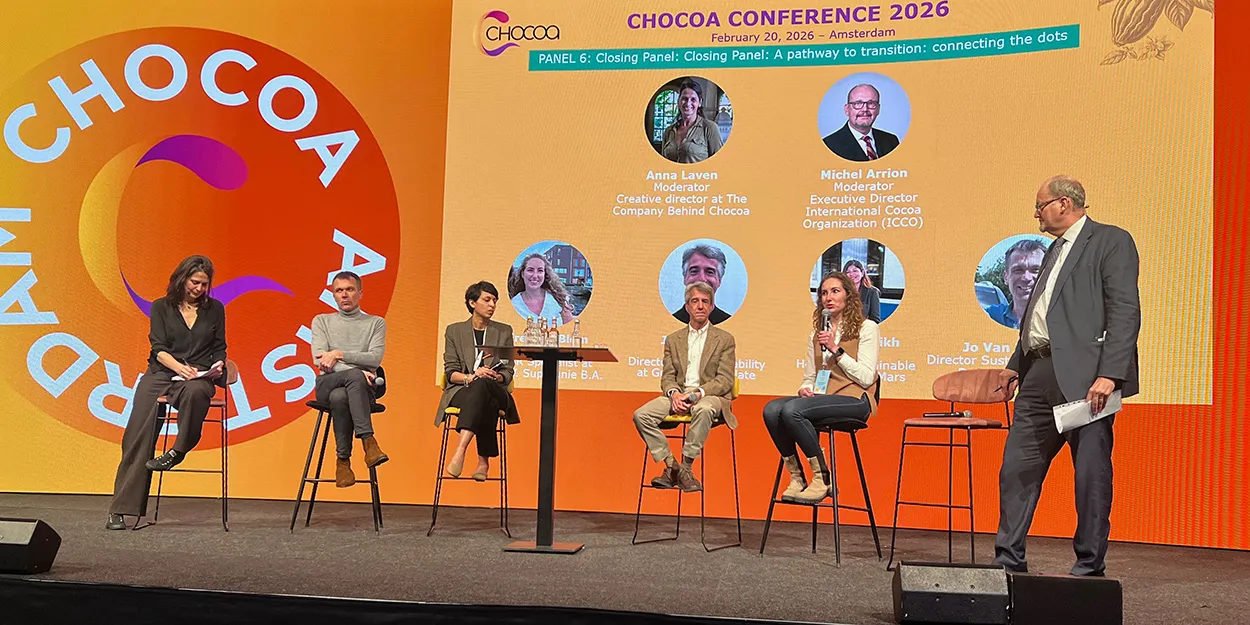
Moderated by Anna Laven of The Company Behind Chocoa and Michel Arrion, Executive Director, ICCO (International Cocoa Organization), the final panel sought to ‘connect the dots’ — distilling insights from two days of debate into concrete action for cocoa’s future. What emerged was a frank, sometimes uncomfortable, but necessary conversation about systemic change in a sector facing unprecedented volatility.
At the heart of the discussion lay a defining shift: the transition from a voluntary sustainability model to a monetary, regulation-driven system. For many in the room, this signals not incremental reform, but the beginning of a new era.
Advertisement

From Voluntary Commitments to Monetary Reality
Arrion was clear: the shift had been years in the making. “We know that this new approach was decided two or three years ago,” he said. “Now is the time to reshape the environment — to adapt, prepare and discuss. We are surely entering a new era.”
The private sector, long accustomed to voluntary sustainability pledges, now faces a regulated framework in which price, compliance, and accountability will increasingly drive behaviour. The change demands more than adaptation; it requires alignment around a shared vision of what meaningful transformation looks like.
Yet as speakers repeatedly underscored, alignment remains elusive.
The Crisis No One Mentioned
In his characteristic forthright style, Voice Network’s Antonie Fountain cut through the conference’s polished rhetoric.
After four days of discussion (including the World Cocoa Foundation Partnership Meeting, held in the same hall two days earlier), he observed that the severe cocoa pricing crisis in Ghana and Côte d’Ivoire had barely been addressed. Farming sectors in both countries are facing acute instability, and — in his view — regulators and governments have failed to respond adequately.
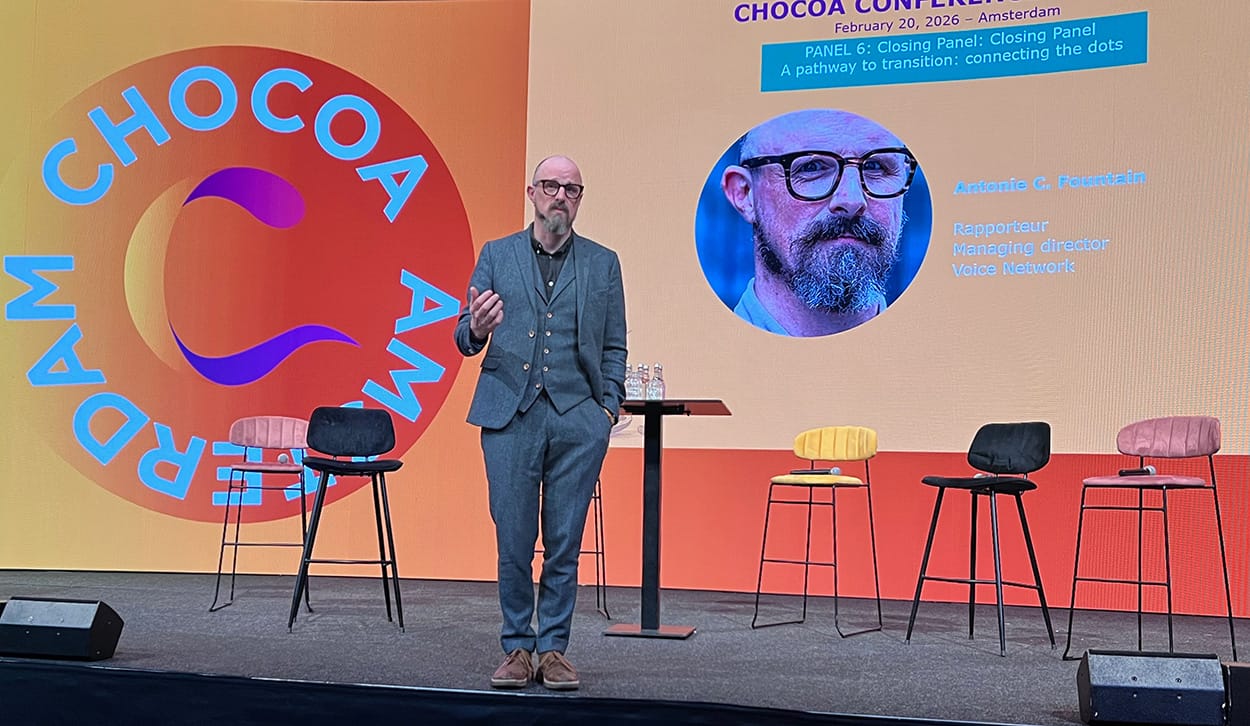
“Business as usual is now one of crisis,” he warned.
The private sector, Fountain argued, cannot distance itself from the turmoil. Procurement strategies directly shape farmer livelihoods. Immediate action is not optional — it is urgent.
Beyond short-term price shocks, he pointed to looming disruptions from climate change and regulatory change, calling for resilient farming systems, stronger sustainability commitments, and the integration of human rights and environmental protection into core business practice.
His recommendation was practical: urgently convene stakeholders in Côte d’Ivoire and Ghana, document farmers’ immediate needs, and mobilise short-term support within months — not years.
Root Causes, Not Just Symptoms
Nupur Parikh, Mars Global Sr. Director, Cocoa Sustainability, agreed on the need for systemic change, but introduced another tension: clarity.
Over the past two years, she said, the industry has become acutely aware of the symptoms — price spikes, volatility, farmer poverty, environmental degradation. What remains less cohesive is a shared articulation of root causes.
“There is a shared passion for doing the right thing,” she noted. “But we need a clear, cohesive vision — something that allows us to hold each other accountable and ensures efforts are not misdirected.”
As an economist, Parikh repeatedly returned to the topic of price. Cocoa farming, she argued, must be profitable — and must cover the cost of sustainable production, including investments in trees, labour, and resilience. Farmers must be able to withstand shocks and live with dignity.
“Price is very important from all dimensions,” she said. “It’s the only way the sector will thrive for everyone’s benefit.”
Yet she offered a caution. Living income reference prices may stabilise the ship in the short term, but over the long term, pricing mechanisms must also encourage productivity, efficiency, and innovation. Overcorrection could distort incentives, stimulate oversupply, and create new structural imbalances.
Systemic change, she suggested, requires systemic thinking.
Volatility and Demand Destruction
Few embodied the market’s turbulence more starkly than John Kehoe, Guittard Chocolate’s Sustainability Manager.
Over the past decade, cocoa prices have swung wildly — at times exceeding $12,000 per tonne plus premiums, then falling back dramatically. The resulting volatility has not only squeezed margins but triggered what Kehoe described as “demand destruction.” Businesses have failed under the weight of soaring input costs. Some have exited the market entirely.
Extreme fluctuations, he stressed, are detrimental to the entire ecosystem.
He urged the sector to compile hard data: document business closures, quantify lost demand, and summarize the impacts. Without evidence, future crises cannot be averted.
Counting the Cost of Sustainability
For Jo Van Dierdonck of Barry Callebaut, the path forward begins with numbers.
How much is truly being invested in sustainability? What are the measurable consequences of inaction — or insufficient action? Accurate cost estimation, he argued, is essential for informed decision-making, particularly in the retail environment where margins are tight and claims must be substantiated.
Data, not rhetoric, will determine whether strategies succeed.
The Retail Reality
From the retail perspective, Frenske Blom of Superunie introduced a consumer lens.
Purchasing decisions vary widely — from self-consumption to gifting, from price sensitivity to ethical preference. Labelling and marketing can steer attention, but the market remains diverse. There is space, she suggested, for differentiated products serving distinct customer needs.
Blom also highlighted Superunie’s involvement in DISCO (the Dutch Initiative for Sustainable Cocoa), which aims to achieve a living income for cocoa farmers by 2030. She expressed confidence in meeting that goal, crediting the retail group’s sustained commitment.
Her remarks underscored a core tension: sustainability ambitions must ultimately translate into consumer-facing propositions that succeed in competitive retail environments.
Diversification, Equality, and the Value of Ordinary Cocoa
Arrion closed the session with a call for diversification and greater equality in the cocoa market, particularly in Ghana. Current government incentive structures, he suggested, have limitations that must be confronted.
Another recurring theme was the value of ordinary-quality cocoa. Despite rising attention on premium and speciality segments, global demand for large volumes of conventional cocoa remains high. Improving quality at scale — while ensuring fair compensation — remains both a challenge and an opportunity.
A Conference Short of Consensus
The Chocoa Conference’s final session did not conclude with consensus. Instead, it crystallised the sector’s central paradox:
- Price is both solution and risk.
- Regulation promises accountability but demands adaptation.
- Sustainability requires investment, yet markets punish volatility.
- Short-term relief must not undermine long-term market fairness.
If there was a shared takeaway, it was this: incrementalism is no longer sufficient. The cocoa sector is entering a monetary, regulation-driven era in which systemic change cannot remain aspirational. It must become operational — measured in prices paid, data gathered, farmers supported, and markets stabilised.
The dots are now visible. The question is whether the industry can truly connect them.