
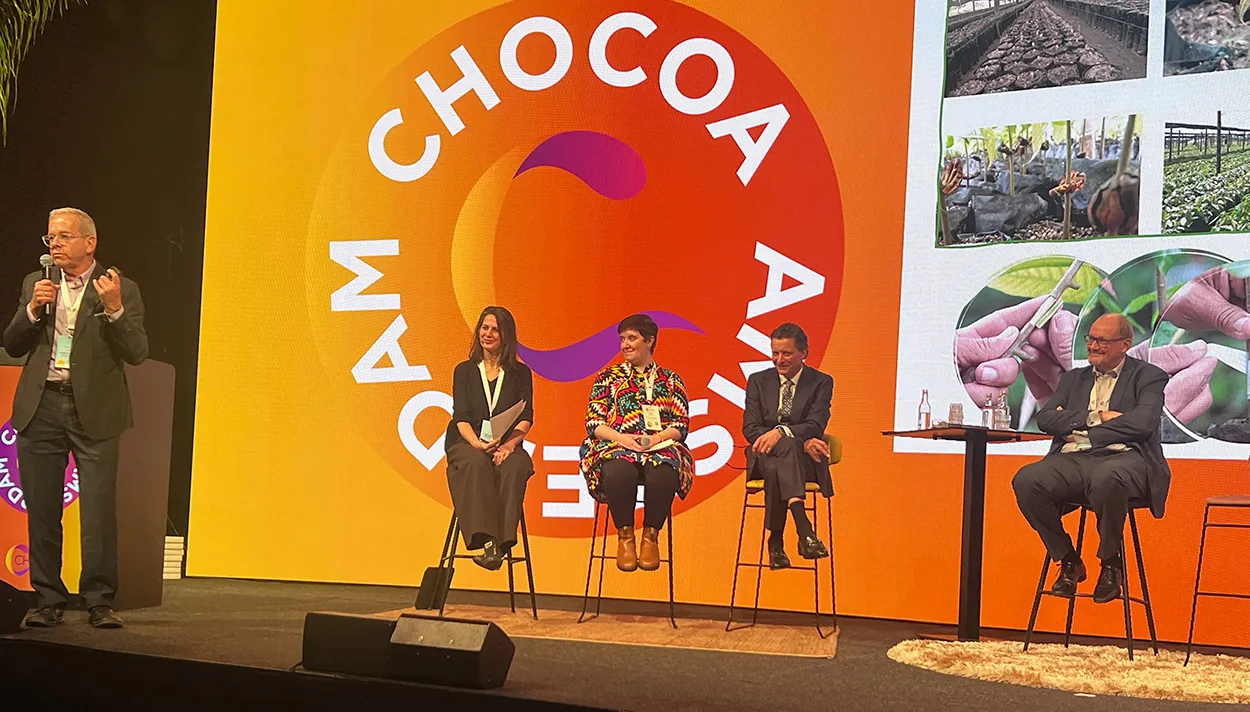
The opening of Chocoa 2026 in Amsterdam did not trade in platitudes. Instead, it delivered a sober assessment of a sector under strain — and a call for structural transformation grounded in solidarity, strategy, and shared responsibility.
Anna Laven, representing The Company Behind Chocoa, set the tone early: cocoa’s future will not be secured through incremental improvements. It requires systemic reform built on genuine cooperation between producing and consuming nations.
Advertisement

Representatives from the Dutch Initiative on Sustainable Cocoa (DISCO) and the Italian Ministry of Foreign Affairs and International Cooperation reinforced that message, signalling a shift from isolated initiatives toward coordinated international action.
Italy’s Strategic Turn Toward Partnership
Minister Stefano Gatti outlined Italy’s expanding role in sustainable commodity systems. With a €6.6 billion cocoa turnover and annual imports of approximately 200,000 metric tonnes, Italy is positioning itself not merely as a buyer, but as a long-term development partner.
Through its Africa-focused strategy and a €4.4 billion climate fund, Italy is investing in:
- Education, healthcare, and agricultural modernisation across 23 African countries
- National resilience plans for coffee in Ethiopia and Uganda
- A forthcoming public–private coffee fund coordinated with the World Bank
The emphasis was clear: partnerships must evolve beyond aid toward shared economic growth and durable resilience.
DISCO: Ambition Meets Accountability
Judith Sargentini of DISCO reminded participants that the Netherlands remains the world’s largest cocoa importer — and therefore bears considerable responsibility.
DISCO’s targets are ambitious:
- Living incomes for farmers by 2030
- Zero deforestation by 2025
- Elimination of child labour by 2025 through expanded CLMRS deployment
While progress has been made, volatility, fragmented procurement policies, and uneven regulatory enforcement continue to impede delivery. Alignment among buyers, brands, regulators, and producing countries remains essential.
'We All Want Systemic Change. Right?
The second session, moderated by Anna Laven and Nicko Debenham of Sustainability Solutions, posed a deliberately provocative question. The consensus: yes — but systemic change requires confronting uncomfortable structural realities.
Market Whiplash: The Volatility Problem
Michel Arrion, Executive Director of the International Cocoa Organization (ICCO), presented sobering data. Cocoa prices surged from around $3,000 per tonne in 2021 to nearly $12,000 in 2024 before retreating toward $4,000. Global stocks now stand at approximately 1.3 million tonnes — roughly three months of production.
Key drivers include:
- Shrinking stock-to-consumption ratios
- Disease and ageing tree stock
- Climate change
- Illegal gold mining in West Africa
- Reduced output in Côte d’Ivoire and Ghana
- Ghana’s production decline in recent years
- Expansion in Ecuador
Yet even amid price spikes, per capita chocolate consumption in major European markets and the United States is declining. Reformulation, smaller product sizes, and compound substitutes are reshaping demand.
Arrion pledged that ICCO will conduct annual global stock assessments and publish stock-to-grindings ratios to improve transparency and market outlooks.
Structural Barriers Beneath the Surface
Debenham pressed the panel on deeper constraints, arguing that complaince must now function as a “license to operate.”
With regulations such as CSRD (Corporate Sustainability Reporting Directive), CSDDD, EUDR, and the Forced Labour Regulation reshaping compliance expectations, market access increasingly depends on demonstrable due diligence and transparency.
Persistent structural barriers include:
- Lack of formal land titles limiting farmers’ access to credit
- Restricted access to improved planting materials
- Limited financial services in rural areas
- Historically low investment due to price instability
Arrion pointed to Brazil’s land documentation systems as evidence that secure tenure can unlock financing. “The resources exist,” he noted. “Access is the challenge.”
He proposed three financing priorities:
- Catalogue funding sources and assess eligibility and borrowing risks
- Improve land titling and documentation
- Develop strategies to promote premium cocoa consumption and counter the rise of compound substitutes
For Arrion, poverty reduction and market development are inseparable. Without rising incomes for both producers and consumers, quality and sustainability cannot flourish.
Africa’s Intellectual and Industrial Reawakening
Harvard scholar Carla Martin of The Institute for Cacao and Chocolate Research shifted the discussion from markets to power structures.
Drawing on her recent white paper, she highlighted Africa’s digital divide: limited connectivity and fibre-optic infrastructure constrain research capacity and knowledge exchange. Yet she also outlined a bold reimagining of the continent’s role in cocoa:
- Strengthening African-led research institutions
- Expanding local chocolate manufacturing
- Exploring nutraceutical and diversified cocoa applications
- Building neutral information-sharing networks
- Fostering Pan-African collaboration
Martin called for stronger engagement with the Côte d’Ivoire–Ghana initiative and greater inclusion of Gen Z voices in industry forums. Africa, she argued, must not only produce cocoa — it must shape cocoa’s intellectual and industrial future.
Productivity and Precision in Latin America
Francisco Gómez of Luker Agrícola offered a pragmatic counterpoint: systemic change also requires disciplined agronomy.
Cocoa production in Latin America has grown from 200,000 tonnes two decades ago to nearly 600,000 today, driven by improved planting materials and farm management.
Key insights included:
- 20% of trees account for 80% of production
- 13.3 million pods harvested across 683 hectares
- Average yields of 2.2 tonnes per hectare
- Agroforestry systems enhancing biodiversity and income diversification
Gómez emphasised context-specific agroforestry design — adapting wind control, shade, species mix, and planting density to local conditions — rather than importing generic models. Rigorous farm-level data collection, he argued, is essential for forecasting yields and identifying underperforming clones.
Productivity and sustainability, in this view, are mutually reinforcing when guided by evidence.
Farmers Take the Floor: Bottom-Up Visions for a Just Transition
In a sector often shaped by distant debates, Chocoa’s farmer-led panel reversed the script.
Moderated by Anna Laven, the session brought together representatives from Latin America and West Africa to articulate their vision of resilience — one rooted in livelihoods, dignity, and long-term sustainability.
Suzan Yemidi of The Voice Network described the forum as a rare space for direct farmer engagement. One particularly resonant proposal was the creation of a global Indigenous market connecting Indigenous communities worldwide — strengthening market access while recognising cultural and ecological stewardship.
Colombia: Quality and Peacebuilding
Eduard Baquero of FedeCacao emphasised that Colombia’s reputation for high-quality cocoa serves as both a commercial asset and a development strategy. In several regions, cocoa cultivation has replaced illicit crops, contributing to soil restoration and rural stability — underscoring cocoa’s role in peacebuilding.
Ecuador’s Amazon: Ancestral Systems Under Pressure
Ivonne Chávez of the Wiñak Association highlighted the resilience of Indigenous and Afro-descendant communities in the Ecuadorian Amazon. The ancestral chacra system — a biodiverse agroforestry model — sustains livelihoods while preserving traditional knowledge.
Yet communities face mounting pressures: deforestation, illegal mining, climate change, and youth migration. Chávez called for regulatory frameworks that adapt to ancestral systems rather than forcing them into ill-fitting compliance models.
Women hold roughly 30% of land titles, signalling progress — but youth engagement remains critical.
Côte d’Ivoire: Cooperative Scaling
Bengaly Bourama of the Coobadi Cooperative described how collective organisation drives resilience. Founded in 2007 with 100 members, the cooperative has grown to more than 2,300 members — nearly half women — and achieved certification in 2014.
Key priorities include:
- Expanding good agricultural practices
- Strengthening child labour monitoring systems
- Investing in agroforestry and diversification
- Supporting schools and health clinics through partnerships
Ecuador: Growth and Risk
Cristian Noboa of Anecacao reported that Ecuador’s exports have doubled since 2021, surpassing 600,000 tonnes, while yields have risen significantly. The country currently meets 70% of EUDR requirements, with further improvements underway.
Yet rapid expansion carries risks. A price downturn could trigger farm abandonment, highlighting the need for diversification and stronger value chains.
Across regions, a unifying message emerged: resilience and equity are inseparable. Farmers must be co-creators of reform, not passive recipients.
Forward-Thinking Farming Models Take Centre Stage
A final panel examined whether new farming models can scale while addressing poverty, insecure land tenure, and climate stress.
Philippe Bastide argued for a combined strategy integrating improved genetics, optimisedhours tree management, precision agriculture, and multi-service farm layouts. Regenerative agriculture and soil health, he stressed, are foundational.
Brazil’s Vitor Stella highlighted lessons from coffee, noting that yields could realistically double through better practices and mechanization. Michiel Kuit’s comparative data from Vietnam revealed how labour intensity, irrigation, and pruning drive yield gains — though replicability requires careful testing.
Juliette Cody of Barry Callebaut underscored the importance of coordinated financing structures and diversified investment vehicles to scale impact.
Beyond Rhetoric
Across eight hours of debate, a pattern crystallised:
- Transparency is becoming mandatory.
- Finance exists — but access remains constrained.
- Productivity, equity, and market reform must advance together.
Volatility has exposed fragility in the cocoa system. But it has also clarified the stakes.
Systemic change is no longer aspirational rhetoric. It is rapidly becoming the condition for survival.
cocoaradar.com is:
- Official Media Partner - Amsterdam Sustainable Cocoa Conference, Chocoa, 2026.
- 'From Our Desk. To Yours. Daily'
- Sign-up here for free and choose your plan.