

At today’s opening session, Anna Laven set the tone: cocoa’s future depends not on incremental change, but on structural transformation grounded in cooperation between producing and consuming nations.
Representatives from the Dutch Initiative on Sustainable Cocoa (DISCO) and the Italian Ministry of Foreign Affairs and International Cooperation reinforced that message.
Advertisement

Italy’s Strategic Turn Toward Partnership
Min. Plen. Stefano Gatti outlined Italy’s expanding role in sustainable commodity systems. With a €6.6 billion cocoa turnover and annual imports of roughly 200,000 metric tonnes, Italy is positioning itself not merely as a buyer, but as a development partner, he said.
Through its Africa-focused strategy and a €4.4 billion climate fund, Italy is investing in:
- Education, health and agricultural modernization across 23 African countries
- National resilience plans for coffee in Ethiopia and Uganda
- A forthcoming public–private coffee fund coordinated with the World Bank
The emphasis was clear: partnerships must move beyond aid toward shared economic growth and long-term resilience.
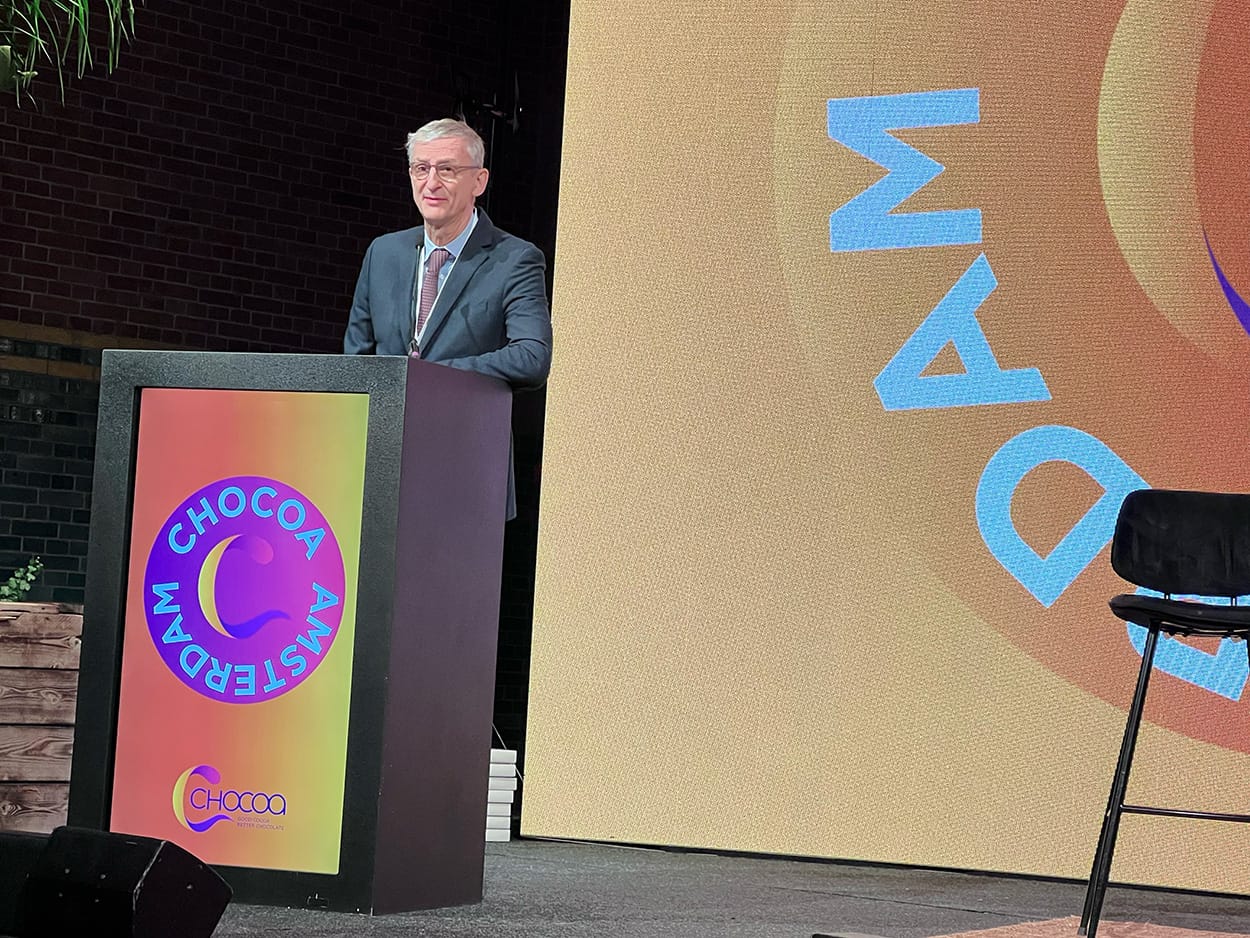
DISCO: Ambition Meets Accountability
Judith Sargentini of DISCO( the Dutch Initiative on Sustainable Cocoa) reminded the audience that the Netherlands remains the world’s largest cocoa importer – and therefore carries significant responsibility.
DISCO’s targets include:
- Living incomes for farmers by 2030
- Ending deforestation by 2025
- Eliminating child labour by 2025 through expanded CLMRS deployment
Progress has been made, but volatility, fragmented procurement policies, and uneven regulatory enforcement continue to challenge delivery. Alignment – between buyers, brands, regulators and producing countries – remains essential.
‘We All Want Systemic Change. Right?’
Second Panel Session from Day One, Chocoa Conference
In the second session, moderated by Anna Laven and Nicko Debenham of Sustainability Solutions. The question was deliberately provocative.
The consensus: yes – but systemic change demands confronting uncomfortable structural realities.
Market Whiplash: The Volatility Problem
Michel Arrion, Executive Director of the International Cocoa Organization (ICCO), provided sobering data.
Cocoa prices surged from around $3,000 per tonne in 2021 to nearly $12,000 in 2024, before retreating toward $4,000. Global stocks stand at roughly 1.3 million tonnes—just three months of production.
Debenham highlighted key drivers including:
- Shrinking stock-to-consumption ratios
- Disease and ageing tree stock
- Climate change
- Illegal gold mining in West Africa
- Reduced output in Côte d’Ivoire and Ghana
- Ghana’s production halving in recent years
- Expansion in Ecuador
Yet even as prices spike, per capita chocolate consumption in major European markets and the United States is declining. Reformulation, smaller tablet sizes, and compound substitutes are reshaping demand.
Arrion pledged that ICCO will conduct an annual global cocoa stock assessment and publish stock-to-grindings ratios to improve transparency and market outlooks.
The Structural Barriers Beneath the Surface
Debenham pressed the panel on deeper constraints. “Compliance,” he argued, “must now be understood as a license to do business.”
With regulations such as CSRD, CSDDD, EUDR and the Forced Labour Regulation (FLR) reshaping compliance expectations, companies face a new reality: participation in global markets increasingly depends on demonstrable due diligence and transparency.
Yet structural barriers persist:
- Smallholders lack titled land, limiting access to credit
- Restrictions on planting materials impede productivity gains
- Financial services rarely reach rural farmers
- Investment in cocoa remains historically low due to price instability
Arrion pointed to Brazil’s land documentation systems as an example of how secure tenure can unlock financing. “The resources exist,” he said. “Access is the challenge.”
He proposed three immediate financing priorities:
- Catalogue funding sources (public, private, subsidized loans) and assess eligibility and borrowing risks
- Improve land titling and documentation to unlock credit access
- Develop a strategy to promote premium cocoa consumption and counter compound substitutes
For Arrion, poverty reduction and market development are inseparable: without rising incomes for both producers and consumers, quality and sustainability cannot thrive.
Africa’s Intellectual and Industrial Reawakening
Harvard University scholar Carla Martin, representing The Institute for Cacao and Chocolate Research, shifted the lens from markets to power structures.
Drawing from her recent white paper on Africa’s cocoa industry, she highlighted the continent’s digital divide—low connectivity and limited fibre-optic infrastructure constrain knowledge exchange and research capacity.
But she also offered a bold reimagining:
- Strengthen African-led research institutions
- Promote local chocolate manufacturing
- Explore nutraceutical and diversified cocoa applications
- Build neutral information-sharing networks
- Foster Pan-African collaboration
Martin called for stronger engagement with the Côte d’Ivoire–Ghana initiative and urged conference organizers to bring more Gen-Z participants into industry forums.
The message: Africa must not only produce cocoa – it must shape cocoa’s intellectual and industrial future.
Productivity, Precision and Agroforestry in Latin America
From South America, Francisco Gómez of Luker Agrícola offered a pragmatic counterpoint: systemic change also requires disciplined agronomy.
Cocoa production in the region has grown from 200,000 tonnes two decades ago to nearly 600,000 today, driven by improved planting materials, technical knowledge and farm management.
Key insights:
- 20% of trees account for 80% of production
- 13.3 million pods harvested across 683 hectares
- Average yields of 2.2 tonnes per hectare
- Agroforestry systems enhancing biodiversity and income diversification
Gómez emphasised tailoring agroforestry design to local conditions—wind control, shade, species mix and planting density—rather than importing generic models.
He also called for rigorous farm-level data collection to forecast yields and identify underperforming clones.
In short: productivity and sustainability are not opposing goals—they are mutually reinforcing when guided by evidence.
Beyond Rhetoric: Is There Political Will?
The panel closed with the core question:
Is there genuine commitment – from governments, industry, civil society and farmer representatives – to do what systemic change requires?
Across sessions, three themes emerged:
- Transparency is becoming mandatory, not optional.
- Finance exists—but structural access barriers persist.
- Long-term resilience depends on aligning productivity, equity and market reform.
The Chocoa opening panels made clear that volatility has exposed fragility in the cocoa system. But they also revealed a sector increasingly aware that incremental fixes will not suffice.
Systemic change is no longer aspirational rhetoric. It is fast becoming the condition for survival.
cocoaradar.com is:
- Official Media Partner - Amsterdam Sustainable Cocoa Conference, Chocoa, 2026.
- 'From Our Desk. To Yours. Daily'
- Sign-up here for free and choose your plan.