
As cocoa markets reel from extreme volatility, Fairtrade cocoa farmers and cooperatives are set to benefit from significantly increased premiums and a strengthened price safety net in 2026, following an announcement by Fairtrade International aimed at helping producers withstand what it calls a 'perfect storm' of climate change, volatile global markets, crop disease, and sharply rising production costs.
Advertisement

At the heart of the package is a 45% increase in the Fairtrade Minimum Price, alongside higher Fairtrade Premiums and a substantially improved organic differential. The new pricing measures will take effect across most cocoa-producing countries in the next 12 months, with special arrangements for Côte d’Ivoire and Ghana, where farmgate prices are government-regulated.
A Stronger Floor in an Unstable Market
The changes come against a backdrop of extreme price swings. Cocoa prices peaked at around US$12,000 per tonne in 2024 before falling to below US$6,000 per tonne at the end of this year. Even during periods of high prices, farmers often fail to benefit as gains are eroded by inflation, extreme weather, and declining yields.
Fairtrade’s new framework aims to counter that volatility:
- The Fairtrade Minimum Price for conventional cocoa will rise by 45% to US$3,500 per tonne in Ghana and €3,200 per tonne in Côte d’Ivoire from 1 October 2026, aligning these origins with global benchmarks.
- The Fairtrade Premium will increase by 15% to US$275 per tonne globally, and by 13% to €250 per tonne in Côte d’Ivoire.
- The Fairtrade Organic Differential will rise by 50% to US$450 per tonne, or €410 per tonne in Côte d’Ivoire, recognising higher compliance and production costs under forthcoming EU organic regulations.
In Ghana and Côte d’Ivoire, from October 2026, 40% of the Fairtrade Premium must be paid directly in cash to cooperative members, with minimum allocations also set for cooperative strengthening, farm services, and community projects.
“There has never been more uncertainty for Fairtrade cocoa farmers, despite relatively high global prices,” says Johanna Schmidt, Cocoa Manager at Fairtrade International. “Fairtrade can’t do this alone. We need the entire cocoa industry to reduce volatility and commit to a long-term, sustainable future for farmers who have been exploited for far too long.”

Retailers Move Beyond Certification
While Fairtrade is reinforcing its price and premium mechanisms, retailers and brands are increasingly acknowledging that certification alone does not guarantee a living income.
This shift was underscored this month when Albert Heijn and PLUS, alongside purchasing cooperative Superunie, received the Living Income Award from Solidaridad for concrete steps to improve cocoa farmer incomes across their private-label chocolate ranges. Supermarket chain Jumbo has now joined this group of frontrunners.
“It is the first time supermarkets are working purposefully towards a living income for cocoa farmers,” said Babasola Olajide, cocoa expert at Solidaridad, during the awards ceremony. “Those who continue to sell chocolate produced by farmers living in desperate poverty risk losing all credibility.”
Tony’s Open Chain as a Practical Bridge
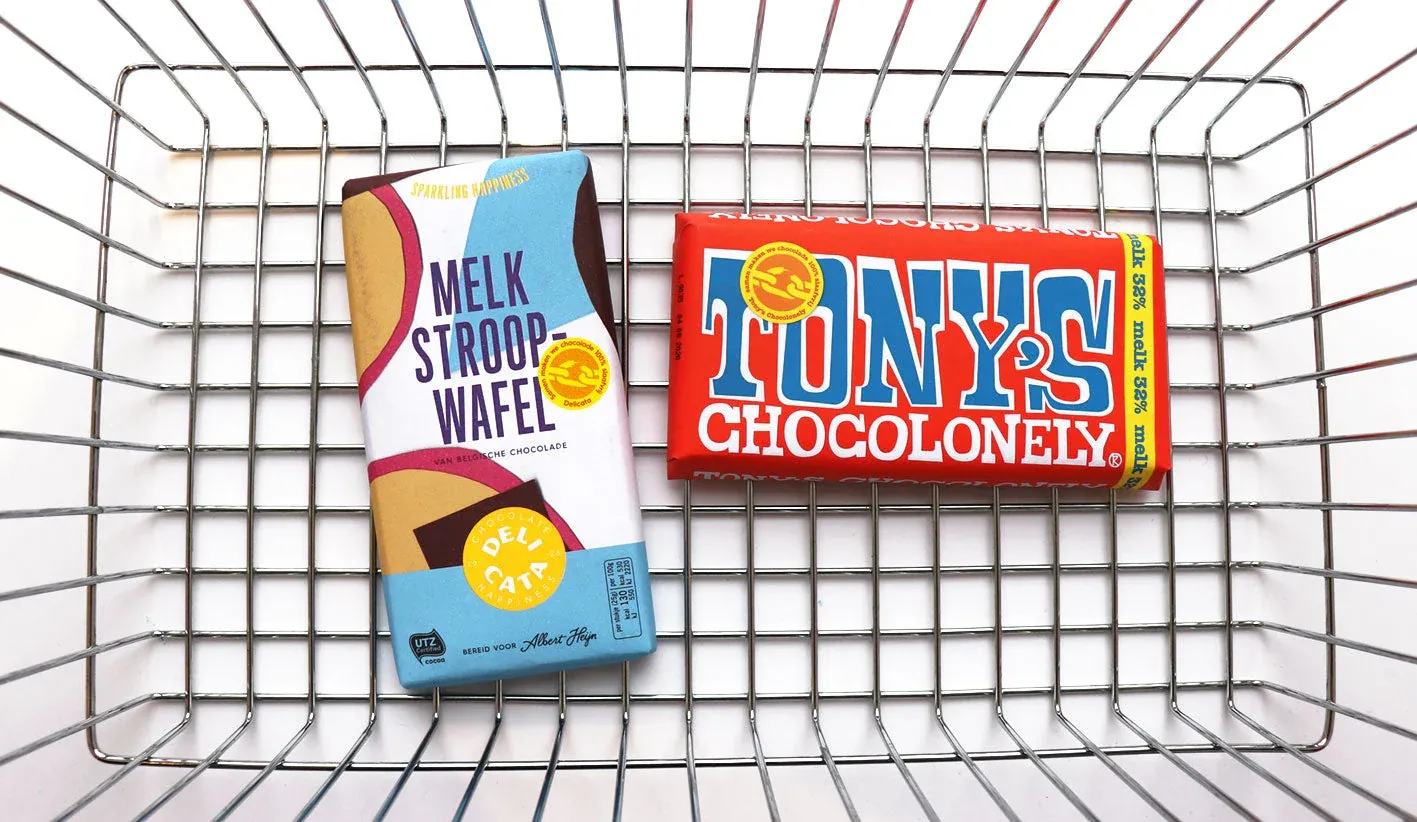
A key differentiator in this emerging retail strategy is the adoption of Tony’s Open Chain, the sourcing model developed by Dutch ethical brand Tony’s Chocolonely to operationalise living income principles through long-term contracts, traceability, and income benchmarks.
Albert Heijn has worked closely with Tony’s Open Chain since 2018, initially through its Delicata private label, and in October 2024 committed to sourcing all cocoa for its private-label chocolate through the Open Chain before 2028 — placing it well ahead of most European retailers.

Superunie, which committed in August 2025, is now collaborating with Fairtrade Netherlands to go beyond standard certification. On its website, Superunie acknowledges that “current Rainforest Alliance or Fairtrade certifications are not sufficient” to guarantee living incomes and that additional, income-focused interventions are required. Its goal is to make living incomes possible for all private-label products containing at least 5% cocoa by 2030.
For farmers, the convergence of Fairtrade’s higher price floor and Tony’s Open Chain’s living income benchmarks could be critical. Fairtrade strengthens the minimum safety net, while Open Chain models seek to close the remaining income gap through longer-term purchasing commitments and transparent cost and income calculations.
Pressure from Consumers and Civil Society
Civil society pressure has played a decisive role in accelerating retailer action. Solidaridad, alongside organisations such as Oxfam Novib, launched a high-profile consumer campaign in September 2024 after research showed that 93% of chocolate sold in Dutch supermarkets did not enable farmers to earn a living income.
More than 22,500 consumers signed a petition calling for fair chocolate on supermarket shelves. Campaigns around chocolate letters, Easter eggs, and everyday products — from croissants to Christmas wreaths — helped push living income from a policy discussion into a commercial priority.
“People want chocolate on the shelves that also puts bread on the table for farmers,” said campaign leader Charlotte van den Arend.
 Anthony Myers
Poverty Remains the Root Problem
The Cocoa Barometer 2025 describes the past few years as the most turbulent of the century for the sector. Climate-related crop failures have driven global price spikes of up to 400%, while rising labour and fertiliser costs continue to squeeze farm incomes in Côte d’Ivoire and Ghana.
Poverty, the report concludes, is the underlying driver of many systemic issues in cocoa — including child labour, deforestation, and low productivity. Addressing farmer income directly is therefore not just a social imperative, but a structural necessity.
Who is still lagging?
As Albert Heijn, Superunie-affiliated retailers, PLUS and Jumbo move towards income-based sourcing models, pressure is mounting on discount chains such as Lidl and Aldi, which have yet to make comparable commitments across their private-label chocolate ranges.
The question for the sector is no longer whether living income is achievable, but how quickly the remaining players are willing to follow.
CocoaRadar’s Takeaway
For cocoa farmers navigating an era of climate shocks and market instability, the alignment of Fairtrade’s reinforced price mechanisms with Tony’s Open Chain’s income-focused sourcing may signal the most credible pathway yet toward stable, dignified livelihoods.
cocoaradar.com is:
- Official Media Partner - Amsterdam Sustainable Cocoa Conference, Chocoa, 2026.
- 'From Our Desk. To Yours. Daily'
- Sign-up here for free and choose your plan.