
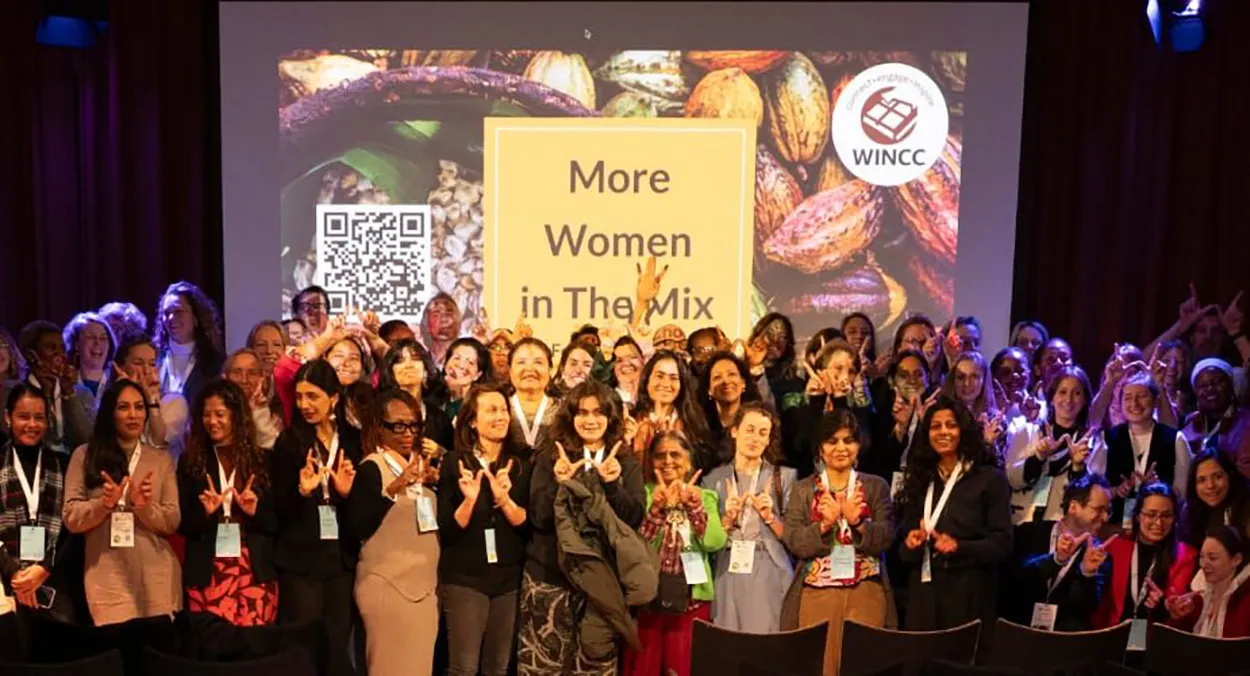
Gender equality is no longer a side conversation in the cocoa sector — it is fast becoming a defining priority. At this year’s Chocoa Sustainability Conference in Amsterdam, the Women in Cocoa & Chocolate Network (WINCC) placed gender-transformative change firmly at the centre of sector dialogue, linking women’s empowerment directly to resilient families, productive farms, and sustainable businesses.
What emerged across multiple sessions was a clear message: strengthening the cocoa value chain requires structural change — beginning at household level and extending to cooperative governance, corporate leadership, and international policy.
Advertisement

Moving Beyond Participation to Power
Moderated by independent consultant Cesar Maita, the WINCC-powered breakout session on the final day of the conference challenged the industry to move beyond counting women’s participation toward enabling genuine decision-making power.
While gender equality has been discussed for decades, progress remains uneven. Research suggests that, at current rates, achieving full global gender equality could take more than a century. At the same time, backlash against gender-focused initiatives is growing in some contexts.
“Gender equality is fundamental to resilient families and sustainable businesses,” Maita emphasised, introducing a framework centred on three pillars:
- Women’s agency
- Control over resources
- Decision-making authority
Participants agreed that representation alone is insufficient. The sector must generate stronger evidence about which interventions produce measurable, scalable change — and invest accordingly.
Making Women’s Labour Visible
A recurring theme throughout the discussion was the “invisible workforce” of women in cocoa production. Across West Africa and beyond, women contribute significantly to farm labour and household income, yet their work often goes unrecognised in official statistics and programme design.
Representatives highlighted chronic underinvestment in training and agronomic resources for women farmers. Without equal access to capacity-building, productivity gains remain constrained, and economic empowerment stalls.
Speakers stressed that meaningful inclusion requires more than consultation meetings. Women must actively co-design and implement programmes that affect their livelihoods. When women influence decisions about land use, income allocation, and farm investment, households and communities become more resilient.
Gender Equality as a Lever for Child Protection
The link between gender equality and child protection was underscored by Katie Bird of the International Cocoa Initiative (ICI). Her message was unequivocal: empowering women is both a fundamental right and a strategic intervention against child and forced labour.
ICI’s recent cash transfer study revealed that directing payments to women — especially when combined with gender training and access to savings mechanisms — strengthens household decision-making and shifts power dynamics in positive ways.
When women control financial resources:
- Household spending prioritises nutrition and education
- Decision-making becomes more balanced
- Families demonstrate greater resilience to shocks
Women’s involvement in Child Labor Monitoring and Remediation Systems (CLMRS) further positions them as influential community change agents. Village savings and loans associations amplify this impact, reinforcing both economic agency and social cohesion.
The conclusion was clear: gender equality is not peripheral to sustainability — it is foundational.
WINCC’s New Chapter: Mentorship and Leadership
The conference also marked a milestone moment for WINCC. Now operating as an independent organisation, the network celebrated its 10-year anniversary during Chocoa with the official launch of its Mentor Academy.
The programme aims to create structured pathways for women’s leadership across cocoa and chocolate value chains through:
- Formal mentorship pairings
- Leadership development modules
- Cross-company professional networks
- Safe spaces for peer exchange
Suzan Yemidi of The Voice Network noted that of the estimated 5–6 million smallholder women farmers globally, only around 30% are meaningfully included in decision-making structures.
Closing gender gaps in agriculture could increase productivity by 20–30% — a substantial opportunity for both poverty reduction and sector growth.
The Mentor Academy’s ambition is simple but transformative: bring “more women in the mix” wherever decisions are made. From cooperative boards to corporate strategy rooms, representation must translate into influence.
Strengthening the Household Unit
Edem Agbe of Participatory Development Associates Ltd reinforced the importance of household-level engagement. His organisation’s community-based intervention model integrates:
- Child labour remediation
- Gender-transformative dialogue
- Nutrition education
- Self-help savings groups
By involving husbands, partners, and family members in structured dialogue sessions, programmes foster shared decision-making rather than isolated empowerment. When household relationships evolve, resilience deepens.
“Women’s empowerment strengthens family and community structures,” Agbe explained, highlighting the interconnected nature of social and economic progress.
Labour Innovation: Professionalising the Cocoa Workforce
While gender equality anchored the conference dialogue, labour reform emerged as a parallel priority during a final day session moderated by Anna Laven.
Across cocoa-growing regions, labour challenges are intensifying. Ageing farmer populations, low returns on investment, hazardous working conditions, and child labour risks continue to strain rural households.
Speakers from Tony’s Open Chain, So-B-Green, and VisionSpring presented initiatives designed to professionalise farm labour, increase productivity, and reduce household vulnerability.
The Rise of Hired Labour
Data from Tony’s Open Chain’s five-year multi-dimensional poverty index study revealed a growing reliance on hired labour:
- 87% of Ghanaian farmers hired labour in the 2023/24 season
- 65% of Ivorian farmers did the same
Farmers who hire labour are significantly more likely to adopt good agricultural practices, particularly pruning and pest management — both of which are essential for higher yields.
Yet labour costs and cash-flow timing remain barriers. To address this, Tony’s Open Chain has introduced subsidised labour brigades supported by a shared productivity premium. Operating through cooperatives in Côte d’Ivoire and resource service centres in Ghana, the model provides five years of structured support.
Reported results are striking: a 90% reduction in child labour and measurable productivity gains within the first year.
The model also integrates farm coaches who offer diagnostics and long-term advisory support, helping farmers transition toward more professionalised systems.
Intensive Pruning and Structured Engagement
Charles Tellier of So-B-Green highlighted the impact of intensive pruning programmes across West Africa, South America, and Southeast Asia.
Last year alone:
- 5,000 hectares were pruned
- 2,000 workers were employed
- The target for this year is 6,000 hectares
Beyond boosting yields and tree health, intensive pruning reduces reliance on costly chemical inputs and generates rural employment.
However, adoption requires structured engagement. Tellier called for:
- Transparent cash-payment mechanisms
- Voluntary participation frameworks
- Labour-cost volatility monitoring systems
Professional labour services, he argued, are not simply technical upgrades — they represent cultural and organisational shifts within farming communities.
Seeing Productivity Clearly
Michael Cooke of VisionSpring introduced a deceptively simple yet powerful intervention: vision care.
Many cocoa farmers are over 40 and experience reduced near vision, which affects precision tasks such as hand pollination and reading product labels. VisionSpring’s research in Ghana shows that correcting near vision can increase productivity by up to 22% in comparable agricultural contexts.
Through community screening camps, farmers are tested and provided with reading glasses on the spot—a low-cost intervention with an immediate impact on productivity.
Cooke emphasised that systemic reform and practical solutions must go hand in hand. Structural transformation takes time; accessible health interventions deliver instant gains.
From Dialogue to Durable Change
Across both sessions, a unifying insight emerged: resilience in the cocoa sector begins with people.
Empowering women strengthens household stability, improves child protection outcomes, and enhances productivity. Professionalising labour systems reduces physical strain, mitigates child labour risk, and unlocks higher yields.
Neither gender equality nor labour reform can be treated as isolated themes, the conference heard. They intersect at the household level — where decisions about income, labour allocation, education, and investment are made daily.
The momentum generated at Chocoa suggests the sector is beginning to embrace this interconnected reality. Through structured mentorship, inclusive governance, cooperative-led labour models, and practical productivity interventions, cocoa stakeholders are moving from conversation to action.
The challenge now is sustained commitment. Transformative change demands long-term investment, credible evidence, and shared accountability across the value chain.
But the direction is clear: a more equitable cocoa sector is not only possible — it is essential for building resilient families, thriving communities, and a sustainable global chocolate industry.
cocoaradar.com is:
- Official Media Partner - Amsterdam Sustainable Cocoa Conference, Chocoa, 2026.
- 'From Our Desk. To Yours. Daily'
- Sign-up here for free and choose your plan.