
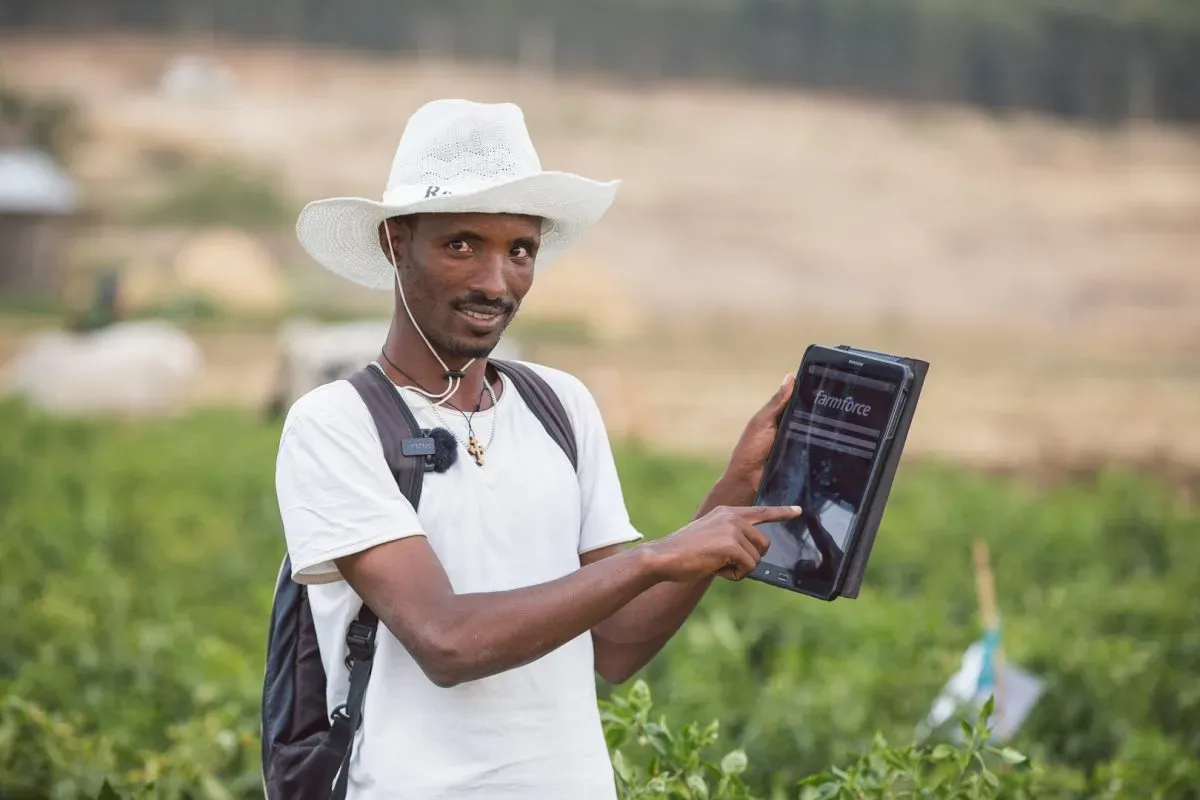
What looks like rapid progress on paper may conceal a deeper structural vulnerability, the Barometer reveals.
The Industry Has Moved — But Onto Unstable Ground
In just three years, cocoa has dramatically expanded farm-level traceability claims. Today, 77% of actors report high visibility, a sharp rise from 2023. At face value, this suggests a sector accelerating toward EU Deforestation Regulation (EUDR) compliance.
Advertisement

But the Farmforce data tells a more complicated story.
- 28% of producers have zero geotagged farms
- 24% have mapped less than 25% of their supply base
The result is what the report terms the Traceability Paradox: the industry increasingly knows who its farmers are, but not precisely where their farms are located. In a regulatory environment that hinges on geospatial verification, this gap is not technical — it is existential.
Traders Are Compliance Engines. Producers Are Hitting a ‘Paper Ceiling’
The EUDR has polarised the supply chain.
Traders and processors have emerged as the fastest-moving segment:
- 63% classify themselves as mostly or fully compliant, up from zero in 2023.
- Significant investments in digital traceability and remote sensing are now standard.
Producers, however, face a different reality:
- 45% still rely on paper records or spreadsheets
- 69% cite cost and resources as the primary barrier to digitalisation
The bottleneck has shifted. In 2023, the challenge was technological capability. In 2026, it is financial capacity.
This ‘Paper Ceiling’ prevents satellite verification, slows audit readiness, and increases the risk of exclusion from EU markets. Compliance is no longer a matter of willingness — it is a question of capital.
The New Bottleneck: Data Quality, Not Data Collection
According to the Barometer, The ‘human layer’ of traceability is largely in place:
- 59–60% of producers maintain unique digital farmer IDs
But precision mapping and verification quality lag significantly.
Most requested support areas, according to the report:
- Data verification methods (69% of producers)
- Mapping & polygon quality assurance (45%)
- Land rights documentation (36% of traders)
This shows that the sector has mastered the art of collecting names. It has not yet professionalised spatial data. Furthermore, without robust polygon accuracy, quality controls, and documented tenure rights, traceability claims may collapse under a forensic audit.
EUDR: Stress Test and Strategic Inflection Point
The EUDR has acted as a catalytic stress test.
- Traders are largely prepared.
- Manufacturers remain split between implementation and transition.
- Producers are still early-stage or mid-adaptation.
The greatest burden is administrative and legal — not technological. Training, documentation systems, and verification standards now determine market access.
Cooperatives face a stark choice: achieve full compliance or risk exclusion from EU trade flows.
Beyond Deforestation: The Rise of Regenerative Agriculture
If Phase 1 was about identifying farmers and Phase 2 about mapping farms, Phase 3 is emerging rapidly: value creation through regenerative agriculture.
- 76% of producers plan to implement regenerative projects
- The industry is pivoting from’no deforestatio’ to ‘pro-regeneration’
But regenerative agriculture requires far more than traceability. It demands advanced farm management systems capable of tracking:
- Soil health metrics
- Sustainability indicators
- Premium payments
- Verified impact data
The infrastructure built for EUDR could become the backbone of long-term resilience — if it is upgraded beyond minimum compliance.
A New Risk on the Horizon
While the industry scrambles to meet EUDR requirements, another regulatory wave is forming.
36% of traders remain unaware of the EU Digital Product Passport (DPP).
Without proactive education and alignment, the sector risks repeating reactive compliance cycles — shifting from one regulatory shock to the next without structural consolidation.
“The data suggests we’re sleepwalking into the next issue. The industry is so consumed by the administrative burden of EUDR that 36% of traders - typically the most prepared group - haven't yet heard of the Digital Product Passport. If the leaders are blind to this, another reactive shock seems inevitable,” said Arnaud Dupuis, Head of Marketing at Farmforce.
CocoaRadar’s Takeaway
The cocoa sector has successfully mobilised around traceability. It has not yet mobilised around verification quality. 2026 marks a decisive strategic inflection point:
- Phase 1 (Completed): Identify farmers
- Phase 2 (Under Pressure): Precisely map farms
- Phase 3 (Emerging): Transform compliance infrastructure into regenerative value creation
As Farmforce highlights, the winners will not be those who merely comply with EUDR. They will be those who convert compliance systems into a long-term digital, operational, and sustainability advantage.
Cocoa’s visibility problem is no longer about transparency. It is about precision. And precision now determines market access.
- Farmfore We will be unveiling the results of its 2026 First Mile Traceability Barometer in full on Thursday, 19 February, 9:00 am in the Keurzaal as part of the Chocoa Sustainability Conference.
Speakers: - Alejandro Gil Aguirre (Procurement and Agricultural Development Director, Compañía Nacional de Chocolates S.A.S)
- Raphaël Felenbok (Independent Advisor, Cocoa & Chocolate)
- Rodney Muriuki (Global Sales Director, Farmforce)
- Thomas Vaassen Vaasen (CEO, Meridia)
- For more details on its First Mile Traceability Barometer, visit this link.
cocoaradar.com is:
- Official Media Partner - Amsterdam Sustainable Cocoa Conference, Chocoa, 2026.
- 'From Our Desk. To Yours. Daily'
- Sign-up here for free and choose your plan.
- Farmforce is an official sponsor of the Chocoa Conference