From our desk to yours. Daily.
Join our growing community of members and receive a free version of our daily newsletter on what really matters in cocoa.
No spam. Unsubscribe anytime.
According to Nestlé, the shipment – part of a new KitKat product line – disappeared last week and remains missing at the time of writing. The company has stated that the stolen bars can be traced through batch codes and warned that they may surface through unofficial or grey-market sales channels. Both Reuters and the Associated Press independently confirmed these details.
Advertisement

Nestlé Responds
A spokesperson for Nestlé struck a light-hearted tone when addressing the incident, quipping: “We’ve always encouraged people to have a break with KitKat - but it seems thieves have taken the message too literally.”
Behind the humour, however, the company underscored a more serious concern. Nestlé warned that cargo theft is a growing, increasingly sophisticated threat, citing a recent joint report by the International Union of Marine Insurance (IUMI) and the Transported Asset Protection Association (TAPA). The report highlights an increase in freight fraud schemes, many of which are digitally enabled and use tactics such as fake carriers and stolen identities.
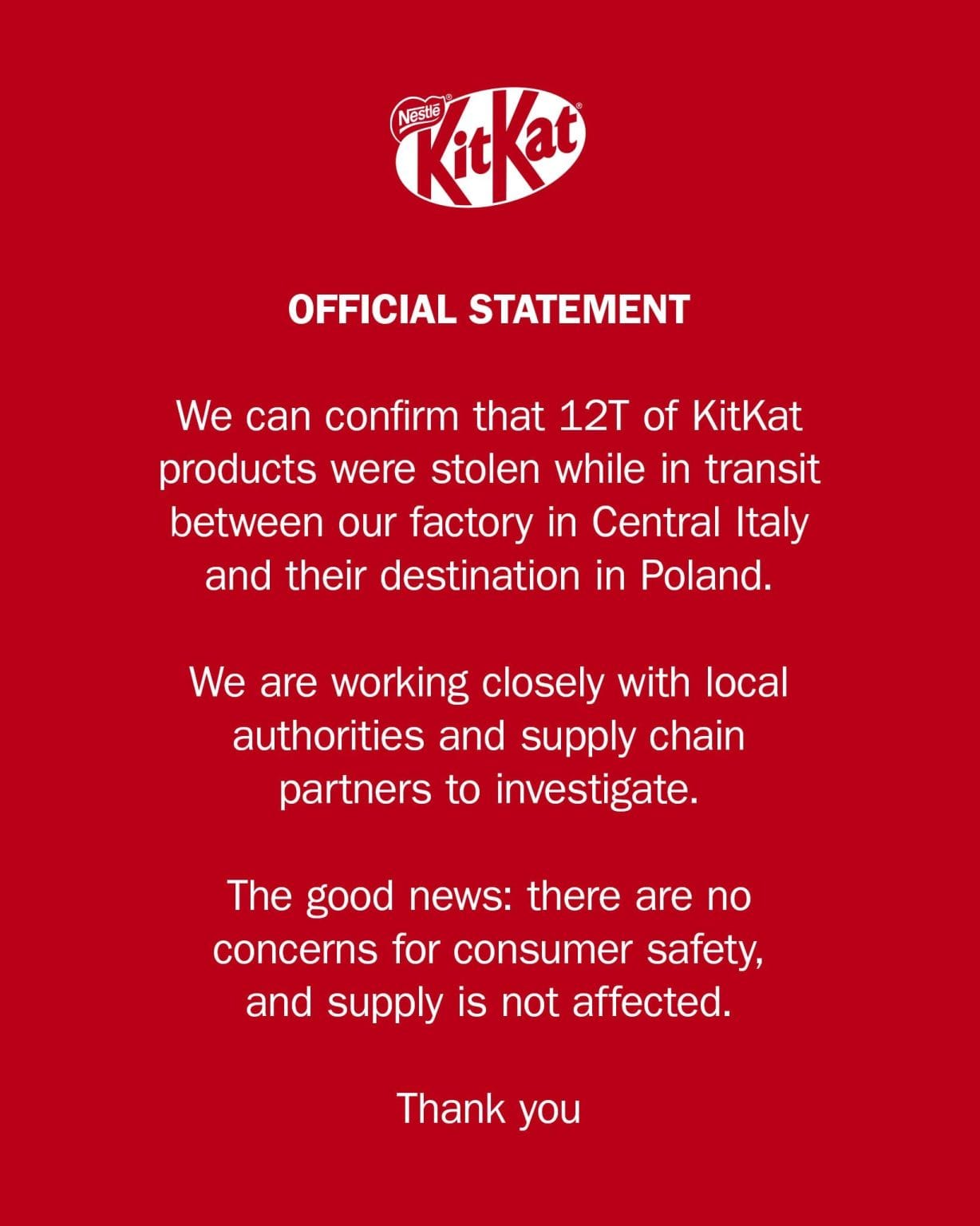
Consumers may also play a role in identifying diverted goods. Nestlé has confirmed that the stolen products can be tracked via batch codes, though no verified public list of those codes has been released. Anyone concerned about a purchased product may wish to check directly with the company for guidance.
Why Chocolate?
At first glance, chocolate might seem like an unusual focus for organised theft. In reality, it fits a near-perfect criminal profile. It is compact, non-perishable, widely recognised, and easily resold without attracting the scrutiny associated with higher-risk goods like electronics or pharmaceuticals.
Recent industry warnings support this shift. The February 2026 IUMI–TAPA alert emphasised that cargo theft across Europe is becoming more organised and technologically sophisticated, reinforcing the idea that food products – once considered low-risk – are now part of a broader criminal strategy.
A Modern Cargo Crime Playbook
While Nestlé has not disclosed how the KitKat shipment disappeared, the circumstances align with known tactics used in freight crime. Increasingly, thefts do not involve hijackings, but deception.
Criminals may pose as legitimate transport providers, exploit subcontracting chains, or manipulate logistics documentation to gain lawful access to cargo. Cross-border routes – such as the Italy-to-Poland corridor in this case – are particularly vulnerable due to the multiple handoffs and fragmented oversight they entail.
Not an Isolated Case
The KitKat theft follows a pattern seen in several high-profile European confectionery heists over the past decade:
- Austria (2019): Around 20 tonnes of Milka chocolate were stolen after a fake driver used falsified credentials to collect a shipment routed through multiple subcontractors across Central Europe.
- Germany (2017): A trailer carrying 20 tonnes of Nutella, Kinder Surprise eggs, and other sweets was stolen in Neustadt, with authorities suspecting rapid redistribution through informal resale channels.
- Italy (2014): Approximately 175 tonnes of Lindt chocolate were stolen from a transport hub near Lodi. Prosecutors later linked the case to mafia-affiliated networks, highlighting how food cargo can intersect with organised crime logistics.
These cases reveal a consistent pattern: chocolate is not merely stolen for opportunistic resale – it is increasingly embedded within structured, sometimes transnational, criminal distribution systems.

The Retail Parallel
The trend extends beyond freight. In the United Kingdom, retailers have begun placing chocolate bars in anti-theft security boxes amid rising shoplifting rates. The British Retail Consortium reported 5.5 million shoplifting incidents last year, costing retailers nearly £400 million ($529m). Organised retail crime groups have specifically targeted high-demand, easily resold items – including confectionery.
While retail theft and cargo crime operate at different scales, both reflect the same underlying economics.
The Price Factor
A key driver behind chocolate’s rising appeal is cost. Cocoa prices surged dramatically in 2024, nearly tripling due to supply constraints. Although futures have since declined, elevated input costs continue to influence retail prices into 2026.
Manufacturers have responded with price increases and product adjustments, effectively repositioning chocolate from a low-cost indulgence to a higher-value consumer good. For criminal networks, that shift translates into greater resale margins and stronger incentives.
Perfect Timing For a Chocolate Heist
The timing of the KitKat theft is also notable. Occurring just ahead of Easter – a peak season for chocolate consumption – it maximizes the likelihood of rapid resale. Demand during this period is both predictable and high, reducing the risk of unsold inventory for illicit distributors.
A Symptom of a Larger System
Taken together, the evidence suggests that the KitKat heist is less an anomaly and more a textbook example of modern European cargo crime. The convergence of rising prices, fragmented logistics networks, seasonal demand, and increasingly sophisticated fraud tactics has created ideal conditions for theft.
Chocolate, once considered a low-risk commodity, has quietly become a premium target.
One detail remains unclear: while Nestlé has confirmed that batch codes exist to trace the stolen products, no publicly verified list of those codes has been released.
For now, the missing shipment underscores a broader reality – today’s supply chains are not only global and efficient, but also increasingly vulnerable.
cocoaradar.com is:
- Official Media Partner - CAA International Cocoa Conference
- 'From Our Desk. To Yours. Daily'
- Sign-up here for free and choose your plan.