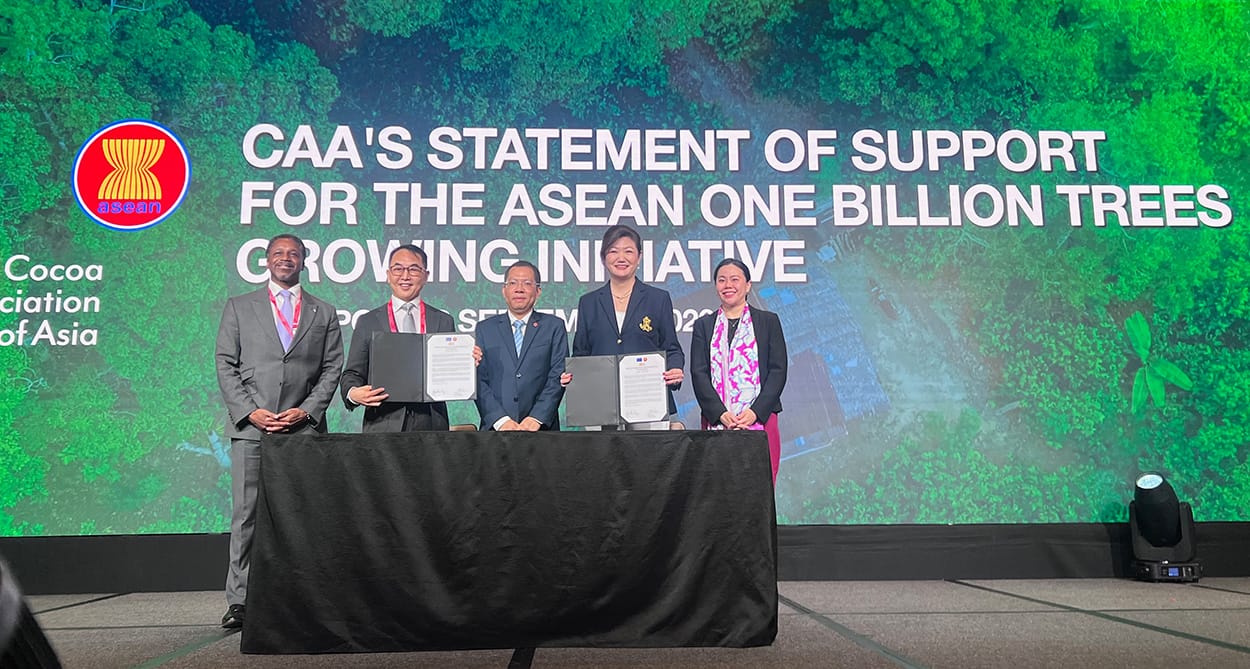
The Cocoa Association of Asia has become the first association to formally support the ASEAN One Billion Trees Growing Initiative, placing the regional cocoa sector behind a wider drive to promote reforestation and sustainable growth, CocoaRadar can reveal.
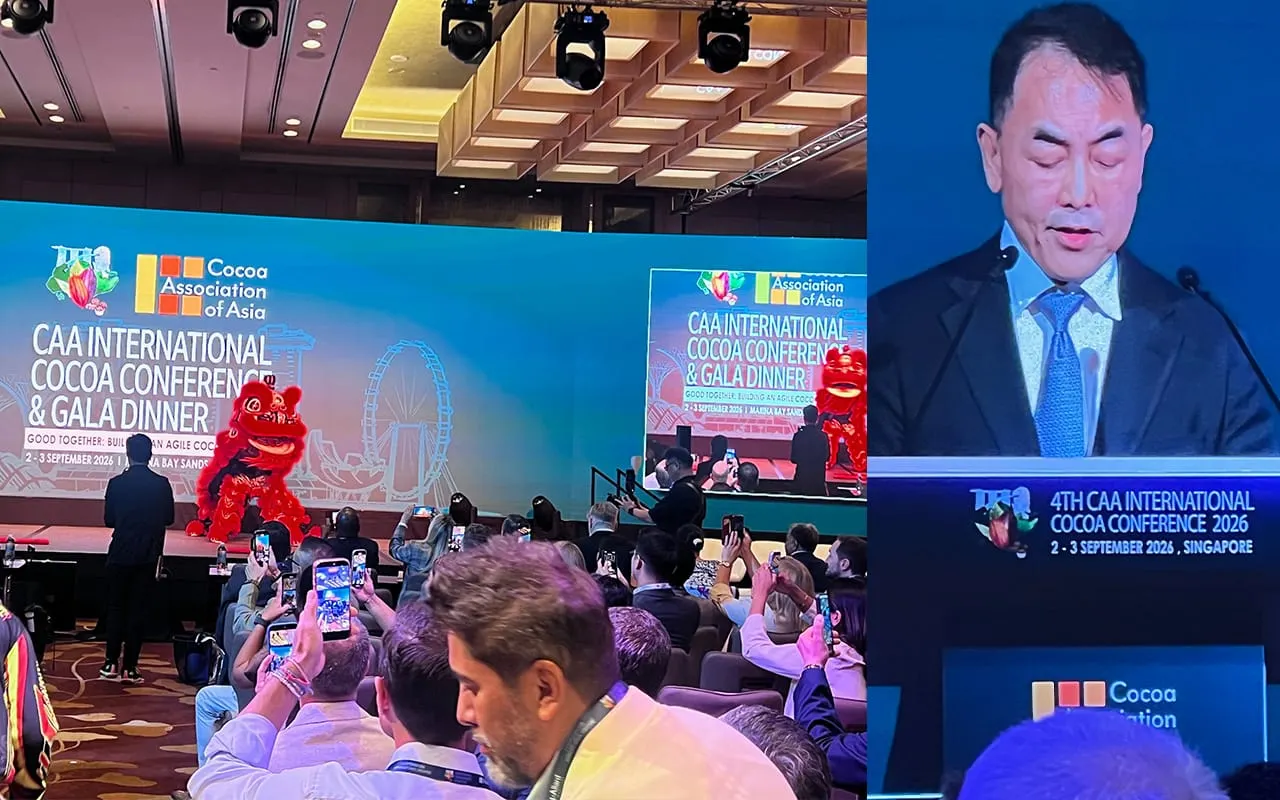
CAA Secretary-General Shirley Choo announced the commitment at the opening of the CAA International Cocoa Conference at Marina Bay Sands in Singapore on Wednesday, where a formal statement of support was signed. Choo said the initiative recognised the close relationship between cocoa production and healthy, biodiverse landscapes. Cocoa does not grow in isolation, she said, with surrounding trees providing shade, protecting soils and supporting the biodiversity on which productive farms depend.
Advertisement

The move also gives the cocoa industry a platform to contribute its practical knowledge of agroforestry, landscape regeneration and crop resilience to regional policymakers.
Choo described the CAA as a convening body operating at the intersection of industry, policy, sustainability and trade. Its role, she said, was to bring stakeholders together, share member expertise and help ensure cocoa remains part of Southeast Asian discussions about future trade and responsible growth.
That work is becoming more urgent as cocoa businesses respond to fast-changing requirements covering traceability, responsible farming and deforestation.
Volatility Tests the Sector
Opening the two-day conference, CAA Chairman Brandon Tay said the global cocoa sector was confronting volatile prices, the effects of weather and climate change in producing regions, stronger consumer demands for transparency and the continuing need to protect farmer livelihoods.
He positioned Asia as an increasingly connected centre of cocoa production and consumption, and said the CAA’s environmental commitment reflected the need for industry, governments and regional organisations to work together.
The conference, held under the theme ‘Good Together: Building an Agile Cocoa Future’, brings together farmers, producing countries, manufacturers, traders, governments, associations and specialists in sustainability, finance and technology. Tay said its purpose was to promote knowledge exchange and build relationships across those groups.
Enterprise Singapore managing director Cindy Khoo identified market volatility, rapid innovation and sustainability as three forces reshaping the industry.
Khoo noted that cocoa prices tripled in 2024 before falling sharply, exposing businesses to structural pressures including geopolitical tensions and supply-chain uncertainty. She highlighted Project Infinity, an AI-based decision-intelligence platform developed in Singapore by ofi (Olam Food Ingredients), as an example of how companies could reduce financial simulation cycles from weeks to seconds.
She also said changing consumer expectations demanded faster product development through connected agri-food ecosystems. Traceability would become increasingly important to market competitiveness as the European Union’s Deforestation Regulation (EUDR) approached implementation.
Khoo identified carbon markets as a potential source of upfront finance for smallholder farmers undertaking agroforestry and soil-restoration projects. Singapore, she said, was home to more than 160 carbon-services companies, while Ecom was establishing a global carbon desk as part of an expansion of its Asia-Pacific trading hub in the city-state.
EU Calls for Practical Support
Errol Levy, deputy head of mission at the European Union Delegation to Singapore, said cooperation across the cocoa value chain would be essential to balance environmental requirements, economic resilience and decent producer livelihoods.
He said farmers needed practical support to raise productivity, diversify and use land sustainably as climate change and market pressures intensified. The EU aimed to combine market requirements with investment through its Global Gateway initiative.
Levy said the EUDR would apply to large and medium-sized operators from 30 December 2026 and to most micro and small operators from 30 June 2027. That timetable made improvements in farm geolocation, legality checks, traceability and producer support urgent.
He cited the EU-backed Sustainable Agriculture and Forest Ecosystems initiative in Indonesia, which supports agroforestry and traceability in Central Sulawesi, Lampung and West Kalimantan, as an example of regional cooperation.
The opening discussions set a clear direction for the conference: Asia’s cocoa sector is seeking to move beyond reacting to immediate market shocks and towards collective action on environmental resilience, responsible trade and farmer support.
More on the CAA Conference:
cocoaradar.com is:
- Official Media Partner - CAA International Cocoa Conference
- 'From Our Desk. To Yours. Daily'
- Sign-up here for free and choose your plan.