

From our desk to yours. Daily.
Join our growing community of members and receive a free version of our daily newsletter on what really matters in cocoa.
No spam. Unsubscribe anytime.
As the official media partner of Chocoa 2026, CocoaRadar followed the discussions, debates, and insights that defined this important gathering. Six months on, many of the themes raised in Amsterdam have only grown in significance, shaping industry conversations around sustainability, compliance, finance, resilience, and the future of cocoa markets.
In an exclusive, open Signal Room discussion with CocoaRadar, Chocoa co-founders Caroline Lubbers and Mariana De La Rosa, and creative and programme director Anna Laven reflected on the lessons from Chocoa 2026 and offered early insights into the thinking behind Chocoa 2027.
Advertisement

Looking Back: Chocoa 2026 and a Sector at a Turning Point
If one message resonated throughout Chocoa 2026, it was that the cocoa sector is entering a new era.
For years, sustainability commitments were largely driven by voluntary initiatives and corporate pledges. Across the conference, speakers pointed to a future increasingly shaped by regulation, accountability, traceability, and measurable outcomes. Compliance is no longer viewed as an optional exercise; it is rapidly becoming a prerequisite for participation in global cocoa markets.
Against a backdrop of unprecedented price volatility, market uncertainty, and evolving regulatory frameworks, industry leaders in Amsterdam described the current period as a defining moment for the sector – a time when incremental change may no longer be enough.
The challenge ahead is clear: can the cocoa value chain transform urgency into practical action that delivers meaningful results for farmers, businesses, consumers, and producing countries alike?
From Volatility to Vision
Rewind to February, and the opening sessions of Chocoa 2026 highlighted a stark reality: volatility is no longer an exception in cocoa markets – it has become a structural feature.
According to De La Rosa, one of the defining characteristics of the 2026 edition was the growing recognition of a changing global cocoa landscape. Latin America featured more prominently than ever, reflecting increasing diversification in supply origins, genetics, and quality. This was reinforced through the Chocoa auction, which highlighted rising appreciation for premium cocoa quality and origin diversity.
Participants explored how producing and consuming countries must work more closely together to address the interconnected challenges of climate change, farmer livelihoods, market instability, and sustainability requirements.
Price volatility dominated almost every discussion. While higher prices have created opportunities, delegates repeatedly questioned how much of the additional value is reaching producers and whether current market dynamics are translating into meaningful improvements in livelihoods.
Laven noted that the macroeconomic context had shifted dramatically compared with previous years. The crisis in West Africa, coupled with the absence of some key producing-country institutions that remained focused on domestic challenges, underscored how rapidly the industry landscape is evolving. At the same time, she emphasised that Chocoa seeks not only to address systemic challenges but also to highlight practical solutions and opportunities that can drive change.
Delegates also acknowledged a growing concern beyond supply: demand. Rising cocoa prices are already influencing consumer behaviour, reformulation strategies, and chocolate consumption patterns in some markets, raising important questions about how the sector balances sustainability goals with long-term market growth.
Building Stronger Foundations Through Finance and Productivity
Access to finance emerged as one of the industry’s most persistent barriers – and one of its most urgent priorities.
De La Rosa described affordable financing as a challenge affecting every level of the value chain, from farmers and cooperatives to exporters and SMEs. Chocoa’s dedicated Financial Course, first introduced in 2025 and expanded in 2026, reflected the growing importance of this issue, with preparations already underway for a third edition in 2027.
Throughout the conference, speakers highlighted how land tenure challenges, documentation requirements, limited rural financial services, and investment uncertainty continue to restrict the flow of capital to cocoa-producing communities.
Farmers themselves repeatedly called for more practical knowledge and peer-to-peer learning. Reflecting on the inaugural Farmers Day, Laven noted strong demand for hands-on sessions, including discussions on financial literacy and even hedging. The appetite for practical solutions highlighted a broader shift toward producer-centred conversations and knowledge exchange.
Examples from Latin America demonstrated how improved agronomy, targeted investment, and agroforestry systems can significantly increase yields while supporting sustainability objectives. These examples reinforced an important message: productivity gains and environmental responsibility do not have to be competing priorities when supported by evidence-based approaches.
Looking ahead, finance is expected to become one of the central themes of Chocoa 2027. Laven revealed that ‘Financing the Future of Cocoa’ is emerging as a guiding concept for next year’s programme, with organisers aiming to attract a broader range of investors and financial institutions to Amsterdam Cocoa Week.
Trade and Transport Enter a New Era
The transformation of cocoa markets is also reshaping the systems that move cocoa around the world.
At Chocoa 2026, experts highlighted the growing importance of digital compliance infrastructure, including traceability systems, deforestation monitoring, and verification of lawful production. Increasingly, these tools are becoming embedded within everyday trading operations rather than existing as standalone sustainability projects.
Another important discussion centred on security and operational resilience. As supply chains face new risks, participants stressed the need to strengthen logistics networks, improve shipment integrity, and ensure that trade infrastructure remains robust in a rapidly changing environment.
The conference also explored practical pathways for reducing emissions across cocoa transport networks. Alongside discussions around alternative transport solutions, delegates called for stronger data collection on emissions, product quality, and logistics performance to ensure sustainability claims are supported by measurable evidence.
Looking ahead, the implementation of the European Union Deforestation Regulation (EUDR) is expected to remain a prominent topic in 2027. Laven noted that while discussions during 2026 benefited from complementary sessions organised alongside the World Cocoa Foundation Partnership Meeting, regulatory developments will inevitably continue to shape future conversations throughout Amsterdam Cocoa Week.
People at the Centre: Gender Equality and Labour Reform
One of the most impactful themes of Chocoa 2026 was the recognition that resilience begins with people.
The introduction of Farmers Day marked a significant milestone. According to De La Rosa, the event was fully booked and demonstrated strong demand for farmer-led dialogue and exchange. Organisers also made a deliberate effort to ensure producer voices featured prominently throughout the conference programme.
Gender equality discussions moved beyond participation metrics and focused on agency, leadership, and decision-making power. Speakers highlighted the critical role women play throughout cocoa-growing communities while emphasising that much of their contribution remains under-recognised in formal systems and datasets.
Participants also explored growing evidence that empowering women through access to finance, training, savings mechanisms, and leadership opportunities can strengthen household resilience while supporting improved outcomes in education, nutrition, and child protection.
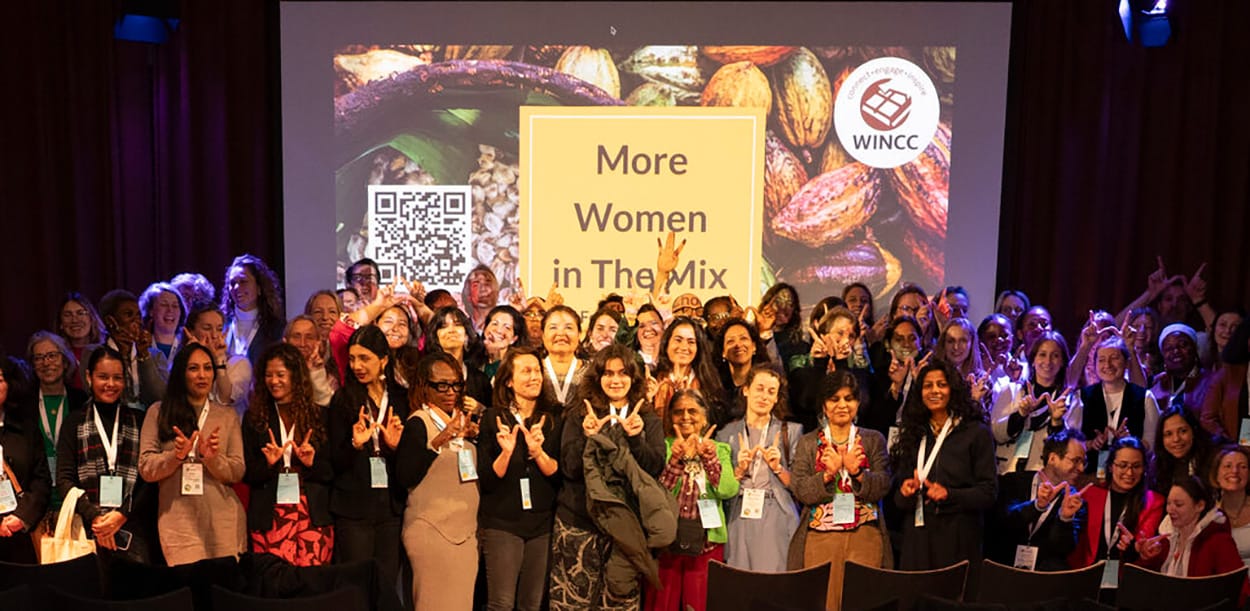
The relaunch of WINCC (Women in Cocoa and Chocolate Network) represented another important development. Lubbers confirmed that new mentoring initiatives are now being rolled out, designed to strengthen leadership pathways and encourage greater female representation throughout the industry.
Labour reform formed an equally important part of the conversation. As cocoa farming increasingly relies on hired labour, discussions focused on how professionalised labour systems, cooperative-supported workforce models, and practical interventions can improve productivity while reducing the risks of child labour.
A key takeaway was that while systemic change takes time, targeted and affordable solutions can deliver meaningful improvements today.
Connecting the Dots
The closing discussions at Chocoa 2026 brought together many of the themes explored throughout the week.
Delegates examined the delicate balance between profitability and sustainability, the opportunities and challenges created by new regulatory frameworks, and the need for stronger evidence to guide decision-making across the value chain.
The event itself also illustrated the benefits of greater collaboration. Co-location with the World Cocoa Foundation Partnership Meeting brought together diverse audiences, creating opportunities for networking and reducing travel-related impacts. Although the schedule proved intense, organisers viewed the convergence of stakeholders in Amsterdam as a major advantage.
Perhaps most importantly, the conference highlighted a series of tensions the industry continues to navigate:
- Higher prices can improve farmer incomes but may also create new market distortions.
- Regulation can drive accountability but requires significant adaptation.
- Sustainability demands investment, even as markets remain volatile.
- Short-term interventions must support rather than undermine long-term resilience.
These discussions underscored that there are no simple solutions. Instead, progress will depend on connecting policy, finance, productivity, sustainability, and market realities into a coherent strategy for the future.
Looking Ahead to Chocoa 2027
As Amsterdam Cocoa Week returns from 22–28 February 2027., expectations are likely to be high.
Organisers are already positioning finance as one of the major themes for the next edition, with a stronger emphasis on investment and new stakeholder groups. Discussions are also underway with additional partners, and support from the Dutch Ministry of Foreign Affairs is expected to strengthen the week's international dimension.
For Lubbers, success will ultimately mean reinforcing Amsterdam Cocoa Week’s role as the place where the global cocoa sector comes together to launch initiatives, exchange ideas, and create new partnerships.
By the time Chocoa reconvenes, the industry will increasingly be judged not by its commitments but by its implementation. Stakeholders will be looking for evidence that compliance systems are operating effectively, that finance is reaching producers, that resilience programmes are delivering measurable outcomes, and that sustainability investments are generating lasting impact.
The conversations that began at Chocoa 2026 have not ended. If anything, they have become more urgent.
With the Chocoa 2027 agenda set to be announced in the coming months, the conference is expected once again to provide a vital platform for examining how the sector responds to some of its most pressing challenges and opportunities.
For businesses, producers, policymakers, researchers, and sustainability leaders across the cocoa and chocolate value chain, Amsterdam Cocoa Week offers a unique opportunity to connect, collaborate, and help shape the industry’s next chapter.
The questions raised in 2026 remain highly relevant today.
Chocoa 2027 may well reveal how many of those conversations have evolved into action.
- Stay tuned to CocoaRadar for agenda announcements, speaker updates, exclusive interviews, and continuing coverage as the road to Chocoa 2027 begins.