From our desk to yours. Daily.
Join our growing community of members and receive a free version of our daily newsletter on what really matters in cocoa.
No spam. Unsubscribe anytime.
As we have been reporting this week, cocoa is not a distant commodity in the Netherlands. It is part of the country’s trading identity, its industrial base and its policy debate on sustainable development.
Around one-fifth of imported cocoa beans pass through the Netherlands, with Amsterdam and its surrounding logistics and processing infrastructure playing a central role in Europe’s chocolate supply chain. The sector supports thousands of jobs and gives the Dutch government a strategic stake in the future of cocoa.
But that position also brings responsibility.
As cocoa faces intensifying scrutiny over farmer poverty, child labour, deforestation, traceability and the uneven distribution of value, the Dutch approach is increasingly focused on collaboration. At the centre of that effort sits Utrecht-headquartered IDH, The Sustainable Trade Initiative, and its model of convening public and private actors around practical solutions.
Advertisement

For Renske Aarnoudse, Cocoa Programme Director at IDH, the challenge is not simply to secure more commitments. It is to turn those commitments into business practice, investment and measurable change for cocoa households.
“Convening is an art,” she said, describing IDH’s role in bringing companies, governments, civil society and producing-country actors into the same room. The aim, she explained, is to create the conditions in which stakeholders can agree not only on ambition, but also on who does what.
That question – who carries responsibility – now sits at the heart of the cocoa sustainability debate.
From Commitments To Living Income
IDH’s Living Income Roadmap, launched three years ago at the Chocoa Conference in Amsterdam, was developed as a framework to help companies identify living income benchmarks, assess income gaps, verify calculations, design interventions and share learnings.
Although not limited to cocoa, the roadmap has become closely linked to the sector because living income is increasingly seen as a root issue behind many of cocoa’s most persistent problems.
Aarnoudse described living income as “the centrepiece” of the Dutch Initiative on Sustainable Cocoa, or DISCO. Without progress in farmers' incomes, she argued, efforts to address child labour, deforestation, gender inequality and exclusion will remain fragile.
But she was clear that a commitment alone is not enough.
Reporting on the various European sustainable cocoa initiatives, including DISCO, is expected to play a growing role in demonstrating
That sequence matters because cocoa has spent years accumulating promises. The harder task now is implementation: changing how cocoa is bought, how risk is shared, how long-term relationships are built and how money actually reaches producers.
For IDH, that means connecting living income more directly to procurement. Aarnoudse pointed to long-term agreements, pricing, and cash-based interventions as areas where companies are beginning to test more serious approaches. Some interventions are tied to cocoa volumes, such as living income reference prices. Others, including conditional cash transfers, are not directly linked to volumes but may still help close income gaps.
The deeper question is whether these interventions are changing the economics of farming – or merely improving productivity within a system that still leaves many households below a decent standard of living.
Aarnoudse acknowledged that this remains a live issue. Reporting on the various European sustainable cocoa initiatives, including DISCO, is expected to play an increasingly important role in demonstrating whether strategies are producing measurable progress. She noted that many companies now have measurements and plans in place, but added that “a measurement and a plan doesn’t mean impact yet.”
That may be the clearest test for the next phase of the Dutch cocoa agenda.
The timing is significant. In 2025, the Netherlands overtook Germany to become the world’s largest exporter of cocoa products, exporting €12.4 billion worth of chocolate, cocoa mass, cocoa butter and cocoa powder, compared with Germany’s €11.4 billion. It is also the world’s largest importer of cocoa beans and the leading global trader in cocoa beans and cocoa products combined, according to Statistics Netherlands.
As Marika van Santvoort reported earlier this week in her column (see below), that rise has been dramatic. Dutch cocoa product exports almost tripled from €4.2 billion in 2020 to €12.4 billion in 2025, driven largely by soaring cocoa prices after poor West African harvests. Germany remains the largest destination for Dutch cocoa exports, followed by Belgium, France, the UK and the US. Unlike Germany and Belgium, whose exports are more heavily weighted toward finished chocolate, the Dutch trade is dominated by semi-finished cocoa products – reinforcing the Netherlands’ role as a processing and trading hub at the centre of the global cocoa economy.
The Dutch ‘Diamond’ In Cocoa
For Pauline van der Aa, Coordinating Policy Officer for Trade for Development at the Dutch Ministry of Foreign Affairs, the Netherlands’ role in cocoa is both economic and developmental.
“The cocoa sector is very important for the Netherlands,” she said, pointing to the country’s position in cocoa imports, processing and trade. But the government’s interest is not limited to commercial flows. Dutch policy also focuses on supporting local economies in producing countries, particularly Ghana and Côte d’Ivoire.
Van der Aa framed the Dutch approach through what she called the “Dutch diamond”: cooperation between government, industry, NGOs and knowledge institutions. That model, she argued, is one of the Netherlands’ strengths.
“If we want to create a future-proof cocoa sector, we have to work together with all the stakeholders,” she said.
That cooperation is evident in Dutch support for IDH, DISCO and wider cocoa-sector initiatives, as well as in projects with organisations including Solidaridad, AgriTerra and the ILO. The ministry is also supporting work on agroforestry, income diversification, swollen shoot virus, local processing and farming systems that could make cocoa more attractive to younger generations.
Van der Aa also highlighted the role of Dutch embassies in Ghana and Côte d’Ivoire, particularly in convening stakeholders around politically sensitive issues such as cocoa pricing, sector reform and trust between governments and companies.
This is where the Dutch state and IDH’s convening model overlap. Both see cocoa sustainability as something that cannot be solved by a single actor.
The Netherlands' ambition to exercise influence is evident not only in trade and development policy but also in convening, where that ambition increasingly extends to Chocoa, Amsterdam’s annual cocoa and chocolate conference, which has grown into one of the industry’s most important gathering points (see article below).
Van der Aa said she was struck by both the scale and significance of the event when she attended for the first time this year. Alongside meetings organised by the World Cocoa Foundation, she sees Chocoa as an increasingly influential forum where companies, governments, civil society and producer-country representatives come together to shape the year’s agenda.
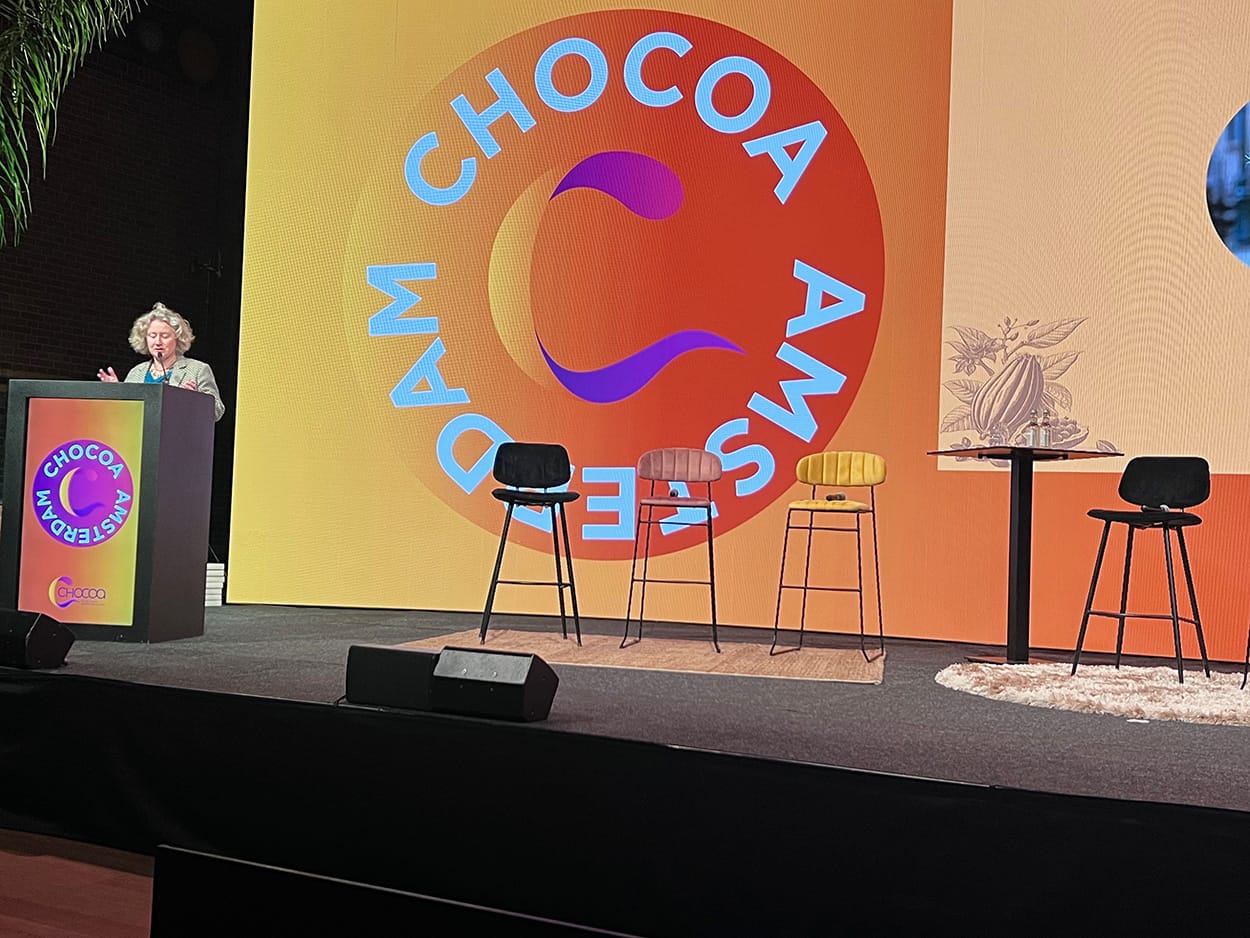
She acknowledged that the Dutch government had not always been sufficiently visible at the conference, but said that it was beginning to change. Working with Chocoa organisers and partners, including IDH, the Ministry of Foreign Affairs is looking at how to strengthen its presence and better communicate the Netherlands’ policy priorities.
For Van der Aa, a more active role at Chocoa reflects the wider Dutch approach to cocoa: using the country’s position as a global trading and processing hub to foster dialogue, promote collaboration and demonstrate what she described as the “Dutch diamond” model of cooperation between government, industry, NGOs and knowledge institutions.
As cocoa supply chains face mounting pressures from regulation, climate change and market volatility, Chocoa has become more than a trade conference. It is increasingly a place where debates around living income, traceability, due diligence and sustainability are tested and translated into action.
For the Dutch government, becoming more visible in that conversation is both a reflection of the Netherlands’ central position in the cocoa economy and a recognition that influence is exercised not only through policy but also through convening.
The Retailer Question
One of the most revealing examples of shared responsibility, according to Aarnoudse, came through DISCO’s work with Dutch retailers.
Suppliers, she said, often hold the closest relationships with cooperatives and farmers. They gather data, understand field realities and know which interventions are practical. But suppliers also look to their clients. Their clients, in turn, look to retailers.
At one point, Dutch retailers asked a basic but important question: What exactly are we supposed to do?
Because DISCO provided a multi-stakeholder platform, IDH and its partners were able to create a working group to explore that question. Over time, major Dutch retailers strengthened their commitments to specific living income interventions.
For Aarnoudse, that example shows why convening matters. It allows different parts of the value chain to clarify their roles, identify barriers and connect commitments to financing.
Civil society, she added, has played a crucial role in pushing ambition and keeping companies “on their toes.” Suppliers bring technical knowledge. Brands and retailers bring market power. Governments help create the enabling environment. NGOs challenge the sector to go further.
But the model still depends on transparency. Aarnoudse said the cocoa sector needs better clarity on how value is distributed through the chain and what it truly costs to produce sustainable cocoa.
EU Rules And The Business Case For Action
The European regulatory environment has sharpened the debate. The EU Deforestation Regulation (EUDR), the Corporate Sustainability Due Diligence Directive, and the Forced Labour Regulation are all changing expectations for companies operating in the cocoa sector.
Aarnoudse said regulation has been essential in creating pressure for action, particularly because the business case for living income is not always immediate.
“It would be cheaper, they would be making more money if they don’t invest in that,” she said of some companies. “Hence, they need that type of legislation coming in.”
The IDH Living Income Roadmap does not function as a compliance tool in a narrow legal sense. Rather, it helps companies build the data, strategy and partnerships needed to understand income gaps and act on them – elements that are increasingly relevant to due diligence and sustainability reporting.
Van der Aa welcomed the existence of EU regulation, while acknowledging questions around implementation. Her concern is practical: can regulations be applied in a way that does not leave smallholders behind?
Aarnoudse added that the Dutch competent authority has played an active role in helping businesses prepare for EUDR implementation, including through practical engagement with the cocoa sector. In her view, cocoa was relatively well prepared compared with some other commodities, partly because traceability and deforestation had already been prominent topics in the sector.
Still, the challenge remains: legislation can raise the floor, but it does not automatically deliver living incomes.
Who Can Reach A Living Income?
Perhaps the most difficult question is what happens to farmers for whom cocoa alone may never provide a living income.
Aarnoudse said the answer depends partly on proportionality. If a household spends half its time on cocoa, should cocoa provide the entire household income or half of it? The answer has implications for prices, productivity, diversification, and buyers' responsibilities.
She argued that the focus should be on cocoa households, not just cocoa farmers. Few households rely solely on cocoa, and in many cases, cocoa must be part of a diversified livelihood system.
“A thriving cocoa sector needs to also sit in a diversified system,” she said.
Van der Aa made a similar distinction from a policy perspective. The Dutch government, she said, is focused on building a sustainable cocoa sector, which means working particularly with “stepping up” farmers with greater potential to invest in productivity and sustainability. More vulnerable “survivalist” farmers require attention too, but the pathway is different.
That distinction is uncomfortable but important. Cocoa sustainability policy often speaks in universal terms, but interventions may not affect all farmers equally. Some farmers may benefit from better prices and procurement models. Others may need diversification, social protection, land-use planning or alternative livelihood pathways.
The living income debate therefore cannot be separated from broader rural development.
What Success Would Look Like
For IDH, success over the next five years would mean a stronger connection between demand for sustainable cocoa and the realities of producing it.
Aarnoudse said there is still too much distance between what companies and policymakers ask for, what farmers are expected to deliver, and what buyers are willing to pay.
The goal, she said, is to ensure that sustainability requirements are matched by investment, procurement practices and pricing models that enable farmers and communities to plan for the long term.
For the Dutch government, Van der Aa defined success in terms of a secure, sustainable cocoa supply and stronger farmer livelihoods. The Netherlands wants cocoa to continue flowing into Europe, but in a way that is traceable, responsible and economically viable.
She also pointed to progress in consumer awareness and traceability. More chocolate consumers now understand that cocoa has an origin, a farmer and a set of social and environmental conditions behind it. That awareness, she suggested, is part of the progress made over the past two decades.
The next five years will test whether that awareness can be converted into bigger change.
For IDH and the Dutch government, the answer lies in keeping the whole chain at the table – and ensuring the conversation moves beyond ambition.
The question for cocoa is no longer whether living income matters. It is whether the sector is willing to pay for the sustainability it says it wants.
- The IDH Living Wage and Living Income Summit 2026 takes place in Rotterdam, The Netherlands, on 30 June. See website for more details.
