
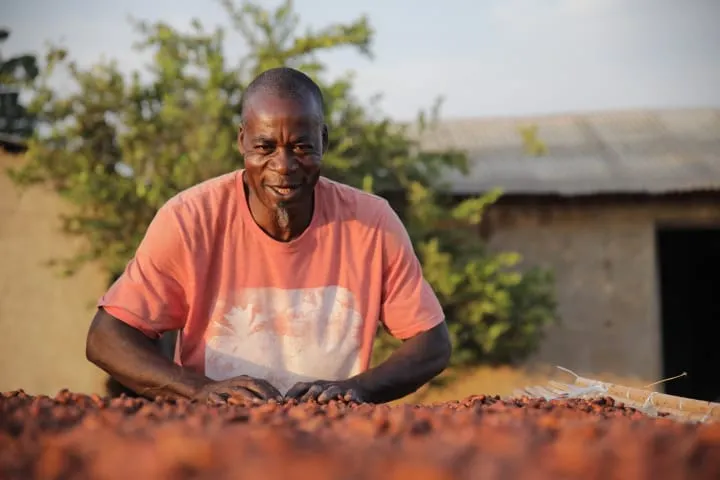
The move follows a year-long consultation process and comes amid renewed debate over whether reference pricing can meaningfully address persistent farmer poverty.
The revised voluntary benchmarks have increased for both countries, which together account for roughly two-thirds of global cocoa production. The new farmgate-equivalent LIRP is set at 1,758 CFA francs per kilogram (approximately $3.11) in Côte d’Ivoire and 45.40 cedi per kilogram (around $3.95) in Ghana.
According to Carla Veldhuyzen van Zanten, Senior Advisor of Sustainable Livelihoods at Fairtrade, price volatility remains a key barrier to long-term farm investment. She said the updated figures incorporate “the latest data and inputs from all sides of the cocoa industry” and are intended to shift the conversation “from talk about the importance of living incomes to concrete action.”
Advertisement

Consultation Follows Criticism Of Earlier Pricing Model
The update comes after Fairtrade’s January 2025 revision triggered significant industry scrutiny. Stakeholders – including companies, producers, civil society groups, and researchers – questioned the assumptions underpinning the pricing model, particularly its ability to reflect real farm conditions.
 Anthony Myers
That criticism has been part of an ongoing debate within the sector. Previous reporting by Cocoaradar highlighted concerns that LIRPs, while directionally positive, “do not go far enough” to close the income gap faced by smallholder farmers.
In response, Fairtrade undertook an extensive review process to align economic modelling with on-the-ground realities. The consultation coincided with a sharp correction in global cocoa prices – from peaks above $10,000 per tonne in late 2024 to roughly $3,400 per tonne by April 2026 – renewing concerns about farmer vulnerability.
Producers Emphasise Realism And Stability
Industry participants involved in the consultation have largely welcomed the process, while stressing that price-setting must remain grounded in practical realities.
Yesson Moussa Yeo, Managing Director of the Yeyasso cooperative in Côte d’Ivoire, described the review as “robust” and participatory, noting that it helped build transparency and trust across the value chain.
However, he cautioned that price benchmarks must account for variables such as farm size, family labour, climate pressures, and adoption of agricultural practices. Crucially, he underscored the importance of price stability: “A realistic price only has an impact if it is stable,” he said, pointing to the need for predictability to enable long-term planning and investment.
Gap Remains Between Reference And Market Prices
The new LIRPs sit significantly above current regulated farmgate prices, particularly in Côte d’Ivoire. The updated Ivorian benchmark is 47% higher than the prevailing farmgate price of 1,200 CFA francs per kilogram. In Ghana, the increase is more modest, with the LIRP about 10 percent above the current 41.40 cedi per kilogram.
This gap underscores a persistent challenge: while LIRPs signal what farmers should earn to achieve a living income, they are voluntary and depend on uptake by companies and retailers.

CAA
The conference theme, "Good Together: Building an Agile Cocoa Future" reflects the collective resolve of the industry to respond to one of the most volatile and complex periods the sector has ever faced — together.
Industry Uptake Grows – But Questions Remain
Fairtrade maintains that LIRPs are only one component of a broader “living income” strategy, which also includes productivity improvements, climate resilience, and income diversification. The organisation is developing a more flexible programme allowing companies to invest in these areas alongside paying higher prices.
Several European retailers – including Action, Marks & Spencer, Lidl, and Superunie – have already committed to integrating LIRPs into their sourcing strategies.
Adoption appears to be increasing. Volumes of Fairtrade cocoa sold at LIRP levels have tripled since 2019, reaching nearly 32,000 metric tonnes in the 2023/24 season. Commitments for 2026–2027 are set to approach 48,000 tonnes, a further 50% rise.
A Step Forward – Or Still Not Enough?
Despite this momentum, the fundamental question remains unresolved: can voluntary reference pricing close the structural income gap in cocoa?
Critics argue that without wider industry alignment – or regulatory intervention – LIRPs risk remaining a niche mechanism rather than a systemic solution. Supporters, meanwhile, view them as a necessary step toward more equitable pricing frameworks.
Fairtrade plans to expand the model further, with a Living Income Reference Price for cocoa in Peru expected in early 2027.
For now, the updated benchmarks mark both progress and continued tension in the sector’s long-running effort to translate sustainability commitments into tangible income gains for farmers.