From our desk to yours. Daily.
Join our growing community of members and receive a free version of our daily newsletter on what really matters in cocoa.
No spam. Unsubscribe anytime.
When European Union Ambassador Rune Skinnebach returned to Ghana more than three decades after first arriving as a young European diplomat, he found a country facing a very different challenge.
Then, Ghana was emerging into a new democratic era. Today, it is attempting something more technically demanding: proving to Europe that one of the world’s most important cocoa industries can remain globally competitive in an age of climate accountability.
Advertisement

That challenge now sits at the centre of EU–Ghana relations. The European Union’s Deforestation Regulation (EUDR), due to begin applying from 30 December 2026 to large and medium-sized operators, will require companies importing commodities such as cocoa into Europe to demonstrate that their supply chains are not linked to deforestation or forest degradation.
EU Market Access
For Ghana, where cocoa remains both a pillar of export earnings and a source of livelihoods for millions, the stakes are unusually high. Roughly 60% of Ghanaian cocoa exports go to Europe, making continued EU market access as much an economic imperative as an environmental one.
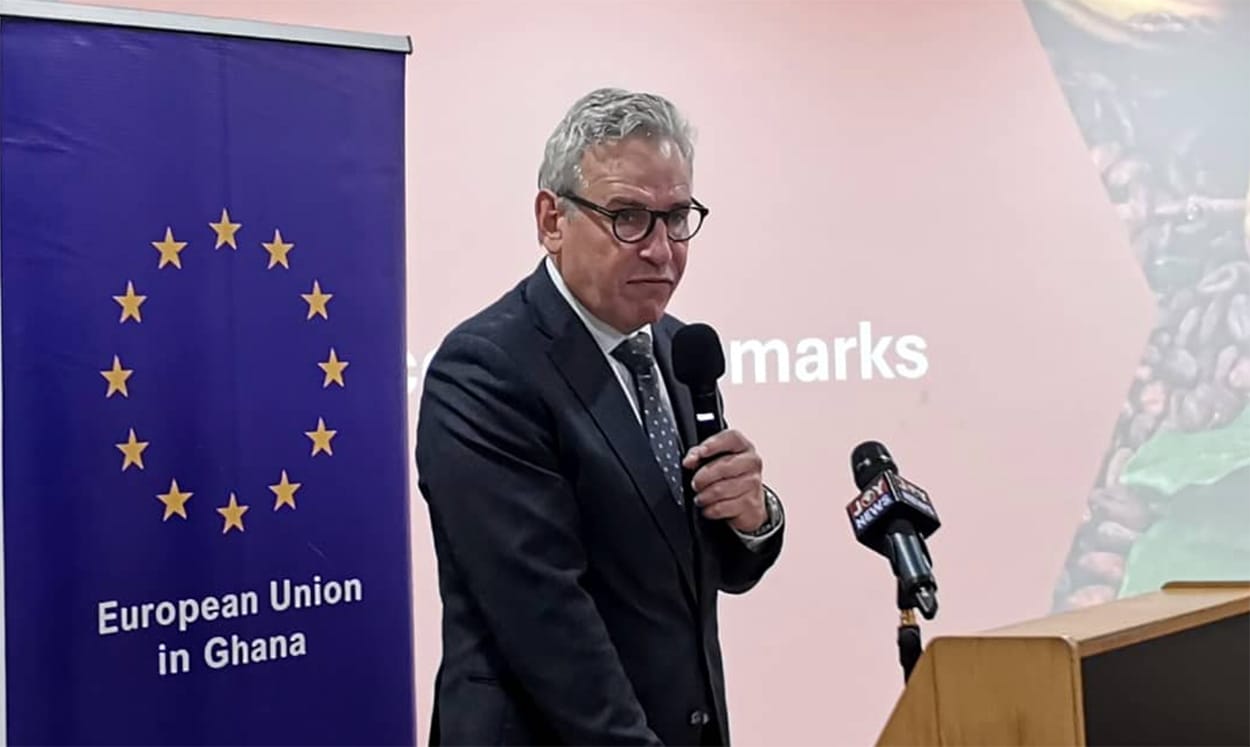
Skinnebach has quickly framed Ghana not as a compliance risk, but as a strategic success story in the making.
Since presenting his credentials to President John Dramani Mahama in September 2025, the ambassador has repeatedly highlighted Ghana’s political stability, reform agenda and investment potential.
More significantly, he has linked those themes directly to sustainability and trade readiness. The EU has already committed more than €1bn ($1.16bn) in Global Gateway investments to Ghana, reinforcing Brussels’ broader strategy of tying market access, environmental standards and infrastructure financing more closely together.
 Anthony Myers