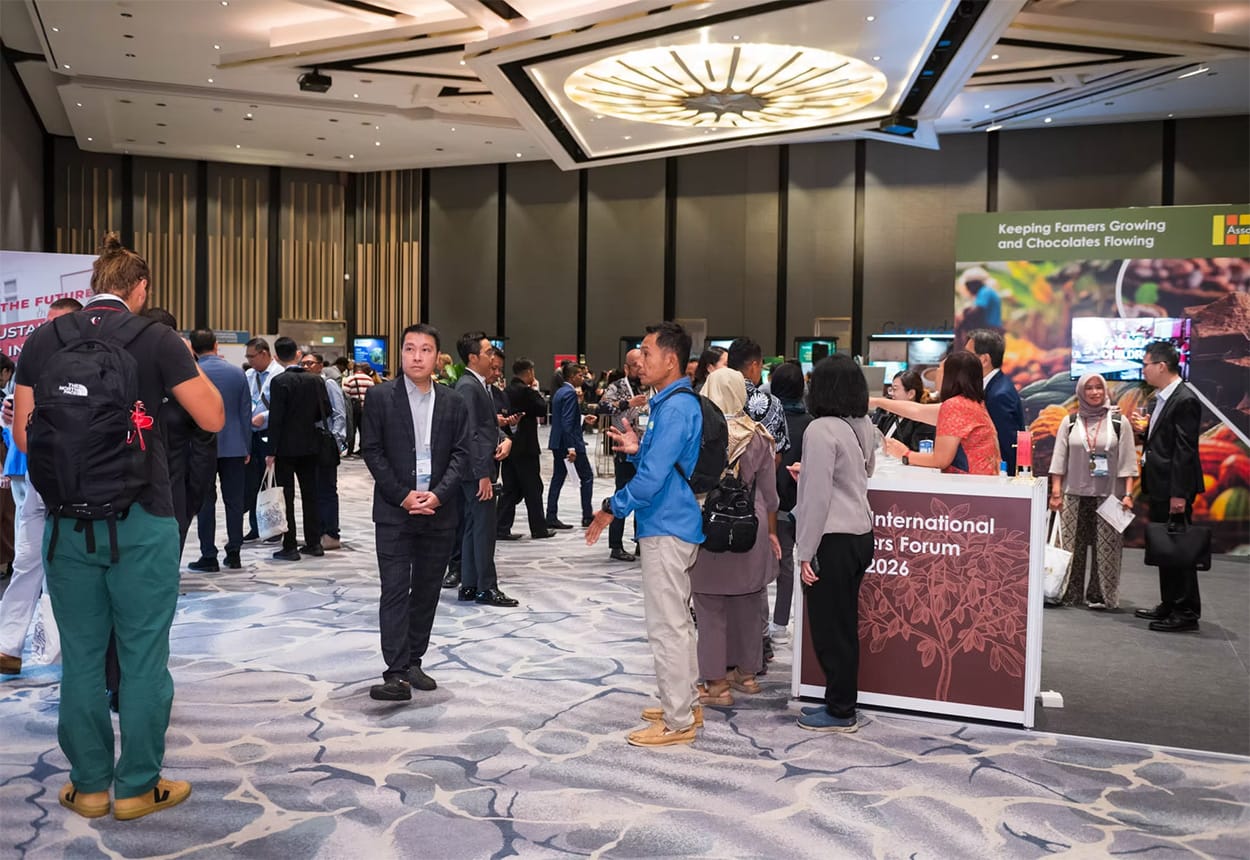
Organised by the Cocoa Association of Asia (CAA), the conference arrives at a significant moment for the sector — one defined by historic price volatility, shifting supply dynamics, and renewed scrutiny on sustainability and farmer livelihoods.
The theme says it plainly:
‘GOOD TOGETHER: BUILDING AN AGILE COCOA FUTURE’
A rallying call for alignment across the value chain — from farm to factory to financial markets — under the enduring mission:
Keep Farmers Growing & Chocolates Flowing:
As official media partner, CocoaRadar will be on the ground throughout the week, reporting on how Asia’s cocoa story is increasingly intertwined with global market forces and corporate performance.
Asia’s Cocoa Footprint: Small in Volume, Strategic in Impact:
Globally, cocoa production remains dominated by West Africa. Yet Asia plays a quietly strategic role in supply diversification.
Advertisement

Indonesia: The Regional Anchor
Indonesia stands as the world’s third-largest cocoa producer, contributing roughly 6% of global output. While modest compared with Côte d’Ivoire or Ghana, its presence offers crucial diversification during periods of crop stress elsewhere.
Other Asian origins — Malaysia, the Philippines, Vietnam and India — contribute smaller volumes, but together reinforce regional supply resilience.
Vietnam, in particular, is gaining recognition for higher-flavour and speciality beans, supporting premium market segments and craft chocolate demand.
Demand Is Shifting East
If Asia’s production footprint is relatively small, its consumption story is not.
Rapidly growing chocolate demand across Asia is reshaping trade flows and accelerating investment in local grinding and processing capacity. As regional middle classes expand and consumer tastes evolve, Asia is no longer just a sourcing region — it is a demand engine.
This demand growth directly influences global cocoa purchasing patterns and long-term investments in processing infrastructure.
The Price Whiplash: From Record Highs to Sharp Correction
Few commodities have experienced a ride like cocoa over the past two years.
After historic peaks through 2023–24 — with futures climbing above US$10,000 per tonne — prices have since corrected sharply. Front-month ICE New York and London contracts have recently traded around the US$2,800–3,000 per tonne range, marking declines of roughly 50–70% from 2024 highs.
The drivers:
- Improved supply conditions and projected global surpluses
- Rising inventories
- Softer grindings and more cautious demand from chocolate manufacturers
Short-term rebounds have occurred, driven by technical factors and shipping cost pressures, but the broader narrative remains one of recalibration.
For producing nations, lower prices mean compressed export earnings and mounting pressure on farm-gate pricing systems. For processors and manufacturers, volatility complicates hedging strategies and margin management.
Asia — including Indonesia — is not insulated. Export competitiveness, hedging positions and procurement timing are all shaped by global circuit dynamics.
Corporate Signals: ofi and Olam Group Reflect the Cycle
The financial results of major agribusiness players underscore how closely corporate performance tracks commodity swings.
Singapore-based Olam Group reported FY2025 PATMI of S$444.1 million (approximately US$320 million), up around 414% year-on-year, as operating performance strengthened amid elevated commodity prices. Group revenue rose roughly 19.3% to S$67.0 billion, with higher cocoa and coffee input prices largely passed through to customers.
Its food ingredients arm, ofi, posted steady EBIT of roughly S$1.1 billion in 2025 — nearly flat year-on-year despite intense volatility. Revenue climbed approximately 30.6% to S$28.5 billion, reflecting elevated cocoa and coffee prices more than pure volume growth.
As cocoa prices normalised from extreme highs, working capital pressures eased, improving cash flow and turning free cash flow to equity positive after a prior negative outturn.
The takeaway for investors and industry watchers: stable EBIT amid price turbulence signals operational resilience — but also highlights the delicate balance between cost pass-through, inventory valuation, and end-market demand.

Why This Context Matters for CAAICC2026
Against this backdrop, CAAICC2026 is more than an industry gathering. It is a strategic checkpoint.
The conference programme reflects the pressures facing the value chain.
Pre-Conference — 1 September:
The International Farmers Network Forum (Invite Only) ensures that farmer realities anchor the week’s discussions — not as a side event, but as a foundation.
Day 1 — 2 September:
Exhibitions open with Cocoa Village and The Asia Cocoa Story photo showcase. Plenary sessions confront urgent questions:
- What in the cocoa world is going on?!
- Will cocoa grind to a halt?
- Invisible No More — elevating farmer voices
A Networking Evening closes the day, where market participants will no doubt compare notes on prices, inventories and procurement strategies.
Day 2 — 3 September:
Masterclasses and plenaries dive deeper:
- Reimagining Chocolate, moderated by Racheal Toh of Barry Callebaut
- Can Cocoa Truly Go Green?
- The Bittersweet Byte – Balancing AI’s promise with realities of the cocoa value chain, moderated by William Gaultier
The Gala Dinner follows — a moment of celebration, but also reflection.
Day 3 — 4 September:
A Social Day with curated tours rounds out the programme.
The Real Conversation: Agility Under Pressure
Across panels and corridors, six themes are likely to dominate:
- Farmer-centric change and youth inclusion
- Macro forces reshaping supply and demand
- Affordability and demand resilience amid price swings
- Reinventing chocolate formats and health-forward positioning
- Sustainability beyond slogans — traceability, carbon markets, and cost allocation
- Practical AI adoption grounded in operational viability
In a market where futures can halve within months, agility is no longer optional.
Asia’s Strategic Role in a Volatile Era
Asia’s cocoa sector may not rival West Africa in scale, but it plays three increasingly critical roles:
- Supply diversification during crop risk cycles.
- Processing expansion that supports global trade buffers.
- Demand growth that reshapes long-term consumption trends.
Corporate results from ofi and Olam Group demonstrate how commodity volatility translates directly into revenue, margin management and investor confidence.
The message for CAAICC2026 delegates is clear: production geography, price cycles, processing economics and consumer demand are now inseparable conversations.
Building the Agile Cocoa Future — Together
CAAICC2026 positions collaboration as the antidote to fragmentation.
Price booms and busts will continue. Climate variability will persist. Consumer expectations will evolve. Technology will disrupt.
But resilience — whether at farm level, processor balance sheet, or brand portfolio — depends on coordinated action.
In Singapore this September, the cocoa world will test whether it can truly live up to its theme.
- Full programme details here.
cocoaradar.com is:
- Official Media Partner - CAA International Cocoa Conference
- 'From Our Desk. To Yours. Daily'
- Sign-up here for free and choose your plan.