
From our desk to yours. Daily.
Join our growing community of members and receive a free version of our daily newsletter on what really matters in cocoa.
No spam. Unsubscribe anytime.
I love technology, especially when it helps to solve real problems. I am convinced technology will shape cocoa much more in the future than it has done in the past. There has probably never been a more interesting time for it either.
Advertisement
AI has opened doors to opportunities we could not even foresee a few years ago. A lot is already possible, but sometimes we need to look at other industries (like tomatoes, flowers, avocados) to see how technology has positively shaped them.
Thinking about technology in cocoa, alternative cocoa also comes to mind. And every time I read that another corporate has snapped up an alt-cocoa start-up, I feel... well... torn.
The innovator part of me is excited, and understands its appeal for companies. After the price rollercoaster of the past two years, I completely understand why securing cocoa has become a real and important problem for corporates to solve. If volumes can't be secured, at least the cocoa's flavour can be preserved.
But the other half of me, the side that truly loves cocoa, worries. If cocoa gets partly, or fully, swapped for something other than cocoa, what then happens to the millions of farmers who live from this crop?
What happens to the beautiful flavour of chocolate, to quality, to all the companies who depend on it?
What happened to the vanilla bean market when vanillin (synthetic flavor) was created?
Personally, I would rather see technology used differently, for example to help reduce the issues we already have in the chain, issues that can be solved without anyone being cut out.
Buying Blind
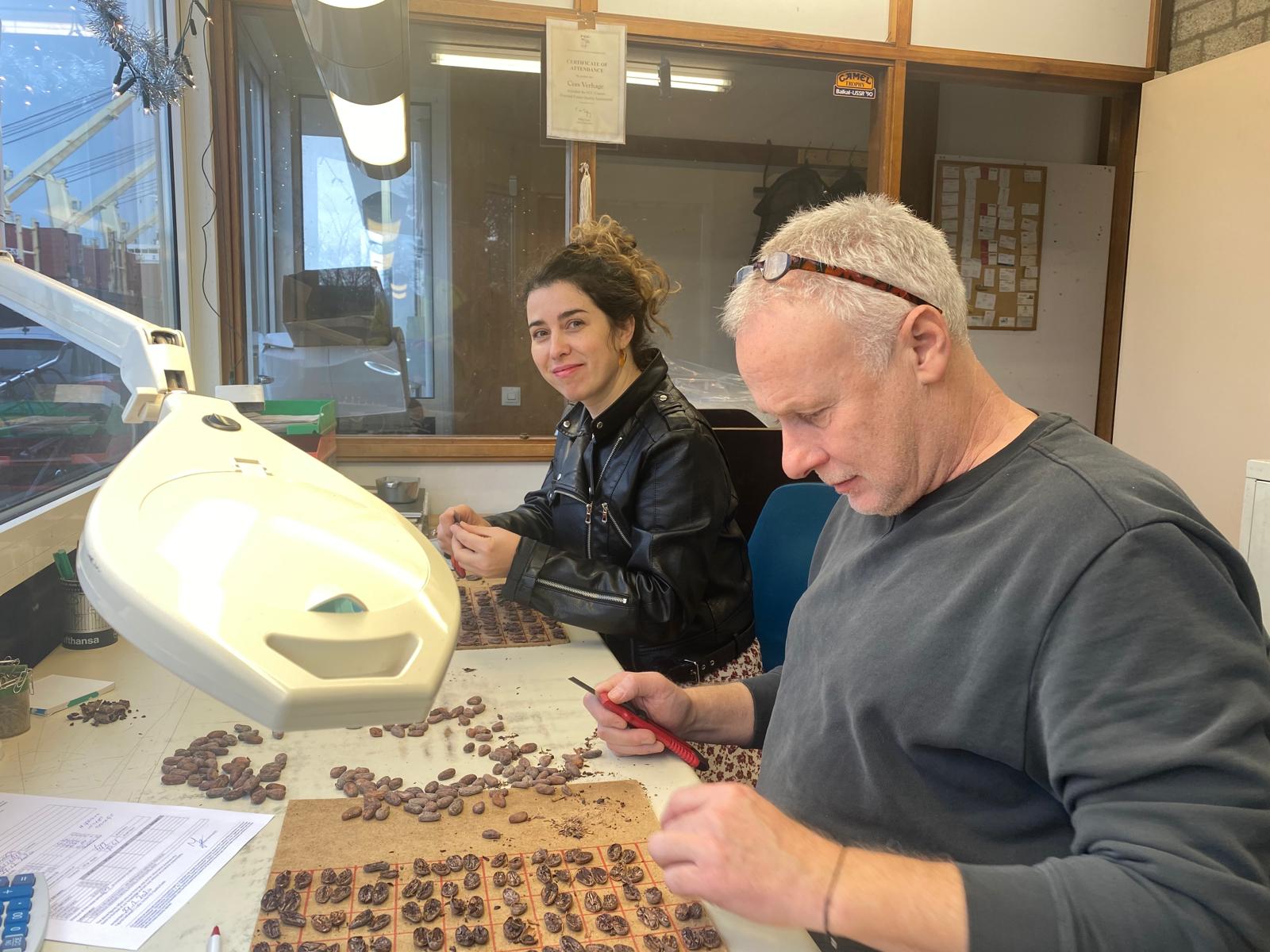
Anyone who has ever bought cocoa knows this issue: it is nerve-wracking to pay so much money for a batch of new cocoa when you don't yet know how it will turn out and taste.
In my first start-up, Gaia Cacao, my co-founder Mariana and I faced this too. You pick a batch from an origin based on a trust relationship and a sample that once tasted great.
You make the purchase, transfer (part of) the money, and the beans are shipped and sail for about six to eight weeks, still not fully dried. Basically, you find out what you actually paid for when the container gets to the warehouse and the doors open. Butt cheeks clenched, fingers crossed, praying to holy Mary that the beans would come out good.
Wouldn't it be better to know before it even ships?
Cacao-Tech: Checking Quality At The Source Using NIRS Scanners
Between 2023 and 2025, Moving Cocoa worked on a project called Cacao-Tech, together with Wageningen Research in the Netherlands, the Czech University of Life Sciences in Prague and a Dutch AI/software partner called Hyves Tech.
It ran under DRG4FOOD, an EU-funded programme on the use of new digital technologies in food systems. Our aim was to identify practical ways to use digital tools to improve quality, traceability, and reduce waste in the cocoa sector.
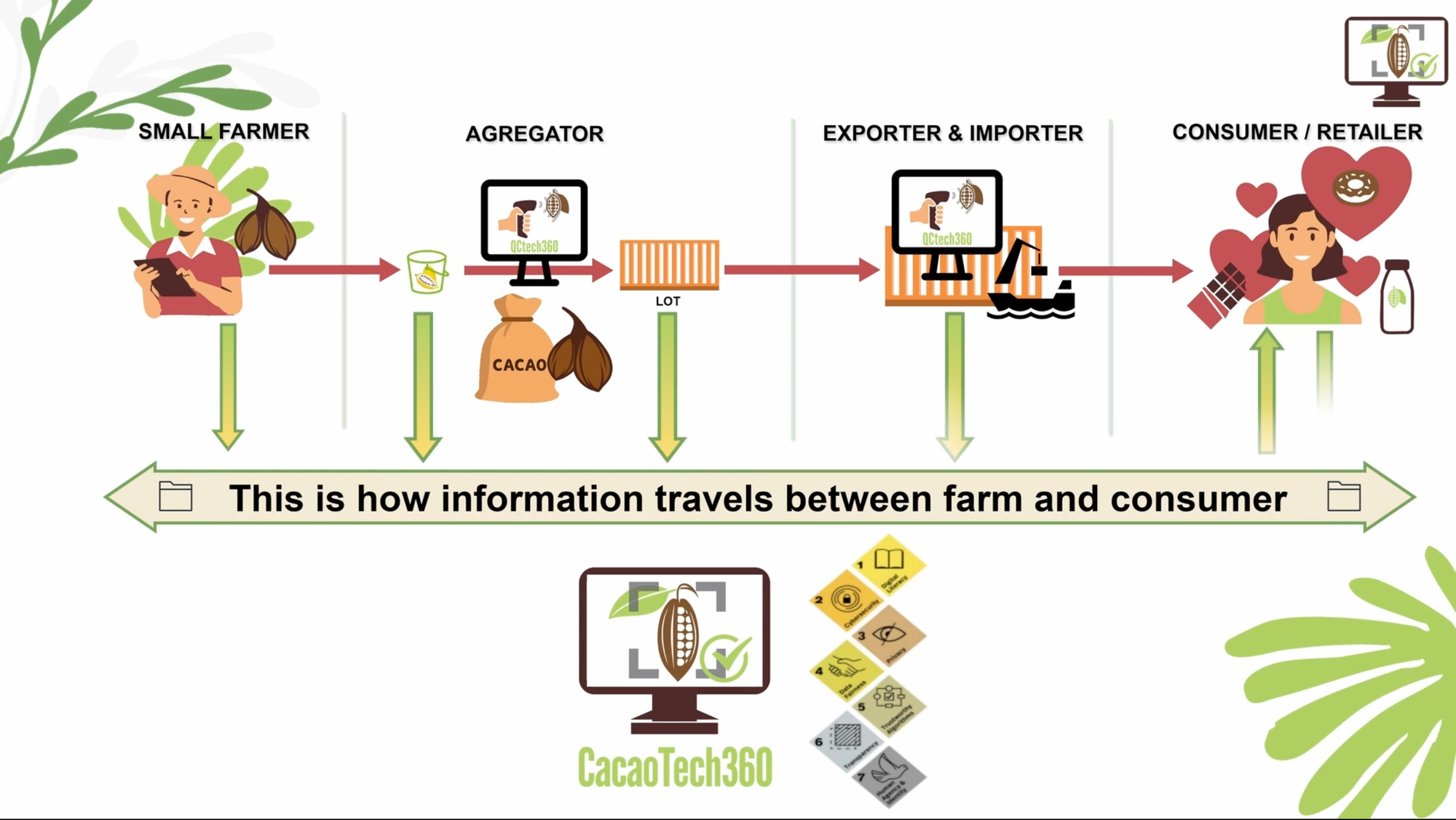
Eventually, we built a data platform from scratch that is EUDR-compliant and takes ethics seriously: who owns the data, who gets to share it, and how. In addition, we worked on a part where we used handheld NIRS scanners to read the quality of the beans, and even of the pulp inside a closed pod, from the outside.
Using NIRS itself is not new. It is a widely used tool in labs for measuring specific parameters. But using a handheld NIRS scanner on the farm or at the collection point to catch quality problems early, tie the result to traceability, and build an AI prediction algorithm with up to 95% accuracy - that is new for cocoa - and very exciting!
 Anthony Myers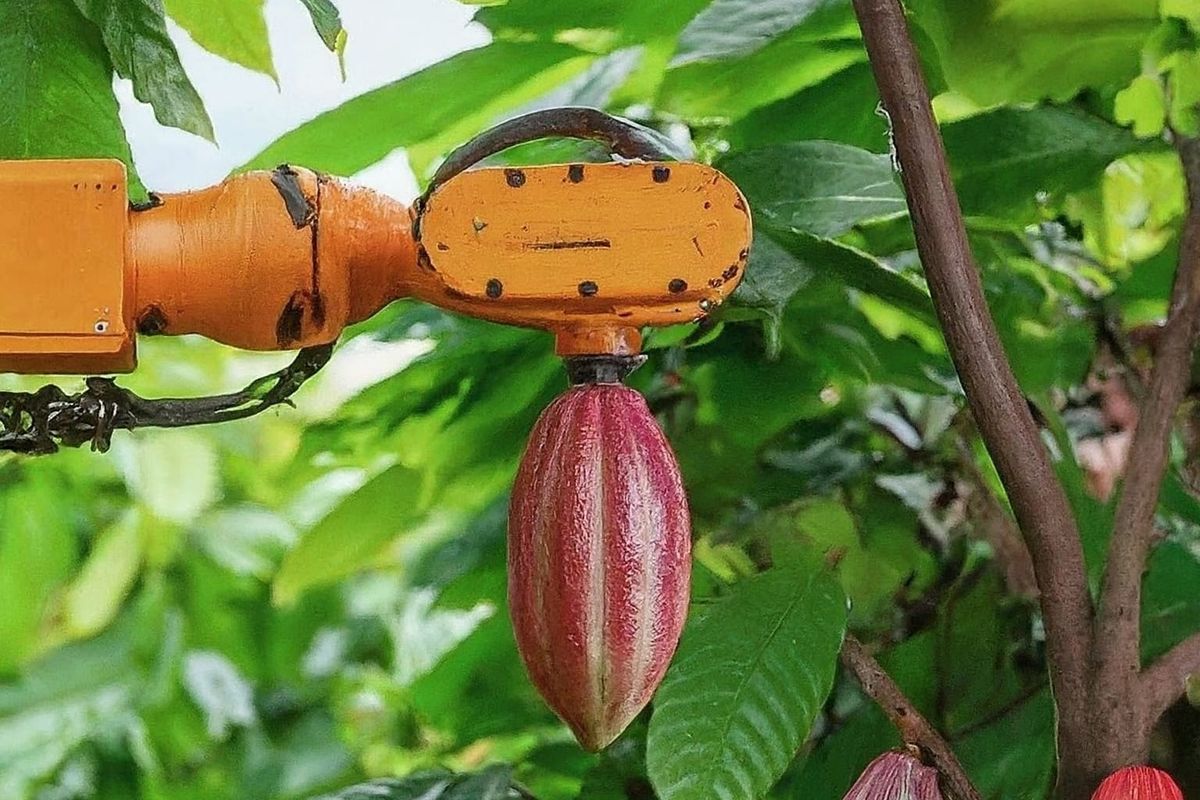
How it Works
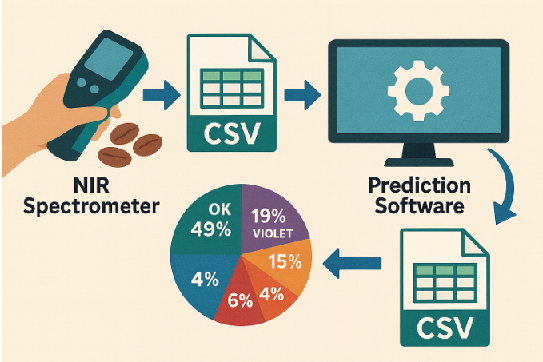
The scanner is a portable near-infrared spectrometer. It is small, easy to carry and (relatively) affordable. You press it against a pod or bean, and it reads the light that bounces back. The scans take a few seconds. That reading runs through a trained model that sorts it into classifications: well-fermented or not, and, with the finer model, violet, slaty, mouldy, white spots, and insect damage.
This is how you build a good, objective understanding of the batch's quality, by scanning the beans of a representative sample. It works completely offline and gives you an answer in half a minute instead of the days or weeks a lab takes. Every scan is time-stamped, tied to its batch, and can be synced with any traceability platform. It even flags a bad or tampered scan, so unreliable numbers never make it in.
We calibrated it against laboratory benchmarks and FCC quality protocols, and the same algorithm can be further trained for moisture and fat, and even for residues the EU now screens for at the border. Yes, even the PAHs and the mineral oils, MOSH and MOAH.
What It Changes
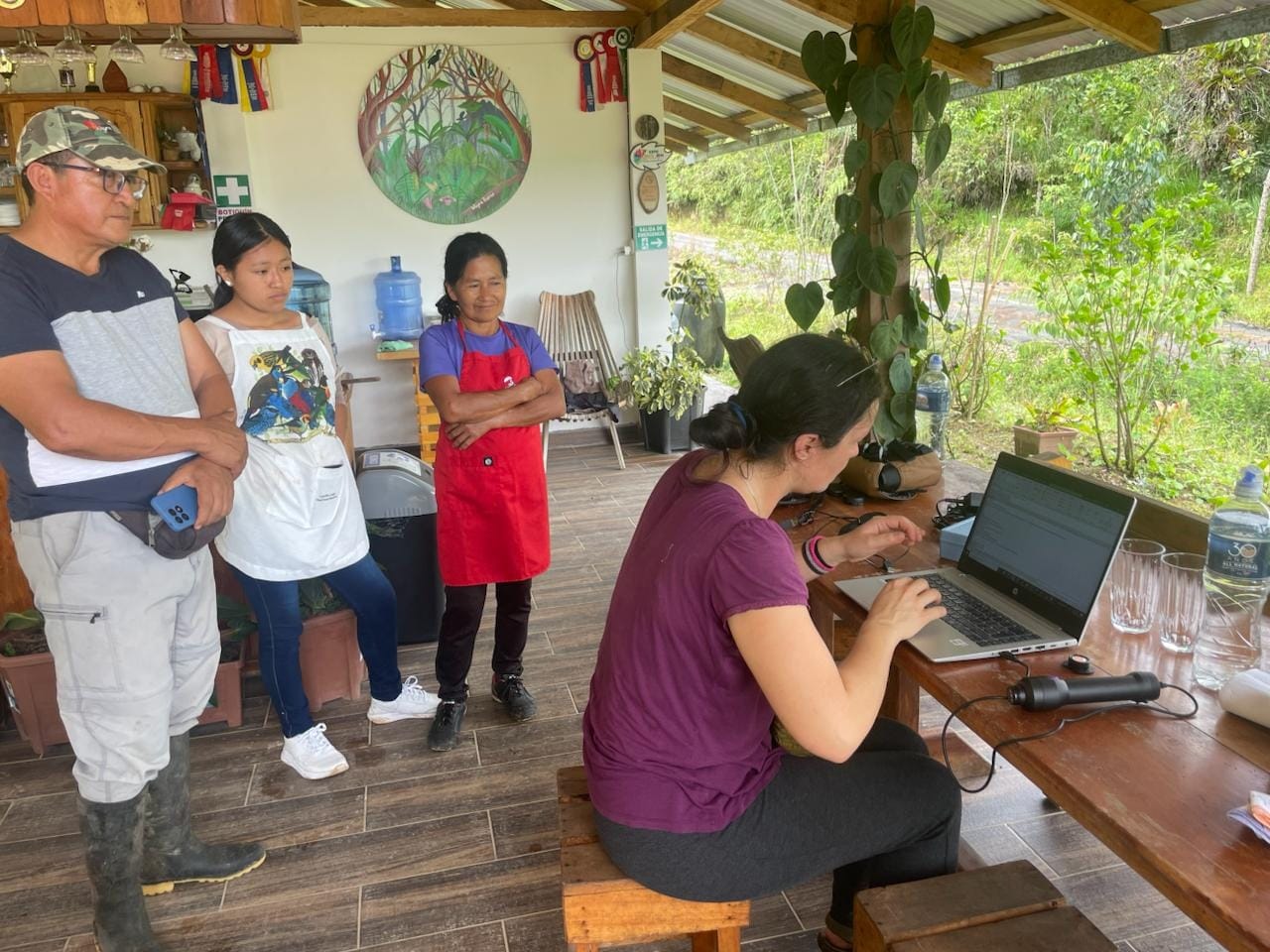
For farmers and cooperatives, this gives a clear answer right away. They can prove the quality of what they are selling and feel confident in a price negotiation with something so tangible and objective in hand. An issue such as poor post-harvest handling can be caught before the beans are sold. This can avoid potentially damaging the trust relationship with a buyer. We built it privacy-first and tested it with farmers and cooperatives in Ecuador. In our pilots, the data stays with the farmer, which was an important element of the project.
For companies, quality translates into consistent, comparable data collected where the beans actually are, rather than where they arrive. This saves a lot of costs, for example on lab tests and cut tests. A shipment gets sampled about three times: at the cooperative, on arrival and often at the client, roughly 3kg a time.
Fine for a small batch and companies that sell premium cocoa, but imagine yours is a company that works on tight margins and imports 500,000 MT a year.
That is around 180 MT of beans and some 60,000 cut tests, close to 7 million euros in costs and losses, about 14 euros a tonne. Reading the quality at origin turns guesswork into one objective check, which helps companies make better decisions later in the chain, for example which recipe the beans should end up in, before the container arrives.
Now, What's Next?
The research project and the pilots are finished, and the tools are ready to be commercialised under a licensing model. The group behind Cacao-Tech is now looking for the right partners to continue the work.
- Further reading: The Cacao Tech project
- Interested in knowing more? Reach out to marika@movingcocoa.com.

Marika van Santvoort has been working in cocoa & chocolate since 2014, with a focus on responsible sourcing, innovation and farmer impact. In this monthly column she shares her own perspective on what is really moving in the sector; what is being said, what is not, why it matters and what it means for the industry. |