

Speaking during the webinar attended by nearly 1,000 participants, Liberato Milo, Head of Nestlé Confectionery and Snacking, said the pressures facing cocoa-producing communities are too large for any single actor to solve alone.
“Collaboration is not just the right approach. It is the only way forward for our sector,” Milo said.
“These are structural issues, not short-term disruptions that cannot be solved by any single company or organisation acting on its own.”
Advertisement

Milo said farmers, suppliers, governments, NGOs and implementing partners all have a role to play in strengthening the cocoa value chain.
“If farmers are not resilient, neither is our business,” he said. “For us, resilience means very concrete things: households earning more stable incomes, farms that can cope better with climate stress, and a cocoa sector that can continue to meet demand in the years ahead with less volatile prices.”
The remarks accompanied the release of a new independent assessment by the KIT Institute, which found that Nestlé’s Income Accelerator programme continues to deliver measurable improvements in productivity, household income and women’s empowerment.
Independent Study Shows Higher Yields And Incomes
The evaluation, based on nearly 2,000 participating households in Côte d’Ivoire between 2022 and 2025, found that farmers enrolled in the programme increased cocoa yields by 4%, while yields among comparable households declined by 16%.
During the difficult 2024-25 season, participating households harvested an average of 2,116 kilograms of cocoa – about 500 kilograms more than comparable farmers.
According to Nestlé, those additional volumes translated into more than $2,000 in additional annual earnings under current cocoa prices. Even using lower historical prices, participating households would still have earned about 31% more than non-participants.
The study also showed that cocoa income increased by 190%, while household savings rose significantly compared with control groups.
Women’s Empowerment More Than Doubled
One of the strongest outcomes highlighted by the KIT Institute was progress in gender inclusion.
The proportion of women classified as empowered increased by 114% compared with 2022, while participation in Village Savings and Loans Associations rose substantially. Food insecurity declined, and households reported improved dietary diversity and greater ownership of productive assets.
Nestlé’s approach combines agricultural training with household support and conditional cash transfers delivered through mobile money accounts. Approximately 90,000 mobile accounts have now been established through the programme.
Learning While Scaling
Milo acknowledged that the model has evolved since its launch in 2022 and emphasised that Nestlé chose to scale while continuously improving the design rather than waiting for a perfect system.
“This innovative programme is the living proof that we can accelerate change at scale,” he said.
“After four years, the results show that this approach can work – not perfectly, not everywhere in the same way – but well enough to confirm that combining farming improvements with household incentives can accelerate impact and make a difference at scale.”
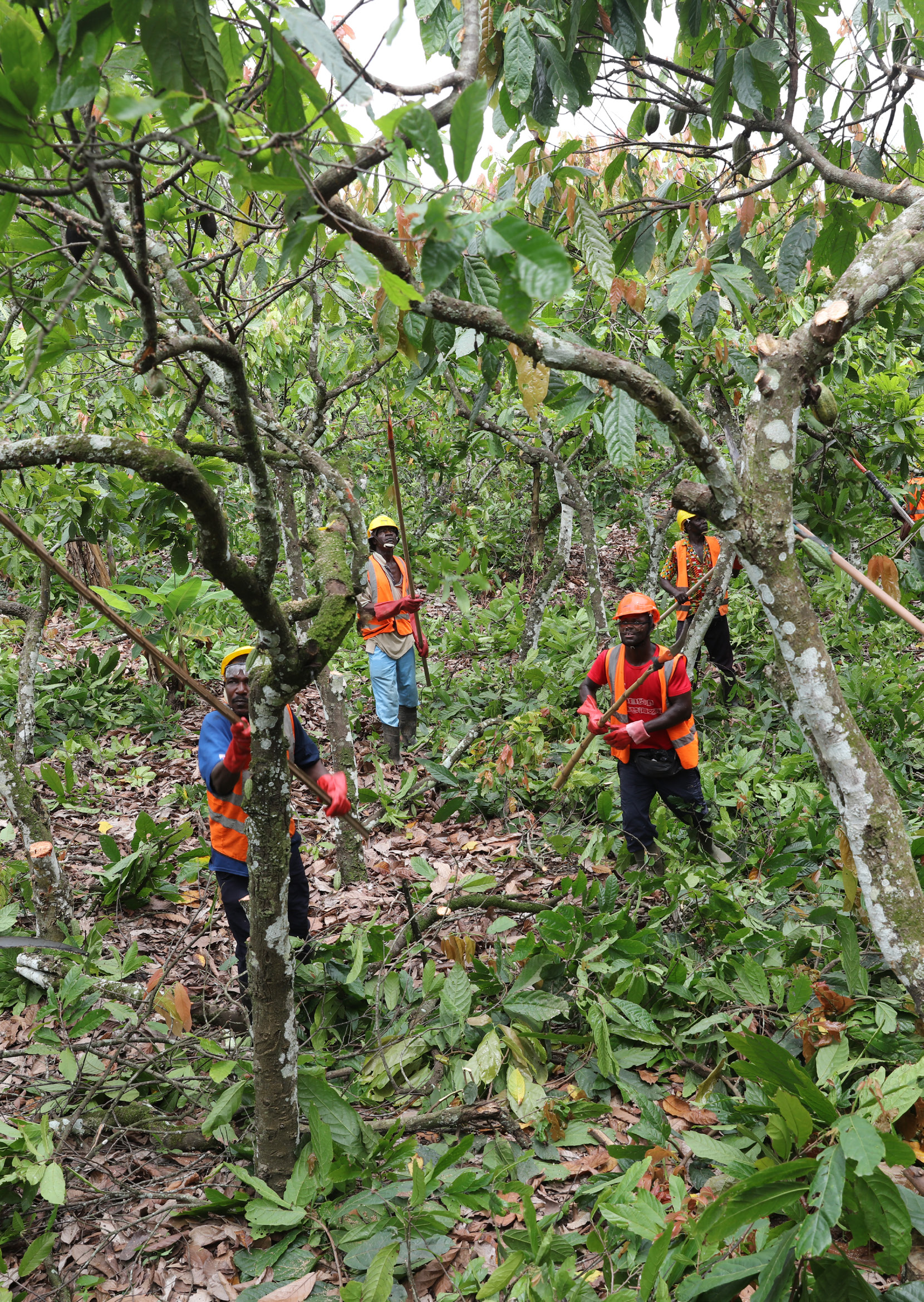
The programme currently reaches around 45,000 households across Côte d’Ivoire and Ghana. More than 50,000 hectares have been pruned or re-pruned, approximately 600,000 forest and fruit trees have been distributed, and farmers have established about 13,000 compost piles.
Nestlé also simplified the programme by reducing incentives from four pillars to two and changing payment structures to improve household cash flow, with half of the incentive paid upfront and the remainder paid after activities are completed.
Cocoa Sector Under Pressure
Milo warned that the industry faces unprecedented challenges.
“Cocoa is under real pressure,” he said. “Climate shocks are affecting production. Prices have been highly volatile.”
Despite those difficulties, he stressed Nestlé’s long-term commitment to cocoa-producing communities.
“Cocoa has been part of Nestlé’s business for more than 120 years,” he said. “Our ability to grow in chocolate has always depended on stable supply and on long-term relations with farming communities.”
 Anthony Myers
Together Cocoa Foundation
While the KIT Institute report identified major gains in productivity and resilience, it also highlighted areas requiring further attention, particularly income diversification and long-term educational outcomes.
Over the next year, researchers will examine yield drivers, the adoption of regenerative agriculture, diversification, and school attendance to help shape the programme's next phase.
Nestlé also highlighted the launch of the Together Cocoa Foundation, created to promote broader industry collaboration.
“This foundation aims to accelerate industry-wide collaboration to help strengthen the resilience of the cocoa supply chain,” Milo said.
He concluded with a warning that the sector must move quickly.
“There is no time to waste,” he said. “Securing the future of cocoa will require collective steps toward a more resilient cocoa sector.”
As climate pressures, disease outbreaks and market volatility continue to reshape global cocoa production, the experience of Nestlé’s Income Accelerator is increasingly being watched by companies and sustainability groups seeking models that can be scaled across the wider industry.
- Read the full KIT report here

cocoaradar.com is:
- Official Media Partner - CAA International Cocoa Conference
- 'From Our Desk. To Yours. Daily'
- Sign-up here for free and choose your plan.