Help That Industry Needs and African Farmers Want
Part 3 | Sustainability Programmes, Yield and the Crisis
Cocoa sustainability programmes date back to 1987. Most originated in Europe, where non-governmental organisations promoted them.
CRA’s searches returned Rainforest Alliance, Fairtrade and UTZ. Their goals were to protect the environment, establish agricultural standards (probably with an emphasis on chemical use), promote farmers’ welfare, set up and audit certification and traceability systems, and monitor child labour.
Funding came from government and industry. By paying to support these branded programmes, industry bought permission to tell consumers that it was supporting sustainability.
‘Yield’ was conspicuous by its absence.
Advertisement

In the early 2000s, these programmes made tackling child labour and slavery in cocoa cultivation a major focus. Systematic surveys sought to establish how many children were working in cocoa. Some surveys in Côte d’Ivoire reported very high numbers. Arguments about the figures usually followed, and new surveys were commissioned. The first lawsuits alleging that major confectioners had turned a blind eye to child slavery were filed around 2005.
In the 2000s, industry members also began developing their own sustainability programmes. In CRA’s view, the main reasons were to gain influence over otherwise independent programmes and to reduce costs. Preventing deforestation became another objective as global warming received more press coverage.
The industry’s first programmes were joint projects. The World Cocoa Foundation (WCF) has played an important role in these efforts. Other initiatives included the International Cocoa Initiative (2002), CocoaAction (organised under the WCF in 2014) and the Cocoa & Forests Initiative (2017).
Mentions of yield and productivity became more frequent. Nestlé launched its Cocoa Plan in 2009 to improve agricultural practices, rejuvenate plantations, empower women, prevent child labour, certify cocoa and improve education and social conditions.
In 2016, Nestlé reported distributing more than two million improved cocoa seedlings and training 57,000 farmers.
Mondelēz launched Cocoa Life, and Cargill launched its Cocoa Promise in 2012. Barry Callebaut followed with Forever Chocolate in 2016. Mars introduced Cocoa for Generations, and Hershey introduced Cocoa For Good in 2018. Olam launched Cocoa Compass in 2019.
Nestlé introduced its Income Accelerator Program in 2022, followed by the Hershey Income Accelerator Program in 2023. Other firms that trade cocoa beans and products have developed their own programmes.
Broadly speaking, independent, branded certification businesses dominated the first 20 years of cocoa sustainability programmes. In the 2000s, major cocoa firms began working together through the WCF. By the end of that decade, individual companies had begun to run their own programmes, a trend that continues today.
The focus widened beyond certification to include traceability, reducing child labour, stopping deforestation and increasing farm incomes. Yet CRA’s searches returned only occasional mentions of yield or productivity.
Research found that cocoa sustainability programmes developed in response to public pressure, first over child labour, then over poverty among cocoa-growing families and later over deforestation.
The industry has certainly been concerned about protecting the favourable image chocolate has enjoyed since it entered the British middle-class diet in the 1850s and subsequently found a wider market around the world. That concern has shaped what the industry tells consumers and governments in consuming countries. Even so, CRA considers it unfair to dismiss these programmes as image protection.
Serious, well-intentioned attempts to find solutions have been made.
Since Nestlé introduced its Cocoa Plan in 2009, the largest processors and users of cocoa beans have collectively spent billions of dollars to train farmers in better techniques, reward them for adopting those techniques, provide higher-yielding seedlings and build schools for their children.
Among the critics of these programmes are the companies that design, run and fund them. They have acknowledged that farm poverty persists, productivity has not increased and training alone is insufficient.
Despite substantial investment, the industry’s efforts to reduce poverty, provide a living income, prevent child labour and stop deforestation have fallen short. Whether the EU Deforestation Regulation (EUDR) will finally end deforestation in cocoa supply chains remains to be seen.
Three themes recur in the industry’s assessment. Past programmes have fallen short of their goals, investment has been insufficient, and companies need to work together.
Advertisement

Poverty is the root cause most often cited for the disappointing results. The industry says that even programmes costing billions of dollars in aggregate have been too small to reach enough farmers in Côte d’Ivoire and Ghana.
Training has reached too few farmers, certification premiums have been too low and programmes have operated independently. Small farm sizes compound the difficulty. The task has simply been too large.
Estimates put the number of cocoa farmers in Côte d’Ivoire and Ghana at close to two million, with more in half a dozen other cocoa-growing countries. Companies report reaching tens of thousands of farmers a year.
Set against the total in Côte d’Ivoire and Ghana, that would represent a few per cent.
Even that comparison is difficult to make. One company may give a cumulative total across several years, another may count farmers in every country where it sponsors a programme, and a third may report the number of individual contracts in a year. A contract count tells us little about how many individual farmers a programme has reached.
 Anthony Myers
Despite these differences in reporting, industry members themselves say they have reached too few farmers to achieve their goals. CRA sees the renewed discussion of collaboration in 2026, and the launch of the TogetherCocoa Foundation, as a consequence of that assessment.
CRA sees additional reasons for the industry’s disappointment that rarely feature in its assessments.
The first is the inherently adversarial relationship between farmers and the industry. Farmers understand that the industry wants lower prices and that lower prices mean lower farm incomes. Certification programmes pay farmers to meet goals set by the industry or by certifiers working for it. The NGOs, governments and industry technical staff that set those goals are in Europe.
The second is the cultural distance between farmers and a largely European and American cocoa industry. Over about 50 years, many new cocoa farmers in Côte d’Ivoire came from Sahel countries to the north, principally Mali and Burkina Faso. They brought religious practices that combined elements of Islam, Christianity or both with traditional African beliefs and customs.
A colleague once told CRA that some farmers had resisted recommendations to clone or prune cocoa trees because they feared the trees would feel the injury.
Cultural similarities have not been considered. Some programmes have tried to teach farmers to increase yields by pruning their trees. These involve approximately five man-days per hectare and remove about half of an African tree’s branches.
Because pods set continuously throughout a year and need about six months to develop from flower to harvest-ready pod, pruning removes about half of a tree’s crop in the first year. By the third year, the tree usually produces twice as many pods as before pruning.
However, losing half the pods in the first year and waiting until the third year to see the increase means the farmer loses half his income in the first year, regains something like his former income in the second, and finally sees the increase in the third year.
If he farms two and one-half hectares of cocoa yielding 400 kilos per hectare, he produces one tonne of beans. If the farm price is €2,000/tonne, he loses €1000 in the first year, gets back to perhaps €2,000 in the second year, and earns €4,000 in the third year.
Although he improves his situation by €2,000 over three years, he does not see a return until the third year.
In the first year, he must pay his family’s expenses, including his children's school fees. The sustainability fund pays €500 if he and his wife meet all requirements, which is less than what he loses in the first year.
A second payment of €500 comes in the second year if the family continues to meet all requirements. A third payment is half that amount.
The way cocoa is bought also matters. The industry generally buys through exporters, their employees or contractors. Those who buy at the farm gate fight to pay farmers the lowest possible price. Year after year, accounts circulate of buyers finding ways to pay farmers less than the official farmgate price.
A few exporters with sustainability programmes now work with farmers and buy their harvests. Yet credible accounts of underpayment persist. For farmers, this is part of a history that goes back a century or more.
From time to time, the adversarial nature of the relationship spills into the open. In CRA’s view, the industry’s response to the Living Income Differential (LID) was one such occasion. Companies praised the LID in public and promised to co-operate. In private, CRA argues, they resisted it, for example by demanding an offsetting reduction in the origin differential.
Against this background, what should we make of the productivity claims in some sustainability programmes? Where a programme reports a gain, it usually does so by comparing participating farms with a control group. That comparison leaves two questions open. Did the gain persist year after year? Could farmers elsewhere achieve it?
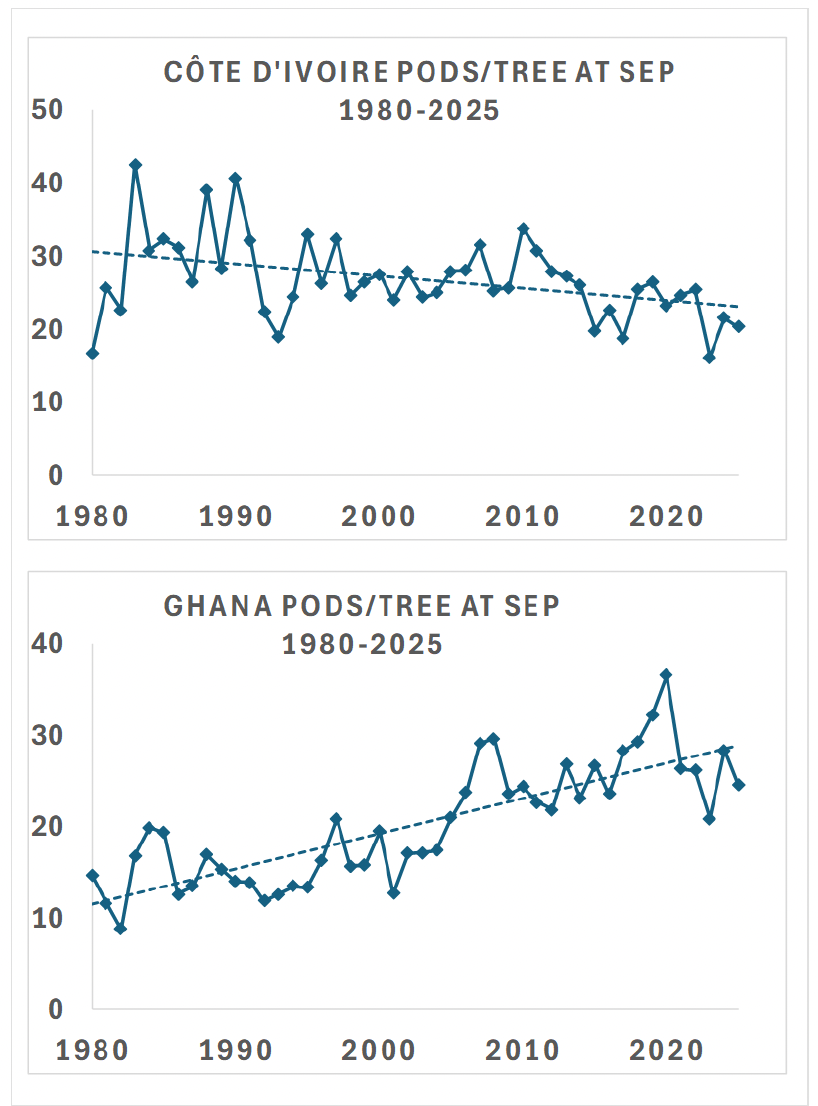
CRA’s charts take a broader view of each country over 45 years. The histories of Côte d’Ivoire and Ghana suggest there is still much to learn about improving cocoa yields.
- Read previous articles in the series here:
About CRA
CRA offers a specific collaboration to support innovation at the beginning of the supply chain: the cocoa farmer in West Africa. Veriground operates networks of weather stations in Côte d'Ivoire and Ghana that provide free local weather forecasts to farmers located near those stations, at a fraction of the cost compared with the potential return.