Part 1: History of the Crisis
Every person working in any cocoa-using industry knows the events of 2023–2025. Cocoa prices jumped from around £2,000 ($2,660) before these years to averages of £7,000, with daily prices sometimes approaching £11,000, then fell almost as quickly as they had risen.
The result has been steep increases in retail prices, shrinking package sizes, products disappearing from store shelves, firms disappearing or losing value, excitement followed by despair among cocoa farmers, anger at marketing boards, and questions about the actions of speculators.
Behind the story of these years, and relevant to it, is a longer story of worsening crises. Some of those crises occurred before the time of today's living market participants.
This is that history.
There were disputes in the 1930s between the UK confectionery industry and agents in Ghana who collected and exported cocoa beans. The conflict led to the creation of an organisation in Ghana that today is the Ghana Cocoa Marketing Board, Cocobod.
In the 1960s, one huge crop and low prices, followed a few years later by excessive taxation of cocoa farmers, led to a collapse in Ghana's crop.
In the 1970s, there was a crisis not entirely different from that of 2023–2025. The declining crop in Ghana, strong consumption growth, weather-related losses, and the economic chaos of the 1970s brought about a bull market. That bull market reached its peak in 1977, then fell for four years to a bottom in mid-1981.
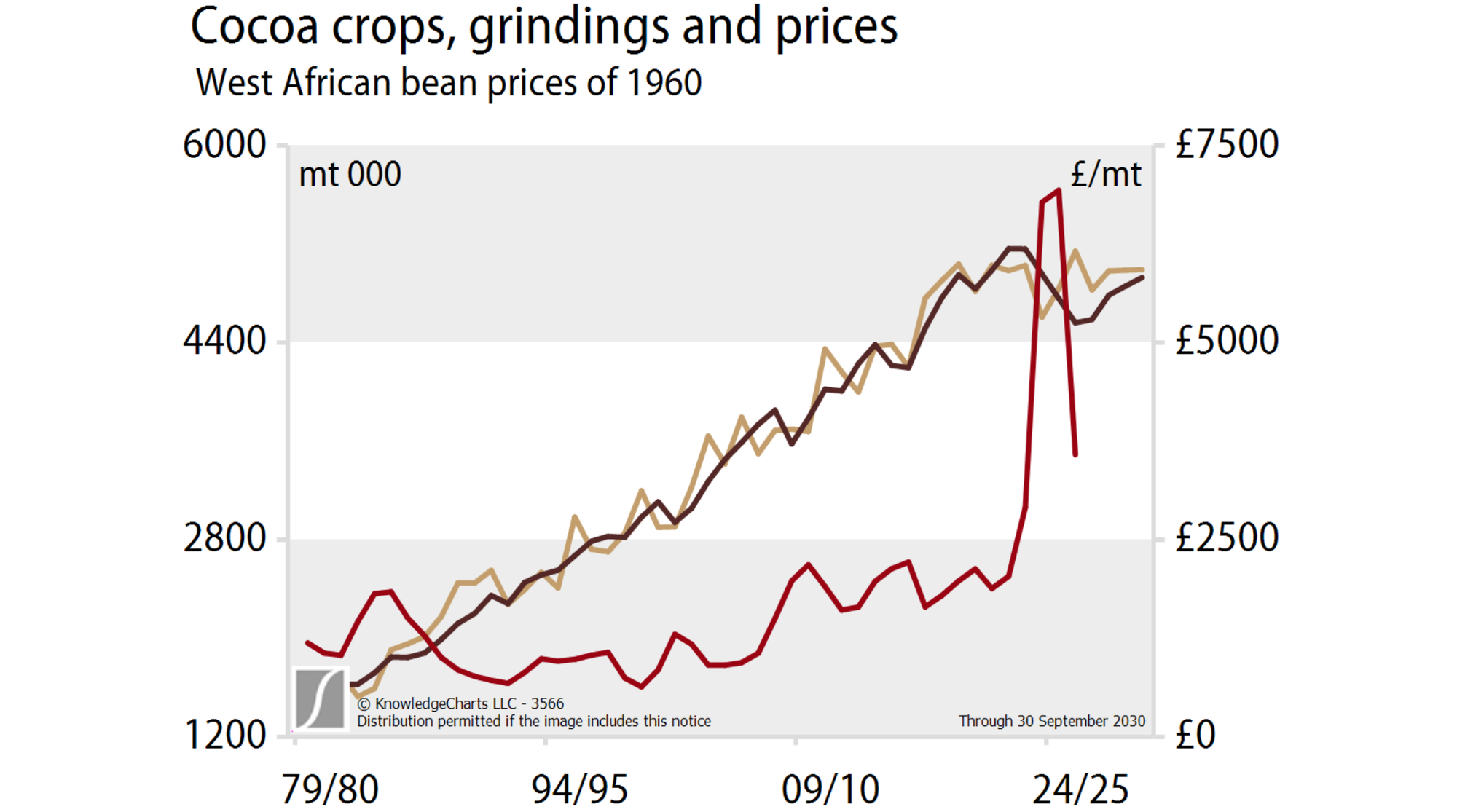
As prices fell, the governments of producing countries persuaded some consuming countries to join them in organizing the International Cocoa Organization (ICCO), with a provision for accumulating a buffer stock to support prices and farm incomes. Calls for improving the incomes of indigenous farmers, including cocoa farmers, also were beginning.
However, within a few years, the buffer stock was overwhelmed by general stocks that accumulated to levels never anticipated. By 1991, end-of-season worldwide stocks stood at 1,765 tmt, equivalent to 75% of a year's grindings.
In the late 1990s, the World Bank, IMF, and other institutions proposed a different solution to the problem of low farm incomes. They argued that Côte d'Ivoire and Ghana could improve farm incomes by closing their marketing boards and allowing free markets.
Côte d'Ivoire closed its Caisse de Stabilisation and allowed exporters to compete in buying from farmers. Ghana resisted and kept Cocobod in place, except that private firms were permitted to compete with Cocobod's Produce Buying Company (PBC) in collecting cocoa from farmers. Côte d'Ivoire reintroduced a marketing board in 2011, Le Conseil du Café-Cacao.
A sequence of public relations crises began in the early 2000s. Calls to increase cocoa farmer incomes reached the news media and public awareness. The first lawsuit regarding child labour was filed around 2005. More lawsuits concerning child labour and slavery have followed from time to time. These have involved years of litigation and generated negative press coverage for the industry.
The first investigations into deforestation in cocoa-growing areas appeared around 2017. As market participants know, these have expanded to become a common topic in the public media as well as in industry discussions, reports, and conferences.
Less visible, but today very important, stocks declined relative to demand after 1991. Although total stock tonnage remained roughly stable from 1992 until 2022, stocks declined as a percentage of annual grindings from 75% in 1992 to 41% in 2018. Consumption had been outpacing production for 30 years. After 2018, stock tonnage also fell while consumption continued to rise.
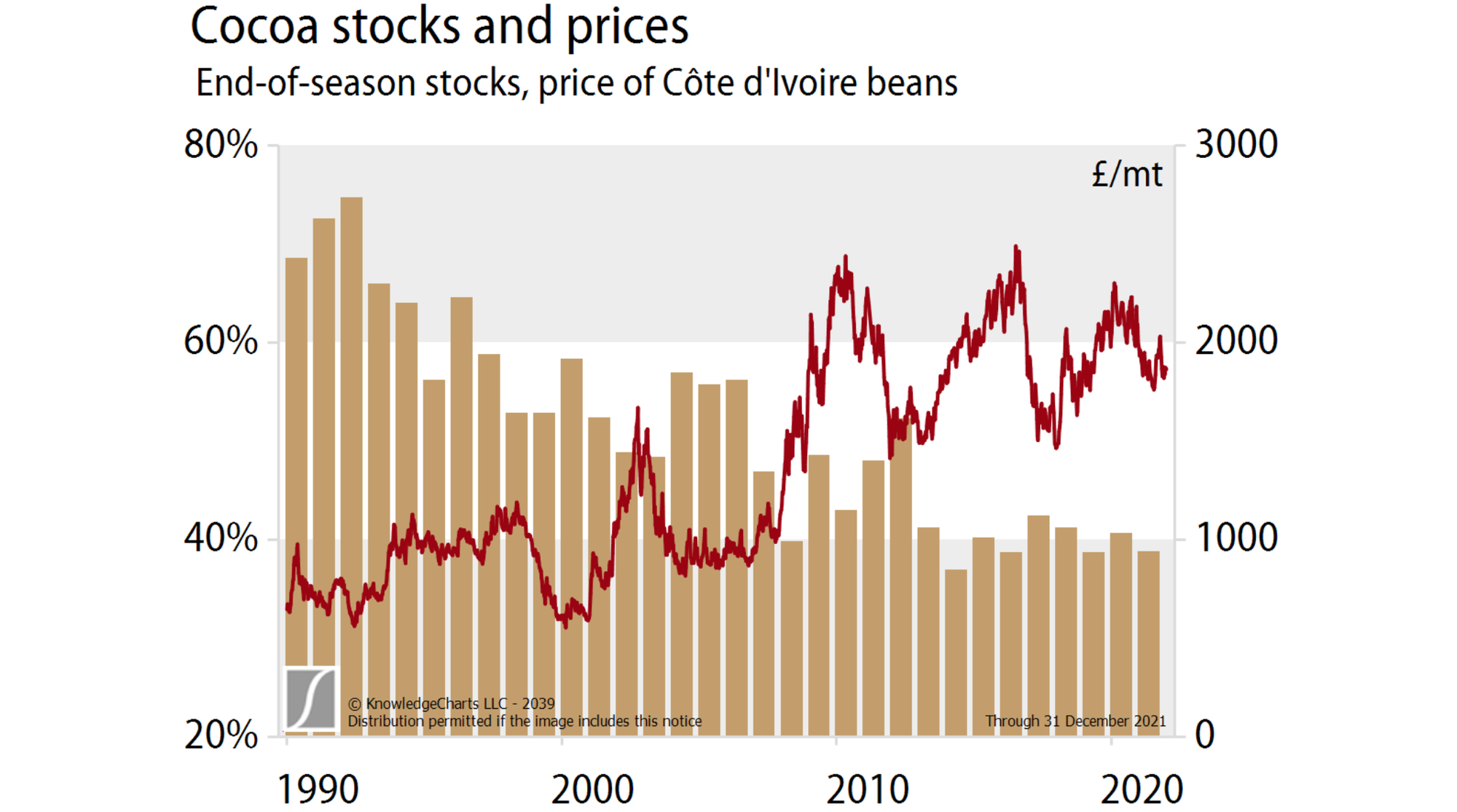
Four cycles of rising then falling prices happened between 2000 and 2022. The cycles reached peaks of £1670 in October 2002 for Côte d’Ivoire beans CIF Europe six months forward, £2440 in April 2010, £2490 in February 2016, and £2305 during February 2020.
Stocks relative to grindings declined during this period from around 49% to 40%. Global weather, specifically a very strong El Niño in 2015-2016, was probably a contributing factor. (A very strong El Niño occurred during 2015–16. It probably contributed to the third bull market cycle. The 2015/16 crops of Côte d'Ivoire, Ghana, and Ecuador were 425 tmt (14%) lower than surrounding years. Global weather probably was not a significant factor in the other years. NOAA reported neither La Niña nor El Niño before the 2002 peak, although crops declined by 13%. NOAA reported a weak La Niña during 2008–09 before the 2009 peak, when crops declined by 10%. NOAA reported a weak El Niño during 2018–19 before the 2020 peak. The 2018/19 crop rose by 9%, while the 2019/20 crop declined by 3% compared with surrounding years.)
The decline of prices during 2016/17 following the third bull market, together with the long history of marketing boards seeking higher prices for impoverished farmers, merged into the efforts of Côte d'Ivoire and Ghana to introduce the Living Income Differential (LID) on exports beginning with the 2020/21 season.
Conflict with the cocoa-using industry followed. The industry agreed publicly while resisting privately. The rise in prices in early 2020 to £2,304 occurred partly because the LID increased differentials in the world market. That rally ended as the COVID-19 pandemic began.
Although the LID continues in name, any meaningful effect on farm incomes ended soon after it came into force.
The fifth bull market began in late 2022, continued through 2023, and reached peaks in 2024 of just under £10,000 and $12,200 (second distant).
A major reason for the extreme price movement was that market participants concluded that the crops of Côte d'Ivoire and Ghana were in long-term decline. Those crops probably peaked in 2019/20.
Speculators – including those from the cocoa trade and cocoa processing industry – accelerated the rise.
The results of the fifth cycle over the past 20-plus years have included a 9% decline in worldwide cocoa consumption in all forms, a race to replace chocolate confectionery with sugar confectionery, and a race to find substitutes for cocoa beans and cocoa products.
Companies that once specialised in bringing chocolate to consumers are not only diversifying into other snack foods – for reasons beyond cocoa prices – but are also reducing their reliance on cocoa alone.
- This is the first article in a four-part series: Part 2 summarises the history of cocoa yields in West Africa; Part 3 examines the history of sustainability programs and critiques of them; Part 4 sets out CRA's Veriground proposal.
- Download the PDF for more information on this topic:
Correction: An earlier version stated that the LID applied to crops starting with the 21/22 harvest. This was incorrect. It applied to crops starting 20/21. Some numbers from the history of price cycles during 2000-2022 did not match the accompanying chart. These have been corrected without changing the substance of the discussion.
About CRA
CRA offers a specific collaboration to support innovation at the beginning of the supply chain: the cocoa farmer in West Africa. Veriground operates networks of weather stations in Côte d'Ivoire and Ghana that provide free local weather forecasts to farmers located near those stations, at a fraction of the cost compared with the potential return.