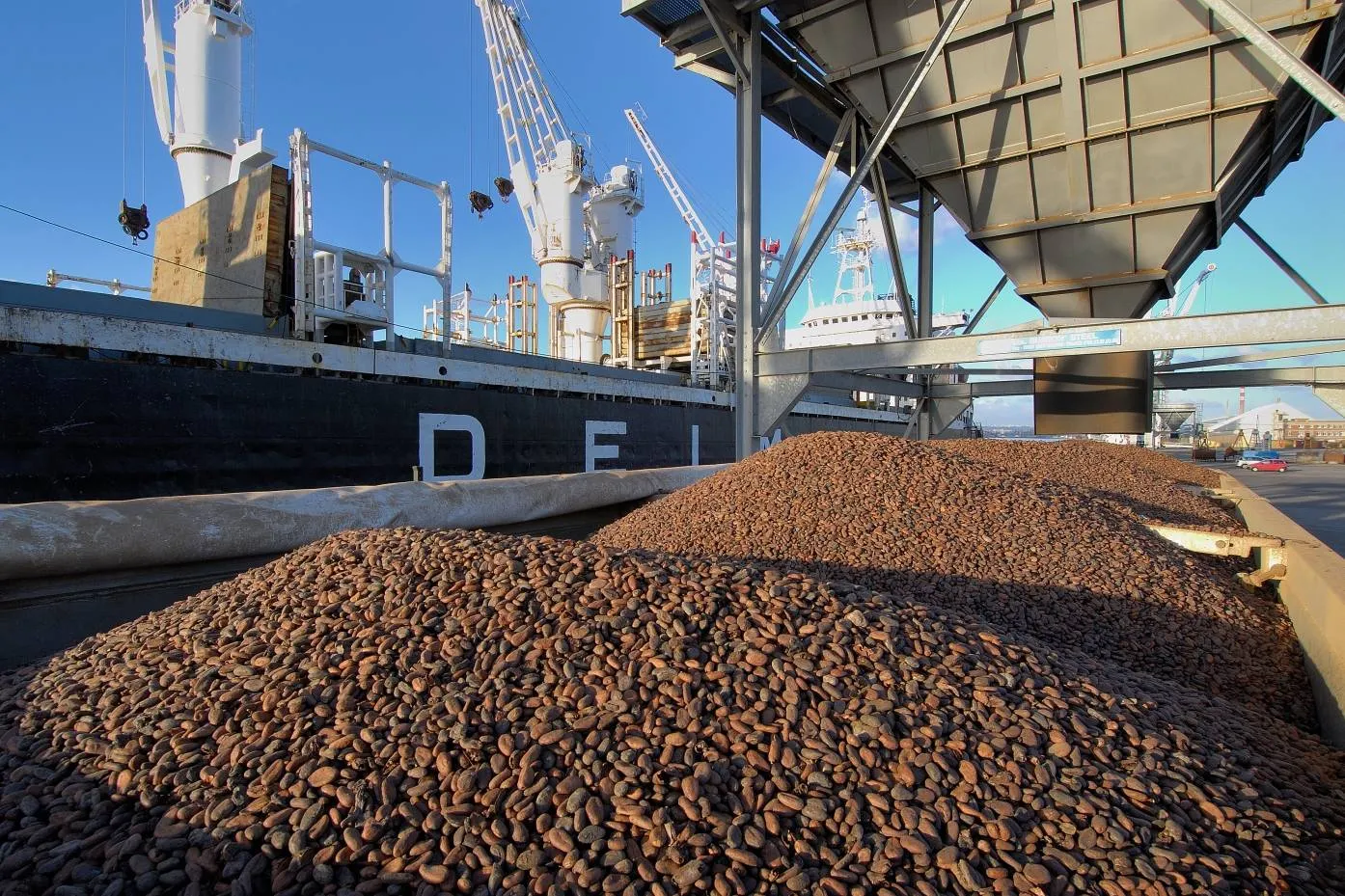
Ask random people on the street in Amsterdam whether they believe their city has the largest cocoa port in the world, and nine out of 10 look at you like you're crazy. Most locals have no idea about the city's role in the cocoa and chocolate sector. I understand why: importing beans and pressing them into semi-finished cocoa is the least glamorous part of the chocolate story.
It is Dutch Week here at CocoaRadar, so a perfect moment to shine a light on exactly that unsexy middle part of the business.
To kick off, I revisited an article I wrote for the World Cocoa Foundation in 2018 about why this city became so important to cocoa historically and how it evolved.
In my WCF article, I mentioned how grinding in origin countries would grow and change Amsterdam Cocoa's role. But that was 2018, and now it is 2026. Eight years, and it seems like a different world considering all the events that have hit the industry since: Covid lockdowns, a freight crisis, a war in Ukraine, climate disruptions that led to poor harvests and then to huge price spikes, EUDR and its delays. The list goes on. If each one on its own pushed up the price of a chocolate bar, imagine what they do combined!
Advertisement

With everything getting so complex and expensive, you would think it must finally make more sense to process the cocoa closer to where it grows. Right?
Well, one thing I have learned in cocoa is that nothing is as simple as it seems.
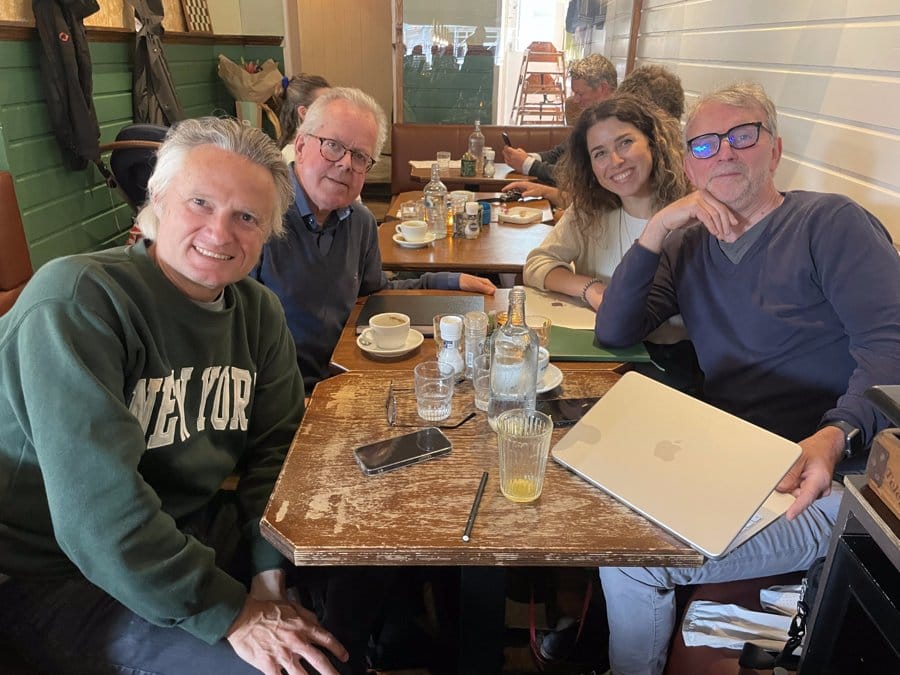
So instead of asking Claude (the AI) to analyse the data, I went one better and went to the source. I called two cocoa friends to meet me for coffee at a typical café on Amsterdam's east side to talk about how all this affects the city's cocoa sector now and in the future.
Cocoa Talk Over Coffee
Bart Verzaal has traded cocoa for 41 years. He started at a broker's desk in Amsterdam, then went to the butter trade in Zaandam, and finally at Barry Callebaut in Switzerland for the last decade. He is retired now, but he still enthusiastically writes a daily cocoa newsletter for the cocoa industry. Bart speaks in trade jargon all the time, with statements like “they'll have to buy their shorts back,” integrated into his common language, though, truth be told, I am only now starting to decode his terminology.
Then there is Martijn Bron, a household name in the cocoa industry. Martijn traded at Cargill for 26 years, 16 of them in cocoa, running its global cocoa trading desk. He now explains how the trade actually works in sharp podcasts, articles, and posts that attract a steady stream of students and young people to the business. Add his adventurous stories from cocoa trips and the trade desk, a sauce of dry Dutch humour, and you understand the appeal to his 53k+ followers on LinkedIn.
How Much Flows Through Amsterdam, And Why?
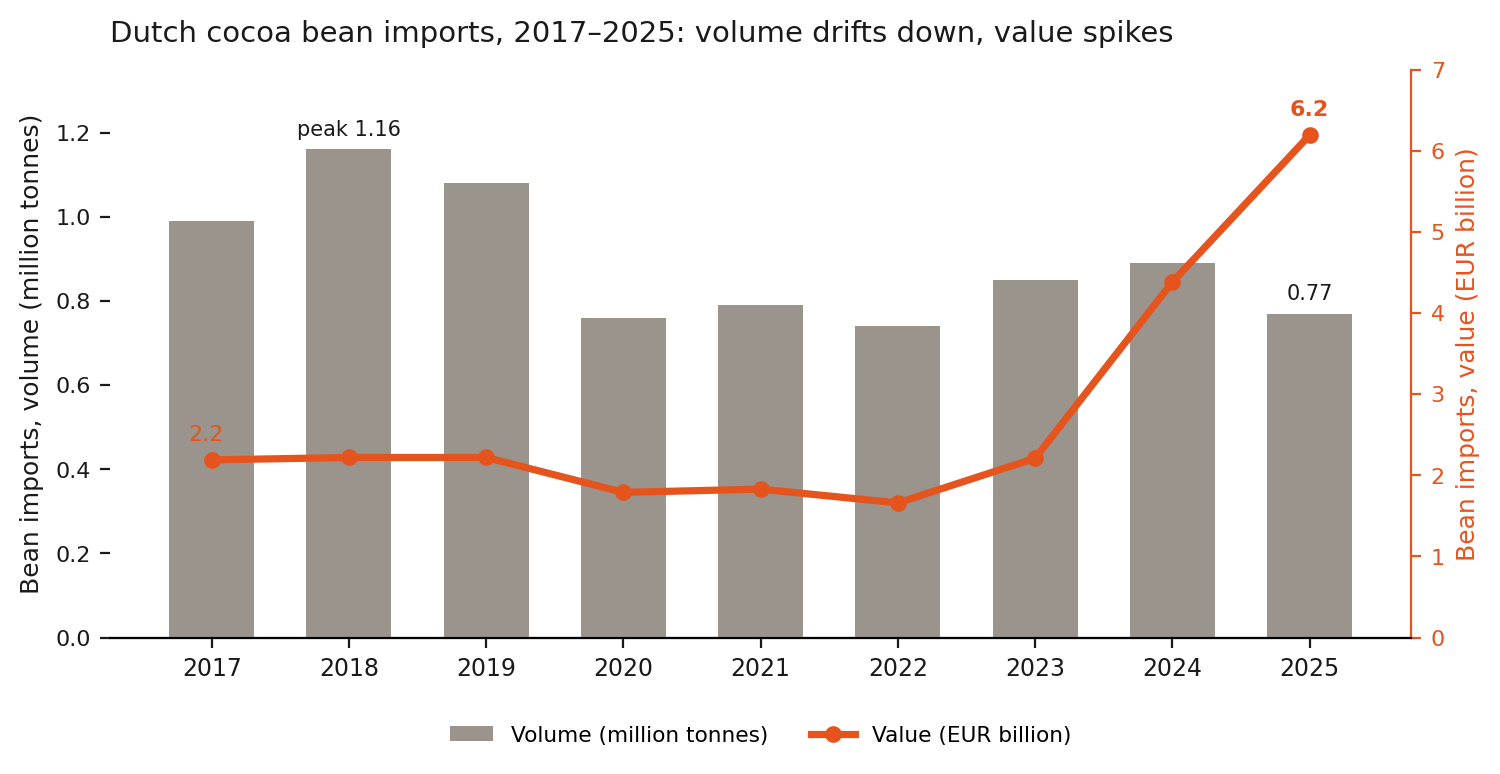
The number you always read online in answer to this question is between 600,000 and 800,000 tonnes a year. The number seems static, as if it has not moved in years. The latest hard figure is more specific: approximately 774,000 tonnes of cocoa beans came into the Netherlands in 2025 (Eurostat).
A decade ago, it was around a million tonnes, with a peak near 1.16 million in 2018. Over 10 years, the trend has drifted down but not collapsed. Interestingly and understandable, while the volume shrank, the value in euros tripled, which has everything to do with high cocoa prices.
The Netherlands is now both the world's largest importer of beans ánd the largest exporter of cocoa products. The port frames its own claim plainly: about 655,000 m² of storage, room for more than a million tonnes of cocoa, and the whole chain of storage, trade and processing clustered in one place (Port of Amsterdam). For the Dutch economy, it is no small thing either, roughly 17,000 jobs across 96 companies and 1.8 billion euros in added value (Erasmus, 2024).
When we say Amsterdam, it is a tad shorthand. The warehouses and trading offices are in the city, but the grinding, turning beans into mass, butter and powder, happens across the water in the Zaanstreek. Around it sits a close-knit cluster of companies: the big traders (Olam, Cargill, ECOM), speciality houses like Daarnhouwer and JS Cocoa, machine builders like Duyvis Wiener (recently taken over by Probat), and the warehouses, logistics firms and banks that keep it all running.
A Brave New World
None of it appeared overnight or coincidentally. Amsterdam started as a small port and was successful largely due to its strategic position relative to other foreign ports. The first cocoa arrived in the 1600s, when ships brought the beans back from the New World. Once the canals were dug, precious cargo like coffee and tobacco (cocoa much later) was unloaded from the canals straight into the warehouses along the water.
That is how great fortunes were made, and the city grew bigger around the port. If you pay attention when you walk in Amsterdam’s old centre, you can still see it on the stone tablets above some of those old houses. The area was packed with windmills, and conveniently, their power was used to crush and grind the beans, which is part of why the processing settled there and never left.
Then, in 1828, a father and son named Van Houten built the cocoa press and worked out alkalisation, the treatment that softens the bitterness and darkens the colour, still called Dutching. It made cheap cocoa possible for the masses.
Bart remembers that when he started trading in 1985, the region still had around 200 cocoa companies. Most have been swallowed by a handful of giants since: Cargill, which took over Gerkens; Olam, which absorbed Cacao de Zaan; and Barry Callebaut, with its grinding just across the border in Belgium.
What About Local Processing in Origin Countries?
Origin countries want more processing done locally, and this desire is amplified in every political campaign in every cocoa-growing country, especially around elections. It makes total sense: grind where the beans grow and keep more of the value, jobs, and margins. It is also better for the climate and for costs, because of fewer logistics.
And when a local company does it well, consistently, it is huge for a country. Ecuador is big in agricultural production but not relevant in manufacturing. Now it has Ecuakao, set up in 2018, which I visited in 2025. They take in around 300 tonnes of beans a day, roughly 100,000 tonnes a year, close to a fifth of Ecuador's cocoa crop, pressing them into liquor, butter and powder and selling straight to large brands in the USA and Asia, without middlemen.
When a local company grinds at home, it is a different story from when a multinational like Cargill grinds in Côte d'Ivoire: the jobs may be local, but the profits still leave the country.
What The Data Says
So is Amsterdam losing its place? It depends on whether you look at incoming euros or at volumes. In 2025 the Netherlands imported about 11.4 billion euro of cocoa and exported 13.3 billion, a record. But the volume tells another story: over the past decade, bean imports drifted down to 0.77 million tonnes in 2025, from around a million a decade ago and a 1.16-million peak in 2018. Less cocoa, much higher prices. And most of that turnover is simply the imported bean passing through. The country itself earns about 3 billion euros from it (CBS, 2025), the value of the grinding and the trade, which is significant for the Dutch economy.
The Netherlands just surpassed Germany as the world's largest cocoa-products exporter, ahead of Côte d'Ivoire and Belgium. But it is a crown by value, riding the high price of butter and powder, not by volume. Germany still makes far more finished chocolate, with the brands and the margins. About three-quarters of what the Netherlands exports is semi-finished cocoa: mass, butter and powder. The Dutch grind and supply the ingredients; others make the chocolate.
Two other things can be seen. First, the port forwards fewer raw beans and grinds more of them itself: re-export of unprocessed beans is down about 45% since 2018, so Amsterdam is moving from a transit harbour toward a processing cluster, with Antwerp and Hamburg competing on the pure logistics. Second, the beans come from new places. In 2024, by value, Ghana, long a favourite, was down to 5% of Dutch bean imports, from about 12% in 2017, while Nigeria (18%), Cameroon (17%) and Ecuador (7%) filled the gap. Taken as a 10-year average those newer origins sit lower (around 14, 17 and 3%, per IDH/DISCO), so it is the recent years that show the move. A large part of Ecuador’s crop goes to Asian grinders rather than to Amsterdam.
Strip away the price spike, and the picture is clear. In euros, Amsterdam looks bigger than ever; in real cocoa, it is shrinking a bit, and origin is starting to grind its own. These shifts are real and have started already some time back.
Why Amsterdam Stays Top, For Now
Still, the traders expect Amsterdam to stay on top for years. Four reasons.
- Smooth operations. A grinding production line must run around the clock to be profitable, which requires reliable power, skilled and experienced personnel, and substantial working capital. In many origin countries the power simply cuts out and the line stops. There is also the butter-and-powder balance every grinder has to get right, or you join what the trade calls the 'cocoa graveyard'.
- Blending. A chocolate is a blend of beans from different origins, usually mostly Côte d'Ivoire and Ghana, with a bit of Ecuador. But you cannot easily move beans between origin countries the way they flow into Amsterdam, so a grinder in Lagos cannot just bring in Ecuadorian beans to balance a recipe. In the Zaanstreek you can, and the blending ideally happens already in the warehouse.
- Food safety and trust. A buyer like Mondelēz International or Nestlé builds its brand on the promise of product consistency and safety. Besides the costs, a food-safety scandal is enormous reputational damage - as Ferrero and Barry Callebaut both learned. They will not move that risk to a new country lightly. And EUDR cuts both ways here too: it makes importing beans more expensive, but the strong EU's food-safety rules (PAH, microbiology) are exactly what origin often cannot meet, yet, as producing there is seen as riskier. And risk is exactly the word any brand wants to avoid, and traders want to control.
- Cost. Beans enter Europe duty-free from everywhere; the duty only bites on processed cocoa, and only for some origins. From the big African origins with an EU trade deal (Côte d'Ivoire, Ghana, Cameroon) even butter and powder come in at zero. But from a country without a deal it climbs at every step: for Nigeria 6.1% on mass, 4.2% on butter, 2.8% on powder; for Malaysia, Brazil or the US the full rate of 9.6, 7.7 and 8%, with chocolate higher again once the sugar duty is added. So the cheaper labour at origin can get eaten by the tariff, depending on where the beans are from. That escalation has protected European grinding for decades, and it still does.
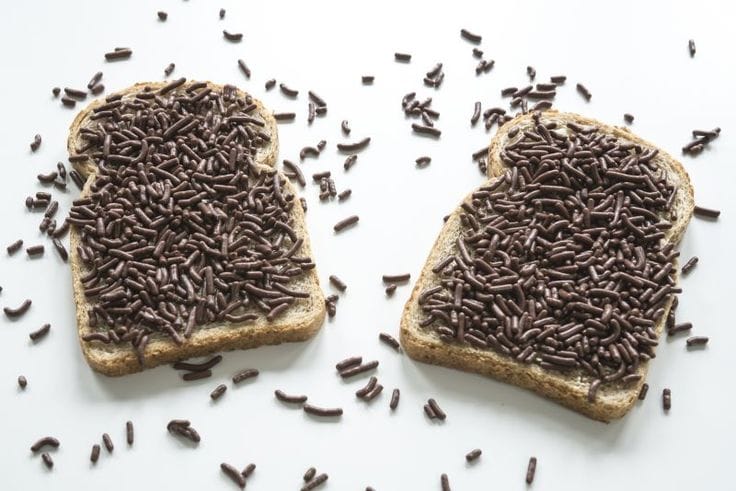
Since it is Dutch Week here at CocoaRadar, and everyone in the Netherlands grows up with Hagelslag (chocolate sprinkles), let’s use it as a quick example. The recipe: roughly half sugar, a quarter lean cocoa powder, and the rest cocoa butter. To see what the duties do, I follow one 390-gram pack along three routes to the shelf: (a) beans shipped in and ground here (as it happens now); (b) semi-finished cocoa ground abroad and finished here; or (c) the pack made entirely at origin and imported finished. Here is how the cost stacks up in each case, with the shelf price at the end (green box).
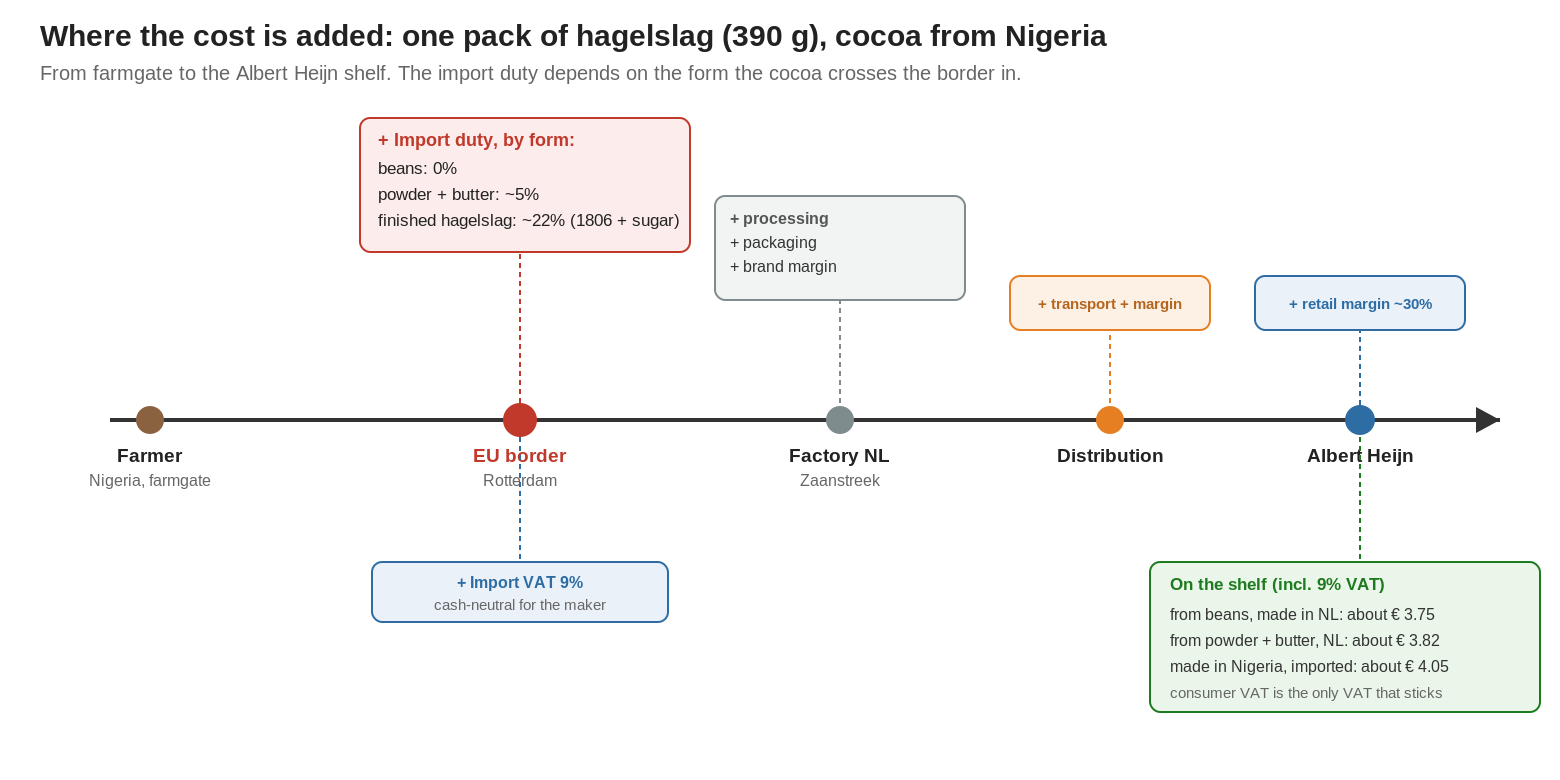
The duty climbs with every step, so the pack made abroad ends up the most expensive, even with cheaper labour. That is the point: where a product is made and where it goes determines the duty; the duty influences the shelf price; and price, for a large part, decides what sells and what does not, because most shoppers count their cents.
The Future of Amsterdam Cocoa
Put together, the direction is much clearer now. Amsterdam remains the largest cocoa port, but the balance keeps tipping: more grinding and ingredients, less raw-bean transit. There is more grinding in origin, but it’s not a fast transformation. Before it really shifts, origin must first solve many difficult problems. It is also not an either-or matter, because cocoa production is growing, and so is demand in new consuming countries, especially in Asia.
So, Amsterdam Cocoa can rest assured. The ships keep arriving in the port, the warehouses keep being stacked, the presses run around the clock – and the wheels of the industry are just too strong to stop anytime soon.
Will it still be so in 20 years? Who knows. In cocoa, nothing is as simple as it seems. So ask me again after the next crisis.
A big thank you to Bart and Martijn for sharing their knowledge, and to the Port of Amsterdam for sharing their figures.
Want to use (parts of) this article? Great. Please cite as: Marika van Santvoort, ‘Moving Cocoa: The Future of Amsterdam Cocoa’, CocoaRadar (2026).
Sources
1. Trade and origin figures: Eurostat Comext (DS-045409) and CBS, 2025; sector context from IDH and DISCO, June 2025.
2. Duties: EU Access2Markets and the ECA cocoa tariff table.
3. Grinding shift to origin: CocoaIntel and ADM; ISS and USDA FAS on Côte d'Ivoire.
My 2018 WCF article and the full import and grinding dataset are available on request, just send me an email to marika@movingcocoa.com.

Marika van Santvoort has been working in cocoa & chocolate since 2014, with a focus on responsible sourcing, innovation and farmer impact. In this monthly column she shares her own perspective on what is really moving in the sector; what is being said, what is not, why it matters and what it means for the industry. |