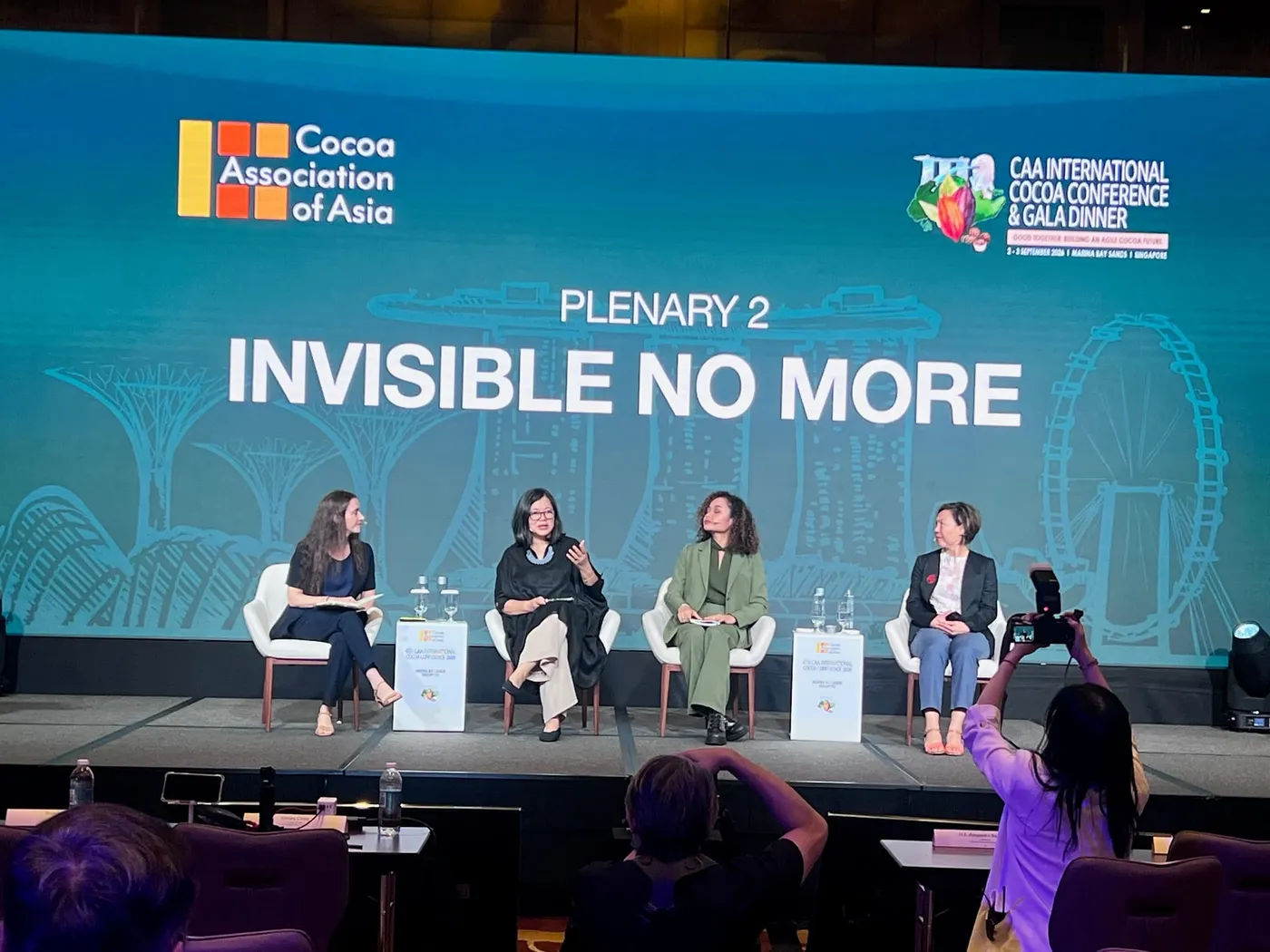
Women and younger people must be given greater influence over cocoa-sector decisions if farming communities and supply chains are to become more resilient, speakers told the CAA International Cocoa Conference in Singapore.
The ‘Invisible No More’ discussion followed a presentation on the second edition of the International Farmers Network Forum. It was moderated by Selene Scotton, Group Cocoa Sustainability Manager at Puratos.
Advertisement

Panellists were Fay Fay Choo, Asia director for cocoa sustainable sourcing at Mars; Cheok Mei-Ing, director of partnerships development for supply chains at Save the Children Federation; and Louise Mabulo, founder of The Cacao Project in the Philippines.
Representation Gaps
Figures presented by Scotton highlighted significant demographic gaps across the cocoa supply chain in 10 countries.
Women made up only 10% of registered farmers, limiting their influence within the sector and affecting power dynamics and access to land ownership.
Around 40% of registered farmers were under 44. In Asia, however, the proportion fell to between 18% and 20%, underlining the challenge of attracting and retaining a new generation of cocoa producers.
The forum was created to give women and younger farmers - groups often excluded from industry discussions - a platform to identify challenges and develop their own solutions.
Using design-thinking and mind-mapping exercises, participants explored knowledge-sharing, agricultural service networks and income opportunities beyond cocoa beans, including ecotourism and cocoa by-products.
Five business proposals emerged: Digital Crop Protection, focused on agricultural technology; Eakar Eco-Village, an ecotourism concept; Cocoa Life Academy, a six-month knowledge-sharing programme; Root Care, a regenerative soil initiative; and Farm Match, a platform connecting farmers with service providers.
The winning team will receive sponsorship to attend the Mars Cocoa Academy in Indonesia.
A mentorship scheme started at Chocoa in Amsterdam was also recognised for organising a programme through the Women in Cocoa & Chocolate Network.
From Labour to Leadership
During the panel discussion, Choo said corporations needed to direct more attention towards women and younger people to improve the adoption of agricultural innovations and strengthen supply stability.
She said Asia had shifted from being a cocoa-bean producer to a net importer despite investment in agricultural technology. Women and youth could help reverse declining engagement with the crop by serving as village-based change agents, she added, pointing to younger people’s energy and concern about climate change.
Cheok identified structural barriers preventing both groups from taking on more influential roles. These included limited access to finance, assets and commercial networks, as well as social norms restricting women’s mobility.
Young people, she said, were also frequently treated as a source of manual labour rather than being included as strategic decision-makers.
Measuring Regeneration and Resilience
The panel argued that conventional measures such as productivity and crop volumes were not sufficient on their own to assess whether cocoa supply chains were becoming more sustainable.
Future indicators should track whether younger people are moving into skilled and higher-value roles, including nursery management, service provision and entrepreneurship.
Cheok also called for greater attention to household resilience, including communities’ ability to recover from floods, earthquakes and other shocks.
Mabulo said traditional knowledge and modern science could be combined to create more accessible agricultural innovations. Farm-focused generative AI and geospatial technologies, for example, could provide farmers with practical guidance in local languages.
She added that women were often among the first to adopt new agricultural methods, making their participation central to the successful introduction of technology.
Building Community-Owned Networks
The speakers favoured integrated, community-led approaches over standalone corporate or development programmes.
Cheok cited an example from Indonesia in which a community savings group successfully sought equipment to establish self-financed organic compost businesses using existing village facilities. The initiative demonstrated how partnerships between companies, non-governmental organisations and communities could become more sustainable when local leaders retained ownership.
Looking towards the next CAA Conference in two years, Choo proposed creating digital and offline networks through which farmers in countries and territories including Vietnam, Taiwan and the Philippines could exchange practical knowledge.
Such networks could support peer-to-peer learning on soil health, cover crops and other locally relevant farming practices, extending knowledge-sharing beyond a single conference.
The discussion linked the representation of women and younger people not only to equality, but also to the cocoa sector’s ability to regenerate its workforce, strengthen farming communities and maintain future supply.
More coverage from the CAA Conference:
cocoaradar.com is:
- Official Media Partner - CAA International Cocoa Conference
- 'From Our Desk. To Yours. Daily'
- Sign-up here for free and choose your plan.