Help That Industry Needs and African Farmers Want
Part 2: Yield and the Crisis
The lack of any significant improvement in the yield of cocoa trees, especially in the most successful area of cocoa cultivation, West Africa, ties together the crises of the past three decades.
A comparison with wheat illustrates this. Chocolate first entered the middle-class diet of Great Britain in the 1850s. At that time, producing one bushel of wheat required three man-hours of labour. Today, 175 years later, producing one bushel requires around two minutes of labour.
Large increases in yields have been achieved in probably every staple food crop for humans and animals: corn, soy, oilseeds, barley, oats, beans, nuts, sugar, potatoes, rice, sorghum, vegetables, fruits, alfalfa, and others.
In contrast, probably more than 80% of the world’s cocoa beans are cultivated in Africa and elsewhere by methods that have not changed significantly in 175 years.
The entire chocolate confectionery industry, with its technologically advanced factories, computerised management systems, and sophisticated marketing departments, depends for its main feedstock on a workforce of mostly impoverished, often uneducated and illiterate, often recently immigrated, and often discriminated-against farmers working by hand.
The total yield of cocoa trees in Côte d’Ivoire and Ghana probably reached its peak in 2019-20 and has been declining by about 75 tmt each year since. The declines in each country have been for different reasons. The following charts reveal important reasons.
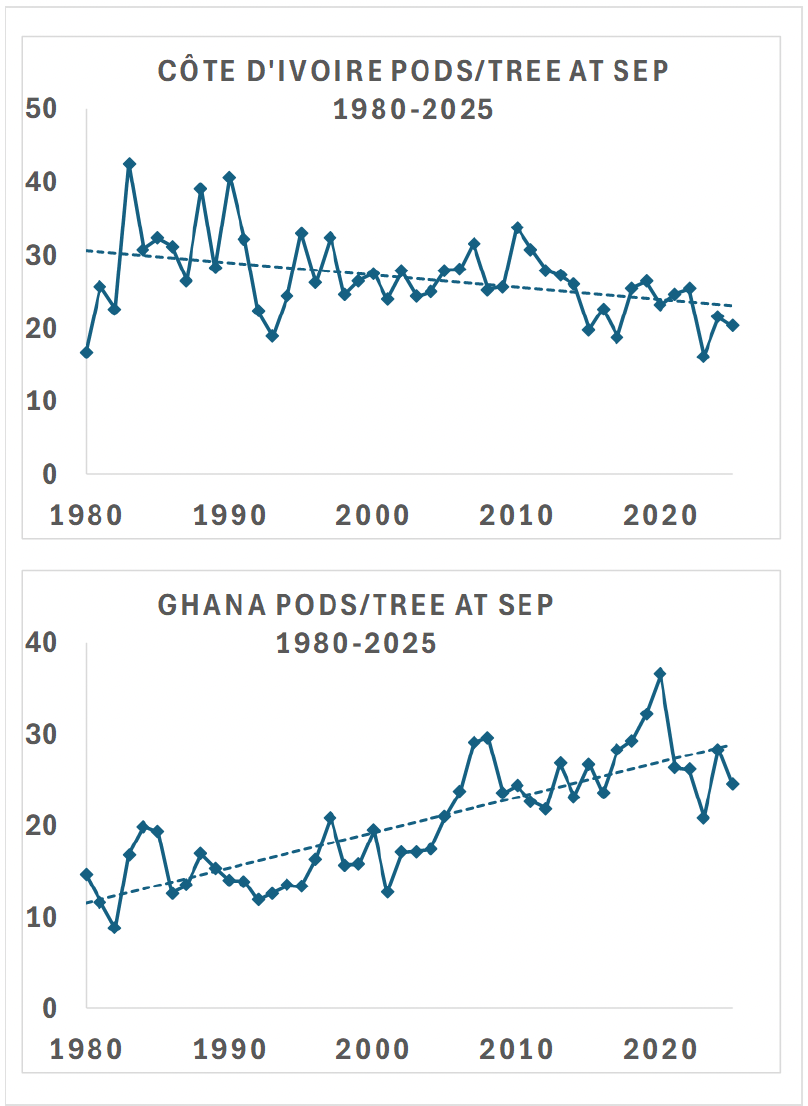
The charts above show the number of pods counted on each cocoa tree during September from 1980 to 2025 by teams working in Côte d’Ivoire and Ghana. They show the number of pods at the time the main-crop harvest was starting.
Although counted by different people and at gradually changing sites, the results should be comparable across years because the number of sites was always about 100, the number of trees 500–600, and the sites were distributed widely throughout each country.
A count during September is likely to be the most accurate of all counts made during a year because most pods are large enough to be seen. The total main-crop harvest will be close to the number of pods per tree found in September multiplied by the number of trees in the country.
The counts are therefore measures of the average main-crop yield per tree in each season.
The histories are very different.
- Côte d’Ivoire: Through the 1980s and early 1990s, the number of pods on trees in Côte d’Ivoire was stable at about 30. Then the number began to decline. It has continued to decline through 2025, and the decline may have accelerated in the last 10 years. In recent years, the average slipped to about 25 pods per tree.
- Ghana: The pod load on Ghana’s trees was also about stable in the 1980s, but very low, at around 14. It declined in the mid-1990s. Then it rose steadily and may have continued rising through 2024-25, despite the 2023-24 failure and weak 2024-25 season, when weather probably played a role. If the rise continues, it will reach the 30 pods per tree counted in Côte d’Ivoire 40 years ago.The long-term rise in Ghana has been about three times as rapid as the long-term decline in Côte d’Ivoire. For every one pod that disappeared in Côte d’Ivoire across seasons, three pods appeared in Ghana.
The difference almost certainly reflects structural differences between Côte d’Ivoire and Ghana.
- Côte d’Ivoire: Except for controlling prices and sales, Côte d’Ivoire never closely regulated its cocoa industry. Until a few years ago, it allowed farmers to migrate freely into native forests. The expansion of its crop depended on immigration from the Sahel of people without experience in cultivating cocoa.Côte d’Ivoire did not subsidise fertiliser or agrochemicals or make significant efforts to promote their use. It operated limited extension services for cocoa. There was some research and general agricultural support under organisations called SATMACI (cocoa and coffee) and, since the 1990s, ANADER (all agriculture).Trees aged; farmers aged. Swollen Shoot invaded from Ghana, if it was not already present, and recognition of its presence came only in about 2015.
- Ghana: Besides controlling prices and sales, Ghana has been continuously involved, through Cocobod, in every phase of cocoa cultivation. It has subsidised fertiliser and agrochemicals, sometimes 100%, and has almost always been involved in importing and distributing them.It has maintained a large extension division – CHED (Cocoa Health and Extension Division) – or predecessors with comparable responsibilities, distributed equipment for spraying, pruning, and weeding, and hired teams for these tasks.Cocobod’s CRIG, the Cocoa Research Institute of Ghana, dates from 1938. Swollen Shoot was recognised in Ghana during the 1930s. Programmess to combat it started in the 1950s. These usually consisted of cutting out diseased trees, paying farmers for their losses, and replanting.Campaigns against Swollen Shoot have taken place every few years. Replanting often has been with new cultivars. These would have improved the tree stock and reduced its average age. Cocoa has been part of the culture and continues to be very important within it, for example through competitions for the best cocoa farmer.
Critics of Cocobod often complain about its inefficiency, mismanagement, and corruption. The complaints have merit. At every election, Cocobod can be a tool for winning the farm vote. Factories that Cocobod finances are perennial money losers.
Despite these real problems, the charts of yield per tree show that the existence of Cocobod and the cultural commitment to cocoa have accomplished something that Côte d’Ivoire has not.
Ghana’s crop has declined because farmers switched to other crops or sold their land for galamsey (gold prospecting). The total land area planted with cocoa declined.
In Côte d’Ivoire, the crop increased because farmers migrated to the forests. The area planted to cocoa expanded so fast that the decline in yields was hidden by the rising tonnes of arrivals at port.
- Download:
Read the first article in the series here:
 Jasper Jemmett
About CRA
CRA offers a specific collaboration to support innovation at the beginning of the supply chain: the cocoa farmer in West Africa. Veriground operates networks of weather stations in Côte d'Ivoire and Ghana that provide free local weather forecasts to farmers located near those stations, at a fraction of the cost compared with the potential return.